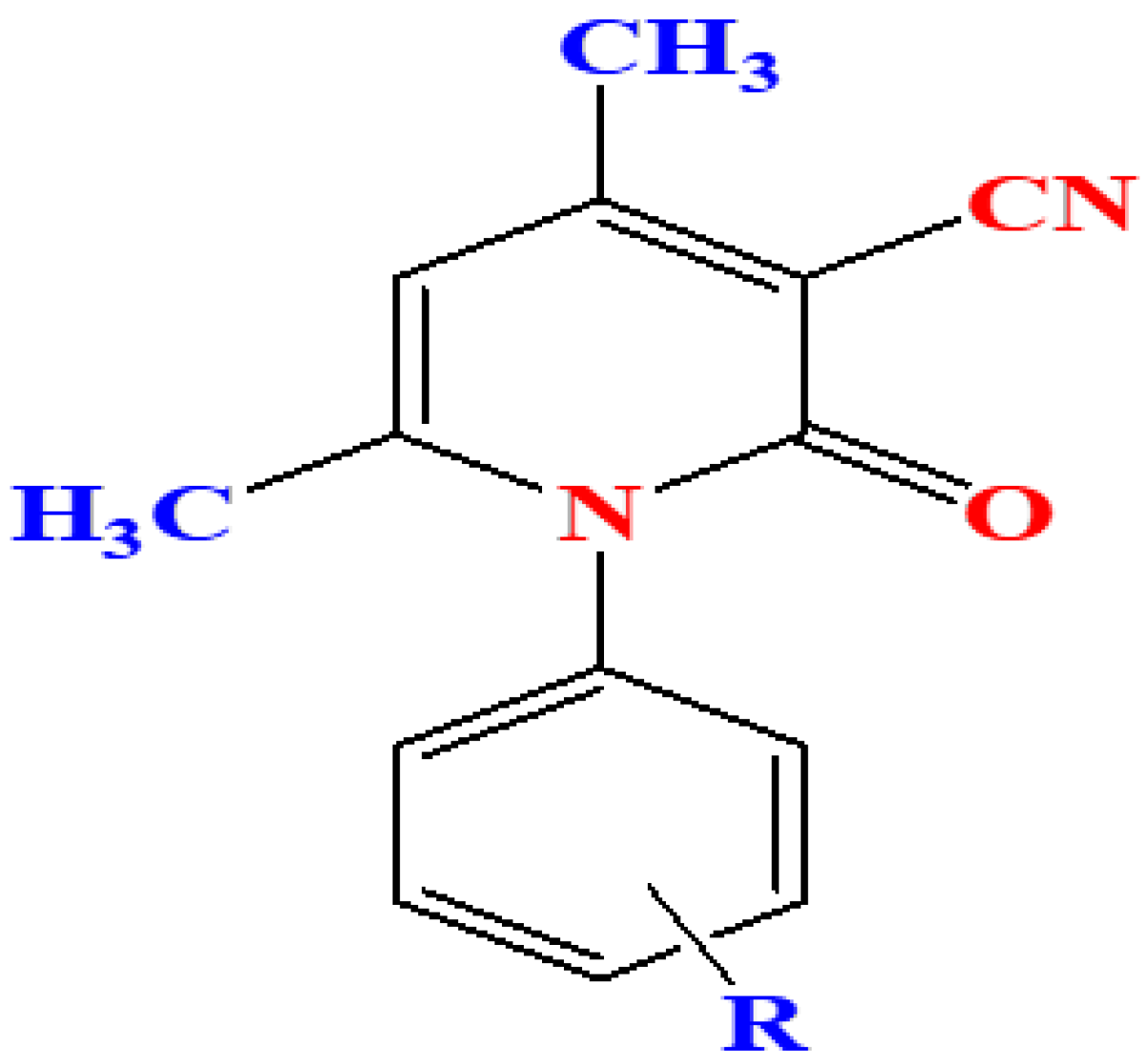

Synthesis and Characterization of New 3-Cyano-2-Pyridone Derivatives as Fluorescent Scaffolds †

 and
and
Abstract
:1. Introduction
2. Results and Discussion
2.1. Synthesis of N-Alkylated-2-cyanoacetamide Derivatives
2.2. Synthesis of 3-Cyano-2-pyridone Derivatives
3. Experimental Procedures
3.1. General Synthesis of N-Alkylated-2-cyanoacetamide Derivatives 3a–d
3.2. General Synthesis of 3-Cyano-2-pyridone Derivatives 5a–d
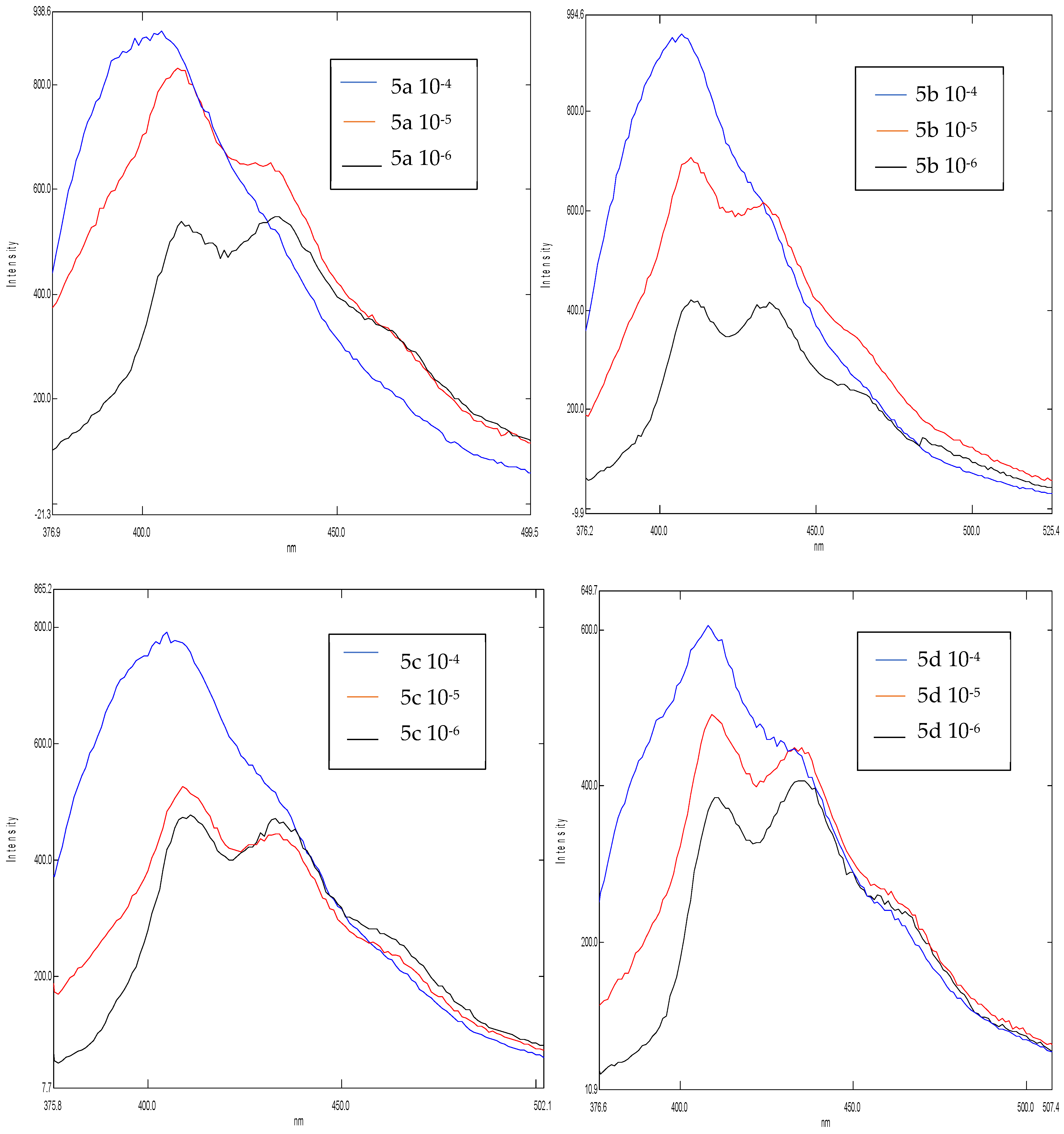
4. Fluorescence Studies of Our 3-Cyano-2-pyridone Derivatives
5. Conclusions
Author Contributions
Funding
Institutional Review Board Statement
Informed Consent Statement
Data Availability Statement
Conflicts of Interest
References
- Bhattacherjee, D.; Zyryanov, G.V.; Das, P. Recent advances in the synthetic approaches to 2-pyridones (microreview). Chem. Heterocycl. Compd. 2020, 56, 1152–1154. [Google Scholar] [CrossRef]
- Kabir, E.; Uzzaman, M. A review on biological and medicinal impact of heterocyclic compounds. Results Chem. 2022, 4, 100606. [Google Scholar] [CrossRef]
- Amer, M.M.; Aziz, M.A.; Shehab, W.S.; Abdellattif, M.H.; Mouneir, S.M. Recent advances in chemistry and pharmacological aspects of 2-pyridone scaffolds. J. Saudi Chem. Soc. 2021, 25, 101259. [Google Scholar] [CrossRef]
- Bayat, M.; Nasri, S.; Notash, B. Synthesis of new 3-cyanoacetamide pyrrole and 3-acetonitrile pyrrole derivatives. Tetrahedron 2017, 73, 1522–1527. [Google Scholar] [CrossRef]
- Majumdar, P.; Pati, A.; Patra, M.; Behera, R.K.; Behera, A.K. Acid hydrazides, potent reagents for synthesis of oxygen-, nitrogen-, and/or sulfur-containing heterocyclic rings. Chem. Rev. 2014, 114, 2942–2977. [Google Scholar] [CrossRef] [PubMed]
- Kumari, S.; Kishore, D.; Paliwal, S.; Chauhan, R.; Dwivedi, J.; Mishra, A. Transition metal-free one-pot synthesis of nitrogen-containing heterocycles. Mol. Divers. 2016, 20, 185–232. [Google Scholar] [CrossRef] [PubMed]
- Menon, P.K.; Krishnaraj, K.; Anabha, E.; Devaky, K.; Thomas, S.P. Synthesis, crystal structure and electron density analysis of a sulfanyl 2-pyridone analogue: Tautomeric preference and conformation locking by S··· O chalcogen bonding. J. Mol. Struct. 2020, 1222, 128798. [Google Scholar] [CrossRef]
- Bai, H.; Sun, R.; Chen, X.; Yang, L.; Huang, C. Microwave-Assisted, Solvent-Free, Three-Component Domino Protocol: Efficient Synthesis of Polysubstituted-2-Pyridone Derivatives. ChemistrySelect 2018, 3, 4635–4638. [Google Scholar] [CrossRef]
- Kasprzyk, W.; Świergosz, T.; Koper, F. Fluorescence assay for the determination of d-panthenol based on novel ring-fused 2-pyridone derivative. Int. J. Mol. Sci 2020, 21, 8386. [Google Scholar] [CrossRef] [PubMed]
- Ershov, O.V.; Fedoseev, S.V.; Ievlev, M.Y.; Belikov, M.Y. 2-Pyridone-based fluorophores: Synthesis and fluorescent properties of pyrrolo [3, 4-c] pyridine derivatives. Dyes Pigment. 2016, 134, 459–464. [Google Scholar] [CrossRef]
- Hamama, W.S.; Waly, M.; El-Hawary, I.; Zoorob, H.H. Developments in the chemistry of 2-pyridone. Synth. Commun. 2014, 44, 1730–1759. [Google Scholar] [CrossRef]
- Hirano, K.; Miura, M. A lesson for site-selective C–H functionalization on 2-pyridones: Radical, organometallic, directing group and steric controls. Chem. Sci 2018, 9, 22–32. [Google Scholar] [CrossRef] [PubMed]
- Asmaa, K.; Fatima, B.; Zahira, K.; Noureddine, C.-B. Ten Years of Progress in the Synthesis of 2-Pyridone Derivatives via Three/Four Component Reaction. Mini-Rev. Org. Chem 2023, 20, 358–371. [Google Scholar] [CrossRef]


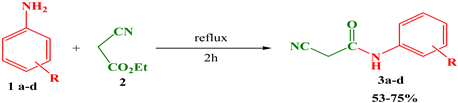 | ||
| Entry | R | Yields (%) |
|---|---|---|
| 3a | H | 58 |
| 3b | 4-Cl | 75 |
| 3c | 4-F | 62 |
| 3d | 3,4-diCl | 53 |
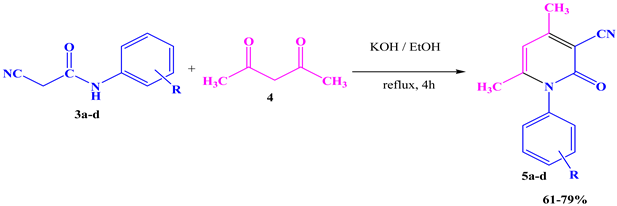 | ||
| Entry | R | Yields (%) |
|---|---|---|
| 5a | H | 75 |
| 5b | 4-Cl | 78 |
| 5c | 4-F | 79 |
| 5d | 3,4-diCl | 61 |
Disclaimer/Publisher’s Note: The statements, opinions and data contained in all publications are solely those of the individual author(s) and contributor(s) and not of MDPI and/or the editor(s). MDPI and/or the editor(s) disclaim responsibility for any injury to people or property resulting from any ideas, methods, instructions or products referred to in the content. |
© 2023 by the authors. Licensee MDPI, Basel, Switzerland. This article is an open access article distributed under the terms and conditions of the Creative Commons Attribution (CC BY) license (https://creativecommons.org/licenses/by/4.0/).
Share and Cite
Kebaili, A.; Belhadj, F.; Kibou, Z.; Seijas, J.A.; Tato, M.P.V.; Choukchou-Braham, N. Synthesis and Characterization of New 3-Cyano-2-Pyridone Derivatives as Fluorescent Scaffolds. Chem. Proc. 2023, 14, 111. https://doi.org/10.3390/ecsoc-27-16124
Kebaili A, Belhadj F, Kibou Z, Seijas JA, Tato MPV, Choukchou-Braham N. Synthesis and Characterization of New 3-Cyano-2-Pyridone Derivatives as Fluorescent Scaffolds. Chemistry Proceedings. 2023; 14(1):111. https://doi.org/10.3390/ecsoc-27-16124
Chicago/Turabian StyleKebaili, Asmaa, Fatima Belhadj, Zahira Kibou, Julio A. Seijas, M. Pilar Vazquez Tato, and Noureddine Choukchou-Braham. 2023. "Synthesis and Characterization of New 3-Cyano-2-Pyridone Derivatives as Fluorescent Scaffolds" Chemistry Proceedings 14, no. 1: 111. https://doi.org/10.3390/ecsoc-27-16124
APA StyleKebaili, A., Belhadj, F., Kibou, Z., Seijas, J. A., Tato, M. P. V., & Choukchou-Braham, N. (2023). Synthesis and Characterization of New 3-Cyano-2-Pyridone Derivatives as Fluorescent Scaffolds. Chemistry Proceedings, 14(1), 111. https://doi.org/10.3390/ecsoc-27-16124