
Abstract
Soil enzymes secure our food security; however, they are sensitive to abiotic stresses. Solving the global issues of food waste by implementing Sandwich compost can be a great solution to secure food security. Food waste Sandwich compost substrate (as soil treatment) and leachate (as seed priming agent and liquid fertilizer) were used to grow Bok Choy for four cycles, where soil pH, cation exchange capacity (CEC), moisture content, aggregate stability and enzyme activity were determined. All variables were positively corelated except catalase activity. Sandwich compost treatment significantly increased soil pH close to neutral and CEC. Anaerobic Sandwich compost-treated soil significantly reduced soil catalase activity. However, it gradually increased throughout the growing cycle. Sandwich compost treatment significantly maintained the aggregate stability along growing cycles. Hence, Sandwich compost substrate is recommended to improve soil quality in the aspects of pH, CEC and urease activity.
1. Introduction
Soil enzyme is the key driver for our food security. Without soil enzyme, the nutrient cycle will be disrupted due to the inability of plant to uptake certain nutrients. Soil enzyme activity is sensitive to conditions in which they work, including pollution and aeration. It is closely related to the amount of soil organic matter, plant, soil, root and microbial biomass [1]. Not only that, soil enzyme activity is also affected by abiotic factor, including pH, moisture content and soil management, and is mainly affected by artificial pollutant and commercial fertilizer [2]. Sandwich compost has significantly improved soil enzyme activity, such as acid and alkaline phosphatase and urease activity in corn and coffee production [3]. In addition to that, organic matter, such as Sandwich compost, significantly improved soil aggregate stability and brought the enhancement of the microbial agent [4,5]. Soil aggregate stability can be affected by soil moisture content, especially in the low moisture content area [6]. Thus, the objectives of this study are to determine the effect and relationship between soil enzyme activity, pH, cation exchange capacity, moisture content and aggregate stability through Sandwich compost treatment on Bok Choy.
2. Materials and Methods
2.1. Study Site
The experiment was carried out in a greenhouse, Field 10, Universiti Putra Malaysia. The clay soil was collected from the study site. Bok Choy was treated with Sandwich compost (Table 1), with these treatments being a combination of Sandwich compost substrate and leachate. Sandwich compost substrate was applied only once through soil incorporation at the beginning of the experiment. As for the seed, it was treated with Sandwich compost leachate for each growing cycle.
Table 1.
Sandwich compost substrate and leachate treatments.
2.2. Treatments
There were nine treatments with three replications each carried out for four growing cycles. The experiment was conducted as destructive sampling. Sandwich compost was prepared according to method by [8]. One g of seed was soaked in 500 mL of tap water overnight with the addition of 1 mL Sandwich compost leachate (0.2%) for 3 h [9,10] before being sown in peat moss. Sandwich compost-treated soil was incubated for 45 days. The seedlings were transplanted to the soil after 7 days of germination. A 0.2% of Sandwich compost leachate [11] was applied every five-day interval beginning from eight days after transplanting.
2.3. Soil Analysis
Soil pH was determined using a 1:2.5 (w/v) soil–water extract [12]. Soil moisture content was measured gravimetrically for 20 g of fresh soil that had been oven-dried at 105 °C until it achieved constant weight [12]. Soil texture and aggregate stability (%) was analysed [13]. Cation exchange capacity was determined by leaching method. Catalase activity was measured by back-titrating residual H2O2 with KMnO4 [2,14,15]. Urease activity was determined by using urea as the substrate [2].
2.4. Statistical Analysis
The collected data were subjected to statistical analyses with two-way analysis of variance (ANOVA) using R-program statistic software. When F was significant at the p < 0.05 level, treatment means were compared and separated using the Duncan’s Multiple Range Test (DMRT). Pearson’s correlation was analysed by package “corrplot” [14].
3. Results and Discussion
All variables were positively corelated to one another except for catalase activity. Catalase activity was significantly negative corelated to pH [15]. However, catalase activity was significantly negatively corelated to the CEC, which contrasts to the previous findings [15]. This may be because catalase mainly presents in aerobic organisms [16]. Soil aggregate stability was positively corelated to soil enzyme activity [17].
3.1. Soil pH
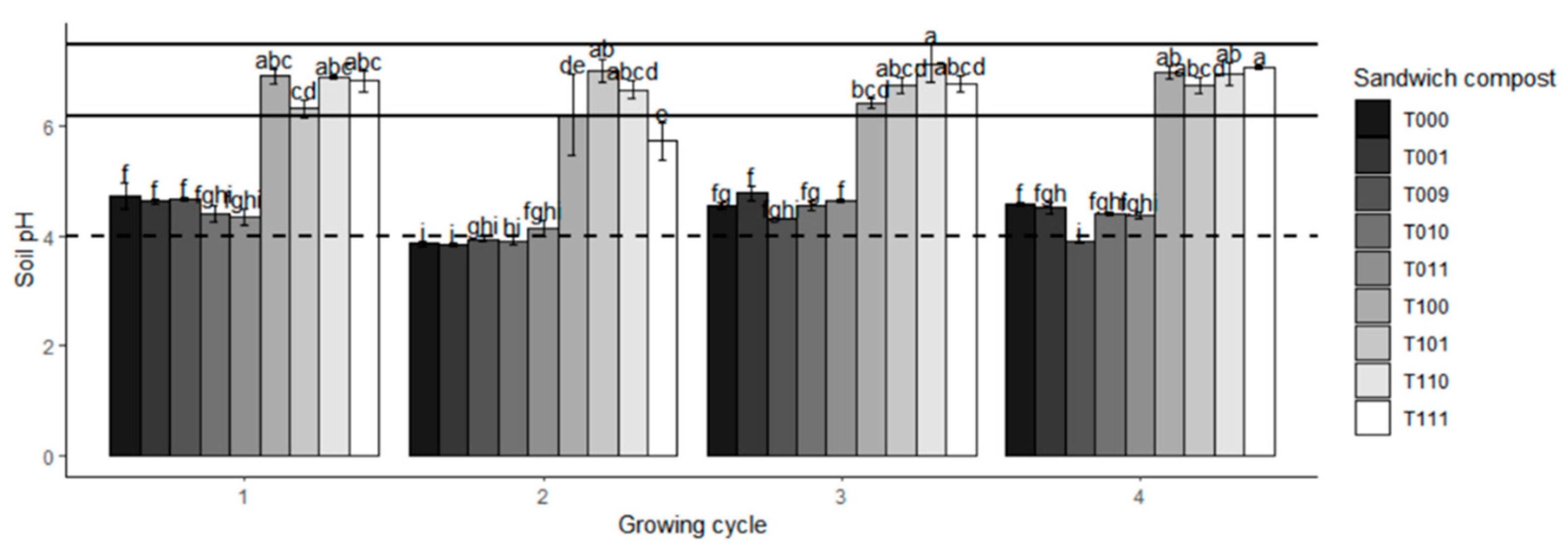
Soil pH had significant interaction between growing cycle and Sandwich compost treatment (Figure 1). Soil pH of Sandwich compost substrate treated soil significantly increased and maintained along the four cycles of growing. The results were supported by the previous studies [18]. Besides, other soil amendments, such as biochar, is also able to stabilize the soil pH under drought conditions [19]. Sandwich compost substrate released cation and allowed proton exchange with soil.
Figure 1.
Interaction effect of growing cycle (1, 2, 3 and 4) and Sandwich compost treatments on soil pH. Means ± standard error with different letters is significantly different at p < 0.05 using DMRT. The dotted line is referred to as original soil pH 4 ± 0.0473. The solid lines are referred to as optimum soil pH 6.2–7 [20].
3.2. Cation Exchange Capacity
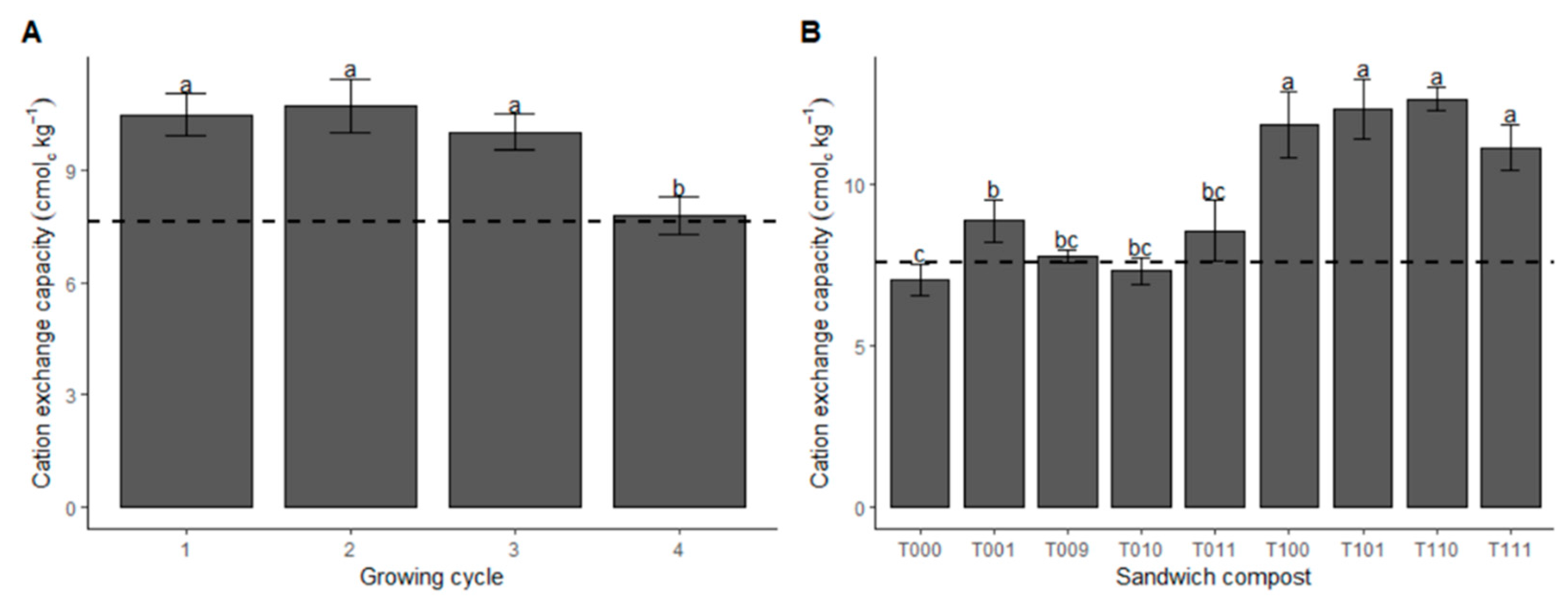
There is no significant interaction of the CEC between the growing cycle and Sandwich compost treatment (Figure 2). The CEC significantly decreases at the fourth growing cycle (Figure 2A). The possible reason is soil organic matter (Sandwich compost) has reduced after three growing cycles. This may be due to the Sandwich compost being fully degraded by microbes. The CEC of Sandwich compost-treated soil was significantly higher than untreated ones (Figure 2B) [21].
Figure 2.
Soil cation exchange capacity. (A) Effect of growing cycle on cation exchange capacity (cmol+ kg−1). (B) Effect of Sandwich compost treatments on cation exchange capacity (cmol+ kg−1). Means ± standard error with different letters is significantly different at p < 0.05 using DMRT. The dotted line is referred to as original cation exchange capacity (7.6 ± 0.216 cmol+ kg−1).
3.3. Soil Moisture Content
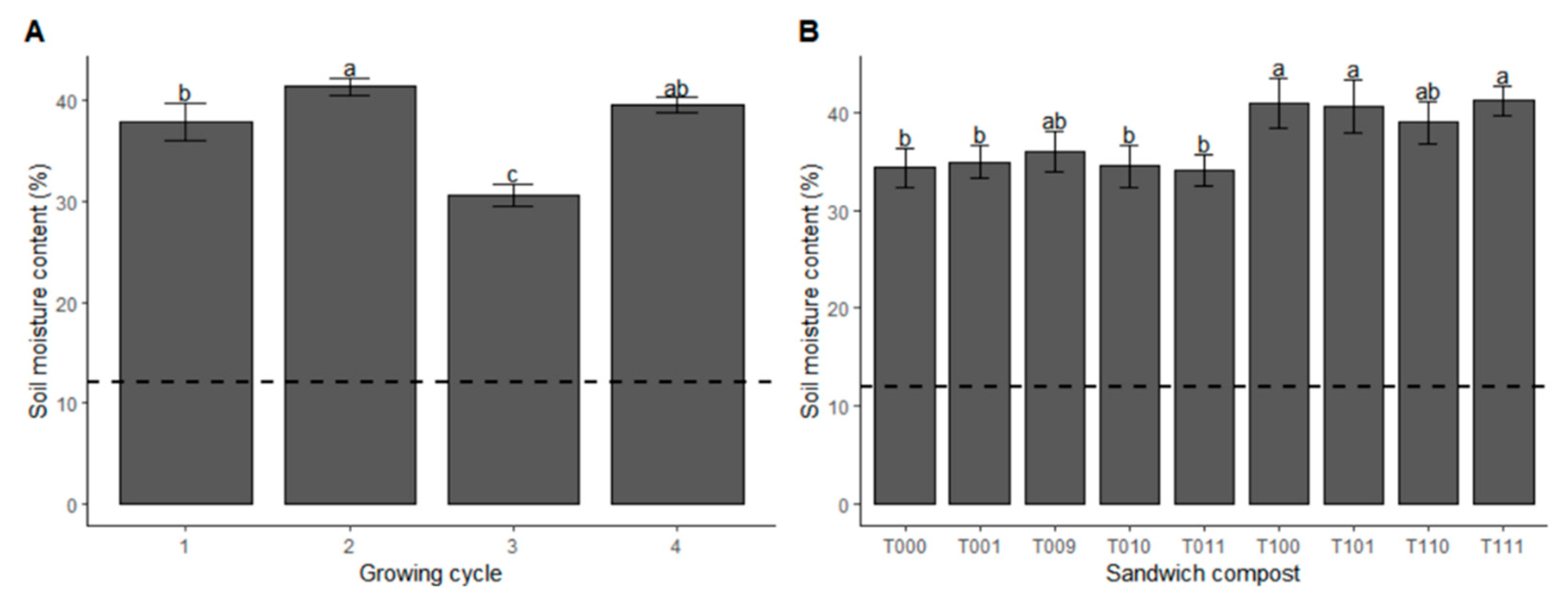
There is no significant interaction of moisture content between the growing cycle and Sandwich compost treatment. Second and fourth growing cycles showed significantly higher soil moisture content (Figure 3A). Sandwich compost-treated soil showed significantly higher soil moisture content (Figure 3B) as well. Soil moisture stress significantly declined the plant physiology parameter [22].
Figure 3.
Soil moisture content. (A) Effect of growing cycle on soil moisture content (%). (B) Effect of Sandwich compost treatments on soil moisture content (%). Means ± standard error with different letters is significantly different at p < 0.05 using DMRT. The dotted line is referred to original soil moisture content (12 ± 0.286%).
3.4. Soil Aggregate Stability
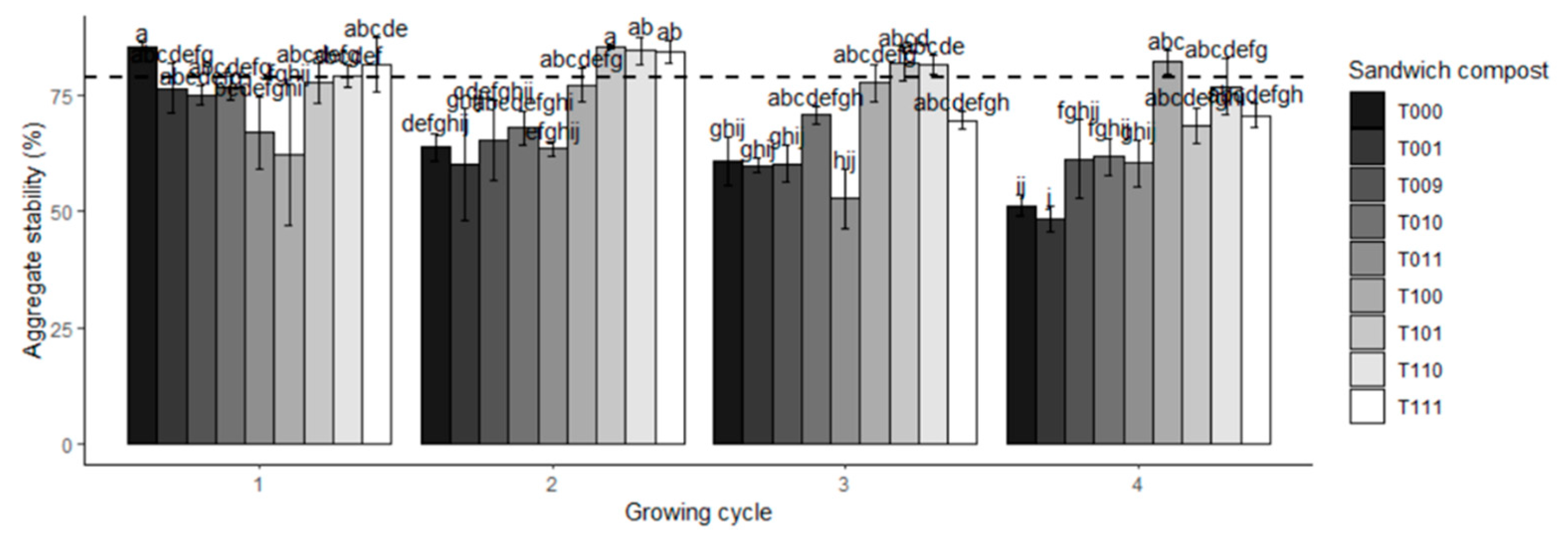
There is significant interaction in soil aggregate stability between the growing cycle and Sandwich compost treatment. The aggregate stability of untreated soil significantly decreased along the growing cycles period (Figure 3). Continuous harvesting may be affecting the soil aggregate. Sandwich compost-treated soil has significantly stronger aggregate stability along the four growing cycles. This is because of the increasing soil organic matter storage by the formation of soil aggregate [23].
3.5. Soil Catalase Activity
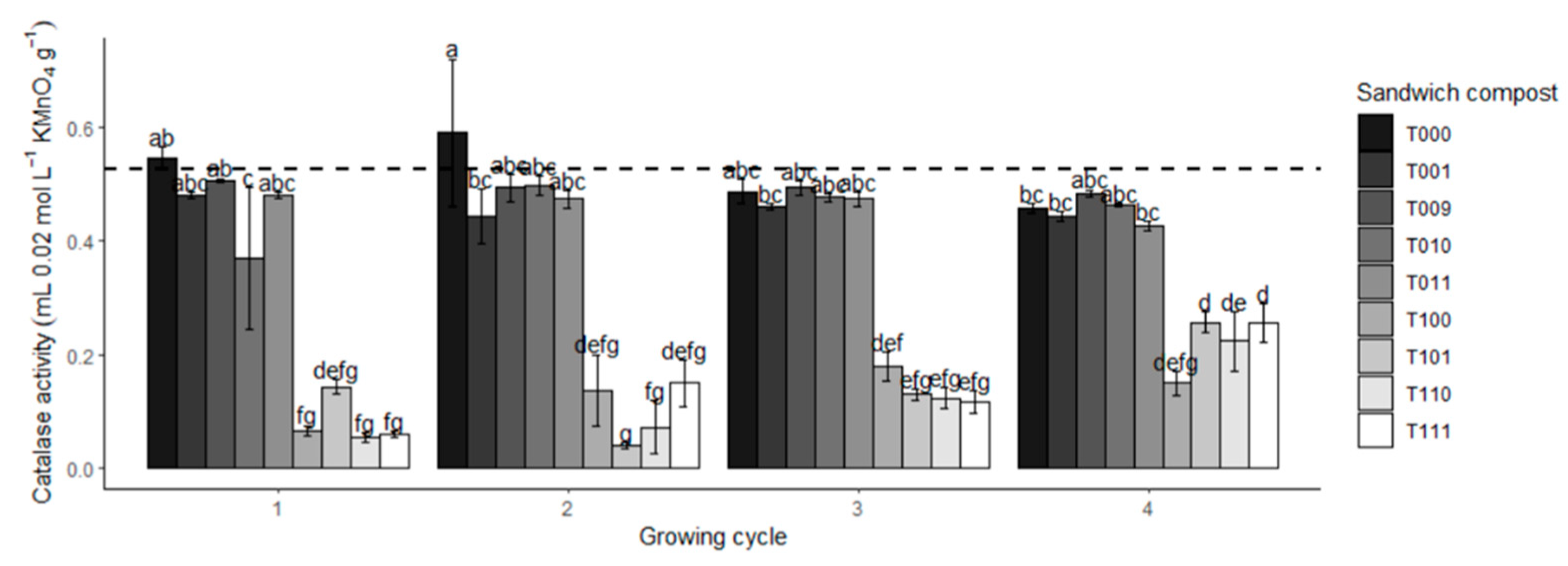
Catalase was significantly stable in the soil without Sandwich compost treatment along the growing cycles (Figure 4). Sandwich compost-treated soil has significantly lower catalase activity (Figure 5) compared to unamended soil along the four growing cycles. This may be due to the production of Sandwich compost in the anaerobic condition. Therefore, the anaerobes were predominant in the soil.
Figure 4.
Interaction effect of growing cycle and Sandwich compost treatments on soil aggregate stability (%). Means ± standard error with different letters is significantly different at p < 0.05 using DMRT. The dotted line is referred to original soil aggregate stability (78.73 ± 0.5679%).
Figure 5.
Interaction effect of growing cycle and Sandwich compost treatments on catalase activity (mL 0.02 mol L−1 KMnO4 g−1). Means ± standard error with different letters is significantly different at p < 0.05 using DMRT. The dotted line is referred to as original soil catalase activity (0.525 ± 0.0104 mL 0.02 mol L−1 KMnO4 g−1).
3.6. Soil Urease Activity
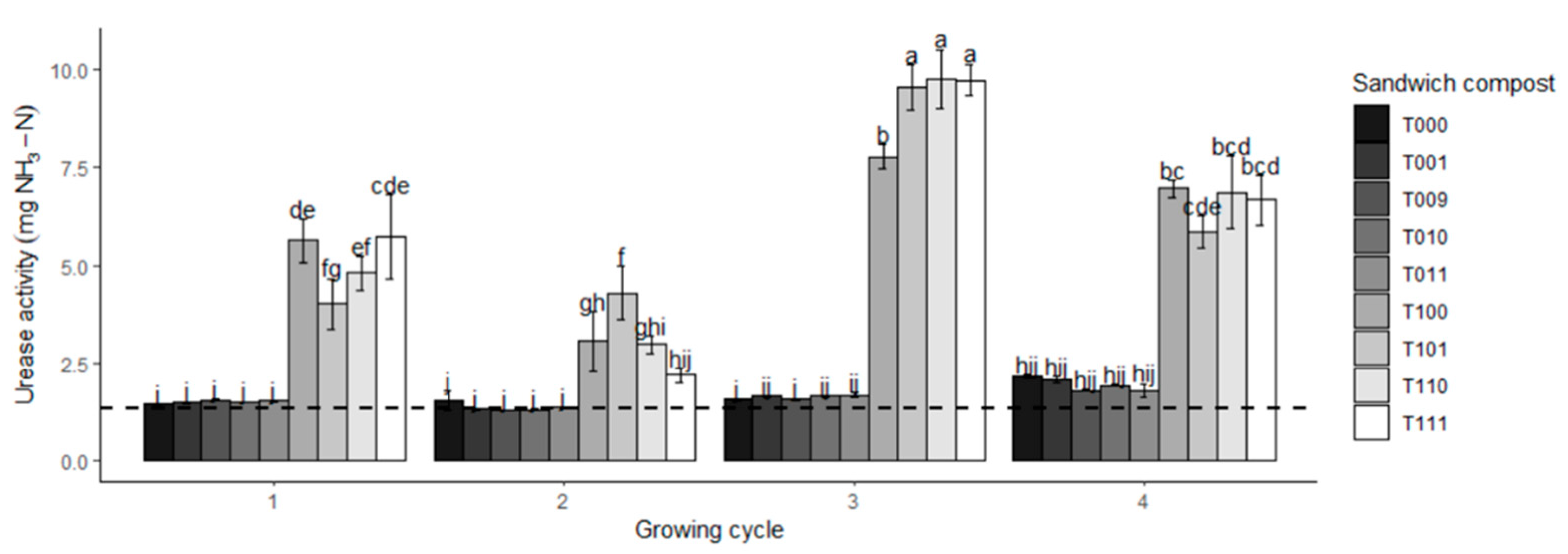
Urease activity has significantly increased with Sandwich compost substrate amendment. However, it decreased during the fourth growing cycle (Figure 6). Sandwich compost substrate possibly contained high urea in order for urease to work on it. However, the Sandwich compost substrate application may be needed to maintain the high urease activity [24].
Figure 6.
Interaction effect of growing cycle and Sandwich compost treatments on urease activity (mg NH3-N). Means ± standard error with different letters is significantly different at p < 0.05 using DMRT. The dotted line is referred to as original soil urease activity (1.33 ± 0.0407 mg NH3-N).
4. Conclusions
The key player of soil quality was Sandwich compost substrate treatment. Soil urease activity, pH and CEC were significantly increased with the treatment of Sandwich compost. Therefore, Sandwich compost substrate is recommended to improve soil quality.
Supplementary Materials
The presentation material can be downloaded at: https://www.mdpi.com/article/10.3390/IOCAG2022-12197/s1.
Author Contributions
Conceptualization, C.L.P.; methodology, C.L.P.; software, C.L.P.; validation, C.L.P.; formal analysis, C.L.P.; investigation, C.L.P.; resources, C.L.P.; data curation, C.L.P.; writing—original draft preparation, C.L.P.; writing—review and editing, C.L.P., E.A.A.; visualization, C.L.P.; supervision, E.A.A. and R.I.; project administration, C.L.P.; funding acquisition, E.A.A. All authors have read and agreed to the published version of the manuscript.
Funding
This research received no external funding.
Institutional Review Board Statement
Not applicable.
Informed Consent Statement
Not applicable.
Data Availability Statement
Not applicable.
Acknowledgments
Thanks to Department of Land Management for the technical support.
Conflicts of Interest
The authors declare no conflict of interest.
References
- Shaw, L.J.; Burns, R.G. Microbiological Methods for Assessing Soil Quality; Bloem, J., Hopkins, D.W., Benedetti, A., Eds.; CABI: Wallingford, UK, 2005; ISBN 9780851990989. [Google Scholar]
- Guan, S. Soil Enzymes and Their Research Methods; Agricultural Press: Beijing, China, 1986; ISBN 16144-3123. [Google Scholar]
- Bautista-Cruz, A.; Domínguez, C.; Mendoza, R.; de las Nieves, M.; Pacheco, P. Revista de la Facultad de Ciencias Agrarias. Ciencias Agrar. 2014, 46, 181–193. [Google Scholar]
- Sodhi, G.P.S.; Beri, V.; Benbi, D.K. Soil aggregation and distribution of carbon and nitrogen in different fractions under long-term application of compost in rice–wheat system. Soil Tillage Res. 2009, 103, 412–418. [Google Scholar] [CrossRef]
- Cosentino, D.; Chenu, C.; Le Bissonnais, Y. Aggregate stability and microbial community dynamics under drying–wetting cycles in a silt loam soil. Soil Biol. Biochem. 2006, 38, 2053–2062. [Google Scholar] [CrossRef]
- Haynes, R.J. Interactions between soil organic matter status, cropping history, method of quantification and sample pretreatment and their effects on measured aggregate stability. Biol. Fertil. Soils 2000, 30, 270–275. [Google Scholar] [CrossRef]
- Pertanian, P. Panduan Penanaman Sawi. 2021. Available online: http://www.pertanianperak.gov.my/images/PakejTeknologi/sawi.pdf (accessed on 14 January 2022).
- Phooi, C.L.; Azman, E.A.; Ismail, R.; Shahruddin, S. Effect of Sandwich Compost Leachate on Allium Tuberosum Seed Germination. Pertanika J. Trop. Agric. Sci. 2022, 45, 481–490. [Google Scholar] [CrossRef]
- O’hare, T.J.; Wong, L.S.; Force, L.E.; Irving, D.E. Glucosinolate composition and anti-cancer potential of seed-sprouts from horticultural members of the brassicaceae. Acta Hortic. 2007, 744, 181–188. [Google Scholar] [CrossRef]
- Alias, N.S.B.; Billa, L.; Muhammad, A.; Singh, A. Priming and temperature effects on germination and early seedling growth of some Brassica spp. Acta Hortic. 2018, 1225, 407–414. [Google Scholar] [CrossRef]
- Olle, M.; Williams, I.H. Effective microorganisms and their influence on vegetable production—A review. J. Hortic. Sci. Biotechnol. 2013, 88, 380–386. [Google Scholar] [CrossRef]
- Xu, Z.; Zhang, T.; Wang, S.; Wang, Z. Soil pH and C/N ratio determines spatial variations in soil microbial communities and enzymatic activities of the agricultural ecosystems in Northeast China: Jilin Province case. Appl. Soil Ecol. 2020, 155, 103629. [Google Scholar] [CrossRef]
- Teh, C.; Talib, J. Bin. In Soil Physics Analyses; Universiti Putra Malaysia Press: Serdang, Malaysia, 2006; Volume I. [Google Scholar]
- Wei, T.; Simko, V.; Levy, M.; Xie, Y.; Jin, Y.; Zemla, J. R Package “Corrplot”: Visualization of a Correlation Matrix, Version 0.92; The R Foundation: Vienna, Austria, 2021.
- Qiu, L.; Zhang, X.; Li, L.; Gao, J. Changes in soil properties with vegetation types in highland grassland of the Loess Plateau, China. African J. Biotechnol. 2011, 10, 15977–15988. [Google Scholar] [CrossRef]
- Sharma, I.; Ahmad, P. Catalase: A Versatile Antioxidant in Plants. In Oxidative Damage to Plants: Antioxidant Networks and Signaling; Academic Press: Cambridge, MA, USA, 2014; pp. 131–148. ISBN 9780127999630. [Google Scholar]
- Udawatta, R.P.; Kremer, R.J.; Adamson, B.W.; Anderson, S.H. Variations in soil aggregate stability and enzyme activities in a temperate agroforestry practice. Appl. Soil Ecol. 2008, 39, 153–160. [Google Scholar] [CrossRef]
- Prayogo, C.; Ihsan, M. Utilization of LCC (Legume Cover Crop) and bokashi fertilizer for the efficiency of Fe and Mn uptake of former coal mine land. J. Degrad. Min. Lands Manag. 2018, 6, 1527–1537. [Google Scholar] [CrossRef]
- Mansoor, S.; Kour, N.; Manhas, S.; Zahid, S.; Wani, O.A.; Sharma, V.; Wijaya, L.; Alyemeni, M.N.; Alsahli, A.A.; El-Serehy, H.A.; et al. Biochar as a tool for effective management of drought and heavy metal toxicity. Chemosphere 2021, 271, 129458. [Google Scholar] [CrossRef] [PubMed]
- Ma, Q.; Cao, X.; Xie, Y.; Gu, Y.; Feng, Y.; Mi, W.; Yang, X.; Wu, L. Effect of PH on the Uptake and Metabolism of Glycine in Pak Choi (Brassica chinensis L.). Environ. Exp. Bot. 2017, 133, 139–150. [Google Scholar] [CrossRef]
- Xiaohou, S.; Min, T.; Ping, J.; Weiling, C. Effect of EM Bokashi application on control of secondary soil salinization. Water Sci. Eng. 2008, 1, 99–106. [Google Scholar] [CrossRef]
- Khan, N.; Bano, A.M.D.; Babar, A. Impacts of plant growth promoters and plant growth regulators on rainfed agriculture. PLoS ONE 2020, 15, e0231426. [Google Scholar] [CrossRef] [PubMed] [Green Version]
- Yu, Z.; Zheng, Y.; Zhang, J.; Zhang, C.; Ma, D.; Chen, L.; Cai, T. Importance of soil interparticle forces and organic matter for aggregate stability in a temperate soil and a subtropical soil. Geoderma 2020, 362, 114088. [Google Scholar] [CrossRef]
- Zaman, M.; Cameron, K.C.; Di, H.J.; Inubushi, K. Changes in mineral N, microbial biomass and enzyme activities in different soil depths after surface applications of dairy shed effluent and chemical fertilizer. Nutr. Cycl. Agroecosyst. 2002, 63, 275–290. [Google Scholar] [CrossRef]
Publisher’s Note: MDPI stays neutral with regard to jurisdictional claims in published maps and institutional affiliations. |
© 2022 by the authors. Licensee MDPI, Basel, Switzerland. This article is an open access article distributed under the terms and conditions of the Creative Commons Attribution (CC BY) license (https://creativecommons.org/licenses/by/4.0/).