

Skip to Content
You are currently on the new version of our website. Access the old version .

Diabetology, Volume 3, Issue 2

2022 June - 12 articles

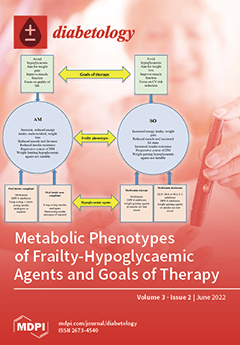
Cover Story: In frail older people with diabetes, frailty spans across the metabolic spectrum, which starts at an anorexic malnourished (AM) phenotype on one end and a sarcopenic obese (SO) one on the other. AM is characterized by weight loss and less insulin resistance while SO is characterized by obesity and increased insulin resistance. AM is less tolerant to oral hypoglycaemic agents due to multiple-organ dysfunction, and insulin can be an early option. Insulin-related weight gain may be an advantage in the context of malnutrition. It may improve muscle function, but this requires future studies. The choice of long-acting insulin analogues, compared with insulin NPH, may be more appropriate due to their lower risk of hypoglycaemia and the simplicity of administration. The goals of therapy are to avoid hypoglycaemia and to maintain quality of life. View this paper
  • Issues are regarded as officially published after their release is announced to the table of contents alert mailing list .
  • You may sign up for email alerts to receive table of contents of newly released issues.
  • PDF is the official format for papers published in both, html and pdf forms. To view the papers in pdf format, click on the "PDF Full-text" link, and use the free Adobe Reader to open them.

Articles (12)

  • Review
  • Open Access
14 Citations
5,550 Views
15 Pages

Insulin in Frail, Older People with Type 2 Diabetes—Low Threshold for Therapy

  • Ahmed Abdelhafiz,
  • Shail Bisht,
  • Iva Kovacevic,
  • Daniel Pennells and
  • Alan Sinclair

The global prevalence of comorbid diabetes and frailty is increasing due to increasing life expectancy. Frailty appears to be a metabolically heterogeneous condition that may affect the clinical decision making on the most appropriate glycaemic targe...

  • Review
  • Open Access
21 Citations
18,461 Views
5 Pages

Gender difference in all fields of medicine and biology has recently become a topic of great interest. At present, most studies report gender differences in their secondary analysis; however, this information receives scant attention from clinicians,...

  • Review
  • Open Access
4 Citations
4,525 Views
9 Pages

Is Non-Alcoholic Fatty Liver Disease Connected with Cognition? The Complex Interplay between Liver and Brain

  • Matina Kouvari,
  • Domenico Sergi,
  • Nathan M. D’Cunha,
  • Amanda Bulman,
  • Demosthenes B. Panagiotakos and
  • Nenad Naumovski

The prevalence of non-alcoholic fatty liver disease (NAFLD) and its progressive form, non-alcoholic steatohepatitis (NASH), is increasing in parallel with the rising rates of obesity and type 2 diabetes. Approximately one in four adults are diagnosed...

  • Article
  • Open Access
6 Citations
5,280 Views
7 Pages

Background: Older people consistently report a desire to remain at home. Beat It is a community-based exercise and lifestyle intervention that uses evidence-based strategies to assist older people with type 2 diabetes mellitus (T2DM) to improve physi...

  • Article
  • Open Access
1 Citations
3,128 Views
14 Pages

During the first lockdown of the COVID-19 pandemic, people with type 1 diabetes (T1D) were worried, stressed, and experienced changes in their self-management practices. Studies found that many had difficulties managing their disease, while others sh...

  • Article
  • Open Access
4 Citations
6,566 Views
13 Pages

Comparison between Policaptil Gel Retard and Metformin by Testing of Temporal Changes in Patients with Metabolic Syndrome and Type 2 Diabetes

  • Giuseppina Guarino,
  • Felice Strollo,
  • Teresa Della-Corte,
  • Ersilia Satta,
  • Carmine Romano,
  • Carmelo Alfarone,
  • Gerardo Corigliano,
  • Marco Corigliano,
  • Giuseppe Cozzolino and
  • Sandro Gentile
  • + 6 authors

26 April 2022

Introduction: Metabolic Syndrome (MS) is a pathologic condition characterized by Type 2 diabetes mellitus (T2DM), insulin resistance, abdominal obesity, hypertension, and hyperlipidemia. Until now, specific drugs such as metformin (MET) have been use...

  • Case Report
  • Open Access
1 Citations
3,161 Views
5 Pages

24 April 2022

Technological advances in the management and treatment of type 1 diabetes have afforded some patients the resources to better manage their condition and live full, healthy lives. One of these technologies is continuous glucose monitoring which allows...

  • Systematic Review
  • Open Access
23 Citations
16,353 Views
18 Pages

24 April 2022

Metabolic syndrome (MetS) is a major societal concern due to its increasing prevalence and its high risk of cardiovascular complications. The ketogenic diet (KD), a high fat, low carbohydrate, and non-caloric restrictive diet, is a new popular weight...

  • Article
  • Open Access
12 Citations
20,531 Views
16 Pages

Fasting during Ramadan: A Comprehensive Review for Primary Care Providers

  • Sumera Ahmed,
  • Natasha Khokhar and
  • Jay H. Shubrook

11 April 2022

Diabetes mellitus has become a non-infectious pandemic. The incidence of T2D has risen dramatically and recent rates have increased in many countries including Muslim countries. As the number of people who participate in Ramadan increases, health car...

  • Article
  • Open Access
4 Citations
6,340 Views
8 Pages

Evaluating the Influence of Mood and Stress on Glycemic Variability in People with T1DM Using Glucose Monitoring Sensors and Pools

  • Jose Manuel Velasco,
  • Marta Botella-Serrano,
  • Almudena Sánchez-Sánchez,
  • Aranzazu Aramendi,
  • Remedios Martínez,
  • Esther Maqueda,
  • Oscar Garnica,
  • Sergio Contador,
  • Juan Lanchares and
  • José Ignacio Hidalgo

11 April 2022

Objective: Assess in a sample of people with type 1 diabetes mellitus whether mood and stress influence blood glucose levels and variability. Material and Methods: Continuous glucose monitoring was performed on 10 patients with type 1 diabetes mellit...

Get Alerted

Add your email address to receive forthcoming issues of this journal.

XFacebookLinkedIn
Diabetology - ISSN 2673-4540