


Abstract
This review explores recent advancements in hydrogen gas (H2) safety through the lens of artificial intelligence (AI) techniques. As hydrogen gains prominence as a clean energy source, ensuring its safe handling becomes paramount. The paper critically evaluates the implementation of AI methodologies, including artificial neural networks (ANN), machine learning algorithms, computer vision (CV), and data fusion techniques, in enhancing hydrogen safety measures. By examining the integration of wireless sensor networks and AI for real-time monitoring and leveraging CV for interpreting visual indicators related to hydrogen leakage issues, this review highlights the transformative potential of AI in revolutionizing safety frameworks. Moreover, it addresses key challenges such as the scarcity of standardized datasets, the optimization of AI models for diverse environmental conditions, etc., while also identifying opportunities for further research and development. This review foresees faster response times, reduced false alarms, and overall improved safety for hydrogen-related applications. This paper serves as a valuable resource for researchers, engineers, and practitioners seeking to leverage state-of-the-art AI technologies for enhanced hydrogen safety systems.
1. Introduction
Hydrogen has been used safely for more than a century in a variety of industries, primarily in oil refineries, ammonia production, fertilizers, metallurgical applications, food industry, and the space program. Despite being nontoxic and lighter than air properties, it is seen hazardous due to historical reasons like the Hindenburg disaster.
However, in the last few decades, in the drive to reduce carbon emissions, hydrogen gas (H2) is potentially considered an important energy carrier for the industry and transport sector. Hydrogen and fuel cells will play a greater role in the energy sector, thus the safety related to the use of H2 as a fuel is now essential. Safety considerations are a prerequisite to establishing the confidence of stakeholders and the public in accepting H2 as a replacement for conventional fuels.
Traditional hydrogen production methods are based on fossil fuel processing and electrolysis of water. Hydrogen produced by electrolysis of water powered by renewable energy sources is now considered green H2 and is preferred compared to steam reforming of fossil fuels. Like other gaseous fuels, the possibility of leakage and subsequent hazards are the main risks through the entire H2 value chain, i.e., from production, storage to delivery, and end-use. Being a light molecule H2 has to be stored under high pressure and due to its high diffusivity and permeation properties, the risk of leakage is high. In the event of leaks, it is undetectable to the human senses, and due to rapid diffusion, low ignition energy, and wide flammability range, the risk of leaks may be associated with ignition. Therefore, rigorous safety measures to mitigate these risks are critical.
The global drive toward hydrogen technologies for decarbonization, emphasized by Ocko and Hamburg [1], highlights H2’s pivotal role in mitigating climate change. However, their study also brings attention to hydrogen’s short-term warming effects, challenging its perceived neutrality and emphasizing the need for emissions reduction and proactive safety measures. Recent investments aiming for the largest electrolyzer capacity by 2028 [2] underscore industry focus on decarbonization, demanding immediate safety standard development amidst rapid expansion.
Jahangiri et al. [3] highlighted the economic feasibility of hydrogen production via renewable energy systems like wind and solar power, with sensitivity analyses emphasizing emission penalties’ influence on generation costs and the efficiency benefits of fuel cell integration. Fahd Amjad et al. [4] identified sites for large-scale green hydrogen production using solar energy, emphasizing proximity to national networks and water resources, with implications for energy storage and transportation sectors. Furthermore, ensuring hydrogen safety in these production and utilization processes remains paramount.
There are international standards for H2 explosion protection IEC 60079 [5] and IEC 80079 [6], as well as specific standards (ISO 22734 [7] and ISO 19880 [8]) for H2 facilities. Various sensors are commercially available, along with guidelines for selection installation and positioning, depending on the facility and the process. At the planning stage, engineers also obtain information on understanding the field of view and blind spots at the facilities for choosing the correct instrumentation, such as layered gas and flame detection sensors for specific potential hazards.
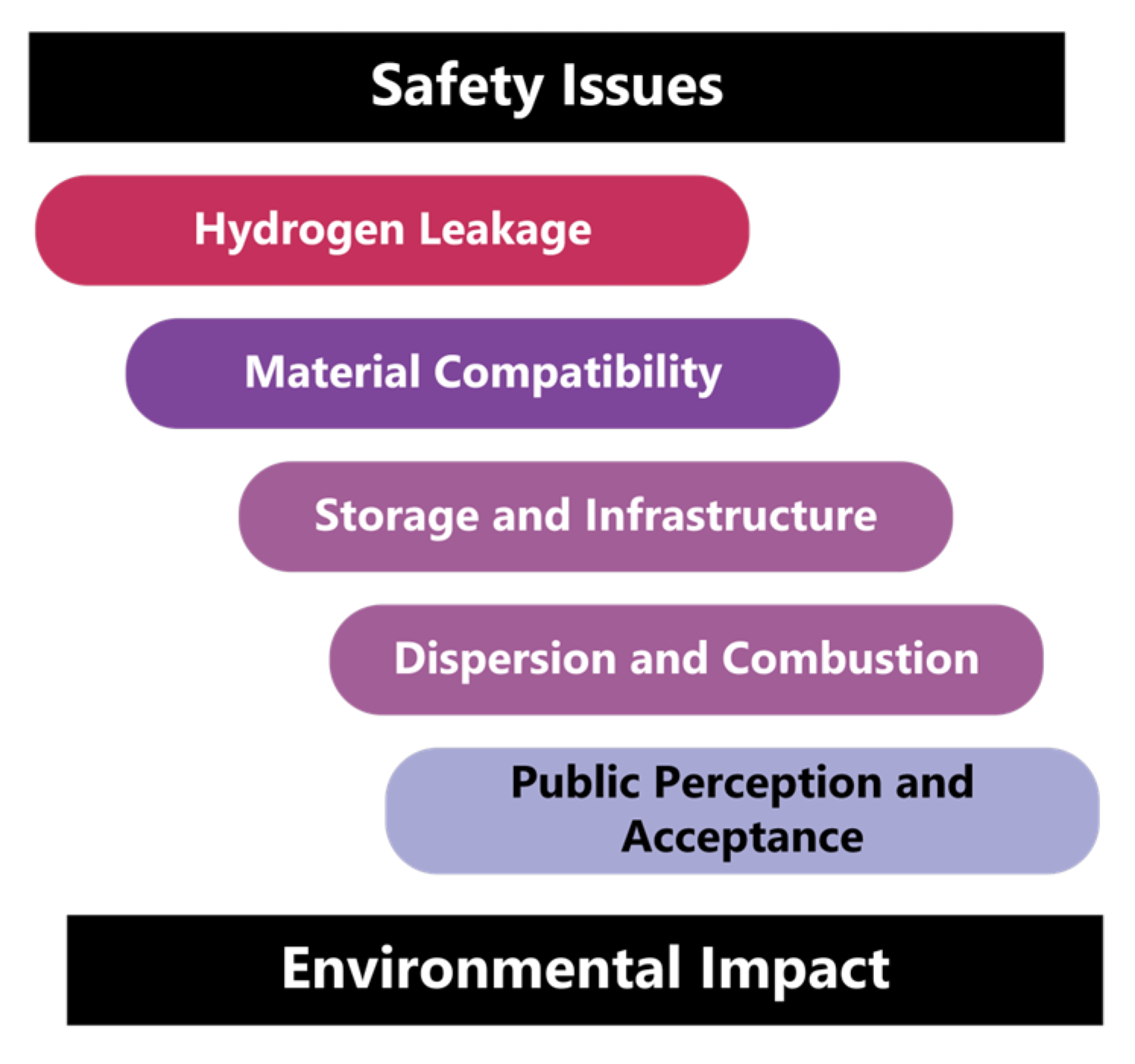
This paper undertakes a comprehensive exploration of recent advancements in hydrogen safety, particularly the application of AI methodologies in evaluating potential safety scenarios, and the design of safety measures is considered. Against this backdrop, the integration of AI methodologies emerges as a transformative paradigm in augmenting H2 safety measures. The H2 safety issues are leakage detection, explosion risk mitigation, material compatibility assessment, optimization of storage systems, infrastructure development planning, dispersion behavior prediction, combustion characteristic analysis, public perception management, emergency response planning, and environmental impact assessment, as shown in Figure 1.
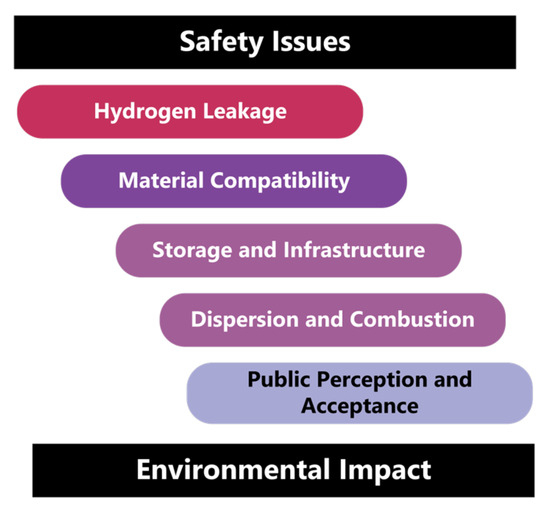
Figure 1.
Hydrogen safety issues.
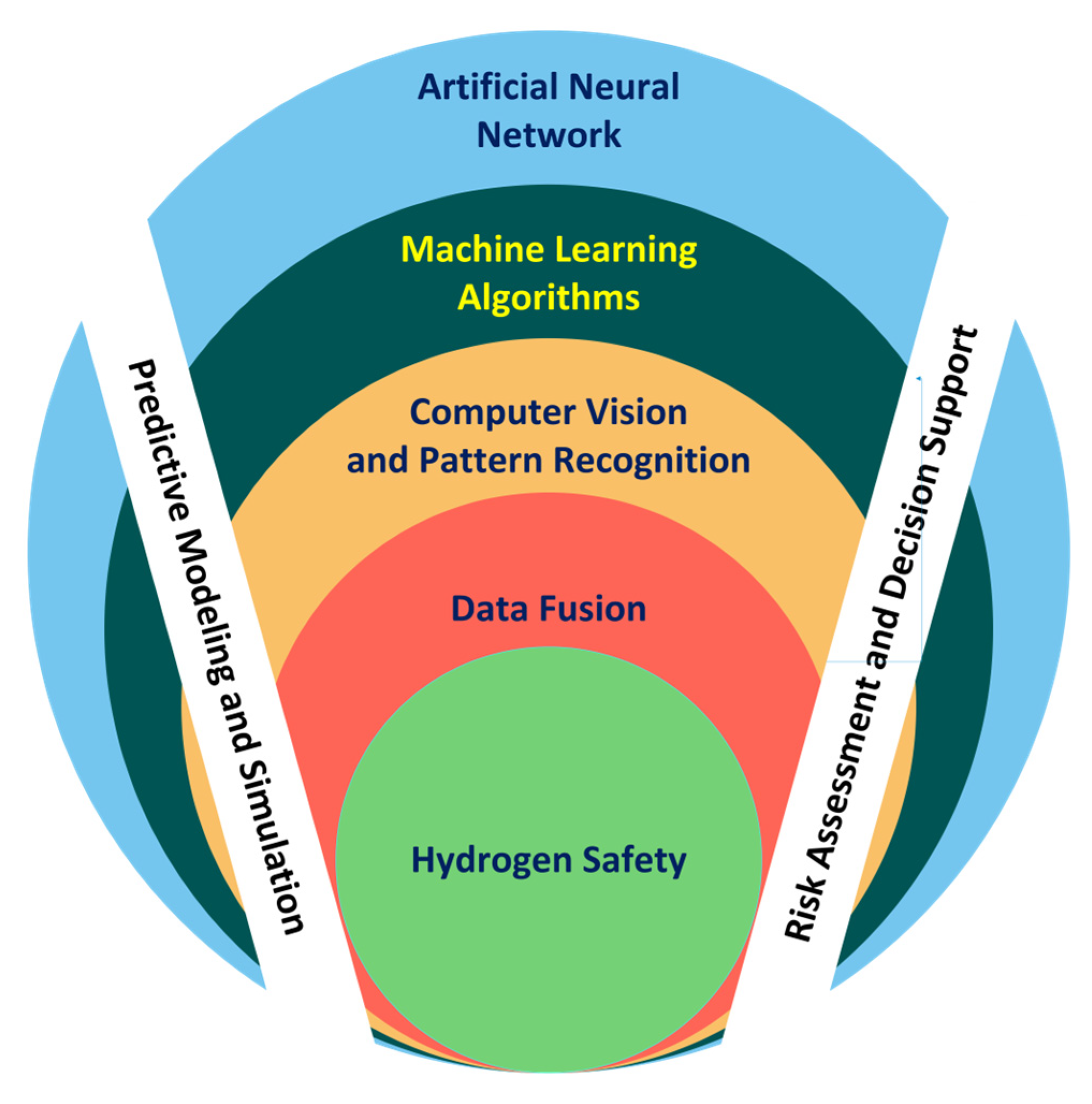
Leveraging ANNs, ML algorithms, CV, and data fusion techniques, as shown in Figure 2, AI promises to enhance detection capabilities, improve response times, and reduce false alarms across the H2 value chain. These methods facilitate efficient data analysis, predictive modeling, risk assessment, and decision support. This review critically evaluates the efficacy of AI-driven approaches in real-time monitoring, hazard detection, and safety protocol optimization, offering insights into key challenges, opportunities, and future directions in the realm of hydrogen safety.
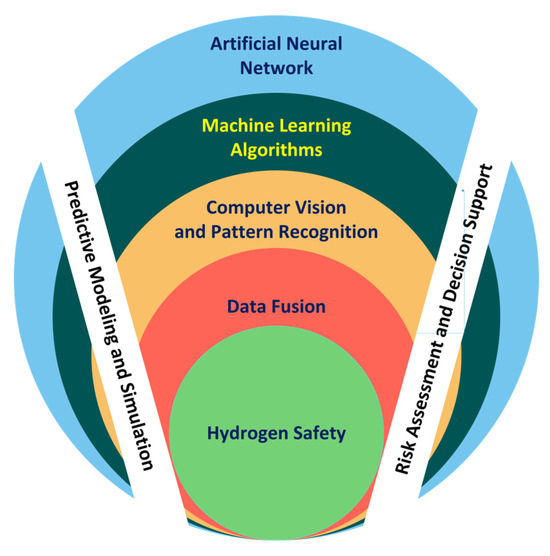
Figure 2.
Digital techniques in hydrogen safety.
The need for a transition toward a sustainable hydrogen economy, the convergence of AI, and hydrogen safety represents a pivotal step toward realizing this vision. This fosters a safer, more resilient hydrogen ecosystem, paving the way for a cleaner, greener energy future. This work provides an understanding of the current landscape of hydrogen safety and identifies key opportunities and challenges for future research and development efforts in developing and implementing safety procedures in all areas of H2 technology.
This paper is structured into six main sections. Section 1 introduces hydrogen energy and its associated safety concerns. Section 2 provides an in-depth review of state-of-the-art technologies in hydrogen safety, covering both conventional methods and advanced AI techniques such as ANN, ML, and CV. Section 3 presents various case studies and applications in hydrogen energy and safety. Section 4 offers a comparative analysis of these techniques for hydrogen safety research. Section 5 delves into safeguarding hydrogen through the integration of advances in materials, models, and storage techniques. Overall, Section 6 provides a discussion and conclusion, summarizing the key findings and outlining future research directions.
2. State-of-the-Art-Technologies in Hydrogen Safety
This section provides a comprehensive overview of the evolving landscape of hydrogen safety, encompassing both conventional methods and cutting-edge AI techniques. It delves into the traditional approaches like sensor-based detection systems, which have long been employed in hydrogen safety protocols. Additionally, it explores the integration of advanced AI methodologies, including ANNs, ML algorithms, and CV with pattern recognition, which offers the potential for real-time monitoring and proactive risk mitigation. By synthesizing insights from diverse sources, this section offers a holistic understanding of how traditional and innovative techniques converge to enhance safety measures in H2-related applications. Despite promising progress, challenges persist in the field of hydrogen safety, emphasizing the necessity for ongoing research and development efforts. It sets a solid foundation for future research endeavors, providing valuable insights for stakeholders aiming to harness AI techniques for the advancement of H2 leak detection systems, fostering a safer and more resilient energy landscape.
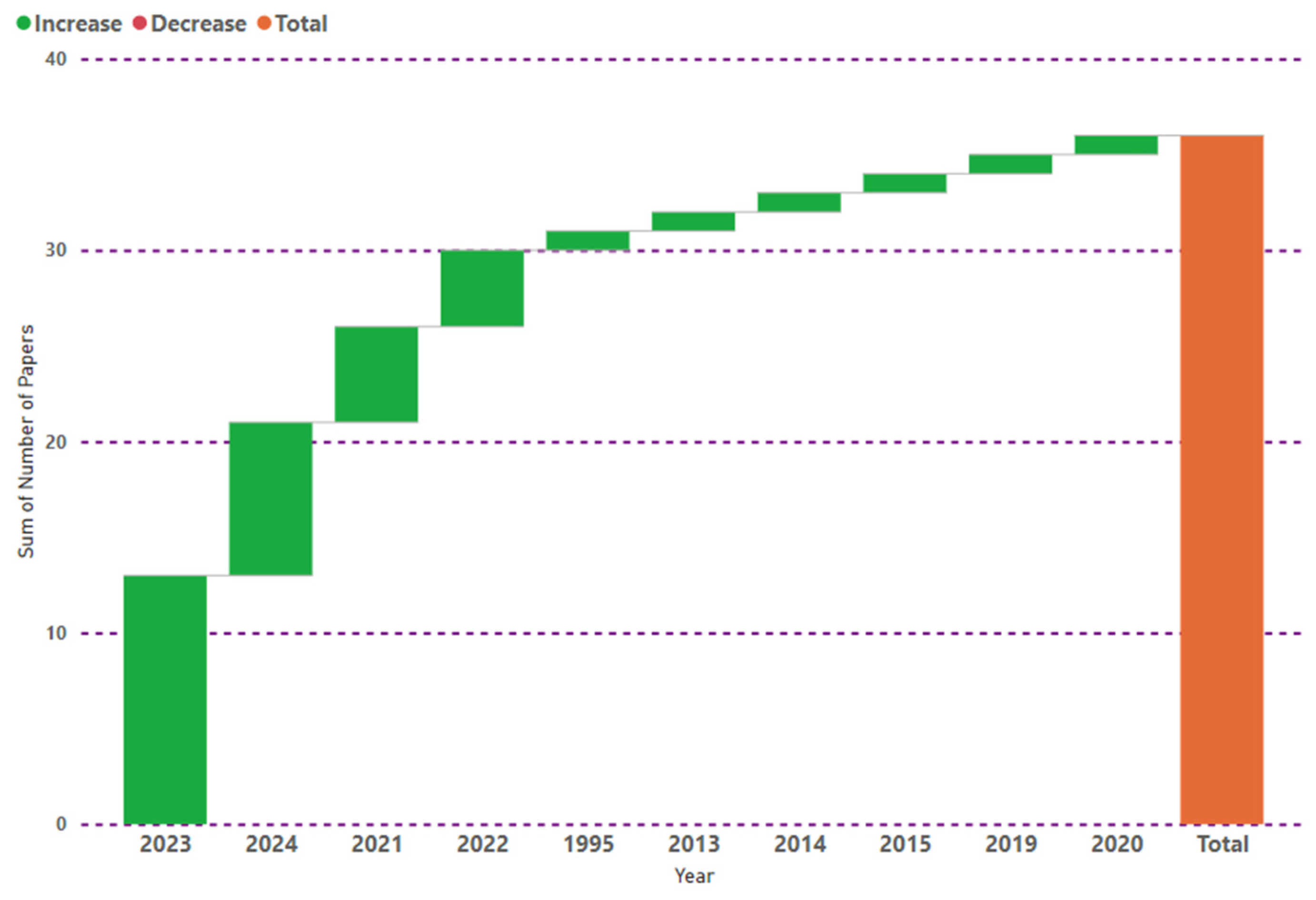
Figure 3 summarizes the distribution of research papers reviewed in this study by their publication year. It highlights the trend and growing interest in AI for hydrogen safety over time.
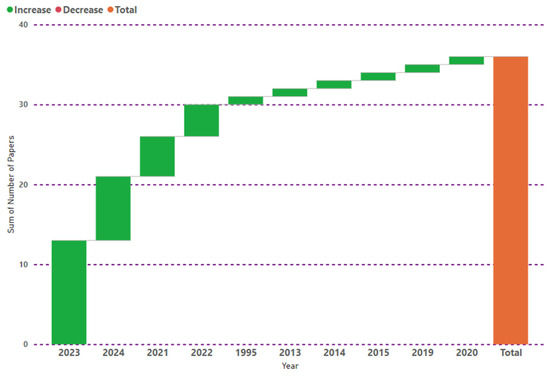
Figure 3.
Articles considered over the year.
2.1. Conventional Techniques
In the realm of hydrogen safety, traditional experimental methods have long been employed to understand the complexities of H2 leakage scenarios. Zhou et al. [9] conducted experimental research investigating the effects of ignition height on explosion characteristics within a 27 m3 hydrogen/air cloud. Their study revealed a fascinating interplay of factors, demonstrating how variations in ignition height impact flame propagation velocity, oscillation frequency, and overpressure metrics. Additionally, a novel parameter, “t”, was introduced to quantify buoyancy effects, shedding light on the intricate dynamics of gas explosions. This research underscores the significance of understanding ignition height dynamics in mitigating explosion risks, highlighting the importance of experimental approaches in comprehending hydrogen safety phenomena.
To gain a comprehensive understanding of hydrogen safety, it is crucial to explore the broader landscape of H2 energy production and utilization. Tarhan and Çil [10] provided an insightful examination of H2 energy as a sustainable solution amid mounting environmental concerns and energy demands. Their work elucidated various aspects of H2 production, storage, and transportation, emphasizing its potential as a low-carbon energy source. Furthermore, the discussion extended to storage technologies like liquid organic hydrogen carriers (LOHCs) and solid-state systems, showcasing diverse applications in different sectors. By offering a comprehensive overview of H2 energy, this study lays a robust foundation for understanding the critical role of leak detection in ensuring the safety and viability of hydrogen-based technologies.
In the domain of sensor technologies for H2 leak detection, Baker [11] presented a hydrogen leak detection sensor database, offering technical specifications for various sensors, including the AppliedSensor Inc HLS-440. This resource provides essential details such as target gas concentration range, operating temperature, dimensions, and weight, facilitating informed decisions in sensor selection for hydrogen safety applications. Additionally, advancements in sensor technology have led to the development of innovative solutions like the H2 IntelliSense Slim Hydrogen Sensor, employing solid-state electrochemical sensor technology for precise H2 detection [12]. With features such as a broad sensing range, rapid response time, and versatile applications across industries, this sensor exemplifies the evolution of sensor technology in addressing hydrogen safety challenges.
Furthermore, addressing the challenging issue of pipeline leakage, Baroudi et al. [13] evaluated state-of-the-art leak detection systems (LDSs) and data fusion approaches to mitigate risks and protect the environment. Their comparative analysis underscored the importance of multiple LDSs for enhanced detection accuracy, emphasizing the need for rigorous data analysis and proper inputs. The study highlighted the role of historical data in predicting pipe deterioration, pointing towards future directions involving advanced technologies like ML and the Internet of Things (IoT) for improved pipeline safety. Additionally, Ramaiyan et al. [14] provided a comprehensive overview of recent developments in hydrogen sensor technology, emphasizing its crucial role in establishing a sustainable hydrogen economy. With a focus on applications such as leak detection and process monitoring throughout the supply chain, this review highlighted the significance of informed sensor selection for the effective implementation of H2 energy solutions.
Table 1 summarizes relevant research investigating diverse techniques in hydrogen safety, displaying key findings and potential applications.

Table 1.
Overview of Techniques and Applications.
2.2. Specific AI Techniques
2.2.1. Artificial Neural Networks (ANNs)
ANNs have emerged as a cornerstone in the realm of hydrogen safety, offering a versatile framework for detecting and mitigating potential risks associated with hydrogen leaks. These sophisticated computational models, inspired by the human brain’s neural structure, have been extensively explored and refined to address various challenges in hydrogen safety. Hamdalla [15] delved into the realm of hydrogen detection using long-period fiber Bragg grating (LPFBG) coupled with ANNs, demonstrating their prowess in accurately predicting transmission power based on H2 concentration. This innovative approach not only highlighted superior fitting to experimental data but also offered advantages in terms of computational time and flexibility, laying a solid foundation for rapid and effective hydrogen detection.
Furthermore, Kopbayev et al. [16] introduced a novel neural network model tailored for early detection and classification of natural gas leaks, highlighting remarkable accuracy without the need for fine-tuning. However, challenges persist, particularly in optimizing these models for shorter datasets and real-world scenarios. Bi et al. [17] proposed a hybrid CEEMDAN–CNN–LSTM model aimed at precise H2 leakage localization in refueling stations. This cutting-edge approach, combining advanced algorithms with neural networks, yielded exceptional prediction performance, highlighting its potential for ensuring station safety. Zhao et al. [18] ventured into H2 leak localization using ML techniques, demonstrating promising accuracy in predicting leak locations. Despite these advancements, further research is warranted to enhance accuracy and robustness, especially when applied to complex environments such as full-size garages. Additionally, Suzuki et al. [19] addressed the challenge of H2 leakage from pipelines using unsupervised ML, highlighting its effectiveness in distinguishing between leakage and nonleakage conditions. Yang et al. [20] introduced a hybrid WD-KNN-CNN model for predicting hydrogen leakage in refueling stations (HRS), achieving 99.14% accuracy for leak location and 97.42% for intensity. Utilizing wavelet denoising and Bayesian optimization, it captures temporal data for fast, reliable predictions, suggesting a need for 14 monitoring points for effective management.
Moreover, He [21] introduced a physics-informed surrogate model for predicting hydrogen leak consequences, leveraging the power of neural networks to offer real-time risk warnings. Lastly, the development of an AI-enabled optical sensor for detecting low levels of H2 by Swedish and Dutch researchers [22] marks a significant breakthrough, emphasizing the transformative potential of AI in ensuring safety across various sectors. These collective efforts, as shown in Table 2, underscore the pivotal role of ANNs in revolutionizing hydrogen safety, paving the way for a cleaner and safer energy future.
Table 2.
Overview of Techniques and Applications.
2.2.2. Machine Learning Algorithms
ML algorithms emerge as a transformative tool, offering innovative solutions to mitigate risks associated with hydrogen leakage and optimize storage systems. El-Amin’s research [23] delves into the complexities of H2 dispersion prediction by employing ML algorithms on synthetic datasets, highlighting the effectiveness of random forest models in forecasting nanoparticle concentration. Building upon this foundation, El-Amin et al. [24] explore the turbulent flow of hydrogen buoyant jets, integrating ML techniques to predict H2 concentration in the air. Their findings underscore the pivotal role of ML in understanding and predicting hydrogen leakage scenarios, with the random forest method demonstrating superior performance.
Davoodi et al. [25] extend the application of ML to optimize H2 storage systems, displaying the efficacy of least squares support vector machines (LSSVM) in predicting hydrogen uptake by porous carbon media. Meanwhile, Shi et al. [26] focus on developing advanced sensing technologies for hydrogen leakage detection, leveraging ML models to estimate H2 detection response for various nanocomposites. Their study emphasizes the reliability of ML-based mathematical models in automating hydrogen sensing processes.
The importance of ML in enhancing safety measures is further exemplified by research addressing real-world safety concerns. One such study [27] utilizes advanced analytics and ML models to predict physical phenomena during indoor H2 releases, thereby improving safety protocols. Additionally, El-Amin et al. [28] employ a random forest ML approach to analyze turbulent buoyant jets and accurately predict hydrogen concentration distribution, contributing to safety enhancement efforts.
Furthermore, ML finds practical applications in real-time gas pipeline leak detection systems [29], quantitative risk assessment of liquid H2 leaks from offshore platforms [30], and prediction of natural gas leakage levels in urban environments [31]. These studies underscore the versatility and efficacy of ML in addressing various safety challenges associated with hydrogen and natural gas handling. Overall, the integration of ML techniques represents a paradigm shift in hydrogen safety, offering unparalleled capabilities in predicting, detecting, and mitigating safety risks.
Table 3 provides a comprehensive overview of the ML techniques employed, along with key findings and their respective applications in enhancing safety and risk management in hydrogen-related scenarios.
Table 3.
Various ML Techniques and Applications.
2.2.3. Computer Vision and Pattern Recognition
Computer vision plays a critical role in enhancing safety measures across various industrial domains, including hydrogen safety. These techniques leverage image analysis and processing algorithms, such as convolutional neural networks (CNNs) and region-based CNNs (R-CNNs), to interpret visual cues and patterns, enabling the detection of hazardous conditions such as gas leaks in real time. In the realm of hydrogen safety, CV techniques offer innovative solutions for early detection and monitoring, complementing traditional sensor-based approaches. This subsection delves into notable research endeavors harnessing computer vision and pattern recognition to mitigate risks associated with H2 leaks and enhance safety protocols.
Jadin et al. [32] proposed a novel method utilizing infrared image analysis to detect gas leaks, offering a promising solution for identifying hazardous conditions in industrial environments. Their approach involves image filtering and segmentation to enhance and identify target regions of interest, contributing to the extraction and identification of leaky areas. Softweb Solutions’ innovative approach [33] introduces an AI-powered leak detection system, leveraging CV techniques such as bidirectional CNNs, to enable real-time monitoring of pipeline integrity.
Additionally, Zhu et al. [34] addressed the challenges of subsea gas leak monitoring through a CV-based approach, demonstrating the potential for automatic and real-time detection of underwater gas leaks. Their study compares the performance of Faster R-CNN and YOLOv4 models with mathematical details supporting the efficacy of the faster R-CNN model in accurately classifying and locating gas plumes. Furthermore, Nooralishahi et al. [35] presented a drone-enabled gas leak detection technique, integrating video stabilization and optical flow analysis to enhance early detection capabilities. These research endeavors exemplify the diverse applications of computer vision and pattern recognition in augmenting hydrogen safety measures as given in Table 4, clearing the path for safer and more efficient hydrogen-related operations.
Table 4.
Various CV Techniques and Applications.
3. Case Studies and Applications
This section delves into practical applications of hydrogen safety technologies, showcasing their significance across diverse environments. These ensure safe hydrogen utilization across various domains such as industry, space, power, and transport sectors. Cutting-edge hydrogen leak detection systems offer rapid, multipoint monitoring and real-time leak data in order to safeguard critical environments.
Breakthroughs in low-cost distributed gas sensors offer cost-effective solutions for industrial settings and wireless sensor networks, spanning from fuel cells to environmental testing. Integrating gas leakage and fire detection into centralized networks enhances safety in buildings.
Advanced models utilizing CNNs enhance long-distance pipeline safety, while collaborative efforts enhance reliability and safety across hydrogen infrastructure. AI-based risk analysis optimizes transportation logistics, ensuring safety throughout the hydrogen value chain. With AI-enabled IoT solutions predicting the consequences of hazardous substance transportation and Arduino-based systems ensuring prompt mitigation of gas leaks, proactive measures are taken to safeguard lives and property in diverse environments. Table 5 gives the practical application details for hydrogen safety technologies.
Table 5.
Real-world applications for hydrogen safety technologies.
4. Comparative Analysis
Table 6 presents a comprehensive analysis across different aspects of hydrogen safety research for leakage issues, providing insights into the research focus, approach, challenges, research gaps, and opportunities for further exploration and development in each area.
Table 6.
Comprehensive analysis framework for hydrogen research.
5. Safeguarding Hydrogen: Integrating Advances in Materials, Models, and Storage for Enhanced Safety
In the pursuit of hydrogen safety, a multidisciplinary approach is paramount, integrating advancements in materials, models, and storage methods to mitigate potential risks and ensure the safe utilization of this versatile energy carrier. Recent research efforts underscore the significance of comprehensive analyses in understanding hydrogen’s role as a future fuel source.
Through meticulous examinations of hydrogen production methods, including the classification of hydrogen by color codes and evaluations based on cost, environmental impact, and technological maturity [49], researchers are delineating pathways toward safer and more sustainable hydrogen utilization. Additionally, the development of digital replicas (DRs) for proton exchange membrane electrolyzers (PEMELs) [50] represents a crucial advancement, enabling the simulation and validation of electrolysis processes, thereby enhancing efficiency and safety. Furthermore, the exploration of advanced materials in hydrogen production, as in [51], illuminates key considerations such as durability, stability, and scalability, essential for ensuring the integration of hydrogen into large-scale systems while mitigating potential hazards. As the hydrogen energy landscape continues to evolve, a proactive approach to safety, supported by innovative research and innovation, remains paramount for realizing its full potential as a sustainable energy solution.
6. Discussion and Conclusions
In conclusion, this comprehensive review underscores the transformative potential of integrating cutting-edge technologies into hydrogen safety measures for leakage issues. From traditional experimental methods to state-of-the-art AI techniques, the research landscape is vast and evolving, with each approach offering unique insights and solutions to address the complex challenges of hydrogen safety.
Through a thorough examination of literature, case studies, and real-world applications, this review has elucidated the critical role of artificial intelligence (AI), machine learning, computer vision, and sensor methodologies in enhancing leak detection, risk assessment, and safety protocols across diverse environments.
While significant progress has been made in leveraging these technologies, numerous challenges persist, including data scarcity, model optimization, and seamless integration into existing infrastructure. However, these challenges also present opportunities for further research and development, such as the creation of standardized datasets, advanced AI algorithms, and interdisciplinary collaborations. Also, current hydrogen leak detection technologies may have limitations in sensitivity, reliability, and response time, posing challenges in the timely identification and mitigation of leaks.
By synthesizing insights from various research domains, this review serves as a roadmap for researchers, engineers, and practitioners seeking to advance hydrogen safety technologies in leakage monitoring. It highlights the importance of continued innovation, collaboration, and investment in order to realize the vision of a cleaner, safer, and more sustainable hydrogen economy. Ultimately, by harnessing the power of technology and innovation, we can pave the way for a greener energy future while ensuring the safety and well-being of communities worldwide.
Author Contributions
Conceptualization, R.R.P., M.Y.M. and R.K.C.; methodology R.R.P. and R.K.C.; validation, R.R.P. and R.K.C.; formal analysis, R.R.P. and R.K.C.; investigation, R.R.P. and R.K.C.; resources, R.R.P., R.K.C., M.Y.M. and S.T.; writing—original draft preparation, R.R.P.; writing—review and editing, R.K.C. and R.R.P.; proofreading, R.R.P., R.K.C., M.Y.M. and S.T.; visualization, R.R.P. and R.K.C.; supervision, R.K.C.; project administration, R.K.C.; funding acquisition, R.K.C. All authors have read and agreed to the published version of the manuscript.
Funding
The publication charges for this article have been funded by a grant from the publication fund of UiT The Arctic University of Norway.
Acknowledgments
This research acknowledges the support of BRIDGE Project (Project No: 322325-INTPART) funded by Norwegian Research Council and PEERS (UTF 2020/10131) at UiT The Arctic University of Norway.
Conflicts of Interest
The authors declare no conflicts of interest.
Nomenclature
| Terms | Meaning |
| AI | Artificial Intelligence |
| ANN | Artificial Neural Network |
| CNN | Convolutional Neural Network |
| RNN | Recurrent Neural Network |
| ML | Machine Learning |
| CV | Computer Vision |
| H2 | Hydrogen gas |
| R&D | Research and Development |
| WSN | Wireless Sensor Network |
| IoT | Internet of Things |
| Leakage Detection | Identifying unintended releases of hydrogen |
| Explosion Risk Mitigation | Measures to reduce the potential for hydrogen explosions |
| Infrastructure Development Planning | Strategic planning for hydrogen infrastructure |
| Dispersion Behavior Prediction | Forecasting how hydrogen disperses in various environments |
| Combustion Characteristic Analysis | Studying how hydrogen burns under different conditions |
| Public Perception Management | Addressing public concerns and understanding about hydrogen safety |
| Emergency Response Planning | Preparing for and managing hydrogen-related emergencies |
| Environmental Impact Assessment | Evaluating the environmental effects of hydrogen use |
References
- Ocko, I.B.; Hamburg, S.P. Climate consequences of hydrogen emissions. Atmos. Chem. Phys. 2022, 22, 9349–9368. [Google Scholar] [CrossRef]
- Available online: https://www.niti.gov.in/sites/default/files/2022-06/Harnessing_Green_Hydrogen_V21_DIGITAL_29062022.pdf (accessed on 18 January 2024).
- Jahangiri, M.; Mostafaeipour, A.; Rahman Habib, H.U.; Saghaei, H.; Waqar, A. Effect of emission penalty and annual interest rate on cogeneration of electricity, heat, and hydrogen in Karachi: 3E assessment and sensitivity analysis. J. Eng. 2021, 2021, 6679358. [Google Scholar] [CrossRef]
- Amjad, F.; Agyekum, E.B.; Wassan, N. Identification of appropriate sites for solar-based green hydrogen production using a combination of density-based clustering, Best-Worst Method, and Spatial GIS. Int. J. Hydrogen Energy 2024, 68, 1281–1296. [Google Scholar] [CrossRef]
- IEC 60079; Explosive Atmospheres. International Electrotechnical Commission: Geneva, Switzerland, 2017.
- IEC 80079; Explosive Atmospheres. International Electrotechnical Commission: Geneva, Switzerland, 2019.
- ISO 22734; Hydrogen Generators Using Water Electrolysis Process—Industrial, Commercial, and Residential Applications. International Organization for Standardization: Geneva, Switzerland, 2019.
- ISO 19880-1; Gaseous Hydrogen—Fueling Stations—Part 1: General Requirements. International Organization for Standardization: Geneva, Switzerland, 2022.
- Zhou, Y.; Li, Y.; Gao, W. Experimental investigation on unconfined hydrogen explosion with different ignition height. Int. J. Hydrogen Energy 2023, 48, 20112–20123. [Google Scholar] [CrossRef]
- Tarhan, C.; Çil, M.A. A study on hydrogen, the clean energy of the future: Hydrogen storage methods. J. Energy Storage 2021, 40, 102676. [Google Scholar] [CrossRef]
- Available online: https://ntrs.nasa.gov/api/citations/20110010231/downloads/20110010231.pdf (accessed on 22 January 2024).
- Available online: https://www.21-senses.com/fixed-hydrogen-leak-detector/?gad_source=1&gclid=Cj0KCQjwk6SwBhDPARIsAJ59Gwdgp6iso-hNqZaORJapQlKZ91cTlhUJjM8ZfHNureMNzixdB5EGcdgaAm33EALw_wcB (accessed on 12 January 2024).
- Baroudi, U.; Al-Roubaiey, A.A.; Devendiran, A. Pipeline leak detection systems and data fusion: A survey. IEEE Access 2019, 7, 97426–97439. [Google Scholar] [CrossRef]
- Ramaiyan, K.; Tsui, L.K.; Brosha, E.L.; Kreller, C.; Stetter, J.; Russ, T.; Du, W.; Peaslee, D.; Hunter, G.; Mukundan, R.; et al. Recent Developments in Sensor Technologies for Enabling the Hydrogen Economy. ECS Sens. Plus 2023, 2, 045601. [Google Scholar] [CrossRef]
- Hamdalla, T.A. Artificial neural network for the hydrogen detection using LPFBG. Aust. J. Basic Appl. Sci. 2013, 7, 447–451. [Google Scholar]
- Kopbayev, A.; Khan, F.; Yang, M.; Halim, S.Z. Gas leakage detection using spatial and temporal neural network model. Process Saf. Environ. Prot. 2022, 160, 968–975. [Google Scholar] [CrossRef]
- Bi, Y.; Wu, Q.; Wang, S.; Shi, J.; Cong, H.; Ye, L.; Gao, W.; Bi, M. Hydrogen leakage location prediction at hydrogen refueling stations based on deep learning. Energy 2023, 284, 129361. [Google Scholar] [CrossRef]
- Zhao, M.; Huang, T.; Liu, C.; Chen, M.; Ji, S.; Christopher, D.M.; Li, X. Leak localization using distributed sensors and machine learning for hydrogen releases from a fuel cell vehicle in a parking garage. Int. J. Hydrogen. Energy 2021, 46, 1420–1433. [Google Scholar] [CrossRef]
- Suzuki, Y.; Nakayama, J.; Suzuki, T.; Soma, T.; Izato, Y.I.; Miyake, A. Machine learning model for detecting hydrogen leakage from hydrogen pipeline using physical modeling. In Proceedings of the PHM Society Asia-Pacific Conference, Tokyo, Japan, 11–14 September 2023; Volume 4. [Google Scholar]
- Yang, G.; Kong, D.; He, X.; Yu, X.; Jiang, K. Prediction of hydrogen leakage location and intensity in hydrogen refueling stations based on deep learning. Int. J. Hydrogen Energy 2024, 68, 209–220. [Google Scholar] [CrossRef]
- He, X.; Kong, D.; Yu, X.; Ping, P.; Wang, G.; Peng, R.; Zhang, Y.; Dai, X. Prediction model for the evolution of hydrogen concentration under leakage in hydrogen refueling station using deep neural networks. Int. J. Hydrogen Energy 2024, 51, 702–712. [Google Scholar] [CrossRef]
- Available online: https://eepower.com/tech-insights/researchers-create-optical-sensor-to-detect-hydrogen-leaks/ (accessed on 9 January 2024).
- El-Amin, M.F. Detection of Hydrogen Leakage Using Different Machine Learning Techniques. In Proceedings of the 2023 20th Learning and Technology Conference (L&T), Jeddah, Saudi Arabia, 26 January 2023; pp. 74–79. [Google Scholar]
- El-Amin, M.F.; Subasi, A. Forecasting a small-scale hydrogen leakage in air using machine learning techniques. In Proceedings of the 2020 2nd International Conference on Computer and Information Sciences (ICCIS), Sakaka, Saudi Arabia, 13–15 October 2020; pp. 1–5. [Google Scholar]
- Davoodi, S.; Thanh, H.V.; Wood, D.A.; Mehrad, M.; Al-Shargabi, M.; Rukavishnikov, V.S. Machine-learning models to predict hydrogen uptake of porous carbon materials from influential variables. Sep. Purif. Technol. 2023, 316, 123807. [Google Scholar] [CrossRef]
- Shi, C.; Pei, W.; Jin, C.; Alizadeh, A.A.; Ghanbari, A. Prediction of the SnO2-based sensor response for hydrogen detection by artificial intelligence techniques. Int. J. Hydrogen Energy 2023, 48, 19834–19845. [Google Scholar] [CrossRef]
- Carlotta, P. Machine Learning Approach for Hydrogen Safety in Confined Spaces: Forecasting Pressure Peaking Phenomenon. Master’s Thesis, NTNU, Trondheim, Norway, 2023. [Google Scholar]
- El-Amin, M.F. Prediction of Hydrogen Leakage in Air Using Random Forest Technique. In Future of Information and Communication Conference; Springer International Publishing: Cham, Switzerland, 2022; pp. 393–405. [Google Scholar]
- Quy, T.B.; Kim, J.M. Real-Time Leak Detection for a Gas Pipeline Using Ak-NN Classifier and Hybrid AE Features. Sensors 2021, 21, 367. [Google Scholar] [CrossRef]
- Kong, X.; Dong, Y.; Kang, J.; Paik, J.K. Quantitative Risk Assessment and Management of Hydrogen Leaks from Offshore Rocket Launching Platforms. In Proceedings of the 2023 9th International Symposium on System Security, Safety, and Reliability (ISSSR), Hangzhou, China, 10–11 June 2023; pp. 149–155. [Google Scholar]
- Dashdondov, K.; Song, M.H. Factorial Analysis for Gas Leakage Risk Predictions from a Vehicle-Based Methane Survey. Appl. Sci. 2021, 12, 115. [Google Scholar] [CrossRef]
- Jadin, M.S.; Ghazali, K.H. Gas leakage detection using thermal imaging technique. In Proceedings of the 2014 UKSim-AMSS 16th International Conference on Computer Modelling and Simulation, Cambridge, UK, 26–28 March 2014; pp. 302–306. [Google Scholar]
- Available online: https://www.softwebsolutions.com/resources/leak-detection-system-using-computer-vision.html (accessed on 13 January 2024).
- Zhu, H.; Xie, W.; Li, J.; Shi, J.; Fu, M.; Qian, X.; Zhang, H.; Wang, K.; Chen, G. Advanced computer vision-based subsea gas leaks monitoring: A comparison of two approaches. Sensors 2023, 23, 2566. [Google Scholar] [CrossRef]
- Nooralishahi, P.; López, F.; Maldague, X. A Drone-Enabled Approach for Gas Leak Detection Using Optical Flow Analysis. Appl. Sci. 2021, 11, 1412. [Google Scholar] [CrossRef]
- Hunter, G.; Makel, D.; Jansa, E.; Patterson, G.; Cova, P.; Liu, C.; Wu, Q.; Powers, W. A hydrogen leak detection system for aerospace and commercial applications. In Proceedings of the 31st Joint Propulsion Conference and Exhibit, San Diego, CA, USA, 10–12 July 1995; p. 2645. [Google Scholar]
- Available online: https://ntrs.nasa.gov/api/citations/20050169155/downloads/20050169155.pdf (accessed on 20 January 2024).
- Salhi, L.; Silverston, T.; Yamazaki, T.; Miyoshi, T. Early detection system for gas leakage and fire in smart home using machine learning. In Proceedings of the 2019 IEEE International Conference on Consumer Electronics (ICCE), Las Vegas, NV, USA, 11–13 January 2019; pp. 1–6. [Google Scholar]
- Wang, T.K.; Lin, Y.H.; Shen, J.Y. Developing and Implementing an AI-Based Leak Detection System in a Long-Distance Gas Pipeline. Adv. Technol. Innov. 2022, 7, 169. [Google Scholar] [CrossRef]
- Hartmann, K.; Correa-Jullian, C.; Thorson, J.; Groth, K.; Buttner, W. Hydrogen Component Leak Rate Quantification for System Risk and Reliability Assessment through QRA and PHM Frameworks; No. NREL/CP-5700-79598; National Renewable Energy Lab. (NREL): Golden, CO, USA, 2021. [Google Scholar]
- Available online: https://www.energy.gov/eere/fuelcells/articles/hydrogen-leak-detection-low-cost-distributed-gas-sensors (accessed on 22 January 2024).
- Available online: https://aramix.ai/en/blog/industrial-processes/ai-based-risk-analysis-for-hydrogen-fueled-transportation/ (accessed on 28 January 2024).
- Tian, Y.; Zou, Q.; Lin, Z. Hydrogen leakage diagnosis for proton exchange membrane fuel cell systems: Methods and suggestions on its application in fuel cell vehicles. IEEE Access 2020, 8, 224895–224910. [Google Scholar] [CrossRef]
- Wang, J.; Tchapmi, L.P.; Ravikumar, A.P.; McGuire, M.; Bell, C.S.; Zimmerle, D.; Savarese, S.; Brandt, A.R. Machine vision for natural gas methane emissions detection using an infrared camera. Appl. Energy 2020, 257, 113998. [Google Scholar] [CrossRef]
- Roberson, L.B.; Williams, M.; Captain, J.E.; Mohajeri, N.; Raissi, A. Color Changing Hydrogen Sensors. In Proceedings of the NIAC Symposium (No. KSC-E-DAA-TN20536), Cocoa Beach, FL, USA, 27–29 January 2015. [Google Scholar]
- Mahmood, L.; Ghommem, M.; Bahroun, Z. Smart Gas Sensors: Materials, Technologies, Practical Applications, and Use of Machine Learning—A Review. J. Appl. Comput. Mech. 2023, 9, 775–803. [Google Scholar]
- Dash, A.; Bandopadhay, S.; Samal, S.R.; Poulkov, V. AI-Enabled IoT Framework for Leakage Detection and Its Consequence Prediction during External Transportation of LPG. Sensors 2023, 23, 6473. [Google Scholar] [CrossRef]
- Shah, S.; Parashar, A.; Rai, C.; Pokhariyal, S. IoT Based Smart Gas Leakage Detection and Alert System. In Proceedings of the 4th International Conference on Advances in Science & Technology (ICAST2021), Sion, Mumbai, 7 May 2021. [Google Scholar]
- Zainal, B.S.; Ker, P.J.; Mohamed, H.; Ong, H.C.; Fattah, I.; Rahman, S.A.; Nghiem, L.D.; Mahlia, T.M.I. Recent advancement and assessment of green hydrogen production technologies. Renew. Sustain. Energy Rev. 2024, 189, 113941. [Google Scholar] [CrossRef]
- Folgado, F.J.; González, I.; Calderón, A.J. PEM Electrolyzer Digital Replica based on internal resistance determination applied to hydrogen energy storage. J. Energy Storage 2024, 75, 109694. [Google Scholar] [CrossRef]
- Alamiery, A. Advancements in materials for hydrogen production: A review of cutting-edge technologies. ChemPhysMater 2023, 3, 64–73. [Google Scholar] [CrossRef]
Disclaimer/Publisher’s Note: The statements, opinions and data contained in all publications are solely those of the individual author(s) and contributor(s) and not of MDPI and/or the editor(s). MDPI and/or the editor(s) disclaim responsibility for any injury to people or property resulting from any ideas, methods, instructions or products referred to in the content. |
© 2024 by the authors. Licensee MDPI, Basel, Switzerland. This article is an open access article distributed under the terms and conditions of the Creative Commons Attribution (CC BY) license (https://creativecommons.org/licenses/by/4.0/).