1. Introduction
Over the past few decades, the linear canonical transform (LCT) has attracted considerable research interest. The LCT may be interpreted as a natural expansion of the classical Fourier transform (FT) and the fractional Fourier transform (FrFT) [
1,
2], which implies that the LCT is more flexible and superior to the FT and the FrFT. The LCT has received a lot of attention and has become a hot topic due to its usefulness in various disciplines; see, e.g., [
3,
4,
5,
6]. In the past ten years, detailed studies on essential properties related to the LCT, such as shifting, modulation, derivatives, Parseval’s relation, inequalities, convolution, and correlation theorems, have been presented in [
7,
8,
9,
10].
As is well known, in probability theory, there is a close relationship between the classical characteristic function (CF) and the Fourier transform (FT), where the CF may be considered as the FT of its probability density function. These facts have inspired a promising research direction, and a number of papers have since appeared that contain generalizations and extensions of the characteristic function in various transformations. For instance, the authors of [
11,
12] have proposed the fractional characteristic function of any random variable, which is a non-trivial generalization of the characteristic function using the Mittag-Leffler transform [
13]. Several important properties of this extended characteristic function have been demonstrated in detail. In [
14], the authors have discussed the characteristic function in the setting of Clifford algebra using the one-dimensional Clifford Fourier transform. The works of the authors in [
15,
16,
17] have explored the characteristic function in quaternion algebra using the quaternion Fourier transform and quaternion fractional Fourier transform. Recently, the authors of [
18,
19] have studied the utility of the quaternion linear canonical transform (QLCT) in probability modeling. They also introduced the quaternion characteristic function in the framework of the QLCT. Despite these significant advancements, further exploration is still needed to extend the classical characteristic function in the context of the LCT, which we call the linear canonical characteristic function (LCCF).
In the present work, we first introduce the definition of the LCCF. The direct connection between the LCCF and the classical characteristic function is also presented. Various properties of the LCCF are demonstrated. We make a fascinating connection between the moments and the LCCF. Based on this relation, we obtain a new definition of variance in the context of the LCCF. Finally, some simple examples of the LCCF are also presented to illustrate the obtained theoretical results.
The structure of our paper is as follows. In
Section 2, we introduce the basic concept of the LCT and summarize its basic properties, which will be useful for this research. In
Section 3, we focus on the construction of the LCCF and derive some of its key properties. In
Section 4, an interesting relationship between the moments and the LCCF is investigated in detail. In
Section 5, we provide some illustrative examples of the LCCF for well-known probability density functions. Lastly, a simple conclusion is given in
Section 6.
2. Linear Canonical Transform and Properties
First, we intend to recall the basic concept of the LCT and then summarize some of its basic properties, which are crucial for the main results of this research.
Definition 1. Let denote the matrix parameter for which . The LCT of a signal is defined bywhereis the kernel function of the LCT. The original signal f above can be restored using the inversion formula for the LCT as follows:
Definition 2. Let , such that . The inversion of the LCT is described throughwhere represents the complex conjugate of . The following lemma collects the elementary properties of the LCT defined above. For more comprehensive information, readers are encouraged to refer to [
3,
4,
5,
7,
9,
10,
20].
Lemma 1. We have the following properties:
- 1.
Linearity
Let f,g in and let , be real constants. Then - 2.
Shifting
Let , and the shifted operator is defined by . Then, we have - 3.
Modulation
For any function with . If , one gets
By exploiting Equation (
1) above, the LCT definition can be reduced to that of the Fourier transform, that is,
This equation is equivalent to
where
stands for the Fourier transform of the signal
given by [
21,
22]
3. Characteristic Function in LCT
Recently, the authors of [
11,
12,
23] have proposed the fractional characteristic function, which is a natural generalization of the classical characteristic function using a fractional calculus approach. This part will construct the characteristic function in the context of the LCT and investigate its crucial properties.
For a real random variable
X with probability density function (pdf)
, the (classical) characteristic function of
X is defined by
and the characteristic function of
is
Equation (
10) may be represented as
where
is the
moment. Equation (
10) shows that the characteristic function is constructed using the kernel of the Fourier transform (FT). Based on this idea, we extend the characteristic function using the LCT kernel, which is called the linear canonical characteristic function (LCCF). The LCCF is obtained by replacing the FT kernel with the LCT kernel in Equation (
10). To this end, we start with the following definition:
Definition 3. Let be a real random variable whose probability density function is . The LCCF, denoted by , is defined byprovided the integral exists and is finite. We may express Equation (
13) in the following form:
Now, if we assume that
then Equation (
14) may be expressed as
for which
It can easily be seen that when we take
, Equation (
16) changes to Equation (
12). The relation of the LCCF with the classical characteristic function is given by
In particular, we have
We collected some of the basic properties of the LCCF in the following lemma:
Lemma 2. Let X be a real random variable. We have the following properties:
, where , .
.
Proof. We just derived part 3, and the others are similar. With the help of Relation (
13), we immediately get
□
In particular, when
, Expression (
20) becomes
.
Another property of the LCCF is given by
To verify (
21), we see that
Also, it is quite simple to check that
Here,
. By virtue of Relations (
18) and (
22), one has
and
Furthermore, according to (3), the probability density function
in terms of the LCCF is given by
The other properties of the LCCF are collected in the following theorems. These properties are an extended version of the classical characteristic function [
24].
Theorem 1. Let X be a random variable. Let denote the LCCF of the function f, thenwhere α and β are constants. In this case, and . Proof. It follows from Equation (
13) that
The above expression may be rewritten in the form
which finishes the proof. □
Remark 1. Taking the matrix in Theorem 1, we obtainwhich is the basic property of the characteristic function. Theorem 2. Let X be a real random variable. Then is uniformly continuous on .
Proof. It follows from Equation (
13) that
The above identity may be expressed as
Equation (
29) yields
According to the dominated convergence theorem (DCT) and Equation (
29), we infer that
when
. This shows that
is continuous on
. □
The following result explains that the LCCF of the convolution of two probability density functions is equal to the simple product of their respective LCCFs with the chirp signal.
Theorem 3. Suppose that and are probability density functions of independent random variables X and Y. Then, we havewhere the convolution of two probability density functions of and is defined by Proof. By Equations (
13) and (
31), the left-hand side of (
31) is equivalent to
Changing variables
in the above equation yields
We arrive at
The proof is complete. □
4. Moments, Variance, and Their Relationship to LCCF
As is well known, moments and variances of a random variable are closely related to characteristic functions, where they can be obtained from the derivatives of the characteristic functions. In this part, we shall discuss these important facts in relation to the proposed LCCF. The main result of this section is a fundamental relation between the
nth derivative of the LCCF calculated at zero and the
nth moment. In this regard, we first recall the
nth moment of a real random variable
X as
provided the integral exists. Based on Equation (
35), we define the
nth moment related to the LCCF as
Equation (
36) may be expressed in the following form:
in which
is described by Equation (
17). In particular, when
, we may utilize the following result to calculate (
36) through the LCCF:
Theorem 4. Let X be a real random variable and let be the LCCF of X. Then there exists the second continuous derivative for the LCCF, which is described byFurthermore, Proof. From Equation (
13), it follows that
This equation yields
Therefore,
This implies that
which is the first moment of a real random variable,
X, related to the LCCF.
Further computations will lead to
which gives (
38). Thus, we get
Equation (
45) is simplified into
This equation is equivalent to
which finishes the proof. □
Remark 2. By putting the matrix in Equation (39), we immediately obtain By Equation (
36), the variance of the random variable
X is therefore defined as
If Equation (
15) is satisfied, Equation (
48) produces
From Equations (
39) and (
43), we get the variance in terms of the LCCF as
If we choose
, then Equation (
50) becomes
In what follows, we establish the nth derivative of the LCCF related to its moment. In this regard, we obtain the important theorem.
Theorem 5. Let X be a real random variable. Then there exists an nth continuous derivative for the LCCF , given by Proof. By invoking Equation (
13), we get
This equation leads to
By induction, it follows that
The proof is complete. □
Remark 3. By selecting in Theorem 5, we obtainEquation (55) explicitly describes the basic relationship between the derivative of a classical characteristic function, evaluated at 0, and the moment of the random variable X. 5. Illustrative Examples
In this last section, we verify the above results by providing some examples of the LCCF for well-known probability density functions.
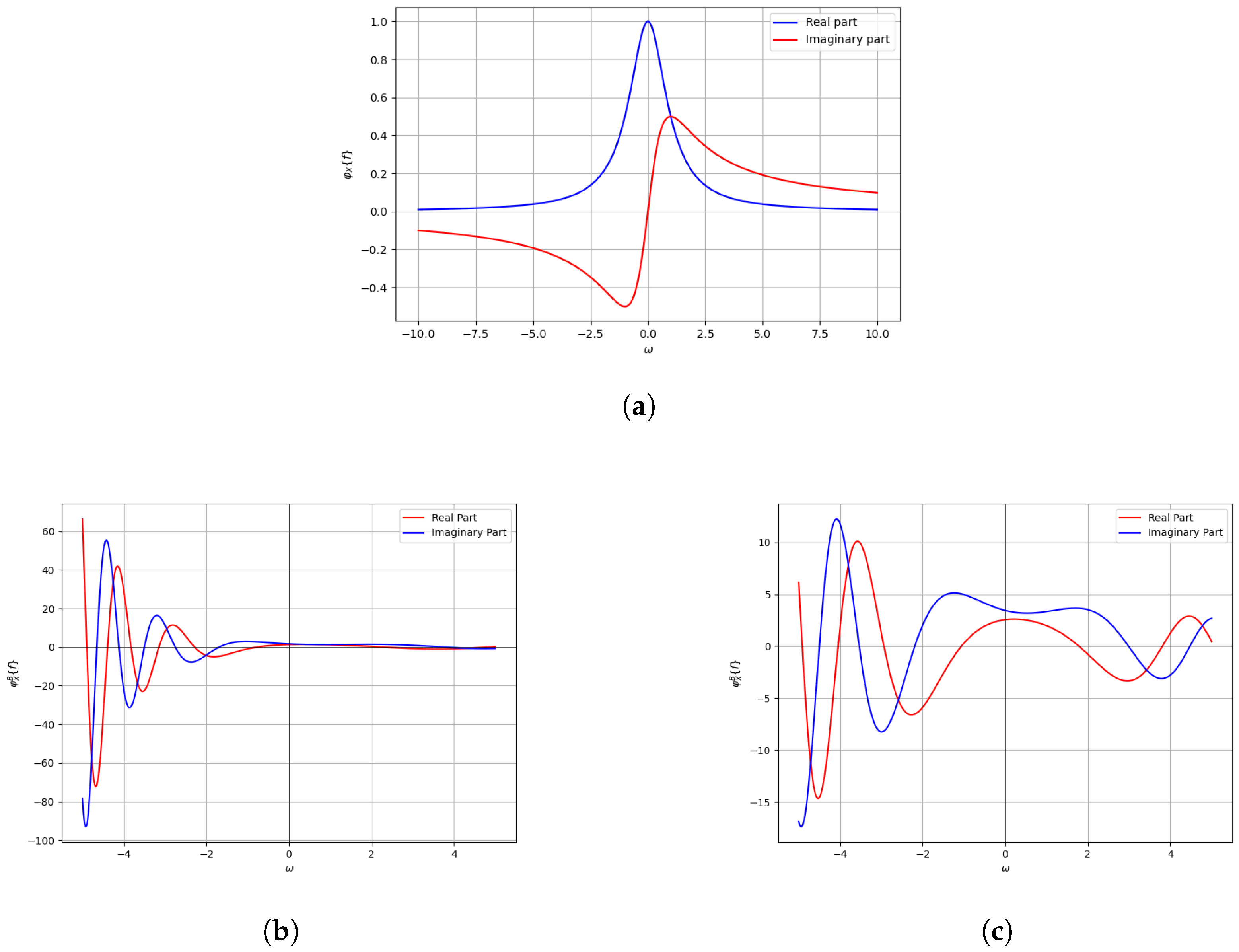
Example 1. Consider the standard exponential distribution whose probability density function is given byThe LCCF of the above function is derived as follows: In fact, we have
We write (
57) as
Changing the variables
, we immediately obtain
A graph of the LCCF of Relation (
59) for different values, compared to the classical characteristic function in (
56), is displayed in
Figure 1.
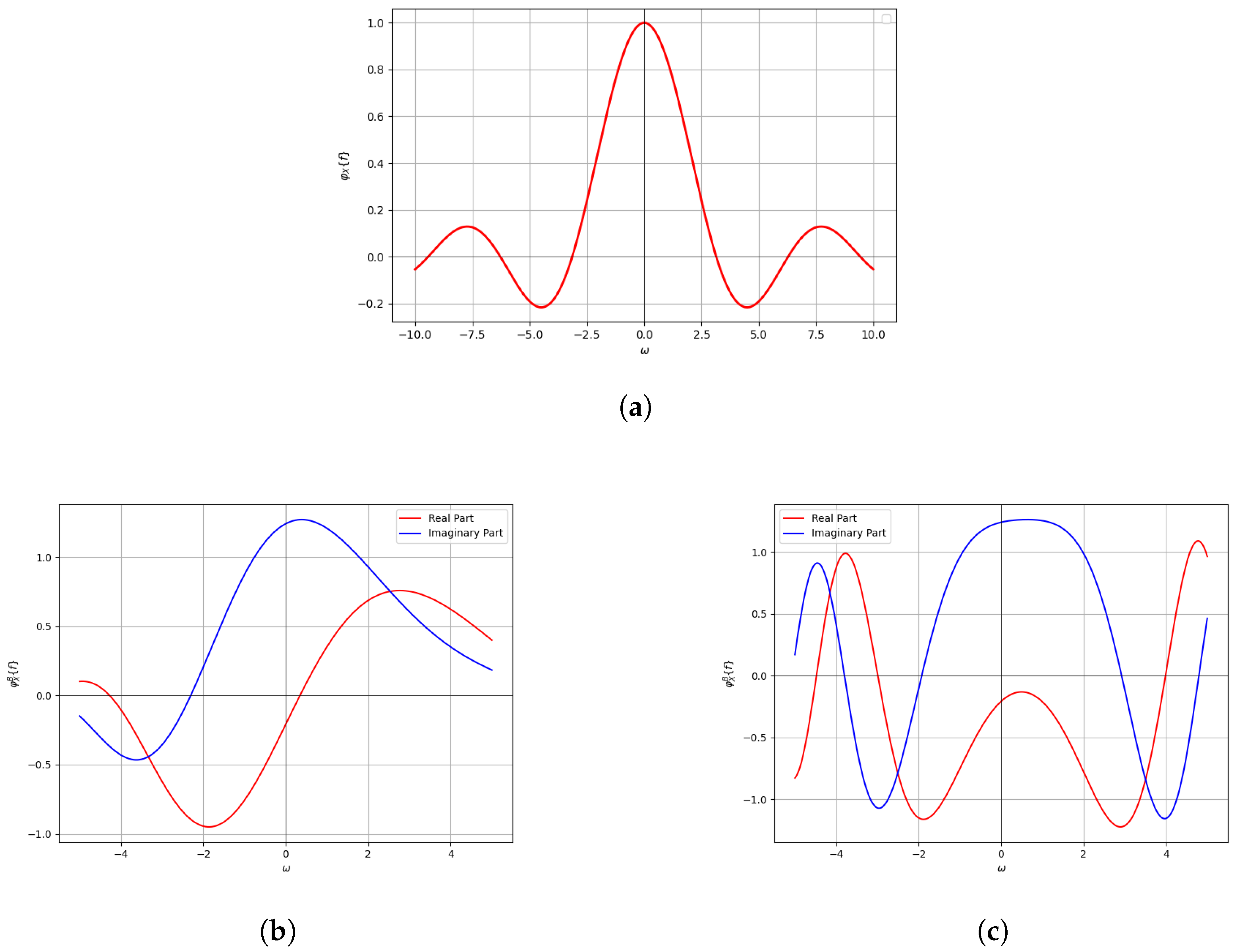
Example 2. Consider the uniform distribution given byIts LCCF is as follows: A simple computation shows
This equation may be further simplified to
Performing the change of variables,
in Equation (
62) yields
Figure 2 illustrates a comparison of the LCCF (
63) with the characteristic function of (
60).
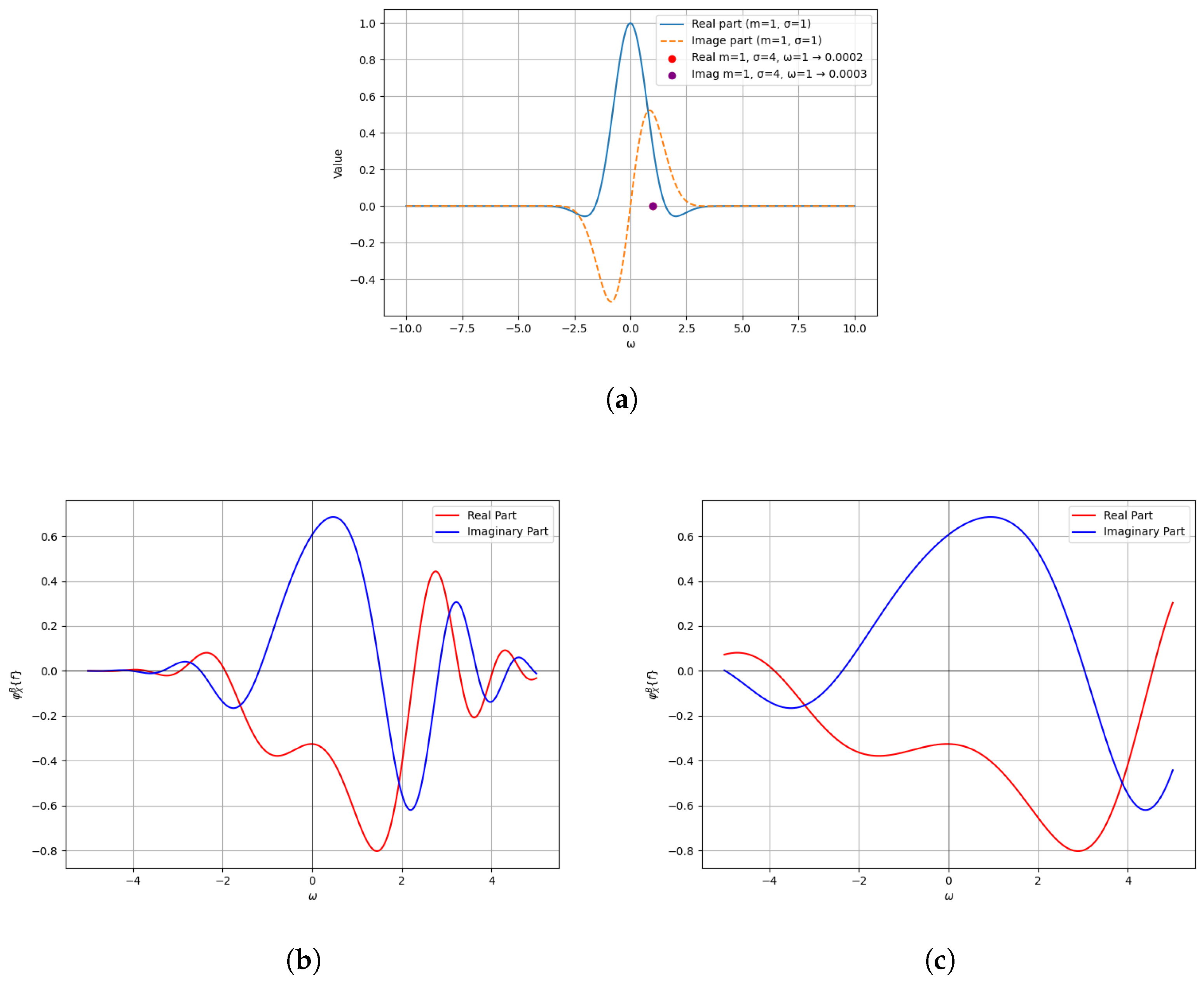
Example 3. Consider a Gaussian random variable with mean m and variance of the form By virtue of Equation (
13), we have
Substituting
into the above expression, we get
Using the fact that
where
with
and
. Thus, Equation (
65) above leads to
This equation is simplified into
It can easily be seen that when
in Expression (
68), we get
which is quite similar to the classical characteristic function of the Gaussian function [
24].
Figure 3 illustrates the difference and comparison of the LCCF (
68) and the characteristic function (
69). These figures demonstrate that the LCCF is more flexible than the classical characteristic function.
Furthermore, we obtain
According to (
43), we obtain
which is the first moment related to the LCCF of Example 3.
Furthermore, simple computations lead to
Now, observe that
By virtue of Equation (
39), we have
which is the second moment related to the LCCF of Example 3. According to Equation (
48), we have
In particular, when we put
in Expression (
74), we immediately obtain
Table 1 summarizes the results derived in Example 3.
6. Conclusions
In this work, we constructed the LCCF as a combination of the LCT kernel and the probability density function used in the classical characteristic function. The investigation of some original results related to the proposed LCCF was performed in detail. It was found that some crucial properties of the classical characteristic function are substantially modified in the LCCF setting. As an application, we presented some examples to verify the obtained results. Future work will extend the one-dimensional LCCF to the n-dimensional case. This approach is based on replacing the kernel of the characteristic function with an n-dimensional LCT kernel. Of course, the results of the -dimensional LCCF will change significantly in the newly constructed n-dimensional LCCF.
Author Contributions
Conceptualization, M.B.; formal analysis, M.B.; funding acquisition, R.I.; investigation, R.I. and S.T.; methodology, R.I.; resources, N.B., S.T. and A.T.A.N.; validation; original draft, R.I., N.B. and S.T.; review—writing and editing, M.B. All authors have read and agreed to the published version of the manuscript.
Funding
This research received no external funding.
Institutional Review Board Statement
Not applicable.
Informed Consent Statement
Not applicable.
Data Availability Statement
Data are contained in the article.
Conflicts of Interest
On behalf of all authors, the corresponding author states that there are no conflicts of interest.
References
- Bahri, M.; Karim, S.A.A. Fractional Fourier transform: Main properties and inequalities. Mathematics 2023, 11, 1234. [Google Scholar] [CrossRef] [Scilit]
- Chen, X.; Dang, P.; Mai, W. LP-type Heisenberg-Pauli-Weyl uncertainty principles for fractional Fourier transform. Appl. Math. Comput. 2025, 491, 129236. [Google Scholar]
- Guo, Y.; Li, B.Z. Blind image watermarking method based on linear canonical transform and QR decomposition. IET Image Process. 2016, 10, 773–786. [Google Scholar] [CrossRef] [Scilit]
- Goel, N.; Singh, K.; Saxena, R. Multiplicative filtering in the linear canonical transform domain. IET Signal Process. 2016, 10, 173–181. [Google Scholar] [CrossRef] [Scilit]
- Wei, D. Filter bank reconstruction of band-limited signals from multichannel samples associated with the LCT. IET Signal Process. 2016, 11, 320–331. [Google Scholar] [CrossRef] [Scilit]
- Mejjaoli, H. Linear canonical DunklWigner transformation: Theory and Localization Operators. J.-Pseudo-Differ. Oper. Appl. 2025, 16, 65. [Google Scholar] [CrossRef] [Scilit]
- Dang, P.; Deng, G.T.; Qian, T. A tighter uncertainty principle for linear canonical transform in terms of phase derivative. IEEE Trans. Signal Process. 2013, 61, 5153–5164. [Google Scholar] [CrossRef] [Scilit]
- Bing, D.; Ran, T.; Yue, W. Convolution theorems for the linear canonical transform and their application. Sci. China Ser. F Inf. Sci. 2006, 49, 592–603. [Google Scholar]
- Wei, D.; Ran, Q.; Li, Y. New convolution theorem for the linear canonical transform and its translation invariance property. Optik 2021, 123, 1478–1481. [Google Scholar] [CrossRef] [Scilit]
- Feng, Q.; Li, B.Z. Convolution and correlation theorems for the two-dimensional linear canonical transform and its applications. IET Signal Process. 2016, 10, 125–132. [Google Scholar] [CrossRef] [Scilit]
- Cottone, G.; Paola, M.D.; Metzler, R. Fractional calculus approach to the statistical characterization of random variables and vectors. Phys. A Stat. Mech. Its Appl. 2010, 389, 909–920. [Google Scholar] [CrossRef] [Scilit]
- Tomovski, Ž.; Ralf Metzler, R.; Gerhold, S. Fractional characteristic functions, and a fractional calculus approach for moments of random variables. Fract. Calc. Appl. Anal. 2022, 25, 1307–1323. [Google Scholar] [CrossRef] [Scilit]
- Peng, J.; Li, K. A note on property of the Mittag-Leffler function. J. Math. Anal. Appl. 2010, 370, 635–638. [Google Scholar] [CrossRef] [Scilit]
- Monaim, H.; Fahlaoui, S. General one-dimensional Clifford Fourier transform and application to probability theory. Rend. Circ. Mat. Palermo Ser. II 2024, 73, 1453–1466. [Google Scholar] [CrossRef] [Scilit]
- Ekasasmita, W.; Bahri, M.; Bachtiar, N.; Rahim, A.; Nur, M. One-dimensional quaternion Fourier transform with application to probability theory. Symmetry 2023, 15, 815. [Google Scholar] [CrossRef] [Scilit]
- Nurwahidah, N.; Bahri, M.; Rahim, A. Two-dimensional quaternion Fourier transform method in probability modeling. Symmetry 2024, 16, 257. [Google Scholar] [CrossRef] [Scilit]
- Samad, M.A.; Xia, Y.; Siddiqui, S.; Bhat, M.Y.; Urynbassarova, D.; Urynbassarova, A. Quaternion fractional Fourier transform: Bridging signal processing and probability theory. Mathematics 2025, 13, 195. [Google Scholar] [CrossRef] [Scilit]
- Samad, M.A.; Xia, Y.; Siddiqui, S.; Bhat, M.Y. Two-dimensional quaternion linear canonical transform: A novel framework for probability modeling. J. Appl. Math. Comput. 2025, 71, 7493–7519. [Google Scholar] [CrossRef] [Scilit]
- Siddiqui, S.; Samad, M.A.; Ismoiljonovich, F.D. One dimensional quaternion linear canonical transform in probability theory. Signal Image Video Process. 2024, 18, 9419–9430. [Google Scholar] [CrossRef] [Scilit]
- Wei, D.; Ran, Q.; Li, Y. A convolution and convolution theorem for the linear canonical transform and its application. Circuits Syst. Sig. Process. 2022, 31, 301–312. [Google Scholar] [CrossRef] [Scilit]
- Debnath, L.; Shah, F.A. Wavelet Transforms and Their Applications; Springer Nature: Cham, Switzerland, 2020. [Google Scholar]
- Bracewell, R. The Fourier Transform and Its Applications; McGraw Hill: New York, NY, USA, 2000. [Google Scholar]
- Dai, H.; Ma, Z.; Li, L. An improved complex fractional moment-based approach for the probabilistic characterization of random variables. Probabilistic Eng. Mech. 2018, 53, 52–58. [Google Scholar] [CrossRef] [Scilit]
- Karr, A.F. Characteristic Functions. In Probability. Springer Texts in Statistics; Springer: New York, NY, USA, 1993. [Google Scholar]
| Disclaimer/Publisher’s Note: The statements, opinions and data contained in all publications are solely those of the individual author(s) and contributor(s) and not of MDPI and/or the editor(s). MDPI and/or the editor(s) disclaim responsibility for any injury to people or property resulting from any ideas, methods, instructions or products referred to in the content. |




 ,
,