


Utilization and Outcomes of Pedicled Anterolateral Thigh Flaps: A Systematic Scoping Review of the Literature


Abstract
1. Introduction
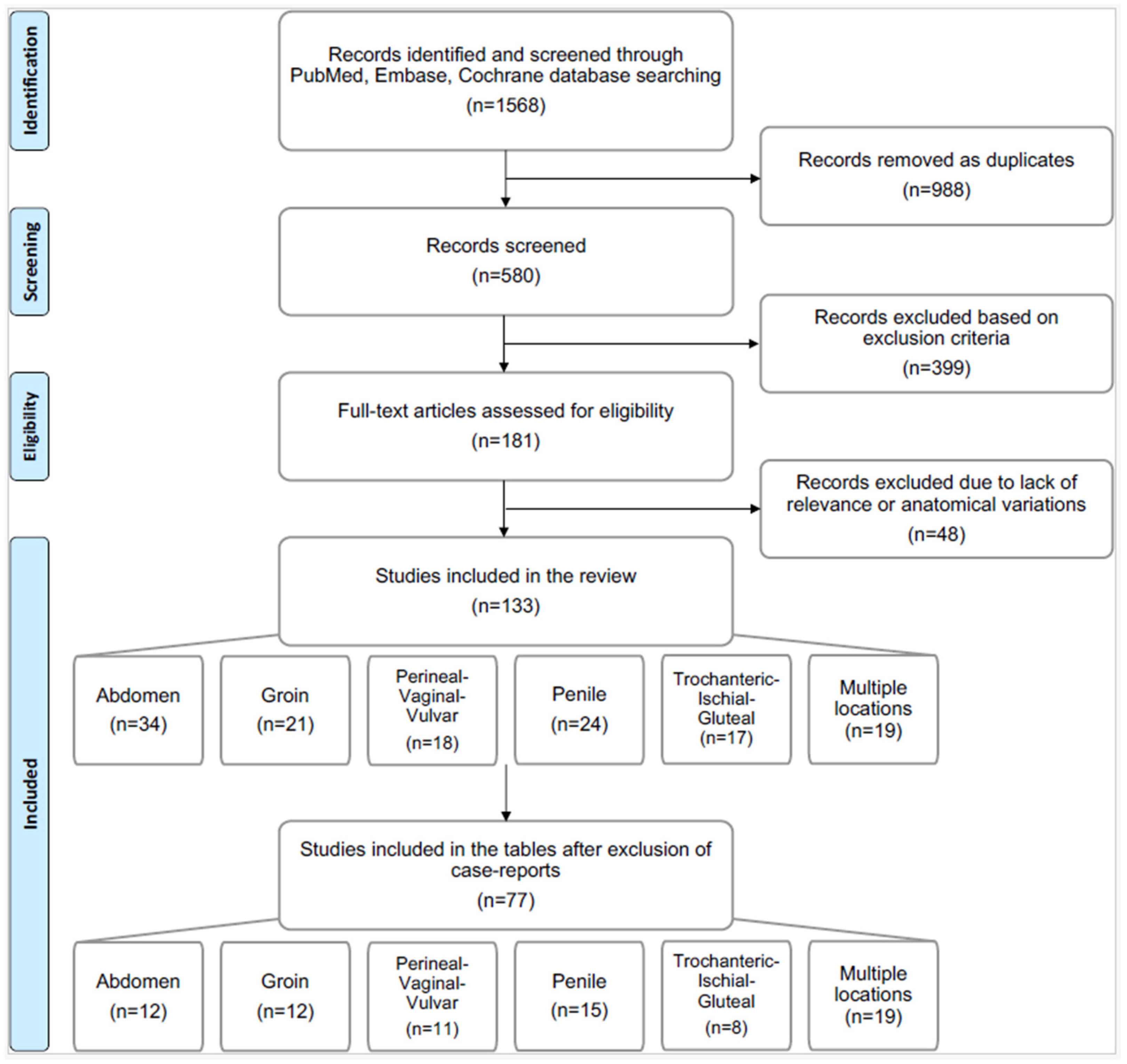
2. Materials and Methods
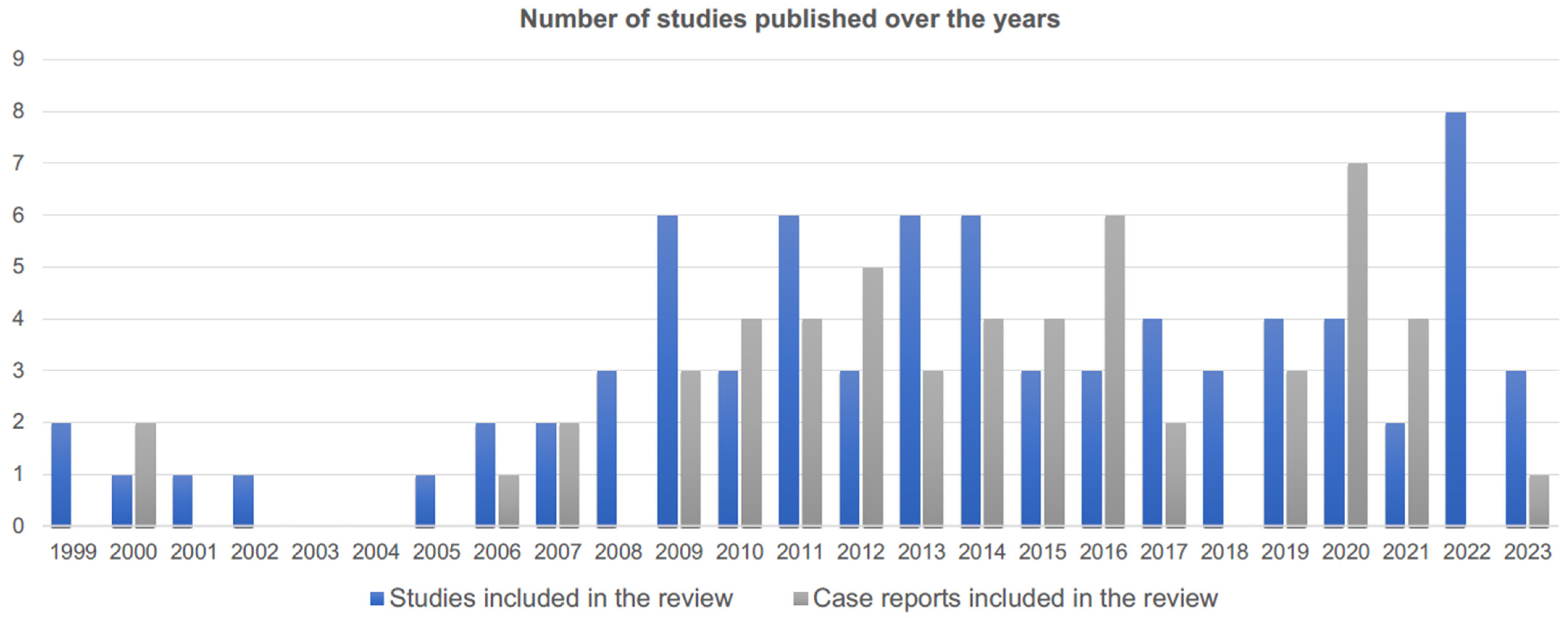
3. Results
4. Discussion
4.1. Abdomen
4.2. Groin
4.3. Perineum
4.4. Penile
4.5. Trochanteric, Ischial and Sacrogluteal
4.6. Multiple Locations
4.7. Limitations
5. Conclusions
Supplementary Materials
Author Contributions
Funding
Institutional Review Board Statement
Informed Consent Statement
Data Availability Statement
Conflicts of Interest
References
- Song, Y.G.; Chen, G.Z.; Song, Y.L. The free thigh flap: A new free flap concept based on the septocutaneous artery. Br. J. Plast. Surg. 1984, 37, 149. [Google Scholar] [CrossRef]
- Wei, F.C.; Jain, V.; Celik, N.; Chen, H.C.; Chuang, D.C.C.; Lin, C.H. Have we found an ideal soft-tissue flap? An experience with 672 anterolateral thigh flaps. Plast. Reconstr. Surg. 2002, 109, 2219–2230. [Google Scholar] [CrossRef] [PubMed]
- Hsu, H.; Chien, S.H.; Wang, C.H.; Hsu, H.M.; Chien, S.-H.; Wang, C.-H.; Cheng, L.-F.; Lin, C.-M.; Wu, M.-S.; Huang, C.-C.; et al. Expanding the Applications of the Pedicled Anterolateral Thigh and Vastus Lateralis Myocutaneous Flaps. Ann. Plast. Surg. 2012, 69, 643–649. [Google Scholar] [CrossRef] [PubMed]
- Di Summa, P.G.; Tremp, M.; Meyer zu Schwabedissen, M.; Schaefer, D.J.; Kalbermatten, D.F.; Raffoul, W. The Combined Pedicled Anterolateral Thigh and Vastus Lateralis Flap as Filler for Complex Perineal Defects. Ann. Plast. Surg. 2015, 75, 66–73. [Google Scholar] [CrossRef]
- Shih, P.K. Feasibility of pedicled anterolateral thigh flap with tensor fascia lata and vastus lateralis for difficult abdominal wall closure. Hernia 2019, 23, 749–755. [Google Scholar] [CrossRef]
- Acartürk, T. Femur-Vastus Intermedius-Anterolateral Thigh Osteomyocutaneous Composite Chimeric Free Flap: A New Free Flap for the Reconstruction of Complex Wounds. J. Reconstr. Microsurg. 2011, 27, 187–194. [Google Scholar] [CrossRef]
- Toia, F.; D’Arpa, S.; Brenner, E.; Melloni, C.; Moschella, F.; Cordova, A. Segmental anatomy of the vastus lateralis: Guidelines for muscle-sparing flap harvest. Plast. Reconstr. Surg. 2015, 135, 185e–198e. [Google Scholar] [CrossRef] [PubMed]
- Neligan, P.C.; Lannon, D.A. Versatility of the Pedicled Anterolateral Thigh Flap. Clin. Plast. Surg. 2010, 37, 677–681. [Google Scholar] [CrossRef] [PubMed]
- Lannon, D.A.; Ross, G.L.; Addison, P.D.; Novak, C.B.; Lipa, J.E.; Neligan, P.C. Versatility of the Proximally Pedicled Anterolateral Thigh Flap and Its Use in Complex Abdominal and Pelvic Reconstruction. Plast. Reconstr. Surg. 2011, 127, 677–688. [Google Scholar] [CrossRef]
- Fernandez-Alvarez, J.A.; Barrera-Pulido, F.; Lagares-Borrego, A.; Narros-Gimenez, R.; Gacto-Sanchez, P.; Gomez-Cia, T. Coverage of supraumbilical abdominal wall defects: The tunnelled-pedicled ALT technique. Microsurgery 2017, 37, 119–127. [Google Scholar] [CrossRef] [PubMed]
- Gravvanis, A.I.; Tsoutsos, D.A.; Karakitsos, D.; Panayotou, P.; Iconomou, T.; Zografos, G.; Karabinis, A.; Papadopoulos, O. Application of the pedicled anterolateral thigh flap to defects from the pelvis to the knee. Microsurgery 2006, 26, 432–438. [Google Scholar] [CrossRef] [PubMed]
- Vijayasekaran, A.; Gibreel, W.; Carlsen, B.T.; Moran, S.L.; Saint-Cyr, M.; Bakri, K.; Sharaf, B. Maximizing the Utility of the Pedicled Anterolateral Thigh Flap for Locoregional Reconstruction: Technical Pearls and Pitfalls. Clin. Plast. Surg. 2017, 44, 371–384. [Google Scholar] [CrossRef] [PubMed]
- Kosutic, D.; Tsapralis, N.; Gubbala, P.; Smith, M. Reconstruction of critically-sized perineal defect with perforator flap puzzle technique: A case report. Case Rep. Plast. Surg. Hand Surg. 2019, 6, 38–42. [Google Scholar] [CrossRef]
- Frey, J.D.; Jacoby, A.; Cohen, S.M.; Saadeh, P.B.; Levine, J.P. Massive, Extended Pedicled Anterolateral Thigh Flap for Abdominal Wall Reconstruction. Plast. Reconstr. Surg. 2020, 147, 181e–182e. [Google Scholar] [CrossRef]
- Yang, Q.; Ren, Z.H.; Chickooree, D.; Wu, H.; Tan, H.; Wang, K.; He, Z.; Gong, C.; Ram, V.; Zhang, S. The effect of early detection of anterolateral thigh free flap crisis on the salvage success rate, based on 10 years of experience and 1072 flaps. Int. J. Oral Maxillofac. Surg. 2014, 43, 1059–1063. [Google Scholar] [CrossRef]
- Kimata, Y.; Uchiyama, K.; Sekido, M.; Sakuraba, M.; Iida, H.; Nakatsuka, T.; Harii, K. Anterolateral thigh flap for abdominal wall reconstruction. Plast. Reconstr. Surg. 1999, 103, 1191–1197. [Google Scholar] [CrossRef] [PubMed]
- Luo, S.; Raffoul, W.; Luo, J.; Luo, L.; Gao, J.; Chen, L.; Egloff, D.V. Anterolateral thigh flap: A review of 168 cases. Microsurgery 1999, 19, 232–238. [Google Scholar] [CrossRef]
- Nthumba, P.; Barasa, J.; Cavadas, P.C.; Landin, L. Pedicled Fasciocutaneous Anterolateral Thigh Flap for the Reconstruction of a Large Postoncologic Abdominal Wall Resection Defect. Ann. Plast. Surg. 2012, 68, 188–189. [Google Scholar] [CrossRef]
- Di Summa, P.G.; Watfa, W.; Giordano, S.; Elahi-Rausis, L.; Bauquis, O.; Hahnloser, D.; Raffoul, W. Composite ALT flap for structured reconstruction of the abdominal wall: New insights from long-term outcomes in 14 patients. J. Plast. Reconstr. Aesthet. Surg. 2019, 72, 1700–1738. [Google Scholar] [CrossRef] [PubMed]
- Zhou, B.; Zhou, X.; Li, Z.; Chen, J.-Y.; Peng, X.-W.; Yang, L.-C.; Lv, C.-L. Reconstruction of the Lower Abdominal Region Using Bilateral Pedicled Anterolateral Thigh Flaps Combined with Poly-Surgical Mesh. Medicine (Baltimore) 2015, 94, e2375. [Google Scholar] [CrossRef] [PubMed]
- Zelken, J.A.; AlDeek, N.F.; Hsu, C.C.; Chang, N.J.; Lin, C.H.; Lin, C.H. Algorithmic approach to lower abdominal, perineal, and groin reconstruction using anterolateral thigh flaps. Microsurgery 2016, 36, 104–114. [Google Scholar] [CrossRef]
- Fukui, K.; Fujioka, M.; Ishiyama, S. Reconstruction of Abdominal Wall Defects Using a Pedicled Anterolateral Thigh Flap Including the Vastus Lateralis Muscle: A Report of Two Cases. Case Rep. Surg. 2016, 2016, 8753479. [Google Scholar] [CrossRef]
- Gao, Z.; Zhang, D.; Lei, F.; Zeng, Q.; Huang, W.; Wang, Y.; Gao, Q.; Niu, P.; Hong, Y.; He, X.; et al. Surgical treatment of massive stoma site tumors after a curative operation for rectal cancer. Eur. J. Surg. Oncol. 2020, 46, e40–e46. [Google Scholar] [CrossRef]
- Lambe, G.; Russell, C.; West, C.; Kalaiselvan, R.; Slade, D.A.J.; Anderson, I.D.; Watson, J.S.; Carlson, G.L. Autologous reconstruction of massive enteroatmospheric fistulation with a pedicled subtotal lateral thigh flap. Br. J. Surg. 2012, 99, 964–972. [Google Scholar] [CrossRef]
- Wu, C.W.; Lin, C.H.; Lin, C.H. One-stage posttraumatic bladder reconstruction and soft-tissue coverage of the lower abdomen or perineum. Ann. Plast. Surg. 2010, 64, 65–68. [Google Scholar] [CrossRef]
- Ete, G.; Mj, F.C.; Kingsly, P.M.; Akamanchi, A.K.; Agarwal, S. Abdominal Wall Reconstruction in Adults with Exstrophy of the Bladder. Ann. Plast. Surg. 2022, 89, 675–678. [Google Scholar] [CrossRef]
- Lin, S.J.; Butler, C.E. Subtotal Thigh Flap and Bioprosthetic Mesh Reconstruction for Large, Composite Abdominal Wall Defects. Plast. Reconstr. Surg. 2010, 125, 1146–1156. [Google Scholar] [CrossRef] [PubMed]
- Vranckx, J.J.; Stoel, A.M.; Segers, K.; Nanhekhan, L. Dynamic reconstruction of complex abdominal wall defects with the pedicled innervated vastus lateralis and anterolateral thigh PIVA flap. J. Plast. Reconstr. Aesthet. Surg. 2015, 68, 837–845. [Google Scholar] [CrossRef] [PubMed]
- Kayano, S.; Sakuraba, M.; Miyamoto, S.; Nagamatsu, S.; Taji, M.; Umezawa, H.; Kimata, Y. Comparison of pedicled and free anterolateral thigh flaps for reconstruction of complex defects of the abdominal wall: Review of 20 consecutive cases. J. Plast. Reconstr. Aesthet. Surg. 2012, 65, 1525–1529. [Google Scholar] [CrossRef]
- Srinivas, J.S.; Panagatla, P.; Damalacheru, M.R. Reconstruction of Type II abdominal wall defects: Anterolateral thigh or tensor fascia lata myocutaneous flaps? Indian J. Plast. Surg. 2018, 51, 33–39. [Google Scholar] [CrossRef]
- Di Summa, P.G.; Watfa, W.; Campisi, C.; Giordano, S.; Oranges, C.M.; Elahi-Rausis, L.; Bauquis, O.; Hahnloser, D.; Demartines, N.; Raffoul, W. Free versus pedicled anterolateral thigh flap for abdominal wall reconstruction. Anticancer Res. 2019, 39, 6759–6768. [Google Scholar] [CrossRef] [PubMed]
- Acarturk, T.O.; Bengur, F.B. Total aesthetic subunit reconstruction of the burned anterior abdomen using pre-expanded pedicled anterolateral thigh flap—A case report. Microsurgery 2019, 39, 753–757. [Google Scholar] [CrossRef]
- Tamai, M.; Nagasao, T.; Miki, T.; Hamamoto, Y.; Kogure, T.; Tanaka, Y. Rotation arc of pedicled anterolateral thigh flap for abdominal wall reconstruction: How far can it reach? J. Plast. Reconstr. Aesthet. Surg. 2015, 68, 1417–1424. [Google Scholar] [CrossRef] [PubMed]
- Maxhimer, J.B.; Hui-Chou, H.G.; Rodriguez, E.D. Clinical Applications of the Pedicled Anterolateral Thigh Flap in Complex Abdominal–Pelvic Reconstruction. Ann. Plast. Surg. 2011, 66, 285–291. [Google Scholar] [CrossRef]
- Cunha-Gomes, D.; Bembde, R.; Bhathena, H.; Kavarana, N.M. The pedicled anterolateral thigh island flap for inguinal defects. Eur. J. Plast. Surg. 2000, 23, 97–100. [Google Scholar] [CrossRef]
- Cunha-Gomes, D.; Bhathena, H.M.; Kavarana, N.M. The anterolateral thigh flap: A versatile pedicled and free flap transfer. Eur. J. Plast. Surg. 2001, 24, 80–84. [Google Scholar] [CrossRef]
- Shih, P.K.; Cheng, H.T.; Wu, C.I.; Chang, S.C.N.; Chen, H.C.; Chen, H.H. Management of infected groin wounds after vascular surgery. Surg. Infect. 2013, 14, 325–330. [Google Scholar] [CrossRef] [PubMed]
- Aslim, E.J.; Rasheed, M.Z.; Lin, F.; Ong, Y.S.; Tan, B.K. Use of the Anterolateral Thigh and Vertical Rectus Abdominis Musculocutaneous Flaps as Utility Flaps in Reconstructing Large Groin Defects. Arch. Plast. Surg. 2014, 41, 556. [Google Scholar] [CrossRef] [PubMed]
- Friji, M.T.; Suri, M.P.; Shankhdhar, V.K.; Ahmad, Q.G.; Yadav, P.S. Pedicled Anterolateral Thigh Flap. Ann. Plast. Surg. 2010, 64, 458–461. [Google Scholar] [CrossRef] [PubMed]
- Evriviades, D.; Raurell, A.; Perks, A.G.B. Pedicled Anterolateral Thigh Flap for Reconstruction After Radical Groin Dissection. Urology 2007, 70, 996–999. [Google Scholar] [CrossRef] [PubMed]
- Gravvanis, A.; Caulfield, R.H.; Mathur, B.; Ramakrishnan, V. Management of Inguinal Lymphadenopathy. Ann. Plast. Surg. 2009, 63, 307–310. [Google Scholar] [CrossRef]
- Uygur, F.; Sever, C.; Kulahci, Y.; Gideroğlu, K. Reconstruction of postburn inguinal contractures using the pedicled anterolateral thigh Flap. Burns 2009, 35, e3–e7. [Google Scholar] [CrossRef] [PubMed]
- Logiudice, J.A.; Haberman, K.; Sanger, J.R. The anterolateral thigh flap for groin and lower abdominal defects: A better alternative to the rectus abdominis flap. Plast. Reconstr. Surg. 2014, 133, 162–168. [Google Scholar] [CrossRef] [PubMed]
- Arvanitakis, M.; Schlagnitweit, P.; Franchi, A.; Fritsche, E.; Chen, Y.C.; Scaglioni, M.F. Groin defect reconstruction with perforator flaps: Considerations after a retrospective single-center analysis of 54 consecutive cases. J. Plast. Reconstr. Aesthet. Surg. 2019, 72, 1795–1804. [Google Scholar] [CrossRef] [PubMed]
- Fuzzard, S.K.; Mah, E.; Choong, P.F.M.; Grinsell, D. Lymphoedema rates in pedicled anterolateral thigh flaps for coverage of irradiated groin defects. ANZ J. Surg. 2020, 90, 135–138. [Google Scholar] [CrossRef] [PubMed]
- Hernekamp, J.F.; Lauer, H.; Goertz, O.; Weigang, E.; Kneser, U.; Kremer, T. Soft Tissue Reconstruction of Complex Infrainguinal Wounds Following Revisionary Vascular Surgery. Ann. Vasc. Surg. 2023, 88, 108–117. [Google Scholar] [CrossRef] [PubMed]
- Scaglioni, M.F.; Meroni, M.; Fritsche, E. Soft Tissue Defect Reconstruction and Lymphatic Complications Prevention: The Lymphatic Flow-Through (LyFT) Concept. Medicina 2022, 58, 509. [Google Scholar] [CrossRef]
- Luo, S.; Raffoul, W.; Piaget, F.; Egloff, D.V. Anterolateral thigh fasciocutaneous flap in the difficult perineogenital reconstruction. Plast. Reconstr. Surg. 2000, 105, 171–173. [Google Scholar] [CrossRef] [PubMed]
- Huang, L.Y.; Lin, H.; Liu, Y.T.; ChangChien, C.C.; Chang, S.Y. Anterolateral thigh vastus lateralis myocutaneous flap for vulvar reconstruction after radical vulvectomy: A preliminary experience. Gynecol. Oncol. 2000, 78, 391–393. [Google Scholar] [CrossRef]
- Wang, X.; Qiao, Q.; Burd, A.; Liu, Z.; Zhao, R.; Wang, C.; Zeng, A. Perineum reconstruction with pedicled anterolateral thigh fasciocutaneous flap. Ann. Plast. Surg. 2006, 56, 151–155. [Google Scholar] [CrossRef]
- Wong, S.; Garvey, P.; Skibber, J.; Yu, P. Reconstruction of Pelvic Exenteration Defects with Anterolateral Thigh–Vastus Lateralis Muscle Flaps. Plast. Reconstr. Surg. 2009, 124, 1177–1185. [Google Scholar] [CrossRef]
- Zeng, A.; Qiao, Q.; Zhao, R.; Song, K.; Long, X. Anterolateral thigh flap-based reconstruction for oncologic vulvar defects. Plast. Reconstr. Surg. 2011, 127, 1939–1945. [Google Scholar] [CrossRef] [PubMed]
- Gentileschi, S.; Servillo, M.; Garganese, G.; Simona, F.; Scambia, G.; Salgarello, M. Versatility of pedicled anterolateral thigh flap in gynecologic reconstruction after vulvar cancer extirpative surgery. Microsurgery 2017, 37, 516–524. [Google Scholar] [CrossRef] [PubMed]
- Ng, R.W.M.; Chan, J.Y.W.; Mok, V.; Li, G.K.H. Clinical use of a pedicled anterolateral thigh flap. J. Plast. Reconstr. Aesthet. Surg. 2008, 61, 158–164. [Google Scholar] [CrossRef]
- Crosby, M.A.; Hanasono, M.M.; Feng, L.; Butler, C.E. Outcomes of partial vaginal reconstruction with pedicled flaps following oncologic resection. Plast. Reconstr. Surg. 2011, 127, 663–669. [Google Scholar] [CrossRef] [PubMed]
- Rossi, S.A.; Martineau, J.J.C.; Guillier, D.; Hübner, M.; Hahnloser, D.; Raffoul, W.; di Summa, P.G.M. Outcomes of the Composite Anterolateral Thigh Flap for Perineal Reconstruction after Postoncological Abdominoperineal Resection. Colon Rectum 2022, 65, 373–381. [Google Scholar] [CrossRef]
- Spyropoulou, G.A.; Jeng, S.F.; Demiri, E.; Dionyssopoulos, A.; Feng, K.M. Reconstruction of Perineoscrotal and Vaginal Defects with Pedicled Anterolateral Thigh Flap. Urology 2013, 82, 461–465. [Google Scholar] [CrossRef] [PubMed]
- Lin, C.T.; Chang, S.C.; Chen, S.G.; Tzeng, Y.S. Reconstruction of perineoscrotal defects in Fournier’s gangrene with pedicle anterolateral thigh perforator flap. ANZ J. Surg. 2016, 86, 1052–1055. [Google Scholar] [CrossRef] [PubMed]
- Perrault, D.; Kin, C.; Wan, D.C.; Kirilcuk, N.; Shelton, A.; Momeni, A. Pelvic/Perineal Reconstruction: Time to Consider the Anterolateral Thigh Flap as a First-line Option? Plast. Reconstr. Surg. Glob. Open 2020, 8, e2733. [Google Scholar] [CrossRef]
- Meuli, J.N.; Hubner, M.; Martineau, J.; Oranges, C.M.; Guillier, D.; Raffoul, W.; di Summa, P.G. Impact of etiology leading to abdominoperineal resection with anterolateral thigh flap reconstruction: A retrospective cohort study. J. Surg. Oncol. 2023, 127, 40–47. [Google Scholar] [CrossRef]
- Nthumba, P. Versatility of the Pedicled ALT Flap in Defect Reconstruction: Experience of a Unit in Rural Sub-Saharan African. Ann. Afr. Surg. 2018, 15. [Google Scholar] [CrossRef]
- Lin, C.T.; Wang, C.H.; Ou, K.W.; Chang, S.; Dai, N.; Chen, S.; Chen, T.; Tzeng, Y. Clinical applications of the pedicled anterolateral thigh flap in reconstruction. ANZ J. Surg. 2017, 87, 499–504. [Google Scholar] [CrossRef] [PubMed]
- Yu, P.; Sanger, J.R.; Matloub, H.S.; Gosain, A.; Larson, D. Anterolateral Thigh Fasciocutaneous Island Flaps in Perineoscrotal Reconstruction. Plast. Reconstr. Surg. 2002, 109, 610–616. [Google Scholar] [CrossRef] [PubMed]
- Gravvanis, A.I.; Tsoutsos, D.A.; Iconomou, T.G.; Papadopoulos, S.G. Penile Resurfacing with Vascularized Fascia Lata. J. Urol. 2006, 175, 594. [Google Scholar] [CrossRef]
- Rashid, M.; Aslam, A.; Malik, S.; Tamimy, M.S.; Haq, E.U.; Aman, S.; Jamy, O. Clinical applications of the pedicled anterolateral thigh flap in penile reconstruction. J. Plast. Reconstr. Aesthet. Surg. 2011, 64, 1075–1081. [Google Scholar] [CrossRef] [PubMed]
- Wu, Q.; Yang, Z.; Ma, N.; Wang, W.; Li, Y. Urethra Reconstruction and Revision Urethroplasty in Pedicled Anterolateral Thigh Flap Penile Reconstruction. Ann. Plast. Surg. 2022, 89, 201–206. [Google Scholar] [CrossRef]
- Cao, Z.; Liu, L.; Yang, Z.; Li, Y.; Jiao, H.; Zhang, T.; Zhou, L. The pedicled gracilis muscle combined with the fascia lata: A preliminary clinical study of a new biomimetic dynamic phalloplasty method. J. Sex. Med. 2023, 20, 573–579. [Google Scholar] [CrossRef]
- Robinson, I.; Chao, B.W.; Blasdel, G.; Levine, J.P.; Bluebond-Langner, R.; Zhao, L.C. Anterolateral Thigh Phalloplasty with Staged Skin Graft Urethroplasty: Technique and Outcomes. Urology 2023, 177, 204–212. [Google Scholar] [CrossRef]
- Lumen, N.; Monstrey, S.; Ceulemans, P.; van Laecke, E.; Hoebeke, P. Reconstructive Surgery for Severe Penile Inadequacy: Phalloplasty with a Free Radial Forearm Flap or a Pedicled Anterolateral Thigh Flap. Adv. Urol. 2008, 2008, 704343. [Google Scholar] [CrossRef] [PubMed]
- Lee, G.K.; Lim, A.F.; Bird, E.T. A novel single-flap technique for total penile reconstruction: The pedicled anterolateral thigh flap. Plast. Reconstr. Surg. 2009, 124, 163–166. [Google Scholar] [CrossRef] [PubMed]
- Descamps, M.J.L.; Hayes, P.M.; Hudson, D.A. Phalloplasty in complete aphallia: Pedicled anterolateral thigh flap. J. Plast. Reconstr. Aesthet. Surg. 2009, 62, e51–e54. [Google Scholar] [CrossRef]
- Sinove, Y.; Kyriopoulos, E.; Ceulemans, P.; Houtmeyers, P.; Hoebeke, P.; Monstrey, S. Preoperative planning of a Pedicled Anterolateral Thigh (ALT) flap for penile reconstruction with the multidetector CT scan. Handchir. Mikrochir. Plast. Chir. 2013, 45, 217–222. [Google Scholar] [CrossRef] [PubMed]
- Zhang, Y.F.; Liu, C.Y.; Qu, C.Y.; Lu, L.-X.; Liu, A.-T.; Zhu, L.; Wang, H.; Lin, Z.-H.; Zhao, Y.-Z.; Zhu, X.-H.; et al. Is vaginal mucosal graft the excellent substitute material for urethral reconstruction in female-to-male transsexuals? World J. Urol. 2015, 33, 2115–2123. [Google Scholar] [CrossRef] [PubMed]
- D’Arpa, S.; Colebunders, B.; Stillaert, F.; Monstrey, S. Pre-expanded Anterolateral Thigh Perforator Flap for Phalloplasty. Clin. Plast. Surg. 2017, 44, 129–141. [Google Scholar] [CrossRef]
- van der Sluis, W.B.; Smit, J.M.; Pigot, G.L.S.; Buncamper, M.E.; Winters, H.A.; Mullender, M.G.; Bouman, M. Double flap phalloplasty in transgender men: Surgical technique and outcome of pedicled anterolateral thigh flap phalloplasty combined with radial forearm free flap urethral reconstruction. Microsurgery 2017, 37, 917–923. [Google Scholar] [CrossRef] [PubMed]
- Ascha, M.; Massie, J.P.; Morrison, S.D.; Crane, C.N.; Chen, M.L. Outcomes of Single Stage Phalloplasty by Pedicled Anterolateral Thigh Flap versus Radial Forearm Free Flap in Gender Confirming Surgery. J. Urol. 2018, 199, 206–214. [Google Scholar] [CrossRef] [PubMed]
- D’Arpa, S.; Claes, K.; Lumen, N.; Oieni, S.; Hoebeke, P.; Monstrey, S. Urethral Reconstruction in Anterolateral Thigh Flap Phalloplasty: A 93-Case Experience. Plast. Reconstr. Surg. 2019, 143, 382e–392e. [Google Scholar] [CrossRef] [PubMed]
- Sinatti, C.; Wolff, D.; Buncamper, M.; Verla, W.; Claes, K.; Lumen, N.; Waterloos, M.; Monstrey, S.; Hoebeke, P.; Spinoit, A.-F. Phalloplasty in biological men with penile insufficiency. J. Pediatr. Urol. 2020, 16, 404–405. [Google Scholar] [CrossRef] [PubMed]
- Terrell, M.; Roberts, W.; Price, C.W.; Slater, M.; Loukas, M.; Schober, J. Anatomy of the pedicled anterolateral thigh flap for phalloplasty in transitioning-males. Clin. Anat. 2018, 31, 160–168. [Google Scholar] [CrossRef] [PubMed]
- Xu, K.Y.; Watt, A.J. The Pedicled Anterolateral Thigh Phalloplasty. Clin. Plast. Surg. 2018, 45, 399–406. [Google Scholar] [CrossRef]
- Morrison, S.D.; Son, J.; Song, J.; Berger, A.; Kirby, J.; Ahdoot, M.; Lee, G.K. Modification of the Tube-in-Tube Pedicled Anterolateral Thigh Flap for Total Phalloplasty. Ann. Plast. Surg. 2014, 72 (Suppl. S1), S22–S26. [Google Scholar] [CrossRef] [PubMed]
- Nahai, F.; Silverton, J.S.; Hill, H.L.; Vasconez, L.O. The tensor fascia lata musculocutaneous flap. Ann. Plast. Surg. 1978, 1, 372–379. [Google Scholar] [CrossRef] [PubMed]
- Lin, M.T.; Chang, K.P.; Lin, S.D.; Lai, C.S.; Yang, Y.L. Tensor fasciae latae combined with tangentially split vastus lateralis musculocutaneous flap for the reconstruction of pressure sores. Ann. Plast. Surg. 2004, 53, 343–347. [Google Scholar] [CrossRef] [PubMed]
- Bovet, J.L.; Nassif, T.M.; Guimberteau, J.C.; Baudet, J. The Vastus Lateralis Musculocutaneous Flap in the Repair of Trochanteric Pressure Sores. Plast. Reconstr. Surg. 1982, 69, 830–834. [Google Scholar] [CrossRef] [PubMed]
- Drimmer, M.A.; Krasna, M.J. The Vastus Lateralis Myocutaneous Flap. Plast. Reconstr. Surg. 1987, 79, 560–564. [Google Scholar] [CrossRef] [PubMed]
- Waterhouse, N.; Healy, C. Vastus lateralis myocutaneous flap for reconstruction of defects around the groin and pelvis. Br. J. Surg. 1990, 77, 1275–1277. [Google Scholar] [CrossRef]
- Tzeng, Y.S.; Yu, C.C.; Chou, T.D.; Chen, T.M.; Chen, S.G. Proximal Pedicled Anterolateral Thigh Flap for Reconstruction of Trochanteric Defect. Ann. Plast. Surg. 2008, 61, 79–82. [Google Scholar] [CrossRef]
- Tzeng, Y.S.; Chang, S.C.; Dai, N.T.; Deng, S.C.; Wang, C.H.; Chen, T.M.; Chen, S.G. Versatile application of pedicled anterolateral thigh flaps in reconstruction. J. Med. Sci. Taiwan 2013, 33, 177–182. [Google Scholar] [CrossRef]
- Wang, C.H.; Chen, S.Y.; Fu, J.P.; Dai, N.-T.; Chen, S.-L.; Chen, T.-M.; Chen, S.-G. Reconstruction of trochanteric pressure sores with pedicled anterolateral thigh myocutaneous flaps. J. Plast. Reconstr. Aesthet. Surg. 2011, 64, 671–676. [Google Scholar] [CrossRef] [PubMed]
- Li, C.C.; Chang, S.C.; Fu, J.P.; Tzeng, Y.-S.; Wang, C.-H.; Chen, T.-M.; Chen, S.-G. Comparison of Hatchet-Shaped Tensor Fascia Lata Flap and Pedicle Anterior Lateral Thigh Flap for Treatment of Trochanteric Sores. Ann. Plast. Surg. 2013, 71, 659–663. [Google Scholar] [CrossRef] [PubMed]
- Lee, J.T.; Cheng, L.F.; Lin, C.M.; Wang, C.H.; Huang, C.C.; Chien, S.H. A new technique of transferring island pedicled anterolateral thigh and vastus lateralis myocutaneous flaps for reconstruction of recurrent ischial pressure sores. J. Plast. Reconstr. Aesthet. Surg. 2007, 60, 1060–1066. [Google Scholar] [CrossRef]
- Acartürk, T.O. Treatment of large ischial ulcers communicating with the hip joint with proximal femoral resection and reconstruction with a combined vastus lateralis, vastus intermedius and rectus femoris musculocutaneous flap. J. Plast. Reconstr. Aesthet. Surg. 2009, 62, 1497–1502. [Google Scholar] [CrossRef]
- Batdorf, N.J.; Lettieri, S.C.; Saint-Cyr, M. Trans-vastus intermedius transfer of the pedicled anterolateral thigh flap for posterior thigh reconstruction. Plast. Reconstr. Surg. 2013, 1, e81. [Google Scholar] [CrossRef] [PubMed]
- Santanelli di Pompeo, F.; Longo, B.; Pagnoni, M.; Laporta, R. Sensate anterolateral thigh perforator flap for ischiatic sores reconstruction in meningomyelocele patients. Microsurgery 2015, 35, 279–283. [Google Scholar] [CrossRef] [PubMed]
- Shah, A.A.; Lozano-Calderon, S.A.; Berner, E.A.; Austen, W.G.; Winograd, J.M.; Park, H.Y.; Bernthal, N.M.; Crawford, B.M.; Hornicek, F.J. Pedicled vastus lateralis myocutaneous flap for sacropelvic defects after wide oncologic resection: Wound complications and outcomes. J. Surg. Oncol. 2022, 126, 978–985. [Google Scholar] [CrossRef] [PubMed]
- Madsen, C.B.; Sørensen, J.A. Versatility of the pedicled anterolateral thigh flap for surgical reconstruction, a case series. JPRAS Open 2020, 25, 52–61. [Google Scholar] [CrossRef] [PubMed]
- Jakubietz, R.; Jakubietz, M.; Vater, A.; Kocot, A.; Kübler, H.; Kalogirou, C. Complex Soft Tissue Defects in Operative Urology: Pedicled Perforator Flaps of the Anterior Lateral Thigh for Tissue Reconstruction of the Lower Trunk. Urol. Int. 2021, 105, 477–482. [Google Scholar] [CrossRef] [PubMed]
- Acartürk, T.O.; Bengür, F.B. individually tailored approach to reconstruction of complex defects using versatility of the lateral circumflex femoral artery system-based pedicled flaps. J. Plast. Reconstr. Aesthet. Surg. 2022, 75, 199–209. [Google Scholar] [CrossRef] [PubMed]
- Scaglioni, M.F.; Meroni, M.; Fuchs, B.; Knobe, M.; Fritsche, E. The use of the chimeric conjoint flap technique for complex defects reconstruction throughout the body: Clinical experience with 28 cases. Microsurgery 2023, 43, 109–118. [Google Scholar] [CrossRef] [PubMed]
- Cammarata, E.; Toia, F.; Maltese, M.; Rossi, M.; Tripoli, M.; Cordova, A. Soft tissue reconstruction of the trunk with pedicled perforator and musculocutaneous flaps: A single-center comparative retrospective study. Microsurgery 2024, 44, e31131. [Google Scholar] [CrossRef] [PubMed]
- McGuire, C.; Samargandi, O.A.; Corkum, J.; Retrouvey, H.; Bezuhly, M. Meta-Analyses in Plastic Surgery: Can We Trust Their Results? Plast. Reconstr. Surg. 2019, 144, 519–530. [Google Scholar] [CrossRef] [PubMed]

| Study | Number of Patients | Etiology | Flap Number and Composition | Number of Reconstructions with Mesh | Flap/Defect Size | Tunnel of the Pedicle | Flap Viability | Complications/ Functional Outcomes | |||
|---|---|---|---|---|---|---|---|---|---|---|---|
| Largest Dimension (cm) | Average Dimension (cm) | Largest Surface Area (cm2) | Average Surface Area (cm2) | ||||||||
| Kimata et al. [16] | 3 | Cancer, infection | 1 Fc, 2 Fc + TFL | No | 15 × 20/14 × 18 | NR | NR | NR | Under RF and sartorius | All survived | 1 donor site morbidity |
| Lin and Butler [27] | 4 | Cancer, osteoradionecrosis, fistula | 2 Mc (RF, VL), 3 Mc + TFL (RF, VL) | 5 | NR | NR | 720 | 514 | Under RF and sartorius | 1 partial loss | 2 donor site graft loss, 1 abdominal bulge |
| Lambe et al. [24] | 6 | Cancer, IBD, fistula | 6 Mc (VL) | 4 | NR | NR | NR/792 | NR/564.5 | Under RF and sartorius | 1 partial loss | 1 infection, 1 death due to pneumonia, 1 incisional hernia |
| Kayano et al. [29] | 12 | Cancer | 12 Fc | No | NR | NR | 510 | 289 | Under the inguinal ligament and RF | 1 partial loss | 2 infection, 1 seroma |
| Vranckx et al. [28] | 15 | Cancer, IBD, fistula | 15 Mc (innervated VL) | No | 25 × 13 | NR | NR | NR | Under RF and sartorius | 1 partial loss | None |
| Fukui et al. [22] | 2 | Cancer | 2 Mc (VL) | No | 10 × 20/7 × 15 | NR | NR | NR | 1 Under RF, 1 subcutaneous | All survived | None |
| Fernandez-Alvarez et al. [10] | 6 | Organ perforation/peritonitis, infection, trauma | 6 Fc | 6 | 29 × 15/27 × 13 | NR | NR | NR | 2 under RF, 4 under RF and sartorius | 1 partial loss | 1 donor site wound dehiscence, 2 bulging |
| Srinivas et al. [30] | 2 | Burn, cancer | 2 Fc, 1 Fc + TFL | 1 | 18 × 36 | NR | NR | NR | Subcutaneous | All survived | 1 bulging |
| Shih [5] | 15 | Cancer, bowel perforation, trauma | 15 Mc + TFL (VL) | No | 15 × 35 | NR/13.4 | NR | NR | Under RF, sartorius, subcutaneous | All survived | 4 donor site graft loss, 2 infection, 1 scar contracture, 1 hypertrophic scar, 2 bulky flaps, 1 incisional hernia |
| Di Summa et al. [31] | 11 | Cancer, recurrent eventrations | 11 Mc + TFL (VL) | 7 | NR | NR | NR/350 | NR/229.3 | Under RF and sartorius | All survived | 3 minor dehiscence, 1 hematoma/seroma, 1 bulging |
| Gao et al. [23] | 7 | Cancer | 6 Mc + TFL, 1 Fc | 1 mesh, 4 ADM | 15 × 14 | NR | NR | NR | NR | 1 partial loss | None |
| Ete et al. [26] | 3 | Bladder extrophy | 3 Fc | 3 | 11 × 9 | 10 × 9 | NR | NR | Under RF | All survived | None |
| Total | 86 | 88 | 6 partial loss | ||||||||
| Study | Number of Patients | Etiology | Flap Number and Composition | Flap/Defect Size | Tunnel of the Pedicle | Flap Viability | Complications | |||
|---|---|---|---|---|---|---|---|---|---|---|
| Largest Dimension (cm) | Average Dimension (cm) | Largest Surface Area (cm2) | Average Surface Area (cm2) | |||||||
| Cunha-Gomes et al. [35] | 2 | Lymph node dissection, cancer | 2 Fc | 22 × 12/22 × 12 | NR | NR | NR | Subcutaneous | All survived | 1 recurrence |
| Cunha-Gomes et al. [36] | 9 | Cancer, ulcer, traumatic | 9 Fc | 23 × 15 | NR | 551 | 222.5 | NR | 2 partial loss | 1 recurrence |
| Evriviades et al. [40] | 6 | Lymph node dissection, cancer | 6 Fc | 17 × 11/16 × 12 | NR | NR | NR | Under RF and sartorius | All survived | 1 seroma, 1 dehiscence and infection |
| Gravvanis et al. [41] | 4 | Lymph node dissection, cancer | 4 Fc | 7 × 12 | NR | NR | NR | Over RF | All survived | None |
| Uygur et al. [42] | 5 | Burn contracture | 2 Fc, 4 Mc (VL) | 20 × 13 | NR | NR | NR | Under RF | All survived | None |
| Shih et al. [37] | 3 | Vascular surgery | 2 Mc, 1 Mc + TFL | NR | NR | NR | NR | NR | All survived | None |
| Aslim et al. [38] | 10 | Cancer, Paget’s disease | 10 Mc | NR | NR | NR | NR | NR | All survived | 1 DVT |
| LoGiudice et al. [43] | 29 | Cancer, wound dehiscence or infection, other | 21 Fc, 9 Mc (VL), (2 Fc + TFL) | NR | NR | NR | 179 | Subcutaneous (and under RF) | All survived | 4 hematomas, 3 infections, 1 partial dehiscence, 1 seroma, 4 donor site complications |
| Arvanitakis et al. [44] | 20 | Infection, cancer | 6 Mc, 14 Fc | NR | NR | NR | NR | Under RF | All survived | 1 infection, 1 seroma, 1 dehiscence |
| Fuzzard et al. [45] | 16 | Cancer | 16 Fc | NR/28 × 9 | NR | NR/252 | NR/148 | NR | All survived | 3 lymphedema, 2 infection, 1 hematoma |
| Hernekamp et al. [46] | 10 | Vascular surgery | 10 Fc | NR | NR | 210 | 24.7 | Subcutaneous | All survived | 1 dehiscence, 1 hematoma |
| Scaglioni et al. [47] | 2 | Cancer | 1 Fc, 1 Fc + VL | 25 × 18 | NR | NR | NR | NR | All survived | None |
| Total | 116 | 118 | 2 partial loss | |||||||
| Study | Number of Patients | Etiology | Location | Flap Number and Composition | Flap/Defect Size | Tunnel of the Pedicle | Flap Viability | Complications | |||
|---|---|---|---|---|---|---|---|---|---|---|---|
| Largest Dimension (cm) | Average Dimension (cm) | Largest Surface Area (cm2) | Average Surface Area (cm2) | ||||||||
| Wang et al. [50] | 18 | Cancer, chronic ulcer | Perineum | 18 Fc | 18 × 20/16 × 17 | NR | NR | NR | Under RF and subcutaneous | 1 partial loss | None |
| Wong et al. [51] | 18 | Cancer | Perineum | 18 Mc (VL) | NR/6 × 30 | NR | NR | NR | Subcutaneous | 1 total loss | 1 ileal leak and dehiscence, 1 delayed healing and seroma, 1 dehiscence and enterocutaneous fistula, 2 dehiscence, 1 dehiscence and hematoma, 1 infection |
| Crosby et al. [55] | 7 | Cancer | Partial vaginal | 7 ALT flaps | NR | NR | NR | NR | NR | 1 partial loss | Not specified |
| Zeng et al. [52] | 11 | Cancer | Vulva | 11 Fc | 15 × 18 | NR | NR | NR | Subcutaneous | 1 partial loss | 2 lymphatic leakage, 1 recurrence, 1 dehiscence, 1 urethral stricture |
| Spyropoulou et al. [57] | 10 | Fournier’s gangrene, vaginal agenesis, cancer | Perineum, scrotum, vagina | 10 Fc | NR | NR | 220 | NR | Under RF, subcutaneous | All survived | 1 infection and skin graft loss |
| Lin et al. [58] | 10 | Fournier’s gangrene | Perineum, scrotum | 10 Fc | NR | NR | 198 | 122.5 | Over RF | All survived | 1 hematoma |
| di Summa et al. [4] | 20 | Cancer, Fournier’s gangrene | Perineum | 19 Mc (VL), 6 Mc + TFL (VL) | 22 × 18 | NR | 396 | 182 | Under RF and subcutaneous | 1 total loss, 1 partial loss, 1 venous congestion requiring revision | 8 dehiscence, 1 additional procedure |
| Gentileschi et al. [53] | 15 | Cancer | Vulva | 16 Fc (+TFL and VL in some cases) | 22 × 15 | NR | NR | NR | Under RF and subcutaneous (+under sartorius in some cases) | All survived | 3 partial dehiscence, 1 sepsis, 1 donor site breakdown, 5 recurrence |
| Perrault et al. [59] | 23 | Cancer, IBD, Paget’s disease | Perineum | 23 Mc (VL) | NR | NR | NR | NR | Under RF and sartorius | All survived | 1 sacral osteomyelitis, 1 donor site seroma, 7 dehiscence, 1 DVT |
| Meuli et al. [60] | 40 | Cancer, Fournier’s gangrene, HS, fistula | Perineum | 44 Fc | NR | NR | NR | 186 | NR | 2 partial loss | 18 dehiscence, 2 major necrosis, 1 hematoma, 1 fistula, 1 surgical site infection |
| Rossi et al. [56] | 27 | Cancer | Perineum | 29 Mc (VL) | 30 × 20 | NR | 600 | 190 | Between sartorius and RF | 2 partial loss, 1 venous congestion requiring revision | 2 partial necrosis, 1 venous congestion, 13 dehiscence |
| Total | 199 | 211 | 2 total loss, 8 partial loss, 2 congestion requiring revision | ||||||||
| Study | Number of Patients | Etiology | Flap Number and Composition | Flap/Defect Size | Tunnel of the Pedicle | Flap Viability | Complications | |||
|---|---|---|---|---|---|---|---|---|---|---|
| Largest Dimension (cm) | Average Dimension (cm) | Largest Surface Area (cm2) | Average Surface Area (cm2) | |||||||
| Gravvanis et al. [64] | 3 | Burn, necrotizing fasciitis | 2 Fc, 1 Fc + TFL | 10 × 30 | NR | NR | NR | Over RF, skin incision | All survived | None |
| Lumen et al. [69] | 4 | Necrosis, infection | 4 Fc | NR | NR | NR | NR | Under adductor muscles | All survived | Not specified, 1 urethral stricture |
| Lee et al. [70] | 2 | Cancer, absence of penis | 2 Fc | 20 × 12 | NR | NR | NR | Under RF and subcutaneous | All survived | 2 urethrocutaneous fistula |
| Descamps [71] | 3 | Aphallia | 3 Fc | NR | NR | NR | NR | Under RF, sartorius and subcutaneous | All survived | 1 dehiscence |
| Rashid et al. [65] | 14 | Partial or complete penile loss | 14 Fc | 15 × 15 | 13 × 14 | NR | NR | Under RF, sartorius and subcutaneous | All survived | 1 urethral fistula, 1 partial graft loss |
| Sinove et al. [72] | 13 | Female-to-male | 13 Fc | 17 | 14 | NR | NR | Under RF | All survived | None |
| Zhang et al. [73] | 8 | Female-to-male | 8 Fc | 12 × 10 | NR | NR | NR | Under RF and sartorius | All survived | Not specified |
| D’Arpa et al. [74] | 7 | Female-to-male, trauma, exstrophy | 7 Fc | NR | NR | NR | NR | Under RF, sartorius and subcutaneous | All survived | 1 donor dehiscence, 1 expander leakage |
| van der Sluis et al. [75] | 19 | Female-to-male | 19 Fc | 15 × 13 | NR | NR | NR | Under RF and adductor muscles | 1 total loss, 1 partial loss | 9 urethral stenosis, 2 urethral fistula, 1 infection |
| Ascha et al. [76] | 64 | Female-to-male | 64 Fc | NR | NR | NR | NR | NR | 5 partial loss | 21 urethral complications, 2 hematoma, 6 dehiscence, 3 abscess |
| D’Arpa et al. [77] | 92 | Female-to-male, penile insufficiency | 92 Fc | NR | NR | NR | NR | Under RF, sartorius and subcutaneous | 2 total loss, 2 partial loss | 30 urinary complications |
| Sinatti et al. [78] | 14 | Penile insufficiency | 14 ALT flaps | NR | NR | NR | NR | NR | Not specified | Not specified |
| Wu et al. [66] | 49 | Penile insufficiency, iatrogenic defect, trauma | 49 Fc | NR | NR | NR | NR | Below RF and sartorius | 2 total loss, 1 partial loss | 14 urethral fistula, 2 urethral stricture |
| Cao et al. [67] | 4 | Hypospadias, penile insufficiency | 4 Fc + TFL + gracilis | NR | NR | NR | NR | NR | All survived | 1 urethral fistula |
| Robinson et al. [68,69] | 25 | Gender affirmation | 25 Fc | NR | NR | NR | NR | Subcutaneous | 1 venous congestion requiring leech therapy | 3 hematoma, 2 delayed wound healing, 14 urethral fistula, 5 urethral stricture, 2 meatal stenosis |
| Total | 321 | 321 | 5 total loss, 9 partial loss | |||||||
| Study | Number of Patients | Etiology | Location | Flap Number and Composition | Flap/Defect Size | Tunnel of the Pedicle | Flap Viability | Complications | |||
|---|---|---|---|---|---|---|---|---|---|---|---|
| Largest Dimension (cm) | Average Dimension (cm) | Largest Surface Area (cm2) | Average Surface Area (cm2) | ||||||||
| Lee et al. [91] | 15 | Pressure sore | Ischium | 11 Fc, 5 Mc (VL) | 12 × 6 | NR | NR | NR | Between VI and VM, through adductors brevis and magnus and gluteus maximus, subcutaneous | 1 total loss | 2 dehiscence, 1 donor dehiscence, 5 recurrence |
| Tzeng et al. [87] | 6 | Pressure sore, osteomyelitis | Trochanter | 4 Fc, 3 Mc (VL) | 9 × 20 | NR | NR | NR | Subcutaneous, over VL | All survived | None |
| Acarturk [92] | 5 | Pressure sore | Ischium | 6 Mc (VL, VI, RF) | 12 × 25/30 × 12 | NR | NR | NR | Directly | All survived | 1 dehiscence |
| Wang et al. [89] | 20 | Pressure sore | Trochanter | 21 Mc (VL) | 21 × 8/12 × 11 | NR | NR | NR | Subcutaneous or under TFL | All survived | 1 hematoma, 1 acute hemorrhagic gastritis, 1 aspiration pneumonia |
| Batdorf et al. [93] | 2 | Cancer, trauma | Posterior thigh | 2 Mc (VL) | 15 × 40/24 × 25 | NR | NR | NR | Trans-muscular from anterior to posterior muscle compartment | All survived | None |
| Li et al. [90] | 24 | Pressure sore | Trochanter | 25 Mc | NR | NR | NR | 100.6/82.56 | Over VL, subcutaneous | All survived | 1 hematoma, 2 seroma |
| Di Pompeo et al. [94] | 5 | Pressure sore | Ischium | 5 Fc | 6 × 10.5 | NR | NR | NR | Between VI and VM, through VM, through adductors brevis and magnus and gluteus maximus | All survived | 1 donor dehiscence |
| Shah et al. [95] | 28 | Cancer | Posterior thigh, trochanter, sacrum | 28 Mc (VL) | NR | NR | NR | NR | Directly | 3 total loss | 10 wound complications requiring reoperation, 5 superficial wound complications |
| Total | 105 | 110 | 4 total loss | ||||||||
| Study | Number of Patients | Etiology | Location | Flap Number and Composition | Flap/Defect Size | Tunnel of the Pedicle | Flap Viability | Complications | |||
|---|---|---|---|---|---|---|---|---|---|---|---|
| Largest Dimension (cm) | Average Dimension (cm) | Largest Surface Area (cm2) | Average Surface Area (cm2) | ||||||||
| Luo et al. [17] | 16 | Not specified | Not specified | 16 ALT flaps | Not specified | Not specified | Not specified | Not specified | Not specified | Not specified | Not specified |
| Yu et al. [63] | 7 | Pressure sore, Fournier’s gangrene | 3 ischium, 2 perineum, 2 scrotum | 2 Fc, 5 Mc | 7 × 15 | NR | NR | NR | Under RF and subcutaneous | All survived | 1 donor area complication, 3 minor wound breakdown |
| Gravvanis et al. [11] | 11 | Infection, necrotizing fasciitis, trauma, pressure sore | 3 abdomen, 2 perineum, 1 lateral gluteal, 2 trochanteric, 1 ischial, 2 knee | 5 Fc + TFL, 6 Fc | 11 × 22 | NR | NR | NR | Over RF for abdomen and perineum; under RF and adductor magnus for ischium; subcutaneous for trochanteric and lateral gluteal | All survived | None |
| Ng et al. [54] | 7 | Cancer | 4 perineum, 1 groin, 2 lateral thigh | 3 Mc (VL), 4 Fc | 15 × 15 | NR | NR | NR | Subcutaneous for lateral thigh; under RF and subcutaneous for perineum and groin | All survived | None |
| Wu et al. [25] | 4 | Trauma | Bladder (1 abdomen, 3 perineum) | 4 Mc (VL) | NR | NR | NR/15 | NR/12.75 | Under RF | All survived | 2 vascular compromise, 3 urine leakage |
| Friji et al. [39] | 78 | Cancer | 56 groin, 13 perineum, 3 upper thigh, 3 abdomen, 8 gluteal, 2 lower back | 11 Fc, 73 Mc (VL) | 38 × 20 | NR | NR | NR | Under RF for groin, perineum and abdomen; subcutaneous for lateral thigh and lower back | 16 partial loss, 2 venous congestion requiring revision | 1 bleeding |
| Maxhimer et al. [34] | 4 | Necrotizing fasciitis, pelvic fracture | 2 abdomen, 2 groin | 4 Fc | 24 × 27 | NR | 648 | 250 | Under RF for abdomen | All survived | 1 wound breakdown, 1 infection |
| Lannon et al. [9] | 27 | Cancer, IBD, necrotizing fasciitis | Abdomen, groin, perineum | 26 Fc, 2 Mc (VL) | 20 × 14 | 16.9 × 9/18.7 × 13.8 | NR | NR | Under RF, subcutaneous, directly | 2 total loss, 1 partial loss | 5 dehiscence, 4 delayed donor site healing, 2 early hernia, 1 death |
| Hsu et al. [3] | 33 | Pressure sore, Fournier’s gangrene, cancer, trauma, burn | 18 ischium, 5 abdomen, 3 trochanteric, 2 perineum, 1 groin, 5 knee | 28 Fc, 6 Mc (VL) | 15 × 27 | NR | NR | 75.5 | Between VI and VM, through adductors brevis and magnus and gluteus maximus; subcutaneous for ischial | 1 total loss, 1 partial loss | 3 wound dehiscence, 1 donor site dehiscence, 1 hematoma |
| Tzeng et al. [88] | 31 | Pressure sore, infection, cancer | 26 trochanteric, 3 abdomen, 1 groin, 1 knee | 6 Fc, 24 Mc, 1 Fc + TFL | 9 × 20 | NR | 180 | NR | Over RF for lower abdomen and groin; lateral rotation for trochanteric | All survived | None |
| Zelken et al. [21] | 22 | Infection, trauma, cancer | 12 perineum, 8 groin, 7 abdomen | 5 Fc, 8 Mc, 9 Mc (VL) | 34 × 16/32 × 20 | NR | NR | NR | Under RF, sartorius and submuscular | All survived | 3 venous congestion, 6 infection, 3 urinary leak, 1 death due to heart failure |
| Lin et al. [62] | 41 | Pressure sore, Fournier’s gangrene, infection, cancer, trauma | 26 trochanteric, 10 perineum, 3 abdomen, 1 groin, 1 knee | 16 Fc, 24 Mc, 1 Fc + TFL | 11 × 8 | NR | 198 | NR | Over RF for perineum, abdomen and groin; lateral rotation for trochanteric | All survived | None |
| Vijayasekaran et al. [12] | 21 | Cancer, infection, pressure sore, | 5 hip, 5 groin, 3 proximal thigh, 3 trochanter, 2 abdomen, 2 posterior thigh, 1 ischium, 1 perineum | 16 Mc, 5 Fc | 40 × 15 | NR | NR | NR | Under RF, subcutaneous, between femur and VI | All survived | 2 donor site complications, 2 infection |
| Nthumba [61] | 17 | Cancer, trauma, congenital, lymphedema, Fournier’s gangrene | 10 perineum, 5 abdomen, 1 hip, 1 knee | 13 Fc, 4 Mc (VL) | NR | NR | NR | NR | NR | 2 total loss, 1 partial loss | 1 donor area complication, 1 urethral dehiscence, 1 partial incontinence, 2 recurrence |
| Madsen and Sorensen [96] | 9 | Infection, trauma, pressure sore, cancer | 4 trochanter, 2 knee *, 1 abdominal, 1 gluteal, 1 groin | 6 Fc, 1 Fc + TFL, 2 Mc (VL) | 15 × 30 | NR | 450 | 222 | NR | All survived | 1 prolonged healing, 1 infection, 1 venous thrombosis |
| Jakubietz et al. [97] | 7 | Cancer, Fournier’s gangrene | 5 abdomen, 1 groin, 1 groin/hemi-scrotum | 7 Fc | NR | NR | 450 | 243 | Below RF and sartorius, direct | All survived | 1 delayed healing |
| Acartürk and Bengür [98] | 20 | Joint infection, burn, bladder extrophy, radiation, cancer, trauma, pressure sore, IBD | 10 abdominal wall, 9 ischio-gluteal, 4 perineal | 1Fc, 1 Fc + TFL, 3 Mc + TFL, 11 Mc (VL), 4 Mc (VL + VI + RF), 1 Mc (VL + VI + RF + VM) | 30 × 35 | NR | NR | NR | Below RF and sartorius, direct, subcutaneous | All survived | 1 incisional hernia, 1 abdominal hernia, 2 wound dehiscence, 1 recurrent pressure sore, 1 recurrent infection |
| Scaglioni et al. [99] | 2 | Cancer, Fournier’s gangrene | Groin, perineum/scrotum | 2 Fc | 14 × 11 | 14 × 10.5 | NR | NR | NR | All survived | 1 seroma |
| Cammarata et al. [100] | 13 | Cancer, infection, fistula | Abdomen, lumbar, ileogluteal | 12 Mc (VL), 1 Mc + FL (VL) | 28 × 16 | NR | NR | NR | NR | 2 partial loss | none |
| Total | 370 | 379 | 5 total loss, 21 partial loss, 2 congestion requiring revision | ||||||||
Disclaimer/Publisher’s Note: The statements, opinions and data contained in all publications are solely those of the individual author(s) and contributor(s) and not of MDPI and/or the editor(s). MDPI and/or the editor(s) disclaim responsibility for any injury to people or property resulting from any ideas, methods, instructions or products referred to in the content. |
© 2025 by the authors. Licensee MDPI, Basel, Switzerland. This article is an open access article distributed under the terms and conditions of the Creative Commons Attribution (CC BY) license (https://creativecommons.org/licenses/by/4.0/).
Share and Cite
Bengur, F.B.; Dominguez, E.; Acarturk, T.O. Utilization and Outcomes of Pedicled Anterolateral Thigh Flaps: A Systematic Scoping Review of the Literature. Surgeries 2025, 6, 13. https://doi.org/10.3390/surgeries6010013
Bengur FB, Dominguez E, Acarturk TO. Utilization and Outcomes of Pedicled Anterolateral Thigh Flaps: A Systematic Scoping Review of the Literature. Surgeries. 2025; 6(1):13. https://doi.org/10.3390/surgeries6010013
Chicago/Turabian StyleBengur, Fuat Baris, Elizabeth Dominguez, and Tahsin Oguz Acarturk. 2025. "Utilization and Outcomes of Pedicled Anterolateral Thigh Flaps: A Systematic Scoping Review of the Literature" Surgeries 6, no. 1: 13. https://doi.org/10.3390/surgeries6010013
APA StyleBengur, F. B., Dominguez, E., & Acarturk, T. O. (2025). Utilization and Outcomes of Pedicled Anterolateral Thigh Flaps: A Systematic Scoping Review of the Literature. Surgeries, 6(1), 13. https://doi.org/10.3390/surgeries6010013

