1. Introduction
The significance of fossil fuels has been enhanced exponentially in the modern era, where a variety of industries are being run on fossil fuels, which is essential for the growth of the economy [
1]. However, immense usage has resulted in a significant decline of non-renewable resources; additionally, environmental factors like global warming have prompted global phenomena, and there have been a lot of studies on alternative fuels in recent years [
2,
3]. To substitute fossil fuels, experts are searching for and creating alternative energy sources in light of the current deteriorating scenario, putting an emphasis on sustainability and environmental friendliness. Researchers are developing more efficient ways to produce energy from green and renewable sources, including solar, wind, hydro, and tidal. However, it is still challenging to meet the requirements of replacing traditional fossil fuels. So, in order to live in the current depreciating condition, feasible renewable green fuels are required. The commonly utilized biofuels, including biodiesel, bioethanol, and biogas, can serve as potential alternative fuels to overcome the energy demand [
4]. The triglycerides found in vegetable oil react with alcohols and other substances to create fatty acid esters known as alkyl esters, which are the building blocks of biodiesel. Transesterification is a simple and affordable process for producing biodiesel. Biodiesel can be considered a significant advancement in renewable energy technologies due to its non-toxic and biodegradable properties.
Additionally, its combustion produces minimal greenhouse gas emissions and generates negligible amounts of hazardous environmental pollutants as compared to diesel petroleum [
5,
6]. Because biodiesel is such a potent medium, it can be mixed in different ratios with petroleum diesel fuel to make different blends [
7]. The process of the transesterification of vegetable and animal fat triglycerides yields biodiesel. Beyond its advantages, producing biodiesel fuel has a number of challenges. The physiochemical properties of feedstocks, such as moisture content, free fatty acid content, and fatty acid composition, have an impact on the process and final product of biodiesel production. For instance, the fuel properties of biodiesel, such as oxidative stability, cetane number, cloud point, flash point, and heat content, are influenced by the chain length and unsaturation of the component fatty acids. Alkali catalysts need a lot of carbinol and are extremely sensitive to water and free fatty acids.
Additionally, alkali catalysts cause a saponification reaction, which complicates the process of separating glycerin and biodiesel. The fundamental catalyst reacts with these free fatty acids, causing soap production and the loss of some of the catalyst’s capacity for transesterification. The creation of gels during the soap-making process also increases viscosity [
8]. The majority of the first-generation feedstocks, which are edible oils used to make biodiesel such as canola, soybean, palm and rapeseed oils, sparked market conflict between food and fuel. Due to their low FFA concentration and high biodiesel output with an alkali catalyst, the edible oils served as the significant feedstock for the amalgamation of biodiesel [
9].
Moreover, the cost of feedstock oil is estimated to range from seventy to ninety percent of the cost of producing biodiesel [
10]. Blended fuels (B5, B10, B20) are made by combining biodiesel with petroleum diesel fuel. These blended fuels can be used in diesel engines without engine modifications instead of biodiesel (B100) [
11].
The previous reports reveal that the biodiesel synthesized from animal fat and vegetable oils can have an adverse impact on the performance parameters of the diesel engine components, such as the injection system, combustion mechanism, and corrosion in the tanks. Due to the high oxygen concentration in biodiesel, biodiesel emits higher NOx content compared to petroleum diesel. Vehicle materials (brass and copper) are susceptible to corrosion from biodiesel, which can result in deposits at injection pumps, fuel system obstructions, seal failures, and filter clogging [
12]. Several initiatives have employed blended feedstocks in their projects, combining edible and nonedible oils, edible and edible oils, as well as nonedible and nonedible oils. To counteract the drawbacks of using a single feedstock, several types of oil feedstocks are now being mixed. Even under the same process circumstances, biodiesel made from a combination of oils had a higher quality than biodiesel made from a single feedstock [
13]. Researchers proposed various remedies for addressing the difficulties caused by the competing elements affecting the price of biodiesel and the limitations associated with the widespread utilization of single oil feedstocks. Among these solutions, the recommendation to blend oils in a suitable proportion before the transesterification process is highlighted as a valuable technique. This approach is suggested to effectively address issues such as feedstock shortages and the suboptimal quality of fuel [
14,
15]. In a one study, Wancura J.H. et al. [
16] stated that related to the biodiesel, the yield was influenced by the composition of the oils when beef tallow and soybean oils were combined. The biodiesel yield was observed to be 79.9% when beef tallow and soybean oils were used as the feedstock. O.A. Falowo et al. [
17] reported that it was found that converting the mixture of rubber seed oil and neem oil into biodiesel yielded an impressive 98.7% and declared that the fuel’s properties fulfilled ASTM requirements. Sharma et al. [
18] reported that ternary oil mixtures made from Karanja, jatropha, and cottonseed, and quaternary oil mixtures made from Karanja, jatropha, coconut, and palm were also used to make biodiesel. T.F. Adepoju et al. [
19] stated that in using a combination of pig and neem seed oil to generate biodiesel, they achieved the 98.03% (highest) yield by having a 60:40 mixing ratio for these oils. M.A. Mujtaba et al. [
20] reported that they created biodiesel through the transesterification of palm and sesame oils using methanol. By employing the same proportion of sesame oil as palm oil, they attained a biodiesel yield of 96.61%. S. Niju et al. [
21] reported that in another investigation, the combination of Calophyllum inophyllum oil and WCO resulted in a 96.5% (highest) conversion rate. D. Kumar et al. [
22] stated that castor oil and Karanja oil were also combined to produce biodiesel, and a 78% (the highest) yield was acquired. A.B. Fadhil et al. [
23] stated that radish seed oil and prunus apricot kernel oil were found to produce high-quality biodiesel in large quantities, with outstanding yields of 94.2% when combined.
In biodiesel production, the catalyst is crucial. There have been reports of a variety of catalysts, including enzymes and homogeneous and heterogeneous catalysts. The enzyme catalysts do not saponify and do not require a complex purification process because they are insensitive to free fatty acids. However, there are a number of issues with enzymes, including the inhibitory effect when employing methanol and the humongous enzyme cost with an extended time of reaction [
24]. In general, homogeneous catalysts are inexpensive and very effective. However, removing them from the reaction mixture can be both time consuming and costly.
Additionally, their neutralization generates a significant volume of wastewater [
25]. It has been determined that heterogeneous catalysts are helpful because they prove advantageous due to their ability to demonstrate elevated activity even in temperate reaction conditions, and the procedures for separating and reutilizing materials are comparatively uncomplicated [
26]. According to studies, switching from homogeneous to heterogeneous catalysts can lower manufacturing costs by 4% to 20% and make processes simpler [
27].
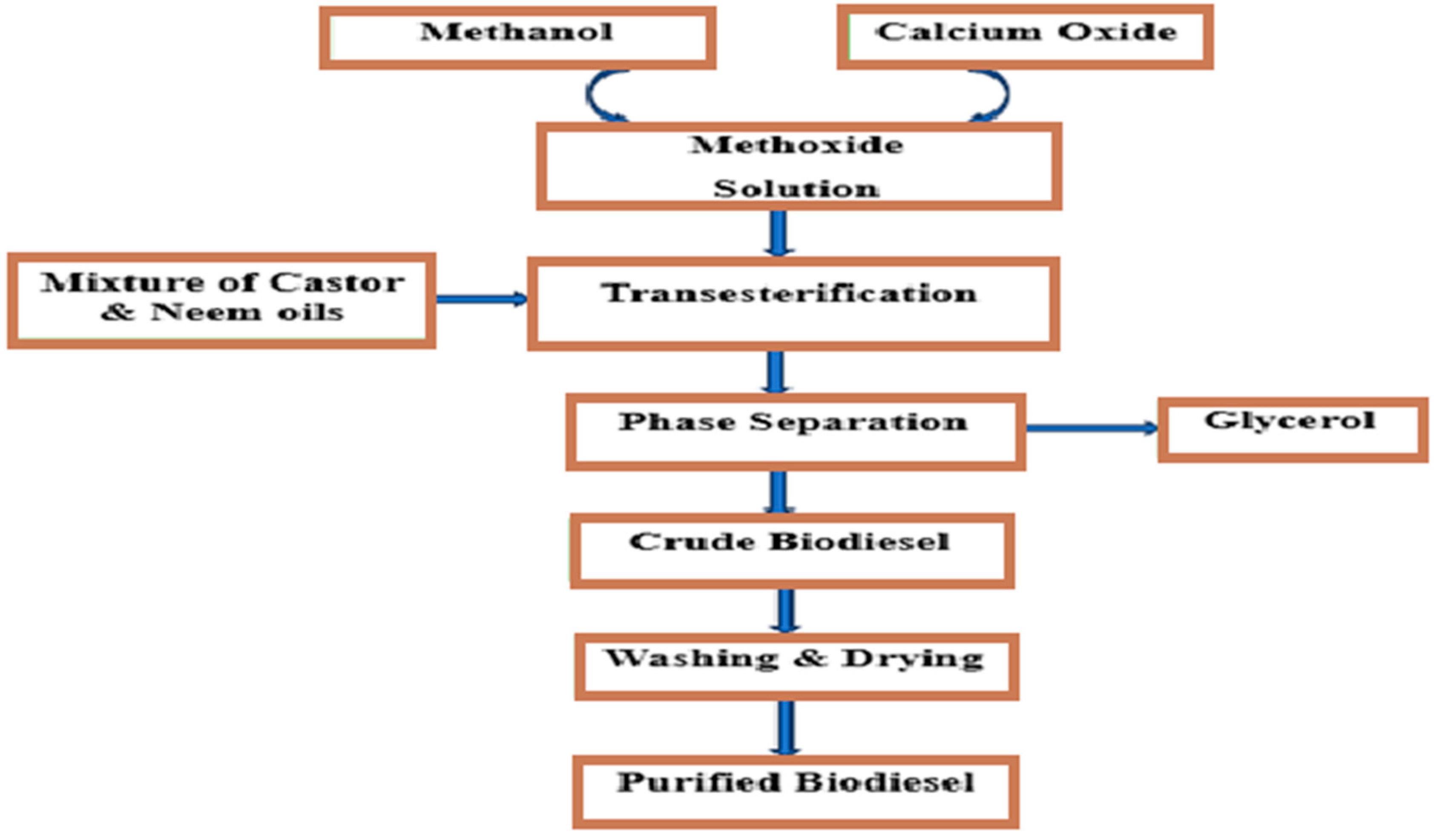
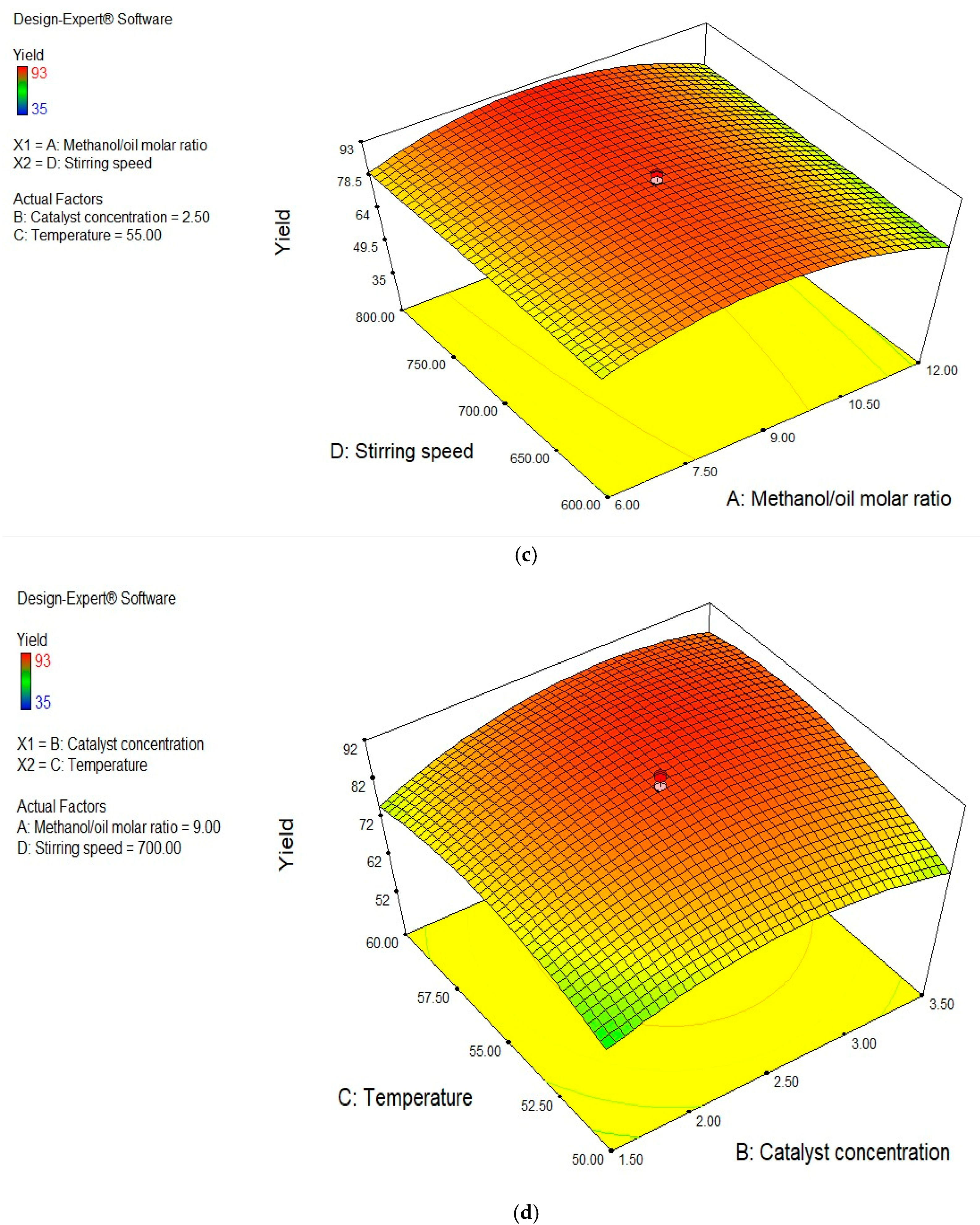
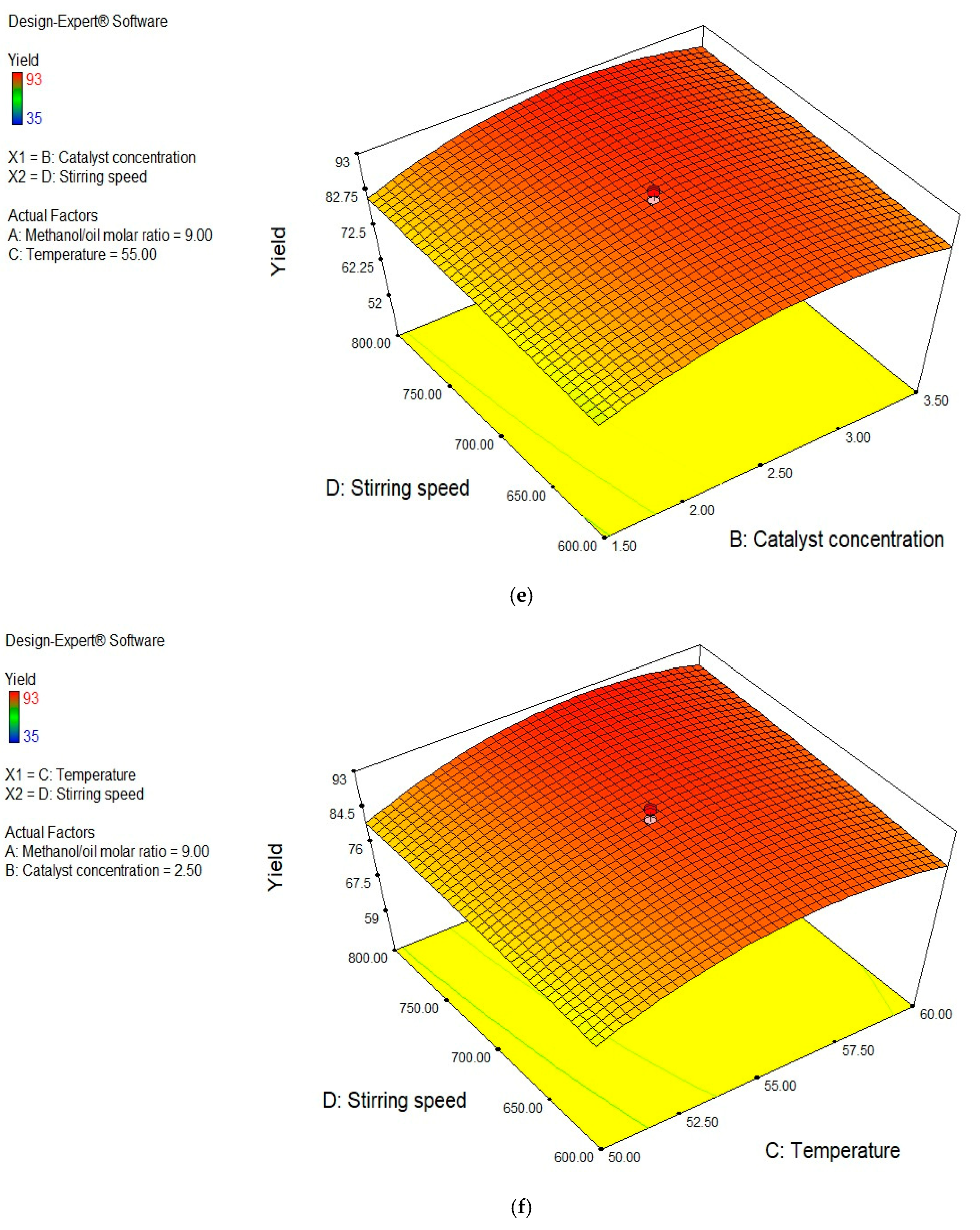
This research study was conducted to produce biodiesel by combining castor oil (Ricinus communis) and neem oil (Azadirachta indica). The goal of the article was to make a blend of castor and neem oils (in a 50:50 ratio) to rectify the drawbacks present in castor biodiesel, such as elevated kinematic viscosity and density. Previous research indicated that the heterogeneous catalyst CaO was never employed to make biodiesel with a mixture of castor and neem oils; CaO is a highly effective heterogeneous catalyst. The evaluation of biodiesel yield was conducted by examining the impact of various process input parameters. These parameters encompassed catalyst dosage, alcohol-to-oil molar ratio, reaction temperature, and reaction duration. Response surface methodology was used to optimize process parameters. Fuel properties such as density, kinematic viscosity, cetane number, acidic value, and calorific value of the castor oil and neem oil mixture were investigated and compared to EN 14214 and ASTM D 6571 standards. The production of biodiesel from a blend of castor oil and neem oil did not have any adverse impacts on food security. Interest in biodiesel has grown as more people look for a fuel that can be used as an alternative to petroleum diesel fuel. While biodiesel is a fuel with many benefits, there are certain health risks as well. According to the research literature, using biodiesel increases NO
X emissions, which can lead to a number of health issues, including headaches, respiratory irritation, lung edema, emphysema, eye irritations, appetite loss, and tooth erosion. Children, asthmatics, and those suffering from chronic bronchitis, emphysema, or other respiratory conditions make up the majority of those afflicted [
28].




 ,
,