
You are currently viewing a new version of our website. To view the old version click .
  • Tracked forImpact Factor
  • 2.4CiteScore
  • 40 daysTime to First Decision

Endocrines, Volume 4, Issue 3

September 2023 - 13 articles

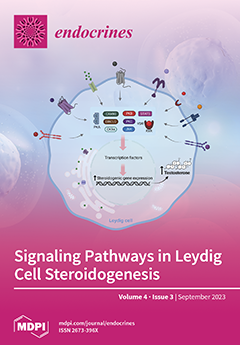
Cover Story: Located within the testicular interstitium, Leydig cells orchestrate the production of testosterone, a pivotal hormone in male health and reproduction. While luteinizing hormone (LH) is the main regulator of Leydig cell steroidogenesis, many other molecules also play key roles, including growth hormone (GH), prolactin (PRL), growth factors (insulin, IGF, FGF, EGF), vitamin D, and osteocalcin. The dynamic interplay between receptors and ligands initiates a series of cascades, modulating the activity of an array of kinases and transcription factors, steroidogenic gene expression, and ultimately, the fine-tuning of testosterone synthesis. View this paper
 
  • Issues are regarded as officially published after their release is announced to the table of contents alert mailing list .
  • You may sign up for email alerts to receive table of contents of newly released issues.
  • PDF is the official format for papers published in both, html and pdf forms. To view the papers in pdf format, click on the "PDF Full-text" link, and use the free Adobe Reader to open them.

Articles (13)

  • Case Report
  • Open Access
2 Citations
2,909 Views
8 Pages

11 September 2023

Pituitary apoplexy (PA) is a rare medical emergency. The sudden pressure increase in the sella turcica may determine compression on the surrounding structures determining the classical symptomatology associated, especially visual field impairment and...

  • Case Report
  • Open Access
1 Citations
4,354 Views
8 Pages

Gynecomastia and Leydigioma: An Unexpected Case Report Outcome

  • Giuseppe Seminara,
  • Paola Chiarello,
  • Rodolfo Iuliano,
  • Emanuele Tinelli,
  • Umberto Sabatini,
  • Stefano Iuliano and
  • Antonio Aversa

8 September 2023

We report a case of a 19-year-old male referred to the Endocrine Unit because of gynecomastia. Initial investigation revealed elevated levels of estradiol (E2) along with secondary hypogonadism (hypotestosteronemia and severe oligoasthenoteratozoospe...

  • Review
  • Open Access
8 Citations
9,275 Views
26 Pages

Exploring SGLT-2 Inhibitors: Benefits beyond the Glucose-Lowering Effect—What Is New in 2023?

  • Clipper F. Young,
  • Neeka Farnoudi,
  • Jenny Chen and
  • Jay H. Shubrook

4 September 2023

Sodium-glucose cotransporter-2 (SGLT-2) inhibitors were once known as a class of glycemic-lowering agents to treat type 2 diabetes. As the evolving evidence from recent cardiorenal trials on these agents has shown—e.g., EMPA-REG OUTCOME, DECLAR...

  • Review
  • Open Access
11 Citations
14,483 Views
14 Pages

Anti-Dyslipidemic and Anti-Diabetic Properties of Corosolic Acid: A Narrative Review

  • Rossella Cannarella,
  • Vincenzo Garofalo and
  • Aldo E. Calogero

1 September 2023

Corosolic acid (CA), a natural compound derived from the Banaba tree (Lagerstroemia speciosa), has attracted attention for its potential therapeutic properties in the management of metabolic diseases. This narrative review aims to summarize the curre...

  • Communication
  • Open Access
3 Citations
3,984 Views
9 Pages

Regulation of Phosphate Transporters and Novel Regulator of Phosphate Metabolism

  • Megumi Koike,
  • Minori Uga,
  • Yuji Shiozaki,
  • Ken-ichi Miyamoto and
  • Hiroko Segawa

21 August 2023

Phosphorus is essential for all living organisms. It plays an important role in maintaining biological functions, such as energy metabolism, cell membrane formation, and bone mineralization. Various factors in the intestine, kidneys, and bones regula...

  • Article
  • Open Access
1 Citations
2,688 Views
12 Pages

Continuous Glucose Monitoring (CGM) and Metabolic Control in a Cohort of Patients with Type 1 Diabetes and Coeliac Disease

  • Flavia Amaro,
  • Maria Alessandra Saltarelli,
  • Marina Primavera,
  • Marina Cerruto and
  • Stefano Tumini

9 August 2023

The association between type 1 diabetes (T1D) and coeliac disease (CD) is well known. Metabolic control of thirty-seven patients aged between 1 and 18 years, with coexisting T1D and CD were evaluated. The control group includes 37 patients affected o...

  • Review
  • Open Access
29 Citations
20,001 Views
22 Pages

Hormones and Signaling Pathways Involved in the Stimulation of Leydig Cell Steroidogenesis

  • Karine de Mattos,
  • Kenley Joule Pierre and
  • Jacques J. Tremblay

1 August 2023

Leydig cells, located in the testis interstitial space, are the primary source of testosterone in males. Testosterone plays critical roles in both reproductive and metabolic functions and therefore is essential for male health. Steroidogenesis must b...

  • Article
  • Open Access
3 Citations
2,938 Views
15 Pages

28 July 2023

Background: The prevalence of thyroid disease has seen a rapid increase in recent times, primarily attributed to the fast pace of lifestyles that often result in poor dietary choices, work-life imbalances, social stress, genetic mutations, and improv...

  • Article
  • Open Access
1 Citations
1,746 Views
10 Pages

28 July 2023

Interstitial expansion is associated with glomerular filtration rate (GFR) loss in many renal diseases, including diabetic nephropathy. The Renin–Angiotensin System Study (RASS) tested whether a 5-year renin–angiotensin system (RAS) block...

  • Review
  • Open Access
5 Citations
21,244 Views
12 Pages

Primary Amenorrhea in Adolescents: Approach to Diagnosis and Management

  • Laura Gaspari,
  • Françoise Paris,
  • Nicolas Kalfa and
  • Charles Sultan

23 July 2023

Primary amenorrhea (PA) describes the complete absence of menses by the age of 15 years. It is a devastating diagnosis that can affect the adolescent’s view of her femininity, sexuality, fertility and self-image. A normal menstrual cycle can oc...

of 2

Get Alerted

Add your email address to receive forthcoming issues of this journal.

XFacebookLinkedIn
Endocrines - ISSN 2673-396X