
Influence of a Plasma Nitriding Treatment on the Corrosion Behavior of API 5L X70 Steel in Simulated Soil Solution


 , , and
Abstract
1. Introduction
2. Materials and Methods
2.1. Samples Preparation
2.2. Plasma Surface Modification
2.3. SEM and EDS
2.4. X-Ray Diffraction (XDR)
2.5. Corrosion Protection Measurements
2.5.1. Corrosion Inhibition Efficiency (%η)
2.5.2. Calculation of the Electrochemical Double Layer Cdl
3. Results and Discussion
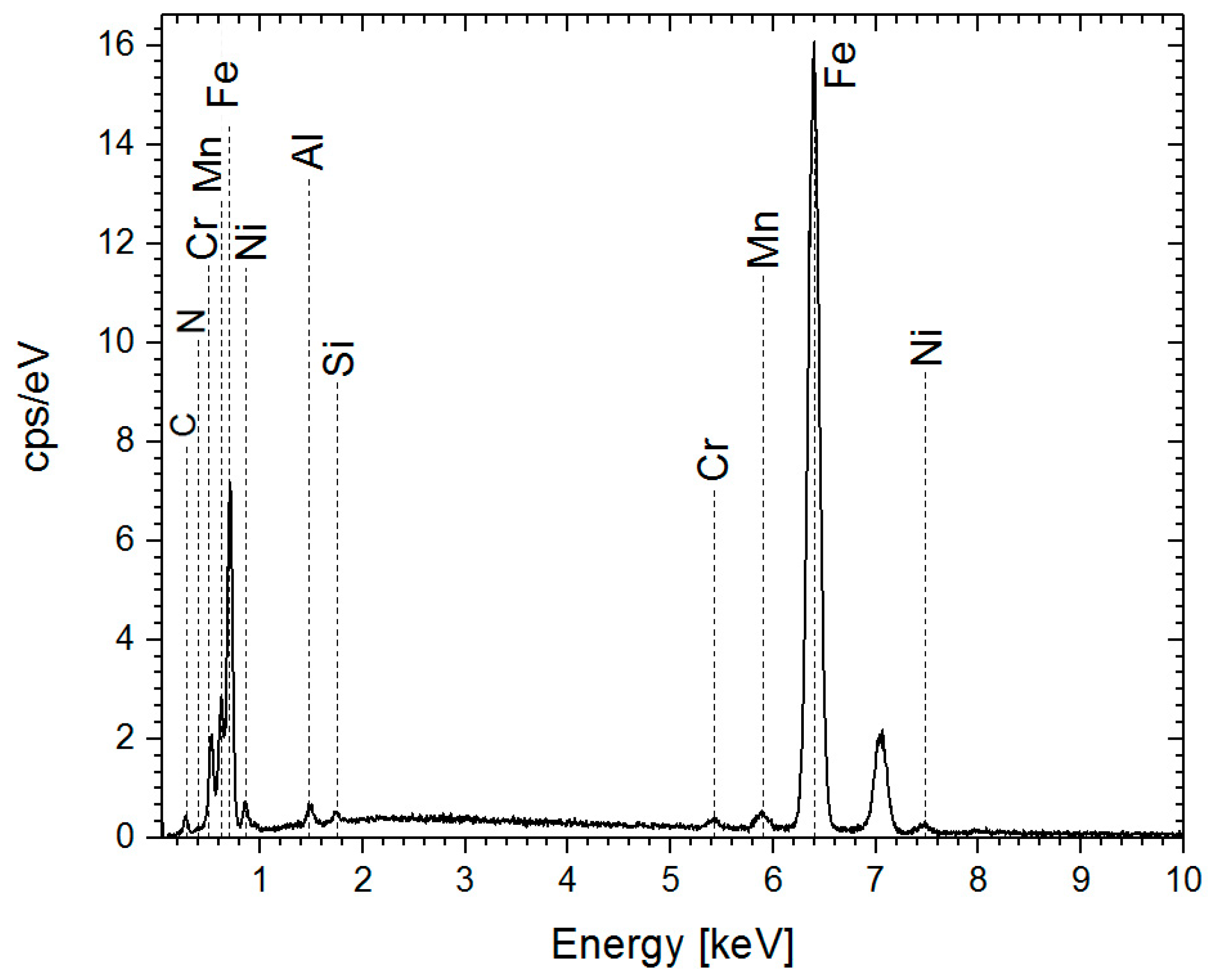
3.1. SEM and EDS Analysis
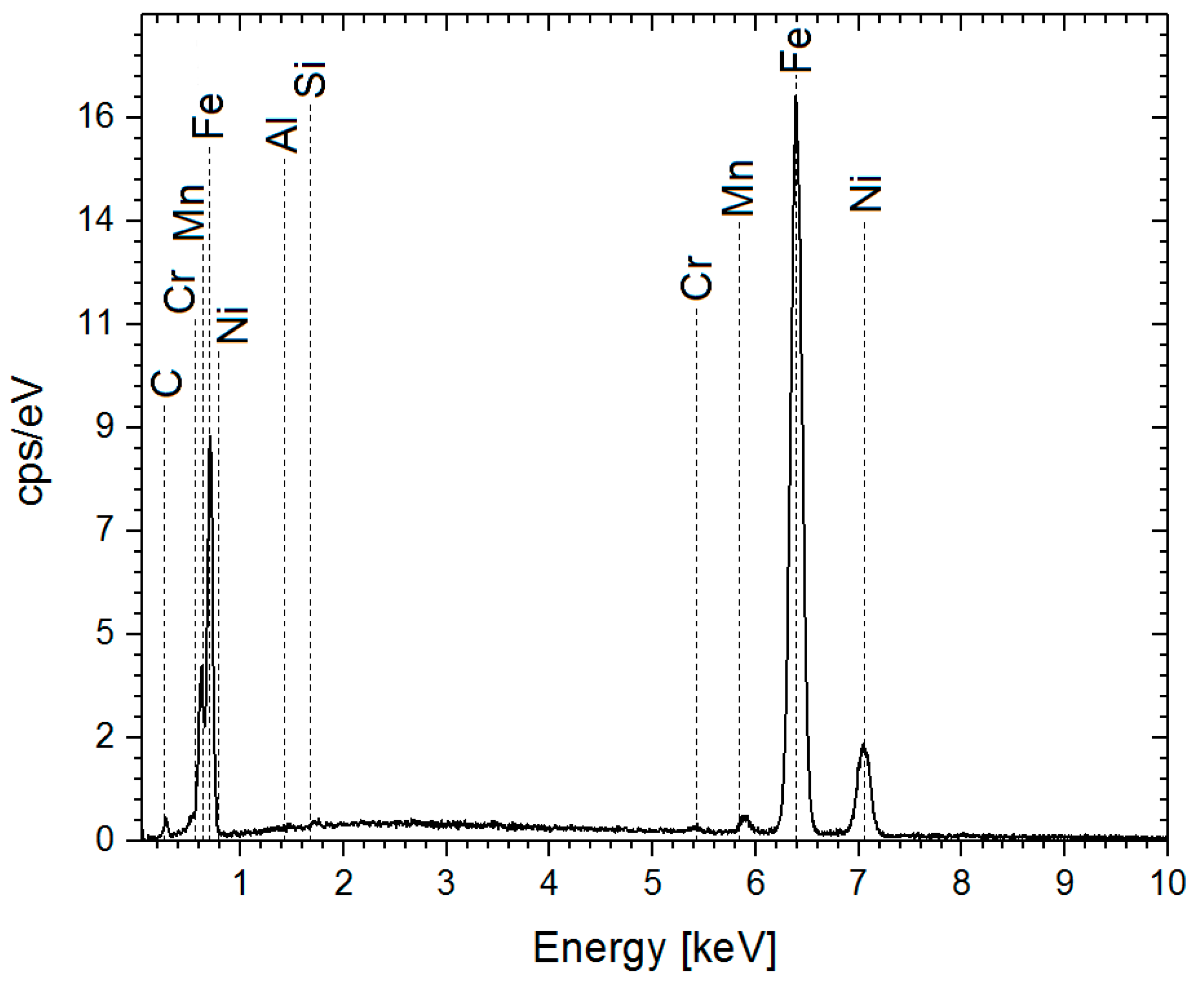
3.1.1. Blank (Steel X70)
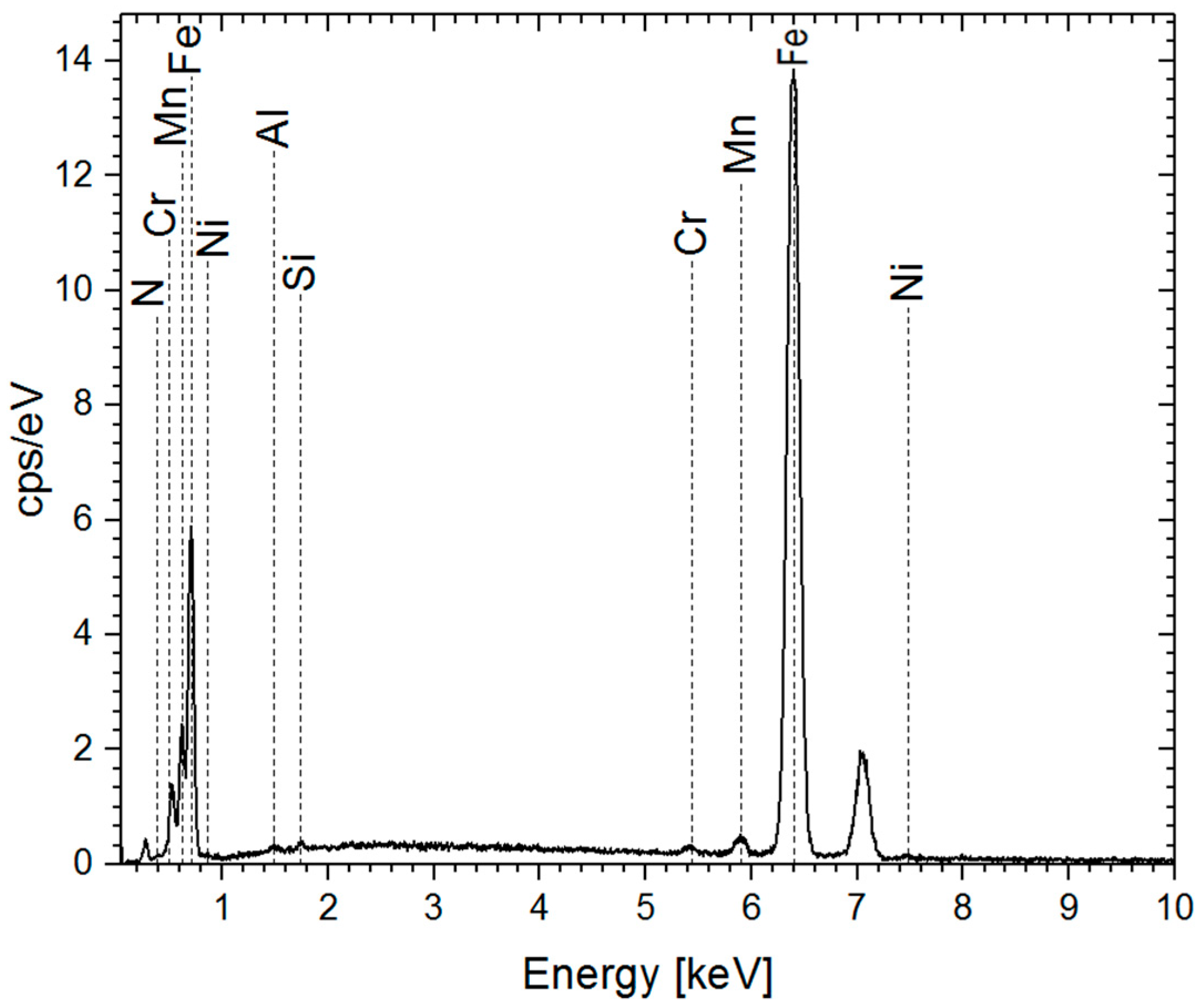
3.1.2. EDS of Nitrided Steel with 4 h of Treatment
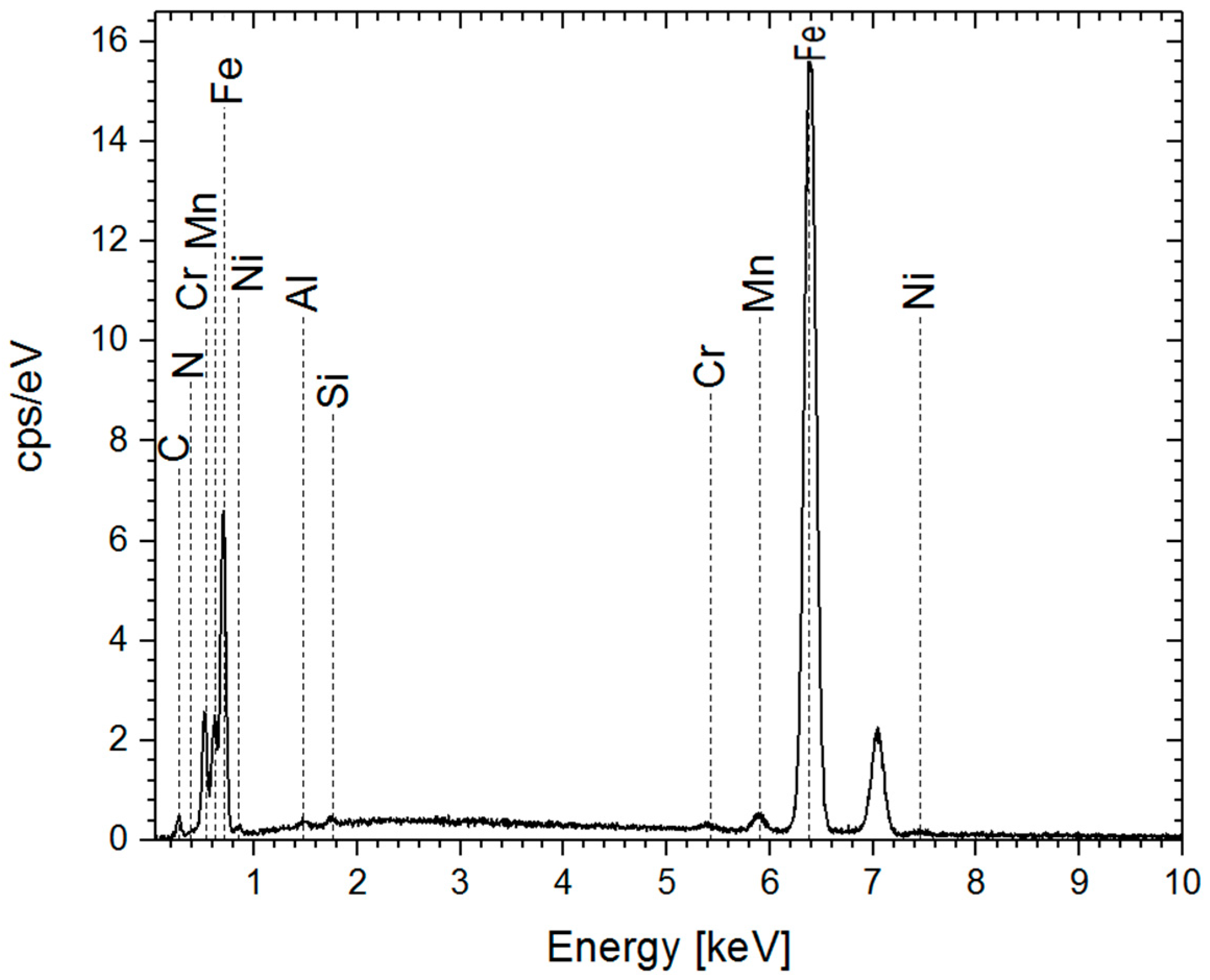
3.1.3. EDS of Nitrided Steel with 6 h of Treatment
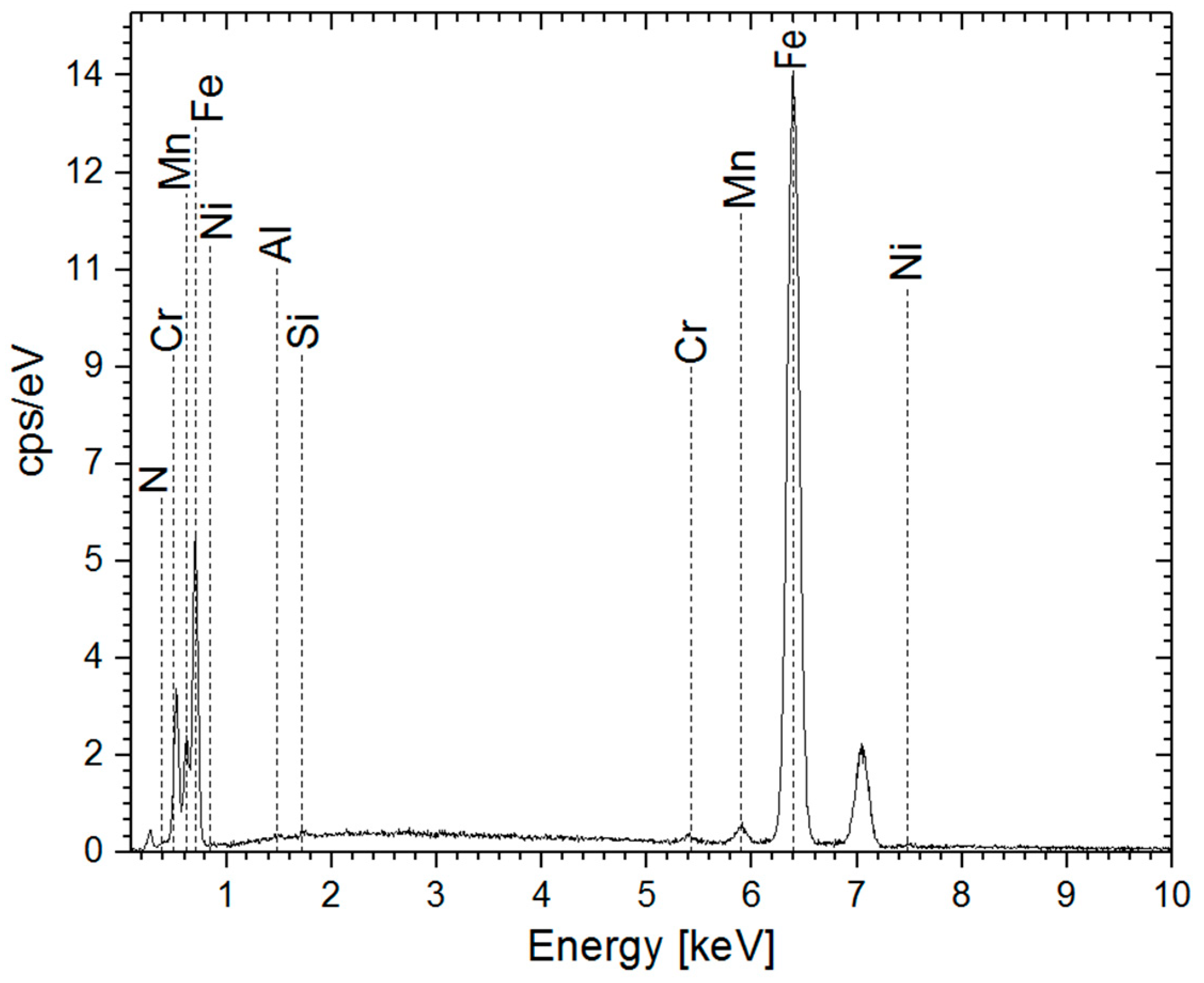
3.1.4. EDS of Nitrided Steel with 8 h of Treatment
3.1.5. EDS of Nitrided Steel with 10 h of Treatment
3.2. X Ray Diffraction (XRD)
3.3. Electrochemical Reactions
3.4. Potentiodynamic Polarization Curves
3.5. Influence of Time Treatment in Current Density and Efficiency
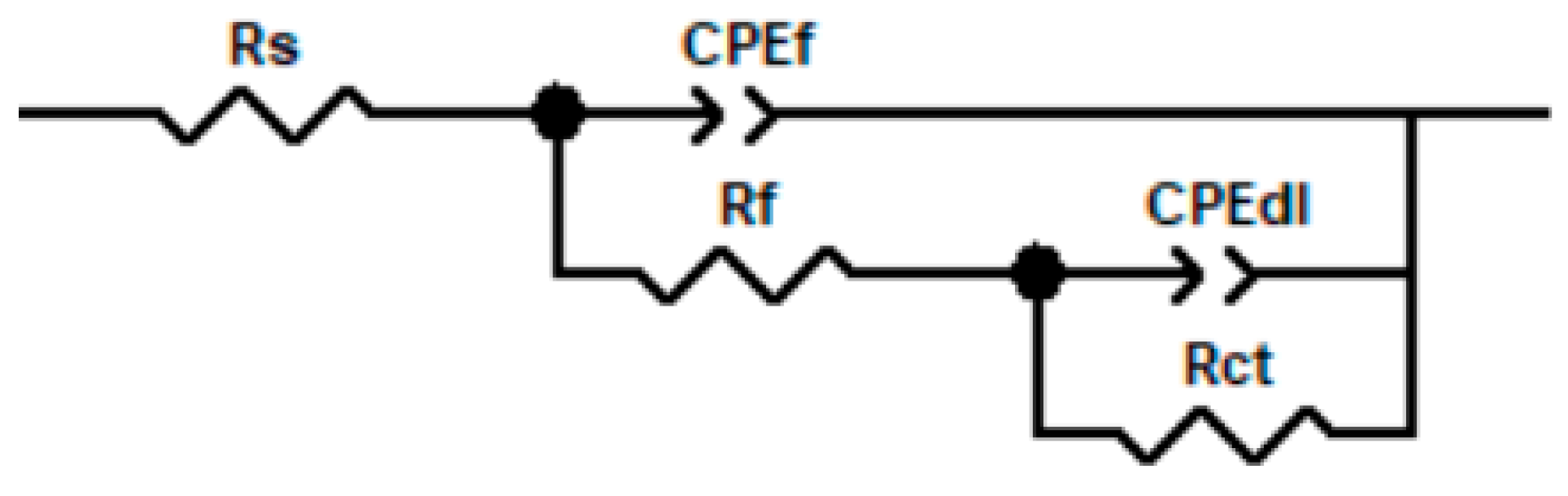
3.6. Electrochemical Impedance Spectroscopy
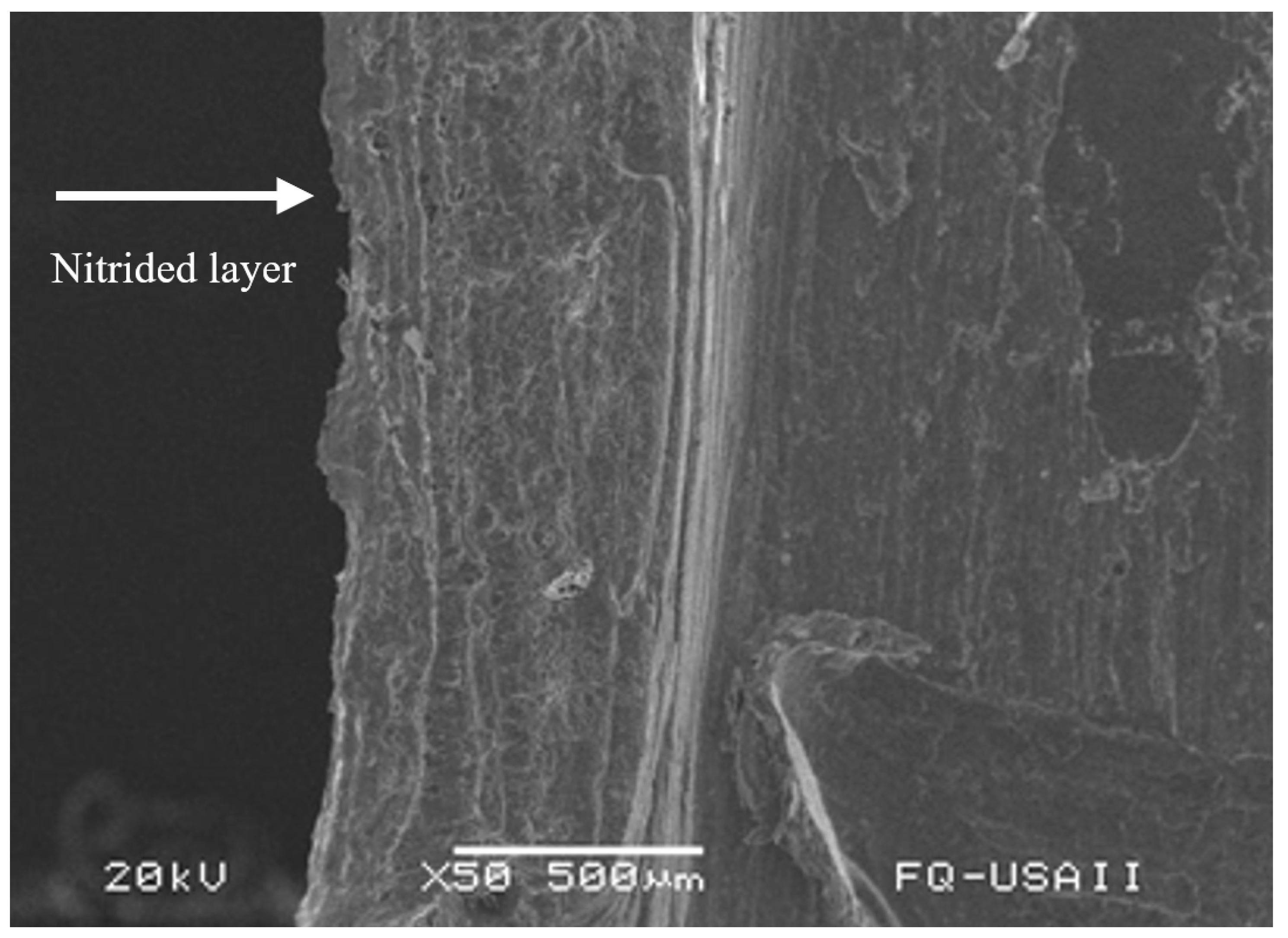
3.7. Cross-Section Analysis
4. Conclusions
- Correct formation of the nitride layer and its behavior with varying treatment times was confirmed.
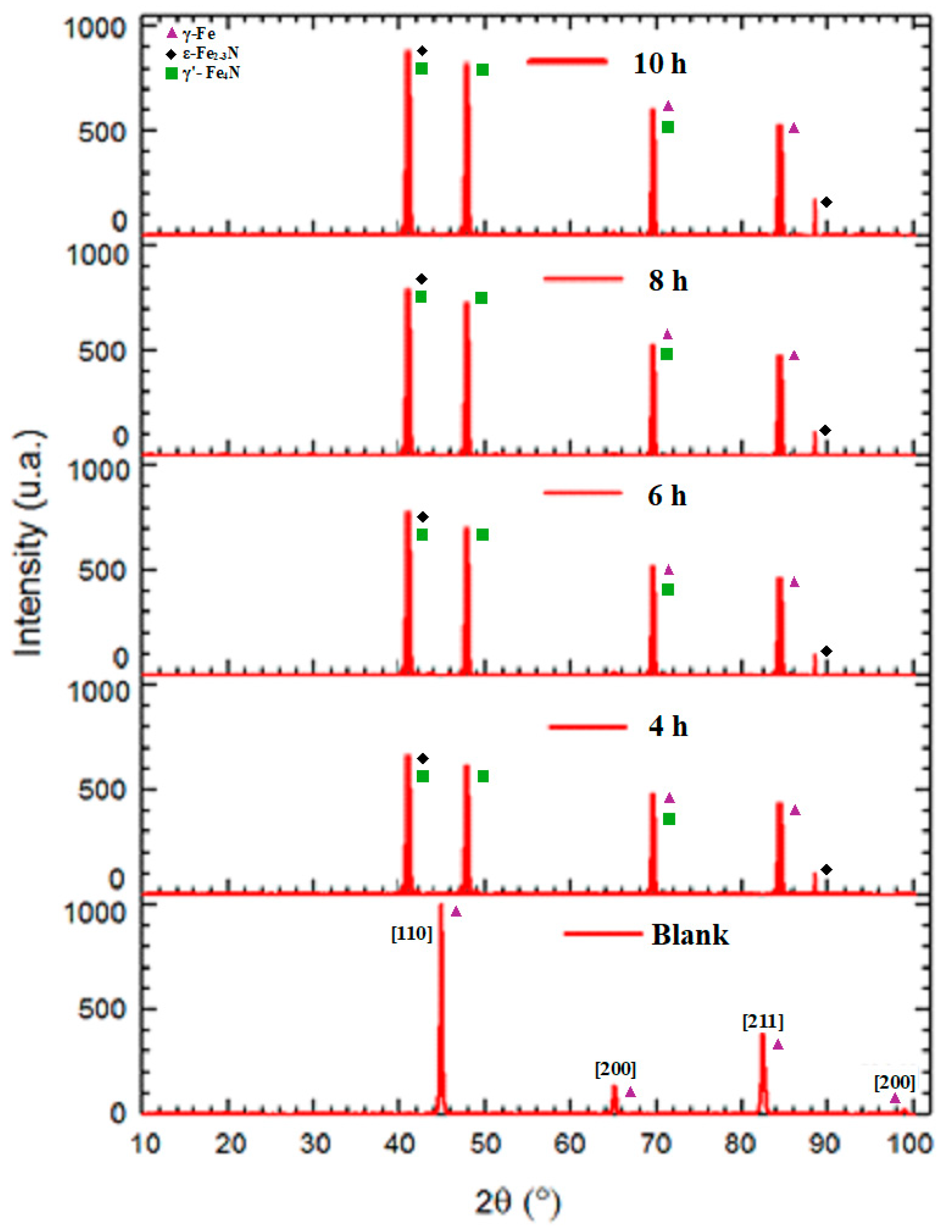
- Formation of the iron nitrides ε-Fe2-3N and γ-Fe4N indicates a clear formation of the nitrided layer. Increasing the plasma nitriding treatment time increases the intensity of the nitride peaks.
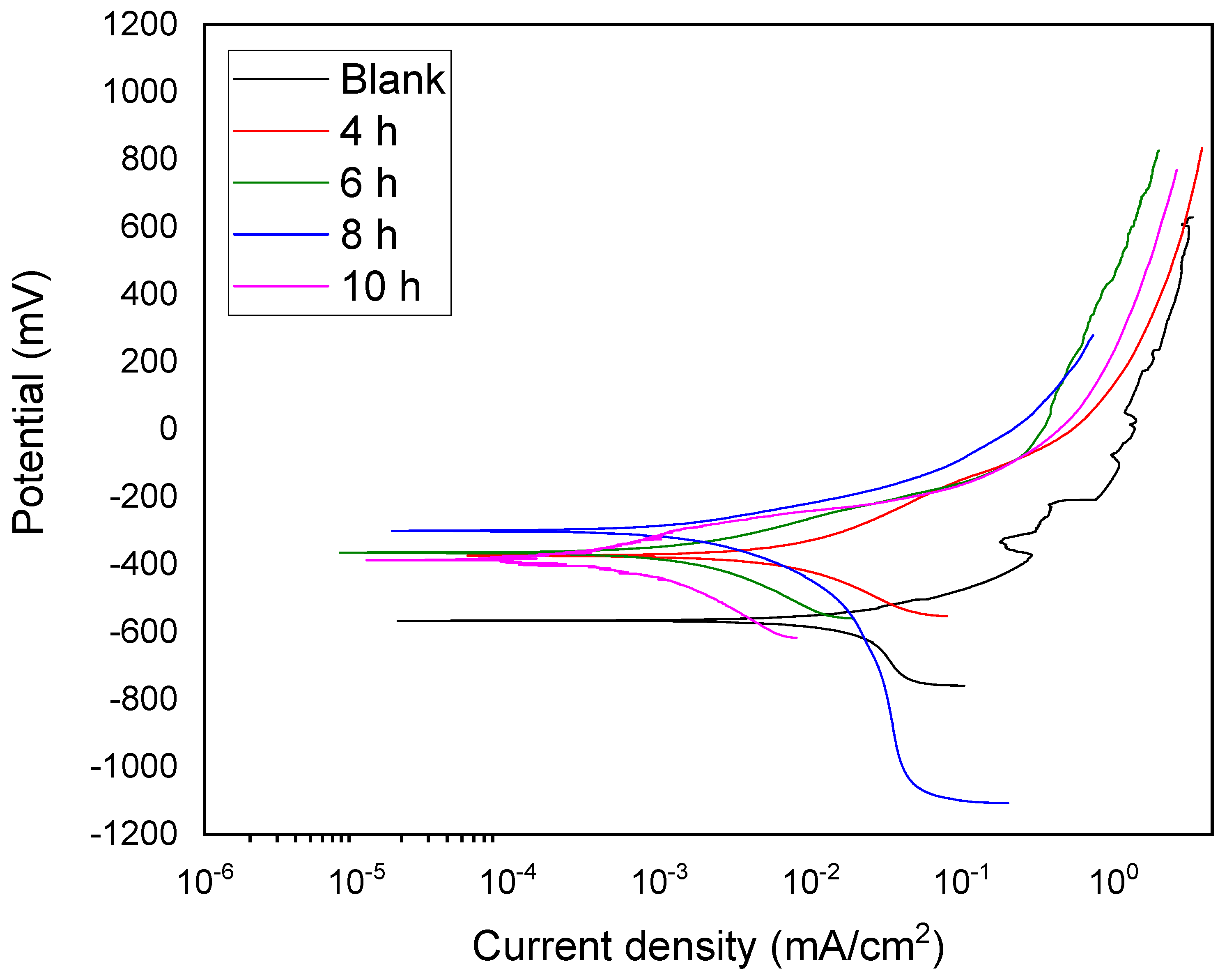
- Plasma nitriding significantly reduces corrosion density by up to three orders of magnitude compared to the blank, with 10 h of treatment providing the best results. The variation in Ecorr and Icorr were mainly due to the reaction kinetics in the formation of corrosion products on the nitrided surface.
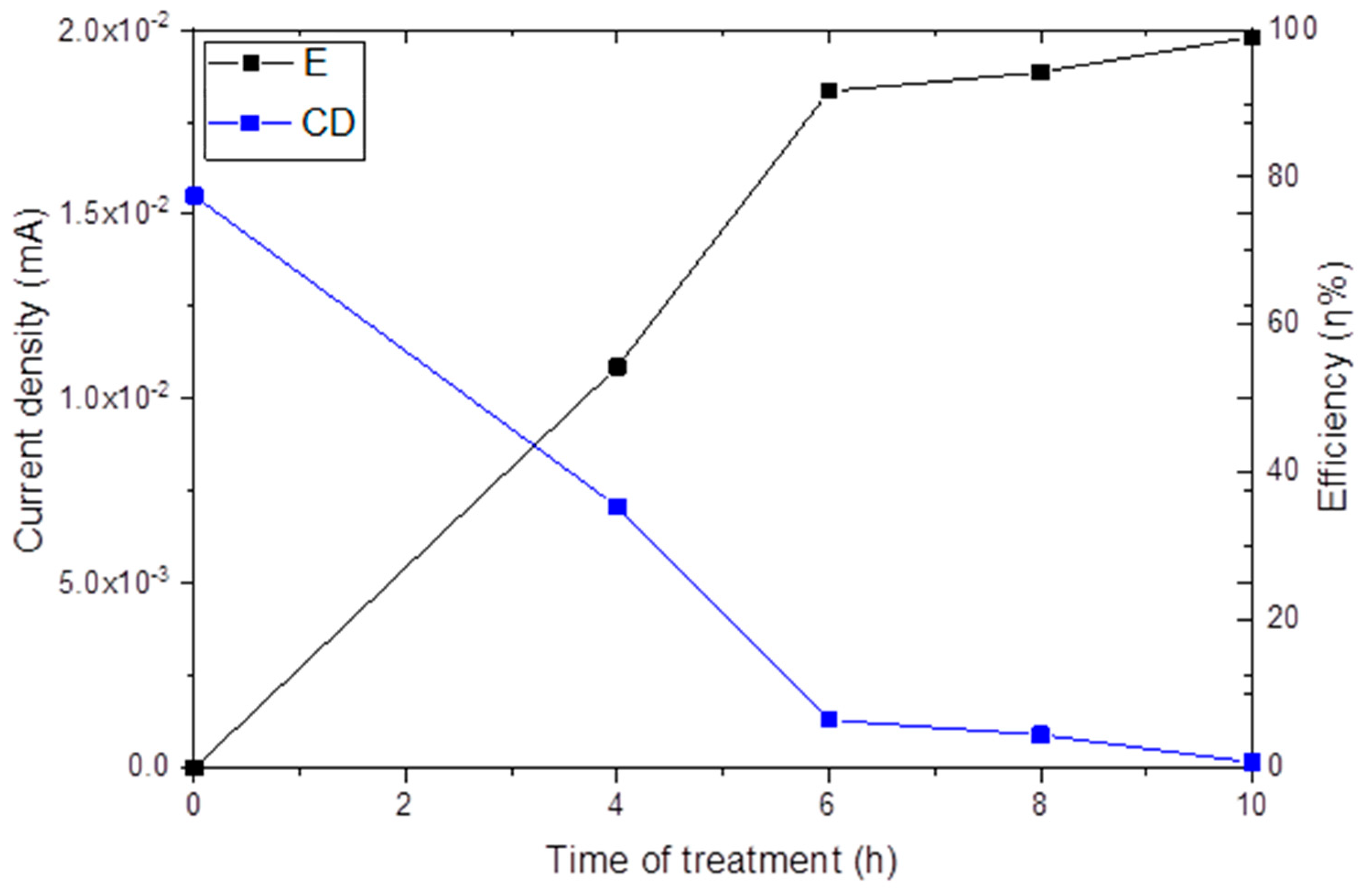
- According to the current density graph against treatment time, the 10 h plasma nitriding treatment provides the best corrosion resistance and efficiency, making a long treatment unnecessary.
Author Contributions
Funding
Institutional Review Board Statement
Informed Consent Statement
Data Availability Statement
Acknowledgments
Conflicts of Interest
References
- Sharma, L.; Chhibber, R. Microstructure evolution and electrochemical corrosion behaviour of API X70 line pipe Steel in different environments. Int. J. Press. Vessel. Pip. 2019, 171, 51–59. [Google Scholar] [CrossRef]
- Espinoza-Vázquez, A.; Rodríguez-Gómez, F.J.; Negrón-Silva, G.E.; González-Olvera, R.; Ángeles-Beltrán, D.; Palomar-Pardavé, M. Fluconazole and fragments as corrosion inhibitors of api 5l × 52 steel immersed in 1M HCl. Corros. Sci. 2020, 174, 108853. [Google Scholar] [CrossRef]
- Mohtadi-Bonab, M.A.; Ariza-Echeverri, E.A.; Masoumi, M. A Comparative investigation of the effect of microstructure and crystallographic data on stress-oriented hydrogen induced cracking susceptibility of API 5L X70 pipeline steel. Metals 2022, 12, 414. [Google Scholar] [CrossRef]
- Ramos, H.E.L.; Franco, A.R.; Vieira, E.A. Influence of plasma nitriding pressure on microabrasive wear resistance of a microalloyed steel. J. Mater. Res. Technol. 2019, 8, 1694–1700. [Google Scholar] [CrossRef]
- Gadala, I.M.; Alfantazi, A. Electrochemical behavior of API-X100 pipeline steel in NS4, near-neutral, and mildly alkaline pH simulated soil solutions. Corros. Sci. 2014, 82, 45–57. [Google Scholar] [CrossRef]
- Mashuga, M.E.; Olasunkanmi, L.O.; Verma, C.; Sherif, E.-S.M.; Ebenso, E.E. Experimental and computational mediated illustration of effect of different substituents on adsorption tendency of phthalazinone derivatives on mild steel surface in acidic medium. J. Mol. Liq. 2020, 305, 112844. [Google Scholar] [CrossRef]
- Mameri, S.; Boughrara, D.; Chopart, J.P.; Kadri, A. Electrochemical corrosion behavior of API 5L X52 pipeline Steel in soil environment. Anal. Bioanal. Electrochem. 2021, 13, 239–263. [Google Scholar]
- Lucio-Garcia, M.A.; Gonzalez-Rodriguez, J.G.; Casales, M.; Martinez, L.; Chacon-Nava, J.G.; Neri-Flores, M.A.; Martinez-Villafañe, A. Effect of heat treatment on H2S corrosion of a micro-alloyed C–Mn steel. Corros. Sci. 2009, 51, 2380–2386. [Google Scholar] [CrossRef]
- Rahman, K.M.M.; Mohtadi-Bonab, M.A.; Ouellet, R.; Szupunar, J. A Comparative study of the role of hydrogen on degradation of the mechanical properties of API X60, X60SS, and X70 pipeline steels. Steel Res. Int. 2019, 90, 1900078. [Google Scholar] [CrossRef]
- Brandon Fabián, P.R.; Arturo, C.T.; Araceli, E.M.; Sergio, G.N.; Manuela, D.C. Study of flow-assisted corrosion (FAC) in a 5L X-70 API steel in a brine-H2S-CO2 system using the rotating cylindrical electrode. Mater. Res. Express 2019, 6, 066550. [Google Scholar] [CrossRef]
- Jacobo, L.R.; García, R.; López, V.H.; Contreras, A. Electrochemical assessment of X70 steel with non-conventional heat treatment. MRS Adv. 2017, 2, 2819–2829. [Google Scholar] [CrossRef]
- Cui, Z.; Liu, Z.; Wang, L.; Du, C.; Li, X. Effect of pH Value on the Crack Growth Behavior of X70 Pipeline Steel in the Dilute Bicarbonate Solutions. Mater. Trans. 2015, 56, 777–780. [Google Scholar] [CrossRef]
- Yang, Y.; Cheng, Y.F. Effect of stress on corrosion at crack tip on pipeline steel in a near-neutral pH solution. J. Mater. Eng. Perform. 2016, 25, 4988–4995. [Google Scholar] [CrossRef]
- Bueno, A.H.S.; Moreira, E.D.; Siqueira, P.; Gomes, J.A.C.P. Effect of cathodic potential on hydrogen permeation of API grade steels in modified NS4 solution. Mater. Sci. Eng. 2014, 597, 117–121. [Google Scholar] [CrossRef]
- Cheng, Y.F.; Niu, L. Mechanism for hydrogen evolution reaction on pipeline steel in near-neutral pH solution. Electrochem. Commun. 2007, 9, 558–562. [Google Scholar] [CrossRef]
- Javidi, M.; Bahalaou Horeh, S. Investigating the mechanism of stress corrosion cracking in near-neutral and high pH environments for API 5L X52 steel. Corros. Sci. 2014, 80, 213–220. [Google Scholar] [CrossRef]
- Fu, A.Q.; Tang, X.; Cheng, Y.F. Characterization of corrosion of X70 pipeline steel in thin electrolyte layer under disbonded coating by scanning Kelvin probe. Corros. Sci. 2009, 51, 186–190. [Google Scholar] [CrossRef]
- Quej-Aké, L.M.; Galván-Martínez, R.; Contreras-Cuevas, A. Electrochemical and Tension Tests Behavior of API 5L X60 Pipeline Steel in a Simulated Soil Solution. Mater. Sci. Forum 2013, 755, 153–161. [Google Scholar] [CrossRef]
- Giarola, J.M.; Calderón-Hernández, J.W.; Conde, F.F.; Marcomini, J.B.; de Melo, H.G.; Avila, J.A.; Bose Filho, W.W. Corrosion Behavior and Microstructural Characterization of Friction Stir Welded API X70 Steel. J. Mater. Eng. Perform. 2021, 30, 5953–5961. [Google Scholar] [CrossRef]
- Bueno, A.H.S.; Gomes, J.A.C.P. Environmentally induced cracking of API grade steel in near-neutral pH soil. J. Braz. Soc. Mech. Sci. Eng. 2009, 31, 97–104. [Google Scholar] [CrossRef]
- Dey, S.; Sivaprasad, S.; Das, N.; Chattoraj, I. Study of electrochemical behavior, hydrogen permeation and diffusion in pipeline steel. Mater. Sci. Forum 2021, 1019, 145–156. [Google Scholar] [CrossRef]
- Sun, Y.; Chen, J.; Xu, Z.; Chen, X. Effect of surface plasma nitriding on corrosion resistance of X80 pipeline Steel in a simulated soil solution of Yingtan area. Corros. Sci. Prot. Technol. 2015, 27, 237–242. [Google Scholar]
- Cheng, Y.; Liu, P.; Yang, M. Effect of Temperature and Applied Potential on the Stress Corrosion Cracking of X80 Steel in a Xinzhou Simulated Soil Solution. Materials 2022, 15, 2560. [Google Scholar] [CrossRef] [PubMed]
- Sun, Y.; Cheng, Y.F. Hydrogen permeation and distribution at a high strength X80 steel weld under stressing conditions and the implication on pipeline failure. Int. J. Hydrogen Energy 2021, 45, 23100–23112. [Google Scholar] [CrossRef]
- Chen, X.; Cui, W.; Wang, Y.; Li, C.; Wang, K. Effect of cathodic protection potential on microbiologically induced corrosion behavior of X70 steel in a near neutral pH solution. Mater. Res. Express 2023, 10, 066508. [Google Scholar] [CrossRef]
- Galván-Martínez, R.; Orozco-Cruz, R.; Carmona-Hernández, A.; Mejía-Sánchez, E.; Morales-Cabrera, M.A.; Contreras, A. Corrosion Study of Pipeline Steel under Stress at Different Cathodic Potentials by EIS. Materials 2019, 9, 1353. [Google Scholar] [CrossRef]
- Liu, Z.Y.; Wang, X.Z.; Du, C.W.; Li, J.K.; Li, X.G. Effect of hydrogen-induced plasticity on the stress corrosion cracking of X70 pipeline steel in simulated soil environments. Mater. Sci. Eng. A 2016, 658, 348–354. [Google Scholar] [CrossRef]
- Liu, Z.Y.; Li, X.G.; Cheng, Y.F. Mechanistic aspect of near-neutral pH stress corrosion cracking of pipelines under cathodic polarization. Corros. Sci. 2012, 55, 54–60. [Google Scholar] [CrossRef]
- Torres-Islas, A.; Serna, S.; Campillo, B.; Colin, J.; Molina, A. Hydrogen Embrittlement behavior on microalloyed pipeline steel in NS-4 solution. Int. J. Electrochem. Sci. 2013, 8, 7608–7624. [Google Scholar] [CrossRef]
- Ghobadi, M.; Danaee, I.; Saebnoori, E.; Eskandari, H. Impedance studies on stress corrosion cracking behavior of steel pipeline in NS4 solution under ssrt test condition. Prot. Met. Phys. Chem. Surf. 2021, 57, 634–646. [Google Scholar] [CrossRef]
- Luo, J.; Luo, S.; Li, L.; Zhang, L.; Wu, G.; Zhu, L. Stress corrosion cracking behavior of X90 pipeline steel and its weld joint at different applied potentials in near-neutral solutions. Nat. Gas Ind. B 2019, 6, 138–144. [Google Scholar] [CrossRef]
- Dai, M.; Liu, J.; Huang, F.; Zhang, Y.; Cheng, Y.F. Effect of cathodic protection potential fluctuations on pitting corrosión of X100 pipeline Steel in acidic soil environment. Corros. Sci. 2018, 143, 428–437. [Google Scholar] [CrossRef]
- Kusmanov, S.; Mukhacheva, T.; Tambovskiy, I.; Naumov, A.; Belov, R.; Sokova, E.; Kusmanova, I. Increasing Hardness and Wear Resistance of Austenitic Stainless Steel Surface by Anodic Plasma Electrolytic Treatment. Metals 2023, 13, 872. [Google Scholar] [CrossRef]
- Davoodi, F.; Ashrafizadeh, F.; Atapour, M.; Akbari-Kharaji, E.; Mokhtari, R. Anticorrosion performance of TiN coating with electroless nickel-phosphorus interlayer on Al 6061 alloy. Mater. Chem. Phys. 2023, 296, 127170. [Google Scholar] [CrossRef]
- Kovács, D.; Quintana, I.; Dobránszky, J. Effects of Different Variants of Plasma Nitriding on the Properties of the Nitrided Layer. J. Mater. Eng. Perform. 2019, 28, 5485–5493. [Google Scholar] [CrossRef]
- Tapia-Bahena, E.; Martínez, H.; Porcayo-Calderon, J.; Gonzalez-Rodriguez, J.G.; Martínez-Gomez, L. Corrosion behavior of nitrided Ni3Al intermetallic alloy in 0.5M H2SO4. Int. J. Electrochem. Sci. 2018, 13, 11323–11334. [Google Scholar] [CrossRef]
- Bott, A.H.; Brühl, S.P.; Gómez, B.; Zampronio, M.A.; Miranda, P.E.V.; Feugeas, J.N. Pulsed-plasma-nitrided API 5L X-65 steel: Hydrogen permeability and microstructural aspects. J. Phys. D Appl. Phys. 1998, 31, 3469–3474. [Google Scholar] [CrossRef]
- Velazquez-Torres, N.; Porcayo-Calderon, J.; Martinez-Valencia, H.; Lopes-Cecenes, R.; Rosales-Cadena, I.; Sarmiento-Bustos, E.; Rocabruno-Valdés, C.I.; Gonzalez-Rodriguez, J.G. Corrosion Resistance of a Plasma-Oxidized Ti6Al4V Alloy for Dental Applications. Coatings 2021, 11, 1136. [Google Scholar] [CrossRef]
- Larios-Galvez, A.K.; Vazquez-Velez, E.; Martinez-Valencia, H.; Gonzalez-Rodriguez, J.G. Effect of Plasma Nitriding and Oxidation on the Corrosion Resistance of 304 Stainless Steel in LiBr/H2O and CaCl2-LiBr-LiNO3-H2O Mixtures. Metals 2023, 13, 920. [Google Scholar] [CrossRef]
- Aslan, M.; Çomakli, O.; Yazici, M.; Yetim, A.F.; BAYRAK, Ö.; ÇELIK, A. The effect of plasma oxidation and nitridation on corrosion behavior of CoCrMo alloy in sbf solution. Surf. Rev. Lett. 2017, 25, 1950024. [Google Scholar] [CrossRef]
- Braceras, I.; Ibáñez, I.; Dominguez-Meister, S.; Sánchez-García, J.A.; Brizuela, M.; Larrañaga, A.; Garmendia, I. Plasma nitriding of the inner surface of stainless steel tubes. Surf. Coat. Technol. 2018, 355, 116–122. [Google Scholar] [CrossRef]
- Li, D.; Wu, J.; Miao, B.; Zhao, X.; Mao, C.; Wei, W.; Hu, J. Enhancement of wear resistance by sand blasting-assisted rapid plasma nitriding for 304 austenitic stainless steel. Surf. Eng. 2019, 36, 524–530. [Google Scholar] [CrossRef]
- Debnath, M.K.; Majumdar, J.D.; Mukherjee, S.; Manna, I. Effect of Prior Cold Deformation and Nitriding Conditions on Microstructure and Mechanical Properties of Plasma Nitrided IF Steel. Metall. Mater. Trans. A 2019, 50, 4319–4330. [Google Scholar] [CrossRef]
- Teng, Y.; Guo, Y.-Y.; Zhang, M.; Yang, Y.-J.; Huang, Z.; Zhou, Y.-W.; Liang, Y.-S. Effect of Cr/CrNx transition layer on mechanical properties of CrN coatings deposited on plasma nitrided austenitic stainless steel. Surf. Coat. Technol. 2019, 367, 100–107. [Google Scholar] [CrossRef]
- Chen, D.; Zhang, T.; Wang, Y.; Zhou, Y. Wear resistance and microstructure of the nitriding layer formed on 2024 aluminum alloy by plasma-enhanced nitriding at different nitriding times. Mater. Res. Express 2019, 6, 066405. [Google Scholar] [CrossRef]
- Andalibi Fazel, Z.; Elmkhah, H.; Nouri, M.; Fattah-alhosseini, A. Effect of compound layer on the corrosion behavior of plasma nitrided AISI H13 tool steel. Mater. Res. Express 2019, 6, 056412. [Google Scholar] [CrossRef]
- Tang, L.; Jia, W.; Hu, J. An enhanced rapid plasma nitriding by laser shock peening. Mater. Lett. 2018, 231, 91–93. [Google Scholar] [CrossRef]
- Noriega, O.A.G.; Porcayo-Calderon, J.; Martinez, H.; Lopez-Sesenes, R.; Gonzalez-Rodriguez, J.G. Effect of plasma treatment of copper on its corrosion behaviour in 3.5% NaCl solution. Int. J. Electrochem. Sci. 2023, 18, 100049. [Google Scholar] [CrossRef]
- Hernandes, I.S.; da Cunha, J.N.; Santana, C.A.; Rodrigues, J.G.A.; D’Elia, E. Application of an Aqueous Extracto f Cotton Seed as a Corrosion Inhibitor for Mild Steel in HCl Media. Mater. Res. 2021, 24, e20200235. [Google Scholar] [CrossRef]
- Guimarães, T.A.; da Cunha, J.N.; de Oliveira, G.A.; da Silva, T.U.; de Oliveira, S.M.; de Araújo, J.R.; Machado, S.D.P.; D’Elia, E.; Rezende, M.J. Nitrogenated derivatives of furfural as green corrosion inhibitors for mild steel in HCl solution. J. Mater. Res. Technol. 2020, 9, 7104–7122. [Google Scholar] [CrossRef]
- Díaz-Cardenas, M.Y.; Valladares-Cisneros, M.G.; Lagunas-Rivera, S.; Salinas-Bravo, V.M.; Lopez-Sesenes, R. Peumus boldus extract as corrosion inhibitor for carbon steel in 0.5 M sulfuric acid. Green Chem. Lett. Rev. 2017, 10, 257–268. [Google Scholar] [CrossRef]
- Ettelaei, M.; Soltani, R.; Rahimi, M. Microstructure and wear properties of plasma nitrided low alloy steel tubes. Mater. Res. Express 2019, 12, 126439. [Google Scholar] [CrossRef]
- ASTM G59-97; Standard Test Method for Conducting Potentiodynamic Polarization Resistance Measurements. ASTM International: West Conshohocken, PA, USA, 2020.
- ASTM G3-14; Standard Practice for Conventions Applicable to Electrochemical Measurements in Corrosion Testing. ASTM International: West Conshohocken, PA, USA, 2019.
- Benarrache, S.; Benchatti, T.; Benhorma, H.A. Formation and Dissolution of Carbides and Nitrides in the Weld Seam of X70 Steel by the Effects of Heat Treatments. Ann. Chim. Sci. Mater. 2019, 43, 11–16. [Google Scholar] [CrossRef]





| Components | Concentration (mg/L) |
|---|---|
| KCl | 122 |
| NaHCO3 | 483 |
| CaCl22H2O | 181 |
| MgSO47H2O | 131 |
| Element | Mass [%] | Normalized Mass [%] | Atoms [%] |
|---|---|---|---|
| Carbon | 3.32 | 3.42 | 14.08 |
| Aluminum | 0.08 | 0.08 | 0.15 |
| Silicon | 0.18 | 0.19 | 0.33 |
| Chrome | 0.23 | 0.23 | 0.22 |
| Manganese | 0.63 | 0.65 | 0.58 |
| Iron | 92.59 | 95.31 | 84.52 |
| Nickel | 0.13 | 0.13 | 0.11 |
| 97.15 | 100.00 | 100.00 |
| Element | Mass [%] | Normalized Mass [%] | Atoms [%] |
|---|---|---|---|
| Carbon | 2.01 | 2.18 | 8.10 |
| Nitrogen | 0.35 | 0.36 | 1.34 |
| Oxygen | 1.70 | 1.73 | 1.04 |
| Aluminum | 0.25 | 0.26 | 0.49 |
| Silicon | 0.24 | 0.25 | 0.36 |
| Chrome | 0.27 | 0.27 | 0.28 |
| Manganese | 0.66 | 0.68 | 0.64 |
| Iron | 91.23 | 93.90 | 87.43 |
| Nickel | 0.35 | 0.37 | 0.32 |
| 97.06 | 100.00 | 100.00 |
| Element | Mass [%] | Normalized Mass [%] | Atoms [%] |
|---|---|---|---|
| Carbon | 2.21 | 2.31 | 8.83 |
| Nitrogen | 0.52 | 0.55 | 1.80 |
| Oxygen | 4.00 | 4.19 | 12.02 |
| Aluminum | 0.84 | 0.88 | 1.49 |
| Silicon | 0.29 | 0.30 | 0.49 |
| Chrome | 0.42 | 0.44 | 0.39 |
| Manganese | 0.66 | 0.69 | 0.56 |
| Iron | 85.37 | 89.36 | 73.42 |
| Nickel | 1.22 | 1.28 | 1.00 |
| 95.53 | 100.00 | 100.00 |
| Element | Mass [%] | Normalized Mass [%] | Atoms [%] |
|---|---|---|---|
| Carbon | 3.32 | 3.37 | 13.68 |
| Nitrogen | 0.52 | 0.55 | 1.91 |
| Aluminum | 0.24 | 0.25 | 0.45 |
| Silicon | 0.20 | 0.21 | 0.37 |
| Chrome | 0.25 | 0.26 | 0.24 |
| Manganese | 0.69 | 0.72 | 0.64 |
| Iron | 90.06 | 94.21 | 82.35 |
| Nickel | 0.42 | 0.44 | 0.36 |
| 95.60 | 100.00 | 100.00 |
| Element | Mass [%] | Normalized Mass [%] | Atoms [%] |
|---|---|---|---|
| Carbon | 2.70 | 2.75 | 9.86 |
| Nitrogen | 0.56 | 0.57 | 1.75 |
| Oxygen | 7.00 | 7.14 | 19.19 |
| Aluminum | 0.15 | 0.15 | 0.24 |
| Silicon | 0.12 | 0.13 | 0.19 |
| Chrome | 0.28 | 0.28 | 0.23 |
| Manganese | 0.73 | 0.74 | 0.58 |
| Iron | 86.21 | 87.91 | 67.70 |
| Nickel | 0.32 | 0.33 | 0.24 |
| 98.08 | 100.00 | 100.00 |
| Condition | Ecorr (mV) | (mV/Dec) | (mV/Dec) | Icorr (mA/cm2) | |
|---|---|---|---|---|---|
| Blank | −707 | 126 | 287 | 1.55 × 10⁻² | - |
| 4 h | −512 | 188 | 210 | 7.07 × 10⁻³ | 54.35 |
| 6 h | −504 | 109 | 169 | 1.29 × 10⁻³ | 91.64 |
| 8 h | −440 | 79 | 99 | 8.98 × 10⁻⁴ | 94.20 |
| 10 h | −525 | 75 | 60 | 1.52 × 10⁻⁴ | 99.01 |
| Time (h) | Nitrogen (%wt) | Icorr (mA/cm2) |
|---|---|---|
| 0 | 0 | 1.55 × 10⁻² |
| 4 | 0.35 | 7.07 × 10⁻³ |
| 6 | 0.52 | 1.29 × 10⁻³ |
| 8 | 0.52 | 8.98 × 10⁻⁴ |
| 10 | 0.56 | 1.52 × 10⁻⁴ |
| Conditions | Rs (Ω·cm2) | Rf (Ω·cm2) | CPEf | Rct (Ω·cm2) | CPEdl | Cdl | ||
|---|---|---|---|---|---|---|---|---|
| Y0 (Ω−1·cm−2sn) | nf | Y0 (Ω−1·cm−2sn) | n | |||||
| Blank | 254.2 | 280.9 | 1.79 × 10⁻³ | 0.56 | 483 | 1.63 × 10⁻³ | 0.61 | 2.086 × 10⁻⁴ |
| 4 h | 248.8 | 245.2 | 1.02 × 10⁻³ | 0.59 | 545 | 1.87 × 10⁻³ | 0.45 | 1.132 × 10⁻⁴ |
| 6 h | 294.7 | 282.1 | 1.30 × 10⁻³ | 0.53 | 376 | 1.35 × 10⁻³ | 0.43 | 7.810 × 10⁻⁵ |
| 8 h | 293.7 | 288.6 | 6.63 × 10⁻⁴ | 0.71 | 342 | 1.16 × 10⁻³ | 0.6 | 1.594 × 10⁻⁴ |
| 10 h | 304.1 | 393.3 | 1.78 × 10⁻⁴ | 0.48 | 902 | 9.56 × 10⁻⁵ | 0.62 | 3.129 × 10⁻⁶ |
Disclaimer/Publisher’s Note: The statements, opinions and data contained in all publications are solely those of the individual author(s) and contributor(s) and not of MDPI and/or the editor(s). MDPI and/or the editor(s) disclaim responsibility for any injury to people or property resulting from any ideas, methods, instructions or products referred to in the content. |
© 2025 by the authors. Licensee MDPI, Basel, Switzerland. This article is an open access article distributed under the terms and conditions of the Creative Commons Attribution (CC BY) license (https://creativecommons.org/licenses/by/4.0/).
Share and Cite
Noriega, O.A.G.; Nicolás, A.F.; Chavarín, J.U.; Islas, A.T.; Campos, E.C.M.; Valencia, H.M. Influence of a Plasma Nitriding Treatment on the Corrosion Behavior of API 5L X70 Steel in Simulated Soil Solution. Electrochem 2025, 6, 42. https://doi.org/10.3390/electrochem6040042
Noriega OAG, Nicolás AF, Chavarín JU, Islas AT, Campos ECM, Valencia HM. Influence of a Plasma Nitriding Treatment on the Corrosion Behavior of API 5L X70 Steel in Simulated Soil Solution. Electrochem. 2025; 6(4):42. https://doi.org/10.3390/electrochem6040042
Chicago/Turabian StyleNoriega, O. A. González, A. Flores Nicolás, J. Uruchurtu Chavarín, A. Torres Islas, E. C. Menchaca Campos, and H. Martínez Valencia. 2025. "Influence of a Plasma Nitriding Treatment on the Corrosion Behavior of API 5L X70 Steel in Simulated Soil Solution" Electrochem 6, no. 4: 42. https://doi.org/10.3390/electrochem6040042
APA StyleNoriega, O. A. G., Nicolás, A. F., Chavarín, J. U., Islas, A. T., Campos, E. C. M., & Valencia, H. M. (2025). Influence of a Plasma Nitriding Treatment on the Corrosion Behavior of API 5L X70 Steel in Simulated Soil Solution. Electrochem, 6(4), 42. https://doi.org/10.3390/electrochem6040042