


Abstract
In this paper, the chaotic behavior and subharmonic bifurcation in a dynamical model for charged dilation-AdS black holes are investigated in extended phase space using analytical and numerical methods. An analytical expression for the chaotic critical value at the disturbance amplitude is obtained using the Melnikov method, revealing the monotonicity of the threshold values for chaos with charge and frequency, and the coupling parameters between the expansion field and the Maxwell field are studied. It is shown that chaos can be controlled through the system parameters. Meanwhile, an analytical expression for the critical value of the bifurcation of subharmonic orbits at disturbance amplitudes is acquired using the subharmonic Melnikov method. The relationship between the threshold value and the vibration frequency and the order of the subharmonic orbit is studied. This demonstrates that the system undergoes chaotic motion via infinite odd-order subharmonic bifurcations. Finally, numerical simulations are used to verify the analytical results.
1. Introduction
Black hole dynamics involves the cross-fusion of different branches of physics, such as general relativity, quantum mechanics and thermodynamics. By studying the dynamic behavior of black holes, one can promote the cross-fusion of and mutual verification between these branches of physics and explore the evolution law of the universe further. So, it is crucial to study the nonlinear dynamic characteristics of black hole systems. Some conclusions on the dynamics of black holes have been acquired in recent years.
In 1983, the stability of black holes were analyzed in asymptotic AdS-spacetime after the introduction of cosmological constants and it was found that the black hole has thermodynamic properties [1]. Later, in Ref. [2], it was found that chaos-bound violations in charged Bardeen black holes persist throughout spacetime while diminishing with increasing black hole charge or particle charge/angular momentum. In Ref. [3], it was established the correspondence between the thermodynamics of black holes and van der Waals fluids by treating the cosmological constant as thermodynamic pressure. In Ref. [4], solutions for AdS black holes with interior mixmaster chaos were derived through massive vector field couplings, reproducing BKL dynamics. In Ref. [5], quantum-corrected AdS black holes across cosmological backgrounds were investigated and van der Waals thermodynamics with universe-dependent criticality and universal quantum-enhanced chaos featuring was shown. In Ref. [6], the dynamics of spinning test particles around a Schwarzschild black hole with quintessence (SQBH) were investigated using the Mathisson–Papapetrou–Dixon equations. Reference [7] studied deterministic chaos in van der Waals fluids using the Melnikov method [8] and discussed the temporal chaos from thermal fluctuations in quenched unstable spinodal states and the spatial chaos from pressure-tuned periodic perturbations in infinite tubes.
It is natural to consider the possible chaotic behavior in black hole systems in the Melnikov context. Reference [9] extended the method for studying the thermodynamic evolution of van der Waals fluids to the extended phase space of an RN–AdS black hole. It was shown that homogeneity/heterotopic orbital entanglements would occur in the phase space of RN–AdS black holes. The Melnikov method was used to study the critical conditions for the emergence of thermodynamic chaos. Using the Melnikov method, in Ref. [10] the chaotic behavior of Born–Infeld–AdS black holes was investigated and it was shown the Born–Infeld parameters significantly to affect the critical conditions of thermodynamic chaos. Reference [11] investigated the chaotic and critical behaviors in time and space of charged dilation black holes using the Melnikov method and showed that temporal chaos requires critical perturbation amplitudes to be exceeded, while spatial chaos persists unconditionally. Reference [12] investigated the chaotic behaviors in temporal and spatial perturbations for a slowly rotating Kerr–AdS black hole based on the Melnikov method, finding that time chaos is rather to occur with an increasing angular momentum, while spatial chaos is independent of the perturbation amplitude. In Ref. [13], chaotic timelike geodesics in disk-perturbed black hole systems were analyzed by extending the Melnikov method to 2-DOF Hamiltonian systems, demonstrating the splitting and intersection of asymptotic manifolds. Reference [14] studied the orbital chaos induced by periodic shape oscillations in Schwarzschild spacetime through the Melnikov method, showing how prolate–oblate spheroidal deformations trigger chaotic dynamics in long-term test-body motion. Reference [15] invetsigated charged-flat black holes in Rényi extended phase space using the Melnikov method, showing their van der Waals-like phase behavior and chaotic dynamics under thermal perturbations, which reveals the profound connections between the Rényi parameters and cosmological constant effects, and spatial perturbations universally induce chaos. Reference [16] studied the chaotic dynamics of pulsating extended bodies in spherically symmetric spacetimes (including RN and Ayón–Beato–García black holes) through the Melnikov method, demonstrating that radial oscillations induce homoclinic intersections and consequent chaos in modified gravity scenarios. Reference [17] investigated the chaos in charged Gauss–Bonnet AdS black holes within extended phase space using the Melnikov method, showing that temporal chaos emerges when the thermal quench parameter surpasses a critical value dependent on the Gauss–Bonnet coupling and charge Q, while spatial chaos persists universally regardless of charge. Reference [18] studied the chaotic particle motion around Schwarzschild black holes using the Melnikov method, showing that unstable circular orbits generate homoclinic trajectories which become chaotic under periodic metric perturbations. Reference [19] investigated the spin effects of Kerr black holes on the charged particle dynamics in magnetized accretion flows, which showed that the frame-dragging induced chaos in the regularity transitions. Reference [20] analyzed magnetized Schwarzschild chaos and demonstrated that the magnetic curvature induces neutral particle chaos while the electromagnetic forces govern the charged particle dynamics. Global dynamic behaviors also profoundly affect the properties of black holes. Therefore, we investigate here the global dynamics of black holes.
In this paper, the global dynamics, including the chaos and subharmonic bifurcation, in a dynamical model of charged expanding AdS-black holes in extended phase space is investigated using analytical and numerical methods. The monotonicity between the chaos threshold and the vibration frequency, the coupling parameters between the expansion field and the Maxwell field, and the charge of the black hole are given and proven analytically. The evolution process of the system from subharmonic bifurcation to chaos is analyzed. This demonstrates that the system can undergo chaotic motion via infinite subharmonic bifurcations of an odd order.
The paper is organized as follows. The derivation of the dynamical system is given in Section 2. In Section 3, the chaotic dynamics of the system is investigated. Section 4 is devoted to the subharmonic bifurcation of this model. Numerical simulations and conclusions are given in Section 5 and Section 6, respectively.
2. The Dynamic Model and Problem Formulation
According to Ref. [11], the action of Einstein–Maxwell theory with a dilation field can be expressed as
where is the dilation field, and the electromagnetic tensor is related to the potential vector , X denotes the four-vector, g is the determinant of the metric tensor with the indexes of Greek letters taking values 0 (time), and 1, 2, and 3 (space) coordinates, is the Ricci scalar, is the cosmological constant. is the coupling parameter between the dilation and Maxwell fields, and b is a positive constant. From Equation (1), one obtains a solution for a spherical symmetric black hole and a metric of the form
where () are the spherical coordinates,
Here, , q is the black-hole charge, the parameter m is associated with the ADM mass of black hole (2) through , and represents the components of electromagnetic field in the directions of t and r. From Equation (2), the Hawking temperature T and entropy S read:
where is the event horizon radius. Introducing the thermodynamic pressure P, its conjugate quantity as the volume V and the electric potential U yields
The first law of thermodynamics and the corresponding Smarr formula in extended phase space are then expressed as
respectively.
Based on Equations (5) and (6), the thermodynamic pressure P then reads
where is the specific volume.
According to Refs. [17,21], one can assume that the flow of the charged dilation-AdS black hole moves along the x-axis of a fixed-volume unit cross-section. Then, using Eulerian coordinates to describe the mass of the column of fluid of the unit cross-section between points x and yields
Note that M in Equations (7) and (9) is not the same parameter. From the definition of M, one can deduce that x can be phrased as , and defines the velocity (where the dot on the top denotes the time-derivative). Then, is defined as the specific volume . According to these equations and Ref. [21], one can deduce that the flow of the charged dilation-Ads black hole can be described using a dynamical system with a balance equation for the mass and the momentum, i.e.,
where is the Piola stress. It can be deduced that the black hole system is thermoelastic, isotropic and slightly viscous [11,21]; thus, reads
Here and in what follows, the variables in the subscript denote the derivatives, such as , , etc. A is a positive coefficient, and is a relatively small positive constant viscosity. Substituting Equation (10) into Equation (11) and introducing the transformation , and , where is a perturbation parameter and is the proper viscosity, Equation (11) can be rewritten as follows:
where . Here, the hats are omitted for brevity.
Similar to that in Ref. [11], the values of the positive parameters are fixed, the system pressure P changes with temperature T and specific volume , and there exists a critical temperature in the system. Specifically, when , the system is considered to undergo a black hole phase transition with a change in : corresponds to a relatively small black hole phase, is a large enough black hole phase, and corresponds to a region in which such small–large black hole phases coexist. The chaotic phenomena in the system under the coexistence of those large and small black holes is studied in the Sections to follow. According to Ref. [7], taking and , the absolute temperature close to can be expressed as with small time-periodic fluctuations, where is the frequency and is the disturbance amplitude. To perform a perturbation analysis, we expand Equation (8) of into a Taylor series. Then, we set
where and , , and equal zero because Equation (8) contains only the first term of T,
As soon as , and can be Fourier-expanded in the vicinity of :
where and are the parameters of the hydrodynamical model which describes the deviation from the initial equilibrium state with . In this paper, we consider only the first mode () and, for brevity, omit the subscript.
With these conditions, Equation (12) reads:
where , , , and are , , , and , respectively. Since , Equation (16) can be rewritten in the following form:
In terms of and , Equation (17) reads
3. Analysis of the Unperturbed System
Three equilibrium points are identified in the system (19): the saddle and two centers . When , Equation (19) has an analytical solution and yields
In solution (21), the stable and unstable manifolds of the hyperbolic saddle point O overlap to form a pair of homologous orbits symmetric about the ordinate axis, with positive and negative half-orbits around the center. This is shown in Figure 1.
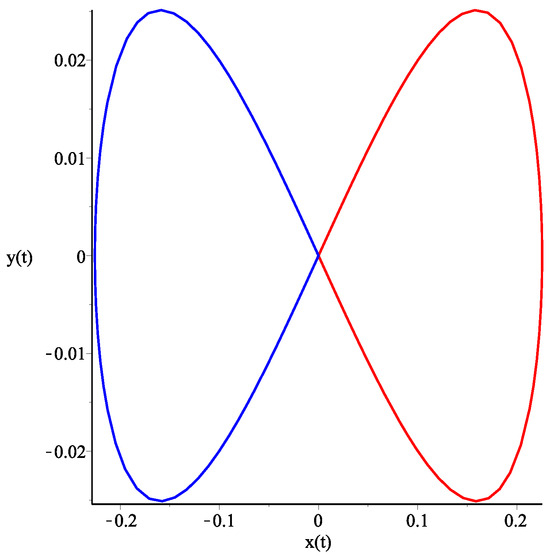
Figure 1.
Phase portrait of the unperturbed Equation (19).
When , Equation (20) has a family of periodic solutions around the saddle point O that can be represented by h, which yields
where , , , and . Thus, B and can be represented by k as and , respectively. is the period of the orbit (22), where is the Legendre complete elliptic integral of the first kind.
4. Chaotic Motion in the System
The chaotic phenomena in dynamic systems can be studied analytically using the Melnikov method. The method is commonly used in various areas, such as for an extended Duffing–van der Pol oscillator with a nonlinear quintic term [22], a symmetric gyro-subjected system [23], the oscillatory nonlinear dynamic system of a turbine rotor [24], a conveyor belt system featuring bilateral rigid restraints interconnected via inclined springs and dampening elements [25], a cantilever beam that is supported by obliquely positioned springs and subjected to bilateral asymmetric rigid constraints [26], a Rayleigh–Duffing oscillator subjected to both non-smooth periodic perturbations and harmonic excitation [27], spherical shells with incompressible hyperelastic properties [28], a bistable piezoelectric energy harvester [29] etc. As so, also in this paper, the chaotic motion of the system (17) is studied using the Melnikov method.
4.1. Melnikov Analysis and Thresholds for Chaotic Systems
Calculating the Melnikov function for the given system (17) along the homoclinic paths
for which, using the residue theorem and function transformation, one obtains the integrals
Thus, has simple zeros if
4.2. The Chaotic Threshold of the System
Now, let us analyze this system’s chaotic threshold value with certain parameters based on Ref. [11], fixing the system’s constant coefficients to , taking the proper viscosity , and setting the perturbation . Equation (25) can be rewritten as follows:
R is the chaotic threshold which is related only to , q (via ), and . The influence of the other parameters on R is discussed by fixing the values of two to achieve the purpose of controlling the chaos threshold, and the following three cases are discussed as follows. Taking q close to 1, the system represents an ideal black hole whose physical properties can be fully determined using the aforementioned parameters. Taking as a small enough valuethe influence of the dilation field on the electromagnetic field becomes relatively weak, and the electromagnetic radiation of the black hole follows rather standard thermodynamic laws. We choose quite a small value for to ensure the periodicity of the perturbations. All the parameters are set to the values given just above.
4.2.1. Case 1: Fixed and q
Figure 2 shows the curve of the chaotic threshold (26) and the change in the chaotic threshold rate with the frequency using the parameters defined just above for different values of and q. One can see that the shape of and trend in the curve are nearly the same, what indicates that proper adjustment of the values of and q do not change the direction of the chaotic threshold . Therefore, it is reasonable and complete to discuss the characteristics of the chaotic threshold when and . (Specifically, and can be determined based on these values).
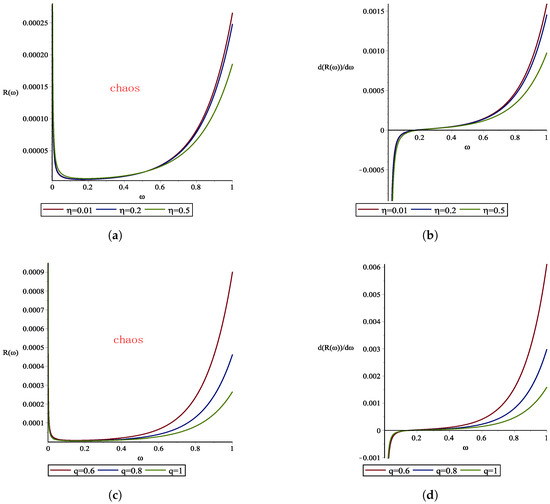
Figure 2.
The chaotic threshold (26) (a,c) and its derivative (b,d) as a function of for and different values of (a,b) and and different values of q (c,d) as indicated. Other parameters are set to , , , and .
Conclusion 1.
For and , the chaotic threshold decreases monotonically as increases for and, conversely, the threshold increases monotonically with for .
4.2.2. Case 2: Fixed and q
Figure 3 shows the curve in the chaotic threshold (26) and the change in the chaotic threshold rate as a function of for different values for and q using the above-defined parameters. As due to Conclusion 1 of Section 4.2.1, the change in the values of q and has little effect on the trend in the chaotic threshold . Therefore, it is reasonable and complete to discuss the characteristics of the chaotic threshold when and .
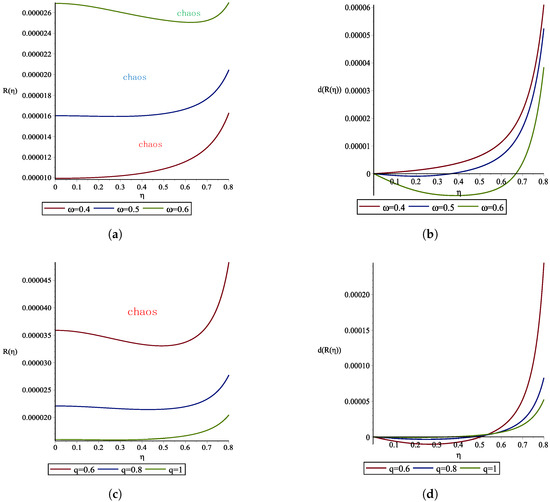
Figure 3.
The chaotic threshold (26) (a,c) and its derivative (b,d) as a function of for and different values of (a,b) and and different values of q (c,d) as indicated. Other parameters are set to , , , and .
Conclusion 2.
For and , the chaotic threshold decreases monotonically as increases for and, conversely, the threshold increases monotonically with for .
4.2.3. Case 3: Fixed and
The curve of the chaotic threshold and the change in the chaotic threshold rate with q for different values of and using the parameters defined above are shown in Figure 4. As due to Conclusion 1 of Section 4.2.1, the change in the values of q and has little effect on the trend in the chaotic threshold . Therefore, it is reasonable and complete to discuss the characteristics of the chaotic threshold when .

Figure 4.
The chaotic threshold (26) (a,c) and its derivative (b,d) as a function of q for and different values of (a,b) and and different values of q (c,d) as indicated. Other parameters are set to , , , and .
Conclusion 3.
For and , the chaotic threshold increases monotonically as q increases for and, conversely, the threshold decreases monotonically with increasing for .
5. Subharmonic Bifurcations
In this Section, subharmonic Melnikov method is used to investigate the subharmonic bifurcations of the system (17).
5.1. Parameter Conditions for Subharmonic Bifurcations
For any coprime positive integers m and n, the period of system (17) can be represented by k as , where k is a certain number belonging to . According to the definition of k and the relationship between k and h (see Equation (22)), one can deduce that . Then, calculating the subharmonic Melnikov function to discuss the parametric critical conditions of subharmonic bifurcation yields
Using the residue theorem and the elliptic function transformation, one obtains
where denotes the complete elliptic integral of the second kind and the prime denotes the k-derivative.
Consequently, when
the system (17) is shown to potentially exhibit chaotic behavior via infinite subharmonic bifurcations of an odd order.
5.2. The Evolution from Subharmonic Bifurcations to Chaos
5.2.1. Case 1: Fixed and q and
The condition (29) can be expressed as follows:
When is fixed and , one deduces that and
and, then,
The chaotic threshold (31) and the change in the chaotic threshold rate with the frequency for different values of and q using the parameters defined in Section 4.2 are shown in Figure 5. One can see that the shape of and the trend in the chaotic threshold are nearly the same, what indicates that a proper adjustment of the values of and q do change the trend in the chaotic threshold . Therefore, it is reasonable and complete to discuss the characteristics of the chaotic threshold when and . The other two cases (when is fixed or q is fixed) are similar to the Cases 2 and 3 therefore, not discussed here.
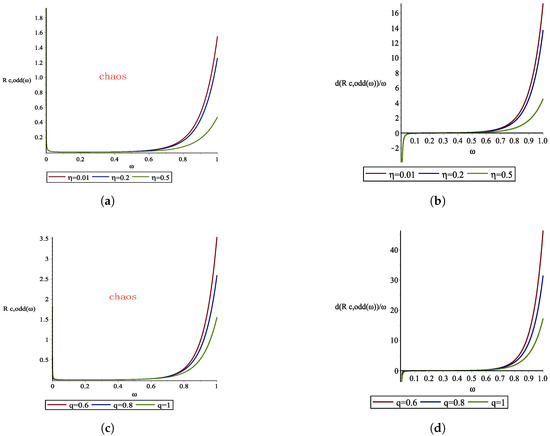
Figure 5.
The the chaotic threshold (31) (a,c) and its derivative (b,d) for and different values of (a,b) and and different values of q (c,d) as indicated. Other parameters are set to , , , and .
With the parameters defined in Section 4.2, one comes to
Conclusion 4.
When , the system is shown to potentially exhibit chaotic behavior via infinite subharmonic bifurcations of an odd order. For and ), decreases monotonically as increases for , and conversely, increases monotonically with increasing for .
5.2.2. Case 2: Fixed and q and
The condition (29) can be written as
The chaos critical curve (32) and the change in its rate with k using the parameters defined in Section 4.2 in Figure 6. As due to Conclusion 4, the change in the values of , q, and has little effect on the trend in the chaotic threshold . Therefore, it is reasonable and complete to discuss the characteristics of the chaotic threshold when , , and .
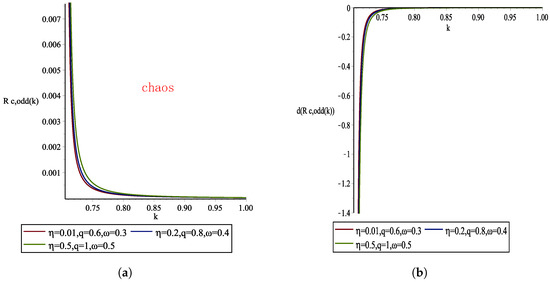
Figure 6.
The chaotic threshold (32) (a) and its derivative (b) as a function of k for different values of , q, and , as indicated. Other parameters are set to , , , and .
One concludes:
Conclusion 5.1.
The chatic threshold value of (32) decreases monotonously with an increase of k for . Specifically, as , , and as , .
Based on the definition , one infers that k increases monotonically with m when and . Then, Conclusion 5.1 can be rewritten:
Conclusion 5.2.
The chaotic threshold (32) decreases monotonically with an increase of m. Specifically, when m is large enough, and monotonically.
6. Numerical Simulations
Now, let us choose the parameters as follows: , and . Using a numerical integration method to simulate the features of the system (17), we find the time history curve, the phase portrait, and the Poincaré section are shown in Figure 7, Figure 8, Figure 9 and Figure 10.

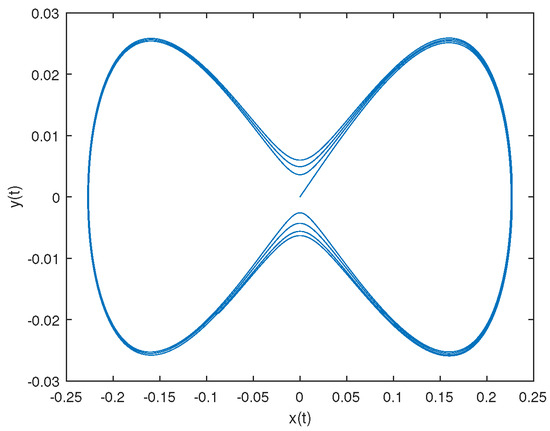
Figure 8.
The phase portrait of the system (17) when .
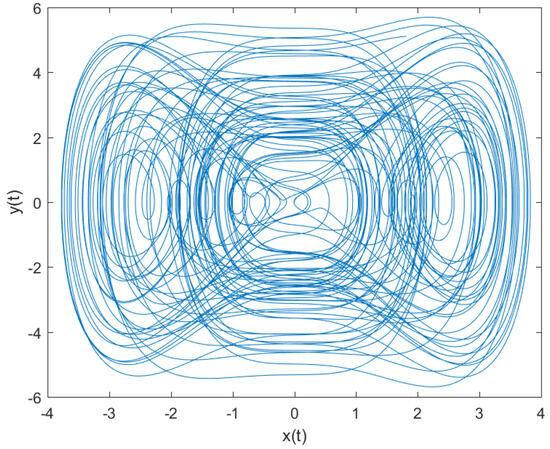
Figure 9.
The phase portrait of the system (17) when .
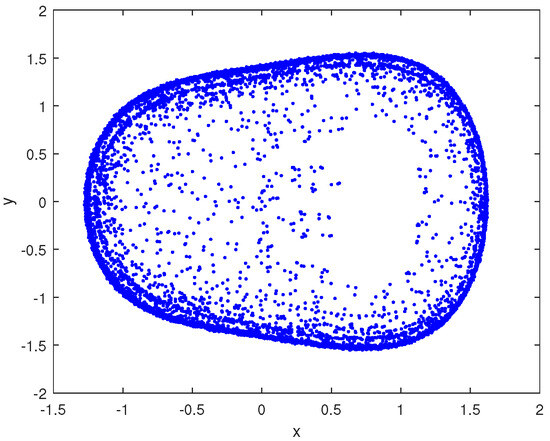
Figure 10.
The Poincaré section of the system (17) for .
Figure 11 demonstrates that the maximum Lyapunov exponent of system (17) transitions to positive values as the excitation amplitude increases, which confirms the onset of chaotic dynamics. A bifurcation diagram of the excitation amplitude is shown in Figure 12. It can be seen that the system has period-doubling bifurcations and tends towards chaotic motion, what demonstrates that the system exhibits chaotic behavior via infinite subharmonic bifurcations with an increase in the amplitude . As one can find that Figure 7, Figure 8, Figure 9, Figure 10, Figure 11 and Figure 12 are all consistent with the theoretical results obtained above.
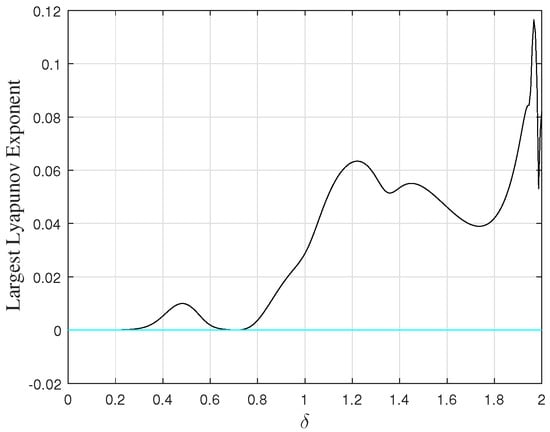
Figure 11.
Maximum Lyapunov exponent diagram of the system (17) as a function of the amplitude .

Figure 12.
Bifurcation diagram of the system (17) as a function of .
7. Conclusions
The chaotic behavior and subharmonic bifurcation of dynamical models of charged dilation-AdS black holes in extended phase space have been investigated using analytical and numerical methods. An analytical expression for the chaotic critical threshold dependence on the disturbance amplitude is obtained using the Melnikov method, revealing the monotonicity of the chaotic threshold R with frequency , charge q and the coupling parameter between the expansion field and the Maxwell field. This shows that the critical R decreases first and then increases with and q but increases first and then decreases with . Meantime, an analytical expression for the threshold of the bifurcation of subharmonic orbits at disturbance amplitudes is obtained using the subharmonic Melnikov method, showing the relationship between frequency , the order of the subharmonic orbit m, and the threshold . This demonstrates that the system is shown to potentially exhibit chaotic behavior via infinite subharmonic bifurcations of an odd order. The numerical simulation verifies the analytical results.
Author Contributions
Conceptualization, Q.C., L.Z. and F.A.; methodology, Q.C., L.Z. and F.A.; software, Q.C.; validation, Q.C.; formal analysis, Q.C.; resources, Q.C. and L.Z.; data curation, Q.C.; writing—original draft preparation, Q.C. and L.Z.; writing—review and editing, Q.C., L.Z. and F.A.; visualization, Q.C.; supervision, Q.C. and L.Z.; project administration, Q.C., L.Z. and F.A.; funding acquisition, L.Z. and F.A. All authors have read and agreed to the published version of the manuscript.
Funding
This project is supported by the National Natural Science Foundation of China (grants 11772148, 12172166) and the Open Foundation of Key Laboratory of Mathematical Modelling and High Performance Computing of Air Vehicles, NUAA (grant No. 202301).
Data Availability Statement
The original contributions presented in this study are included in the article. Further inquiries can be directed to the corresponding author.
Acknowledgments
We sincerely thank the referees for their valuable comments and constructive suggestions, which have significantly improved the quality of this paper.
Conflicts of Interest
The authors declare no conflicts of interest.
Abbreviations
The following abbreviations are used in this manuscript:
| ADM | Arnovitt–Deser–Misner |
| AdS | anti-de Sitter |
| BKL | Belinsky–Khalatnikov–Lifshitz |
| DOF | degrees of freedom |
| RN | Reissner–Nordström |
| SQBH | Schwarzschild black hole with quintessence |
References
- Hawking, S.W.; Page, D.N. Thermodynamics of black holes in anti-de Sitter space. Commun. Math. Phys. 1983, 87, 577–588. [Google Scholar] [CrossRef]
- Wang, Z.Q.; He, Y.C.; Lei, C.X.; Chen, D.Y. Chaos bound and circular motion around Bardeen black holes. Int. J. Theor. Phys. 2023, 62, 187. [Google Scholar] [CrossRef]
- Kubiznak, D.; Bmann, R. P–V criticality of charged AdS black holes. J. High Energy Phys. 2012, 2012, 33. [Google Scholar] [CrossRef]
- De Clerck, M.; Hartnoll, S.A.; Santos, J.E. Mixmaster chaos in an AdS black hole interior. High Energy Phys. 2024, 202, 1007. [Google Scholar] [CrossRef]
- You, L.; Wang, B.R.; Tang, C.Y. Thermal chaos of quantum-corrected-AdS black hole in the extended phase space. Eur. Phys. J. C 2024, 84, 1133. [Google Scholar] [CrossRef]
- Giri, S.; Sheoran, P.; Nandan, H.; Shaymatov, S. Chaotic motion and Periastron precession of spinning test particles moving in the vicinage of a Schwarzschild black hole surrounded by a quintessence matter field. Eur. Phys. J. Plus 2023, 138, 245. [Google Scholar] [CrossRef]
- Slemrod, M.; Marsden, J. Temporal and spatial chaos in a van der Waals fluid due to periodic thermal fluctuations. Adv. Appl. Math. 1985, 6, 135–158. [Google Scholar] [CrossRef]
- Melnikov (Mel’nikov), V.K. On the stability of a center for time-periodic perturbations. Tr. Mosk. Mat. Obshch. [Proc. Moscow Math. Soc.] 1963, 12, 3–52. Available online: https://www.mathnet.ru/eng/mmo137 (accessed on 10 May 2025). (In Russian).
- Chabab, M.; El Moumni, H.; Iraoui, S.; Masmar, K.; Zhizeh, S. Chaos in charged AdS black hole extended phase space. Phys. Lett. B 2018, 781, 316–321. [Google Scholar] [CrossRef]
- Chen, Y.; Li, H.; Zhang, S.-J. Chaos in Born–Infeld–AdS black hole within extended phase space. Gen. Relativ. Gravit. 2019, 51, 134. [Google Scholar] [CrossRef]
- Dai, C.; Chen, S.; Jing, J. Thermal chaos of a charged dilaton-AdS black hole in the extended phase space. Eur. Phys. J. C 2020, 80, 245. [Google Scholar] [CrossRef]
- Tang, B. Temporal and spatial chaos in the Kerr–AdS black hole in an extended phase space. Chin. Phys. C 2021, 45, 206–215. [Google Scholar] [CrossRef]
- Polcar, L.; Semerák, O. Free motion around black holes with discs or rings: Between integrability and chaos. Phys. Rev. D 2019, 100, 103013. [Google Scholar] [CrossRef]
- Mosna, R.A.; Rodrigues, F.E.; Vieira, R.S.S. Chaotic dynamics of a spinless axisymmetric extended body around a Schwarzschild black hole. Phys. Rev. D 2022, 106, 024016. [Google Scholar] [CrossRef]
- Barzi, F.; Moumni, H.E.; Masmar, K. Thermal chaos of charged-flat black hole via Rényi formalism. Nucl. Phys. B 2024, 1005, 116606. [Google Scholar] [CrossRef]
- Rodrigues, F.D.F.; Mosna, A.R.; Vieira, S.S.R. Chaotic dynamics of pulsating spheres orbiting black holes. Gen. Relativ. Gravit. 2024, 56, 112. [Google Scholar] [CrossRef]
- Mahish, S.; Chandrasekhar, B. Chaos in charged Gauss–Bonnet AdS black holes in extended phase space. Int. J. Geom. Methods Mod. Phys. 2019, 99, 106012. [Google Scholar] [CrossRef]
- Bombelli, L.; Calzetta, E. Chaos around a black hole. Class. Quantum Gravity 1992, 9, 2573–2599. [Google Scholar] [CrossRef]
- Masaaki, T.; Hiroko, K. Chaotic motion of charged particles in an electromagnetic field surrounding a rotating black hole. Astrophys. J. 2009, 693, 472–483. [Google Scholar]
- Li, D.; Wu, X. Chaotic motion of neutral and charged particles in a magnetized Ernst-Schwarzschild spacetime. Eur. Phys. J. 2019, 134, 96. [Google Scholar] [CrossRef]
- Chabab, M.; Moumni, H.; Iraoui, S.; Masmar, K.; Zhizeh, S. More insight into microscopic properties of RN–AdS black hole surrounded by quintessence via an alternative extended phase space. Int. J. Geom. Methods Mod. Phys. 2018, 15, 1850171. [Google Scholar] [CrossRef]
- Yu, J.; Li, J.R. Investigation on dynamics of the extended Duffing–Van der Pol system. Z. Naturf. A 2009, 64, 341–346. [Google Scholar] [CrossRef]
- Tong, X.; Mard, N. Chaotic motion of a symmetric gyro subjected to a harmonic base excitation. Appl. Mech. 2001, 68, 681–684. [Google Scholar] [CrossRef]
- Xu, J.-X.; Yan, R.; Zhang, W. An algorithm for Melnikov functions and application to a chaotic rotor. SIAM J. Sci. Comput. 2005, 26, 1525–1546. [Google Scholar] [CrossRef]
- Peng, R.; Li, Q.; Zhang, W. Homoclinic bifurcation analysis of a class of conveyor belt systems with dry friction and impact. Chaos Solitons Fractals 2024, 180, 114469. [Google Scholar] [CrossRef]
- Zhang, Y.; Xu, H.; Zhang, J. Global dynamics for impacting cantilever beam supported by oblique springs. Chaos Solitons Fractals 2023, 169, 113179. [Google Scholar] [CrossRef]
- Zhou, L.; Chen, F. Chaos of the Rayleigh–Duffing oscillator with a non-smooth periodic perturbation and harmonic excitation. Math. Comput. Simul. 2022, 192, 1–18. [Google Scholar] [CrossRef]
- Zhao, Z.; Yuan, X.; Zhang, W.; Niu, D.; Zhang, H. Dynamical modeling and analysis of hyperelastic spherical shells under dynamic loads and structural damping. Appl. Math. Model. 2021, 95, 468–483. [Google Scholar] [CrossRef]
- Cui, D.; Shang, H. Global dynamic analysis of a typical istable piezoelectric cantilever energy harvesting system. Fractal Fract. 2023, 7, 717. [Google Scholar] [CrossRef]
Disclaimer/Publisher’s Note: The statements, opinions and data contained in all publications are solely those of the individual author(s) and contributor(s) and not of MDPI and/or the editor(s). MDPI and/or the editor(s) disclaim responsibility for any injury to people or property resulting from any ideas, methods, instructions or products referred to in the content. |
© 2025 by the authors. Licensee MDPI, Basel, Switzerland. This article is an open access article distributed under the terms and conditions of the Creative Commons Attribution (CC BY) license (https://creativecommons.org/licenses/by/4.0/).