


Abstract
Agrivoltaics (AVs), the co-location of photovoltaic panels and agricultural production, is increasingly promoted as a strategy to enhance land-use efficiency and support renewable energy transitions. While numerous studies emphasize potential synergies, growing evidence indicates that AV systems also entail significant biophysical, ecological and socio-economic trade-offs. This review synthesizes published literature on the negative impacts and management challenges associated with agrivoltaics across diverse crops, climates and institutional contexts. A structured literature analysis was conducted, integrating findings from experimental field studies, ecological assessments, economic evaluations and policy analyses. The reviewed evidence demonstrates that panel-induced shading and altered microclimatic conditions frequently reduce photosynthetically active radiation, modify soil temperature and moisture regimes, and impair photosynthetic efficiency, yield stability, and quality in light-demanding crops. Open-field AV installations further alter understory vegetation, pollinator activity and soil arthropod communities, leading to functional biodiversity losses beneath panel-covered areas. Economic and institutional analyses reveal high investment costs, regulatory ambiguity and land-tenure constraints that disproportionately transfer agronomic and financial risks to farmers, while land-use conflicts may reduce food production and contribute to indirect land-use change. Overall, open-field AV outcomes are strongly context- and design-dependent. The review highlights the need for long-term, integrative assessments and governance frameworks that explicitly address trade-offs to ensure that AVs contribute to sustainable land-use transitions rather than undermining agricultural and ecological functions.
1. Introduction
Agrivoltaics (AVs) refers to the combination of photovoltaic (PV) panels and crop production on the same location [1,2]. It is increasingly promoted as a promising strategy to increase land productivity and contribute to renewable energy targets [3]. AV can modify microclimatic conditions by altering light, temperature, humidity, wind and soil moisture dynamics beneath the panels [4,5]. These microclimatic effects may enhance plant growth under specific environmental conditions, particularly in drylands, through improved water-use efficiency and moderated temperatures [5,6]. However, evidence accumulated over the past decade indicates that these benefits are highly context-dependent and frequently accompanied by significant trade-offs.
While many studies highlight potential synergies (e.g., improved water-use efficiency in arid regions), a growing body of literature documents important biophysical, ecological and socio-economic constraints that may limit AV suitability across crops, climates and social contexts. Strong or poorly managed shading can reduce photosynthetically active radiation (PAR) in the crop canopy. This reduction can diminish photosynthetic activity and alter crop phenology, morphology and metabolic composition, particularly in high-light-demanding species such as wheat, maize, grapevine and soybean [2,7,8,9]. These physiological changes frequently translate into reduced crop yield and quality, or highly variable yield responses across years, depending on climatic conditions [10,11]. Furthermore, AV structures not only affect cultivated crops but also reshape vegetation communities and ecological processes under and around the panels. Shaded conditions and altered microhabitats may reduce biodiversity, pollinator activity, soil arthropod abundance and the resilience of natural ecosystems, particularly in systems originally dominated by open-habitat species [12,13,14,15].
Besides biophysical impacts, AVs introduce substantial economic, social and institutional challenges. High initial costs, complex permitting procedures, and uncertain returns on investment can limit adoption, particularly among smallholder farmers [16,17]. Regulatory frameworks in many countries were designed for single-use land categories and therefore impose unclear, restrictive or even contradictory requirements on AV development [18,19]. Furthermore, community acceptance of AV projects is shaped by perceptions of landscape transformation, loss of agricultural identity, and trust in institutions responsible for planning and regulation [18]. In addition, land-use conflicts may arise when agricultural land is converted into predominantly energy-producing sites, potentially reducing food production, displacing farming, and contributing to indirect land-use change [20,21].
Given these documented biophysical, ecological and socio-economic risks, this review synthesizes evidence of the negative impacts of AV systems across five major thematic sections. Section 2 synthesizes evidence on microclimatic alterations induced by PV panels. Section 3 examines crop physiological responses to shading and altering light regimes. Section 4 addresses biodiversity and impacts on an ecosystem level, including effects on pollinators, vegetation, and soil communities. Section 5 analyses economic, institutional and policy changes associated with AV development. Section 6 discusses land-use conflicts and broader socio-economic consequences. Section 7 discusses beforementioned topics and provides possible solutions to management issues. Lastly, Section 8 summarizes key findings and outlines the implications for research. All the addressed sections are visually shown in Figure 1. The objective is not to reject AV as a concept, but to provide a comprehensive assessment of the key trade-offs and constraints that must be considered when evaluating AV as a sustainable land-use strategy. Rather than deriving universal thresholds or causal response functions, this review focuses on identifying recurrent patterns, context dependencies and design-related risks that shape negative outcomes in AV systems.
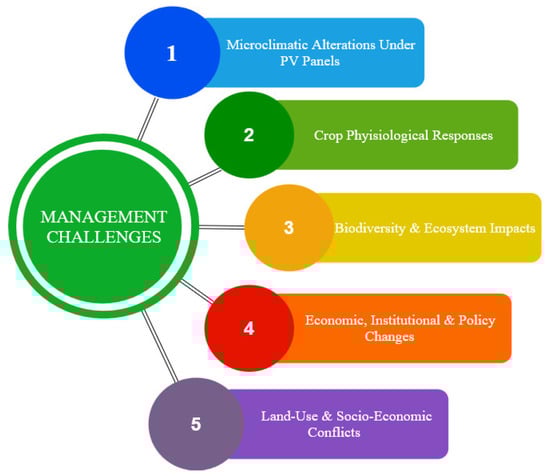
Figure 1.
Visual representation of the management challenges of AV systems addressed in this paper.
Distinguishing between these two categories is essential to avoid attributing avoidable design or policy failures to agrivoltaics as a concept.
A structured bibliometric analysis was conducted to synthesize evidence on the biophysical, ecological, economic, and institutional impacts of AV systems. Peer-reviewed articles were identified using the Web of Science, Scopus, and Google Scholar databases. Search terms included combinations of “agrivoltaics”, “photovoltaics”, “crop shading”, “microclimate”, “crop physiology”, “biodiversity”, “economic impacts”, and “land-use conflicts”. The literature search primarily covered publications from 2010 to 2025, reflecting the rapid development of AV research over the past decade.
Studies were included if they reported empirical, modeling, or review-based evidence on crop performance, microclimatic modification, biodiversity impacts, economic outcomes, or regulatory frameworks related to AV systems. The review adopts a qualitative synthesis approach, focusing on identifying recurrent patterns, trade-offs, and context dependencies rather than performing a quantitative meta-analysis. Additionally, the negative outcomes observed in AV systems stem from two fundamentally different sources. Some impacts are intrinsic to the AV concept itself, including inevitable reductions in solar radiation beneath panels, changes in light quality, and increased variability in microclimatic conditions. In contrast, other negative effects arise from suboptimal system design, economic limitations, or inadequate policy and governance frameworks. These include overly dense panel arrangements, insufficient panel elevation, and poor alignment between system configuration and crop functional traits. Regulatory incentives that favor electricity generation at the expense of agricultural performance can also have negative effects on the system.
2. Microclimatic Alterations Under Photovoltaic Panels
In this section, the effects of the installation of PV systems on local microclimatic conditions, including radiation, temperature, humidity, wind dynamics, and soil moisture, are examined. The section synthesizes evidence on how these alterations affect interactions between soil, plants and atmosphere, and evaluates their implications for agricultural performance and system sustainability.
The installation of PV panels in AV introduces systematically and spatially heterogeneous changes in the microclimate under the panels, which have direct implications for plant physiology, soil dynamics and the sustainability of agricultural production. Among the most frequently reported negative microclimatic effects are reductions in incoming solar radiation, altered soil thermal regimes, and disruptions of natural water redistribution patterns.
Marrou et al. [4] investigated microclimatic effects beneath AV structures and demonstrated that soil temperature was consistently lower under panels, both at 0.05 m and 0.25 m depth.
Although air temperature, relative humidity, and wind speed at canopy height differed only slightly from open-field conditions, radiometric measurements revealed notable changes in the light regime. Incident shortwave radiation was reduced by approximately 32% under partially covered systems and up to 68% under fully covered panels. Such reductions are agronomically relevant because they directly constrain PAR interception and alter the soil energy balance. Cooling of the surface layer may slow early-season root growth, delay phenological development, and shift soil moisture dynamics through reduced evaporation, effects which are documented in other shaded systems [22,23]. Furthermore, radiation-driven reductions in surface drying can increase nocturnal humidity and prolong leaf wetness duration, creating favorable conditions for fungal pathogens in partially shaded environments [24,25]. Although Marrou et al. [4] did not detect pronounced changes in canopy-level air masses, the magnitude of radiative alteration alone is sufficient to generate biologically meaningful microclimatic stressors.
Hassanpour Adeh et al. [5] quantified significant differences in average air temperature, relative humidity, wind speed and direction, and soil moisture in an AV system in Oregon. Pastures under PV panels maintained higher soil moisture throughout the observation period, resulting in substantially higher late-season biomass, with increases of up to 90% relative to the control group and improved water-use efficiency by up to 328%. These pastures consist of eight grass types: Foxtail barley, redtop bentgrass, meadow foxtail, tall rye grass, foxtailbrome, reed grass, thistle, and orchid grass. These findings suggest that microclimatic moderation under panels can be advantageous in water-limited environments, yet they also highlight a fundamental trade-off between reduced radiation and enhanced water availability. These findings highlight that microclimatic benefits of shading depend on context and cannot be generalized to all crops or climates.
Indeed, microclimatic changes under panels are frequently detrimental for high-light-demanding perennial crops. In the grapevine cv. Corvina (Vitis vinifera L.) grown under AV in Italy, shading significantly altered the microclimate, reducing photosynthesis and delaying berry maturation. It also modified cluster morphology and lowered phenolic, sugar, and anthocyanin concentrations, ultimately compromising grape quality and potential yield [7]. Similarly, a study on grapevine in Puglia, southeastern Italy, showed that shading in AV in semi-arid Mediterranean conditions increases microclimate variability, affecting photomorphogenesis, yield components, and fruit composition [26]. The spatiotemporal dynamics of shading, together with altered light quality signals (e.g., reduced red: far-red and blue light ratios), underline the complexity of plant–panel interactions beyond simple reductions in PAR.
In annual crops, comparable patterns of context-dependent responses have been reported. In celeriac (Apium graveolens L. var. rapaceum), PAR was reduced by approximately 29.5% under AV, as measured by photosynthetically active photon flux density sensors at canopy height. Fresh bulb yield decreased by approximately 19% in 2017 but increased by approximately 12% in 2018, although neither change was statistically significant [10]. This variability between years indicates strong interannual dependence of AV yield responses and highlights the importance of multi-year observations for robust agronomic assessment. Omer et al. [27] similarly reported that AV systems can lower air and soil temperatures, reduce evapotranspiration, and improve soil moisture retention, but cautioned that excessive shading often leads to reduced photosynthetic rates and yield penalties, especially in radiation-demanding crops. Agostini et al. [28] noted that reduced direct solar radiation can lower evaporation in arid regions. However, this shading may also cause uneven soil moisture distribution beneath panels, resulting in agronomically negative consequences.
At larger spatial scales, AV installations can also introduce emergent microclimatic effects. In large-scale systems exceeding several hectares, heat accumulation by panel surfaces may contribute to localized heat build-up analogous to a micro-urban heat island effect [29]. Panels can disrupt natural wind flow and rainfall redistribution, resulting in non-uniform soil moisture patterns. Runoff tends to accumulate at panel edges, causing localized waterlogging, while more distant areas become comparatively drier [30,31]. Such heterogeneity may impair soil structure, promote compaction and enhance nutrient leaching, ultimately constraining root development and long-term soil fertility [32].
Overall, available evidence indicates that microclimatic alterations induced by AV systems are highly heterogeneous and frequently involve trade-offs between radiation availability, thermal regulation and soil moisture dynamics. While certain conditions may benefit from microclimate moderation, poorly optimized designs or unsuitable crop–climate combinations can exacerbate abiotic stress and undermine agricultural productivity.
3. Crop Physiological Responses to Shading and Light Alteration
This section examines the physiological responses of crops to shading and altered light regimes induced by AV systems. Attention is given to photosynthetic performance, biomass allocation, morphological acclimation, and yield formation across different crop types and environmental contexts.
One of the most frequently reported adverse effects of AV systems is the shading of crops by PV panels, which directly constrains light availability and thereby alters key physiological processes governing plant growth and productivity. Plant physiological responses to light stress are typically assessed through stomatal conductance (gs), net photosynthetic rate (Pn), transpiration (Tr), and chlorophyll fluorescence parameters (Fv/Fm, φPSII, qP, NPQ). Reductions in the maximum quantum efficiency of photosystem II (Fv/Fm) with values below 0.8 typically indicate the appearance of physiological stress in C3 plants. Enzymatic activity, including Rubisco carboxylation capacity, is also commonly measured. These parameters provide mechanistic insight into photosynthetic efficiency, carbon assimilation, water use and overall plant performance under reduced radiation regimes.
The spatial configuration, height and orientation of PV panels can substantially reduce the amount of PAR reaching the crop canopy, often resulting in decreased yields, particularly in light-demanding species. Over the past decade, an increasing number of experimental and modeling studies have documented yield penalties associated with excessive or poorly managed shading in AV systems. Ağır et al. [16] reported that while certain crops can tolerate moderate shading, yield responses remain strongly crop-specific and climate-dependent. For example, reduced light availability diminishes photosynthetic efficiency in cereals such as wheat and maize, leading to suppressed biomass accumulation and lower grain yield [2]. Optimization of panel spacing and tilt angle is frequently proposed to mitigate shading effects. Such design adjustments often involve technological complexity and additional economic costs, limiting their practical implementation [33].
Empirical evidence further demonstrates that high shading intensities can induce pronounced physiological trade-offs. Rouini et al. [11] reported that AV systems with approximately 75% shading reduced PAR by approximately 79%, resulting in a cooler microclimate (−1.1 °C) and higher soil moisture. Under these conditions, zucchini (Cucurbita pepo L.) exhibited reduced fruit yield. On the other hand, a greater proportion of assimilated carbon was allocated to leaves and stems rather than reproductive organs. This shift in biomass partitioning illustrates how shading can decouple vegetative growth from yield formation. Lv et al. [34] observed that with increasing leaf age, gs, Tr, and Pn progressively declined, with older leaves showing lower maximum values compared to younger ones. Under shaded environments, such age-related declines may be accelerated, contributing to earlier leaf senescence and reduced canopy-level photosynthetic capacity. Li et al. [35] further demonstrated that shade tolerance is closely linked to photosynthetic limitations, where reductions in stomatal conductance, increased stomatal limitation, and suppressed Rubisco activity collectively resulted in lower net photosynthetic rates.
Chlorophyll fluorescence parameters, widely used as non-destructive indicators of photosystem II performance, are also sensitive to shading stress. Naseer et al. [36] reported that prolonged shading significantly reduced Fv/Fm, φPSII, qP, and NPQ in winter wheat, particularly when combined with drought stress. These responses indicate impaired electron transport through photosystem II, suggesting that shading-induced limitations may interact synergistically with water stress. Such conditions are frequently observed in AV systems with heterogeneous soil moisture distribution. Similarly, Khalid et al. [9] found that in soybean (Glycine max (L.) Merr.), morphological traits, Fv/Fm, φPSII, qP, and electron transport rate (ETR) declined significantly with increasing shading intensity, with the lowest values recorded under 75% shading.
Morphological acclimation to reduced light availability represents another important aspect of crop response in AV systems. Stallknecht et al. [37] reported increases in specific leaf area under shading, reflecting thinner leaves with expanded surface area, a common strategy to enhance light capture. However, such morphological adjustments often come at the expense of structural robustness and stress tolerance. In soybean, shading significantly reduced leaf biomass and stem tensile strength, increasing susceptibility to lodging [38]. Shading also alters within-plant biomass allocation patterns. Sun et al. [8] showed that increased mutual shading in densely planted maize reduced leaf area, SPAD values, net photosynthetic rate, and dry matter accumulation, resulting in significant yield losses. In AV systems, panel-induced shading may exacerbate these density-related constraints, particularly in crops already grown near their optimal planting density.
Responses to shading vary considerably among crop species, further complicating AV design. In blueberry (Vaccinium spp.), 50% shading promoted vegetative growth, whereas 80% shading caused degradation of leaf cellular structure and a reduction in vascular bundle development [39]. These findings highlight the existence of species-specific and threshold-dependent responses, where moderate shading may be beneficial but excessive shading leads to structural and physiological dysfunction. Similar patterns have been reported in grapevines grown under AV systems in southern Italy. High shading levels reduced berry sugar accumulation and, in some cases, total polyphenol and anthocyanin concentrations. As such, it is negatively affecting fruit and wine quality despite otherwise favorable semi-arid conditions [26].
Taken together, these studies demonstrate that shading-induced physiological responses in AV systems are governed by complex interactions between light quantity, light quality, crop functional traits and environmental context. Although partial acclimation to reduced radiation is possible, excessive or uneven shading commonly reduces photosynthetic efficiency and biomass allocation, leading to yield losses in high-light-demanding species.
4. Biodiversity and Ecosystem Changes
This section inspects the impacts of AV systems on biodiversity and ecosystems functioning at both above- and below-ground levels, including habitat fragmentation, changes in pollinator behavior, effects on plant physiology, and impact on soil-dependent communities. Renewable energy systems, including AV installations, can directly and indirectly disturb wildlife and natural ecosystems through habitat modification, fragmentation and persistent microclimatic alteration.
The construction, operation and eventual dismantling of PV infrastructure introduce physical disturbances that may fragment habitats, reduce landscape connectivity, and interfere with ecological processes such as dispersal, pollination and predator–prey interactions [40]. These impacts are not limited to the construction phase but often persist throughout the operational lifetime of AV systems.
AV installations influence ecological processes at multiple organizational levels, affecting vegetation, fauna, soil organisms and habitat connectivity [12,41]. Habitat fragmentation arises not only from panel placement but also from supporting infrastructure, including access roads, fencing and maintenance corridors [41]. These structures act as semi-permanent barriers and reshape wildlife movement pathways [41]. For small mammals and ground-dwelling species, linear panel rows and edge zones may increase exposure to predators and disrupt established movement corridors. For pollinators, shading and altered floral distribution beneath panels can constrain foraging efficiency and reduce access to nectar-rich resources [13].
Shading from PV panels reduces light availability and alters temperature and humidity regimes, often leading to shifts in plant community composition beneath and around AV structures. Understory vegetation tends to become dominated by shade-tolerant species, frequently at the expense of open-habitat grasses and forbs that provide diverse floral resources [15,42]. Such compositional changes are closely linked to declines in pollinator abundance and diversity, as floral resource availability and phenological synchrony are key determinants of pollinator population stability [43]. In their study, Ludzuweit et al. [44] reported that shading beneath AV panels significantly reduced plant species richness and pollinator activity, particularly wild bee visitation rates. Additionally, Graham et al. [13] observed delayed flowering under partial shading in dryland AV systems. The study demonstrated that partial shading treatments resulted in a 3.8-times higher floral abundance than full sun during the late season. However, this same study found significantly fewer total pollinators and significantly fewer wild bees in the shaded plots, with wild bee counts dropping from 2.31 to 0.82 bees per plot [13]. This phenological decoupling might lower pollination success and affect ecosystem services, even if overall floral biomass seems abundant. To counter the decline in the number of pollinators, Graham et al. [13] propose planting arrays with pollen and nectar-producing flowers in partially shaded sites to increase pollinator populations.
These findings indicate that AV systems can function as ecological filters, selectively favoring a limited subset of shade-adapted species.
Soil biodiversity represents another sensitive component of AV-induced ecosystem change. Variations in soil moisture and temperature regimes beneath panels alter microbial community structure and function. Luo et al. [45] reported increased microbial biomass but reduced microbial diversity under PV panels, indicating a shift toward simplified but more abundant microbial communities. These changes may affect nutrient cycling, soil respiration and long-term soil resilience. Evidence from soil fauna further supports concerns regarding functional biodiversity loss. In Italian photovoltaic parks, Menta et al. [14] observed substantially lower densities of mites, springtails, hymenopterans and hemipterans directly beneath panels. In contrast, inter-row areas more closely resembled control grasslands. Similarly, Kocsis et al. [46] reported reductions of approximately 30–50% in both biomass and abundance of soil-emergent arthropods under panels, despite comparable species richness. These patterns suggest functional impoverishment rather than complete species loss. Additionally, Kocis et al. [46] also pointed out that bee and butterfly communities were lower in solar parks compared to extensive grasslands.
Comparable trends have been documented in aboveground arthropod communities in northern Germany. Zitzmann et al. [47] found that ground beetle (Carabidae) species richness and activity density were reduced by 40 to 50% beneath PV panels relative to inter-row gaps and edge zones. Some predator groups, such as Pseudoscorpionidae, were preferentially associated with panel-covered areas, likely due to higher soil moisture and reduced interspecific competition. Such shifts indicate a restructuring of trophic interactions rather than simple declines in abundance, with uncertain consequences for ecosystem stability and pest regulation. At larger spatial scales, AV systems may contribute to the fragmentation of ecological corridors essential for migratory and wide-ranging species, such as birds [12]. An additional concern is localized thermal alteration induced by panel surfaces, which can elevate near-ground temperatures during peak radiation periods. Although AV installations are generally smaller than utility-scale solar farms, dense clustering of panels may create micro-scale heat anomalies. Species sensitive to thermal thresholds, including seeds with thermally regulated germination cues, temperature-sensitive insects, and amphibians, may therefore experience unfavorable conditions. Elevated temperatures can further exacerbate the competitive advantages of heat-tolerant invasive species over native flora, amplifying biodiversity loss [48].
Quantitative evidence presented in Table 1 shows that PV infrastructure can lead to measurable declines in grassland ecosystem condition and biodiversity in certain regions. Bai et al. [15] concluded in their experiment in Daqin City, China, a significant decline in aboveground grassland productivity. This decline was present specifically in the areas beneath the center of each panel compared to the interspace adjacent to each panel [15].

Table 1.
Synthesis of documented impacts of AV systems on biodiversity and ecosystem functions, including quantitative ranges and regional context.
Mitigation strategies have been proposed to address these negative effects. Ludzuweit et al. [44] suggested a three-zone buffer design incorporating flower strips, shrubs and forest elements around AV fields, with modeling results indicating potential increases of 55–80% in the pollinator supply index. While such measures may partially offset biodiversity losses, they do not eliminate the underlying ecological pressures imposed by panel-induced shading and habitat modification beneath AV arrays.
Environmental and ecological effects of AV systems are highly context-dependent, varying with climatic region, land-use policies, and system design. Reported impacts range from measurable reductions in plant and animal diversity under AV installations to more moderate or mixed responses under less disruptive configurations, as shown in Table 2.
Table 2.
Synthesis of reported quantitative ranges of biodiversity and ecosystem responses associated with AV systems.
Overall, available evidence indicates that AV systems can significantly alter ecosystem structure and function, particularly beneath panel-covered areas. While inter-row zones may retain near-natural characteristics, the shaded understory often experiences reduced functional biodiversity, altered trophic interactions, and disrupted ecosystem services. These ecological trade-offs should therefore be explicitly considered in AV planning and sustainability assessments.
5. Economic, Institutional and Policy Challenges
In this section, the economic viability of AV systems alongside the institutional and policy frameworks that shape their deployment is analyzed. The section addresses investment costs, operational complexity, regulatory uncertainty, land tenure arrangements, and the distribution of risks and benefits among farmers, investors, and other stakeholders.
The economic assessment of AV schemes is strongly influenced by the ratio of agricultural and electricity market prices and their changes. The negative impacts of AV extend into the economic and institutional domains. High initial investments, uncertainties in return on investment, and complex regulatory frameworks represent significant barriers to the widespread adoption of AVs [16,32]. Bim and Bim & Valentová [49,50] have documented those bureaucratic obstacles, especially in regions with stringent land-use policies, further exacerbate the economic challenges associated with AV deployment. In addition, the perceived risks associated with crop yield reductions due to shading and altered microclimates can diminish farmer enthusiasm, creating a reluctance to invest in these systems.
The initial capital costs of AV vary widely and depend on many of the same factors that affect ground-mounted PV systems [17]. Several factors shape these outcomes, including the relative maturity of the PV industry in each region. This maturity influences soft costs, total capital and maintenance expenditures, financing options, and the availability of incentives [51]. All these factors influence the levelized cost of energy (LCOE), which is significantly higher in AV compared to traditional PV systems [17,51]. AV installations usually require some specialized mounting structures, such as elevated racks, to allow various farming tools and machinery to access crop cultures while keeping light regimes intact. As such, they are a risky investment for smallholder farms, especially in regions where retail electricity prices are low [17].
The specialized engineering requirements for AV also add complexity to the permit processes, installation and maintenance, and increase project development costs when compared to conventional PV solar farms [32]. Unlike traditional solar farms, it is of key importance to find a balance between growing crops and producing electricity in AV in a way that electricity production does not negatively affect food production and vice versa [17]. Maintenance must cover both agricultural activities and PV system operations, such as panel cleaning, electronic servicing, and equipment replacement.
Challenges in coordinating these activities can appear between farm and energy operations. For instance, important activities, such as irrigation schedules or pesticide application schedules, must align with solar system maintenance. This dual management increases operational costs, as farmers must either acquire new technical expertise, hire additional labor, or outsource specialized services [1,52]. For smaller farms operating on thin margins, these ongoing costs can erode much of the potential financial benefit, particularly when crop microclimate advantages are limited or negligible. Therefore, the success of AV projects depends on close integration between agricultural and engineering expertise [1,19]. However, institutional capacity in both areas remains incomplete, as agricultural agencies often lack solar energy knowledge, while many PV technicians are unfamiliar with common agronomical practices. This skills gap can lead to inadequate system designs and underperforming installations, heightening the risk of additional costs or even project failure [1,53].
Additionally, in many countries, clear regulations for construction, maintenance, and environmental, landscape, and wildlife conservation are lacking. This regulatory ambiguity can raise project authorization costs and prolong approval processes [54,55]. The AV can improve total land productivity in certain areas; however, they still pose a risk of investment when it comes to possible yield reduction for shade-intolerant crops. In such cases, when agricultural revenues decline, the financial sustainability of AV becomes reliant on electricity generation or lease income [33]. Both factors can become quite uncertain over time. This effect creates a trade-off for farmers, who must balance the potential loss in crop output against shifting energy revenues. Expected electricity earnings do not fully offset reduced agricultural income in many regions, especially where power purchase agreements are weak or electricity market prices are low. As a result, farmers adopting AV without diversified income could face increased economic vulnerability [1].
Financial institutions also perceive AV projects as high-risk due to their novelty and regulatory ambiguity. This perception usually leads to higher borrowing and insurance costs, which are not affordable for smaller or new farmers. Many rural financial institutions lack standardized methods to evaluate AV, leaving farmers without an option for well-structured financing [56]. As such, transition to AVs will remain among capitalized farms and institutions with strong financial support.
Institutional challenges include the lack of standardized guidelines for system design and operation, which complicates efforts to integrate AVs into conventional agricultural practices [57]. Investment costs for AV production may vary depending on the capacity, size, technology, and type of the applied modules, as well as the crop. In the case of permanent crops like fruit trees, which are designed for more than one decade of production, there is a need for special technology for higher-mounted designs [58].
Institutional arrangements for land tenure and leasing are a major source of uncertainty among farmers who opt into AV systems. Regional institutions, which allow land renting or short-term leases for farmers, conflict with the long-term and uncertain nature of AV installations [56]. Therefore, land lessees may not be in favor of installing semi-permanent PV structures in addition to using that land for farming. For this reason, landowners and institutions may prefer long-term conventional PV systems for energy production over AVs for dual crop and energy production. This dynamic can lead to the consolidation of land control, thus displacing and reducing farming in such regions. Additionally, complex contract terms and limited information can place lessee farmers at a disadvantage, particularly when they lack legal or technical expertise. As a result, they might accept unfavorable lease conditions without adequate protection, such as compensation for yield losses [59]. Such outcomes risk concentrating economic benefits among solar investors while passing agricultural and economic risks to farm tenants.
Current regulatory and grid frameworks are not suitable for AV’s dual-use nature. Many laws, such as zoning, agricultural land and wildlife protections, and renewable energy-oriented laws, were written mostly with single-use categories in mind, focused generally on energy production in PV systems [18]. Since no particular laws refer to AV, it may cause delays or even completely block AV projects, depending on the region. In countries where agricultural land is taxed or specially regulated, AV projects may face unexpected tax treatments or even completely lose the qualification for either agricultural or solar energy financial support programs [19]. Lack of, or inadequate, regulatory frameworks, combined with already high costs of AV and farming equipment, discourage both farmers and investors from choosing AV. Building the necessary cross-disciplinary expertise within universities, extension services, and technical companies requires significant time and investment, posing a substantial barrier to the rapid scaling of AV [18].
While AV systems can improve total land-use efficiency, they present a significant financial risk if electricity revenues fail to compensate for agricultural losses. For example, a landmark study on a potato-based AV system in Germany found that while land-use efficiency slightly increased for AV systems, the LCOE was approximately 8.29 €ct/kilowatt-hour (kWh), significantly higher than the 6.03 €ct/kWh average for traditional ground-mounted PV during the same period [54]. Furthermore, the CAPEX (capital expenditure) for European AV systems is often higher than standard PV due to the cost of elevated mounting structures and specialized installation, with costs reaching up to 415 €/kilowatt-peak (kWp) compared to 62–82 €/kWp for ground-mounted PV systems [3].
The economic and institutional viability of AV systems is not uniform but varies significantly based on regional market conditions, regulatory maturity, and financial structures. Table 3 synthesizes documented challenges across different geographical contexts, illustrating how the high capital costs and regulatory ambiguities discussed in this section manifest in specific, real-world barriers to AV deployment.
Table 3.
Region-specific overview of the major issues facing AV implementation.
6. Land-Use Conflicts and Socio-Economic Consequences
This section discusses land-use conflicts and socio-economic consequences arising from the integration of photovoltaic infrastructure into agricultural landscapes. Emphasis is placed on competition between food and energy production, farmer displacement, indirect land-use change, and the implications for rural livelihoods and food security.
The AV systems inherently introduce competition between energy production and agricultural use. In regions with limited arable land, this dual-use approach may lead to conflicts over land allocation and usage rights [20]. Several studies highlight that without clear policy frameworks and land-use planning, the expansion of AV can conflict with national food security objectives and local community interests [60]. These conflicts are compounded by uncertainties in legislative environments, where evolving regulatory policies may either hinder or unpredictably alter the economics of AVs [57]. As such, comprehensive policy interventions are needed to balance the energy and food production benefits against the potential negative impacts on land use.
Some AV projects can end up displacing active farming altogether, as landowners may opt for long-term solar leases instead of continuing regular crop production [61,62]. Because solar installations yield the highest returns on high-irradiance soils, AV expansion may be at risk. Investors may instead convert large, flat, sunny parcels into PV farms rather than farmland, leaving dual-use concepts largely nominal [63]. The land is technically still agricultural, but no longer contributes as much to food production. Such an effect can end up reducing local crop yields in exchange for energy reserves [64]. When these lands are converted to AV, farming often moves elsewhere, sometimes, for instance, onto ecologically sensitive areas, causing indirect land-use change (ILUC). This process can increase deforestation, harm biodiversity, and wildlife [21,65].
As AV sites often need new infrastructure, such as access roads and fencing, these new additions can break up fields, alter water drainage, and restrict access to shared resources like grazing areas [12]. The result is often tension between different land users and even conflicts with conservation efforts when habitats become fragmented [41]. At a larger scale, converting farmland to AV use can decrease the local supply of food, thus increasing product prices and denying access to small-scale farmers in the local or regional markets [61].
Recent socio-political analyses suggest that AV outcomes are shaped not only by technical design but also by how projects are framed and governed. Decision-making lacks community participation, which can potentially call into question the legitimacy of the acquisition of farmland by large AV companies. There is a risk that benefits may be unevenly distributed, reinforcing existing inequalities, and invalidate farmers’ rights [66]. This highlights the need for inclusive, deliberative policy processes alongside performance-based criteria.
Overall, the evidence shows that AVs are a complex land-use intervention involving interconnected biological, physical, ecological, and socio-economic trade-offs. Factors such as shading-caused crop stress, biodiversity changes, high investment costs, regulatory uncertainties, and uneven risk sharing collectively affect the performance and adoption of AVs. Without coordinated planning and governance, deploying AV systems may prioritize energy production over agricultural functions, social equity, and long-term land sustainability.
7. Discussion
This review shows that AV systems cannot be considered universally beneficial or intrinsically harmful. Instead, their agronomic, ecological, and economic performance depends on interactions among crop traits, climate, system design, and institutional context. Proposed evidence indicates that AV systems can enhance land-use efficiency and ecosystem services, but only when carefully designed and supported by appropriate policy frameworks [67]. Hauger et al. [67] mention in their work that 10% of agricultural farms could potentially cover 9% of Germany’s electricity demand using only 1% of arable land.
Field studies indicate that AV systems typically reduce PAR beneath photovoltaic structures by approximately 20 to 40%, and even up to 79% in cooler climates [11,68,69]. Crop responses to this reduction vary widely. Yield losses of up to 20% have been reported for light-demanding crops, such as cereals and some root vegetables, whereas neutral or positive yield responses are frequently observed in shade-tolerant species, including leafy vegetables, forage crops, and berries [4,10,69]. These ranges support the conclusion that yield penalties are not an inherent feature of AVs but depend on crop functional traits and local climatic conditions.
A key synthesis emerging from this review is the need to distinguish between trade-offs inherent to AVs and negative outcomes arising from suboptimal implementation. Inherent trade-offs include limited irradiance, altered microclimate, and constraints on machinery access, which limit suitability for certain crops and farming systems. In contrast, many reported negative impacts, such as severe yield losses or poor economic performance, are often associated with low panel clearance, excessive panel density, or insufficient agronomic adaptation [3,54,67].
Economic analyses consistently indicate that AV systems involve higher capital costs than conventional ground-mounted photovoltaic installations, often 20–90% higher compared to ground-mounted PVs, due to structural complexity and lower power density [54]. Electricity revenues alone frequently do not compensate for crop yield losses, particularly in regions with low feed-in tariffs or limited opportunities for on-farm electricity consumption [70].
Nevertheless, a well-designed AV project can bring benefits. For example, Barron-Gafford et al. [62] measured a 157% greater water use efficiency and a three-times greater production of Capsicum anuum var. glabriusculum in Tucson, AZ, USA.
Interannual variability emerges as a critical factor shaping AV performance. Several studies report contrasting yield responses between years, reflecting interactions between shading and weather extremes such as heat and drought [4,10]. These findings emphasize the limitations of short-term trials and support the conclusion that multi-year datasets are essential for better assessment.
The recent inclusion of AVs in Croatian spatial planning legislation represents an important enabling step, yet practical implementation guidelines remain limited, particularly regarding minimum agricultural productivity requirements and farmer safeguards. Similar institutional challenges have been identified across Europe, where regulatory uncertainty and inconsistent incentive structures continue to constrain adoption [18].
Clear spatial planning guidelines and streamlined permitting procedures are essential to reduce investment uncertainty, particularly for farmers and small landowners. Integration of AV into agricultural schemes and rural development programs would further align farmer incentives with renewable energy targets. Finally, public support for long-term monitoring and pilot projects is critical to generate region-specific evidence and inform adaptive policy refinement under changing climatic conditions [66,71].
Successful deployment of AV systems depends on policy frameworks that clearly acknowledge their dual role as both an energy and an agricultural land use. At the European Union level, better integration of AVs into the Common Agricultural Policy (CAP) and renewable energy strategies could help adjust to climate goals with the protection of productive farmland. Keeping farms eligible for agricultural support when AVs are introduced would reduce uncertainty for farmers [18].
In Croatia, the development of AV systems would benefit from clearer spatial planning rules and simpler permitting procedures, especially given fragmented land ownership and limited experience with such systems. Pilot projects, supported by public co-funding, could help reduce financial risks and build practical knowledge. Across both contexts, long-term monitoring and transparent data sharing are essential to support adaptive policymaking and informed productivity of AV systems.
8. Conclusions
This review synthesizes evidence demonstrating that open-field AV systems are not universally benign nor inherently sustainable across contexts. While AVs can deliver microclimatic benefits and improve water-use efficiency under specific environmental conditions, these advantages frequently coexist with substantial trade-offs affecting crop physiology, yield stability, biodiversity, soil health and social equity.
Across crop systems, excessive or poorly distributed shading reduces photosynthetic efficiency, alters biomass allocation, and delays phenological development. Yield responses are often variable rather than neutral, increasing production risk for farmers. At the ecosystem level, AV installations modify understory vegetation, pollinator activity, soil arthropod, and soil microorganism communities, resulting in functional biodiversity losses beneath panels despite near-natural conditions in inter-row areas.
Economic and institutional analyses reveal that the financial risks associated with open-field AVs are unevenly distributed. High capital costs, regulatory ambiguity and complex leasing arrangements frequently shift agronomic and income risks toward farmers. In the absence of coherent regulatory frameworks, AV systems may intensify land-use conflicts, displace agricultural activity, and contribute to indirect land-use change.
Panel height, spacing, orientation and light-transmissive designs critically determine AV outcomes, yet suboptimal or cost-constrained engineering choices often exacerbate negative impacts. Consequently, open-field AVs should not be evaluated as a single technology, but rather as a spectrum of site- and design-specific interventions with distinct ecological and socio-economic implications. This review does not argue against open-field AV systems but rather demonstrates that their successful integration into agroecosystems is dependent upon resolving the identified biophysical, ecological, and socio-economic challenges.
In conclusion, given the strong context dependency of existing evidence and the lack of long-term, multi-site studies integrating ecological and socio-economic metrics, future research must explicitly address trade-offs across diverse environments. Open-field AVs can contribute to sustainable land-use transitions only if negative impacts are systematically assessed and mitigated through informed design, regulation, and governance.
Author Contributions
Conceptualization, Š.K., A.Z. and T.K.; methodology, Š.K., A.Z., M.Z. and T.K.; investigation, Š.K., A.Z., T.K., M.L. and J.R.; writing—original draft preparation, Š.K. and A.Z.; writing—review and editing, Š.K., A.Z., T.K., V.Z. and M.L.; visualization, A.Z., M.Z. and J.R.; supervision, Š.K., T.K., V.Z. and M.L.; funding acquisition, T.K. and M.L. All authors have read and agreed to the published version of the manuscript.
Funding
This research was funded as part of the Development of Innovative Products Within the Priority Niche of Smart Agriculture—Agriculture Next Generation (ANG) project, ID: IP.1.03.0010, funded by the European Union (“IRI—Research, Development and Innovation”).
Data Availability Statement
The original contributions presented in this study are included in the article. Further inquiries can be directed to the corresponding authors.
Conflicts of Interest
The authors declare no conflicts of interest.
Abbreviations
The following abbreviations are used in this manuscript:
| AV | Agrivoltaic |
| PV | Photovoltaic |
| PAR | Photosynthetically active radiation |
| ETR | Electron transport rate |
| LCOE | Levelized cost of energy |
| ILUC | Indirect land-use change |
References
- Ghosh, A. Nexus between Agriculture and Photovoltaics (Agrivoltaics, Agriphotovoltaics) for Sustainable Development Goal: A Review. Sol. Energy 2023, 266, 112146. [Google Scholar] [CrossRef]
- Al Mamun, M.A.; Dargusch, P.; Wadley, D.; Zulkarnain, N.A.; Aziz, A.A. A Review of Research on Agrivoltaic Systems. Renew. Sustain. Energy Rev. 2022, 161, 112351. [Google Scholar] [CrossRef]
- Trommsdorff, M.; Dhal, I.S.; Özdemir, Ö.E.; Ketzer, D.; Weinberger, N.; Rösch, C. Agrivoltaics: Solar Power Generation and Food Production. In Solar Energy Advancements in Agriculture and Food Production Systems; Gorjian, S., Campana, P.E., Eds.; Academic Press: London, UK; San Diego, CA, USA, 2022; pp. 159–210. [Google Scholar] [CrossRef]
- Marrou, H.; Guilioni, L.; Dufour, L.; Dupraz, C.; Wery, J. Microclimate under Agrivoltaic Systems: Is Crop Growth Rate Affected in the Partial Shade of Solar Panels? Agric. For. Meteorol. 2013, 177, 117–132. [Google Scholar] [CrossRef]
- Hassanpour Adeh, E.; Selker, J.S.; Higgins, C.W. Remarkable Agrivoltaic Influence on Soil Moisture, Micrometeorology and Water-Use Efficiency. PLoS ONE 2018, 13, e0203256. [Google Scholar] [CrossRef]
- Barron-Gafford, G.A.; Murphy, P.; Salazar, A.; Lepley, K.; Rouini, N.; Barnett-Moreno, I.; Macknick, J.E. Agrivoltaics as a Climate-Smart and Resilient Solution for Midday Depression in Photosynthesis in Dryland Regions. Sust. Agric. 2025, 3, 32. [Google Scholar] [CrossRef]
- Ferrara, G.; Boselli, M.; Palasciano, M.; Mazzeo, A. Effect of Shading Determined by Photovoltaic Panels Installed above the Vines on the Performance of Cv. Corvina (Vitis vinifera L.). Sci. Hortic. 2023, 308, 111595. [Google Scholar] [CrossRef]
- Sun, Z.; Geng, W.; Ren, B.; Zhao, B.; Liu, P.; Zhang, J. Responses of the Photosynthetic Characteristics of Summer Maize to Shading Stress. J. Agron. Crop Sci. 2023, 209, 330–344. [Google Scholar] [CrossRef]
- Khalid, M.H.B.; Raza, M.; Yu, H.; Sun, F.; Zhang, Y.; Lu, F.; Si, L.; Iqbal, N.; Khan, I.; Fu, F.L.; et al. Effect of Shade Treatments on Morphology, Photosynthetic and Chlorophyll Fluorescence Characteristics of Soybeans (Glycine max L. Merr.). Appl. Ecol. Environ. Res. 2019, 17, 2551–2569. [Google Scholar] [CrossRef]
- Weselek, A.; Bauerle, A.; Zikeli, S.; Lewandowski, I.; Högy, P. Effects on Crop Development, Yields and Chemical Composition of Celeriac (Apium graveolens L. Var. Rapaceum) Cultivated Underneath an Agrivoltaic System. Agronomy 2021, 11, 733. [Google Scholar] [CrossRef]
- Rouini, N.; Salazar, A.; Murphy, P.; Lepley, K.; Barron-Gafford, G.A. High-Shade Dryland Agrivoltaic Conditions Enhanced Carbon Uptake and Water-Use Efficiency in Zucchini (Cucurbita pepo). Front. Sustain. Food Syst. 2025, 9, 1686773. [Google Scholar] [CrossRef]
- Hernandez, R.R.; Easter, S.B.; Murphy-Mariscal, M.L.; Maestre, F.T.; Tavassoli, M.; Allen, E.B.; Barrows, C.W.; Belnap, J.; Ochoa-Hueso, R.; Ravi, S.; et al. Environmental Impacts of Utility-Scale Solar Energy. Renew. Sustain. Energy Rev. 2014, 29, 766–779. [Google Scholar] [CrossRef]
- Graham, M.; Ates, S.; Melathopoulos, A.P.; Moldenke, A.R.; DeBano, S.J.; Best, L.R.; Higgins, C.W. Partial Shading by Solar Panels Delays Bloom, Increases Floral Abundance during the Late-Season for Pollinators in a Dryland, Agrivoltaic Ecosystem. Sci. Rep. 2021, 11, 7452. [Google Scholar] [CrossRef]
- Menta, C.; Remelli, S.; Andreoni, M.; Gatti, F.; Sergi, V. Can Grasslands in Photovoltaic Parks Play a Role in Conserving Soil Arthropod Biodiversity? Life 2023, 13, 1536. [Google Scholar] [CrossRef] [PubMed]
- Bai, Z.; Jia, A.; Bai, Z.; Qu, S.; Zhang, M.; Kong, L.; Sun, R.; Wang, M. Photovoltaic Panels Have Altered Grassland Plant Biodiversity and Soil Microbial Diversity. Front. Microbiol. 2022, 13, 1065899. [Google Scholar] [CrossRef] [PubMed]
- Ağır, S.; Derin-Gure, P.; Senturk, B. Farmers’ Perspectives on Challenges and Opportunities of Agrivoltaics in Turkiye: An Institutional Perspective. Renew. Energy 2023, 212, 35–49. [Google Scholar] [CrossRef]
- Dinesh, H.; Pearce, J.M. The Potential of Agrivoltaic Systems. Renew. Sustain. Energy Rev. 2016, 54, 299–308. [Google Scholar] [CrossRef]
- Chatzipanagi, A.; Taylor, N.; Jaeger-Waldau, A. Overview of the Potential and Challenges for Agri-Photovoltaics in the European Union; JRC132879; EUR 31482 EN; Publications Office of the European Union: Luxembourg, 2023; Available online: https://publications.jrc.ec.europa.eu/repository/handle/JRC132879 (accessed on 25 November 2025).
- Brunswick, S.; Marzillier, D. The New Solar Farms: Growing a Fertile Policy Environment for Agrivoltaics. Minn. J. Law Sci. Technol. 2023, 24, 123–179. Available online: https://scholarship.law.umn.edu/mjlst/vol24/iss1/9/?utm_source=scholarship.law.umn.edu%2Fmjlst%2Fvol24%2Fiss1%2F9&utm_medium=PDF&utm_campaign=PDFCoverPages (accessed on 25 November 2025).
- Moore, S.; Graff, H.; Ouellet, C.; Leslie, S.; Olweean, D. Can We Have Clean Energy and Grow Our Crops Too? Solar Siting on Agricultural Land in the United States. Energy Res. Soc. Sci. 2022, 91, 102731. [Google Scholar] [CrossRef]
- Searchinger, T.; Heimlich, R.; Houghton, R.A.; Dong, F.; Elobeid, A.; Fabiosa, J.; Tokgoz, S.; Hayes, D.; Yu, T.-H. Use of U.S. Croplands for Biofuels Increases Greenhouse Gases Through Emissions from Land-Use Change. Science (1979) 2008, 319, 1238–1240. [Google Scholar] [CrossRef]
- Lott, J.E.; Ong, C.K.; Black, C.R. Understorey Microclimate and Crop Performance in a Grevillea robusta-Based Agroforestry System in Semi-Arid Kenya. Agric. For. Meteorol. 2009, 149, 1140–1151. [Google Scholar] [CrossRef]
- Sudmeyer, R.A.; Speijers, J. Influence of Windbreak Orientation, Shade and Rainfall Interception on Wheat and Lupin Growth in the Absence of below-Ground Competition. Agrofor. Syst. 2007, 71, 201–214. [Google Scholar] [CrossRef]
- Roberts, M.R.; Paul, N.D. Seduced by the Dark Side: Integrating Molecular and Ecological Perspectives on the Influence of Light on Plant Defence against Pests and Pathogens. New Phytol. 2006, 170, 677–699. [Google Scholar] [CrossRef] [PubMed]
- Wu, B.M.; Subbarao, K.V.; van Bruggen, A.H.C. Analyses of the Relationships Between Lettuce Downy Mildew and Weather Variables Using Geographic Information System Techniques. Plant. Dis. 2005, 89, 90–96. [Google Scholar] [CrossRef] [PubMed][Green Version]
- Magarelli, A.; Mazzeo, A.; Alhajj Ali, S.; Ferrara, G. Shading Enhanced Microclimate Variability, Photomorphogenesis and Yield Components in a Grapevine Agrivoltaic System in Semi-Arid Mediterranean Conditions in Puglia Region, Southeastern Italy. Sci. Hortic. 2025, 350, 114311. [Google Scholar] [CrossRef]
- Ali Abaker Omer, A.; Li, M.; Zhang, F.; Hassaan, M.M.E.; El Kolaly, W.; Zhang, X.; Lan, H.; Liu, J.; Liu, W. Impacts of Agrivoltaic Systems on Microclimate, Water Use Efficiency, and Crop Yield: A Systematic Review. Renew. Sustain. Energy Rev. 2025, 221, 115930. [Google Scholar] [CrossRef]
- Agostini, A.; Colauzzi, M.; Amaducci, S. Innovative Agrivoltaic Systems to Produce Sustainable Energy: An Economic and Environmental Assessment. Appl. Energy 2020, 281, 116102. [Google Scholar] [CrossRef]
- Mills, G.; Stewart, I.D.; Niyogi, D. The Origins of Modern Urban Climate Science: Reflections on ‘A Numerical Model of the Urban Heat Island’. Prog. Phys. Geogr. Earth Environ. 2022, 46, 649–656. [Google Scholar] [CrossRef]
- Xu, Z.; Li, Y.; Qin, Y.; Bach, E. A Global Assessment of the Effects of Solar Farms on Albedo, Vegetation, and Land Surface Temperature Using Remote Sensing. Sol. Energy 2024, 268, 112198. [Google Scholar] [CrossRef]
- Zhang, W.; Hendriks, P.-W.; Uchanski, M.; Page, S.; Renwick, A.; Maxwell, T.; Kaiser, C.; Dong, J.; de Koning, W. Climatic and Design Tipping Points in Agrivoltaic Crop Production Systems. A Meta-Analysis. Agron. Sustain. Dev. 2025, 45, 69. [Google Scholar] [CrossRef]
- Zahrawi, A.A.; Aly, A.M. A Review of Agrivoltaic Systems: Addressing Challenges and Enhancing Sustainability. Sustainability 2024, 16, 8271. [Google Scholar] [CrossRef]
- Di Francia, G.; Cupo, P. A Cost–Benefit Analysis for Utility-Scale Agrivoltaic Implementation in Italy. Energies 2023, 16, 2991. [Google Scholar] [CrossRef]
- Lv, Y.; Gu, L.; Man, R.; Liu, X.; Xu, J. Response of Stomatal Conductance, Transpiration, and Photosynthesis to Light and CO2 for Rice Leaves with Different Appearance Days. Front. Plant Sci. 2024, 15, 1397948. [Google Scholar] [CrossRef]
- Li, Y.; Zhao, J.; Ma, H.; Pu, L.; Zhang, J.; Huang, X.; Yang, H.; Fan, G. Shade Tolerance in Wheat Is Related to Photosynthetic Limitation and Morphological and Physiological Acclimations. Front. Plant Sci. 2024, 15, 1465925. [Google Scholar] [CrossRef] [PubMed]
- Naseer, M.A.; Hussain, S.; Mukhtar, A.; Rui, Q.; Ru, G.; Ahmad, H.; Zhang, Z.Q.; Shi, L.B.; Asad, M.S.; Chen, X.; et al. Chlorophyll Fluorescence, Physiology, and Yield of Winter Wheat under Different Irrigation and Shade Durations during the Grain-Filling Stage. Front. Plant Sci. 2024, 15, 1396929. [Google Scholar] [CrossRef] [PubMed]
- Stallknecht, E.J.; Herrera, C.K.; Yang, C.; King, I.; Sharkey, T.D.; Lunt, R.R.; Runkle, E.S. Designing Plant–Transparent Agrivoltaics. Sci. Rep. 2023, 13, 1903. [Google Scholar] [CrossRef] [PubMed]
- Wu, Y.; Chen, P.; Gong, W.; Gul, H.; Zhu, J.; Yang, F.; Wang, X.; Yong, T.; Liu, J.; Pu, T.; et al. Morphological and Physiological Variation of Soybean Seedlings in Response to Shade. Front. Plant Sci. 2022, 13, 1015414. [Google Scholar] [CrossRef] [PubMed]
- Wu, Y.; Huang, Z.; Zhang, C.; Shi, C.; Lyu, L.; Li, W.; Wu, W. Comparative Analysis of the Morphological, Physiological, Proteomic, and Metabolic Mechanisms of the “Biloxi” Blueberry Response to Shade Stress. Front. Plant Sci. 2022, 13, 877789. [Google Scholar] [CrossRef] [PubMed]
- Torma, G.; Aschemann-Witzel, J. Social Acceptance of Dual Land Use Approaches: Stakeholders’ Perceptions of the Drivers and Barriers Confronting Agrivoltaics Diffusion. J. Rural Stud. 2023, 97, 610–625. [Google Scholar] [CrossRef]
- Lovich, J.E.; Ennen, J.R. Wildlife Conservation and Solar Energy Development in the Desert Southwest, United States. Bioscience 2011, 61, 982–992. [Google Scholar] [CrossRef]
- Randle-Boggis, R.J.; White, P.C.L.; Cruz, J.; Parker, G.; Montag, H.; Scurlock, J.M.O.; Armstrong, A. Realising Co-Benefits for Natural Capital and Ecosystem Services from Solar Parks: A Co-Developed, Evidence-Based Approach. Renew. Sustain. Energy Rev. 2020, 125, 109775. [Google Scholar] [CrossRef]
- Potts, S.G.; Biesmeijer, J.C.; Kremen, C.; Neumann, P.; Schweiger, O.; Kunin, W.E. Global Pollinator Declines: Trends, Impacts and Drivers. Trends Ecol. Evol. 2010, 25, 345–353. [Google Scholar] [CrossRef]
- Ludzuweit, A.; Paterson, J.; Wydra, K.; Pump, C.; Müller, K.; Miller, Y. Enhancing Ecosystem Services and Biodiversity in Agrivoltaics through Habitat-Enhancing Strategies. Renew. Sustain. Energy Rev. 2025, 212, 115380. [Google Scholar] [CrossRef]
- Luo, Z.; Luo, J.; Wu, S.; Luo, X.; Sui, X. Soil Bacterial Community in a Photovoltaic System Adopted Different Survival Strategies to Cope with Small-Scale Light Stress under Different Vegetation Restoration Modes. Front. Microbiol. 2024, 15, 1365234. [Google Scholar] [CrossRef] [PubMed]
- Kocsis, T.; de Groot, A.; van Beersum, F.; Boer, J.; Dimmers, W.; Laros, I.; Lammertsma, D.; Polling, M.; Schnerch, B.; Villing, N.; et al. Mixed Plant and Arthropod Biodiversity Responses to Solar Park Establishment on Former Agricultural Lands. J. App. Ecol. 2025, 62, 3078–3091. [Google Scholar] [CrossRef]
- Zitzmann, F.; Stern, M.; Schmidt, M.; Schirmel, J. Carabid Beetles in Solar Parks: Assemblages under Solar Panels Are Severely Impoverished Compared to Gaps between Panel Rows and Edge Areas. J. Insect Conserv. 2024, 28, 763–776. [Google Scholar] [CrossRef]
- Hulme, P.E. Climate Change and Biological Invasions: Evidence, Expectations, and Response Options. Biol. Rev. 2017, 92, 1297–1313. [Google Scholar] [CrossRef] [PubMed]
- Bim, J. Agrivoltaic system development barriers from European legislative framework perspective. In Sustainable Development with Renewable Energy; Caetano, N.S., Ed.; Springer: Cham, Switzerland, 2024; pp. 3–16. [Google Scholar] [CrossRef]
- Bím, J.; Valentová, M. Agrivoltaics system as an integral part of modern farming. In The 9th International Conference on Energy and Environment Research (ICEER 2022); Caetano, N.S., Felgueiras, M.C., Eds.; Springer: Cham, Switzerland, 2023; pp. 547–558. [Google Scholar] [CrossRef]
- Denholm, P.; Drury, E.; Margolis, R.; Mehos, M. Solar energy: The largest energy resource. In Generating Electricity in a Carbon-Constrained World; Academic Press: Oxford, UK, 2009; pp. 271–302. [Google Scholar] [CrossRef]
- Gomez-Casanovas, N.; Mwebaze, P.; Khanna, M.; Branham, B.; Time, A.; DeLucia, E.H.; Bernacchi, C.J.; Knapp, A.K.; Hoque, M.J.; Du, X.; et al. Knowns, Uncertainties, and Challenges in Agrivoltaics to Sustainably Intensify Energy and Food Production. Cell Rep. Phys. Sci. 2023, 4, 101518. [Google Scholar] [CrossRef]
- Pascaris, A.S.; Schelly, C.; Burnham, L.; Pearce, J.M. Integrating Solar Energy with Agriculture: Industry Perspectives on the Market, Community, and Socio-Political Dimensions of Agrivoltaics. Energy Res. Soc. Sci. 2021, 75, 102023. [Google Scholar] [CrossRef]
- Schindele, S.; Trommsdorff, M.; Schlaak, A.; Obergfell, T.; Bopp, G.; Reise, C.; Braun, C.; Weselek, A.; Bauerle, A.; Högy, P.; et al. Implementation of Agrophotovoltaics: Techno-Economic Analysis of the Price-Performance Ratio and Its Policy Implications. Appl. Energy 2020, 265, 114737. [Google Scholar] [CrossRef]
- Trommsdorff, M.; Hopf, M.; Hörnle, O.; Berwind, M.; Schindele, S.; Wydra, K. Can Synergies in Agriculture through an Integration of Solar Energy Reduce the Cost of Agrivoltaics? An Economic Analysis in Apple Farming. Appl. Energy 2023, 350, 121619. [Google Scholar] [CrossRef]
- Adelhardt, N.; Berneiser, J. Risk Analysis for Agrivoltaic Projects in Rural Farming Communities in SSA. Appl. Energy 2024, 362, 122933. [Google Scholar] [CrossRef]
- Hrabanski, M.; Verdeil, S.; Ducastel, A. Agrivoltaics in France: The Multi-Level and Uncertain Regulation of an Energy Decarbonisation Policy. Rev. Agric. Food Environ. Stud. 2024, 105, 45–71. [Google Scholar] [CrossRef]
- Toyoda, T.; Yajima, D.; Araki, K.; Nishioka, K. Design Optimization of Agri-Photovoltaic Systems in Different Climate Regions. IEEJ Trans. Electr. Electron. Eng. 2024, 19, 208–214. [Google Scholar] [CrossRef]
- Trommsdorff, M.; Campana, P.E.; Macknick, J.; Fernández Solas, A.; Gorjian, S.; Tsanakas, I. Dual Land Use for Agriculture and Solar Power Production: Overview and Performance of Agrivoltaic Systems; IEA PVPS Task 13 Report T13-29:2025; International Energy Agency Photovoltaic Power Systems Programme: Paris, France, 2025; Available online: https://iea-pvps.org/key-topics/dual-land-use-agriculture-solar-power-production/ (accessed on 2 December 2025).
- Taylor, M.; Pettit, J.; Sekiyama, T.; Sokołowski, M.M. Justice-Driven Agrivoltaics: Facilitating Agrivoltaics Embedded in Energy Justice. Renew. Sustain. Energy Rev. 2023, 188, 113815. [Google Scholar] [CrossRef]
- Buckley Biggs, N.; Shivaram, R.; Acuña Lacarieri, E.; Varkey, K.; Hagan, D.; Young, H.; Lambin, E.F. Landowner Decisions Regarding Utility-Scale Solar Energy on Working Lands: A Qualitative Case Study in California. Environ. Res. Commun. 2022, 4, 055010. [Google Scholar] [CrossRef]
- Barron-Gafford, G.A.; Pavao-Zuckerman, M.A.; Minor, R.L.; Sutter, L.F.; Barnett-Moreno, I.; Blackett, D.T.; Thompson, M.; Dimond, K.; Gerlak, A.K.; Nabhan, G.P.; et al. Agrivoltaics Provide Mutual Benefits across the Food–Energy–Water Nexus in Drylands. Nat. Sustain. 2019, 2, 848–855. [Google Scholar] [CrossRef]
- Mavani, D.D.; Chauhan, P.M.; Joshi, V. Beauty of Agrivoltaic System Regarding Double Utilization of Same Piece of Land for Generation of Electricity & Food Production. Int. J. Sci. Eng. Res. 2019, 10, 118–148. [Google Scholar]
- Majumdar, D.; Pasqualetti, M.J. Dual Use of Agricultural Land: Introducing ‘Agrivoltaics’ in Phoenix Metropolitan Statistical Area, USA. Landsc. Urban Plan. 2018, 170, 150–168. [Google Scholar] [CrossRef]
- Oliver, T.H.; Morecroft, M.D. Interactions between Climate Change and Land Use Change on Biodiversity: Attribution Problems, Risks, and Opportunities. WIREs Clim. Change 2014, 5, 317–335. [Google Scholar] [CrossRef]
- Seay-Fleming, C.; Swanson, T.; Gerlak, A. For what and for whom? A political ecology of agrivoltaics in the Southwestern United States. Sustain. Sci. 2025, 20, 1467–1481. [Google Scholar] [CrossRef]
- Hauger, S.; Lieb, V.; Glaser, R. Spatial potential analysis and site selection for agrivoltaics in Germany. Renew. Sustain. Energy Rev. 2025, 213, 115469. [Google Scholar] [CrossRef]
- Tan, Y.; Liu, J.; Li, W.; Yin, J.; Chen, H.; Peng, Y.; Tan, J.; Wei, M. Agrivoltaics development progresses: From the perspective of photovoltaic impact on crops, soil ecology and climate. Environ. Res. 2025, 266, 120540. [Google Scholar] [CrossRef] [PubMed]
- Randle-Boggis, R.J.; Barron-Gafford, G.A.; Kimaro, A.A.; Lamanna, C.; Macharia, C.; Maro, J.; Mbele, A.; Hartley, S.E. Harvesting the sun twice: Energy, food and water benefits from agrivoltaics in East Africa. Renew. Sustain. Energy Rev. 2025, 208, 115066. [Google Scholar] [CrossRef]
- Chen, X.; Sukhwani, V.; Mitra, B.; Batsaikhan, A.; Shaw, R. Assessing financial feasibility and equity prospects in agrivoltaics: A case study of Hachinohe, Japan. Renew. Energy Focus 2025, 5, 100751. [Google Scholar] [CrossRef]
- Taylor, M.; McDonnell, N.; Davies, P.; Trück, S. Scaling agrivoltaics: Planning, legal, and market pathways to readiness. Sustain. Sci. 2025, 20, 1499–1517. [Google Scholar] [CrossRef]
Disclaimer/Publisher’s Note: The statements, opinions and data contained in all publications are solely those of the individual author(s) and contributor(s) and not of MDPI and/or the editor(s). MDPI and/or the editor(s) disclaim responsibility for any injury to people or property resulting from any ideas, methods, instructions or products referred to in the content. |
© 2026 by the authors. Licensee MDPI, Basel, Switzerland. This article is an open access article distributed under the terms and conditions of the Creative Commons Attribution (CC BY) license.