


Ambrosia artemisiifolia in Hungary: A Review of Challenges, Impacts, and Precision Agriculture Approaches for Sustainable Site-Specific Weed Management Using UAV Technologies


Abstract
1. Introduction
2. Literature Search Approach
2.1. Search Strategy and Keywords
2.2. Timeframe and Scope
2.3. Selection Approach
3. Common Ragweed or Annual Ragweed (Ambrosia artemisiifolia)
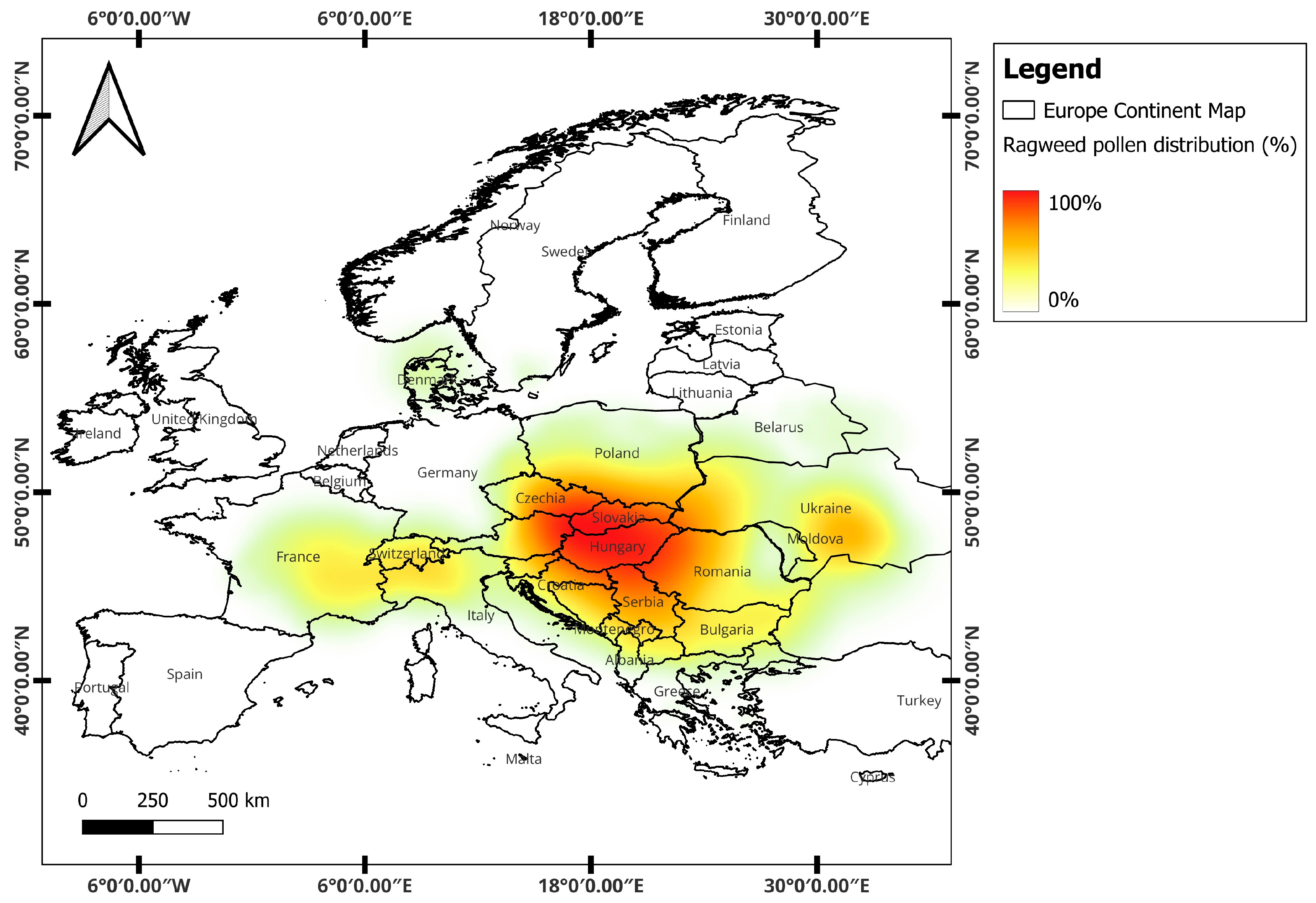
3.1. History of Common Ragweed in Europe, Specifically in Hungary
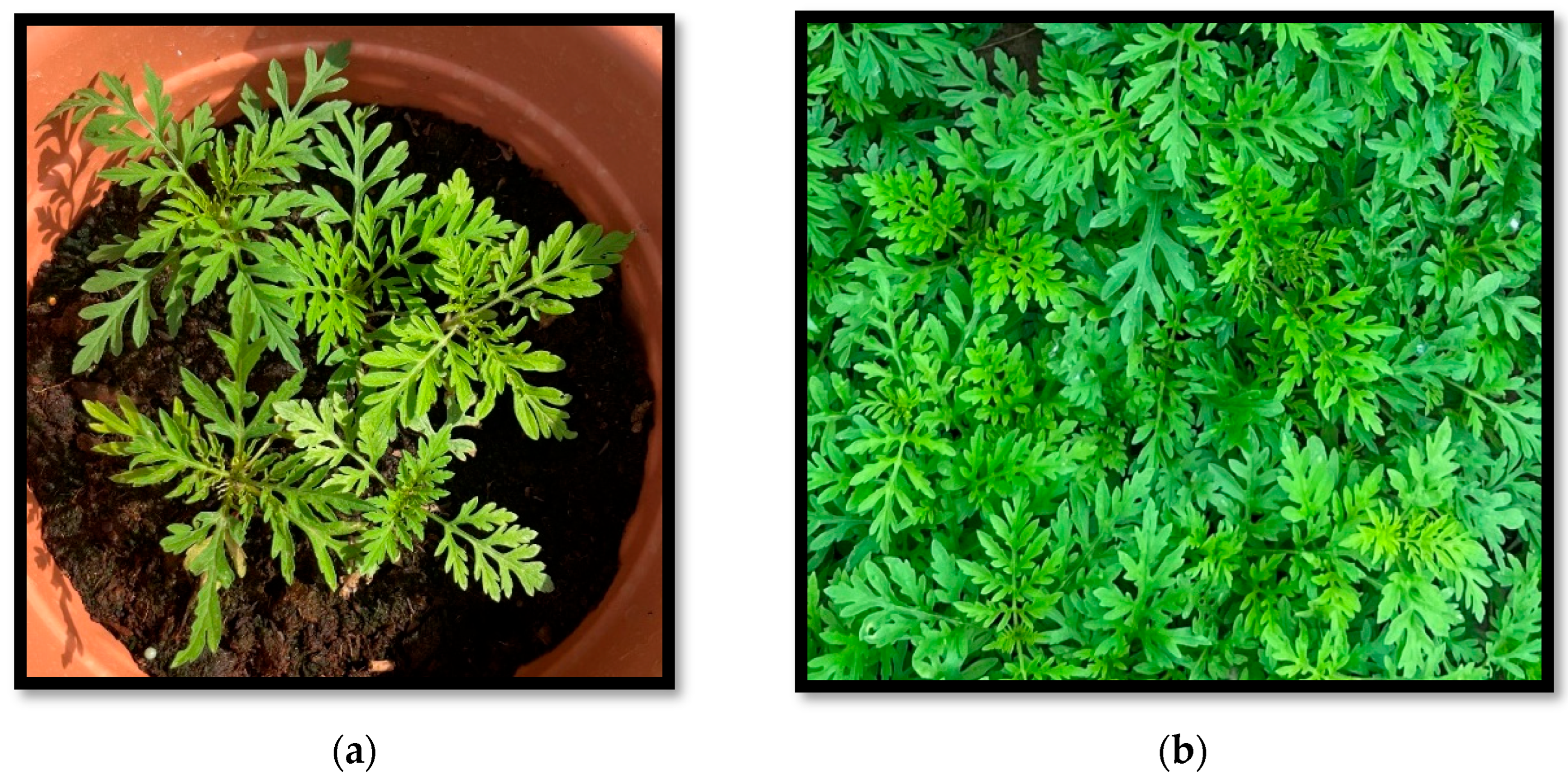
3.2. Botanical and Biological Characteristics Relevant to Weed Detection
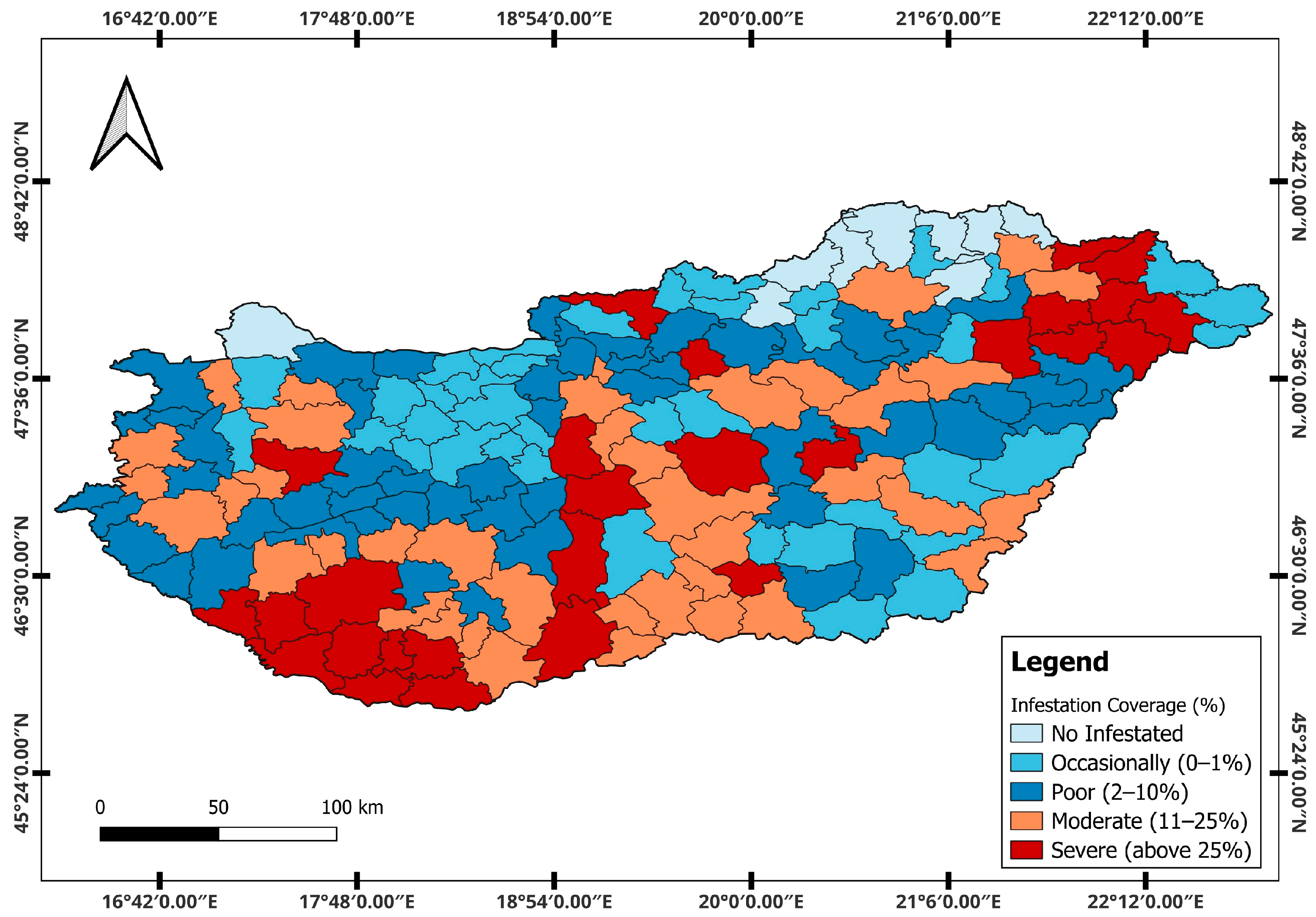
3.3. Agricultural and Health Impacts
4. Precision Agriculture (PA) and Site-Specific Weed Management (SSWM)
4.1. Machine Learning Approaches for Weed Detection and Mapping
4.2. Deep Learning for Weed Crop Discrimination in Complex Field Environments
4.3. From Weed Detection to Precision Herbicide Application
4.4. Role of AI in Supporting Sustainable Site-Specific Weed Management
5. Unmanned Aerial Vehicles (UAVs) in Weed Management
5.1. Advantages of UAV-Based Remote Sensing Compared to Other Platforms
5.2. UAV-Based Imaging Systems and Data Acquisition for Weed Detection
5.3. Type of Cameras for Weed Detection
5.4. Mitigation of Sensor Limitations and Emerging Solutions
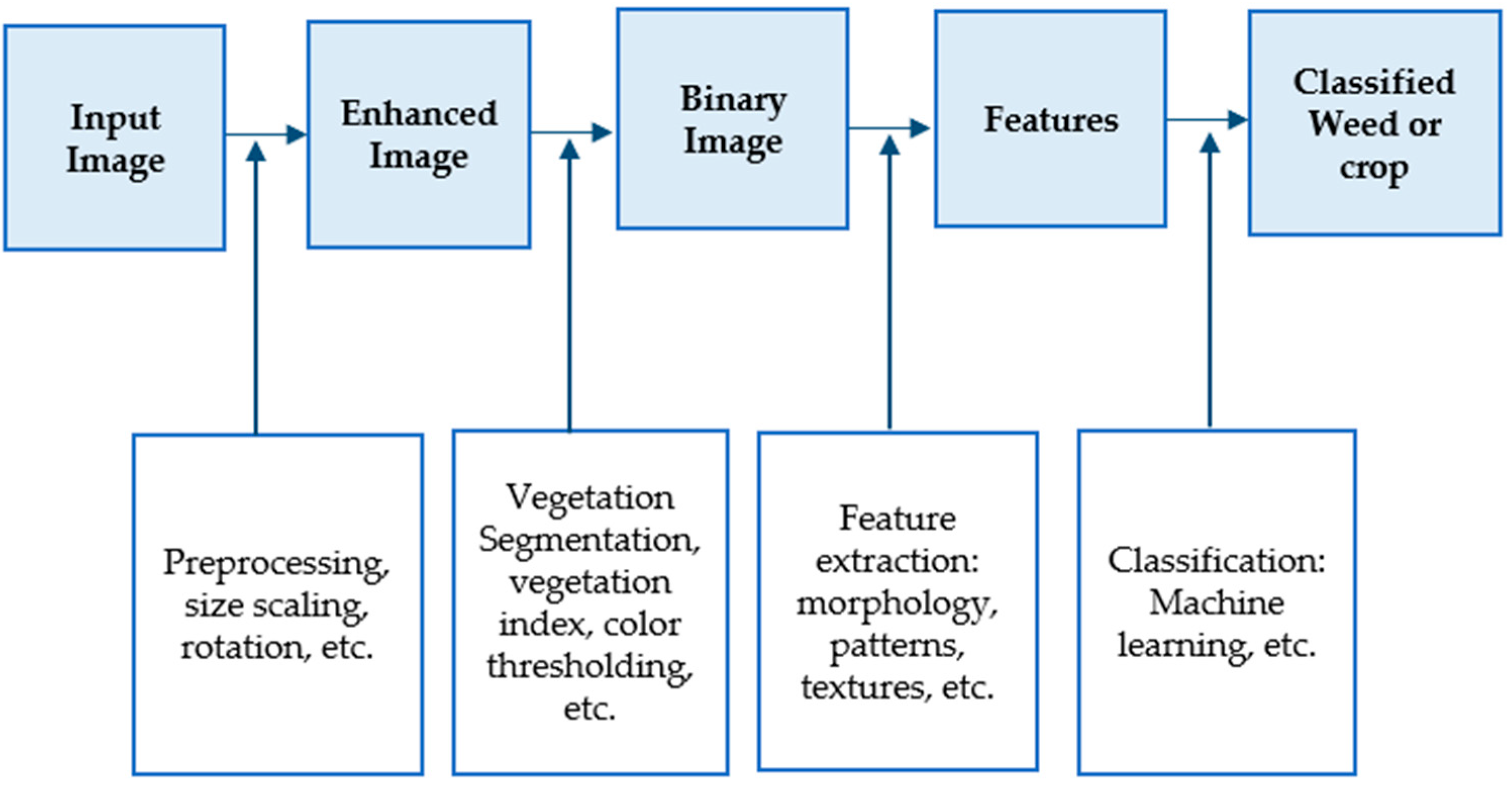
5.5. Image Processing and Machine Learning Workflows for Weed Detection
5.6. Synthesis of ML and DL Approaches for UAV-Based Weed Detection
5.7. Applications of UAV and AI Methods for Ambrosia artemisiifolia Detection
6. Challenges, Limitations, and Future Directions of UAV-Based SSWM for Ambrosia artemisiifolia
6.1. Regulatory, Operational, and Economic Constraints
6.1.1. Fragmented Regulations
6.1.2. Safety and Risk Management
6.1.3. Technical and Operational Constraints
6.1.4. Insurance, Liability, and Economic
6.2. Sensor and Image Acquisition Constraints
6.2.1. Solar Angle
6.2.2. Flight Altitude and Spatial Resolution
6.2.3. Motion Blur and Platform Instability
6.3. Weed–Crop Spectral and Structural Complexity
6.4. Potential Directions to Overcome Limitations
7. Conclusions
Author Contributions
Funding
Institutional Review Board Statement
Informed Consent Statement
Data Availability Statement
Acknowledgments
Conflicts of Interest
Abbreviations
| AI | Artificial Intelligence |
| CNN | Convolutional Neural Networks |
| D1 | Derivative Index |
| DL | Deep Learning |
| EAN | European Aeroallergen Network |
| EPI | European Pollen Information |
| FAO | Food and Agriculture Organization |
| GPU | Graphic Processing Unit |
| ILS | Incident Light Sensors |
| KNN | K-Nearest Neighbour |
| ML | Machine Learning |
| NB | Naïve Bayes |
| OBIA | Object-Based Image Analysis |
| PA | Precision Agriculture |
| PBIA | Pixel-Based Image Analysis |
| PSND | Pigment-Specific Normalized Difference |
| RF | Random Forests |
| RGB | Red, Green, Blue |
| RPAAS | Remotely Piloted Aerial Application Systems |
| SDM | Species Distribution Models |
| SORA | Specific Operations Risk Assessment |
| SSWM | Site-Specific Weed Management |
| SVM | Support Vector Machines |
| UAVs | Unmanned Aerial Vehicles |
| Vis | Vegetation Indices |
| WSSA | Weed Science Society of America |
References
- FAO. How to feed the world in 2050. Insights from an expert meet. In Insights from an Expert Meeting at FAO; FAO: Rome, Italy, 2009; Volume 2050, pp. 1–35. [Google Scholar]
- Castellano, G.; De Marinis, P.; Vessio, G. Weed mapping in multispectral drone imagery using lightweight vision transformers. Neurocomputing 2023, 562, 126914. [Google Scholar] [CrossRef]
- Burke, M.; Driscoll, A.; Lobell, D.B.; Ermon, S. Using satellite imagery to understand and promote sustainable development. Science 2021, 371, eabe8628. [Google Scholar] [CrossRef]
- Vougioukas, S.G. Agricultural Robotics. Annu. Rev. Control Robot. Auton. Syst. 2019, 2, 365–392. [Google Scholar] [CrossRef]
- Stafford, J.V. Implementing precision agriculture in the 21st century. J. Agric. Eng. Res. 2000, 76, 267–275. [Google Scholar] [CrossRef]
- Zhang, N.; Wang, M.; Wang, N. Precision agriculture—A worldwide overview. Comput. Electron. Agric. 2002, 36, 113–132. [Google Scholar] [CrossRef]
- Meesaragandla, S.; Jagtap, M.P.; Khatri, N.; Madan, H.; Vadduri, A.A. Herbicide spraying and weed identification using drone technology in modern farms: A comprehensive review. Results Eng. 2024, 21, 101870. [Google Scholar] [CrossRef]
- Vijayakumar, V.; Ampatzidis, Y.; Schueller, J.K.; Burks, T. Smart spraying technologies for precision weed management: A review. Smart Agric. Technol. 2023, 6, 100337. [Google Scholar] [CrossRef]
- Abo-Habaga, M.; Imara, Z.; Okasha, M. Development of a Combine Hoeing Machine for Flat and Ridged Soil. J. Soil Sci. Agric. Eng. 2018, 9, 817–820. [Google Scholar] [CrossRef]
- Roshan, P.; Kulshreshtha, A.; Hallan, V. Global Weed-Infecting Geminiviruses. In Geminiviruses: Impact, Challenges and Approaches; Springer International Publishing: Cham, Switzerland, 2019. [Google Scholar]
- Zandstra, B.H.; Motooka, P.S. Beneficial Effects of Weeds in Pest Management—A Review. PANS 1978, 24, 333–338. [Google Scholar] [CrossRef]
- Duffus, J.E. Role of Weeds in the Incidence of Virus Diseases. Annu. Rev. Phytopathol. 1971, 9, 319–340. [Google Scholar] [CrossRef]
- Byron, M.; Treadwell, D.D.; Dittmar, P.J. Weeds as Reservoirs of Plant Pathogens Affecting Economically Important Crops. Edis 2019, 2019, 7. [Google Scholar] [CrossRef]
- Makra, L.; Juhász, M.; Borsos, E.; Béczi, R. Meteorological variables connected with airborne ragweed pollen in Southern Hungary. Int. J. Biometeorol. 2004, 49, 37–47. [Google Scholar] [CrossRef]
- Sala, O.E.; Stuart Chapin, F.; Armesto, J.J.; Berlow, E.; Bloomfield, J.; Dirzo, R.; Huber-Sanwald, E.; Huenneke, L.F.; Jackson, R.B.; Kinzig, A.; et al. Global Biodiversity Scenarios for the Year 2100. Science 2000, 287, 1770–1774. [Google Scholar] [CrossRef]
- Vitousek, P.M.; Mooney, H.A.; Lubchenco, J.; Melillo, J.M. Human Domination of Earth’s Ecosystems. Science 1997, 277, 494–499. [Google Scholar] [CrossRef]
- Bradley, B.A.; Blumenthal, D.M.; Wilcove, D.S.; Ziska, L.H. Predicting plant invasions in an era of global change. Trends Ecol. Evol. 2010, 25, 310–318. [Google Scholar] [CrossRef]
- Liu, B.; Bruch, R. Weed Detection for Selective Spraying: A Review. Curr. Robot. Rep. 2020, 1, 19–26. [Google Scholar] [CrossRef]
- Lanini, W.T.; Le Strange, M. Low-input management of weeds in vegetable fields. Calif. Agric. 1991, 45, 11–13. [Google Scholar] [CrossRef]
- Amare, T.; Sharma, J.J.; Zewdie, K. Effect of Weed Control Methods on Weeds and Wheat (Triticum aestivum L.) Yield. World J. Agric. Res. 2014, 2, 124–128. [Google Scholar] [CrossRef][Green Version]
- Bullock, J.M.; Chapman, D.; Schafer, S.; Roy, D.; Girardello, M.; Haynes, T.; Beal, S.; Wheeler, B.; Dickie, I.; Phang, Z.; et al. Assessing and Controlling the Spread and the Effects of Common Ragweed in Europe. Final report: ENV. B2/ETU/2010/0037. 2010. Available online: https://www.google.com/url?sa=t&source=web&rct=j&opi=89978449&url=https://circabc.europa.eu/sd/d/d1ad57e8-327c-4fdd-b908-dadd5b859eff/FinalFinalReport.pdf&ved=2ahUKEwia-uam__WRAxXz3AIHHbvoAFQQFnoECBgQAQ&usg=AOvVaw2C0iNelILWHrjMUvTr13lK (accessed on 10 December 2025).
- Jager, O.R.S. Ambrosia (ragweed) in Europe. Allergy Clin. Immunol. Int. 2001, 13, 60–66. [Google Scholar]
- Jäger, S. Global aspects of ragweed in Europe. In Proceedings of the 6th International Congress on Aerobiology. Satellite Symposium Proceedings: Ragweed in Europe, Perugia, Italy, 22–26 August 1998; ALK Abelló: Hørsholm, Denmark, 1998; pp. 6–10. [Google Scholar]
- Juhász, M. History of ragweed in Europe. In Proceedings of the 6th International Congress on Aerobiology. Satellite Symposium Proceedings: Ragweed in Europe, Perugia, Italy, 22–26 August 1998; ALK Abelló: Hørsholm, Denmark, 1998; pp. 11–14. [Google Scholar]
- Makra, L.; Matyasovszky, I.; Deák, Á.J. Ragweed in Eastern Europe. In Invasive Species and Global Climate Change; CABI: Wallingford, UK, 2014; pp. 117–128. [Google Scholar] [CrossRef]
- Gaudeul, M.; Giraud, T.; Kiss, L.; Shykoff, J.A. Nuclear and chloroplast microsatellites show multiple introductions in the worldwide invasion history of common ragweed, Ambrosia artemisiifolia. PLoS ONE 2011, 6, e17658. [Google Scholar] [CrossRef]
- Makra, L.; Matyasovszky, I.; Hufnagel, L.; Tusnády, G. The history of ragweed in the world. Appl. Ecol. Environ. Res. 2015, 13, 489–512. [Google Scholar] [CrossRef]
- Járai-Komlódi, M.; Juhász, M. Ambrosia elatior (L.) in Hungary (1989–1990). Aerobiologia 1993, 9, 75–78. [Google Scholar] [CrossRef]
- Makra, L.; Juhász, M.; Béczi, R.; Borsos, E.K. The history and impacts of airborne Ambrosia (Asteraceae) pollen in Hungary. Grana 2005, 44, 57–64. [Google Scholar] [CrossRef]
- European Aeroallergen Network (EAN). Distribution of Ambrosia artemisiifolia Pollen in Europe. 2025. Available online: https://ean.polleninfo.eu/Ean (accessed on 10 December 2025).
- European Pollen Information (EPI). Pollen Information and Ragweed Pollen Distribution Data. 2025. Available online: https://www.polleninformation.at/en/allergy/pollen-load-map-of-europe (accessed on 10 December 2025).
- Tóth, Á.; Hoffmanné, P.Z.; Szentey, L. A parlagfű (Ambrosia elatior) helyzet 2003-ban Magyarországon. A Levegő Pollenszám Csökkentésének Nehézségei 2004, 14. [Google Scholar]
- Pinke, G.; Kolejanisz, T.; Vér, A.; Nagy, K.; Milics, G.; Schlögl, G.; Bede-Fazekas, Á.; Botta-Dukát, Z.; Czúcz, B. Drivers of Ambrosia artemisiifolia abundance in arable fields along the Austrian-Hungarian border. Preslia 2019, 91, 369–389. [Google Scholar] [CrossRef]
- Knolmajer, B.; Jócsák, I.; Taller, J.; Keszthelyi, S.; Kazinczi, G. Common Ragweed—Ambrosia artemisiifolia L.: A Review with Special Regards to the Latest Results in Protection Methods, Herbicide Resistance, New Tools and Methods. Agronomy 2025, 15, 1765. [Google Scholar] [CrossRef]
- Gerber, E.; Schaffner, U.; Gassmann, A.; Hinz, H.L.; Seier, M.; Müller-Schärer, H. Prospects for biological control of Ambrosia artemisiifolia in Europe: Learning from the past. Weed Res. 2011, 51, 559–573. [Google Scholar] [CrossRef]
- Leru, P.M.; Eftimie, A.M.; Anton, V.F.; Thibaudon, M. Assessment of the risks associated with the invasive weed Ambrosia artemisiifolia in urban environments in Romania. Ecocycles 2019, 5, 56–61. [Google Scholar] [CrossRef]
- Bohren, C.; Mermillod, G.; Delabays, N. Ambrosia artemisiiifolia L.—Control measures and their effects on its capacity of reproduction. J. Plant Dis. Proctection 2008, 21, 311–316. [Google Scholar]
- Attila, M. Ambrosia vs. authority: Tasks, methods and results of the land management in ragweed prevention and monitoring of common interest. Geod. Kartogr. 2009, 61, 32–34. [Google Scholar]
- Vidović, B.; Cvrković, T.; Rančić, D.; Marinković, S.; Cristofaro, M.; Schaffner, U.; Petanović, R. Eriophyid mite Aceria artemisiifoliae sp.nov. (Acari: Eriophyoidea) potential biological control agent of invasive common ragweed, Ambrosia artemisiifolia L. (Asteraceae) in Serbia. Syst. Appl. Acarol. 2016, 21, 919–935. [Google Scholar] [CrossRef]
- Lommen, S.T.; Jolidon, E.F.; Sun, Y.; Bustamante Eduardo, J.I.; Müller-Schärer, H. An early suitability assessment of two exotic Ophraella species (Coleoptera: Chrysomelidae) for biological control of invasive ragweed in Europe. Eur. J. Entomol. 2017, 114, 160–169. [Google Scholar] [CrossRef]
- Dirr, L.; Bastl, K.; Bastl, M.; Berger, U.E.; Bouchal, J.M.; Kofol Seliger, A.; Magyar, D.; Ščevková, J.; Szigeti, T.; Grímsson, F. The Ragweed Finder: A Citizen-Science Project to Inform Pollen Allergy Sufferers About Ambrosia artemisiifolia Populations in Austria. Appl. Sci. 2025, 15, 12333. [Google Scholar] [CrossRef]
- Valkó, O.; Deák, B.; Török, P.; Kelemen, A.; Miglécz, T.; Tóth, K.; Tóthmérész, B. Abandonment of croplands: Problem or chance for grassland restoration? case studies from hungary. Ecosyst. Health Sustain. 2016, 2, e01208. [Google Scholar] [CrossRef]
- Kazinczi, G.; Beres, I.; Novák, R.; Biro, K.; Pathy, Z. Common ragweed (Ambrosia artemisiifolia): A review with special regards to the results in Hungary. I. Taxonomy, origin and distribution, morphology, life cycle and reproduction strategy. Herbologia 2008, 9, 55–91. [Google Scholar]
- Qin, Z.; Mao, D.J.; Quan, G.M.; Zhang, J.-E.; Xie, J.F.; DiTommaso, A. Physiological and morphological responses of invasive Ambrosia artemisiifolia (common ragweed) to different irradiances. Botany 2012, 90, 1284–1294. [Google Scholar] [CrossRef][Green Version]
- Zhao, W.; Xue, Z.; Liu, T.; Wang, H.; Han, Z. Factors affecting establishment and population growth of the invasive weed Ambrosia artemisiifolia. Front. Plant Sci. 2023, 14, 1251441. [Google Scholar] [CrossRef]
- Smith, M.; Cecchi, L.; Skjøth, C.A.; Karrer, G.; Šikoparija, B. Common ragweed: A threat to environmental health in Europe. Environ. Int. 2013, 61, 115–126. [Google Scholar] [CrossRef] [PubMed]
- Sărățeanu, V.; Moisuc, A.; Cotuna, O. Ambrosia artemisiifolia L. an invasive weed from ruderal areas to disturbed grasslands. Lucr. Ştiinţifice—Ser. Agron. 2010, 53, 235–238. [Google Scholar]
- Lehoczky, E.; Szabó, R.; Nelima, M.O.; Nagy, P.; Béres, I. Examination of common ragweed’s (Ambrosia artemisiifolia L.) allelopathic effect on some weed species. Commun. Agric. Appl. Biol. Sci. 2010, 75, 107–111. [Google Scholar]
- Lehoczky, E.; Gólya, G.; Szabó, R.; Szalai, A. Allelopathic effects of ragweed (Ambrosia artemisiifolia L.) on cultivated plants. Commun. Agric. Appl. Biol. Sci. 2011, 76, 545–549. [Google Scholar]
- Beam, S.C.; Cahoon, C.W.; Haak, D.C.; Holshouser, D.L.; Mirsky, S.B.; Flessner, M.L. Integrated Weed Management Systems to Control Common Ragweed (Ambrosia artemisiifolia L.) in Soybean. Front. Agron. 2021, 2, 598426. [Google Scholar] [CrossRef]
- Pannacci, E.; Lattanzi, B.; Tei, F. Non-chemical weed management strategies in minor crops: A review. Crop Prot. 2017, 96, 44–58. [Google Scholar] [CrossRef]
- Xu, K.; Shu, L.; Xie, Q.; Song, M.; Zhu, Y.; Cao, W.; Ni, J. Precision weed detection in wheat fields for agriculture 4.0: A survey of enabling technologies, methods, and research challenges. Comput. Electron. Agric. 2023, 212, 108. [Google Scholar] [CrossRef]
- Carver, B.F. Wheat Science and Trade; Wiley: Hoboken, NJ, USA, 2009; pp. 1–569. [Google Scholar] [CrossRef]
- Authority, E.F.S. The 2015 European Union report on pesticide residues in food. EFSA J. 2017, 15, e04791. [Google Scholar] [CrossRef] [PubMed]
- Hasan, A.S.M.M.; Sohel, F.; Diepeveen, D.; Laga, H.; Jones, M.G.K. A survey of deep learning techniques for weed detection from images. Comput. Electron. Agric. 2021, 184, 106067. [Google Scholar] [CrossRef]
- Wiles, L.J. Beyond patch spraying: Site-specific weed management with several herbicides. Precis. Agric. 2009, 10, 277–290. [Google Scholar] [CrossRef]
- Rai, N.; Zhang, Y.; Ram, B.G.; Schumacher, L.; Yellavajjala, R.K.; Bajwa, S.; Sun, X. Applications of deep learning in precision weed management: A review. Comput. Electron. Agric. 2023, 206, 107698. [Google Scholar] [CrossRef]
- da Costa Lima, A.; Mendes, K.F. Variable Rate Application of Herbicides for Weed Management in Pre- and Postemergence. In Pests, Weeds and Diseases in Agricultural Crop and Animal Husbandry Production; Kontogiannatos, D., Kourti, A., Mendes, K.F., Eds.; IntechOpen: Rijeka, Croatia, 2020. [Google Scholar] [CrossRef]
- Velumani, K.; Madec, S.; de Solan, B.; Lopez-Lozano, R.; Gillet, J.; Labrosse, J.; Jezequel, S.; Comar, A.; Baret, F. An automatic method based on daily in situ images and deep learning to date wheat heading stage. Field Crops Res. 2020, 252, 107793. [Google Scholar] [CrossRef]
- Barbedo, J.G.A. Detection of nutrition deficiencies in plants using proximal images and machine learning: A review. Comput. Electron. Agric. 2019, 162, 482–492. [Google Scholar] [CrossRef]
- Madeshwar, M.; Priyan, M.V.; Manvizhi, N. Hybrid Vision Transformer and CNN-Based System for Real-Time Weed Detection in Precision Agriculture. In Proceedings of the 2025 International Conference on Emerging Technologies in Engineering Applications, ICETEA, Puducherry, India, 5–6 June 2025. [Google Scholar] [CrossRef]
- Bazrafkan, A.; Kosugi, Y.; Flores, P. A machine learning extension built on ArcGIS for the detection of weeds in cornfields. In Proceedings of the 2024 ASABE Annual International Meeting, Anaheim, CA, USA, 28–31 July 2024. [Google Scholar] [CrossRef]
- Sharma, A.; Sharma, S.; Malik, A.; Sobti, R.; Hussain, M. Enhancing Sustainable Farming with Automated Weed Detection: A Hybrid Approach Using Image Processing and Machine Learning; Lecture Notes in Networks and Systems, LNNS; Springer: Cham, Switzerland, 2025; Volume 1399, pp. 54–68. [Google Scholar] [CrossRef]
- Sunil, G.C.; Upadhyay, A.; Zhang, Y.; Howatt, K.; Peters, T.; Ostlie, M.; Aderholdt, W.; Sun, X. Field-based multispecies weed and crop detection using ground robots and advanced YOLO models: A data and model-centric approach. Smart Agric. Technol. 2024, 9, 100538. [Google Scholar] [CrossRef]
- Pérez-Ortiz, M.; Peña, J.M.; Gutiérrez, P.A.; Torres-Sánchez, J.; Hervás-Martínez, C.; López-Granados, F. Selecting patterns and features for between- and within- crop-row weed mapping using UAV-imagery. Expert. Syst. Appl. 2016, 47, 85–94. [Google Scholar] [CrossRef]
- Al-Badri, A.H.; Ismail, N.A.; Al-Dulaimi, K.; Salman, G.A.; Khan, A.R.; Al-Sabaawi, A.; Salam, M.S.H. Classification of weed using machine learning techniques: A review—Challenges, current and future potential techniques. J. Plant Dis. Prot. 2022, 129, 745–768. [Google Scholar] [CrossRef]
- Shilaskar, S.; Gholap, R.; Bhatlawande, S.; Ranade, N.; Ghadge, S. Computer Vision Based Detection of Weed in Ginger and Sugarcane Crop for Automated Farming System. In Proceedings of the 2023 International Conference on IoT, Communication and Automation Technology, ICICAT 2023, Gorakhpur, India, 23–24 June 2023. [Google Scholar] [CrossRef]
- Adhinata, F.D.; Wahyono Sumiharto, R. A comprehensive survey on weed and crop classification using machine learning and deep learning. Artif. Intell. Agric. 2024, 13, 45–63. [Google Scholar] [CrossRef]
- de Villiers, C.; Munghemezulu, C.; Mashaba-Munghemezulu, Z.; Chirima, G.J.; Tesfamichael, S.G. Weed Detection in Rainfed Maize Crops Using UAV and PlanetScope Imagery. Sustainability 2023, 15, 13416. [Google Scholar] [CrossRef]
- Kavitha, K.; Gopalakrishnan, K.; Balaji, S.; Jeevanantham, J.; Aakhila Hayathunisa, M. Crop Classification using Convolutional Neural Network. In Proceedings of the 15th International Conference on Advances in Computing, Control, and Telecommunication Technologies, ACT 2024, Hyderabad, India, 21–22 June 2024; Volume 2, pp. 5438–5444. [Google Scholar]
- Das, A.; Yang, Y.; Subburaj, V.H. YOLOv7 for Weed Detection in Cotton Fields Using UAV Imagery. AgriEngineering 2025, 7, 313. [Google Scholar] [CrossRef]
- Nidhya, R.; Pavithra, D.; Smilarubavathy, G.; Mythrayee, D. Automated Weed Detection in Crop Fields Using Convolutional Neural Networks: A Deep Learning Approach for Smart Farming. Data Metadata 2025, 4, 848. [Google Scholar] [CrossRef]
- Kumar, G.; Sharma, C. Weed Identification and Classification in Mixed Crop Using Deep Learning Technique: A Review. In Proceedings of the IEEE International Conference on Signal Processing, Computing and Control, Solan, India, 6–8 March 2025; pp. 681–686. [Google Scholar] [CrossRef]
- Reedha, R.; Dericquebourg, E.; Canals, R.; Hafiane, A. Transformer Neural Network for Weed and Crop Classification of High Resolution UAV Images. Remote Sens. 2022, 14, 592. [Google Scholar] [CrossRef]
- Hossain, N.; Rahman, S.T.; Sun, S. An End-to-End Deep Learning Framework for Multi-Scale Cross-Domain Weed Segmentation. In Proceedings of the 2025 ASABE Annual International Meeting, Toronto, ON, Canada, 13–16 July 2025. [Google Scholar] [CrossRef]
- Anantha Sivaprakasam, S.; Senthil Pandi, S.; Yuva Prathima, S.; Varshini, V. Weed Plant Detection in Agricultural Field Using Deep Learning Integrated with IOT. In Proceedings of the 2024 5th International Conference for Emerging Technology, INCET 2024, Karnataka, India, 24–26 May 2024. [Google Scholar] [CrossRef]
- Modi, R.U.; Kancheti, M.; Subeesh, A.; Raj, C.; Singh, A.K.; Chandel, N.S.; Dhimate, A.S.; Singh, M.K.; Singh, S. An automated weed identification framework for sugarcane crop: A deep learning approach. Crop Prot. 2023, 173, 106360. [Google Scholar] [CrossRef]
- Li, Y.; Ke, A.; Guo, Z.; Tan, Q.; Yang, J. WeedNet-X: A lightweight field weed detection algorithm. Eng. Appl. Artif. Intell. 2025, 162, 112441. [Google Scholar] [CrossRef]
- Zhang, Y.; Wang, M.; Zhao, D.; Liu, C.; Liu, Z. Early weed identification based on deep learning: A review. Smart Agric. Technol. 2023, 3, 100123. [Google Scholar] [CrossRef]
- Hussain, A.A.; Nair, P.S. An Efficient Deep Learning Based AgriResUpNet Architecture for Semantic Segmentation of Crop and Weed Images. Ing. Des. Syst. D’information 2024, 29, 1829–1845. [Google Scholar] [CrossRef]
- Thenmozhi, T.; Subashini, S.; Pradeepa, K.; Pooja, E. Automated Weed Detection and Removal using Deep Learning. In Proceedings of the 2024 4th Asian Conference on Innovation in Technology, ASIANCON 2024, Pune, India, 23–25 August 2024. [Google Scholar] [CrossRef]
- Abhiram, K.; Abhishek, C.; Sharma, D.A. An Automated Weed-Detection Approach Using Deep Learning in Agriculture System. In Proceedings of the International Conference on Advanced Computing Technologies, ICoACT 2025, Sivakasi, India, 14–15 March 2025. [Google Scholar] [CrossRef]
- Gurjar, B.; Sapkota, B.; Torres, U.; Ceperkovic, I.; Kutugata, M.; Kumar, V.; Zhou, X.-G.; Martin, D.; Bagavathiannan, M. Site-Specific Treatment of Late-Season Weed Escapes in Rice Utilizing a Remotely Piloted Aerial Application System. Weed Technol. 2025, 39, e74. [Google Scholar] [CrossRef]
- Xu, B.; Werle, R.; Chudzik, G.; Zhang, Z. Enhancing weed detection using UAV imagery and deep learning with weather-driven domain adaptation. Comput. Electron. Agric. 2025, 237, 110673. [Google Scholar] [CrossRef]
- Awedat, K. A Dual-Stage Deep Learning Framework for Weed Detection. In Proceedings of the IEEE International Conference on Electro Information Technology, Valparaiso, IN, USA, 29–31 May 2025; pp. 17–22. [Google Scholar] [CrossRef]
- Babu, V.S.; Venkatram, N. Ensemble Learning for Weed Detection in Soybean Crop. In Proceedings of the 2024 11th International Conference on Computing for Sustainable Global Development, INDIACom 2024, New Delhi, India, 28 February–1 March 2024; pp. 867–871. [Google Scholar] [CrossRef]
- Ram Prakash, L.; Pravinesh, H.; Ariyamala, V. A Novel Approach for Classification of Crops and Weeds using Deep Learning. In Proceedings of the IEEE International Conference on Electronic Systems and Intelligent Computing, ICESIC 2024, Chennai, India, 22–23 November 2024; pp. 284–288. [Google Scholar] [CrossRef]
- Singh, P.; Zhao, B.; Shi, Y. Computer Vision for Site-Specific Weed Management in Precision Agriculture: A Review. Agriculture 2025, 15, 2296. [Google Scholar] [CrossRef]
- Rao, R.; Pushparaj Shetty, K.S.; Morabad, S.S.; Revathi, G.P. AI-Powered Weed Control: Image Processing and Robotics in Agriculture. In Proceedings of the 2024 IEEE Conference on Engineering Informatics, ICEI 2024, Melbourne, Australia, 20–28 November 2024. [Google Scholar] [CrossRef]
- Das, S.; Upadhyay, A.; Sun, X. Weed Management Strategies Employing Artificial Intelligence and Robotics. In Smart Farming, Smarter Solutions: Revolutionizing Agriculture with Artificial Intelligence; CRC Press: Boca Raton, FL, USA, 2025; pp. 154–179. [Google Scholar] [CrossRef]
- Vasileiou, M.; Kyrgiakos, L.S.; Kleisiari, C.; Kleftodimos, G.; Vlontzos, G.; Belhouchette, H.; Pardalos, P.M. Transforming weed management in sustainable agriculture with artificial intelligence: A systematic literature review towards weed identification and deep learning. Crop. Prot. 2024, 176, 106522. [Google Scholar] [CrossRef]
- Riksen, V.; Shpak, V. Convolutional Neural Network for Identification and Classification of Weeds in Buckwheat Crops. In Machine Intelligence for Smart Applications; Studies in Computational Intelligence; Springer: Cham, Switzerland, 2023; Volume 1105, pp. 61–72. [Google Scholar] [CrossRef]
- Singh, S.; Yadav, P. A Critical Analysis Toward Sustainable Farming: The Role of AI in Weed Identification and Management. In Communication and Intelligent Systems; Lecture Notes in Networks and Systems, LNNS; Springer: Singapore, 2024; Volume 967, pp. 369–382. [Google Scholar] [CrossRef]
- Mathur, G.; Pandey, H. Precision Farming with Automated Weed Detection Using Machine Learning. In Applying Remote Sensing and GIS for Spatial Analysis and Decision-Making; IGI Global Scientific Publishing: Hershey, PA, USA, 2024; pp. 267–310. [Google Scholar] [CrossRef]
- Gómez, A.; Moreno, H.; Valero, C.; Andújar, D. Spatio-temporal stability of intelligent modeling for weed detection in tomato fields. Agric. Syst. 2025, 228, 104394. [Google Scholar] [CrossRef]
- Anne, P.; Gasser, S.; Göttl, M.; Tanner, S. The reduction of chemical inputs by ultra-precise smart spot sprayer technology maximizes crop potential by lowering phytotoxicity. Front. Environ. Econ. 2024, 3, 1394315. [Google Scholar] [CrossRef]
- Dastres, E.; Esmaeili, H.; Edalat, M. Species distribution modeling of Malva neglecta Wallr. weed using ten different machine learning algorithms: An approach to site-specific weed management (SSWM). Eur. J. Agron. 2025, 167, 127579. [Google Scholar] [CrossRef]
- Gerhards, R.; Andújar Sanchez, D.; Hamouz, P.; Peteinatos, G.G.; Christensen, S.; Fernandez-Quintanilla, C. Advances in site-specific weed management in agriculture—A review. Weed Res. 2022, 62, 123–133. [Google Scholar] [CrossRef]
- Borra-Serrano, I.; Peña, J.M.; Torres-Sánchez, J.; Mesas-Carrascosa, F.J.; López-Granados, F. Spatial quality evaluation of resampled unmanned aerial vehicle-imagery for weed mapping. Sensors 2015, 15, 19688–19708. [Google Scholar] [CrossRef]
- Xiang, H.; Tian, L. Development of a low-cost agricultural remote sensing system based on an autonomous unmanned aerial vehicle (UAV). Biosyst. Eng. 2011, 108, 174–190. [Google Scholar] [CrossRef]
- Hassanein, M.; El-Sheimy, N. An efficient weed detection procedure using low-cost UAV imagery system for precision agriculture applications. Int. Arch. Photogramm. Remote Sens. Spat. Inf. Sci. 2018, 42, 181–187. [Google Scholar] [CrossRef]
- Huang, Y.; Reddy, K.N.; Fletcher, R.S.; Pennington, D. UAV Low-Altitude Remote Sensing for Precision Weed Management. Weed Technol. 2018, 32, 2–6. [Google Scholar] [CrossRef]
- Fernández-Quintanilla, C.; Peña, J.M.; Andújar, D.; Dorado, J.; Ribeiro, A.; López-Granados, F. Is the current state of the art of weed monitoring suitable for site-specific weed management in arable crops? Weed Res. 2018, 58, 259–272. [Google Scholar] [CrossRef]
- Zhu, W.; Li, S.; Zhang, X.; Li, Y.; Sun, Z. Estimation of winter wheat yield using optimal vegetation indices from unmanned aerial vehicle remote sensing. Nongye Gongcheng Xuebao/Trans. Chin. Soc. Agric. Eng. 2018, 34, 78–86. [Google Scholar] [CrossRef]
- Pérez-Ortiz, M.; Peña, J.M.; Gutiérrez, P.A.; Torres-Sánchez, J.; Hervás-Martínez, C.; López-Granados, F. A semi-supervised system for weed mapping in sunflower crops using unmanned aerial vehicles and a crop row detection method. Appl. Soft Comput. J. 2015, 37, 533–544. [Google Scholar] [CrossRef]
- Zhang, J.; Yu, F.; Zhang, Q.; Wang, M.; Yu, J.; Tan, Y. Advancements of UAV and Deep Learning Technologies for Weed Management in Farmland. Agronomy 2024, 14, 494. [Google Scholar] [CrossRef]
- Amarasingam, N.; Kelly, J.E.; Sandino, J.; Hamilton, M.; Gonzalez, F.; Dehaan, R.L.; Zheng, L.; Cherry, H. Bitou bush detection and mapping using UAV-based multispectral and hyperspectral imagery and artificial intelligence. Remote Sens. Appl. 2024, 34, 101151. [Google Scholar] [CrossRef]
- Hunt, E.R.; Daughtry, C.S.T. What good are unmanned aircraft systems for agricultural remote sensing and precision agriculture? Int. J. Remote Sens. 2018, 39, 5345–5376. [Google Scholar] [CrossRef]
- Castellano, G.; De Marinis, P.; Vessio, G. Applying Knowledge Distillation to Improve Weed Mapping with Drones. In Proceedings of the 18th Conference on Computer Science and Intelligence Systems, FedCSIS 2023, Warsaw, Poland, 17–20 September 2023; pp. 393–400. [Google Scholar] [CrossRef]
- Luo, W.; Chen, Q.; Wang, Y.; Fu, D.; Mi, Z.; Wang, Q.; Li, H.; Shi, Y.; Su, B. Real-time identification and spatial distribution mapping of weeds through unmanned aerial vehicle (UAV) remote sensing. Eur. J. Agron. 2025, 169, 127699. [Google Scholar] [CrossRef]
- Li, H.; He, Y.; Qin, C.; Liu, D.; Zhang, K.; Zhang, L. Ecological Analysis on Spray Performance of Multi-rotor Unmanned Aerial Sprayer in Soybean Field. Ekoloji 2019, 28, 4573–4579. [Google Scholar] [CrossRef]
- Tsouros, D.C.; Bibi, S.; Sarigiannidis, P.G. A review on UAV-based applications for precision agriculture. Information 2019, 10, 349. [Google Scholar] [CrossRef]
- Maes, W.H.; Steppe, K. Perspectives for Remote Sensing with Unmanned Aerial Vehicles in Precision Agriculture. Trends Plant Sci. 2019, 24, 152–164. [Google Scholar] [CrossRef] [PubMed]
- Wang, T.; Gao, M.; Cao, C.; You, J.; Zhang, X.; Shen, L. Winter wheat chlorophyll content retrieval based on machine learning using in situ hyperspectral data. Comput. Electron. Agric. 2022, 193, 106728. [Google Scholar] [CrossRef]
- Eide, A.; Koparan, C.; Zhang, Y.; Ostlie, M.; Howatt, K.; Sun, X. UAV-Assisted Thermal Infrared and Multispectral Imaging of Weed Canopies for Glyphosate Resistance Detection. Remote Sens. 2021, 13, 4606. [Google Scholar] [CrossRef]
- Farooq, A.; Hu, J.; Jia, X. Weed classification in hyperspectral remote sensing images via deep convolutional neural network. In Proceedings of the 2018 IEEE International Geoscience and Remote Sensing Symposium (IGARSS), Valencia, Spain, 22–27 July 2018; Volume 2018, pp. 3816–3819. [Google Scholar] [CrossRef]
- Farooq, U.; Rehman, A.; Khanam, T.; Amtullah, A.; Bou-Rabee, M.A.; Tariq, M. Lightweight Deep Learning Model for Weed Detection for IoT Devices. In Proceedings of the 2022 2nd International Conference on Emerging Frontiers in Electrical and Electronic Technologies, ICEFEET 2022, Patna, India, 24–25 June 2022. [Google Scholar] [CrossRef]
- Fischer, B.; Gauweiler, P.; Gruna, R.; Beyerer, J. Utilizing multispectral imaging for improved weed and crop detection. In Optical Instrument Science, Technology, and Applications III; SPIE: Bellingham, WA, USA, 2024; Volume 13024. [Google Scholar] [CrossRef]
- Okamoto, H.; Murata, T.; Kataoka, T.; Hata, S.I. Plant classification for weed detection using hyperspectral imaging with wavelet analysis: Research paper. Weed Biol. Manag. 2007, 7, 31–37. [Google Scholar] [CrossRef]
- Ahsen, R.; Di Bitonto, P.; De Trizio, L.; Magarelli, M.; Romano, D.; Novielli, P. Precision Agriculture: Integrating Sensors for Weed Detection using Machine Learning in Agriculture Fields. In Proceedings of the 2024 7th IEEE International Humanitarian Technologies Conference, IHTC 2024, Bari, Italy, 27–30 November 2024. [Google Scholar] [CrossRef]
- Barrero, O.; Perdomo, S.A. RGB and multispectral UAV image fusion for Gramineae weed detection in rice fields. Precis. Agric. 2018, 19, 809–822. [Google Scholar] [CrossRef]
- Ronay, I.; Lati, R.N.; Kizel, F. Weed Species Identification: Acquisition, Feature Analysis, and Evaluation of a Hyperspectral and RGB Dataset with Labeled Data. Remote Sens. 2024, 16, 2808. [Google Scholar] [CrossRef]
- Wendel, A.; Underwood, J. Self-supervised weed detection in vegetable crops using ground based hyperspectral imaging. In Proceedings of the 2016 IEEE International Conference on Robotics and Automation (ICRA), Stockholm, Sweden, 16–21 May 2016; pp. 5128–5135. [Google Scholar] [CrossRef]
- Noshiri, N.; Beck, M.A.; Bidinosti, C.P.; Henry, C.J. A comprehensive review of 3D convolutional neural network-based classification techniques of diseased and defective crops using non-UAV-based hyperspectral images. Smart Agric. Technol. 2023, 5, 100316. [Google Scholar] [CrossRef]
- Lu, B.; Dao, P.D.; Liu, J.; He, Y.; Shang, J. Recent advances of hyperspectral imaging technology and applications in agriculture. Remote Sens. 2020, 12, 2659. [Google Scholar] [CrossRef]
- Srinivasa Rao, P.; Anantha Raman, G.R.; Rao, M.S.S.; Radha, K.; Ahmed, R. Enhancing Orchard Cultivation Through Drone Technology and Deep Stream Algorithms in Precision Agriculture. Int. J. Adv. Comput. Sci. Appl. 2024, 15, 781–795. [Google Scholar] [CrossRef]
- Petrova, T.; Marinov, M.; Petrov, Z. Study of an Index for Assessing Grass Quality in Pastures Using RGB Images Obtained by Unmanned Aerial Vehicle. In Proceedings of the 2024 23rd International Symposium INFOTEH-JAHORINA, INFOTEH 2024, East Sarajevo, Bosnia and Herzegovina, 20–22 March 2024. [Google Scholar] [CrossRef]
- Amziane, A.; Losson, O.; Mathon, B.; MacAire, L.; Duménil, A. Weed detection by analysis of multispectral images acquired under uncontrolled illumination conditions. In Fifteenth International Conference on Quality Control by Artificial Vision; SPIE: Bellingham, WA, USA, 2021; Volume 11794. [Google Scholar] [CrossRef]
- Bhandari, S.; Raheja, A.; Green, R.L.; Do, D. Towards collaboration between unmanned aerial and ground vehicles for precision agriculture. In Autonomous Air and Ground Sensing Systems for Agricultural Optimization and Phenotyping II; SPIE: Bellingham, WA, USA, 2017; Volume 10218. [Google Scholar] [CrossRef]
- Hassler, S.C.; Baysal-Gurel, F. Unmanned aircraft system (UAS) technology and applications in agriculture. Agronomy 2019, 9, 618. [Google Scholar] [CrossRef]
- Zhang, Y.; Su, Z.; Meng, L. A Review of UAV-Based Artificial Intelligence Applications in Agriculture. In Proceedings of the International Conference on Advanced Mechatronic Systems, ICAMechS, Xi’an, China, 19–22 September 2025; pp. 250–255. [Google Scholar] [CrossRef]
- Triska, D.; Uryeu, D.; Becerra, E.C.; Haddad, M.; Bhandari, S.; Raheja, A. Investigating the Performance of Monocular and Stereo Vision for the Detection of Weeds in a Strawberry Field using UAVs and Machine Learning Techniques. In Autonomous Air and Ground Sensing Systems for Agricultural Optimization and Phenotyping IX; SPIE: Bellingham, WA, USA, 2024; Volume 13053. [Google Scholar] [CrossRef]
- Nguyen, V.-H.; Le, C.-D.; Truong, M.-T.; Huynh, P.-H. Weedy Rice Detection and Segmentation in UAV Imagery Using Deep Learning Models. In ICT for Intelligent Systems; Lecture Notes in Networks and Systems, LNNS; Springer: Singapore, 2025; Volume 1507, pp. 357–369. [Google Scholar] [CrossRef]
- Yang, S.; Lin, J.; Cernava, T.; Chen, X.; Zhang, X. WeedDETR: An efficient and accurate detection method for detecting small-target weeds in UAV images. Weed Sci. 2025, 73, 10035. [Google Scholar] [CrossRef]
- Sunitha, M.J.; Reddy, V.S.; Charan, K.G.V.; Sujith, L.; Chandrika, E.J.; Patel, M. Feature selection-based hybrid DL model for detecting the unwanted land using satellite data. In Proceedings of the 2024 International Conference on Knowledge Engineering and Communication Systems, ICKECS 2024, Chikkaballapur, India, 18–19 April 2024. [Google Scholar] [CrossRef]
- Dutta, A.K.; Albagory, Y.; Sait, A.R.W.; Keshta, I.M. Autonomous Unmanned Aerial Vehicles Based Decision Support System for Weed Management. Comput. Mater. Contin. 2022, 73, 899–915. [Google Scholar] [CrossRef]
- Singh, V.; Rana, A.; Bishop, M.; Filippi, A.M.; Cope, D.; Rajan, N.; Bagavathiannan, M. Unmanned aircraft systems for precision weed detection and management: Prospects and challenges. Adv. Agron. 2020, 159, 93–134. [Google Scholar] [CrossRef]
- Sreeja, K.A.; Pradeep, A.; Arshey, M.; Warrier, G.S.; Ragesh, K.T. Implementing Innovative Weed Detection Techniques for Environmental Sustainability. J. Environ. Nanotechnol. 2024, 13, 287–294. [Google Scholar] [CrossRef]
- Xia, F.; Lou, Z.; Sun, D.; Li, H.; Quan, L. Weed resistance assessment through airborne multimodal data fusion and deep learning: A novel approach towards sustainable agriculture. Int. J. Appl. Earth Obs. Geoinf. 2023, 120, 103352. [Google Scholar] [CrossRef]
- Lou, Z.; Quan, L.; Sun, D.; Xia, F.; Li, H.; Guo, Z. Multimodal deep fusion model based on Transformer and multi-layer residuals for assessing the competitiveness of weeds in farmland ecosystems. Int. J. Appl. Earth Obs. Geoinf. 2024, 127, 103681. [Google Scholar] [CrossRef]
- Sandoval-Pillajo, L.; García-Santillán, I.; Pusdá-Chulde, M.; Giret, A. Weed detection based on deep learning from UAV imagery: A review. Smart Agric. Technol. 2025, 12, 101147. [Google Scholar] [CrossRef]
- Modica, G.; De Luca, G.; Messina, G.; Praticò, S. Comparison and assessment of different object-based classifications using machine learning algorithms and UAVs multispectral imagery: A case study in a citrus orchard and an onion crop. Eur. J. Remote Sens. 2021, 54, 431–460. [Google Scholar] [CrossRef]
- Verma, J.; Snehi, M.; Kansal, I.; Tiwari, R.G.; Prasad, D. Real-time weed detection and classification using deep learning models and IoT-based edge computing for social learning applications. In Augmented and Virtual Reality in Social Learning: Technological Impacts and Challenges; De Gruyter: Berlin, Germany, 2023; pp. 241–268. [Google Scholar] [CrossRef]
- Jiveesha, J.; Vinothini, A. Comparative Analysis of Various Deep Learning Techniques for Weed Detection in Corn Crops. In Proceedings of the 8th International Conference on Electronics, Communication and Aerospace Technology, ICECA 2024, Coimbatore, India, 6–8 November 2024; pp. 812–819. [Google Scholar] [CrossRef]
- Gunapriya, B.; Thirumalraj, A.; Anusuya, V.S.; Kavin, B.P.; Seng, G.H. A smart innovative pre-trained model-based QDM for weed detection in soybean fields. In Advanced Intelligence Systems and Innovation in Entrepreneurship; IGI Global Scientific Publishing: Hershey, PA, USA, 2024; pp. 262–285. [Google Scholar] [CrossRef]
- Jabir, B.; Rabhi, L.; Falih, N. RNN- and CNN-based weed detection for crop improvement: An overview. Foods Raw Mater. 2021, 9, 387–396. [Google Scholar] [CrossRef]
- Mohidem, N.A.; Che’Ya, N.N.; Juraimi, A.S.; Fazlil Ilahi, W.F.; Mohd Roslim, M.H.; Sulaiman, N.; Saberioon, M.; Mohd Noor, N. How can unmanned aerial vehicles be used for detecting weeds in agricultural fields? Agriculture 2021, 11, 1004. [Google Scholar] [CrossRef]
- Kumar Nagothu, S.; Anitha, G.; Siranthini, B.; Anandi, V.; Siva Prasad, P. Weed detection in agriculture crop using unmanned aerial vehicle and machine learning. Mater. Today Proc. 2023; in press. [Google Scholar] [CrossRef]
- Pai, D.G.; Kamath, R.; Balachandra, M. Deep Learning Techniques for Weed Detection in Agricultural Environments: A Comprehensive Review. IEEE Access 2024, 12, 113193–113214. [Google Scholar] [CrossRef]
- Saini, P. Recent Advancement of Weed Detection in Crops Using Artificial Intelligence and Deep Learning: A Review. In Advances in Energy Technology; Lecture Notes in Electrical Engineering; Springer: Singapore, 2022; Volume 766, pp. 631–640. [Google Scholar] [CrossRef]
- Mwitta, C.; Rains, G.C.; Prostko, E. Evaluation of Inference Performance of Deep Learning Models for Real-Time Weed Detection in an Embedded Computer. Sensors 2024, 24, 514. [Google Scholar] [CrossRef]
- Jin, X.; Liu, T.; McCullough, P.E.; Chen, Y.; Yu, J. Evaluation of convolutional neural networks for herbicide susceptibility-based weed detection in turf. Front. Plant Sci. 2023, 14, 1096802. [Google Scholar] [CrossRef]
- Sanjay, M.; Vaideeswar, D.P.; Reddy, C.V.R.; Tavares, M.B. Weed Detection: A Vision Transformer Approach for Soybean Crops. In Proceedings of the 2023 14th International Conference on Computing Communication and Networking Technologies, ICCCNT 2023, Delhi, India, 6–8 July 2023. [Google Scholar] [CrossRef]
- Bah, M.D.; Hafiane, A.; Canals, R.; Emile, B. Deep features and One-class classification with unsupervised data for weed detection in UAV images. In Proceedings of the 2019 9th International Conference on Image Processing Theory, Tools and Applications, IPTA 2019, Istanbul, Turkey, 6–9 November 2019. [Google Scholar] [CrossRef]
- Haq, M.A. CNN Based Automated Weed Detection System Using UAV Imagery. Comput. Syst. Sci. Eng. 2021, 42, 837–849. [Google Scholar] [CrossRef]
- Saini, P.; Nagesh, D.S. A review of deep learning applications in weed detection: UAV and robotic approaches for precision agriculture. Eur. J. Agron. 2025, 168, 127652. [Google Scholar] [CrossRef]
- Gallo, I.; Rehman, A.U.; Dehkordi, R.H.; Landro, N.; La Grassa, R.; Boschetti, M. Deep Object Detection of Crop Weeds: Performance of YOLOv7 on a Real Case Dataset from UAV Images. Remote Sens. 2023, 15, 539. [Google Scholar] [CrossRef]
- Shaheen, A.Y.; El-Gayar, O. Weed Detection using Lightweight DL models with Transfer Learning & Hyperparameter Optimization. In Proceedings of the 30th Americas Conference on Information Systems, AMCIS 2024, Salt Lake City, UT, USA, 15–17 August 2024. [Google Scholar]
- Divyanth, L.G.; Guru, D.S.; Soni, P.; Machavaram, R.; Nadimi, M.; Paliwal, J. Image-to-Image Translation-Based Data Augmentation for Improving Crop/Weed Classification Models for Precision Agriculture Applications. Algorithms 2022, 15, 401. [Google Scholar] [CrossRef]
- López-Granados, F. Weed detection for site-specific weed management: Mapping and real-time approaches. Weed Res. 2011, 51, 1–11. [Google Scholar] [CrossRef]
- Harders, L.O.; Ufer, T.; Wrede, A.; Hussmann, S. UAV-based real-time weed detection in horticulture using edge processing. J. Electron. Imaging 2023, 32, 052405. [Google Scholar] [CrossRef]
- Islam, M.D.; Liu, W.; Izere, P.; Singh, P.; Yu, C.; Riggan, B.; Zhang, K.; Jhala, A.J.; Knezevic, S.; Ge, Y.; et al. Towards real-time weed detection and segmentation with lightweight CNN models on edge devices. Comput. Electron. Agric. 2025, 237, 110600. [Google Scholar] [CrossRef]
- Ahmed, F.; Al-Mamun, H.A.; Bari, A.S.M.H.; Hossain, E.; Kwan, P. Classification of crops and weeds from digital images: A support vector machine approach. Crop Prot. 2012, 40, 98–104. [Google Scholar] [CrossRef]
- dos Santos Ferreira, A.; Matte Freitas, D.; Gonçalves da Silva, G.; Pistori, H.; Folhes, M.T. Weed detection in soybean crops using ConvNets. Comput. Electron. Agric. 2017, 143, 314–324. [Google Scholar] [CrossRef]
- Osorio, K.; Puerto, A.; Pedraza, C.; Jamaica, D.; Rodríguez, L. A Deep Learning Approach for Weed Detection in Lettuce Crops Using Multispectral Images. AgriEngineering 2020, 2, 471–488. [Google Scholar] [CrossRef]
- Aaron, A.; Hassan, M.; Hamada, M.; Kakudi, H. A Lightweight Deep Learning Model for Identifying Weeds in Corn and Soybean Using Quantization. Eng. Proc. 2023, 56, 318. [Google Scholar] [CrossRef]
- Saqib, M.A.; Aqib, M.; Tahir, M.N.; Hafeez, Y. Towards deep learning based smart farming for intelligent weeds management in crops. Front. Plant Sci. 2023, 14, 1211235. [Google Scholar] [CrossRef]
- Alirezazadeh, P.; Schirrmann, M.; Stolzenburg, F. A comparative analysis of deep learning methods for weed classification of high-resolution UAV images. J. Plant Dis. Prot. 2024, 131, 227–236. [Google Scholar] [CrossRef]
- Hruška, A.; Hamouz, P. Verification of a machine learning model for weed detection in maize (Zea mays) using infrared imaging. Plant Prot. Sci. 2023, 59, 292–297. [Google Scholar] [CrossRef]
- Sohail, R.; Nawaz, Q.; Hamid, I.; Amin, H.; Chauhdary, J.N.; Gilani, S.M.M.; Mumtaz, I. A novel machine learning based algorithm to detect weeds in Soybean crop. Pak. J. Agric. Sci. 2021, 58, 1007–1015. [Google Scholar]
- Shirzadifar, A.; Bajwa, S.; Nowatzki, J.; Bazrafkan, A. Field identification of weed species and glyphosate-resistant weeds using high resolution imagery in early growing season. Biosyst. Eng. 2020, 200, 200–214. [Google Scholar] [CrossRef]
- Rai, N.; Villamil Mahecha, M.; Christensen, A.; Quanbeck, J.; Zhang, Y.; Howatt, K.; Ostlie, M.; Sun, X. Multi-format open-source weed image dataset for real-time weed identification in precision agriculture. Data Brief. 2023, 51, 109691. [Google Scholar] [CrossRef]
- Lechner, M.; Steindl, L.; Jantsch, A. Study of DNN-Based Ragweed Detection from Drones. In Embedded Computer Systems: Architectures, Modeling, and Simulation; Orailoglu, A., Reichenbach, M., Jung, M., Eds.; Springer International Publishing: Cham, Switzerland, 2022; pp. 187–199. [Google Scholar]
- Sunil, G.C.; Zhang, Y.; Koparan, C.; Ahmed, M.R.; Howatt, K.; Sun, X. Weed and crop species classification using computer vision and deep learning technologies in greenhouse conditions. J. Agric. Food Res. 2022, 9, 100325. [Google Scholar] [CrossRef]
- Sanders, J.T.; Everman, W.J.; Austin, R.; Roberson, G.T.; Richardson, R.J. Weed species differentiation using spectral reflectance land image classification. In Advanced Environmental, Chemical, and Biological Sensing Technologies XV; SPIE: Bellingham, WA, USA, 2019; Volume 11007, p. 110070P. [Google Scholar] [CrossRef]
- Dmitriev, P.A.; Kozlovsky, B.L.; Kupriushkin, D.P.; Dmitrieva, A.A.; Rajput, V.D.; Chokheli, V.A.; Tarik, E.P.; Kapralova, O.A.; Tokhtar, V.K.; Minkina, T.M.; et al. Assessment of Invasive and Weed Species by Hyperspectral Imagery in Agrocenoses Ecosystem. Remote Sens. 2022, 14, 2442. [Google Scholar] [CrossRef]
- Dammer, K.H.; Intress, J.; Beuche, H.; Selbeck, J.; Dworak, V. Discrimination of Ambrosia artemisiifolia and Artemisia vulgaris by hyperspectral image analysis during the growing season. Weed Res. 2013, 53, 146–156. [Google Scholar] [CrossRef]
- Maken, Q.-; Hussain, S.; Tariq, S.; Qaisrani, S.A.; Mubeen, M. UAVs’ Scope in Agricultural Water Management. In Innovations in Agricultural Water Management: Risks and Solutions; Springer: Cham, Switzerland, 2025; pp. 401–414. [Google Scholar] [CrossRef]
- Tamminga, A.; Hugenholtz, C.; Eaton, B.; Lapointe, M. Hyperspatial Remote Sensing of Channel Reach Morphology and Hydraulic Fish Habitat Using an Unmanned Aerial Vehicle (UAV): A First Assessment in the Context of river Research and Management. River Res. Appl. 2015, 391, 379–391. [Google Scholar] [CrossRef]
- Krebsz, M.; Dwivedi, D. Re-wilding Natural Habitats with Flying Robots, AI, and Metaverse Ecosystems. In The Business of the Metaverse: How to Maintain the Human Element Within This New Business Reality; CRC Press: Boca Raton, FL, USA, 2023; pp. 34–60. [Google Scholar] [CrossRef]
- Nieto, H. Mapping Evapotranspiration and Crop Stress with Unmanned Aerial Vehicles: A Cost-effective Approach. In Proceedings of the 2022 IEEE International Conference on Automation/25th Congress of the Chilean Association of Automatic Control: For the Development of Sustainable Agricultural Systems, ICA-ACCA 2022, Curicó, Chile, 24–28 October 2022. [Google Scholar] [CrossRef]
- Kotlinski, M.; Calkowska, J.K. U-Space and UTM Deployment as an Opportunity for More Complex UAV Operations Including UAV Medical Transport. J. Intell. Robot. Syst. Theory Appl. 2022, 106, 12. [Google Scholar] [CrossRef]
- Clothier, R.; Williams, B.; Washington, A. Development of a Template Safety Case for Unmanned Aircraft Operations over Populous Areas; SAE Technical Papers; SAE International: Warrendale, PA, USA, 2015. [Google Scholar] [CrossRef]
- Denney, E.; Pai, G.; Johnson, M. Towards a rigorous basis for specific operations risk assessment of UAS. In Proceedings of the AIAA/IEEE Digital Avionics Systems Conference, London, UK, 23–27 September 2018. [Google Scholar] [CrossRef]
- Gheorghe, A.V.; Ancel, E. Unmanned aerial systems integration to National Airspace System. In Proceedings of the 2008 1st International Conference on Infrastructure Systems and Services: Building Networks for a Brighter Future, INFRA 2008, Rotterdam, The Netherlands, 10–12 November 2008. [Google Scholar] [CrossRef]
- Ma, Q. Optimization and evolution of UAV insurance provision framework: Insights into multi-sector cooperation. J. Air Transp. Manag. 2025, 124, 102740. [Google Scholar] [CrossRef]
- Chiriacò, F.; Catellani, E.; Ciccullo, F. Exploring the adoption process of drones and robots in agriculture. In Proceedings of the Summer School Francesco Turco, Lecce, Italy, 10–12 September 2025. [Google Scholar]
- Gheorghe, G.-V.; Dumitru, D.-N.; Ciupercă, R.; Mateescu, M.; Mantovani, S.A.; Prisacariu, E.; Harabagiu, A. Advancing Precision Agriculture with UAV’S: Innovations IN Fertilization. Inmateh—Agric. Eng. 2024, 74, 1057–1072. [Google Scholar] [CrossRef]
- Jafarbiglu, H.; Pourreza, A. Impact of sun-view geometry on canopy spectral reflectance variability. ISPRS J. Photogramm. Remote Sens. 2023, 196, 270–286. [Google Scholar] [CrossRef]
- Raymond Hunt, E.; Stern, A.J. Evaluation of incident light sensors on unmanned aircraft for calculation of spectral reflectance. Remote Sens. 2019, 11, 2622. [Google Scholar] [CrossRef]
- Zhao, W.; Li, X.; Wang, W.; Wen, F.; Yin, G. DSRC: An Improved Topographic Correction Method for Optical Remote-Sensing Observations Based on Surface Downwelling Shortwave Radiation. IEEE Trans. Geosci. Remote Sens. 2022, 60, 3083754. [Google Scholar] [CrossRef]
- Pflanz, M.; Nordmeyer, H.; Schirrmann, M. Weed mapping with UAS imagery and a bag of visualwords based image classifier. Remote Sens. 2018, 10, 1530. [Google Scholar] [CrossRef]
- Gómez-Candón, D.; De Castro, A.I.; López-Granados, F. Assessing the accuracy of mosaics from unmanned aerial vehicle (UAV) imagery for precision agriculture purposes in wheat. Precis. Agric. 2014, 15, 44–56. [Google Scholar] [CrossRef]
- Ubben, N.; Pukrop, M.; Jarmer, T. Spatial Resolution as a Factor for Efficient UAV-Based Weed Mapping—A Soybean Field Case Study. Remote Sens. 2024, 16, 1778. [Google Scholar] [CrossRef]
- Mesas-Carrascosa, F.J.; Clavero Rumbao, I.; Torres-Sánchez, J.; García-Ferrer, A.; Peña, J.M.; López Granados, F. Accurate ortho-mosaicked six-band multispectral UAV images as affected by mission planning for precision agriculture proposes. Int. J. Remote Sens. 2017, 38, 2161–2176. [Google Scholar] [CrossRef]
- Zaw, H.H.; Hein, Z.; Mikhailovich, P.E. Development of Mathematical Methods and Algorithms for Filtering Images Obtained from Unmanned Aerial Vehicle Camera. In Proceedings of the 2023 International Conference on Industrial Engineering, Applications and Manufacturing, ICIEAM 2023, Sochi, Russia, 15–19 May 2023; pp. 837–844. [Google Scholar] [CrossRef]
- Zhang, D.; Watson, R.; Dobie, G.; MacLeod, C.; Khan, A.; Pierce, G. Quantifying impacts on remote photogrammetric inspection using unmanned aerial vehicles. Eng. Struct. 2020, 209, 109940. [Google Scholar] [CrossRef]
- Wan, Y.; Wei, W.; Zheng, Q. Study on the aerial image degradation caused by satellite swing and its correction. In Proceedings of the 2016 5th International Conference on Computer Science and Network Technology, ICCSNT 2016, Changchun, China, 10–11 December 2017; pp. 795–799. [Google Scholar] [CrossRef]
- Genze, N.; Ajekwe, R.; Güreli, Z.; Haselbeck, F.; Grieb, M.; Grimm, D.G. Deep learning-based early weed segmentation using motion blurred UAV images of sorghum fields. Comput. Electron. Agric. 2022, 202, 107388. [Google Scholar] [CrossRef]
- Pei, H.; Sun, Y.; Huang, H.; Zhang, W.; Sheng, J.; Zhang, Z. Weed Detection in Maize Fields by UAV Images Based on Crop Row Preprocessing and Improved YOLOv4. Agriculture 2022, 12, 975. [Google Scholar] [CrossRef]
- Che’Ya, N.N.; Dunwoody, E.; Gupta, M. Assessment of Weed Classification Using Hyperspectral Reflectance and Optimal Multispectral UAV Imagery. Agronomy 2021, 11, 1435. [Google Scholar] [CrossRef]
- Basinger, N.T.; Jennings, K.M.; Hestir, E.L.; Monks, D.W.; Jordan, D.L.; Everman, W.J. Phenology affects differentiation of crop and weed species using hyperspectral remote sensing. Weed Technol. 2020, 34, 897–908. [Google Scholar] [CrossRef]
- Mohammadi, V.; Minaei, S.; Gouton, P.; Mahdavian, A.R.; Khoshtaghaza, M.H. Spectral discrimination of crops and weeds using deep learning assisted by wavelet transform and statistical preprocessing. Weed Sci. 2024, 72, 536–545. [Google Scholar] [CrossRef]
- Castro A-Ide Jurado-Expósito, M.; Gómez-Casero, M.-T.; López-Granados, F. Applying Neural Networks to Hyperspectral and Multispectral Field Data for Discrimination of Cruciferous Weeds in Winter Crops. Sci. World J. 2012, 2012, 630390. [Google Scholar] [CrossRef]
- Smith, A.M.; Blackshaw, R.E. Weed-crop discrimination using remote sensing: A detached leaf experiment. Weed Technol. 2003, 17, 811–820. [Google Scholar] [CrossRef]
- Zhu, F.; Zhou, Z.; Shen, Y.; He, M.; Jiang, J.; Qiao, X.; Peng, J.; He, Y. A 3D spectral compensation method on close-range hyperspectral imagery of plant canopies. Comput. Electron. Agric. 2025, 231, 109955. [Google Scholar] [CrossRef]
- Ali, Z.A.; Yang, C.; Israr, A.; Zhu, Q. A Comprehensive Review of Scab Disease Detection on Rosaceae Family Fruits via UAV Imagery. Drones 2023, 7, 97. [Google Scholar] [CrossRef]
- Tamouridou, A.A.; Alexandridis, T.K.; Pantazi, X.E.; Lagopodi, A.L.; Kashefi, J.; Kasampalis, D.; Kontouris, G.; Moshou, D. Application of multilayer perceptron with automatic relevance determination on weed mapping using UAV multispectral imagery. Sensors 2017, 17, 2307. [Google Scholar] [CrossRef]
- Alexandridis, T.K.; Tamouridou, A.A.; Pantazi, X.E.; Lagopodi, A.L.; Kashefi, J.; Ovakoglou, G.; Polychronos, V.; Moshou, D. Novelty detection classifiers in weed mapping: Silybum marianum detection on UAV multispectral images. Sensors 2017, 17, 2007. [Google Scholar] [CrossRef]
- Ngom, R.; Gosselin, P. Development of a remote sensing-based method to map likelihood of common ragweed (Ambrosia artemisiifolia) presence in urban areas. IEEE J. Sel. Top. Appl. Earth Obs. Remote Sens. 2014, 7, 126–139. [Google Scholar] [CrossRef]
- Marzialetti, F.; Frate, L.; De Simone, W.; Frattaroli, A.R.; Acosta, A.T.R.; Carranza, M.L. Unmanned aerial vehicle (Uav)-based mapping of acacia saligna invasion in the mediterranean coast. Remote Sens. 2021, 13, 3361. [Google Scholar] [CrossRef]
- Al-Ali, Z.M.; Abdullah, M.M.; Asadalla, N.B.; Gholoum, M. A comparative study of remote sensing classification methods for monitoring and assessing desert vegetation using a UAV-based multispectral sensor. Environ. Monit. Assess 2020, 192, 389. [Google Scholar] [CrossRef]
- Chen, X.; Chen, T.; Meng, H.; Zhang, Z.; Wang, D.; Sun, J.; Wang, J. An improved algorithm based on YOLOv5 for detecting Ambrosia trifida in UAV images. Front. Plant Sci. 2024, 15, 1360419. [Google Scholar] [CrossRef]
- Hall, R.M.; Urban, B.; Wagentristl, H.; Karrer, G.; Winter, A.; Czerny, R.; Kaul, H.-P. Common ragweed (Ambrosia artemisiifolia L.) causes severe yield losses in soybean and impairs bradyrhizobium japonicum infection. Agronomy 2021, 11, 1616. [Google Scholar] [CrossRef]
- Pinke, G.; Karácsony, P.; Czúcz, B.; Botta-Dukát, Z. Environmental and land-use variables determining the abundance of Ambrosia artemisiifolia in arable fields in Hungary. Preslia 2011, 83, 219–235. [Google Scholar]
- Krähmer, H. Overview of selected problems. In Atlas of Weed Mapping; Wiley: Hoboken, NJ, USA, 2016; pp. 103–112. [Google Scholar] [CrossRef]
- Lommen, S.T.E.; Hallmann, C.A.; Jongejans, E.; Chauvel, B.; Leitsch-Vitalos, M.; Aleksanyan, A.; Tóth, P.; Preda, C.; Šćepanović, M.; Onen, H.; et al. Explaining variability in the production of seed and allergenic pollen by invasive Ambrosia artemisiifolia across Europe. Biol. Invasions 2018, 20, 1475–1491. [Google Scholar] [CrossRef]
- Kröel-Dulay, G.; Csecserits, A.; Szitár, K.; Molnár, E.; Szabó, R.; Ónodi, G.; Botta-Dukát, Z. The potential of common ragweed for further spread: Invasibility of different habitats and the role of disturbances and propagule pressure. Biol. Invasions 2019, 21, 137–149. [Google Scholar] [CrossRef]
- Schaffner, U.; Steinbach, S.; Sun, Y.; Skjøth, C.A.; de Weger, L.A.; Lommen, S.T.; Augustinus, B.A.; Bonini, M.; Karrer, G.; Šikoparija, B.; et al. Biological weed control to relieve millions from Ambrosia allergies in Europe. Nat. Commun. 2020, 11, 1745. [Google Scholar] [CrossRef] [PubMed]
- Bajwa, A.A.; Khan, M.J.; Bhowmik, P.C.; Walsh, M.; Chauhan, B.S. Sustainable weed management. In Innovations in Sustainable Agriculture; Springer: Cham, Switzerland, 2019; pp. 249–286. [Google Scholar] [CrossRef]
- Mohan, A.V.; Baskaran, R.; Harisudan, C.; Kalpana, R.; Boominanthan, P.; Jaghadeeswaran, R. Advances and trends in weed management: A comprehensive review. Plant Sci. Today 2024, 11, 5141. [Google Scholar] [CrossRef]
- Roberts, J.; Florentine, S. Advancements and developments in the detection and control of invasive weeds: A global review of the current challenges and future opportunities. Weed Sci. 2024, 72, 205–215. [Google Scholar] [CrossRef]
- Tataridas, A.; Kanatas, P.; Chatzigeorgiou, A.; Zannopoulos, S.; Travlos, I. Sustainable Crop and Weed Management in the Era of the EU Green Deal: A Survival Guide. Agronomy 2022, 12, 589. [Google Scholar] [CrossRef]
- Infanta, S.C.; Selvakumar, T.; Ragavan, T.; Sathya Sheela, K.R.V.; Bharathi, C. Cultivating change: A review of progressive technologies in weed detection and management. Emir. J. Food Agric. 2024, 2024, 1–11. [Google Scholar] [CrossRef]
- Hakzi, K.; Pareeth, S.; Gaznayee, H.A.A.; Chukalla, A.; Safi, A.R.; de Fraiture, C. Assessing the Spatio-Temporal Variations of Wheat Yield and Water Productivity under Centre Pivot Irrigation Systems Using Open-Access Remote Sensing Data. Agric. Water Manag. 2025, 319, 109733. [Google Scholar] [CrossRef]
- Mahdi, K.; Gaznayee, H.A.A.; Aliehsan, P.H.; Zaki, S.H.; Keya, D.R.; Hakzi, K.; Alqrinawi, F.; Riksen, M. Intensifying Drought Patterns and Agricultural Water Stress in Erbil Governorate, Iraq: A Spatiotemporal Climate Analysis. Glob. Chall. 2026, 10, e00491. [Google Scholar] [CrossRef] [PubMed]
- Mesías-Ruiz, G.A.; Borra-Serrano, I.; Peña, J.M.; de Castro, A.I.; Fernández-Quintanilla, C.; Dorado, J. Weed species classification with UAV imagery and standard CNN models: Assessing the frontiers of training and inference phases. Crop. Prot. 2024, 182, 106721. [Google Scholar] [CrossRef]
- Vijayakumar, S.; Kumar, V.; Gurjar, B.; Bagavathiannan, M. The Role of Unmanned Aerial Vehicles and Sensor Technology in Site-Specific Weed Management. In Recent Advances in Weed Science; Springer: Cham, Switzerland, 2025; pp. 89–123. [Google Scholar] [CrossRef]
- Sankararao, A.U.G.; Rajalakshmi, P. UAV Based Hyperspectral Remote Sensing and CNN for Vegetation Classification. In Proceedings of the International Geoscience and Remote Sensing Symposium (IGARSS), Kuala Lumpur, Malaysia, 17–22 July 2022; pp. 7737–7740. [Google Scholar] [CrossRef]
- Agrawal, J.; Arafat, M.Y. Transforming Farming: A Review of AI-Powered UAV Technologies in Precision Agriculture. Drones 2024, 8, 664. [Google Scholar] [CrossRef]
- Unde, S.S.; Kurkute, V.K.; Chavan, S.S.; Mohite, D.D.; Harale, A.A.; Chougle, A. The expanding role of multirotor UAVs in precision agriculture with applications AI integration and future prospects. Discov. Mech. Eng. 2025, 4, 38. [Google Scholar] [CrossRef]
- Raouhi, E.M.; Lachgar, M.; Hrimech, H.; Kartit, A. Unmanned Aerial Vehicle-based Applications in Smart Farming: A Systematic Review. Int. J. Adv. Comput. Sci. Appl. 2023, 14, 1150–1165. [Google Scholar] [CrossRef]
- Katsigiannis, P.; Misopolinos, L.; Liakopoulos, V.; Alexandridis, T.K.; Zalidis, G. An autonomous multi-sensor UAV system for reduced-input precision agriculture applications. In Proceedings of the 24th Mediterranean Conference on Control and Automation, MED 2016, Athens, Greece, 21–24 June 2016; pp. 60–64. [Google Scholar] [CrossRef]
- Perera, H.; Perera, S.; Chamika, D.; Ashraff, S.; Sandagomi, S.; Balasingham, D.; Rajahrajasingh, H.; Primal, D.; Jayakody, A. Advancing Agriculture: A Review of UAV Technologies and Their Impact on Sustainable Farming. In Proceedings of the International Research Conference on Smart Computing and Systems Engineering, SCSE 2025, Colombo, Sri Lanka, 3 April 2025. [Google Scholar] [CrossRef]
- Xuan, T.D.; Khanh, T.D.; Minh, T.T.N. Implementation of Conventional and Smart Weed Management Strategies in Sustainable Agricultural Production. Weed Biol. Manag. 2025, 25, e70000. [Google Scholar] [CrossRef]
- Schindler, S.; Bayliss, H.R.; Essl, F.; Rabitsch, W.; Follak, S.; Pullin, A.S. Effectiveness of management interventions for control of invasive Common ragweed Ambrosia artemisiifolia: A systematic review protocol. Environ. Evid. 2016, 5, 11. [Google Scholar] [CrossRef]
- Li, H.; Fu, T.; Hao, H.; Yu, Z. MAVSD: A Multi-Angle View Segmentation Dataset for Detection of Solidago canadensis L. Sci. Data 2025, 12, 861. [Google Scholar] [CrossRef]
- Asmus, A.; Schroeder, J. Rethinking Outreach: Collaboration Is Key for Herbicide-Resistance Management. Weed Sci. 2016, 64, 655–660. [Google Scholar] [CrossRef]
- Pontes Junior, V.B.; Alberto da Silva, A.; D’Antonino, L.; Mendes, K.F.; de Paula Medeiros, B.A. Methods of Control and Integrated Management of Weeds in Agriculture. In Applied Weed and Herbicide Science; Springer: Cham, Switzerland, 2022; pp. 127–156. [Google Scholar] [CrossRef]
- Barathkumar, R.; Selvanayaki, S.; Deepa, N.; Kannan, P.; Prahadeeswaran, M. Impact of drone technology on agriculture—farmers’ perception analysis. Plant Sci. Today 2024, 11, 13. [Google Scholar] [CrossRef]
- Nafar, N.; Fatemi, M.; Rezaei-Moghaddam, K. Decoding drone adoption in agriculture: A comparative analysis of behavioral models. Inf. Process. Agric. 2025; in press. [Google Scholar] [CrossRef]
- Karupakula, S.R.; Maram, B.R.; Ram, V. Soil and field analysis using unmanned aerial vehicles for smart and sustainable farming. In Hyperautomation in Precision Agriculture: Advancements and Opportunities for Sustainable Farming; Academic Press: London, UK, 2024; pp. 147–158. [Google Scholar] [CrossRef]
- Samko, M.; Zatserkovnyi, V.; Vorokh, V.; Tsyguliov, I.; Ilchenko, A. Monitoring using uavs in precision farming technologies. In Proceedings of the 18th International Scientific Conference “Monitoring of Geological Processes and Ecological Condition of the Environment”, Monitoring 2025, Kyiv, Ukraine, 14–17 April 2025. [Google Scholar] [CrossRef]
- Nahiyoon, S.A.; Ren, Z.; Wei, P.; Li, X.; Li, X.; Xu, J.; Yan, X.; Yuan, H. Recent Development Trends in Plant Protection UAVs: A Journey from Conventional Practices to Cutting-Edge Technologies—A Comprehensive Review. Drones 2024, 8, 457. [Google Scholar] [CrossRef]

| Imaging Technology | Description | Advantages | Challenges | Applications | Performance |
|---|---|---|---|---|---|
| RGB Imaging | Uses red, green, and blue wavebands to capture images. | Cost-effective Widely accessible High spatial resolution | Limited spectral Information affected by lighting conditions | General crop monitoring Basic weed detection | Effective for general monitoring, but less accurate for weed detection compared to multispectral and hyperspectral imaging identification [118,119,120,121,127,128]. |
| Multispectral Imaging | Captures images in multiple specific wavebands beyond the visible spectrum. | Enhanced spectral information Better weed discrimination | Higher cost Requires specialized equipment | Weed detection Crop health monitoring | Improved weed detection performance compared to RGB imaging [118,119,120,121,127,128,129,130]. |
| Hyperspectral Imaging | Captures images across a wide range of wavelengths, providing detailed spectral information. | High spectral resolution Detailed chemical and physical property analysis | High-cost large data volume Complex data processing | Precise weed detection Crop health and disease monitoring | Superior weed detection and classification accuracy [116,119,120,121,122,123,124,125]. |
| Thermal Imaging | Measures the thermal radiation emitted by objects. | Monitors plant health Detects water stress | Limited spectral information Affected by environmental conditions | Irrigation management Plant health monitoring | Useful for specific applications like irrigation, but not for detailed weed detection [120,126]. |
| LiDAR | Uses laser pulses to measure distances and create detailed 3D maps. | High spatial resolution Accurate plant height measurement | High cost Requires specialized equipment | Crop growth monitoring Phenology tracking | Effective for structural analysis but not for spectral weed detection [120]. |
| Fluorescence Imaging | Measures the fluorescence emitted by plants. | Detects plant stress Monitors photosynthetic activity | Limited spectral information Requires specific conditions | Plant health monitoring, Stress detection | Useful for specific stress detection but not for general weed detection [120]. |
| Ultrasonic Imaging | Uses sound waves to measure distances and detect objects. | Non-invasive Effective in various conditions | Limited spectral information Lower resolution | - Soil and crop structure analysis | Useful for structural analysis but not for detailed weed detection [120]. |
| Aspect | Machine Learning (ML) | Deep Learning (DL) | References |
|---|---|---|---|
| Accuracy | Requires careful feature selection to achieve high accuracy, especially under varying conditions like lighting and early growth stages. | Generally, produces superior accuracy under various conditions. | [66,68,149,150] |
| Real-time Processing | Achieves real-time processing with smaller models, eliminating the need for additional GPUs. | Requires powerful GPUs for real-time processing, but advancements in GPU technology are making this more feasible. | [68,117,151] |
| Challenges | Struggles with visual similarity between weeds and crops, occlusion, and lighting effects. | Faces challenges with computational resource requirements and distinguishing between morphologically similar weed species. | [68,149,151,152] |
| Model Types | Traditional ML algorithms like Support Vector Machines (SVM) and K-means. | Convolutional Neural Networks (CNN), YOLO, EfficientNet, ResNet, Vision Transformers. | [66,68,117,152,153] |
| Training Data | Requires extensive labeled datasets for training. | Utilizes large, annotated datasets; some models can also use unsupervised data. | [66,149,153,154] |
| Applications | Suitable for environments with limited computational resources. | Ideal for high-accuracy applications and complex pattern recognition. | [68,117,149,151] |
| Performance Metrics | Performance can be limited by the selection of features and hyperparameters. | High performance in terms of accuracy, precision, and recall, but computationally intensive. | [64,150,152,155] |
| Technique | Model/Algorithm | Dataset | Accuracy | Key Features | Notes |
|---|---|---|---|---|---|
| Deep Learning | InceptionV3 | 13,177 samples of corn, soybean, and weeds | 97% (original), 87% (quantized) | Transfer learning, quantization | Lightweight model for edge devices [166]. |
| Deep Learning | EfficientNet B0 | 24,000 images of corn | 96% | Normalization, data augmentation | High resilience and capability [143] |
| Deep Learning | YOLOv4 | 1065 RGB images of 4 weed species groups in a wheat field, including Lolium perenne, Dactylis glomerata, Chloris cucullata (grass), Cirsium arvense (creeping thistle), Convolvulus arvensis (bindweed), and Eschscholzia californica (California poppy). | 98.88% | LAB and HSV transformations | High accuracy, future integration with sprayers [167]. |
| Deep Learning | YOLO-Weed Nano (YOLOv8n) | Cotton field images | Improved mAP by 1% | Depthwise Separable Convolution, BiFPN, LiteDetect | Reduced parameters and computational load [167]. |
| Deep Learning | Custom CNNs | 13,765 square images from 5 weed species (Lithospermum arvense, Spergula arvensis, Stellaria media, Chenopodium album, and Lamium purpureum) were obtained from the annotated UAV images of winter wheat field | Not specified | Transfer learning, species-level classification | Focus on architecture depth and width. The neural networks with excessive layers may not struggle to learn meaningful representations, effectively [168]. |
| Machine Learning | SSD Mobilenet | Cotton crop images | 90–95% | 4-channel NIR + RGB or regular RGB images | High precision detection [148]. |
| Machine Learning | Custom model | 5120 objects of 18 weed species | 94.5% | Near-infrared data | Real-time detection in maize fields [169]. |
| Machine Learning | Random Forest | Images of broadleaf weed, grass, soil, and soybean | 91% (weed), 100% (soil), 90% (grass), 99% (soybean) | Texture and color feature extraction | Efficient for real-time environment [170]. |
| Machine Learning | One-class classification | UAV images | Up to 90% | Unsupervised data, deep features | Comparable to supervised deep learning models [154]. |
Disclaimer/Publisher’s Note: The statements, opinions and data contained in all publications are solely those of the individual author(s) and contributor(s) and not of MDPI and/or the editor(s). MDPI and/or the editor(s) disclaim responsibility for any injury to people or property resulting from any ideas, methods, instructions or products referred to in the content. |
© 2026 by the authors. Licensee MDPI, Basel, Switzerland. This article is an open access article distributed under the terms and conditions of the Creative Commons Attribution (CC BY) license.
Share and Cite
Hammad, S.Y.; Kovács, G.P.; Milics, G. Ambrosia artemisiifolia in Hungary: A Review of Challenges, Impacts, and Precision Agriculture Approaches for Sustainable Site-Specific Weed Management Using UAV Technologies. AgriEngineering 2026, 8, 30. https://doi.org/10.3390/agriengineering8010030
Hammad SY, Kovács GP, Milics G. Ambrosia artemisiifolia in Hungary: A Review of Challenges, Impacts, and Precision Agriculture Approaches for Sustainable Site-Specific Weed Management Using UAV Technologies. AgriEngineering. 2026; 8(1):30. https://doi.org/10.3390/agriengineering8010030
Chicago/Turabian StyleHammad, Sherwan Yassin, Gergő Péter Kovács, and Gábor Milics. 2026. "Ambrosia artemisiifolia in Hungary: A Review of Challenges, Impacts, and Precision Agriculture Approaches for Sustainable Site-Specific Weed Management Using UAV Technologies" AgriEngineering 8, no. 1: 30. https://doi.org/10.3390/agriengineering8010030
APA StyleHammad, S. Y., Kovács, G. P., & Milics, G. (2026). Ambrosia artemisiifolia in Hungary: A Review of Challenges, Impacts, and Precision Agriculture Approaches for Sustainable Site-Specific Weed Management Using UAV Technologies. AgriEngineering, 8(1), 30. https://doi.org/10.3390/agriengineering8010030

