

Vegetation Indices from UAV Imagery: Emerging Tools for Precision Agriculture and Forest Management



 and
and
Abstract
1. Introduction
2. Materials and Methods
3. Results
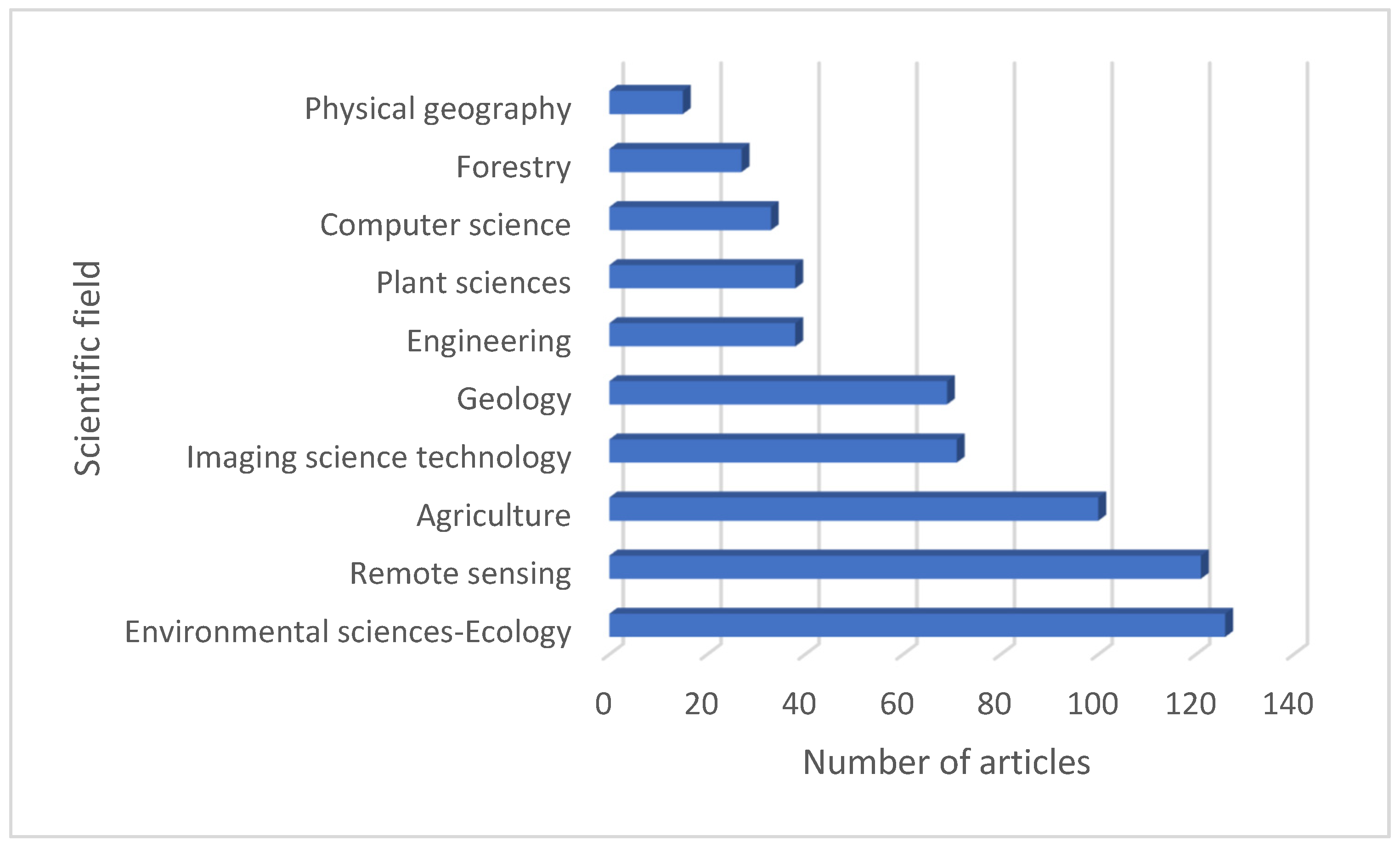
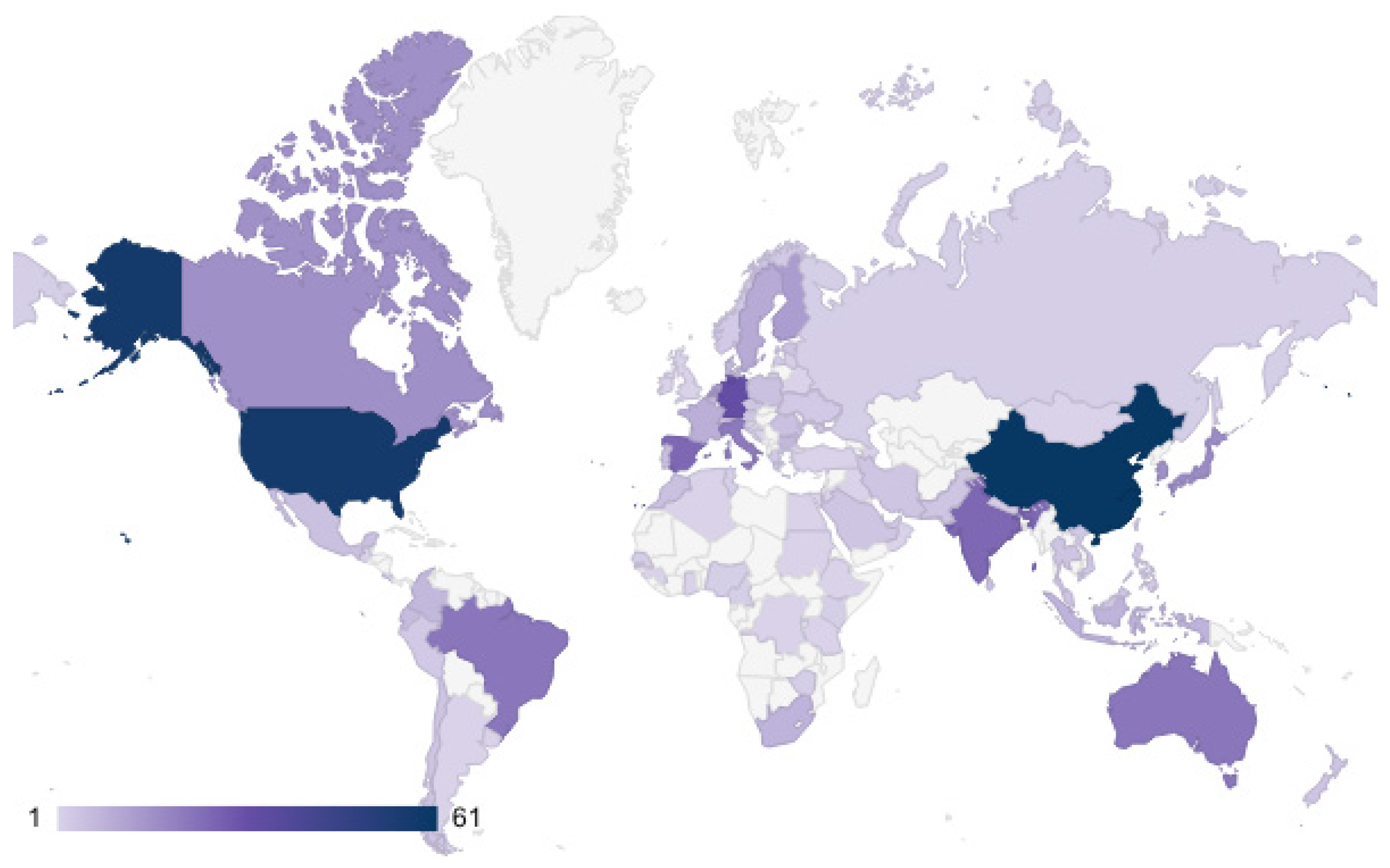
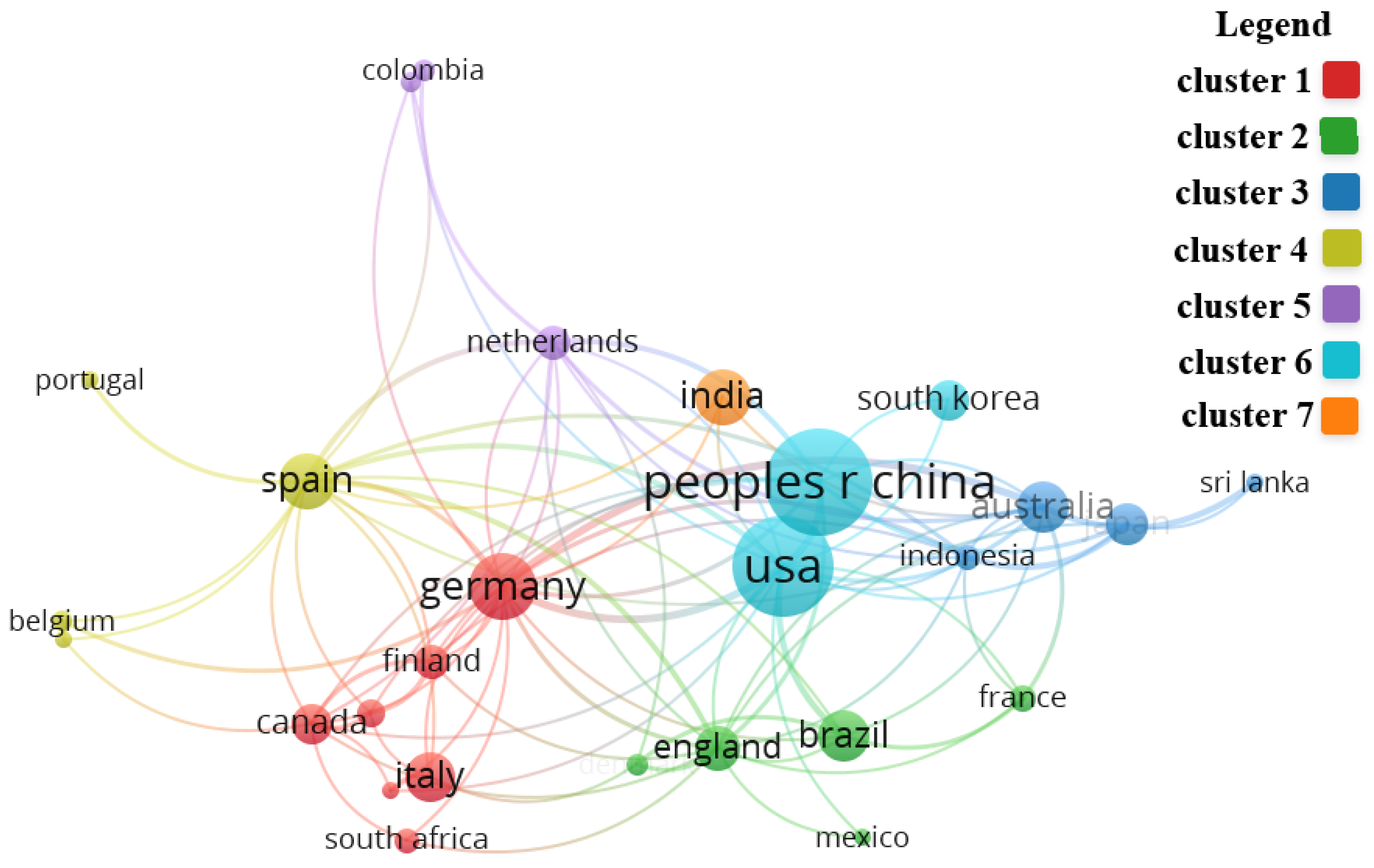
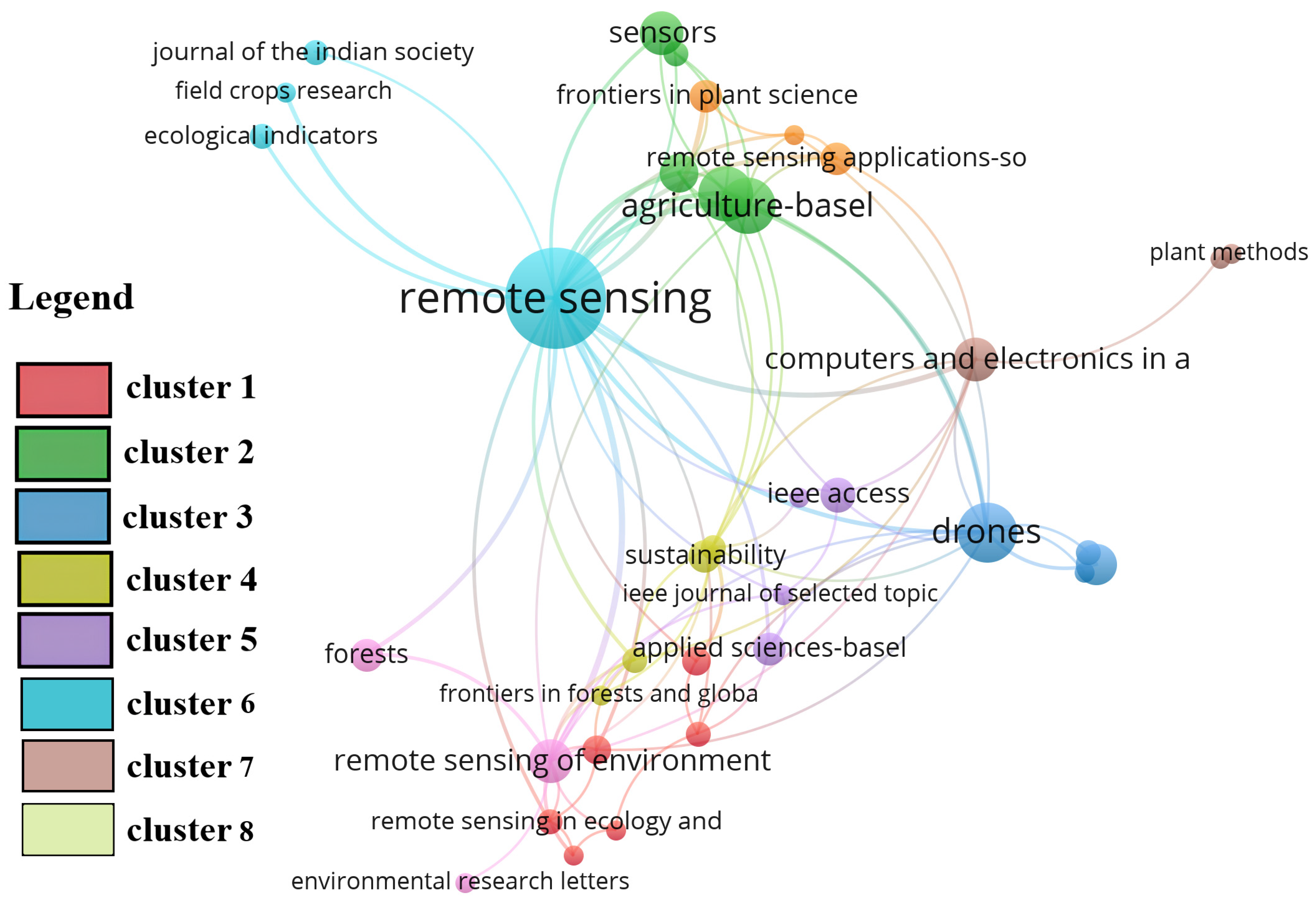
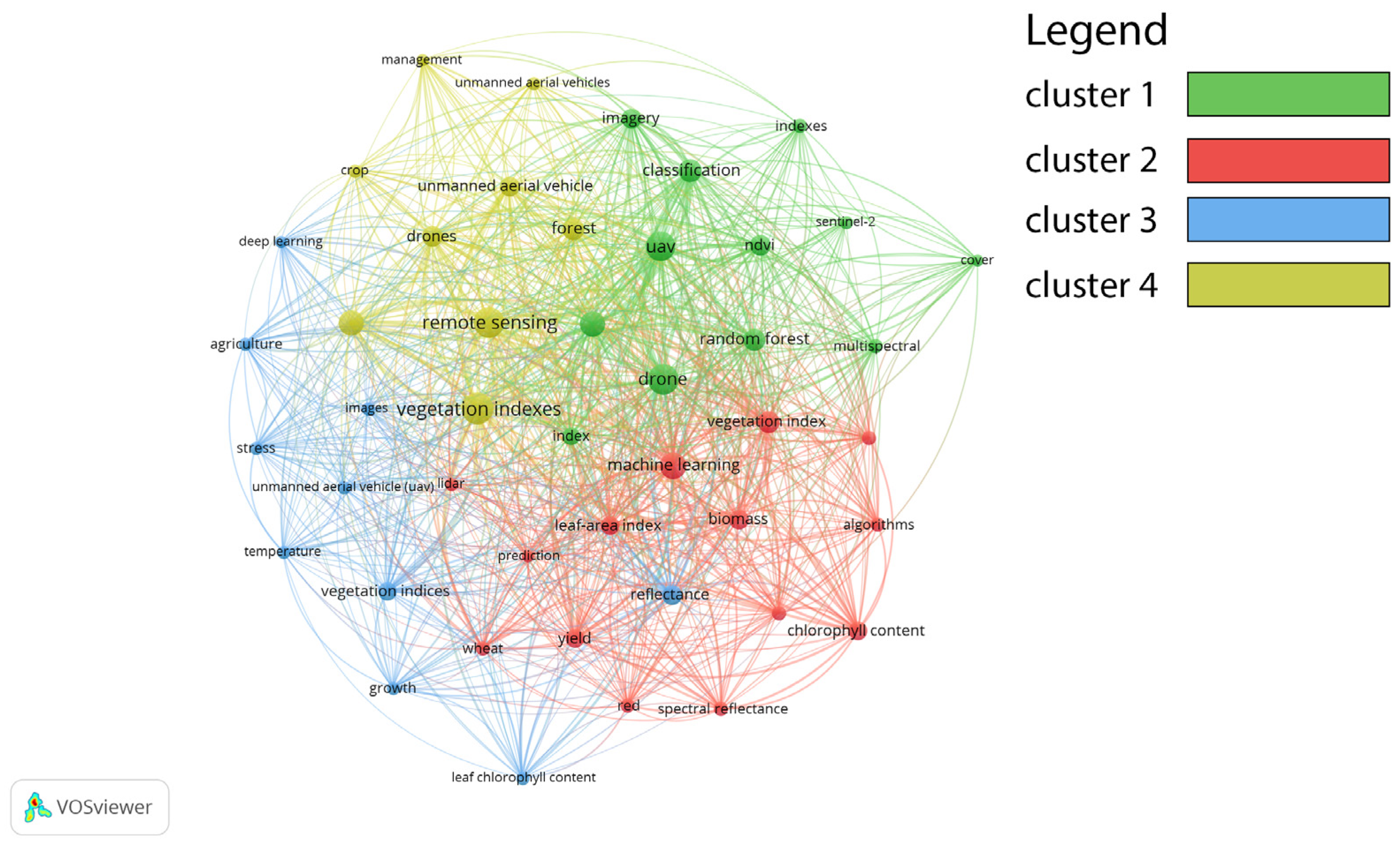
3.1. A Bibliometric Review
3.2. The Literature Review
3.2.1. UAV-Derived Vegetation Indices in Agriculture and Forestry
3.2.2. Technical Achievements in UAV-Based Vegetation Index Development
Performance of UAV-Derived Vegetation Indices in Agricultural Monitoring
Vegetation Indices and Forest Health Monitoring
New Vegetation Indices for Disease and Stress Detection
3.2.3. Application of Drone-Derived Vegetation Indices in Agriculture and Forestry: Case Study Outcomes
Agricultural Crops
Forest and Tree Systems
3.2.4. Effects of Environmental and Field Conditions on Vegetation Indices
4. Discussion
4.1. Bibliometric Review
4.2. Applications and Advances in UAV-Based Vegetation Indices
4.3. Performance of UAV-Derived Vegetation Indices in Agricultural and Forest Monitoring
4.4. Interpreting UAV-Based Vegetation Indices: Insights for Crop and Forest Monitoring
4.5. Vegetation Index Responses to Environmental Influences
4.6. Research Gaps and Future Directions
- Develop harmonized acquisition and calibration standards for UAV vegetation monitoring, enabling reproducibility and interoperability.
- Strengthen multi-scale fusion approaches combining UAV, satellite, and proximal sensing data to enhance temporal resolution and regional scalability.
- Validate crop- and stress-specific indices across multiple environments and develop next-generation indices tailored to forest structure, water stress, and disease phenotyping.
- Expand the use of RGB-based and other low-cost sensors together with open-source analytical platforms to democratize UAV use and reduce dependency on high-end equipment.
- Conduct long-term ecological and forestry monitoring campaigns to evaluate vegetation responses to disturbances, pests, and climate extremes.
- Incorporate socio-economic, environmental, and regulatory considerations to bridge the gap between technical research and practical, policy-relevant implementation.
5. Conclusions
Supplementary Materials
Author Contributions
Funding
Institutional Review Board Statement
Informed Consent Statement
Data Availability Statement
Conflicts of Interest
References
- Vashishth, T.K.; Sharma, V.; Sharma, K.K.; Chaudhary, S.; Kumar, B.; Panwar, R. Integration of unmanned aerial vehicles (UAVs) and IoT for crop monitoring and spraying. In Internet of Things Applications and Technology; Auerbach Publications: Boca Raton, FL, USA, 2024; pp. 95–117. [Google Scholar]
- Marin, S.O.; Clinciu, I.; Tudose, N.C.; Ungurean, C. An evaluating methodology for hydrotechnical torrent-control structures condition. Ann. For. Res. 2012, 55, 125–143. [Google Scholar] [CrossRef]
- Mihalache, A.L.; Marin, M.; Davidescu, Ș.O.; Ungurean, C.; Adorjani, A.; Tudose, N.C.; Davidescu, A.A.; Clinciu, I. Physical status of torrent control structures in Romania. Environ. Eng. Manag. J. 2020, 19, 861–872. [Google Scholar] [CrossRef]
- Marin, M.; Clinciu, I.; Tudose, N.C.; Ungurean, C.; Mihalache, A.L.; Mărțoiu, N.E.; Tudose, O.N. Assessment of seasonal surface runoff under climate and land use change scenarios for a small forested watershed: Upper Tarlung Watershed (Romania). Water 2022, 14, 2860. [Google Scholar] [CrossRef]
- Marin, M.; Tudose, N.C.; Ungurean, C.; Mihalache, A.L. Application of life cycle assessment for torrent control structures: A review. Land 2024, 13, 1956. [Google Scholar] [CrossRef]
- Nhamo, L.; Magidi, J.; Nyamugama, A.; Clulow, A.D.; Sibanda, M.; Chimonyo, V.G.; Mabhaudhi, T. Prospects of improving agricultural and water productivity through unmanned aerial vehicles. Agriculture 2020, 10, 256. [Google Scholar] [CrossRef]
- Mohan, M.; Richardson, G.; Gopan, G.; Aghai, M.M.; Bajaj, S.; Galgamuwa, G.A.P.; Vastaranta, M.; Arachchige, P.S.P.; Amorós, L.; Corte, A.P.D.; et al. UAV-supported forest regeneration: Current trends, challenges and implications. Remote Sens. 2021, 13, 2596. [Google Scholar] [CrossRef]
- Berie, H.T.; Burud, I. Application of unmanned aerial vehicles in earth resources monitoring: Focus on evaluating potentials for forest monitoring in Ethiopia. Eur. J. Remote Sens. 2018, 51, 326–335. [Google Scholar] [CrossRef]
- Nursaputra, M.; Larekeng, S.H.; Hamzah, A.S. The NDVI algorithm utilization on the Google Earth Engine platform to monitor changes in forest density in mining area. IOP Conf. Ser. Earth Environ. Sci. 2021, 886, 012100. [Google Scholar] [CrossRef]
- Abdulridha, J.; Min, A.; Rouse, M.N.; Kianian, S.; Isler, V.; Yang, C. Evaluation of stem rust disease in wheat fields by drone hyperspectral imaging. Sensors 2023, 23, 4154. [Google Scholar] [CrossRef]
- Hassan, M.A.; Yang, M.; Rasheed, A.; Yang, G.; Reynolds, M.; Xia, X.; Xiao, Y.; He, Z. A rapid monitoring of NDVI across the wheat growth cycle for grain yield prediction using a multi-spectral UAV platform. Plant Sci. 2019, 282, 95–103. [Google Scholar] [CrossRef]
- Änäkkälä, M.; Lajunen, A.; Hakojärvi, M.; Alakukku, L. Evaluation of the influence of field conditions on aerial multispectral images and vegetation indices. Remote Sens. 2022, 14, 4792. [Google Scholar] [CrossRef]
- Michels, R.N.; Bertozzi, J.; Dal Bosco, T.C.; Aguiar e Silva, M.A.; Gnoatto, E.; Soares, C.H.E. Use of drone with digital photographic machine embedded for determination of leaf cover. Rev. Agrogeoambient. 2019, 11, 17–25. [Google Scholar] [CrossRef]
- Simic Milas, A.; Romanko, M.; Reil, P.; Abeysinghe, T.; Marambe, A. The importance of leaf area index in mapping chlorophyll content of corn under different agricultural treatments using UAV images. Int. J. Remote Sens. 2018, 39, 5415–5431. [Google Scholar] [CrossRef]
- Vasile, D.; Petritan, A.-M.; Tudose, N.C.; Toiu, F.L.; Scarlatescu, V.; Petritan, I.C. Structure and spatial distribution of dead wood in two temperate old-growth mixed European beech forests. Not. Bot. Horti Agrobot. 2017, 45, 639–645. [Google Scholar] [CrossRef]
- Mustățea, M.; Clius, M.; Tudose, N.C.; Cheval, S. An enhanced Machado Index of naturalness. Catena 2022, 212, 106091. [Google Scholar] [CrossRef]
- Oprică, R.; Tudose, N.C.; Davidescu, S.O.; Zup, M.; Marin, M.; Comanici, A.N.; Crit, M.N.; Pitar, D. Gender inequalities in Transylvania’s largest peri-urban forest usage. Ann. For. Res. 2022, 65, 57–69. [Google Scholar] [CrossRef]
- Tudose, N.C.; Petritan, I.C.; Toiu, F.L.; Petritan, A.-M.; Marin, M. Relation between topography and gap characteristics in a mixed sessile oak–beech old-growth forest. Forests 2023, 14, 188. [Google Scholar] [CrossRef]
- Naseri, M.H.; Shataee Jouibary, S.; Habashi, H. Analysis of forest tree dieback using UltraCam and UAV imagery. Scand. J. For. Res. 2023, 38, 392–400. [Google Scholar] [CrossRef]
- Ayamga, M.; Akaba, S.; Nyaaba, A.A. Multifaceted applicability of drones: A review. Technol. Forecast. Soc. Change 2021, 167, 120677. [Google Scholar] [CrossRef]
- Floreano, D.; Wood, R.J. Science, technology and the future of small autonomous drones. Nature 2015, 521, 460–466. [Google Scholar] [CrossRef] [PubMed]
- Dutta, G.; Goswami, P. Application of drone in agriculture: A review. Int. J. Chem. Stud. 2020, 8, 181–187. [Google Scholar] [CrossRef]
- Scudder, M.G.; Sampson, L.E. Cost-effective forestry? A systematic literature review of drone applications (2014–2024). J. For. 2025, 123, 523–545. [Google Scholar] [CrossRef]
- Achim, F.; Dinca, L.; Chira, D.; Raducu, R.; Chirca, A.; Murariu, G. Sustainable management of willow forest landscapes: A review of ecosystem functions and conservation strategies. Land 2025, 14, 1593. [Google Scholar] [CrossRef]
- Dincă, L.; Crișan, V.; Murariu, G.; Țupu, E. Oxalis acetossela in forests: A systematic bibliometric study over the last 47 years. Sci. Pap. Ser. B Hortic. 2025, 69, 756–761. [Google Scholar]
- Bratu, I.; Dinca, L.; Constandache, C.; Murariu, G. Resilience and decline: The impact of climatic variability on temperate oak forests. Climate 2025, 13, 119. [Google Scholar] [CrossRef]
- Budău, R.; Timofte, C.S.C.; Mirisan, L.V.; Bei, M.; Dinca, L.; Murariu, G.; Racz, K.A. Living landmarks: A review of monumental trees and their role in ecosystems. Plants 2025, 14, 2075. [Google Scholar] [CrossRef]
- Dincă, L.; Crișan, V.; Ienașoiu, G.; Murariu, G.; Drășovean, R. Environmental indicator plants in mountain forests: A review. Plants 2024, 13, 3358. [Google Scholar] [CrossRef] [PubMed]
- Enescu, C.M.; Mihalache, M.; Ilie, L.; Dinca, L.; Constandache, C.; Murariu, G. Agricultural benefits of shelterbelts and windbreaks: A bibliometric analysis. Agriculture 2025, 15, 1204. [Google Scholar] [CrossRef]
- Dincă, L.; Coca, A.; Tudose, N.C.; Marin, M.; Murariu, G.; Munteanu, D. The Role of Trees in Sand Dune Rehabilitation: Insights from Global Experiences. Appl. Sci. 2025, 15, 7358. [Google Scholar] [CrossRef]
- Murariu, G.; Stanciu, S.; Dincă, L.; Munteanu, D. GIS Applications in Monitoring and Managing Heavy Metal Contamination of Water Resources. Appl. Sci. 2025, 15, 10332. [Google Scholar] [CrossRef]
- Slepetiene, A.; Belova, O.; Fastovetska, K.; Dincă, L.; Murariu, G. Managing Boreal Birch Forests for Climate Change Mitigation. Land 2025, 14, 1909. [Google Scholar] [CrossRef]
- Page, M.J.; McKenzie, J.E.; Bossuyt, P.M.; Boutron, I.; Hoffmann, T.C.; Mulrow, C.D.; Shamseer, L.; Tetzlaff, J.M.; Akl, E.A.; Brennan, S.E.; et al. The PRISMA 2020 statement: An updated guideline for reporting systematic reviews. BMJ 2021, 372, n71. [Google Scholar] [CrossRef]
- Clarivate.com. Web of Science Core Collection. Available online: https://clarivate.com/academia-government/lp/pivot-rp/?campaignname=UL_PivotRP_LeadGen_AG_Global&campaignid=701QO00000BvPD5YAN&utm_campaign=UL_PivotRP_LeadGen_AG_Global&utm_source=Google&utm_medium=Paid_Search&utm_content=&utm_term=&gad_source=1&gad_campaignid=22932413470&gbraid=0AAAAACv9_uOFOYI_9kHMn5wNhcCda0nPI&gclid=Cj0KCQiAuvTJBhCwARIsAL6Demg8Fov6bhlPvC0lwXN_vRZToXg0CFqCvczGshFyrg12pnmuK5TwxyMaAu_EEALw_wcB (accessed on 20 June 2025).
- Elsevier. Scopus. Available online: https://www.elsevier.com/products/scopus (accessed on 20 June 2025).
- Microsoft Corporation. Microsoft Excel. Available online: https://www.microsoft.com/en-us/microsoft-365/excel?legRedir=true&CorrelationId=3bb60ab0-fe13-41a4-812b-2627667cf346 (accessed on 26 June 2025).
- Google. Geochart. Available online: https://developers.google.com/chart/interactive/docs/gallery/geochart (accessed on 23 June 2025).
- VOSviewer. Available online: https://www.vosviewer.com/ (accessed on 22 June 2025).
- Ali, M.; Athar, U.; Zafar, Z.; Berns, K.; Fraz, M.M. Water stress diagnosis in rainfed wheat through UAV multispectral imagery and IoT data. In Proceedings of the 2024 19th International Conference on Emerging Technologies (ICET), Topi, Pakistan, 19–20 November 2024; IEEE: New York City, NY, USA, 2024; pp. 1–7. [Google Scholar]
- Woebbecke, D.M.; Meyer, G.E.; Bargen, K.V.; Mortensen, D.A. Color indices for weed identification under various soil, residue, and lighting conditions. Am. Soc. Agric. Eng. 1995, 38, 259–269. [Google Scholar] [CrossRef]
- Du, X.; Zhou, Z.; Huang, D. Influence of spatial scale effect on UAV remote sensing accuracy in identifying Chinese cabbage (Brassica rapa subsp. Pekinensis) plants. Agriculture 2024, 14, 1871. [Google Scholar] [CrossRef]
- Meyer, G.E.; Neto, J.C. Verification of color vegetation indices for automated crop imaging applications. Comput. Electron. Agric. 2008, 63, 282–293. [Google Scholar] [CrossRef]
- Alevizos, E.; Nurdin, N.; Aris, A.; Barillé, L. Proximal sensing for characterising seaweed aquaculture crop conditions: Optical detection of ice-ice disease. Remote Sens. 2024, 16, 3502. [Google Scholar] [CrossRef]
- Escadafal, R.; Belghit, A.; Ben-Moussa, A. Indices spectraux pour la télédétection de la dégradation des milieux naturels en Tunisie aride. In Actes du 6ème Symposium International sur les Mesures Physiques et Signatures en Télédétection, Proceedings of the 6th International Symposium on Physical Measurements and Signatures in Remote Sensing, Val d’Isère, France, 17–24 January 1994; Guyot, G., Ed.; CNES: Paris, France, 1994; pp. 253–259. [Google Scholar]
- Atanasov, A.I.; Stoyanov, H.P.; Atanasov, A.Z. Differentiating growth patterns in winter wheat cultivars via unmanned aerial vehicle imaging. AgriEngineering 2024, 6, 3652–3671. [Google Scholar] [CrossRef]
- Bendig, J.; Yu, K.; Aasen, H.; Bolten, A.; Bennertz, S.; Broscheit, J.; Gnyp, M.L.; Bareth, G. Combining UAV-based plant height from crop surface models, visible, and near-infrared vegetation indices for biomass monitoring in barley. Int. J. Appl. Earth Obs. Geoinf. 2015, 39, 79–87. [Google Scholar] [CrossRef]
- Adak, A.; Murray, S.C.; Božinović, S.; Lindsey, R.; Nakasagga, S.; Chatterjee, S.; Wilde, S. Temporal vegetation indices and plant height from remotely sensed imagery can predict grain yield and flowering time breeding value in maize via machine learning regression. Remote Sens. 2021, 13, 2141. [Google Scholar] [CrossRef]
- Ahamed, T.; Tian, L.; Zhang, Y.; Ting, K.C. A review of remote sensing methods for biomass feedstock production. Biomass Bioenergy 2011, 35, 2455–2469. [Google Scholar] [CrossRef]
- D’Odorico, P.; Besik, A.; Wong, C.Y.; Isabel, N.; Ensminger, I. High-throughput drone-based remote sensing reliably tracks phenology in thousands of conifer seedlings. New Phytol. 2020, 226, 1667–1681. [Google Scholar] [CrossRef]
- Barnes, E.M.; Clarke, T.R.; Richards, S.E.; Colaizzi, P.D.; Haberland, J.; Kostrzewski, M.; Waller, P.; Choi, C.; Riley, E.; Thompson, T.; et al. Coincident detection of crop water stress, nitrogen status, and canopy density using ground-based multispectral data. In Proceedings of the Fifth International Conference on Precision Agriculture, Bloomington, MN, USA, 16–19 July 2000. [Google Scholar]
- Chatraei Azizabadi, E.; El-Shetehy, M.; Cheng, X.; Youssef, A.; Badreldin, N. In-season potato nitrogen prediction using multispectral drone data and machine learning. Remote Sens. 2025, 17, 1860. [Google Scholar] [CrossRef]
- Gitelson, A.A.; Viña, A.; Arkebauer, T.J.; Rundquist, D.C.; Keydan, G.; Leavitt, B. Remote estimation of leaf area index and green leaf biomass in maize canopies. Geophys. Res. Lett. 2003, 30, 1248. [Google Scholar] [CrossRef]
- Zheng, C.; Abd-Elrahman, A.; Whitaker, V.; Dalid, C. Prediction of strawberry dry biomass from UAV multispectral imagery using multiple machine learning methods. Remote Sens. 2022, 14, 4511. [Google Scholar] [CrossRef]
- Arcidiaco, L.; Danti, R.; Corongiu, M.; Emiliani, G.; Frascella, A.; Mello, A.; Bonora, L.; Barberini, S.; Pellegrini, D.; Sabatini, N.; et al. Preliminary machine learning-based classification of ink disease in chestnut orchards using high-resolution multispectral imagery from unmanned aerial vehicles: A comparison of vegetation indices and classifiers. Forests 2025, 16, 754. [Google Scholar] [CrossRef]
- Buschmann, C.; Nagel, E. In vivo spectroscopy and internal optics of leaves as basis for remote sensing of vegetation. Int. J. Remote Sens. 1993, 14, 711–722. [Google Scholar] [CrossRef]
- Bozzini, A.; Brugnaro, S.; Morgante, G.; Santoiemma, G.; Deganutti, L.; Finozzi, V.; Battisti, A.; Faccoli, M. Drone-based early detection of bark beetle infested spruce trees differs in endemic and epidemic populations. Front. For. Glob. Change 2024, 7, 1385687. [Google Scholar] [CrossRef]
- Maccioni, A.; Agati, G.; Mazzinghi, P. New vegetation indices for remote measurement of chlorophylls based on leaf directional reflectance spectra. J. Photochem. Photobiol. B Biol. 2001, 61, 52–61. [Google Scholar] [CrossRef]
- Buschmann, C. Fernerkundung von Pflanzen. Naturwissenschaften 1993, 80, 439–453. [Google Scholar] [CrossRef]
- Cruz-Grimaldo, C.; Nieves, M.; Vera, E.; Duran, M.; Morales, A.; Salazar, W.; Arbizu, C.I. Yield predictions of ‘Del Cerro’ cotton (Gossypium hirsutum L.) germplasm by multispectral monitoring in the north coast of Peru. Chil. J. Agric. Res. 2025, 85, 15–26. [Google Scholar] [CrossRef]
- Baret, F.; Guyot, G. Potentials and limits of vegetation indices for LAI and APAR assessment. Remote Sens. Environ. 1991, 35, 161–173. [Google Scholar] [CrossRef]
- Guo, Y.; Wang, N.; Wei, X.; Zhou, M.; Wang, H.; Bai, Y. Desert oasis vegetation information extraction by PLANET and unmanned aerial vehicle image fusion. Ecol. Indic. 2024, 166, 112516. [Google Scholar] [CrossRef]
- Herrmann, I.; Karnieli, A.; Bonfil, D.J.; Cohen, Y.; Alchanatis, V. SWIR-based spectral indices for assessing nitrogen content in potato fields. Int. J. Remote Sens. 2010, 31, 5127–5143. [Google Scholar] [CrossRef]
- Bāders, E.; Seipulis, A.; Kaupe, D.; Champion, J.J.C.; Krišāns, O.; Elferts, D. UAV-based multispectral assessment of wind-induced damage in Norway spruce crowns. Forests 2025, 16, 1348. [Google Scholar] [CrossRef]
- Richardson, A.J.; Everitt, J.H. Using spectral vegetation indices to estimate rangeland productivity. Geocartogr. Int. 1992, 1, 63–69. [Google Scholar] [CrossRef]
- Sims, D.A.; Gamon, J.A. Relationships between leaf pigment content and spectral reflectance across a wide range of species, leaf structures and developmental stages. Remote Sens. Environ. 2002, 81, 337–354. [Google Scholar] [CrossRef]
- Chen, J.M.; Cihlar, J. Retrieving leaf area index of boreal conifer forests using Landsat TM images. Remote Sens. Environ. 1996, 55, 153–162. [Google Scholar] [CrossRef]
- Blackburn, G.A. Spectral indices for estimating photosynthetic pigment concentrations: A test using senescent tree leaves. Int. J. Remote Sens. 1998, 19, 657–675. [Google Scholar] [CrossRef]
- Nielsen, D.C. Scheduling irrigations for soybeans with the crop water stress index (CWSI). Field Crops Res. 1990, 23, 103–116. [Google Scholar] [CrossRef]
- Lee, W.S.; Alchanatis, V.; Yang, C.; Hirafuji, M.; Moshou, D.; Li, C. Sensing technologies for precision specialty crop production. Comput. Electron. Agric. 2010, 74, 2–33. [Google Scholar] [CrossRef]
- Pazhanivelan, S.; Kumaraperumal, R.; Shanmugapriya, P.; Sudarmanian, N.S.; Sivamurugan, A.P.; Satheesh, S. Quantification of biophysical parameters and economic yield in cotton and rice using drone technology. Agriculture 2023, 13, 1668. [Google Scholar] [CrossRef]
- Bannari, A.; Morin, D.; Bonn, F.; Huete, A.R. A review of vegetation indices. Remote Sens. Rev. 1995, 13, 95–120. [Google Scholar] [CrossRef]
- Ecke, S.; Stehr, F.; Dempewolf, J.; Frey, J.; Klemmt, H.J.; Seifert, T.; Tiede, D. Species-specific machine learning models for UAV-based forest health monitoring: Revealing the importance of the BNDVI. Int. J. Appl. Earth Obs. Geoinf. 2024, 135, 104257. [Google Scholar] [CrossRef]
- Yang, C.; Everitt, J.H.; Bradford, J.M. Airborne hyperspectral imagery and yield monitor data for mapping cotton yield variability. Comput. Electron. Agric. 2004, 5, 445–461. [Google Scholar] [CrossRef]
- Matyukira, C.; Mhangara, P. Utilising RGB drone imagery and vegetation indices for accurate above-ground biomass estimation: A case study of the Cradle Nature Reserve, Gauteng Province, South Africa. Geocarto Int. 2024, 39, 2390512. [Google Scholar] [CrossRef]
- Atanasov, A.; Mihova, G.; Stoyanov, S.; Bankova, A.; Mihaylova, D. Use of unmanned aircraft for assessment of maize vegetation in Southern Dobruja. In Proceedings of the 2024 9th International Conference on Energy Efficiency and Agricultural Engineering (EE&AE), Ruse, Bulgaria, 27–29 June 2024; IEEE: New York, NY, USA, 2024; pp. 1–6. [Google Scholar]
- Datt, B.; McVicar, T.R.; Van Niel, T.G.; Jupp, D.L.B.; Pearlman, J.S. Preprocessing EO-1 Hyperion hyperspectral data to support the application of agricultural indexes. IEEE Trans. Geosci. Remote Sens. 2003, 41, 1246–1259. [Google Scholar] [CrossRef]
- Nagler, P.L.; Scott, R.L.; Westenburg, C.; Cleverly, J.R.; Glenn, E.P.; Huete, A.R. Evapotranspiration on western U.S. rivers estimated using the Enhanced Vegetation Index from MODIS and data from eddy covariance and Bowen ratio flux towers. Remote Sens. Environ. 2005, 97, 337–351. [Google Scholar] [CrossRef]
- Goigochea-Pinchi, D.; Justino-Pinedo, M.; Vega-Herrera, S.S.; Sanchez-Ojanasta, M.; Lobato-Galvez, R.H.; Santillan-Gonzales, M.D.; Ganoza-Roncal, J.J.; Ore-Aquino, Z.L.; Agurto-Piñarreta, A.I. Yield prediction models for rice varieties using UAV multispectral imagery in the Amazon lowlands of Peru. AgriEngineering 2024, 6, 2955–2969. [Google Scholar] [CrossRef]
- Huete, A.R.; Didan, K.; Miura, T. Development of a two-band enhanced vegetation index without a blue band. Remote Sens. Environ. 2008, 112, 3833–3845. [Google Scholar]
- Adak, A.; DeSalvio, A.J.; Murray, S.C. A computational framework for modeling and predicting maize senescence: Integrating UAV phenotyping, logistic growth, and genomics. Comput. Electron. Agric. 2025, 237, 110471. [Google Scholar] [CrossRef]
- Neto, J.C. A Combined Statistical-Soft Computing Approach for Classification and Mapping Weed Species in Minimum-Tillage Systems. Doctoral Dissertation, University of Nebraska-Lincoln, Lincoln, NE, USA, 2004. Available online: http://digitalcommons.unl.edu/dissertations/AAI3147135 (accessed on 8 May 2025).
- Du, M.; Li, M.; Noguchi, N.; Ji, J.; Ye, M. Retrieval of fractional vegetation cover from remote sensing image of unmanned aerial vehicle based on mixed pixel decomposition method. Drones 2023, 7, 43. [Google Scholar] [CrossRef]
- Morisio, M.; Noris, E.; Pagliarani, C.; Pavone, S.; Moine, A.; Doumet, J.; Ardito, L. Characterization of hazelnut trees in open field through high-resolution UAV-based imagery and vegetation indices. Sensors 2025, 25, 288. [Google Scholar] [CrossRef] [PubMed]
- Gitelson, A.A.; Kaufman, Y.J.; Stark, R.; Rundquist, D. Novel algorithms for remote estimation of vegetation fraction. Remote Sens. Environ. 2002, 80, 76–87. [Google Scholar] [CrossRef]
- Gobron, N.; Pinty, B.; Verstraete, M.M.; Widlowski, J.-L. Advanced vegetation indices optimized for upcoming sensors: Design, performance, and applications. IEEE Trans. Geosci. Remote Sens. 2000, 38, 2489–2505. [Google Scholar]
- Huo, L.; Koivumäki, N.; Oliveira, R.A.; Hakala, T.; Markelin, L.; Näsi, R.; Suomalainen, J.; Polvivaara, A.; Junttila, S.; Honkavaara, E. Bark beetle pre-emergence detection using multi-temporal hyperspectral drone images: Green shoulder indices can indicate subtle tree vitality decline. ISPRS J. Photogramm. Remote Sens. 2024, 216, 200–216. [Google Scholar] [CrossRef]
- Datt, B. Remote sensing of water content in eucalyptus leaves. Aust. J. Bot. 1999, 47, 909–923. [Google Scholar] [CrossRef]
- Eitel, J.U.H.; Long, D.S.; Gessler, P.E.; Smith, A.M.S. Using in-situ measurements to evaluate the new RapidEyeTM satellite series for prediction of wheat nitrogen status. Int. J. Remote Sens. 2007, 28, 4183–4190. [Google Scholar] [CrossRef]
- Pereira, J.S.; Ferraz, G.A.e.S.; Santana, L.S. Aerial images to monitor grapevine vegetative growth. Rev. Eng. Agric. 2022, 30, 166–174. [Google Scholar] [CrossRef]
- Liu, H.; Xiang, Y.; Chen, J.; Wu, Y.; Du, R.; Tang, Z.; Yang, N.; Shi, H.; Li, Z.; Zhang, F. A new spectral index for monitoring leaf area index of winter oilseed rape (Brassica napus L.) under different coverage methods and nitrogen treatments. Plants 2024, 13, 1901. [Google Scholar] [CrossRef] [PubMed]
- Dash, J.; Curran, P.J. The MERIS terrestrial chlorophyll index. Int. J. Remote Sens. 2004, 25, 5403–5413. [Google Scholar] [CrossRef]
- Carbonell-Rivera, J.P.; Moran, C.J.; Seielstad, C.A.; Parsons, R.A.; Hoff, V.; Ruiz, L.Á.; Torralba, J.; Estornell, J. Relationships of fire rate of spread with spectral and geometric features derived from UAV-based photogrammetric point clouds. Fire 2024, 7, 132. [Google Scholar] [CrossRef]
- Gao, B.-C. NDWI—A normalized difference water index for remote sensing of vegetation liquid water from space. Remote Sens. Environ. 1996, 58, 257–266. [Google Scholar] [CrossRef]
- Malthus, T.J.; Andrieu, B.; Danson, F.M.; Jaggard, K.W.; Steven, M.D. Candidate high spectral resolution infrared indices for crop cover. Remote Sens. Environ. 1993, 46, 204–212. [Google Scholar] [CrossRef]
- Cunha, J.; Gaspar, P.D.; Assunção, E.; Mesquita, R. Prediction of the vigor and health of peach tree orchard. In Computational Science and Its Applications—ICCSA 2021, Proceedings of the International Conference on Computational Science and Its Applications, Cagliari, Italy, 13–16 September 2021; Springer International Publishing: Cham, Switzerland, 2021; pp. 541–551. [Google Scholar]
- Gitelson, A.A.; Kaufman, Y.J.; Merzlyak, M.N. Use of a green channel in remote sensing of global vegetation from EOS-MODIS. Remote Sens. Environ. 1996, 58, 289–298. [Google Scholar] [CrossRef]
- Moran, M.S.; Inoue, Y.; Barnes, E.M. Opportunities and limitations for image-based remote sensing in precision crop management. Remote Sens. Environ. 1997, 61, 319–346. [Google Scholar] [CrossRef]
- Chandel, N.S.; Jat, D.; Chakraborty, S.K.; Upadhyay, A.; Subeesh, A.; Chouhan, P.; Manjhi, M.; Dubey, K. Deep learning assisted real-time nitrogen stress detection for variable rate fertilizer applicator in wheat crop. Comput. Electron. Agric. 2025, 237, 110545. [Google Scholar] [CrossRef]
- Wang, F.M.; Huang, J.F.; Tang, Y.L.; Wang, X.Z. New vegetation index and its application in estimating leaf area index of rice. Rice Sci. 2007, 14, 195–203. [Google Scholar] [CrossRef]
- Peres, D.J.; Cancelliere, A. Analysis of multi-spectral images acquired by UAVs to monitor water stress of citrus orchards in Sicily, Italy. In World Environmental and Water Resources Congress 2021; American Society of Civil Engineers: Reston, VA, USA, 2021; pp. 270–278. [Google Scholar]
- de Lima, G.S.A.; Ferreira, M.E.; Madari, B.E.; de Melo Carvalho, M.T. Carbon estimation in an integrated crop-livestock system with imaging sensors aboard unmanned aerial platforms. Remote Sens. Appl. Soc. Environ. 2022, 28, 100867. [Google Scholar] [CrossRef]
- Haboudane, D.; Miller, J.R.; Tremblay, N.; Zarco-Tejada, P.J.; Dextraze, L. Integrated narrow-band vegetation indices for prediction of crop chlorophyll content for application to precision agriculture. Remote Sens. Environ. 2002, 81, 416–426. [Google Scholar] [CrossRef]
- Gitelson, A.A. Wide dynamic range vegetation index for remote quantification of biophysical characteristics of vegetation. J. Plant Physiol. 2004, 161, 165–173. [Google Scholar] [CrossRef]
- Allen, M.J.; Moreno-Fernández, D.; Ruiz-Benito, P.; Grieve, S.W.; Lines, E.R. Low-cost tree crown dieback estimation using deep learning-based segmentation. Environ. Data Sci. 2024, 3, e18. [Google Scholar] [CrossRef]
- Diykh, M.; Ali, M.; Jamei, M.; Abdulla, S.; Uddin, P.; Farooque, A.A.; Labban, A.H.; Alabdally, H. Empirical curvelet transform based deep DenseNet model to predict NDVI using RGB drone imagery data. Comput. Electron. Agric. 2024, 221, 108964. [Google Scholar] [CrossRef]
- Banaszek, S.; Szota, M. A semi-automated RGB-based method for wildlife crop damage detection using QGIS-integrated UAV workflow. Sensors 2025, 25, 4734. [Google Scholar] [CrossRef] [PubMed]
- Ansari, R.A.; Esimaje, T.; Ibrahim, O.M.; Mulrooney, T. Analysis of forest change detection induced by Hurricane Helene using remote sensing data. Forests 2025, 16, 788. [Google Scholar] [CrossRef]
- Baloloy, A.B.; Blanco, A.C.; Ana, R.R.C.S.; Nadaoka, K. Development and application of a new mangrove vegetation index (MVI) for rapid and accurate mangrove mapping. ISPRS J. Photogramm. Remote Sens. 2020, 166, 95–117. [Google Scholar] [CrossRef]
- Heim, R.H.J.; Wright, I.J.; Allen, A.P.; Geedicke, I.; Oldeland, J. Developing a spectral disease index for myrtle rust (Austropuccinia psidii). Plant Pathol. 2019, 68, 738–745. [Google Scholar] [CrossRef]
- Chira, D.; Bolea, V.; Chira, F.; Mantale, C.; Tăut, I.; Șimonca, V.; Diamandis, S. Biological control of Cryphonectria parasitica in Romanian protected sweet chestnut forests. Not. Bot. Horti Agrobot. 2017, 45, 632–638. [Google Scholar] [CrossRef]
- Pádua, L.; Marques, P.; Martins, L.; Sousa, A.; Peres, E.; Sousa, J.J. Monitoring of chestnut trees using machine learning techniques applied to UAV-based multispectral data. Remote Sens. 2020, 12, 3032. [Google Scholar] [CrossRef]
- Sebastiani, A.; Bertozzi, M.; Vannini, A.; Morales-Rodriguez, C.; Calfapietra, C.; Laurin, G.V. Monitoring ink disease epidemics in chestnut and cork oak forests in central Italy with remote sensing. Remote Sens. Appl. Soc. Environ. 2024, 36, 101329. [Google Scholar] [CrossRef]
- Chira, D.; Borlea, F.G.; Chira, F.; Mantale, C.Ș.; Ciocîrlan, M.I.C.; Turcu, D.O.; Cadar, N.; Trotta, V.; Camele, I.; Marcone, C.; et al. Selection of elms tolerant to Dutch elm disease in south-west Romania. Diversity 2022, 14, 980. [Google Scholar] [CrossRef]
- Wilson, B.A.; Luther, J.E.; Stuart, T.D.T. Spectral reflectance characteristics of Dutch elm disease. Can. J. Remote Sens. 1998, 24, 200–205. [Google Scholar] [CrossRef]
- Wei, X.; Zhang, J.; Conrad, A.O.; Flower, C.E.; Pinchot, C.C.; Hayes-Plazolles, N.; Chen, Z.; Song, Z.; Fei, S.; Jin, J. Machine learning-based spectral and spatial analysis of hyper- and multi-spectral leaf images for Dutch elm disease detection and resistance screening. Artif. Intell. Agric. 2023, 10, 26–34. [Google Scholar] [CrossRef]
- Hocknell, J.; Morso, I.; Graziano, J.; Paramore, K. Assessing tree health conditions in New York City’s Central Park with Earth observation data. In Proceedings of the AG24 Annual Meeting, Washington, DC, USA, 9–13 December 2024; NASA: Washington, DC, USA, 2024. Available online: https://ntrs.nasa.gov/api/citations/20240014521/downloads/2024AGU_Poster_GC51N_Hocknell.pdf (accessed on 8 May 2025).
- Chan, A.H.; Barnes, C.; Swinfield, T.; Coomes, D.A. Monitoring ash dieback (Hymenoscyphus fraxineus) in British forests using hyperspectral remote sensing. Remote Sens. Ecol. Conserv. 2021, 7, 306–320. [Google Scholar] [CrossRef]
- Fernández-Fernández, M.; Naves, P.; Witzell, J.; Musolin, D.L.; Selikhovkin, A.V.; Paraschiv, M.; Chira, D.; Martínez-Álvarez, P.; Martín-García, J.; Muñoz-Adalia, E.J.; et al. Pine pitch canker and insects: Relationships and implications for disease spread in Europe. Forests 2019, 10, 627. [Google Scholar] [CrossRef]
- Bravo-Arrepol, M.; Sanfuentes, E.; Amigo, J.; Hasbún, R.; Fuentes, C.; Navarro, A.; Sanhueza, P.; Castillo, R.D.P. Early detection of Fusarium circinatum in Pinus radiata cuttings using VIS–NIR hyperspectral imaging and multivariate analysis. Spectrochim. Acta A Mol. Biomol. Spectrosc. 2025, 345, 126778. [Google Scholar] [CrossRef]
- Shi, H.; Chen, L.; Chen, M.; Zhang, D.; Wu, Q.; Zhang, R. Advances in global remote sensing monitoring of discolored pine trees caused by pine wilt disease: Platforms, methods, and future directions. Forests 2024, 15, 2147. [Google Scholar] [CrossRef]
- Ciocîrlan, M.I.C.; Curtu, A.L.; Radu, G.R. Predicting leaf phenology in forest tree species using UAVs and satellite images: A case study for European beech (Fagus sylvatica L.). Remote Sens. 2022, 14, 6198. [Google Scholar] [CrossRef]
- Al-Juboury, I.A.M.; Aljuboury, A.B.T.; Talib, Z.A.; Atya, A.K.; Ahmed, E.; Ali, S.M.H. Prediction vegetation dynamics in Fadak palm forests utilizing remote sensing data and artificial intelligence techniques. AIP Conf. Proc. 2025, 3303, 080007. [Google Scholar]
- Li, G.; Zhao, D.; Li, J.; Feng, S. Unmanned aerial vehicle hierarchical detection of leaf blast in rice crops based on a specific spectral vegetation index. Front. Agric. Sci. Eng. 2025, 12, 2. [Google Scholar] [CrossRef]
- Bak, H.-J.; Kim, E.-J.; Lee, J.-H.; Chang, S.; Kwon, D.; Im, W.-J.; Kim, D.-H.; Lee, I.-H.; Lee, M.-J.; Hwang, W.-H.; et al. Canopy-level rice yield and yield component estimation using NIR-based vegetation indices. Agriculture 2025, 15, 594. [Google Scholar] [CrossRef]
- Adeluyi, O.; Harris, A.; Foster, T.; Clay, G.D. Exploiting centimetre resolution of drone-mounted sensors for estimating mid–late season above-ground biomass in rice. Eur. J. Agron. 2022, 132, 126411. [Google Scholar] [CrossRef]
- Tamilmounika, R.; Muthumanickam, D.; Pazhanivelan, S.; Ragunath, K.P.; Kumaraperumal, R.; Sivamurugan, A.P. Rice yield prediction through drone-derived vegetation indices: A case study in Tamil Nadu, India. Plant Sci. Today 2024, 11, 853–863. [Google Scholar] [CrossRef]
- Coswosk, G.G.; Gonçalves, V.M.L.; de Lima, V.J.; de Souza, G.A.R.; Junior, A.T.D.A.; Pereira, M.G.; de Oliveira, E.C.; Leite, J.T.; Kamphorst, S.H.; de Oliveira, U.A.; et al. Utilizing visible band vegetation indices from unmanned aerial vehicle images for maize phenotyping. Remote Sens. 2024, 16, 3015. [Google Scholar] [CrossRef]
- Macedo, F.L.; Nóbrega, H.; de Freitas, J.G.; Ragonezi, C.; Pinto, L.; Rosa, J.; Pinheiro de Carvalho, M.A. Estimation of productivity and above-ground biomass for corn (Zea mays) via vegetation indices in Madeira Island. Agriculture 2023, 13, 1115. [Google Scholar] [CrossRef]
- Alves, A.K.; Araújo, M.S.; Chaves, S.F.; Dias, L.A.S.; Corrêdo, L.P.; Pessoa, G.G.; Bezerra, A.R. High throughput phenotyping in soybean breeding using RGB image vegetation indices based on drone. Sci. Rep. 2024, 14, 32055. [Google Scholar] [CrossRef]
- Abrougui, K.; Khemis, C.; Guebsi, R.; Ouni, A.; Mohammadi, A.; Amami, R.; Kefauver, S.; Ben Mansour, H.; Chehaibi, S. Efficient management of potato fields: Integrating ground and UAV vegetation indexes for optimal mechanical planting parameters. Euro-Mediterr. J. Environ. Integr. 2025, 10, 2033–2048. [Google Scholar] [CrossRef]
- Ahmad, N.; Iqbal, J.; Shaheen, A.; Ghfar, A.; Al-Anazy, M.M.; Ouladsmane, M. Spatio-temporal analysis of chickpea crop in arid environment by comparing high-resolution UAV image and LANDSAT imagery. Int. J. Environ. Sci. Technol. 2022, 19, 6595–6610. [Google Scholar] [CrossRef]
- Sanches, G.M.; Duft, D.G.; Kölln, O.T.; Luciano, A.C.D.S.; De Castro, S.G.Q.; Okuno, F.M.; Franco, H.C.J. The potential for RGB images obtained using unmanned aerial vehicles to assess and predict yield in sugarcane fields. Int. J. Remote Sens. 2018, 39, 5402–5414. [Google Scholar] [CrossRef]
- Aldrighettoni, J.; D’Urso, M.G. Advances in precision farming: A contribute for estimating crop health and water stress by comparing UAV multispectral and thermal imagery. ISPRS Ann. Photogramm. Remote Sens. Spatial Inf. Sci. 2025, X-G-2025, 33–40. [Google Scholar] [CrossRef]
- Qi, H.; Wu, Z.; Zhang, L.; Li, J.; Zhou, J.; Jun, Z.; Zhu, B. Monitoring of peanut leaves chlorophyll content based on drone-based multispectral image feature extraction. Comput. Electron. Agric. 2021, 187, 106292. [Google Scholar] [CrossRef]
- Pinargote, C.K.; Pacheco Gil, H.A. Weed Discrimination Bbased on the Spectral Response of the Corn Crop, Manabí, Ecuador. 2021. Available online: https://redi.cedia.edu.ec/document/498056 (accessed on 16 February 2023).
- Stephen, S.; Kumar, V. Detection and analysis of weed impact on sugar beet crop using drone imagery. J. Indian Soc. Remote Sens. 2023, 51, 2577–2597. [Google Scholar] [CrossRef]
- Bai, X.; Yang, C.; Fang, L.; Chen, J.; Wang, X.; Gao, N.; Zheng, P.; Wang, G.; Wang, Q.; Ren, S. Identification of salt marsh vegetation in the Yellow River Delta using UAV multispectral imagery and deep learning. Drones 2025, 9, 235. [Google Scholar] [CrossRef]
- Keskes, M.I.; Mohamed, A.H.; Borz, S.A.; Niță, M.D. Improving national forest mapping in Romania using machine learning and Sentinel-2 multispectral imagery. Remote Sens. 2025, 17, 715. [Google Scholar] [CrossRef]
- Akturk, E. Monitoring forest canopy cover change with ICESat-2 data in fire-prone areas: A case study in Antalya, Türkiye. Ann. For. Res. 2023, 66, 87–98. [Google Scholar] [CrossRef]
- Romano, E.; Brambilla, M.; Chianucci, F.; Tattoni, C.; Puletti, N.; Chirici, G.; Travaglini, D.; Giannetti, F. Estimating canopy and stand structure in hybrid poplar plantations from multispectral UAV imagery. Ann. For. Res. 2024, 67, 143–153. [Google Scholar] [CrossRef]
- UNECE ICP Forests. Manual on Methods and Criteria for Harmonized Sampling, Assessment, Monitoring and Analysis of the Effects of Air Pollution on Forests; Thünen Institute of Forest Ecosystems: Eberswalde, Germany, 2022; 12 p. + Annexes; Available online: https://www.icp-forests.net/fileadmin/icp_forests/Dateien/Manual_Versions/2020-22/2022_ICP_Forests_Manual_Part_I_-_ICP_Manual_part01_2022_Objectives_version_2022-2.pdf (accessed on 8 May 2025).
- Şimonca, V.; Oroian, I.; Chira, D.; Tăut, I. Methods for the Quantification of Decline Phenomenon and Determination of the Vulnerability Degree for the Oak Stands in Northwestern Transylvania. Not. Bot. Horti Agrobot. 2017, 45, 623–631. [Google Scholar] [CrossRef]
- Ciceu, A.; Popa, I.; Leca, S.; Pitar, D.; Chivulescu, S.; Badea, O. Climate change effects on tree growth from Romanian forest monitoring Level II plots. Sci. Total Environ. 2020, 698, 134129. [Google Scholar] [CrossRef] [PubMed]
- Hernández-Lambraño, R.E.; de la Cruz, D.R.; Sánchez-Agudo, J.Á. Spatial oak decline models to inform conservation planning in the Central-Western Iberian Peninsula. For. Ecol. Manag. 2019, 441, 115–126. [Google Scholar] [CrossRef]
- Hornero, A.; Zarco-Tejada, P.J.; Marengo, I.; Faria, N.; Hernández-Clemente, R. Detection of oak decline using radiative transfer modelling and machine learning from multispectral and thermal RPAS imagery. Int. J. Appl. Earth Obs. Geoinf. 2024, 127, 103679. [Google Scholar] [CrossRef]
- Mazurek, A.C.; Hill, A.J.; Schumacher, R.S.; McDaniel, H.J. Can Ingredients-Based Forecasting Be Learned? Disentangling a Random Forest’s Severe Weather Predictions. Weather Forecast. 2025, 40, 237–258. [Google Scholar] [CrossRef]
- Kalogiannidis, S.; Spinthiropoulos, K.; Kalfas, D.; Chatzitheodoridis, F.; Tziampazi, F. Integration of Remote Sensing and GIS for Urban Sprawl Monitoring in European Cities. Eur. J. Geogr. 2025, 16, 75–90. [Google Scholar]
- Posite, V.R.; Ahana, B.S.; Abdelbaki, C.; Saber, M.; Kantoush, S.; Khaldoon, M.; Guadie, A.; Kumar, N. Decoding vegetation dynamics in High-Altitude tropical ecosystems: A Spatio-Temporal assessment using Multi-Index and biophysical remote sensing products (2002–2024). Earth Syst. Environ. 2025, 1–21. [Google Scholar] [CrossRef]
- Wang, Y.; Zhang, N.; Chen, M.; Zhao, Y.; Guo, F.; Huang, J.; Peng, D.; Wang, X. Prediction and Spatiotemporal Dynamics of Vegetation Index Based on Deep Learning and Environmental Factors in the Yangtze River Basin. Forests 2025, 16, 460. [Google Scholar] [CrossRef]
- Avdagić, A.; Lojo, A.; Balić, B.; Fazlić, I. Detection of Dry Trees Using NDVI Images Taken by a Drone. In New Technologies, Development and Application VIII: Volume 3; Springer: London, UK, 2025; p. 336. [Google Scholar]
- Skydan, O.V.; Fedoniuk, T.P.; Mozharovskii, O.S.; Zhukov, O.V.; Zymaroieva, A.A.; Pazych, V.M.; Hurelia, V.M.; Melnychuk, T. Monitoring tree mortality in Ukrainian Pinus sylvestris L. forests using remote sensing data from earth observing satellites. Ann. For. Res. 2022, 65, 91–101. [Google Scholar] [CrossRef]
- Buzatu, A.; Nețoiu, C.; Apostol, B.; Badea, O. The use of remote sensing indices derived from Sentinel 2 satellite images for the defoliation damage assessment of Lymantria dispar. Ann. For. Res. 2023, 66, 123–138. [Google Scholar] [CrossRef]
- Wall, W.A.; Busby, R.; Bosche, L. Vegetation predicts soil shear strength in Arctic Soils: Ground-based and remote sensing techniques. Ann. For. Res. 2024, 67, 155–166. [Google Scholar] [CrossRef]
- Barker, M.; Burnett, J.D.; Haddad, T.; Hirsch, W.; Kang, D.K.; Pawlak-Kjolhaug, K.; Wing, M. Multi-temporal Pacific madrone leaf blight assessment with unoccupied aircraft systems. Ann. For. Res. 2023, 66, 109–118. [Google Scholar] [CrossRef]
- Thapa, N.; Narine, L.L.; Fan, Z.; Yang, S.; Tiwari, K. Detection of invasive plants using NAIP imagery and airborne LiDAR in coastal Alabama and Mississippi, USA. Ann. For. Res. 2023, 66, 63–77. [Google Scholar] [CrossRef]
- Wiesel, P.G.; Schroeder, M.H.; Deprá, B.; Salgueiro, B.J.; Barreto, B.M.; de Santana, E.R.R.; Köhler, A.; Lobo, E.A. Integrating remote sensing and UAV imagery for detection of invasive Hovenia dulcis Thumb. (Rhamnaceae) in urban Atlantic Forest remnants. Environ. Monit. Assess. 2024, 197, 55. [Google Scholar] [CrossRef] [PubMed]
- Fajar, M.M.; Natalie, D.; Sales, B.P.G.; Sihotang, E.F.A.; Irwansyah, E. Deep Learning Classification Model for Oil Palm Tree Health Assessment. In Proceedings of the 2024 IEEE Asia-Pacific Conference on Geoscience, Electronics and Remote Sensing Technology (AGERS), Manado, Indonesia, 13–14 December 2024; IEEE: New York, NY, USA, 2024; pp. 32–37. [Google Scholar]
- Wavrek, M.T.; Carr, E.; Jean-Philippe, S.; McKinney, M.L. Drone remote sensing in urban forest management: A case study. Urban For. Urban Green. 2023, 86, 127978. [Google Scholar] [CrossRef]
- Oussaoui, S.; Boudhar, A.; Hadri, A.; Lebrini, Y.; Houmma, I.H.; Karaoui, I.; El Khalki, E.M.; Ouzemou, J.-E.; Kinnard, C. Mapping drought severity impact on arboriculture systems over Tadla and lower Tassaout plains in Morocco using Sentinel-2 data and machine learning approaches. Geocarto Int. 2025, 40, 2471104. [Google Scholar] [CrossRef]
- Kaufman, Y.; Tanre, D. Atmospherically resistant vegetation index (ARVI) for EOS-MODIS. IEEE Trans. Geosci. Remote Sens. 1992, 30, 261–270. [Google Scholar] [CrossRef]
- Huete, A.; Justice, C.; Liu, H. Development of vegetation and soil indices for MODIS-EOS. Remote Sens. Environ. 1994, 49, 224–234. [Google Scholar] [CrossRef]
- Fitzgeralda, G.; Rodriguezb, D.; O’Learya, G. Measuring and predicting canopy nitrogen nutrition in wheat using a spectral index—The canopy chlorophyll content index (CCCI). Field Crops Res. 2010, 116, 318–324. [Google Scholar] [CrossRef]
- Guo, Y.; Senthilnath, J.; Wu, W.; Zhang, X.; Zeng, Z.; Huang, H. Radiometric Calibration for Multispectral Camera of Different Imaging Conditions Mounted on a UAV Platform. Sustainability 2019, 11, 978. [Google Scholar] [CrossRef]
- Yin, C.; Lv, X.; Zhang, L.; Ma, L.; Wang, H.; Zhang, L.; Zhang, Z. Hyperspectral UAV Images at Different Altitudes for Monitoring the Leaf Nitrogen Content in Cotton Crops. Remote Sens. 2022, 14, 2576. [Google Scholar] [CrossRef]
- Lee, H.; Wang, J.; Leblon, B. Intra-Field Canopy Nitrogen Retrieval from Unmanned Aerial Vehicle Imagery for Wheat and Corn Fields. Can. J. Remote Sens. 2020, 46, 454–472. [Google Scholar] [CrossRef]
- Li, G.-S.; Wu, D.-H.; Su, Y.-C.; Kuo, B.-J.; Yang, M.-D.; Lai, M.-H.; Lu, H.-Y.; Yang, C.-Y. Prediction of plant nutrition state of rice under water-saving cultivation and panicle fertilization application decision making. Agronomy 2021, 11, 1626. [Google Scholar] [CrossRef]
- Chen, P.; Wang, F. Effect of crop spectra purification on plant nitrogen concentration estimations performed using high-spatial-resolution images obtained with unmanned aerial vehicles. Field Crops Res. 2022, 288, 108708. [Google Scholar] [CrossRef]
- Hama, A.; Tanaka, K.; Chen, B.; Kondoh, A. Examination of appropriate observation time and correction of vegetation index for drone-based crop monitoring. J. Agric. Meteorol. 2021, 77, 200–209. [Google Scholar] [CrossRef]
- Rouse, J.W.; Haas, R.H.; Schell, J.A.; Deering, D.W. Monitoring Vegetation Systems in the Great Plains with ERTS. In Third ERTS-1 Symposium; NASA SP-351: Washington, DC, USA, 1974; pp. 309–317. [Google Scholar]
- Carlson, T.; Ripley, D.A. On the relation between NDVI, fractional vegetation cover, and leaf area index. Remote Sens. Environ. 1997, 62, 241–252. [Google Scholar] [CrossRef]
- Suab, S.A.; Syukur, M.S.B.; Avtar, R.; Korom, A. Unmanned aerial vehicle (UAV) derived normalized difference vegetation index (NDVI) and crown projection area (CPA) to detect health conditions of young oil palm trees for precision agriculture. In Proceedings of the 6th International Conference on Geomatics and Geospatial Technology, Kuala Lumpur, Malaysia, 1–3 October 2019. [Google Scholar]
- Apostol, E.N.; Stuparu, E.; Scarlatescu, V.; Budeanu, M. Testing Hungarian oak (Quercus frainetto Ten.) provenances in Romania. iForest 2020, 13, 9–15. [Google Scholar] [CrossRef]
- Besliu, E.; Budeanu, M.; Apostol, E.N.; Radu, R.G. Microenvironment impact on survival rate, growth and stability traits in a half-sib test of pendula and pyramidalis varieties of Norway spruce. Forests 2022, 13, 1691. [Google Scholar] [CrossRef]
- Besliu, E.; Curtu, A.L.; Apostol, E.N.; Budeanu, M. Using adapted and productive European beech (Fagus sylvatica L.) provenances as future solutions for sustainable forest management in Romania. Land 2024, 13, 183. [Google Scholar] [CrossRef]
- Budeanu, M.; Şofletea, N.; Petriţan, I.C. Among-population variation in quality traits in two Romanian provenance trials with Picea abies L. Balt. For. 2014, 20, 37–47. [Google Scholar]
- Budeanu, M.; Popescu, F.; Beşliu, E.; Apostol, N.E. Diallel crossing (10 × 10) in Swiss stone pine. Juvenile–adult correlations and genetic gain for predicting forward selection. Ann. For. Res. 2024, 67, 109–120. [Google Scholar] [CrossRef]
- Budeanu, M.; Besliu, E.; Pepelea, D. Testing the radial increment and climate–growth relationship between Swiss stone pine European provenances in the Romanian Carpathians. Forests 2025, 16, 391. [Google Scholar] [CrossRef]
- Murariu, G.; Hahuie, V.; Murariu, A.; Georgescu, L.; Iticescu, C.; Calin, M.; Preda, C.; Buruiana, D.L.; Carp, G.B. Forest monitoring method using combinations of satellite and UAV aerial images. Case study—Bălăbăneşti forest. Int. J. Conserv. Sci. 2017, 8, 703–714. [Google Scholar]
- Mekonen, A.A.; Accardo, D.; Renga, A. Above-Ground Biomass Prediction in Agroforestry Areas Using Machine Learning and Multispectral Drone Imagery. In Proceedings of the IEEE 12th International Workshop on Metrology for AeroSpace (MetroAeroSpace), Naples, Italy, 18–20 June 2025; IEEE: New York, NY, USA, 2025; pp. 63–68. [Google Scholar]



| Item | Details |
|---|---|
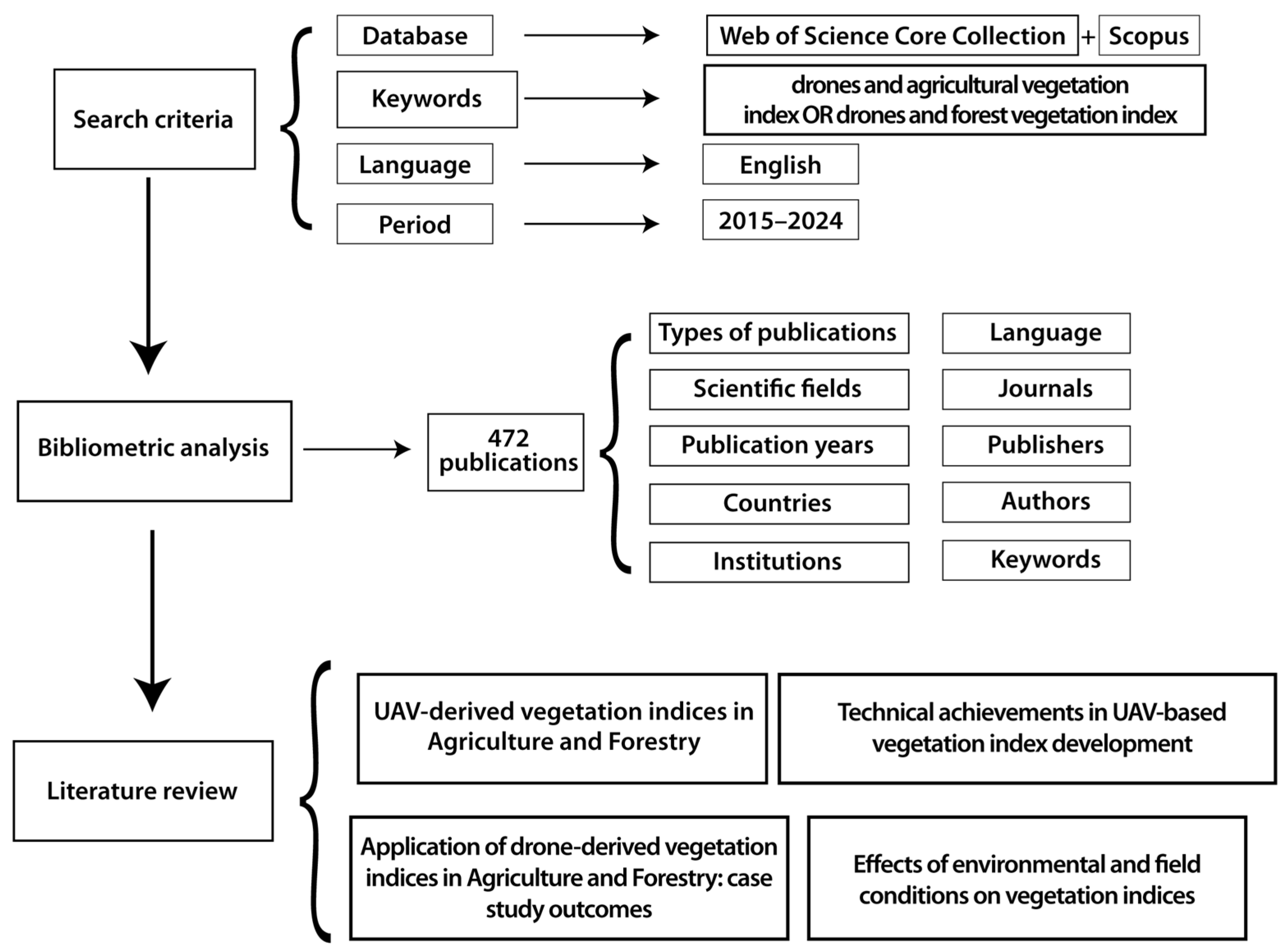
| Databases consulted | Scopus; Web of Science—SCI-Expanded |
| Exact search strings | Scopus (TITLE-ABS-KEY): (“drone” OR “drones” OR “UAV” OR “UAS” OR “unmanned aerial vehicle*” OR “unmanned aerial system*”) AND (“vegetation index” OR “vegetation indices” OR “NDVI” OR “EVI” OR “VARI” OR “GNDVI” OR “SAVI”) WoS—SCI-Expanded (TS): TS = (drone OR drones OR UAV OR UAS OR “unmanned aerial vehicle*” OR “unmanned aerial system*”) AND TS = (“vegetation index” OR “vegetation indices” OR NDVI OR EVI OR VARI OR GNDVI OR SAVI) |
| Date of record export | 12 August 2025 (searches and exports performed on this date) |
| Time span | All years indexed up to search date (no lower year limit) |
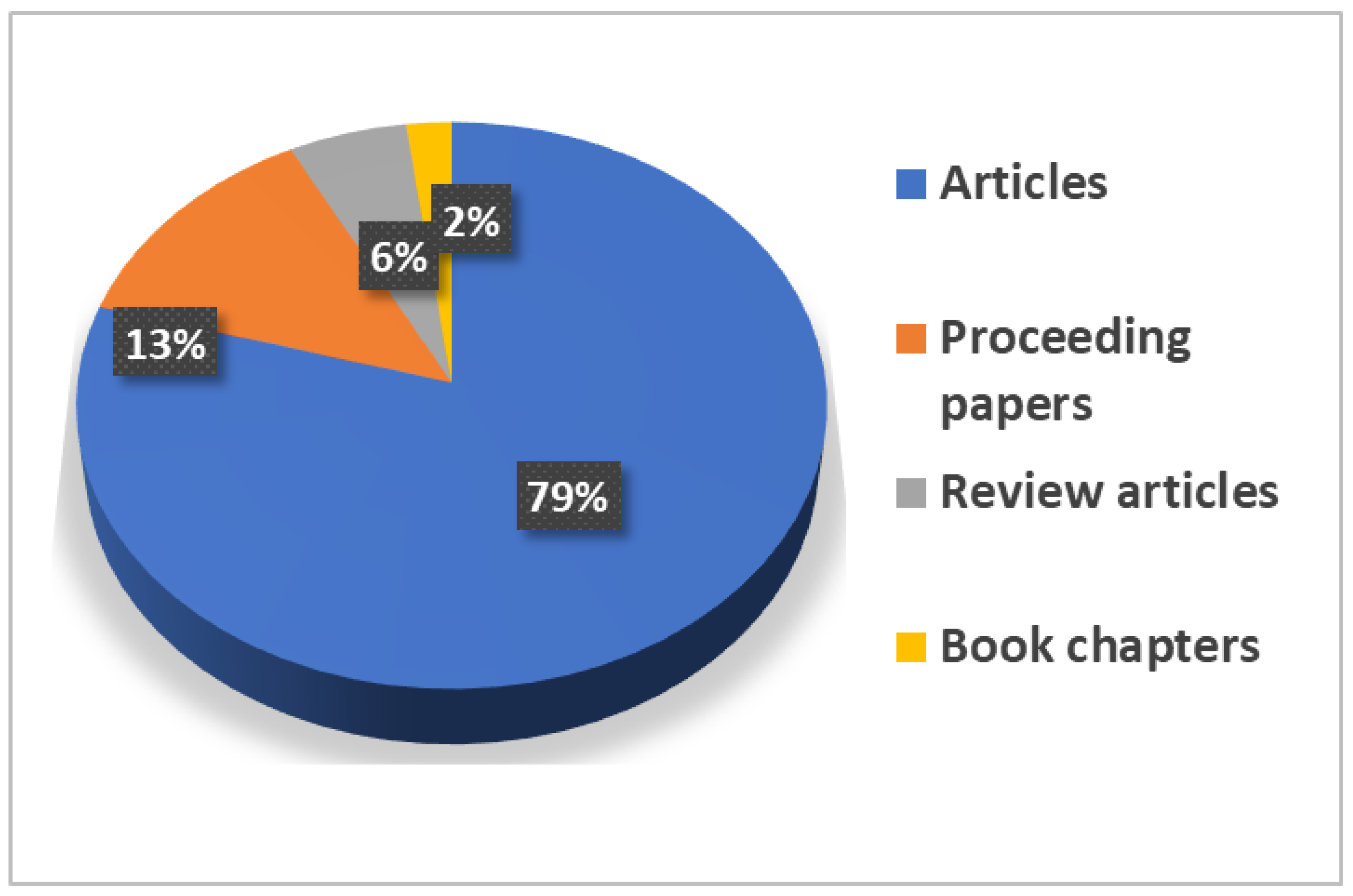
| Document types included | Peer-reviewed articles and reviews |
| Language | English only |
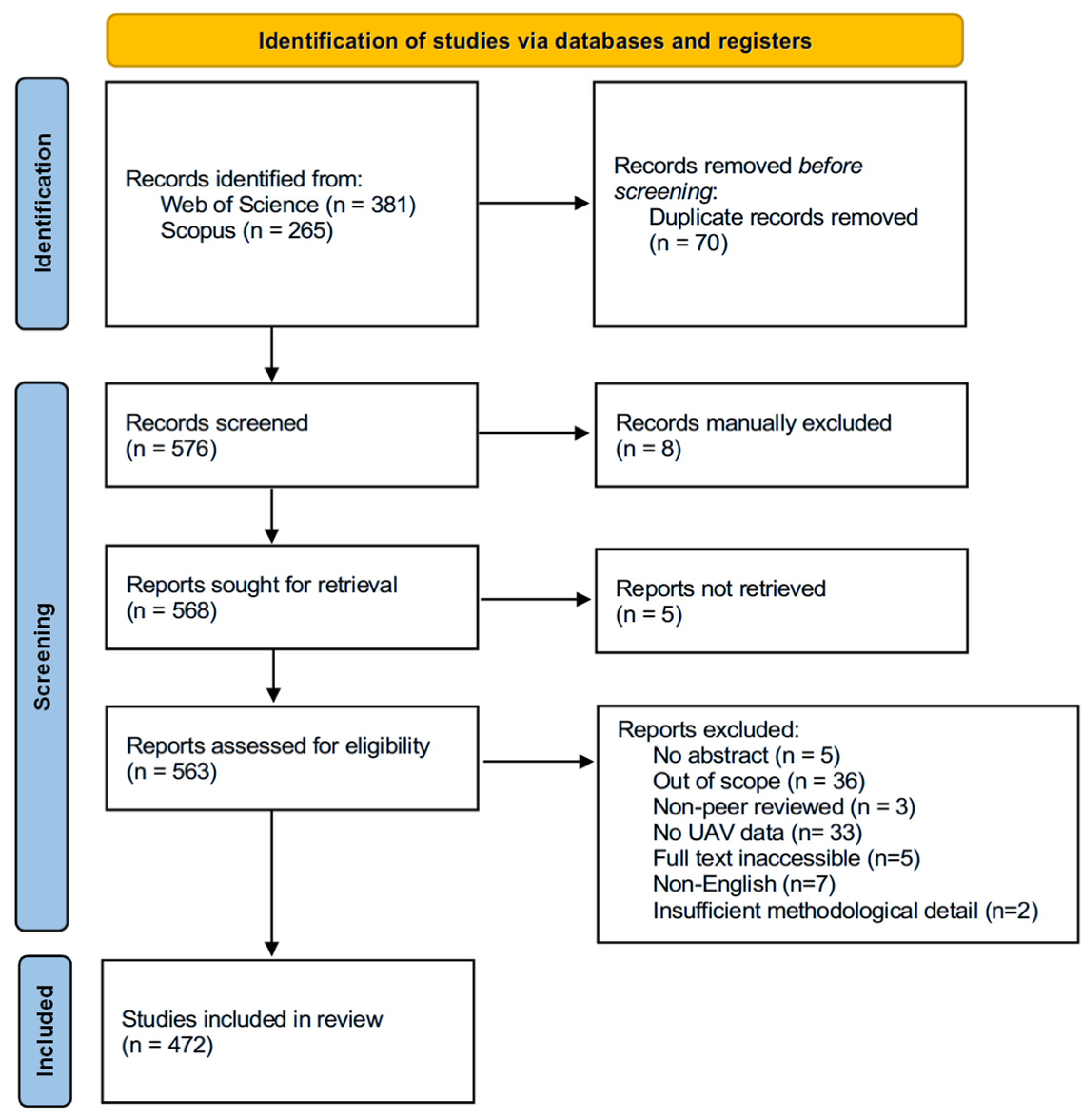
| Initial records retrieved | 646 (265 Scopus; 381 WoS) |
| Duplicates removed | 70 (automated DOI/title + manual checks) |
| Records after de-duplication | 576 (prior to title/abstract screening) |
| Records screened (title/abstract) | 576 (after initial automated QC and duplicate removal) |
| Records after full-text screening | 472 (included in final analysis) |
| Screening procedure | Two independent reviewers for title/abstract; two independent reviewers for full text; third reviewer adjudicated disagreements |
| Exclusion reasons recorded | Structured tags: A—out of scope; B—non-peer reviewed/editorial; C—no UAV data; D—inaccessible full text; E—non-English; F—insufficient methodological detail |
| Data quality control and normalization | DOI/title matching, manual metadata correction, author/affiliation normalization, keyword harmonization, fractional counting for network metrics; audit log maintained |
| Software used | Web of Science Core Collection v5.35 [34]; Scopus exports [35]; Microsoft Excel 2024 [36]; Geochart [37]; VOSviewer 1.6.20 [38]; ad hoc processing in R (bibliometrix, tidyverse) |
| PRISMA compliance | PRISMA flow diagram and checklist included; structured exclusion reasons and examples provided in Supplementary Table S1 |
| Qualitative analysis | Iterative codebook; two-coder calibration; remainder coded with quality checks; themes described in the main text |
| Crt. No. | Journal | Documents | Citations | Total Link Strength |
|---|---|---|---|---|
| 1 | Remote sensing | 47 | 1224 | 58 |
| 2 | Drones | 17 | 432 | 20 |
| 3 | Agriculture | 15 | 386 | 19 |
| 4 | Agronomy | 14 | 105 | 10 |
| 5 | Remote sensing of the environment | 9 | 509 | 23 |
| 6 | Computers and electronics in agriculture | 9 | 429 | 11 |
| 7 | Sensors | 9 | 212 | 4 |
| 8 | Korean journal of remote sensing | 8 | 21 | 2 |
| 9 | Agri-engineering | 7 | 21 | 9 |
| 10 | Frontiers in plant science | 5 | 39 | 6 |
| 11 | Applied science | 5 | 59 | 5 |
| 12 | Forests | 5 | 7 | 5 |
| 13 | Agricultural and forest meteorology | 4 | 19 | 6 |
| 14 | International journal of remote sensing | 3 | 138 | 12 |
| Crt. No. | Keyword | Occurrences | Total Link Strength |
|---|---|---|---|
| 1 | UAV | 101 | 413 |
| 2 | Remote sensing | 81 | 302 |
| 3 | Machine learning | 58 | 279 |
| 4 | Precision agriculture | 53 | 205 |
| 5 | Random forest | 42 | 189 |
| 6 | classification | 45 | 184 |
| 7 | biomass | 34 | 180 |
| 8 | yield | 32 | 159 |
| 9 | reflectance | 35 | 158 |
| 10 | imagery | 33 | 152 |
| 11 | NDVI | 38 | 139 |
| Cur. No. | Sensor Type | Vegetation Index | Definition/Observation | Application | References |
|---|---|---|---|---|---|
| 1 | RGB | ExG (Excess Green) | ExG = 2∙G − (R + B); higher values indicate more vegetation | Crop vigor assessment | Ali et al., 2024 [39]; Woebbecke et al., 1995 [40] |
| 2 | RGB | ExG−ExR (Excess Green − Excess Red) | ExG−ExR = ExG − ExR; ExR = (1.4∙R − G)/(R + G + B) | Chinese cabbage identification | Du et al., 2024 [41]; Meyer et al., 2008 [42] |
| 3 | RGB | H-Hue Index | H = arctan((2∙R − G − B)/30.5∙(G − B)) | Ice-ice disease in seaweeds | Alevizos et al., 2024 [43]; Escadafal et al., 1994 [44] |
| 4 | Multispectral | MGRVI (Modified Green-Red VI) | MGRVI = (G2 − R2)/(G2 + R2) | Maize vegetation assessment | Atanasov et al., 2024a [45]; Bendig et al., 2015 [46] |
| 5 | RGB | NGRDI (Normalized Red-Green Difference) | NGRDI = (G − R)/(G + R) | Predicting maize senescence | Adak et al., 2021 [47]; Ahamed et al., 2011 [48] |
| 6 | Multispectral (satellite) | CCI (Chlorophyll:Carotenoid Index) | CCI = (Band11 − Band1)/(Band11 + Band1) or using NIR/RedEdge | Phenology in conifers | D’Odorico et al., 2020 [49]; Barnes et al., 2000 [50] |
| 7 | Multispectral VIS-IR | CIgreen (Green Chlorophyll Index) | CIgreen = NIR/G − 1; estimates chlorophyll content | Potato nitrogen prediction | Chatraei Azizabadi et al., 2025 [51]; Gitelson et al., 2003 [52] |
| 8 | Multispectral VIS-IR | CIRE (Red-edge Chlorophyll Index) | CIRE = NIR/RedEdge − 1 | Strawberry dry biomass prediction | Zheng et al., 2022 [53]; Gitelson et al., 2003 [52] |
| 9 | Multispectral VIS-IR | GNDVI (Green NDVI) | GNDVI = (NIR − G)/(NIR + G) | Ink disease in chestnut orchards | Arcidiaco et al., 2025 [54]; Buschmann and Nagel, 1993 [55] |
| 10 | Multispectral VIS-IR | NDRE (Normalized Difference Red-edge) | NDRE = (NIR − RedEdge)/(NIR + RedEdge); measures chlorophyll | Bark beetle detection in spruce | Bozzini et al., 2024 [56]; Maccioni et al., 2001 [57] |
| 11 | Multispectral VIS-IR | NDVI (Normalized Difference VI) | NDVI = (NIR − R)/(NIR + R); −1 to 1 scale | Water stress diagnosis in wheat | Ali et al., 2024 [39]; Buschmann, 1993 [58] |
| 12 | Multispectral VIS-IR | RVI (Simple Ratio) | RVI = NIR/R; alternative: 800 nm/670 nm | Cotton performance evaluation | Cruz–Grimaldo et al., 2025 [59]; Baret and Guyot, 1991 [60] |
| 13 | Multispectral VIS-IR | OSAVI (Optimized Soil-Adjusted VI) | OSAVI = (NIR − R)/(NIR + R + L); L = 0.16 | Vegetation in desert oases | Guo et al., 2024 [61]; Herrmann et al., 2010 [62] |
| 14 | Multispectral VIS-IR | ReNDVI (Red-edge NDVI) | ReNDVI = (NIR − RedEdge)/(NIR + RedEdge) | Ink disease in chestnut orchards | Arcidiaco et al., 2025 [54]; Ahamed et al., 2011 [48] |
| 15 | Multispectral VIS-IR | SAVI (Soil-Adjusted VI) | SAVI = (1 + L)(NIR − R)/(NIR + R + L) | Wind-induced damage in spruce | Baders et al., 2025 [63]; Richardson and Everitt 1992 [64] |
| 16 | Hyperspectral | MSR (Modified Simple Ratio) | MSR = ((R_NIR/R_Red − 1)/√(R_NIR/R_Red + 1)) | Strawberry dry biomass prediction | Zheng et al., 2022 [53]; Sims and Gamon, 2002 [65] |
| 17 | Hyperspectral | MSR-RedEdge | MSR = ((R_NIR/R_RE − 1)/√(R_NIR/R_RE + 1)) | Strawberry dry biomass prediction | Zheng et al., 2022 [53]; Chen and Cihlar, 1996 [66] |
| 18 | Hyperspectral | SIPI (Structural Independent Pigment Index) | SIPI = (R800 − R445)/(R800 + R680) | Wind-induced damage in spruce | Baders et al., 2025 [63]; Blackburn, 1998 [67] |
| 19 | Thermal | CWSI (Crop Water Stress Index) | CWSI = (Tc − Ta − Tmin)/(Tmax − Tmin); measures canopy water stress | Soybean irrigation | Nielsen, 1990 [68]; Lee et al., 2010 [69] |
| 20 | Multispectral VIS-IR | ARVI (Atmospherically Resistant VI) | ARVI = (NIR − R − y(R − B))/(NIR + R − y(R − B)) | Cotton and rice yield | Pazhanivelan et al., 2023 [70]; Bannari et al., 1995 [71] |
| 21 | Multispectral VIS-IR | BNDVI (Blue NDVI) | BNDVI = (NIR − B)/(NIR + B) | Forest health monitoring | Ecke et al., 2024 [72]; Yang et al., 2004 [73] |
| 22 | Hyperspectral | BGVI (Blue-Green VI) | Formula not provided; measures street-side greenery | Biomass estimation | Matyukira et al., 2024 [74] |
| 23 | Multispectral VIS-IR | CVI (Chlorophyll VI) | CVI = NIR∙R/G | Maize vegetation assessment | Atanasov et al., 2024b [75]; Datt et al., 2003 [76] |
| 24 | Multispectral VIS-IR | DVI (Difference VI) | DVI = NIR − R | Wind damage assessment in spruce | Bāders et al., 2025 [63]; Nagler et al., 2005 [77] |
| 25 | Multispectral VIS-IR | EVI (Enhanced VI) | EVI = G(NIR − R)/(NIR + C1∙R − C2∙B + L) | Rice yield prediction | Goigochea–Pinchi et al., 2024 [78]; Barnes et al., 2000 [50] |
| 26 | Multispectral VIS-IR | EVI2 (Enhanced VI 2) | EVI2 = G(NIR − R)/(L + NIR + C∙R) | Winter wheat growth patterns | Atanasov et al., 2024a [45]; Huete et al., 2008 [79] |
| 27 | RGB | ExR (Excess Red) | ExR = (1.4∙R − G)/(R + G + B) | Predicting maize senescence | Adak et al., 2025 [80]; Neto, 2004 [81] |
| 28 | Multispectral VIS-IR | FVC (Fractional Vegetation Cover) | Proportion of area covered by vegetation; linked to NDVI and LAI | Wheat density estimation | Du et al., 2023 [82] |
| 29 | Multispectral VIS-IR | GCI (Green Chlorophyll Index) | GCI = NIR/G | Hazelnut monitoring | Morisio et al., 2025 [83]; Gitelson et al., 2002 [84] |
| 30 | Hyperspectral | GI (Greenness Index) | GI = R554/R677 | Hazelnut monitoring | Morisio et al., 2025 [83] |
| 31 | RGB | GLI (Green Leaf Index) | GLI = (2∙G − R − B)/(2∙G + R + B) | Ice-ice disease in seaweeds | Alevizos et al., 2024 [43]; Gobron et al., 2000 [85] |
| 32 | RGB | GRVI (Green-Red VI) | GRVI = R560/R658 | Ice-ice disease in seaweeds | Alevizos et al., 2024 [43]; Gitelson et al., 2002 [84] |
| 33 | Hyperspectral | GSI (Green Shoulder Index) | Uses the 490–550 nm range to detect tree vitality | Spruce bark beetle detection | Huo et al., 2024 [86] |
| 34 | Hyperspectral | LCI (Leaf Chlorophyll Index) | LCI = (R850 − R710)/(R850 + R680) | Rice yield prediction | Goigochea–Pinchi et al., 2024 [78]; Datt, 1999 [87] |
| 35 | Hyperspectral | MCARI (Modified Chlorophyll Absorption Ratio Index) | MCARI = ((R700 − R670) − 0.2(R700 − R550)) × (R700/R670) | Rice yield prediction | Goigochea–Pinchi et al., 2024 [78]; Eitel et al., 2007 [88] |
| 36 | RGB | MPRI (Modified Photochemical Reflectance Index) | MPRI = (G − R)/(G + R) | Maize vegetation assessment | Atanasov et al., 2024a [45]; Pereira et al., 2022 [89] |
| 37 | Hyperspectral | MTCI (MERIS Terrestrial Chlorophyll Index) | MTCI = (R850 − R730)/(R730 − R675) | Winter oilseed rape LAI monitoring | Liu et al., 2024 [90]; Dash and Curran, 2004 [91] |
| 38 | Hyperspectral | MTVI (Modified Triangular VI) | MTVI = 1.5 × (1.2 × (R800 − R550)/A − 1.5 × (2.5 × (R670 − R550)/A)) | Strawberry dry biomass prediction | Zheng et al., 2022 [53]; Eitel et al., 2007 [88] |
| 39 | Hyperspectral and SWIR | NBRDI (Normalized Burn Ratio Index) | NBRDI = (NIR − SWIR)/(NIR + SWIR) | Fire rate assessment | Carbonell–Rivera et al., 2024 [92] |
| 40 | Multispectral VIS-IR | NDDI (Normalized Difference Drought Index) | NDDI = (NDVI − NDWI)/(NDVI + NDWI) | Winter oilseed rape LAI monitoring | Liu et al., 2024 [90] |
| 41 | Multispectral VIS-IR | NDWI (Normalized Difference Water Index) | NDWI = (G − NIR)/(G + NIR) or (NIR − SWIR)/(NIR + SWIR) | Water stress diagnosis | Ali et al., 2024 [39]; Gao, B.-C, 1996 [93] |
| 42 | Multispectral VIS-IR | NDRI (Natural Disaster Risk Index) | Measures disaster impact (deaths, frequency) | Water stress risk assessment | Ali et al., 2024 [39]; Malthus et al., 1993 [94] |
| 43 | Multispectral VIS-IR | OPIVI (Observation Perspective Insensitivity VI) | NDVI-based, reduces angle sensitivity | Winter oilseed rape LAI | Liu et al., 2024 [90] |
| 44 | Multispectral VIS-IR | RECI (Red-edge Chlorophyll Index) | RECI = NIR/Red − 1 | Hazelnut monitoring | Barnes et al., 2000 [50] |
| 45 | Multispectral VIS-IR | REGNDVI (Green-Red NDVI) | REGNDVI = (G − R)/(G + R) | Peach tree health prediction | Cunha et al., 2021 [95]; Gitelson et al., 1996 [96] |
| 46 | Multispectral VIS-IR | RBVI (Red-Blue VI) | NIR-RGB based VI for chlorophyll | Biomass estimation | Matyukira et al., 2024 [74]; Moran et al., 1997 [97] |
| 47 | RGB | RGRI (Red-Green Ratio Index) | RGRI = R/G; indicates anthocyanin vs. chlorophyll | Nitrogen stress detection | Chandel et al., 2025 [98] |
| 48 | RGB | RBNDVI | RBNDVI = (R − B)/(R + B) or (NIR − (R + B))/(NIR + (R + B)) | Ice-ice disease | Alevizos et al., 2024 [43]; Wang et al., 2007 [99] |
| 49 | Multispectral VIS-IR | RFC (Random Forest Classifier) | Machine learning-based selection of VIs | Wheat stem rust disease evaluation | Abdulridha et al., 2023 [10] |
| 50 | Spectral and mechanical | RI-dB (Redness Index—decibels) | Measures redness using reflectance and dB | Winter oilseed rape LAI | Liu et al., 2024 [90] |
| 51 | Hyperspectral | SIPI2 (Structure Intensive Pigment Index) | SIPI2 = (R800 − R505)/(R800 − R690) | Citrus water stress monitoring | Peres and Cancelliere, 2021 [100]; Blackburn, 1998 [67] |
| 52 | Multispectral VIS-IR | SR (Simple Ratio) | SR = NIR/R; also called RVI | Rice carbon stock | de Lima et al., 2022 [101]; Bannari et al., 1995 [71] |
| 53 | Multispectral VIS-IR | SR-RedEdge | SR-RedEdge = NIR/RedEdge | Strawberry dry biomass | Zheng et al., 2022 [53] |
| 54 | Hyperspectral | TCARI (Transformed Chlorophyll Absorption Ratio) | TCARI/OSAVI; TCARI = 3 × (R700 − R670) − 0.2×(R700 − R550) | Hazelnut monitoring | Haboudane et al., 2002 [102] |
| 55 | RGB | VARI (Visible Atmospherically Resistant Index) | VARI = (G − R)/(G + R − B) | Nitrogen stress detection | Chandel et al., 2025 [98]; Gitelson et al., 2002 [84] |
| 56 | Hyperspectral | WDRVI (Wide Dynamic Range VI) | WDRVI = (a∙NIR − R)/(a∙NIR + R); a = 0.1–0.2 | Cotton and rice biophysical parameter quantification | Pazhanivelan et al., 2023 [70]; Gitelson, 2004 [103] |
Disclaimer/Publisher’s Note: The statements, opinions and data contained in all publications are solely those of the individual author(s) and contributor(s) and not of MDPI and/or the editor(s). MDPI and/or the editor(s) disclaim responsibility for any injury to people or property resulting from any ideas, methods, instructions or products referred to in the content. |
© 2025 by the authors. Licensee MDPI, Basel, Switzerland. This article is an open access article distributed under the terms and conditions of the Creative Commons Attribution (CC BY) license (https://creativecommons.org/licenses/by/4.0/).
Share and Cite
Peticilă, A.; Iliescu, P.G.; Dinca, L.; Popa, A.-S.; Murariu, G. Vegetation Indices from UAV Imagery: Emerging Tools for Precision Agriculture and Forest Management. AgriEngineering 2025, 7, 431. https://doi.org/10.3390/agriengineering7120431
Peticilă A, Iliescu PG, Dinca L, Popa A-S, Murariu G. Vegetation Indices from UAV Imagery: Emerging Tools for Precision Agriculture and Forest Management. AgriEngineering. 2025; 7(12):431. https://doi.org/10.3390/agriengineering7120431
Chicago/Turabian StylePeticilă, Adrian, Paul Gabor Iliescu, Lucian Dinca, Andy-Stefan Popa, and Gabriel Murariu. 2025. "Vegetation Indices from UAV Imagery: Emerging Tools for Precision Agriculture and Forest Management" AgriEngineering 7, no. 12: 431. https://doi.org/10.3390/agriengineering7120431
APA StylePeticilă, A., Iliescu, P. G., Dinca, L., Popa, A.-S., & Murariu, G. (2025). Vegetation Indices from UAV Imagery: Emerging Tools for Precision Agriculture and Forest Management. AgriEngineering, 7(12), 431. https://doi.org/10.3390/agriengineering7120431