



Signals, Volume 5, Issue 2 (June 2024) – 11 articles
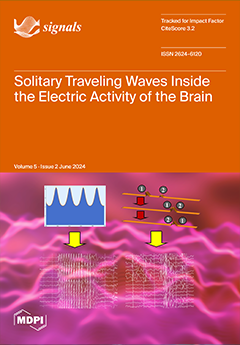
Cover Story (view full-size image):
The balance between dissipative and nonlinear forces allows widespread traveling waves termed solitons to preserve their shape and energy for long distances without steepening and flattening out. We suggest that the electric oscillations detectable by scalp electroencephalography (EEG) could be assessed in terms of solitons. We argue that solitons bear striking similarities with the electric activity recorded for medical conditions like epilepsies and encephalopathies. Emerging from the noisy background of normal electric activity, high-amplitude, low-frequency EEG soliton-like waves with relatively uniform morphology and duration can be observed, characterized by repeated, stereotyped patterns propagating on the brain hemispheric surface over relatively large distances. The theoretical possibility of treating pathological brain oscillations using solitons is discussed in this paper. View this paper
- Issues are regarded as officially published after their release is announced to the table of contents alert mailing list.
- You may sign up for e-mail alerts to receive table of contents of newly released issues.
- PDF is the official format for papers published in both, html and pdf forms. To view the papers in pdf format, click on the "PDF Full-text" link, and use the free Adobe Reader to open them.
Previous Issue
Next Issue
