
Beyond the Gut: Inflammatory Bowel Disease as a Driver of Cardiovascular and Thromboembolic Risk—A Systematic Review and Meta-Analysis of 1.4 Million Patients

 , , , ,
Abstract
1. Introduction
2. Materials and Methods
2.1. Data Resources and Search Strategy
2.2. Inclusion and Exclusion Criteria
2.3. Study Selection and Data Extraction
2.4. Quality Assessment
2.5. Statistical Analysis
3. Results
3.1. Literature Search Results
3.2. Study Characteristics and Quality Assessment
3.3. Results of Meta-Analysis
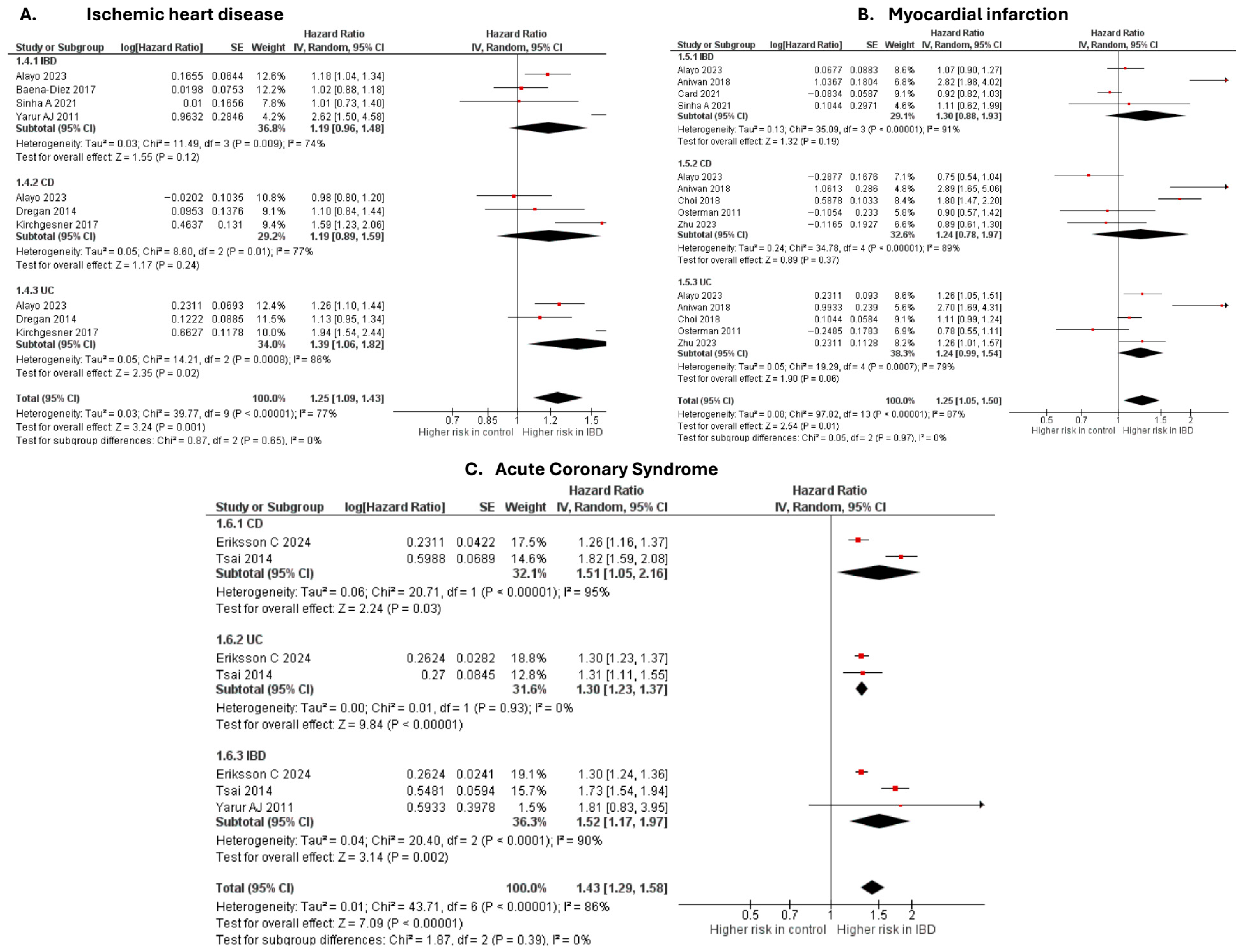
3.3.1. Coronary Atherosclerosis and Acute Coronary Syndromes
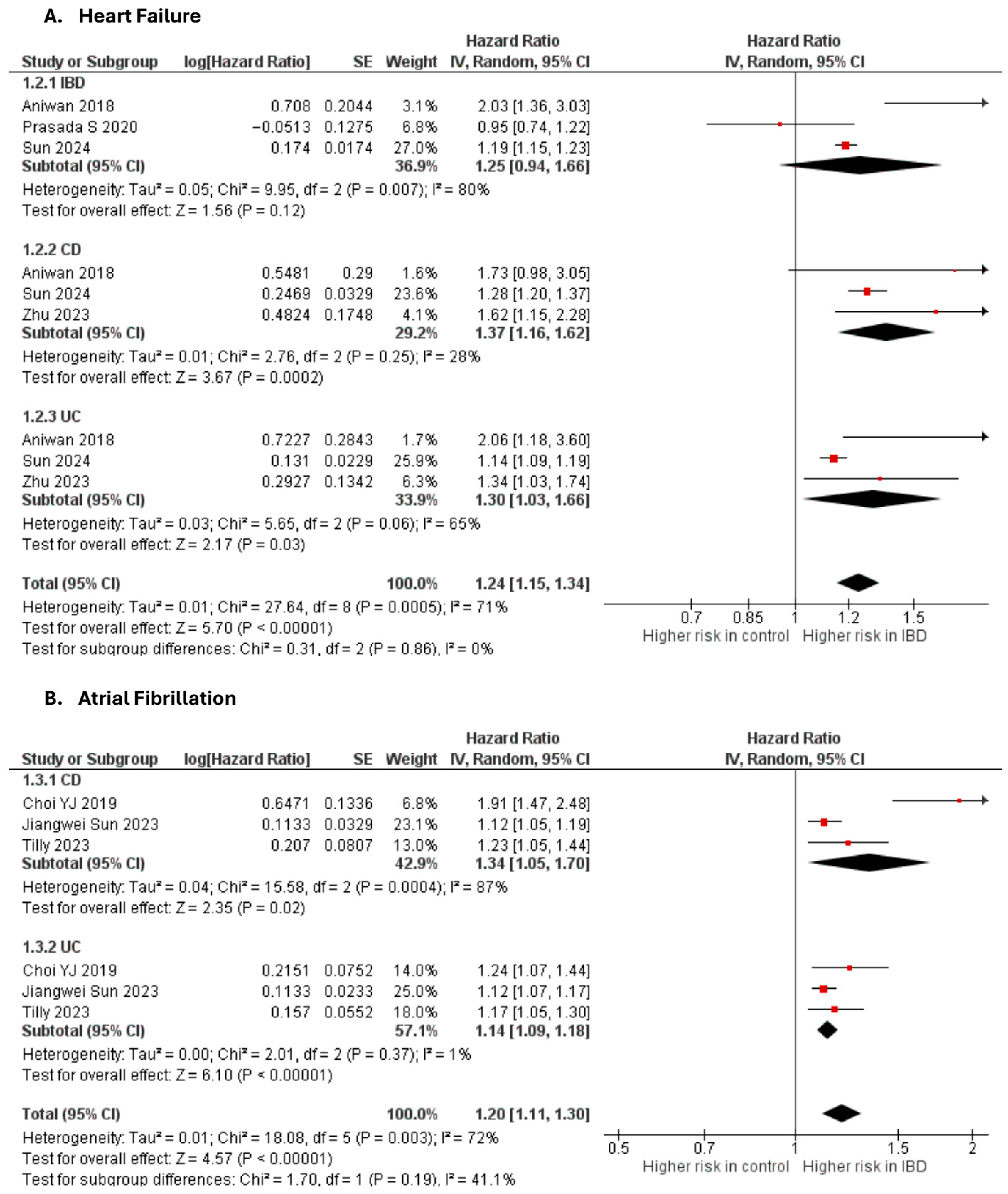
3.3.2. Cardiac Dysfunction and Arrhythmia
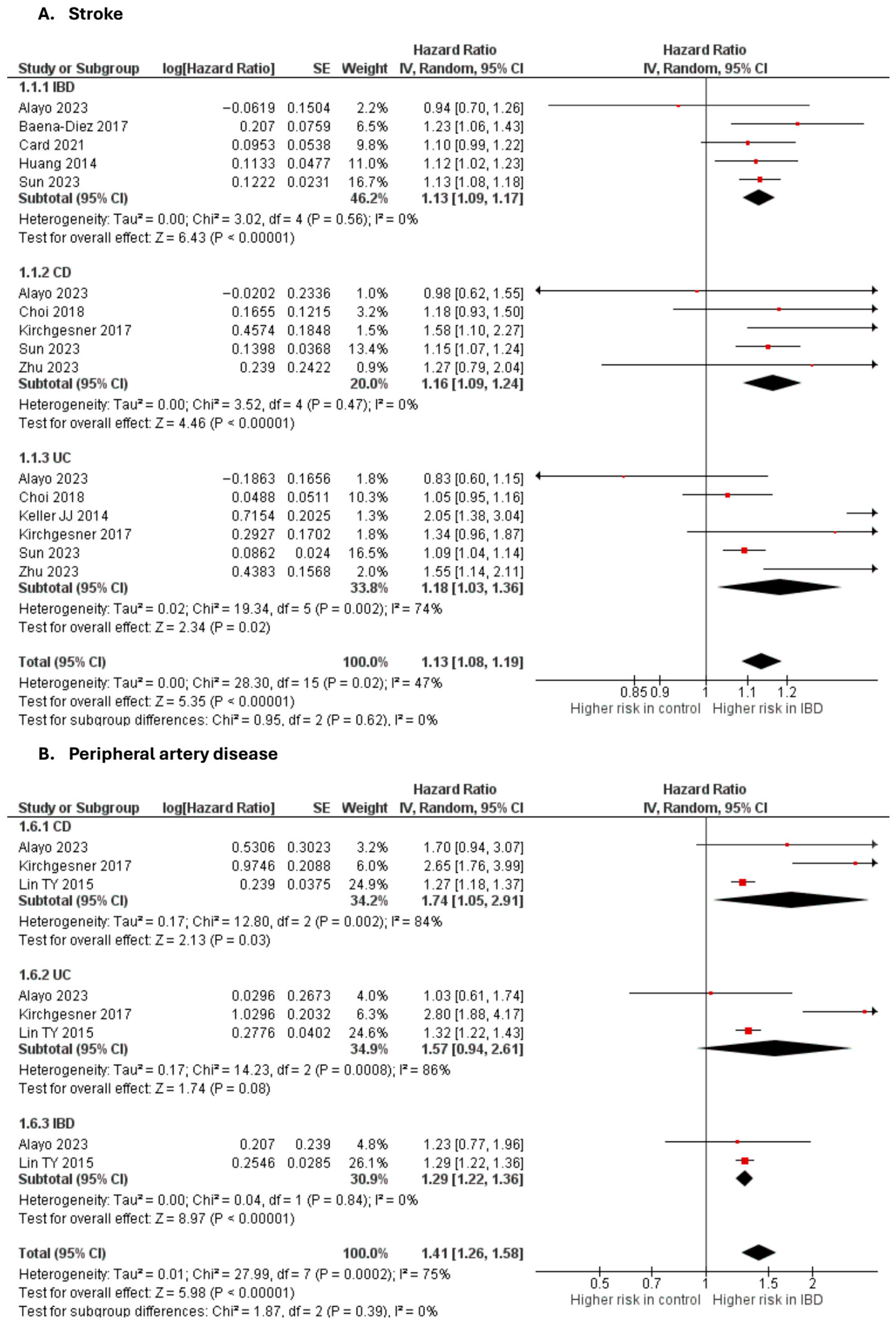
3.3.3. Cerebrovascular and Peripheral Vascular Disease
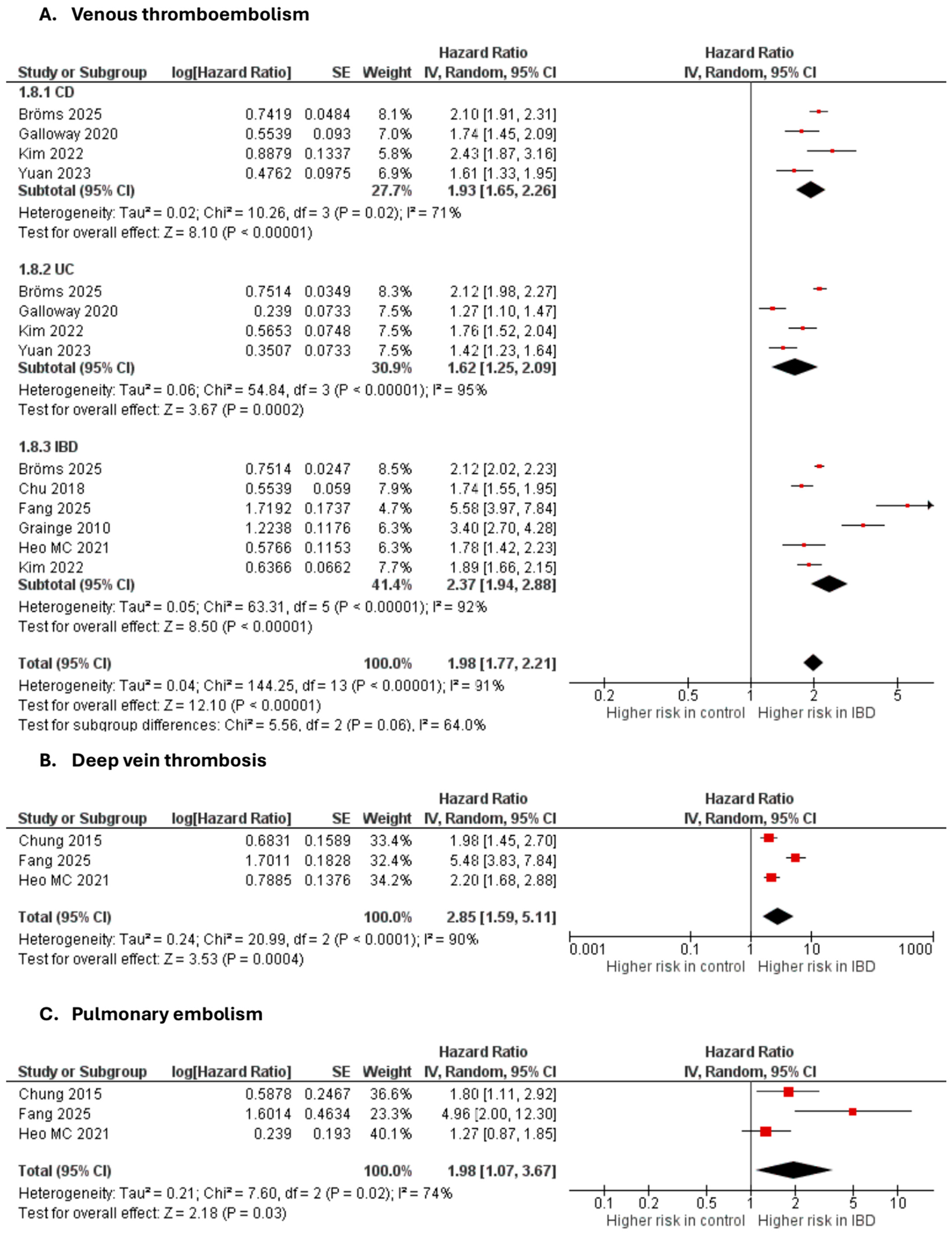
3.3.4. Venous Thromboembolic Events
3.3.5. Mortality
4. Discussion
Limitations
5. Conclusions
Supplementary Materials
Author Contributions
Funding
Institutional Review Board Statement
Informed Consent Statement
Data Availability Statement
Acknowledgments
Conflicts of Interest
Abbreviations
| IBD | Inflammatory bowel disease |
| CD | Crohn’s disease |
| UC | Ulcerative colitis |
| IBD-U | IBD unclassified |
| IHD | Ischemic heart disease |
| MI | Myocardial infarction |
| AF | Atrial fibrillation |
| HF | Heart failure |
| PAD | Peripheral arterial disease |
| DM | Diabetes mellitus |
| VTE | Venous thromboembolism |
| DVT | Deep vein thrombosis |
| PE | Pulmonary embolism |
| CVD | Cardiovascular disease |
References
- Wang, R.; Li, Z.; Liu, S.; Zhang, D. Global, regional and national burden of inflammatory bowel disease in 204 countries and territories from 1990 to 2019: A systematic analysis based on the Global Burden of Disease Study 2019. BMJ Open 2023, 13, e065186. [Google Scholar] [CrossRef] [PubMed]
- Lin, D.; Jin, Y.; Shao, X.; Xu, Y.; Ma, G.; Jiang, Y.; Hu, D. Global, regional, and national burden of inflammatory bowel disease, 1990–2021: Insights from the global burden of disease 2021. Int. J. Color. Dis. 2024, 39, 139. [Google Scholar] [CrossRef]
- Knowles, S.R.; Keefer, L.; Wilding, H.; Hewitt, C.; Graff, L.A.; Mikocka-Walus, A. Quality of Life in Inflammatory Bowel Disease: A Systematic Review and Meta-analyses—Part II. Inflamm. Bowel Dis. 2018, 24, 966–976. [Google Scholar] [CrossRef] [PubMed]
- Alvestad, L.; Jelsness-Jørgensen, L.-P.; Goll, R.; Clancy, A.; Gressnes, T.; Valle, P.C.; Broderstad, A.R. Health-related quality of life in inflammatory bowel disease: A comparison of patients receiving nurse-led versus conventional follow-up care. BMC Health Serv. Res. 2022, 22, 1602. [Google Scholar] [CrossRef]
- Nicholas, D.B.; Otley, A.; Smith, C.; Avolio, J.; Munk, M.; Griffiths, A.M. Challenges and strategies of children and adolescents with inflammatory bowel disease: A qualitative examination. Health Qual. Life Outcomes 2007, 5, 28. [Google Scholar] [CrossRef]
- Agca, R.; Smulders, Y.; Nurmohamed, M. Cardiovascular disease risk in immune-mediated inflammatory diseases: Recommendations for clinical practice. Heart 2022, 108, 73–79. [Google Scholar] [CrossRef] [PubMed]
- Hansson, G.K. Inflammation, Atherosclerosis, and Coronary Artery Disease. N. Engl. J. Med. 2005, 352, 1685–1695. [Google Scholar] [CrossRef]
- D’Ascenzo, F.; Bruno, F.; Iannaccone, M.; Testa, G.; Filippo, O.D.; Giannino, G.; Caviglia, G.P.; Bernstein, C.N.; De Ferrari, G.M.; Bugianesi, E.; et al. Patients with inflammatory bowel disease are at increased risk of atherothrombotic disease: A systematic review with meta-analysis. Int. J. Cardiol. 2023, 378, 96–104. [Google Scholar] [CrossRef]
- Sung, Y.-F.; Lin, C.-C.; Yin, J.-H.; Chou, C.-H.; Chung, C.-H.; Yang, F.-C.; Tsai, C.-K.; Tsai, C.-L.; Lee, J.T. Increased Risk of Stroke in Patients with Atopic Dermatitis: A Population-based, Longitudinal Study in Taiwan. J. Med. Sci. 2017, 37, 12. [Google Scholar] [CrossRef]
- Zhu, Z.; Jia, Y.; Li, F.-R.; Li, Y.; Chen, L.-H.; Yang, H.-H.; Guo, D.; Sun, L.; Shi, M.; Wang, T.; et al. Inflammatory Bowel Disease and Risk of Global Cardiovascular Diseases and Type 2 Diabetes. Inflamm. Bowel Dis. 2024, 30, 1130–1137. [Google Scholar] [CrossRef]
- Qiu, X.; Hou, C.; Yang, Z.; Wang, Q.; Li, L. Inflammatory bowel disease and risk of coronary heart disease. Wien. Klin. Wochenschr. 2022, 134, 779–787. [Google Scholar] [CrossRef]
- Chen, J.; Duan, T.; Fang, W.; Liu, S.; Wang, C. Analysis of clinical characteristics of mesalazine-induced cardiotoxicity. Front. Pharmacol. 2022, 13, 970597. [Google Scholar] [CrossRef]
- Sholter, D.E.; Armstrong, P.W. Adverse effects of corticosteroids on the cardiovascular system. Can. J. Cardiol. 2000, 16, 505–511. [Google Scholar] [PubMed]
- Pujades-Rodriguez, M.; Morgan, A.W.; Cubbon, R.M.; Wu, J. Dose-dependent oral glucocorticoid cardiovascular risks in people with immune-mediated inflammatory diseases: A population-based cohort study. PLoS Med. 2020, 17, e1003432. [Google Scholar] [CrossRef] [PubMed]
- Ytterberg, S.R.; Bhatt, D.L.; Mikuls, T.R.; Koch, G.G.; Fleischmann, R.; Rivas, J.L.; Germino, R.; Menon, S.; Sun, Y.; Wang, C.; et al. Cardiovascular and Cancer Risk with Tofacitinib in Rheumatoid Arthritis. N. Engl. J. Med. 2022, 386, 316–326. [Google Scholar] [CrossRef] [PubMed]
- Li, Z.; Qiao, L.; Yun, X.; Du, F.; Xing, S.; Yang, M. Increased risk of ischemic heart disease and diabetes in inflammatory bowel disease. Z. Gastroenterol. 2021, 59, 117–124. [Google Scholar] [CrossRef]
- Fumery, M.; Xiaocang, C.; Dauchet, L.; Gower-Rousseau, C.; Peyrin-Biroulet, L.; Colombel, J.-F. Thromboembolic events and cardiovascular mortality in inflammatory bowel diseases: A meta-analysis of observational studies. J. Crohns Colitis 2014, 8, 469–479. [Google Scholar] [CrossRef]
- Sun, J.; Yao, J.; Olén, O.; Halfvarson, J.; Bergman, D.; Ebrahimi, F.; Rosengren, A.; Sundström, J.; Ludvigsson, J.F. Risk of heart failure in inflammatory bowel disease: A Swedish population-based study. Eur. Heart J. 2024, 45, 2493–2504. [Google Scholar] [CrossRef]
- Eriksson, C.; Sun, J.; Bryder, M.; Bröms, G.; Everhov, Å.H.; Forss, A.; Jernberg, T.; Ludvigsson, J.F.; Olén, O. Impact of inflammatory bowel disease on the risk of acute coronary syndrome: A Swedish Nationwide Cohort Study. Aliment. Pharmacol. Ther. 2024, 59, 1122–1133. [Google Scholar] [CrossRef]
- Alayo, Q.A.; Loftus, E.V.; Yarur, A.; Alvarado, D.; Ciorba, M.A.; de las Fuentes, L.; Deepak, P. Inflammatory Bowel Disease Is Associated with an Increased Risk of Incident Acute Arterial Events: Analysis of the United Kingdom Biobank. Clin. Gastroenterol. Hepatol. Off. Clin. Pract. J. Am. Gastroenterol. Assoc. 2023, 21, 761–770.e13. [Google Scholar] [CrossRef]
- Malham, M.; Jansson, S.; Ingels, H.; Jørgensen, M.H.; Rod, N.H.; Wewer, V.; Fox, M.P. Paediatric-onset immune-mediated inflammatory disease is associated with an increased mortality risk—A nationwide study. Aliment. Pharmacol. Ther. 2024, 59, 1551–1558. [Google Scholar] [CrossRef]
- Tilly, M.J.; Geurts, S.; Zhu, F.; Bos, M.M.; Ikram, M.A.; de Maat, M.P.M.; de Groot, N.M.S.; Kavousi, M. Autoimmune diseases and new-onset atrial fibrillation: A UK Biobank study. Europace 2023, 25, 804–811. [Google Scholar] [CrossRef] [PubMed]
- Page, M.J.; McKenzie, J.E.; Bossuyt, P.M.; Boutron, I.; Hoffmann, T.C.; Mulrow, C.D.; Tetzlaff, J.M.; Akl, E.A.; Brennan, S.E.; Chou, R.; et al. The PRISMA 2020 statement: An updated guideline for reporting systematic reviews. BMJ 2021, 372, n71. [Google Scholar] [CrossRef] [PubMed]
- Lo, C.K.-L.; Mertz, D.; Loeb, M. Newcastle-Ottawa Scale: Comparing reviewers’ to authors’ assessments. BMC Med. Res. Methodol. 2014, 14, 45. [Google Scholar] [CrossRef]
- West, S.L.; Gartlehner, G.; Mansfield, A.J.; Poole, C.; Tant, E.; Lenfestey, N.; Lux, L.J.; Amoozegar, J.; Morton, S.C.; Carey, T.C.; et al. Table 7, Summary of Common Statistical Approaches to Test for Heterogeneity 2010. Available online: https://www.ncbi.nlm.nih.gov/books/NBK53317/table/ch3.t2/ (accessed on 25 January 2025).
- Andersohn, F.; Waring, M.; Garbe, E. Risk of ischemic stroke in patients with Crohn’s disease: A population-based nested case-control study. Inflamm. Bowel Dis. 2010, 16, 1387–1392. [Google Scholar] [CrossRef]
- Aniwan, S. Increased Risk of Acute Myocardial Infarction and Heart Failure in Patients with Inflammatory Bowel Diseases. Clin. Gastroenterol. Hepatol. 2018, 16, 1607–1615.e1. [Google Scholar] [CrossRef] [PubMed]
- Baena-Díez, J.M.; Garcia-Gil, M.; Comas-Cufí, M.; Ramos, R.; Prieto-Alhambra, D.; Salvador-González, B.; Elosua, R.; Dégano, I.R.; Peñafiel, J.; Grau, M. Association between chronic immune-mediated inflammatory diseases and cardiovascular risk. Heart Br. Card. Soc. 2018, 104, 119–126. [Google Scholar] [CrossRef]
- Bernstein, C.N. The Incidence of Arterial Thromboembolic Diseases in Inflammatory Bowel Disease: A Population-Based Study. Clin. Gastroenterol. Hepatol. 2008, 6, 41–45. [Google Scholar] [CrossRef]
- Bernstein, C.N.; Nugent, Z.; Targownik, L.E.; Singh, H.; Lix, L.M. Predictors and risks for death in a population-based study of persons with IBD in Manitoba. Gut 2015, 64, 1403–1411. [Google Scholar] [CrossRef]
- Card, T.; Hubbard, R.; Logan, R.F.A. Mortality in inflammatory bowel disease: A population-based cohort study. Gastroenterology 2003, 125, 1583–1590. [Google Scholar] [CrossRef]
- Card, T.R.; Zittan, E.; Nguyen, G.C.; Grainge, M.J. Disease Activity in Inflammatory Bowel Disease Is Associated With Arterial Vascular Disease. Inflamm. Bowel Dis. 2021, 27, 629–638. [Google Scholar] [CrossRef]
- Choi, Y.J.; Lee, D.H.; Shin, D.W.; Han, K.-D.; Yoon, H.; Shin, C.M.; Park, Y.S.; Kim, N. Patients with inflammatory bowel disease have an increased risk of myocardial infarction: A nationwide study. Aliment. Pharmacol. Ther. 2019, 50, 769–779. [Google Scholar] [CrossRef]
- Choi, Y.-J.; Choi, E.-K.; Han, K.-D.; Park, J.; Moon, I.; Lee, E.; Choe, W.-S.; Lee, S.-R.; Cha, M.-J.; Lim, W.-H.; et al. Increased risk of atrial fibrillation in patients with inflammatory bowel disease: A nationwide population-based study. World J. Gastroenterol. 2019, 25, 2788–2798. [Google Scholar] [CrossRef] [PubMed]
- Chu, T.P.C.; Grainge, M.J.; Card, T.R. The risk of venous thromboembolism during and after hospitalisation in patients with inflammatory bowel disease activity. Aliment. Pharmacol. Ther. 2018, 48, 1099–1108. [Google Scholar] [CrossRef] [PubMed]
- Chung, W.-S.; Lin, C.-L.; Hsu, W.-H.; Kao, C.-H. Inflammatory bowel disease increases the risks of deep vein thrombosis and pulmonary embolism in the hospitalized patients: A nationwide cohort study. Thromb. Res. 2015, 135, 492–496. [Google Scholar] [CrossRef]
- Dregan, A.; Charlton, J.; Chowienczyk, P.; Gulliford, M.C. Chronic Inflammatory Disorders and Risk of Type 2 Diabetes Mellitus, Coronary Heart Disease, and Stroke. Circulation 2014, 130, 837–844. [Google Scholar] [CrossRef]
- Dregan, A.; Chowienczyk, P.; Molokhia, M. Cardiovascular and type 2 diabetes morbidity and all-cause mortality among diverse chronic inflammatory disorders. Heart Br. Card. Soc. 2017, 103, 1867–1873. [Google Scholar] [CrossRef]
- Fang, L.; Gao, H.; Gao, X.; Wu, W.; Miao, Y.; Zhang, H.; Wang, Y.; Li, M.; Yang, H.; Gao, X.; et al. Risks of Cardiovascular Events in Patients with Inflammatory Bowel Disease in China: A Retrospective Multicenter Cohort Study. Inflamm. Bowel Dis. 2022, 28, S52–S58. [Google Scholar] [CrossRef]
- Galloway, J.; Barrett, K.; Irving, P.; Khavandi, K.; Nijher, M.; Nicholson, R.; de Lusignan, S.; Buch, M.H. Risk of venous thromboembolism in immune-mediated inflammatory diseases: A UK matched cohort study. RMD Open 2020, 6, e001392. [Google Scholar] [CrossRef] [PubMed]
- Gill, G.S.; Fernandez, S.J.; Malhotra, N.; Mete, M.; Garcia-Garcia, H.M. Major acute cardiovascular events in patients with inflammatory bowel disease. Coron. Artery Dis. 2021, 32, 73. [Google Scholar] [CrossRef]
- Grainge, M.J.; West, J.; Card, T.R. Venous thromboembolism during active disease and remission in inflammatory bowel disease: A cohort study. Lancet Lond. Engl. 2010, 375, 657–663. [Google Scholar] [CrossRef]
- Ha, C.; Magowan, S.; Accortt, N.A.; Chen, J.; Stone, C.D. Risk of arterial thrombotic events in inflammatory bowel disease. Am. J. Gastroenterol. 2009, 104, 1445–1451. [Google Scholar] [CrossRef]
- Heo, C.M.; Kim, T.J.; Kim, E.R.; Hong, S.N.; Chang, D.K.; Yang, M.; Kim, S.; Kim, Y.-H. Risk of venous thromboembolism in Asian patients with inflammatory bowel disease: A nationwide cohort study. Sci. Rep. 2021, 11, 2025. [Google Scholar] [CrossRef] [PubMed]
- Huang, W.-S.; Tseng, C.-H.; Chen, P.-C.; Tsai, C.-H.; Lin, C.-L.; Sung, F.-C.; Kao, C.-H. Inflammatory bowel diseases increase future ischemic stroke risk: A Taiwanese population-based retrospective cohort study. Eur. J. Intern. Med. 2014, 25, 561–565. [Google Scholar] [CrossRef] [PubMed]
- Kang, E.A.; Han, K.; Chun, J.; Soh, H.; Park, S.; Im, J.P.; Kim, J.S. Increased Risk of Diabetes in Inflammatory Bowel Disease Patients: A Nationwide Population-based Study in Korea. J. Clin. Med. 2019, 8, 343. [Google Scholar] [CrossRef]
- Kappelman, M.D.; Horvath-Puho, E.; Sandler, R.S.; Rubin, D.T.; Ullman, T.A.; Pedersen, L.; Baron, J.A.; Sørensen, H.T. Thromboembolic risk among Danish children and adults with inflammatory bowel diseases: A population-based nationwide study. Gut 2011, 60, 937–943. [Google Scholar] [CrossRef]
- Keller, J.J.; Wang, J.; Huang, Y.-L.; Chou, C.-C.; Wang, L.-H.; Hsu, J.-L.; Bai, C.-H.; Chiou, H.-Y. Increased risk of stroke among patients with ulcerative colitis: A population-based matched cohort study. Int. J. Colorectal Dis. 2014, 29, 805–812. [Google Scholar] [CrossRef]
- Kim, S.Y.; Cho, Y.S.; Kim, H.-S.; Lee, J.K.; Kim, H.M.; Park, H.J.; Kim, H.; Kim, J.; Kang, D.R. Venous Thromboembolism Risk in Asian Patients with Inflammatory Bowel Disease: A Population-Based Nationwide Inception Cohort Study. Gut Liver 2022, 16, 555–566. [Google Scholar] [CrossRef]
- Kirchgesner, J.; Beaugerie, L.; Carrat, F.; Andersen, N.N.; Jess, T.; Schwarzinger, M. Increased risk of acute arterial events in young patients and severely active IBD: A nationwide French cohort study. Gut 2018, 67, 1261–1268. [Google Scholar] [CrossRef] [PubMed]
- Kristensen, S.L.; Ahlehoff, O.; Lindhardsen, J.; Erichsen, R.; Jensen, G.V.; Torp-Pedersen, C.; Nielsen, O.H.; Gislason, G.H.; Hansen, P.R. Disease Activity in Inflammatory Bowel Disease Is Associated with Increased Risk of Myocardial Infarction, Stroke and Cardiovascular Death—A Danish Nationwide Cohort Study. PLoS ONE 2013, 8, e56944. [Google Scholar] [CrossRef]
- Kristensen, S.L.; Lindhardsen, J.; Ahlehoff, O.; Erichsen, R.; Lamberts, M.; Khalid, U.; Torp-Pedersen, C.; Nielsen, O.H.; Gislason, G.H.; Hansen, P.R. Increased risk of atrial fibrillation and stroke during active stages of inflammatory bowel disease: A nationwide study. EP Eur. 2014, 16, 477–484. [Google Scholar] [CrossRef]
- Lee, M.T.; Mahtta, D.; Chen, L.; Hussain, A.; Al Rifai, M.; Sinh, P.; Khalid, U.; Nasir, K.; Ballantyne, C.M.; Petersen, L.A.; et al. Premature Atherosclerotic Cardiovascular Disease Risk Among Patients with Inflammatory Bowel Disease. Am. J. Med. 2021, 134, 1047–1051.e2. [Google Scholar] [CrossRef]
- Li, F.; Ramirez, Y.; Yano, Y.; Daniel, C.R.; Sharma, S.V.; Brown, E.L.; Li, R.; Moshiree, B.; Loftfield, E.; Lan, Q.; et al. The association between inflammatory bowel disease and all-cause and cause-specific mortality in the UK Biobank. Ann. Epidemiol. 2023, 88, 15–22. [Google Scholar] [CrossRef]
- Lin, T.-Y.; Chen, Y.-G.; Lin, C.-L.; Huang, W.-S.; Kao, C.-H. Inflammatory Bowel Disease Increases the Risk of Peripheral Arterial Disease: A Nationwide Cohort Study. Medicine 2015, 94, e2381. [Google Scholar] [CrossRef]
- Nocerino, A.; Feathers, A.; Ivanina, E.; Durbin, L.; Swaminath, A. Mortality Risk of Inflammatory Bowel Disease: A Case-Control Study of New York State Death Records. Dig. Dis. Sci. 2019, 64, 1604–1611. [Google Scholar] [CrossRef]
- Olén, O.; Askling, J.; Sachs, M.C.; Frumento, P.; Neovius, M.; Smedby, K.E.; Ekbom, A.; Malmborg, P.; Ludvigsson, J.F. Increased Mortality of Patients with Childhood-Onset Inflammatory Bowel Diseases, Compared with the General Population. Gastroenterology 2019, 156, 614–622. [Google Scholar] [CrossRef] [PubMed]
- Osterman, M.T.; Yang, Y.-X.; Brensinger, C.; Forde, K.A.; Lichtenstein, G.R.; Lewis, J.D. No Increased Risk of Myocardial Infarction Among Patients with Ulcerative Colitis or Crohn’s Disease. Clin. Gastroenterol. Hepatol. 2011, 9, 875–880. [Google Scholar] [CrossRef]
- Prasada, S.; Rivera, A.; Nishtala, A.; Pawlowski, A.E.; Sinha, A.; Bundy, J.D.; Chadha, S.A.; Ahmad, F.S.; Khan, S.S.; Achenbach, C.; et al. Differential Associations of Chronic Inflammatory Diseases with Incident Heart Failure. JACC Heart Fail. 2020, 8, 489–498. [Google Scholar] [CrossRef] [PubMed]
- Rothberg, M.B.; Lindenauer, P.K.; Lahti, M.; Pekow, P.S.; Selker, H.P. Risk factor model to predict venous thromboembolism in hospitalized medical patients. J. Hosp. Med. 2011, 6, 202–209. [Google Scholar] [CrossRef] [PubMed]
- Rungoe, C.; Basit, S.; Ranthe, M.F.; Wohlfahrt, J.; Langholz, E.; Jess, T. Risk of ischaemic heart disease in patients with inflammatory bowel disease: A nationwide Danish cohort study. Gut 2013, 62, 689–694. [Google Scholar] [CrossRef]
- Setyawan, J.; Mu, F.; Zichlin, M.L.; Billmyer, E.; Downes, N.; Yang, H.; Azimi, N.; Strand, V.; Yarur, A. Risk of Thromboembolic Events and Associated Healthcare Costs in Patients with Inflammatory Bowel Disease. Adv. Ther. 2022, 39, 738–753. [Google Scholar] [CrossRef]
- Sinha, A.; Rivera, A.S.; Chadha, S.A.; Prasada, S.; Pawlowski, A.E.; Thorp, E.; DeBerge, M.; Ramsey-Goldman, R.; Lee, Y.C.; Achenbach, C.J.; et al. Comparative Risk of Incident Coronary Heart Disease Across Chronic Inflammatory Diseases. Front. Cardiovasc. Med. 2021, 8, 757738. [Google Scholar] [CrossRef] [PubMed]
- Sun, J.; Roelstraete, B.; Svennberg, E.; Halfvarson, J.; Sundström, J.; Forss, A.; Olén, O.; Ludvigsson, J.F. Long-term risk of arrhythmias in patients with inflammatory bowel disease: A population-based, sibling-controlled cohort study. PLoS Med. 2023, 20, e1004305. [Google Scholar] [CrossRef] [PubMed]
- Sun, J.; Halfvarson, J.; Appelros, P.; Bergman, D.; Ebrahimi, F.; Roelstraete, B.; Olén, O.; Ludvigsson, J.F. Long-term Risk of Stroke in Patients with Inflammatory Bowel Disease: A Population-Based, Sibling-Controlled Cohort Study, 1969–2019. Neurology 2023, 101, e653–e664. [Google Scholar] [CrossRef]
- Tanislav, C.; Trommer, K.; Labenz, C.; Kostev, K. Inflammatory Bowel Disease as a Precondition for Stroke or TIA: A Matter of Crohn’s Disease Rather than Ulcerative Colitis. J. Stroke Cerebrovasc. Dis. 2021, 30, 105787. [Google Scholar] [CrossRef]
- Tsai, M.-S.; Lin, C.-L.; Chen, H.-P.; Lee, P.-H.; Sung, F.-C.; Kao, C.-H. Long-term risk of acute coronary syndrome in patients with inflammatory bowel disease: A 13-year nationwide cohort study in an Asian population. Inflamm. Bowel Dis. 2014, 20, 502–507. [Google Scholar] [CrossRef]
- Weng, M.-T.; Park, S.H.; Matsuoka, K.; Tung, C.-C.; Lee, J.Y.; Chang, C.-H.; Yang, S.-K.; Watanabe, M.; Wong, J.-M.; Wei, S.-C. Incidence and Risk Factor Analysis of Thromboembolic Events in East Asian Patients with Inflammatory Bowel Disease, a Multinational Collaborative Study. Inflamm. Bowel Dis. 2018, 24, 1791–1800. [Google Scholar] [CrossRef]
- Yarur, A.J.; Deshpande, A.R.; Pechman, D.M.; Tamariz, L.; Abreu, M.T.; Sussman, D.A. Inflammatory bowel disease is associated with an increased incidence of cardiovascular events. Am. J. Gastroenterol. 2011, 106, 741–747. [Google Scholar] [CrossRef] [PubMed]
- Yuan, S.; Sun, Y.; Chen, J.; Li, X.; Larsson, S.C. Long-term risk of venous thromboembolism among patients with gastrointestinal non-neoplastic and neoplastic diseases: A prospective cohort study of 484,211 individuals. Am. J. Hematol. 2024, 99, 172–181. [Google Scholar] [CrossRef]
- Bröms, G.; Forss, A.; Eriksson, J.; Askling, J.; Eriksson, C.; Halfvarson, J.; Linder, M.; Sun, J.; Westerlund, E.; Ludvigsson, J.F.; et al. Adult-onset inflammatory bowel disease and the risk of venous thromboembolism—A Swedish nationwide cohort study 2007–2021. Scand. J. Gastroenterol. 2025, 60, 526–535. [Google Scholar] [CrossRef]
- Fang, Y.-J.; Hsieh, H.-H.; Lin, H.-J.; Lin, C.-L.; Lee, W.-Y.; Chen, C.-H.; Tsai, F.-J.; You, B.-J.; Tien, N.; Lim, Y.-P. Relationship between venous thromboembolism and inflammatory bowel disease in Taiwan: A nationwide retrospective cohort study. BMC Cardiovasc. Disord. 2025, 25, 153. [Google Scholar] [CrossRef] [PubMed]
- Singh, S.; Singh, H.; Loftus, E.V.; Pardi, D.S. Risk of Cerebrovascular Accidents and Ischemic Heart Disease in Patients With Inflammatory Bowel Disease: A Systematic Review and Meta-analysis. Clin. Gastroenterol. Hepatol. 2014, 12, 382–393.e1. [Google Scholar] [CrossRef]
- Arvanitakis, K.D.; Arvanitaki, A.D.; Karkos, C.D.; Zintzaras, E.A.; Germanidis, G.S. The risk of venous thromboembolic events in patients with inflammatory bowel disease: A systematic review and meta-analysis. Ann Gastroenterol 2021, 34, 680–690. [Google Scholar] [CrossRef]
- Goyal, A.; Jain, H.; Maheshwari, S.; Jain, J.; Odat, R.M.; Saeed, H.; Daoud, M.; Mahalwar, G.; Bansal, K. Association between inflammatory bowel disease and atrial fibrillation: A systematic review and meta-analysis. Int. J. Cardiol. Heart Vasc. 2024, 53, 101456. [Google Scholar] [CrossRef]
- Kamperidis, N.; Kamperidis, V.; Zegkos, T.; Kostourou, I.; Nikolaidou, O.; Arebi, N.; Karvounis, H. Atherosclerosis and Inflammatory Bowel Disease-Shared Pathogenesis and Implications for Treatment. Angiology 2021, 72, 303–314. [Google Scholar] [CrossRef]
- Roberts-Thomson, I.C.; Fon, J.; Uylaki, W.; Cummins, A.G.; Barry, S. Cells, cytokines and inflammatory bowel disease: A clinical perspective. Expert. Rev. Gastroenterol. Hepatol. 2011, 5, 703–716. [Google Scholar] [CrossRef]
- Schicho, R.; Marsche, G.; Storr, M. Cardiovascular Complications in Inflammatory Bowel Disease. Curr. Drug Targets 2015, 16, 181–188. Available online: https://www.eurekaselect.com/article/64948 (accessed on 25 January 2025). [CrossRef]
- Konstantinou, C.S.; Korantzopoulos, P.; Fousekis, F.S.; Katsanos, K.H. Inflammatory bowel disease and atrial fibrillation: A contemporary overview. Eur. J. Gastroenterol. Hepatol. 2023, 35, 695–701. [Google Scholar] [CrossRef] [PubMed]
- Rehman, K.; Akash, M.S.H. Mechanisms of inflammatory responses and development of insulin resistance: How are they interlinked? J. Biomed. Sci. 2016, 23, 87. [Google Scholar] [CrossRef] [PubMed]
- Krebs, D.L.; Hilton, D.J. SOCS: Physiological suppressors of cytokine signaling. J. Cell Sci. 2000, 113, 2813–2819. [Google Scholar] [CrossRef]
- Xu, G.; Xu, Y.; Zheng, T.; Liu, T. Type 2 diabetes and inflammatory bowel disease: A bidirectional two-sample Mendelian randomization study. Sci. Rep. 2024, 14, 5149. [Google Scholar] [CrossRef]
- Wu, H.; Hu, T.; Hao, H.; Hill, M.A.; Xu, C.; Liu, Z. Inflammatory bowel disease and cardiovascular diseases: A concise review. Eur. Heart J. Open 2022, 2, oeab029. [Google Scholar] [CrossRef]
- Jess, T.; Jensen, B.W.; Andersson, M.; Villumsen, M.; Allin, K.H. Inflammatory Bowel Diseases Increase Risk of Type 2 Diabetes in a Nationwide Cohort Study. Clin. Gastroenterol. Hepatol. 2020, 18, 881–888.e1. [Google Scholar] [CrossRef] [PubMed]
- Baumgart, D.C.; Sandborn, W.J. Crohn’s disease. Lancet Lond. Engl. 2012, 380, 1590–1605. [Google Scholar] [CrossRef]
- Kristensen, S.L.; Ahlehoff, O.; Lindhardsen, J.; Erichsen, R.; Lamberts, M.; Khalid, U.; Nielsen, O.H.; Torp-Pedersen, C.; Gislason, G.H.; Hansen, P.R. Inflammatory Bowel Disease Is Associated With an Increased Risk of Hospitalization for Heart Failure. Circ. Heart Fail. 2014, 7, 717–722. [Google Scholar] [CrossRef]
- Introduction to Survival Analysis—Sainani—2016—PM&R—Wiley Online Library. Available online: https://onlinelibrary.wiley.com/doi/10.1016/j.pmrj.2016.04.003 (accessed on 25 January 2025).
- Anker, S.D.; von Haehling, S. Inflammatory mediators in chronic heart failure: An overview. Heart Br. Card. Soc. 2004, 90, 464–470. [Google Scholar] [CrossRef] [PubMed]
- Sinh, P.; Cross, R. Cardiovascular Risk Assessment and Impact of Medications on Cardiovascular Disease in Inflammatory Bowel Disease. Inflamm. Bowel Dis. 2021, 27, 1107–1115. [Google Scholar] [CrossRef]
- Myocarditis Secondary to Mesalamine-Induced Cardiotoxicity in a Patient with Ulcerative Colitis–Okoro—2018—Case Reports in Medicine—Wiley Online Library. Available online: https://onlinelibrary.wiley.com/doi/10.1155/2018/9813893 (accessed on 25 January 2025).
- Orakzai, A.A.; Khan, O.S.; Sharif, M.H.; Raza, S.S.; Rashid, M.U. S39 Heart Failure as an Adverse Outcome With the Use of Biologic Medications for Crohn’s Colitis: A Pharmacovigilance Study. Off. J. Am. Coll. Gastroenterol. ACG 2023, 118, S11. [Google Scholar] [CrossRef]
- Grillo, T.G.; Almeida, L.R.; Beraldo, R.F.; Marcondes, M.B.; Queiróz, D.A.R.; da Silva, D.L.; da Quera, R.; Baima, J.P.; Saad-Hossne, R.; Sassaki, L.Y. Heart failure as an adverse effect of infliximab for Crohn’s disease: A case report and review of the literature. World J. Clin. Cases 2021, 9, 10382–10391. [Google Scholar] [CrossRef] [PubMed]
- Fan, J.-S.; Wang, M.; Chen, N.; Sun, B.; Zhang, Q.-B.; Li, Y.; Huang, M.-J. Association between inflammatory bowel disease and risk of stroke: A systematic review and meta-analysis of cohort studies. Front. Neurol. 2023, 14, 1204727. [Google Scholar] [CrossRef]
- Wan, J.; Wang, X.; Zhang, Y.J.; Yin, Y.; Wang, Z.; Che, X.; Chen, M.; Liang, J.; Wu, K.C. Incidence and disease-related risk factors for cerebrovascular accidents in patients with inflammatory bowel diseases: A systematic review and meta-analysis. J. Dig. Dis. 2023, 24, 504–515. [Google Scholar] [CrossRef] [PubMed]
- Boccatonda, A.; Balletta, M.; Vicari, S.; Hoxha, A.; Simioni, P.; Campello, E. The Journey Through the Pathogenesis and Treatment of Venous Thromboembolism in Inflammatory Bowel Diseases: A Narrative Review. Semin. Thromb. Hemost. 2022, 49, 744–755. [Google Scholar] [CrossRef]
- Hasan, R.A.; Koh, A.Y.; Zia, A. The gut microbiome and thromboembolism. Thromb. Res. 2020, 189, 77–87. [Google Scholar] [CrossRef] [PubMed]
- Santana, P.T.; Rosas, S.L.B.; Ribeiro, B.E.; Marinho, Y.; de Souza, H.S.P. Dysbiosis in Inflammatory Bowel Disease: Pathogenic Role and Potential Therapeutic Targets. Int. J. Mol. Sci. 2022, 23, 3464. [Google Scholar] [CrossRef]
- Shah, N.N.; Wass, S.; Hajjari, J.; Heisler, A.C.; Malakooti, S.; Janus, S.E.; Al-Kindi, S.G. Proportionate Cardiovascular Mortality in Chronic Inflammatory Disease in Adults in the United States From 1999 to 2019. J. Clin. Rheumatol. Pr. Rep. Rheum. Musculoskelet. Dis. 2022, 28, 97–103. [Google Scholar] [CrossRef]
- Pham, H.N.; Ibrahim, R.; Sainbayar, E.; Aiti, D.; Mouhaffel, R.; Shahid, M.; Ozturk, N.B.; Olson, A.; Ferreira, J.P.; Lee, K. Ischemic heart disease mortality in individuals with inflammatory bowel disease: A nationwide analysis of disparities in the United States. Cardiovasc. Revascularization Med. Mol. Interv. 2024, 65, 46–51. [Google Scholar] [CrossRef] [PubMed]



| Study | Follow-Up Duration (Years) | UC (n = 619,490) | CD (n = 398,612) | Total No. of pts with IBD (n = 1,406,773) | Total No. of Individuals Without IBD (n = 12,608,263) | Dataset Used | Country | Duration of Study | Gender (Female %) | Age of Non-IBD Patients, y ± SD | Age of IBD Patients, y ± SD | |
|---|---|---|---|---|---|---|---|---|---|---|---|---|
| 1 | Alayo 2023 [20] | 12.4 years | 1928 | 915 | 5094 | 20,376 | UK Biobank | UK | 2006–2021 | 13,905 (54.6) | 56.7 ± 7.9 | 56.0 ± 8.1 |
| 2 | Andersohn 2010 [26] | 5.4 years | 882 | 882 | 1764 | 18,214 | UK General Practice Research Database | United Kingdom | 1987–2005 | 10,064 (52.8) | - | - |
| 3 | Aniwan 2018 [27] | 14.3 years | 397 | 339 | 736 | 1472 | Rochester Epidemiology Project | United States | 1980–2010 | 993 (45) | - | - |
| 4 | Baena-Diez 2017 [28] | - | - | - | 9544 | 952,489 | SIDIAP | Catalonia (Spain) | 2007–2012 | 524,052 (52.9) | 52 ± 13 | 56 ± 14 |
| 5 | Bernstein 2008 [29] | - | 3879 | 4193 | 8072 | 80,489 | Manitoba Health administrative databases | Canada | 1984–2003 | 48,407 (30.2) | - | - |
| 6 | Bernstein CN 2015 [30] | 5502 | 5286 | 10,788 | 101,860 | University of Manitoba IBD Epidemiology Database (UMIBDED) | Canada | 1 April 1984–31 March 2010 | - | 37.6 (18.2) | 43.6 (19.1) | |
| 7 | Card 2003 [31] | 8301 | 5960 | 16,550 | 82,917 | General Practice Research Database (GPRD) United Kingdom | United Kingdom | - | 53,364 (53.7) | 46.3 | 46.16 | |
| 8 | Card 2021 [32] | 5.9 years | 16,734 | 10,903 | 31,175 | 154,412 | Clinical Practice Research Datalink (CPRD) linked to Hospital Episode Statistics (HES) data and Office for National Statistics (ONS) mortality data. | UK | April 1997–June 2017 | 16 292 (52.3) | 45.4 ± 17.1 | 45.2 ± 17.2 |
| 9 | Choi 2018 [33] | 8.4 ± 1.7 years | 26,769 | 10,708 | 37,477 | 112,431 | National Health Insurance Service (NHIS) | South Korea | 2006–2009 | 16,184 (43.2) | 40.4 ± 16.6 | 40.4 ± 16.6 |
| 10 | Choi YJ 2019 [34] | 25,347 | 12,349 | 37,696 | 113,088 | National Health Insurance Service (NHIS) database | South Korea | 1 January 2010–31 December 2014 | 58,844 (39%) | 39.42 ± 16.4 | 39.4 ± 16.4 | |
| 11 | Chu 2018 [35] | - | 23,046 | 106,795 | Clinical Practice Research Datalink (CPRD) | United Kingdom | January 1987–January 2011 | 61,166 (47.1) | - | - | ||
| 12 | Chung 2015 [36] | - | 11,445 | 45,780 | National Health Insurance Research Database (NHIRD) | Taiwan | 2000–2010 | 26,095 (45.6) | 53.0 (19.5) | 53.5 (19.5) | ||
| 13 | Dregan 2014 [37] | ≥12 months | 12,203 | 7628 | 19,831 | 373,851 | Clinical Practice Research Datalink (CPRD) | UK | 1 January 2002–31 January 2013 | 10,212 (51.5) | 47 ± 18 | |
| 14 | Dregan A 2017 [38] | - | 1494 | 2659 | 4153 | 483,559 | UK Biobank | United Kingdom | - | 263,837 (54.1) | 57 (8) | 37.9 (13.4) |
| 15 | Eriksson C 2024 [19] | 8 years | 42,194 | 22,732 | 76,517 | 757,141 | Nationwide registers | Sweden | 2003–2021 | 411,985 (49%) | 42.58 (20.34) | 42.8 (20.45) |
| 16 | Fang 2022 [39] | - | 509 | 926 | 1435 | 1588 | Chines IBD Elite Union comprising 12 IBD centers | China | 2013–2018 | 1141 (37.7) | 38.6 (25–51) | 38.9 (26–51) |
| 17 | Galloway 2020 [40] | - | 14,182 | 9489 | 23,671 | 213,512 | Royal College of General Practitioners Research (RCGP) and Surveillance Centre (RSC) database | England, UK | 1999–2018 | 192,303 (60.0) | 45.0 (16.8) | 51.7 (17.8) |
| 18 | Gill 2021 [41] | 4.4 years | 6658 | 9406 | 15,292 | 15,292 | MedStar Health system | United States | - | 8955 (59) | 51 (18) | 50 (18) |
| 19 | Grainge 2010 [42] | - | 6765 | 4835 | 13,756 | 71,672 | General Practice Research Database (GPRD) | United Kingdom | November 1987–July 2001. | 45,295 (53) | 46·6 (18·1) | 46·1 (17·9) |
| 20 | Ha 2009 [43] | 4.1 years | 9968 | 7480 | 17,487 | 69,958 | MarketScan Commercial Claims and Encounters database (Thomson Reuters) | United States | July 2001–September 2006 | 48,787 (56) | 43.2 (18–59) | 43.3 (18–59) |
| 21 | Heo MC 2021 [44] | - | 9893 | 23,199 | 33,131 | 198,825 | Health Insurance and Review Agency (HIRA) database | South Korea | 2012–2016 | 13,013 (39.3) | - | - |
| 22 | Huang 2014 [45] | - | - | - | 18,392 | 73,568 | National Health Insurance Research Database (NHIRD) | Taiwan | 1998–2011 | 50,510 (54.9) | 44.5 (16.8) | 44.8 (16.6) |
| 23 | Sun 2024 [18] | 10 years | 46,856 | 24,954 | 206,455 | 399,904 | Swedish National Patient Register (NPR), 1 biopsy record indicating IBD in the ESPRESSO | Sweden | 1969–2017 | 263,992 (66) | - | - |
| 24 | Kang 2019 [46] | 5.1 years | - | - | 8070 | 40,350 | National Health Insurance (NHI) database | South Korea | 2010–2014 | 16,169 (33.4) | 44.9 ± 13.1 | 45.0 ± 12.8 |
| 25 | Kappelman 2011 [47] | - | 35,299 | 14,211 | 49,799 | 477,504 | Danish National Patient Registry (DNPR) | Denmark | 1980–2007 | 289,541 (55) | - | - |
| 26 | Keller JJ 2014 [48] | - | 516 | - | - | 2063 | Longitudinal Health Insurance Database 2000 (LHID2000) | Taiwan | 1 January 2001 and 31 December 2005 | - | - | |
| 27 | Kim 2022 [49] | 5.03 ± 2.94 years | 31,187 | 13,850 | 45,037 | 133,019 | Korean NHIS | Korea | 2004–2015 | 37.80% | - | - |
| 28 | Kirchgesner 2017 [50] | 3.4 years (IQR:1.8–4.0) | 112,454 | 97,708 | 210,162 | - | French National Hospital Discharge Database | France | 2008–2013 | 113,157 (53.8) | - | 40 years (28–53) |
| 29 | Kristensen 2013 [51] | 6.04 years | 13,622 | 4732 | 20,795 | 199,978 | National Patient Register, Danish Register of Medicinal Product Statistics, National Cause of Death Register | Denmark | 1996–2009 | 120,879 (54.7) | 43.1 (18.7) | 43.8 (18.7) |
| 30 | Kristensen 2014 [52] | 6.8 years | 24,499 | 236,275 | National Patient Register, Danish Register of Medicinal Product Statistics, Danish civil Registration System | Denmark | 1996–2011 | 140,557 (53.9) | 43.2 (18.7) | 43.1 (18.7) | ||
| 31 | Lee MT 2021 [53] | 1475 | 1619 | 9485 | - | Veterans wIth premaTure AtheroscLerosis (VITAL) registry | United States | 2014–2015 | 220,219 (13.8%) | - | - | |
| 32 | Li 2023 [54] | 13.7 years | 4166 | 2112 | 5789 | 496,624 | UK Biobank | UK | 2006 to 2010 | 273,301 (54.0) | 56.5 ± 8.1 | 57.3 ± 7.9 |
| 33 | Lin TY 2015 [55] | - | - | - | 11,067 | 43,765 | National Health Insurance Research Database (NHIRD) | Taiwan | 2000–2010 | 25,099 (45.8) | 53.0(19.3) | - |
| 34 | Malham 2024 [21] | 11.1 years (IQR: 5.9–18.0) | 2558 | 2644 | 11,581 | 99,665 | Danish healthcare registers | Denmark | 1980–2018 | 61,923 (56) | 12.4 (7.7–15.3) | 12.6 (7.9–15.5) |
| 35 | Nocerino A 2019 [56] | - | 841 | 1129 | 1970 | 7880 | New York state death records | United States | 1993–2010 | 5670 (57.56%) | 75.36 (16.87) | 72.85 (15.02) |
| 36 | Olén O 2019 [57] | 138,690 person-years | 4671 | 3780 | 9442 | - | Swedish National Patient Registry | Sweden | 1964–2014 | 4219 (44.7) | - | 15.2 (5.4) |
| 37 | Osterman 2011 [58] | 4.6–4.7 years | 15,498 | 9829 | 25,327 | 144,605 | General Practice Research Database | United Kingdom | - | 82,933 (51.8) | 49.1 | 50 |
| 38 | Prasada S 2020 [59] | 3.6 years | 5078 | 19,358 | Northwestern Medicine Enterprise Data Warehouse (NMEDW) (Northwestern University Clinical and Translational Sciences Institute, Chicago, Illinois) electronic health record data | United States | 2000–2019 | 10,446 (42.7%) | 48.60 (16.65) | 44.55 (16.49) | ||
| 39 | Rothberg 2011 [60] | - | 814 | 241,924 | Premier’s Perspective | United States | 1 January 2004–30 June 2005 | - | - | - | ||
| 40 | Rungoe C [61] | 13 years | 19,990 | 7521 | 28,833 | 4,541,987 | Danish National Patient Register (NPR) | Denmark | 1997–2009 | 2,222,553 (51.1) | 40.9 (19.5) | 38.3 (18.6) |
| 41 | Setyawan 2021 [62] | - | 34,687 | 34,687 | MarketScan Commercial and Medicare Supplemental Databases | United States | 2014–2018 | 18,880 (54.4) | 49.0 ± 16.1 | 49.0 ± 16.1 | ||
| 42 | Sinha A 2021 [63] | 4.4 years | 1290 | 10,289 | Northwestern Medicine Enterprise Data Warehouse (NMEDW) (Northwestern University Clinical and Translational Sciences Institute, Chicago, Illinois) electronic health record data | United States | 2000–2019 | 55.70% | 50.6 ± 15.6 | 47.9 ± 15.9 | ||
| 43 | Sun 2023 [64] | 12.2 (6.8–18.7) years | 47,354 | 25,257 | 85,006 | 406,987 | Swedish National Patient Register | Sweden | 1969–2019 | 238,947 (48.6) | 42.3 ± 18.7 | 43.3 ± 19.2 |
| 44 | Sun 2024 [65] | 12.4 years | 45,709 | 24,303 | 11,737 | 81,749 | Swedish National Patient Register (NPR) | Sweden | 1969–2017 | 218,636 (47.1) | 41.6 ± 18.4 | 42.7 ± 18.9 |
| 45 | Tanislav 2021 [66] | - | 11,947 | 11,947 | from several general practices | Germany | 2000–2015 | 54.3 | 47.2 (16.2) | 47.2 (16.2) | ||
| 46 | Tilly 2023 [22] | - | 4067 | 2061 | 6128 | - | UK Biobank | UK | 2006–2022 | 270,804 (54.8) | - | 58.0 (13) median age |
| 47 | Tsai MS 2014 [67] | 6.78 (3.59) years | 11,822 | 47,288 | National Health Insurance Research Database (NHIRD) | Taiwan | 1998–2010 | 26,970 (45.6) | 52.3 (19.2) | 52.8 (19.3) | ||
| 48 | Weng 2018 [68] | - | 2492 | 686 | 3178 | 31,780 | Tokyo Medical and Dental University (TMDU; Japan), Asan Medical Center (AMC; South Korea), National Taiwan University Hospital (NTUH; Taiwan) | Japan, South Korea, Taiwan | 2010–2015 | 13,004 (37.2) | - | - |
| 49 | Yarur AJ 2011 [69] | 52 months | 183 | 173 | 356 | 712 | Jackson Memorial Hospital medical records | United States | January 1995–December 2009 | 556 (51.69) | 45.11 (16.02) | 44.62 (15.82) |
| 50 | Yuan 2023 [70] | 12.0 years | 4205 | 2276 | 6481 | - | UK Biobank | UK | 2006–2010 | - | - | |
| 51 | Zhu 2024 [10] | - | 1861 | 3635 | 5496 | - | UK Biobank | UK | From 2006–2010 up until December 2019 | 255,600 (56.2) | - | 56.2 ± 8.1 |
| 52 | Bröms 2025 [71] | 6.5 | 30,881 | 16,243 | 55,252 | 536,067 | Swedish Healthcare Registers | Sweden | 2007–2021 | 49.7% | 46 (19) | |
| 53 | Fang 2025 [72] | 5.94 | - | - | 12,126 | 12,126 | Taiwan National Health Insurance Research Database (NHIRD) | Taiwan | - | 44.69% | 49.19 |
Disclaimer/Publisher’s Note: The statements, opinions and data contained in all publications are solely those of the individual author(s) and contributor(s) and not of MDPI and/or the editor(s). MDPI and/or the editor(s) disclaim responsibility for any injury to people or property resulting from any ideas, methods, instructions or products referred to in the content. |
© 2025 by the authors. Licensee MDPI, Basel, Switzerland. This article is an open access article distributed under the terms and conditions of the Creative Commons Attribution (CC BY) license (https://creativecommons.org/licenses/by/4.0/).
Share and Cite
Shoaib, A.; Shahabi, M.; Shaikh, R.H.; Jamshed, M.M.; Ashraf, S.U.; Jahangir, F.; Arif, F.; Ali, S.; Hassan, S.A.; Rasheed, W.; et al. Beyond the Gut: Inflammatory Bowel Disease as a Driver of Cardiovascular and Thromboembolic Risk—A Systematic Review and Meta-Analysis of 1.4 Million Patients. Gastrointest. Disord. 2025, 7, 78. https://doi.org/10.3390/gidisord7040078
Shoaib A, Shahabi M, Shaikh RH, Jamshed MM, Ashraf SU, Jahangir F, Arif F, Ali S, Hassan SA, Rasheed W, et al. Beyond the Gut: Inflammatory Bowel Disease as a Driver of Cardiovascular and Thromboembolic Risk—A Systematic Review and Meta-Analysis of 1.4 Million Patients. Gastrointestinal Disorders. 2025; 7(4):78. https://doi.org/10.3390/gidisord7040078
Chicago/Turabian StyleShoaib, Aqsa, Mariam Shahabi, Reyan Hussain Shaikh, Mian Muinuddin Jamshed, Syed Usama Ashraf, Faryal Jahangir, Faqeeha Arif, Soha Ali, Syed Adeel Hassan, Waqas Rasheed, and et al. 2025. "Beyond the Gut: Inflammatory Bowel Disease as a Driver of Cardiovascular and Thromboembolic Risk—A Systematic Review and Meta-Analysis of 1.4 Million Patients" Gastrointestinal Disorders 7, no. 4: 78. https://doi.org/10.3390/gidisord7040078
APA StyleShoaib, A., Shahabi, M., Shaikh, R. H., Jamshed, M. M., Ashraf, S. U., Jahangir, F., Arif, F., Ali, S., Hassan, S. A., Rasheed, W., Jabeen, T., Mansoor, F., Khalid, S., & Khan, A. (2025). Beyond the Gut: Inflammatory Bowel Disease as a Driver of Cardiovascular and Thromboembolic Risk—A Systematic Review and Meta-Analysis of 1.4 Million Patients. Gastrointestinal Disorders, 7(4), 78. https://doi.org/10.3390/gidisord7040078