


Abstract
This study presents the on-site public evaluation of Notre-Dame Whispers, a geolocated audio-guided tour that explores the sonic history of the Cathédrale Notre-Dame de Paris. The experience combines binaural reproduction, embodied storytelling, and historically informed soundscapes to immerse visitors in the cathedral’s past auditory environments. Drawing on virtually recreated acoustics, it reconstructs key components of Notre-Dame’s sound heritage, including the medieval construction site, early polyphonic chant, and the contemporary urban soundscape. An on-site evaluation was conducted to assess visitor engagement, usability, and the perceived authenticity of the reconstructed soundscapes. A mixed-methods approach integrated questionnaire responses, semi-structured interviews, and anonymized user analytics collected through the mobile application. Results indicate a high level of immersion, with participants particularly valuing the spatialised audio design and narrative depth. However, challenges were identified regarding GPS-based triggering reliability and the difficulty of situational interpretation in complex spatial environments. These findings offer insights into public reception of immersive heritage audio experiences and inform future developments in digital cultural mediation.
1. Introduction
Mediation tools at cultural heritage sites aim to support visitor understanding by providing contextual information and enhancing engagement. Alongside traditional mediation approaches such as informational panels and standard audio guides, heritage sites are increasingly adopting immersive technologies, including VR and AR, 360° video, spatial audio, and interactive mobile applications. This growing trend is documented in both museum-focused bibliometric studies (e.g., Li et al. [1]) and broader surveys of immersive technologies in cultural heritage (e.g., Bekele et al. [2], Economou and Meintani [3]). These tools can enrich visitors’ sensory experience, offer alternative ways of accessing historical knowledge, and help recreate environments that are otherwise inaccessible. When paired with historically informed reconstructions and narrative-driven content, immersive approaches have been shown to foster imagination, enhance presence, and strengthen visitors’ connection with heritage sites, including in studies comparing spatial and conventional audio guides, such as by Glaser et al. [4].
This study presents the public evaluation of Notre-Dame Whispers, a novel audio-guided visit designed to promote scientific research on the sonic identity of the Cathédrale Notre-Dame de Paris across different historical periods. As a mediation tool, Notre-Dame Whispers combines accessible storytelling with spatialised, historically informed soundscapes to communicate complex research themes. Its design also provided a practical setting to test how methods from virtual archaeoacoustics, historically informed soundscape reconstruction, and spatial audio can be applied in heritage interpretation, as described in De Muynke [5]. The tool was evaluated through an on-site study with volunteer visitors on the parvis (the open forecourt in front of a church or cathedral) of Notre-Dame, examining how personified narratives and spatial audio contribute to engagement and learning in a real-world heritage context.
1.1. Historically Informed Soundscape Reconstruction and Virtual Archaeoacoustics
In the current context, historically informed soundscape reconstruction refers to the reconstruction of past sonic environments through the combined use of historical documentation, architectural and material evidence, and present-day acoustic investigation. Reconstructing historical soundscapes involves identifying which sonic elements should be included to recreate the soundscapes of the past and complementing archival sources with contemporary field investigations, rather than relying exclusively on historical documents, as detailed in Katz et al. [6].
This approach aligns with soundscape archaeology practices that treat soundscapes as lived, perceptual phenomena embedded in specific cultural and architectural contexts. In the case of Notre-Dame, historically informed soundscape reconstruction draws on architectural records, historical descriptions of liturgical and musical practices, and knowledge of the cathedral’s evolving material state to frame plausible listening scenarios associated with particular historical periods. The objective is not to assert a single definitive historical soundscape, but to construct evidence-based and historically plausible sonic situations constrained by available documentation and physical evidence.
Virtual archaeoacoustics, as employed here, designates the use of acoustic measurements and calibrated simulations to investigate the acoustical properties of historical or no-longer-extant architectural states. This methodology employs a workflow combining in situ acoustic measurements, geometric acoustic modelling, and historically informed simulations to explore how sound may have behaved in earlier configurations of the building, such as those studies by De Muynke [5], Rindel [7], Rindel and Nielsen [8], Chourmouziadou and Kang [9], Katz and Wetherill [10], Wall [11], Mullins [12].
This approach builds on established traditions in architectural acoustics, particularly long-standing studies of large ecclesiastical spaces, while extending them into the domain of cultural heritage and interpretive research. By modelling different architectural states of Notre-Dame and evaluating their acoustic consequences, virtual archaeoacoustics enables hypotheses concerning audibility, reverberation, spatial impression, and performance practice to be examined under controlled yet historically grounded conditions.
The concepts adopted in this study are continuous with earlier foundational research rather than a departure from it. First, it builds upon architectural acoustics research that has long examined sound propagation, reverberation, and energy relations in historic places of worship (see Martellotta and Pon [13], Martellotta et al. [14], Canfield-Dafilou et al. [15], Foteinou et al. [16]), including prior acoustic surveys of Notre-Dame by Katz and Weber [17]. Second, it draws from soundscape archaeology and acoustic heritage studies, which conceptualize sound as a cultural and historical phenomenon embedded in place, practice, and material conditions.
Taken together, historically informed soundscape reconstruction provides the cultural and historical framework, while virtual archaeoacoustics provides the technical means of investigation and simulation. Their integration enables a coherent, evidence-based approach to acoustic heritage that demonstrates continuity with early foundational efforts while contributing to ongoing scholarly discussions.
Finally, the work aligns with research in virtual heritage and immersive media, where simulation and reconstruction are used as interpretive tools to communicate scholarly knowledge to wider audiences. The work of creating public engagement productions does not lie in proposing new acoustic theory, but in translating rigorously grounded acoustic and historical research into an experiential audio installation that renders acoustic history perceptible to contemporary listeners, as discussed in Katz et al. [18].
1.2. Notre-Dame Whispers: From Academic Research to Public Outreach
Notre-Dame Whispers is a geo-located, audio-guided tour designed to immerse international visitors in the sonic history of the Cathédrale Notre-Dame de Paris. Developed in response to the cathedral’s closure following the 2019 fire, the project aims to make research conducted within the European project The Past Has Ears (PHE) [19], the French project PHEND [20], and the working group on Acoustics of the Chantier scientifique CNRS/Ministère de la Culture/Notre-Dame (https://notre-dame-de-paris.culture.gouv.fr/fr/acoustique (accessed on 31 December 2025) & http://acoustic-task-force-notre-dame.dalembert.upmc.fr/ (accessed on 31 December 2025)) accessible to a wide audience. It serves as a concrete use case for assessing how virtual archaeoacoustics, historically informed soundscapes, and spatial audio can contribute to visitor engagement and mediation in cultural heritage contexts.
The experience is implemented as a geo-located audio guide embedded in a mobile application and designed primarily for outdoor use around the cathedral, while also allowing the tour to be experienced off-site. It features static binaural audio reproduction (Binaural reproduction is considered static when the audio scene remains fixed relative to the listener’s head, regardless of head movements. In dynamic or head-tracked reproduction, by contrast, the audio scene is continuously updated according to the listener’s head orientation—analogous to visual XR experiences—resulting in an auditory scene that is perceptually anchored in the real environment and minimising localisation errors such as front-back reversals [21]). This choice reflects practical constraints related to the use of visitors’ personal listening equipment, as only a very limited proportion of users are equipped with headphones supporting head-tracking capabilities, making dynamic binaural rendering impractical in this context. Furthermore, it is available in French, English, and Spanish, with the selection of languages reflecting the countries of origin of the majority of tourists visiting Paris, based on 2022 tourism statistics (pro.visitparisregion.com, accessed on 31 December 2025).
More detailed descriptions of the conception, soundscape production workflow, and historical-acoustic modelling underlying Notre-Dame Whispers can be found in De Muynke [5], Katz et al. [18], Peichert et al. [22].
1.3. Design Concepts of Notre-Dame Whispers
Beyond its scientific grounding, the design of Notre-Dame Whispers relies on a set of narrative and audio-production principles intended to make the cathedral’s sonic history accessible to a broad audience. The visit is organised around a sequence of outdoor listening points—referred to here as waypoints–positioned around the perimeter of the cathedral (see Figure A1). At each waypoint, visitors encounter narrative audio pieces guided by a personified narration in which Notre-Dame speaks in the first person, providing an intimate and continuous thread throughout the tour (see list of audio pieces in Table A1).
Each audio piece follows a simple dramaturgy: a short introduction tied to the visitor’s present-day viewpoint, followed by a transition into a reconstructed auditory “memory.” These virtual scenes draw on historically informed sound materials and spatial audio renderings based on the cathedral’s acoustic digital twin, developed within the PHE and PHEND projects [6,18]. By combining anechoic recordings with impulse responses generated from the cathedral’s digital acoustic twin, the production workflow enabled the simulation of past acoustic conditions, including sounds of the medieval construction sites, early polyphonic chant, or orchestra performance in the cathedral as it stood before the 2019 fire. Mixed in static binaural format, these scenes support a natural listening experience while encouraging visitors to focus visually on the monument rather than the reproduction device.
A central hypothesis guiding the conception of Notre-Dame Whispers was that lively, first-person storytelling—embodied by a narrator-character representing the cathedral—combined with spatialised, historically informed binaural soundscapes, could support a multisensory and imaginative experience. This approach was intended to make complex and academically grounded material more accessible and engaging to the general public, thereby serving the broader objective of transforming PHE and PHEND’s research outputs into an engaging cultural mediation tool.
1.4. Ekko of Notre-Dame de Paris Mobile Application
The tour is embedded in Ekko of Notre-Dame de Paris, a free mobile application developed in collaboration with the cultural mediation agency Talkartive. Using GPS-based geolocation and an interactive map (see Figure 1a), the application guides visitors along a six-waypoint route around the cathedral (In off-site mode, achieved by disabling GPS tracking in the application settings, the interface remains unchanged apart from the absence of the user location marker, and all waypoints remain accessible via simple clicks.). Upon reaching each waypoint, carefully selected for its distinct perspective on the cathedral as illustrated in Figure A2a, the visitor is given access to two narrative audio pieces associated with that specific observation point. Appearing as medallions and grouped within a playlist screen specific to each waypoint (see Figure 1b), the audio items include a principal audio piece, which must be completed to continue the visit, and a secondary audio piece, whose completion is optional. Additionally, an interview with a researcher involved in the cathedral’s restoration project is included at each waypoint as a “behind-the-scenes” feature for visitors seeking further insights.
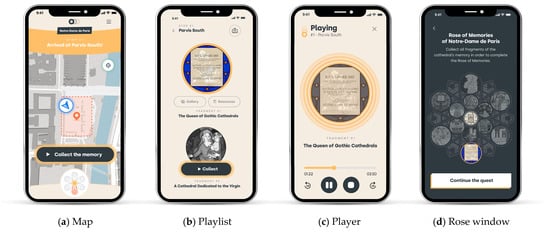
Figure 1.
Main screens of the mobile application Ekko of Notre-Dame de Paris. From left to right: (a) Map screen where the visitor has reached the GPS zone associated with waypoint 1 activating the apparition of the button to access the corresponding audio content. The six-petal rose icon shown at the bottom leads to the Rose window screen. (b) Playlist screen including the two narrative audio pieces of waypoint 1. The interview is not shown here, as it appears further down and requires scrolling. Only the principal audio piece has been completed, unlocking access to the associated image gallery and additional resources. (c) Player screen of the principal audio piece of waypoint 1 displaying the associated medallion halfway between greyscale and coloured. (d) Rose window screen where only the principal audio piece of waypoint 1 has been completed.
The audio player screen (see Figure 1c) was intentionally designed with minimal controls to enhance inclusivity across a variety of visitor profiles and to reduce visual distraction, as the audio guide is intended to be listened to primarily while observing the cathedral rather than looking at the phone screen. After completing an audio piece, visitors gain access to an image gallery illustrating key concepts discussed in the narration, along with additional resources including a glossary of complex terms and links to related scientific articles and videos.
A gamification element was introduced to encourage further exploration, framed as the Quest for Memories: each audio piece, associated with a medallion, represents a fragment of Notre-Dame’s sonic memory. As visitors complete these fragments, the medallions gradually transition from greyscale to vibrant colour, contributing to the progressive completion of the Rose of Memories (see Figure 1d).
2. Materials and Methods
The official on-site launch of Notre-Dame Whispers took place from 6 to 12 May 2024 (Week #19). During that week, the Notre-Dame Whispers tour was actively promoted to visitors around the cathedral by a team of volunteers serving as cultural mediators, while a survey was conducted in parallel to gather feedback on their visit experience.
2.1. On-Site Launch and Public Survey
The launch of the Notre-Dame Whispers tour included a major on-site installation and was supported by a self-initiated publicity campaign and recent press coverage. Event headquarters were based in the Pavillon Nord, one of two offices beneath the wooden seating on the parvis, provided by the Cathédrale Notre-Dame de Paris for the week. The event was staffed by volunteers from the Talkartive agency, the PHEND project, and Humanities students from Sorbonne Université, recruited through a call for volunteers.
As shown in Figure 2, the volunteers, wearing yellow T-shirts with the project’s logo—some additionally carrying project-branded banners—were positioned at strategic locations around the cathedral’s parvis to engage visitors and promote the tour. Interested visitors were directed to the team’s headquarters, where they were welcomed by other volunteers in English, French, or Spanish and invited to download Ekko of Notre-Dame de Paris on their own mobile device by scanning a printed QR code. A public WiFi router was provided for those preferring not to use mobile data. Sennheiser HD300 headphones (The HD300, manufactured by Sennheiser electronic SE & Co. KG Am Labor 1 30900 Wedemark Germany, are wired, circumaural, closed-back headphones, which provide passive attenuation of environmental noise. This characteristic is particularly relevant in the outdoor context of the visit, as background sounds from the parvis and surrounding areas (e.g., tourists, traffic, street musicians, construction work) are not part of the virtual auditory scenes and may otherwise reduce immersion.) were available for visitors without their own, along with USB-C and Lightning adapters for mobile devices without a headphone jack, provided in exchange for an identification document as a deposit. Headphone jack splitters were also offered for shared mobile phone use, such as between couples or parents and children.
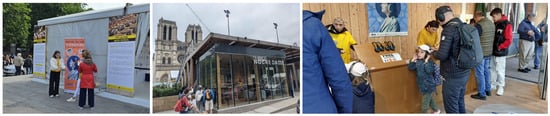
Figure 2.
(left) Two volunteers standing by a project-branded banner, introducing Notre-Dame Whispers tour to a visitor on the parvis; (centre) Exterior view of the Pavillon Nord, used as the office for the event during the launch week, located beneath the wooden tiered seating installed across Notre-Dame’s parvis; (right) Interior view of the office with volunteers providing explanations to visitors about Notre-Dame Whispers tour.
Visitors received a brief orientation on the visit route and the application’s main functionalities before beginning the tour at the wooden tier seating on the parvis, which corresponds to the first waypoint. They were informed they could exit the tour at any time and, upon returning the headphones, had the option to complete a questionnaire and participate in an interview in exchange for a souvenir gift.
2.2. Survey Protocol
To evaluate the impact of the Notre-Dame Whispers mediation tool on the visitor experience, both quantitative and qualitative data were collected via anonymised Firebase Analytics embedded in the mobile application, alongside post-visit self-administered questionnaires and semi-structured interviews (see the questionnaire form in Figure A3).
Previous research on mediation tools in museums and cultural heritage sites informed the methodological approach, particularly regarding the role of audio guides in helping visitors understand, imagine, and learn about the subject of their visit, drawing on Deshayes [23]. Building on these insights, the survey evaluated the effectiveness of the Notre-Dame Whispers tool in enhancing the visitor experience, focusing on satisfaction, educational value, usability, auditory experience quality, and novelty of the visit. The questionnaire, inspired by evaluations of audio-guided tours at other cultural heritage sites, targeted formats aligned with the Notre-Dame Whispers tour. These included Augmented Reality and Audio Augmented Reality tours by Durand et al. [24], Bachiller et al. [25], Zimmermann and Lorenz [26], and more traditional museum exhibits featuring audio-visual installations by Couillard et al. [27].
Available in English, French, and Spanish, the questionnaire was divided into four categories: demographic information (Social class was assessed through questions on education level and work sector, using the French PCS 2020 nomenclature https://www.insee.fr/fr/metadonnees/pcs2020/groupeSocioprofessionnel/1?champRecherche=true, accessed on 31 December 2025), with added descriptions for ambiguous categories.); cultural profile (e.g., museum visits, audio guide usage); visit conditions and setup; and visitor satisfaction. Visitor satisfaction was assessed through statements rated on a four-point agreement scale (“Strongly disagree,” “Somewhat disagree,” “Somewhat agree,” “Strongly agree”), with an additional “Unsure” option included to discourage neutral responses and channel uncertainty into a distinct category, as recommended by Nardi [28]. Affirmative and negative statements were interleaved to encourage thoughtful responses. A few questions were open-ended to allow more detailed feedback.
3. Quantitative Results: Questionnaire and Analytics
A total of 235 completed questionnaires across the three language versions were collected during the launch week, representing approximately 40% of the 589 application downloads. This percentage excludes users who downloaded the application without proceeding to the visit, as well as those who completed the visit but either declined to fill out the questionnaire or did not return to the office, for instance because they were using their own headphones. The questionnaires were completed by respondents representing either individual visitors or groups.
To complement this self-reported data, objective usage patterns were gathered through Ekko of Notre-Dame de Paris’s integrated analytics. By agreeing to the Terms of Service, visitors consented to the storage of their location along the visit route and application usage data. Collected data include language, mobile device type, operating system version, GPS location, time spent at each waypoint, completed audio pieces, viewed images and resources, and screen time. Mechanisms for collecting user preferences were also integrated, including prompts to rate each audio piece after playback using a five-star scale and to submit a review of the application in app stores upon completing the six-waypoint tour.
The analysis of these combined data sources is presented in the following subsections. For clarity, specific questionnaire items associated with each metric are indicated at the beginning of their respective subsections.
3.1. User Analytics and Usage Patterns
3.1.1. Downloads
The number of application downloads is used here as a proxy for the number of visitors who engaged with the Notre-Dame Whispers experience. During the launch week (Week #19 (2024)), the application recorded 589 new downloads, with an Android-to-iOS user ratio of approximately . Over the remainder of 2024, the application averaged approximately 25 new downloads per week. In 2025, the average decreased slightly to around 22 new downloads per week. At the time of writing (Week #48 (2025)), the cumulative number of downloads reached approximately 2700, with the Android-to-iOS user ratio gradually evolving over time toward approximately .
For general comparison, visibility of other related public engagement productions associated with Notre-Dame de Paris and its acoustics are presented in Table 1. Regarding productions of similar duration ( 1 ), Notre-Dame Whispers achieves a comparable public reach. It must be reiterated that Notre-Dame Whispers is publicised as both an on-site experience (using GPS localisation around the cathedral) and an off-site listening experience, while all others are off-site non-geolocalised experiences.

Table 1.
Access/download/view data to date for various Notre-Dame de Paris project related public outreach productions. For Notre-Dame Whispers, the reported 1 h duration corresponds to the cumulative duration of the two narrative pieces across all six waypoints.
3.1.2. Demographics
The country of origin, determined by the user’s smartphone registration in the app store, provides insight into the geographic distribution of users. Analytics identified 49 countries, spanning a wide area and supporting the goal of creating an inclusive, international mediation tool. The top 24 countries by number of downloads are listed in Table 2.
Table 2.
Downloads of Ekko of Notre-Dame de Paris by country (top 24) during Week #19 (2024).
Of the completed questionnaires, 51% were in French, 31% in English, and 19% in Spanish. Further demographic data—including gender, age, and socio-professional background—were retrieved from the self-reported responses in items 8–12 of the questionnaire (see Figure A3). Gender distribution was 53% female, 43% male, and 4% unreported. Ages ranged from 7 yrs to 82 yrs, with an average of 44 yrs. 63% of respondents were employees, 17% retired, and 10% students. Regarding work sectors, 41% identified as “Higher management/professional occupations/secondary and higher education teachers”. For education levels, 11%, 31%, and 16% held a PhD, Master’s, and Bachelor’s degree, respectively, while 23% did not report, indicating generally high levels of education.
3.1.3. Visit Completion
To assess visit completion rates, the number of audio pieces successfully triggered at each waypoint was analysed. As described in Section 1.4, although each waypoint includes several audio pieces (The total listening time is approximately 28 min for all principal pieces, 56 min for principal and secondary pieces combined, and 114 min when including interviews.), visitors can only advance to the next waypoint after completing the principal audio piece; therefore, completion data for these pieces indicate the extent of their progress along the route.
Figure 3 shows audio piece completion rates relative to the principal piece of waypoint 1. Approximately 50% of visitors completed the entire tour, exploring all six waypoints. Principal piece completion rates reveal user drop-off points, with the largest drop (22%) occurring between waypoints 1 and 2. Inter-waypoint drop-off rates decrease progressively, reaching a minimum (3%) between waypoints 4 and 5, before slightly rising to 8% between waypoints 5 and 6. At least half of the users who completed a principal piece also completed the corresponding secondary piece at each waypoint.
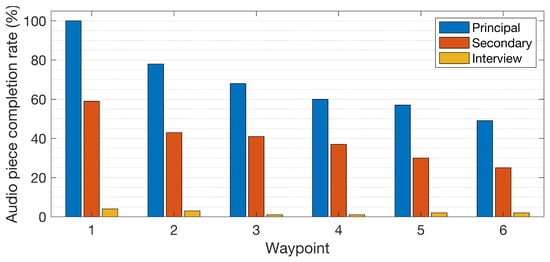
Figure 3.
Percentage of completed pieces at each waypoint, relative to the principal audio piece of waypoint 1.
By contrast, few users listened to the full interview pieces with researchers. This may stem from several factors: interviews double the playback time, adding about an hour to the visit, requiring extended stationary periods at each waypoint; they are framed as “behind-the-scenes” content and lack the immediate visual connection with the cathedral, making them suitable for later listening; and their medallions were positioned at the bottom of the playlist screen, often requiring scrolling to access, depending on phone screen aspect ratios. This UI limitation has been subsequently addressed by the development team for a future version of Ekko of Notre-Dame de Paris.
3.1.4. Visitor Cultural Profile
The cultural background and habits of the participants were assessed through items 7 and 13 of the questionnaire (see Figure A3). These items revealed that, regarding museum attendance and familiarity with audio guides, 58% of respondents reported visiting at least three museums in the 12 months prior to the Notre-Dame Whispers tour, and 62% indicated having used museum audio guides multiple times (see Figure 4). Most respondents can therefore be classified as frequent museum-goers with prior experience using audio guides.
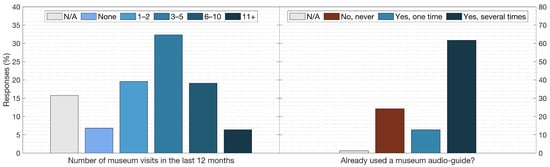
Figure 4.
Users’ museum and audio guide habits.
In response to inquiry about preferred sites for audio guides, the Louvre Museum stands out with 20 mentions, followed by the Orsay Museum (9 mentions), the Châteaux of the Loire Valley (4 mentions), the Vaux-le-Vicomte Castle (3 mentions), and the Citadel of Besançon (3 mentions). This overrepresentation of French heritage sites likely reflects the high proportion of French respondents (51% of the collected questionnaires). Reported sites outside France included Westminster Abbey (2 mentions), Stonehenge (2 mentions), St Mark’s Basilica (2 mentions), the Bundestag (2 mentions), and the Uffizi Gallery (2 mentions).
3.1.5. Technical Conditions
Items 4–6 of the questionnaire (see Figure A3) analysed the technical conditions of the visit, including adherence to volunteers’ recommendations to use headphones and the group size sharing a single mobile phone.
Reproduction Device
The Notre-Dame Whispers audio content, mixed in binaural, is optimally experienced through headphones. Users were encouraged to use either the free headphones provided by volunteers or their own headphones or earbuds, though the internal loudspeaker of their mobile phone was an option. 92% of respondents reported using headphones, 4% used the internal loudspeaker, and 4% alternated between the two.
In response to the question about using wired or wireless headphones, 9% of respondents reported using wireless headphones or earbuds, indicating that at least this proportion used their own devices, as the Sennheiser HD300 headphones provided by volunteers are wired. However, the high rate of non-responses (36%), compared to 55% who reported using wired headphones, suggests the question may have been unclear to many users. Similarly, the question regarding active noise cancellation yielded inconclusive results, with 59% non-responses, likely reflecting limited familiarity with this technology.
Visitor Group
Users were asked about the size of their visit group sharing a single mobile phone to determine whether the listening experience was individual or shared with others using a jack splitter on the phone’s audio output. While the results indicate representation of both individual (44%) and group users (55%), these findings should be interpreted with caution. This response distribution does not align with volunteer observations, which noted that most users were individuals who did not borrow a jack splitter. This discrepancy likely stems from the unclear phrasing of the question.
3.2. Visitor Satisfaction and Engagement
Visitor satisfaction was assessed through questionnaire items 3 and 7 (see Figure A3), covering categories such as general satisfaction, educational value, the immersive nature of the visit (particularly audio content quality), storytelling, the visit route, application usability, extra features, and comparisons with audio guides from other sites. The results are presented below. To facilitate analysis, responses to negatively phrased statements were inverted to align with their corresponding affirmative counterparts, enabling direct comparison across all statements. For instance, responses to the negative statement “The application is not easy to use” were reversed, so “Somewhat Disagree” became “Somewhat Agree,” and “Strongly Disagree” became “Strongly Agree,” corresponding to the affirmative statement “The application is easy to use,” and vice versa. In the figures below, items initially formulated as negative statements are marked with an asterisk (*).
3.2.1. General Satisfaction
Regarding the statement “Overall, I have enjoyed my visit so far,” 88% of respondents strongly agreed and 9% moderately agreed. While high, this figure serves primarily as a baseline reference for visitor appreciation, providing necessary context for the interpretation of subsequent, more specific questions in the study. As Notre-Dame Whispers was a spontaneous, free experience available to on-site visitors, standing as one of only two primary cultural offerings accessible from the parvis alongside the pre-booked VR experience “Eternal Notre-Dame”, the positive feedback may have been influenced by the unexpected availability of such mediation. A more meaningful interpretation of this measure is the overwhelming majority of respondents who advocated for the implementation of such a system at other heritage sites (see Section 3.2.2).
3.2.2. Availability at Other Heritage Sites
In response to the statement, “This type of audio guide should be available at other places to visit,” 85% of respondents strongly agreed, 11% moderately agreed, and 2% were undecided, with all other responses accounting for less than 1%. These results highlight a significant interest in having experiences similar to Notre-Dame Whispers implemented at other heritage sites, reinforcing the value of this mediation approach beyond the unique context of Notre-Dame.
3.2.3. Educational Value
Users were asked whether they had learned something new about Notre-Dame during the visit. 78% reported learning a lot, while 16% reported learning a little, supporting the hypothesis that Notre-Dame Whispers has significant educational value regarding the cathedral’s sonic history. Respondents could mention multiple topics, which were then classified into categories based on lexical fields and grouped by frequency. As illustrated in Figure 5, the most frequently mentioned topics included the bells (60 occurrences), the 2019 fire (50 occurrences), the history of Notre-Dame (49 occurrences), and musical aspects such as concerts, organs, and singing (30 occurrences).
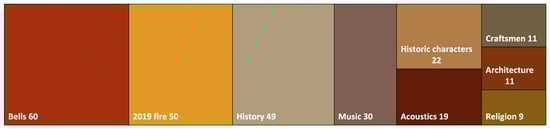
Figure 5.
Distribution of the most striking topics, based on a lexical field analysis of keywords from the open-ended question: “Could you please provide the most striking example?” The total number of occurrences is shown next to each lexical field name.
3.2.4. Immersive Audio Content
As shown in Figure 6, in response to the statement, “I find the experience immersive,” (In the questionnaire, “immersive” was defined as “a multidimensional sound experience that gives the impression of being physically present in the sound environment”.) 68% strongly agreed and 20% moderately agreed. Similarly, 75% and 77% of respondents strongly agreed that the soundscapes were realistic and that sounds of objects like bells and tools were authentic, respectively. These results suggest that the Notre-Dame Whispers visit was widely perceived as immersive, with realistic and historically informed auditory content.

Figure 6.
Response distribution on the immersive nature of the visit. Items marked with an asterisk (*) were initially phrased as negative statements in the questionnaire.
3.2.5. Narrative Appeal
As shown in Figure 7, the narrator was judged captivating by a large majority of respondents, and the topics covered were considered interesting by a similar proportion of respondents: approximately 76% strongly agreed, while 14% moderately agreed. Responses to the statement, “The Quest for Memories motivates me to continue the tour,” were more balanced, with 63% expressing strong agreement and 25% moderate agreement (see description of the gamified quest in Section 1.4). These findings indicate that the narrative appeal was widely regarded as engaging, likely due to the embodied narrative and voice acting, despite addressing complex topics. However, the Quest for Memories, a gamification feature of Ekko of Notre-Dame de Paris designed to encourage exploration, was less engaging for some users.

Figure 7.
Response distribution on the narrative appeal. Items marked with an asterisk (*) were initially phrased as negative statements in the questionnaire.
3.2.6. Visit Route
As shown in Figure 8, while 73% of respondents strongly agreed that directions between waypoints were clear, only 47% strongly agreed that the waypoint positions were well chosen, with 13% moderately disagreeing and 10% strongly disagreeing. These results suggest that some waypoints were perceived as difficult to access, such as Quai Montebello, located at a lower level and accessible only by stairs. Others, like Rue-du-Cloître Notre-Dame, may have been considered unsuitable due to crowding or obstructions from Notre-Dame restoration site’s security enclosure, which narrows the street (see Figure A2b). Notably, the statement concerning waypoint positions was the first negatively phrased item in the survey, which may also have introduced confusion for some users.

Figure 8.
Response distribution on the visit route. Items marked with an asterisk (*) were initially phrased as negative statements in the questionnaire.
3.2.7. Application Usability
Regarding application usability, users were asked whether the application was easy to use, if they enjoyed its visual appearance, and if they enjoyed using headphones and their own phone compared to another type of device. As shown in Figure 9, at least 60% strongly agreed with all statements. However, specific usability aspects received mixed feedback: 9% of respondents were undecided about preferring their own mobile phone, 11% disagreed (moderately or strongly) that they enjoyed using headphones, and 17% disagreed (moderately or strongly) that the application was easy to use. These findings suggest that some users may favour standard audio guide devices over mobile phones and/or encountered difficulties with the application, potentially due to technical issues. Moreover, although closed-back headphones can effectively filter background noise and enhance immersion in the spatialised audio scenes, they can also impede communication with other visitors.
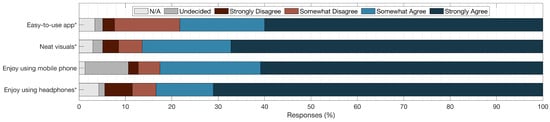
Figure 9.
Response distribution on the application usability. Items marked with an asterisk (*) were initially phrased as negative statements in the questionnaire.
3.2.8. Extra Features
In the extra features category, which includes the image gallery, additional resources (e.g., glossary and links to scientific references), and the researcher interviews as detailed in Section 1.4, users were asked whether these elements enriched their experience. While most users responded positively (see Figure 10), this category had the highest proportion of undecided and blank responses among visitor satisfaction items. This likely indicates that some users were unaware of certain extra features, as confirmed by informal post-visit comments, or chose not to access them, such as the researcher interviews, as previously analysed in Figure 3.

Figure 10.
Response distribution on the extra features. Items marked with an asterisk (*) were initially phrased as negative statements in the questionnaire.
Notably, 14% of respondents disagreed that the image gallery enriched their experience, potentially reflecting dissatisfaction with a UI design choice that restricted access to the gallery until audio playback was completed. This restriction aimed to encourage observation of the cathedral during playback. However, informal comments revealed that some users, particularly at waypoint 5 (where the view of the cathedral was obstructed by the restoration site’s security enclosure and machinery, see Figure A2b), would have preferred to access the gallery during playback.
3.2.9. Comparison with Other Audio Guides
Users were asked to compare Notre-Dame Whispers to other audio guides they had used, evaluating characteristics such as its innovative, engaging, and playful nature. They also assessed whether it was enjoyable to use, motivated further exploration, and featured interesting content. As shown in Figure 11, the results were generally positive, despite a significant number of blank responses (17% to 20%). Among the evaluated characteristics, Notre-Dame Whispers’s playful nature received the fewest strong agreements (46%), while its interesting content received the highest (66%).
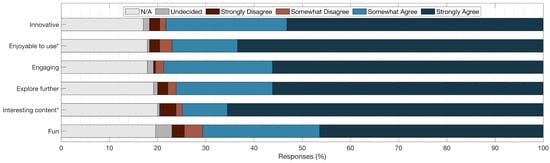
Figure 11.
Response distribution on how Notre-Dame Whispers compares to other audio guides. Items marked with an asterisk (*) were initially phrased as negative statements in the questionnaire.
4. Qualitative Analysis: Thematic Triangulation
To provide a deeper understanding of the results issued from the quantitative analysis, this section presents a thematic analysis that triangulates two qualitative data sources: (1) the open-ended responses collected from the post-visit questionnaire () and (2) the semi-structured interviews conducted on-site (). The integration of these sources allows for a comprehensive exploration of the visitor experience, balancing the broad diversity of the questionnaire feedback with the phenomenological depth provided by the interviews.
The resulting interview corpus consists of twelve recordings ranging from 5 min to 44 min in duration (mean 21 min ± 14 min). These were conducted by one of three members of the mediation team—including two from the Notre-Dame Whispers development team—following a standardised interview guide. Several interviewees were professionals working in mediation or monument preservation, providing expert perspectives alongside general visitor feedback. To ensure high-quality transcriptions despite the outdoor environment, recordings captured via a Zoom H3-VR were post-processed through a dynamic beamformer using the COMPASS Tracker VST plug-in to minimise background noise. Transcriptions were then completed through a combination of manual review and the HappyScribe automatic transcription tool (https://www.happyscribe.com/en, accessed on 31 December 2025.).
The combined corpus was analysed using an inductive thematic coding process. This systematic approach identified four primary analytical axes: (1) Spatial and Narrative Immersion, (2) Emotional Resonance and Collective Memory, (3) The Intelligibility of the Worksite, and (4) System Usability and UX Requirements. The distribution of these categories, including the number of participants (n) and the total number of coded segments across both data sources, is summarized in Table 3. These themes reflect the tension between high-fidelity sensory immersion and the ergonomic requirements of the mobile application.
Table 3.
Thematic coding distribution across the combined qualitative corpus (114 questionnaire comments and 12 semi-structured interviews). The table illustrates the breadth (Participants) and depth (Coded Segments) of the analysis.
Participants from the interview phase are hereafter referred to by the notation [PN], where N represents the specific interviewee number (1–12), while excerpts from the questionnaire’s open-ended responses are indicated as [Q].
4.1. Theme 1: Spatial and Narrative Immersion
The majority of interviewees () and numerous questionnaire respondents identified the binaural “plausibility” as a primary driver of their engagement. The narrative format was frequently praised for its ability to “plunge” the visitor into history, effectively substituting the current lack of visual access to the cathedral’s interior. One visitor noted: “The quality of the sound is excellent… We are truly immersed in the story” [P12], a sentiment echoed by several questionnaire participants who simply remarked: “Congratulations, it is very immersive” [Q]. This suggests that the spatialised audio successfully creates a “mental reconstruction” of the space, allowing the narrative to provide a spatial presence that anchors the visitor’s physical presence outside the gates.
However, the depth of this immersion also revealed the limits of spatialised audio when listeners’ expectations of a stable sound field were challenged. While the immersive nature was a high point for most, some noted that the spatialisation could be “too much,” disrupting their sensory balance:
I’m not moving, so the bells shouldn’t move. It was unsettling because I was watching something, yet I felt like something was shifting. [P1]
This feedback underscores the need for caution when incorporating moving elements into spatialised audio scenes without corresponding visual cues. Interestingly, the left-to-right swinging of the tenor bell Emmanuel in the Meeting with the bourdon Emmanuel audio piece (see Table A1), which surprised the visitor, derives directly from the original bell recording made in the belfry. This recording was captured using an artificial head positioned close to the bell and oriented toward its rotational trajectory. The perceived unnaturalness reported by [P1] likely originates not from excessive post-processing, but from a general unfamiliarity with how a bell sounds at such close range. This highlights a significant design challenge: the tension between objective technical authenticity and the listener’s subjective expectation of a stable auditory environment.
4.2. Theme 2: Emotional Resonance and Collective Memory
Beyond sensory immersion, the qualitative data revealed a significant emotional dimension to the visitor experience, cited by 10 interviewees and 35 questionnaire respondents. This resonance is primarily anchored in the collective memory of the 2019 fire. Participants described the experience as “moving” [Q] and “enriching” [Q], with several noting that the audio format allowed for a unique emotional connection to the cathedral during its period of physical closure.
The narrative’s ability to evoke the fire without visual representation was particularly impactful. One interviewee noted: “It was wonderful, it moved me… it brings the experience of Notre-Dame to life even while it is still closed” [P4]. For many, the audio tour served as a bridge between the traumatic memory of the destruction and the hope of reconstruction. This is exemplified by the comment of an architect who participated in the study:
Congratulations! An incredible experience. You really feel like the cathedral is speaking to you! […] I appreciate the great effort that goes into creating such an experience. Hats off! [Q]
The use of an embodied, first-person narrator was frequently cited as the mechanism for this emotional “living” history. Respondents noted that this perspective made the story “come alive” [Q], transforming a standard historical visit into a personal encounter with the building’s resilience. However, the emotional weight of the 2019 fire also led to suggestions for narrative pacing; one user suggested “changing the placement of the memory of the fire to put it at the beginning or the end” [Q], suggesting that for some, the emotional peak of the tour required a more strategic position within the overall visit structure to allow for reflection.
Ultimately, this theme suggests that Notre-Dame Whispers functions as more than a digital guide; it acts as a tool for “heritage healing,” allowing visitors to mentally re-occupy the space and reconcile their memories of the disaster with the ongoing reality of the worksite.
4.3. Theme 3: The Intelligibility of the Worksite
While the cathedral remains physically inaccessible, participants identified the audio tour as a vital tool for understanding the technical and human reality of the restoration site. This theme, discussed by 8 interviewees and 9 questionnaire respondents, focuses on the “unveiling” of the craftsmanship involved in the reconstruction.
The inclusion of specific soundscapes—such as the resonance of stones being carved or the ambient sounds of the belfry—served to humanize the massive scale of the worksite. Visitors noted that the tour allowed them to grasp the “human labour and craft complexity” [P4] that is otherwise hidden by scaffolding. As one respondent noted, the experience provided a “deep dive into the heart of life at Notre-Dame” [Q]. This suggests that the audio mediation successfully shifted the visitor’s focus from the building as a static monument to the building as a “living” process of resilient craftsmanship.
However, this reliance on auditory descriptions of complex technical tasks created a demand for more robust visual support. Both data sources highlighted that describing the interior of the cathedral and the intricate worksite maneuvers solely through sound was a design challenge. Questionnaire respondents specifically suggested the addition of “diagrams or plans to clarify the descriptions of the interior” [Q]. One user noted that during technical explanations, such as those regarding the bells, “you lose focus if there’s no visual aid” [Q].
This feedback indicates that while sound is excellent for evoking the atmosphere of labor, it requires synchronized visual reference—such as maps or technical sketches—to ensure the intelligibility of architectural and engineering concepts. This theme underscores a key finding for future heritage mediation: the most effective “mental reconstruction” occurs when high-fidelity soundscapes are supported by targeted, non-distracting visual diagrams that ground the auditory narrative in physical space.
4.4. Theme 4: System Usability and UX Requirements
The final analytical theme addresses the technical infrastructure of the experience. While many visitors found the application “very practical” and “easy to use” [Q], this category also concentrated the highest volume of critical feedback, particularly from the questionnaire (n = 45). The issues raised serve as a form of real-world beta-testing, highlighting the challenges of deploying geolocated audio in a dense urban environment with varying device capabilities.
The most significant friction point involved GPS reliability. Several users reported inaccuracies that prevented them from unlocking content (e.g., “Bug of geo-location at waypoint 6” [Q]), which led to frustration and a disruption of the narrative flow. Interviewees clarified that when the technology fails, it immediately pulls the visitor out of the immersive state described in Theme 1. In response to this recurring feedback, the development team implemented a manual waypoint-unlocking feature and introduced waypoint numbering. These iterations ensure that the narrative remains accessible even when hardware limitations—such as GPS drift caused by surrounding buildings—interfere with the automated triggers.
Beyond technical bugs, participants provided specific recommendations for feature enhancement:
- Language Support: While the tour was available in French, English, and Spanish, questionnaire respondents expressed a need for more options, specifically requesting German and Portuguese [Q].
- Playback Control: Several users suggested adding an adjustable audio playback speed [Q]. This would allow visitors with limited time to experience a greater portion of the tour without missing key historical segments.
- Quality Consistency: Feedback noted quality variances between language versions, such as the remark that “The English version of Victor Hugo is not convincing” [Q], highlighting the importance of cultural and linguistic nuance in voice acting for heritage mediation.
This theme underscores that the success of a binaural heritage experience is deeply contingent upon the reliability of the delivery system. The transition from a fully automated, geolocated experience to a hybrid model allowing for manual control reflects a necessary adaptation to the diversity of visitor devices and the physical constraints of the Notre-Dame site.
5. Future Work
As possible future work, the quantitative and qualitative data collected during the on-site survey could be further analysed to provide deeper insights into the reception of Notre-Dame Whispers by cathedral visitors. This may include examining interactions between specific user groups sharing common demographic characteristics, such as age or cultural engagement, and their appreciation of the proposed audio-guided visit. Analysis presented in Figure A4 explores how frequent museum-goers perceive the innovative aspects of the Notre-Dame Whispers audio guide compared to other respondents. Future work could build on these findings to conduct a more comprehensive analysis of users’ feedback in relation to their demographic and cultural engagement characteristics.
Based on users’ suggestions and bug reports, improvements to the application and adjustments to the content could be made to integrate new functionalities, such as the ability to accelerate audio playback or access the image gallery during playback, and to add other language versions. These enhancements would improve the experience and broaden accessibility for users of future versions.
Finally, the forthcoming HeSoAN project [33] will build on the design principles established in Notre-Dame Whispers while extending them to a new historical and technological context: the 14th-century Palais des Papes, with a focus on the emergence of Ars Nova, the polyphonic chant tradition that developed there at that time. In contrast to the static binaural reproduction used in Notre-Dame Whispers, HeSoAN will feature dynamic, head-tracked binaural audio and indoor navigation supported by Bluetooth beacons. Planned for deployment in early 2026, this project will benefit from the lessons learned in the present study, particularly regarding user experience and mediation strategies.
6. Conclusions
This article presented the on-site public survey conducted alongside the official launch of the Notre-Dame Whispers visit tour. During the launch week, hundreds of spontaneous visitors to the Notre-Dame de Paris parvis were welcomed by a team of volunteer cultural mediators in an office across the parvis. Visitors were encouraged to download Ekko of Notre-Dame de Paris on their mobile phone and provided with headphones to ensure optimal binaural audio reproduction for the tour. The survey aimed to evaluate the reception of the audio-guided tour, collecting both quantitative and qualitative data through anonymized analytics, questionnaires, and interviews. The analysis offered insights into user satisfaction, focusing on educational value, application usability, the immersive and innovative aspects of the visit, and how Notre-Dame Whispers compares to audio guides at other cultural sites.
Participants responded positively to the visit experience, demonstrating strong interest in the self-guided audio tour despite the diversity of visitor profiles in terms of origin, age, employment status, education level, and cultural engagement. Feedback highlighted several well-received aspects, including the educational value, immersive nature, storytelling quality, audio content, and the novelty of the experience. Enthusiasm for Notre-Dame Whispers was further reflected in the broad consensus among questionnaire respondents who expressed a desire for similar audio-guided tours at other sites. Negative feedback and suggestions for improvement provided valuable insights for enhancing the experience, including addressing bugs, revising certain UI/UX design choices, and expanding content such as additional language options to appeal to a wider audience.
These results support the hypothesis formulated during the creation of Notre-Dame Whispers: that lively storytelling, narrated in the first person by a narrator-character embodying the cathedral, combined with spatialised, historically informed binaural soundscapes, fosters a multi-sensory and imaginative experience. This approach helps make complex and initially forbidding topics more accessible and engaging for the general public. In this respect, the primary objective of Notre-Dame Whispers—to popularise the PHEND group’s research through a cultural mediation tool accessible to a broad audience—appears to have been largely achieved.
The warm reception of Notre-Dame Whispers during the launch week is encouraging and suggests that innovative approaches to cultural mediation at heritage sites, integrating scientific research in virtual archaeoacoustics, lively storytelling, and spatialised, historically informed soundscapes, show significant potential for future applications.
Author Contributions
Conceptualization, J.D.M. and S.P.; methodology, J.D.M. and S.P.; software, J.D.M. and S.P.; validation, J.D.M., S.P. and B.F.G.K.; formal analysis, J.D.M.; investigation, J.D.M.; resources, B.F.G.K.; data curation, J.D.M.; writing—original draft preparation, J.D.M. and S.P.; writing—review and editing, J.D.M. and B.F.G.K.; visualization, J.D.M.; supervision, B.F.G.K.; project administration, S.P. and B.F.G.K.; funding acquisition, S.P. and B.F.G.K. All authors have read and agreed to the published version of the manuscript.
Funding
This research was funded by the European Union’s Joint Programming Initiative on Cultural Heritage project PHE (The Past Has Ears, http://phe.pasthasears.eu, accessed on 31 December 2025), the French project PHEND (The Past Has Ears at Notre-Dame, Grant No. ANR-20-CE38-0014, http://phend.pasthasears.eu, accessed on 31 December 2025), and the Chantier scientifique CNRS/Ministère de la Culture/Notre-Dame (https://notre-dame-de-paris.culture.gouv.fr/fr, accessed on 31 December 2025), and OPUS (Observatoire des Patrimoines de l’Alliance Sorbonne Université, https://institut-opus.sorbonne-universite.fr/, accessed on 31 December 2025).
Data Availability Statement
The datasets generated during the current study are not publicly available due to ethical and practical constraints associated with data collection in an on-site cultural mediation context, including the absence of participant consent for public data release. Aggregated data may be made available from the corresponding author upon reasonable request.
Acknowledgments
Warmest thanks must go to the team of volunteer mediators whose enthusiasm and involvement were crucial to the success of Notre-Dame Whispers’s on-site launch and survey, as well as to the Collegium Musicae (https://collegium-musicae.sorbonne-universite.fr/, accessed on 31 December 2025) and OPUS (https://institut-opus.sorbonne-universite.fr/, accessed on 31 December 2025) for circulating the call for volunteers. The authors also acknowledge Margot Mahoudeau, engineer at SUMMIT, for her essential contributions to the design of the questionnaire, the conduct of the on-site survey, and the analysis of the results. Finally, we thank the Cathédrale Notre-Dame de Paris for providing access to the Pavillon Nord. Further details about the application and the full list of contributors to its creation are available on the project website (http://ndwhispers.pasthasears.eu/, accessed on 31 December 2025.)
Conflicts of Interest
Julien De Muynke participated in this study as a researcher from Sorbonne Université. Stéphanie Peichert participated in this study as a member of Talkartive under contract to Sorbonne Université to create the free audio-guide. Since the study was carried out, Julien De Muynke has become a member of Talkartive. The authors declare no conflicts of interest.
Abbreviations
The following abbreviations are used in this manuscript:
| GPS | Global Positioning System |
| OPUS | Observatoire des Patrimoines de Sorbonne Université |
| PHE | The Past Has Ears |
| PHEND | The Past Has Ears at Notre-Dame |
| SUMMIT | Sorbonne Université Maison des Modélisations Ingénieries et Technologies |
| UI | User Interface |
| UX | User Experience |
| VR | Virtual Reality |
| VST | Virtual Studio Technology |
| XR | Extended Reality |
Appendix A
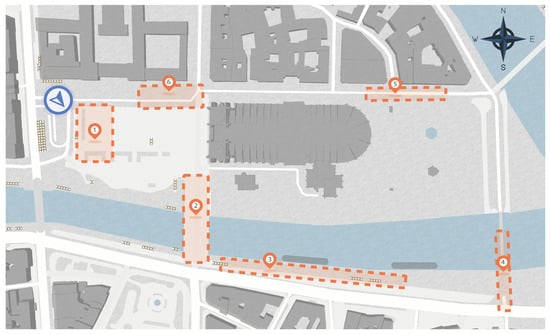
Figure A1.
Overhead map of the proposed visit route around Notre-Dame including the visitor’s position (blue arrow) and the six waypoints (orange dashed square-boxes). List of waypoints: Parvis (1), Pont-au-Double (2), Quai Montebello (3), Pont de l’Archevêché (4), Rue du Cloître-Notre-Dame (5), and Return to Parvis (6).
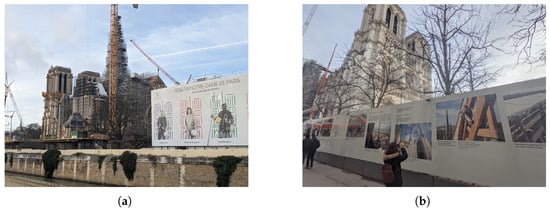
Figure A2.
(a) View from waypoint 4 of the cathedral’s new spire, surrounded by scaffoldings, following the collapse of the previous spire that burnt during the fire of April 2019; (b) Notre-Dame restoration site’s security enclosure in the Rue du Cloître-Notre-Dame. Image credits: photographs by the author (January 2023).
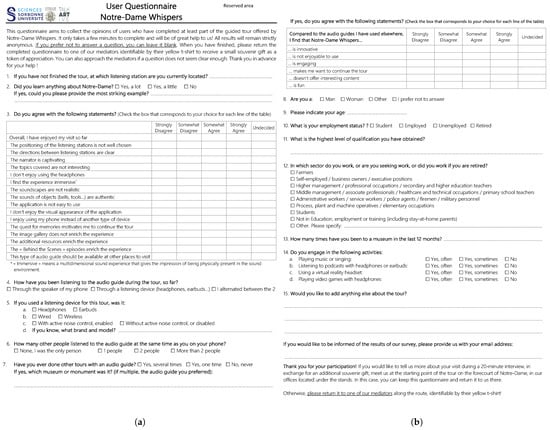
Figure A3.
(a) Front and (b) back of the English version of the post-visit questionnaire form distributed to users of Notre-Dame Whispers during the launch week.
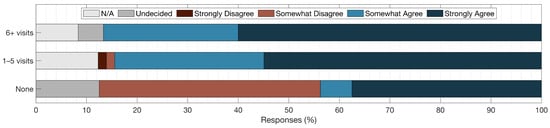
Figure A4.
Distribution of responses to the statement: “Compared to the audio guides I have used elsewhere, I find that Notre-Dame Whispers is innovative”, as a function of number of museum visits done in the 12 previous months.
Table A1.
(left column) Title and (right column) short description of the audio pieces included in Notre-Dame Whispers visit. ND stands for Notre-Dame and V for visitor.
Table A1.
(left column) Title and (right column) short description of the audio pieces included in Notre-Dame Whispers visit. ND stands for Notre-Dame and V for visitor.
| The queen of Gothic cathedrals (waypoint 1) | ND reminisces about the sounds of the Île de la Cité at the time of her first stone being laid. The island is buzzing with activity. She mentions the cathedrals that came before her and has V experience the difference of acoustics between those buildings and her own. |
| A cathedral dedicated to the Virgin (waypoint 1) | ND explains that the cathedral is dedicated to the Virgin Mary and highlights the importance of Marian worship during medieval times, illustrated by various representations of the Virgin on and in the building. V attends an orchestral performance of Jules Massenet’s oratorio of the Virgin as recorded in the cathedral in 2013. |
| Meeting with the bourdon Emmanuel (waypoint 2) | ND invites V to meet the renowned tenor bell Emmanuel. After ascending the South tower stairs to the Chimera gallery and then to the belfry, V experiences the sound of Emmanuel’s ringing up close. |
| Each with its own name, each with its own sound (waypoint 2) | ND introduces V to all the bells from the two bell towers during a full peal. V listens to the sound of a bell casting—the pouring of bronze into the mould and its polishing—and learns the identity of each bell through its name and the note it produces. |
| A ship of stone (waypoint 3) | ND describes the cathedral’s structure and transports V to a medieval construction site, where V follows the journey of a limestone block from the dock to the cathedral wall, experiencing the sounds of stone cutting, mortar mixing, and lifting onto a wall using a treadwheel crane. |
| A lost forest (waypoint 3) | ND guides V to the carpenters’ lodge and then to the cathedral’s framework, called the forest, which was burnt during the fire of April 2019. V learns about the history and characteristics of this “lost forest.” |
| Evening of 15 April 2019 (waypoint 4) | ND takes V back to the fire of 15 April 2019. They attend the service of that day and then move to the parvis to listen to the sounds of firefighters battling the flames, and experience the sound of praying and singing by onlookers on the Pont de l’Archevêché. |
| The 21th-century construction site (waypoint 4) | ND brings V to the contemporary restoration site, where V experiences the soundscape of craftsmen at work, restorers in action, and acoustic experts during their measuring campaign. |
| The School of Notre-Dame (waypoint 5) | ND takes V to the cathedral in 1199 during Christmas celebrations to attend a performance of one of the first polyphonic chants produced in the cathedral, Viderunt Omnes by Pérotin, performed by singers positioned in front of the lectern facing the main altar. |
| Pueri chori (waypoint 5) | On Palm Sunday of 1402, ND lets V listen to the Pueri Hebraeorum chant in antiphony, combining children’s and adults’ voices, and informs V about the tradition of child singers and their daily lives. |
| Stone monument/paper monument (waypoint 6) | ND takes V to the 1830s parvis to learn about the degradation of the building over time, Victor Hugo’s role in spotlighting its state, and the restoration by architects Lassus and Viollet-le-Duc, leading to its classification as a Historic Monument. |
| The organs of Notre-Dame (waypoint 6) | ND introduces V to the history of the cathedral’s organs, their functioning, and their sounds. V eventually experiences a performance on the Great Organ with four hands from the nave. |
References
- Li, J.; Wider, W.; Ochiai, Y.; Fauzi, M.A. A bibliometric analysis of immersive technology in museum exhibitions: Exploring user experience. Front. Virtual Real. 2023, 4, 1240562. [Google Scholar] [CrossRef]
- Bekele, M.K.; Pierdicca, R.; Frontoni, E.; Malinverni, E.S.; Gain, J. A Survey of Augmented, Virtual, and Mixed Reality for Cultural Heritage. J. Comput. Cult. Herit. 2018, 11, 1–36. [Google Scholar] [CrossRef]
- Economou, M.; Meintani, E. Promising beginnings? Evaluating museum mobile phone apps. In Proceedings of the Rethinking Technology in Museums 2011: Emerging Experiences, Limerick, Ireland, 26–27 May 2011; Available online: https://eprints.gla.ac.uk/104173/1/104173.pdf (accessed on 31 December 2025).
- Glaser, M.; Hug, L.; Werner, S.; Schwan, S. Spatial versus normal audio guides in exhibitions: Cognitive mechanisms and effects on learning. Educ. Technol. Res. Dev. 2025, 73, 169–198. [Google Scholar] [CrossRef]
- De Muynke, J. Reconstructing Acoustic Heritage: Methods and Tools for Interdisciplinary Research and Audio-Augmented Experiences. Ph.D. Thesis, Sorbonne Université, Paris, France, 2025. Available online: https://theses.fr/2025SORUS215 (accessed on 31 December 2025).
- Katz, B.F.G.; Mullins, S.S.; Canfield-Dafilou, E.K.; Weber, A.; Pardoen, M.; Poirier-Quinot, D.; d′Alessandro, C. The Past Has Ears at Notre-Dame: Archaeoacoustic and historically informed soundscape research on the history of Paris’ cathedral. J. Anthropol. Archaeol. Sci. 2025, 11, 1525–1545. [Google Scholar]
- Rindel, J.H. Roman Theatres and Revival of Their Acoustics in the ERATO Project. Acta Acust. 2013, 99, 21–29. [Google Scholar] [CrossRef]
- Rindel, J.H.; Nielsen, M.L. The ERATO project and its contribution to our understanding of the acoustics of ancient Greek and Roman theatres. In Proceedings of the ERATO Project Symposium, Istanbul, Turkey, 20 January 2006; pp. 1–10. [Google Scholar]
- Chourmouziadou, K.; Kang, J. Acoustic evolution of ancient Greek and Roman theatres. Appl. Acoust. 2008, 69, 514–529. [Google Scholar] [CrossRef]
- Katz, B.F.G.; Wetherill, E.A. Fogg art museum lecture room, a calibrated recreation of the birthplace of room acoustics. In Proceedings of the Forum Acusticum, Budapest, Hungary, 29 August–2 September 2005; pp. 2191–2196. Available online: https://www.researchgate.net/publication/228954144_Fogg_Art_Museum_Lecture_Room_A_calibrated_recreation_of_the_birthplace_of_Room_Acoustics (accessed on 31 December 2025).
- Wall, J.N. Transforming the Object of our Study: The Early Modern Sermon and the Virtual Paul’s Cross Project. J. Digit. Humanit. 2014, 3. Available online: https://journalofdigitalhumanities.org/3-1/transforming-the-object-of-our-study-by-john-n-wall/ (accessed on 31 December 2025).
- Mullins, S.S. Des Voix Du Passé: The Historical Acoustics of Notre-Dame de Paris and Choral Polyphony. Ph.D. Thesis, Sorbonne Université, Paris, France, 2023. Available online: https://theses.fr/s390605 (accessed on 31 December 2025).
- Martellotta, F.; Pon, L. An Acoustic Reconstruction of Sistine Chapel in Rome at the Time of Leo X: The Role of Tapestries. Heritage 2025, 8, 436. [Google Scholar] [CrossRef]
- Martellotta, F.; Benferhat, M.L.; Rubino, C.; Bouttout, A.; Debache Benzagouta, S. Geometrical acoustic modelling of occupied acoustic conditions in mosques: Application to a case study. Appl. Acoust. 2025, 228, 110323. [Google Scholar] [CrossRef]
- Canfield-Dafilou, E.K.; Katz, B.F.G.; Chevallier, B.C. History and Acoustics of Preaching in Notre-Dame de Paris. Heritage 2024, 7, 6614–6628. [Google Scholar] [CrossRef]
- Foteinou, A.; Stevens, F.; Murphy, D. Revisiting the Acoustics of St Paul’s Cathedral, London. Acoustics 2025, 7, 49. [Google Scholar] [CrossRef]
- Katz, B.F.G.; Weber, A. An Acoustic Survey of the Cathédrale Notre-Dame de Paris before and after the Fire of 2019. Acoustics 2020, 2, 791–802. [Google Scholar] [CrossRef]
- Katz, B.F.G.; Cros, C.; Peichert, S.; De Muynke, J. The Past Has Ears at Notre-Dame: Acoustic digital twins for research and narration. Digit. Appl. Archaeol. Cult. Herit. 2024, 34, e00369. [Google Scholar] [CrossRef]
- Mullins, S.S.; Katz, B.F.G. The Past Has Ears at Notre-Dame Cathedral: An Interdisciplinary Project in Digital Archaeoacoustics. Acoust. Today 2024, 20, 49–58. [Google Scholar] [CrossRef]
- Katz, B.F.G. The Past Has Ears An interdisciplinary project in digital archaeoacoustics. In Proceedings of the Résonances Gothiques; Collegium Musicae: Paris, France, 2024; pp. 17–23. [Google Scholar] [CrossRef]
- Wenzel, E.M.; Arruda, M.; Kistler, D.J.; Wightman, F.L. Localization using nonindividualized head-related transfer functions. J. Acoust. Soc. Am. 1993, 94, 111–123. [Google Scholar] [CrossRef]
- Peichert, S.; De Muynke, J.; Katz, B.F.G. Notre-Dame Whispers: A geolocated immersive walk through the sonic memory of Notre-Dame de Paris cathedral. In Proceedings of the Résonances Gothiques; Collegium Musicae: Paris, France, 2024; pp. 105–128. [Google Scholar] [CrossRef]
- Deshayes, S. Interprétation du statut d’un audioguide. Études de Commun. 2001, 24, 71–90. [Google Scholar] [CrossRef]
- Durand, E.; Merienne, F.; Roger, J.; Pere, C. Une implémentation de la réalité augmentée pour le patrimoine. In Proceedings of the Colloque International de la Conception et Innovation (CONFERE), Venise, Italy, July 2012; pp. 1–8. Available online: https://hal.science/hal-01197458 (accessed on 31 December 2025).
- Bachiller, C.; Monzo, J.M.; Rey, B. Augmented and Virtual Reality to Enhance the Didactical Experience of Technological Heritage Museums. Appl. Sci. 2023, 13, 3539. [Google Scholar] [CrossRef]
- Zimmermann, A.; Lorenz, A. LISTEN: A user-adaptive audio-augmented museum guide. User Model. User-Adapt. Interact. 2008, 18, 389–416. [Google Scholar] [CrossRef]
- Couillard, N.; Nouvellon, M.; Gaëlle, L.; Pailler, F. Réception de l’exposition “Tolkien Voyage en Terre du Milieu” à la BnF (2019–2020); Technical Report; Bibliothèque nationale de France: Paris, France, 2020; Available online: https://hal.science/hal-04100524 (accessed on 31 December 2025).
- Nardi, P. Doing Survey Research: A Guide to Quantitative Research Methods, 4th ed.; Routledge: Oxfordshire, UK, 2018. [Google Scholar] [CrossRef]
- Postma, B.N.; Poirier-Quinot, D.; Meyer, J.; Katz, B.F.G. Virtual reality performance auralization in a calibrated model of Notre-Dame Cathedral. In Proceedings of the Euroregio, Porto, Portugal, 13–15 June 2016; pp. 1–10. Available online: https://hal.science/hal-01789760 (accessed on 31 December 2025).
- Katz, B.F.G.; Poirier-Quinot, D.; Lyzwa, J.M. La Vierge 2020: Reconstructing a Virtual Concert Performance Through Historic Auralisation of Notre-Dame Cathedral. In Proceedings of the 2021 Immersive and 3D Audio: From Architecture to Automotive (I3DA), Bologna, Italy, 8–10 September 2021; pp. 1–9. [Google Scholar] [CrossRef]
- Katz, B.F.G.; Pardoen, M.; Lyzwa, J.M.; Peichert, S.; Cros, C.; Poirier-Quinot, D.; De Muynke, J.; Ling, A.; Cacheux, S.; Griner, J.; et al. The Past Has Ears at Notre-Dame: Immersive audio experiences for public engagement. In Proceedings of the 156th Convention Audio Engineering Society, Audio Engineering Society, Madrid, Spain, 15–17 June 2024; Available online: https://hal.science/hal-04639402 (accessed on 31 December 2025).
- Poirier-Quinot, D.; Lyzwa, J.M.; Mouscadet, J.; Katz, B.F.G. Vaulted Harmonies: Archaeoacoustic concert in Notre-Dame de Paris. Acoustics 2025, 7, 66. [Google Scholar] [CrossRef]
- Ferrando, J.; De Muynke, J.; Katz, B.F.G. HeSoAN: Un projet archéoacoustique. In Proceedings of the Résonances Gothiques; Collegium Musicae: Paris, France, 2024; pp. 281–306. [Google Scholar] [CrossRef]
Disclaimer/Publisher’s Note: The statements, opinions and data contained in all publications are solely those of the individual author(s) and contributor(s) and not of MDPI and/or the editor(s). MDPI and/or the editor(s) disclaim responsibility for any injury to people or property resulting from any ideas, methods, instructions or products referred to in the content. |
© 2026 by the authors. Licensee MDPI, Basel, Switzerland. This article is an open access article distributed under the terms and conditions of the Creative Commons Attribution (CC BY) license.