
Systematic Methodology for Mitigating Radon Risk and Enhancing Fruition of Underground Sites: The Case-Study of Herculaneum’s Theatre

 ,
,  ,
,  , and
, and 
Abstract
1. Introduction
1.1. Historical Background
- The ima cavea, which is closest to the stage, featured marble steps for movable chairs (subsellia) and was designated for city authorities.
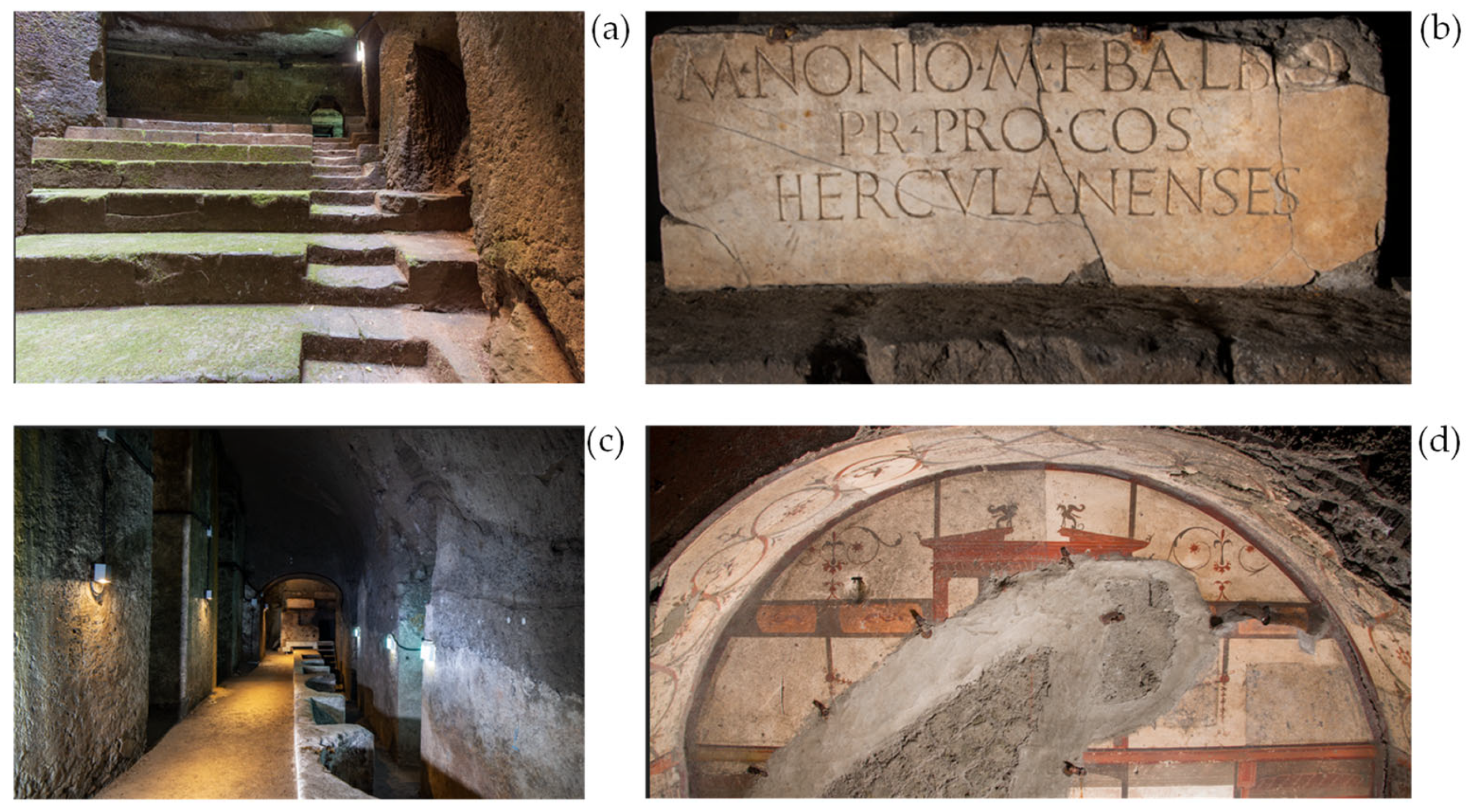
- The media cavea, equipped with tuff seats (Figure 1a), was accessible to the middle class.
- The summa cavea was set apart from the media cavea by a podium decorated with marble pilasters and rectangular panels, and it was reserved for less prominent individuals and women.
1.2. Radon as a Limiting Factor for Fruition in Underground Sites
1.3. Aim of the Paper
2. Materials and Methods
2.1. Legislation-Driven Transferable Protocol (Procedural Steps)
- Site screening and zoning (Observation stage): Identify access areas and openings, document constraints for mitigation, and define the zones relevant to workers and visitors.
- Monitoring design (Analysis stage): Perform a technical site inspection and define the monitoring plan; where workers are present, assign passive dosimeters and record individual occupancy/working hours.
- Long-term monitoring for annual average (Expertise stage): Deploy passive dosimeters at representative points and process data to obtain six-monthly and annual mean concentrations.
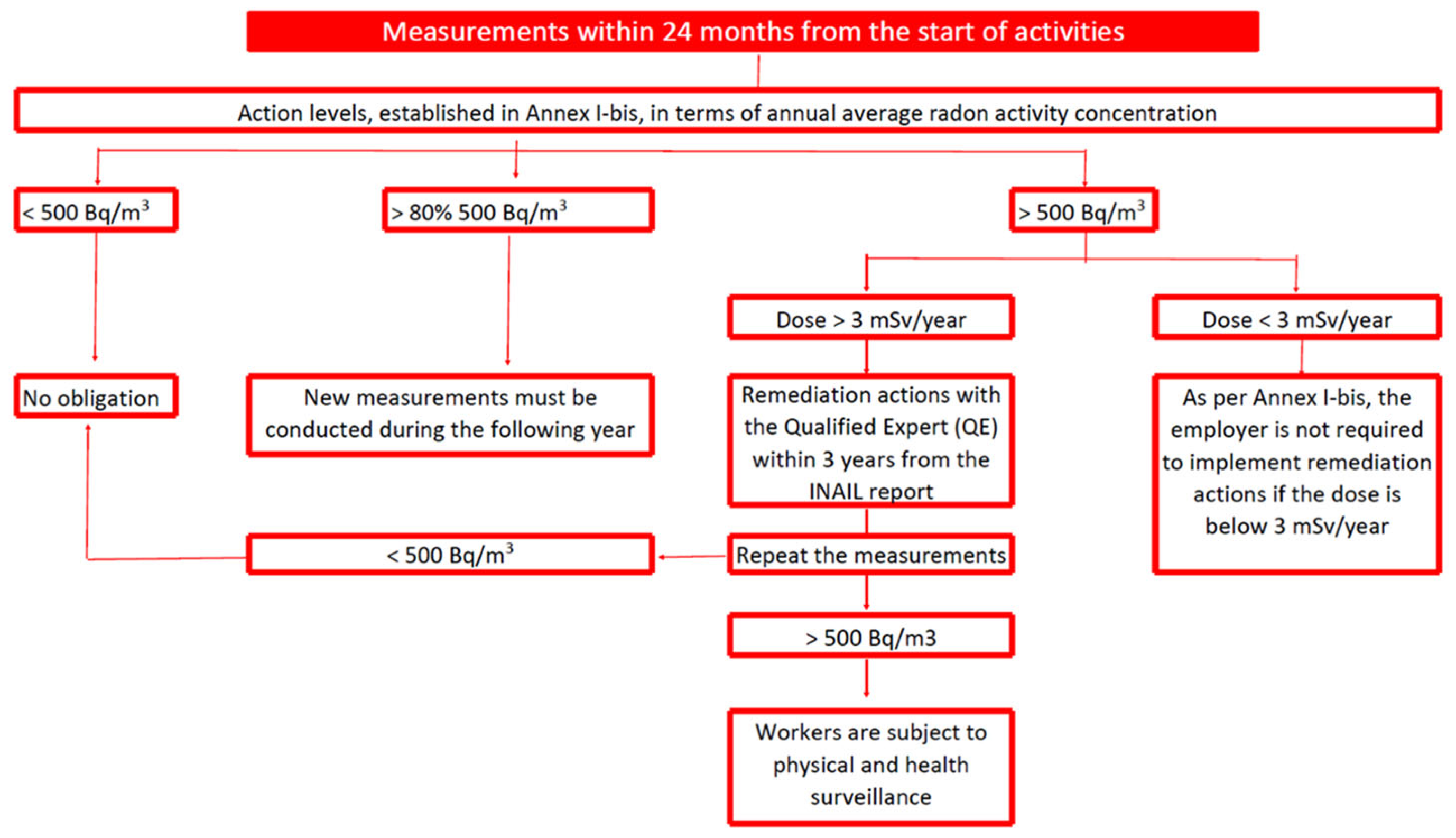
- Regulatory decision logic: Compare the annual average concentration with the action level and, where required, verify compliance through dose assessment.
- Access management (Operational control): Translate the dose-based evaluation into permissible stay durations and implement controlled access through time tracking (e.g., entry badges) and periodic updates of the limits.
2.2. The Theatre Geometry
2.3. The Investigation Timeline
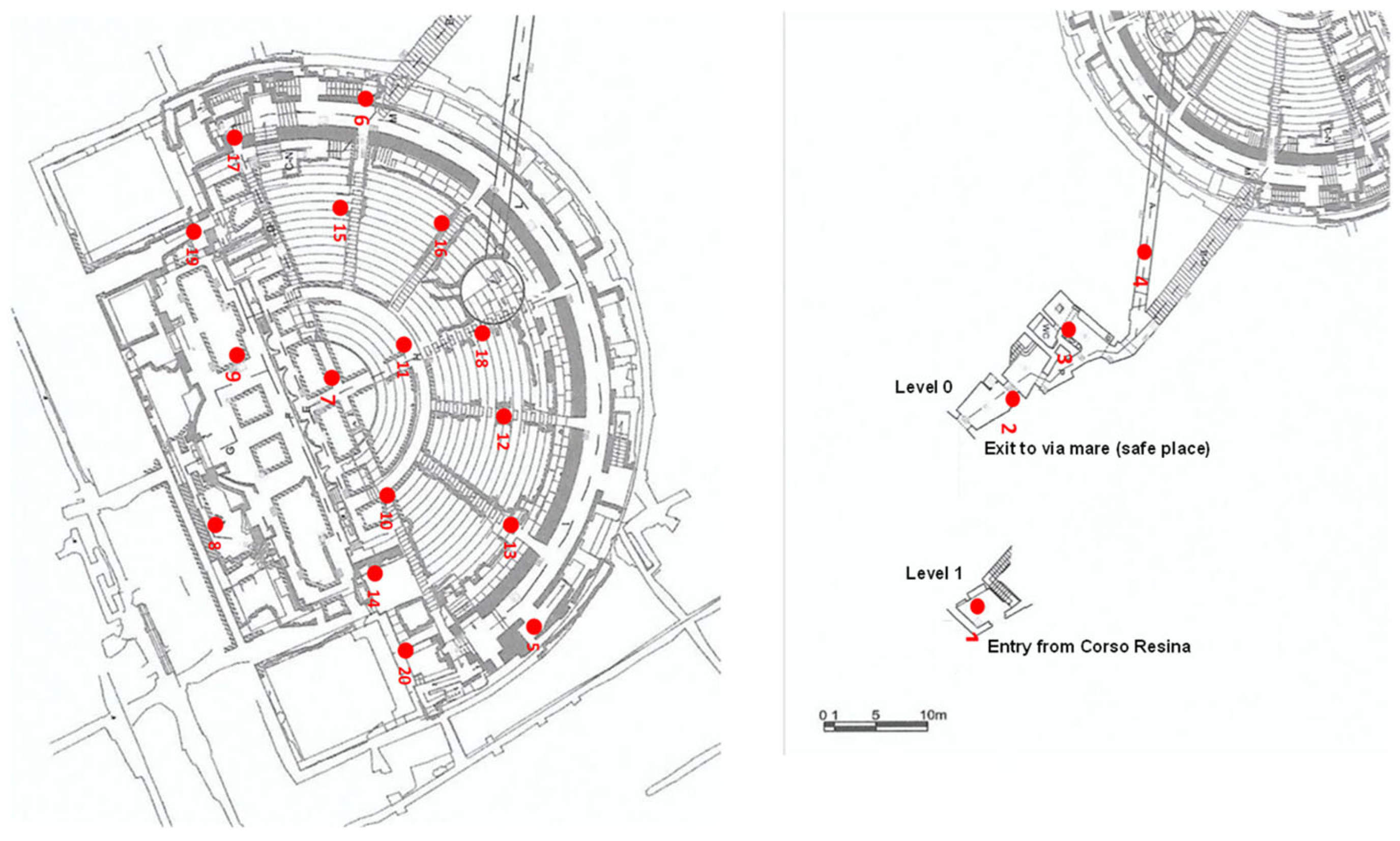
- In 1998, the Archaeological Superintendency of Pompeii tasked the Interdepartmental Centre for Engineering for Cultural Heritage (CIBeC) at the University of Naples Federico II with a study. The study’s purpose was to determine the necessary safety measures—specifically regarding ventilation issues—to open the theatre to the public, ensuring the well-being of both visitors and staff.
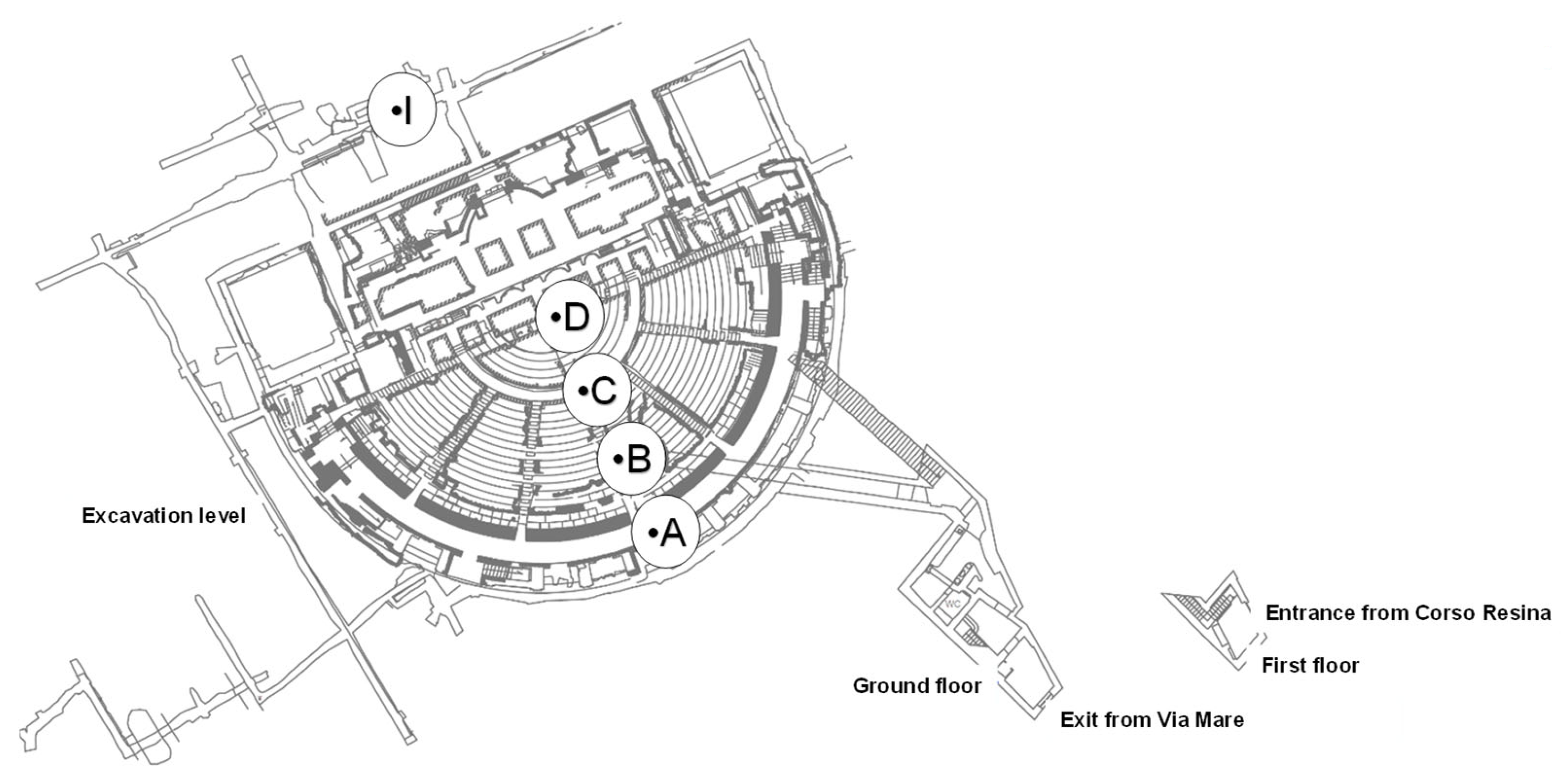
- In 1999, the Radiation Protection Service of the University Federico II of Naples conducted a radon concentration monitoring that involved four distinct points of the monument (on behalf of the CIBeC).
- In 2008, the Herculaneum Conservation Project5 (HCP) commissioned further monitoring from the Ionizing Radiation Laboratory—Natural Radioactivity Sector of the Higher Institute for Prevention and Safety at Work (ISPESL). This later study aimed to provide a general indication for technical consultancy regarding radon risk diagnostics.
- Scheduled in 2017, a 2018–2019 monitoring campaign used personal dosimeters on theatre personnel to determine absorbed radon doses. The goal was to inform safety measures for public reopening, pending full annual radon monitoring, with checks occurring monthly in 2018 and annually throughout 2018–2019.
- Environmental monitoring campaign started in 2024 (still ongoing).
2.3.1. The Ventilation Study Carried out in 1998
- Two Brüel & Kjær (Nærum, Denmark) Type 1302 Multi-Gas Monitors;
- One Brüel & Kjær (Nærum, Denmark) Type 1303 Multipoint Sampler and Doser;
- One Innova AirTech Instruments (Ballerup, Denmark) Type 1303 Multipoint Sampler;
- Two personal computers equipped with Brüel & Kjær (Ballerup, Denmark) 7620 software (B&K 7620 Version 3.5) for system control and data acquisition.
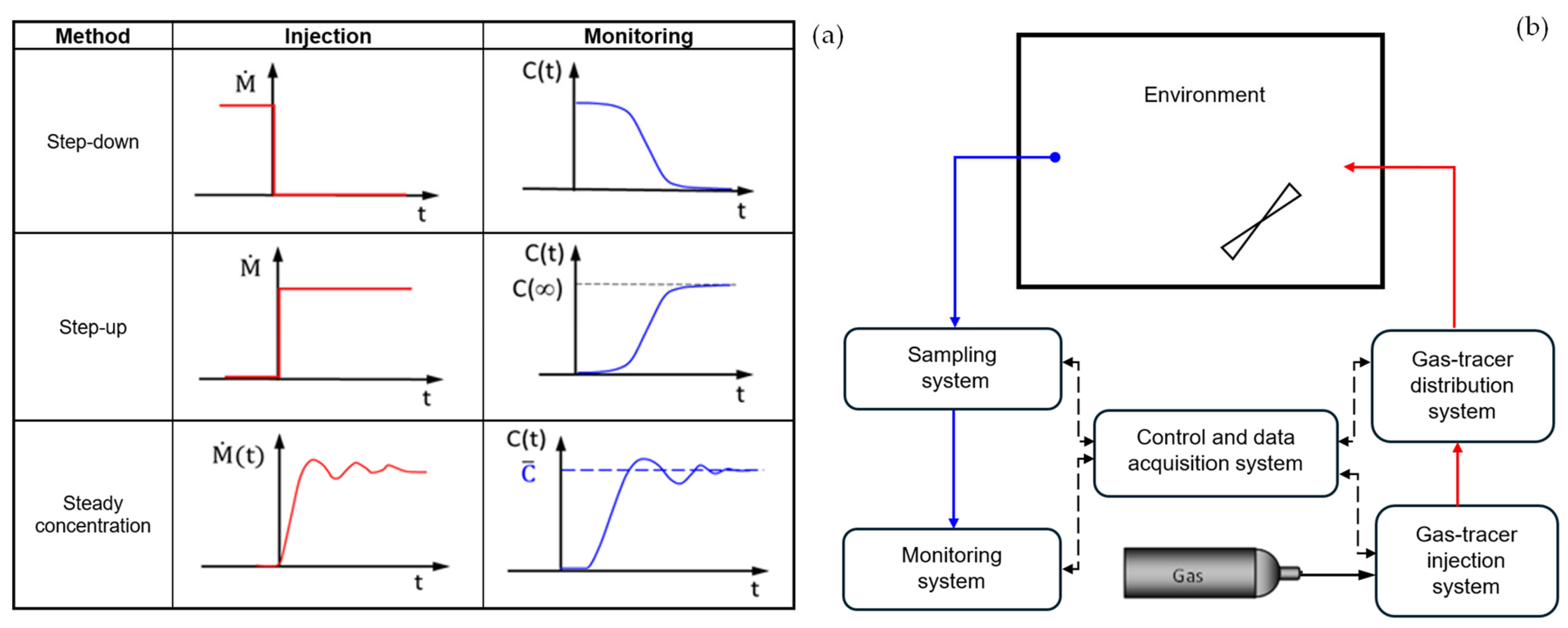
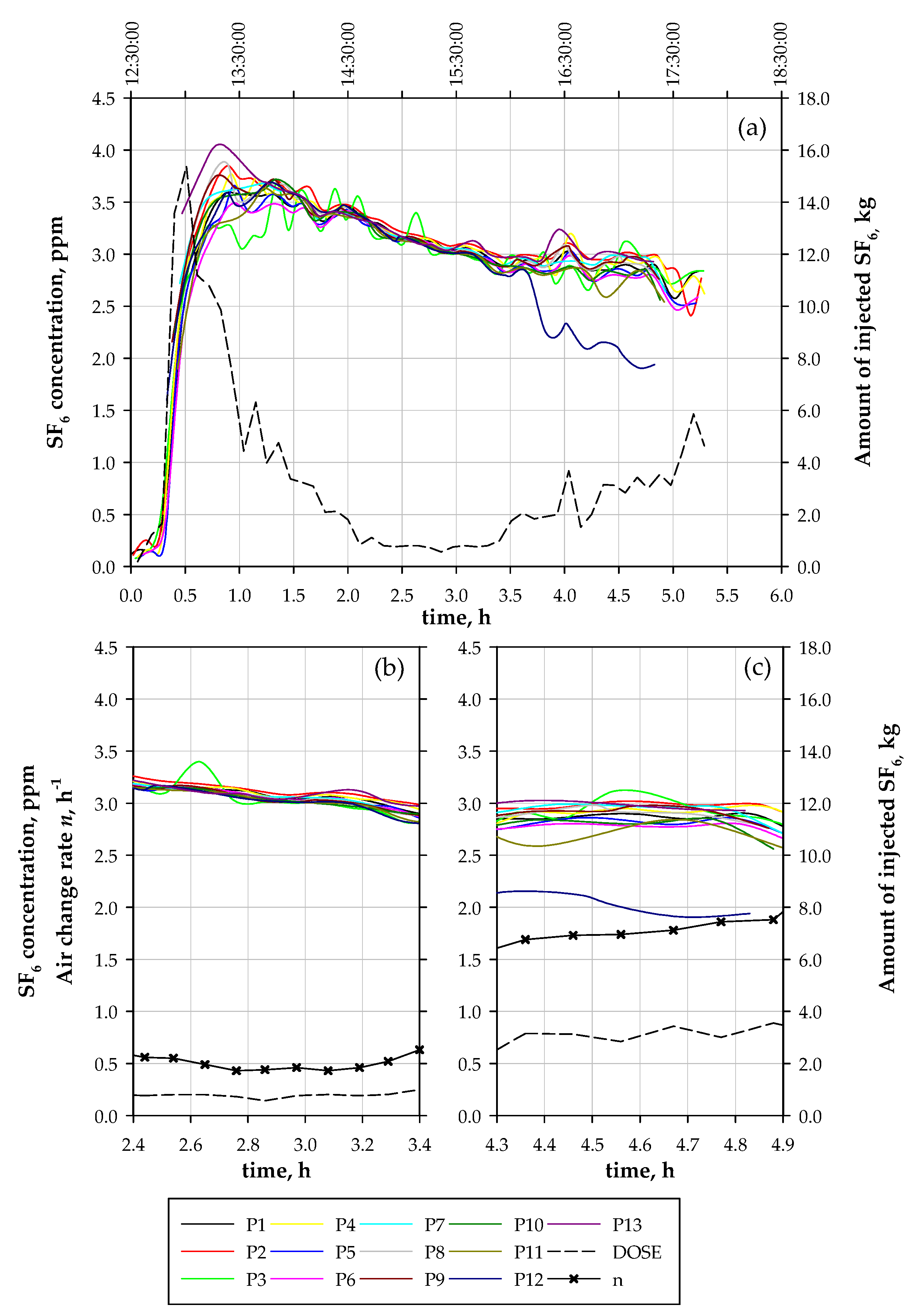
- The tracer gas was introduced using the constant concentration method.
- A set-point concentration of 3 ppm for sulphur hexafluoride (SF6) was established.
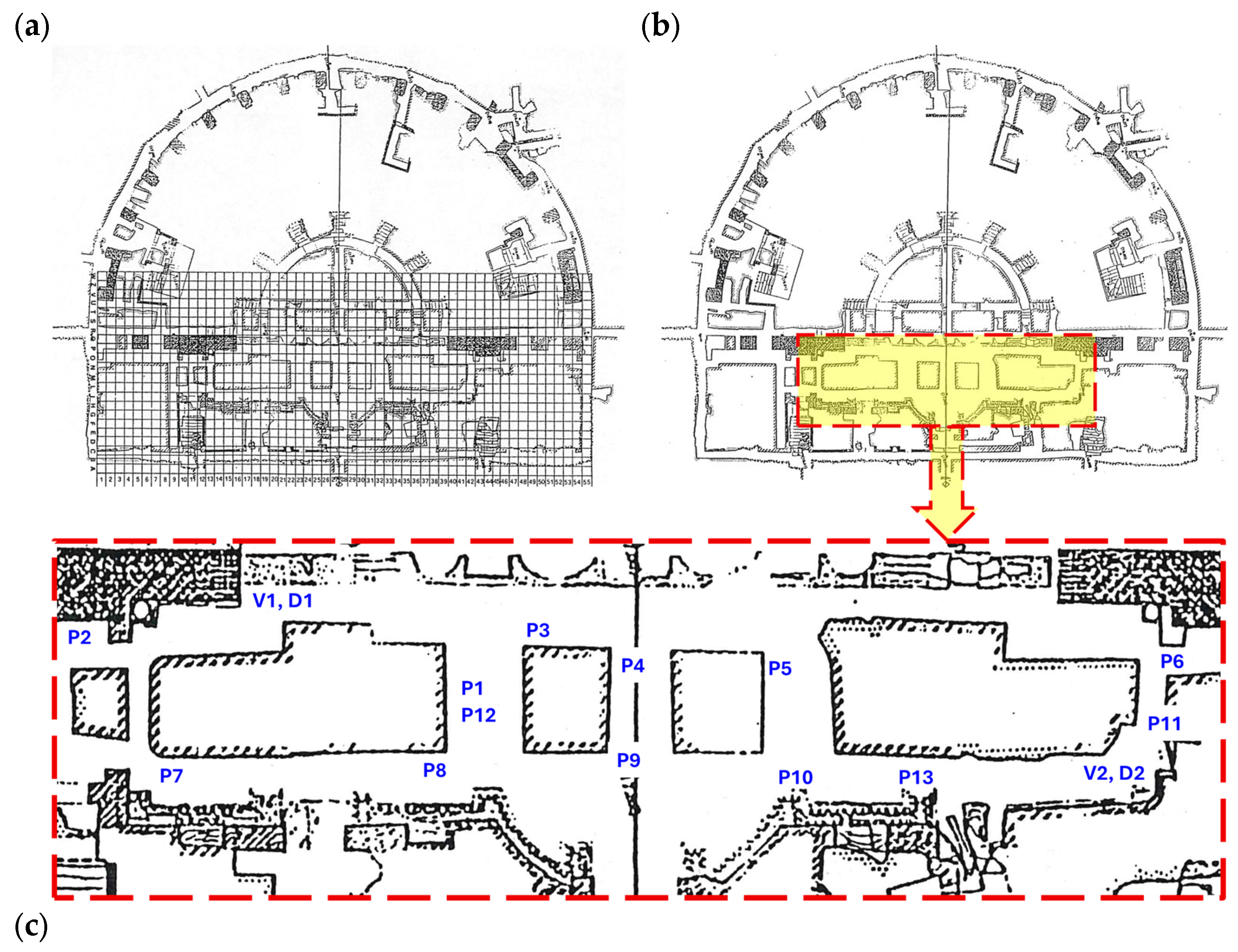
- At approximately 16:00, the sampling probe at point P12 was relocated to the summa cavea, near the ventilation shaft, to assess vertical distribution.
- The measurement campaign concluded at 18:00 to allow sufficient time—approximately one hour—for the dismantling and removal of equipment from the theatre.
2.3.2. Radon Concentration Monitoring Campaign Developed in 1999
2.3.3. Radon Concentration Spot Measurements Carried out in 2008
2.3.4. The Monitoring Campaign Carried out over the Period 2018–2019
The Systematic Assessment Strategy Formulated and Adopted
Dose Assessment Model and Monitoring Features
- Initial technical inspection.
- Assignment to the 9 workers of dosimeters equipped with appropriate identification codes.
- Recording the working hours of each person involved in the monitoring.
- Analysis of the radon gas activity concentration data.
- Conversion factors described in Legislative Decree 241/2000 [40].
- Assessment of personnel exposure.
2.3.5. Monitoring Campaign Started in 2024
3. Results and Discussion
3.1. The Ventilation Study Carried out in 1998
3.2. The Ventilation Study Carried out in 1998 and 2008
3.3. Measurement Campaign Carried out over the Period 2018–2019
3.3.1. Monitoring on Workers
3.3.2. Half-Yearly and Yearly Monitoring
3.3.3. Definition of the Allowable Exposure Time for Workers
- The variability of radon concentration throughout the year, which, as mentioned, varies significantly depending on the depth and location of the environments.
- The occasional presence of workers inside the site, which depends on their tasks and visiting shifts.
- Monitoring conditions.
3.3.4. Further Investigations on the Causes of the Presence of Radon
3.4. Possible Mitigation Solutions Under Discussion
3.5. The Fruition of the Theatre Today
3.5.1. The Restoration
3.5.2. The Lighting System
3.5.3. Other Interventions
4. Limitations
5. Conclusions
Author Contributions
Funding
Institutional Review Board Statement
Informed Consent Statement
Data Availability Statement
Acknowledgments
Conflicts of Interest
Abbreviations
| CIBeC | Interdepartmental Centre of Engineering for the Cultural Heritage |
| E-PERM | Electret Passive Environmental Radon Monitor |
| ERR | Excess Relative Risk |
| GRP | Glass Reinforced Plastic |
| GWP | Global Warming Potential |
| HCP | Herculaneum Conservation Project |
| IARC | International Agency for Research on Cancer |
| INAIL | National Institute for Insurance against Accidents at Work |
| ISPESL | Higher Institute for Prevention and Safety at Work |
| LED | Light Emitting Diode |
| NHL 3.5 | Natural Hydraulic Lime with a strength rating of 3.5 |
| PTFE | Polytetrafluoroethylene |
| PUC | Municipal Urban Plan |
| SOBANE | Screening Observation Analysis Expertise |
| WHO | World Health Organization |
| Symbols | |
| C | radon activity concentration, Bq m−3 |
| C(t) | tracer gas concentration over time, ppm |
| C(∞) | stable tracer gas concentration, ppm |
| C6F14 | perfluoro hexane |
| CCl2F2 | dichlorodifluoromethane (or R12) |
| CO2 | carbon dioxide |
| D | absorbed dose, Gy or J kg−1 |
| dε | mean energy imparted by ionizing radiation to matter in a volume element, J |
| dm | mass of matter contained in the considered volume element, kg |
| DOSE | amount of injected SF6, kg |
| e | height above sea level, m |
| E | effective dose, mSv yr−1 |
| F | conventional conversion factor, mSv m3 Bq−1 h−1 |
| n | air change rate, h−1 |
| N2O | nitrous oxide |
| q | gas tracer emission rate, m3 h−1 |
| qsup | fresh air supply rate, m3 h−1 |
| SD | Standard deviation of the radon concentration, Bq m−3 |
| SF6 | sulphur hexafluoride |
| t | time, h |
| T | Occupancy time, h yr−1 |
| V | volume of the ventilated environment, m3 |
| Greek symbols | |
| τn | Ventilation time constant, h |
| 1 | The Lex Iulia Theatralis get approved by Augustus between 20 and 17 BC. |
| 2 | In 1748, excavations began at Pompeii, allowing for a shift from tunnel techniques to open-air excavations. Amedeo Maiuri fully implemented this approach in Herculaneum, conducting excavations and restoration work from 1927 to 1961, which revealed much of what remains visible today of the ancient Roman city. |
| 3 | Naples was the final destination on their journey to Italy. |
| 4 | The Archaeological Park of Herculaneum is a site of significant national interest established by the Decree of the Minister of Cultural Heritage and Activities and Tourism of 9 April 2016 n. 198 adopted under Article 6 of the Decree of the Minister of Cultural Heritage and Activities and Tourism of 23 January 2016 n. 44. |
| 5 | The Herculaneum Conservation Project (HCP), launched in 2001 by the Packard Humanities Institute (PHI), is a public–private initiative aimed at conserving and enhancing the ancient city of Herculaneum. An interdisciplinary team of Italian professionals worked with the Archaeological Superintendence of Pompeii until 2016 and now supports the Park officials in addressing conservation challenges. |
| 6 | CR-39, a thermosetting resin, excels at detecting alpha particles emitted by radon. For this application, a small CR-39 plate (25 × 25 × 2 mm) was placed inside a cylindrical plastic container. This container filters out non-radon radiation, allowing only radon gas to penetrate and deposit on the plate. Alpha particles striking the plate leave micro-traces, which are then chemically enlarged using a sodium hydroxide solution. These measurements remain unaffected by environmental conditions such as temperature (up to 110 °C) or relative humidity (from 5% to 95%). |
References
- Museo Archeologico Nazionale di Napoli (inv. 3740–3742). CIL 10, 1443; CIL 10, 1444; CIL 10, 1445.
- Guadagno, G. Supplemento epigrafico ercolanese II. Cron. Ercol. 1981, 11, 129–164. [Google Scholar]
- Pagano, M. Il teatro di Ercolano. Cron. Ercol. 1993, 21, 121–156. [Google Scholar]
- Pagano, M.; Balasco, A. Il Teatro Antico di Ercolano; Electa: Napoli, Italy, 2000; p. 111. [Google Scholar]
- Ciancio Rossetto, P.; Pisani Sartorio, G. Teatri Greci e Romani alle Origini del Linguaggio Rappresentato: Censimento Analitico, Voll. I–III; Edizioni SEAT: Torino, Italy, 1994; pp. 502, 610, 599. [Google Scholar]
- Rawson, E. Discrimina Ordinum: La Lex Julia Theatralis. Pap. Br. Sch. Rome 1987, 55, 83–114. [Google Scholar] [CrossRef]
- Zanker, P. Augusto e il Potere delle Immagini; Bollati Boringhieri: Torino, Italy, 1989; p. 432. [Google Scholar]
- Museo Archeologico Nazionale di Napoli (inv. 3740-3742). CIL X 1427.
- Museo Archeologico Nazionale di Napoli (inv. 3740-3742). CIL X 1424.
- Guadagno, G. Contributi epigrafici per la storia amministrativa e la topografia ercolanese. In La Regione Sotterrata dal Vesuvio. Studi e Prospettive, Atti del Convegno Internazionale, Naples, Italy, 11–15 November 1979; Università degli Studi di Napoli: Naples, Italy, 1979; pp. 193–210. (In Italian) [Google Scholar]
- Camodeca, G. I Ceti Dirigenti di Rango Senatorio, Equestre e Decurionale della Campania Romana; Satura Editrice: Napoli, Italy, 2008; p. 418. [Google Scholar]
- d’Ambrosio Alfano, F.R.; Iannace, G.; Ianniello, C.; Ianniello, E. Velaria in ancient roman theatres: Can they have an acoustic role? Energy Build. 2015, 95, 98–105. [Google Scholar] [CrossRef]
- Triscari, M.O. Il Complesso Scultoreo del Teatro di Ercolano; Arbor Sapientiae Editore: Roma, Italy, 2021; p. 248. [Google Scholar]
- Sirano, F. Die gleichzeitigkeit des ungleichzeitigen: Gli scavi borbonici del 1700 come stratigrafia del Parco Archeologico di Ercolano. In Studi e Ricerche del Parco Archeologico di Pompei 43, 2020 (La Cultura Dell’antico a Napoli nel Secolo dei Lumi: Omaggio a Fausto Zevi nel Dì genetliaco. Atti del Convegno Internazionale. Napoli, 14–16 novembre 2018); L’ERMA di Bretschneider: Rome, Italy, 2020; pp. 419–433. (In Italian) [Google Scholar]
- Camardo, D.; Notomista, M. Ricostruire il paesaggio antico. La planimetria del territorio ercolanese realizzata da Francesco La Vega nel XVIII secolo. In Extra Moenia. Abitare il Territorio Della Regione Vesuviana (a Cura di A. Coralini); Scienze e Lettere: Rome, Italy, 2021; pp. 41–52. (In Italian) [Google Scholar]
- Frasca, F.; Verticchio, E.; Caratelli, A.; Bertolin, C.; Camuffo, D. A Comprehensive Study of the Microclimate-Induced Conservation Risks in Hypogeal Sites: The Mithraeum of the Baths of Caracalla (Rome). Sensors 2020, 20, 3310. [Google Scholar] [CrossRef]
- D’Orazio, M.; Quagliarini, E.; Bernardini, G.; Gregorini, B.; Gianangeli, A. Sustainable fruition as a preventive conservation strategy for hypogeum artefacts. J. Cult. Herit. 2020, 46, 235–243. [Google Scholar] [CrossRef]
- Sainz-Jimenez, C. (Ed.) The Conservation of Subterranean Cultural Heritage; Taylor and Francis: London, UK, 2014. [Google Scholar]
- Albero, S.; Giavarini, C.; Santarelli, M.L.; Vodret, A. CFD modeling for the conservation of the Gilded Vault Hall in the Domus Aurea. J. Cult. Herit. 2004, 5, 197–203. [Google Scholar] [CrossRef]
- Benavente, D.; Sanchez-Moral, S.; Fernandez-Cortes, A.; Cañaveras, J.C.; Elez, J.; Saiz-Jimenez, C. Salt damage and microclimate in the Postumius Tomb, Roman Necropolis of Carmona, Spain. Environ. Earth Sci. 2011, 63, 1529–1543. [Google Scholar] [CrossRef]
- D’Agostino, D.; Congedo, P.M.; Cataldo, R. Computational fluid dynamics (CFD) modeling of microclimate for salts crystallization control and artworks conservation. J. Cult. Herit. 2014, 15, 448–457. [Google Scholar] [CrossRef]
- International Agency for Research on Cancer. Man-Made Mineral Fibres and Rado, IARC Monographs on the Evaluation of the Carcinogenic Risks to Humans Volume 43, 1988. Available online: https://publications.iarc.fr/_publications/media/download/1592/bddbe727065b1d7fddd8a42fa4e9e9cf758ce65e.pdf (accessed on 17 June 2025).
- World Health Orgaization. WHO Guidelines for Indoor Air Quality: Selected Pollutants; WHO Regional Office for Europe: Copenhagen, Denmark, 2010. [Google Scholar]
- Council of Europe. Council directive 2013/59/EURATOM of 5 December 2013 laying down basic safety standards for protection against the dangers arising from exposure to ionising radiation, and repealing Directives 89/618/Euratom, 90/641/Euratom, 96/29/Euratom, 97/43/Euratom and 2003/122/Euratom. Off. J. Eur. Union 2014, L13, 1–73. [Google Scholar]
- Istituto Superiore di Sanità. Come si Riduce il Livello di Radon Negli Edifici. Available online: https://www.iss.it/documents/20126/6944167/Come+si+riduce+il+livello+di+radon+negli+edifici.pdf/56c8dc12-4fa0-9fa2-2917-b2a39c779875?t=1650018396369 (accessed on 31 December 2025). (In Italian)
- Agenzia Regionale per la Protezione Ambientale della Toscana (ARPAT), Radon: Cosa Fare. Available online: https://www.arpat.toscana.it/temi-ambientali/radioattivita/radon/cosa-fare/radon-cosa-fare? (accessed on 31 December 2025). (In Italian)
- Khan, S.M.; Gomes, J.; Krewski, D.R. Radon interventions around the globe: A systematic review. Heliyon 2019, 5, e01737. [Google Scholar] [CrossRef] [PubMed]
- Guida, D.; Guida, M.; Cuomo, A.; Mancini, S.; Siervo, V. The RAD Campania Program: Premises, activities, state of art and perspective. In Proceedings of the Italian Radon & N.O.R.M. Workshop “Research Advances and Applications” (IRANOW 2015), Fisciano, Italy, 15–17 October 2015; pp. 18–20. [Google Scholar]
- Asimakou, K.; Kallithrakas-Kontos, N.; Vafeidis, A.; Manoutsoglou, E. Distribution of Radon Concentrations in Active and Inactive Underground Mines. Mater. Proc. 2021, 5, 38. [Google Scholar] [CrossRef]
- Nunes, L.J.R.; Curado, A.; Lopes, S.I. The Relationship between Radon and Geology: Sources, Transport and Indoor Accumulation. Appl. Sci. 2023, 13, 7460. [Google Scholar] [CrossRef]
- Rage, E.; Caër-Lorho, S.; Drubay, D.; Ancelet, S.; Laroche, P.; Laurier, D. Mortality analyses in the updated French cohort of uranium miners (1946–2007). Int. Arch. Occup. Environ. Health 2015, 88, 717–730. [Google Scholar] [CrossRef]
- Italian Parliament. Adozione del piano nazionale d’azione per il radon 2023–2032 [Adoption of the National Radon Action Plan 2023–2032]. Suppl. Ordin. Alla Gazz. Uff. 2024, 43, 121. Available online: https://www.gazzettaufficiale.it/eli/id/2024/02/21/24A00877/sg (accessed on 31 December 2025). (In Italian)
- Sherman, M.H. Tracer-Gas Techniques for Measuring Ventilation in a Single Zone. Build. Environ. 1990, 25, 365–374. [Google Scholar] [CrossRef]
- Remion, G.; Moujalled, B.; El Mankibi, M. Review of tracer gas-based methods for the characterization of natural ventilation performance: Comparative analysis of their accuracy. Build. Environ 2019, 160, 106180. [Google Scholar] [CrossRef]
- ISO Standard 15265; Ergonomics of Thermal Environments: Strategy of Evaluation of the Risk for the Prevention of Constraints or Discomfort Under Thermal Working Conditions Standard. International Standardization Organization: Geneva, Switzerland, 2005.
- d’Ambrosio Alfano, F.R.; Palella, B.I.; Riccio, G. On the transition thermal discomfort to heat stress as a function of the PMV value. Ind. Health 2013, 51, 285–296. [Google Scholar] [CrossRef]
- Malchaire, J.B.; Gebhardt, H.J.; Piette, A. Strategy for Evaluation and Prevention of Risk due to Work in Thermal Environment. Ann. Occup. Hyg. 1999, 43, 367–376. [Google Scholar] [CrossRef]
- Italian Parliament. Decreto Legislativo 9 aprile 2008, n. 81: Attuazione dell’articolo 1 della legge 3 agosto 2007, n. 123, in materia di tutela della salute e della sicurezza nei luoghi di lavoro [Legislative Decree 9 April 2008, no. 81: Implementation of Article 1 of Law 3 August 2007, no. 123, concerning the protection of health and safety in the workplace]. Gazz. Uff. Della Repubb. Ital. 2008, 101. Available online: https://www.normattiva.it/esporta/attoCompleto?atto.dataPubblicazioneGazzetta=2008-04-30&atto.codiceRedazionale=008G0104 (accessed on 31 December 2025). (In Italian)
- Italian Parliament. Decreto Legislativo 17 marzo 1995, n. 230: Attuazione delle direttive 89/618/EURATOM, 90/641/EURATOM, 92/3/EURATOM e 96/29/EURATOM in materia di protezione sanitaria dei lavoratori e della popolazione contro i pericoli delle radiazioni ionizzanti. [Legislative Decree 17 March 1995, no. 230: Implementation of Directives 89/618/EURATOM, 90/641/EURATOM, 92/3/EURATOM, and 96/29/EURATOM concerning the health protection of workers and the population against the dangers of ionizing radiation…]. Gazz. Uff. Della Repubb. Ital. 1995, 136. Available online: https://www.normattiva.it/uri-res/N2Ls?urn:nir:stato:decreto.legislativo:1995-03-17;230 (accessed on 31 December 2025). (In Italian)
- Italian Parliament. Decreto Legislativo 26 maggio 2000, n. 241: Attuazione della direttiva 97/43/EURATOM in materia di protezione sanitaria contro i pericoli delle radiazioni ionizzanti connesse ad esposizioni mediche [Legislative Decree 26 May 2000, no. 241: Implementation of Directive 97/43/EURATOM concerning health protection against the dangers of ionizing radiation related to medical exposures]. Gazz. Uff. Della Repubb. Ital. 2000, 203. Available online: https://www.normattiva.it/uri-res/N2Ls?urn:nir:stato:decreto.legislativo:2000-05-26;241 (accessed on 31 December 2025). (In Italian)
- International Commission on Radiological Protection. Protection Against Radon-222 at Home and at Work (ICRP Publication 65). In Annals of the ICRP; Elsevier: Oxford, UK, 1993; Volume 23, pp. 1–43. Available online: https://journals.sagepub.com/doi/pdf/10.1177/ANIB_23_2 (accessed on 31 December 2025).
- International Commission on Radiological Protection. Occupational Intakes of Radionuclides: Part 3 (ICRP Publication 137). In Annals of the ICRP; SAGE Publications: London, UK, 2017; Volume 46, pp. 1–486. Available online: https://journals.sagepub.com/doi/pdf/10.1177/ANIB_46_3-4#page=1.00&gsr=0 (accessed on 31 December 2025).
- Italian Parliament, Decreto Legislativo 31 luglio 2020, n. 101: Attuazione della direttiva 2013/59/EURATOM, che stabilisce norme fondamentali di sicurezza relative alla protezione contro i pericoli derivanti dall’esposizione alle radiazioni ionizzanti [Legislative Decree 31 July 2020, no. 101: Implementation of Directive 2013/59/EURATOM, which establishes basic safety standards for protection against dangers arising from exposure to ionizing radiation…]. Gazz. Uff. Della Repubb. Ital. 2020, 201. Available online: https://www.gazzettaufficiale.it/eli/id/2020/08/12/20G00121/sg (accessed on 31 December 2025). (In Italian)
- Carbonara, G. Avvicinamento al Restauro; Liguori: Napoli, Italy, 1997; p. 836. [Google Scholar]
- EN Standard 12464-1; Light and lighting—Lighting of Workplaces—Part 1: Indoor Workplaces. European Committee for Standardization: Brussels, Belgium, 2021.
- EN Standard 12464-2; Light and lighting—Lighting of Workplaces—Part 2: Outdoor Workplaces. European Committee for Standardization: Brussels, Belgium, 2024.
- Italian Parliament. Decreto Ministeriale 10 maggio 2001: Atto di indirizzo sui criteri tecnico-scientifici e sugli standard di funzionamento e sviluppo dei musei [Ministerial Decree of May 10, 2001: Guidelines on technical-scientific criteria and standards for the operation and development of museums]. Gazz. Uff. Della Repubb. Ital. 2001, 244. Available online: https://sabapmetropolitanana.cultura.gov.it/wp-content/uploads/2023/03/1310746917330_DM10_5_01.pdf (accessed on 31 December 2025). (In Italian)
- Technical Specification TS 16163; Conservation of Cultural Heritage—Guidelines and Procedures for Choosing Appropriate Lighting for Indoor Exhibitions. European Committee for Standardization: Brussels, Belgium, 2014.
- Bellia, L.; Birolo, L.; Casillo, A.; Corsaro, M.M.; De Natale, A.; Fragliasso, F.; Genovese, A.; Palella, B.I.; Petraretti, M.; Pollio, A.; et al. Analyzing the Effects of Monochromatic Lights on the Fungal Growth to Control the Progression of Microbial Deterioration on Animal Collections Preserved in the Zoological Museum of Naples, Italy. Leukos 2025, 21, 404–422. [Google Scholar] [CrossRef]
- Lapilli del Parco Archeologico di Ercolano: Casa dello Scheletro. Available online: https://www.youtube.com/watch?v=JvTEd1RZN4Y&list=PLpL9S4HFhyIRksZgFneQApWcJ3R-UMoRd (accessed on 31 December 2025). (In Italian)






| Method | Hypotheses | Initial Condition | C(t) | n | Note |
|---|---|---|---|---|---|
| Step down | q = 0 n = cost. | C(0) = C0 | Gas is premixed with air | ||
| Step up | q = cost. n = cost. | C(0) = 0 | Gas is injected with a known and constant flow rate, up to a constant concentration C(∞) | ||
| Steady state concentration | C(0) = 0 | Gas is injected with a known and modulable flow rate to maintain a constant concentration |
| Tracer | Molecular Weight (kg kgmol−1) | Boiling Point (°C) | Range of Detection (ppm) | Base Concentration (ppm) | GWP |
|---|---|---|---|---|---|
| CO2 | 44 | −56.6 | 0.05–2000 | Variable | 1 |
| N2O | 44 | −88.5 | 0.05–2000 | 0.03 | 265 |
| CCl2F2 (R12) | 121 | −29.8 | 0.05–2000 0.001–0.05 | - | 10,900 |
| SF6 | 146 | −50.8 | 0.05–2000 0.00002–0.5 | - | 22,800 |
| C6F14 | 338 | 57.0 | 10−8 | - | 9300 |
| Modalities | Stage 1 Observation | Stage 2 Analysis | Stage 3 Expertise |
|---|---|---|---|
| When? | when a “problem” is detected | more complicated cases | very complex cases |
| How? | qualitative observations | ordinary measurements | specialised measurements |
| Cost? | Low | average | high |
| Duration (order of magnitude) | 2 h | 1 day | a few days |
| By whom? | workers + management from the company | same + specialists | same + specialists + experts |
| Competency | |||
| work situation: | high | average | low |
| ergonomics: | average | high | specialised |
| Quantity | Range of Values | Average Value |
|---|---|---|
| Air temperature (°C) | 13.9–15.1 | 14.3 |
| Relative humidity (%) | 96.5–99.0 | 98.0 |
| Point | Height Above Sea Level (m) | Mean Radon Concentration (Bq m−3) | SD (Bq m−3) |
|---|---|---|---|
| 1999 | |||
| Higher media cavea (A) | 34.38 | 239 | 121 |
| Big well (B) | 28.86 | 2384 | 120 |
| Lower media cavea (C) | 23.34 | 2562 | 128 |
| Orchestra (D) | 17.82 | 2313 | 116 |
| Mean value | - | 2406 | 61 |
| 2008 | |||
| Proscaenium (I) | 17.82 | 371 | 312 |
| Dosimeter ID | Worker | Total Exposure Time (h) | Dose (mSv) |
|---|---|---|---|
| 57139 | A | 98 | 0.01 |
| 57183 | B | 97 | 0.01 |
| 57222 | C | 194 | 0.6 |
| 57259 | D | 103 | 0.1 |
| 57296 | E | 106 | 0.01 |
| 57092 | F | 203 | 0.4 |
| 57135 | G | 75 | 0.0 |
| 57294 | H | 200 | 0.2 |
| 57301 | I | 36 | 0.01 |
| Measurement Point | Height Above Sea Level (m) | 1st Semester Average Concentration (Bq m−3) | 2nd Semester Average Concentration (Bq m−3) | Yearly Average Concentration (Bq m−3) |
|---|---|---|---|---|
| 1 | 39.65 | 212 ± 23 | 325 ± 35 | 269 ± 42 |
| 2 | 34.38 | 242 ± 26 | 381 ± 40 | 312 ± 48 |
| 3 | 34.38 | 291 ± 31 | 522 ± 54 | 407 ± 62 |
| 4 | 34.38 | 333 ± 36 | 549 ± 57 | 442 ± 67 |
| 5 | 34.38 | 4195 ± 423 | 1747 ± 177 | 2965 ± 459 |
| 6 | 34.38 | 1972 ± 200 | 1442 ± 147 | 1706 ± 248 |
| 7 | 17.82 | 3575 ± 361 | 1190 ± 121 | 2376 ± 381 |
| 8 | 17.82 | 4018 ± 405 | 1343 ± 137 | 2673 ± 428 |
| 9 | 17.82 | 3585 ± 362 | 1300 ± 132 | 2436 ± 385 |
| 10 | 17.82 | 3207 ± 324 | 1247 ± 127 | 2222 ± 348 |
| 11 | 23.34 | 3084 ± 311 | 1409 ± 143 | 2242 ± 342 |
| 12 | 28.86 | 3475 ± 350 | 1771 ± 180 | 2619 ± 394 |
| 13 | 32.31 | 3880 ± 391 | 1505 ± 153 | 2686 ± 420 |
| 14 | 17.82 | 3944 ± 398 | 1358 ± 138 | 2644 ± 421 |
| 15 | 28.86 | 3042 ± 307 | 1488 ± 151 | 2261 ± 342 |
| 16 | 29.90 | 2241 ± 227 | 1338 ± 136 | 1787 ± 265 |
| 17 | 17.82 | 1717 ± 174 | 1446 ± 147 | 1581 ± 228 |
| 18 | 27.48 | 3429 ± 346 | 1552 ± 158 | 2486 ± 380 |
| 19 | 17.82 | 2927 ± 295 | 1203 ± 123 | 2060 ± 320 |
| 20 | 17.82 | 3945 ± 398 | 1282 ± 131 | 2606 ± 419 |
| Depth Form Ground Level (m) | Soil Description |
|---|---|
| −1.50 | Pyroclastic fill material |
| −3.50 | Water table |
| −4.50 | Ash and lapilli—ash and ejecta |
| −6.50 | Fine sand |
| −9.00 | Sand with grey pumice and lava inclusions |
| −11.00 | Coarse sand and with grey pumice |
| −12.50 | Coarse sand with lenses of tuffaceous conglomerate |
| −14.00 | Layers of tuffaceous conglomerate |
| −16.20 | Gray-green tuffaceous conglomerate (massive bed) |
| −18.00 | Tuffaceous conglomerate with white pumice—mosaic |
| −19.50 | Lapilli and Herculaneum bricks—humic layer |
| −20.00 | Heterogeneous sand |
Disclaimer/Publisher’s Note: The statements, opinions and data contained in all publications are solely those of the individual author(s) and contributor(s) and not of MDPI and/or the editor(s). MDPI and/or the editor(s) disclaim responsibility for any injury to people or property resulting from any ideas, methods, instructions or products referred to in the content. |
© 2026 by the authors. Licensee MDPI, Basel, Switzerland. This article is an open access article distributed under the terms and conditions of the Creative Commons Attribution (CC BY) license.
Share and Cite
d’Ambrosio Alfano, F.R.; Sirano, F.; Cantone, F.; Caso, M.; Di Lillo, A.; Riccio, G.; Siano, S.; Testa, A.; Palella, B.I. Systematic Methodology for Mitigating Radon Risk and Enhancing Fruition of Underground Sites: The Case-Study of Herculaneum’s Theatre. Heritage 2026, 9, 18. https://doi.org/10.3390/heritage9010018
d’Ambrosio Alfano FR, Sirano F, Cantone F, Caso M, Di Lillo A, Riccio G, Siano S, Testa A, Palella BI. Systematic Methodology for Mitigating Radon Risk and Enhancing Fruition of Underground Sites: The Case-Study of Herculaneum’s Theatre. Heritage. 2026; 9(1):18. https://doi.org/10.3390/heritage9010018
Chicago/Turabian Styled’Ambrosio Alfano, Francesca Romana, Francesco Sirano, Francesca Cantone, Marina Caso, Angela Di Lillo, Giuseppe Riccio, Stefania Siano, Antonio Testa, and Boris Igor Palella. 2026. "Systematic Methodology for Mitigating Radon Risk and Enhancing Fruition of Underground Sites: The Case-Study of Herculaneum’s Theatre" Heritage 9, no. 1: 18. https://doi.org/10.3390/heritage9010018
APA Styled’Ambrosio Alfano, F. R., Sirano, F., Cantone, F., Caso, M., Di Lillo, A., Riccio, G., Siano, S., Testa, A., & Palella, B. I. (2026). Systematic Methodology for Mitigating Radon Risk and Enhancing Fruition of Underground Sites: The Case-Study of Herculaneum’s Theatre. Heritage, 9(1), 18. https://doi.org/10.3390/heritage9010018