


The Simulation-Based Analysis Focusing on Street Obstruction of Evacuee Mobility to Mitigate Disaster Risk: Chiang Mai Historic City




Abstract
1. Introduction
2. Materials and Methods
2.1. Background of Study Site
2.2. Conceptual Framework
2.3. Determination of Origin and Destination
2.4. Input Parameter of Evacuees (Agent)
2.5. Creation of Street Obstruction Scenarios
2.5.1. No Obstruction Scenario
2.5.2. Vehicle Obstruction Scenario
2.5.3. Building Rubble Obstruction Scenario
2.5.4. Combined Obstruction Scenario
3. Results and Discussion
3.1. Overview of Comparative Results
3.2. Simulation
3.3. Time to Evacuation Destination and Accumulated Route
3.4. Evacuation Capacity and Gate Location
4. Conclusions
Supplementary Materials
Author Contributions
Funding
Data Availability Statement
Acknowledgments
Conflicts of Interest
References
- Shaw, R. Community Practices for Disaster Risk Reduction in Japan; Springer: Tokyo, Japan, 2014; ISBN 4431542469. [Google Scholar]
- Shaw, R.; Uy, N.; Baumwoll, J. Indigenous Knowledge for Disaster Risk Reduction: Good Practices and Lessons Learned from Experiences in the Asia-Pacific Region; United Nations, International Strategy for Disaster Reduction: Geneva, Switzerland, 2008. [Google Scholar]
- Balay-As, M.; Marlowe, J.; Gaillard, J.C. Deconstructing the Binary between Indigenous and Scientific Knowledge in Disaster Risk Reduction: Approaches to High Impact Weather Hazards. Int. J. Disaster Risk Reduct. 2018, 30, 18–24. [Google Scholar] [CrossRef]
- Rodwell, D. Conservation and Sustainability in Historic Cities; Blackwell Publ.: Oxford, UK, 2008; ISBN 9781405126564. [Google Scholar]
- Okubo, T. Traditional Wisdom for Disaster Mitigation in History of Japanese Architectures and Historic Cities. J. Cult. Herit. 2016, 20, 715–724. [Google Scholar] [CrossRef]
- Mercer, J.; Kelman, I.; Taranis, L.; Suchet-Pearson, S. Framework for Integrating Indigenous and Scientific Knowledge for Disaster Risk Reduction. Disasters 2010, 34, 214–239. [Google Scholar] [CrossRef] [PubMed]
- Mercer, J.; Kelman, I.; Suchet-Pearson, S.; Lloyd, K. Integrating Indigenous and Scientific Knowledge for Disaster Risk Reduction. Geogr. Ann. B Hum. Geogr. 2009, 91, 157–183, ISBN 9781607415749. [Google Scholar] [CrossRef]
- Agrawal, A. Dismantling the Divide Between Indigenous and Scientific Knowledge. Dev. Change 1995, 26, 413–439. [Google Scholar] [CrossRef]
- Amideo, A.E.; Scaparra, M.P.; Kotiadis, K. Optimising Shelter Location and Evacuation Routing Operations: The Critical Issues. Eur. J. Oper. Res. 2019, 279, 279–295. [Google Scholar] [CrossRef]
- Pedraza-Martinez, A.J.; Van Wassenhove, L.N. Empirically Grounded Research in Humanitarian Operations Management: The Way Forward. J. Oper. Manag. 2016, 45, 1–10. [Google Scholar] [CrossRef]
- Bandarin, F. Changing Heritage; Routledge: London, UK, 2024; ISBN 9781003463306. [Google Scholar]
- UNITAR. UNDRR Making Cities Resilient: Developing Local Disaster Risk Reduction and Resilience Strategies; UNITAR: Geneva, Switzerland, 2023. [Google Scholar]
- Ferreira, T.M.; Lourenço, P.B. Disaster Risk Reduction and Urban Resilience: Concepts, Methods and Applications. In Resilient Structures and Infrastructure; Farsangi, E.N., Takewaki, I., Yang, T.Y., Astaneh-Asl, A., Gardoni, P., Eds.; Springer: Singapore, 2019; pp. 453–473. [Google Scholar]
- UNDRR. Monitoring Sendai Framework. Available online: https://www.undrr.org/monitoring-sendai-framework (accessed on 14 August 2023).
- United Nations Office for Disaster Risk Reduction (UNDRR), The Report of the Midterm Review of the Implementation of the Sendai Framework for Disaster Risk Reduction 2015–2030; UNDRR: Geneva, Switzerland, 2023.
- Rahman, A.; Fang, C. Appraisal of Gaps and Challenges in Sendai Framework for Disaster Risk Reduction Priority 1 Through the Lens of Science, Technology and Innovation. Prog. Disaster Sci. 2019, 1, 100006. [Google Scholar] [CrossRef]
- Helbing, D.; Farkas, I.; Vicsek, T. Simulating Dynamical Features of Escape Panic. Nature 2000, 407, 487–490. [Google Scholar] [CrossRef]
- Burstedde, C.; Klauck, K.; Schadschneider, A.; Zittartz, J. Simulation of Pedestrian Dynamics Using a Two-Dimensional Cellular Automaton. Phys. A Stat. Mech. Appl. 2001, 295, 507–525. [Google Scholar] [CrossRef]
- Yue, H.; Zhang, J.; Chen, W.; Wu, X.; Zhang, X.; Shao, C. Simulation of the Influence of Spatial Obstacles on Evacuation Pedestrian Flow in Walking Facilities. Phys. A Stat. Mech. Appl. 2021, 571, 125844. [Google Scholar] [CrossRef]
- Kuligowski, E.D.; Peacock, R.D. A Review of Building Evacuation Models; National Institute of Standards and Technology: Gaithersburg, MD, USA, 2005; 156p.
- Wood, N.J.; Schmidtlein, M.C. Anisotropic Path Modeling to Assess Pedestrian-Evacuation Potential from Cascadia-Related Tsunamis in the US Pacific Northwest. Nat. Hazards 2012, 62, 275–300. [Google Scholar] [CrossRef]
- Pereira, L.A.; Burgarelli, D.; Duczmal, L.H.; Cruz, F.R.B. Emergency Evacuation Models Based on Cellular Automata with Route Changes and Group Fields. Phys. A Stat. Mech. Appl. 2017, 473, 97–110. [Google Scholar] [CrossRef]
- Chen, X.; Zhan, F.B. Agent-Based Modelling and Simulation of Urban Evacuation: Relative Effectiveness of Simultaneous and Staged Evacuation Strategies. J. Oper. Res. Soc. 2008, 59, 25–33. [Google Scholar] [CrossRef]
- Bish, D.R. Planning for a Bus-Based Evacuation. OR Spectr. 2011, 33, 629–654. [Google Scholar] [CrossRef]
- Cova, T.J.; Johnson, J.P. A Network Flow Model for Lane-Based Evacuation Routing. Transp. Res. Part A Policy Pr. 2003, 37, 579–604. [Google Scholar] [CrossRef]
- Lim, G.J.; Rungta, M.; Baharnemati, M.R. Reliability Analysis of Evacuation Routes under Capacity Uncertainty of Road Links. IIE Trans. (Inst. Ind. Eng.) 2015, 47, 50–63. [Google Scholar] [CrossRef]
- Miller-Hooks, E.; Patterson, S.S. On Solving Quickest Time Problems in Time-Dependent, Dynamic Networks. J. Math. Model. Algorithms 2004, 3, 39–71. [Google Scholar] [CrossRef]
- Shahparvari, S.; Abbasi, B.; Chhetri, P. Possibilistic Scheduling Routing for Short-Notice Bushfire Emergency Evacuation under Uncertainties: An Australian Case Study. Omega 2017, 72, 96–117. [Google Scholar] [CrossRef]
- Chen, C.C.F.; Chou, C.S. Modeling and Performance Assessment of a Transit-Based Evacuation Plan within a Contraflow Simulation Environment. Transp. Res. Rec. 2009, 2091, 40–50. [Google Scholar] [CrossRef]
- Altay, N.; Green, W.G., III. OR/MS Research in Disaster Operations Management. Eur. J. Oper. Res. 2006, 175, 475–493. [Google Scholar] [CrossRef]
- Galindo, G.; Batta, R. Review of Recent Developments in OR/MS Research in Disaster Operations Management. Eur. J. Oper. Res. 2013, 230, 201–211. [Google Scholar] [CrossRef]
- Tufekci, S.; Wallace, W.A. The Emerging Area of Emergency Management and Engineering. IEEE Trans. Eng. Manag. 1998, 45, 103–105. [Google Scholar] [CrossRef]
- Bayram, V.; Yaman, H. Shelter Location and Evacuation Route Assignment under Uncertainty: A Benders Decomposition Approach. Transp. Sci. 2018, 52, 416–436. [Google Scholar] [CrossRef]
- Lim, G.J.; Zangeneh, S.; Baharnemati, M.R.; Assavapokee, T. A Capacitated Network Flow Optimization Approach for Short Notice Evacuation Planning. Eur. J. Oper. Res. 2012, 223, 234–245. [Google Scholar] [CrossRef]
- Michon, P.-E.; Denis, M. When and Why Are Visual Landmarks Used in Giving Directions? In Spatial Information Theory, Proceedings of the COSIT 2001, Morro Bay, CA, USA, 19–23 September 2001; Montello, D.R., Ed.; Springer: Berlin/Heidelberg, Germany, 2001; pp. 292–305. [Google Scholar]
- Sharma, G.; Kaushal, Y.; Chandra, S.; Singh, V.; Mittal, A.P.; Dutt, V. Influence of Landmarks on Wayfinding and Brain Connectivity in Immersive Virtual Reality Environment. Front. Psychol. 2017, 8, 1220. [Google Scholar] [CrossRef]
- Cliburn, D.C.; Winlock, T.; Rilea, S.; Donsel, M. Van Dynamic Landmark Placement as a Navigation Aid in Virtual Worlds. In Proceedings of the VRST ’07, Newport Beach, CA, USA, 5–7 November 2007. [Google Scholar]
- Amini Hosseini, K.; Tarebari, S.A.; Mirhakimi, S.A. A New Index-Based Model for Site Selection of Emergency Shelters after an Earthquake for Iran. Int. J. Disaster Risk Reduct. 2022, 77, 103110. [Google Scholar] [CrossRef]
- Lindell, M.K. EMBLEM2: An Empirically Based Large Scale Evacuation Time Estimate Model. Transp. Res. Part A Policy Pr. 2008, 42, 140–154. [Google Scholar] [CrossRef]
- Joo, J.; Kim, N.; Wysk, R.A.; Rothrock, L.; Son, Y.J.; Oh, Y.G.; Lee, S. Agent-Based Simulation of Affordance-Based Human Behaviors in Emergency Evacuation. Simul. Model. Pr. Theory 2013, 32, 99–115. [Google Scholar] [CrossRef]
- Haghani, M.; Sarvi, M. Human Exit Choice in Crowded Built Environments: Investigating Underlying Behavioural Differences between Normal Egress and Emergency Evacuations. Fire Saf. J. 2016, 85, 1–9. [Google Scholar] [CrossRef]
- Tamima, U.; Chouinard, L. Development of Evacuation Models for Moderate Seismic Zones: A Case Study of Montreal. Int. J. Disaster Risk Reduct. 2016, 16, 167–179. [Google Scholar] [CrossRef]
- Severiukhina, O.; Voloshin, D.; Lees, M.H.; Karbovskii, V. The Study of the Influence of Obstacles on Crowd Dynamics. Procedia Comput. Sci. 2017, 108, 215–224. [Google Scholar] [CrossRef]
- Yang, X.; Wu, Z.; Li, Y. Difference between Real-Life Escape Panic and Mimic Exercises in Simulated Situation with Implications to the Statistical Physics Models of Emergency Evacuation: The 2008 Wenchuan Earthquake. Phys. A Stat. Mech. Appl. 2011, 390, 2375–2380. [Google Scholar] [CrossRef]
- Shiwakoti, N. Understanding Differences in Emergency Escape and Experimental Pedestrian Crowd Egress through Quantitative Comparison. Int. J. Disaster Risk Reduct. 2016, 20, 129–137. [Google Scholar] [CrossRef]
- Mentis, A.-F.A.; Papadopulos, J.S. Near-Collapse Buildings and Unsafe Sidewalks as Neglected Urban & Public Health Issue: A Qualitative Study. Urban Sci. 2021, 5, 47. [Google Scholar] [CrossRef]
- Castro, S.; Poulos, A.; Herrera, J.C.; de la Llera, J.C. Modeling the Impact of Earthquake-Induced Debris on Tsunami Evacuation Times of Coastal Cities. Earthq. Spectra 2019, 35, 137–158. [Google Scholar] [CrossRef]
- Ito, E.; Kawase, H.; Matsushima, S.; Hatayama, M. Tsunami Evacuation Simulation Considering Road Blockage by Collapsed Buildings Evaluated from Predicted Strong Ground Motion. Nat. Hazards 2020, 101, 959–980. [Google Scholar] [CrossRef]
- Chu, H.; Yu, J.; Wen, J.; Yi, M.; Chen, Y. Emergency Evacuation Simulation and Management Optimization in Urban Residential Communities. Sustainability 2019, 11, 795. [Google Scholar] [CrossRef]
- Barnes, B.; Dunn, S.; Pearson, C.; Wilkinson, S. Improving Human Behaviour in Macroscale City Evacuation Agent-Based Simulation. Int. J. Disaster Risk Reduct. 2021, 60, 102289. [Google Scholar] [CrossRef]
- Faucher, J.-E.; Dávila, S.; Hernández-Cruz, X. Modeling Pedestrian Evacuation for Near-Field Tsunamis Fusing ALCD and Agent-Based Approaches: A Case Study of Rincón, PR. Int. J. Disaster Risk Reduct. 2020, 49, 101606. [Google Scholar] [CrossRef]
- UNESCO. Recommendation Concerning the Safeguarding and Contemporary Role of Historic Areas; UNESCO: Nairobi, Kenya, 1976. [Google Scholar]
- ICOMOS. International Charter for the Conservation and Restoration of Monuments and Sites; ICOMOS: Paris, France, 1966. [Google Scholar]
- ICOMOS. Charter for the Conservation of Historic Towns and Urban Areas (Washington Charter 1987); ICOMOS: Washington, DC, USA, 1987. [Google Scholar]
- Kolonias, S.A. Charter for the Conservation of Historic Towns and Urban Areas (Washington 1987). In Encyclopedia of Global Archaeology; Springer: New York, NY, USA, 2014; pp. 1372–1374. [Google Scholar]
- UNESCO. Vienna Memorandum on “World Heritage and Contemporary Architecture—Managing the Historic Urban Landscape”. In Proceedings of the 15th Session of the General Assembly of States Parties, Paris, France, 10–11 October 2005. [Google Scholar]
- Brooks, G. The Burra Charter: Australia’s Methodology for Conserving Cultural Heritage [Standards]. Places 1992, 8, 86–88. [Google Scholar]
- Australia ICOMOS; International Council on Monuments and Sites. The Burra Charter: The Australia ICOMOS Charter for Places of Cultural Significance 2013; Australia ICOMOS: Burwood, Australia, 2013; ISBN 0957852843. [Google Scholar]
- ICOMOS. The Burra Charter: The Australia ICOMOS Charter for Places of Cultural Significance; Australia ICOMOS Incorporated: Paris, France, 1991; Volume 37. [Google Scholar]
- Bandarin, F.; van Oers, R. The Historic Urban Landscape: Managing Heritage in an Urban Century; Wiley: Hoboken, NJ, USA, 2012; ISBN 9781119968092. [Google Scholar]
- UNESCO. Recommendation on the Historic Urban Landscape; UNESCO: Paris, France, 2011. [Google Scholar]
- Fairclough, G. Cultural Landscape, Sustainability, and Living. In Managing Change: Sustainable Approaches to the Conservation of the Built Environment, Proceedings of the 4th Annual US/ICOMOS International Symposium Organized by US/ICOMOS, Program in Historic Preservation of the University of Pennsylvania, and the Getty Conservation Institute, Philadelphia, PA, USA, 6–8 April 2001; ICOMOS: Paris, France, 2003; p. 23. [Google Scholar]
- Margottini, C. Introduction to Heritage and Climate Change: Current Gaps and Scientific Challenges. In A Research Agenda for Heritage Planning; Edward Elgar Publishing: Cheltenham, UK, 2021. [Google Scholar]
- Ripp, M. A Metamodel for Heritage-Based Urban Development: Enabling Sustainable Growth through Urban Cultural Heritage; Springer Nature: Dordrecht, The Netherland, 2022. [Google Scholar]
- Ripp, M.; Clifford, J. Heritage-Based Urban Development. Encyclopedia 2025, 5, 82. [Google Scholar] [CrossRef]
- Acimovic, J.; Goentzel, J. Models and Metrics to Assess Humanitarian Response Capacity. J. Oper. Manag. 2016, 45, 11–29. [Google Scholar] [CrossRef]
- Wang, Y.; Kyriakidis, M.; Dang, V.N. Incorporating Human Factors in Emergency Evacuation—An Overview of Behavioral Factors and Models. Int. J. Disaster Risk Reduct. 2021, 60, 102254. [Google Scholar] [CrossRef]
- Srinurak, N.; Mishima, N.; Sukwai, J. Angular Segment Analysis to Support the Reinvention of Religious Spaces in Chiang Mai’s Historic Town. In Proceedings of the 11th International Symposium on Architectural Interchange in Asia, Sendai, Japan, 21 August 2016; Nakashima, M., Ed.; Architectural Institute of Japan, Tohoku University: Sendai, Japan, 2016; Volume 1, p. D5-1. [Google Scholar]
- Srinurak, N.; Mishima, N. Urban Axis and City Shape Evaluation Through Spatial Configuration in ‘Lan Na’ Northern Thailand Historic City. City Territ. Archit. 2017, 4, 10. [Google Scholar] [CrossRef]
- Srinurak, N.; Mishima, N.; Sukwai, J. The Obstructions Scenario in Evacuation: Simulation of Urban Evacuation Vulnerability and Its Solution. In Proceedings of the Annual International Conference on Architecture and Civil Engineering, Singapore, 27–28 May 2019; Anderson, M.S.T., Anderson, P.C.O., Eds.; Global Science and Technology Forum: Singapore, 2019; pp. 37–43. [Google Scholar]
- Mishima, N.; Miyamoto, N.; Taguchi, Y.; Kitagawa, K.; Oh, Y.-S.; Park, S.G. Development of a Two-Way Evacuation Route Database Based on Interviews Conducted with Historic Preservation Area Residents. Int. J. Contents 2013, 9, 48–57. [Google Scholar] [CrossRef][Green Version]
- Quagliarini, E.; Bernardini, G.; Santarelli, S.; Lucesoli, M. Evacuation Paths in Historic City Centres: A Holistic Methodology for Assessing Their Seismic Risk. Int. J. Disaster Risk Reduct. 2018, 31, 698–710. [Google Scholar] [CrossRef]
- Ferreira, T.M.; Mendes, N.; Silva, R. Multiscale Seismic Vulnerability Assessment and Retrofit of Existing Masonry Buildings. Buildings 2019, 9, 91. [Google Scholar] [CrossRef]
- Ripp, M.; Egusquiza, A.; Lückerath, D. Urban Heritage Resilience: An Integrated and Operationable Definition from the SHELTER and ARCH Projects. Land 2024, 13, 2052. [Google Scholar] [CrossRef]
- Okubo, T. Chapter 6: Temples and Shrines as Contemporary Shelters that Support Evacuees. In Tohoku Recovery: Challenges, Potentials and Future; Springer: Tokyo, Japan, 2014; pp. 65–78. [Google Scholar]
- Noisangiam, N. The Relationship between Temple Public Spaces and Surrounding Communities: The Case of Songkhla Municipality. J. Lib. Arts Prince Songkla Univ. 2022, 14, 230–257. [Google Scholar] [CrossRef]
- Moonkham, P.; Chladek, M. Living Sacred Landscape. In The Oxford Handbook of Lived Buddhism; Oxford University Press: Oxford, UK, 2024; pp. 155–172. [Google Scholar]
- Hills, A. Seduced by Recovery: The Consequences of Misunderstanding Disaster. J. Contingencies Crisis Manag. 1998, 6, 162–170. [Google Scholar] [CrossRef]
- Jumsai, S. Chapter 3: Aquatic Culture. In Laksana Thai2: Background; Thaiwatanapanich: Bangkok, Thailand, 2008; pp. 149–295. [Google Scholar]
- Ongsakun, S.; Millar, D.W.; Barron, S.; Tanratanakul, C. History of Lan Na, 2nd ed.; Silkworm Books: Chiang Mai, Thailand, 2005; ISBN 9749575849 9789749575840. [Google Scholar]
- Guntang, I. The Study on Characteristic and Development of Transportation Network and Built-Up Area in Chiang Mai. Master’s Thesis, Chulalongkorn University, Bangkok, Thailand, 1990. [Google Scholar]
- Tansukanun, P.; Duangthima, W. The Multi-Layered Districts of Chiang Mai City; Puepae: Chiang Mai, Thailand, 2013. [Google Scholar]
- Jarernmuang, T.; Apavajaruta, D. 700 Years of Chiang Mai; AkesornSiamKarnpim: Bangkok, Thailand, 1986. [Google Scholar]
- Charoenmuang, D.A. Sustainable Cities in Chiang Mai: A Case of a City in a Valley, 1st ed.; Beauclerk, C., Charoenmuang, T., Eds.; Chiang Mai University: Chiang Mai, Thailand, 2007. [Google Scholar]
- Chen, C.; Cheng, L. Evaluation of Seismic Evacuation Behavior in Complex Urban Environments Based on GIS: A Case Study of Xi’an, China. Int. J. Disaster Risk Reduct. 2020, 43, 101366. [Google Scholar] [CrossRef]
- Thornton, C.; O’Konski, R.; Klein, B.; Hardeman, B.; Swenson, D. New Wayfinding Techniques in Pathfinder and Supporting Research. In Pedestrian and Evacuation Dynamics 2012; Weidmann, U., Kirsch, U., Schreckenberg, M., Eds.; Springer International Publishing: Cham, Switzerland, 2014; pp. 1315–1322. [Google Scholar]
- Kendik, E. Methods of Design for Means of Egress: Towards A Quantitative Comparison of National Code Requirements. Fire Saf. Sci. 1986, 1, 497–511. [Google Scholar] [CrossRef][Green Version]
- Knoblauch, R.L.; Pietrucha, M.T.; Nitzburg, M. Field Studies of Pedestrian Walking Speed and Start-Up Time. Transp. Res. Rec. 1996, 1538, 27–38. [Google Scholar] [CrossRef]
- Forde, A.; Daniel, J. Pedestrian Walking Speed at Un-Signalized Midblock Crosswalk and Its Impact on Urban Street Segment Performance. J. Traffic Transp. Eng. (Engl. Ed.) 2021, 8, 57–69. [Google Scholar] [CrossRef]
- Association of Siamese Architects. Thai Anthropometry Handbook for Architectural Design; ASA: Bangkok, Thailand, 2008. [Google Scholar]
- Hillier, B. A Theory of the City as Object: Or, How Spatial Laws Mediate the Social Construction of Urban Space. URBAN Des. Int. 2002, 7, 153–179. [Google Scholar] [CrossRef]
- Lee, S.; Seo, K.W. Combining Space Syntax with GIS-Based Built Environment Measures in Pedestrian Walking Activity. In Proceedings of the 2013 International Space Syntax Symposium, Seoul, Republic of Korea, 31 October–3 November 2013. [Google Scholar]
- Hillier, B. Space Is the Machine, 3rd ed.; University of Cambridge: London, UK, 2007. [Google Scholar]
- Van Nes, A.; Yamu, C. Introduction to Space Syntax in Urban Studies; Springer International Publishing: Cham, Switzerland, 2021; ISBN 978-3-030-59139-7. [Google Scholar]
- Santarelli, S.; Bernardini, G.; Quagliarini, E. Earthquake Building Debris Estimation in Historic City Centres: From Real World Data to Experimental-Based Criteria. Int. J. Disaster Risk Reduct. 2018, 31, 281–291. [Google Scholar] [CrossRef]
- Quagliarini, E.; Bernardini, G.; Wazinski, C.; Spalazzi, L.; D’Orazio, M. Urban Scenarios Modifications Due to the Earthquake: Ruins Formation Criteria and Interactions with Pedestrians’ Evacuation. Bull. Earthq. Eng. 2016, 14, 1071–1101. [Google Scholar] [CrossRef]
- Jokilehto, J. Management of Sustainable Change in Historic Urban Areas. In Conservation and Urban Sustainable Development—A Theoretical Framework; Zancheti, S.M., Ed.; Centro de Conservação Integrada e Territorial: Recife, Brazil, 1999; Volume 1, pp. 61–68. [Google Scholar]
- Ernstson, H.; van der Leeuw, S.E.; Redman, C.L.; Meffert, D.J.; Davis, G.; Alfsen, C.; Elmqvist, T. Urban Transitions: On Urban Resilience and Human-Dominated Ecosystems. Ambio 2010, 39, 531–545. [Google Scholar] [CrossRef]
- Srinurak, N.; Sukwai, J. Urban Open Space’s Accessibility Assessment Using Angular Segment to Reinvent as Evacuation Shelter in Historic City. Int. J. Soc. Sci. Humanit. 2019, 1, 17–21. [Google Scholar] [CrossRef]
- Etzkowitz, H.; Leydesdorff, L. The Triple Helix—University-Industry-Government Relations: A Laboratory for Knowledge Based Economic Development. EASST Rev. 1995, 14, 14–19. [Google Scholar]
- Etzkowitz, H. The Triple Helix: University-Industry-Government Innovation in Action; Routledge: Oxfordshire, UK, 2008; ISBN 9781135925284. [Google Scholar]
- Ripp, M.; Lukat, A.H. From Obstacle to Resource: How Built Cultural Heritage Can Contribute to Resilient Cities. In Going Beyond; Springer International Publishing: Cham, Switzerland, 2017; pp. 99–112. [Google Scholar]



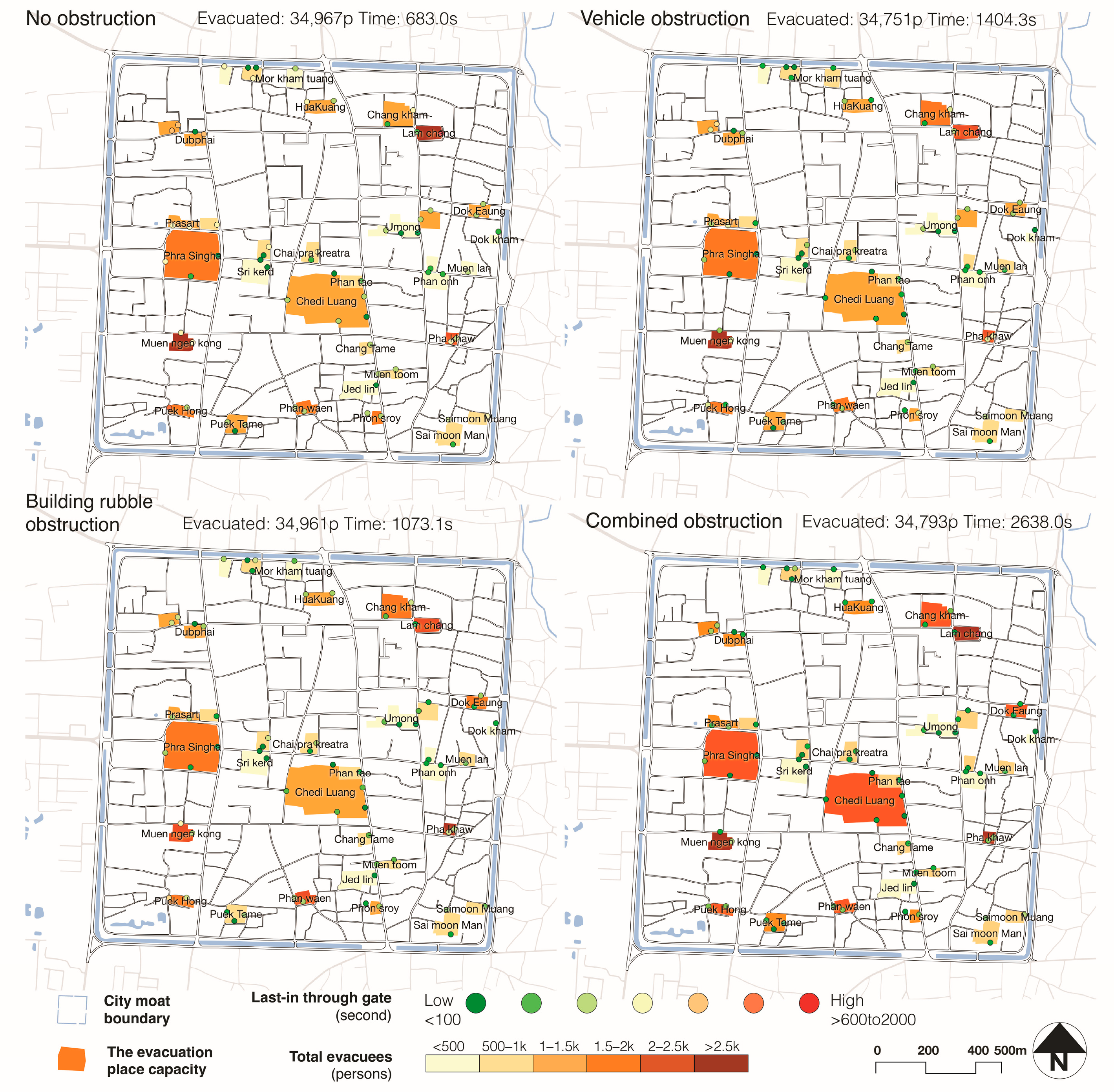
| No Obstruction (n = 34,967) | Vehicle Obstruction (n = 34,751) | Building Rubble Obstruction (n = 34,961) | Combined Obstruction (n = 34,793) | |||||
|---|---|---|---|---|---|---|---|---|
| Time (s) | Distance (m) | Time (s) | Distance (m) | Time (s) | Distance (m) | Time (s) | Distance (m) | |
| Min | 3.9 | 3.1 | 3.9 | 3.1 | 3.9 | 3.1 | 3.9 | 3.1 |
| Max | 682.8 | 609.6 | 1404.3 | 619.6 | 1073.1 | 785.2 | 2638 | 790.7 |
| Average | 112.4 | 165.6 | 261.2 | 176.2 | 183.5 | 176.2 | 343.4 | 127.4 |
Disclaimer/Publisher’s Note: The statements, opinions and data contained in all publications are solely those of the individual author(s) and contributor(s) and not of MDPI and/or the editor(s). MDPI and/or the editor(s) disclaim responsibility for any injury to people or property resulting from any ideas, methods, instructions or products referred to in the content. |
© 2025 by the authors. Licensee MDPI, Basel, Switzerland. This article is an open access article distributed under the terms and conditions of the Creative Commons Attribution (CC BY) license (https://creativecommons.org/licenses/by/4.0/).
Share and Cite
Srinurak, N.; Sukwai, J.; Mishima, N. The Simulation-Based Analysis Focusing on Street Obstruction of Evacuee Mobility to Mitigate Disaster Risk: Chiang Mai Historic City. Heritage 2025, 8, 546. https://doi.org/10.3390/heritage8120546
Srinurak N, Sukwai J, Mishima N. The Simulation-Based Analysis Focusing on Street Obstruction of Evacuee Mobility to Mitigate Disaster Risk: Chiang Mai Historic City. Heritage. 2025; 8(12):546. https://doi.org/10.3390/heritage8120546
Chicago/Turabian StyleSrinurak, Nattasit, Janjira Sukwai, and Nobuo Mishima. 2025. "The Simulation-Based Analysis Focusing on Street Obstruction of Evacuee Mobility to Mitigate Disaster Risk: Chiang Mai Historic City" Heritage 8, no. 12: 546. https://doi.org/10.3390/heritage8120546
APA StyleSrinurak, N., Sukwai, J., & Mishima, N. (2025). The Simulation-Based Analysis Focusing on Street Obstruction of Evacuee Mobility to Mitigate Disaster Risk: Chiang Mai Historic City. Heritage, 8(12), 546. https://doi.org/10.3390/heritage8120546