1. Introduction
Culture, understood as the traditions belonging to local communities, persists across generations through the legacies transmitted to younger members of society [
1]. The advent of the Internet and digital technologies has significantly benefited community-led heritage initiatives, particularly those centred on intangible heritage, by enabling new forms of participation [
2]. The UNESCO Convention [
3] explicitly emphasises the need to raise awareness among younger generations of the importance of intangible heritage, highlighting its social and economic impact [
4]. This emphasis resonates with broader scholarly perspectives that view cultural heritage as central to human development, not only through evolutionary processes but also through the preservation and adaptation of traditions [
5].
Traditional crafts can be understood as
manual practices that embody local knowledge, creativity, and community identity, often transmitted through apprenticeship and oral tradition [
3,
4]. They encompass not only the production of material objects but also the skills, meanings, and cultural values embedded in their making. In this sense, learning crafts contributes to emotional development, imagination, and self-expression, while fostering manual dexterity and cultural openness [
4]. Yet heritage is not sustained only through education—it also requires active community involvement. Tradition motivates individuals to preserve and share, transforming cultural continuity into a collective responsibility.
However, heritage transmission today faces critical challenges: younger generations are less exposed to craft-making, and digital culture often privileges speed and consumption over continuity. While prior research has explored how young people engage with heritage in museums or educational games [
6,
7], the specific role of teenagers in reimagining and communicating traditional crafts remains underexplored. This gap is particularly relevant in the context of intangible cultural heritage, where crafts, oral traditions, and social practices are increasingly mediated by digital platforms.
The methodological approach of this study builds on the principles of co-design, defined as
a participatory process where users and designers collaboratively shape ideas and solutions [
8,
9]. Co-design is increasingly applied in heritage contexts to promote ownership, authenticity, and intergenerational dialogue [
2]. Through previous co-design studies conducted with teenagers in Madeira’s museums, Cesário and colleagues demonstrated that young participants value playful, narrative-driven interaction as a means of connecting with heritage [
6,
7]. Building on these findings, the present study extends the application of co-design beyond museums to the context of traditional crafts, investigating how teenagers imagine the future of such practices through digital communication.
In doing so, this article addresses a research gap at the intersection of youth participation, intangible cultural heritage, and digital communication. Specifically, it seeks to understand how co-design can serve as a method for capturing and amplifying teenagers’ perspectives on cultural heritage. The study was guided by three research questions:
- (1)
How do teenagers perceive Madeira’s traditional crafts and their role in cultural heritage?
- (2)
What kinds of strategies do teenagers envision for preserving and promoting traditional crafts through digital communication?
- (3)
In what ways can co-design methods reveal youth perspectives on cultural heritage and foster creative engagement with tradition?
To address these questions, the study involved sixty teenagers from Madeira Island in structured co-design workshops aimed at developing creative proposals for communicating traditional crafts. The findings contribute to Heritage Studies by demonstrating how participatory methods can empower younger generations to act as co-creators of cultural futures rather than passive recipients of tradition.
2. Related Work
Co-design is often described as a bottom-up approach because it starts from the perspectives and experiences of participants rather than from predefined institutional goals. Thus, it gives individuals a voice in shaping the outcomes of a project. Sanders and Stappers [
8] define co-design as a process that invites people to “make and tell” during creation, encouraging shared decision-making and the redistribution of design authority between professionals and users. Within the field of cultural heritage, this means that communities are not simply consulted but actively participate in defining what their heritage is and how it should be represented. Such a participatory stance contrasts with more top-down approaches to heritage communication, in which audiences are positioned mainly as recipients of curated narratives. The bottom-up perspective is particularly important when dealing with intangible heritage, as these practices depend on lived participation and intergenerational dialogue.
Several authors have explored the relationship between participation, heritage, and technology. Giglitto et al. [
2] applied participatory methods to document the intangible heritage of Egyptian Bedouins, showing that local involvement increased authenticity and a sense of ownership. Rather than transferring control to external experts, the process helped participants decide which aspects of their culture to preserve and how to share them. This example illustrates how co-design can act as a catalyst for self-representation and for sustaining traditions in digital environments.
Other studies have added conceptual depth to these discussions. Zhang and colleagues [
10] proposed a four-dimensional framework—purpose, positioning, perspectives, and power relations—to explain how participation in heritage management is shaped by context and by the dynamics between stakeholders. Ågren and Aarsand [
11] examined young people’s digital drawing practices as forms of everyday heritage, highlighting that creativity in online spaces can also function as cultural continuity. Kasemsarn and Nickpour [
12] reviewed digital storytelling models in cultural tourism, stressing that authenticity and multimodal engagement are crucial when targeting youth audiences. Taken together, these works demonstrate that participation is not a single activity but a continuum ranging from consultation to genuine collaboration.
Despite the growing body of research on digital participation in heritage [
2,
13], few studies have examined how young people engage with traditional crafts—a field that is less mediated by technology and more rooted in manual skill and community knowledge [
4,
14]. Most participatory projects to date have focused on museums, tourism, or online archives [
7,
15]. This gap provides the rationale for the present study, which looks at crafts as a meaningful yet underexplored context for co-design with teenagers.
Previous work by Cesário and colleagues has already applied co-design with teenagers in museum environments [
6,
7,
16]. Those studies showed that young participants respond positively to storytelling, playfulness, and interactive design when exploring heritage. The current study builds on that foundation but shifts the focus from museum-based heritage to traditional crafts. By analysing how teenagers imagine and communicate craft practices in Madeira Island, the study offers both empirical findings and theoretical reflections on youth participation in intangible heritage communication.
In short, earlier research has shown that co-design can strengthen engagement and authenticity, but its potential to connect digital culture with embodied traditions remains largely unexplored. The present work therefore approaches co-design not only as a participatory method but also as a space for dialogue between generations, where creative collaboration can foster a shared understanding of heritage and its future.
3. Materials and Methods
This study followed an empirical, qualitative design based on co-design workshops. The research was conducted between March and May 2024 across three secondary school classes in Funchal, Madeira Island. In total, 78 students aged 17–20 were invited to participate, and 60 provided informed consent (along with parental consent when required). All sessions complied with the ethical guidelines of the University of Madeira, ensuring voluntary participation and anonymity throughout.
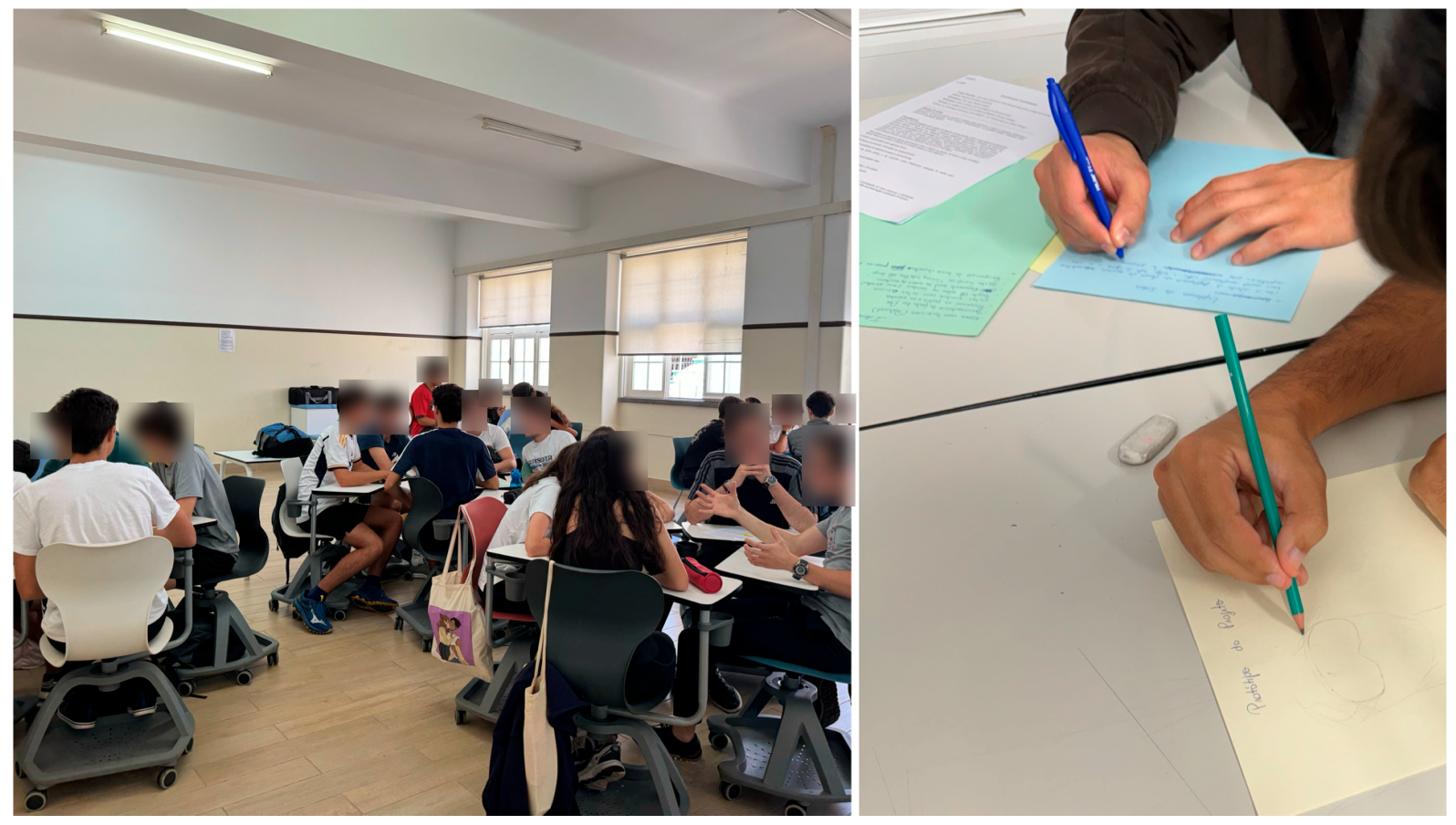
Each class took part in a 90 min co-design workshop conducted during regular class hours, with the approval and support of school management, and aligned with subjects addressing culture and communication themes. The workshops aimed to engage students in identifying, discussing, and reimagining Madeiran traditional craft (such as embroidery, wickerwork, and oral traditions) through the lens of digital communication. Workshops were co-facilitated by the researcher and a trained assistant. Teachers remained present to ensure discipline but did not intervene in the design process. Facilitators’ roles included introducing the task, explaining the sequence of activities, encouraging participation, and clarifying questions. No guidance was given about what constituted a “good” idea, to reduce bias and allow spontaneous expression. Nonetheless, the presence of adults might have influenced participation, particularly in groups where students were initially reserved.
Students were randomly assigned to groups of three to four members to balance gender and friendship ties. This randomisation helped reduce pre-existing hierarchies, although group dynamics naturally varied. Some teams showed collaborative energy, while others were dominated by one or two outspoken voices. These dynamics were noted during observation and considered when interpreting the findings.
Each workshop followed a four-step co-design process, guided by colour-coded worksheets adapted from previous research by Cesário and colleagues [
17]:
- (1)
Idea generation (green sheet): groups brainstormed possible ways to safeguard or promote Madeiran crafts;
- (2)
Concept development (blue sheet): one idea was selected and expanded with objectives and audiences;
- (3)
Interaction design (yellow sheet): groups described potential user experiences or media strategies;
- (4)
Prototyping (white sheet): final sketches illustrated the proposed solution (see
Figure 1).
The process encouraged participants to move from abstract thinking to tangible visualisation. At the end of each session, groups presented their ideas in an open discussion moderated by the facilitator. Workshops were audio recorded, and all worksheets were collected for analysis.
The data corpus included 56 completed worksheets and approximately 90 min of audio recordings per class, totalling 270 min. Notes taken during facilitation were also used as contextual support. The material was analysed following Braun and Clarke’s six-step model of thematic analysis [
18].
Analysis began with familiarisation through repeated reading and listening, followed by initial coding of recurrent ideas related to perceptions of heritage, technology, and youth agency. Codes were then collated into themes that reflected shared patterns across classes. The themes were refined through iterative comparison until five main categories were identified (see
Table 1).
The interpretative process considered both content (what was said) and context (how it was said and by whom), acknowledging that workshop dynamics could shape contributions. Given the qualitative and context-specific nature of the study, the findings are not intended to be generalised, but they may offer transferable insights for similar educational and cultural environments.
4. Results
The analysis followed Braun and Clarke’s six-step model of thematic analysis [
18], as outlined in
Section 3. Coding began with the systematic reading of all worksheets and workshop transcripts to identify recurrent ideas and expressions. Initial codes were generated inductively from participants’ words and later refined through iterative comparison across the three school contexts. Codes were then grouped into broader thematic categories that captured shared meanings. After several rounds of review, five main themes were retained because they consistently appeared across groups and schools: (1)
Heritage recognition, (2)
Cultural loss, (3)
Youth agency, (4)
Technology and gamification, and (5)
Storytelling and media.
The five selected themes best represented the collective discourse of participants about heritage and digital engagement. These themes, together with illustrative codes and excerpts from the workshops, are summarised in
Table 1 above, which provides an overview of how participants conceptualised heritage and digital communication.
4.1. Heritage Recognition
Participants demonstrated both familiarity and uncertainty regarding Madeira’s cultural heritage. They frequently mentioned embroidery (bordado), wickerwork (cestos de vime), the bailinho (folk dance), and traditional foods such as bolo do caco (bread). However, some responses included contemporary figures and infrastructures—such as Cristiano Ronaldo or cable cars, showing a fluid understanding of what counts as heritage. This blending of tradition and popular culture reflects how identity is experienced in everyday life. As one participant noted, “As a Madeiran, everyone should know this,” adding that heritage “represents who we are and how we live.” Such comments show that teenagers connect heritage with belonging rather than with formal classification.
4.2. Cultural Loss
A strong concern expressed across workshops was the fear of cultural erosion. Students perceived that tourism and globalisation were changing local customs. Several remarked that “we are losing our identity,” associating this with commercialisation and the transformation of religious festivals into entertainment. These concerns reveal not only nostalgia but also awareness of socio-economic dynamics that affect tradition. Some groups linked cultural loss to generational change: “Young people no longer want to learn crafts.” Such statements demonstrate a sense of urgency and responsibility among teenagers regarding preservation.
4.3. Youth Agency
Many participants viewed themselves as potential mediators between tradition and modernity. They called for initiatives that would “encourage young people to continue the traditions” and argued that heritage “represents a part of us and our origins.” Although these affirmations suggest motivation, their performative nature must be acknowledged: the co-design setting may have encouraged socially desirable responses. Still, repeated emphasis on agency indicates that young people recognise their role in sustaining cultural practices, even if they have limited opportunities to do so in daily life.
4.4. Technology and Gamification
Digital media emerged as the dominant framework through which teenagers imagined the future of crafts. Proposals included interactive games, augmented reality tours, and mobile apps for learning Madeiran recipes or embroidery. One group suggested “a game with rewards where people explore the island, like Pokémon Go but in Madeira.” Others described virtual museum visits or apps linking craftspeople to younger audiences. Such ideas show that technology was perceived not as a replacement for tradition but as a bridge connecting heritage to youth culture.
4.5. Storytelling and Media
Storytelling appeared as a transversal strategy across all groups. Participants proposed podcasts, YouTube channels, short documentaries, and hybrid cultural events combining physical and digital experiences. For example, one team described a “Thematic Week” that would mix school activities with performances and excursions. The use of narrative formats indicates that students associate heritage with lived experiences and personal stories rather than with static displays. They also stressed authenticity and local voice, viewing social media as a space for creative expression and community promotion.
Overall, the thematic structure highlights a collective understanding of heritage as both personal and evolving. Teenagers framed cultural traditions through emotional attachment, digital fluency, and awareness of change. The combination of pride, anxiety, and creativity characterises their relationship with heritage today.
5. Discussion
This discussion addresses the study’s three research questions and situates the findings within the broader debates on youth participation, intangible heritage, and digital communication. While the co-design process generated valuable insights, the analysis also highlights the challenges and limits of applying participatory methods in classroom contexts.
RQ1: How do teenagers perceive Madeira’s traditional crafts and their role in cultural heritage? The results show that young people in Madeira connect heritage with identity and belonging but also reveal blurred boundaries between formal traditions and popular culture. This dual perception reflects what Smith [
19] describes as the “authorised heritage discourse,” where institutional narratives coexist with everyday experiences of culture. For the students, embroidery, music, and food traditions coexist naturally with football idols or local landmarks, illustrating how heritage is lived rather than formally defined. Other studies similarly note that younger generations tend to blend traditional and contemporary symbols in expressing cultural pride [
2,
10]. This finding reinforces the idea that heritage literacy among youth is not only about knowledge of traditions but also about recognition of cultural hybridity. In Madeira’s context, where tourism and globalisation play visible roles, teenagers’ views reveal a desire to maintain cultural continuity while adapting to change—a tension observed in other peripheral regions facing cultural commodification [
20].
RQ2: What kinds of strategies do teenagers envision for preserving and promoting traditional crafts through digital communication? The teenagers’ proposal focused on gamification, social media, and storytelling align with previous research showing that narrative and play can increase engagement with heritage [
7,
21,
22]. However, unlike studies where digital heritage design was led by professionals, the co-design approach here allowed teenagers to construct their own visions of what digital heritage could be. This suggests that young people see technology not as an external add-on, but as part of their everyday cultural expression. Still, the proposals are deeply contextual. Madeira’s island setting, tourism economy, and close-knit communities influence how youth imagine digital interaction with heritage. For example, the idea of a Pokémon Go-style cultural game draws on both local geography and the desire for visibility beyond the island. These results therefore should not be read as general models for “youth and heritage” globally but as reflections of a specific cultural and geographic environment.
RQ3: In what ways can co-design methods reveal youth perspectives on cultural heritage and foster creative engagement with tradition? The co-design process proved effective for eliciting creative ideas, but it also introduced methodological constraints. Conducting workshops within school timetables meant that time was limited and that participation occurred within a semi-formal environment. Some students may have been influenced by peers or facilitators, and group hierarchies occasionally shaped the discussion. These factors, noted in other co-design research [
8,
9], can affect openness and depth of contribution.
Nevertheless, the method succeeded in shifting teenagers from passive reflection to active ideation. The structured worksheets provided scaffolding for creativity, and the public sharing of ideas encouraged collective reflection. Future studies might combine co-design workshops with follow-up sessions, allowing participants to develop prototypes further or to test them with local artisans. Recognising these methodological limits reinforces the need for reflexivity in participatory design. As Steen [
9] notes, co-design is a process of negotiation that always reflects its social context. In this case, it illuminated teenagers’ aspirations and concerns but also the institutional conditions that shape their voice.
5.1. Implications for Heritage Practice
While the findings are specific to Madeira, they offer practical lessons for heritage education and policy.
For educators, the study shows that integrating co-design activities into school curricula can enhance heritage literacy by connecting tradition with digital creativity. Simple interventions—such as thematic workshops or storytelling projects—can help students engage emotionally and critically with local culture. For museums and cultural institutions, co-design can serve as a model for participatory programming. Involving young audiences in content creation or exhibition design not only strengthens engagement but also diversifies interpretive perspectives. For policymakers, supporting youth-centred initiatives through small grants or digital literacy programmes can sustain local crafts in ways that resonate with younger generations.
These recommendations do not seek to universalize Madeira’s experience but to suggest pathways that could be adapted in comparable insular or community-based contexts. This study contributes to ongoing discussions about participatory heritage and youth engagement. It extends the work of Giglitto et al. [
2] and Zhang et al. [
10] by applying co-design to the realm of traditional crafts rather than digital archives or museums. It also adds to debates on authenticity and agency, showing how teenagers articulate both pride and anxiety toward cultural continuity.
Theoretically, the findings support the argument that digital heritage practices must move beyond representation to participation. Co-design becomes not merely a design tool but a means of cultural mediation—a way to negotiate identity and belonging through shared creation. In this regard, the study contributes to the understanding of how intangible heritage can be sustained when communities, including young members, are empowered to imagine its future.
5.2. Limitations
The study’s context-specific nature limits the generalisation of its findings. The participants were all based in Madeira, and their views reflect a particular socio-cultural environment. The relatively small sample and time-limited workshops also restrict the depth of exploration possible. Further studies could expand to different regions or cultural groups, apply longitudinal approaches, or incorporate artisans as co-participants to explore intergenerational collaboration.
6. Conclusions
This study explored how teenagers in Madeira perceive and imagine the future of traditional crafts through co-design. Sixty students participated in structured workshops that encouraged reflection, creativity, and collaboration around local heritage practices. The analysis revealed that young people associate heritage with identity and belonging, yet they interpret it flexibly, combining traditional symbols with contemporary culture. When invited to design digital strategies for promoting crafts, participants emphasised storytelling, gamification, and social media as ways to connect their peers to tradition.
Beyond these insights, the study demonstrates that co-design can be a powerful pedagogical and participatory method for heritage communication, provided it is adapted to educational and institutional realities. Implementing youth-led heritage initiatives, however, presents several challenges. Curriculum constraints often leave little time for creative, project-based activities; limited funding can restrict access to digital tools; and adult gatekeeping—by teachers, administrators, or heritage professionals—may unintentionally limit youth agency. Addressing these barriers requires institutional flexibility and partnerships between schools, museums, and local communities. Pilot projects co-organised by educators and cultural institutions could, for instance, integrate short co-design modules into art, history, or digital media courses, using low-cost tools such as mobile phones or online platforms for prototyping.
The findings suggest that co-design can help bridge the gap between traditional knowledge and digital culture, but only when young people are given real opportunities to act as co-creators rather than symbolic participants. For heritage professionals, this means recognising youth perspectives as valuable contributions to the design of exhibitions, digital campaigns, and community events. For educators, it highlights the importance of connecting classroom learning with lived cultural experience.
Future research should build on this study in three concrete directions. First, by testing youth-generated ideas in real-world contexts—such as museum exhibitions, local festivals, or artisan workshops—to examine their feasibility and impact. Second, by including multiple generations (e.g., artisans, families, and teachers) in co-design processes to understand intergenerational learning and collaboration. Third, by conducting comparative studies across regions to explore how local culture, school systems, or digital access shape teenagers’ engagement with heritage.
Ultimately, this study reinforces that safeguarding intangible heritage in the digital age depends on creating participatory spaces where young people can imagine, design, and share cultural futures—anchored in their own contexts, yet connected to broader conversations about continuity and change.