


Abstract
We investigate the off-shell generalized parton distributions (GPDs) and transverse momentum dependent parton distributions (TMDs) of kaons within the framework of the Nambu–Jona-Lasinio model, employing proper time regularization. Compared to the pion case, the off-shell effects in kaons are of similar magnitude, modifying the GPDs by about 10–, which is notable. The absence of crossing symmetry leads to odd powers in the x-moments of the off-shell GPDs, giving rise to new off-shell form factors. We analyze the relations among these kaon off-shell form factors by analogy with electromagnetic form factors. Our results extend the off-shell GPDs from pions to kaons and simultaneously address the associated off-shell form factors. We also compare the off-shell and on-shell gravitational form factors of the kaon. In addition, the off-shell kaon TMD shows a stronger dependence on the momentum fraction x than its on-shell counterpart.
1. Introduction
One of the central topics in hadronic physics is the understanding of the hadron structure in terms of quark and gluon degrees of freedom. The partonic structure of a hadron is commonly described by light-cone parton distribution functions (PDFs) [1,2,3], which correspond to diagonal matrix elements of certain operators and provide crucial inputs for theoretical predictions in deep inelastic scattering (DIS) and other high-energy processes. However, PDFs only give information on the longitudinal momentum distribution of partons. Accessing the full three-dimensional structure requires the study of non-diagonal (off-forward) matrix elements, which are parameterized by GPDs [4,5,6,7,8,9,10,11,12,13,14,15,16,17,18,19].
Since their introduction, GPDs have attracted extensive research interest due to their ability to illuminate partonic probability densities in longitudinal momentum, transverse position, and angular momentum. GPDs thus encode information on how partons are distributed in the plane transverse to the hadron’s motion, offering a pathway to reconstruct the three-dimensional structure of hadrons.
On the one hand, different Mellin moments of GPDs are related to various hadronic form factors (FFs) [20,21,22,23], such as electromagnetic FFs [24], axial FFs, gravitational FFs (GFFs), and transition FFs [25]. In particular, GFFs are connected to the energy–momentum tensor [26], enabling a gauge-invariant decomposition of hadron spin. They also provide access to mass and pressure distributions, whose Fourier transforms relate to Breit-frame pressure and shear profiles.
On the other hand, in the forward limit, GPDs reduce to standard PDFs. At zero skewness, a Fourier transform with respect to the transverse momentum transfer yields the impact parameter distribution (IPD), which describes the probability density of finding a parton at the transverse position relative to the hadron’s center of momentum for a given longitudinal momentum fraction x.
Overall, GPDs encapsulate essential information on angular momentum, mass, and mechanical properties of hadrons, offering key insights into the spatial distribution as well as the spin and orbital motion of quarks inside these particles.
These properties make GPDs essential for describing hard exclusive and elastic scattering processes, such as deeply virtual Compton scattering (DVCS) [27,28,29,30], deep virtual meson production (DVMP) [31,32,33], and timelike Compton scattering (TCS) [34,35,36,37,38]. These reactions provide key experimental avenues to access GPDs. Recent extractions of GPDs have also been achieved through global analyses of electron scattering data [39,40].
While the phenomenological extraction of GPDs has not yet reached the maturity of PDFs or FFs, the field is progressing quickly. Key drivers include the advent of next-generation facilities like the U.S. Electron–Ion Collider (EIC) and China’s EicC, together with advances in first-principles computations of GPDs via lattice QCD.
Studies in Refs. [41,42] suggest that pion GPDs could be accessed via the off-shell Sullivan process [43] at future EIC. A key challenge is that the initial pion is off-shell in this process, making it essential to properly address off-shell effects in the theoretical description of the reaction and the GPDs.
Complementary to GPDs, TMDs [44,45] also offer a three-dimensional picture of partonic structure, especially regarding transverse momentum. We thus extend our calculation to include the off-shell TMDs for the kaon.
In Refs. [46,47,48], the off-shell behavior of pion GPDs was studied in a chiral quark model. In this work, we extend the analysis to kaon off-shell GPDs using the Nambu–Jona-Lasinio (NJL) model [49,50,51,52,53]. The NJL model preserves the global symmetries of QCD, especially chiral symmetry while integrating gluonic degrees of freedom to yield point-like quark interactions. This feature, however, renders the model non-renormalizable, making the choice of a regularization scheme essential for its full definition. The NJL approach has been widely applied in studies of hadron structure [54,55,56,57,58,59,60,61,62,63,64,65,66] and serves as the basis for our present investigation.
This paper is organized as follows. In Section 2, we begin by briefly introducing the NJL model and then define and calculate the off-shell GPDs of the kaon, also examining their basic properties. The off-shell kaon TMDs are investigated in Section 3. Finally, a summary and outlook are provided in Section 4.
2. The Off-Shell GPDs
2.1. Nambu–Jona-Lasinio Model
The SU(3) flavor NJL Lagrangian in the interaction channel is presented in the form described in [67],
the quark field is represented by the flavor components . The matrices , where , denote the eight Gell–Mann matrices in color space, and = , where is the unit matrix in the flavor space. The current quark mass matrix is represented as . The parameter denotes the effective coupling strength associated with the scalar interaction channel () and the pseudoscalar interaction channel () [68,69].
The dressed quark propagator within the framework of the NJL model is derived by solving the gap equation illustrated in Figure 1
the dressed quark mass is denoted as . The local interaction kernel of the gap equation in Figure 1 leads to a constant dressed quark mass , satisfying:
the trace is taken over Dirac indices. It is notable that, unlike the SU(2) case, flavor mixing is absent in SU(3) flavor [49,70]. Additionally, dynamical chiral symmetry breaking occurs only for , resulting in a nonzero dressed quark mass .

Figure 1.
The NJL gap equation in the Hartree–Fock approximation is illustrated in the figure, where a thin line denotes the elementary quark propagator and a shaded circle represents the interaction kernel. This kernel does not incorporate higher-order contributions, such as those from meson loops.
Mesons in the NJL model are treated as bound states, obtained as solutions to the Bethe–Salpeter equation (BSE). The BSE solution in a given meson channel is described by a channel-dependent two-body t-matrix. For example, the reduced t-matrices for kaons take the following form:
where the bubble diagram is defined as [71,72]
where trace is taken over Dirac indices. The mass of the kaon is determined by the pole in the reduced t-matrix
Expanding the complete t-matrix around the pole yields the homogeneous Bethe–Salpeter vertex for the kaon
and the normalization factor is defined as follows:
This residue corresponds to the square of the effective meson–quark–quark coupling constant. The homogeneous Bethe–Salpeter vertex functions play a key role in processes such as triangle diagrams, which are used to determine meson form factors.
The NJL model is non-renormalizable and thus requires regularization. Here we adopt the proper time regularization (PTR) scheme [73,74,75].
where the product of propagators connected via Feynman parametrization is Wick-rotated to Euclidean space, with the resulting denominator denoted as X. PTR is then applied to evaluate the final result. denotes the ultraviolet cutoff. To account for the absence of confinement in the NJL model, an infrared cutoff of order is employed; we accordingly choose GeV.
For the dressed quark masses, GeV and GeV. The ultraviolet cutoff and the coupling constant are fixed by matching empirical values of the pion decay constant and pion mass. The kaon is described as a relativistic bound state of a dressed quark and a dressed antiquark, whose properties are obtained by solving the Bethe–Salpeter equation in the pseudoscalar channel. The full set of parameters used in this work, taken from Ref. [69], is listed in Table 1.

Table 1.
The parameter set utilized in our study is presented here. The current quark mass and regularization parameters are expressed in units of GeV, while the coupling constants are measured in units of GeV−2. The decay constants are in units of GeV.
An explicit scale is absent in our approach—a typical limitation in most model-based determinations of quark distributions. This necessitates setting a model scale by comparing with empirical data. Here we adopt GeV2, which is consistent with Ref. [76] and typical for models dominated by valence contributions [77,78,79,80].
The following sections make use of the functions and corresponding formulas provided in the Appendix A.
2.2. The Off-Shell Kaon GPDs
GPDs are currently undergoing extensive examination across a variety of models and theoretical frameworks [81,82]. Within the NJL model, the kaon off-shell GPDs are depicted in Figure 2, where p and represent the initial and final kaon momenta, respectively. For the off-shell case with , the relevant kinematic variables are defined as follows:
where represents the skewness parameter, and n denotes the light-cone four-vector defined as in the context of light-cone coordinates
for any four-vector , it can be defined in light-cone coordinates as follows:
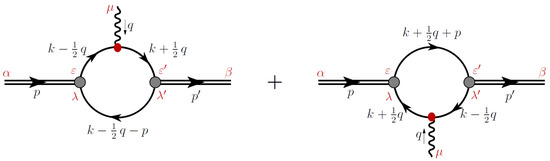
Figure 2.
Diagrams for the off-shell kaon GPDs in the case . The left diagram gives the valence u quark off-shell GPDs and the right diagram the valence antiquark off-shell GPDs in the kaon.
The vector and tensor quark GPDs of kaon are defined as [46]
where x represents the longitudinal momentum fraction. The function denotes the u quark non-spin-flip or vector GPD, while corresponds to the u quark spin-flip or tensor GPD.
The operators depicted in Figure 2 for off-shell kaon GPDs are structured as follows:
where the first term corresponds to the vector GPD and the second to the tensor GPD.
In the NJL model, the vector and tensor GPDs for the u quark in the meson are defined as follows:
where , , .
We adopt the following notation:
one can derive the following simplified formulas
after some calculation we arrive at
and
We denote the step function by . It takes the value of 1 in the corresponding region and is otherwise equal to zero. These results pertain to the region where . Under the transformation , we observe that ; furthermore, both and remain invariant.
Here, we present only the off-shell kaon GPDs for the u quark. For the s quark, we can derive the GPDs using the relationship outlined below.
where indicates the exchange of with .
The distributions of and are shown in Figure 3 and Figure 4, where the off-shell dependence arises from varying while is held fixed. The results demonstrate that as increases, the off-shell effects in the half-off-shell kaon GPDs grow significantly. In particular, at GeV2, the relative deviation reaches about , and increases to roughly at GeV2. As expected, the magnitude of the off-shell effects depends on , and increases gradually with . The strongest effects are observed near . These results are consistent with earlier findings for off-shell pion GPDs reported in Refs. [46,48,83], suggesting that off-shell effects in GPDs can be substantial in physical processes and should be properly accounted for.
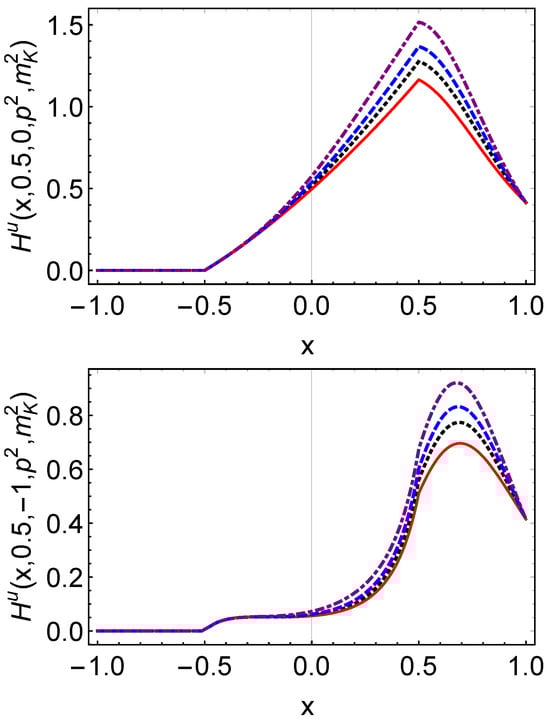
Figure 3.
Kaon off-shell vector GPD: in Equation (26) with for (upper panel) and (lower panel). Case is represented by the red solid line, black dotted line, GeV2 blue dashed line, and GeV2 purple dot-dashed line.
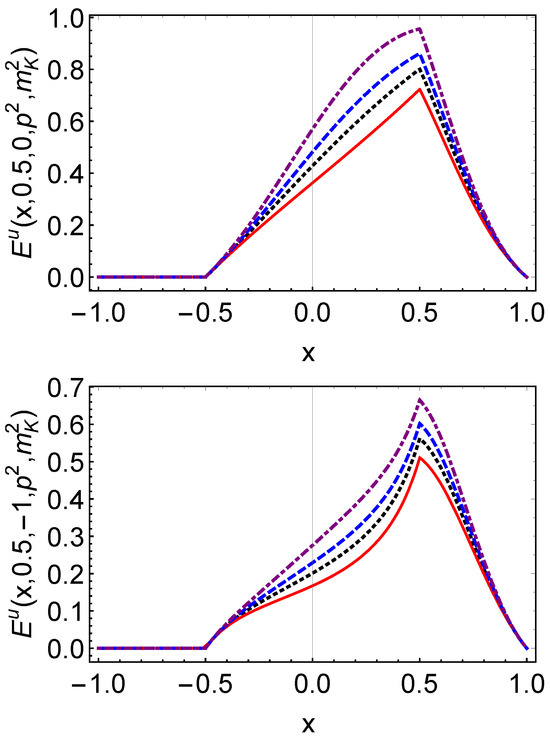
Figure 4.
Kaon off-shell tensor GPD: in Equation (27) with for (upper panel) and (lower panel). Case is represented by the red solid line, black dotted line, GeV2 blue dashed line, and GeV2 purple dot-dashed line.
In Ref. [83], the off-shell pion GPDs were studied using the NJL model. Given that the kaon mass is larger than the pion mass, different values were chosen for comparison: for the pion, GeV2, and for the kaon, GeV2, where GeV2. If is increased by the same amount relative to each meson’s on-shell mass—e.g., by GeV2 —the off-shell effects become comparable: for the pion at GeV2 and for the kaon at GeV2. This suggests that the off-shell effects in pions and kaons are of similar magnitude, a conclusion consistent with the results from the chiral quark model in Ref. [48].
2.3. The Properties of Kaon Off-Shell GPDs
2.3.1. Forward Limit
In the case where the initial and final kaon momenta are equal, , implying and , the vector GPD reduces to the kaon PDF,
when the skewness parameter , the function vanishes for . In contrast, for , the off-shell PDF of the u-quark in the kaon differs from that in the pion, as described in the NJL model [12,83].
Thus far, we have analyzed off-shell effects in GPDs. We now turn to the off-shell behavior of the normalization factor given in Equation (8) [46]. When , the value of changes accordingly. Several representative values of for different choices of are listed in Table 2.
Table 2.
The normalization factor corresponding to various values of , where is expressed in units of GeV2.
The kaon PDF should satisfy the relationship
where distinct values of correspond to different values of .
Figure 5 shows the off-shell u-quark PDF in the kaon. When or , the distribution is nearly flat in x. As increases—especially in the off-shell case—a stronger x-dependence develops. While the NJL model captures low-energy QCD features well, at large the PDF must be evolved, which will further modify its x-dependence. Unlike the pion PDF, the peak of the kaon PDF shifts to , breaking the symmetry around and distinguishing it from the pion case. Additionally, for the u-quark PDF in the kaon, the value at exceeds that at . As increases, both endpoint values decrease.
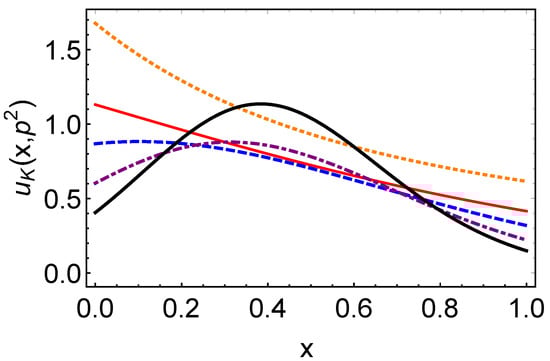
Figure 5.
Off-shell u quark PDFs in the kaon: , for different virtualities: GeV2—orange dotted curve, GeV2—red solid curve, GeV2—blue dashed curve, GeV2—purple dot-dashed curve, and GeV2—black solid thick curve.
2.3.2. Polynomiality Condition
The x-moments of the off-shell GPDs also include odd powers of the skewness parameter .
This highlights the remarkable polynomiality property of GPDs: the sums corresponding to the x-integrals of and are polynomials in of order .
When , we obtain FFs
where and are the vector and tensor FFs of the u quark, while and are additional FFs induced by off-shell effects. The former are symmetric under , whereas the latter are antisymmetric.
The functions and are defined in the general covariant structure of the kaon-photon vertex:
at , the relationship [48]
where implies, via crossing symmetry (time-reversal invariance) [47], that . Crossing symmetry further requires that on-shell GPDs are invariant under interchange of initial and final momenta (), leading to . Here, denotes the u-quark electromagnetic FF, with the normalization . From the off-shell kaon GPDs, one can derive
where .
We show that our result for equals as given in Equation (41), in agreement with Ref. [48]. Figure 6 displays above and in Equation (41), confirming that the two curves coincide exactly.
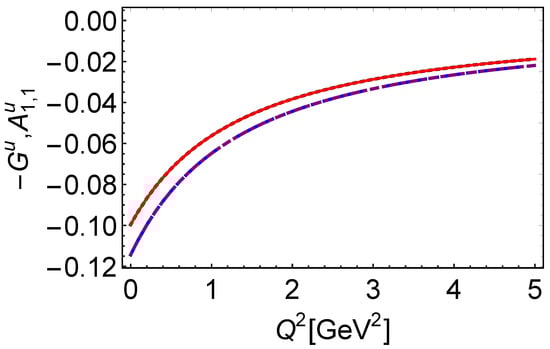
Figure 6.
The graphs of and : —black dotted curve, —red solid curve, —blue dashed curve, and —purple dot-dashed curve.
For , GPDs should follow the sum rule:
where pertains to the mass distribution of the u quark within the kaon, while is associated with the pressure distribution of the u quark. The polynomial contains the terms , and , thereby satisfying Equations (36) and (37). The generalized FFs for are as follows:
For the u quark tensor GPD of the kaon within the NJL model, we find that .
2.3.3. Impact Parameter Denpendent PDFs
The impact parameter dependent PDFs are given by,
This implies that the impact parameter dependent PDFs introduced above are given by the Fourier transform of , thus, once is known, the parton distribution as a function of the transverse position and momentum fraction x can be determined. Similarly, the off-shell tensor impact parameter dependent PDF is obtained as the Fourier transform of .
When and , the off-shell GPDs reduce to
where x is defined within the interval , we can derive the following:
integrating over yields the u-quark PDF given in Equation (34). The quantity denotes the off-shell tensor impact parameter dependent PDF derived from the tensor GPD .
Figure 7 shows the off-shell impact parameter dependent PDFs multiplied by x, evaluated at GeV−2 for different values of . The maximum of occurs at a larger x than that of . As increases, the peak heights of both distributions grow. At the same time, the peak position of shifts to smaller x, though it remains above . In contrast, the peak position of stays near as varies.
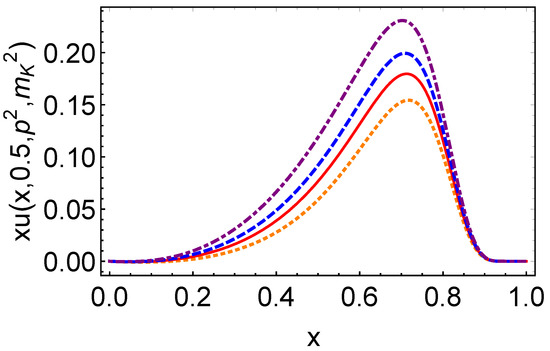
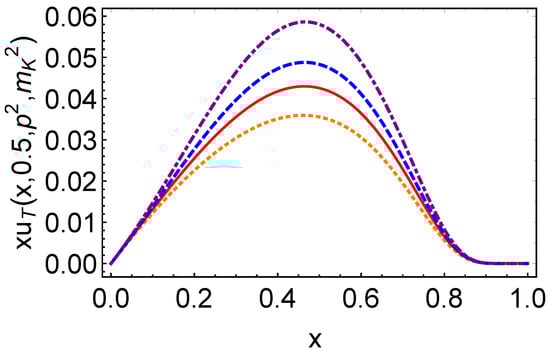
Figure 7.
Impact parameter space PDFs: (upper panel); the component in the first line of Equation (55) is suppressed in the image; (lower panel); both panels with GeV2—orange dotted curve; GeV2—red solid curve; GeV2—blue dashed curve; GeV2—purple dot-dashed curve.
3. The Kaon Off-Shell TMDs
TMDs have been widely investigated [84,85], yet studies specifically addressing their off-shell counterparts are still scarce.
Figure 8 shows the kaon TMD within the NJL model. Its definition, analogous to that of the pion TMD [55], is given by:
where represents a trace over spinor indices. As a result, we have successfully derived the final expression for the off-shell kaon TMD.
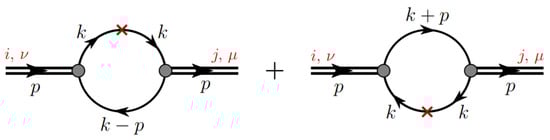
Figure 8.
Feynman diagrams for the kaon TMDs in the NJL model. The shaded circles represent the kaon Bethe–Salpeter vertex functions, and the solid lines correspond to dressed quark propagators. The operator insertion is given by . The left diagram describes the TMDs of the u quark, and the right diagram those of the s quark in the kaon.
Figure 9 displays the three-dimensional distributions of the on-shell and off-shell kaon TMD at GeV2. In the on-shell case, peaks as , differing from the pion on-shell TMD. The off-shell TMD shows a stronger x-dependence, similar to the pion off-shell TMD, but its peak shifts to , in contrast to the symmetry about seen in both on-shell and off-shell pion TMDs. Integrating over recovers the off-shell kaon PDF given in Equation (34).
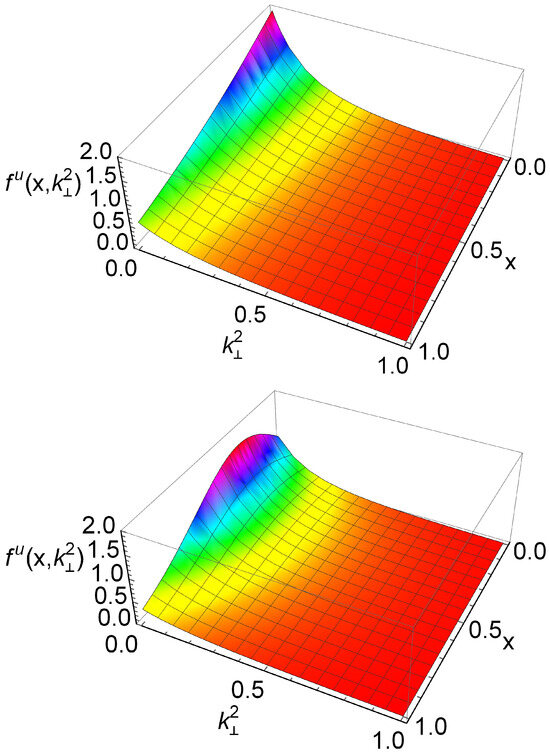
Figure 9.
Kaon TMDs: The on-shell kaon TMDs (upper panel); The off-shell kaon TMDs (lower panel).
Here we consider only the off-shell u quark TMD, since the off-shell s quark TMD can be obtained from that of the u quark according to Ref. [86].
4. Summary and Outlook
We study the off-shell generalized parton distributions (GPDs) and transverse momentum dependent parton distributions (TMDs) of the kaon in the Nambu–Jona-Lasinio (NJL) model using proper time regularization. The corresponding off-shell form factors (FFs), parton distribution functions (PDFs), and impact parameter dependent PDFs are derived and systematically compared with their on-shell counterparts.
Unlike on-shell GPDs, off-shell GPDs lack crossing symmetry, leading to Mellin moments that contain both even and odd powers of the skewness parameter. This gives rise to new off-shell FFs. Our results show clear modifications in kaon GPDs due to off-shell effects. Certain properties valid for on-shell GPDs—such as symmetry constraints and polynomiality conditions—may no longer hold in the off-shell case.
The relative off-shell effect in kaon GPDs is found to be between about and . A comparison with pion off-shell GPDs is also carried out. From the Mellin moments of the kaon GPDs, we extract the off-shell FFs and gravitational form factors (GFFs), and further compare the kaon off-shell FFs with those of the pion.
We also examine the off-shell TMD of the kaon, which shows a stronger dependence on x—a feature shared with the pion off-shell TMD. However, unlike the pion off-shell TMD, which is symmetric about , the peak position of the kaon off-shell TMD shifts to , marking a clear distinction between the two.
In summary, the NJL model proves effective in describing the off-shell structure of pions and kaons. Future work may extend these calculations to off-shell GPDs and FFs of vector mesons (e.g., and ) and nucleons. Repeating the present analysis using models with more realistic interactions could also offer further insight into the underlying dynamics.
Funding
This research was funded by the Natural Science Foundation of Jiangsu Provincial Department of Education, grant number 25KJD140001. And the Scientific Research Foundation of Nanjing Institute of Technology, grant number YKJ202352.
Data Availability Statement
The raw data supporting the conclusions of this article will be made available by the authors on request.
Conflicts of Interest
The author declares no conflict of interest.
Appendix A. Useful Formulae
Here we use the gamma functions (, )
where are, respectively, the infrared and ultraviolet regulators described above.
The functions denoted by are defined as follows:
References
- Xu, Z.N.; Binosi, D.; Chen, C.; Raya, K.; Roberts, C.D.; Rodríguez-Quintero, J. Kaon distribution functions from empirical information. Phys. Lett. B 2025, 865, 139451. [Google Scholar] [CrossRef]
- Wu, Q.; Cui, Z.F.; Segovia, J. Parton distribution functions of ground state mesons composed of c or b quarks. Phys. Rev. D 2025, 111, 116023. [Google Scholar] [CrossRef]
- Tanisha; Puhan, S.; Yadav, A.; Dahiya, H. Valence quark distribution of light ρ and heavy J/ψ vector mesons in light-cone quark model. arXiv 2025, arXiv:2505.09213. [Google Scholar] [CrossRef]
- Muller, D.; Robaschik, D.; Geyer, B.; Dittes, F.M.; Horejsi, J. Wave functions, evolution equations and evolution kernels from light ray operators of QCD. Fortsch. Phys. 1994, 42, 101–141. [Google Scholar] [CrossRef]
- Ji, X.D. Deeply virtual Compton scattering. Phys. Rev. D 1997, 55, 7114–7125. [Google Scholar] [CrossRef]
- Radyushkin, A.V. Nonforward parton distributions. Phys. Rev. D 1997, 56, 5524–5557. [Google Scholar] [CrossRef]
- Ji, X.D. Off forward parton distributions. J. Phys. G 1998, 24, 1181–1205. [Google Scholar] [CrossRef]
- Theussl, L.; Noguera, S.; Vento, V. Generalized parton distributions of the pion in a Bethe-Salpeter approach. Eur. Phys. J. A 2004, 20, 483–498. [Google Scholar] [CrossRef]
- Diehl, M. Generalized parton distributions. Phys. Rep. 2003, 388, 41–277. [Google Scholar] [CrossRef]
- Zhang, J.L.; Cui, Z.F.; Ping, J.; Roberts, C.D. Contact interaction analysis of pion GTMDs. Eur. Phys. J. C 2021, 81, 6. [Google Scholar] [CrossRef]
- Zhang, J.L.; Raya, K.; Chang, L.; Cui, Z.F.; Morgado, J.M.; Roberts, C.D.; Rodríguez-Quintero, J. Measures of pion and kaon structure from generalised parton distributions. Phys. Lett. B 2021, 815, 136158. [Google Scholar] [CrossRef]
- Zhang, J.L.; Lai, M.Y.; Zong, H.S.; Ping, J.L. Pion generalized parton distributions and light-front wave functions in the Nambu–Jona-Lasinio model. Nucl. Phys. B 2021, 966, 115387. [Google Scholar] [CrossRef]
- Zhang, J.L.; Ping, J.L. Kaon generalized parton distributions and light-front wave functions in the Nambu–Jona-Lasinio model. Eur. Phys. J. C 2021, 81, 814. [Google Scholar] [CrossRef]
- Zhang, J.L.; Kang, G.Z.; Ping, J.L. Regularization dependence of pion generalized parton distributions *. Chin. Phys. C 2022, 46, 063105. [Google Scholar] [CrossRef]
- Zhang, J.L.; Kang, G.Z.; Ping, J.L. ρ meson generalized parton distributions in the Nambu–Jona-Lasinio model. Phys. Rev. D 2022, 105, 094015. [Google Scholar] [CrossRef]
- Mezrag, C. An Introductory Lecture on Generalised Parton Distributions. Few Body Syst. 2022, 63, 62. [Google Scholar] [CrossRef]
- Qiu, J.W.; Yu, Z. Exclusive production of a pair of high transverse momentum photons in pion-nucleon collisions for extracting generalized parton distributions. J. High Energy Phys. 2022, 08, 103. [Google Scholar] [CrossRef]
- Zhang, J.L. Kaon GTMDs in the Dyson-Schwinger equations using contact interaction. arXiv 2024, arXiv:2409.04105. [Google Scholar] [CrossRef]
- Goharipour, M.; Amiri, M.H.; Irani, F.; Hashamipour, H.; Azizi, K. Determination of the pion generalized parton distributions at zero skewness. arXiv 2025, arXiv:2508.15073. [Google Scholar] [CrossRef]
- Zhang, J.L. ρ meson form factors and parton distribution functions in impact parameter space*. Chin. Phys. C 2025, 49, 043104. [Google Scholar] [CrossRef]
- Bondarenko, S.; Slautin, M. Space-like pion off-shell form factors in the Bethe-Salpeter approach. arXiv 2025, arXiv:2506.22153. [Google Scholar]
- Hernández-Pinto, R.J.; Gutiérrez-Guerrero, L.X.; Bedolla, M.A.; Bashir, A. Electric, magnetic, and quadrupole form factors and charge radii of vector mesons: From light to heavy sectors in a contact interaction. Phys. Rev. D 2024, 110, 114015. [Google Scholar] [CrossRef]
- Puhan, S.; Dahiya, H. Scalar, vector, and tensor form factors of pion and kaon. Phys. Rev. D 2025, 111, 114039. [Google Scholar] [CrossRef]
- Cheng, P.; Yao, Z.Q.; Binosi, D.; Roberts, C.D. Likelihood of a zero in the proton elastic electric form factor. Phys. Lett. B 2025, 862, 139323. [Google Scholar] [CrossRef]
- Zhang, J.L.; Wu, J. Pion-photon and kaon-photon transition distribution amplitudes in the Nambu–Jona-Lasinio model*. Chin. Phys. C 2024, 48, 083106. [Google Scholar] [CrossRef]
- Ji, X.; Yang, C. A Journey of Seeking Pressures and Forces in the Nucleon. arXiv 2025, arXiv:2508.16727. [Google Scholar] [CrossRef]
- Goeke, K.; Polyakov, M.V.; Vanderhaeghen, M. Hard exclusive reactions and the structure of hadrons. Prog. Part. Nucl. Phys. 2001, 47, 401–515. [Google Scholar] [CrossRef]
- Radyushkin, A.V. Scaling limit of deeply virtual Compton scattering. Phys. Lett. B 1996, 380, 417–425. [Google Scholar] [CrossRef]
- Hobart, A. Deeply Virtual Compton Scattering with CLAS12 at Jefferson Lab. EPJ Web Conf. 2023, 290, 06001. [Google Scholar] [CrossRef]
- Xie, G.; Kou, W.; Fu, Q.; Ye, Z.; Chen, X. Deeply virtual compton scattering at future electron-ion colliders. Eur. Phys. J. C 2023, 83, 900. [Google Scholar] [CrossRef]
- Müller, D.; Lautenschlager, T.; Passek-Kumericki, K.; Schaefer, A. Towards a fitting procedure to deeply virtual meson production-the next-to-leading order case. Nucl. Phys. B 2014, 884, 438–546. [Google Scholar] [CrossRef]
- Favart, L.; Guidal, M.; Horn, T.; Kroll, P. Deeply Virtual Meson Production on the nucleon. Eur. Phys. J. A 2016, 52, 158. [Google Scholar] [CrossRef]
- Čuić, M.; Duplančić, G.; Kumerički, K.; Passek-K, K. NLO corrections to the deeply virtual meson production revisited: Impact on the extraction of generalized parton distributions. J. High Energy Phys. 2023, 2023, 192, Erratum in J. High Energy Phys. 2024, 2, 225. [Google Scholar] [CrossRef]
- Berger, E.R.; Diehl, M.; Pire, B. Time-like Compton scattering: Exclusive photoproduction of lepton pairs. Eur. Phys. J. C 2002, 23, 675–689. [Google Scholar] [CrossRef]
- Boër, M.; Guidal, M.; Vanderhaeghen, M. Timelike Compton scattering off the proton and generalized parton distributions. Eur. Phys. J. A 2015, 51, 103. [Google Scholar] [CrossRef]
- Xie, Y.P.; Goncalves, V.P. Timelike Compton scattering in ultraperipheral pPb collisions. Phys. Lett. B 2023, 839, 137762. [Google Scholar] [CrossRef]
- Chatagnon, P.; Niccolai, S.; Stepanyan, S.; Amaryan, M.J.; Angelini, G.; Armstrong, W.R.; Atac, H.; Gayoso, C.A.; Baltzell, N.A. First Measurement of Timelike Compton Scattering. Phys. Rev. Lett. 2021, 127, 262501. [Google Scholar] [CrossRef]
- Peccini, G.M.; Moriggi, L.S.; Machado, M.V.T. Exclusive dilepton production via timelike Compton scattering in heavy ion collisions. Phys. Rev. D 2021, 103, 054009. [Google Scholar] [CrossRef]
- Hashamipour, H.; Goharipour, M.; Azizi, K.; Goloskokov, S.V. Determination of the generalized parton distributions through the analysis of the world electron scattering data considering two-photon exchange corrections. Phys. Rev. D 2022, 105, 054002. [Google Scholar] [CrossRef]
- Hashamipour, H.; Goharipour, M.; Gousheh, S.S. Determination of generalized parton distributions through a simultaneous analysis of axial form factor and wide-angle Compton scattering data. Phys. Rev. D 2020, 102, 096014. [Google Scholar] [CrossRef]
- Aguilar, A.C.; Ahmed, Z.; Aidala, C.; Ali, S.; Andrieux, V.; Arrington, J.; Bashir, A.; Berdnikov, V.; Binosi, D.; Chang, L.; et al. Pion and Kaon Structure at the Electron-Ion Collider. Eur. Phys. J. A 2019, 55, 190. [Google Scholar] [CrossRef]
- Chávez, J.M.M.; Bertone, V.; De Soto Borrero, F.; Defurne, M.; Mezrag, C.; Moutarde, H.; Rodríguez-Quintero, J.; Segovia, J. Accessing the Pion 3D Structure at US and China Electron-Ion Colliders. Phys. Rev. Lett. 2022, 128, 202501. [Google Scholar] [CrossRef]
- Sullivan, J.D. One pion exchange and deep inelastic electron-nucleon scattering. Phys. Rev. D 1972, 5, 1732–1737. [Google Scholar] [CrossRef]
- Zhang, J.L.; Wu, J. ρ meson transverse momentum-dependent parton distributions. Eur. Phys. J. C 2025, 85, 13. [Google Scholar] [CrossRef]
- Liu, W.Y.; Zahed, I. Tomography of the Rho meson in the QCD Instanton Vacuum: Transverse Momentum Dependent Parton Distribution Functions. arXiv 2025, arXiv:2503.11959. [Google Scholar] [CrossRef]
- Shastry, V.; Broniowski, W.; Ruiz Arriola, E. Off-shellness in generalized parton distributions and form factors of the pion. Phys. Rev. D 2023, 108, 114024. [Google Scholar] [CrossRef]
- Broniowski, W.; Shastry, V.; Ruiz Arriola, E. Off-shell Generalized Parton Distributions of the Pion. Acta Phys. Pol. B Proc. Suppl. 2023, 16, 7–A7. [Google Scholar] [CrossRef]
- Broniowski, W.; Shastry, V.; Ruiz Arriola, E. Off-shell generalized parton distributions and form factors of the pion. Phys. Lett. B 2023, 840, 137872. [Google Scholar] [CrossRef]
- Klevansky, S.P. The Nambu-Jona-Lasinio model of quantum chromodynamics. Rev. Mod. Phys. 1992, 64, 649–708. [Google Scholar] [CrossRef]
- Buballa, M. NJL model analysis of quark matter at large density. Phys. Rep. 2005, 407, 205–376. [Google Scholar] [CrossRef]
- Zhang, J.L.; Li, C.M.; Zong, H.S. Discussion of thermodynamic features within the PNJL model. Chin. Phys. C 2018, 42, 123105. [Google Scholar] [CrossRef]
- Zhang, J.L.; Shi, Y.M.; Xu, S.S.; Zong, H.S. Proper time regularization at finite quark chemical potential. Mod. Phys. Lett. A 2016, 31, 1650086. [Google Scholar] [CrossRef]
- Cui, Z.F.; Cloët, I.C.; Lu, Y.; Roberts, C.D.; Schmidt, S.M.; Xu, S.S.; Zong, H.S. Critical endpoint in the presence of a chiral chemical potential. Phys. Rev. D 2016, 94, 071503. [Google Scholar] [CrossRef]
- Bentz, W.; Hama, T.; Matsuki, T.; Yazaki, K. NJL model on the light cone and pion structure function. Nucl. Phys. A 1999, 651, 143–173. [Google Scholar] [CrossRef]
- Noguera, S.; Scopetta, S. Pion transverse momentum dependent parton distributions in the Nambu and Jona-Lasinio model. J. High Energy Phys. 2015, 11, 102. [Google Scholar] [CrossRef]
- Carrillo-Serrano, M.E.; Bentz, W.; Cloët, I.C.; Thomas, A.W. ρ meson form factors in a confining Nambu–Jona-Lasinio model. Phys. Rev. C 2015, 92, 015212. [Google Scholar] [CrossRef]
- Ceccopieri, F.A.; Courtoy, A.; Noguera, S.; Scopetta, S. Pion nucleus Drell–Yan process and parton transverse momentum in the pion. Eur. Phys. J. C 2018, 78, 644. [Google Scholar] [CrossRef]
- Freese, A.; Freese, A.; Cloët, I.C.; Cloët, I.C. Gravitational form factors of light mesons. Phys. Rev. C 2019, 100, 015201, Erratum in Phys. Rev. C 2022, 105, 059901. [Google Scholar] [CrossRef]
- Shastry, V.; Broniowski, W.; Ruiz Arriola, E. Generalized quasi-, Ioffe-time-, and pseudodistributions of the pion in the Nambu–Jona-Lasinio model. Phys. Rev. D 2022, 106, 114035. [Google Scholar] [CrossRef]
- Broniowski, W.; Ruiz Arriola, E.; Golec-Biernat, K. Generalized parton distributions of the pion in chiral quark models and their QCD evolution. Phys. Rev. D 2008, 77, 034023. [Google Scholar] [CrossRef][Green Version]
- Bissey, F.; Cudell, J.R.; Cugnon, J.; Lansberg, J.P.; Stassart, P. A Model for the off forward structure functions of the pion. Phys. Lett. B 2004, 587, 189–200. [Google Scholar] [CrossRef][Green Version]
- Ruiz Arriola, E. Parton distributions for the pion in a chiral quark model. In Proceedings of the Workshop on Lepton Scattering, Hadrons and QCD, Adelaide, Australia, 26 March–6 April 2001; pp. 37–44. [Google Scholar] [CrossRef]
- Davidson, R.M.; Ruiz Arriola, E. Parton distributions functions of pion, kaon and eta pseudoscalar mesons in the NJL model. Acta Phys. Polon. B 2002, 33, 1791–1808. [Google Scholar]
- Noguera, S.; Vento, V. Pion parton distributions in a non local Lagrangian. Eur. Phys. J. A 2006, 28, 227–236. [Google Scholar] [CrossRef]
- Volkov, M.K.; Pivovarov, A.A.; Nurlan, K. Three-meson τ decays involving kaons and η mesons in the NJL model. Phys. Rev. D 2024, 109, 016016. [Google Scholar] [CrossRef]
- Yu, X.; Wang, X. (Pseudo) Scalar mesons in a self-consistent NJL model. Chin. Phys. C 2023, 47, 123103. [Google Scholar] [CrossRef]
- Ishii, N.; Bentz, W.; Yazaki, K. Faddeev approach to the nucleon in the Nambu-Jona-Lasinio (NJL) model. Phys. Lett. B 1993, 301, 165–169. [Google Scholar] [CrossRef]
- Cloët, I.C.; Bentz, W.; Thomas, A.W. Role of diquark correlations and the pion cloud in nucleon elastic form factors. Phys. Rev. C 2014, 90, 045202. [Google Scholar] [CrossRef]
- Hutauruk, P.T.P.; Bentz, W.; Cloët, I.C.; Thomas, A.W. Charge Symmetry Breaking Effects in Pion and Kaon Structure. Phys. Rev. C 2018, 97, 055210. [Google Scholar] [CrossRef]
- Carrillo-Serrano, M.E.; Bentz, W.; Cloët, I.C.; Thomas, A.W. Baryon Octet Electromagnetic Form Factors in a confining NJL model. Phys. Lett. B 2016, 759, 178–183. [Google Scholar] [CrossRef]
- Ninomiya, Y.; Bentz, W.; Cloët, I.C. Dressed Quark Mass Dependence of Pion and Kaon Form Factors. Phys. Rev. C 2015, 91, 025202. [Google Scholar] [CrossRef]
- Hutauruk, P.T.P.; Cloët, I.C.; Thomas, A.W. Flavor dependence of the pion and kaon form factors and parton distribution functions. Phys. Rev. C 2016, 94, 035201. [Google Scholar] [CrossRef]
- Ebert, D.; Feldmann, T.; Reinhardt, H. Extended NJL model for light and heavy mesons without q - anti-q thresholds. Phys. Lett. 1996, B388, 154–160. [Google Scholar] [CrossRef]
- Hellstern, G.; Alkofer, R.; Reinhardt, H. Diquark confinement in an extended NJL model. Nucl. Phys. 1997, A625, 697–712. [Google Scholar] [CrossRef]
- Bentz, W.; Thomas, A.W. The Stability of nuclear matter in the Nambu-Jona-Lasinio model. Nucl. Phys. 2001, A696, 138–172. [Google Scholar] [CrossRef]
- Cloët, I.C.; Bentz, W.; Thomas, A.W. Transversity quark distributions in a covariant quark-diquark model. Phys. Lett. B 2008, 659, 214–220. [Google Scholar] [CrossRef]
- Schreiber, A.W.; Signal, A.I.; Thomas, A.W. Structure functions in the bag model. Phys. Rev. D 1991, 44, 2653–2662. [Google Scholar] [CrossRef]
- Mineo, H.; Bentz, W.; Yazaki, K. Quark distributions in the nucleon based on a relativistic three-body approach to the NJL model. Phys. Rev. C 1999, 60, 065201. [Google Scholar] [CrossRef]
- Mineo, H.; Bentz, W.; Ishii, N.; Yazaki, K. Axial vector diquark correlations in the nucleon: Structure functions and static properties. Nucl. Phys. A 2002, 703, 785–820. [Google Scholar] [CrossRef]
- Ninomiya, Y.; Bentz, W.; Cloët, I.C. Transverse-momentum-dependent quark distribution functions of spin-one targets: Formalism and covariant calculations. Phys. Rev. C 2017, 96, 045206. [Google Scholar] [CrossRef]
- Mezrag, C. Generalised Parton Distributions in Continuum Schwinger Methods: Progresses, Opportunities and Challenges. Particles 2023, 6, 262–296. [Google Scholar] [CrossRef]
- Siddikov, M. Photoproduction of Heavy Meson and Photon Pairs. Particles 2025, 8, 23. [Google Scholar] [CrossRef]
- Zhang, J.L. Off-shell modifications of the pion generalized parton distributions and transverse momentum dependent parton distributions. arXiv 2025, arXiv:2507.09557. [Google Scholar] [CrossRef]
- Abdulov, N.A.; Kotikov, A.V.; Lipatov, A. Parametrizations of Collinear and kT-Dependent Parton Densities in Proton. Particles 2022, 5, 535–560. [Google Scholar] [CrossRef]
- Loomis, D. Spin Physics at PHENIX. Particles 2025, 8, 14. [Google Scholar] [CrossRef]
- Shi, C.; Bednar, K.; Cloët, I.C.; Freese, A. Spatial and Momentum Imaging of the Pion and Kaon. Phys. Rev. D 2020, 101, 074014. [Google Scholar] [CrossRef]
Disclaimer/Publisher’s Note: The statements, opinions and data contained in all publications are solely those of the individual author(s) and contributor(s) and not of MDPI and/or the editor(s). MDPI and/or the editor(s) disclaim responsibility for any injury to people or property resulting from any ideas, methods, instructions or products referred to in the content. |
© 2025 by the author. Licensee MDPI, Basel, Switzerland. This article is an open access article distributed under the terms and conditions of the Creative Commons Attribution (CC BY) license (https://creativecommons.org/licenses/by/4.0/).