


Abstract
Six-dimensional spinors with symmetry are utilized to efficiently encode three generations of matter. is shown to contain physically relevant subgroups with representations for GUT groups, spacetime symmetries, three generations of the standard model fermions, and Higgs bosons. Pati–Salam, , and grand unified theories are found when a single generation is isolated. For spacetime symmetries, may be used for conformal symmetry, , or simply broken to of a Minkowski space. Another class of representations finds and can give with various GUTs. An action for three generations of fermions in the Majorana–Weyl spinor of is found with flavor symmetry inside . The 128 of can be regarded as the tangent space to a particular pseudo-Riemannian form of the octo-octonionic Rosenfeld projective plane .
1. Introduction
In addition to the Pati–Salam model [1,2,3,4,5,6], the -series of Lie algebras ( [7,8,9,10,11,12,13,14], [15,16,17,18,19,20,21,22,23,24,25,26,27,28,29,30,31], [32,33,34,35,36,37,38,39], [40,41,42], and [43,44,45,46,47,48,49,50,51,52,53,54,55,56,57,58,59,60,61]) is used to describe various grand unification theories (GUTs). Additionally, string theory proposes an heterotic theory [62,63,64,65,66]. Beyond the standard model (BSM), physics is also studied with the infinite-dimensional exceptional Lie algebras, such as [67,68,69,70,71] and [72,73,74]. This work investigates the role of as the noncompact (quaternionic) real form of in unification physics, not as a single GUT model, but as a single algebra that breaks into representations of GUT gauge algebras, spacetime algebras, fermions, and Higgs sectors.
Three generations of matter from 6D spinors via is a feature of all of the models discussed within this work. Six-dimensional physics has been successful for additional mass terms and unitarity methods [75,76,77] and standard model (SM) physics [78,79], whereas three-time physics has been discussed in supersymmetric models with multiple superparticles [80,81], and various graviweak/graviGUT proposals [82,83,84,85,86,87,88,89,90,91] have used for the SM [61,92,93,94]. In previous work, the authors have explored branes given by exceptional periodicity (EP) [95], and all of the so-called EP algebras () allow reductions along 3-branes or 4-branes with dual magnetic brane cohomologies encoding spinors. The case in was used to propose a worldvolume interpretation for M-theory [96]. Here, we build on the result for that allows for a 3-brane (with (3, 3) worldvolume) to be found by breaking to .
The double copy finds a relationship between Yang–Mills and gravity [97,98,99,100,101,102,103,104]. Given the recent developments in the double copy and heterotic theories [105,106,107], this work is complementary to these developments and the graviGUT models by finding an internal charge space and external spacetime. For , breaking allows for the identification of 6D spacetime and 10D charge space. (This internal charge space can have the same signature of the critical spacetime dimension for superstring theory. Here, we find that is relevant as a charge space for the SM that is, in a sense, dual to the GUT algebra in ). Removing a lightcone gives and relates to branes found in three-time supersymmetry models [80,81,108,109]. The benefit of three times allows for three superparticles, which can be interpreted to yield three generations of fermions.
Given the difficulties of finding UV-finite quantum gravity and its small coupling constant, GUTs were proposed to unify all of the fundamental forces besides gravity. Recently, it has been suggested that torsion allows for UV-complete fermions [110,111,112], while the Gauss–Bonnet term allows for two-loop graviton scattering [113], both of which are related to the MacDowell–Mansouri formalism [114,115,116,117] studied in various graviGUT models [61,118]. Grand unified theory has been studied in a supersymmetry or supergravity context [6,18,21,24,29,36,45,47,48,52,54].
Using spinor representations allows for to describe three generations of matter with only 128 degrees of freedom (dofs) instead of 192 dofs typically used to describe three generations of SM fermions), which corrects aspects of the model [61]. Complaints with for unified theory [119] do not apply to 6D spacetime, as only 128 fermions are needed for three generations [120]. While does not contain complex representations, the algebra can be broken to smaller algebras with complex representations, such as . Real Majorana spinors exhibiting Majorana–Weyl chiral spinor decompositions with three independent complex subspaces with respect to can be found with , , , and . Additionally, the spinor inside relates to , which is not complex, but contains three complex subalgebras for three generations of chiral spinors.
While typical GUTs study algebra and add representations, the representation theory discussed here breaks alone into GUT algebras, spinors, spacetime algebras, and Higgs representations. gauge theory need not be used as a GUT in the conventional sense in this manner; nevertheless, can be used to encapsulate GUTs with spacetime by gauging subgroups.
The manuscript is ordered as follows. Next, the representation theory of , , Pati–Salam, and GUTs is introduced. Section 2 explains how GUT fits into for one generation and how the magic star projection of (also called the decomposition by Mukai [121]) motivates three generations [122,123]. It also introduces spacetime via a toy model from that contains various spinors. Section 3 discusses extensions of previous (and new) graviGUT models by breaking (with four spacelike dimensions) to the SM spectrum. Section 4 explores additional models from with four timelike dimensions. Concluding remarks are given in Section 5.
A Review of Various Grand Unification Models
Gauge theories are QFTs with local symmetry whose fields are representations of the gauge group, which can include spacetime symmetries for gauge theories of gravity. The standard model and all GUT models are devoid of gravity, implying that fields may be representations of the gauge group plus spacetime symmetries. Gauge theories may be spontaneously broken when a vacuum expectation value of one of the (Higgs) fields is taken, which finds a low-energy theory whose gauge symmetry is a subalgebra. Since representation theory uniquely determines the field content of a theory [124], we primarily explore the representation theory of and its subalgebras throughout in order to describe a landscape of possible models. Our notation is that a semi-simple Lie algebra as a direct sum of non-Abelian Lie algebras and Abelian algebras has non-Abelian representations in bold and Abelian charges or weights as subscripts, such that corresponds to a field in the representation of , the representation of , and charge c with respect to .
The gauge algebra of the SM can be found from the symmetry breaking of the Pati–Salam GUT with gauge symmetry [1] and the Georgi–Glashow GUT with [7]. Pati–Salam GUT allows for a fermionic unification of the quarks and the leptons into and representations by treating the leptons as a fourth color. Alternatively, unifies the bosons into a single gauge group. The fermions are placed in the and representations.
Both of these GUT algebras can be unified into with chiral spinors for fermions since
where is the algebra associated with the SM and describes electromagnetism. The commutative diagram in Equation (1) [125] denotes that the same SM gauge group is found from via or . Finding in or differentiates between or flipped GUT [126,127,128,129,130,131,132,133,134]. For , a right-handed neutrino is required since the contains ,
For standard GUT, the charge is proportional to (as shown above), while flipped GUT finds proportional to . The GUT allows for either a , , or a Higgs [135]. Here, the Higgs of is shown to break to a Higgs of . Singularities from in F-theory have been argued to lead to flipped GUTs [133]. Earlier investigations of flipped found a hidden gauge group [130], which may naturally fit in . Throughout, we focus on the real form to include noncompact spacetime symmetries with GUT groups.
Breaking from to the of Pati–Salam GUT gives
where two algebras and can be mixed to give proportional to . The electroweak Higgs comes from , which fits into the of . Note that other VEVs are also required for each symmetry breaking, such as for , for , and for [3]. In our interpretation, we will find that the off-shell fermionic dofs allow for the symmetry breaking to .
The flipped GUT uses the algebra , which is a maximal subalgebra of [136,137]. Moreover, GUT uses the entire for describing fermions [32], which is mathematically similar yet physically distinct from other recent work [138,139,140,141]. We rule out this possibility with , as only of the dofs are fermionic, which will become more clear below. GUT does not provide any mechanism for naturally describing three generations.
There are three conjugacy classes of subalgebras in , related by inner automorphisms of itself (in turn related to triality). Breaking to gives the following branchings,
where and are the fundamental and adjoint of , respectively. The trinification GUT uses , a maximal and non-symmetric subalgebra of [142,143,144,145,146,147,148,149,150,151]. Furthermore, contains , which can give GUT [152,153,154,155] with an additional [156]. Next, and are shown to encapsulate GUT.
2. Three Mass Generations from 6D Spacetime
2.1. Intuition from the Magic Star of
The only exceptional GUT algebra is . However, and contain representations of GUT. The adjoint representation of contains bosons and a single generation of fermions via
From the perspective of GUTs, the utility of is not to generalize GUT to GUT but to simply place all of the content of GUT for one generation within . The so-called magic star projection of [122] breaks to the maximal subalgebra to naturally give three generations,
which can be visualized in Figure 1. As hinted by the magic star of itself, three distinct embeddings of are within and overlap by to give three generations. Breaking gives the five-grading of contact type,
Figure 1.
The exceptional Lie algebra is projected onto a -like root lattice, which places in the center with three fundamental and three anti-fundamental representations of , and , respectively.
Unsurprisingly, has been embedded inside to give a way to extend GUT to include a family unification [50,157]. Furthermore, contains , suggesting a quadrification model as trinification with a global family [150]. However, we take a different approach in this work. The only real form of that has a chance of obtaining and is . While this cannot give , is suggested via three timelike dimensions to motivate spinors. The algebra is natural for three generations of matter that are efficiently encoded in 128 off-shell dofs.
The magic star projection of in Figure 1 [158] isolates six exceptional Jordan algebras surrounding (strictly speaking, only the noncompact real forms and admit real forms of exceptional Jordan algebras as fundamental representations). The Peirce decomposition of the exceptional Jordan algebra (cfr. e.g., Chap. 8 of [159]) occurs when breaking from to ; as shown in Equation (4), three ’s and three ’s emerge from , which are representations of and give the 96 on-shell fermionic dofs. Following the breaking of shown in Equation (4), an additional is contained within the adjoint of (in the center of the magic star in Figure 1). The inside represent additional off-shell fermionic dofs, as contains 128 spinorial roots, 96 of which are outside of . As mentioned above, the magic star of , shown in Figure 1, allows for three embeddings of within , and each of them contains the same central . Thus, the magic star projection of provides a simple geometric way to see how three mass generations of fermions fit inside the spinor representation inside .
It has been stated that all GUTs besides and require mirror fermions [120] unless supersymmetry is introduced. Mirror fermions must have weak hypercharge for the right-handed chirality states instead of the left-handed. The relationship between three generations and mirror fermions is discussed in the next section.
2.2. Three Momenta with Different Mass
In this section, spacetime is shown to efficiently encode three Dirac spinors of different mass in 16 off-shell dofs, provided that they have the same charge. A 4D Dirac spinor is given by 8 off-shell dofs, implying that three generations of a particle require 24 off-shell dofs. The scattering amplitudes community utilizes massless spinors to encode massive 4D spinors for computational simplicity [75]. Other work also utilized or six dimensions for three generations [35,78]. The spacetime from more clearly allows for three spacetimes as a subalgebra. The intuition for multiple time dimensions is to encode multiple mass generations. While for a single time is a trivial algebra with no generators, allows for an explanation for three generations [160,161,162,163], which we explore here as a spacetime symmetry that generalizes the Lorentz and conformal algebras with extra time dimensions.
To briefly show how encodes three masses, consider a 6D massive vector , where . It is clear that we can find three 4D momenta for or 3, where time is taken from , or . Given that with a positive signature for space,
This demonstrates that a 6D momentum can be projected to three generations of 4D momenta with different masses , and . To obtain 4D spinors, each momentum can be decomposed into spinors via the isomorphism . We consider as the conformal group of . The three extra time dimensions in provide a geometrical origin of comprehensive family unification proposed by Wilczek et al. [160,161,162,163]. Ghosts are often thought to make multiple time dimensions problematic, but here, focus is given to spinors in taken from representations of and twistor representations of .
Before diving into and the eight charges associated with fermions found in the SM, we demonstrate how can be used to efficiently contain spacetime symmetry with fermions and antifermions with their mirrors in a single algebra. The fermions are contained in the of inside . The maximal and non-symmetric subalgebra is found within [164] to give the following representations,
Note that contains as a maximal (and symmetric) subalgebra. The of can be found inside the of . Since also contains a , the fermions as of are contained in one inside and seven ’s inside of . The SM contains eight charge configurations of the electron, three up quarks, three down quarks, and neutrino. Focusing on allows for the isolation of a single charge configuration, such as the electron, giving instead of . As shown above, the inside allows for three distinct spacetime algebras with different timelike projections that can lead to different masses in 4D spacetime.
As hinted at above, focusing on allows for a simple demonstration of how three generations of fermions are contained inside before diving into all of the different charge configurations. The algebra is broken in the following manner:
Mirror fermions are identified when breaking spacetime to and thinking of the as a dummy (electric) charge (cf. the second subscript in the last step of (11)). The weight of (cf. the first subscript in the last step of (11)) identifies the mirror fermions with a . Spinors of combine the fermion of one chirality with the antifermion of the opposite chirality.
While not experimentally measured, mirror fermions preserve symmetry with the weak force, which must acquire a large mass if physical. Mirror fermions typically require additional fermionic dofs. Given that we will use to give three generations of matter in 128 dofs, the mirror fermions in spacetime for a single generation are created from the on-shell dofs from the other generations in , not off-shell dofs. This subtlety leads to three generations in 96 on-shell dofs without propagating mirror fermions from 128 off-shell dofs, not 192 as needed with spinors. It is clear that we should not assign roots to dofs at the beginning, but rather symmetry break and see what particles arise at lower energy phases. In generalizing to , the in Equation (11) will be replaced by . The can be thought of as providing a charge, which helps identify fermions vs. antifermions.
To explicitly demonstrate that three generations of a single massless Dirac spinor can be encoded in 16 off-shell degrees of freedom instead of 24, consider the representation inside as a Majorana spinor of . Two Majorana–Weyl spinors can be combined to make a single Majorana spinor in and . In this manner, the spinor in is an spinor representation with two chiralities (if studied as a supermultiplet). The Clifford algebra leads to a set of matrices. Next, we work towards an explicit set of projection matrices for three generations.
Our chosen basis for is generated by recursively taking tensor products of [165]. Each set of four ’s are spanned by two elements and with . The signature is encoded in the index since and . The matrix representation of is given by matrices,
Our basis of matrices can then be written as
where for .
The bivectors of act as generators of , which can be thought of as a conformal symmetry for . For de Sitter spacetime with an for mass-flavor oscillations, the following isometry groups are found,
where and provide quotient space realizations. Interpreting as a flavor symmetry leads to a way to naturally isolate three generations from a single spinor of . To find chiral projection operators with respect to , the emergence of imaginary units must be accounted for. Fortunately, the three extra time dimensions admit three bivectors that are isomorphic to quaternionic imaginary units that implement mass/flavor rotations,
where . By focusing on the subsector of and removing the extra spatial dimension, three different chiral projection operators can be identified by generalizing the notion of ,
where and for correspond to the right- and left-chiral projection operators, respectively, and , similarly for other cases. These do not project out the mirror fermionic states; it should not be possible to find on-shell dofs in 16 off-shell dofs. To project to the normal matter (N) and remove the mirror matter (M), the representation theory implies that projectors for weights are needed. This leads to three sets of Dirac spinors from the projectors ,
Three sets of Dirac spinors embedded in subsectors of are identified as ,
Combining both sets of projection operators allows for three sets of two projection operators for three generations of two chiral spinors ,
where no summation over i is taken above. Six sets of chiral spinors can be found via ,
As seen above, three planes with symmetry are spanned by the fourth spatial and one of three extra time dimensions, leading to three independent conformal subspaces found within .
The final step to construct a Lagrangian for three generations of fermions from generalizations of Dirac matrices is to construct the analog of complex conjugation, as is a spinor of , while projects to three separate spaces of . Recall that can be embedded in , such that is represented as a real vector . Multiplication by i and complex conjugation are conveniently implemented by generators of or elements of ,
where is spanned by , , and . By recognizing that i admits a representation of the generator , its realization as a Kronecker product of four algebra elements helps identify the appropriate generalization of to implement the analog of complex conjugation of the three real 8-dimensional spinors inside the 16-dimensional spinor . Identifying three sets of generators , , with allows for to apply three independent complex conjugations
where the matrix representations of are
The three sets of are contained within , which commutes with the Lorentz group of spacetime and is contained and realized within as bivectors of .
An explicit Lagrangian in terms of 16-dimensional real non-chiral spinors of for three massless Dirac spinors is obtained by
Similarly, the chiral projection operators in Equation (19) can lead to three generations of Weyl spinors.
When generalizing from to , the non-chiral Majorana spinor of is replaced with a chiral Majorana–Weyl spinor of , which contains three sets of off-shell spinors with on-shell degrees of freedom that are independent. To construct a Lagrangian for three generations of eight independent fermions, generators of can be identified to give matrices, giving a single Majorana spinor in , which stems from a Majorana–Weyl spinor in . To generalize , generators for are identified as matrices, where the chirality operator can be identified to project to a 128-dimensional subspace for a single Majorana–Weyl spinor.
One generation of the standard model with Dirac neutrinos can be described by 16 chiral spinors, giving 64 off-shell degrees of freedom. By uplifting to spinors, three generations can be found in 128 off-shell degrees of freedom by applying to 16 sets of Majorana spinors in . The action for kinetic terms of three generations can be written as
where is the identity matrix combined with −1 times three Pauli matrices. While the standard model is often formulated from left-chiral spinors only, this is equivalent to our convention of choosing right-chiral spinors for weak isospin singlets , , , and found from acting on four sets of spinors as spinors of . The weak isospin doublets and are taken as left-chiral spinors found from acting on the same spinors U, D, E, and N, where contains spinors from U and D, while contains spinors from E and N. Note that there are three sets of U and D for three colors (indices suppressed), resulting in eight copies of 16-spinors in total. Interaction terms are found by uplifting partial derivatives to covariant derivatives for flavor eigenstates based on charges found from representation theory.
By identifying the three sets of complex structures embedded in real vectors, the following electroweak Yukawa interactions with the Higgs field are shown for mass eigenstates,
where , , , and are mass eigenstates of weak isospin singlets in terms of right-chiral fermions found with , while and are left-chiral weak isospin doublets found from . The spinor takes a transpose, yet must also implement the analog of complex conjugation with . is also used for finding the analog of the Hermitian conjugate term. The mass eigenvalues can be found as eigenvalues of the matrices . The three complex subspaces overlap to give as imaginary quaternions for mass-flavor oscillations and make contact with models such as Refs. [160,161,162,163,166]. While the Lagrangian uses spinors from , the global spacetime manifold is restricted to .
This realization of the quaternions from Clifford algebras for three generations is similar to recent work by Wilson [167], except here, the quaternionic units emerge naturally from the rotations within as bivectors of , while Wilson considers from . By starting with a 16-dimensional real spinor for , it is more difficult to identify the irreducible spinor representations of and the flavor symmetry to implement mass/flavor oscillations. By projecting on chiral states of normal matter, can appropriately project to six sets of chiral spinors with four off-shell dofs, just as contained in a Weyl spinor of and is found in the standard model.
While it is often thought that complex spinor representations are required for chiral spinors, this is not true whenever Majorana–Weyl spinors are allowed, which occurs for the spinors of or in and spinors in all real forms of . The spinor in can also be represented by a split-octonionic spinor of , which clearly admits three complex subsets, since and the quaternions contain three imaginary units. Wilson, Dray, and Manogue have recently explored the octo-octonionic structure of the Lie algebra as well as a physics proposal for [168,169]. While their work focuses on recovering gluon-like fields from the noncompact algebra , ours focuses on recovering GUTs with standard QCD using the compact algebra. The use of split octonions for three generations of matter has been discussed by Gogberashvili [170].
This section demonstrates that three on-shell generations of Dirac fermions with complex representations can be found from a single off-shell Majorana spinor of , which can be found as the representation . Projection operators for three generations of chiral spinors provide an understanding of the quaternionic subspaces of spinors, leading to three complex subspaces in and six in for two chiralities of each generation. Since the standard model includes eight fermionic charge configurations of the electron, three down quarks, neutrino, and three up quarks, totaling 128 off-shell degrees of freedom contained within [171]. If the standard model combined with gravity can be found in a single representation of , it can only be achieved if Majorana–Weyl spinors of , , , or are utilized, thus confirming Distler and Garibaldi’s refutation of spinors [119], yet placing a later conjecture of Lisi’s use of on a more rigorous footing [61].
Rather than supposing that gauge theory should be pursued, we propose that this structure or can be viewed as a global symmetry that is dual or hidden from the gauge theoretic structure. In this manner, these results may be helpful for string theory, as supergravity compactifications often lead to gauge symmetry, including the study of as a compactification of M-theory. By considering as a global spacetime manifold structure, the gauge gravity formulation of Ivanov and Niederle can be employed to find symmetry with M as a global spacetime manifold and G as a local gauge group [172]. Our notion of a unified field theory with an internal double copy is one where M and G are treated as different objects at low energies yet stemming from the same symmetry group at high energies. While this sounds similar to heterotic string theory [62,63], this proposal is unique in the sense that string theory has only studied in the context of magic supergravity U-dualities [173,174], which is different. Instead, this work suggests the exploration of a supermembrane theory with a 4-brane and an S-dual 8-brane that contains superalgebras of M-theory, F-theory, and S-theory [95]. A membrane realization of the high energy theory containing all of the subsequent representation theory is outside the scope of this work.
3. High Energy Theories from Four Spacelike Dimensions
This section looks to generalize the work of Nesti and Percacci, who used to describe GUT with spacetime for one generation [92,93]. Thus, we will consider the maximal subalgebra of to have its 16-dimensional vector representation with signature , where s and t, respectively, denote the number of spacelike and timelike dimensions. With the utilization of and the intuitive picture provided by the magic star projection of (discussed in the previous section), we look to establish how the SM and spacetime can fit into various high energy theories. Additionally, new routes that directly lead to and Pati–Salam GUTs that bypass are found. The utilization of is more similar to a Lie group cosmology model [61] than Ref. [55], yet we differ on the fermionic interpretations and demonstrate how this noncompact real form connects to various GUTs.
The following breaking could be taken to isolate spacetime,
While this breaking isolates a spacetime of interest, it introduces a Lorentzian charge algebra, which is not ideal for connecting with high energy theory. As it turns out, the Majorana–Weyl (semi)spinors of contain the same physical content as the complex Weyl (semi)spinors of . While spinors separate dofs into left and right chiralities, spinors separates dofs into particles and antiparticles. Adding multiple lightcones allows for multiple mass generations, and including additional off-shell dofs can be thought about as a fourth lightcone, giving . As we will show, chiral spinors can be found from .
The notion of charge space will be pursued in more detail in future work, but the primary goal of this work is to establish the high energy theory inside . We briefly note that in addition to high energy GUTs, also contains a dual Lorentz symmetry, which was sought after in an attempt to understand the origins of the double copy [97] and the low-energy nonsupersymmetric field theory limit of the KLT relations in string theory [175]. It is quite curious to find the signature as the critical spacetime dimensions of superstring theory; however, we should stress that this work does not look to find spacetime inside . Isolating for Pati–Salam GUT and the strong force would lead to a commuting . This seems to be an internal symmetry that mirrors spacetime and allows for a dual Lorentz symmetry different than the one found in pure gravity [176,177].
Similar to how there are three distinct subalgebras in , there are also three distinct ’s inside and three ’s inside . These three distinct ’s can be found inside , which simultaneously isolates three district ’s, which fit inside . In addition to spacetime, is found, which can either be used as a conformal symmetry in spacetime dimensions, or allow for the introduction of for a single generation. We propose a three-time generalization of , which is and yields with for mass/flavor oscillations, generalizing what was found in Ref. [61]. Isolating in leaves behind a commuting . However, in order to connect with in , one must isolate a single generation.
3.1. From to GUT with Spacetime: A Threefold Way
Using for GUT is the most popular model, as it unifies the bosons into a single gauge group and a single generation of fermions into a single chiral spinor . Three related ways to break to and include for spacetime,
In generalizing Nesti and Percacci’s model [92,93] to with , the following path of symmetry breaking is taken:
where the breaking to yields the extended Poincaré five-grading of mentioned in Ref. [60]. While typical GUT analysis refers to on-shell dofs via , including allows for the off-shell dofs to be accounted for, introducing for left chiralities and for right chiralities. The weight here is for SM fermions and antifermions, while gives the mirror fermions. Simply starting with and its spinors only gives one generation and a mirror fermion. However, the algebraic structure here is richer, as contains three ’s, which have a fourth “generation” shared amongst the others (as it can be seen from the magic star projection of ; see Figure 1), giving three on-shell generations.
A Higgs candidate is found in in (30), which was not found in Nesti and Percacci’s model [92,93]. Various bosonic vectors are also found. These additional dofs will be explored in subsequent work and are outside the scope of this paper.
Next, as another possible option, the spacetime can be isolated from the beginning and shown to give the same result when breaking ,
Removing isolates , which happens to be the spacetime signature of F-theory. The difference here is that is used for a type of Lorentzian charge space rather than spacetime. Breaking off the charge space lightcone isolates and splits the of into a left-handed spinor of with its mirror , given by and , respectively.
Finally, as the third possibility indicated in (29), one may also immediately isolate to give ,
This approach gives , which may be either the conformal symmetry of or the algebra of isometries of (which can be broken to [178]). While is useful for 4D physics, is applicable for an expanding universe with a positive cosmological constant. While typical GUT refers to the on-shell fermionic dofs only, we find that including allows for the identification of off-shell fermions, such as .
Since GUT can be embedded inside and , it is also possible to break to either real form of [164] and obtain ,
However, this does not allow for the isolation of spacetime. Nevertheless, may isolate three on-shell generations from the “fourth” additional off-shell generation,
as the of gets separated to of . It appears that does not directly refer to mirror fermions, while does. It is also worth noting that this approach to is dissimilar to GUT, as the typical GUT introduces additional fermions into the of , while this approach only assigns fermions to the of the Peirce decomposition of . Furthermore, the interpretation of as an exceptional Jordan algebra over only occurs with and , which, respectively, contains and (reduced structure algebras of and of , respectively) as a subalgebra, rather than . The complete comparison of and is saved for future work, and we will not develop a full-fledged GUT model here, as there are many possibilities to consider, thus deserving separate treatment.
3.2. From to Pati–Salam GUT with Spacetime: A Twofold Way
Since it is already understood that GUT can be found from , obtaining Pati–Salam GUT from is trivial, since Section 3.1 found from . Now, we focus on including reference to spacetime to explicitly confirm chiralities.
To start, we break through to Pati–Salam with and then to to ensure the appropriate chiralities and to confirm, as pointed out above, that the weight refers to nonmirror or mirror fermions. Breaking to and gives
The fermions with weight 1 correspond to one generation, while -1 weights correspond to mirror fermions.
Next, bypassing , a different approach to obtaining Pati–Salam GUT that bypasses is discussed. The unification of the three forces via GUT seems computationally motivated by the almost unification of the coupling constants of the strong and electroweak forces [179]. With the combination of the difficulty of treating general relativity as a quantum field theory, this tends to unify the strong force with the electroweak force before gravity. However, treating gravity as a gauge theory may help. In particular, the frame field can be used for a Higgs-like mechanism [180,181] for breaking from higher to lower dimensions [182]. Furthermore, the dilaton relates to conformal symmetry breaking and has been proposed as a Higgs candidate [183]. Furthermore, the electroweak Higgs boson provides mass, which is a charge of gravity.
Since it appears that trivially combining the strong force with the electroweak force under a single gauge group leads to proton decay, we demonstrate a way to unify spacetime with the electroweak force. Starting from , a new path to break to Pati–Salam GUT is found that bypasses GUT:
As shown above, this route avoids , which is known to give proton decay. It turns out that the mirror fermions have weight this time. While further work is needed to systematically determine if this path avoids proton decay, this approach presents a candidate, although there are nontrivial alternatives with [13,14], as well.
3.3. From to GUT with Spacetime: A Threefold Way
Next, we demonstrate that there are three different ways to symmetry break and obtain GUT with spacetime. The most straightforward one breaks from since Section 3.1 found inside . Since has as a maximal and non-symmetric subalgebra [164], with spacetime can be recovered, as , by breaking to . The allows for the cohomology description of the fermions [96,184]. Additionally, is also a subalgebra of [164]. This provides at least three distinct ways to break from to ,
Breaking from through and to gives
As shown in Equation (3), of contains left-handed quarks, anti-up quarks, and the positron, while contains left-handed anti-down quarks and leptons (of a single generation with their mirror fermions). As mentioned above, once is obtained, this may be used as the isometry of and broken to or simply broken to .
Let us start and consider four different paths from ,
where
It is evident that (39) and (40) are related by an exchange . In , the two in are not equivalent, thus their embedding in is not symmetric under the exchange of them (the two conjugacy classes of subalgebras are related by internal automorphisms of , corresponding to conjugation of modules within the second summand in ).
Moreover, there are also two conjugacy classes of , related by the conjugation (flip) of the weights of :
The two inside are not equivalent if one considers the charge with respect to ; thus, the embedding of into is not symmetric under the exchange of the two ’s. Note that the exchange is equivalent to flipping the weight associated with .
The branching of the of goes as follows,
The same calculations were also worked out for and , which found the same results above except with opposite weights. Thus, it holds that
where the subscript refers to the representations of .
Next, we consider ,
where, as above, there are two non-equivalent embeddings of into (cf. (41) and (42)). The branching of the of goes as follows,
Thus, it holds
where “” denotes a rescaling of the charge of by a factor .
To recap: As shown above, , , and all can lead to the same , which can further be broken to . Up to a rescaling of the charges, all of the representations from these three paths coincide with the same result.
4. High Energy Theories from Four Timelike Dimensions
Given the reluctance to study additional timelike dimensions, there may be additional reluctance to pursue twelve timelike dimensions, as we have considered in Section 3.3. Therefore, in this section, we will consider the maximal subalgebra of to have its 16-dimensional vector representation with signature . In particular, we explore two possibilities to work with four times. First, in Section 4.1, we attempt to connect to graviweak unification with spacetime, which demonstrates some internal consistency but most likely violates the Coleman–Mandula theorem since we work with a real form of . Secondly, in Section 4.2 we explore spacetime, which can be utilized as global isometry for and have no issues with the Coleman–Mandula theorem. We will primarily focus on and Pati–Salam GUTs in this section, as this allows for the easiest comparison with .
4.1. An Attempt for
When working with , it is tempting to isolate for spacetime. This, however, leaves behind , which does not allow for or Pati–Salam GUTs. While it could be conceivable that could overlap with maximally by or , this would appear to violate the Coleman–Mandula theorem, as this implies that the spacetime and internal symmetries would not be a direct product. However, studying gravity as a gauge theory has allowed for clever ways to get around the Coleman–Mandula theorem [82,180,185,186,187,188]. While it is impossible to break to with as spatial dimensions, we compare two paths of symmetry breaking that go through and and look to see if there is at least self-consistency with respect to the chirality of the spinors. Since graviweak unification works with complex [82], it is clear that we cannot recover the full graviweak unification with a real form of . However, we can take two different paths of symmetry breaking and show how spacetime and of Pati–Salam may overlap.
A double gauge theory that acts on spinors from the left and right to allow for gravity on one side and the electroweak symmetry on the other can be used in a Clifford/geometric algebra formalism [185,187,188]
where L generates Lorentz transformations in terms of a bivector generator B, is an Pauli matrix of weak isospace, and is a hypercharge gauge parameter such that . This notion of two gauge theories acting from different sides bypasses the assumptions of Coleman–Mandula [187]. While it is unclear if the two paths of symmetry breaking below are related precisely to graviweak unification or the Clifford/geometric algebra approaches, it is plausible that something similar allows for the Coleman–Mandula theorem to not be violated.
The two paths explored are
To clarify, we break to to compare with , where the subscripts c and s refer to charge space and spacetime. We also establish that , which allows for the bottom of the left chain above to be related to the bottom of the right chain above.
Starting with the left chain in Equation (52) and omitting, here and below, intermediate breakings for brevity,
where the superscripts and denote , , , and of Pati–Salam, respectively, and M corresponds to mirror fermions.
Next, we focus on the right chain in Equation (52),
Comparing Equations (53) and (54), the representations are identical, except for the charges. However, they can be related to each other by
where and are the charges from Equation (53), while and are the charges from Equation (54). Furthermore, the weights associated with and are identical. This demonstrates that the two paths from Equation (52) are identical up to the rescaling of the charges shown above.
Next, we would like to ensure that the fermionic spinors have a self-consistent chirality with respect to and . Since it was impossible to isolate , the right path in Equation (54) broke spacetime to , which allowed for us to ensure that the representations matched with those found in Equation (53). This has one spacelike and three timelike dimensions, and so it is not spacetime; however, we look to break in two paths to understand the appropriate chiralities with respect to ,
The factor is included to help keep track of mirror fermions. Disregarding and its associated reps, we focus on a subclass of fermions that corresponds to the ones studied in Section 2, giving
where these representations are for . Note that 32 is not a formal representation for any algebra, but we use it as a compact way to refer to these 32 dofs.
Focusing on the top path ,
This allows us to ensure which fermionic dofs are associated with left and right chiralities, which are labeled by the superscripts L and R.
Focusing on the bottom path ,
Since the two paths and lead to the same representations (so long as the two charges are swapped), we can understand how to label the fermionic roots with L and R superscripts for chirality of , even though representations of are found. As it turns out, of corresponds to a left-handed chirality.
Now, we look back at Equation (53) and remember that the ’s of with positive weight are left-handed, while the negative weight gives mirrors that would be right-handed. Furthermore, we look at Equation (54) and see that representations of allow for us to identify chiralities of the fermions. Comparing the representations from both paths allows us to determine that the chiralities of the fermions are self-consistent in the sense that the fermionic representations of have the desired chiralities as would be found with .
In closing off this subsection, we do not make any claims whether can be utilized in this way to give a realistic model that bypasses the Coleman–Mandula theorem but figured it was worthwhile to at least demonstrate similarities with graviweak unification [82,83,84,85,86,87,88,89,90,91]. Graviweak unification does allow for a nontrivial way to have the weak force overlapping with spacetime without violating the Coleman–Mandula theorem, so perhaps this work will be inspirational for future work to address if can be used in this manner.
4.2. Spacetime from
In order to refer to the gauge symmetry via Pati–Salam or GUT, must be broken to , which can be regarded as the global isometry of a timelike for three generations, or to spacetime for a single generation with charge algebra internally, which can give an dual symmetry. Alternatively, can be thought of as the conformal symmetry of .
Breaking from to gives
From here, breaking to or Pati–Salam GUTs can be pursued to lead to the SM. While seems bizarre in this case, is a possibility, given its relation to gravity with a CFT boundary theory. (Note that 4D gravity can be generated from 3D gravity at high energies [189]. Since is a high energy GUT, considering this in 3D spacetime may allow for low-energy physics in 4D).
4.3. Branes and GUT Symmetry Breaking: A Glance to the Geometric Perspective
Within this framework, Pati–Salam GUT and the resulting SM emerging from are placed in a modern string perspective. The D3-brane in type IIB supergravity, which comes from F-theory, has a near-horizon geometry of [178]. It was shown by Sezgin, Rudychev, and Sundell that the , superalgebra can reduce to the type IIA, IIB and heterotic superalgebras, as well as to the superalgebras for and [108,109]. The , superalgebra supports a 3-brane and 7-brane, where the 3-brane can reduce to the 3-brane of F-theory in along a single time projection. In , the 3-brane near horizon geometry is , while the 7-brane has near horizon geometry. We can see these geometries from breaking or breaking , respectively. Projecting to a 1-brane slice of the 3-brane, one recovers near horizon geometry, which can be recovered from breaking . This projection can be achieved in three different ways along each spatial direction of the 3-brane.
If one reduces of with respect to of the 7-brane near horizon geometry, one has the isometry breaking , giving the sphere decomposition . From here, projecting induces , while projecting induces . Both of these have corresponding fibrations
over fibers, as , , and . This provides a consistent geometric justification for the breaking of GUT symmetry down to the SM.
5. Summary and Conclusions
5.1. Summary
In summary, we have demonstrated that the most exceptional Lie algebra has precisely one noncompact real form, namely the quaternionic form , that allows for the combination of spacetime Lorentz symmetry with various GUTs. We have explored both the possible signatures of the maximal and symmetric subalgebra of : namely, the cases with twelve timelike dimensions in Section 3.3 and the cases with four timelike dimensions in Section 4. In particular, the subalgebra of the maximal and symmetric subalgebra of could be used as a conformal symmetry or for in models with twelve timelike dimensions, while can be found as the isometry of in models with four timelike dimensions. Both pictures may allow for a holographic description, leading to and holography, respectively. On the one hand, the models with twelve timelike dimensions may naturally reduce to and thus relate to our physical universe. On the other hand, the models with four timelike dimensions may allow for a computationally tractable way to stitch together 3D gravity results to obtain 4D physics, as a 4D Riemannian manifold with local affine charts can be regarded as affine transformations of copies of ; vertex operator algebras may be useful for stitching together multiple copies of to obtain 4D gravity from 3D.
We obtained , , and Pati–Salam GUTs in both possible signatures of , obtaining a class of generalized graviGUT models [92], which has been quite recently considered in [60]. Moreover, we have expanded on this by demonstrating how a Higgs scalar with three generations can be found. In Section 3.2, a new path of unification that bypasses and goes directly to Pati–Salam GUT was proposed, which may allow for a high energy theory that has no proton decay. In Section 3.3, we also have proposed two new paths for GUT with spacetime, respectively, starting from the maximal and non-symmetric subalgebras and of .
While and exceptional Jordan algebras are found in these models, these seem to differ from various approaches, such as GUT [32,33,141] and recent attempts to connect to the SM [138,139,140,190,191,192]. Instead, we find the Peirce decomposition to give bosons and fermions, rather than only fermions (recent work by and private communications with Dubois-Violette and Todorov [193] suggest that the appropriate utilization of in Refs. [138,139,140,190,191] is similar to the inside discussed in Equation (52)). This is intuitive from the perspective of string theory. It still remains an open question if these classes of models suggest a new GUT, or if the algebra allows for a convenient packaging of GUTs, similar to .
In future work, we look to establish a Lagrangian formalism for at least one of these models. While it may appear that these models contain many additional bosonic dofs outside the SM and spacetime, this may not be the case. Note that these models account for all of the off-shell dofs of the fermions, yet the symmetry-breaking analysis of GUTs merely counts the adjoint dofs, not the bosonic off-shell dofs. It may turn out that nontrivially accounts for off-shell bosonic degrees of the SM as well, which warrants more careful study in future work.
Various phenomenological aspects, such as neutrino masses and mass/flavor mixing, also warrant additional study. Since the mirror electron was identified as borrowing on-shell dofs from the muon and tau, it is conceivable that may also allow for mass and flavor eigenstates.
Additionally, the exploration of charge space and its relevance for the origins of the double copy [194] and KLT relations [175] is warranted, as a dual Lorentz symmetry [176,177] is found between spacetime and charge space. The notion of triality [195] and charge space is suggestive of a new type of supersymmetry. If these models do allow for supersymmetry, it is clear that it is a type of charge space supersymmetry, rather than spacetime supersymmetry. This seems to differ, as additional unphysical superparticles do not need to be introduced. This may suggest a way to break spacetime supersymmetry while preserving a charge space (i.e., internal) supersymmetry. However, it still remains unclear if these models actually contain supersymmetry or not, which should be investigated further.
Finally, the algebras occurring in exceptional periodicity (and stemming from suitable generalizations of the magic star projection) allow for a natural way to generalize that is distinct from the infinite-dimensional Kac–Moody algebras [158,196]. Given their apparent ability to describe a monstrous M-theory that adds fermions to bosonic M-theory [96], further work is warranted to study BSM physics in relation to brane dynamics similar to those studied in generalizations of M-theory, such as F-theory and beyond [81,95,109,197,198,199].
5.2. Conclusions
In conclusion, the Lie algebra has representation theory that has applications for model building for beyond-the-standard-model physics including gravity. Various subalgebras allow for gauge groups of the most common GUT models, including , , and . Lorentz and conformal spacetime symmetries are also found within . The Majorana–Weyl spinor representation from allows for an efficient way to encode three generations of the standard model fermions.
Author Contributions
Conceptualization, D.C., A.M. and M.R.; methodology, D.C., A.M. and M.R.; validation, D.C., A.M. and M.R.; formal analysis, D.C., A.M. and M.R.; investigation, D.C., A.M. and M.R.; writing—original draft preparation, D.C. and A.M.; writing—review and editing, D.C., A.M. and M.R. All authors have read and agreed to the published version of the manuscript.
Funding
This research received no external funding.
Institutional Review Board Statement
Not applicable.
Informed Consent Statement
Not applicable.
Data Availability Statement
Not applicable.
Acknowledgments
Thanks to Piero Truini for encouraging discussions.
Conflicts of Interest
The authors declare no conflict of interest.
Abbreviations
The following abbreviations are used in this manuscript:
| SM | standard model |
| GUT | grand unified theory |
| dofs | degrees of freedom |
| EP | exceptional periodicity |
References
- Pati, J.C.; Salam, A. Lepton number as the fourth “color”. Phys. Rev. D 1974, 10, 275, Erratum in Phys. Rev. D 1975, 11, 703. [Google Scholar]
- Pati, J.C. Probing Grand Unification Through Neutrino Oscillations, Leptogenesis, and Proton Decay. Int. J. Mod. Phys. A 2003, 18, 4135. [Google Scholar] [CrossRef] [Scilit]
- Hartmann, F.; Kilian, W.; Schnitter, K. Multiple scales in Pati-Salam unification models. J. High Energy Phys. 2014, 5, 64. [Google Scholar] [CrossRef] [Scilit]
- Saad, S. Fermion masses and mixings, Leptogenesis and Baryon number violation in Pati-Salam model. Nucl. Phys. B 2019, 943, 114630. [Google Scholar] [CrossRef] [Scilit]
- Molinaro, E.; Sannino, F.; Wang, Z.W. Asymptotically safe Pati-Salam theory. Phys. Rev. D 2018, 98, 115007. [Google Scholar] [CrossRef] [Scilit]
- Li, T.; Mansha, A.; Sun, R. Revisiting the supersymmetric Pati–Salam models from intersecting D6-branes. Eur. Phys. J. C 2021, 81, 82. [Google Scholar] [CrossRef] [Scilit]
- Georgi, H.; Glashow, S.L. Unity of all elementary-particle forces. Phys. Rev. Lett. 1974, 32, 438. [Google Scholar] [CrossRef] [Scilit]
- Dimopoulos, S.; Georgi, H. Softly broken supersymmetry and SU (5). Nucl. Phys. B 1981, 193, 150–162. [Google Scholar] [CrossRef] [Scilit]
- Ibáñez, L. Locally supersymmetric SU (5) grand unification. Phys. Lett. B 1982, 118, 73–78. [Google Scholar] [CrossRef] [Scilit]
- Buchmüller, W.; Wyler, D. Constraints on SU (5)-type leptoquarks. Phys. Lett. B 1986, 177, 377–382. [Google Scholar] [CrossRef] [Scilit]
- Giveon, A.; Hall, L.J.; Sarid, U. SU (5) unification revisited. Phys. Lett. B 1991, 271, 138–144. [Google Scholar] [CrossRef] [Scilit]
- Arnowitt, R.; Nath, P. Supersymmetric mass spectrum in SU (5) supergravity grand unification. Phys. Rev. Lett. 1992, 69, 725. [Google Scholar] [CrossRef] [Scilit]
- Nath, P.; Arnowitt, R. Predictions in SU (5) supergravity grand unification with proton stability and relic density constraints. Phys. Rev. Lett. 1993, 70, 3696. [Google Scholar] [CrossRef] [Scilit]
- Altarelli, G.; Feruglio, F. SU (5) grand unification in extra dimensions and proton decay. Phys. Lett. B 2001, 511, 257–264. [Google Scholar] [CrossRef] [Scilit]
- Georgi, H. The State of the Art—Gauge Theories. AIP Conf. Proc. 1975, 23, 575. [Google Scholar]
- Fritzsch, H.; Minkowski, P. Unified interactions of leptons and hadrons. Ann. Phys. 1975, 93, 193–266. [Google Scholar] [CrossRef] [Scilit]
- Del Aguila, F.; Ibanez, L.E. Higgs bosons in SO (10) and partial unification. Nucl. Phys. B 1981, 177, 60–86. [Google Scholar] [CrossRef] [Scilit]
- Aulakh, C.S.; Mohapatra, R.N. Implications of supersymmetric SO (10) grand unification. Phys. Rev. D 1983, 28, 217. [Google Scholar] [CrossRef] [Scilit]
- Babu, K.S.; Mohapatra, R.N. Predictive neutrino spectrum in minimal SO (10) grand unification. Phys. Rev. Lett. 1993, 70, 2845. [Google Scholar] [CrossRef] [Scilit] [PubMed]
- Chamseddine, A.H.; Fröhlich, J. SO (10) unification in noncommutative geometry. Phys. Rev. D 1994, 50, 2893. [Google Scholar] [CrossRef] [Scilit]
- Hall, L.J.; Rattazzi, R.; Sarid, U. Top quark mass in supersymmetric SO (10) unification. Phys. Rev. D 1994, 50, 7048. [Google Scholar] [CrossRef] [Scilit] [PubMed]
- Barr, S.M.; Raby, S. Minimal SO (10) unification. Phys. Rev. Lett. 1997, 79, 4748. [Google Scholar] [CrossRef] [Scilit]
- Lykken, J.; Montroy, T.; Willenbrock, S. Group-theoretic evidence for SO (10) grand unification. Phys. Lett. B 1998, 418, 141–144. [Google Scholar] [CrossRef] [Scilit]
- Plümacher, M. Baryon asymmetry, neutrino mixing and supersymmetric SO (10) unification. arXiv 1998, arXiv:hep-ph/9807557. [Google Scholar] [CrossRef] [Scilit]
- Blažek, T.; Dermíšek, R.; Raby, S. Yukawa unification in SO (10). Phys. Rev. D 2002, 65, 115004. [Google Scholar] [CrossRef] [Scilit]
- Özer, A.D. SO(10)-Grand Unification and Fermion Masses. Ph.D. Thesis, LMU München, Munich, Germany, 2005. [Google Scholar]
- King, S.F.; Malinský, M. Towards a complete theory of fermion masses and mixings with SO (3) family symmetry and 5D SO (10) unification. J. High Energy Phys. 2006, 2006, 071. [Google Scholar] [CrossRef] [Scilit]
- Bertolini, S.; Di Luzio, L.; Malinský, M. Intermediate mass scales in the nonsupersymmetric SO (10) grand unification: A reappraisal. Phys. Rev. D 2009, 80, 015013. [Google Scholar] [CrossRef] [Scilit]
- Feruglio, F.; Patel, K.M.; Vicino, D. A realistic pattern of fermion masses from a five-dimensional SO (10) model. J. High Energy Phys. 2015, 2015, 1–30. [Google Scholar] [CrossRef] [Scilit]
- Babu, K.S.; Bajc, B.; Saad, S. Yukawa sector of minimal SO (10) unification. J. High Energy Phys. 2017, 2017, 1–25. [Google Scholar] [CrossRef] [Scilit]
- de Anda, F.J.; King, S.F.; Perdomo, E. SO (10)× S4 grand unified theory of flavour and leptogenesis. J. High Energy Phys. 2017, 2017, 1–30. [Google Scholar] [CrossRef] [Scilit]
- Gürsey, F. First Workshop on Grand Unification: New England Center University of New Hampshire 10–12 April 1980; Birkhäuser: Boston, MA, USA, 1980; pp. 39–55. [Google Scholar]
- Barbieri, R.; Nanopoulos, D.V. An exceptional model for grand unification. Phys. Lett. B 1980, 91, 369–375. [Google Scholar] [CrossRef] [Scilit]
- Mohapatra, P.K.; Mohapatra, R.N.; Pal, P.B. Implications of E 6 grand unification. Phys. Rev. D 1986, 33, 2010. [Google Scholar] [CrossRef] [Scilit] [PubMed]
- Hall, L.; Nomura, Y.; Okui, T.; Smith, D. SO (10) unified theories in six dimensions. Phys. Rev. D 2002, 65, 035008. [Google Scholar] [CrossRef] [Scilit]
- Ito, M.; Kuwakino, S.; Maekawa, N.; Moriyama, S.; Takahashi, K.; Takei, K.; Teraguchi, S.; Yamashita, T. E 6 grand unified theory with three generations from heterotic string theory. Phys. Rev. D 2011, 83, 091703. [Google Scholar] [CrossRef] [Scilit]
- Chiang, C.-W.; Nomura, T.; Sato, J. Gauge-Higgs Unification Models in Six Dimensions with Extra Space and GUT Gauge Symmetry. Adv. High Energy Phys. 2012, 2012, 260848. [Google Scholar] [CrossRef] [Scilit]
- Benli, S.; Dereli, T. Masses and Mixing of Neutral Leptons in a Grand Unified E6 Model with Intermediate Pati-Salam Symmetry. Int. J. Theor. Phys. 2018, 57, 2343–2358. [Google Scholar] [CrossRef] [Scilit]
- Schwichtenberg, J.; Tremper, P.; Ziegler, R. A grand-unified Nelson–Barr model. Eur. Phys. J. C 2018, 78, 1–11. [Google Scholar] [CrossRef] [Scilit]
- Gürsey, F. New Pathways in High-Energy Physics I: Magnetic Charge and Other Fundamental Approaches; Springer: Boston, MA, USA, 1976; pp. 231–248. [Google Scholar]
- Lednický, R.; Tzeitlin, V. Neutral currents in the E7 theory. Phys. Lett. B 1979, 88, 302–305. [Google Scholar] [CrossRef] [Scilit]
- Kugo, T.; Yanagida, T. Unification of families based on a coset space E7/SU (5)× SU (3)× U (1). Phys. Lett. B 1984, 134, 313–317. [Google Scholar] [CrossRef] [Scilit]
- Bars, I. Group Theoretical Methods in Physics; Springer: Berlin/Heidelberg, Germany, 1980; pp. 560–566. [Google Scholar]
- Baaklini, N.S. Supergrand unification in E8. Phys. Lett. B 1980, 91, 376–378. [Google Scholar] [CrossRef] [Scilit]
- Konshtein, S.E.; Fradkin, E.S. Asymptotically supersymmetrical model of a single interaction based on E8. Pisma Zh. Eksp. Teor. Fiz. 1980, 32, 575. [Google Scholar]
- Koca, M. On tumbling E8. Phys. Lett. B 1981, 107, 73–76. [Google Scholar] [CrossRef] [Scilit]
- Ong, C.L. Supersymmetric models for quarks and leptons with nonlinearly realized E 8 symmetry. Phys. Rev. D 1985, 31, 3271. [Google Scholar] [CrossRef] [Scilit]
- Itoh, K.; Kugo, T.; Kunitomo, H. Supersymmetric Non-Linear Lagrangians of Kählerian Coset Spaces G/H: G= E 6, E 7 and E 8. Prog. Theor. Phys. 1986, 75, 386–426. [Google Scholar] [CrossRef] [Scilit]
- Buchmüller, W.; Napoly, O. Exceptional coset spaces and the spectrum of quarks and leptons. Phys. Lett. B 1985, 163, 161–166. [Google Scholar] [CrossRef] [Scilit]
- Barr, S.M. E 8 family unification, mirror fermions, and new low-energy physics. Phys. Rev. D 1988, 37, 204. [Google Scholar] [CrossRef] [Scilit]
- Mahapatra, S.; Deo, B.B. Supergravity-induced E 8 gauge hierarchies. Phys. Rev. D 1988, 38, 3554. [Google Scholar] [CrossRef] [Scilit] [PubMed]
- Ellwanger, U. Dynamical electroweak, GUT and family symmetry breaking in an E8 SUSY sigma model. Nucl. Phys. B 1991, 356, 46–68. [Google Scholar] [CrossRef] [Scilit]
- Adler, S.L. Should E8 SUSY Yang–Mills be reconsidered as a family unification model? Phys. Lett. B 2002, 533, 121–125. [Google Scholar] [CrossRef] [Scilit]
- Adler, S.L. Further thoughts on supersymmetric E8 as a family and grand unification theory. arXiv 2004, arXiv:0401212. [Google Scholar]
- Lisi, A.G. An Exceptionally Simple Theory of Everything. arXiv 2007, arXiv:0711.0770. [Google Scholar]
- Pavšič, M. A novel view on the physical origin of E8. J. Phys. A Math. Theor. 2008, 41, 332001. [Google Scholar] [CrossRef] [Scilit]
- Castro Perelman, C. The Exceptional E8 geometry of clifford (16) superspace and conformal gravity yang–mills grand unification. Int. J. Geom. Methods Mod. Phys. 2009, 6, 385–417. [Google Scholar] [CrossRef] [Scilit]
- Lisi, A.G. An Explicit Embedding of Gravity and the Standard Model in E8. arXiv 2010, arXiv:1006.4908. [Google Scholar]
- Castro, C. A Clifford algebra-based grand unification program of gravity and the Standard Model: A review study. Can. J. Phys. 2014, 92, 1501–1527. [Google Scholar] [CrossRef] [Scilit]
- Douglas, A.; Repka, J. The GraviGUT algebra is not a subalgebra of E8, but E8 does contain an extended GraviGUT algebra. SIGMA 2014, 10, 072. [Google Scholar]
- Lisi, A.G. Lie Group Cosmology. arXiv 2015, arXiv:1506.08073. [Google Scholar]
- Green, M.B.; Schwarz, J.H. Anomaly cancellations in supersymmetric D= 10 gauge theory and superstring theory. Phys. Lett. B 1984, 149, 117–122. [Google Scholar] [CrossRef] [Scilit]
- Candelas, P.; Horowitz, G.T.; Strominger, A.; Witten, E. Vacuum configurations for superstrings. Nucl. Phys. B 1985, 258, 46–74. [Google Scholar] [CrossRef] [Scilit]
- Dixon, L.; Harvey, J.A.; Vafa, C.; Witten, E. Strings on orbifolds. Nucl. Phys. B 1985, 261, 678–686. [Google Scholar] [CrossRef] [Scilit]
- Dixon, L.; Harvey, J.A.; Vafa, C.; Witten, E. Strings on orbifolds (II). Nucl. Phys. B 1986, 274, 285–314. [Google Scholar] [CrossRef] [Scilit]
- Greene, B.R. Superstrings: Topology, Geometry and Phenomenology and Astrophysical Implications of Supersymmetric Models. Ph.D. Thesis, University of Oxford, Oxford, UK, 1986. [Google Scholar]
- Damour, T.; Henneaux, M.; Nicolai, H. E 10 and a small tension expansion of M theory. Phys. Rev. Lett. 2002, 89, 221601. [Google Scholar] [CrossRef] [Scilit]
- Kleinschmidt, A.; Nicolai, H.; Palmkvist, J. K (E9) from K (E10). J. High Energy Phys. 2007, 2007, 051. [Google Scholar] [CrossRef] [Scilit]
- Kleinschmidt, A.; Nicolai, H. Maximal supergravities and the E10 model. J. Phys. Conf. Ser. 2006, 33, 150. [Google Scholar] [CrossRef] [Scilit]
- Houart, L. Kac-Moody algebras in gravity and M-theories. AIP Conf. Proc. 2006, 841, 298. [Google Scholar]
- Palmkvis, J. Exceptional Lie algebras and M-theory. arXiv 2009, arXiv:0912.1612. [Google Scholar]
- West, P. E11 and M theory. Class. Quantum Gravity 2001, 18, 4443. [Google Scholar] [CrossRef] [Scilit]
- de Buyl, S. Kac-Moody Algebras in M-theory. arXiv 2006, arXiv:0608161. [Google Scholar]
- Bossard, G.; Kleinschmidt, A.; Sezgin, E. On supersymmetric E11 exceptional field theory. J. High Energy Phys. 2019, 10, 165. [Google Scholar] [CrossRef] [Scilit]
- Cheung, C.; O’Connell, D. Amplitudes and spinor-helicity in six dimensions. J. High Energy Phys. 2009, 2009, 075. [Google Scholar] [CrossRef] [Scilit]
- Bern, Z.; Carrasco, J.J.; Dennen, T.; Huang, Y.T.; Ita, H. Generalized unitarity and six-dimensional helicity. Phys. Rev. D 2011, 83, 085022. [Google Scholar] [CrossRef] [Scilit]
- Chester, D. Bern-Carrasco-Johansson relations for one-loop QCD integral coefficients. Phys. Rev. D 2016, 93, 065047. [Google Scholar] [CrossRef] [Scilit]
- Babu, K.S.; Barr, S.M.; Kyae, B. Family unification in five and six dimensions. Phys. Rev. D 2002, 65, 115008. [Google Scholar] [CrossRef] [Scilit]
- Kojima, K.; Takenaga, K.; Yamashita, T. The standard model gauge symmetry from higher-rank unified groups in grand gauge-Higgs unification models. J. High Energy Phys. 2017, 2017, 1–35. [Google Scholar] [CrossRef] [Scilit]
- Sezgin, E. Super Yang-Mills in (11, 3) dimensions. Phys. Lett. B 1997, 403, 265–272. [Google Scholar] [CrossRef] [Scilit]
- Bars, I. A case for 14 dimensions. Phys. Lett. B 1997, 403, 257–264. [Google Scholar] [CrossRef] [Scilit]
- Nesti, F.; Percacci, R. Gravi-weak unification. J. Phys. A Math. Theor. 2008, 41, 075405. [Google Scholar] [CrossRef] [Scilit]
- Alexander, S.H. Isogravity: Toward an electroweak and gravitational unification. arXiv 2007, arXiv:0706.4481. [Google Scholar]
- Percacci, R. Mixing internal and spacetime transformations: Some examples and counterexamples. J. Phys. A Math. Theor. 2008, 41, 335403. [Google Scholar] [CrossRef] [Scilit]
- Das, C.R.; Laperashvili, L.V.; Tureanu, A. Graviweak unification, invisible universe and dark energy. Int. J. Mod. Phys. A 2013, 28, 1350085. [Google Scholar] [CrossRef] [Scilit]
- Froggatt, C.D.; Das, C.R.; Laperashvili, L.V.; Nielsen, H.B.; Tureanu, A. Gravi-weak unification and multiple point principle. arXiv 2013, arXiv:1311.4413. [Google Scholar]
- Das, C.R.; Laperashvili, L.V. Graviweak unification in the visible and invisible universe and inflation from the Higgs field false vacuum. arXiv 2014, arXiv:1409.1115. [Google Scholar]
- Laperashvili, L.V.; Nielsen, H.B.; Tureanu, A. Standard model and graviweak unification with (super) renormalizable gravity. Part I: Visible and invisible sectors of the universe. Int. J. Mod. Phys. A 2015, 30, 1550044. [Google Scholar] [CrossRef] [Scilit]
- Laperashvili, L.V.; Nielsen, H.B.; Sidharth, B.G. Planck scale physics, gravi-weak unification and the Higgs inflation. arXiv 2015, arXiv:1503.03911. [Google Scholar]
- Das, C.R.; Laperashvili, L.V. False vacuum Higgs inflation and the graviweak unification. arXiv 2015, arXiv:1506.08366. [Google Scholar]
- Sidharth, B.G.; Das, C.R.; Laperashvili, L.V.; Nielsen, H.B. Gravi-weak unification and the black-hole-hedgehog’s solution with magnetic field contribution. Int. J. Mod. Phys. A 2018, 33, 1850188. [Google Scholar] [CrossRef] [Scilit]
- Nesti, F.; Percacci, R. Chirality in unified theories of gravity. Phys. Rev. D 2010, 81, 025010. [Google Scholar] [CrossRef] [Scilit]
- Percacci, R. Gravity from a particle physicists’ perspective. arXiv 2009, arXiv:0910.5167. [Google Scholar]
- Lisi, A.G.; Smolin, L.; Speziale, S. Unification of gravity, gauge fields and Higgs bosons. J. Phys. A Math. Theor. 2010, 43, 445401. [Google Scholar] [CrossRef] [Scilit]
- Rios, M.; Marrani, A.; Chester, D. Geometry of exceptional super Yang-Mills theories. Phys. Rev. D 2019, 99, 046004. [Google Scholar] [CrossRef] [Scilit]
- Rios, M.; Marrani, A.; Chester, D. Exceptional super Yang-Mills in 27+ 3 and worldvolume M-theory. Phys. Lett. B 2020, 808, 135674. [Google Scholar] [CrossRef] [Scilit]
- Bern, Z.; Carrasco, J.J.M.; Johansson, H. New relations for gauge-theory amplitudes. Phys. Rev. D 2008, 78, 085011. [Google Scholar] [CrossRef] [Scilit]
- Bern, Z.; Dennen, T.; Huang, Y.T.; Kiermaier, M. Gravity as the square of gauge theory. Phys. Rev. D 2010, 82, 065003. [Google Scholar] [CrossRef] [Scilit]
- Bern, Z.; Carrasco, J.J.M.; Dixon, L.J.; Johansson, H.; Roiban, R. Simplifying multiloop integrands and ultraviolet divergences of gauge theory and gravity amplitudes. Phys. Rev. D 2012, 85, 105014. [Google Scholar] [CrossRef] [Scilit]
- Bern, Z.; Davies, S.; Dennen, T.; Huang, Y.T.; Nohle, J. Color-kinematics duality for pure Yang-Mills and gravity at one and two loops. Phys. Rev. D 2015, 92, 045041. [Google Scholar] [CrossRef] [Scilit]
- Bern, Z.; Davies, S.; Nohle, J. Double-copy constructions and unitarity cuts. Phys. Rev. D 2016, 93, 105015. [Google Scholar] [CrossRef] [Scilit]
- Monteiro, R.; O’Connell, D.; White, C.D. Black holes and the double copy. J. High Energy Phys. 2014, 2014, 1–23. [Google Scholar] [CrossRef] [Scilit]
- Ridgway, A.K.; Wise, M.B. Static Spherically Symmetric Kerr-Schild Metrics and Implications for the Classical Double Copy. arXiv 2015, arXiv:1512.02243. [Google Scholar] [CrossRef] [Scilit]
- Chester, D. Radiative double copy for Einstein-Yang-Mills theory. Phys. Rev. D 2018, 97, 084025. [Google Scholar] [CrossRef] [Scilit]
- Chiodaroli, M.; Günaydin, M.; Johansson, H.; Roiban, R. Gauged supergravities and spontaneous supersymmetry breaking from the double copy construction. Phys. Rev. Lett. 2018, 120, 171601. [Google Scholar] [CrossRef] [Scilit]
- Azevedo, T.; Chiodaroli, M.; Johansson, H.; Schlotterer, O. Heterotic and bosonic string amplitudes via field theory. J. High Energy Phys. 2018, 2018, 1–42. [Google Scholar] [CrossRef] [Scilit]
- Cho, W.; Lee, K. Heterotic Kerr-Schild double field theory and classical double copy. J. High Energy Phys. 2019, 2019, 1–30. [Google Scholar] [CrossRef] [Scilit]
- Rudychev, I.; Sezgin, E. Superparticles in D> 11. Phys. Lett. 1997, B415, 363. [Google Scholar] [CrossRef] [Scilit]
- Rudychev, I.; Sezgin, E.; Sundell, P. Supersymmetry in dimensions beyond eleven. Nucl. Phys. B 1998, 68, 285–294. [Google Scholar] [CrossRef] [Scilit]
- Popławski, N.J. Nonsingular Dirac particles in spacetime with torsion. Phys. Lett. B 2010, 690, 73. [Google Scholar] [CrossRef] [Scilit]
- Popławski, N. Noncommutative momentum and torsional regularization. Found. Phys. 2020, 50, 900–923. [Google Scholar] [CrossRef] [Scilit]
- Popławski, N. Torsional regularization of vertex function. arXiv 2018, arXiv:1807.07068. [Google Scholar]
- Bern, Z.; Chi, H.H.; Dixon, L.; Edison, A. Two-loop renormalization of quantum gravity simplified. Phys. Rev. D 2017, 95, 046013. [Google Scholar] [CrossRef] [Scilit]
- MacDowell, S.W.; Mansouri, F. Unified geometric theory of gravity and supergravity. Phys. Rev. Lett. 1977, 38, 739. [Google Scholar] [CrossRef] [Scilit]
- Wise, D.K. MacDowell–Mansouri gravity and Cartan geometry. Class. Quantum Gravity 2010, 27, 155010. [Google Scholar] [CrossRef] [Scilit]
- Bjorken, J. Darkness: What comprises empty space? Annalen der Physik 2013, 525, A67–A79. [Google Scholar] [CrossRef] [Scilit]
- Aydemir, U. A scale at 10 MeV, gravitational topological vacuum, and large extra dimensions. Universe 2018, 4, 80. [Google Scholar] [CrossRef] [Scilit]
- Krasnov, K.; Percacci, R. Gravity and unification: A review. Class. Quantum Gravity 2018, 35, 143001. [Google Scholar] [CrossRef] [Scilit]
- Distler, J.; Garibaldi, S. There is no “theory of everything” inside E8. Commun. Math. Phys. 2010, 298, 419–436. [Google Scholar] [CrossRef] [Scilit]
- Maalampi, J.; Roos, M. Physics of mirror fermions. Phys. Rep. 1990, 186, 53–96. [Google Scholar] [CrossRef] [Scilit]
- Mukai, S. Simple Lie algebra and Legendre variety. Nagoya Sūri Forum 1996, 3, 1–12. [Google Scholar]
- Truini, P. Exceptional Lie algebras, SU (3), and Jordan pairs. Pac. J. Math. 2012, 260, 227–243. [Google Scholar] [CrossRef] [Scilit]
- Marrani, A.; Truini, P. Exceptional lie algebras at the very foundations of space and time. P-Adic Numbers Ultrametric Anal. Appl. 2016, 8, 68–86. [Google Scholar] [CrossRef] [Scilit]
- Slansky, R. Group theory for unified model building. Phys. Rep. 1981, 79, 1–128. [Google Scholar] [CrossRef] [Scilit]
- Baez, J.; Huerta, J. The algebra of grand unified theories. Bull. Am. Math. Soc. 2010, 47, 483–552. [Google Scholar] [CrossRef] [Scilit]
- Barr, S.M. A new symmetry breaking pattern for SO (10) and proton decay. Phys. Lett. B 1982, 112, 219–222. [Google Scholar] [CrossRef] [Scilit]
- Derendinger, J.P.; Kim, J.E.; Nanopoulos, D.V. Anti-su (5). Phys. Lett. B 1984, 139, 170–176. [Google Scholar] [CrossRef] [Scilit]
- Antoniadis, I.; Ellis, J.; Hagelin, J.S.; Nanopoulos, D.V. Supersymmetric flipped SU (5) revitalized. Phys. Lett. B 1987, 194, 231–235. [Google Scholar] [CrossRef] [Scilit]
- Tamvakis, K. Flipped so (10). Phys. Lett. B 1988, 201, 95–100. [Google Scholar] [CrossRef] [Scilit]
- Antoniadis, I.; Ellis, J.R.; Hagelin, J.S.; Nanopoulos, D.V. The flipped SU (5) x U (1) string model revamped. Phys. Lett. B 1989, 231, 65–74. [Google Scholar] [CrossRef] [Scilit]
- Lopez, J.L.; Nanopoulos, D.V. Flipped SU(5): Origins and Recent Developments. arXiv 1991, arXiv:9110036. [Google Scholar]
- Huang, C.S.; Li, T.; Liu, C.; Shock, J.P.; Wu, F.; Wu, Y.L. Embedding flipped SU (5) into SO (10). J. High Energy Phys. 2006, 2006, 035. [Google Scholar] [CrossRef] [Scilit]
- Chen, C.M.; Chung, Y.C. Flipped SU (5) GUTs from E 8 singularities in F-theory. J. High Energy Phys. 2011, 2011, 49. [Google Scholar] [CrossRef] [Scilit]
- Ellis, J.; Garcia, M.A.; Nagata, N.; Nanopoulos, D.V.; Olive, K.A. Symmetry breaking and reheating after inflation in no-scale flipped SU (5). J. Cosmol. Astropart. Phys. 2019, 2019, 9. [Google Scholar] [CrossRef] [Scilit]
- Croon, D.; Gonzalo, T.E.; Graf, L.; Košnik, N.; White, G. GUT physics in the era of the LHC. Front. Phys. 2019, 7, 76. [Google Scholar] [CrossRef] [Scilit]
- Maekawa, N.; Yamashita, T. Flipped SO (10) model. Phys. Lett. B 2003, 567, 330–338. [Google Scholar] [CrossRef] [Scilit]
- Bertolini, S.; Di Luzio, L.; Malinský, M. Minimal flipped S O (10) U (1) supersymmetric Higgs model. Phys. Rev. D 2011, 83, 035002. [Google Scholar] [CrossRef] [Scilit]
- Dubois-Violette, M. Exceptional quantum geometry and particle physics. Nucl. Phys. B 2016, 912, 426–449. [Google Scholar] [CrossRef] [Scilit]
- Todorov, I.; Dubois-Violette, M. Deducing the symmetry of the standard model from the automorphism and structure groups of the exceptional Jordan algebra. Int. J. Mod. Phys. A 2018, 33, 1850118. [Google Scholar] [CrossRef] [Scilit]
- Dubois-Violette, M.; Todorov, I. Exceptional quantum geometry and particle physics II. Nucl. Phys. B 2019, 938, 751–761. [Google Scholar] [CrossRef] [Scilit]
- Schwichtenberg, J. Dark matter in E6 Grand unification. J. High Energy Phys. 2018, 2018, 1–25. [Google Scholar] [CrossRef] [Scilit]
- de Rujula, A.; Georg, H.; Glashow, S.L. Fifth Workshop on Grand Unification; Kang, K., Fried, H., Frampton, F., Eds.; World Scientific: Singapore, 1984. [Google Scholar]
- Babu, K.S.; He, X.G.; Pakvasa, S. Neutrino masses and proton decay modes in SU (3)× SU (3)× SU (3) trinification. Phys. Rev. D 1986, 33, 763. [Google Scholar] [CrossRef] [Scilit]
- Lazarides, G.; Panagiotakopoulos, C. MSSM from SUSY trinification. Phys. Lett. B 1994, 336, 190–193. [Google Scholar] [CrossRef] [Scilit]
- Lazarides, G.; Panagiotakopoulos, C. Minimal supersymmetric standard model and large tan from SUSY trinification. Phys. Rev. D 1995, 51, 2486. [Google Scholar] [CrossRef] [Scilit]
- Kim, J.E. Z3 orbifold construction of SU (3) 3 GUT with sin2W0= 38. Phys. Lett. B 2003, 564, 35–41. [Google Scholar] [CrossRef] [Scilit]
- Willenbrock, S. Triplicated trinification. Phys. Lett. B 2003, 561, 130–134. [Google Scholar] [CrossRef] [Scilit]
- Carone, C.D.; Conroy, J.M. Higgsless grand unified theory breaking and trinification. Phys. Rev. D 2004, 70, 075013. [Google Scholar] [CrossRef] [Scilit]
- Hetzel, J. Phenomenology of a left-right-symmetric model inspired by the trinification model. arXiv 2015, arXiv:1504.06739. [Google Scholar]
- Camargo-Molina, J.E.; Morais, A.P.; Pasechnik, R.; Wessén, J. On a radiative origin of the Standard Model from Trinification. J. High Energy Phys. 2016, 2016, 1–40. [Google Scholar] [CrossRef] [Scilit]
- Babu, K.S.; Bajc, B.; Nemevšek, M.; Tavartkiladze, Z. Trinification at the TeV scale. AIP Conf. Proc. 2017, 1900, 020002. [Google Scholar]
- Fukugita, M.; Yanagida, T.; Yoshimura, M. NN oscillation without left-right symmetry. Phys. Lett. B 1982, 109, 369–372. [Google Scholar] [CrossRef] [Scilit]
- Majumdar, P. NN oscillations in an SU (6) GUT: With and without supersymmetry. Phys. Lett. B 1983, 121, 25–29. [Google Scholar] [CrossRef] [Scilit]
- Tabata, K.; Umemura, I.; Yamamoto, K. A realistic SU (6) GUT with dynamical generation of gauge hierarchy. Prog. Theor. Phys. 1984, 71, 615–632. [Google Scholar] [CrossRef] [Scilit]
- Hartanto, A.; Handoko, L.T. Grand unified theory based on the SU (6) symmetry. Phys. Rev. D 2005, 71, 095013. [Google Scholar] [CrossRef] [Scilit]
- Huang, C.S.; Li, W.J.; Wu, X.H. E6 GUT through effects of dimension-5 operators. J. Phys. Commun. 2017, 1, 055025. [Google Scholar] [CrossRef] [Scilit]
- Kawase, H.; Maekawa, N. Flavor structure of E 6 GUT models. Prog. Theor. Phys. 2010, 123, 941–955. [Google Scholar] [CrossRef] [Scilit]
- Truini, P.; Rios, M.; Marrani, A. The Magic Star of Exceptional Periodicity. arXiv 2017, arXiv:1711.07881. [Google Scholar]
- McCrimmon, K. A Taste of Jordan Algebras; Springer: New York, NY, USA, 2004. [Google Scholar]
- Wilczek, F.; Zee, A. Families from spinors. Phys. Rev. D 1982, 25, 553. [Google Scholar] [CrossRef] [Scilit]
- BenTov, Y.; Zee, A. Origin of families and S O (18) grand unification. Phys. Rev. D 2016, 93, 065036. [Google Scholar] [CrossRef] [Scilit]
- Reig, M.; Valle, J.W.; Vaquera-Araujo, C.A.; Wilczek, F. A model of comprehensive unification. Phys. Lett. B 2017, 774, 667–670. [Google Scholar] [CrossRef] [Scilit]
- Reig, M.; Valle, J.W.; Wilczek, F. SO (3) family symmetry and axions. Phys. Rev. D 2018, 98, 095008. [Google Scholar] [CrossRef] [Scilit]
- De Graaf, W.A.; Marrani, A. Real forms of embeddings of maximal reductive subalgebras of the complex simple Lie algebras of rank up to 8. J. Phys. A Math. Theor. 2020, 53, 155203. [Google Scholar] [CrossRef] [Scilit]
- Floerchinger, S. Real Clifford algebras and their spinors for relativistic fermions. Universe 2021, 7, 168. [Google Scholar] [CrossRef] [Scilit]
- King, S.F. Predicting neutrino parameters from SO (3) family symmetry and quark-lepton unification. J. High Energy Phys. 2005, 2005, 105. [Google Scholar] [CrossRef] [Scilit]
- Wilson, R.A. Subgroups of Clifford algebras. arXiv 2020, arXiv:2011.05171. [Google Scholar]
- Wilson, R.A.; Dray, T.E.V.I.A.N.; Manogue, C.A. An octonionic construction of E8 and the Lie algebra magic square. arXiv 2022, arXiv:2204.04996. [Google Scholar]
- Manogue, C.A.; Dray, T.; Wilson, R.A. Octions: An E8 description of the Standard Model. arXiv 2022, arXiv:2204.05310. [Google Scholar] [CrossRef] [Scilit]
- Gogberashvili, M.; Sakhelashvili, O. Geometrical Applications of Split Octonions. arXiv 2015, arXiv:1506.01012. [Google Scholar] [CrossRef] [Scilit]
- Marrani, A.; Corradetti, D.; Chester, D.; Aschheim, R.; Irwin, K. A magic approach to octonionic Rosenfeld spaces. arXiv 2022, arXiv:2212.06426. [Google Scholar]
- Ivanov, E.A.; Niederle, J. Gauge formulation of gravitation theories. I. The Poincaré, de Sitter, and conformal cases. Phys. Rev. D 1982, 25, 976. [Google Scholar] [CrossRef] [Scilit]
- Günaydin, M.; Sierra, G.; Townsend, P.K. Exceptional supergravity theories and the magic square. Phys. Lett. B 1983, 133, 72–76. [Google Scholar] [CrossRef] [Scilit]
- Günaydin, M.; Sierra, G.; Townsend, P.K. The geometry of N = 2 Maxwell-Einstein supergravity and Jordan algebras. Nucl. Phys. B 1984, 242, 244–268. [Google Scholar]
- Kawai, H.; Lewellen, D.C.; Tye, S.H. A relation between tree amplitudes of closed and open strings. Nucl. Phys. B 1986, 26, 1–23. [Google Scholar] [CrossRef] [Scilit]
- Cheung, C.; Remmen, G.N. Twofold symmetries of the pure gravity action. J. High Energy Phys. 2017, 2017, 1–22. [Google Scholar] [CrossRef] [Scilit]
- Cheung, C.; Remmen, G.N. Hidden simplicity of the gravity action. J. High Energy Phys. 2017, 2017, 1–18. [Google Scholar] [CrossRef] [Scilit]
- Chu, C.S.; Giataganas, D. AdS/dS CFT correspondence. Phys. Rev. D 2016, 94, 106013. [Google Scholar] [CrossRef] [Scilit]
- Langacker, P. Grand unified theories and proton decay. Phys. Rep. 1981, 72, 185–385. [Google Scholar] [CrossRef] [Scilit]
- Chisholm, J.S.R.; Farwell, R.S. Clifford Algebras and Their Applications in Mathematical Physics: Proceedings of Second Workshop Held at Montpellier, France, 1989; Springer: Dordrecht, The Netherlands, 1992; pp. 363–370. [Google Scholar]
- Krasnov, K. Spontaneous symmetry breaking and gravity. Phys. Rev. D 2012, 85, 125023. [Google Scholar] [CrossRef] [Scilit]
- Das, S.; Faizal, M. Dimensional reduction via a novel Higgs mechanism. Gen. Relativ. Gravit. 2018, 50, 87. [Google Scholar] [CrossRef] [Scilit]
- Goldberger, W.D.; Grinstein, B.; Skiba, W. Distinguishing the Higgs boson from the dilaton at the Large Hadron Collider. Phys. Rev. Lett. 2008, 100, 111802. [Google Scholar] [CrossRef] [Scilit] [PubMed]
- Dijkgraaf, R.; Verlinde, E.; Verlinde, H. BPS quantization of the five-brane. Nucl. Phys. B 1997, 486, 89–113. [Google Scholar] [CrossRef] [Scilit]
- Hestenes, D. Space-time structure of weak and electromagnetic interactions. Found. Phys. 1982, 12, 153–168. [Google Scholar] [CrossRef] [Scilit]
- Chisholm, J.S.R.; Farwell, R.S. Electroweak spin gauge theories and the frame field. J. Phys. A Math. Gen. 1987, 20, 6561. [Google Scholar] [CrossRef] [Scilit]
- Trayling, G.; Baylis, W.E. A geometric basis for the standard-model gauge group. J. Phys. A Math. Gen. 2001, 34, 3309. [Google Scholar] [CrossRef] [Scilit]
- Hestenes, D. Gauge gravity and electroweak theory. In Proceedings of the Eleventh Marcel Grossmann Meeting: On Recent Developments in Theoretical and Experimental General Relativity, Gravitation and Relativistic Field Theories, Berlin, Germany, 23–29 July 2008. [Google Scholar]
- Sugamoto, A. 4d gauge theory and gravity generated from 3d gauge theory and gravity at high energy. Prog. Theor. Phys. 2002, 107, 793–804. [Google Scholar] [CrossRef] [Scilit]
- Todorov, I.; Drenska, S. Octonions, Exceptional Jordan Algebra and The Role of The Group F4 in Particle Physics. Adv. Appl. Clifford Algebr. 2018, 28, 82. [Google Scholar] [CrossRef] [Scilit]
- Krasnov, K. SO (9) characterization of the standard model gauge group. J. Math. Phys. 2021, 62, 021703. [Google Scholar] [CrossRef] [Scilit]
- Furey, C. Three generations, two unbroken gauge symmetries, and one eight-dimensional algebra. Phys. Lett. B 2018, 785, 84–89. [Google Scholar] [CrossRef] [Scilit]
- Todorov, I. Exceptional Quantum Algebra for the Standard Model of Particle Physics. Springer Proc. Math. Stat. 2019, 335, 29–52. [Google Scholar]
- Bern, Z.; Carrasco, J.J.M.; Johansson, H. Perturbative quantum gravity as a double copy of gauge theory. Phys. Rev. Lett. 2010, 105, 061602. [Google Scholar] [CrossRef] [Scilit] [PubMed]
- Baez, J.C.; Huerta, J. Division algebras and supersymmetry I. Proc. Symp. Pure Maths. 2010, 81, 65. [Google Scholar]
- Truini, P.; Marrani, A.; Rios, M. Magic star and exceptional periodicity: An approach to quantum gravity. J. Phys. Conf. Ser. 2019, 1194, 012106. [Google Scholar] [CrossRef] [Scilit]
- Vafa, C. Evidence for F-theory. Nucl. Phys. B 1996, 469, 403–415. [Google Scholar] [CrossRef] [Scilit]
- Bars, I. S theory. Phys. Rev. 1997, D55, 2373. [Google Scholar]
- Bars, I.; Kuo, Y.C. Super Yang-Mills theory in 10+ 2 dimensions, The 2T-physics Source for N= 4 SYM and M (atrix) Theory. arXiv 2010, arXiv:1008.4761. [Google Scholar]
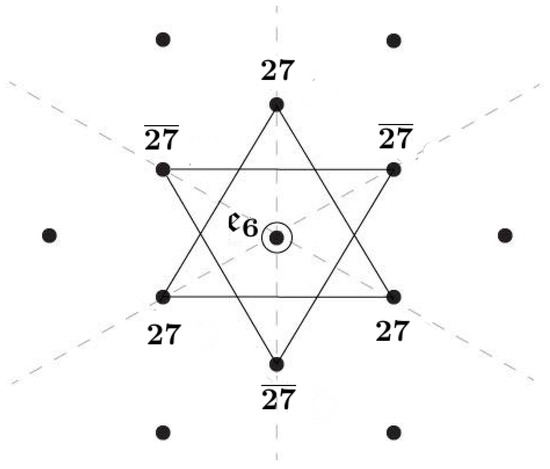
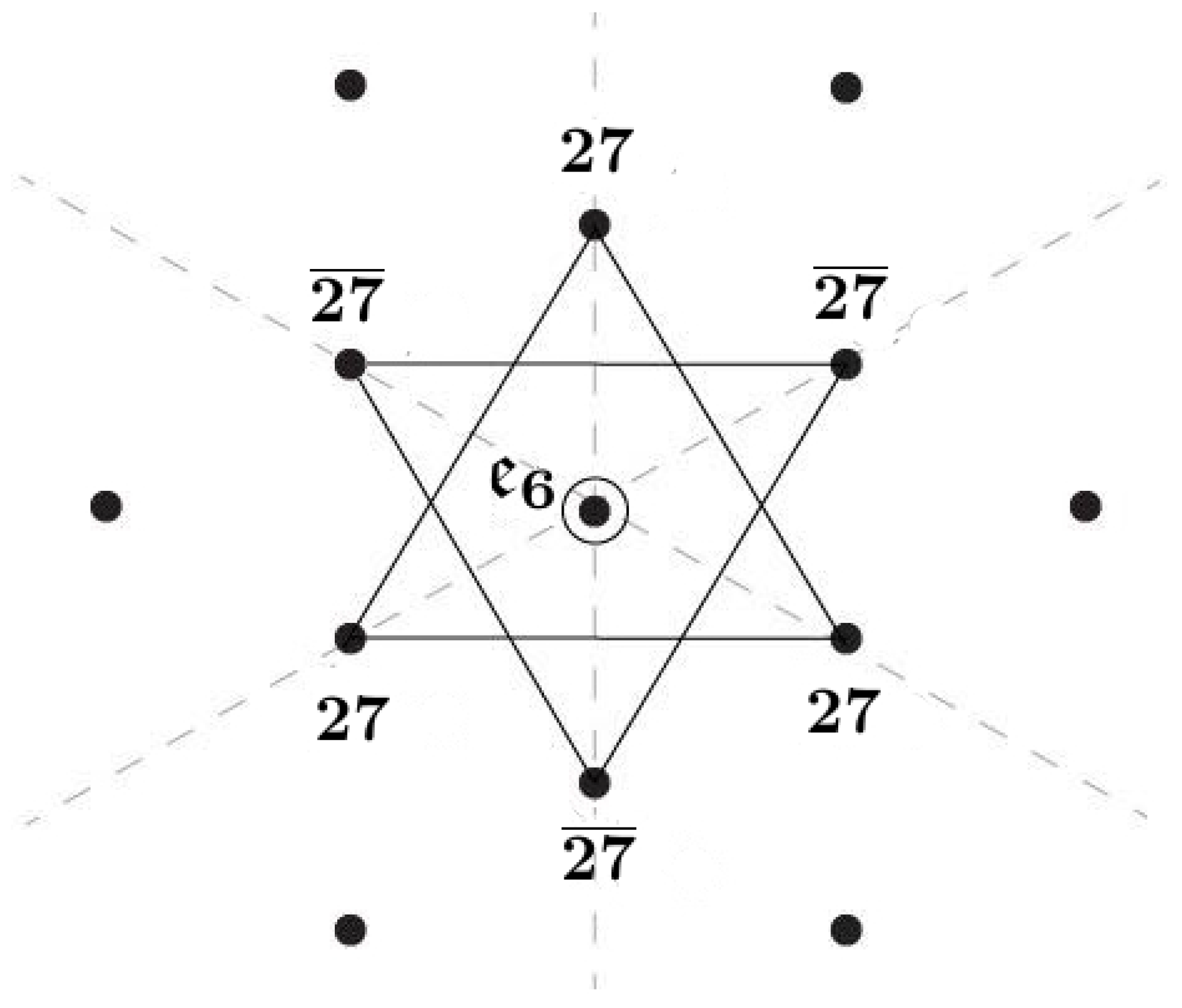
Disclaimer/Publisher’s Note: The statements, opinions and data contained in all publications are solely those of the individual author(s) and contributor(s) and not of MDPI and/or the editor(s). MDPI and/or the editor(s) disclaim responsibility for any injury to people or property resulting from any ideas, methods, instructions or products referred to in the content. |
© 2023 by the authors. Licensee MDPI, Basel, Switzerland. This article is an open access article distributed under the terms and conditions of the Creative Commons Attribution (CC BY) license (https://creativecommons.org/licenses/by/4.0/).