
Modeling and Control of Rigid–Elastic Coupled Hypersonic Flight Vehicles: A Review

Abstract
1. Introduction
- Hypersonic cruising stage: Aerodynamic heating degrades structural material stiffness, perturbing the body’s dynamic parameters and introducing significant nonlinearity—requiring control parameters to adapt accordingly. Thus, traditional linear control methods may fail; nonlinear compensation or adaptive mechanisms are therefore needed to adjust control parameters online and ensure stability. Elastic vibration-induced angle-of-attack fluctuations reduce the lift–drag ratio, significantly impacting control system stability and accuracy; a more effective robust control strategy is therefore required.
- Large Angle-of-Attack Maneuver Stage: During large angle of attack or rapid maneuvering, the aircraft faces high overload demands—even approaching the critical threshold of its available overload capacity. In this state, energy exchange between the aircraft’s low-frequency rigid-body motion and high-frequency elastic modes (e.g., 1 Hz rigid-body pitch motion exciting the 20 Hz wing bending mode) can amplify lateral flutter amplitude to 200% of the critical value [1]. Additionally, fuel tank oscillation couples with the fuselage’s elastic vibration, degrading guidance accuracy. These factors pose significant challenges to the aircraft’s structural strength and attitude control stability.
- Multi-body separation stage: Shock loads from interstage separation excite vibrations of the flexible adapter, whose excited modal frequency is close to that of the attitude control system. This forms closed-loop coupling with the attitude control system, inducing roll oscillations of the test vehicle and leading to separation failure or structural damage [2].
- Modal interaction effect: The nonlinear energy exchange between the rigid-body mode and the elastic mode, as well as between different-order elastic modes, breaks the assumption of modal independence, leading to the mismatch of the control law and triggering the “modal capture” phenomenon, which significantly reduces the robustness margin.
- Frequency overlap effect: The frequencies of elastic modes (10–50 Hz) are likely to overlap with the attitude control bandwidth (5–20 Hz), forming a positive-feedback resonance that causes the vibration amplitude to increase exponentially and destroys the closed-loop stability.
- Amplitude-dependent effect: When the amplitude of elastic vibration exceeds the critical value, the material and geometric nonlinearities cause changes in the structural stiffness, leading to the mismatch of control parameters and forming a vicious cycle of “increased stiffness–gain mismatch–intensified vibration”.
2. Research on Rigid–Elastic Coupling Modeling of Aircraft
2.1. Definition of Coordinate System of Rigid–Elastic Coupling
2.2. Elastic Mode and Sensor Layout
2.3. Fuel Tank Liquid Shaking Model
2.4. Research on Multi-Physical Field Coupling Modeling
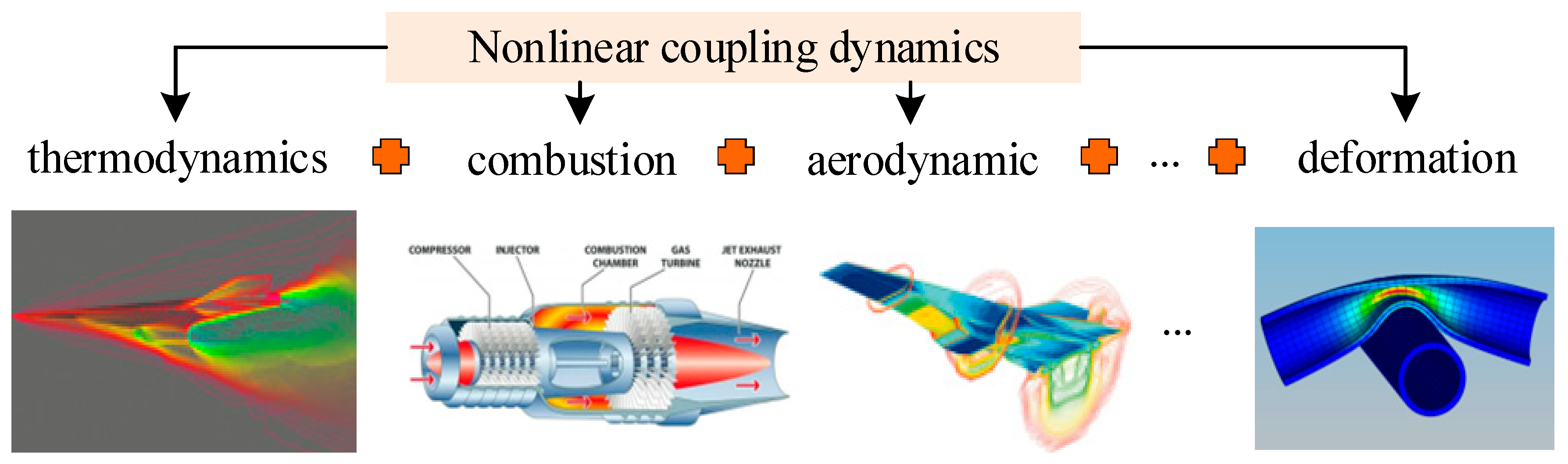
- Thermal–structural–control coupling modeling: During hypersonic flight, aerodynamic heating can cause the structural temperature to reach over 1200 °C, leading to material stiffness degradation, the generation of thermal stress, and a shift in elastic modes (the first-order modal frequency decreases by 5–10% [22]), which, in turn, affects the adaptability of control law parameters. The existing modeling methods mainly include the following: ➀ finite element–control coupling simulation, which calculates the structural temperature distribution through the heat conduction equation and then substitutes the temperature-dependent stiffness matrix into the dynamic model [31]; ➁ the simplified thermoelastic model, which equates the thermal effect to parameter perturbation and uses the linear parameter-varying (LPV) model to describe the thermal–structural coupling characteristics [32]; and ➂ data-driven modeling, which uses deep learning (e.g., CNN-LSTM network) to fit the nonlinear mapping relationship of thermal–structural–control and predict the control response under thermal environment. The current challenges include the large difference in the time scales of heat conduction and structural dynamics (heat conduction is in seconds, while structural vibration is in milliseconds), resulting in low efficiency of coupling simulation. It is difficult to accurately characterize the uncertainty of material parameters under extreme temperatures.
- Fluid–structural–control coupling modeling: Flow field characteristics such as transonic shock wave oscillation and rarefied atmosphere viscous effect form a strong coupling with structural elastic vibration and control loops. The existing methods include the following: ➀ aero-servoelastic (ASE) modeling, which uses piston theory and the dipole lattice method to calculate the unsteady aerodynamic force and forms a coupling model in combination with the structural dynamic equation [20]; ➁ co-simulation of computational fluid dynamics (CFD) and multi-body dynamics (MBD), which accurately capture the dynamic interaction between the flow field and the structure [33]; and ➂ reduced-order modeling technology (e.g., Proper Orthogonal Decomposition, POD), which performs reduced-order processing on CFD data to reduce the computational complexity of the coupling model [4]. There are still limitations in engineering applications: the computational cost of CFD-MBD co-simulation is extremely high, making it difficult to be used for real-time control; the accuracy of the reduced-order model depends on the sampling conditions, and its generalization ability is insufficient.
3. Research Status of Rigid–Elastic Coupling Control Strategy
3.1. Linear Control Method
3.2. Nonlinear Control Method
3.3. Intelligent Control Method
3.4. Rigid–Elastic Coupling Control Method
3.4.1. Optimal Configuration of Measuring Devices
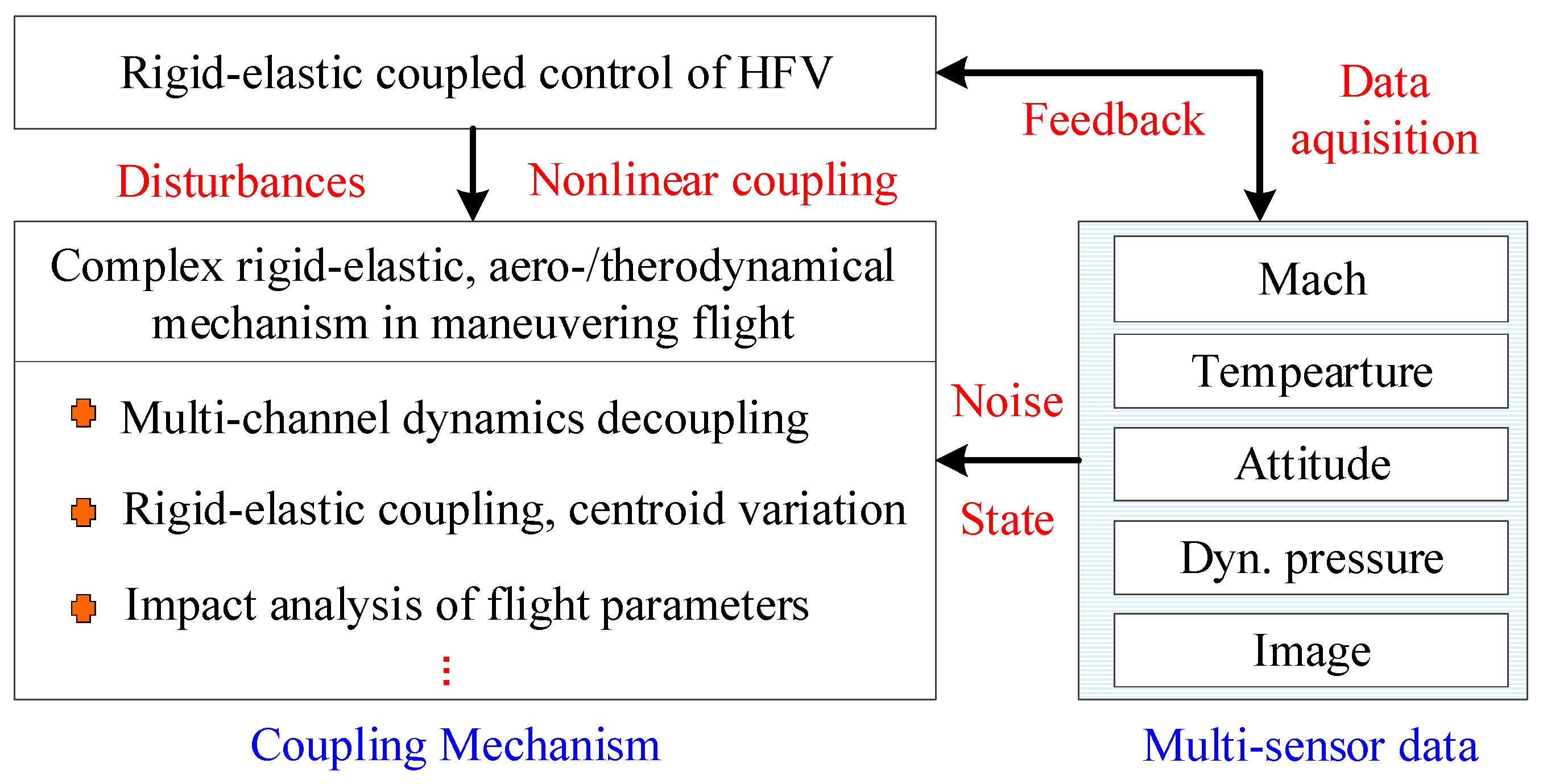
- Inertial Measurement Unit (IMU): Typically installed near the vehicle’s center of mass (CoM), it is used to measure the angular rate and linear acceleration of rigid-body motion. However, the IMU output is a superimposed signal of rigid-body motion and elastic vibrations, which introduces measurement noise. Moreover, direct utilization of this output may excite elastic modes.
- Rate Gyroscopes (RGs) and Accelerometers: These can be installed in a distributed arrangement at key locations (e.g., wings and tail surfaces) to directly measure the vibrational angular rates and accelerations of local structures. They serve as the primary data sources for constructing elastic modal observers.
- Global Positioning System (GPS) and Vision Sensors: These provide rigid-body position and attitude information to support state estimation.
- New Sensors (e.g., Fiber Bragg Gratings, FBGs): They possess the advantages of being lightweight, anti-electromagnetic interference (EMI) capable, and easy for distributed deployment, making them highly suitable for strain and vibration measurement of hypersonic vehicle structures.
- Methods Based on Modal Observability: This method calculates the observability Gram matrix or eigenvector orthogonality between each sensor position and the target elastic modes through analysis of the system’s state-space model. Optimization algorithms (e.g., genetic algorithm (GA) and particle swarm optimization (PSO)) are employed to determine the sensor distribution scheme that maximizes the observability index of the target modes.
- Energy/Contribution-Based Approaches: These approaches analyze the output energy of sensors at different positions or their contribution to controller performance under specific modes, prioritizing positions sensitive to the response of key elastic modes.
- Robust Configuration Methods: Considering model uncertainties (e.g., aerodynamic parameter variations, structural damage), robustness indices are incorporated into the optimization process to ensure the sensor system maintains favorable sensing performance even under parameter perturbations.
3.4.2. Active and Passive Control Strategies
- Disturbance suppression method: Regarding elastic vibration as a disturbance, its influence is eliminated through robust control, disturbance observers, etc. This method is suitable for scenarios where the elastic mode frequency is far from the control bandwidth and the vibration amplitude is small (such as the cruise phase). However, it has a large steady-state error (up to 5–8%) in scenarios with large maneuvers and strong coupling.
- Explicit elastic state feedback control: The elastic vibration state is directly measured by sensors, and a dedicated controller is designed to actively suppress the vibration. This method is suitable for scenarios where the elastic mode is close to the control bandwidth and the vibration amplitude is large (such as large-angle-of-attack maneuvers). However, it requires additional sensors to be installed, which increases the system complexity. In engineering, dynamic switching is required according to flight conditions: the disturbance suppression method is used in the cruise phase to simplify the system, and the explicit feedback control is switched to in the large-maneuver phase to ensure accuracy.
- Collaborative design of structure and control: In the topological optimization stage, with the constraint of “minimizing control energy consumption”, the structural stiffness distribution is adjusted to keep the key elastic mode frequencies away from the control bandwidth. After the application in a certain type of hypersonic glide vehicle, the active control energy consumption is reduced by 35% [99].
- Integrated application of smart materials: Piezoelectric ceramics, shape memory alloys, etc., are used as structural components (passive load-bearing) and actuators (active suppression). The piezoelectric active damping structure applied by NASA on the X-57 verification aircraft has achieved millisecond-level suppression of wing bending vibration [98].
- Collaborative control of passive damping and active compensation: Medium- and low-frequency vibrations are attenuated by high-damping composite materials (passive), and then the high-frequency residual vibrations are compensated for by an adaptive notch filter (active) to solve the problem of insufficient high-frequency vibration suppression by single passive control [96].
3.4.3. Comparison of Different Control Methods
3.4.4. Digital Twin-Oriented Rigid–Flexible Coupling Control
- Real-time mapping based on multi-source data fusion: In 2023, Zhang et al. proposed a rigid–flexible coupling dynamic modeling method based on a digital twin [105]. Through the multi-source data fusion of distributed FBG sensors, IMUs, and GPS, a high-precision digital twin of the aircraft was constructed to achieve millisecond-level synchronous mapping of elastic vibration, structural thermal deformation, and rigid-body attitude. In the simulation of a certain type of flexible missile, the dynamic response error between the twin and the physical entity was less than 3%, providing accurate state feedback for control decisions.
- Virtual closed-loop control and pre-decision: In 2022, Li et al. designed a digital twin-driven feedforward–feedback composite control architecture [106]. By using the twin to simulate the rigid–flexible coupling responses under different control strategies, the excitation trend of elastic vibration was predicted in advance, and the optimal feedforward control instructions were generated to cooperate with the online feedback control. During the hypersonic cruise phase, the amplitude of elastic vibration was reduced by 40% compared with the traditional feedback control, and the lag of the control loop was reduced.
- Full-life-cycle health management and control optimization: In 2024, Chen et al. proposed a control strategy combining a digital twin and federated learning [107]. The twin accumulates the flight data of multiple aircraft, and federated learning is used to train a general control model. At the same time, for the individual characteristics of a single aircraft, such as structural aging and elastic mode drift, the control parameters are fine-tuned online to achieve the optimization mode of “general model + personalized correction”, thus extending the effective life cycle of the control system.
3.4.5. Parameter Sensitivity Analysis
- Influence of Elastic Frequency Change: The elastic modal frequency is the core parameter determining the adaptability of the control strategy. Its fluctuation mainly affects the control performance through the “frequency matching degree”.
- Influence of Structural Damping Change: Structural damping directly determines the attenuation rate of elastic vibration. Its insufficiency is the key factor leading to the difficulty in vibration suppression.
- Influence of Stiffness Change Induced by Thermal Effect: Aerodynamic heating during the hypersonic cruise phase (the wall temperature can reach 500–1000 °C) will cause significant degradation of the structural stiffness, indirectly affecting the control performance.
- Influence of Fuel Mass Change: The fuel mass accounts for a high proportion (50–90%) and is dynamically consumed. Its change affects the control performance in two ways through “centroid migration + modal coupling”.
3.5. Consider the Control Method of Fuel Shaking
4. Summary and Outlook
4.1. Research Summary
4.2. Research Outlook
4.2.1. Short-Term Engineering Needs
- Collaborative optimization of sensor layout and control law: To address the high-dimensional optimization problem of large-scale flexible structures, future research should integrate distributed fiber Bragg grating (FBG) sensing technology with multi-objective optimization algorithms (such as the improved particle swarm algorithm); establish a sensor layout model that combines “modal observability–robustness–economy” and realizes the collaborative design of sensor configuration and control law; and solve the problem of system instability caused by the closed-loop coupling of elastic vibration signals.
- Improvement in adaptive notch and active vibration control: Aiming at the problem of the failure of traditional notch filters in low-mode frequency scenarios, future research should combine the disturbance estimation ability of the extended state observer (ESO) with the precise approximation ability of the attention mechanism neural network; develop a composite strategy of notch-active control with adaptive parameter tuning, which can dynamically match the changes in elastic modes without manual intervention; and improve the accuracy and robustness of vibration suppression.
- Collaborative control of fuel sloshing–rigid–flexible coupling: Based on the rigid pendulum composite model and the coupled simulation of multi-body dynamics (MBD) and computational fluid dynamics (CFD), future research should establish an integrated dynamic model of fuel sloshing and rigid–flexible coupling; design a composite control strategy of fuzzy sliding mode-boundary feedback to solve engineering pain points, such as POGO vibration and reduced guidance accuracy caused by liquid sloshing; and meet the large-attitude maneuver requirements of hypersonic vehicles.
- Multi-mode switching control: Current research mainly focuses on a specific flight phase of high-speed vehicles. However, in practical application scenarios, hypersonic vehicles usually operate in a large-envelope maneuvering flight mode. Their complex flight tasks often require designing corresponding controllers for different flight phases. Reasonably switching between controllers can not only adapt to the dynamic needs of multiple phases but also significantly improve the overall dynamic performance of the system. It is worth noting that there are significant differences in rudder effectiveness characteristics under different flight conditions, which further increases the complexity of controller design.
4.2.2. Long-Term Research Directions
- Integrated collaborative technology of metamaterials–intelligent control: Future research should break through the limitations of the separate design of traditional structures and control; utilize the programmable mechanical properties of metamaterials (dynamic stiffness adjustment, negative damping effect) to realize the real-time reconstruction of structural mechanical properties at key parts of the vehicle; combine the deep reinforcement learning (DRL) algorithm to train an intelligent decision-making model that can autonomously sense the flight state; and dynamically optimize the matching strategy of metamaterial parameters and controller parameters to achieve the integrated collaboration of “structural adaptability–control self-optimization” and fundamentally improve the system stability under large-envelope maneuvers.
- Autonomous evolutionary control driven by digital twins: Future research should build a trinity architecture of “physical entity–digital twin–cloud brain”. Based on the distributed FBG sensing network, it should collect multi-source heterogeneous data throughout the life cycle. Through edge computing, it should realize real-time data pre-processing and millisecond-level mapping of the digital twin. In addition, future research should use the cloud brain to integrate deep reinforcement learning and federated learning, complete billions of iterations of working condition training in a virtual environment, realize the autonomous iterative update of control strategies and experience sharing among multiple vehicles, and endow the vehicle with “autonomous learning and evolution ability” to cope with complex and unknown working conditions.
- High-precision control with strong cross-scale coupling: For the cross-scale strong coupling problem of “unsteady aerodynamics–structural modes–centroid migration” during the deformation of near-space vehicles, future research should integrate distributed high-precision sensing and the Transformer model to capture the long-time-series-dependent features of multi-physical field coupling and build a dynamic prediction model. It should propose an adaptive model predictive control method with a closed-loop of “sensing–prediction–control” to predict the excitation trend of elastic vibration in advance. Through the collaboration of feed-forward control and feedback correction, future research should achieve nanometer-level attitude control accuracy to meet the strict requirements of future high-precision strikes, space transportation, and other tasks.
- Innovative cross-disciplinary integration: Future research should break the barriers between disciplines, such as machinery, aviation, materials, and computers, and carry out integrated collaborative design of “aerodynamics–metamaterial structure–intelligent control–high-precision sensing”. It should incorporate the requirements of rigid–flexible coupling suppression into the conceptual design stage; focus on complex problems, such as the coupling of multiple physical fields of heat–elasticity–control–fluid; and develop AI-driven, efficient modeling methods. Finally, it should promote the cross-integration of aeroelastic mechanics and material gene engineering and design metamaterials with specific rigid–flexible coupling suppression functions to open up disruptive technological paths for multi-physical field coupling problems.
- Multi-field coupling and error quantification in reduced-order modeling: Future research should develop a multi-field coupling reduced-order framework based on “physical mechanism + data-driven”; integrate the advantages of methods such as POD and Transformer to solve the problem of data scarcity under extreme working conditions; establish an error quantification theory for reduced-order models; clarify the mapping relationship between error boundaries and control performance; and provide reliability guarantees for engineering applications.
- Construction of flight-level verification platform: Future research should rely on the existing hypersonic vehicle test platform; install measurement equipment such as distributed FBG sensors and high-precision IMUs; carry out special flight tests on rigid–flexible coupling control; and establish a three-level verification system of “simulation–ground experiment–flight verification” to ensure the engineering reliability of control methods.
Author Contributions
Funding
Data Availability Statement
Conflicts of Interest
Abbreviations
| AIM | Approximate Inertial Manifold |
| CFD | Computational Fluid Dynamics |
| ESO | Extended State Observer |
| FBG | Fiber Bragg Grating |
| FEM | Finite Element Method |
| HSV | Hypersonic Vehicle |
| IMU | Inertial Measurement Unit |
| LPV | Linear Parameter Varying |
| MBD | Multi-body Dynamics |
| POD | Proper Orthogonal Decomposition |
| RBCA | Robust Control and Adaptive |
| RG | Rate Gyro |
| SMC | Sliding Mode Control |
| STMPC | Self-triggered Model Predictive Control |
| T-S | Takagi–Sugeno |
| VSC | Variable Structure Control |
References
- Chen, H.B.; Zhang, L.T. Experimental Study on Vibration Characteristics of Rigid-Elastic Coupling System. Trans. Chin. Soc. Aeronaut. Astronaut. 2021, 34, 567–576. [Google Scholar]
- Smith, J.; Johnson, C. Kinetics of Multibody Separation, 1st ed.; National Defense Industry Press: Beijing, China, 2019; pp. 234–258. [Google Scholar]
- Martin, R.W.; David, K.S. Flight Dynamics of Aeroelastic Vehicles. J. Aircr. 1988, 25, 563–571. [Google Scholar] [CrossRef]
- Chavez, F.R.; Schmidt, D.K. Analytical Aeropropulsive Aeroelastic Hypersonic Vehicle Model with Dynamic Analysis. J. Guid. Control Dyn. 1994, 17, 1308–1319. [Google Scholar] [CrossRef]
- Bilimoria, K.D.; Schmidt, D.K. Integrated Development of the Equations of Motion for Elastic Hypersonic Flight Vehicles. J. Guid. Control Dyn. 1995, 18, 73–81. [Google Scholar] [CrossRef]
- Bolender, M.A.; Doman, D.B. Nonlinear Longitudinal Dynamical Model of an Air-Breathing Hypersonic Vehicle. J. Spacecr. Rocket. 2007, 44, 374–386. [Google Scholar] [CrossRef]
- Liu, Y.; Chen, B.; Li, Y.; Shen, H. Overview of control-centric integrated design for hypersonic vehicles. Astrodynamics 2018, 2, 307–324. [Google Scholar] [CrossRef]
- Zhu, Q.J.; Tang, S.; Tan, Y.M. Modeling and Analysis of Rear Body/External Nozzle of Hypersonic Elastic Vehicle. Flight Mech. 2012, 30, 48–52. [Google Scholar]
- Zhang, X.B.; Zong, Q.; Zeng, F.L. Modeling and Analysis of Oriented Control of Hypersonic Aircraft Considering Aerodynamic-Propulsion-Elastic Coupling. J. Astronaut. 2014, 35, 528–536. [Google Scholar]
- Zhang, X.B.; Zong, Q. Modeling and Analysis of Control-Oriented Elastomer Hypersonic Vehicle. Control Decis. 2014, 29, 1205–1210. [Google Scholar]
- Meirovitch, L.; Nelson, H.D. On the High-Spin Motion of a Satellite Containing Elastic Parts. J. Spacecr. Rocket. 1996, 3, 1597–1602. [Google Scholar] [CrossRef]
- Meirovitch, L. Hybrid State Equation of Motion for Flexible Bodies in Terms of Quasi-Coordinates. J. Guid. Control Dyn. 1991, 14, 1008–1013. [Google Scholar] [CrossRef]
- Meirovitch, L.; Tuzcu, I. Unified Theory for the Dynamics and Control of Maneuvering Flexible Aircraft. AIAA J. 2004, 42, 714–727. [Google Scholar] [CrossRef]
- Guo, D.; Xu, M.; Chen, S.L. Research on Flight Dynamics Modeling of Elastic Aircraft. J. Aerodyn. 2013, 31, 413–436. [Google Scholar]
- Ding, H.X.; Xu, B.W.; Yang, W.Q.; Zhou, Y.F.; Wu, X.Y. A robust control method for the trajectory tracking of hypersonic unmanned flight vehicles based on model predictive control. Drones 2025, 9, 223. [Google Scholar] [CrossRef]
- Xu, B.W.; Yang, W.Q.; Zhou, Y.F.; Zhao, W.; Wu, X.Y.; Zhang, Z.D.; Liu, Y. A data-driven online estimation method for aerodynamic parameter of high-speed aircraft considering strong nonlinearity and noise. ISA Trans. 2025, 163, 86–97. [Google Scholar] [CrossRef] [PubMed]
- Chen, E.K.; Jing, W.X.; Gao, C.S.; Zhang, Z. An Adaptive Control Approach for a Flexible Hypersonic Glide Vehicle. In Proceedings of the 9th International Conference on Mechanical and Aerospace Engineering, Budapest, Hungary, 10–13 July 2018. [Google Scholar]
- Ge, D.M.; Huang, X.L. Analysis of Dynamic Characteristics of Control-Oriented Hypersonic Aircraft. Aerosp. Control 2010, 28, 3–9. [Google Scholar]
- Li, X.R.; He, J.W.; Hei, L.J. Comprehensive Study on Structure/Control Coupling of Hypersonic Aircraft. Flight Mech. 2013, 31, 57–60. [Google Scholar]
- Zong, Q.; You, M.; Zeng, F.L.; Dou, L. Aeroservoelastic Modeling and Analysis of a Six-DOF Hypersonic Flight Vehicle. Proc. Inst. Mech. Eng. Part G J. Aerosp. Eng. 2016, 230, 1240–1251. [Google Scholar] [CrossRef]
- Qian, W.; Bai, Y.G.; Chen, X.Y.; Lu, T. Aero-Servo-Elastic Analysis of a Hypersonic Aircraft. J. Low Freq. Noise Vib. Act. Control 2018, 37, 534–553. [Google Scholar] [CrossRef]
- Wei, Y.Y.; Hao, M.R.; Duan, G.R.; Patnaik, S. Control Law Design for Elastic Aircraft Based on Intelligent Variable Structure. J. Intell. Fuzzy Syst. 2018, 35, 485–499. [Google Scholar] [CrossRef]
- Xu, H.; Xie, Y.L.; Gao, Q.S.; Chen, X.L. Sensor Layout Optimization Method Based on Projectile Positioning Accuracy Analysis. Piezoelectr. Acousto-Opt. 2024, 46, 264–272. [Google Scholar]
- He, C.; Ma, D.L.; Jia, Y.H. Multi-Objective Optimization Design of Wing Layout Sensor Aircraft. J. Aeronaut. 2021, 42, 237–252. [Google Scholar]
- Yang, W.Q.; Yang, H. Sensor Layout in Servo-Elastic Mode of Large Sine Ratio Aircraft. J. Natl. Univ. Def. Technol. 2018, 40, 1–6. [Google Scholar]
- Cheng, X.D. Modeling Method of Spacecraft Liquid Shaking. J. Anqing Norm. Univ. Nat. Sci. Ed. 1995, 1, 35–37. [Google Scholar]
- Li, Q.; Wang, T.S.; Ma, X.R. Research and Application of Liquid Shaking and Liquid-Solid Coupling Dynamics of Liquid-Filled Spacecraft. Prog. Mech. 2012, 42, 472–481. [Google Scholar]
- Abramson, H.N. The Dynamic Behavior of Liquids in Moving Containers, with Applications to Space Vehicle Technology; National Aeronautics and Space Administration: Washington, DC, USA, 1966; pp. 1–100. [Google Scholar]
- Liu, F.; Yue, B.Z.; Ma, B.L.; Shen, Y.F. Modeling and Analysis of Equivalent Dynamics of Liquid-Filled Spacecraft under Fuel Consumption. Acta Mech. 2020, 52, 1454–1464. [Google Scholar]
- Wang, D.H.; Sun, B.; Liu, C.X.; Zhou, Z.Y.; Liu, Y. Research on Vertical Vibration Control of Nonlinear Viscoelastic Vibration Isolation System by Time Lag Feedback. J. Appl. Math. Mech. 2025, 46, 199–207. [Google Scholar]
- Hughes, H.; Wu, F. H-Infinity LPV State Feedback Control for Flexible Hypersonic Vehicle Longitudinal Dynamics. In Proceedings of the AIAA Guidance, Navigation, and Control Conference, Toronto, ON, Canada, 5–8 August 2010; p. 8281. [Google Scholar]
- Qin, W.W.; Zheng, Z.; Liu, G.; Ma, J.J.; Li, W.Q. LPV Robust Variable Gain Control of Hypersonic Aircraft. Syst. Eng. Electron. 2011, 33, 1327–1331. [Google Scholar]
- Yu, L.; Yue, B.Z. Dynamic Modeling of Liquid-Filled Free-Floating Space Robot and Joint Trajectory Planning with Considering Liquid Positioning. Aerosp. Sci. Technol. 2025, 161, 11013332.46. [Google Scholar]
- Yang, F.; Huang, Y.; Chen, Y.S.; Wang, Z. Implementation of Hypersonic Aircraft Control System Based on Differential Geometric Feedback Linearization. Comput. Meas. Control 2022, 30, 125–130. [Google Scholar]
- Xu, B.; Shi, Z.K. An overview on flight dynamics and control approaches for hypersonic vehicles. Sci. China-Inf. Sci. 2015, 58, 070201. [Google Scholar] [CrossRef]
- An, H.; Wu, Q. Anti-Windup Disturbance Suppression Control of Feedback Linearizable Systems with Application to Hypersonic Flight Vehicles. Proc. Inst. Mech. Eng. Part G J. Aerosp. Eng. 2019, 233, 3952–3967. [Google Scholar] [CrossRef]
- Hu, C.; Yang, X.; Wei, X.; Hu, Y. Robust Model Predictive Control for Hypersonic Vehicle with State-Dependent Input Constraints and Parameter Uncertainty. Int. J. Robust Nonlinear Control 2021, 31, 9676–9691. [Google Scholar] [CrossRef]
- Li, Y.J.; Hou, M.S.; Liang, S.; Liu, B.J. Simulation of Hypersonic Aircraft Trajectory Tracking Control. Comput. Simul. 2018, 35, 72–77. [Google Scholar]
- Qu, Y.; Fan, L.; Dai, L.; Li, F.; Zhong, X. Disturbance observer-based neural adaptive fault-tolerant control for flexible air-breathing hypersonic vehicles with multiple model uncertainties. Trans. Inst. Meas. Control 2023, 47, 1–22. [Google Scholar] [CrossRef]
- Liu, J.; Jiang, J.; Yin, H.B.; Wang, H. Adaptive Fixed-Time Anti-Saturation Control of Hypersonic Aircraft. J. Harbin Eng. Univ. 2022, 43, 1013–1022. [Google Scholar]
- Liu, H.; Zhang, J.; Xi, J. Robust Nonlinear Controller Design for Uncertain Hypersonic Vehicles. CEAS Aeronaut. J. 2019, 10, 357–366. [Google Scholar] [CrossRef]
- Zhao, Y.; Cai, G.B.; Zhang, S.X.; Zhang, X. Design of Finite Time LPV Sliding Mode Controller for Hypersonic Aircraft. J. Harbin Inst. Technol. 2019, 51, 107–114. [Google Scholar]
- Xu, B.W.; Lu, X.J. A data-driven spatiotemporal model predictive control strategy for nonlinear distributed parameter systems. Nonlinear Dyn. 2022, 108, 1269–1281. [Google Scholar] [CrossRef]
- Tang, W.; Long, W.; Gao, H. A Novel Robust Flight Controller Design for an Air-Breathing Hypersonic Vehicle. Autom. Control Comput. Sci. 2018, 52, 198–207. [Google Scholar] [CrossRef]
- Shen, T.L. H∞ Control Theory and Application, 1st ed.; Tsinghua University Press: Beijing, China, 1996; pp. 1–200. [Google Scholar]
- Yu, L. Robust Control-Linear Matrix Inequality Processing Method, 1st ed.; Tsinghua University Press: Beijing, China, 2002; pp. 50–150. [Google Scholar]
- Ren, J.; Hang, B.; Sang, M.; Hong, R.; Xu, B. Nonlinearity Compensation Based Robust Tracking Control of Nonlinear Nonminimum Phase Hypersonic Flight Vehicles. ISA Trans. 2022, 131, 236–245. [Google Scholar] [CrossRef]
- Zhao, Y.; Yu, L.Y.; Liu, H.; Zhang, X. Design of Nonlinear Robust Control Law for Hypersonic Aircraft. Control Theory Appl. 2016, 33, 62–69. [Google Scholar]
- Zhang, J.S.; Ma, Q.H.; Li, H.Q.; Fan, L.M. Research on Robust Longitudinal Control Technology of Hypersonic Aircraft. J. Guid. Control 2020, 40, 19–22. [Google Scholar]
- Shao, X.L.; Shi, Y. Fault-tolerant quantized control for flexible air-breathing hypersonic vehicles with appointed-time tracking performances. IEEE Trans. Airsp. Electron. Syst. 2021, 57, 1261–1273. [Google Scholar] [CrossRef]
- Liu, H.; Liu, D.; Xi, J.; Yu, Y. Robust Control for Hypersonic Vehicles with Parametric and Unstructured Uncertainties. Proc. Inst. Mech. Eng. Part C J. Mech. Eng. Sci. 2018, 232, 2369–2380. [Google Scholar] [CrossRef]
- Tan, S.; Li, J.; Lei, H. Robust Control of Air-Breathing Hypersonic Vehicles with Adaptive Projection-Based Parameter Estimation. IEEE Access 2019, 7, 88998–89013. [Google Scholar] [CrossRef]
- Fiorentini, L.; Serrani, A.; Bolender, M.A.; Doman, D.B. Nonlinear Robust Adaptive Control of Flexible Airbreathing Hypersonic Vehicles. J. Guid. Control Dyn. 2009, 32, 402–417. [Google Scholar] [CrossRef]
- Zong, Q.; Wang, F.; Tian, B.; Su, R. Robust Adaptive Dynamic Surface Control Design for a Flexible Air-Breathing Hypersonic Vehicle with Input Constraints and Uncertainty. Nonlinear Dyn. 2014, 78, 289–315. [Google Scholar] [CrossRef]
- Meng, Y.; Jiang, B.; Qi, R. Adaptive Fault-Tolerant Attitude Tracking Control of Hypersonic Vehicle Subject to Unexpected Centroid-Shift and State Constraints. Aerosp. Sci. Technol. 2019, 95, 105515. [Google Scholar] [CrossRef]
- Yang, X.X. Trajectory Tracking Control of Air-Breathing High-Speed Aircraft Based on Adaptive Dynamic Programming. Master’s Thesis, Tianjin University of Technology, Tianjin, China, 2022. [Google Scholar]
- Liu, J.K. MATLAB Simulation of Sliding Mode Variable Structure Control, 1st ed.; Tsinghua University Press: Beijing, China, 2005; pp. 80–120. [Google Scholar]
- Gao, W.B. Theory and Design Method of Variable Structure Control, 1st ed.; Science Press: Beijing, China, 1996; pp. 60–100. [Google Scholar]
- Zhang, H.; Wang, P.; Tang, G.; Bao, W. Fuzzy Disturbance Observer-Based Dynamic Sliding Mode Control for Hypersonic Morphing Vehicles. Aerosp. Sci. Technol. 2023, 142, 108987. [Google Scholar] [CrossRef]
- Lv, X.; Zhang, G.; Bai, Z.; Zhou, X.; Shi, Z.; Zhu, M. Adaptive Neural Network Global Fractional Order Fast Terminal Sliding Mode Model-Free Intelligent PID Control for Hypersonic Vehicle’s Ground Thermal Environment. Aerospace 2023, 10, 777. [Google Scholar] [CrossRef]
- Sheng, Y.; Gan, J.; Xia, L. Predefined-Time Fractional-Order Time-Varying Sliding Mode Control and Its Application in Hypersonic Vehicle Guidance Law. Nonlinear Dyn. 2023, 111, 14177–14198. [Google Scholar] [CrossRef]
- Gao, R.; Ding, Y.; Yue, X. Active Adaptive Continuous Nonsingular Terminal Sliding Mode Controller for Hypersonic Vehicle. Aerosp. Sci. Technol. 2023, 137, 108832. [Google Scholar] [CrossRef]
- Cui, P.; Gao, C.; Jing, W.; An, R. Fault-Tolerant Control of Hypersonic Vehicle Using Neural Network and Sliding Mode. Int. J. Aerosp. Eng. 2022, 2022, 1637305. [Google Scholar] [CrossRef]
- Chen, H.; Lin, W.; Ma, T.; Jin, H.; Xu, C. Parameter Adaptive Terminal Sliding Mode Control of Flexible Coupling Air-Breathing Hypersonic Vehicle. Int. J. Aerosp. Eng. 2020, 2020, 9430272. [Google Scholar] [CrossRef]
- Wang, Z.S.; Liao, Y.X.; Wei, C.S.; Dai, T. Fault Tolerance Control of Fast Terminal Sliding Mode Performance Assurance of Hypersonic Aircraft. J. Aeronaut. Astronaut. 2023, 44, 162–175. [Google Scholar]
- Recasens, J.J.; Chu, Q.P.; Mulder, J.A. Robust Model Predictive Control of a Feedback Linearized System for the Lifting-Body Re-Entry Vehicle. In Proceedings of the AIAA Guidance, Navigation, & Control Conference & Exhibit, Keystone, CO, USA, 21–24 August 2006; pp. 495–500. [Google Scholar]
- Oort, E.V.; Chu, Q.P.; Mulder, J.A. Robust Model Predictive Control of a Feedback Linearized F-16/MATV Aircraft Model. In Proceedings of the AIAA Guidance, Navigation, & Control Conference & Exhibit, Boston, MA, USA, 19–22 August 2013; pp. 328–331. [Google Scholar]
- Tang, W.Q.; Long, W.K.; Gao, H.Y. Model Predictive Control of Hypersonic Vehicles Accommodating Constraints. IET Control Theory Appl. 2017, 11, 2599–2606. [Google Scholar] [CrossRef]
- Yan, L.D.; Qing, X.W.; Chang, S.J. Adaptive Predictive Control of Near Space Vehicle Using Functional Link Network. Trans. Nanjing Univ. Aeronaut. Astronaut. 2010, 27, 148–154. [Google Scholar]
- Wang, P.; Liu, L.H.; Wu, J. Nonlinear Hierarchy-Structured Predictive Control System Design for Hypersonic Flight Vehicle. Appl. Mech. Mater. 2012, 232, 194–199. [Google Scholar] [CrossRef]
- Cheng, X.; Wang, P.; Liu, L.; Tang, G. Predictive Sliding Mode Control Using Feedback Linearization for Hypersonic Vehicle. Procedia Eng. 2015, 99, 1076–1081. [Google Scholar] [CrossRef]
- Guo, M.K. High-Speed Aircraft Based on Self-Interference Immunity Control Technology. Master’s Thesis, Lanzhou University of Technology, Lanzhou, China, 2021. [Google Scholar]
- Lu, B.; Lu, Y.P. Research on Dynamic Inverse Control of Neural Network for High-Altitude and Hypersonic Vehicles. Comput. Meas. Control 2008, 16, 966–968. [Google Scholar]
- Zhai, Z.H.; Sun, X.X.; Liu, S.G. Adaptive Neural Network Dynamic Surface Control of Hypersonic Vehicle. Flight Mech. 2013, 31, 426–428. [Google Scholar]
- Butt, W.A.; Yan, L.; Kendrick, A.S. Dynamic Surface Control for Nonlinear Hypersonic Air Vehicle Using Neural Network. In Proceedings of the 29th Chinese Control Conference, Beijing, China, 29–31 July 2010. [Google Scholar]
- Bu, X.; Wu, X.Y.; Zhu, F.J.; Huang, J.; Ma, Z.; Zhang, R. Novel Prescribed Performance Neural Control of a Flexible Air-Breathing Hypersonic Vehicle with Unknown Initial Errors. ISA Trans. 2015, 59, 125–136. [Google Scholar] [CrossRef] [PubMed]
- Hu, Y.A.; Zhang, L.; Geng, B.L. Research Progress on Preset Performance Control. J. Nav. Aeronaut. Eng. Coll. 2016, 31, 1–6. [Google Scholar]
- Bechlioulis, C.P.; Rovithakis, G.A. Prescribed Performance Adaptive Control of SISO Feedback Linearizable Systems with Disturbances. In Proceedings of the 16th Mediterranean Conference on Control & Automation (MED), Ajaccio, France, 25–27 June 2008. [Google Scholar]
- Bechlioulis, C.P.; Rovithakis, G.A. Robust Adaptive Control of Feedback Linearizable MIMO Nonlinear Systems with Prescribed Performance. IEEE Trans. Autom. Control 2008, 53, 2090–2099. [Google Scholar] [CrossRef]
- Kostarigka, A.K.; Rovithakis, G.A. Adaptive Dynamic Output Feedback Neural Network Control of Uncertain MIMO Nonlinear Systems with Prescribed Performance. IEEE Trans. Neural Netw. Learn. Syst. 2012, 23, 138–149. [Google Scholar] [CrossRef]
- Bechlioulis, C.P.; Rovithakis, G.A. Approximation-Free Prescribed Performance Control for Unknown SISO Pure Feedback Systems. In Proceedings of the European Control Conference (ECC), Zurich, Switzerland, 17–19 July 2013; pp. 4544–4549. [Google Scholar]
- Shou, Y.X.; Xu, B.; Liang, X.H.; Yang, D.P. Aerodynamic/ reaction-jet compound control of hypersonic reentry vehicle using sliding mode control and neural learning. Aerosp. Sci. Technol. 2021, 111, 106564. [Google Scholar] [CrossRef]
- Sui, S.; Tong, S.C.; Li, Y.M. Observer-Based Fuzzy Adaptive Prescribed Performance Tracking Control for Nonlinear Stochastic Systems with Input Saturation. Neurocomputing 2015, 158, 100–108. [Google Scholar] [CrossRef]
- Chen, H.; Lin, W.; Ma, T.; Zhang, Y. Data-Driven Kernel Ridge Regression Based Adaptive Robust Control for Flexible Hypersonic Vehicles with Stability Proof. ISA Trans. 2022, 129, 287–298. [Google Scholar]
- Liu, J.; Yu, X.; Zhang, L.; Wang, Y. Data-Driven Model Ref. Adaptive Control for Aeroelastic Systems with Fast Convergence. Int. J. Robust Nonlinear Control 2024, 34, 1123–1141. [Google Scholar]
- Yang, Z.; Piao, M.; Sun, M.; Li, J. Barrier Lyapunov Function Based Deep Reinforcement Learning Control for Hypersonic Aeroelastic Vehicles. J. Vib. Control 2023, 29, 2689–2705. [Google Scholar]
- Wang, P.; Zhang, H.; Tang, G.; Bao, W. PPO-Sliding Mode Hybrid Control for Flexible Hypersonic Vehicles with Parameter Uncertainties. Aerospace 2021, 8, 276. [Google Scholar]
- Yuan, J.P.; Chen, S.L. Sensor Position Design of Elastic Aircraft. J. Astronaut. 1987, 1, 81–88. [Google Scholar]
- Xu, Z.; Yang, W.Q. Optimal Position Design of Large Aspect Ratio Elastic Aircraft Sensor. In Proceedings of the 2015 China Annual Conference on Flight Mechanics, Beijing, China, 2–5 August 2015. [Google Scholar]
- Jankovsky, P.; Sigthorsson, D.; Serrani, A.; Yurkovich, S.; Bolender, M.; Doman, D. Output Feedback Control and Sensor Placement for a Hypersonic Vehicle Model. In Proceedings of the AIAA Guidance, Navigation and Control Conference and Exhibit, Hilton Head Island, SC, USA, 20–23 August 2007. [Google Scholar]
- Englehart, M.J.; Krause, J.M. An Adaptive Control Concept for Flexible Launch Vehicles. In Proceedings of the Astrodynamics Conference, Hilton Head Island, SC, USA, 10–12 August 1992; pp. 1505–1512. [Google Scholar]
- Song, C.; Lei, J.; Wu, H.; Hao, M.R. Adaptive Fuzzy Sliding Mode Control for Flexible Aircraft with Parameter Uncertainties. J. Intell. Fuzzy Syst. 2019, 36, 1235–1246. [Google Scholar]
- Oh, C.S.; Bang, H. Attitude Control of a Flexible Launch Vehicle Using an Adaptive Notch Filter: Ground Experiment. Control Eng. Pract. 2008, 16, 30–42. [Google Scholar]
- Zhu, W.W.; Zong, Q.; Tian, B.L. Adaptive Tracking and Command Shaped Vibration Control of Flexible Spacecraft. IET Control Theory Appl. 2019, 13, 1121–1128. [Google Scholar] [CrossRef]
- Lv, Y.; Wang, R.C.; Ma, G. Disturbance Observer Based Back-Stepping Attitude Control for the Flexible Hypersonic Vehicle. In Proceedings of the International Spaceplane and Hypersonic Systems and Technologies Conference, Xiamen, China, 6–9 March 2017. [Google Scholar]
- Liu, Y.; Pu, Z.; Yi, J. Observer-Based Robust Adaptive T2 Fuzzy Tracking Control for Flexible Air-Breathing Hypersonic Vehicles. IET Control Theory Appl. 2018, 12, 1036–1045. [Google Scholar] [CrossRef]
- Wang, X.; Jia, Y. Sliding Mode Tracking and Input Shaped Vibration Control of Flexible Hypersonic Vehicles. In Proceedings of the 2015 Chinese Intelligent Automation Conference, Haikou, China, 30 March 2015. [Google Scholar]
- Zhou, J.; Zhao, J.L. Extended Disturbance Observer-Based Terminal Sliding Mode Control for Reentry Vehicles. J. Northwestern Polytech. Univ. 2016, 34, 817–822. [Google Scholar]
- Ren, J.X.; Yang, D.P. Disturbance Observer–Based Control of Flexible Hypersonic Flight Vehicles. Int. J. Adv. Robot. Syst. 2017, 14, 1729881416686953. [Google Scholar] [CrossRef]
- Piao, M.; Yang, Z.; Sun, M.; Huang, J.; Wang, Z.; Chen, Z. Synthesis of Attitude Control for Statically Unstable Hypersonic Vehicle with Low-Frequency Aero-Servo-Elastic Effect. Aerosp. Sci. Technol. 2018, 80, 67–77. [Google Scholar] [CrossRef]
- Piao, M.; Zhang, Y.; Sun, M.; Yang, Z.; Wang, Z.; Chen, Z. Adaptive Aeroservoelastic Mode Stabilization of Flexible Airbreathing Hypersonic Vehicle. J. Vib. Control 2019, 25, 2124–2142. [Google Scholar] [CrossRef]
- Pu, Z.; Yuan, R.; Tan, X.; Yi, J. Active Robust Control of Uncertainty and Flexibility Suppression for Air-Breathing Hypersonic Vehicles. Aerosp. Sci. Technol. 2015, 42, 429–441. [Google Scholar] [CrossRef]
- Theis, J.; Pfifer, H.; Seiler, P.J. Robust Control Design for Active Flutter Suppression. In Proceedings of the AIAA Atmospheric Flight Mechanics Conference, Washington, DC, USA, 13–17 June 2016. [Google Scholar]
- Gao, Q.; Peng, C.; Wang, Y. Design of Active Vibration Damping Combined Controller for Elastomer Missiles. Tactical Missile Technol. 2010, 140, 77–81. [Google Scholar]
- Zhang, Y.; Piao, M.; Li, J.; Zhang, W.W. Digital Twin Driven Real-Time Mapping and Dynamic Modeling for Aeroelastic Hypersonic Vehicles. Aerosp. Sci. Technol. 2023, 139, 108965. [Google Scholar]
- Li, M.; Jiang, Y.; Wang, X.; Chen, S. Digital Twin Based Feedforward-Feedback Composite Control for Aeroelastic Vibration Suppression. IET Control Theory Appl. 2022, 16, 2019–2034. [Google Scholar]
- Zhang, D.Q.; Li, S.P.; Xu, J.; Hu, X.X. Internet of Things Based Digital Twin Model Construction and Online Fault-Tolerant Control of Hypersonic Flight Vehicle. Drones 2024, 8, 460. [Google Scholar] [CrossRef]
- Sun, X.X.; Ma, K.; Fan, Z.; He, N. Resilient STMPC Method for Disturbed Mobile Robot Systems Under False Data Injection Attacks. Comput. Eng. Appl. 2025, 61, 304–314. [Google Scholar]
- Zhang, P.; Jiang, M.H.; Li, W.H.; Zhu, C.S. Vibration Control of Active Dry Friction Damper-twin Rotor System Based on the Model-free Adaptive Algorithm. J. Mech. Eng. 2025, 61, 140–149. [Google Scholar]
- Yu, L.T.; Nie, H.S.; Yuan, H.Y.; Yang, Z.Y.; Sun, Z.Z. Study on the variable stiffness model of magnetorheological elastomer for soft robots. J. Harbin Eng. Univ. 2024, 45, 2259–2265. [Google Scholar]
- Haghparast, B.; Salarieh, H.; Pishkenari, H.N.; Abdollahi, T.; Jokar, M.; Ghanipoor, F. A Cubature Kalman Filter for Parameter Identification and Output-Feedback Attitude Control of Liquid-Propellant Satellites Considering Fuel Sloshing Effects. Aerosp. Sci. Technol. 2024, 144, 108813. [Google Scholar]
- Jokar, M.; Salarieh, H.; Nejat Pishkenari, H. Slosh-Free Feedback Stabilization of Liquid-Propellant Satellites with Robustness to Fuel Density. ISA Trans. 2025, 167, 348–358. [Google Scholar] [CrossRef]
- Hu, Q.L.; Meng, Y. Adaptive backstepping control for air-breathing hypersonic vehicle with actuator dynamics. Aerosp. Sci. Technol. 2017, 67, 412–421. [Google Scholar] [CrossRef]
- Zhang, Z.J.; Chen, F.Z.; Shi, T.D. Numerical Simulation of Fuel Supply of Multi-Tandem Fuel Tanks in Flight Vehicle. AIP Adv. 2023, 13, 075314. [Google Scholar] [CrossRef]
- Bu, B. Evaluation of the Numerical Method of Differential Formula Based on Optimal Control of SR’s Attitude and Motion. Informatica 2024, 48, 205–218. [Google Scholar] [CrossRef]
- Nerattini, A.; Pizzoli, M.; Martinez-Carrascal, J.; Saltari, F.; González-Gutiérrez, L.M.; Mastroddi, F. Loads-Based Optimal Fuel-Usage Strategy by Using a Neural-Network-Based Reduced-Order Model for Vertical Sloshing. Aerosp. Sci. Technol. 2024, 152, 109408. [Google Scholar]
- Cao, K.; You, W.; Li, H.Y.; Li, S. The Analysis of Coupling Behaviors of Fluid-Filled Flexible Spacecraft Based on the SPH Method. J. Dyn. Control 2025, 23, 16–28. [Google Scholar]
- Liu, H.W.; Zhang, Y.; Hu, Z.; Wang, J.; Yu, Z.; Yuan, Y. Simulation Analysis of Liquid Sloshing Separation in Spacecraft with Tank Based on SPH Method. Sci. Sin. Technol. 2021, 51, 938–947. [Google Scholar] [CrossRef]
- Lv, H.Y.; Zhang, Z.; Chen, L.; Chen, S.; Yang, T.; Zhang, K.; Hou, Y. Study on Thermohydrodynamic Responses of Liquid Hydrogen in Baffled Tankers during Braking Process. Int. J. Heat Fluid Flow 2024, 110, 109612. [Google Scholar] [CrossRef]
- Wu, T.T.; Song, X.J.; Lü, S. Research on Attitude Maneuver and Vibration of Liquid-Filled Flexible Spacecraft Based on Terminal Sliding Mode Control. Chin. J. Space Sci. 2023, 43, 758–767. [Google Scholar] [CrossRef]
- Zhao, R. Parameter Design of Variable Swept Wing Missile Control System. Master’s Thesis, Nanjing University of Science and Technology, Nanjing, China, 2014. [Google Scholar]



| Core Coordinate System | Modeling Fidelity | Coupling Representation Ability | Computational Cost | Applicable Scenarios | Core Coordinate System |
|---|---|---|---|---|---|
| Average Axis System | Medium | Supports rigid–elastic coupling (mediated by aerodynamic loads), does not support multi-physical field/fuel sloshing direct coupling | Low | Weak-medium rigid–elastic coupling, high-supersonic flight with stable working conditions, cruise stage of aircraft | Average Axis System |
| Undeformed Aircraft Body-Fixed Coordinate System | Medium-High | Supports strong rigid–elastic coupling, can be extended to elastic state interaction, does not support center-of-mass dynamic offset coupling | Medium | Medium-strong rigid–elastic coupling, flexible aircraft with small structural deformation during maneuvering stage | Undeformed Aircraft Body-Fixed Coordinate System |
| Instantaneous Coordinate System | High | Supports rigid–elastic and center-of-mass offset coupling, can be extended to multi-physical field coupling | High | Strong rigid–elastic coupling, cross-domain maneuvering, complex scenarios with significant structural deformation | Instantaneous Coordinate System |
| Evaluation Indicators | Linear Control Methods | Nonlinear Control Methods | Intelligent Control Methods | Rigid–Elastic Coupling Specialized Control Methods |
|---|---|---|---|---|
| Representative Methods | PID control, feedback linearization, Linear Quadratic Regulator (LQR) | Sliding mode variable structure control, backstepping control, fault-tolerant control, model predictive control, active disturbance rejection control + adaptive notch filter, and nonlinear disturbance observer + backstepping control | Neural network control, fuzzy control, reinforcement learning + neural network, and prescribed performance control | Explicit elastic state feedback control, active vibration control, digital twin-driven control, and adaptive notch filter + active control composite strategy |
| Core Principle | Design control laws based on linearized system models and adjust system responses through linear feedback | Directly adapt to the nonlinear dynamic characteristics of the system; estimate and real-time compensate for perturbations and model uncertainties through disturbance observers, adaptive notch filters, etc. | Weak model dependence; autonomously learn system dynamics through intelligent algorithms, estimate total perturbations and adapt to complex environmental changes | Targeted handling of rigid–elastic coupling effects, explicitly incorporating elastic modal states, and realizing coordinated active vibration suppression and attitude control through multi-sensor data fusion |
| Advantages and Characteristics | Simple structure; mature engineering implementation; low computational load | Strong robustness and effective suppression of composite perturbations; ability to meet multiple constraints, such as rudder deflection limits and actuator saturation; adapt to attitude stabilization and command tracking under parameter perturbation scenarios | Adapt to large airspace/wide speed range maneuvers and multi-task phase dynamic switching scenarios; strong adaptability to complex environments, capable of improving multi-condition adaptability, such as different altitudes | Active suppression of elastic vibrations; adaptation to dynamic changes of elastic modes; outstanding control accuracy and stability under strong coupling |
| Limitations Analysis | Unable to handle strong nonlinearity, dynamic uncertainties (parameter perturbations/environmental disturbances), and complex constraints of hypersonic vehicles; significant errors under strong coupling | Multi-task partitioned integration strategy has high computational complexity and control delay issues; most methods rely on the full-state observability assumption and do not consider sensor failures; sliding mode chattering is prone to exciting high-order elastic modes; robust control has conservatism | High requirements for hardware computing power; the effectiveness of control laws is difficult to strictly prove theoretically; also relies on the full-state observability assumption and does not fully consider partial sensor failures; limited real-time performance and difficult parameter tuning | High-precision modeling required for sensor layout; high hardware cost for active control; high complexity of multi-sensor data fusion; need to balance modeling accuracy and computational efficiency |
| Control Accuracy | General (large errors under strong coupling) | High (directly handle nonlinearity, good vibration suppression effect) | High (neural networks approximate unknown coupling terms; prescribed performance guarantees accuracy) | High (targeted handling of rigid–elastic coupling; active vibration suppression) |
| Robustness | Weak (difficult to cope with nonlinearity and parameter perturbations) | Strong (outstanding ability to resist perturbations and parameter variations) | Medium-High (model predictive control depends on model accuracy; neural network generalization ability is crucial) | Strong (adapts to dynamic changes in elastic modes) |
| Computational Complexity | Low (simple algorithm; good real-time performance) | Medium (robust control has conservatism; sliding mode requires chattering suppression) | High (model predictive control requires rolling optimization, neural network training/parameter tuning is complex) | Medium-High (active control requires multi-sensor data fusion) |
| Practical Implementability | High (mature engineering; easy parameter tuning) | Medium (sliding mode chattering needs optimization; complex parameter tuning) | Low-Medium (limited real-time performance; difficult parameter tuning; few applications in flight control field) | Medium (high-precision modeling required for sensor layout; high hardware cost for active control) |
| Application Scenarios and Limitations | Suitable for low-speed, small-maneuver, weak rigid–elastic coupling scenarios and simple flight tasks with significant linear characteristics, weak perturbations, and nonlinearity; unable to adapt to strong coupling characteristics under hypersonic large maneuvers | Suitable for medium-high speed, medium-maneuver, strong coupling scenarios; capable of achieving aeroelastic and frequency-varying vibration suppression, stable control under parameter perturbations within a large flight envelope, and fast command tracking under composite perturbations; robust control may increase system design burden, and sliding mode chattering affects structural safety | Suitable for high-precision, complex working condition demand scenarios; capable of achieving adaptive control under different altitude conditions, complex perturbation compensation during large flight envelope switching, and adaptation to parameter perturbations and structural changes in multi-task phases; needs to solve real-time and engineering implementation issues, and prescribed performance control needs to be extended to full-state constraints | Suitable for hypersonic, large-maneuver, strong rigid–elastic coupling core scenarios; needs to reduce hardware deployment costs and balance modeling accuracy and computational efficiency |
| Type of Control Method | Closed-Loop Coupling Adaptability | Mechanism of Success | Failures/Limitations | Applicable Scenarios |
|---|---|---|---|---|
| Linear Control | Poor | Simple structure under weak coupling, good real-time performance, relying on the assumption of modal independence | Unable to handle modal interactions and frequency overlap; linearized model error reaches 20%; no adaptive capability | Scenarios with weak rigid–elastic coupling, low speed, small maneuver, and stable operating conditions |
| Robust Control (H∞, LPV Control) | Medium | Tolerates uncertainties through worst-case analysis; suppresses coupling disturbances via linear matrix inequalities/guaranteed cost criteria | Conservatism leads to a 30% increase in control surface deflection, easily triggering actuator saturation; only passively tolerates vibration instead of actively suppressing it | Scenarios with medium-to-strong coupling and modal frequency drift within ±20% |
| Sliding Mode Variable Structure Control | Good | Discontinuous switching characteristics exhibit invariance to parameter perturbations/modal coupling, capable of blocking closed-loop positive feedback | Chattering tends to excite high-order elastic modes (chatter amplitude increases from 0.1 mm to 0.6 mm); chattering suppression fails in strong thermal environments | Scenarios with strong coupling and modal frequency-control bandwidth overlap rate ≥80% |
| Intelligent Control (Model Predictive/Neural Network) | Medium-Good | Neural networks approximate nonlinear coupling terms; model predictive control predicts modal coupling trends in advance | Model predictive control has a calculation delay of 50 ms; neural network parameter tuning is complex with insufficient generalization ability | Scenarios with strong coupling, high-precision requirements, and relatively clear operating conditions |
| Rigid–Elastic Coupling-Specific Control (Explicit Elastic Feedback/Active Vibration Control) | Excellent | Directly perceives elastic modal states, constructs negative feedback to block positive feedback, and actively offsets vibration energy | Requires high-precision sensor layout and real-time data processing; high engineering deployment costs | Scenarios with strong coupling, multi-modal interaction, and vibration exceeding structural safety thresholds |
Disclaimer/Publisher’s Note: The statements, opinions and data contained in all publications are solely those of the individual author(s) and contributor(s) and not of MDPI and/or the editor(s). MDPI and/or the editor(s) disclaim responsibility for any injury to people or property resulting from any ideas, methods, instructions or products referred to in the content. |
© 2026 by the authors. Licensee MDPI, Basel, Switzerland. This article is an open access article distributed under the terms and conditions of the Creative Commons Attribution (CC BY) license.
Share and Cite
Li, R.; Xu, B.; Yang, W. Modeling and Control of Rigid–Elastic Coupled Hypersonic Flight Vehicles: A Review. Vibration 2026, 9, 8. https://doi.org/10.3390/vibration9010008
Li R, Xu B, Yang W. Modeling and Control of Rigid–Elastic Coupled Hypersonic Flight Vehicles: A Review. Vibration. 2026; 9(1):8. https://doi.org/10.3390/vibration9010008
Chicago/Turabian StyleLi, Ru, Bowen Xu, and Weiqi Yang. 2026. "Modeling and Control of Rigid–Elastic Coupled Hypersonic Flight Vehicles: A Review" Vibration 9, no. 1: 8. https://doi.org/10.3390/vibration9010008
APA StyleLi, R., Xu, B., & Yang, W. (2026). Modeling and Control of Rigid–Elastic Coupled Hypersonic Flight Vehicles: A Review. Vibration, 9(1), 8. https://doi.org/10.3390/vibration9010008