
Research on the Explosion Characteristics of Hydrogen-Propane Based on the Angle of the “Z”-Shaped Pipe Elbow
 , ,
, ,
Abstract
1. Introduction
2. Experimental Steps
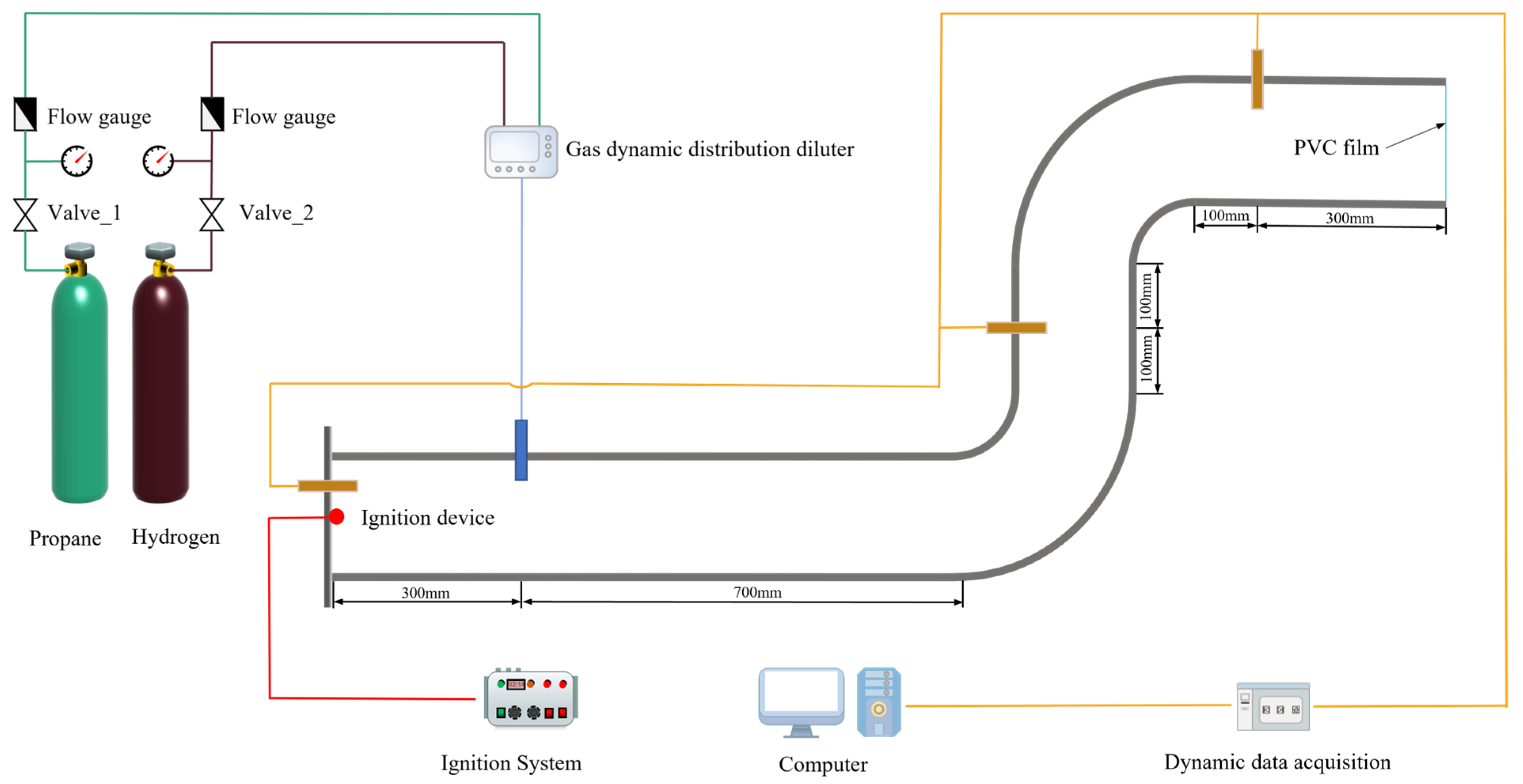
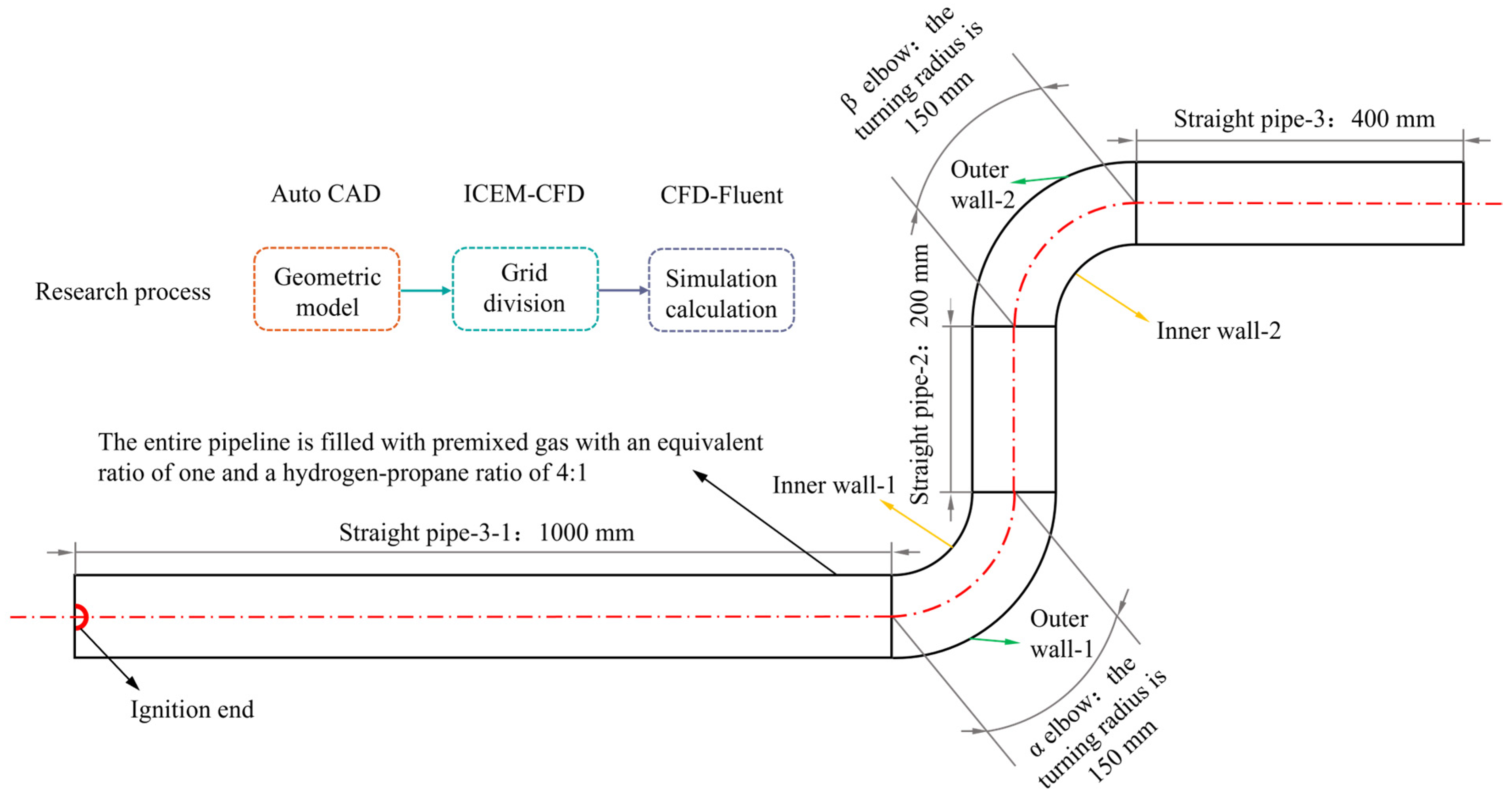
2.1. Experimental Setup and Pipeline Dimensions
2.2. Experimental Method
3. Numerical Model
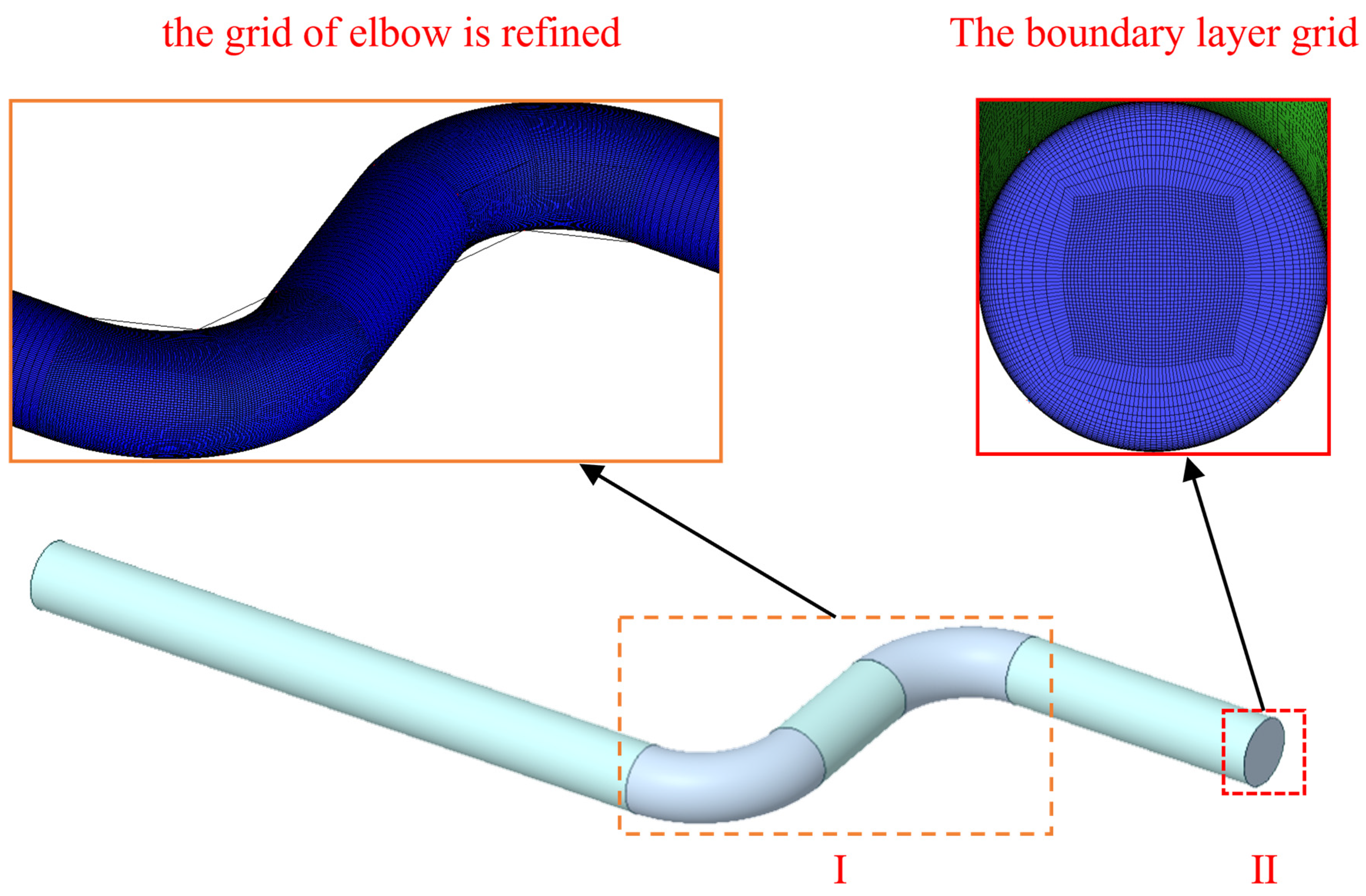
3.1. Grid Generation
3.2. Boundary and Initial Settings
3.3. Discussion on Model Limitations and Validation
4. Results and Analysis
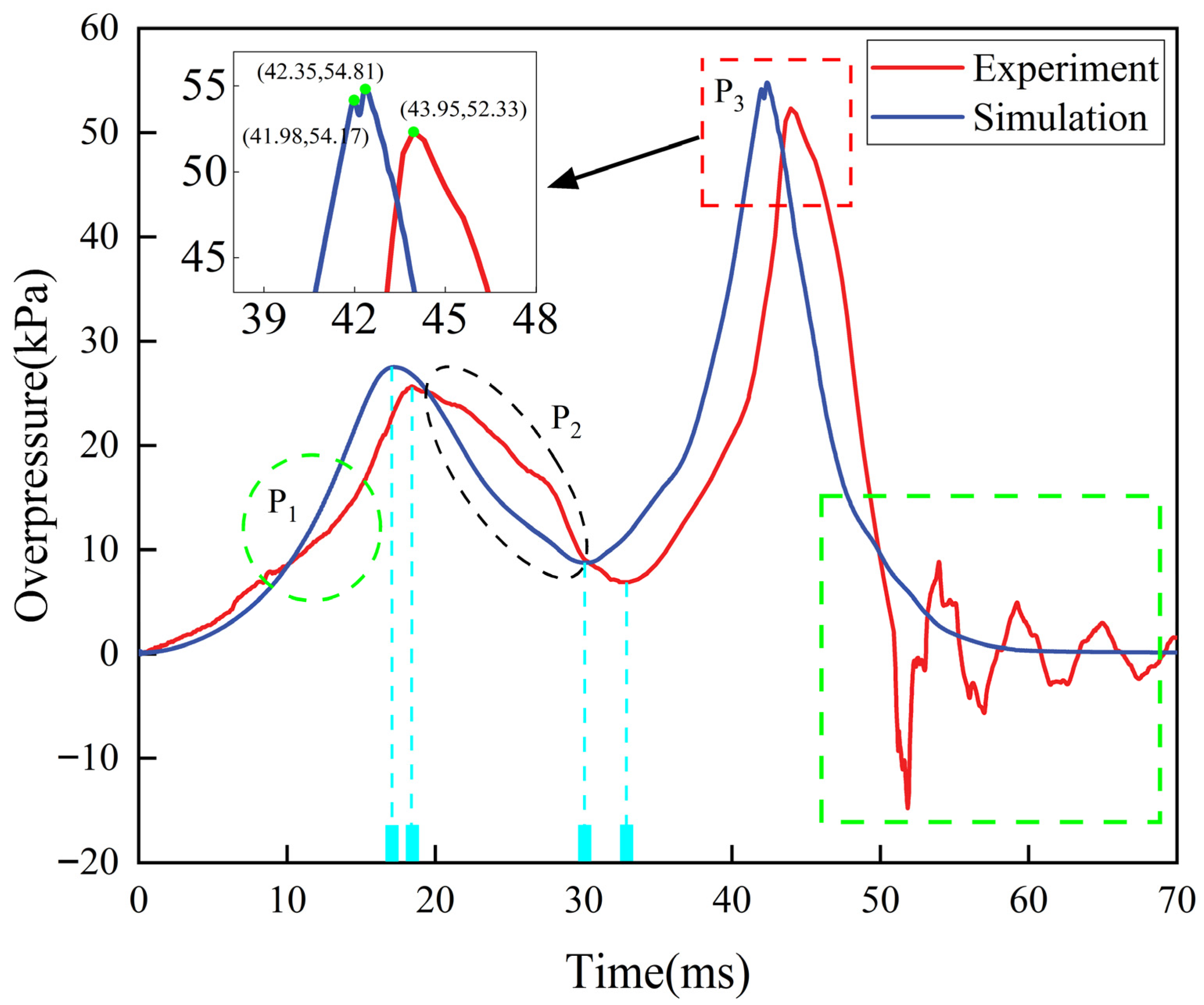
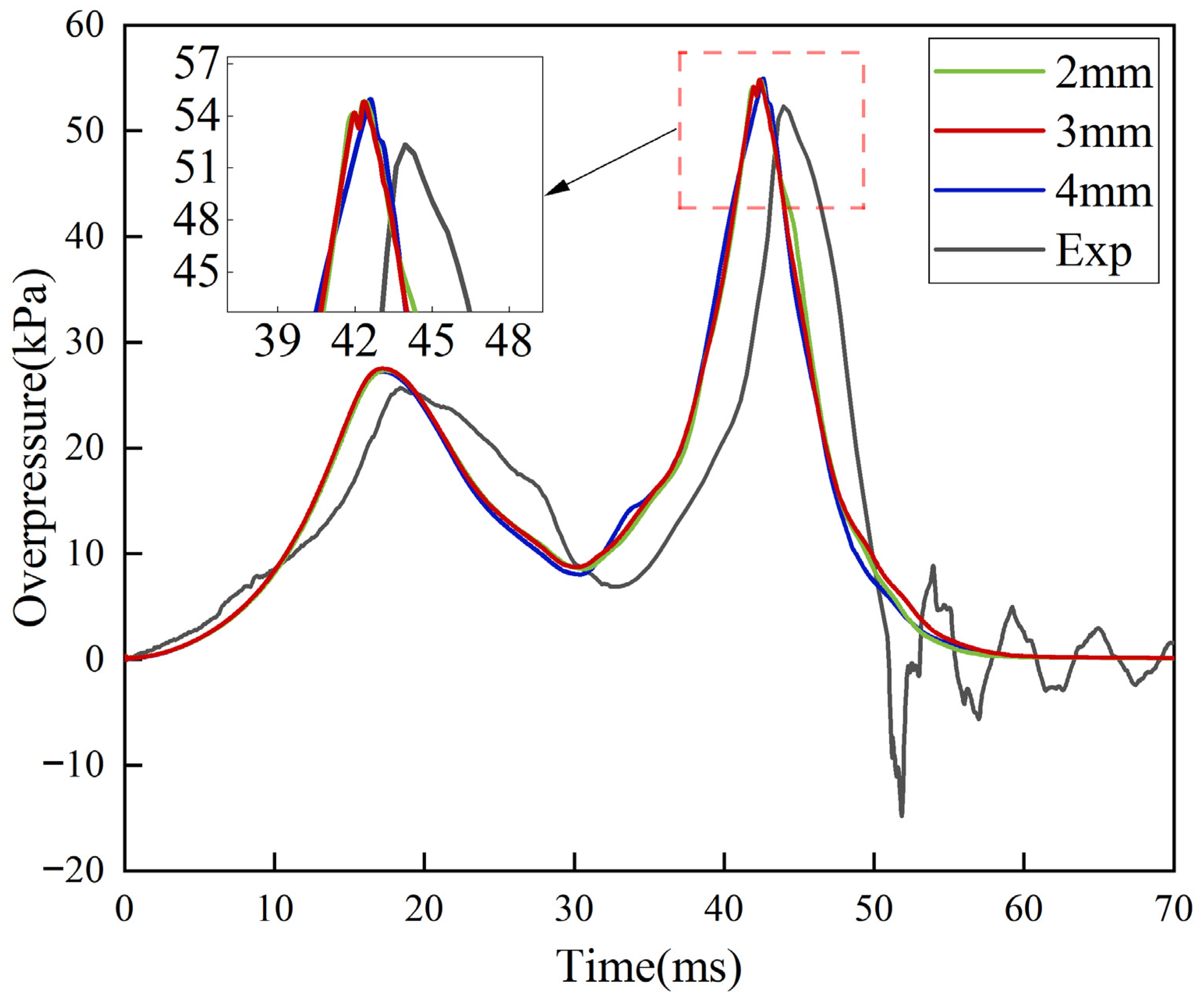
4.1. Verification of the Validity of Numerical Models
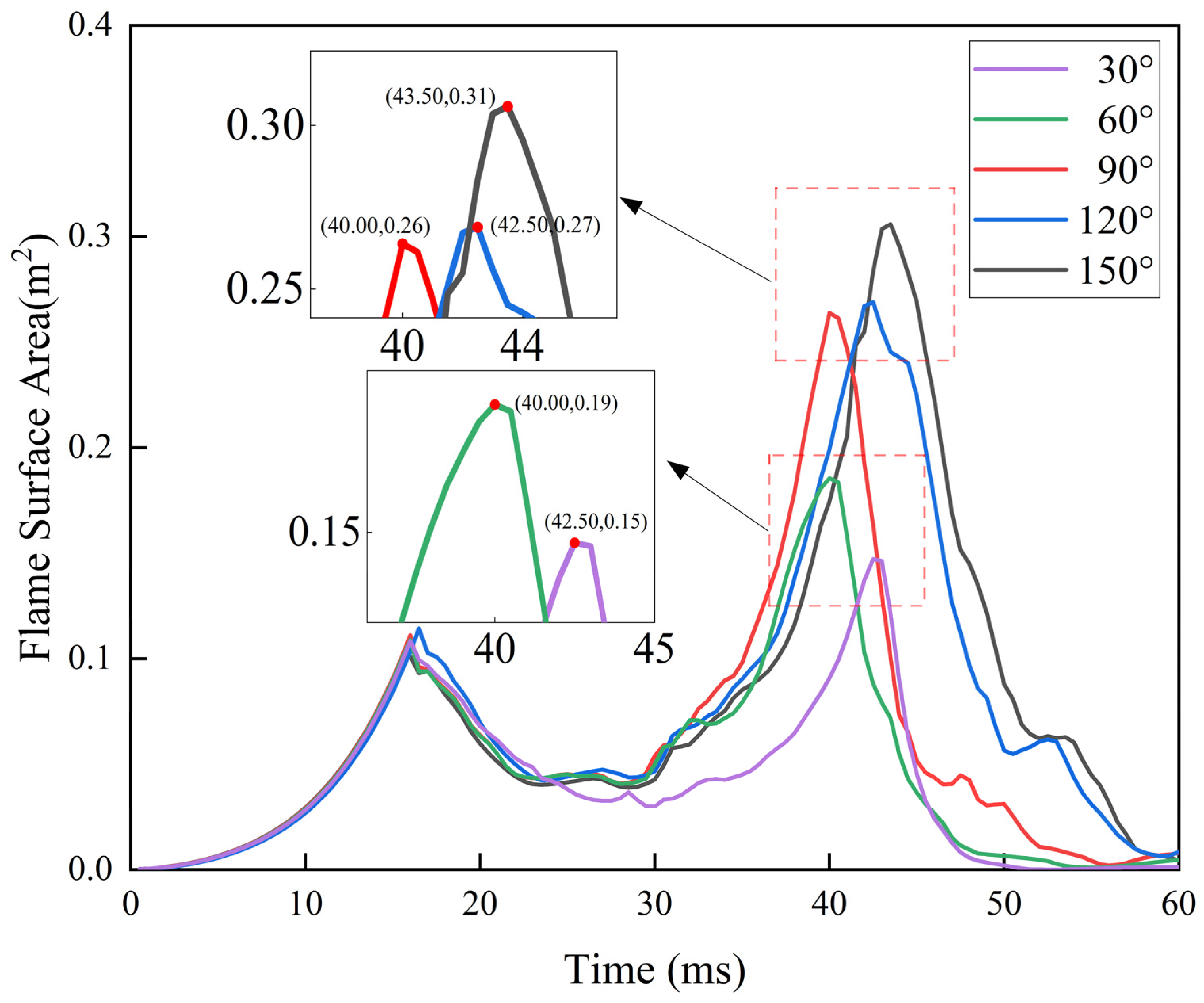
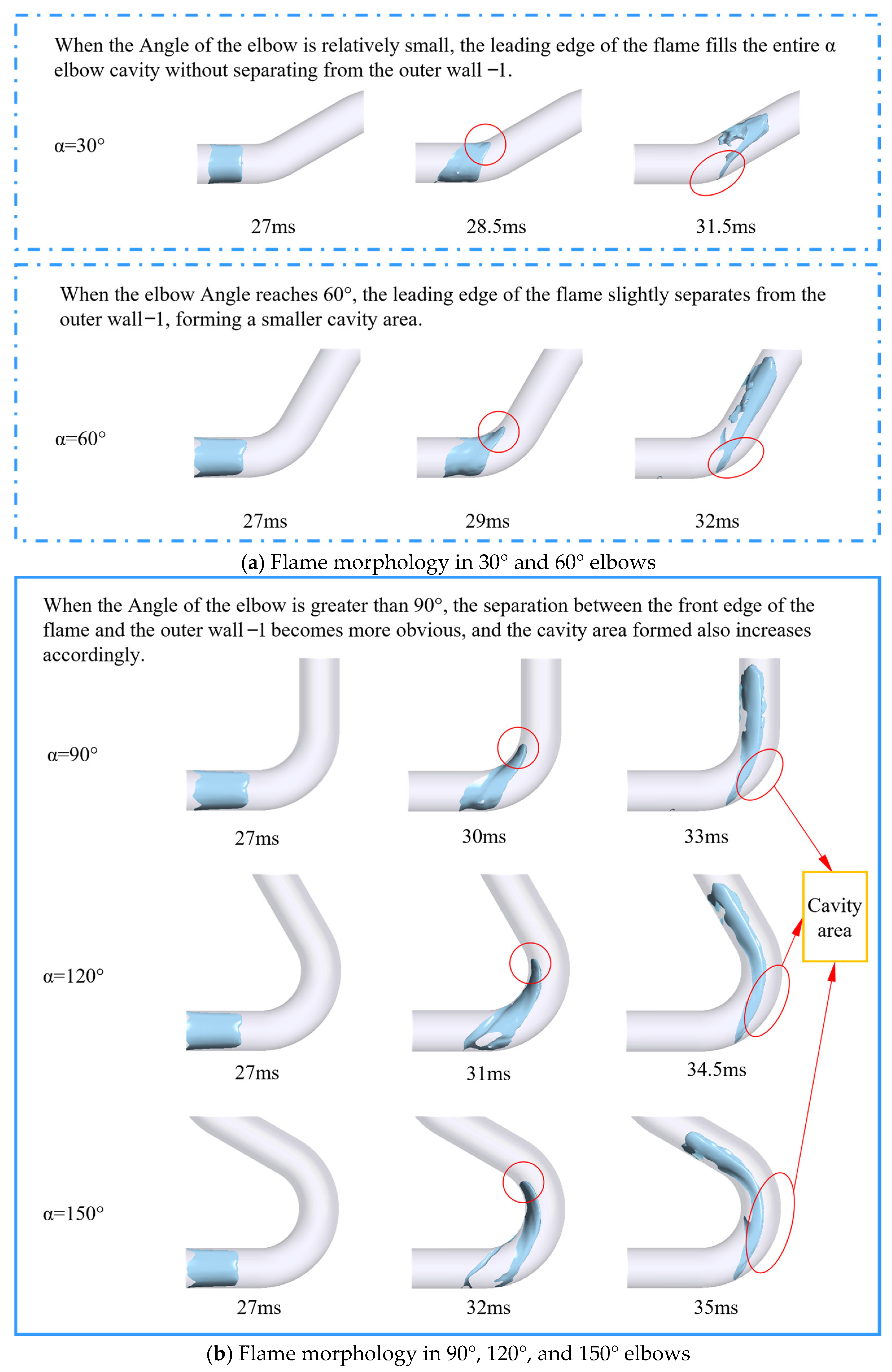
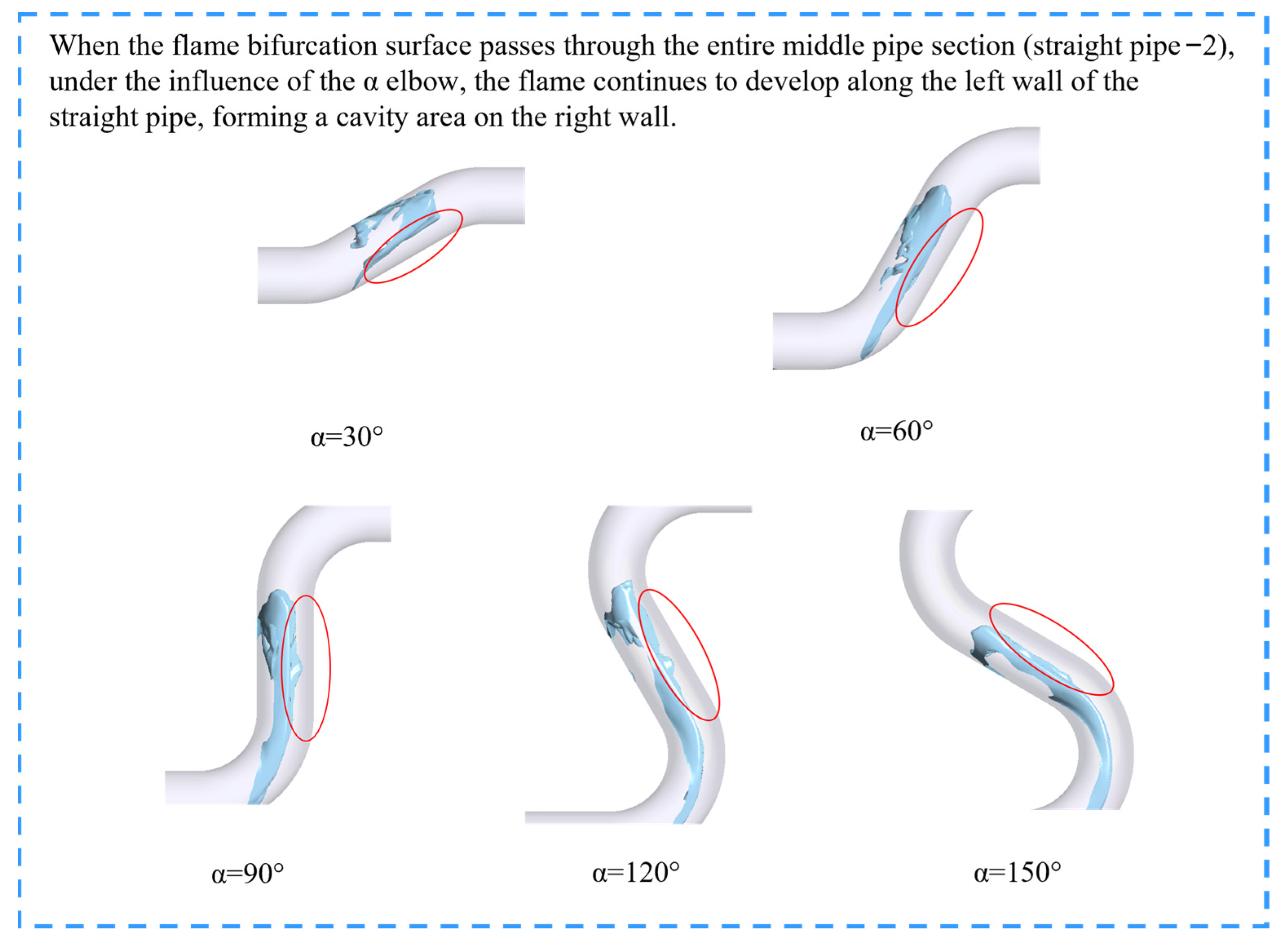
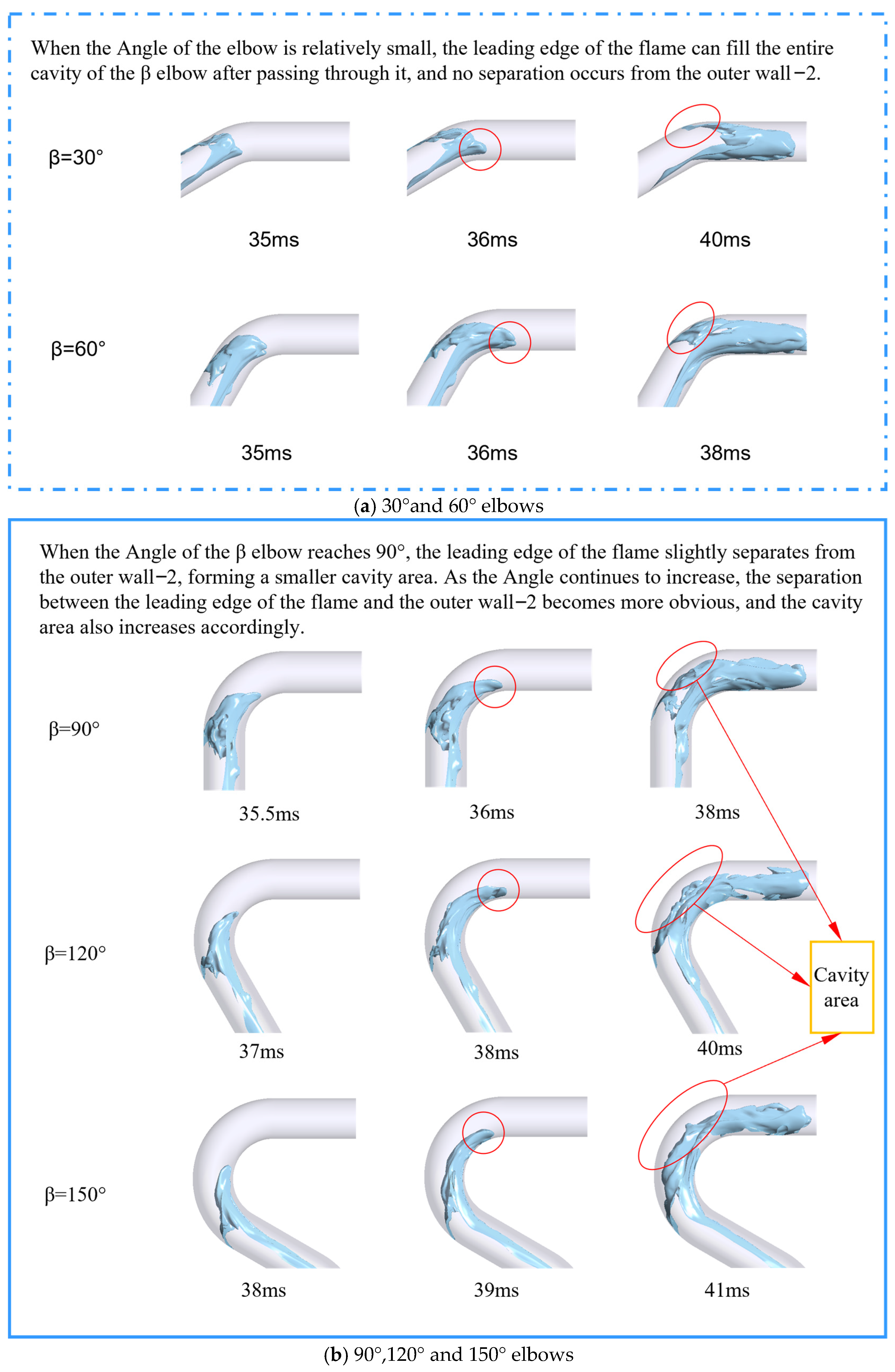
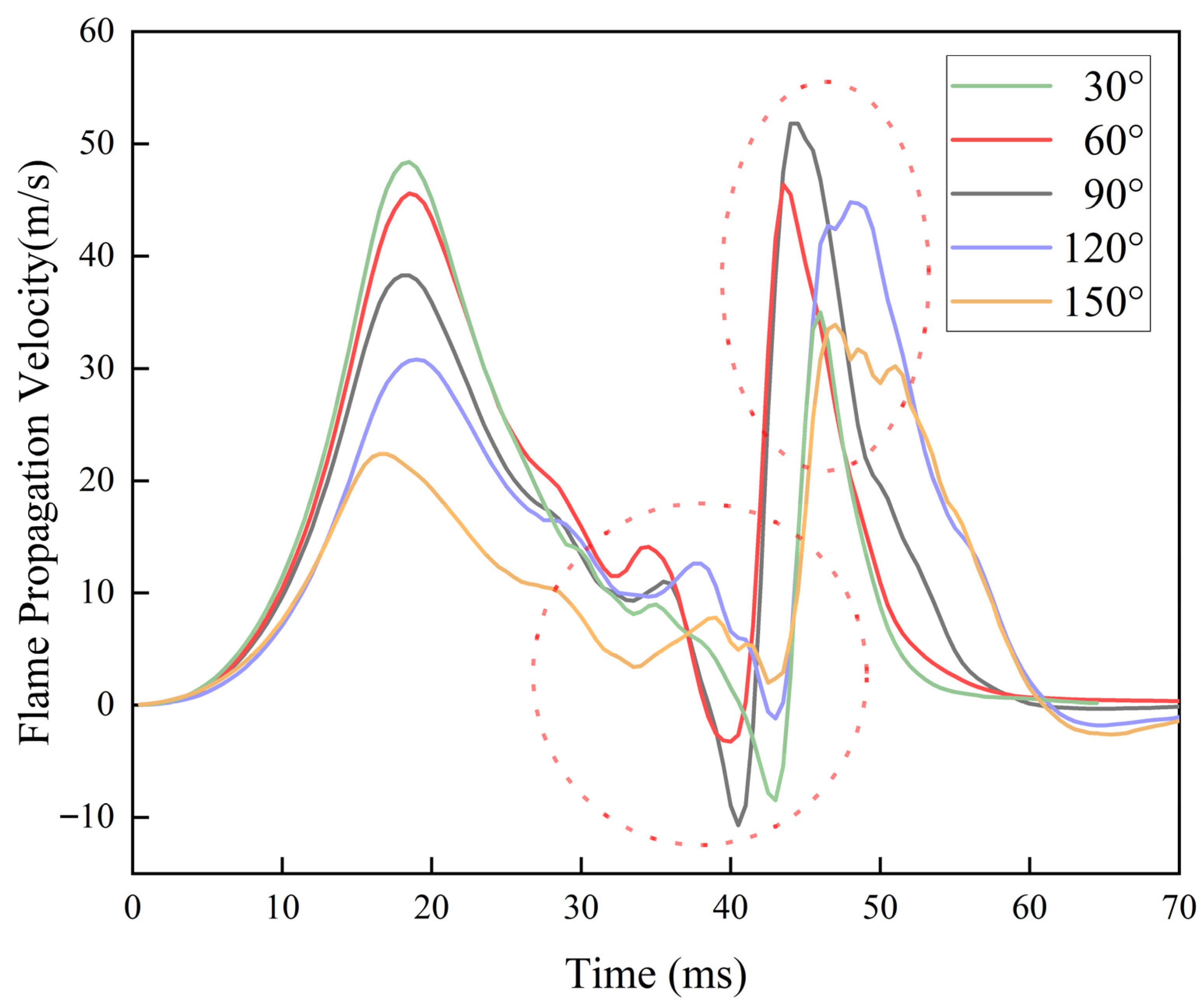
4.2. Patterns of Flame Propagation Within Curved Pipes
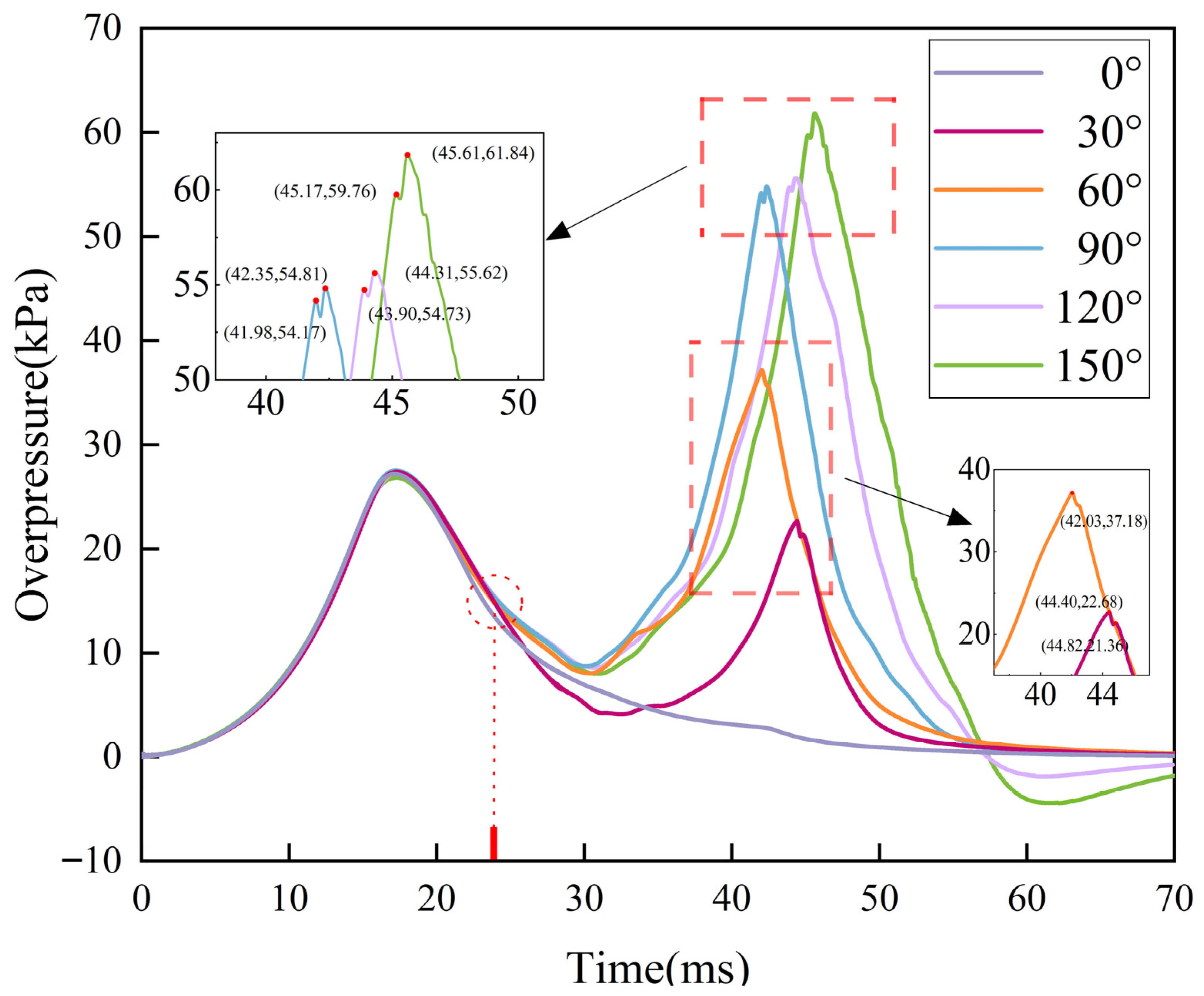
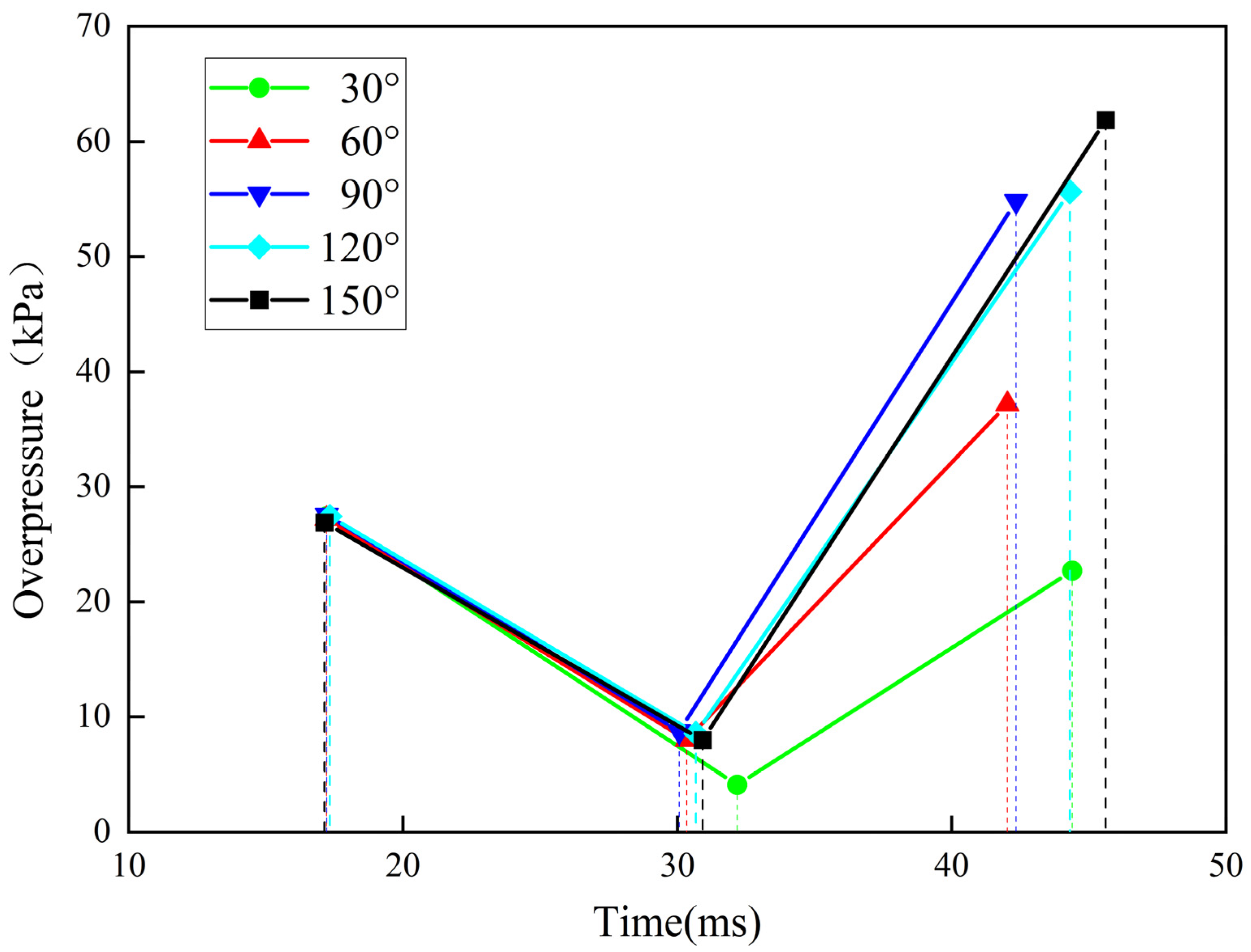
4.3. Development of Explosion Overpressure Under the Influence of Bends
5. Conclusions
Author Contributions
Funding
Data Availability Statement
Conflicts of Interest
References
- Jia, X.; Zhang, Y.; Tan, R.R.; Li, Z.; Wang, S.; Wang, F.; Fang, K. Multi-Objective Energy Planning for China’s Dual Carbon Goals. Sustain. Prod. Consum. 2022, 34, 552–564. [Google Scholar] [CrossRef]
- Hossain Bhuiyan, M.M.; Siddique, Z. Hydrogen as an Alternative Fuel: A Comprehensive Review of Challenges and Opportunities in Production, Storage, and Transportation. Int. J. Hydrogen Energy 2025, 102, 1026–1044. [Google Scholar] [CrossRef]
- Huang, Y.; Zhou, Y.; Zhong, R.; Wei, C.; Zhu, B. Hydrogen Energy Development in China: Potential Assessment and Policy Implications. Int. J. Hydrogen Energy 2024, 49, 659–669. [Google Scholar] [CrossRef]
- Yu, Q.; Hao, Y.; Ali, K.; Hua, Q.; Sun, L. Techno-Economic Analysis of Hydrogen Pipeline Network in China Based on Levelized Cost of Transportation. Energy Convers. Manag. 2024, 301, 118025. [Google Scholar] [CrossRef]
- Kovač, A.; Paranos, M.; Marciuš, D. Hydrogen in Energy Transition: A Review. Int. J. Hydrogen Energy 2021, 46, 10016–10035. [Google Scholar] [CrossRef]
- Tountas, A.A.; Ozin, G.A.; Sain, M.M. Choosing a Liquid Hydrogen Carrier for Sustainable Transportation. Sustain. Energy Fuels 2024, 8, 5181–5194. [Google Scholar] [CrossRef]
- Zhang, X.; Fu, G.; Liao, Q.; Tu, R.; Zhang, H.; Liang, Y. Large-Scale Hydrogen Supply Chain Vision with Blended Pipeline Transportation of China. Renew. Energy 2025, 240, 122230. [Google Scholar] [CrossRef]
- Di Lullo, G.; Giwa, T.; Okunlola, A.; Davis, M.; Mehedi, T.; Oni, A.O.; Kumar, A. Large-Scale Long-Distance Land-Based Hydrogen Transportation Systems: A Comparative Techno-Economic and Greenhouse Gas Emission Assessment. Int. J. Hydrogen Energy 2022, 47, 35293–35319. [Google Scholar] [CrossRef]
- Miao, H.; Yu, Y.; Wan, Y.; Zhang, Y.; Ma, T. Levelized Cost of Long-Distance Large-Scale Transportation of Hydrogen in China. Energy 2024, 310, 133201. [Google Scholar] [CrossRef]
- Lee, J.-S.; Cherif, A.; Yoon, H.-J.; Seo, S.-K.; Bae, J.-E.; Shin, H.-J.; Lee, C.; Kwon, H.; Lee, C.-J. Large-Scale Overseas Transportation of Hydrogen: Comparative Techno-Economic and Environmental Investigation. Renew. Sustain. Energy Rev. 2022, 165, 112556. [Google Scholar] [CrossRef]
- Raj, A.; Larsson, I.A.S.; Ljung, A.-L.; Forslund, T.; Andersson, R.; Sundström, J.; Lundström, T.S. Evaluating Hydrogen Gas Transport in Pipelines: Current State of Numerical and Experimental Methodologies. Int. J. Hydrogen Energy 2024, 67, 136–149. [Google Scholar] [CrossRef]
- Fan, X.; Cheng, Y.F. Hydrogen Pipelines and Embrittlement in Gaseous Environments: An up-to-Date Review. Appl. Energy 2025, 387, 125636. [Google Scholar] [CrossRef]
- Islam, M.A.; Farhat, Z.N.; Alam, T.; Islam, M.A. Assessing Hydrogen Embrittlement in Pipeline Steels for Natural Gas-Hydrogen Blends: Implications for Existing Infrastructure. Solids 2024, 5, 375–393. [Google Scholar] [CrossRef]
- Kappes, M.A.; Perez, T. Hydrogen Blending in Existing Natural Gas Transmission Pipelines: A Review of Hydrogen Embrittlement, Governing Codes, and Life Prediction Methods. Corros. Rev. 2023, 41, 319–347. [Google Scholar] [CrossRef]
- Najjar, Y.S.; S, M. Hydrogen Leakage Sensing and Control: (Review). Biomed. J. Sci. Tech. Res. 2019, 21, 16228–16240. [Google Scholar] [CrossRef]
- Cardozo Soares Amaral, P.; Oh, C.B.; Do, K.H.; Choi, B.-I. Risk Assessment of Hydrogen Leakage and Explosion in a Liquid Hydrogen Facility Using Computational Analysis. Int. J. Hydrogen Energy 2024, 91, 950–964. [Google Scholar] [CrossRef]
- Wierzba, I.; Kilchyk, V. Flammability Limits of Hydrogen–Carbon Monoxide Mixtures at Moderately Elevated Temperatures. Int. J. Hydrogen Energy 2001, 26, 639–643. [Google Scholar] [CrossRef]
- Bauer, C.G.; Forest, T.W. Effect of Hydrogen Addition on the Performance of Methane-Fueled Vehicles. Part I: Effect on S.I. Engine Performance. Int. J. Hydrogen Energy 2001, 26, 55–70. [Google Scholar] [CrossRef]
- Houf, W.; Schefer, R.; Evans, G.; Merilo, E.; Groethe, M. Evaluation of Barrier Walls for Mitigation of Unintended Releases of Hydrogen. Int. J. Hydrogen Energy 2010, 35, 4758–4775. [Google Scholar] [CrossRef]
- Ramamurthi, K.; Bhadraiah, K.; Murthy, S.S. Formation of Flammable Hydrogen–Air Clouds from Hydrogen Leakage. Int. J. Hydrogen Energy 2009, 34, 8428–8437. [Google Scholar] [CrossRef]
- Qu, J.; Zhao, H.; Zhao, L.; Luo, Z.-M.; Wang, T.; Deng, J. Flame Propagation Characteristics of Non-Uniform Premixed Hydrogen-Air Mixtures Explosion in a Pipeline. Int. J. Hydrogen Energy 2024, 88, 462–476. [Google Scholar]
- Qin, Y.; Chen, X. Flame Propagation of Premixed Hydrogen-Air Explosion in a Closed Duct with Obstacles. Int. J. Hydrogen Energy 2021, 46, 2684–2701. [Google Scholar] [CrossRef]
- Liu, Y.; Zhang, Y.; Zhao, D.; Yin, J.; Liu, L.; Shu, C.-M. Experimental Study on Explosion Characteristics of Hydrogen–Propane Mixtures. Int. J. Hydrogen Energy 2019, 44, 22712–22718. [Google Scholar] [CrossRef]
- Cheng, X.; Scribano, G. Effects of Hydrogen Addition on the Laminar Premixed Flames and Emissions of Methane and Propane. Int. J. Hydrogen Energy 2024, 53, 1–16. [Google Scholar]
- Masoumi, S.; Ashjaee, M.; Houshfar, E. Laminar Flame Stability Analysis of Ammonia-Methane and Ammonia-Hydrogen Dual-Fuel Combustion. Fuel 2024, 363, 131041. [Google Scholar]
- Kazemi, M.; Brennan, S.; Molkov, V. Hydrogen-Methane Blends: Critical Diameters and Flame Stability Curves for Non-Premixed Turbulent Flames. Int. J. Hydrogen Energy 2025, 105, 693–700. [Google Scholar] [CrossRef]
- Kazemi, M.; Brennan, S.; Molkov, V. Numerical Simulations of the Critical Diameter and Flame Stability for Hydrogen Flames. Int. J. Hydrogen Energy 2024, 59, 591–603. [Google Scholar] [CrossRef]
- Peng, Q.; Wei, J.; Yang, W.; E, J. Study on Combustion Characteristic of Premixed H2/C3H8/Air and Working Performance in the Micro Combustor with Block. Fuel 2022, 318, 123676. [Google Scholar] [CrossRef]
- Gao, Y.; Gao, Y.; Sun, C.; He, P.; Liu, Y.; Tao, C.; Gao, W. Morphological Characteristics of Propane–Hydrogen Diffusion Flame: Experiments and Correlations. Combust. Sci. Technol. 2025, 197, 3577–3595. [Google Scholar]
- Xu, Z.; Zhang, J.; Zhang, Y.; Chu, Z.; Yu, C.; Fu, G.; Xu, J.; Zhou, W.; Zhao, H.; Yu, Y.; et al. Experimental Investigation on Vented Hydrogen Explosion in Synergetic Application of Hydrogen Concentration and Pipe Length. Int. J. Hydrogen Energy 2025, 123, 89–99. [Google Scholar] [CrossRef]
- Gaathaug, A.V.; Vaagsaether, K.; Bjerketvedt, D. Experimental and Numerical Investigation of DDT in Hydrogen–Air behind a Single Obstacle. Int. J. Hydrogen Energy 2012, 37, 17606–17615. [Google Scholar] [CrossRef]
- Li, D.; Zhang, Q.; Ma, Q.; Shen, S. Comparison of Explosion Characteristics between Hydrogen/Air and Methane/Air at the Stoichiometric Concentrations. Int. J. Hydrogen Energy 2015, 40, 8761–8768. [Google Scholar] [CrossRef]
- Ma, Q.; Zhang, Q.; Chen, J. Numerical Analysis on Propagation Characteristics of Methane/Air Explosion in Elbow Pipe and Pipe Network. Int. J. Numer. Methods Heat Fluid Flow 2014, 24, 1610–1623. [Google Scholar] [CrossRef]
- Boutabaa, M.; Helin, L.; Mompean, G.; Thais, L. Numerical Study of Dean Vortices in Developing Newtonian and Viscoelastic Flows through a Curved Duct of Square Cross-Section. Comptes Rendus Mécanique 2008, 337, 40–47. [Google Scholar] [CrossRef]
- Kalpakli, A.; Örlü, R.; Alfredsson, P.H. Vortical Patterns in Turbulent Flow Downstream a 90° Curved Pipe at High Womersley Numbers. Int. J. Heat Fluid Flow 2013, 44, 692–699. [Google Scholar] [CrossRef]
- Ciccarelli, G.; Dorofeev, S. Flame Acceleration and Transition to Detonation in Ducts. Prog. Energy Combust. Sci. 2008, 34, 499–550. [Google Scholar] [CrossRef]
- Lipatnikov, A.N.; Sabelnikov, V.A. Karlovitz Numbers and Premixed Turbulent Combustion Regimes for Complex-Chemistry Flames. Energies 2022, 15, 5840. [Google Scholar] [CrossRef]
- Sabelnikov, V.A.; Lipatnikov, A.N. Bifractal Nature of Turbulent Reaction Waves at High Damköhler and Karlovitz Numbers. Phys. Fluids 2020, 32, 095118. [Google Scholar] [CrossRef]
- Guo, S.; Jing, G.; Wang, Y.; Sun, Y. Research on Gas Explosion Pressure and Flame Propagation Characteristics in Turning Pipelines. ACS Omega 2024, 9, 43203–43210. [Google Scholar] [CrossRef]
- Zhou, X.; Jing, J.; Chen, C.; He, L. Physics of Pressurized Hydrogen Spontaneous Ignition in Pipes Containing Bends of Different Angles. Front. Energy Res. 2024, 12, 1383759. [Google Scholar] [CrossRef]
- Mei, Y.; Shuai, J.; Zhou, N.; Ren, W.; Ren, F. Flame Propagation of Premixed Hydrogen-Air Explosions in Bend Pipes. J. Loss Prev. Process Ind. 2022, 77, 104790. [Google Scholar] [CrossRef]
- Pan, C.; Wang, X.; Sun, H.; Zhu, X.; Zhao, J.; Fan, H.; Liu, Y. Large-Eddy Simulation and Experimental Study on Effects of Single-Dual Sparks Positions on Vented Explosions in a Channel. Fuel 2022, 322, 124282. [Google Scholar] [CrossRef]
- Liu, J.; Wang, H. Machine Learning Assisted Modeling of Mixing Timescale for LES/PDF of High-Karlovitz Turbulent Premixed Combustion. Combust. Flame 2022, 238, 111895. [Google Scholar] [CrossRef]
- Li, R.; Malalasekera, W.; Ibrahim, S. Numerical Study of Vented Hydrogen Explosions in a Small Scale Obstructed Chamber. Int. J. Hydrogen Energy 2018, 43, 16667–16683. [Google Scholar] [CrossRef]
- Li, R.; Xiu, Z.; Liu, Z.; Liu, Q.; Li, M. Simulation of Obstacle Spacing Effects on Premixed Hydrogen-Air Explosion Dynamics in Semi-Confined Spaces. Int. J. Hydrogen Energy 2025, 105, 735–747. [Google Scholar] [CrossRef]
- Charlette, F.; Meneveau, C.; Veynante, D. A Power-Law Flame Wrinkling Model for LES of Premixed Turbulent Combustion Part I: Non-Dynamic Formulation and Initial Tests. Combust. Flame 2002, 131, 159–180. [Google Scholar]
- Qiao, Z.; Ma, H.; Li, C. Influence of Change in Obstacle Blocking Rate Gradient on LPG Explosion Behavior. Arab. J. Chem. 2023, 16, 104496. [Google Scholar] [CrossRef]
- Gao, J.; Ai, B.; Hao, B.; Guo, B.; Hong, B.; Jiang, X. Effect of Obstacles Gradient Arrangement on Non-Uniformly Distributed LPG–Air Premixed Gas Deflagration. Energies 2022, 15, 6872. [Google Scholar] [CrossRef]
- Zimont, V.L. Gas Premixed Combustion at High Turbulence. Turbulent Flame Closure Combustion Model. Exp. Therm. Fluid Sci. 2000, 21, 179–186. [Google Scholar] [CrossRef]
- Guo, B.; Gao, J.; Hao, B.; Ai, B.; Hong, B.; Jiang, X. Experimental and Numerical Study on the Explosion Dynamics of the Non-Uniform Liquefied Petroleum Gas and Air Mixture in a Channel with Mixed Obstacles. Energies 2022, 15, 7999. [Google Scholar] [CrossRef]
- Shao, X.; Gao, J.; Hao, B.; Ai, B.; Han, Y.; Wu, Y.; Guo, B. Study on the LES of Premixed Gas Flame Dynamics in a Weak Confinement Structure: The Influence of Continuous Obstacle Plates. J. Appl. Fluid Mech. 2025, 18, 864–879. [Google Scholar] [CrossRef]
- Tang, C.; Huang, Z.; Jin, C.; He, J.; Wang, J.; Wang, X.; Miao, H. Laminar Burning Velocities and Combustion Characteristics of Propane–Hydrogen–Air Premixed Flames. Int. J. Hydrogen Energy 2008, 33, 4906–4914. [Google Scholar] [CrossRef]
- Lilly, D.K. A Proposed Modification of the Germano Subgrid-Scale Closure Method. Phys. Fluids A Fluid Dyn. 1992, 4, 633–635. [Google Scholar] [CrossRef]
- William, S. The Viscosity of Gases and Molecular Force. Lond. Edinb. Dublin Philos. Mag. J. Sci. 1893, 36, 507–531. [Google Scholar]
- Li, Y.; Zheng, L.; Wang, X.; Zhang, S.; Tang, S.; Xu, M. Effect of Initial Pressure on Hydrogen/Propane/Air Flames in a Closed Duct. Int. J. Hydrogen Energy 2024, 64, 947–957. [Google Scholar] [CrossRef]
- Ponizy, B.; Leyer, J.C. Flame Dynamics in a Vented Vessel Connected to a Duct: 1. Mechanism of Vessel-Duct Interaction. Combust. Flame 1999, 116, 259–271. [Google Scholar] [CrossRef]
- Cao, Y.; Li, B.; Gao, K. Pressure Characteristics during Vented Explosion of Ethylene-Air Mixtures in a Square Vessel. Energy 2018, 151, 26–32. [Google Scholar] [CrossRef]
- Fakandu, B.M.; Andrews, G.E.; Phylaktou, H.N. Vent Burst Pressure Effects on Vented Gas Explosion Reduced Pressure. J. Loss Prev. Process Ind. 2015, 36, 429–438. [Google Scholar] [CrossRef]
- Sun, S.; Pan, Z. Morphing Flames and Localized Hot Spots: Unlocking the Dynamics of Deflagration-to-Detonation Transition in Curved Channels. Combust. Flame 2025, 276, 114169. [Google Scholar] [CrossRef]



| Mode of Transportation | Advantages | Disadvantage |
|---|---|---|
| Long pipe trailer | Suitable for short-distance, small-scale transport [8]. Highly mobile with strong flexibility, such as for hydrogen refueling at hydrogen stations. | Its single-trip hydrogen transport capacity is relatively low, resulting in reduced transport efficiency. Furthermore, diesel-powered trailers are incompatible with low-carbon hydrogen development objectives. |
| Liquid hydrogen tanker transportation | Suitable for medium-to-long-distance transport. Offers substantial carrying capacity, with liquid hydrogen tankers capable of transporting up to 4 tons per journey. Features high hydrogen purity [9]. | Hydrogen liquefaction entails relatively high energy consumption. Safety must be continuously safeguarded. |
| Ship transportation | Suitable for large-scale, transnational transport [10]. Vessel capacity can reach ten thousand tons. Relatively low cost for large-scale transport operations. | Low flexibility, subject to weather and sea conditions. Technical maturity requires further enhancement. |
| Pipeline hydrogen transportation | Suitable for large-scale, cross-regional hydrogen supply. Annual transport capacity can reach the million-ton level. Hydrogen transport costs are significantly lower than other methods of transport. | Hydrogen readily induces hydrogen embrittlement in steel pipes, leading to pipeline leaks and thereby creating safety hazards [11]. |
| Part of the Pipeline | Pipe Length (mm)/Angle | Pipe Diameter (mm) | Other Parameters |
|---|---|---|---|
| Straight pipe-1 | 1000 | 100 | The wall thickness is 5 mm |
| lbow | = 30°, 60°, 90°, 120°, 150° | 100 | The turning radius is 150 mm |
| Straight pipe-2 | 200 | 100 | The wall thickness is 5 mm |
| lbow | = 30°, 60°, 90°, 120°, 150° | 100 | The turning radius is 150 mm |
| Straight pipe-3 | 400 | 100 | The wall thickness is 5 mm |
| Name of the Instrument | Model | Manufacturer |
|---|---|---|
| Digital pressure sensors | CY-301 | Chengdu Taitest Electronic Information Co., Ltd. (Chengdu, China) |
| Adjustable igniter | KTGD-B | Xi’an Kehui Thermal Engineering Technology Design Research Institute (Xi’an, China) |
| Dynamic data acquisition system | TST6250 | Chengdu Taitest Electronic Information Co., Ltd. (Chengdu, China) |
| Dynamic gas mixing and dilution instrument | YC-ZC200 | Chengdu Yanchuang Zhongcheng Technology Co., Ltd. (Chengdu, China) |
Disclaimer/Publisher’s Note: The statements, opinions and data contained in all publications are solely those of the individual author(s) and contributor(s) and not of MDPI and/or the editor(s). MDPI and/or the editor(s) disclaim responsibility for any injury to people or property resulting from any ideas, methods, instructions or products referred to in the content. |
© 2025 by the authors. Licensee MDPI, Basel, Switzerland. This article is an open access article distributed under the terms and conditions of the Creative Commons Attribution (CC BY) license (https://creativecommons.org/licenses/by/4.0/).
Share and Cite
Wu, X.; Gao, J.; Hao, B.; Shao, X.; Yang, Y.; Li, M.; Han, Y.; Wu, Y. Research on the Explosion Characteristics of Hydrogen-Propane Based on the Angle of the “Z”-Shaped Pipe Elbow. Fire 2025, 8, 468. https://doi.org/10.3390/fire8120468
Wu X, Gao J, Hao B, Shao X, Yang Y, Li M, Han Y, Wu Y. Research on the Explosion Characteristics of Hydrogen-Propane Based on the Angle of the “Z”-Shaped Pipe Elbow. Fire. 2025; 8(12):468. https://doi.org/10.3390/fire8120468
Chicago/Turabian StyleWu, Xiao, Jianfeng Gao, Bin Hao, Xiaojun Shao, Yulin Yang, Meng Li, Yanan Han, and Yang Wu. 2025. "Research on the Explosion Characteristics of Hydrogen-Propane Based on the Angle of the “Z”-Shaped Pipe Elbow" Fire 8, no. 12: 468. https://doi.org/10.3390/fire8120468
APA StyleWu, X., Gao, J., Hao, B., Shao, X., Yang, Y., Li, M., Han, Y., & Wu, Y. (2025). Research on the Explosion Characteristics of Hydrogen-Propane Based on the Angle of the “Z”-Shaped Pipe Elbow. Fire, 8(12), 468. https://doi.org/10.3390/fire8120468