1. Introduction
Urban environments are increasingly challenged by the presence of underground cavities, which may be either natural, such as karstic voids, or anthropogenic, including abandoned tunnels and deteriorated utility conduits. These subsurface anomalies pose significant risks to infrastructure integrity and public safety, as their undetected presence can lead to ground subsidence [
1,
2,
3], structural failures [
4,
5], and even catastrophic collapses [
6,
7]. The complexity of urban subsurface conditions, compounded by ongoing construction and historical land use, necessitates advanced investigative techniques to identify and mitigate these hazards effectively.
To address these challenges, geophysical methods have become indispensable tools for the non-invasive investigation of subsurface anomalies. Ground-Penetrating Radar (GPR) is particularly effective for detecting shallow cavities due to its high-resolution imaging capabilities [
8,
9,
10,
11]. This method transmits short electromagnetic pulses into the ground and records the energy reflected from interfaces where electrical properties change. Variations in dielectric permittivity, moisture content, and material composition generate contrasts that appear as reflections on the radargram. Because of its ability to produce continuous, high-resolution 2D and 3D images of the near surface, GPR is especially suited for mapping voids, fractures, and discontinuities within heterogeneous deposits. Moreover, its rapid acquisition speed and non-destructive nature make it a practical technique in urban environments, where accessibility, safety, and minimal disruption are key considerations.
Over the past two decades, Ground-Penetrating Radar (GPR) has proven indispensable in mapping karst-related hazards in urban environments, where rapid development often conceals complex subsurface risks. In Zaragoza, NE Spain, GPR combined with other geophysical techniques effectively identified shallow cavities and disturbed zones caused by gypsum dissolution beneath newly urbanized areas, surpassing traditional surface indicators like historical maps or aerial photos and enabling more accurate hazard delineation for urban planning [
12]. Similarly, in several Chinese cities, a novel 3D GPR system with dual antenna arrays and enhanced polarization significantly improved the detection and discrimination of cavities beneath urban roads from other utilities, successfully locating over 100 cavities and providing precise estimations of their geometry—demonstrating its strong potential for complex, infrastructure-dense urban settings [
13]. Additionally, a targeted GPR survey at a proposed substation site in Zaozhuang, Shandong Province, characterized by Cambrian limestone overlain by Quaternary silty clay, employed an 80 MHz shielded antenna to delineate subsurface voids and fractures associated with karst features such as dissolution gullies. This detailed subsurface imaging supplied critical data for the safe design and construction of pile foundations, emphasizing GPR’s essential role in infrastructure risk management [
14]. Collectively, these studies underscore GPR’s high-resolution capabilities and versatility across varied karst contexts, confirming its value as a core tool for early detection, risk assessment, and mitigation in urban karst terrains.
In parallel to GPR, Vertical Electrical Sounding (VES) is a widely applied geophysical technique, particularly effective for characterizing subsurface layering through measurements of electrical resistivity. It is commonly used in hydrogeological studies to investigate soil properties [
15,
16], assess groundwater potential [
17,
18,
19,
20], and delineate lithological boundaries due to its strong sensitivity to vertical resistivity contrasts [
21,
22]. The method operates by injecting electric current into the ground and measuring the resulting potential differences while progressively increasing the spacing between the current and potential electrodes. This expansion of electrode spacing allows VES to probe deeper strata and detect variations associated with changes in lithology, moisture content, porosity, and degree of weathering. Because resistivity contrasts often reflect the transition between different geological units, VES is particularly suited for identifying horizons affected by karstification and for mapping subsurface structures where direct access is limited. However, beyond its conventional applications, VES has also shown promise in the detection of subsurface cavities and voids, particularly in karst terrains where abrupt resistivity contrasts are common. In the Bakony region of Hungary, VES was employed to compare the epikarst characteristics of five covered karst areas by analyzing specific bedrock resistivity averages and variances. The study concluded that lower mean resistivity values and smaller standard deviations corresponded to a higher degree of cavity formation and more uniform karstification, whereas high resistivity values indicated less water infiltration and less karst development [
23]. Another study in the same region explored the influence of epikarst on doline formation using VES resistivity profiles. Results showed that drawdown dolines were characterized by increasing resistivity toward the center, suggestive of deeper piezometric surfaces and vertical percolation, while subsidence dolines exhibited lower resistivity due to cavity fill and closer proximity to the water table. These resistivity anomalies also highlighted heterogeneity in cavity development and hydraulic behavior across doline morphologies [
24]. In an urban setting, a study conducted in the Tghat-Oued Fez district of Fez city, Morocco, combined VES with 2D Electrical Resistivity Tomography (ERT) to investigate landslides and detect underground cavities. Here, VES data, interpreted alongside ERT sections and processed with open-source tools like pyGIMLi and BERT, successfully identified voids within conductive marly formations and delineated the overlying conglomeratic caprock [
25,
26]. These case studies collectively reinforce that, when carefully integrated or statistically analyzed, VES is a capable method for detecting epikarst features and subsurface voids, providing valuable insights in both natural and urban karst settings.
This study aims to apply and evaluate the effectiveness of Ground-Penetrating Radar (GPR) and Vertical Electrical Sounding (VES) methods for detecting and characterizing subsurface cavities within the mixed travertine, Quaternary deposits, and Liassic dolomitic limestones underlying the urban areas of Bhalil and Sefrou. The primary objectives are to delineate lithological boundaries, accurately estimate the geometry and depth of underground voids, and establish a detailed stratigraphic framework of the study sites. By integrating the high spatial-resolution imaging capability of GPR with the vertical resistivity profiling strength of VES, this research seeks to assess the combined potential of these geophysical techniques in complex karst environments. The VES data will be interpreted using both 1D and 2D inversion approaches to resolve resistivity contrasts associated with geological layering and cavity presence, while GPR data will be processed and visualized through open-source Ground Penetrating Radar software designed for advanced data analysis and imaging. This combined methodological framework aims to improve the detection limits between geological layers and cavities, providing robust estimations of subsurface heterogeneities relevant to urban risk mitigation and geotechnical planning in karst-affected areas.
2. Geology of the Study Area
The study area comprises two sites situated in the northern part of the Tabular Middle Atlas mountain range, positioned at the southern boundary of the Saïs Plain. The Bhalil site is located within the historic old Medina of Bhalil, renowned for its troglodyte dwellings—ancient man-made caves carved into the landscape. In contrast, the Sefrou site lies northeast of the city in the Binna district, an area distinguished by numerous karstic cavities formed primarily through the dissolution of carbonate formations. Both sites present ideal settings for investigating subsurface voids within Quaternary deposits in a complex karst environment.
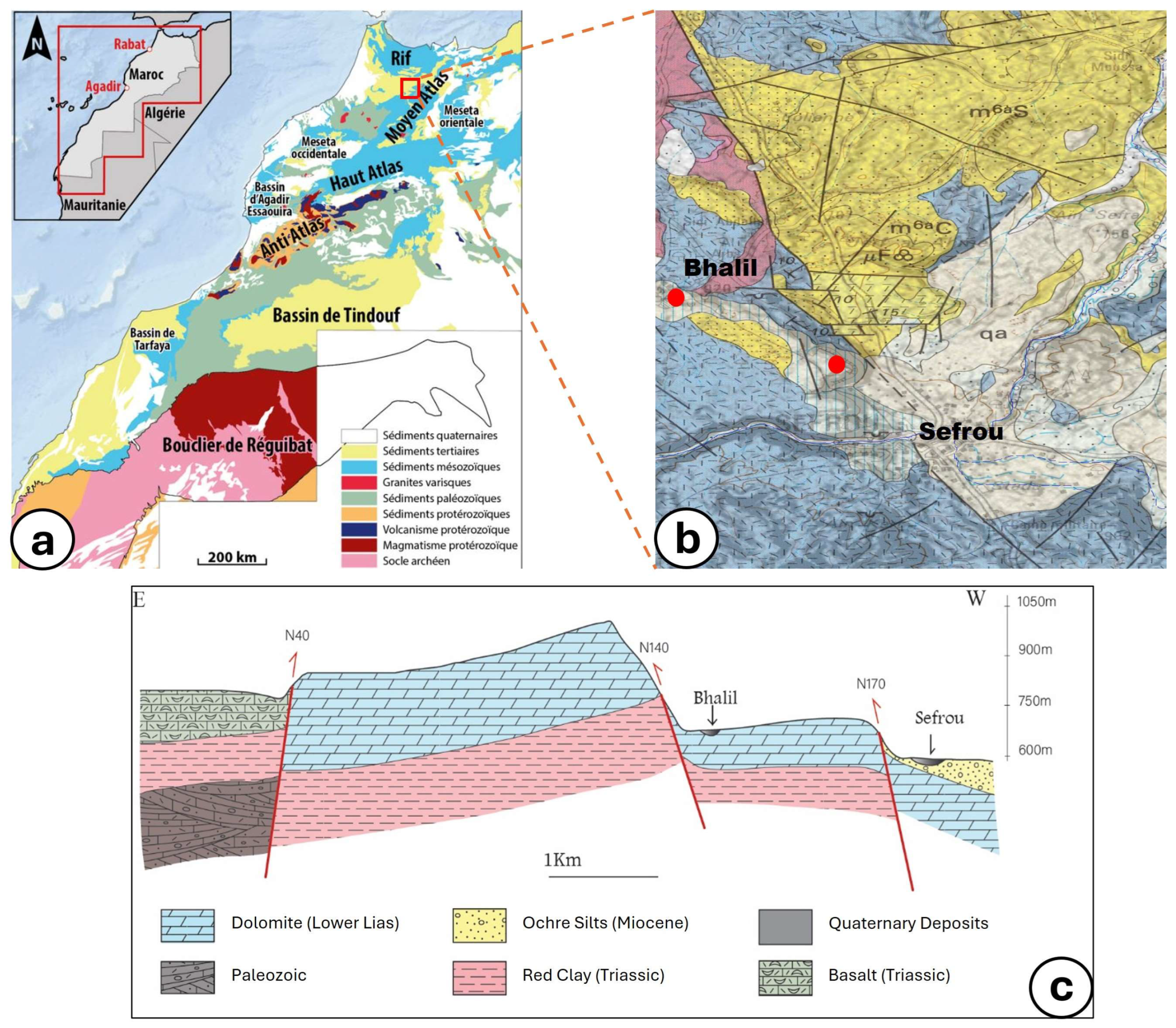
The Sefrou region, located in the northern Middle Atlas of Morocco (
Figure 1a,b), exhibits a geologically intricate setting resulting from the interplay between Paleozoic–Mesozoic basement blocks and the overlying Neogene–Quaternary sedimentary and travertine formations. These carbonate-detrital units are shaped by active fault systems and episodic karstification processes, particularly during humid intervals of the Pliocene to Quaternary period [
27,
28,
29]. The two contrasting sites—Bhalil and Binna—are exemplary of this complex geological context.
The broader Sefrou area belongs to the Tabular Middle Atlas structural domain, where both Hercynian and Alpine tectonic phases have uplifted blocks composed of Liasian dolomites and Triassic evaporites. These are bounded by major fault systems to the north and south, forming an intricate horst-and-graben morphology (
Figure 1c). Toward the north, the Paleozoic–Mesozoic basement is progressively overlain by Upper Miocene to Plio-Quaternary molasse, characterized by heterogeneous sequences of alluvial conglomerates, fossiliferous limestones, ocher silts, and sandy marls. This stratigraphy is punctuated by a series of colluvial and fluvial terraces that preserve a record of alternating depositional (biostatic) and erosional (bioclimatic) phases, reflecting the region’s uplift history and paleoclimatic variability [
30].
At the Binna site, the local stratigraphy reveals a substratum dominated by Liasian dolomitic breccias and sandy dolomites, which are occasionally underlain by Tortonian–Messinian conglomerates or pure Lias dolomites. Above this lies a thick succession of Plio-Quaternary carbonate-detrital deposits, including carbonate conglomerates, carbonatic sandstones, fluvio-lacustrine limestones, and massive, recrystallized travertine and tufa bodies [
28,
29]. Karst development at this site is controlled by a dense network of North-trending faults and orthogonal joint systems, which have channeled meteoric and vadose water infiltration. This hydrogeological activity has facilitated the formation of metric-scale endokarst conduits and surface collapse features, particularly along cliffs capped with travertine, such as those surrounding the Kef El Moumen cave system [
27].
The Bhalil site, in contrast, occupies a structurally defined synclinal basin, delimited by a set of major faults: to the east by a N170° fault parallel to the P20 road, to the west by the Bhalil–Sefrou fault, to the northwest by the Bhalil inlier, and to the south by the Aggay River [
31]. Exposures in the inliers reveal a Paleozoic substratum of Silurian–Devonian marbles and shales overlain by Triassic red clays with gypsum and salt interbeds, locally intruded by altered doleritic basalts, and capped by Jurassic carbonates [
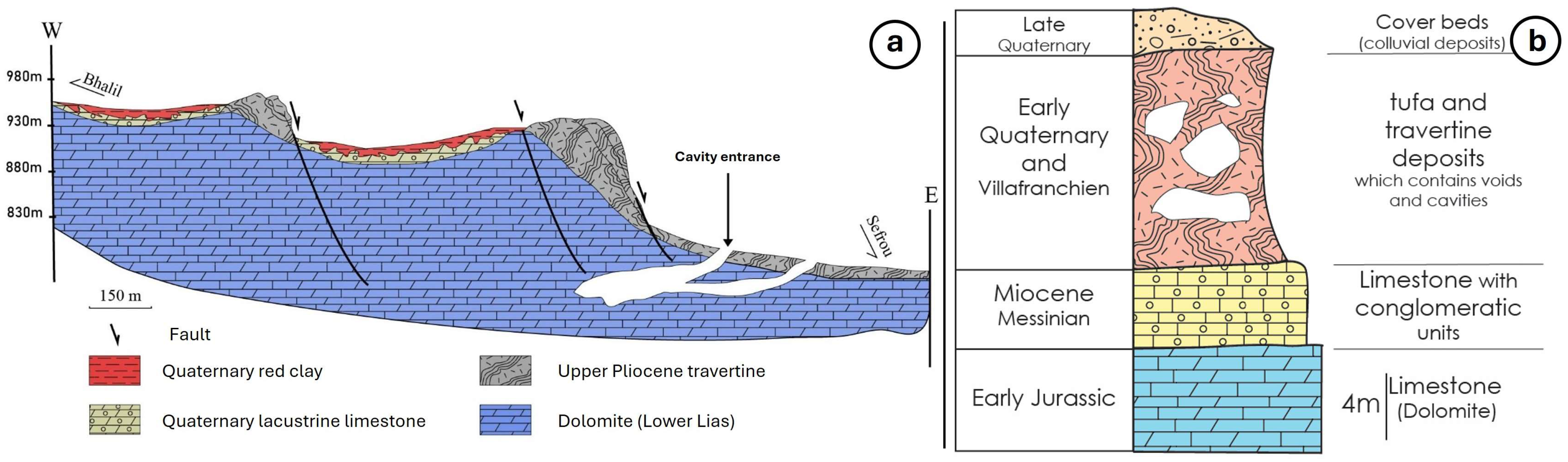
32]. Over these formations, a northward-thinning cover of Upper Miocene marine molasse and Miocene limestones with local conglomeratic intercalations is observed within the urban limits. Directly beneath the historic center, Late Villafranchian travertine and tufa deposits host a dense network of natural and anthropogenic voids, now buried beneath a ~2 m thick cover of Late Quaternary colluvium composed of slope-wash and alluvial sediments [
31,
32].
The tectonic and karst evolution of the Aggay–Sefrou basin (
Figure 2a), reflects a polyphase neotectonic regime active throughout the Plio-Quaternary, expressed mainly by normal faulting and left-lateral strike-slip displacements [
32,
33,
34,
35,
36,
37]. These structural dynamics have controlled the architecture of the basin and the spatial evolution of sedimentation. Notably, they facilitated a hydrological transition from late endorheic conditions to fully exorheic drainage during the Middle Pleistocene, redirecting surface water into the modern Oued Aggay system [
27,
38]. This tectonic reorganization, combined with the region’s lithological heterogeneity, played a crucial role in enhancing karstification. CO
2-rich meteoric and phreatic waters exploited fault zones and fracture networks, intensifying carbonate dissolution and promoting the development of both subterranean (endokarst) conduits and surface collapse features [
27,
33,
38].
3. Methodology
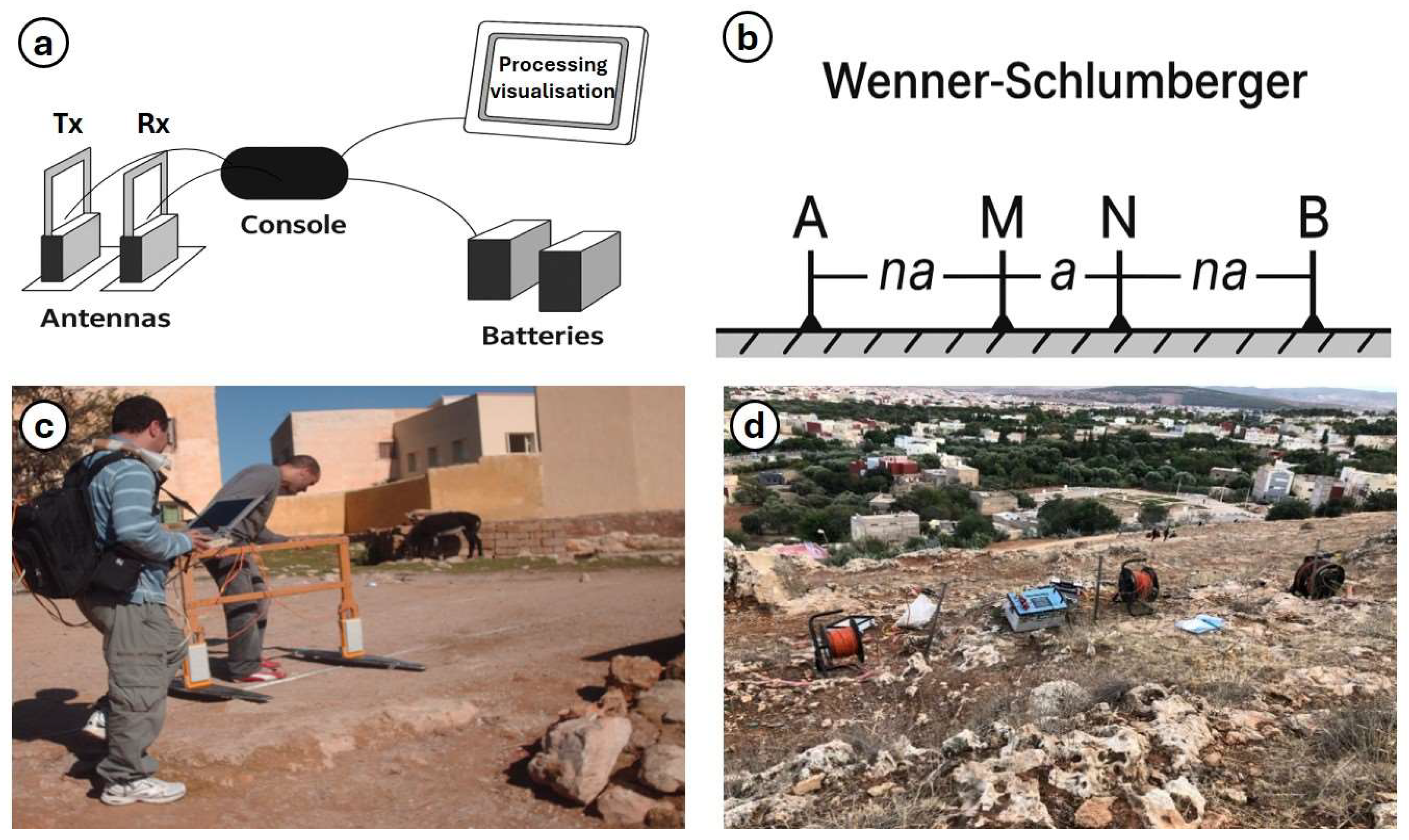
Two non-invasive geophysical methods were employed in the study area to investigate the subsurface conditions: Vertical Electrical Sounding (VES) and Ground Penetrating Radar (GPR) (
Figure 3). These techniques were selected for their distinct sensitivity to subsurface resistivity and electromagnetic contrasts, allowing for the detection of voids, lithological discontinuities, and potential instability zones.
A total of 42 VES soundings were conducted in the Binna district, using a Syscal Pro resistivity meter manufactured by IRIS Instruments, Orléans, France. The measurements employed the Wenner–Schlumberger configuration [
39], which is well-suited for resolving both horizontal and vertical resistivity variations(
Figure 3b,d). This classical direct current (DC) geoelectrical method involves injecting a current (I) into the ground through a pair of current electrodes and measuring the resulting potential difference (∆V) using a separate pair of potential electrodes [
40].
The spacing between the current electrodes (AB/2) progressively increased from 2 to 80 m to expand the depth of investigation [
41], while the MN spacing was adjusted proportionally. The VES survey layout consisted of six equidistant profiles, each composed of seven VES points spaced at 5-meter intervals. The profiles were oriented in a NNW–SSE direction to cover the extension of the underground cavity, ensuring optimal detection along its expected axis.
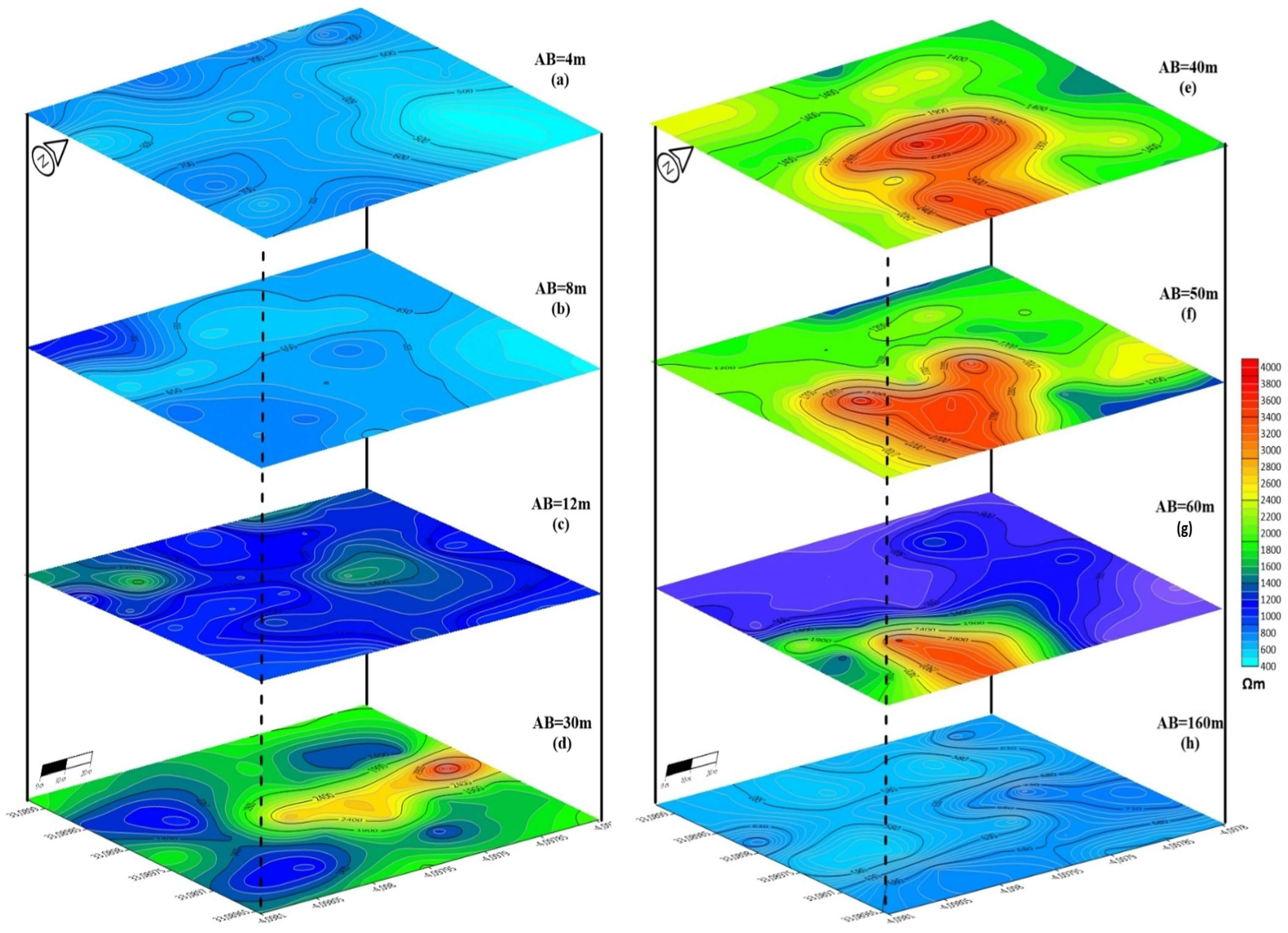
The first step in processing the collected VES data involved qualitative interpretation, achieved by generating eight isoresistivity maps that allowed for a 3D-like visualization of lateral resistivity variations along horizontal planes. This was performed using Surfer version 19.2.213 software [
42], which is widely used for geospatial data gridding and contour mapping in geophysics. The VES technique in this stage provides a more qualitative analysis, helping to define the general distribution of subsurface resistivity parameters, particularly valuable for delineating broad resistivity anomalies associated with geological features [
43,
44].
The VES data were processed using ZondIP1D version 6.1 [
45], a specialized software designed for the interpretation of one-dimensional resistivity and induced polarization vertical electrical soundings. ZondIP1D employs advanced inversion algorithms, including smooth and focusing inversions, to estimate the resistivity and thickness of subsurface layers with high reliability. A key feature of the software is its multi-station interpretation approach, which treats aligned VES measurements along a profile line as a continuous geoelectric section rather than as isolated soundings. This allows the integration of seven VES points collected along the same line to generate 2D pseudosection visualizations that reveal the lateral and vertical distribution of resistivity.
Following VES, Ground Penetrating Radar (GPR) was employed as a subsequent method to provide higher-resolution imaging of near-surface features. GPR measurements were carried out in a parcel of the Rquiba district (
Figure 3c) using a RAMAC system with bistatic antennas. After several tests to optimize data quality, a central frequency of 200 MHz and a recording time window of 200 ns were selected. This time window can be translated into an estimated depth of investigation once the radar wave velocity is determined from the subsurface materials, allowing an approximate penetration depth of up to 10 m under the local lithological conditions. The survey included six profiles-oriented NNE–SSW, perpendicular to the known underground cavities and spaced 1.2 m apart, plus four profiles perpendicular to these, spaced 3 m apart, to ensure thorough spatial coverage. Raw radargram data were processed using the open-source GPRPy version 1.0.3 software [
46], which enhances the signal-to-noise ratio and attenuates propagation artifacts. Processing steps included time-zero correction, background removal, band-pass filtering, gain application, and migration where applicable. These steps significantly improved the radar image quality, facilitating clearer identification and interpretation of subsurface cavities and geological structures.
4. Results and Discussion
4.1. Apparent Resistivity Maps
The isoresistivity maps for AB = 4 m and AB = 8 m (
Figure 4a,b) highlight clear lateral variations in apparent resistivity within the shallow subsurface, particularly between 0.5 and 1 m depth, where values cluster around 500 Ωm. At this scale, the influence of the superficial clayey soil appears limited. This can be attributed to the fact that the clay-rich allochthonous cover has been reworked over time; eroded, transported downslope, and redeposited within pre-existing dissolution depressions developed in the travertine layers. As a result, its thickness and continuity are highly irregular, reducing its impact on the electrical response. The contrast observed between the southeastern and northwestern sectors, where the southeast exhibits slightly lower resistivity may signal the presence of shallow structural weakening or a thinning of the travertine roof, consistent with proximity to the underlying cavity.
At greater depths (
Figure 4c,d), spanning 1–4 m, resistivity increases substantially, ranging from 1000 to 3500 Ωm. The highest values in
Figure 4c correspond to the upper surface of the limestone formation, which typically exhibits resistivities between 1000 and 2000 Ωm in this geological context. At these depths, the porous travertine cover is no longer present, giving way to more competent and resistive carbonate deposits. This transition is also consistent with the resistivity distribution observed in the AB = 30 m configuration, confirming the deeper extent of the more resistive lithology. Overall, resistivity tends to increase with depth, especially in the central-eastern sector of the survey area, which coincides with the mapped entrance of the potential cavity. The presence of two high-resistivity anomalies in the eastern sector, located between longitudes −4.098 and −4.0979, aligns with the position of two known cavity openings and reinforces their geoelectrical expression. Toward the western part of the map, higher surface elevation combined with a thicker travertine cover results in deeper cavity levels and, consequently, lower measured resistivity at comparable depths.
The isoresistivity distribution at 5 m depth (
Figure 4e) further clarifies the geometry of the subsurface void. The southward extension of the cavity becomes more apparent, spreading toward the central-western portion of the map, where mean resistivity values reach approximately 2400 Ωm. Several VES measurements positioned directly above the cavity outline a large, laterally continuous void that appears to remain connected to the eastern cavity system through a narrow subsurface passage. Subtle variations in resistivity with increasing depth, particularly in the eastern sector, may indicate the top of a deeper, third carbonate formation or an additional possible cavity level, suggesting a more complex multi-tiered karst system than initially inferred from surface observations.
Figure 4f presents the apparent resistivity distribution obtained for AB = 50 m and AB = 60 m, corresponding to an estimated investigation depth of 6–8 m. The first map in this series displays a remarkably regular pattern dominated by high resistivity values, including a pronounced anomaly in the central part of the survey area. This anomaly correlates well with the cavity previously identified in the AB = 40 m configuration, confirming the vertical continuity of the void. A comparison of these maps indicates that the high-resistivity signature associated with the cavity persists to at least 7 m depth, suggesting a substantial vertical extension of the void and a stable air-filled structure within this interval. In addition, similar high-resistivity values are observed in the southwestern sector of the map. This pattern may signal the presence of a secondary underground extension of the cavity. The interpretation is consistent with field observations, where a second entrance is documented in that area, lending credence to the hypothesis of a branching or interconnected karst system.
At 8 m depth (
Figure 4g), the apparent resistivity map exhibits a more uniform distribution, characteristic of the underlying Liasic dolomite, which dominates the response at this depth. Within the limestone layer, a distinct high-resistivity anomaly remains visible in the southeastern quadrant. However, the amplitude and spatial extent of the resistive zone associated with the main cavity significantly decrease compared with shallower levels. This observation suggests that the possible cavity reaches its lower limit around this depth, with only residual high-resistivity traces marking the deepest portions of the void or small residual pockets of air-filled space.
The final isoresistivity map, corresponding to the largest AB spacing used in the survey and probing depths of approximately 20 m, shows a marked shift from the patterns observed at shallower levels. Apparent resistivity values decrease substantially across the map, with the AB = 100 m configuration yielding mean values around 500 Ωm (
Figure 4h). This systematic reduction highlights a transition to a more homogeneous and conductive geological unit. The trend is consistent with the presence of Triassic red clays, which are known to occupy the deeper stratigraphic levels. These clays were likely mobilized upward along fault planes, filling structural depressions beneath the carbonate formations. Their fine-grained, highly deformable nature and lower degree of compaction explain their significantly reduced resistivity compared with the overlying dolomite and travertine layers. This deeper conductive unit marks the base of the karstified carbonate system within the investigation depth of the survey.
The depth intervals presented in the isoresistivity maps are consistent with the investigation capabilities of the Wenner–Schlumberger configuration used in this study. As described in the methodology, both the current electrode spacing (AB/2) and the potential electrode spacing (MN) were progressively increased during acquisition, which expands the sensitivity of the array to deeper subsurface levels. When MN spacing is adjusted proportionally to AB/2, the method provides reliable estimates of shallow to intermediate depths, allowing depth slices from 0.5 m down to approximately 20 m to be interpreted within the expected range of the acquisition geometry and subsurface resistivity contrasts.
4.2. 2D Pseudosections
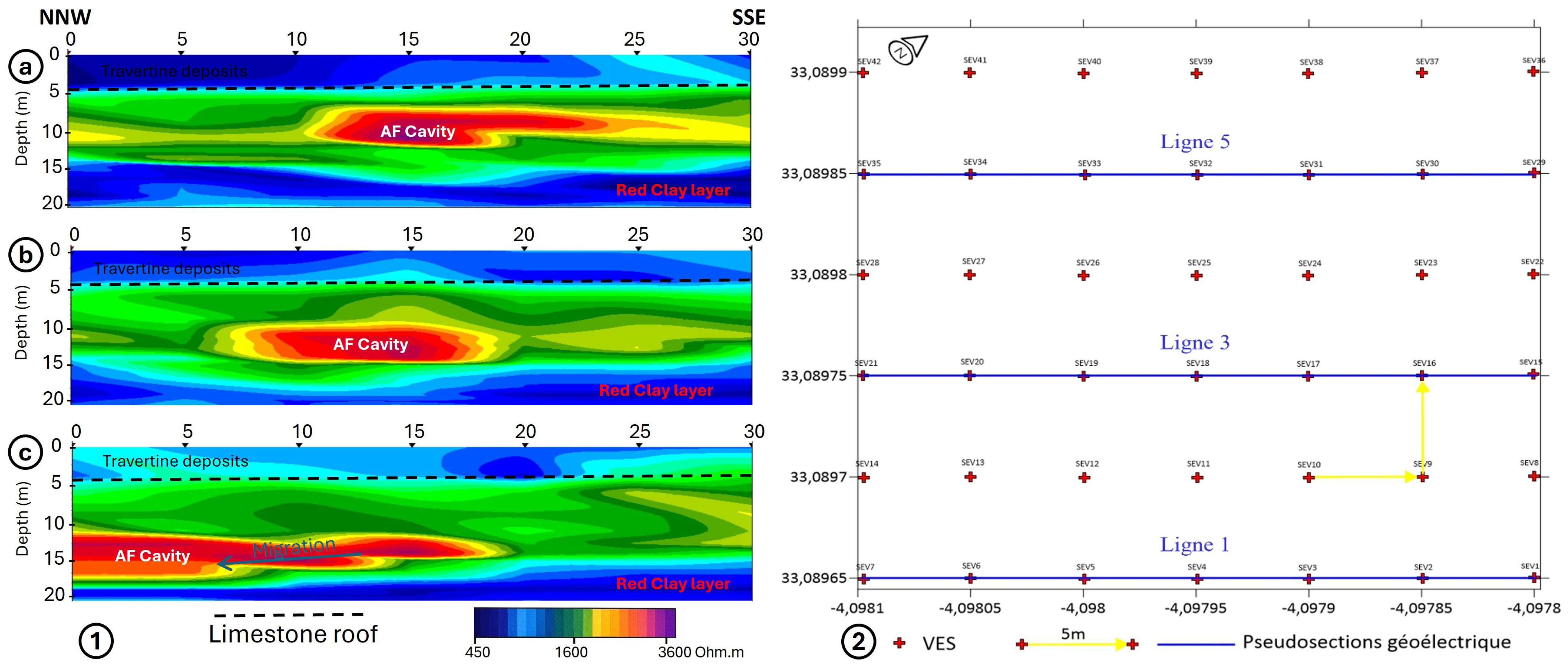
Several 2D geo-electrical pseudosections were produced from the vertical electrical sounding (VES) measurements using the ZondIP1d version 6.1 inversion software. Although a complete set of pseudosections was generated, only the most representative profiles are presented here in order to emphasize the main structural and lithological features (
Figure 5②). These profiles, oriented NNW–SSE following the dominant structural trend of the area, support a more robust interpretation of subsurface variability. The primary objective of this interpretation is to refine the estimation of the geo-electrical parameters of the subsurface formations and to enhance the understanding of the geometry, depth, and connectivity of the potential cavity systems within the study area. This approach provides a complementary perspective to the isoresistivity maps, enabling a more coherent three-dimensional reconstruction of the karst features.
The pseudosection for Survey Line 1 (
Figure 5①(a)) reveals the presence of at least four distinct resistivity units arranged vertically. The shallowest unit corresponds to a surface layer composed of altered and highly fractured travertine. This horizon displays relatively low resistivity values and variable thicknesses, ranging from 0.5 to 5 m, reflecting the heterogeneous degree of weathering and the infilling of dissolution features by reworked sediments.
Beneath this layer lies a more massive resistive formation extending from 2 to 10 m depth, characterized by resistivity values between 900 and 1600 Ωm. Based on field observations and regional stratigraphy, this unit is interpreted as Liassic brecciated dolomite, which generally exhibits higher resistivity due to its compactness and reduced porosity compared with the overlying travertine. Within this dolomitic horizon, several pronounced high-resistivity anomalies are observed beneath VES2 to VES5. These anomalies correspond to two distinct cavities, the larger of which is located near the center of the section. It reaches an estimated vertical dimension of approximately 4 m and extends laterally toward VES5, indicating a sizeable and laterally connected void system. The contrast between the resistive cavity signal and the surrounding carbonates facilitates a clear delineation of the cavity boundaries.
At greater depths, starting around 14 m, resistivity values drop sharply, suggesting the transition to a much more conductive geological unit. This deeper horizon is likely associated with a clayey formation, consistent with the Triassic red clays identified in regional geology. Their lower resistivity is attributed to their fine-grained texture, higher water content, and lower structural consolidation compared with the overlying carbonate sequence.
The pseudosection of Survey Line 2 (
Figure 5①(b)) displays a shallow, low-resistivity cover (<600 Ωm), similar in nature to that observed in Line 1 but noticeably thinner. This superficial layer extends to a maximum depth of about 4 m, reflecting a reduced thickness of the altered travertine cover in this part of the study area. Beneath this unit lies an intermediate resistivity layer extending down to roughly 15 m depth, which is again attributed to the brecciated Liassic dolomite. The resistivity range and stratigraphic position of this horizon are consistent with the regional carbonate sequence encountered in the previous profile. Embedded within this dolomitic unit is a well-defined high-resistivity anomaly (>2000 Ωm) located near the center of the section. This feature is interpreted as the expression of two interconnected air-filled cavities, forming part of the same karst system revealed in the earlier pseudosection. Their electrical signature is particularly distinct due to the strong contrast between resistive voids and the surrounding compact dolomite. At greater depths, the dolomitic formation transitions into a conductive substratum (<700 Ωm), interpreted as Triassic red clays, whose electrical properties match those observed regionally and in the deeper parts of Survey Line 1.
The pseudosection of Survey Line 3 (
Figure 5①(c)) reveals a more complex structural arrangement, consisting of four main resistivity regions. The shallowest corresponds to a low-resistivity layer that is significantly thicker in the northern portion of the profile, gradually thinning toward the south. This spatial variation reflects the distribution of weathered travertine and reworked sediments, which appear to accumulate preferentially downslope. Below this horizon, a moderately resistive layer (1000–1800 Ωm) extends across the entire section and is attributed to the dolomitic sequence that dominates the intermediate subsurface throughout the study area.
Within this dolomitic unit, a large, elongated high-resistivity anomaly emerges in the southeastern part of the pseudosection. This anomaly is interpreted as the southward continuation of the main cavity, confirming the extension previously inferred from the isoresistivity maps (
Figure 4f,g). Its geometry—elongated and laterally continuous—suggests that the void expands and branches in this direction, forming part of a larger, multi-entry karst network.
At greater depths, a fourth, distinctly more conductive formation begins to appear, starting at approximately 14 m depth in the northern sector and deepening to around 18 m in the south. This variation in depth to the conductive unit reflects the topographic gradient across the study area: elevation increases progressively from Line 1 to Line 3, leading to a deeper position of the Triassic clayey horizon beneath the higher southern terrain. This transition is consistent with the broader structural framework, where the carbonate formations thin upslope and the clayey substratum dips gently southward.
4.3. 2D GPR Radargrams
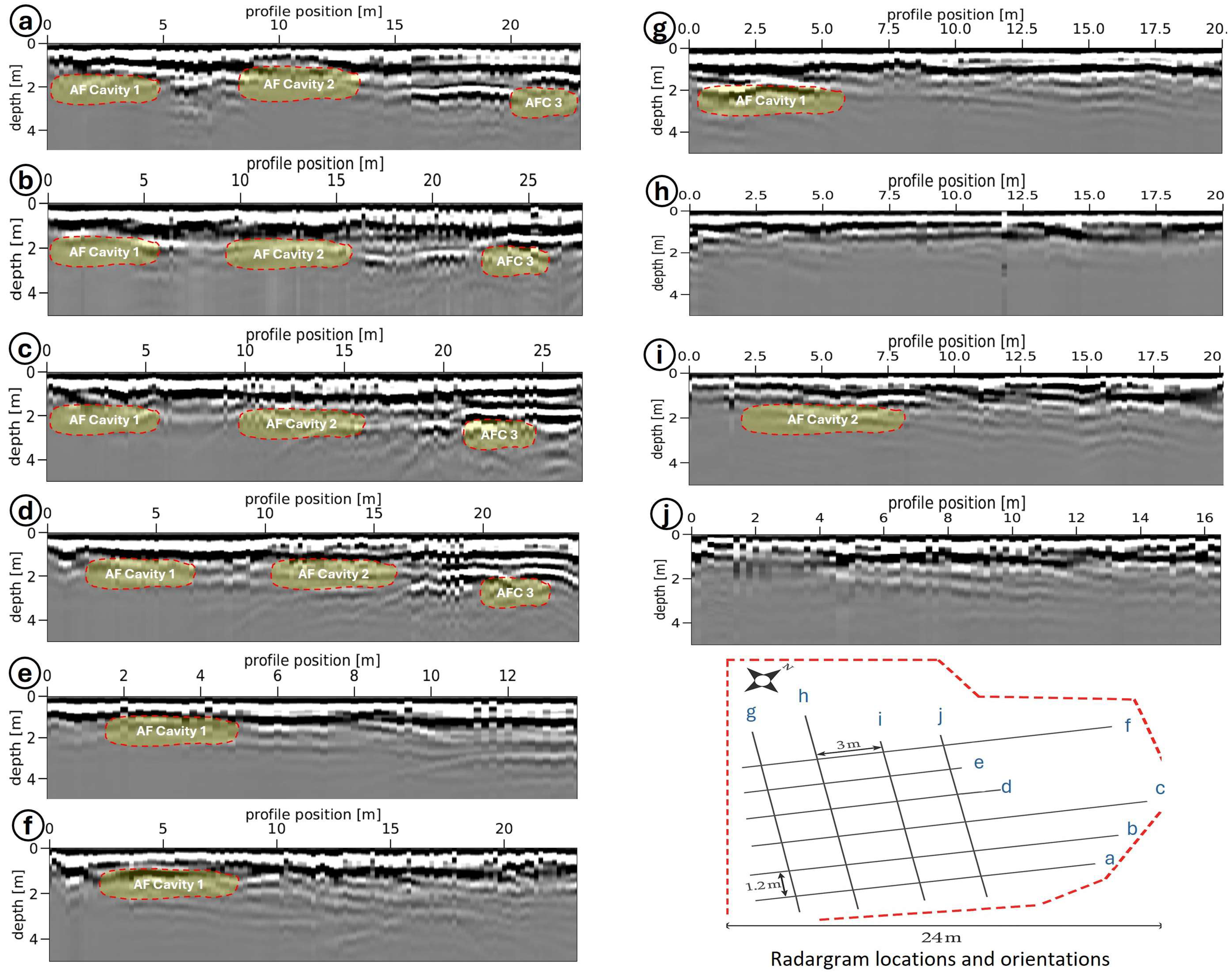
Figure 6 presents the results of the ground-penetrating radar (GPR) survey carried out across the travertine outcrop, illustrating a series of radar
Figure 6a–j along with their spatial layout. These radargrams provide a high-resolution view of the shallow subsurface and reveal a combination of high-amplitude, laterally continuous reflections and low-amplitude, disrupted signal zones. The alternation between these two patterns is characteristic of heterogeneous travertine sequences affected by dissolution processes. The low-amplitude, chaotic zones are of particular interest, as they are interpreted as air-filled cavities within the shallow subsurface. For clarity, these anomalies are highlighted and labeled AF Cavity 1, AF Cavity 2, and AF Cavity 3, representing the main void structures detected within the surveyed area.
In
Figure 6a–d, three major reflection discontinuities are observed at depths ranging from approximately 1.5 to 3 m. The uppermost high-amplitude reflections correspond to the thin travertine roof, typically about 1.5 m thick, which maintains lateral continuity across the profiles before showing clear signs of disruption directly above the low-amplitude zones. These disrupted areas are indicative of air-filled voids, as the strong dielectric contrast between air and the surrounding carbonate materials produces abrupt changes in reflection amplitude and breaks in reflector coherence. Such features are consistent with the expected geophysical response of shallow karst cavities in carbonate formations.
AF Cavity 1 and AF Cavity 2 display strong lateral continuity across multiple radar profiles. Their repeated expression suggests that they constitute elongated voids or interconnected karstic conduits within the travertine unit. Their geometry is consistent with dissolution processes that preferentially exploit stratification planes or zones of enhanced fracturing.
In contrast, AF Cavity 3 is also recognized across the same set of
Figure 6a–d but appears at a slightly greater depth, typically 0.5–1 m deeper than its position in
Figure 6a,b. This subtle downward shift indicates vertical variability within the cavity system, possibly reflecting differences in the elevation of dissolution horizons or the presence of stacked void levels within the travertine. Such variability is typical in multi-tiered karst settings, where cavities may develop at different depth intervals depending on fracture density, hydraulic connectivity, or paleo-geomorphic conditions.
Profiles (e–f) exhibit a generally homogeneous subsurface radar response, characterized by continuous, high-amplitude reflections and minimal disturbance. Only isolated anomalies associated with AF Cavity 1 are visible in these sections, suggesting that the travertine in this sector is comparatively compact, less fractured, and structurally more uniform than in the northern profiles. The limited expression of cavities in this area may reflect reduced dissolution activity or greater infill of former voids, resulting in a more coherent travertine roof.
The perpendicular
Figure 6g–j intersect the same cavity system but display weaker reflection disturbances, owing to their orientation relative to the principal alignment of the voids.
Figure 6g,i show shallow amplitude anomalies that align with the expected positions of AF Cavity 1, corroborating the presence of the cavity in cross-section. These anomalies, although subtler than those detected in the main profiles, reinforce the interpretation that AF Cavity 1 forms a laterally consistent void when viewed along its principal axis.
In contrast,
Figure 6h,j do not reveal any significant reflector disruption or continuity associated with the mapped cavities. The absence of pronounced anomalies along these transects indicates that the voids detected in
Figure 6a–d do not extend uniformly across the entire study area. Instead, they appear to be laterally confined, possibly restricted by variations in fracture density, stratigraphic architecture, or localized dissolution zones within the travertine.
Taken together, the integrated interpretation of all GPR profiles supports the presence of a network of air-filled cavities within the upper travertine horizon, characterized by variable depth and heterogeneous lateral continuity. The consistent appearance of AF Cavity 1 and AF Cavity 2 in multiple profiles, combined with the marked attenuation of reflections above them, strongly suggests the existence of open voids partially guided by stratification planes or preferential dissolution pathways. Conversely, the more limited spatial footprint of AF Cavity 3 indicates a localized karst feature—possibly a smaller dissolution pocket or a collapse-related void that did not propagate laterally.
These findings collectively emphasize the structural heterogeneity of the travertine and highlight the potential for subsurface instability in areas affected by cavity development. Such information is crucial for assessing geohazards, guiding future geophysical investigations, and informing site-specific engineering or conservation strategies.
5. Conclusions
This study demonstrates the effectiveness of combined geophysical methods, including vertical electrical soundings (VES) in the Binna Mountain area of Sefrou and ground-penetrating radar (GPR) in the old medina of Bhalil, for characterizing subsurface structures and detecting cavities within Quaternary deposits in urban settings. The 42 VES measurements in Binna allowed the construction of detailed isoresistivity maps and geo-electrical pseudosections, revealing distinct resistivity units corresponding to travertine, brecciated Liassic dolomite, and underlying clayey formations. These results identified an interconnected karstic network, with cavities of varying size and depth, highlighting the complex subsurface heterogeneity of the Quaternary deposits.
High-resolution GPR surveys in the old medina of Bhalil further mapped these cavities along the survey lines, detecting both large air-filled voids and smaller fractures within the travertine layers. The GPR data provided detailed information on the depth and lateral extent of the cavities, showing that the largest voids are centrally located while smaller anomalies are spatially limited and often inclined northeast. These observations demonstrate that subsurface heterogeneity is highly localized and closely related to the distribution of travertine formations within the Quaternary deposits, providing a precise depiction of zones affected by cavities in these urban areas.
Overall, the independent use of VES and GPR results enabled a detailed understanding of the subsurface heterogeneity within the travertine, Quaternary deposits, and underlying Liassic formations, and highlighted areas with higher georisk. Future work should focus on additional geophysical surveys in adjacent urban areas and, if possible, borehole investigations to validate cavity dimensions and refine the stratigraphic interpretation of these mixed-age deposits.





 ,
,