You are currently viewing a new version of our website. To view the old version click .

Quaternary, Volume 7, Issue 3

September 2024 - 12 articles

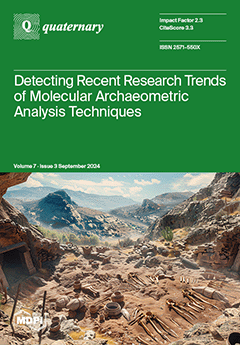
Cover Story: This review, through the collection and comparative analysis of the most recent literature, aimed to analyze the new trends in archaeometric analysis and some selected laboratory techniques aimed at determining the provenance, physical–chemical characteristics, and state of decay of archaeological finds of different types (ancient manuscripts, paintings, frescoes, and ceramics). In particular, the methodologies and analytical techniques relating to Raman spectroscopy, X-ray fluorescence, laser ablation, IR spectroscopy, LIBS, and Thz spectroscopy were compared and tabulated, with the aim of determining the appropriateness of each technique applied to various archaeological items. The work was also based on the construction of comparative tables of the consulted scientific literature and on the analysis of the research trends using the Google Trends app. View this paper
  • Issues are regarded as officially published after their release is announced to the table of contents alert mailing list .
  • You may sign up for email alerts to receive table of contents of newly released issues.
  • PDF is the official format for papers published in both, html and pdf forms. To view the papers in pdf format, click on the "PDF Full-text" link, and use the free Adobe Reader to open them.

Articles (12)

  • Review
  • Open Access
7 Citations
3,497 Views
31 Pages

A Review on the Latest Early Pleistocene Carnivoran Guild from the Vallparadís Section (NE Iberia)

  • Joan Madurell-Malapeira,
  • Maria Prat-Vericat,
  • Saverio Bartolini-Lucenti,
  • Andrea Faggi,
  • Darío Fidalgo,
  • Adrian Marciszak and
  • Lorenzo Rook

23 September 2024

The Vallparadís Section encompasses various geological layers that span a significant chronological range, extending from the latest Early Pleistocene to the early Middle Pleistocene, covering a timeframe from approximately 1.2 to 0.6 Ma. This...

  • Article
  • Open Access
1 Citations
1,870 Views
19 Pages

Soils in Understanding Land Surface Construction: An Example from Campania Plain, Southern Italy

  • Antonella Ermice,
  • Rossana Marzaioli,
  • Marco Vigliotti,
  • Pierferdinando Lamberti and
  • Daniela Ruberti

19 September 2024

The contribution of sediment transport and accumulation to soil formation was investigated in an area characterized by continental sedimentary activity since the Late Pleistocene. The area was the north-eastern portion of the large Quaternary graben...

  • Commentary
  • Open Access
1 Citations
2,048 Views
5 Pages

3 September 2024

This commentary underscores the importance of the recent discovery of the oldest in situ Holocene mangrove sediments found to date in the Caribbean region. It also emphasizes the implications of this finding for understanding postglacial sea level ri...

  • Article
  • Open Access
2 Citations
1,829 Views
21 Pages

Carrying Capacity, Available Meat and the Fossil Record of the Orce Sites (Baza Basin, Spain)

  • Guillermo Rodríguez-Gómez,
  • M. Patrocinio Espigares,
  • Bienvenido Martínez-Navarro,
  • Sergio Ros-Montoya,
  • Antonio Guerra-Merchán,
  • Jesús A. Martín-González,
  • Isidoro Campaña,
  • Alejandro Pérez-Ramos,
  • Alejandro Granados and
  • José Manuel García-Aguilar
  • + 2 authors

27 August 2024

The Early Pleistocene sites of Orce in southeastern Spain, including Fuente Nueva-3 (FN3), Barranco León (BL) and Venta Micena (VM), provide important insights into the earliest hominin populations and Late Villafranchian large mammal communit...

  • Review
  • Open Access
1 Citations
2,194 Views
31 Pages

22 August 2024

This review, through the collection and comparative analysis of the most recent literature, aims to analyze the new trends in archaeometric analysis and some selected laboratory techniques aimed at determining the provenance, the physical–chemi...

  • Article
  • Open Access
2 Citations
1,840 Views
24 Pages

15 August 2024

The loess–paleosol profile of Máza brickyard in SW Hungary was investigated through multivariate analyses of malacofauna and sedimentological analyses. The aim was to reconstruct the complex developmental history of both sediment and mal...

  • Article
  • Open Access
1,819 Views
15 Pages

13 August 2024

In the northern part of the Niğde (Central Anatolian) Quaternary Bor Basin, stratigraphic sections P1 and P2 were sampled, reaching depths of 11 m and 25 m. The samples were analyzed with thin-section, XRD, and chemical analyses (ICP-MS) to dete...

  • Article
  • Open Access
2 Citations
2,060 Views
16 Pages

1 August 2024

Recent technological advancements in spectral imaging core-scanning techniques have proved to be a promising tool to study lake sediments at extremely high resolution. We used this novel analytical approach to scan core AU3 of the Pleistocene Auel ma...

  • Article
  • Open Access
1 Citations
1,507 Views
21 Pages

19 July 2024

At the end of the Pleniglacial and the first half of the Late Glacial period, approximately between 18 and 14 ka BP, rivers of the central and southern parts of the East European Plain had channels up to 10 times as large as the present day channels...

  • Article
  • Open Access
1 Citations
1,903 Views
18 Pages

New Diatom and Sedimentary Data Confirm the Existence of the Northern Paleo-Outlet from Lake Ladoga to the Baltic Sea

  • Anna V. Ludikova,
  • Dmitry A. Subetto,
  • Denis D. Kuznetsov,
  • Alexander V. Orlov and
  • Angelina E. Shatalova

19 July 2024

Despite more than 100 years of research, a number of questions concerning the evolution of the post-glacial connection between Lake Ladoga, the largest European lake, and the Baltic Sea remain unanswered. In particular, the location and chronological...

of 2

Get Alerted

Add your email address to receive forthcoming issues of this journal.

XFacebookLinkedIn
Quaternary - ISSN 2571-550X