

Skip to Content
You are currently on the new version of our website. Access the old version .

Quaternary, Volume 6, Issue 2

2023 June - 14 articles

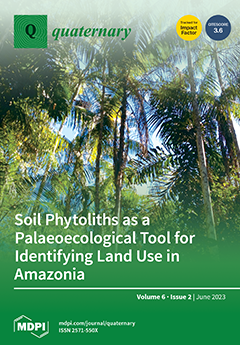
Cover Story: The effectiveness of phytolith analysis for reconstructing pre-Columbian land-use beyond archaeological sites has received little critical attention. We use both new and previously published soil phytolith data from SW Amazonia to assess the robustness of this proxy for reconstructing land use. Our results support the hypothesis that pre-Columbian peoples enriched their forests with palms over several millennia, although phytoliths are limited in their ability to capture small-scale crop cultivation and deforestation. Despite these drawbacks, we conclude that off-site soil phytolith analysis can provide novel insights into pre-Columbian land use, provided it is effectively integrated with other land-use (e.g., charcoal) and archaeological data. View this paper
  • Issues are regarded as officially published after their release is announced to the table of contents alert mailing list .
  • You may sign up for email alerts to receive table of contents of newly released issues.
  • PDF is the official format for papers published in both, html and pdf forms. To view the papers in pdf format, click on the "PDF Full-text" link, and use the free Adobe Reader to open them.

Articles (14)

  • Article
  • Open Access
6 Citations
3,110 Views
20 Pages

12 June 2023

Understanding sedimentation processes in response to past hydrogeological and climatic changes and capturing millennial-scale variations is a key focus of lacustrine paleoenvironmental research. This study presents the first high-resolution chronolog...

  • Article
  • Open Access
3 Citations
3,755 Views
32 Pages

Assessment of Pollen Representation in NW Italy (Liguria and Piedmont)

  • Davide Attolini,
  • Francesco Ciani,
  • Maria Angela Guido and
  • Carlo Montanari

This research focuses on the recent pollen image of several vegetation types in NW Italy. In 201 arboreal, shrubby, and herbaceous plant populations, pollen samples were taken from moss polsters, and the corresponding vegetation was recorded using th...

  • Article
  • Open Access
2 Citations
3,113 Views
16 Pages

Fluvial terrace formation is a complex process governed by the interplay of climatic and tectonic forcings. From a climatic perspective, an incision is usually related to climatic transitions, while valley aggradation is attributed to glacial periods...

  • Article
  • Open Access
4 Citations
3,821 Views
19 Pages

Plants, Fire and Landscape at the Prehistoric Pile-Dwelling Village of Palù di Livenza (PaluON1), UNESCO Site in the Italian Alps

  • Jessica Zappa,
  • Nicola Degasperi,
  • Michele Bassetti,
  • Assunta Florenzano,
  • Paola Torri,
  • Gabriel Servera-Vives,
  • Anna Maria Mercuri and
  • Roberto Micheli

This paper presents palynological data obtained from a trench excavated at the Neolithic pile-dwelling archaeological site of Palù di Livenza (northeastern Italy). The site is in a wetland located in a tectonic basin at the foot of the Cansigl...

  • Article
  • Open Access
10 Citations
4,791 Views
24 Pages

An Assessment of Soil Phytolith Analysis as a Palaeoecological Tool for Identifying Pre-Columbian Land Use in Amazonian Rainforests

  • James Hill,
  • Stuart Black,
  • Alejandro Araujo-Murakami,
  • Rene Boot,
  • Roel Brienen,
  • Ted Feldpausch,
  • John Leigue,
  • Samaria Murakami,
  • Abel Monteagudo and
  • Francis E. Mayle
  • + 6 authors

Phytolith analysis is a well-established archaeobotanical tool, having provided important insights into pre-Columbian crop cultivation and domestication across Amazonia through the Holocene. Yet, its use as a palaeoecological tool is in its infancy i...

  • Article
  • Open Access
1 Citations
6,059 Views
31 Pages

The Late Holocene fossil pollen records from the Zemu glacier, located in Yabuk, North Sikkim, in the eastern Himalayas, effectively generated quantitative climate reconstructions based on the transfer function model. The transfer function model was...

  • Article
  • Open Access
3,388 Views
16 Pages

While the North American mylodont sloth, Parmylodon harlani, has been identified in multiple localities in Mexico, most of these records are from the southern part of the country. Consequently, there is a large geographic gap between its distribution...

  • Article
  • Open Access
10 Citations
4,440 Views
21 Pages

Vegetation Composition in a Typical Mediterranean Setting (Gulf of Corinth, Greece) during Successive Quaternary Climatic Cycles

  • Aikaterini Kafetzidou,
  • Eugenia Fatourou,
  • Konstantinos Panagiotopoulos,
  • Fabienne Marret and
  • Katerina Kouli

The Gulf of Corinth is a semi-isolated basin in central Greece interrupting the Pindus Mountain Range, which nowadays is a biodiversity hotspot. Considering its key location, deep drilling was carried out within the International Ocean Discovery Prog...

  • Article
  • Open Access
3,598 Views
17 Pages

30 April 2023

Buried river valleys from the Neogene–Quaternary time are widespread throughout the Middle Volga region of the Russian Plain. They have been studied for a long period, since the 1940s, with the last major generalizations dating back to the 1980...

  • Article
  • Open Access
31 Citations
5,791 Views
16 Pages

19 April 2023

Crop yield prediction is one of the crucial components of agriculture that plays an important role in the decision-making process for sustainable agriculture. Remote sensing provides the most efficient and cost-effective solution for the measurement...

  • Article
  • Open Access
9 Citations
5,367 Views
13 Pages

19 April 2023

Earthquake precursors are the indicators that appear before an earthquake. The release of radon gas, ionospheric disturbances, anomalous animal behavior, and so on are examples of seismic and aseismic events. Ionospheric perturbations can be proved t...

  • Article
  • Open Access
3 Citations
5,269 Views
20 Pages

3 April 2023

Blades as a component of lithic assemblages hold significant importance to understanding the more recent part of human evolution, particularly with regard to the emergence and adaptations of Homo sapiens. The systematic production of elongated stone...

  • Review
  • Open Access
3 Citations
5,521 Views
19 Pages

The Fish Tanks of the Mediterranean Sea

  • Paris Oikonomou,
  • Anna Karkani,
  • Niki Evelpidou,
  • Isidoros Kampolis and
  • Giorgio Spada

3 April 2023

Roman fish tanks are found in various coastal regions of the Mediterranean, although the vast majority is found on the Tyrrhenian coast of Italy. In this work, a database was developed with information on 62 fish tanks along the Mediterranean coasts...

Get Alerted

Add your email address to receive forthcoming issues of this journal.

XFacebookLinkedIn
Quaternary - ISSN 2571-550X