You are currently viewing a new version of our website. To view the old version click .

Quaternary, Volume 4, Issue 4

December 2021 - 16 articles

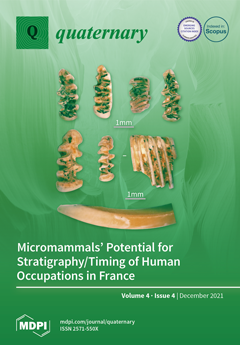
Cover Story: As micromammals are highly sensitive to changes in their habitat, variations in species representation are often used to reconstruct local environmental conditions. La Roche-à-Pierrot, Saint-Césaire, is an archaeological site that is significant to our understanding of the Middle-to-Upper Palaeolithic transition in Western Europe. Clearly documenting site formation processes, the post-depositional reworking of deposits, and the sequence of human occupations is fundamental for providing a secure archaeostratigraphic context of the site. The exceptionally large accumulation of micromammals from recently excavated stratigraphic units at the site makes it possible to track variations in the density of micromammals across the stratigraphic sequence. View this paper
  • Issues are regarded as officially published after their release is announced to the table of contents alert mailing list .
  • You may sign up for email alerts to receive table of contents of newly released issues.
  • PDF is the official format for papers published in both, html and pdf forms. To view the papers in pdf format, click on the "PDF Full-text" link, and use the free Adobe Reader to open them.

Articles (16)

  • Technical Note
  • Open Access
1 Citations
4,355 Views
6 Pages

31 October 2021

In semi-arid regions that are characterized by large agricultural activities, a high volume of water is needed to cover the water requirements for agricultural production. Due to low precipitation and the associated limited availability of surface wa...

  • Article
  • Open Access
6 Citations
5,485 Views
37 Pages

San Josecito Cave and Its Paleoecological Contributions for Quaternary Studies in Mexico

  • Joaquin Arroyo-Cabrales,
  • Eileen Johnson and
  • J. Alberto Cruz

26 October 2021

San Josecito Cave (2250 m elevation) is located nearby Aramberri, Nuevo León, northeastern Mexico, with excavations occurring in 1935–1941 and 1990. It is a paleontological cave and the significance of its faunal data rests in the understanding of th...

  • Article
  • Open Access
6 Citations
3,780 Views
13 Pages

The Potential of Micromammals for the Stratigraphy and the Timing of Human Occupations at La Roche-à-Pierrot (Saint-Césaire, France)

  • Loïc Lebreton,
  • Eugène Morin,
  • Brad Gravina,
  • Alexandre Michel,
  • François Bachellerie,
  • Cédric Beauval,
  • Damien Flas,
  • Véronique Laroulandie,
  • Josserand Marot and
  • Hélène Rougier
  • + 3 authors

21 October 2021

As micromammals are highly sensitive to changes in their habitat, variations in species representation are often used to reconstruct local environmental conditions. However, taphonomic aspects of micromammals are often overlooked, despite the fact th...

  • Article
  • Open Access
3 Citations
3,585 Views
14 Pages

Human-Altered Soils at an Archeological Site of the Bronze Age: The Tyater-Araslanovo-II Settlement, Southern Cis-Ural Region, Russia

  • Ruslan Suleymanov,
  • Gulnara Obydennova,
  • Andrey Kungurtsev,
  • Niyaz Atnabaev,
  • Mikhail Komissarov,
  • Artyom Gusarov,
  • Ilgiza Adelmurzina,
  • Azamat Suleymanov and
  • Evgeny Abakumov

15 October 2021

This paper presents the results of studying the soils at the archeological site of the Tyater-Araslanovo-II settlement located in the Republic of Bashkortostan, eastern European Russia. The settlement functioned in the 15th–12th centuries BCE (the La...

  • Article
  • Open Access
5 Citations
5,713 Views
20 Pages

The Stegodon Bonebed of the Middle Pleistocene Archaeological Site Mata Menge (Flores, Indonesia): Taphonomic Agents in Site Formation

  • Meagan J. Powley,
  • Indra Sutisna,
  • Katarina M. Mikac,
  • Unggul Prasetyo Wibowo and
  • Gerrit D. van den Bergh

29 September 2021

The Middle Pleistocene fluvial channel site of the Upper Fossil-bearing Interval at Mata Menge in the So’a Basin, Flores, Indonesia, has yielded the earliest fossil evidence for Homo floresiensis in association with stone artefacts and fossils of hig...

  • Article
  • Open Access
11 Citations
6,331 Views
24 Pages

28 September 2021

In recent years, several studies have significantly changed our knowledge concerning the use of birds by Neanderthals. However, what remains to be clarified is the geographical and chronological variability of this human behaviour. The present case s...

of 2

Get Alerted

Add your email address to receive forthcoming issues of this journal.

XFacebookLinkedIn
Quaternary - ISSN 2571-550X