

Highlights
During the recent pandemic, IPF patients experienced an additional weight of stress related to their higher risk of being affected by severe COVID-19, the fear of forthcoming death, and the feeling of social isolation, especially during the initial phases of early lockdown implementation. Our study prospectively assessed the impact of vaccination against COVID-19 on mental health of IPF patients and revealed a significant decrease in anxiety and depression scores one month after the first dose of vaccines in IPF patients. It seems that vaccination offered an additional beneficial effect on the mental health of IPF patients by alleviating the perception of depression and anxiety.
What are the main findings?
- A higher Hospital Anxiety and Depression Scale score was detected before vaccination against COVID-19.
- A significant decrease in both anxiety and depression scores one month after the first dose of vaccines in IPF patients was found.
What is the implication of the main finding?
- It seems that vaccination also offered an additional beneficial effect on depression and anxiety in IPF patients.
- Vaccination against SARS-COV-2 offered at least a beneficial effect on the inception of patients’ mental health, an important issue in patients’ well-being and quality of life, in the course of IPF.
Abstract
Background: Depression and anxiety represent significant comorbidities in idiopathic pulmonary fibrosis (IPF) patients, affecting their quality of life. The COVID-19 pandemic has had an uneven impact on global mental health. The Hospital Anxiety and Depression Scale (HADS) constitutes a validated tool to identify anxiety disorders and depression. The aim of this multicentre study was to evaluate the effect of COVID-19 vaccination on depression and anxiety in IPF patients. Methods: Consecutive IPF patients (median 73.5 years) who are regularly followed-up with were included in the study. Demographics, functional, and clinical were recorded. The HADS score was calculated before and one month after vaccination against COVID-19 in all participants. A Wilcoxon signed ranks test was conducted. Results: A total of 180 IPF patients (median 73.5 years) were included in the study. Among them, 145 patients (81%) received antifibrotic treatment. A significant reduction in HADS, both in anxiety and depression scales, was observed one month after vaccination against SARS-COV-2), independent of age, smoking, lung function impairment, and prior history of depression (p < 0.01). Conclusions: A higher Hospital Anxiety and Depression Scale score was detected before vaccination against COVID-19. It seems that vaccination also offered a beneficial effect on depression and anxiety in IPF patients, independent of age, smoking, lung function impairment, and prior history of depression.
1. Introduction
Usual Interstitial Pneumonia (UIP) and Idiopathic Pulmonary Fibrosis (IPF) constitute two irreversibly progressive and fatal fibrotic Interstitial Lung Diseases (ILDs), despite current treatment [1]. The recent coronavirus disease (COVID-19) pandemic imposed an additional health burden on exposed IPF patients, which are the most vulnerable population and are shown to experience an increased risk of severe acute respiratory syndrome (SARS) related to COVID-19 and high rates of hospitalisation and mortality, reaching approximately 50% [2,3]. Due to the above-reported dismal prognosis, the adoption of preventive measures including the imposition of the lockdown and vaccination, when it became available, was strongly advised to the IPF population, and patients were thankfully granted priority access to vaccination [4].
Among IPF patients, depression and anxiety are prevalent comorbidities affecting their quality of life [5,6]. During the course of the disease, the development of symptoms like dyspnoea is known to be related to the presence of depression in patients with IPF, revealing the importance of detecting this treatable comorbidity [7]. Moreover, it is generally accepted that when patients experience irreversible or unpredictable conditions, like that of the COVID-19 pandemic, depression and anxiety tend to become more severe. In general, the feeling of social isolation and the fear of forthcoming death represent frequent causes of psychological distress. A validated tool to evaluate accurately depression and anxiety in IPF is the Hospital Anxiety and Depression (HAD) score [7]. It constitutes a self-assessment questionnaire comprising seven questions for anxiety and seven for depression, and is a reliable scale to detect and evaluate the severity of both emotional disorders in the setting of a hospital outpatient clinic [8,9,10]. In the course of the pandemic and as soon as vaccines became available, the positive impact of vaccination on the mental health of vulnerable groups, especially those that faced the highest risk of hospitalisation or death, has been recognized [11].
We hypothesised that vaccination against SARS-COV-2, in addition to its preventative and protective role in IPF patients, may have also a beneficial impact on depression and anxiety in this group of patients. The aim of this multicentre, prospective study was to assess the potential impact of vaccination against COVID-19 on the mental health of IPF patients by evaluating the HAD score before and one month after vaccination.
2. Materials and Methods
The study was conducted between February 2021 and August 2021 and included IPF patients referred to 13 specialised ILD centres in Greece and were regularly followed-up with. In our country, vaccination for IPF patients was available after March 2021 [12]. Disease diagnosis was made according to the American Thoracic Society/European Respiratory Society/Japanese Respiratory Society/Latin American Thoracic Association consensus criteria for definite/probable UIP/IPF and after applying a multidisciplinary approach for each case. The study protocol was approved by the local Ethics Committee (ΠΝΕΥ, ΕΒΔ 104/17-2-2021) and participants provided written informed consent.
Demographic, epidemiological, functional, clinical, and microbiology data were collected for all participants. In addition, vaccination history, time since first diagnosis, comorbidities, and data on any immunosuppressive and/or antifibrotic treatment were recorded in detail. HAD score was assessed in all participants prior to vaccination against SARS-CoV-2 and one month after the first dose. Data were analysed using SPSS 18.0 for Windows (SPSS Inc, Chicago, IL, USA). Wilcoxon signed paired rank analysis was performed. A p-value <0.05 was considered statistically significant.
3. Results
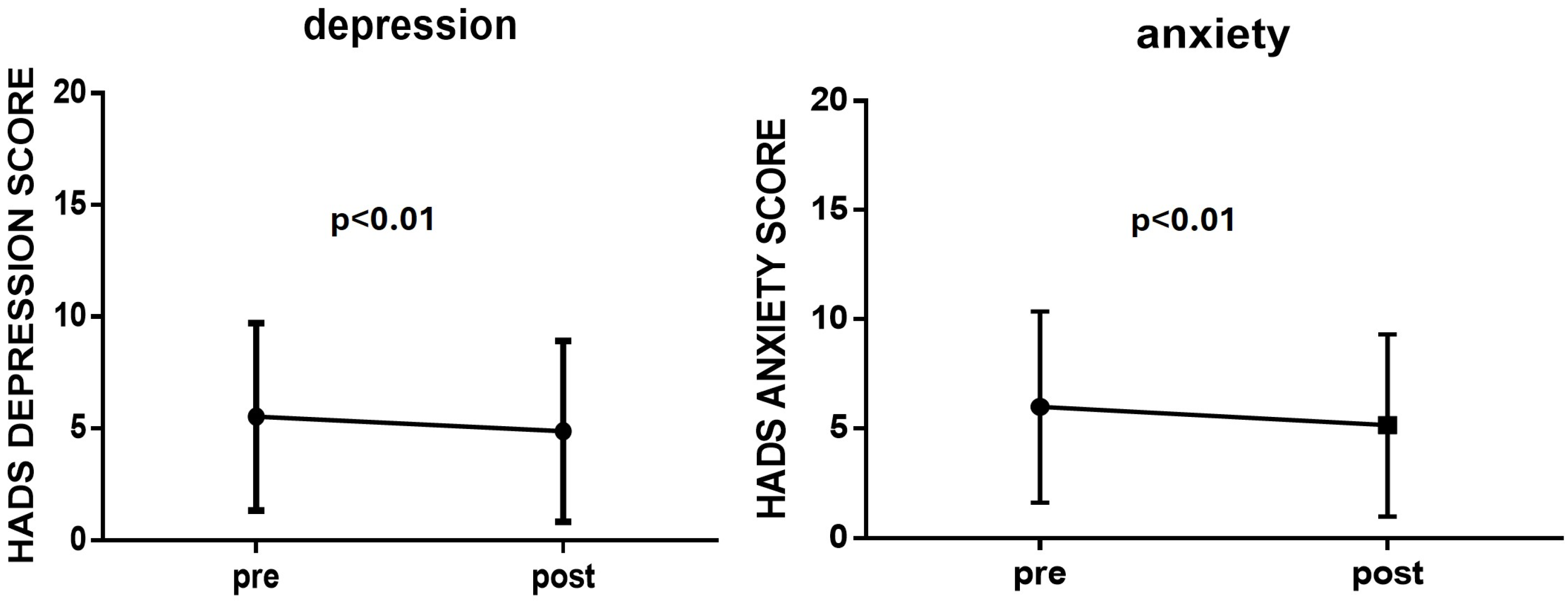
In total, 180 IPF patients were included in the study [median age (IQR) 73.5 (68–78) years] with a male preponderance (78.9%), a median (IQR) forced vital capacity (FVC) of 79% (64–91%), and a diffusing capacity of the lungs for carbon monoxide (DLCO) at 46% (37–58%). The median disease duration was approximately 36 (20–53) months. The demographic and clinical characteristics of the study subjects are presented in Table 1. The majority of them had a history of smoking, while 81.1% received antifibrotic treatment, either nintedanib or pirferidone. During the study period that was at the beginning of the pandemic, only 2.8% of the participants suffered from SARS-COV-2 infection. Almost all patients were immunised against influenza (98.3%) and Streptococcus pneumoniae (97.8%), while 98.3% of them strongly intended to become vaccinated against SARS-CoV-2 prior to the circulation of vaccines. Arterial hypertension was the most common comorbidity among IPF patients [100 patients out of 180 (55.6%)], followed by diabetes mellitus (27.8%) and coronary artery disease (16.1%). Regarding the HAD score, the median (IQR) values for anxiety and depression in our IPF patients were low, 6 (2–9) and 5 (2–8), respectively, and a score less than 8 is considered a value indicative of the presence of anxiety disorders and depression. However, as shown in Figure 1, a higher Hospital Anxiety and Depression Scale score was detected before vaccination against COVID-19. Particularly, a significant reduction in the HAD score, both in depression and anxiety scale, one month after the first vaccination against SARS-CoV-2 (p < 0.01) (Figure 1) was observed, registering an additional beneficial effect of vaccination on IPF patients’ mental health and quality of life.
Table 1.
Clinical characteristics of IPF patients (n = 180).
Figure 1.
Significant reduction in HAD score in IPF patients one month after the first vaccination against SARS-CoV-2 (p < 0.01) registering an additional beneficial effect of vaccination on patients’ mental health.
4. Discussion
During the recent pandemic, IPF patients experienced an additional weight of stress related to their higher risk of being affected by severe COVID-19, the fear of forthcoming death, and the feeling of social isolation, especially during the initial phases of early lockdown implementation, with all of them being frequent and well-known factors of psychological distress. Previous studies have reported increased levels of psychological distress and anxiety, in the general population since the onset of the pandemic [11,13,14]. Koltai J and co-workers, in a representative cohort of adults in the U.S., showed that vaccination against COVID-19 was also associated with a reduction in distress scores and alleviation of the perception of death [13]. Other observational studies confirm that unvaccinated people experience a high perceived risk of COVID-19 infection [15] and that fully vaccinated participants seem to present lower levels of anxiety and depression, providing further evidence that vaccination against SARS-CoV-2 may alleviate mental health symptoms [11].
Our study, for the first time, to the best of our knowledge, prospectively assessed the impact of vaccination against COVID-19 on the mental health of IPF patients, showing a significant decrease in anxiety and depression scores one month after the first dose of vaccines in IPF patients. Regarding the potential mechanism of this effect, we speculate that, as vaccination reduces the risk of severe infection, it may provide individuals with an additional sense of relief, a finding also observed in a previous study in a nationally representative cohort of U.S. adults [13].
In our cohort, the decrease detected in both HAD scores, although statistically significant, was particularly 1 unit in the medium of anxiety scale and 1 unit in the upper quartile range of the depression scale one month after the first vaccination against SARS-CoV-2. This is less than the minimal clinically significant difference necessary to reach a clinically meaningful improvement in patients’ symptom state, which is considered a limitation of the study. In addition, one month following vaccination may not be enough time to identify long-lasting changes, which might restrict the capacity to make firm conclusions on long-term impacts on mental health. One could speculate also that the reported clinical effects were quite mild and were not sufficient to significantly affect patients’ quality of life despite the statistical significance of the data. Nevertheless, this significant decrease in the score reveals at least a beneficial effect on the inception of patients’ mental health, an important issue in patients’ well-being and quality of life, in the course of this progressive and fatal disease. Further studies with additional measures to evaluate quality of life and overall well-being might offer further insight and a more thorough explanation of the therapeutic relevance of these findings. In this direction, even though the HAD score has been validated, using it alone cannot adequately represent the complexity of mental health issues; for instance, the HAM-A and HAM-D scales might be more helpful in future studies. However, this study represents a multicentre, prospective study with well-defined IPF patients assessing for the first time the impact of vaccination on mental health, an issue that deserves further investigation in IPF patients.
5. Conclusions
This study reports prospectively a significant decrease in HAD score one month after the first vaccination against COVID-19 in IPF patients, suggesting that vaccination offered an additional beneficial effect on the mental health of IPF patients by alleviating the perception of depression and anxiety.
Author Contributions
Conceptualization, K.S., A.I.P., E.M. and S.P.; methodology, A.I.P. and I.T.; software, A.I.P.; investigation, E.M. and A.I.P.; data curation, Z.I.D., I.E.D., P.K., A.G., K.T., I.P., V.T., A.T., P.T., P.S., P.N., A.X., A.K., E.S., A.H., M.M., L.K., E.-M.A., V.A., M.K., S.L., D.B. and K.A.; writing—original draft preparation, I.T., E.M. and S.P.; writing—review and editing Z.I.D., I.E.D., P.K., A.G., K.T., I.P., V.T., A.T., P.T., P.S., P.N., A.X., A.K., E.S., A.H., M.M., L.K., E.-M.A., V.A., M.K., S.L. and K.A.; supervision, E.M. and S.P. All authors have read and agreed to the published version of the manuscript.
Funding
This research received no external funding.
Institutional Review Board Statement
The study was conducted in accordance with the Declaration of Helsinki and approved by the Institutional Review Board (or Ethics Committee) of ATTIKON University Hospital NAME OF INSTITUTE ((ΠΝΕΥ, ΕΒΔ 104/17-2-2021).
Informed Consent Statement
Informed consent was obtained from all subjects involved in the study.
Data Availability Statement
The data presented in this study are available on request from the corresponding author due to ethical and privacy reasons.
Conflicts of Interest
D.I., K.P., G.A., T.K., P.I.C., T.V., T.A., T.P., S.P., N.P., X.A., A.K., S.E.K., H.A., M.A., K.L., A.E.M., A.V., K.M., L.S. and K.A. have no conflicts to declare. E.D.M. and S.A.P had honoraria for lectures from Boehringer Ingelheim, Hoffman La Roche, DEMO Hellas, ASTRA, and Elpen Hellas and support for attending congresses from Boehringer Ingelheim and Elpen. I.T. received honoraria for participation on Advisory Board from Boehringer Ingelheim and support for attending congresses from Boehringer Ingelheim and Elpen. Z.D. had honoraria for lectures from Boehringer Ingelheim and Hoffman La Roche, support for attending congresses from Boehringer Ingelheim and La Roche, and honoraria for participation on Advisory Board from Boehringer Ingelheim and Hoffman La Roche. K.A. had honoraria for lectures from Boehringer Ingelheim, Hoffman La Roche, Chiesi, Elpen, Menarini, GSK, and Astra Zeneka, support for attending congresses from Boehringer Ingelheim, Chiesi and Menarini, and honoraria for participation on Advisory Board from Boehringer Ingelheim and Hoffman La Roche.
References
- Raghu, G.; Remy-Jardin, M.; Richeldi, L.; Thomson, C.C.; Inoue, Y.; Johkoh, T.; Kreuter, M.; Lynch, D.A.; Maher, T.M.; Martinez, F.J.; et al. Idiopathic Pulmonary Fibrosis (an Update) and Progressive Pulmonary Fibrosis in Adults: An Official ATS/ERS/JRS/ALAT Clinical Practice Guideline. Am. J. Respir. Crit. Care Med. 2022, 205, e18–e47. [Google Scholar] [CrossRef] [PubMed]
- Guan, W.J.; Ni, Z.Y.; Hu, Y.; Liang, W.H.; Ou, C.Q.; He, J.X.; Liu, L.; Shan, H.; Lei, C.L.; Hui, D.S.C.; et al. Clinical Characteristics of Coronavirus Disease 2019 in China. N. Engl. J. Med. 2020, 382, 1708–1720. [Google Scholar] [CrossRef] [PubMed]
- Esposito, A.J.; Menon, A.A.; Ghosh, A.J.; Putman, R.K.; Fredenburgh, L.E.; El-Chemaly, S.Y.; Goldberg, H.J.; Baron, R.M.; Hunninghake, G.M.; Doyle, T.J. Increased Odds of Death for Patients with Interstitial Lung Disease and COVID-19: A Case–Control Study. Am. J. Respir. Crit. Care Med. 2020, 202, 1710–1713. [Google Scholar] [CrossRef]
- Papiris, S.A.; Bouros, D.; Markopoulou, K.; Kolilekas, L.; Papaioannou, A.I.; Tzilas, V.; Tzouvelekis, A.; Fouka, E.; Papakosta, D.; Daniil, Z.; et al. Early COVID-19 lockdown in Greece and idiopathic pulmonary fibrosis: A beneficial “impact” beyond any expectation. Eur. Respir. J. 2021, 57, 2003111. [Google Scholar] [CrossRef] [PubMed]
- Lee, Y.J.; Choi, S.M.; Lee, Y.J.; Cho, Y.-J.; Yoon, H.I.; Lee, J.-H.; Lee, C.-T.; Park, J.S. Clinical impact of depression and anxiety in patients with idiopathic pulmonary fibrosis. PLoS ONE 2017, 12, e0184300. [Google Scholar] [CrossRef] [PubMed]
- Tzouvelekis, A.; Karampitsakos, T.; Kourtidou, S.; Bouros, E.; Tzilas, V.; Katsaras, M.; Antonou, C.; Dassiou, M.; Bouros, D. Impact of Depression on Patients With Idiopathic Pulmonary Fibrosis. Front. Med. 2020, 7, 29. [Google Scholar] [CrossRef] [PubMed]
- Ryerson, C.J.; Berkeley, J.; Carrieri-Kohlman, V.L.; Pantilat, S.Z.; Landefeld, C.S.; Collard, H.R. Depression and functional status are strongly associated with dyspnea in interstitial lung disease. Chest 2011, 139, 609–616. [Google Scholar] [CrossRef] [PubMed]
- Zigmond, A.S.; Snaith, R.P. The hospital anxiety and depression scale. Acta Psychiatr. Scand. 1983, 67, 361–370. [Google Scholar] [CrossRef] [PubMed]
- Michopoulos, I.; Douzenis, A.; Kalkavoura, C.; Christodoulou, C.; Michalopoulou, P.; Kalemi, G.; Fineti, K.; Patapis, P.; Protopapas, K.; Lykouras, L. Hospital Anxiety and Depression Scale (HADS): Validation in a Greek general hospital sample. Ann. Gen. Psychiatry 2008, 7, 4. [Google Scholar] [CrossRef]
- Tzanakis, N.; Samiou, M.; Lambiri, I.; Antoniou, K.; Siafakas, N.; Bouros, D. Evaluation of health-related quality-of-life and dyspnea scales in patients with idiopathic pulmonary fibrosis. Correlation with pulmonary function tests. Eur. J. Intern. Med. 2005, 16, 105–112. [Google Scholar] [CrossRef] [PubMed]
- Chaudhuri, K.; Howley, P. The impact of COVID-19 vaccination for mental well-being. Eur. Econ. Rev. 2022, 150, 104293. [Google Scholar] [CrossRef] [PubMed]
- Συστάσεις εμβολιασμού κατά την περίοδο της πανδημίας COVID19-Υπουργείο Υγείας. Available online: https://www.moh.gov.gr/articles/health/dieythynsh-dhmosias-ygieinhs/emboliasmoi/systaseis-emboliasmoy-kata-thn-periodo-ths-pandhmias-covid19 (accessed on 14 July 2024).
- Koltai, J.; Raifman, J.; Bor, J.; McKee, M.; Stuckler, D. COVID-19 Vaccination and Mental Health: A Difference-In-Difference Analysis of the Understanding America Study. Am. J. Prev. Med. 2022, 62, 679–687. [Google Scholar] [CrossRef] [PubMed]
- O’Connor, R.C.; Wetherall, K.; Cleare, S.; McClelland, H.; Melson, A.J.; Niedzwiedz, C.L.; O’Carroll, R.E.; O’Connor, D.B.; Platt, S.; Scowcroft, E.; et al. Mental health and well-being during the COVID-19 pandemic: Longitudinal analyses of adults in the UK COVID-19 Mental Health & Wellbeing study. Br. J. Psychiatry J. Ment. Sci. 2021, 218, 326–333. [Google Scholar] [CrossRef]
- Willis, D.E.; Andersen, J.A.; Bryant-Moore, K.; Selig, J.P.; Long, C.R.; Felix, H.C.; Curran, G.M.; McElfish, P.A. COVID-19 vaccine hesitancy: Race/ethnicity, trust, and fear. Clin. Transl. Sci. 2021, 14, 2200–2207. [Google Scholar] [CrossRef]
Disclaimer/Publisher’s Note: The statements, opinions and data contained in all publications are solely those of the individual author(s) and contributor(s) and not of MDPI and/or the editor(s). MDPI and/or the editor(s) disclaim responsibility for any injury to people or property resulting from any ideas, methods, instructions or products referred to in the content. |
© 2024 by the authors. Published by MDPI on behalf of the Polish Respiratory Society. Licensee MDPI, Basel, Switzerland. This article is an open access article distributed under the terms and conditions of the Creative Commons Attribution (CC BY) license (https://creativecommons.org/licenses/by/4.0/).



