



Mach. Learn. Knowl. Extr., Volume 4, Issue 3 (September 2022) – 13 articles
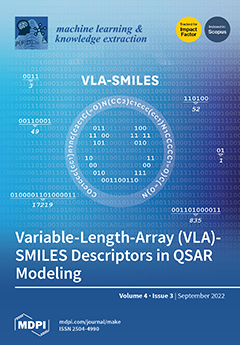
Cover Story (view full-size image):
Molecular descriptors essentially dictate the performance of quantitative structure–activity relationship (QSAR) models that uncover molecules with desired properties in the ever-expanding virtual and synthetically available chemical space. The Simplified Molecular Input Line Entry System (SMILES) is one of the most used descriptors, for which the importance of numerical encoding has recently been recognized. We propose a new variable-length-array SMILES (VLA-SMILES) descriptor that reduces the code size while preserving structural characteristics, where the tradeoff between training speed and accuracy is controlled through clustering of binary numbers. The method of statistical H0 hypothesis testing based on the F2,n-2 criteria was used for predictive ability validation of designed VLA-SMILES featuring QSAR models using prototypical ChEMBL datasets (n is a volume of the testing set). View this paper
- Issues are regarded as officially published after their release is announced to the table of contents alert mailing list.
- You may sign up for e-mail alerts to receive table of contents of newly released issues.
- PDF is the official format for papers published in both, html and pdf forms. To view the papers in pdf format, click on the "PDF Full-text" link, and use the free Adobe Reader to open them.
Previous Issue
Next Issue
