You are currently viewing a new version of our website. To view the old version click .
Journal of Composites Science
  • Article
  • Open Access

10 December 2025

Silver Mask-Mediated Synthesis and Plasmonic Nanoparticle Decoration of ZnO Nanosheaves

,
,
,
,
,
,
,
,
and
1
Institute of Advanced Materials and Technologies, National Research University “Moscow Institute of Electronic Technology” (MIET), Zelenograd, Moscow 124498, Russia
2
Department of Materials Science of Semiconductors and Dielectrics, University of Science and Technology “Moscow Institute of Steel and Alloys” (MISiS), Moscow 119049, Russia
3
Applied Plasmonics Laboratory, Belarusian State University of Informatics and Radioelectronics, 220013 Minsk, Belarus
4
Institute for Lasers, Photonics and Biophotonics, State University of New York at Buffalo, Buffalo, NY 14260, USA
This article belongs to the Section Nanocomposites

Abstract

Wide band gap (WBG) oxide and metal nanocomposites can possess bifunctionality from combining tightly coupled nanoobjects with different physicochemical properties. Adjusting synthesis conditions tunes these properties through modulating the process–morphology–function relationship. However, the controllable synthesis of such nanocomposites and their related applications are still underexplored. Here, we present a novel process flow to synthesize crystalline ZnO nanosheaves dotted with silver nanoparticles. The uniqueness of our strategy lies in the use of a silver mask for vertical growth of ZnO nanosheaves and thermal evaporating/dewetting Ag film to form a photocatalytic/plasmonic heterostructure. Upon combining a huge specific surface area and nanocrystallinity of ZnO nanosheaves, we enabled its surface-enhanced Raman scattering (SERS)-activity free of plasmonic components, yet their Ag modification resulted in improving detection limit in relation to Ellman’s reagent. Ag/ZnO nanosheaves showed dramatic photocatalytic activity to clean SERS-active surface. The systematic approach to synthesize Ag/ZnO heterostructure holds great promise in practical applications associated with interest in both photocatalytic and plasmonic properties.

1. Introduction

Surface-enhanced Raman scattering (SERS) of light was observed and explained about half a century ago [1,2,3]. Since then, the scientific community has paid ongoing attention to this intriguing surface effect [4,5]. SERS addresses the detection and structural analysis of chemical compounds at extremely low concentrations, including but not limited to carbon nanostructures [6,7], inorganic oxide molecules [8], organic dyes [9,10,11], colorogenic chemicals [12], drugs [13,14,15], vital proteomic analytes [16,17,18], and biomarkers of different diseases [19,20,21]. In the long course of study of SERS phenomena, justified skepticism has arisen related to its reliability for biosensing. In fact, most SERS-active substrates consist of plasmonic nanostructures that contribute to a dramatic increase in the Raman signal of analyte molecules due to the electromagnetic mechanism [22,23]. Certainly, a material of such nanostructures has electronic conductivity and is typically represented by noble metals [24]. SERS-activity can be maximized by adjusting geometric parameters of metal nanostructures, which is invariably connected to the overheating of SERS-active substrates due to the increase in the local electromagnetic field in them [25,26]. Temperature growth usually leads to the burning of analyte molecules. This is especially critical for the detection of chemicals in small amounts. As a result, collected SERS-spectra can be irreproducible and noninformative. Therefore, it is an urgent goal to engineer reusable SERS-active substrates with modest plasmonic properties that avoid overheating but are effective enough for the detection of target molecules at submolar concentrations. An elegant approach to achieve this objective is to introduce nanostructures of wide band gap (WBG) semiconductors in SERS-active substrates [27,28,29]. The WBG semiconductor nanostructures contribute to SERS-activity due to the chemical mechanism assisted by an athermal charge transfer [28,30]. Additionally, they have a potential to be cleaned for new use since many WBG semiconductors possess a photocatalytic property that facilitates the destruction of organic analyte molecules if exposed to ultraviolet (UV) light [31,32].
Zinc oxide (ZnO) is one of the WBG semiconductor leaders applied to improve SERS-active substrates [33]. Recently, SERS-sensing of many vital organic molecules on various ZnO nanostructures free of or combined with noble metals has been reported [34,35]. To unleash a full potential of this WBG semiconductor in the SERS-spectroscopy field, optimization of the structure of ZnO nanocrystals and minimizing the content of plasmon metal are encouraged. These require fundamentally based research devoted to a deep understanding of the process–structure–property relationship of ZnO and noble metal nanostructures.
Here, we engineered original quasi-ordered Ag/ZnO nanosheaves composed of ZnO nanowires (NWs) dotted with Ag nanoparticles (NPs) which demonstrate prominent SERS-activity as a result of combined plasmonic/charge transfer effects and photocatalytic activity enabling their reusability.

2. Materials and Methods

2.1. Materials

Silicon wafers with 300 nm wet SiO2 were supplied by University Wafer Inc. (Boston, MA, USA). Zn(NO3)2·6H2O, NaOH, methylene blue (MB), 5,5’-dithiobis-2-nitrobenzoic acid (DTNB), and Rhodamine B (RhB) were purchased from Sigma Aldrich (Darmstadt, Germany) and used without further purification. Deionized water was provided by a Millipore water system (Merck KGaA, Darmstadt, Germany).

2.2. Fabrication Methodology

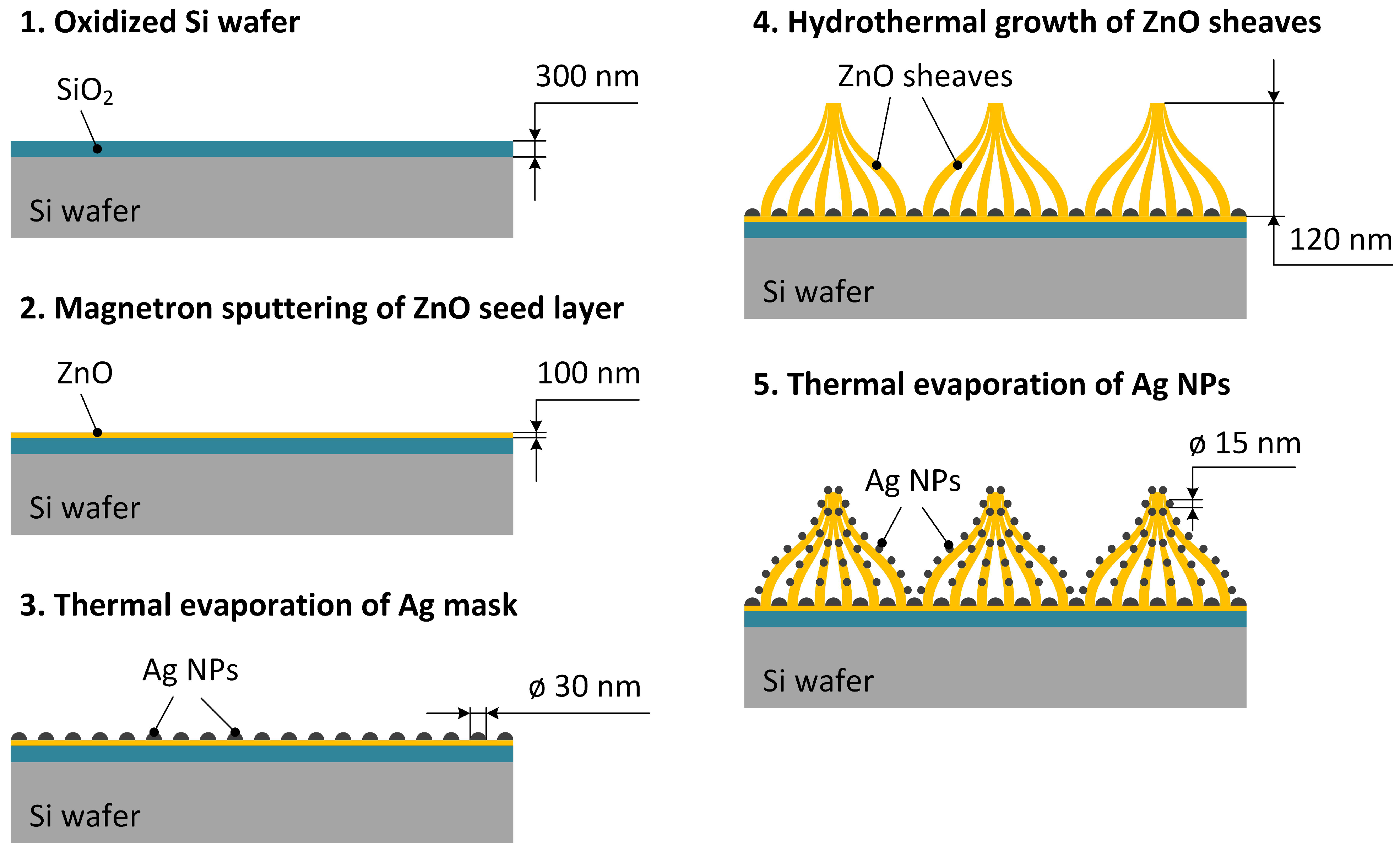
An oxidized Si wafer was used as an initial substrate for magnetron sputtering of the 100 nm ZnO seed layer. Then, an array of Ag NPs was grown on the ZnO seed layer by the thermal evaporation method that allowed us to control a mean diameter of Ag NPs by selecting a metal source mass [36,37]. Here, we used a 6 g silver source located on the molybdenum evaporator. The distance between the substrate and the evaporator was 20 cm. The evaporating procedure was carried out at 3 × 10⁻⁵ Torr. After that, the Ag/ZnO/SiO2 substrate was annealed in air at 400 °C for 10 min. As a result, Ag NPs of approx. 30 nm diameter were formed. The 30 nm Ag NP layer played a role of the silver mask in defining the sites for the nucleation and growth of ZnO NWs. The nanosheaves of ZnO NWs were hydrothermally grown on the ZnO seed layer coated with the silver mask. The hydrothermal processing was carried out from a Zn(NO3)2·6H2O and NaOH solution at 80 °C for 30 min. Once hydrothermal synthesis was completed, the ZnO nanosheaves were dotted with Ag NPs by thermal evaporation followed by annealing in air at 400 °C for 10 min. The entire fabrication process flow is schematically shown in Figure 1.
Figure 1. The process flow scheme for fabrication of the Ag/ZnO nanosheaves.

2.3. Characterization

A scanning electron microscopy (SEM) manufactured by Field Electron and Ion Company (FEI, Hillsboro, OR, USA) was used to study the geometrical parameters of the Ag/ZnO nanosheaves. Elemental composition of the samples was investigated using a JEOL JSM-6020 Plus/LA SEM (JEOL Ltd., Tokyo, Japan) with an energy-dispersive X-ray (EDX) spectroscopy attachment. The EDX-spectra of the samples were obtained in the mode of recording secondary electrons at an accelerating voltage of 20 kV. The electron beam diameter was approximately 1 µm during the EDX-spectra collection. The phase composition of the samples was studied by X-ray diffrectometry (XRD) with a Rigaku MiniFlex 600 (Rigaku Corporation, Tokyo, Japan) that contains a Cu K α radiation source ( λ = 1.54 Å). The Bragg angle 2 θ ranged from 30° to 80°. X-ray photoelectron spectrometer (XPS) PHI5000 Versa Probe II (ULVAC-PHI) was used for chemical analysis of the Ag/ZnO nanosheaves. An excitation source was monochromatic Al K α radiation ( = 1486.6 eV), the diameter of the beam was 200 µm. Atomic concentrations were determined by the method of relative elemental sensitivity factors from the survey spectra, using the integral intensities of the following lines: C 1s, O 1s, Zn 3p, and Ag 3d. The chemical state of the elements was determined from the high-resolution spectra of Zn 2p3/2, Zn LMM, Ag 3d, Ag MNN, and O 1s. To determine a chemical state of silver, the ‘modified’ Auger parameter α was used, which is the sum of the kinetic energy (KE) of the Ag M4N45N45 Auger peak and the binding energy (BE) of the Ag 3d5/2 peak. The Auger parameter α was also determined for zinc as the sum of KE (Zn LMM) and BE (Zn 2p3/2). The BE scale was calibrated using Au 4f—83.96 eV and Cu 2p3/2—932.62 eV peaks. When processing the data, the BE scale was adjusted using the O 1s line—530.4 eV; the reference value of BE (O 1s) in ZnO [38,39,40]. Reflectance spectra were collected with the Proscan MS 122 spectrophotometer (Proscan Special Instruments Ltd., Minsk, Belarus) in the range of 200–900 nm.

2.4. Computer Simulations

Computer simulations of the 3D geometry of the Ag/ZnO nanosheaves and the electric field strength (E) were made with COMSOL Multiphysics 5.3. Quantitative analysis of geometrical parameters of the samples was made using an ImageJ 1.54i software (Wayen Rasband, US National Institutes of Health, Bethesda, MD, USA) by adjusting the contrast and brightness of the SEM images for further evaluation of the ZnO NW length range and diameter as well as the diameter of Ag NPs. The mean geometrical parameters formed the basis for the 3D structure modeling. The resulting 3D model was used for further simulation of the electric field strength distribution. An excitation was a plane wave. A wave propagation vector was normally directed to the xy plane. We considered a study of the modeled 3D structure with 473, 633, or 785 nm wavelength lasers. The power of the laser was a multiplication of the laser spot surface area by E at 1 V/m. The E vector was parallel to the y axis.

2.5. SERS-Measurements

SERS-activity of the Ag/ZnO nanosheaves was studied using two Raman spectrometers.
3D scanning confocal laser Raman microscope-spectrometer Confotec NR500 (SOL Instruments, Minsk, Belarus) equipped with 473, 633, and 785 nm lasers was used to experimentally reveal an optimal laser wavelength for the SERS-spectra excitation of the DTNB analyte, its detection limit, and the Raman/SERS-spectra of RhB. Such equipment was selected for study of the DTNB and RhB molecules because these analytes are characterized by absorption bands out of the 473, 633 and 785 nm wavelength regions. The laser beams were focused on the sample surface through a 100× objective (N.A. = 0.95). Passed through the objective, the 473, 633, and 785 nm laser beams had 4.65, 4.66, and 13.67 mW powers, respectively.
The second Raman spectrometer was Confotec MR200 (SOL Instruments, Minsk, Belarus) equipped with a 532 nm laser. The laser beam power was approx. 4.4 µW after passing through a 40× objective (N.A. = 0.75). This spectrometer was used for the SERS study of MB because its absorbance bands do not overlap the green range.
The Raman spectrometer photodetectors were cooled to 20 °C to eliminate the influence of thermal noise. SERS-measurements were made by scanning the 20 × 20 µm area of the sample to collect 100 SERS-spectra in total, which were then processed to present a mean SERS-spectrum for each spectra array. The accumulation time was 1 s for the single spectrum in the array.
Before measurements, both spectrometers were calibrated referring to a Raman peak of monocrystalline silicon at 520 cm−1.
The analyte liquids for the SERS-study were prepared by dissolution of RhB and MB in water, DTNB was dissolved in a mixture of water and ethanol (1:1 volume ratio). The experimental samples were kept in analyte solutions for 30 min, rinsed with water, and then air dried.

3. Results and Discussion

3.1. Morphology and Chemical Composition of the Samples

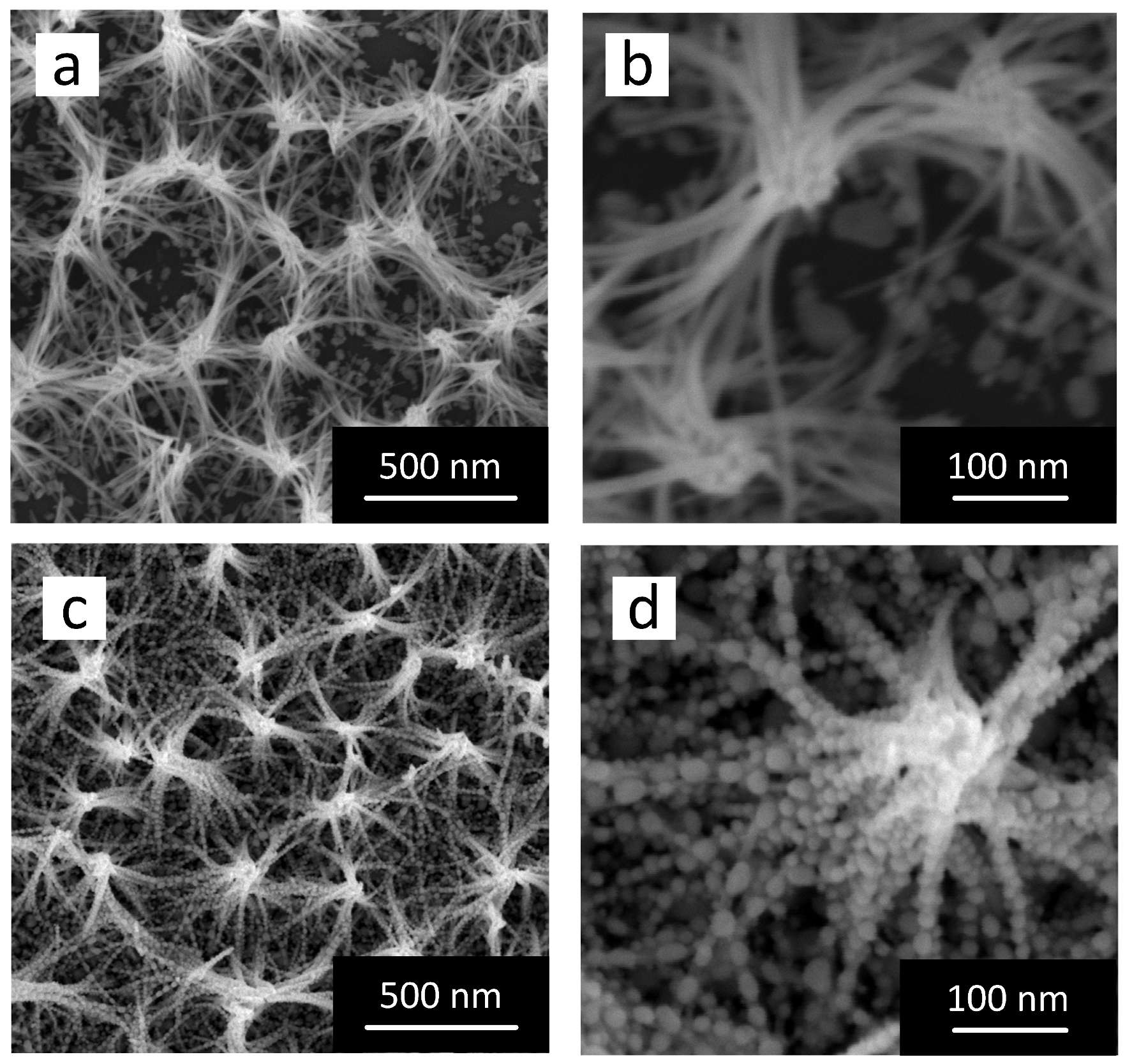
Figure 2 shows SEM images of the ZnO nanosheaves before and after deposition of silver. The pull of the ZnO NWs into the nanosheaves is apparently caused by their flexibility and a surface tension when the sample dries after the hydrothermal synthesis. Silver deposition provided a tight coating of each ZnO NW with Ag NPs. The length of ZnO NWs was found to vary from 100 to 300 nm while its mean value was approx. 120 nm. The mean diameter of the ZnO NW cross section was 15 nm. The same mean diameter was typical for Ag NPs.
Figure 2. SEM images of the array of ZnO nanosheaves (a,b) before and (c,d) after silver deposition.
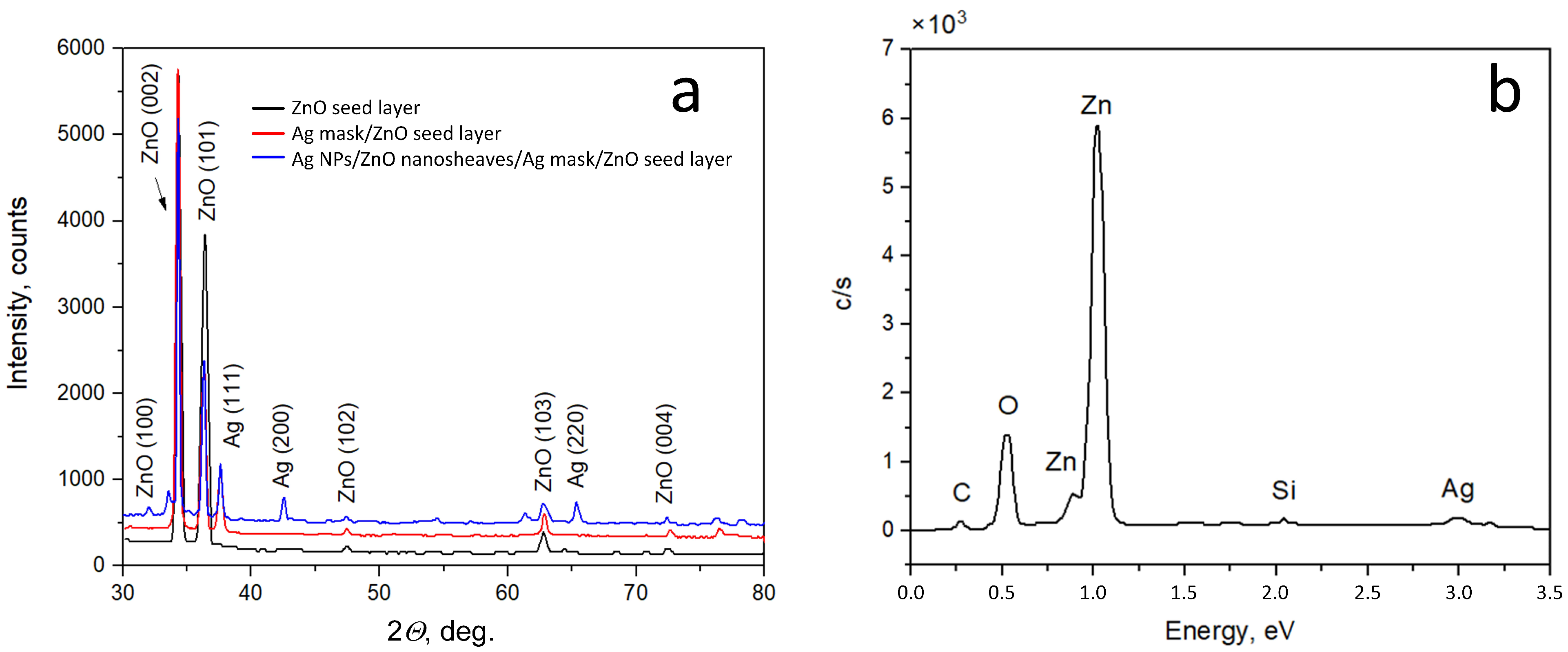
The phase composition of the experimental samples was revealed by the XRD method. Figure 3a presents the corresponding XRD patterns, which show that the samples are composed of polycrystalline ZnO with a wurtzite phase (JCPDS No. 36-1451). A distinct diffraction peak at 2 θ = 38.2° attributed to metallic Ag (111) is also observed in the XRD patterns of the samples subjected to the Ag deposition (JCPDS No. 04-0783). Phase analysis shows new XRD peaks corresponding to crystalline silver (Ag (200) and Ag (220)) once magnetron sputtering/annealing is completed. Considering the only bright spots on the ZnO nanosheaves are new nanostructures observed after the Ag sputtering one can conclude on their metallic nature. Scherrer equation [41] was used to calculate the crystalline size of the ZnO nanocrystals.
D = K · λ β · cos θ
where D is the nanoparticles crystalline size; K is a shape factor, which is typically equal to 0.89 if the nanocrystallite shape is assumed to be spherical; λ is the X-ray wavelength (1.54 Å); β is the full width at half maximum intensity (FWHM) of the specific line of the XRD pattern; θ is the Bragg angle. The sizes of the ZnO (002), (101) and Ag (111) nanocrystals were found to correspond to 24, 36, and 29 nm, respectively. It should be pointed out that the mean diameter of Ag NPs (15 nm) obtained by SEM measurements is twice less than Ag nanocrystallite size calculated from the XRD pattern. The calculated sizes of ZnO nanocrystallites (24 and 36 nm) also exceed the ZnO cross section diameter (15 nm) revealed from the SEM-image. This can be associated with limits of Scherrer equation related to the estimation of the nanocrystallite sizes below 20 nm reported elsewhere [42]. In such a case, the XRD peak related to the Ag nanocrystallites with the 29 nm sizes appears from the Ag mask. In the same way, the peaks corresponding to the ZnO nanocrystallites of the 24 and 36 nm sizes are associated only with the ZnO seed layer. Thereby, the XRD pattern is unlikely to contain reflexes of the Ag/ZnO nanosheaves but demonstrates exclusively the contribution of the seed ZnO layer and the Ag mask.
Figure 3. (a) XRD patterns of ZnO seed layer, Ag mask/ZnO seed layer, Ag NPs/ZnO nanosheaves/Ag mask/ZnO seed layer; (b) EDX-spectrum of Ag NPs/ZnO nanosheaves/Ag mask/ZnO seed layer.
The EDX-spectrum of the sample shows a presence of the Ag, Zn, O, and Si atoms as seen from Figure 3b. However, the EDX-spectroscopy analysis, the same as the XRD one, hardly provides distinguishing signatures of the Ag/ZnO nanosheaves.
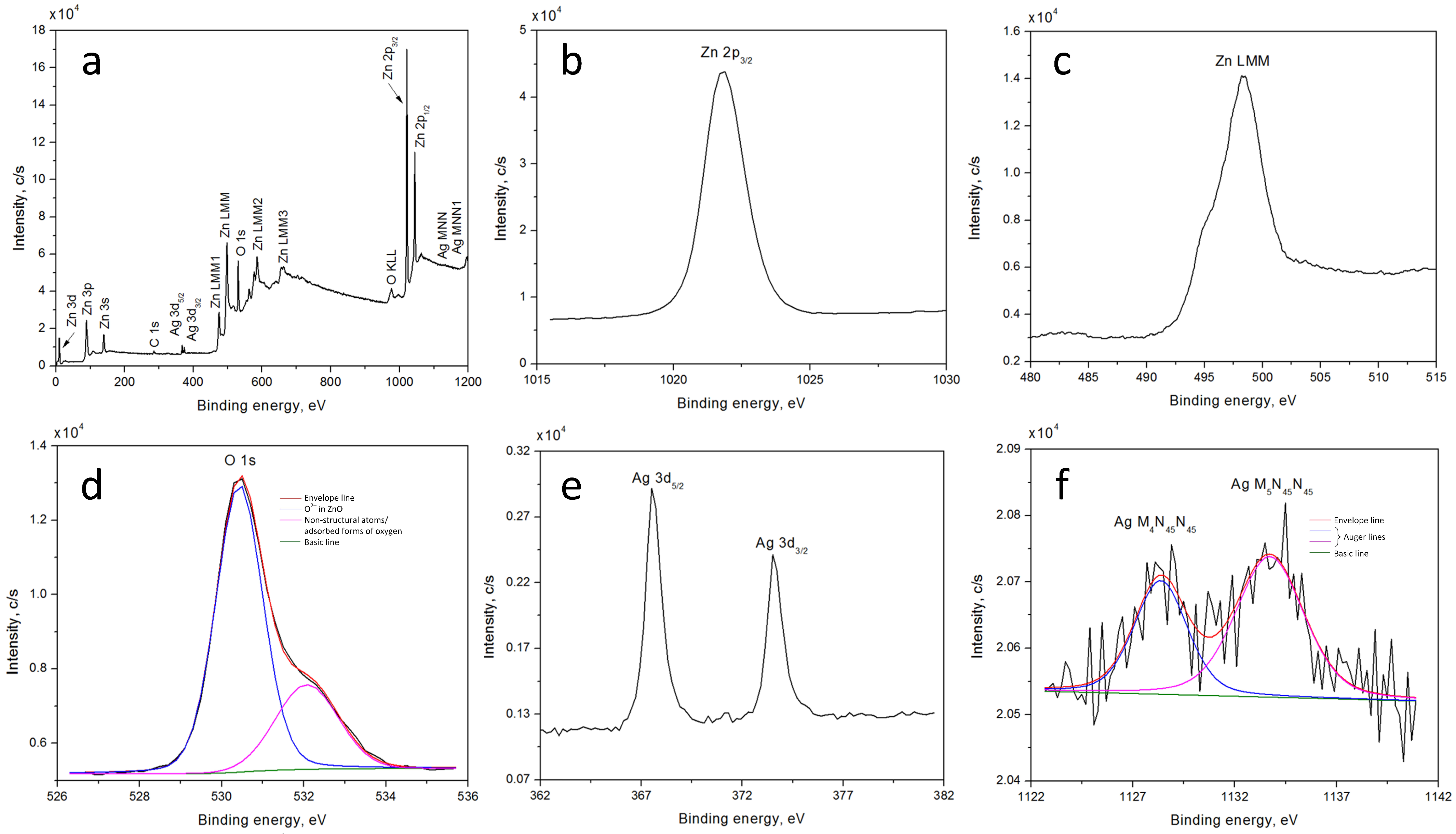
The photoelectron survey and narrow spectra of the Ag/ZnO nanosheaves are depicted in Figure 4. The BE of the Zn 2p3/2 peak is 1021.9 eV and the Auger parameter α is 2010.2 eV, which corresponds to ZnO [43]. The spectrum O 1s contains two peaks at 530.4 eV and 532.31 eV. The first peak is due to O2− in ZnO, the second broad peak can be due to both non-structural atoms and adsorbed forms of oxygen. The BE of the Ag 3d peak is 367.6 eV; the Auger parameter α (Ag 3d5/2—Ag M4N45N45) is 725.9 eV. The BE value of the Ag 3d peak does not coincide with the reference value for metallic silver (368.3 eV) and is in the range typical for Ag2O and AgO. Reference values for Auger parameter α are in the range 726.1–726.4 eV for metallic silver and noticeably lower for oxides (722.9–718.6 eV) [43]. The signal-to-noise ratio of the Auger spectrum is very low, and therefore the error in determining the peak position is quite high. However, the obtained value of parameter α , taking into account the error, corresponds to metal. The discrepancy between BE and α values can be explained by an oxide encapsulation of Ag NPs.
Figure 4. The photoelectron spectra of the Ag/ZnO nanosheaves grown through the Ag mask on the ZnO seed layer/SiO2/Si substrate: (a) the survey spectrum; the narrow spectra of (b) Zn 2p3/2, (c) Zn LMM, (d) O 1s, (e) Ag 3d3/2 (red and blue lines show deconvolution of the spectrum), and (f) Ag M4N45N45.

3.2. Three-Dimensional Geometry and Electric Field Strength Simulations of the Ag/ZnO Nanosheaf

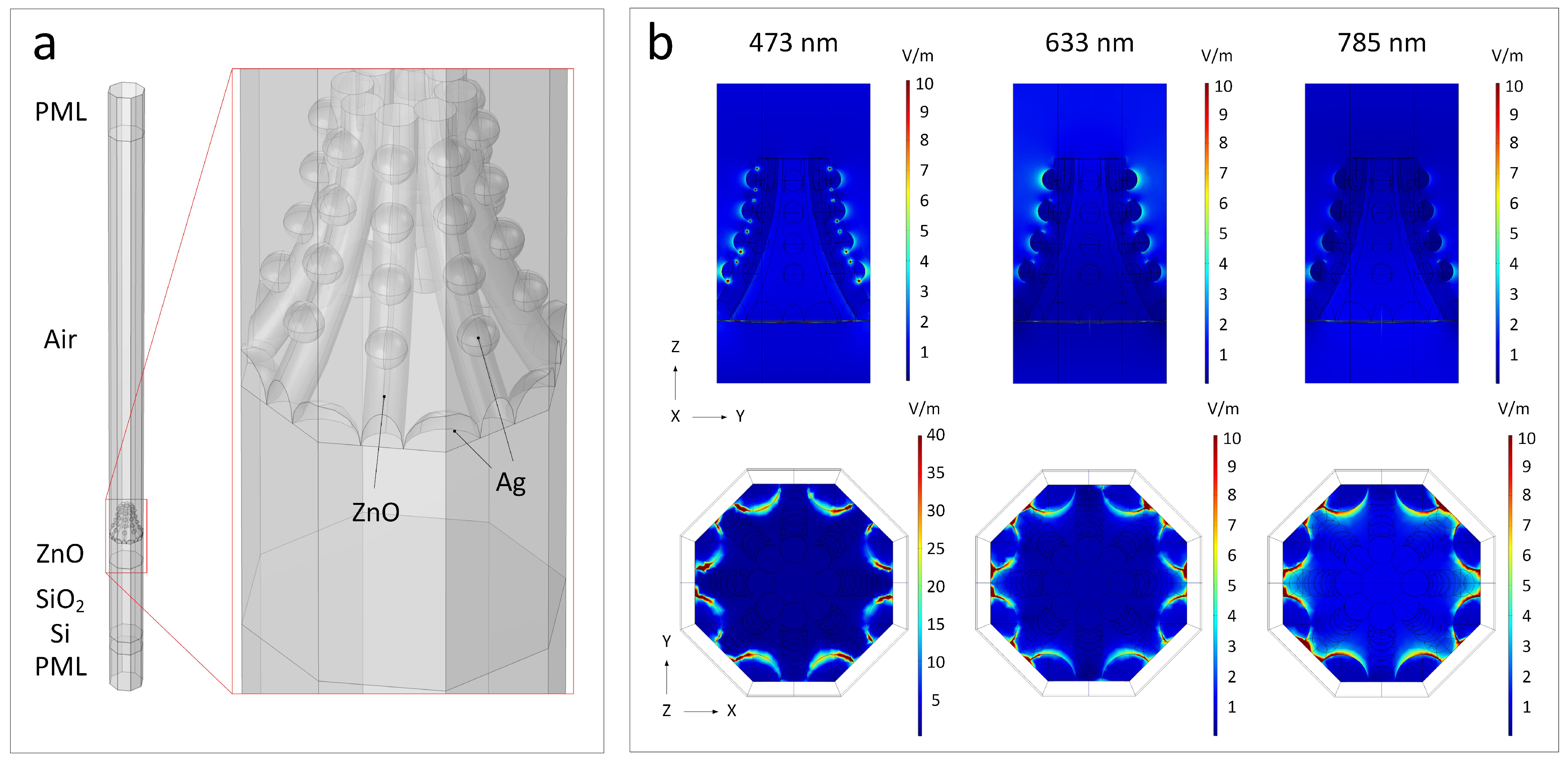
A structure selected for the simulation of the single Ag/ZnO nanosheaf is shown in Figure 5a. The Ag/ZnO nanosheaf base represents an octagon with an edge length equal to 45 nm. The thickness of the air layer above the Ag/ZnO nanosheaf is 1500 nm. The thickness of the ZnO seed layer is 100 nm. The Ag NP diameters on the ZnO seed layer (i.e., in the Ag mask) and on ZnO NWs are 30 and 15 nm, respectively. The diameter of the ZnO NW cross section is 15 nm; the length of ZnO NWs is 120 nm. We selected periodic boundary conditions (Floquet) along all the faces of the octagon as boundary ones. Figure 5b depicts the simulated electric field strength distribution in Ag NPs located on the ZnO seed layer and ZnO NWs at 473, 633, and 785 nm excitation wavelengths. The electric field strength in the Ag mask (Ag NPs on the ZnO seed layer) reaches the maximum value upon 473 nm wavelength excitation, which interplays with data previously reported for 30 nm Ag NPs [44]. The 15 nm Ag NPs on ZnO NWs are characterized by a similar electric field strength for all the wavelengths used.
Figure 5. Computer simulations of the Ag/ZnO nanosheaf: (a) 3D geometry and (b) electric field strength distribution depending on the excitation wavelength.

3.3. SERS-Activity and Photocatalytic Property of the Samples

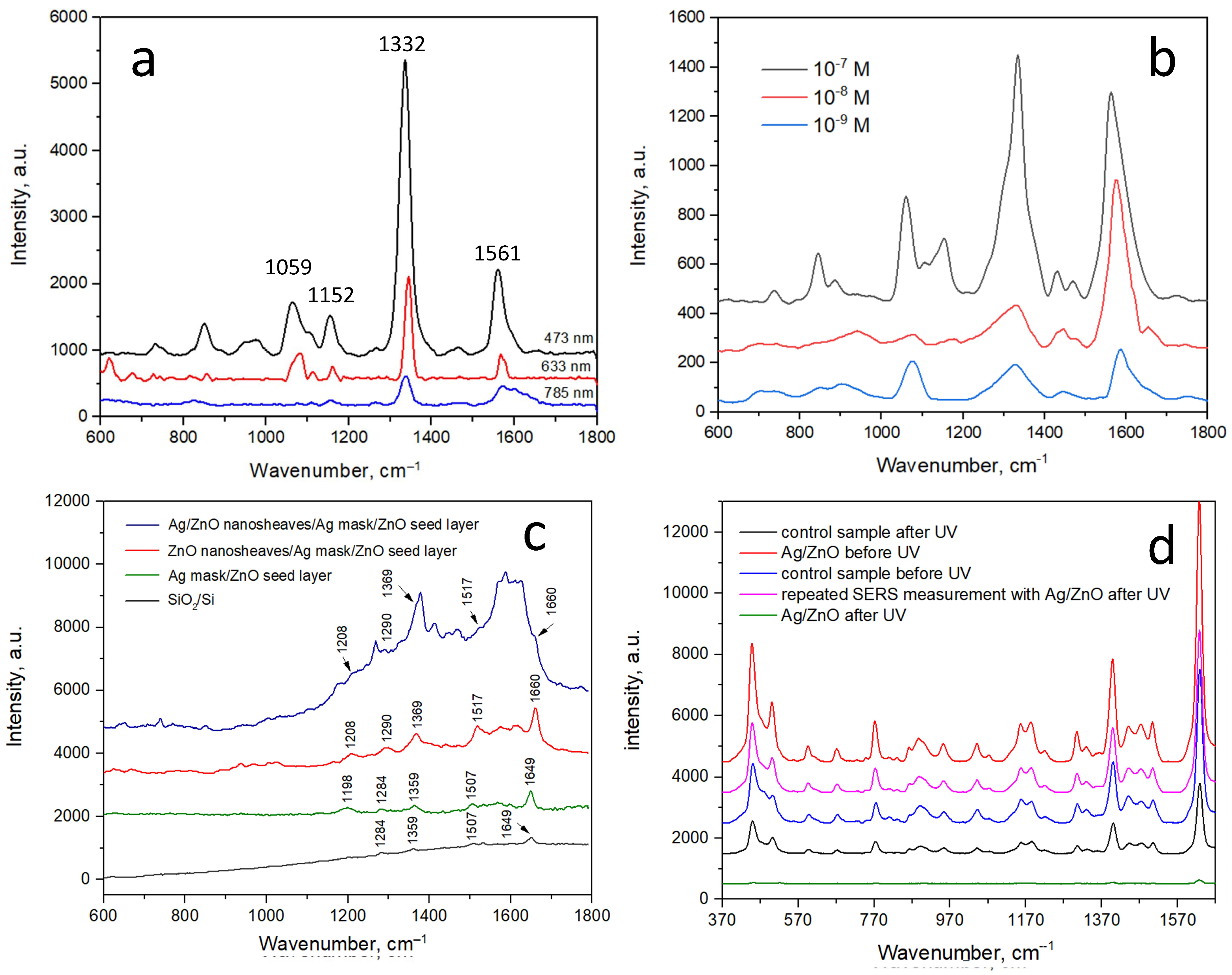
SERS-activity study and validation of the simulation results were performed using DTNB molecules. It should be noted that DTNB has not been so often used as some other Raman probe molecules (e.g., organic dyes like rhodamine 6G or methylene blue). However, it is also popular since the DTNB molecule has the disulfide bond, which is broken in the presence of silver. As a result, the TNB residues anchor on the silver particle surface through sulfur forming a uniform layer of the analyte molecules on the SERS-active substrate. Therefore, DTNB eliminates false negative results during the SERS-scanning that may occur due to uneven adsorption of molecules of other analytes. In our case, the DTNB was also chosen because this analyte absorbs light in the UV range, which does not overlap with the 473, 633, and 785 nm laser wavelengths used during the SERS-measurements. Thus, we can be confident of a purely SERS-effect free of the contribution of resonance-enhanced Raman scattering. Figure 6a shows the SERS-spectra of this analyte collected when excited by lasers with the wavelengths used in the simulations. On the basis of the results, the Ag/ZnO nanosheaves can be used as SERS-active substrates operating in a wide wavelength range, which overlaps visible and near-infrared regions. The maximum signal upon excitation with the 473 nm laser is typical for Ag NPs and is associated with the surface plasmon resonance belonging to the band around 470 nm. The characteristic Raman bands of DTNB are observed at 1059, 1152, 1332, and 1561 cm−1, which can be attributed to CH3 rocking, C-N stretching/bending, symmetric nitro (NO2) stretching, and aromatic ring stretching, respectively. A detection limit for DTNB was found to reach 10−9 M, as seen in Figure 6b. It should be noted that the intensity of the aromatic ring stretching band exceeds that of the nitro group stretching below the 10−8 M concentration. This is not typical for the DTNB Raman spectra and can take place because of the specific orientation of the analyte molecules between the Ag/ZnO nanosheaves at very low concentrations.
Figure 6. SERS-spectra of (a) 10−5 M DTNB on Ag/ZnO nanosheaves at 473, 633, and 785 nm; (b) 10−7, 10−8, and 10−9 M DTNB on Ag/ZnO nanosheaves at 473 nm; (c) Raman spectrum of 10−4 M RhB on SiO2/Si substrate and SERS-spectra of 10−6 M RhB on the Ag-masked ZnO seed layer, ZnO nanosheaves, and Ag/ZnO nanosheaves at 532 nm; (d) SERS-spectra of 10−5 M MB on Ag/ZnO nanosheaves and the control sample at 473 nm.
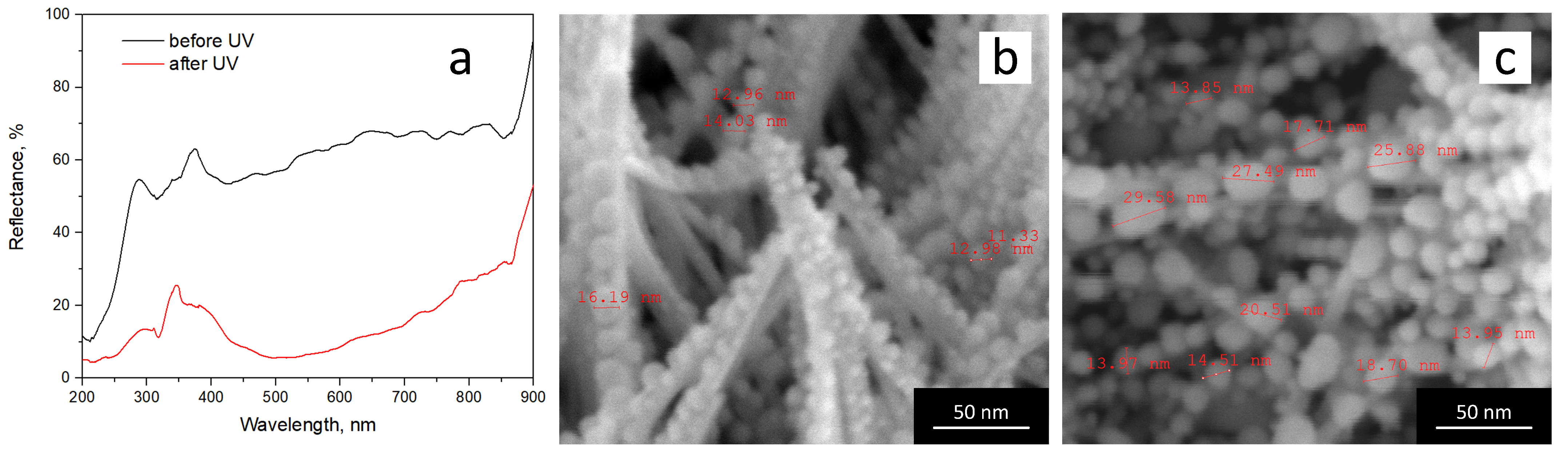
Figure 6c shows the comparison of the Raman (black curve) and SERS-spectra of RhB depending on the substrate type. Both SERS-spectra collected with the samples containing ZnO nanosheaves (red and blue spectra) have characteristic bands of analyte molecules that are shifted to the larger wavenumbers compared to that free of ZnO nanosheaves (green spectrum). As reported elsewhere, such a shift can be caused by polarization of the molecules during charge transfer both from the nanostructures semiconductor/dielectric and metallic nanoparticles [45]. Considering no shift in the analyte Raman bands in the SERS-spectrum collected with the Ag mask/ZnO seed layer, it can be concluded that the charge transfer is much more effective for the samples with ZnO nanosheaves. It should be mentioned that dotting the ZnO nanosheaves with Ag NPs improved SERS-activity (blue curve). Computer simulations showed that a noticeable enhancement of the electric field in the Ag/ZnO nanosheaves is observed only in Ag NPs. Although the ZnO semiconductor is characterized by n-type conductivity [46], ZnO NWs did not provide a worthwhile contribution to the electric field strength. This indirectly signifies that an improvement in the SERS-activity of the Ag NPs mask after the growth of ZnO NWs was due to charge transfer provided by the semiconducting nanostructures. Computer simulations also demonstrated a maximal value of the electric field strength around Ag NPs on the very tops of ZnO NWs when exposed to a laser of 473 nm wavelength. This theoretical result is validated by not only the SERS-analysis of DTNB (Figure 6a) but also the reflectance spectrophotometry of the sample of Ag/ZnO nanosheaves (Figure 7a, black spectrum). The surface plasmon resonance band (SPR) in the reflectance spectra of the sample has minimum at 425 nm, i.e., in the close vicinity to the simulated results.
Figure 7. (a) Reflectance spectra of the Ag/ZnO nanosheaves before (black spectrum) and after (red spectrum) UV cleaning; SEM images of the Ag/ZnO nanosheaves (b) before and (c) after the UV cleaning where the red numbers show sizes of Ag NPs.
The photocatalytic activity of the Ag/ZnO nanosheaves was proved during near-UV exposure (365 nm) as follows from Figure 6d. At the same time, the SERS-signal intensity from the testing dye (MB) is not observed compared to that of the simply washed control sample. It should be noted that the SERS-activity is still typical for the Ag/ZnO nanosheaves cleaned with the UV light (purple spectrum in Figure 6d). However, the reflectance spectrum of this sample is characterized by the broader SPR band with the minimum shifted to 510 nm (red spectrum in Figure 7a). The changes in the reflectance spectrum of the sample subjected to the UV treatment are caused by the slightly increased mean diameter of Ag NPs on ZnO nanosheaves from 13.5 to 21.8 nm as calculated from the SEM images of the corresponding samples presented in Figure 7b,c. These results show the prospects of the engineered Ag/ZnO nanosheaves as reusable SERS-active substrates.

4. Conclusions

Here, we proposed original SERS-active nanostructures based on the quasi-ordered Ag/ZnO nanosheaves composed of ZnO NWs dotted with silver NPs. ZnO NWs were grown hydrothermally on the ZnO seed layer through the silver mask. Then, they were coated with Ag NPs by the thermal evaporation method. It is found that the DTNB at the nanomolar concentration can be detected with the engineered SERS-active substrates after processing the SERS-spectral array. It should be noted that searching for hot spots and recording the DTNB spectra at these hot spots would be a way to demonstrate an even lower detection limit, as was performed with the Ag dendrites when single-molecule SERS-imaging was achieved for the same analyte adsorbed on the SERS-active substrate from its 10−18 M solution. However, our goal was not to set a record for the detection limit, which has already been achieved. Alternatively, we aimed at the theoretical and experimental study of the contribution of each nanostructured component to an enhancement of Raman signal from different organic molecules. It was established that the nanosheaves of the pure ZnO NWs grown through the silver mask provide a more pronounced SERS-effect compared to just the silver mask on the seed ZnO layer. The subsequent coating of the ZnO nanosheaves with Ag NPs increased SERS-activity but unfortunately led to the analyte burning. Computer simulations showed that electric field strength was noticeably enhanced only in Ag NPs and on the silver mask. The ZnO nanostructures were also expected to contribute slightly to the strengthening of the electric field because ZnO is known to have n-type conductivity. However, such an assumption was not justified by the simulation results. This indirectly suggests that the improvement in the SERS-activity of the silver mask after growing ZnO NWs was due to charge transfer provided by the semiconducting nanostructures. Computer simulations also demonstrated the maximal value of the electric field strength around Ag NPs on the tips of ZnO NWs when exposed to the laser of a wavelength of 473 nm. This theoretical result was experimentally validated by SERS-analysis of DTNB. The thorough structural characterization of the Ag/ZnO nanosheaves showed a certain amount of silver oxide, which nevertheless did not lead to the loss of SERS-activity. The detection limit of testing organic dye molecules (RhB) adsorbed on the Ag/ZnO nanosheaves was found to be equal to the nanomolar concentration. The photocatalytic activity of the Ag/ZnO nanosheaves in relation to MB was proved upon near-UV exposure (365 nm), which showed that the Ag/ZnO nanosheaves are prospective as reusable SERS-active substrates.

Author Contributions

Conceptualization, S.D., D.G., and H.V.B.; methodology, D.D., N.M., D.N., A.T., E.S., V.M., and V.K.; software, H.V.B. and E.S.; validation, D.D., N.M., D.N., and A.T.; formal analysis, S.D., D.G., and H.V.B.; investigation, D.D., N.M., D.N., A.T., E.S., V.M., and V.K.; resources, S.D., S.G., and H.V.B.; data curation, D.D., N.M., D.N., A.T., and E.S.; writing—original draft preparation, S.D., E.S., and H.V.B.; writing—review and editing, D.G. and S.G.; visualization, E.S. and H.V.B.; supervision, D.G. and S.G.; project administration, S.D., S.G., and H.V.B.; funding acquisition, S.D., S.G., and E.S. All authors have read and agreed to the published version of the manuscript.

Funding

This research was funded by the Russian Science Foundation (Project No. 24-19-00610), https://rscf.ru/project/24-19-00610/ (accessed on 7 December 2025). Skryleva is grateful to the Ministry of Science and Higher Education of the Russian Federation (project FSME-2024-0001) for funding the XPS measurements.

Data Availability Statement

The data sets presented in this study are available within the article.

Conflicts of Interest

The authors declare no conflicts of interest.

References

  1. Fleischmann, M.; Hendra, P.; McQuillan, A. Raman spectra of pyridine adsorbed at a silver electrode. Chem. Phys. Lett. 1974, 26, 163–166. [Google Scholar] [CrossRef]
  2. Fleischmann, M.; Hendra, P.J.; McQuillan, A.J.; Paul, R.L.; Reid, E.S. Raman spectroscopy at electrode-electrolyte interfaces. J. Raman Spectrosc. 1976, 4, 269–274. [Google Scholar] [CrossRef]
  3. Jeanmaire, D.L.; Van Duyne, R.P. Surface raman spectroelectrochemistry. J. Electroanal. Chem. Interfacial Electrochem. 1977, 84, 1–20. [Google Scholar] [CrossRef]
  4. Sharma, B.; Frontiera, R.R.; Henry, A.I.; Ringe, E.; Van Duyne, R.P. SERS: Materials, applications, and the future. Mater. Today 2012, 15, 16–25. [Google Scholar] [CrossRef]
  5. Panarin, A.Y.; Terekhov, S.; Kholostov, K.; Bondarenko, V. SERS-active substrates based on n-type porous silicon. Appl. Surf. Sci. 2010, 256, 6969–6976. [Google Scholar] [CrossRef]
  6. Khinevich, N.; Girel, K.; Bandarenka, H.; Salo, V.; Mosunov, A. Surface enhanced Raman spectroscopy of fullerene C60 drop-deposited on the silvered porous silicon. J. Phys. Conf. Ser. 2017, 917, 062052. [Google Scholar] [CrossRef]
  7. Perevedentseva, E.; Karmenyan, A.; Chung, P.H.; He, Y.T.; Cheng, C.L. Surface enhanced Raman spectroscopy of carbon nanostructures. Surf. Sci. 2006, 600, 3723–3728. [Google Scholar] [CrossRef]
  8. Dubkov, S.; Novikov, D.; Bandarenka, H.; Burko, A.; Trifonov, A.; Volkova, L.; Edelbekova, P.; Lebedev, E.; Skryleva, E.; Gromov, D. Express formation and characterization of SERS-active substrate from a non-degradable Ag-Nb-N-O film. Appl. Surf. Sci. 2024, 645, 158682. [Google Scholar] [CrossRef]
  9. Phuong, N.T.T.; Nguyen, T.A.; Huong, V.T.; Tho, L.H.; Anh, D.T.; Ta, H.K.T.; Huy, T.H.; Trinh, K.T.L.; Tran, N.H.T. Sensors for Detection of the Synthetic Dye Rhodamine in Environmental Monitoring Based on SERS. Micromachines 2022, 13, 1840. [Google Scholar] [CrossRef] [PubMed]
  10. Sharma, H.S.; Carmichael, E.; McCall, D. Fabrication of SERS substrate for the detection of rhodamine 6G, glyphosate, melamine and salicylic acid. Vib. Spectrosc. 2016, 83, 159–169. [Google Scholar] [CrossRef]
  11. Klyachkovskaya, E.; Strekal, N.; Motevich, I.; Vaschenko, S.; Harbachova, A.; Belkov, M.; Gaponenko, S.; Dais, C.; Sigg, H.; Stoica, T.; et al. Enhanced Raman Scattering of Ultramarine on Au-coated Ge/Si-nanostructures. Plasmonics 2011, 6, 413–418. [Google Scholar] [CrossRef]
  12. Temur, E.; Boyacı, İ.H.; Tamer, U.; Unsal, H.; Aydogan, N. A highly sensitive detection platform based on surface-enhanced Raman scattering for Escherichia coli enumeration. Anal. Bioanal. Chem. 2010, 397, 1595–1604. [Google Scholar] [CrossRef]
  13. Yarantseva, N.D.; Belyatsky, V.N.; Shleiko, E.V.; Osotskaya, E.S.; Burko, A.A.; Dolgiy, A.L.; Girel, K.V.; Bandarenka, H.V. Detection of ibuprofen and aspirin on silver nets by surface enhanced Raman scattering (SERS) spectroscopy. J. Phys. Conf. Ser. 2021, 1866, 012007. [Google Scholar] [CrossRef]
  14. Trachta, G.; Schwarze, B.; Sägmüller, B.; Brehm, G.; Schneider, S. Combination of high-performance liquid chromatography and SERS detection applied to the analysis of drugs in human blood and urine. J. Mol. Struct. 2004, 693, 175–185. [Google Scholar] [CrossRef]
  15. Gambucci, M.; Cambiotti, E.; Sassi, P.; Latterini, L. Multilayer Gold-Silver Bimetallic Nanostructures to Enhance SERS Detection of Drugs. Molecules 2020, 25, 3405. [Google Scholar] [CrossRef] [PubMed]
  16. Khrustalev, V.V.; Khrustaleva, T.A.; Kahanouskaya, E.Y.; Rudnichenko, Y.A.; Bandarenka, H.V.; Arutyunyan, A.M.; Girel, K.V.; Khinevich, N.V.; Ksenofontov, A.L.; Kordyukova, L.V. The alpha helix 1 from the first conserved region of HIV1 gp120 is reconstructed in the short NQ21 peptide. Arch. Biochem. Biophys. 2018, 638, 66–75. [Google Scholar] [CrossRef] [PubMed]
  17. Pavel, I.; McCarney, E.; Elkhaled, A.; Morrill, A.; Plaxco, K.; Moskovits, M. Label-Free SERS Detection of Small Proteins Modified to Act as Bifunctional Linkers. J. Phys. Chem. C 2008, 112, 4880–4883. [Google Scholar] [CrossRef]
  18. Feliu, N.; Hassan, M.; Garcia Rico, E.; Cui, D.; Parak, W.; Alvarez-Puebla, R. SERS Quantification and Characterization of Proteins and Other Biomolecules. Langmuir 2017, 33, 9711–9730. [Google Scholar] [CrossRef] [PubMed]
  19. Vázquez-Iglesias, L.; Stanfoca Casagrande, G.M.; García-Lojo, D.; Ferro Leal, L.; Ngo, T.A.; Pérez-Juste, J.; Reis, R.M.; Kant, K.; Pastoriza-Santos, I. SERS sensing for cancer biomarker: Approaches and directions. Bioact. Mater. 2024, 34, 248–268. [Google Scholar] [CrossRef]
  20. Gong, T.; Das, C.M.; Yin, M.J.; Lv, T.R.; Singh, N.M.; Soehartono, A.M.; Singh, G.; An, Q.F.; Yong, K.T. Development of SERS tags for human diseases screening and detection. Coord. Chem. Rev. 2022, 470, 214711. [Google Scholar] [CrossRef]
  21. Colniță, A.; Toma, V.A.; Brezeștean, I.A.; Tahir, M.A.; Dina, N.E. A Review on Integrated ZnO-Based SERS Biosensors and Their Potential in Detecting Biomarkers of Neurodegenerative Diseases. Biosensors 2023, 13, 499. [Google Scholar] [CrossRef]
  22. Kerker, M. Electromagnetic model for surface-enhanced Raman scattering (SERS) on metal colloids. Accounts Chem. Res. 1984, 17, 271–277. [Google Scholar] [CrossRef]
  23. Schlücker, S. Surface Enhanced Raman Spectroscopy: Analytical, Biophysical and Life Science Applications; Wiley-VCH GmbH: Weinheim, Germany, 2010. [Google Scholar] [CrossRef]
  24. Mosier-Boss, P. Review of SERS Substrates for Chemical Sensing. Nanomaterials 2017, 7, 142. [Google Scholar] [CrossRef]
  25. King, M.D.; Khadka, S.; Craig, G.A.; Mason, M.D. Effect of Local Heating on the SERS Efficiency of Optically Trapped Prismatic Nanoparticles. J. Phys. Chem. C 2008, 112, 11751–11757. [Google Scholar] [CrossRef]
  26. Shin, G.; Lim, D.; Shin, D. Plasmonic heating effect in SERS-based nanoplastic detection. Sensors Actuators B Chem. 2023, 393, 134196. [Google Scholar] [CrossRef]
  27. Milekhin, A.; Sveshnikova, L.; Duda, T.; Yeryukov, N.; Rodyakina, E.; Gutakovskii, A.; Batsanov, S.; Latyshev, A.; Zahn, D. Surface-enhanced Raman spectroscopy of semiconductor nanostructures. Phys. E Low-Dimens. Syst. Nanostruct. 2016, 75, 210–222. [Google Scholar] [CrossRef]
  28. Song, G.; Cong, S.; Zhao, Z. Defect engineering in semiconductor-based SERS. Chem. Sci. 2022, 13, 1210–1224. [Google Scholar] [CrossRef] [PubMed]
  29. Yang, B.; Jin, S.; Guo, S.; Park, Y.; Chen, L.; Zhao, B.; Jung, Y.M. Recent Development of SERS Technology: Semiconductor-Based Study. ACS Omega 2019, 4, 20101–20108. [Google Scholar] [CrossRef]
  30. Xie, S.; Lai, K.; Gu, C.; Jiang, T.; Zhou, L.; Zheng, X.; Shen, X.; Han, J.; Zhou, J. Fine fabrication of TiO2/MoOx nano-heterojunctions and investigating on the improved charge transfer for SERS application. Mater. Today Nano 2022, 18, 100179. [Google Scholar] [CrossRef]
  31. Dong, J.; Huang, J.; Wang, A.; Biesold-McGee, G.V.; Zhang, X.; Gao, S.; Wang, S.; Lai, Y.; Lin, Z. Vertically-aligned Pt-decorated MoS2 nanosheets coated on TiO2 nanotube arrays enable high-efficiency solar-light energy utilization for photocatalysis and self-cleaning SERS devices. Nano Energy 2020, 71, 104579. [Google Scholar] [CrossRef]
  32. Xie, Y.; Jin, Y.; Zhou, Y.; Wang, Y. SERS activity of self-cleaning silver/titania nanoarray. Appl. Surf. Sci. 2014, 313, 549–557. [Google Scholar] [CrossRef]
  33. Barbillon, G. Fabrication and SERS Performances of Metal/Si and Metal/ZnO Nanosensors: A Review. Coatings 2019, 9, 86. [Google Scholar] [CrossRef]
  34. Ha Pham, T.T.; Vu, X.H.; Dien, N.D.; Trang, T.T.; Kim Chi, T.T.; Phuong, P.H.; Nghia, N.T. Ag nanoparticles on ZnO nanoplates as a hybrid SERS-active substrate for trace detection of methylene blue. RSC Adv. 2022, 12, 7850–7863. [Google Scholar] [CrossRef] [PubMed]
  35. Lin, J.; Yu, J.; Akakuru, O.U.; Wang, X.; Yuan, B.; Chen, T.; Guo, L.; Wu, A. Low temperature-boosted high efficiency photo-induced charge transfer for remarkable SERS activity of ZnO nanosheets. Chem. Sci. 2020, 11, 9414–9420. [Google Scholar] [CrossRef] [PubMed]
  36. Gromov, D.G.; Pavlova, L.M.; Savitskii, A.I.; Trifonov, A.Y. Investigation of the early stages of condensation of Ag and Au on the amorphous carbon surface during thermal evaporation under vacuum. Phys. Solid State 2015, 57, 173–180. [Google Scholar] [CrossRef]
  37. Gromov, D.G.; Pavlova, L.M.; Savitsky, A.I.; Trifonov, A.Y. Nucleation and growth of Ag nanoparticles on amorphous carbon surface from vapor phase formed by vacuum evaporation. Appl. Phys. A 2015, 118, 1297–1303. [Google Scholar] [CrossRef]
  38. Lee, Y.S.; Kim, H.T.; Yoo, K.O. Effect of Ferric Oxide on the High-Temperature Removal of Hydrogen Sulfide over ZnO-Fe2O3 Mixed Metal Oxide Sorbent. Ind. Eng. Chem. Res. 1995, 34, 1181–1188. [Google Scholar] [CrossRef]
  39. Nefedov, V.; Salyn, Y.; Leonhardt, G.; Scheibe, R. A comparison of different spectrometers and charge corrections used in X-ray photoelectron spectroscopy. J. Electron Spectrosc. Relat. Phenom. 1977, 10, 121–124. [Google Scholar] [CrossRef]
  40. Wagner, C.D.; Zatko, D.A.; Raymond, R.H. Use of the oxygen KLL Auger lines in identification of surface chemical states by electron spectroscopy for chemical analysis. Anal. Chem. 1980, 52, 1445–1451. [Google Scholar] [CrossRef]
  41. Patterson, A.L. The Scherrer Formula for X-Ray Particle Size Determination. Phys. Rev. 1939, 56, 978–982. [Google Scholar] [CrossRef]
  42. Miranda, M.A.R.; Sasaki, J.M. The limit of application of the Scherrer equation. Acta Cryst. 2018, 74, 54–65. [Google Scholar] [CrossRef] [PubMed]
  43. Gorham, J. NIST X-Ray Photoelectron Spectroscopy Database—SRD 20; National Institute of Standards and Technology: Gaithersburg, MD, USA, 2012. [Google Scholar] [CrossRef]
  44. Farooq, S.; De Araujo, R.E. Engineering a Localized Surface Plasmon Resonance Platform for Molecular Biosensing. Open J. Appl. Sci. 2018, 08, 126–139. [Google Scholar] [CrossRef]
  45. Ye, J.; Arul, R.; Nieuwoudt, M.K.; Dong, J.; Zhang, T.; Dai, L.; Greenham, N.C.; Rao, A.; Hoye, R.L.Z.; Gao, W.; et al. Understanding the Chemical Mechanism behind Photoinduced Enhanced Raman Spectroscopy. J. Phys. Chem. Lett. 2023, 14, 4607–4616. [Google Scholar] [CrossRef]
  46. Zhou, Z.; Kato, K.; Komaki, T.; Yoshino, M.; Yukawa, H.; Morinaga, M.; Morita, K. Effects of dopants and hydrogen on the electrical conductivity of ZnO. J. Eur. Ceram. Soc. 2004, 24, 139–146. [Google Scholar] [CrossRef]
Disclaimer/Publisher’s Note: The statements, opinions and data contained in all publications are solely those of the individual author(s) and contributor(s) and not of MDPI and/or the editor(s). MDPI and/or the editor(s) disclaim responsibility for any injury to people or property resulting from any ideas, methods, instructions or products referred to in the content.

Article Metrics

Citations

Article Access Statistics

Multiple requests from the same IP address are counted as one view.