
You are currently viewing a new version of our website. To view the old version click .
Journal of Composites Science
  • Article
  • Open Access

11 December 2025

Synthesis of Halogen-Containing Methylenedianiline Derivatives as Curing Agents for Epoxy Resins and Evaluation of Mechanical Properties of Their Carbon-Fiber-Reinforced Polymers

,
,
,
,
and
1
Faculty of Chemistry, Lomonosov Moscow State University, 119991 Moscow, Russia
2
Department of Organic Chemistry, Lobachevsky Nizhny Novgorod State University, 603950 Nizhny Novgorod, Russia
*
Author to whom correspondence should be addressed.
This article belongs to the Section Carbon Composites

Abstract

Owing to their superior mechanical performance, strong adhesion, thermal resistance, and insulating properties, epoxy resins are commonly employed as protective coatings, electronic encapsulants, adhesives, and matrices in composites. The selection of the epoxy system components—the base resin and curing agent—along with the chosen curing protocol, directly determines the properties of the final cross-linked polymer. This study compares the influence of halogen substituents in 4,4′-methylenebis(2,6-diethylaniline) (MDEA), 4,4′-methylenebis(3-chloro-2,6-diethylaniline) (MCDEA) and 4,4′-methylenebis(3-bromo-2,6-diethylaniline) (MBDEA). The results of mechanical tests on plastics and composites demonstrated an increase in the strength properties and elastic modulus of the matrix, improved adhesive interactions with carbon fiber, and showed a reduction in moisture saturation across the series MDEA → MCDEA → MBDEA. Notably, the improvement in properties exceeded the increase in the density of the compositions, indicating an enhancement in the specific characteristics of the matrix.

1. Introduction

Epoxy resins represent a category of organic compounds characterized by the presence of epoxy or glycidyl groups. These groups undergo reactions with curing agents or catalysts, resulting in the formation of a three-dimensional thermosetting structure. Due to their high versatility, cost-effectiveness, strong adhesion to various substrates, and notable resistance to heat and chemicals, as well as their excellent mechanical properties, epoxy resins are employed in a diverse array of applications, ranging from low- to high-performance requirements. These applications include adhesives [1,2,3]; protective and decorative coatings [4,5,6]; encapsulants and circuit boards in electronics [7,8,9]; components in biomedical systems [10,11,12]; and structural materials, such as composites in construction [13,14], automotive [15,16,17,18] and aerospace [19,20,21,22] applications.
As is well known, the structure of epoxy resins and curing agents significantly affects the properties of the cured epoxy system [23,24,25,26]. The presence of multiple reactive groups in both epoxy resins and curing agents facilitates multiple addition reactions during polymerization, leading to the formation of complex cross-linked structures during curing [27,28]. The chemical structures of epoxy resins and curing agents decisively determine the network architecture and the final properties [29,30]. Curing agents for epoxy resins typically include acid anhydrides [31], amines [32], Lewis acids [33], and others [34]. Although epoxy resins can be cured with various curing agents, aromatic amines maintain a prominent role in high-performance applications [35]. Extensive research has focused on the curing behavior and properties of cured multifunctional epoxy resins and composites in the field of advanced composite materials [15,16,17,36,37,38]. Epoxy–aromatic amine systems exhibit appropriate viscosity and reactivity at processing temperatures suitable for the vacuum infusion method, which occupies a unique and critical position in the world of composite manufacturing, offering a compelling balance of quality, cost, and scalability that sets it apart from other methods [39,40]. However, this places higher demands on the resin. The resin used for vacuum infusion must have a wide processing window and a low viscosity (less than 500 mPa·s) [41,42]. These properties largely depend on the curing agent.
Aromatic amine-cured epoxies provide the enhanced thermal stability and mechanical performance necessary for demanding composite applications [2,43]. The reactivity of these systems is governed by the hardener’s molecular structure. Studies on substituted diphenylmethane-based diamines—namely, 4,4′-methylenedianiline (MDA), 4,4′-methylenebis(2-ethylaniline) (MOEA), 4,4′-methylenebis(2-chloroaniline) (MOCA), and 4,4′-methylenebis(3-chloro-2,6-diethylaniline) (MCDEA)—demonstrate that reactivity is reduced by two mechanisms: (1) electron-withdrawing groups increasing amine electrophilicity and (2) bulky electron-donating groups causing steric hindrance. These effects yield a consistent decrease in curing reaction kinetics in the order: MDA > MOEA > MOCA > MCDEA, which is a critical factor for processing [36].
In addition to the influence of steric effects on the kinetics of polymerization, halogen-containing compounds are known for their fire-retardant properties [44]. The safety of halogen-containing compounds has been a subject of debate for decades; however, there are no restrictions on their use within the aerospace industry [45,46,47]. Traditionally, brominated derivatives of bisphenol A have been employed as fire retardants [48,49,50]. The aerospace industry requires materials that simultaneously meet stringent flammability and mechanical performance standards. While brominated compounds are prevalent for their flame-retardant properties and tri-/tetrafunctional epoxy resins are standard for their mechanical strength, common brominated resins like tetrabromobisphenol A diglycidyl ether lack the necessary structural integrity [47,51]. Consequently, their use is restricted to non-structural applications such as adhesives and coatings. To fulfill the dual requirements of exceptional mechanical properties, processability, and fire safety in structural components, halogenated aromatic amines are employed in high-performance aerospace composites. Furthermore, the thermal decomposition of epoxy polymers results in minimal release of hazardous bromine-containing compounds, such as HBr, primarily due to the presence of amine compounds used as curing agents [52]. The utilization of aromatic amine curing agents enhances the thermal stability of resins and reduces the emission of bromine-containing products [53]. Consequently, the application of bromine-containing aromatic curing agents appears to be highly promising.
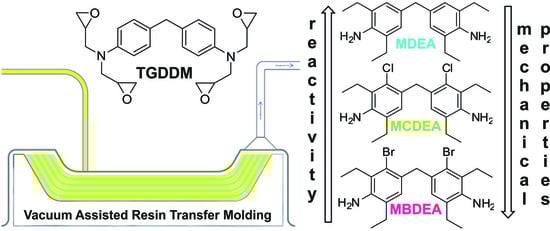
However, a systematic study on the influence of halogen types, such as bromine, in the structure of diphenylmethane-based diamines on the properties of multifunctional epoxy resins and their composites is still lacking. This paper compares the effects of halogen substituents in the structures of aromatic diamine curing agents—4′-methylenebis(2,6-diethylaniline) (MDEA), 4,4′-methylenebis(3-chloro-2,6-diethylaniline) (MCDEA), and 4,4′-methylenebis(3-bromo-2,6-diethylaniline) (MBDEA)—when used with the epoxy monomer tetraglycidyl ether of methylenedianiline (TGDDM). The study evaluates their influence on the technological properties of the uncured resin, as well as the thermal and mechanical properties and moisture saturation of the resulting plastics. Additionally, it examines the mechanical properties of carbon-fiber-reinforced materials produced via vacuum infusion.

2. Materials and Methods

2.1. Materials

2,6-diethylaniline produced by Win-Win Chemical Co., Ltd. (Wenzhou, China); 3-chloro-2,6-diethylaniline produced by Dayang Chem (Hangzhou) Co., Ltd. (Hangzhou, China); 4,4′-methylenebis(N,N-diglycidylaniline) were purchased from the Shanghai Macklin Biochemical Co., Ltd. (Shanghai, China), paraformaldehyde, sodium hydroxide and anhydrous sodium sulfate by Lenreactive JSC (Saint Petersburg, Russia); hydrochloric acid, sulfuric acid and acetic acid by SIGMATEK LLC (Lamprechtshausen, Austria); toluene, isopropyl alcohol, acetonitrile, dioxane and chloroform by EKOS-1 JSC (Moscow, Russia); bromine by Reachemlab LLC (Reachemlab, Russia), N-bromosuccinimide by Alfa Aesar (Waltham, MA, USA).

2.2. Methods

NMR spectra were recorded on a Bruker Avance II 600 (Rheinstetten, Germany) at 600 MHz for 1H and 151 MHz for 13C with DMSO-d6 as a solvent. The chemical shifts were reported in ppm and spin–spin coupling constants are reported in Hz. The chemical shifts of DMSO-d6 at 2.50 ppm for 1H NMR and 39.52 ppm for 13C NMR were used as an internal standard.
The molecular mass was determined using matrix-assisted laser desorption/ionization time-of-flight (MALDI-TOF) mass spectrometry. Analysis was performed on an Axima Confidence instrument (Shimadzu, Kyoto, Japan) in positive linear mode. A matrix solution was prepared by dissolving 5 mg/mL 2,5-dihydroxybenzoic acid (DHB) in the manufacturer’s diluent. A 1 µL aliquot of this matrix was first deposited on the target, air-dried, and then overlaid with 0.5 µL of the analyte solution mixed with 0.5 µL of fresh matrix. The resulting co-crystals were air-dried prior to analysis. Data were acquired in positive ion linear mode using a 337 nm nitrogen laser with a 75 kV source acceleration voltage. Instrument control and data processing were conducted using the Shimadzu Biotech Launchpad software (version 2.9.8.1).
Gas chromatograph Shimadzu GC-2010A equipped with an Equity™-1 Capillary Column (60 m × 0.32 mm × 0.25 μm, model 28056-U). Carrier gas: nitrogen. In all methods, the injector temperature was set to 250 °C, the detector temperature to 340 °C, the injected sample volume was 1 μL, and the split ratio was 30:1. The temperature program started at 100 °C (held for 15 min), then increased at a rate of 15 °C/min to 325 °C, which was held for 45 min.
High-performance liquid chromatograph Knauer Smartline S2600 (Berlin, Germany). Column: SUPELCOSIL™ LC-18, 25 cm × 2.1 mm (57,935). Eluent: 90% acetonitrile and 10% water, flow rate 0.1 mL/min.
Differential scanning calorimetry (DSC) was conducted using a DSC214 Polyma instrument (NETZSCH, Selb, Germany). Samples weighing 5–10 mg were heated at a rate of 10 °C/min under an inert gas flow of 100 mL/min.
Rheological behavior was measured with an Anton Paar MCR 302 rheometer (Graz, Austria) using cone 7 at 200 rpm in the temperature range from 50 to 180 °C at a heating rate of 2 °C min−1.
A TA Instruments Q800 DMA (TA Instruments, New Castle, DE, USA) was employed to assess the viscoelastic response of polymer specimens (55 × 5 × 2 mm) as a function of temperature. The analysis was run from 50 to 275 °C at 1 Hz under an inert atmosphere. The resulting data yielded the temperature profiles for the key dynamic mechanical properties: the storage modulus (E′), loss modulus (E″), and tan δ.
The density was determined by hydrostatic weighing using an HTR-220CE analytical balance (Shinko Denshi, Shimotsuma, Japan) for three samples of each composition.
The strength and deformation properties of the materials—including ultimate tensile strength, elastic modulus, relative elongation, and Poisson’s ratio—were investigated using static tensile testing. Seven specially prepared specimens were tested on an Instron 5985 servohydraulic testing machine (Instron, Norwood, MA, USA) at 25 °C, with a loading rate of 5 mm/min. Peak load data were recorded, and failure modes were analyzed.
The mechanical properties of plastics under bending were investigated using a Tinus Olsen H5K-S testing machine (Horsham, PA, USA). Tests were performed at 25 °C on specially fabricated elongated specimens, which were loaded at a constant rate of 5 mm/min.
The compressive strength and compressive modulus of plastics and carbon-fiber-reinforced plastics were measured using an Instron 5985 testing machine at 25 °C. The test involved compressing carbon-fiber-reinforced plastic specimens at a constant strain rate of 1.3 mm/min. Each of the seven specimens was securely clamped in a fixture positioned between the testing machine’s platens.
The strain release energy and fracture toughness of plastics were measured using a Tinus Olsen H5K-S testing machine (Horsham, PA, USA) at 25 °C. Specially prepared elongated specimens were clamped in the machine’s grips and loaded at a constant rate of 10 mm/min.
Thermomechanical analysis (TMA) was performed on Netzsch TMA 402 F3 Hyperion (Netzsch, Selb, Germany). The measurements were conducted in an air atmosphere with a heating rate of 5 °C/min over a temperature range of 50 to 350 °C. The loading device applied a constant load of 10 mN, and a 25 mm long Al2O3 sample was used as the standard.
Shore hardness was measured on five samples using a Shore durometer, model DTBP-D (Vostok-7, Moscow, Russia), equipped with an analog indicator. The weight of the loading block was 5 kg.
The shear properties of the specimens were determined using the Iosipescu method. V-notched specimens were precision-cut using a CNC milling machine. Tests were performed on a Tinius Olsen ST series universal testing machine, model 300ST (Horsham, PA, USA), at room temperature with a load platen speed of 2 mm/min. Shear strain was measured using two mutually perpendicular strain gauges installed in the test area.
To evaluate the apparent interlaminar shear strength (ILSS), six replicates of 20 × 10 mm specimens were tested using a Tinius Olsen 50ST testing machine. The method involves loading a specimen, freely supported on two supports, at the center at a rate of 1.0 mm/min until failure. The maximum applied load is used as the strength criterion.

2.3. Synthesis of Curing Agents

4,4′-methylenebis(2,6-diethylaniline) (MDEA) and 4,4′-methylenebis(3-chloro-2,6-diethylaniline) (MCDEA) were synthesized according to methodology outlined in the article [54] with nearly quantitative yields (more than 95%), without any modifications.
Synthesis of 4,4′-methylenebis(3-bromo-2,6-diethylaniline) (MBDEA).
MDEA (203 g, 654 mmol) was dissolved in 98% sulfuric acid (1 L) at 60 °C in a 2 L round-bottom flask equipped with a reflux condenser and magnetic stirrer. After dissolving the mixture was cooled to 5–10 °C and N-bromosuccinimide was added (233 g, 1308 mmol). The reaction mixture was stirred at 5–10 °C and monitored by thin-layer chromatography (TLC). After 2 h, the solution was slowly poured into 1 L of ice, the reaction mixture changed color from yellow to blue. A 10% (w/v) aqueous solution of potassium hydroxide was added to the resulting solution until the neutral pH was reached. The precipitate was then filtered and thoroughly washed with water. The product was dissolved in chloroform to facilitate the separation of succinimide. The solution was dried over sodium sulfate, and following the removal of chloroform using a rotary evaporator, a pure product was obtained with a yield of 75%.
1H NMR (600 MHz, DMSO-d6) δ ppm: 6.47 (2H, s); 4.73 (4H, s); 3.86 (2H, s); 2.78 (4H, q, J = 7.32 Hz); 2.36 (4H, q, J = 7.44 Hz); 1.05 (6H, t, J = 7.39 Hz); 1.01 (6H, t, J = 7.46 Hz).
13C NMR (151 MHz, DMSO-d6) δ ppm: 142.41; 127.48; 126.51; 126.07; 125.67; 124.56; 42.48; 24.53; 23.55; 12.94; 12.13.

2.4. Resin Preparation

4,4′-Methylenebis(N,N-diglycidylaniline) and amine curing agents were mixed in an equimolar ratio under vacuum at a temperature exceeding 80 °C. Degassing was continued until the vacuum level dropped below 2 mm Hg (267 Pa).

2.5. Vacuum Infusion Process

Sheets of reinforcing filler (2 × 2 twill carbon fabric with a surface density of 200 g/m2) were laid out on metal tooling that had been treated with an anti-adhesive compound, and the process package was assembled. A vacuum gauge was connected to the feed tube, while a vacuum line was connected to the outlet tube to create a vacuum. The residual pressure within the inner package should not exceed 2 mm Hg (267 Pa). The assembled process package was then placed in a ventilated drying cabinet, heated to a temperature range of 100–120 °C, and held for a minimum of 30 min.
CFRPs were cured according to the following mode:
  • Heating to a temperature of 180 °C at a rate of 2 °C per minute and maintaining that temperature for 3 h.
  • Cooling to a temperature not exceeding 50 °C at a rate not greater than 5 °C/min.
  • Cooling to room temperature.

2.6. Water Absorption

The samples were immersed in boiling distilled water for 70 h following the schedule: 5 h of boiling, cooling in distilled water to room temperature, and weighing. The test was conducted on four samples of each composition.

2.7. Fire Tests

The oxygen index determination procedure, according to ASTM D2863 [55], involves mounting a prepared and conditioned vertical specimen in a column through which a controlled mixture of oxygen and nitrogen flows from bottom to top. The initial oxygen concentration is set, the upper end of the specimen is ignited, and the flame source is then removed while the time is recorded. The specimen’s behavior is observed for a specified duration or until it reaches a predetermined burn length. If the specimen burns longer than the established criterion, the oxygen concentration in the mixture for the next test is decreased; if it extinguishes sooner, the concentration is increased. This process of sequentially testing new specimens at varying oxygen concentrations is repeated using a specific algorithm known as the “up-down method” until a series of results is obtained that includes both combustion and extinction at similar concentrations.
The flammability test procedure according to UL-94 (using the vertical tests V-0, V-1, and V-2 as examples) consists of the following steps: Conditioned specimens are mounted vertically in a holder inside a test chamber, with a layer of dry surgical cotton wool placed 300 mm below their lower ends. A calibrated gas torch is used to apply a 20 mm flame to the lower end of the specimen for 10 s. After removing the torch, the post-ignition time (t) is recorded. Throughout the experiment, the researchers note whether burning droplets of material ignite the cotton wool. The procedure is performed on a series of five identical specimens.

3. Results and Discussions

3.1. Synthesis of MBDEA

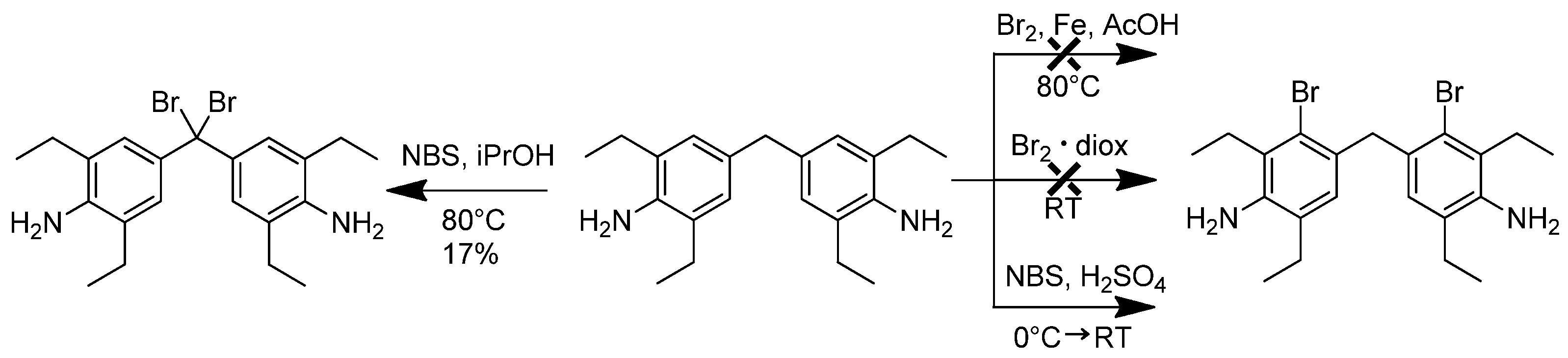
Initial efforts to synthesize the product involved the direct bromination of MDEA. From an electronic structure perspective, each aromatic ring possesses three electron-donating substituents, which should theoretically facilitate electrophilic substitution within the ring. Consequently, standard electrophilic substitution methods for activated aromatic systems using bromine were initially employed. However, direct interaction with bromine in acetic acid, with carbonyl iron powder as a catalyst, did not yield the desired product. Increasing the temperature also failed to produce the target compound; notably, raising the oil bath temperature above 80 °C resulted in vigorous bromine boiling. Halogenation using dioxane dibromide similarly did not yield the product. Another frequently utilized brominating agent, N-bromosuccinimide (NBS), was tested. Reactions conducted in organic solvents such as acetonitrile or isopropyl alcohol led to the formation of a by-product. NMR data identified this by-product as 4,4′-(dibromomethylene)bis(2,6-diethylaniline), which was isolated with a 17% yield (Figure 1).
Figure 1. Different ways of brominating MDEA.
These findings suggest that the deactivation of the meta position by the amino group supersedes the electronic effects of the alkyl substituents. Consequently, further bromination attempts of MDEA were conducted using aniline salts. Salts derived from hydrochloric and hydrobromic acids exhibited extremely low solubility, resulting in a very slow reaction rate. The most favorable results were obtained using concentrated sulfuric acid. In a sulfuric acid solution, the reaction proceeded with both bromine and NBS, with a slightly higher yield observed in the latter case. Ultimately, under these conditions, pure 4,4′-methylenebis(3-bromo-2,6-diethylaniline) (MBDEA) was successfully synthesized with a yield of 75%. The structure of MBDEA was confirmed by 1H and 13C NMR, MALDI-TOF MS, GC and HPLC analysis (see Figures S1–S5).

3.2. Properties of Uncured Epoxy Resins

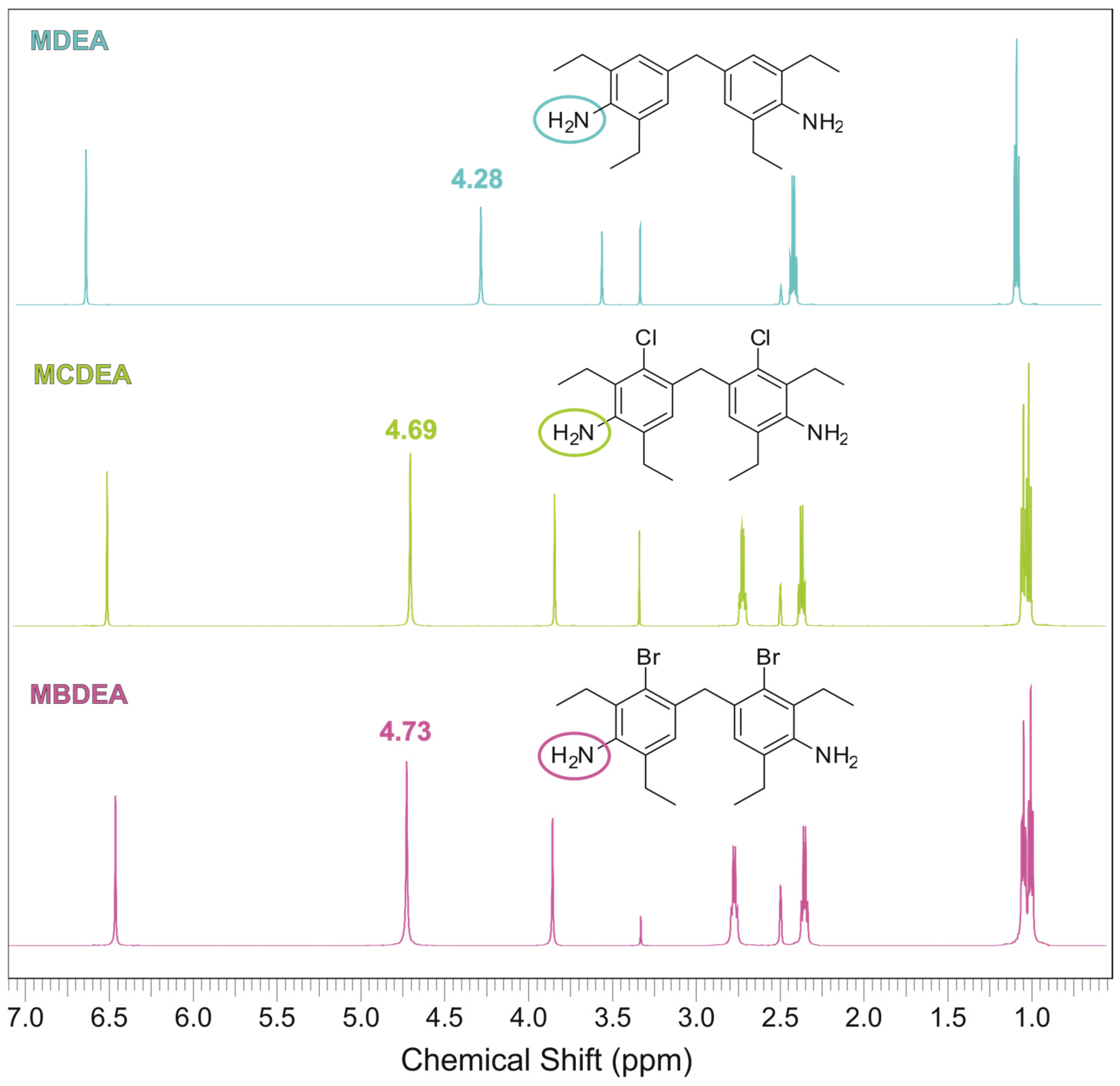
In the context of resins, nucleophilicity refers to the relative reactivity of the epoxy monomer, which is influenced by steric and electronic factors. Regarding its impact on the electronic structure, chlorine exhibits a more pronounced negative inductive effect and a more significant positive mesomeric effect than bromine. Consequently, the overall influence of both halogens at the meta-position is similar, making it challenging to ascertain which effect predominates. The chemical shift of the hydrogen atoms on nitrogen in the 1H NMR spectrum reflects the relative electron density of the amino group; a higher value indicates a lower electron density on the nitrogen atom. Thus, when comparing the chemical shifts of the amine group of 3-haloanilines, it is evident that both halogens exert nearly identical effects on the electronic structure of the molecules [56,57]. As illustrated in Figure 2, the chemical shifts of the amino groups in MCDEA and MBDEA are comparable, with the amine in the bromine-containing molecule exhibiting slightly greater deactivation. As anticipated, the relative electron density on the nitrogen in the MDEA molecule was substantially higher. According to the NMR data, the activity of the three curing agents in nucleophilic reactions is predicted to follow the order MDEA >> MCDEA > MBDEA.
Figure 2. 1H NMR spectra of MDEA, MCDEA and MBDEA in DMSO-d6.
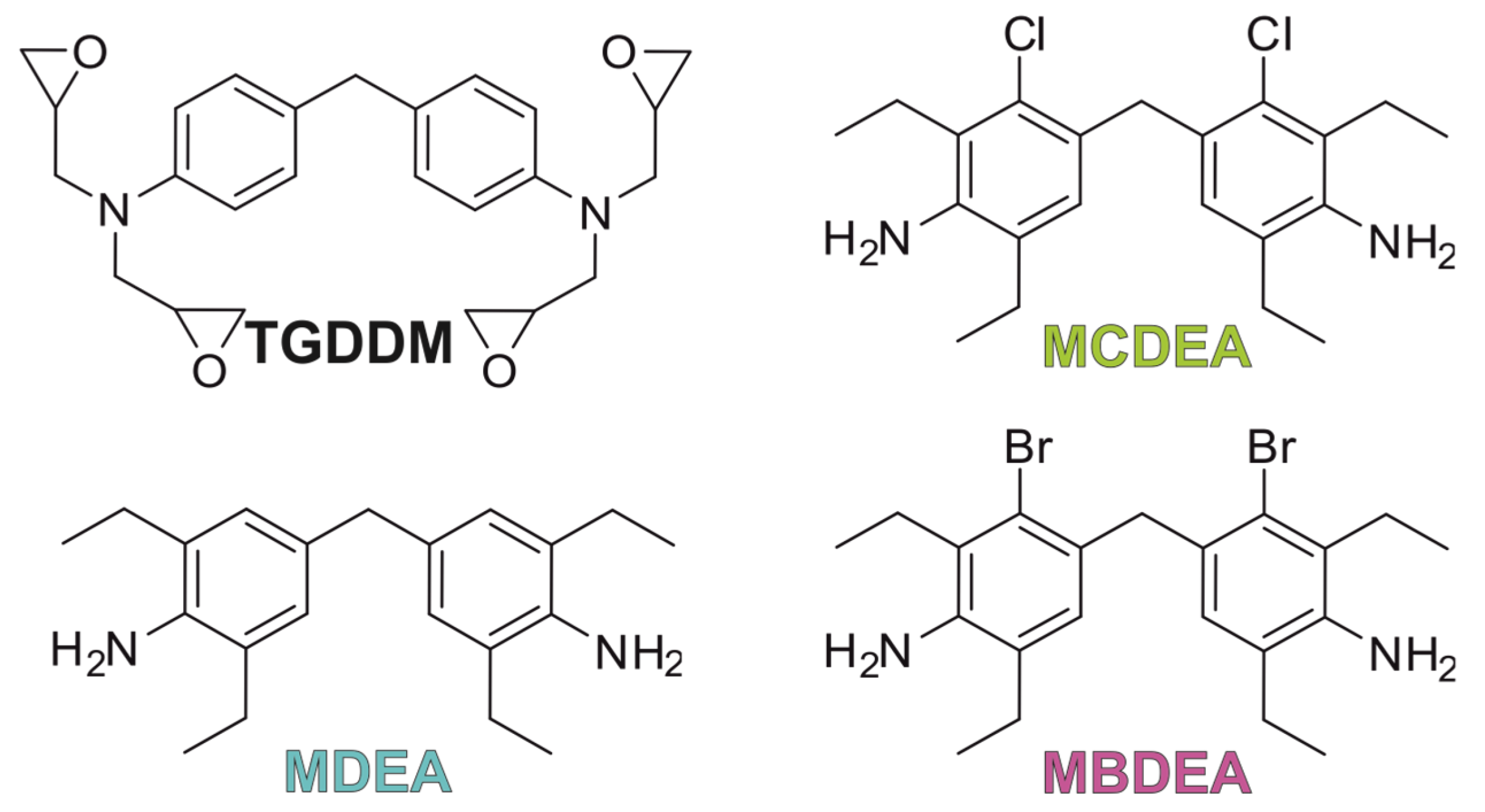
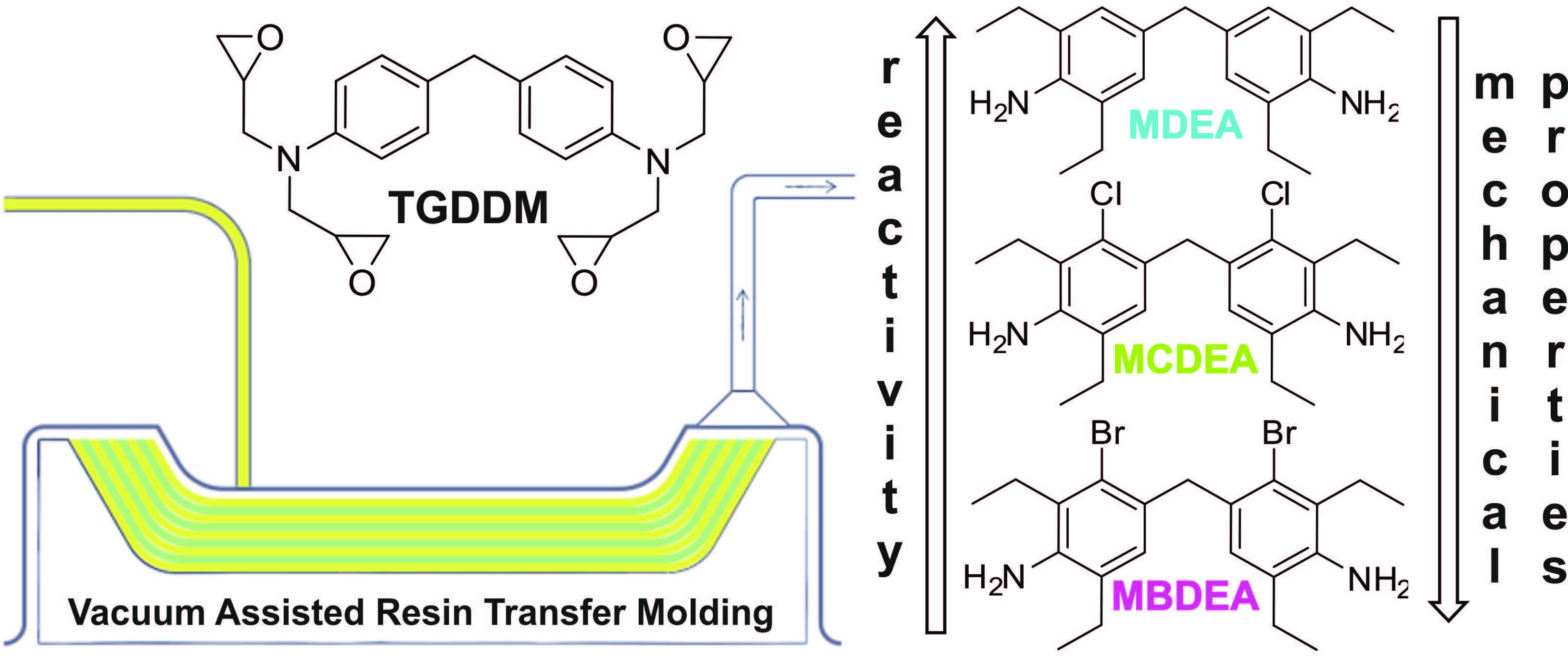
The steric factor is equally significant in predicting the relative reactivity. Previous studies using single-crystal X-ray analysis have demonstrated that the incorporation of chlorine into the MDEA structure significantly alters the geometry of the molecule. The chlorine atom impedes the rotation of the adjacent ethyl group, thereby increasing the steric load on nitrogen. In the absence of chlorine, the ethyl groups were oriented away from the nitrogen atom towards the aromatic cycle [54]. The bromine atom, which has a larger radius than chlorine, is expected to exert an even greater influence on steric properties. However, epoxy resins cure at elevated temperatures, which can substantially affect the ethyl group mobility. Only experimental investigations can determine which factors most significantly impact the relative activity of the curing agents. To determine the effect of halogens on the properties of epoxy resins, a series of compositions were prepared consisting of tetraglycidyl ether of methylenedianiline (TGDDM) and the corresponding diamine curing agents (MDEA, MCDEA, MBDEA) in equimolar ratios (Figure 3).
Figure 3. Structures of the components included in the compositions of epoxy resins.
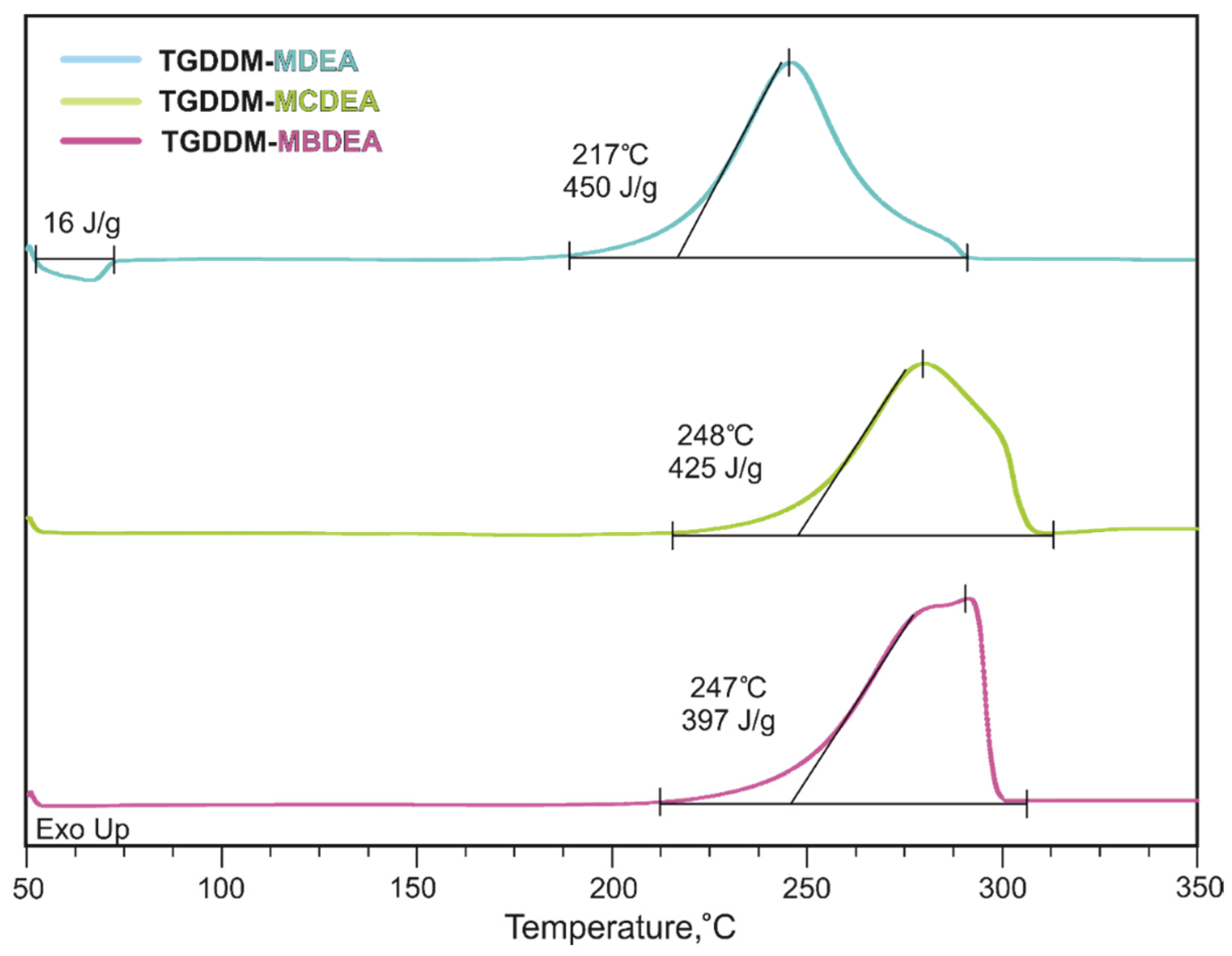
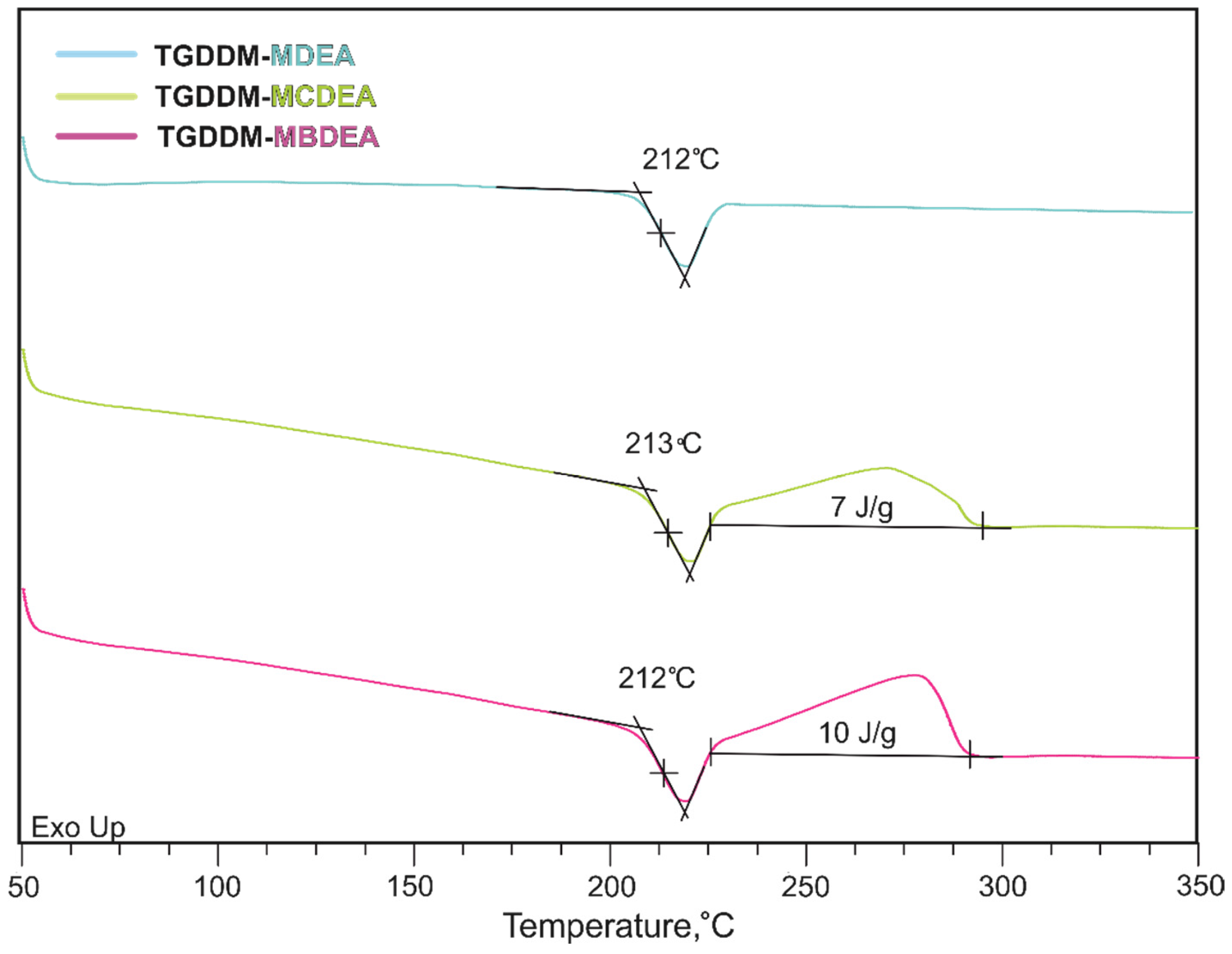
The incorporation of halogens into the MDEA structure elevated the curing onset temperature. Differential scanning calorimetry (DSC) results (Figure 4) demonstrate that the compositions containing MCDEA and MBDEA exhibited a comparable shift in the onset temperature of the exothermic effect. This phenomenon may be attributed to the steric accessibility of the amino group [54,58], indicating that the size of the substituent does not significantly affect the degree of the peak shift. Additionally, a reduction in the specific heat of the reaction was observed, which correlated with the higher molecular weights of the corresponding diamines. These values were proportional to the number of functional groups per unit mass of the resin. Furthermore, the DSC curve of MDEA displayed an endothermic melting peak. This observation may be explained by the more symmetrical structure of MDEA than that of MCDEA and MBDEA, which enhances its propensity to form a crystalline phase within the epoxy resin.
Figure 4. DSC curves of uncured epoxy resins with different curing agents.
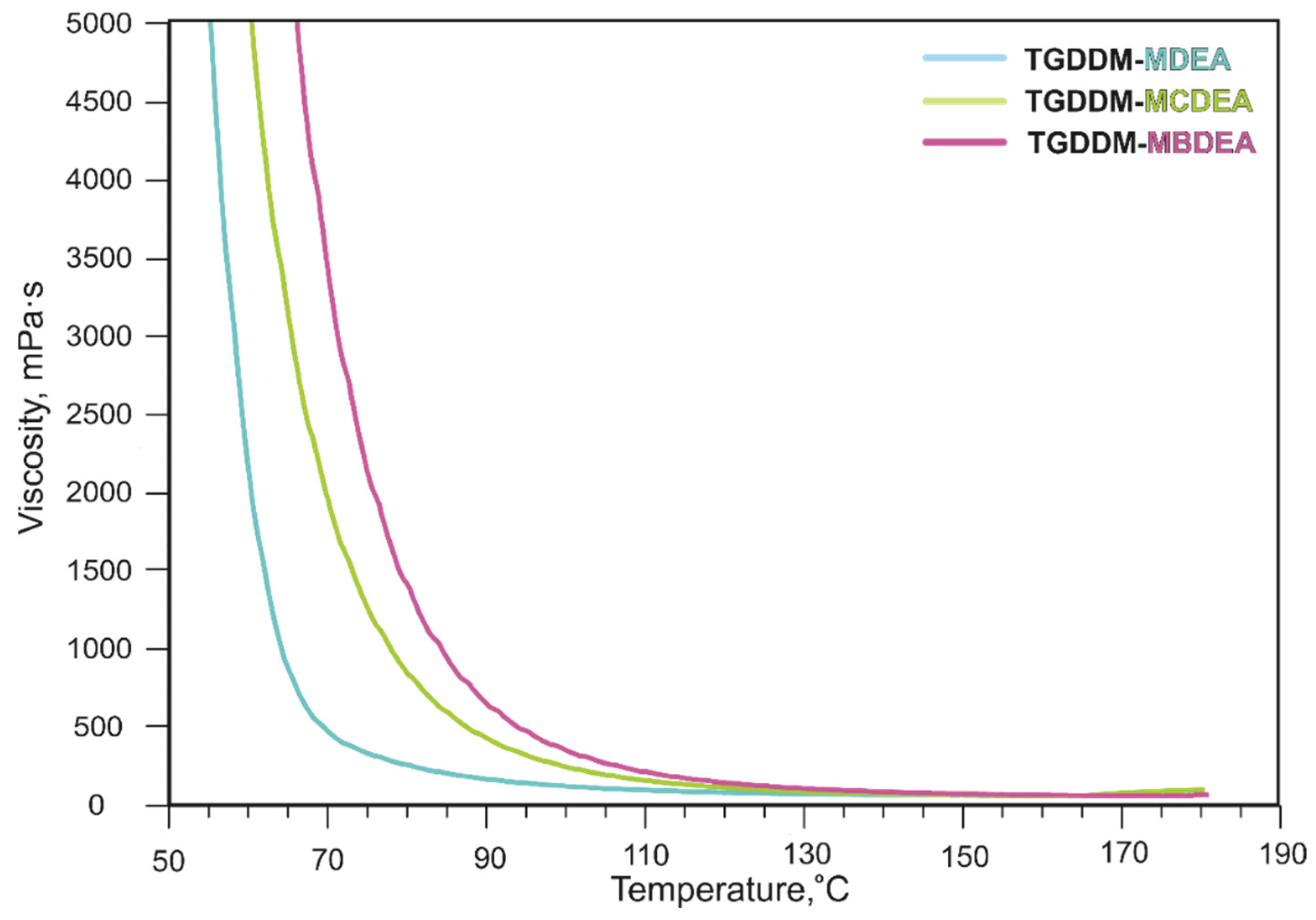
The rheological behavior of TGDDM-based resins cured with various agents was assessed. The temperature–viscosity profile (Figure 5) indicates that the addition of halogen raised the viscosity drop temperature by 15 °C for MCDEA and by 20 °C for MBDEA. Since these formulations exhibited a viscosity significantly lower than 500 mPa∙s, they may be suitable for the production of carbon-fiber-reinforced polymers (CFRPs) via vacuum infusion.
Figure 5. Temperature–viscosity profile for uncured epoxy resins with different curing agents.

3.3. Mechanical Properties of Epoxy Plastics

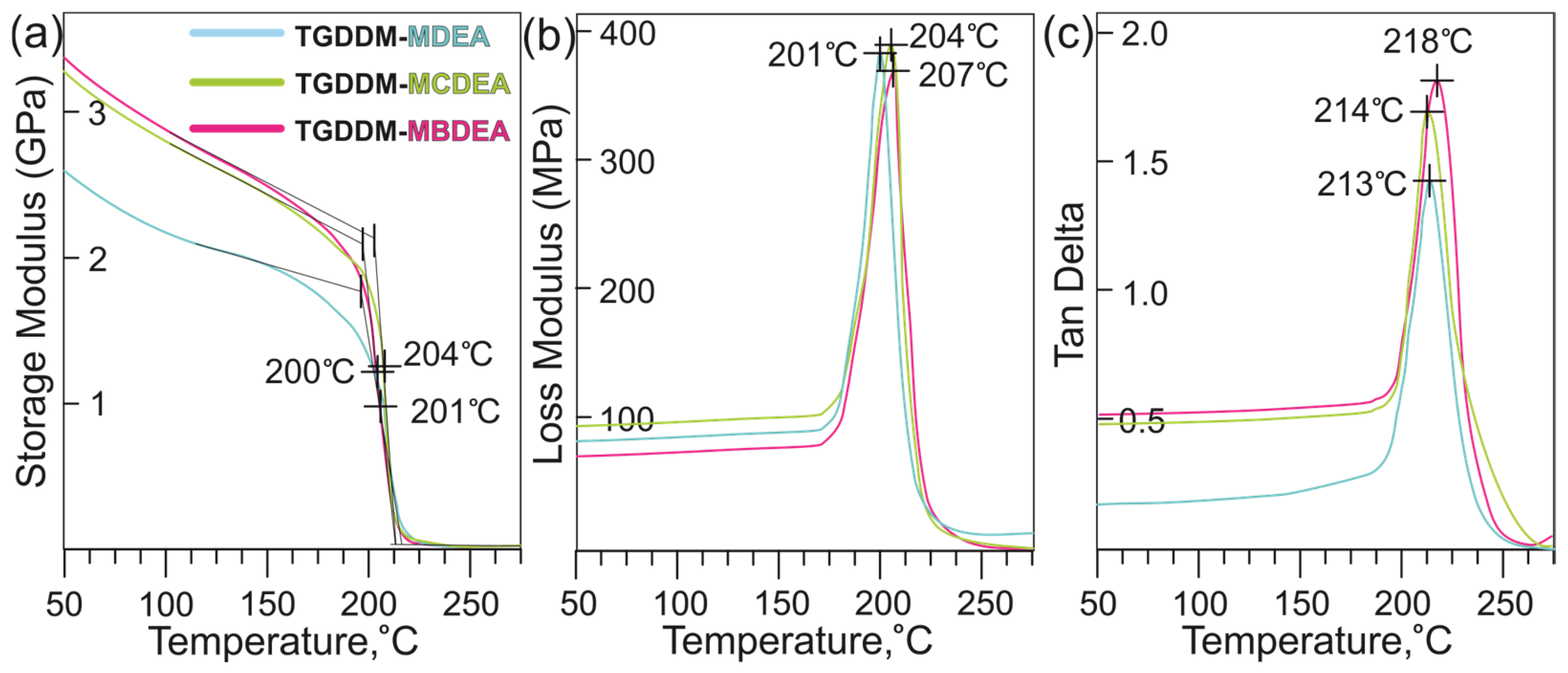
To investigate the influence of halogen incorporation into the structure of the amine curing agent on the thermal and mechanical properties of the resulting polymers, plastic samples with thicknesses of 2 and 4 mm were fabricated from the corresponding resins. The curing regimen consisted of 3 h at 180 °C. DSC was used to evaluate the degree of epoxy group conversion. As illustrated in Figure 6, complete conversion of the epoxy groups was achieved for the composition containing TGDDM-MDEA. In contrast, the conversions of the TGDDM-MCDEA and TGDDM-MBDEA compositions were 98% and 97%, respectively. This difference can be attributed to the increased steric hindrance of halogen-containing MDEA, which necessitated higher reaction temperatures. In addition, second-order phase transitions were evident in the DSC curves, corresponding to the glass transition temperatures of the resulting plastics. These findings are consistent with the results obtained from dynamic mechanical analysis (Figure 7).
Figure 6. DSC curves of cured epoxy resins with different curing agents.
Figure 7. DMA curves of cured epoxy resins with different curing agents ((a)—storage modulus, (b)—loss modulus, (c)—tan delta).
The mechanical properties of the resultant plastics were assessed, and these findings are consistent with the results obtained from dynamic mechanical analysis. The elastic moduli in compression, tension, and flexural tests are higher when halogen-containing curing agents are used, likely due to a denser packing of the structure resulting from steric factors of the molecular structure. As anticipated, the incorporation of halogens increased the density of the cured resin. Specifically, the density increased by 5% with chlorine and by 15% with bromine. Differences in the degree of polymer crosslinking can be assessed by measuring the residual elastic modulus above the glass transition temperature using dynamic mechanical analysis. The results showed that, for each composition, the residual elastic modulus was approximately 20 MPa in both dry and saturated states. This indicates an equivalent degree of crosslinking, which is consistent with the epoxy reaction mechanism, as the segment lengths remain constant in each case. However, since the curing agent contains a substituent, it does not affect the degree of crosslinking but only alters the mass of the segment for the same dimensions. The crosslinking density remained constant across all compositions, resulting in comparable glass transition temperatures, as evidenced by the DSC and DMA curves.
The tensile strength and elongation of the composition with MDEA are higher, attributed to the greater degree of freedom in the polymers of this formulation. In all cases, tensile strength values are significantly lower than compressive or flexural strength values. Cured epoxy resins, being brittle materials, are significantly less resistant to tensile stresses, which directly lead to cracking at surface defects caused by resin shrinkage. Under compression, the load is distributed more evenly, and flexural strength is an apparent value due to the higher compressive strength on one side of the specimen. Therefore, for unreinforced plastics, the elastic modulus values are the most indicative. The tensile and flexural modulus, Poisson’s ratio, and compressive strength exhibit elevated values, while the coefficient of linear thermal expansion (CLTE) values were lower for compositions containing MCDEA and MBDEA. This phenomenon is also due to the increased density of the polymer network in these compositions, which was also observed in the storage modulus curve in the dynamic mechanical analysis (Figure 7a).
To analyze the properties of the obtained compositions with different curing agents, comparisons were made with commercial epoxy resins commonly used in structural components of aircraft equipment, such as HexFlow RTM 6 [59] from Hexcel and T26 [60] from ITECMA (Table 1). The mechanical properties of plastics derived from commercial formulations are comparable to those of TGDDM-based blends. However, in the sequence MDEA → MCDEA → MBDEA, both fracture toughness and strain energy release increase significantly, surpassing the values of commercial resins. Additionally, compared to HexFlow RTM 6, formulations containing a halogenated curing agent exhibit lower water saturation. In the order MDEA → MCDEA → MBDEA, the reduction in water saturation is more pronounced than the increase in resin density, which may indicate a decrease in free volume within the thermosetting structure, thereby hindering water diffusion into the matrix.
Table 1. Physical and mechanical properties of cured TGDDM-containing plastics with different curing agents and commercial resins at 25 °C.
The Shore hardness value of 85 for the epoxy materials indicates significant hardness and wear resistance. Additionally, the combination of enhanced crack resistance and impact toughness results in improved impact resistance across the series MDEA → MCDEA → MBDEA.
The effect of moisture saturation on the performance characteristics of plastics was evaluated using dynamic mechanical analysis in a moisture-saturated state (Table 1). As shown in Table 1, moisture saturation decreases as the size of the substituent increases. This may be attributed to the fact that the composition containing MDEA has a greater free volume, which facilitates enhanced diffusion within the polymer matrix.
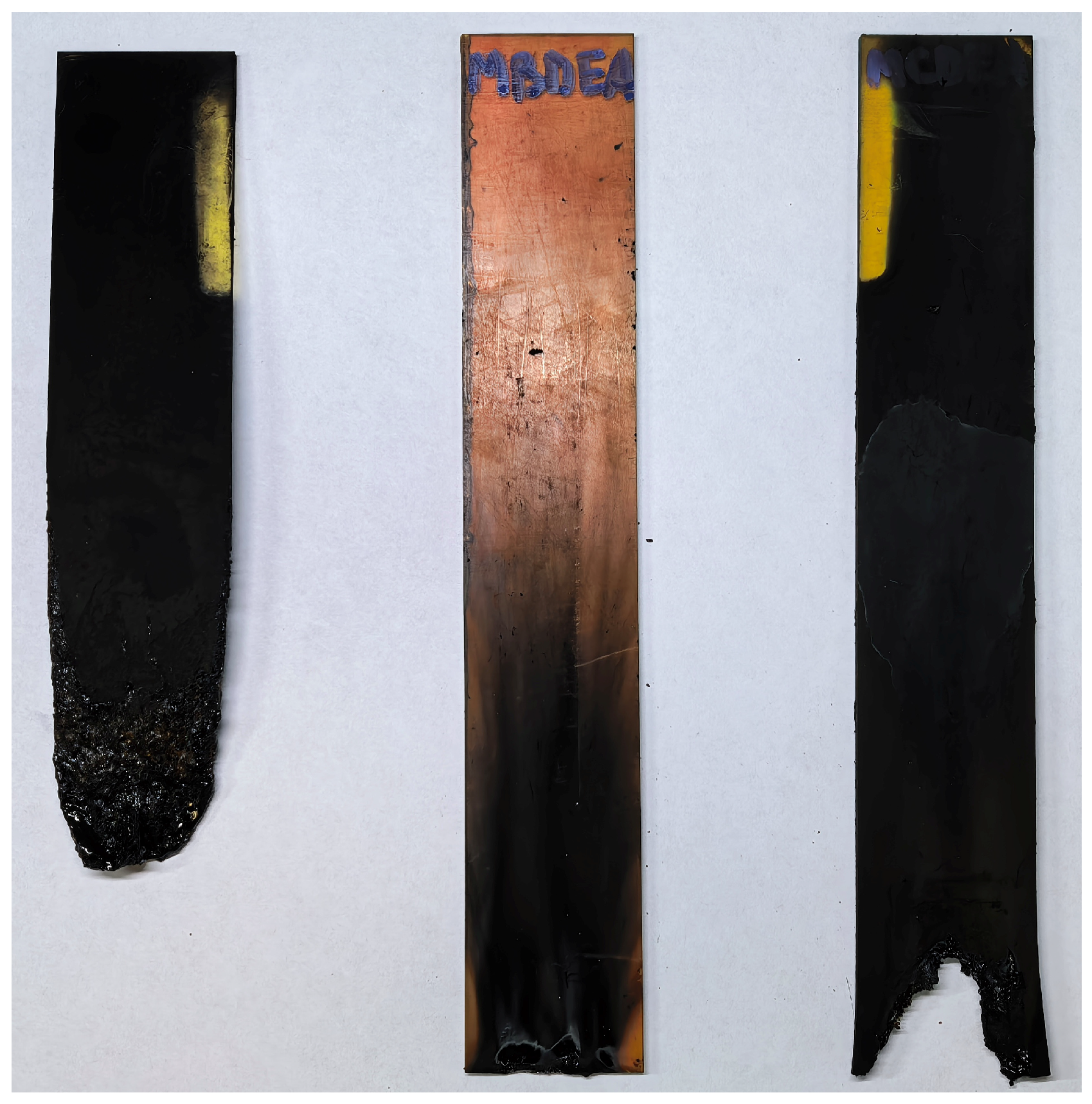
To assess the effect of halogen content on the flame retardancy of epoxy plastics, the oxygen index was determined and characterized by a flammability class in accordance with UL-94 vertical test. According to the oxygen index, a significant increase in value is observed in the series MDEA → MCDEA → MBDEA. LOI values above 27% indicate that such polymers are considered difficult to burn. Combustion of these substances in air is slow, as it requires a large amount of oxygen. To verify the obtained data, UL-94 testing was conducted; a video of the test is included in the supporting information. According to the fire test results, the sample with MDEA burned with falling droplets that ignited the cotton wool; the sample with MCDEA exhibited less intense combustion, with no droplets formed; and the sample with MBDEA self-extinguished almost immediately after the flame was removed. The samples after the fire tests are shown in Figure 8.
Figure 8. Samples of plastics with MDEA (left), MBDEA (center), and MCDEA (right) after combustion testing according to the UL-94 standard.

3.4. Properties of Carbon-Fiber-Reinforced Polymers Obtained by Vacuum Infusion Method

The vacuum infusion process was chosen as the composite manufacturing method for this study due to its popularity in the aerospace industry for producing large, complex, and high-volume structural parts [37,38]. This technology places special demands on the resin system: low initial viscosity (<500 mPa s) and a sufficiently wide processing window to completely infiltrate the dry fabric under vacuum before gelation. DSC data show that halogenated curing agents react later, allowing for more time for the infusion process. The rheological profiles of the developed TGDDM-based resins (Section 3.2) were explicitly evaluated against these criteria. The samples were prepared following the procedure described in Section 2.5. Carbon twill fabric was chosen as the reinforcing filler. Each sample consisted of 10 layers of fabric oriented in the zero-degree direction [0]10. The curing process was the same as that used for the plastics: heating to 180 °C at a rate of 2 °C per minute, followed by maintaining this temperature for 3 h.
In the series MDEA → MCDEA → MBDEA, an increase in the tensile and compressive strength of the CFRP along the reinforcement direction was observed (Table 2), suggesting improved interaction between the matrix and the carbon fiber. High adhesion facilitates better stress redistribution under loading in the CFRP. The modulus of elasticity under tension and compression remained unchanged, as this property depends solely on the reinforcing filler. Tensile strength and shear modulus in the plane are properties exclusively of the epoxy matrix. Here, an increase in both strength and modulus of elasticity was also observed, attributed to the influence of the substituent on the final properties, as previously noted in the plastic samples shown in Table 1. The interaction between the matrix and the reinforcing filler is reflected in the apparent tensile strength under interlayer shear. Since MBDEA/MCDEA-based matrices exhibit lower deformation at failure, the increase in ILSS may be partially due to this factor.
Table 2. Mechanical properties of CFRPs with different curing agents, produced by vacuum infusion method at 25 °C.
Since the mechanical properties of commercial CFRP composites—HexFlow RTM 6 from Hexcel (5H satin weave, 370 g/m2, HR 6K) and T26 from ITECMA (8H satin weave, 200 g/m2, HR 3K)—are presented for different carbon fabric weaves, the data can only be compared indirectly. Tensile strengths were 860 and 910 MPa; compressive strengths, 680 and 643 MPa; shear strengths, 95 and 84 MPa; and interlaminar shear strengths, 62 and 74 MPa, respectively [59,60]. These values are comparable to the results obtained in this study, indicating that the resulting composites meet the required aviation standards.

4. Conclusions

This study successfully demonstrates the synthesis and application of a novel bromine-containing aromatic diamine curing agent, 4,4′-methylenebis(3-bromo-2,6-diethylaniline) (MBDEA). By strategically incorporating bromine into the structure of a high-performance curing agent rather than the epoxy resin, we have developed composites that simultaneously fulfill the stringent and often competing demands of aerospace materials: exceptional flame retardancy and superior mechanical performance.
The underlying effectiveness of this approach is revealed through a comparative analysis with its non-halogenated (MDEA) and chlorinated (MCDEA) analogs. The introduction of halogen atoms, particularly bromine, into the curing agent’s structure provides a dual mechanism: it significantly enhances flame retardancy through efficient gas-phase radical quenching during combustion, evidenced by a sharp increase in the limiting oxygen index (from 18% for MDEA to 34% for MBDEA) and the achievement of a V-0 UL-94 rating; and it improves the mechanical integrity of the network through steric and polarizability effects. This leads to a denser, more tightly packed polymer structure, which results in increased tensile and compressive modulus, dramatically improved fracture toughness (KIC rising from 0.75 to 1.73 MPa·m1/2), superior moisture resistance, and enhanced fiber–matrix adhesion in carbon fiber composites—all without compromising the high glass transition temperature or processability required for vacuum infusion.
In conclusion, the MBDEA-cured epoxy system represents a significant advancement in material design. It moves beyond the limitations of traditional additive or resin-modified flame retardants by offering a pathway to create high-performance structural composites where critical safety properties and mechanical robustness are intrinsically linked at the molecular level of the curing chemistry. This makes MBDEA a highly promising candidate for demanding applications in the aerospace and automotive industries.

Supplementary Materials

The following supporting information can be downloaded at: https://www.mdpi.com/article/10.3390/jcs9120687/s1, Figure S1: 1H NMR spectrum of MBDEA in DMSO-d6; Figure S2. 13C NMR spectrum of MBDEA in DMSO-d6; Figure S3. MALDI-TOF MS spectrum of MBDEA with DHB matrix; Figure S4. GC chromatogram of MBDEA; Figure S5. HPLC chromatogram of MBDEA. Eluent: 90% acetonitrile and 10% water; Video S1: UL-94 vertical test.

Author Contributions

Conceptualization, O.M.; validation, V.T.; investigation, A.K. and E.K.; resources, V.A.; writing—original draft preparation, A.K.; writing—review and editing, O.M. and V.T.; visualization, A.K.; supervision, V.A. and A.F.; project administration, A.F.; funding acquisition, V.A. All authors have read and agreed to the published version of the manuscript.

Funding

The research was carried out as a part of the Integrated Scientific and Technical Programme of the Full Innovation Cycle, approved by Order of the Government of the Russian Federation dated 4 July 2023 No. 1789-r. for the event “New composite materials: design and production technologies” with financial support from the Ministry of Education and Science of Russia under Agreement dated 27 February 2025 No. 075-15-2025-002 (internal number 14.1789.23.0014/KNTP).

Data Availability Statement

The original contributions presented in this study are included in the article/Supplementary Material. Further inquiries can be directed to the corresponding author.

Conflicts of Interest

The authors declare no conflicts of interest.

Abbreviations

The following abbreviations are used in this manuscript:
CFRPCarbon-Fiber-Reinforced Material
MDEA4,4′-methylenebis(2,6-diethylaniline)
MCDEA4,4′-methylenebis(3-chloro-2,6-diethylaniline)
MBDEA4,4′-methylenebis(3-bromo-2,6-diethylaniline)
DMADynamic Mechanical Analysis
DSCDifferential Scanning Calorimetry
CTECoefficient of Thermal Expansion
TGDDMTetraglycidyl ether of methylenedianiline
DMSO-d6Deuterated Dimethyl Sulfoxide
HPLCHigh-Performance Liquid Chromatography
GCGas Chromatography

References

  1. Ahmadi, Z. Nanostructured Epoxy Adhesives: A Review. Prog. Org. Coat. 2019, 135, 449–453. [Google Scholar] [CrossRef]
  2. Shundo, A.; Yamamoto, S.; Tanaka, K. Network Formation and Physical Properties of Epoxy Resins for Future Practical Applications. JACS Au 2022, 2, 1522–1542. [Google Scholar] [CrossRef] [PubMed]
  3. Aziz, T.; Haq, F.; Farid, A.; Cheng, L.; Chuah, L.F.; Bokhari, A.; Mubashir, M.; Tang, D.Y.Y.; Show, P.L. The Epoxy Resin System: Function and Role of Curing Agents. Carbon Lett. 2024, 34, 477–494. [Google Scholar] [CrossRef]
  4. Anwar, S.; Li, X. A Review of High-Quality Epoxy Resins for Corrosion-Resistant Applications. J. Coat. Technol. Res. 2024, 21, 461–480. [Google Scholar] [CrossRef]
  5. Ou, B.; Wang, Y.; Lu, Y. A Review on Fundamentals and Strategy of Epoxy-Resin-Based Anticorrosive Coating Materials. Polym. Technol. Mater. 2021, 60, 601–625. [Google Scholar] [CrossRef]
  6. Sun, S.; Yu, Q.; Yu, B.; Zhou, F. New Progress in the Application of Flame-Retardant Modified Epoxy Resins and Fire-Retardant Coatings. Coatings 2023, 13, 1663. [Google Scholar] [CrossRef]
  7. Wen, Y.; Chen, C.; Ye, Y.; Xue, Z.; Liu, H.; Zhou, X.; Zhang, Y.; Li, D.; Xie, X.; Mai, Y.W. Advances on Thermally Conductive Epoxy-Based Composites as Electronic Packaging Underfill Materials—A Review. Adv. Mater. 2022, 34, 2201023. [Google Scholar] [CrossRef]
  8. Wu, Y.; Fan, X.; Wang, Z.; Zhang, Z.; Liu, Z. A Mini-Review of Ultra-Low Dielectric Constant Intrinsic Epoxy Resins: Mechanism, Preparation and Application. Polym. Adv. Technol. 2024, 35, e6241. [Google Scholar] [CrossRef]
  9. Dallaev, R.; Pisarenko, T.; Papež, N.; Sadovský, P.; Holcman, V. A Brief Overview on Epoxies in Electronics: Properties, Applications, and Modification. Polymer 2024, 15, 3964. [Google Scholar] [CrossRef]
  10. Egbo, M.K. A Fundamental Review on Composite Materials and Some of Their Applications in Biomedical Engineering. J. King Saud Univ. Eng. Sci. 2021, 33, 557–568. [Google Scholar] [CrossRef]
  11. Gonçalves, F.A.M.M.; Santos, M.; Cernadas, T.; Ferreira, P.; Alves, P. Advances in the Development of Biobased Epoxy Resins: Insight into More Sustainable Materials and Future Applications. Int. Mater. Rev. 2022, 67, 119–149. [Google Scholar] [CrossRef]
  12. Bertani, R.; Bartolozzi, A.; Pontefisso, A.; Quaresimin, M.; Zappalorto, M. Improving the Antimicrobial and Mechanical Properties of Epoxy Resins via Nanomodification: An Overview. Molecules 2021, 26, 5426. [Google Scholar] [CrossRef] [PubMed]
  13. Rahman, M.M.; Akhtarul Islam, M. Application of Epoxy Resins in Building Materials: Progress and Prospects. Polym. Bull. 2022, 79, 1949–1975. [Google Scholar] [CrossRef]
  14. Nodehi, M. Epoxy, Polyester and Vinyl Ester Based Polymer Concrete: A Review. Innov. Infrastruct. Solut. 2022, 7, 64. [Google Scholar] [CrossRef]
  15. Fekiač, J.J.; Krbata, M.; Kohutiar, M.; Janík, R.; Kakošová, L.; Breznická, A.; Eckert, M.; Mikuš, P. Comprehensive Review: Optimization of Epoxy Composites, Mechanical Properties, & Technological Trends. Polymers 2025, 17, 271. [Google Scholar] [CrossRef]
  16. Patel, R.V.; Yadav, A.; Winczek, J. Physical, Mechanical, and Thermal Properties of Natural Fiber-Reinforced Epoxy Composites for Construction and Automotive Applications. Appl. Sci. 2023, 13, 5126. [Google Scholar] [CrossRef]
  17. Sakib, M.N.; Iqbal, A.A. Epoxy Based Nanocomposite Material for Automotive Application—A Short Review. Int. J. Automot. Mech. Eng. 2021, 18, 9127–9140. [Google Scholar] [CrossRef]
  18. Singh, P.; Raghavender, V.; Joshi, S.; Pooja Vasant, N.; Awasthi, A.; Nagpal, A.; Al-Saleb, A.J.A. Composite Material: A Review over Current Development and Automotive Application. Mater. Today Proc. 2023, in press. [Google Scholar] [CrossRef]
  19. Dyer, W.E.; Kumru, B. Polymers as Aerospace Structural Components: How to Reach Sustainability? Macromol. Chem. Phys. 2023, 224, 2300186. [Google Scholar] [CrossRef]
  20. Arena, M.; Vertuccio, L.; Barra, G.; Viscardi, M.; Guadagno, L. Damping Assessment of New Multifunctional Epoxy Resin for Aerospace Structures. Mater. Today Proc. 2019, 34, 180–183. [Google Scholar] [CrossRef]
  21. Gebrehiwet, L.; Abate, E.; Negussie, Y.; Teklehaymanot, T.; Abeselom, E. Application Of Composite Materials In Aerospace & Automotive Industry: Review. Int. J. Adv. Eng. Manag. 2023, 5, 697. [Google Scholar] [CrossRef]
  22. Soni, R.; Verma, R.; Kumar Garg, R.; Sharma, V. A Critical Review of Recent Advances in the Aerospace Materials. Mater. Today Proc. 2023, 113, 180–184. [Google Scholar] [CrossRef]
  23. Mohan, P. A Critical Review: The Modification, Properties, and Applications of Epoxy Resins. Polym. Plast. Technol. Eng. 2013, 52, 107–125. [Google Scholar] [CrossRef]
  24. Rafique, I.; Kausar, A.; Anwar, Z.; Muhammad, B. Exploration of Epoxy Resins, Hardening Systems, and Epoxy/Carbon Nanotube Composite Designed for High Performance Materials: A Review. Polym. Plast. Technol. Eng. 2016, 55, 312–333. [Google Scholar] [CrossRef]
  25. Agarwal, K.K.; Agarwal, G.; Kumar Agarwal, K. A Study of Mechanical Properties of Epoxy Resin in Presence of Different Hardeners. In Proceedings of the Technological Innovation In Mechanical Engineering, Chennai, India, 19–20 September 2019; 2019; pp. 1–9. [Google Scholar]
  26. Mostovoi, A.S.; Plakunova, E.V.; Panova, L.G. New Epoxy Composites Based on Potassium Polytitanates. Int. Polym. Sci. Technol. 2018, 40, 49–51. [Google Scholar] [CrossRef]
  27. Dusek, K. Cross-Linking of Epoxy Resins. In Rubber-Modified Thermoset Resins; American Chemical Society: Washington, DC, USA, 1984; pp. 3–14. [Google Scholar] [CrossRef]
  28. Zhao, Y.; Kikugawa, G.; Kawagoe, Y.; Shirasu, K.; Kishimoto, N.; Xi, Y.; Okabe, T. Uncovering the Mechanism of Size Effect on the Thermomechanical Properties of Highly Cross-Linked Epoxy Resins. J. Phys. Chem. B 2022, 126, 2593–2607. [Google Scholar] [CrossRef]
  29. Chen, X.; Yu, R.; Yuan, X.; Wang, X. Toughening Epoxy Resins: Recent Advances in Network Architectures and Rheological Behavior. Polymer 2025, 334, 128770. [Google Scholar] [CrossRef]
  30. Okabe, T.; Oya, Y.; Tanabe, K.; Kikugawa, G.; Yoshioka, K. Molecular Dynamics Simulation of Crosslinked Epoxy Resins: Curing and Mechanical Properties. Eur. Polym. J. 2016, 80, 78–88. [Google Scholar] [CrossRef]
  31. Li, J.; Aung, H.H.; Du, B. Curing Regime-Modulating Insulation Performance of Anhydride-Cured Epoxy Resin: A Review. Molecules 2023, 28, 547. [Google Scholar] [CrossRef] [PubMed]
  32. Tkachuk, A.I.; Zagora, A.G.; Terekhov, I.V.; Mukhametov, R.R. Isophorone Diamine—A Curing Agent for Epoxy Resins: Production, Application, Prospects. A Review. Polym. Sci. Ser. D 2022, 15, 171–176. [Google Scholar] [CrossRef]
  33. Illy, N.; Fu, H.; Mongkhoun, E. Simple/Commercially Available Lewis Acid in Anionic Ring-Opening Polymerization: Powerful Compounds with Multiple Applications in Macromolecular Engineering. ChemCatChem 2025, 17, e202401032. [Google Scholar] [CrossRef]
  34. Saeed, S.; Rashid, N.; Jones, P.; Hussain, R. Thermomechanical Studies of Thermally Stable Metal-Containing Epoxy Polymers from Diglycidyl Ether of Bisphenol A and Amino-Thiourea Metal Complexes. Eur. J. Chem. 2011, 2, 77–82. [Google Scholar] [CrossRef]
  35. Zhou, Y.; Liu, W.; Feng, Y.; Shi, P.; Wan, L.; Hao, X.; Huang, F.; Qian, J.; Liu, Z. The Effect of the Structure of Aromatic Diamine on High-Performance Epoxy Resins. J. Compos. Sci. 2025, 9, 416. [Google Scholar] [CrossRef]
  36. De Leon, A.; Sweat, R.D. Interfacial Engineering of CFRP Composites and Temperature Effects: A Review. Mech. Compos. Mater. 2023, 59, 419–440. [Google Scholar] [CrossRef]
  37. Zhang, J.; Zhang, Z.; Huang, R.; Tan, L. Advances in Toughening Modification Methods for Epoxy Resins: A Comprehensive Review. Polymers 2025, 17, 1288. [Google Scholar] [CrossRef]
  38. Yang, J.-W.; Wang, Z.-Z.; Liu, L. Synthesis of a novel phosphorus-containing dicyclopentadiene novolac hardener and its cured epoxy resin with improved thermal stability and flame retardancy. J. Appl. Polym. Sci. 2016, 134, 44599. [Google Scholar] [CrossRef]
  39. Huberty, W.; Roberson, M.; Cai, B.; Hendrickson, M. State of the Industry—Resin Infusion: A Literature Review; United States Department of Transportation: Washington, DC, USA, 2024.
  40. Kondrateva, A.; Morozov, O.; Erdni-Goryaev, E.; Afanaseva, E.; Avdeev, V. Improvement of the Impact Resistance of Epoxy Prepregs Through the Incorporation of Polyamide Nonwoven Fabric. Materials 2025, 18, 661. [Google Scholar] [CrossRef]
  41. Morán, J.I.; Ludueña, L.N.; Stocchi, A.L.; Basso, A.D.; Francucci, G. The Driven Flow Vacuum Infusion Process: An Overview and Analytical Design. J. Reinf. Plast. Compos. 2021, 40, 880–897. [Google Scholar] [CrossRef]
  42. Wang, T.; Huang, K.; Guo, L.; Zheng, T.; Zeng, F. An Automated Vacuum Infusion Process for Manufacturing High-Quality Fiber-Reinforced Composites. Compos. Struct. 2023, 309, 116717. [Google Scholar] [CrossRef]
  43. Jin, F.L.; Li, X.; Park, S.J. Synthesis and Application of Epoxy Resins: A Review. J. Ind. Eng. Chem. 2015, 29, 1–11. [Google Scholar] [CrossRef]
  44. Zhi, M.; Yang, X.; Fan, R.; Yue, S.; Zheng, L.; Liu, Q.; He, Y. A Comprehensive Review of Reactive Flame-Retardant Epoxy Resin: Fundamentals, Recent Developments, and Perspectives. Polym. Degrad. Stab. 2022, 201, 109976. [Google Scholar] [CrossRef]
  45. Sunday, O.E.; Bin, H.; Guanghua, M.; Yao, C.; Zhengjia, Z.; Xian, Q.; Xiangyang, W.; Weiwei, F. Review of the Environmental Occurrence, Analytical Techniques, Degradation and Toxicity of TBBPA and Its Derivatives. Environ. Res. 2022, 206, 112594. [Google Scholar] [CrossRef] [PubMed]
  46. Miao, B.; Yakubu, S.; Zhu, Q.; Issaka, E.; Zhang, Y.; Adams, M. A Review on Tetrabromobisphenol A: Human Biomonitoring, Toxicity, Detection and Treatment in the Environment. Molecules 2023, 28, 2505. [Google Scholar] [CrossRef]
  47. Patel, R.; Chaudhary, M.L.; Patel, Y.N.; Chaudhari, K.; Gupta, R.K. Fire-Resistant Coatings: Advances in Flame-Retardant Technologies, Sustainable Approaches, and Industrial Implementation. Polymers 2025, 17, 1814. [Google Scholar] [CrossRef]
  48. Liu, K.; Li, J.; Yan, S.; Zhang, W.; Li, Y.; Han, D. A Review of Status of Tetrabromobisphenol A (TBBPA) in China. Chemosphere 2016, 148, 8–20. [Google Scholar] [CrossRef]
  49. Weil, E.D.; Levchik, S. A Review of Current Flame Retardant Systems for Epoxy Resins. J. Fire Sci. 2004, 22, 25–40. [Google Scholar] [CrossRef]
  50. European Union. 2,2′,6,6′-TETRABROMO-4,4′-ISOPROPYLIDENEDIPHENOL (TETRABROMOBISPHENOL-A or TBBP-A) Part II—Human Health. In European Union Risk Assessment Report; European Union: Brussels, Belgium, 2006. [Google Scholar]
  51. Allen, J.G.; Stapleton, H.M.; Vallarino, J.; McNeely, E.; McClean, M.D.; Harrad, S.J.; Rauert, C.B.; Spengler, J.D. Exposure to flame retardant chemicals on commercial airplanes Exposure to flame retardant chemicals on commercial airplanes. Environ. Health 2013, 12, 17. [Google Scholar] [CrossRef]
  52. Balabanovich, A.I.; Hornung, A.; Merz, D.; Seifert, H. The Effect of a Curing Agent on the Thermal Degradation of Fire Retardant Brominated Epoxy Resins. Polym. Degrad. Stab. 2004, 85, 713–723. [Google Scholar] [CrossRef]
  53. Luda, M.P.; Balabanovich, A.I.; Zanetti, M.; Guaratto, D. Thermal Decomposition of Fire Retardant Brominated Epoxy Resins Cured with Different Nitrogen Containing Hardeners. Polym. Degrad. Stab. 2007, 92, 1088–1100. [Google Scholar] [CrossRef]
  54. Smirnov, D.E.; Morozov, O.S.; Afanasyeva, E.S.; Avdeev, V.V. Synthesis and Crystal Structures of 4,4′-Methylenebis(2,6-Diethylaniline) and 4,4′-Methylenebis(3-Chloro-2,6-Diethylaniline). Acta Crystallogr. Sect. E Crystallogr. Commun. 2025, 81, 148–152. [Google Scholar] [CrossRef]
  55. ASTM D2863-09; Standard Test Method for Measuring the Minimum Oxygen Concentration to Support Candle-Like Combustion of Plastics. ASTM International: West Conshohocken, PA, USA, 2009.
  56. Gawande, M.B.; Rathi, A.K.; Branco, P.S.; Nogueira, I.D.; Velhinho, A.; Shrikhande, J.J.; Indulkar, U.U.; Jayaram, R.V.; Ghumman, C.A.A.; Bundaleski, N.; et al. Regio- and Chemoselective Reduction of Nitroarenes and Carbonyl Compounds over Recyclable Magnetic Ferrite-Nickel Nanoparticles (Fe3O4-Ni) by Using Glycerol as a Hydrogen Source. Chem. A Eur. J. 2012, 18, 12628–12632. [Google Scholar] [CrossRef]
  57. Vijaykumar, G.; Mandal, S.K. An Abnormal N-Heterocyclic Carbene Based Nickel Complex for Catalytic Reduction of Nitroarenes. Dalton Trans. 2016, 45, 7421–7426. [Google Scholar] [CrossRef]
  58. Lahlali, N.; Dupuy, J.; Dumon, M. Tuning Morphologies of Thermoset/Thermoplastic Blends Part 1: Kinetic Modelling of Epoxy-Amine Reactions Using Amine Mixtures. E-Polymers 2006, 6, 79. [Google Scholar] [CrossRef]
  59. Datasheet HexFlow® RTM 6. Available online: https://www.imatec.it/wp-content/uploads/2016/05/RTM6_global.pdf (accessed on 1 January 2016).
  60. Datasheet T26 ITECMA. Available online: https://itecma.ru/upload/iblock/975/thjysdnb65zsw3310gjz21j65s7x5sy6.pdf (accessed on 1 March 2018).
Disclaimer/Publisher’s Note: The statements, opinions and data contained in all publications are solely those of the individual author(s) and contributor(s) and not of MDPI and/or the editor(s). MDPI and/or the editor(s) disclaim responsibility for any injury to people or property resulting from any ideas, methods, instructions or products referred to in the content.

Article Metrics

Citations

Article Access Statistics

Article metric data becomes available approximately 24 hours after publication online.