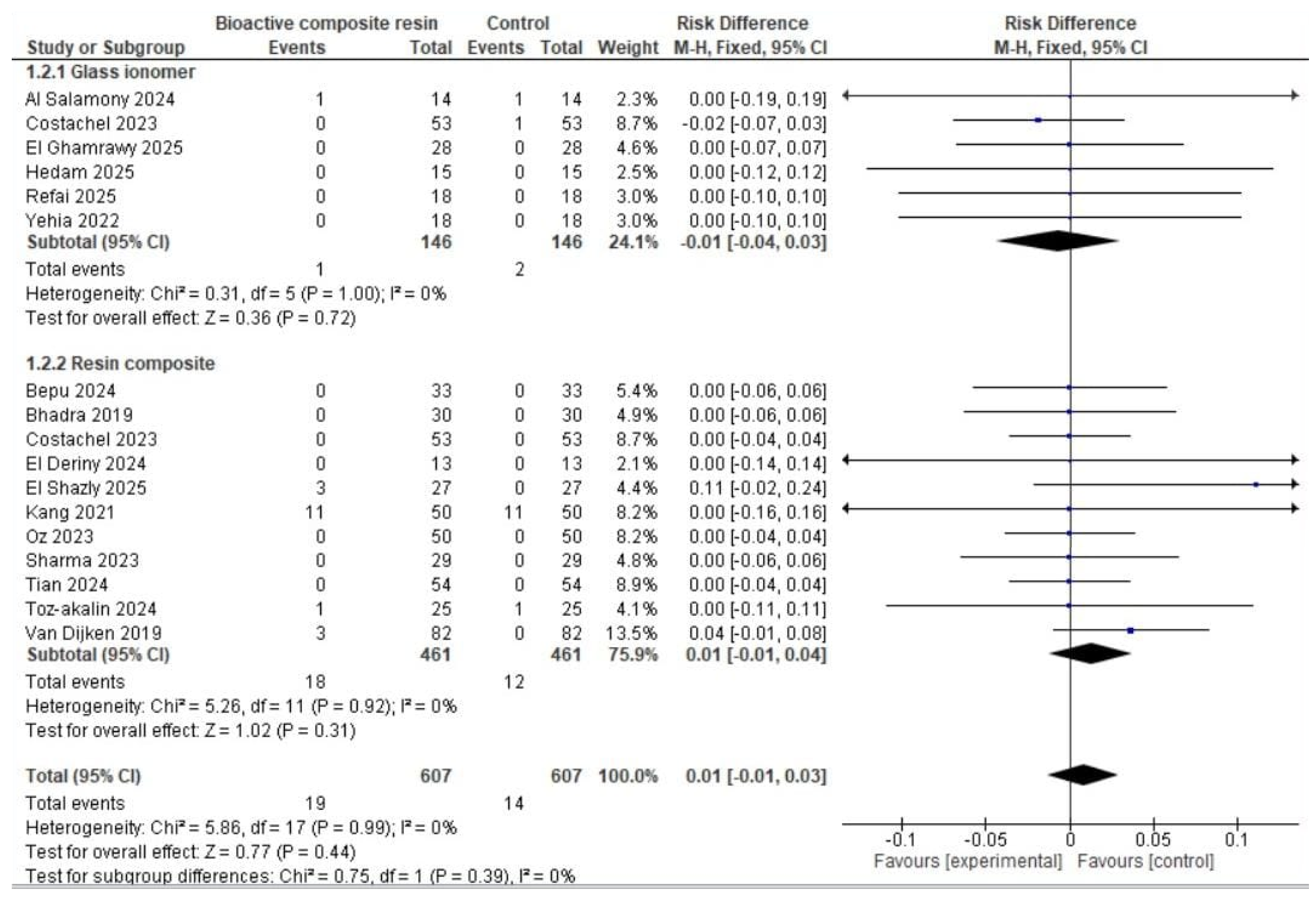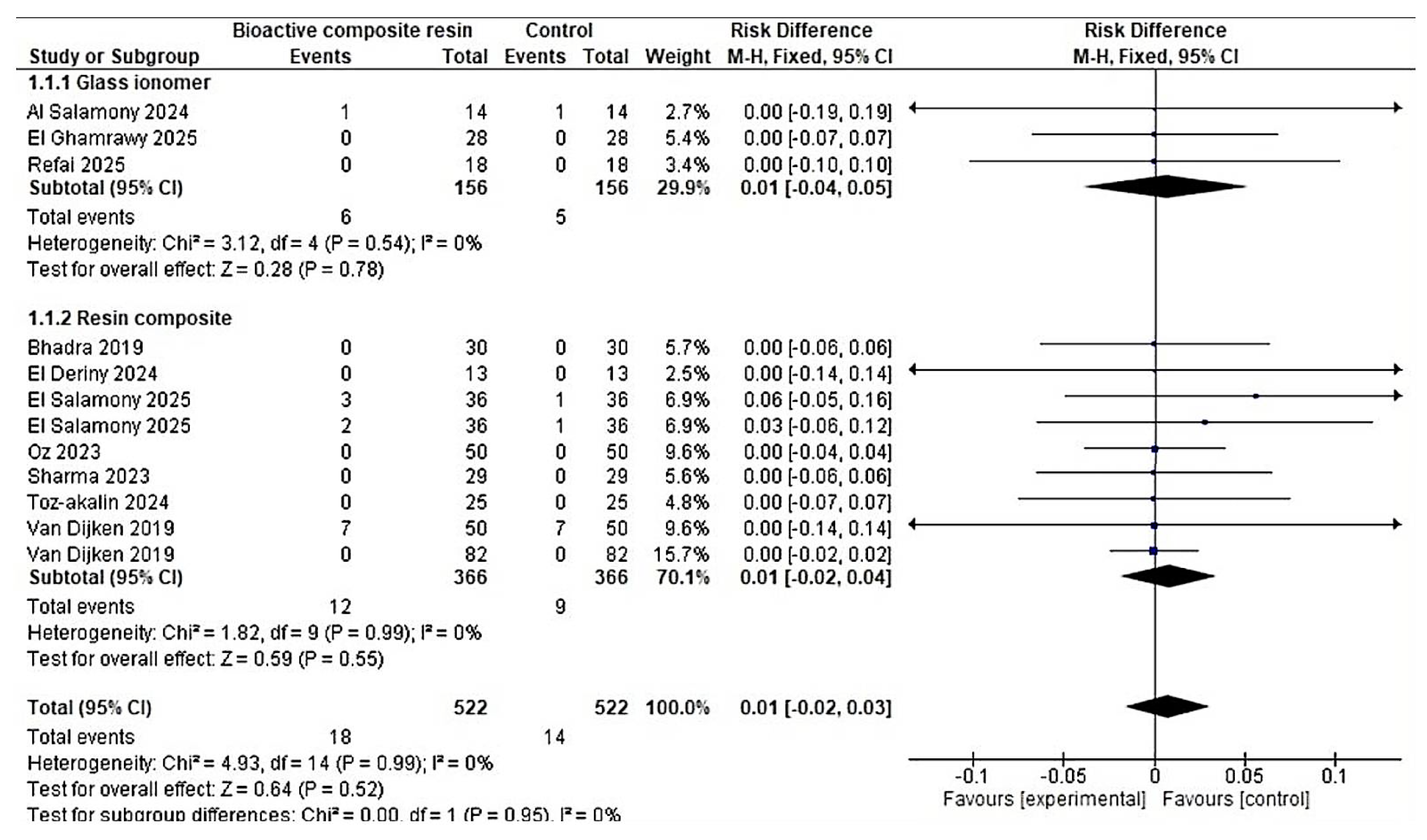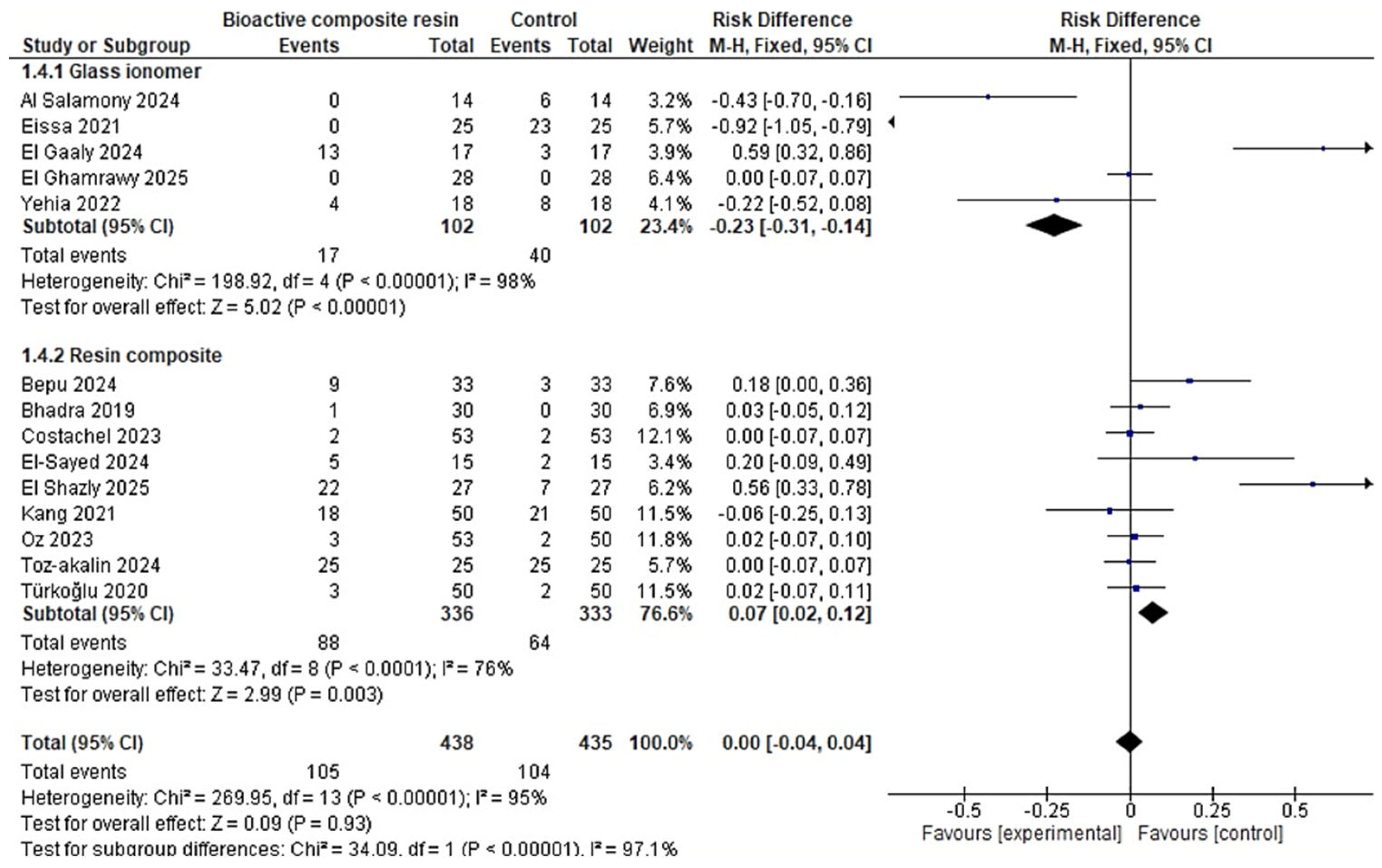

A Systematic Review and Meta-Analysis on the Clinical Performance and Longevity of Bioactive Composite Resin Restorations

 ,
,  ,
,  ,
,  ,
,  ,
,  ,
,  and
and 
Abstract
1. Introduction
2. Materials and Methods
2.1. Study Design
2.2. Search Strategy
2.3. Study Selection
2.4. Data Extraction
2.5. Risk of Bias Assessment
2.6. Certainty of Evidence Assessment
2.7. Data Synthesis
3. Results
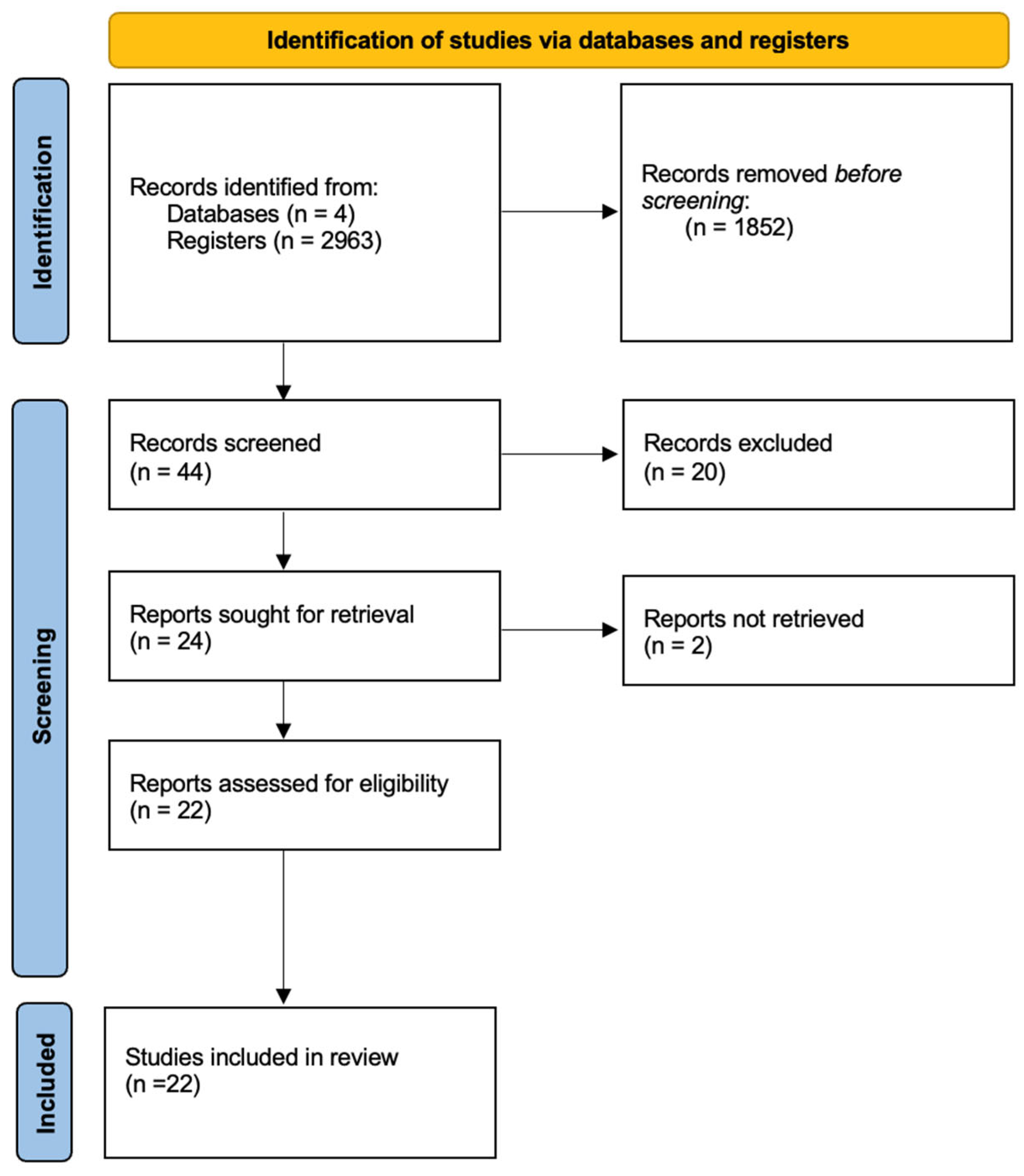
3.1. Search Strategy
3.2. Study Characteristics
3.3. Descriptive Analysis
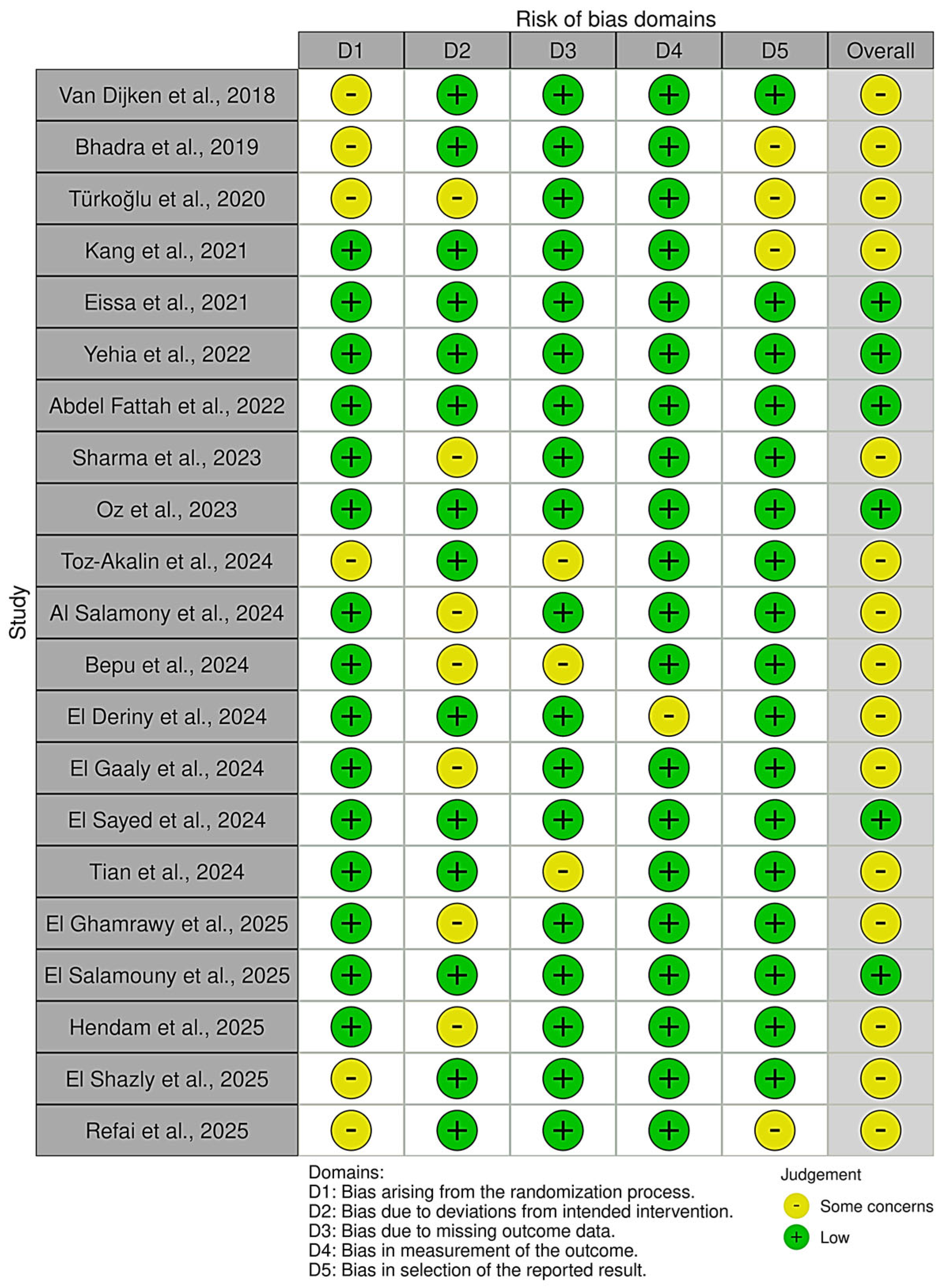
3.4. Risk of Bias of Included Studies
3.5. Evidence Quality

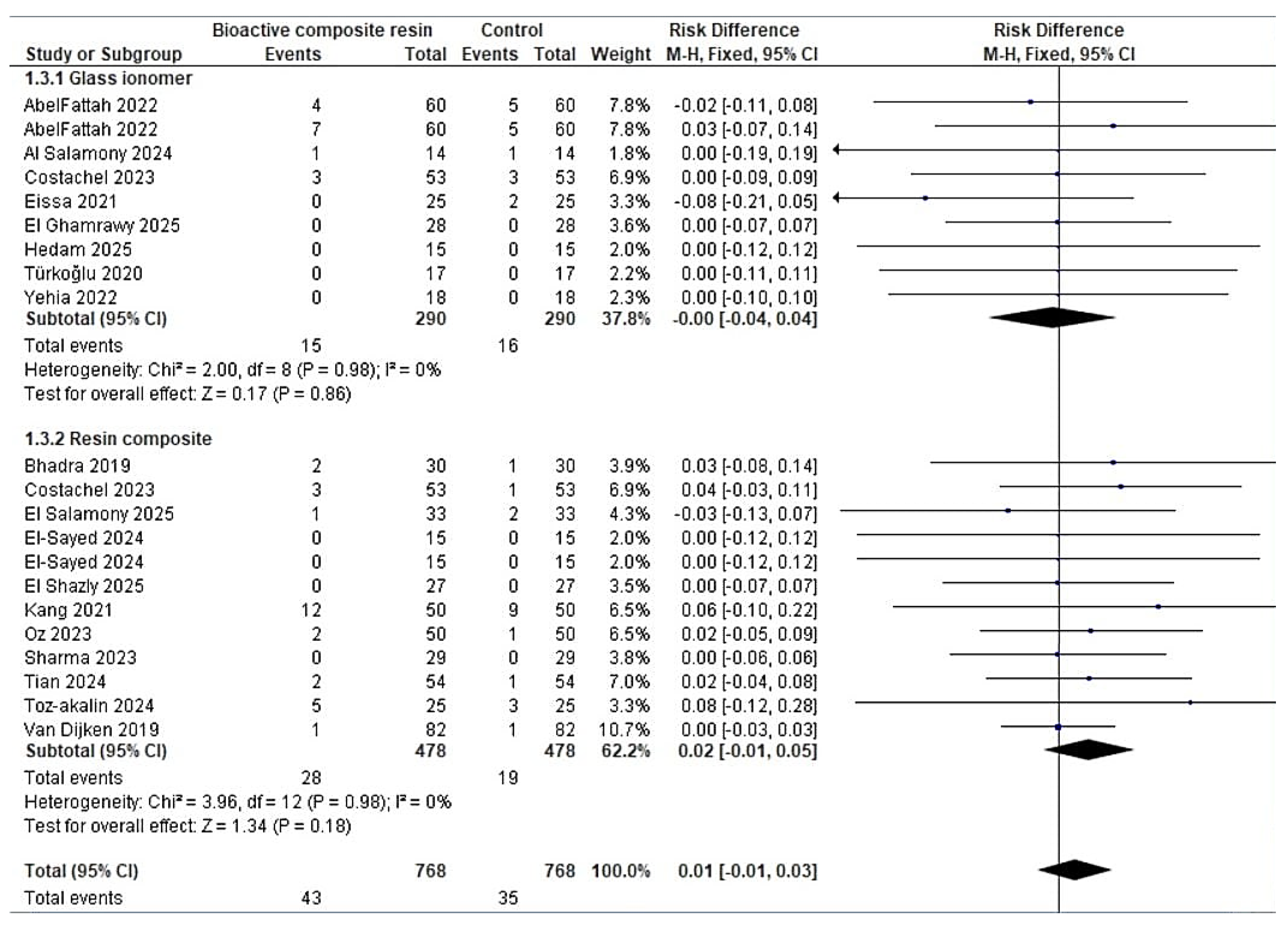
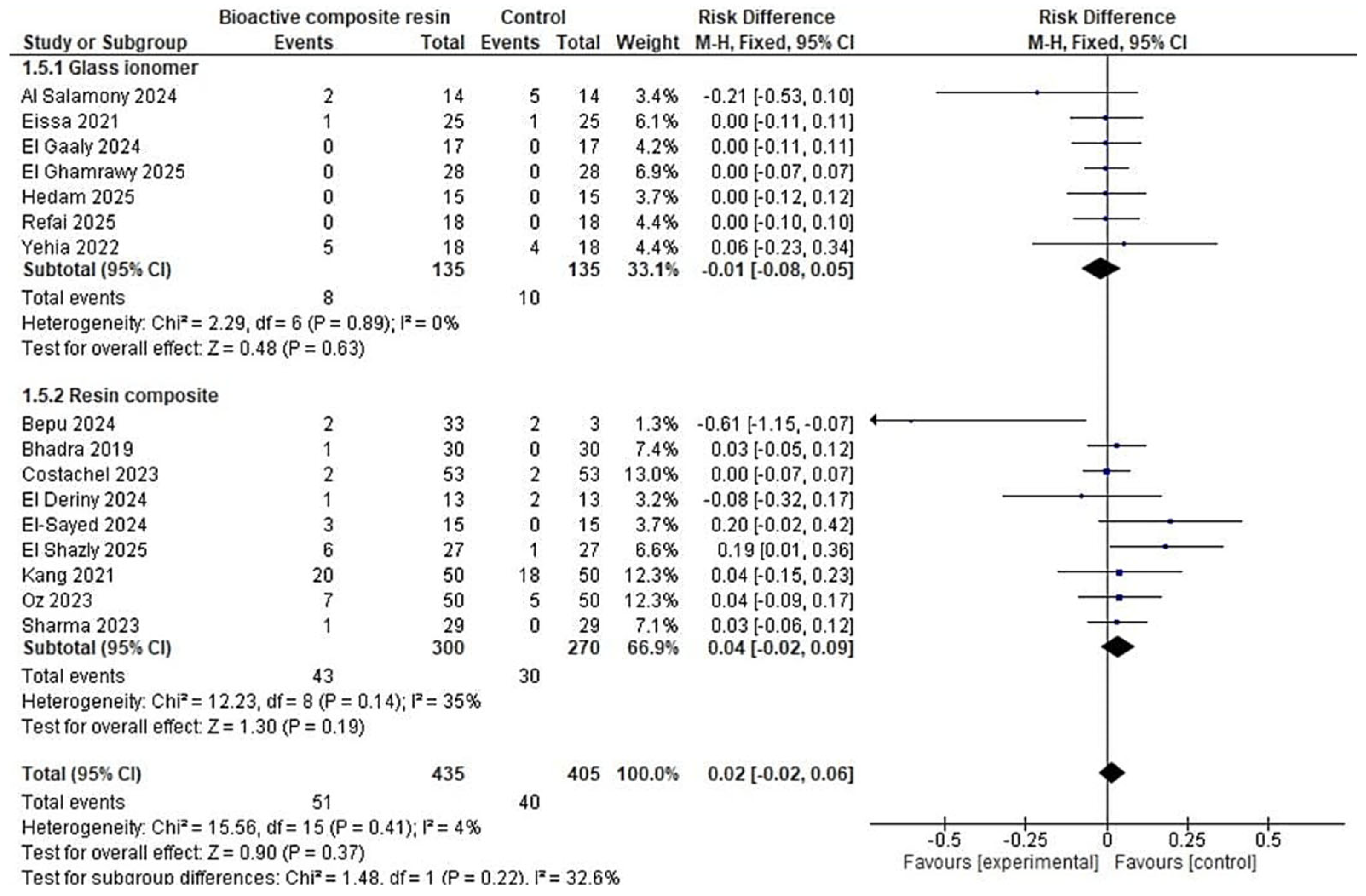
3.6. Meta-Analysis
4. Discussion
5. Conclusions
Author Contributions
Funding
Institutional Review Board Statement
Data Availability Statement
Conflicts of Interest
References
- Ástvaldsdóttir, Á.; Dagerhamn, J.; van Dijken, J.W.; Naimi-Akbar, A.; Sandborgh-Englund, G.; Tranæus, S.; Nilsson, M. Longevity of posterior resin composite restorations in adults—A systematic review. J. Dent. 2015, 43, 934–954. [Google Scholar] [CrossRef]
- Elraggal, A.; Raheem, I.A.; Holiel, A.; Alhotan, A.; Alshabib, A.; Silikas, N.; Watts, D.C.; Alharbi, N.; Afifi, R.R. Bond Strength, Microleakage, Microgaps, and Marginal Adaptation of Self-adhesive Resin Composites to Tooth Substrates with and without Preconditioning with Universal Adhesives. J. Adhes. Dent. 2024, 26, 53–64. [Google Scholar] [CrossRef] [PubMed]
- Melo, M.A.S.; Mokeem, L.; Sun, J. Bioactive restorative dental materials—The new frontier. Dent. Clin. N. Am. 2022, 66, 551–566. [Google Scholar] [CrossRef]
- Stewart, C.A.; Hong, J.H.; Hatton, B.D.; Finer, Y. Antimicrobial antidegradative dental adhesive preserves resto-ration-tooth bond. Dent. Mater. 2020, 36, 1666–1679. [Google Scholar] [CrossRef]
- Yun, J.; Burrow, M.F.; Matinlinna, J.P.; Wang, Y.; Tsoi, J.K.H. A Narrative Review of Bioactive Glass-Loaded Dental Resin Composites. J. Funct. Biomater. 2022, 13, 208. [Google Scholar] [CrossRef] [PubMed]
- Porenczuk, A.; Jankiewicz, B.; Naurecka, M.; Bartosewicz, B.; Sierakowski, B.; Gozdowski, D.; Kostecki, J.; Nasiłowska, B.; Mielczarek, A. A comparison of the remineralizing potential of dental restorative materials by analyzing their fluoride release profiles. Adv. Clin. Exp. Med. 2019, 28, 815–823. [Google Scholar] [CrossRef] [PubMed]
- Al-Salamony, H.; Akah, M.; Naguib, E.A.; Safwat, O.M. Clinical Evaluation of Bulk-fill Alkasite Restoration vs Resin-modified Glass Ionomer in Class V Carious Lesions: 1-year Randomized Clinical Trial. J. Contemp. Dent. Pract. 2024, 25, 1127–1134. [Google Scholar] [CrossRef]
- El-Salamouny, N.A.; Elmahy, W.A.; Holiel, A.A. Comparative evaluation of bioactive alkasite-based material in different application modes: A 1-year randomized controlled clinical trial. Odontology 2025, 113, 1689–1700. [Google Scholar] [CrossRef]
- Hirani, R.T.; Batra, R.; Kapoor, S. Comparative evaluation of postoperative sensitivity in bulk fill restoratives: A randomized controlled trial. J. Int. Soc. Prev. Community Dent. 2018, 8, 534–539. [Google Scholar] [CrossRef]
- Mandic, V.N.; Plancak, L.; Marovic, D.; Tarle, Z.; Gavran, M.T.; Par, M. Mechanical Properties of Alkasite Mate-rial with Different Curing Modes and Simulated Aging Conditions. Materials 2024, 17, 2777. [Google Scholar] [CrossRef]
- Pracheth, T.V.; Pai, V.S.; Vedavathi, B.; Girish, P.; Sujith, R.; Bhaskar, A.; Mazumdar, P. Comparative Evaluation of Mi-croleakage in Class V Cavities Restored with Newer Bioactive Restorative Materials: Activa Bioactive Restorative and Activa Pronto. Int. J. Clin. Pediatr. Dent. 2024, 17, 1272–1276. [Google Scholar] [CrossRef]
- Page, M.J.; McKenzie, J.E.; Bossuyt, P.M.; Boutron, I.; Hoffmann, T.C.; Mulrow, C.D.; Shamseer, L.; Tetzlaff, J.M.; Moher, D. Updating guidance for re-porting systematic reviews: Development of the PRISMA 2020 statement. J. Clin. Epidemiol. 2021, 134, 103–112. [Google Scholar] [CrossRef]
- Rethlefsen, M.L.; Kirtley, S.; Waffenschmidt, S.; Ayala, A.P.; Moher, D.; Page, M.J.; Koffel, J.B.; PRISMA-S Group. PRISMA-S: An extension to the PRISMA Statement for Reporting Literature Searches in Systematic Reviews. Syst. Rev. 2021, 10, 39. [Google Scholar] [CrossRef]
- Sterne, J.A.C.; Savović, J.; Page, M.J.; Elbers, R.G.; Blencowe, N.S.; Boutron, I.; Cates, C.J.; Cheng, H.Y.; Corbett, M.S.; Eldridge, S.M.; et al. RoB 2: A revised tool for assessing risk of bias in randomised trials. BMJ 2019, 366, l4898. [Google Scholar] [CrossRef]
- Sterne, J.A.; Hernán, M.A.; Reeves, B.C.; Savović, J.; Berkman, N.D.; Viswanathan, M.; Henry, D.; Altman, D.G.; Ansari, M.T.; Boutron, I.; et al. ROBINS-I: A tool for assessing risk of bias in non-randomised studies of interventions. BMJ 2016, 355, i4919. [Google Scholar] [CrossRef] [PubMed]
- Guyatt, G.H.; Oxman, A.D.; Vist, G.E.; Kunz, R.; Falck-Ytter, Y.; Alonso-Coello, P.; Schünemann, H.J. GRADEWorking Group GRADE: An emerging consensus on rating quality of evidence strength of recommenda tions. BMJ 2008, 336, 924–926. [Google Scholar] [CrossRef]
- Albelasy, E.H.; Hamama, H.H.; Chew, H.P.; Montasser, M.; Mahmoud, S.H. Clinical performance of two ion-releasing bulk-fill com-posites in class I and class II restorations: A two-year evaluation. J. Esthet. Restor. Dent. 2024, 36, 723–736. [Google Scholar] [CrossRef] [PubMed]
- Ozer, F.; Patel, R.; Yip, J.; Yakymiv, O.; Saleh, N.; Blatz, M.B. Five-year clinical performance of two fluoride-releasing giomer resin materials in occlusal restorations. J. Esthet. Restor. Dent. 2022, 34, 1213–1220. [Google Scholar] [CrossRef]
- van Dijken, J.W.; Pallesen, U.; Benetti, A. A randomized controlled evaluation of posterior resin restorations of an altered resin modified glass-ionomer cement with claimed bioactivity. Dent. Mater. 2019, 35, 335–343. [Google Scholar] [CrossRef] [PubMed]
- Bhadra, D.; Shah, N.C.; Rao, A.S.; Dedania, M.S.; Bajpai, N. A 1-year comparative evaluation of clinical perfor-mance of nanohybrid composite with Activa™ bioactive composite in Class II carious lesion: A randomized control study. J. Conserv. Dent. Endod. 2019, 22, 92–96. [Google Scholar]
- Türkoğlu, Ö.; Bağlar, S.; Bulut, A.C. Different Restorative Systems in Non Carious Cervical Lesions. Ann. Dent. Spec. 2020, 8, 20–31. [Google Scholar] [CrossRef]
- Kang, Y.H.; Magnuson, B.E.; Singh, M.L.; Tran, D.L.; Pagni, S.E.; Perry, R.D.; Kugel, G. 18-Month Clinical Comparison of Giomer Based and Nano Technology Based Materials in Non-Carious Cervical Lesion Class V Restorations. Open Access J. Dent. Sci. 2021, 6, 1–17. [Google Scholar] [CrossRef]
- Eissa, M.M.; Akah, M.; Yousry, M.M.; Hamza, H.; Hassanein, H.; Pameijer, C.H. Clinical Performance of a Bioactive Re-storative Material vs a Glass Hybrid Restorative in Posterior Restorations in High-risk Caries Patients. World J. Dent. 2021, 12, 292–300. [Google Scholar] [CrossRef]
- Yehia, Y.H.; Ibrahim, A.H.; Abou-Auf, E.; Elzogbhi, A.F. Clinical Evaluation of Bioactive Restorative Material versus Resin Modified Glass Ionomer in Cervical Restorations: A Randomized Controlled Clinical Trial. Open Access Maced. J. Med. Sci. 2022, 10, 33–40. [Google Scholar] [CrossRef]
- Fattah, R.I.A.; Jamil, W.E.; Elezz, A.F.A. Comparative Evaluation of Clinical Performance of Three Different Glass Hybrid Restorations in High Caries Risk Patients: A Randomized Control Trial. Open Access Maced. J. Med. Sci. 2022, 10, 398–405. [Google Scholar] [CrossRef]
- Costăchel, B.C.; Bechir, A.; Burcea, A.; Mihai, L.L.; Ionescu, T.; Marcu, O.A.; Bechir, E.S. Evaluation of Abfraction Lesions Restored with Three Dental Materials: A Comparative Study. Clin. Pract. 2023, 13, 1043–1058. [Google Scholar] [CrossRef]
- Sharma, H.; Suprabha, B.S.; Shenoy, R.; Rao, A.; Kotian, H. Clinical effectiveness of alkasite versus nanofilled resin composite in the restoration of occlusal carious lesions in permanent molar teeth of children: A randomized clinical trial. Eur. Arch. Paediatr. Dent. 2023, 24, 301–311. [Google Scholar] [CrossRef]
- Oz, F.D.; Meral, E.; Gurgan, S. Clinical performance of an alkasite-based bioactive restorative in class II cavities: A randomized clinical trial. J. Appl. Oral. Sci. 2023, 31, e20230025. [Google Scholar] [CrossRef]
- Toz-Akalin, T.; Öztürk-Bozkurt, F.; Kusdemir, M.; Özsoy, A.; Yüzbaşıoğlu, E.; Özcan, M. Three-year clinical per-formance of direct restorations using low-shrinkage Giomer vs. nano-hybrid resin composite. Front. Dent. Med. 2024, 5, 1459473. [Google Scholar] [CrossRef]
- Bepu, D.A.N.; Scatolin, R.S.; Franco, N.S.J.; Sanchez, L.P.; Souza-Gabriel, A.E.; Corona, S.A.M. Alkasite restorative material for endodontically treated teeth: A randomized controlled pilot study. Restor. Dent. Endod. 2024, 49, e24. [Google Scholar] [CrossRef]
- Elderiny, H.M.; Khallaf, Y.S.; Akah, M.M.; Hassanein, O.E. Clinical Evaluation of Bioactive Injectable Resin Composite vs Conventional Nanohybrid Composite in Posterior Restorations: An 18-Month Randomized Controlled Clinical Trial. J. Contemp. Dent. Pract. 2024, 25, 794–802. [Google Scholar] [CrossRef]
- El-Gaaly, A.N.; Hassan, R.R.; Shaalan, O.O. Clinical evaluation of new bioactive restorative material versus resin modified glass ionomer in restoration of cervical carious lesions: Randomized clinical trial. Adv. Dent. J. 2024, 6, 339–349. [Google Scholar] [CrossRef]
- El-Sayed, N.O.; El-Kady, D.M.; Ibrahim, S.H. Esthetic and Mechanical Evaluation of Calcium and Phosphate Re-leasing Hybrid Restorative Material and Fluoride Releasing Hybrid Restorative Material versus the Conventional Resin Composite in Proximal Carious Lesions over a Period of One Year. Adv. Dent. J. 2024, 6, 646–661. [Google Scholar] [CrossRef]
- Tian, F.; Mu, H.; Shi, Y.; Chen, X.; Zou, X.; Gao, X.; Wang, X. Clinical evaluation of Giomer and self-etch adhesive compared with nanofilled resin composite and etch-and-rinse adhesive—Results at 8 years. Dent. Mater. 2024, 40, 1088–1095. [Google Scholar] [CrossRef] [PubMed]
- El Ghamrawy, M.; Kamal, D.; Hamza, H. Clinical performance and cost-effectiveness of low-shrinkage giomer resin composite versus resin-modified glass ionomer in cervical carious lesions: A 12-month randomized controlled trial. BMC Oral Health 2025, 25, 1295. [Google Scholar] [CrossRef]
- Hendam, R.; Mosallam, R.; Kamal, D. Clinical evaluation of giomer-based injectable resin composite versus res-in-modified glass ionomer in class V carious lesions over 18 months: A randomized clinical trial. J. Conserv. Dent. Endod. 2025, 28, 50–56. [Google Scholar] [CrossRef]
- El-Shazly, R.K.; El-Zayat, I.M.; Mohsen, M.M.; Labib, M.E. Clinical Evaluation of Self-Adhesive Bulk-Fill Com-posite Versus Conventional Nano-Hybrid Composite in Cervical Cavities—A Randomized Controlled Clinical Trial. J. Esthet. Restor. Dent. 2025, 37, 1907–1919. [Google Scholar] [CrossRef]
- Refai, S.Y.; Shalaby, M.E.; Elmarhomy, A.-Z.M. Clinical evaluation of modified glass ionomer restorative materials. Tanta Dent. J. 2025, 22, 21–32. [Google Scholar] [CrossRef]
- Raghip, A.G.M.; Comisi, J.C.; Hamama, H.H.; Mahmoud, S.H. Two-year randomized clinical trial to evaluate the performance of posterior bulk-fill resin composite with ionic releasing restorative material. J. Dent. 2025, 160, 105912. [Google Scholar] [CrossRef]
- Par, M.; Gubler, A.; Attin, T.; Tarle, Z.; Tarle, A.; Prskalo, K.; Tauböck, T.T. Effect of adhesive coating on calcium, phosphate, and fluoride release from experimental and commercial remineralizing dental restorative materials. Sci. Rep. 2022, 12, 10272. [Google Scholar] [CrossRef]
- François, P.; Benoit, A.; Slimani, L.; Dufresne, A.; Gouze, H.; Attal, J.-P.; Mangione, F.; Dursun, E. In vitro remin-eralization by various ion-releasing materials of artificially demineralized dentin: A micro-CT study. Dent. Mater. 2024, 40, 520–526. [Google Scholar] [CrossRef] [PubMed]
- El-Adl, E.T.; Ebaya, M.M.; Habib, E.-S.E.; Zaghloul, N.M. Comparative measurement of short-term fluoride re-lease and inhibition of caries around restoration by ion releasing restorative materials: An in vitro study. Sci. Rep. 2025, 15, 1600. [Google Scholar] [CrossRef]
- Pinto, N.S.; Jorge, G.R.; Vasconcelos, J.; Probst, L.F.; De-Carli, A.D.; Freire, A. Clinical efficacy of bioactive restor-ative materials in controlling secondary caries: A systematic review and network meta-analysis. BMC Oral Health 2023, 23, 394. [Google Scholar] [CrossRef] [PubMed]
- de Carvalho, L.F.; e Silva, M.G.; Barboza, A.d.S.; Badaró, M.M.; Stolf, S.C.; Cuevas-Suárez, C.E.; Lund, R.G.; de Andrade, J.S.R. Effectiveness of bioactive resin materials in preventing secondary caries and retention loss in direct posterior restorations: A systematic review and meta-analysis. J. Dent. 2024, 152, 105460. [Google Scholar] [CrossRef]
- Vilela, H.S.; Vela, B.F.; Campos, A.L.; Trinca, R.B.; Braga, R.R. Ion-releasing restorative materials and dentin re-mineralization: Current strategies and future perspectives. Dent. Mater. 2025, 41, 1251–1265. [Google Scholar] [CrossRef]
- Lopes, S.; Lopes, P.C.; Fidalgo-Pereira, R.; Flores-Fraile, J.; Veiga, N.; Gomes, A.T. Antimicrobial potential of bioactive resin composites in caries management: A systematic review of in vitro studies. Front. Oral Health 2025, 6, 1625977. [Google Scholar] [CrossRef]
- Abozaid, D.; Azab, A.; Bahnsawy, M.A.; Eldebawy, M.; Ayad, A.; Soomro, R.; Elwakeel, E.; Mohamed, M.A. Bioactive restorative materials in dentistry: A comprehensive review of mechanisms, clinical applications, and future directions. Odontology 2025, 16, 1–29. [Google Scholar] [CrossRef]
- Ahmed, B.; Wafaie, R.A.; Hamama, H.H.; Mahmoud, S.H. 3-year randomized clinical trial to evaluate the per-formance of posterior composite restorations lined with ion-releasing materials. Sci. Rep. 2024, 14, 4942. [Google Scholar] [CrossRef]
- Francois, P.; Fouquet, V.; Attal, J.-P.; Dursun, E. Commercially Available Fluoride-Releasing Restorative Mate-rials: A Review and a Proposal for Classification. Materials 2020, 13, 2313. [Google Scholar] [CrossRef]
- Slimani, A.; Sauro, S.; Hernández, P.G.; Gurgan, S.; Turkun, L.S.; Miletic, I.; Banerjee, A.; Tassery, H. Commer-cially Available Ion-Releasing Dental Materials and Cavitated Carious Lesions: Clinical Treatment Options. Materials 2021, 14, 6272. [Google Scholar] [CrossRef] [PubMed]
- Naidu, S.S. Comparative Analysis of Mechanical Properties of Glass Ionomer Cement Type IX and Cention N: An In-Vitro Study. J. Adv. Med. Dent. Sci. Res. 2025, 13, 68–71. [Google Scholar]
- da Silva, A.R.; Feitosa, V.G.; de Souza, A.N.; Muniz, R.P.; Ornellas, M.C.; Silva, E.P.; Braz, R. Mechanical properties of composites with bioactive technology Giomer: A literature review. Res. Soc. Dev. 2021, 10, e43310313413. [Google Scholar] [CrossRef]
- Tokarczuk, D.; Tokarczuk, O.; Kiryk, J.; Kensy, J.; Szablińska, M.; Dyl, T.; Dobrzyński, W.; Matys, J.; Dobrzyński, M. Fluo-ride Release by Restorative Materials after the Application of Surface Coating Agents: A Systematic Review. Appl. Sci. 2024, 14, 4956. [Google Scholar] [CrossRef]
- Morawska-Wilk, A.; Kensy, J.; Kiryk, S.; Kotela, A.; Kiryk, J.; Michalak, M.; Grychowska, N.; Fast, M.; Matys, J.; Do-brzyński, M. Evaluation of Factors Influencing Fluoride Release from Dental Nanocomposite Materials: A Systematic Review. Nanomaterials 2025, 15, 651. [Google Scholar] [CrossRef]



| Search | Terms |
|---|---|
| #1 (Bioactive Composite Resins) | “bioactive composite resin” OR “bioactive resin composite” OR “bioactive restorative composite” OR “Activa BioACTIVE” OR “Cention N” OR “bioactive resin” |
| #2 (Clinical Performance) | “clinical trial” OR “clinical evaluation” OR “clinical performance” OR “restoration survival” OR “marginal adaptation” OR “postoperative sensitivity” OR “secondary caries” |
| #3 (Dentistry Context) | “dentistry” OR “restorative dentistry” OR “dental restoration” OR “dental filling” |
| #4 (Combined) | #1 AND #2 AND #3 |
| Study (Author, Year) | Study Design | Sample Size/Teeth | Material (Bioactive Composite) | Comparator | Follow-Up | Clinical Outcomes Reported | Key Findings |
|---|---|---|---|---|---|---|---|
| Van Dijken, 2018 [19] | RCT | n = 82/group (n = 164), Class I/II | Activa BioACTIVE | Nanofilled resin composite (CeramX) | baseline, 6, 12 months | Retention, postoperative symptoms, secondary caries | Activa BioACTIVE in Class II without adhesive pretreatment had very high failure. |
| Bhadra, 2019 [20] | RCT | n = 30/group (n = 60), Class II, permanent molars | Activa BioACTIVE | Nanohybrid composite | 1 week, 6 months, 1 year | Survival, marginal adaptation | Both materials successful with acceptable performance at 1-year follow-up. |
| Türkoğlu, 2020 [21] | One-blind clinical trial | n = 50/group (n = 300) NCCLs, anterior/posterior | Giomer; Compomer | Filtek Ultimate | 1 week, 3 months, 6 months, 9 months, 12 months | Retention, secondary caries, anatomic form, surface texture, marginal adaptation/discoloration, color match | Giomer, flowable giomer, and compomer showed unsatisfactory retention but similar other outcomes. |
| Kang YH, 2021 [22] | RCT, split-mouth | n = 50/group (n = 98), Class V | Giomer | Nanohybrid composite | 6 months, 18 months | Survival, marginal adaptation | Similar performance; no significant differences. |
| Eissa, 2021 [23] | Split-mouth clinical trial | n = 25/group (n = 50), Class II, posterior | Activa BioACTIVE | Bulk-fill glass hybrid restorative | baseline, 6 months, 12 months | Survival, esthetics, wear | Activa BioACTIVE higher esthetics and wear resistance; Equia Forte suitable as semi-permanent. |
| Yehia, 2022 [24] | RCT | n = 18/group (n = 36), Class V, anterior/premolar | Activa BioACTIVE | RMGI (Fuji II LC) | 1 week, 6 months, 12 months | Survival, esthetics | Suitable as interim restorations; bioactive composite maintained esthetics. |
| Abdel-Fattah, 2022 [25] | RCT | n = 15/group (n = 45), Class I, upper/lower molars | Activa BioACTIVE; Bulk-Fill Alkasite | Nano-ionomer (Ketac Nano) | 1 year | Functional properties, fracture, retention, marginal adaptation | All materials had acceptable clinical performance. |
| Costachel, 2023 [26] | Comparative study | n = 53/group (n = 219), abfraction lesions | Giomer | GIC-Fuji bulk, Omnichroma Flow | baseline, 2 months, 6 months, 12 months, 18 months, 24 months | Color match, marginal discoloration, surface texture, contour, secondary caries, retention | All materials showed good clinical behavior regardless of additional therapy. |
| Sharma, 2023 [27] | RCT | n = 29/group (n = 59), Class I, first permanent molars | Bulk-Fill Alkasite | Nanohybrid composite | 1 year | Survival, marginal adaptation | Similar clinical success; Alkasite viable for occlusal caries. |
| Oz, 2023 [28] | RCT | n = 50/group (n = 100), Class II, posterior | Bulk-Fill Alkasite | Conventional composite (G-ænial Posterior) | 1 week, 6 months, 12 months | Survival, marginal adaptation | Similar clinical success for both materials. |
| Toz-Akalin, 2024 [29] | RCT | n = 35/group (n = 70), Class I/II, premolars/molars | Low-shrinkage Giomer | Nanohybrid composite | 2 weeks, 6 months, 1 year, 2 years, 3 years | Survival, marginal adaptation, surface integrity | Similar performance; minor surface deterioration at 3 years. |
| Al Salamony, 2024 [7] | RCT | n = 14/group (n = 28), Class V, anterior/premolar | Bulk-Fill Alkasite | Fuji II LC | 1 week, 6 months, 12 months | Survival, marginal integrity, anatomic form | Alkasite slightly better marginal integrity; promising alternative. |
| Bepu, 2024 [30] | RCT, pilot | n = 15/group (n = 30), Class I/II, first/second molars | Alkasite | Bulk-fill composite | 1 week, 6 months, 17 months | Survival, marginal adaptation, wear, color match | Greater anatomical wear and slight color mismatch; acceptable after 17 mo. |
| El Deriny, 2024 [31] | RCT | n = 13/group (n = 26), Class I/II, posterior | Giomer | Nanohybrid composite | baseline, 6 months, 12 months, 18 months | Survival, marginal adaptation | Similar clinical performance at 18 months. |
| El-Gaaly, 2024 [32] | RCT | n = 17/group (n = 34), Class V, anterior/premolar | Activa Presto | Fuji II LC | baseline, 6 months, 12 months | Survival, marginal adaptation, gingival response | Slight gingival inflammation and color mismatch; overall acceptable. |
| El-Sayed, 2024 [33] | RCT | n = 15/group (n = 45), Class II, posterior | Activa Presto; Giomer | Nanoceramic composite | baseline, 1 month, 3 months, 6 months, 12 months | Survival, marginal adaptation, esthetics | Comparable mechanical properties; Activa Presto slightly inferior esthetics. |
| Tian, 2024 [34] | Double-blinded CT | n = 54/group (n = 108), Class I/II, premolar/molar | Giomer | Nanohybrid composite | 6 months, 18 months, 4 years, 8 years | Survival, marginal adaptation | Similar long-term clinical results. |
| El Ghamrawy, 2025 [35] | RCT | n = 28/group (n = 56), Class V, maxillary anterior | Low-shrinkage Giomer | Fuji II LC | baseline, 6 months, 12 months | Survival, marginal adaptation, esthetics | Low-shrinkage giomer promoted bioactivity, high integrity, excellent esthetics. |
| El Salamouny, 2025 [8] | RCT | n = 12/group (n = 36), Class I, posterior | Alkasite with/without adhesive | Bulk-fill composite | baseline, 3 months, 6 months, 12 months | Survival, marginal staining, postoperative sensitivity | Slightly inferior outcomes without adhesive; overall similar performance. |
| Hendam, 2025 [36] | RCT | n = 15/group (n = 30), Class V | Giomer injectable resin | RMGI (Fuji II LC) | baseline, 6 months, 12 months, 18 months | Survival, marginal adaptation, functional/esthetic | Similar clinical properties over 18 months. |
| El-Shazly, 2025 [37] | RCT, split-mouth | n = 27/group (n = 54), Class V, incisors/premolars/molars | Self-adhesive bulk-fill composite | Conventional composite | baseline, 6 months, 12 months | Survival, marginal integrity, color match, surface roughness, secondary caries | Comparable overall performance; Neo-Spectra higher marginal integrity and color match. |
| Refai, 2025 [38] | Clinical trial | n = 18/group (n = 54), Class I, posterior | Bulk-Fill Alkasite | Zirconomer; Bulk-fill glass hybrid | baseline, 6 months, 12 months | Survival, marginal adaptation, functional/esthetic | Cention N superior, followed by Equia Forte and Zirconomer; all satisfactory. |
| Clinical Outcome | No. of Studies (Restorations) | Study Design | Risk of Bias | Inconsistency | Indirectness | Imprecision | Publication Bias | Overall Certainty of Evidence (GRADE) |
|---|---|---|---|---|---|---|---|---|
| Restoration survival/retention (6–36 months) | 21 (~1483) | RCT | Not serious | Not serious | Not serious | Serious a | Not serious | ⊕⊕⊕⊝ Moderate |
| Marginal adaptation (USPHS/FDI; acceptable vs. unacceptable) | 15 (~1115) | RCT | Not serious | Not serious | Not serious | Serious a | Not serious | ⊕⊕⊕⊝ Moderate |
| Secondary caries incidence | 3 (~518) | RCT | Not serious | Not serious | Not serious | Very serious b | Not serious | ⊕⊕⊝⊝ Low |
| Postoperative sensitivity | 3 (~254) | RCT | Not serious | Not serious | Possibly serious c | Serious a | Not serious | ⊕⊕⊝⊝ Low |
| Color match/esthetic outcomes | 9 (~655) | RCT | Not serious | Serious | Not serious | Serious a | Not serious | ⊕⊕⊝⊝ Low |
Disclaimer/Publisher’s Note: The statements, opinions and data contained in all publications are solely those of the individual author(s) and contributor(s) and not of MDPI and/or the editor(s). MDPI and/or the editor(s) disclaim responsibility for any injury to people or property resulting from any ideas, methods, instructions or products referred to in the content. |
© 2026 by the authors. Licensee MDPI, Basel, Switzerland. This article is an open access article distributed under the terms and conditions of the Creative Commons Attribution (CC BY) license.
Share and Cite
Holiel, A.A.; M. Al Nakouzi, M.; Bourgi, R.; Cuevas-Suárez, C.E.; Olivares Acosta, I.; Hardan, L.; Kharouf, N.; Haikel, Y. A Systematic Review and Meta-Analysis on the Clinical Performance and Longevity of Bioactive Composite Resin Restorations. J. Compos. Sci. 2026, 10, 39. https://doi.org/10.3390/jcs10010039
Holiel AA, M. Al Nakouzi M, Bourgi R, Cuevas-Suárez CE, Olivares Acosta I, Hardan L, Kharouf N, Haikel Y. A Systematic Review and Meta-Analysis on the Clinical Performance and Longevity of Bioactive Composite Resin Restorations. Journal of Composites Science. 2026; 10(1):39. https://doi.org/10.3390/jcs10010039
Chicago/Turabian StyleHoliel, Ahmed A., Mounir M. Al Nakouzi, Rim Bourgi, Carlos Enrique Cuevas-Suárez, Iván Olivares Acosta, Louis Hardan, Naji Kharouf, and Youssef Haikel. 2026. "A Systematic Review and Meta-Analysis on the Clinical Performance and Longevity of Bioactive Composite Resin Restorations" Journal of Composites Science 10, no. 1: 39. https://doi.org/10.3390/jcs10010039
APA StyleHoliel, A. A., M. Al Nakouzi, M., Bourgi, R., Cuevas-Suárez, C. E., Olivares Acosta, I., Hardan, L., Kharouf, N., & Haikel, Y. (2026). A Systematic Review and Meta-Analysis on the Clinical Performance and Longevity of Bioactive Composite Resin Restorations. Journal of Composites Science, 10(1), 39. https://doi.org/10.3390/jcs10010039