Abstract
Last-mile delivery (LMD) is an important aspect of contemporary logistics that directly affects operational cost, efficiency, and customer satisfaction. In this paper, we provide a review of the optimization techniques of LMD, focusing on Artificial Intelligence (AI) driven decision-making, IoT-supported real-time monitoring, and hybrid delivery networks. The combination of AI and IoT improves predictive analytics, dynamic routing, and fleet management, but scalability and regulatory issues are still major concerns. Hybrid frameworks that integrate drones or Unmanned Aerial Vehicles (UAVs), ground robots, and conventional vehicles reduce energy expenditure and increase delivery range, especially in urban contexts. Furthermore, sustainable logistics approaches, including electric vehicle fleets and shared delivery infrastructures, provide promise for minimizing environmental impact. However, economic viability, legal frameworks, and infrastructure readiness still influence the feasibility of large-scale adoption. This review offers a perspective on the changing patterns in LMD, calling for regulatory evolution, technological advancement, as well as interdisciplinary approaches toward cost-effective, durable, and environmentally friendly logistics systems.
1. Introduction
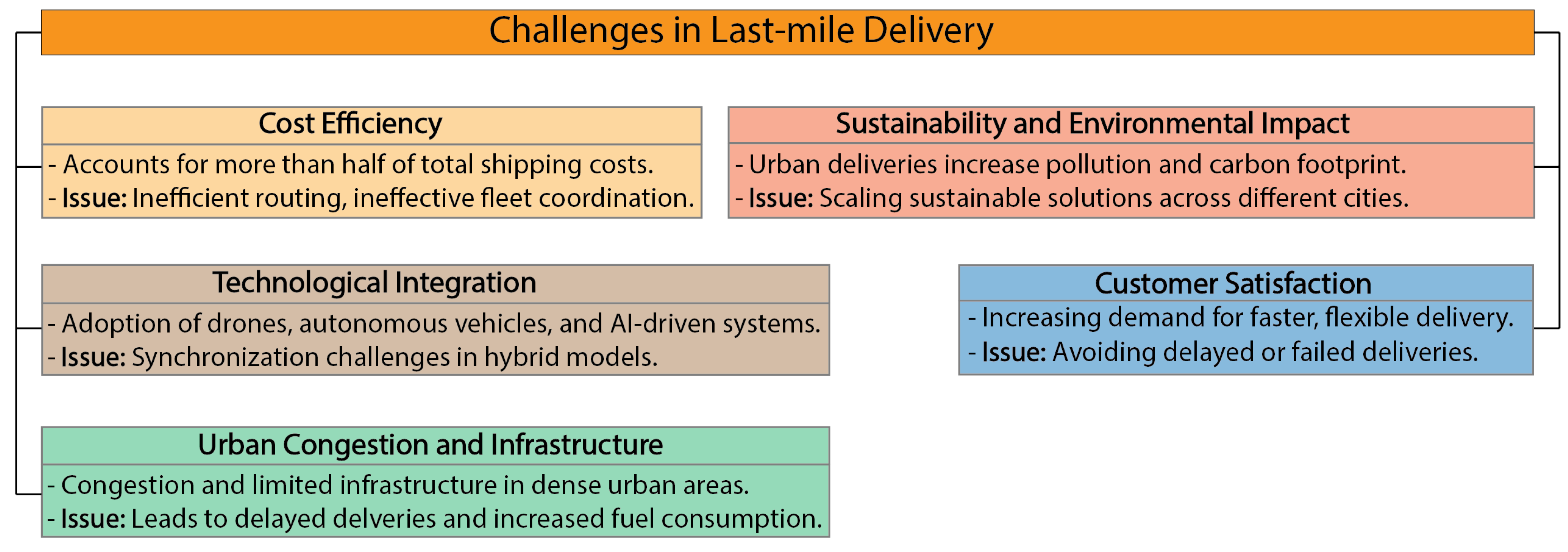
LMD represents the final stage in the supply chain journey, where items are transported from the central hub or distribution center to the end customer [1,2,3,4,5]. This stage is very critical since it involves direct contact with the customer. It is also the most expensive and inefficient part of the supply chain. The growth of e-commerce coupled with the increasing demands on delivery options, speed, flexibility, and cost of delivery have put LMD in a significant position among practitioners and researchers. In view of this evolving nature, optimization of LMD faces increasingly difficult challenges that have to be addressed with the help of integrating new technologies, sophisticated algorithms, and sustainable logistics strategies [4,6,7,8,9]. These challenges, which are discussed in subsequent paragraphs, are summarized in Figure 1.
Figure 1.
Key challenges in LMD. A visual representation of the major issues affecting LMD, including cost efficiency, sustainability, customer satisfaction, technological integration, and urban congestion, each with their respective factors contributing to inefficiencies.
The need for optimization in LMD emerges in relation to a set of issues that include the growing complexity of metropolitan areas, greater pressure for reduced delivery times, and operational costs that are at a minimum for logistics companies. Traditional delivery methods, relying on truck fleets, soon reach bottlenecks due to congestion in cities, environmental regulations, and fuel price increases [10,11]. Due to ecological concerns, the global drive for greener logistics has motivated the growing deployment of electric cars, electric cargo bikes, and even drones to assist LMD. The work in [12] shows that a hub-based delivery strategy that employs the use of electric cargo bikes greatly reduces emissions and traffic congestion in urban cities, proving it to be a potentially better approach in achieving efficiency compared to the conventional modes of delivery.
The largest challenge faced by logistics companies is reducing operational costs. LMD accounts for more than 50% of the total cost of shipping and is apparently the most expensive stage in the chain of supply [13]. However, the works in [5,14] show that these costs can be considerably reduced by using drones. The random nature of delivery locations, especially in densely populated urban areas, almost guarantees high fuel consumption, underutilized delivery vehicles, and delays caused by traffic congestion or inefficient routing. To address these inefficiencies, new techniques are investigated in the fields of routing optimization, parcel consolidation, and dynamic resource allocation. In [15], a model was proposed for UAVs based parcel consolidation using particle swarm optimization and reinforcement learning to minimize both costs and delivery delays.
Besides cost issues, sustainability has emerged as one of the most important issues in last-mile logistics. The increasing volume of urban deliveries has led to a rise in carbon pollution and traffic congestion, especially in metropolitan cities [16]. This makes governments and environmental bodies now call for companies to start reducing their carbon footprint, besides developing greener logistic models. The authors of [17] perform a simulation consisting of macroscopic traffic details, mode shift model, and approximation methods that is effective for reducing carbon emissions, delivery time, and delivery costs. The simulation shows how to accomplish the possibility of greener LMD solutions in an efficient manner, but scaling such breakthroughs across cities and regions remains a challenging task. Regulations, infrastructure availability, and operational scalability continue to be barriers to the widespread adoption of sustainable delivery systems [18].
Customer satisfaction is another powerful driver of LMD improvement efforts. The number of individuals requesting faster and more flexible delivery options is rapidly increasing, driven by the ongoing increase in the amount of transactions made online. Same-day and/or even one-hour deliveries are common expectations nowadays. This puts a lot of pressure on logistics providers to deliver at full speed while maintaining accuracy. Because customers may not be available at the point of delivery, making failed deliveries further adds inefficiency and costs to the process. Due to this, studies have been conducted on customer acceptance systems such as smart lockers [8,19,20,21,22] which have proven to be instrumental in saving time.
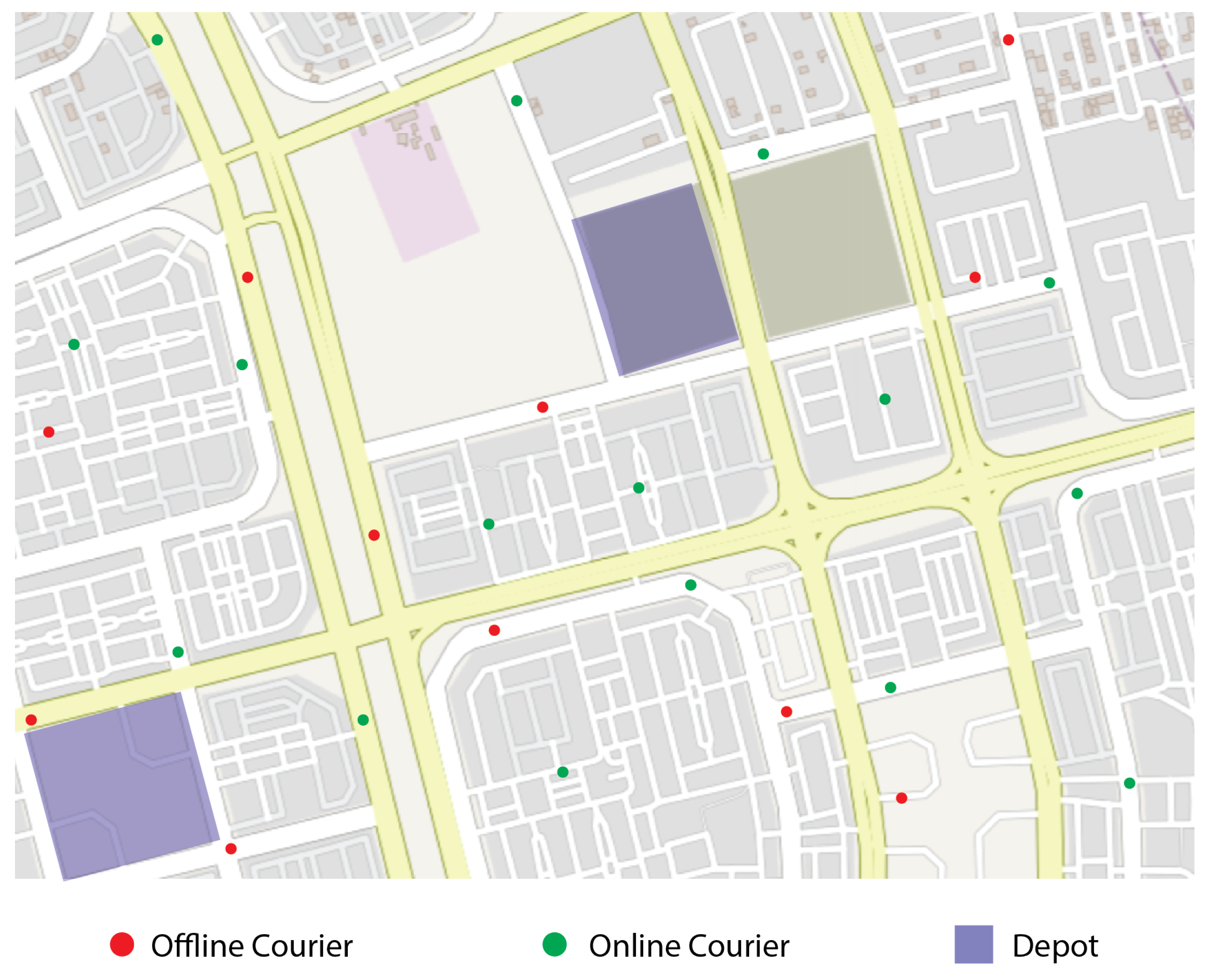
Matching customers with the couriers is another challenging aspect of LMD that surfaces, particularly with the crowdsourced modes of delivery. Real-time adaptive delivery systems can already dynamically match couriers with tasks. Li et al. [23] explore the possibility of a real-time city express delivery model using deep reinforcement learning-based adaptive matching frameworks, showing the role that could be played by AI toward the success of timely deliveries. This further illustrates how real-time involvement of available couriers and dynamic route optimization may provide much lower delivery failure rates and higher customer satisfaction.
For logistics firms, the integration of AI and sophisticated algorithms has become more crucial since it reduces operating expenses without compromising service quality. AI is among the important tools in the optimization of LMD due to its simplicity in implementation. Key methods in AI that come in handy while trying to solve complex problems, such as those related to vehicle routing or real-time adjustments in delivery routines, include Machine Learning and reinforcement learning. There are AI-based multi-agent systems [24,25] developed for route optimization. These systems update the routes dynamically based on real-time traffic and customer availability. Deep reinforcement learning models have shown efficiency in the processes of parcel consolidation and matching [1]. Additionally, AI can maximize revenues and enhance courier performances [26]. These advances are not restricted to land transport alone; AI has also been used to optimize the mechanisms of drone operations, which is an important development in LMD. Logistics companies can achieve faster delivery timescales and enhance the total efficiency of hybrid delivery systems using flight path optimization of drones and parcel consolidation with the support of AI-driven models [27].
The integration of AI into LMD improves its sustainability and enhances customer satisfaction by analyzing previous demand patterns and optimizing fleet operation in real time, ensuring a fair distribution of workload among couriers. This feature enables logistics companies to dynamically adapt to changing conditions, allowing them to cut down on operational costs and improve delivery times. LMD is evolving at an ever-increasing rate and AI will remain one of the prime movers in the next phase of development in logistics, helping to address the industry’s most pressing challenges, from cost efficiency to environmental sustainability.
2. Technological Approaches to Last-Mile Delivery Optimization
The cutting-edge technologies that are currently revolutionizing LMD are presented in this section. Logistics will be able to meet the demands of speed, economic efficiency, and environmental sustainability only through integration of processes with cutting-edge technologies such as AI, algorithmic optimization methods, autonomous systems, and the Internet of Things.These technologies provide certain guarantees for enhancing route planning, operational effectiveness, and customer happiness, which will aid in resolving some of the inherent issues within contemporary logistics systems.
2.1. Optimization Problems
Last-mile delivery optimization problems are important to achieve more efficient and cost-effective logistics operations. Optimization problems in LMD typically deal with optimal routing, scheduling, and balancing cost, time, and sustainability trade-offs. Numerous mathematical formulations and heuristic methods have been proposed to address the problems, with a strong focus on combinatorial optimization. Two of the most basic and most researched optimization problems in LMD are the Vehicle Routing Problem (VRP) and the Traveling Salesman Problem (TSP). These problems form the basis of numerous complex delivery optimization models, including those that involve emerging technologies like drones and autonomous vehicles.
2.1.1. Vehicle Routing Problem and Variants
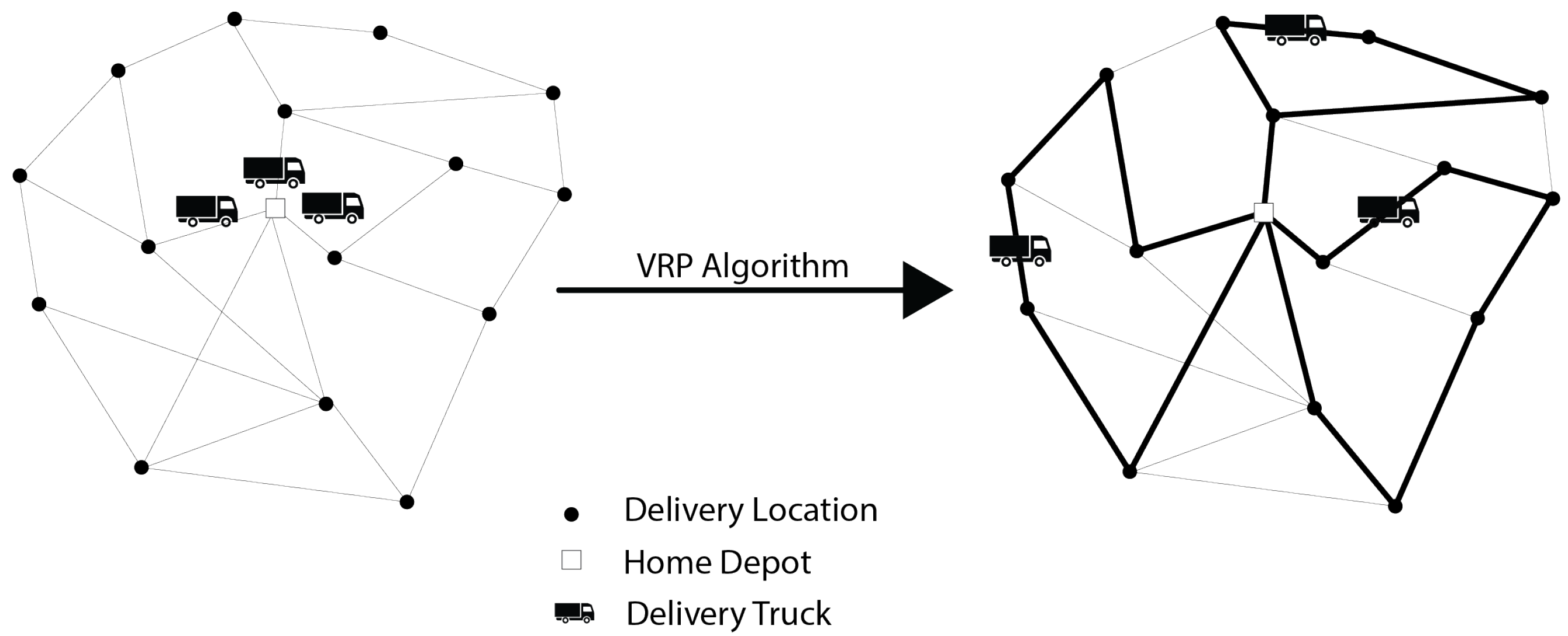
The Vehicle Routing Problem is one of the main problems of combinatorial optimization. It is a central optimization challenge in LMD. Given some constraints, such as the capacity of the vehicle and/or the delivery time windows, it aims at finding the best way of performing the deliveries. Figure 2 depicts the basic function of a VRP algorithm. Some variants of the VRP are widely used when modeling many LMD problems, including Capacitated VRP (CVRP) and VRP with Time Windows (VRPTW). Li and Yang [28] address the variant of the VRP involving handling costs: the optimal solution to multi-commodity routing with pickup and delivery constraints using heuristic methods is considered. Wang et al. [29] present a two-echelon model of the VRP that considers using multimodal solutions for transport—like trucks and public transport—with the aim of optimizing routes for deliveries within cities. The mode switching is identified as being crucial in gaining efficiencies. Another interesting approach is that of Stodola and Kutej [30], where an application for the ant colony optimization (ACO) for a multi-depot VRP with considerations for drones is proposed. These studies show the application of VRP variants to modern LMD challenges, such as growing demand for deliveries and road congestion, using those advanced algorithms to come to some balance between environmental considerations and efficiency.
Figure 2.
Visualization of a VRP solution. On the left, the unsolved scenario shows multiple delivery points with no clear routes. On the right, the VRP solution defines optimized routes (in thick dark lines) for each truck, connecting the delivery locations and returning to the depot.
2.1.2. Traveling Salesman Problem
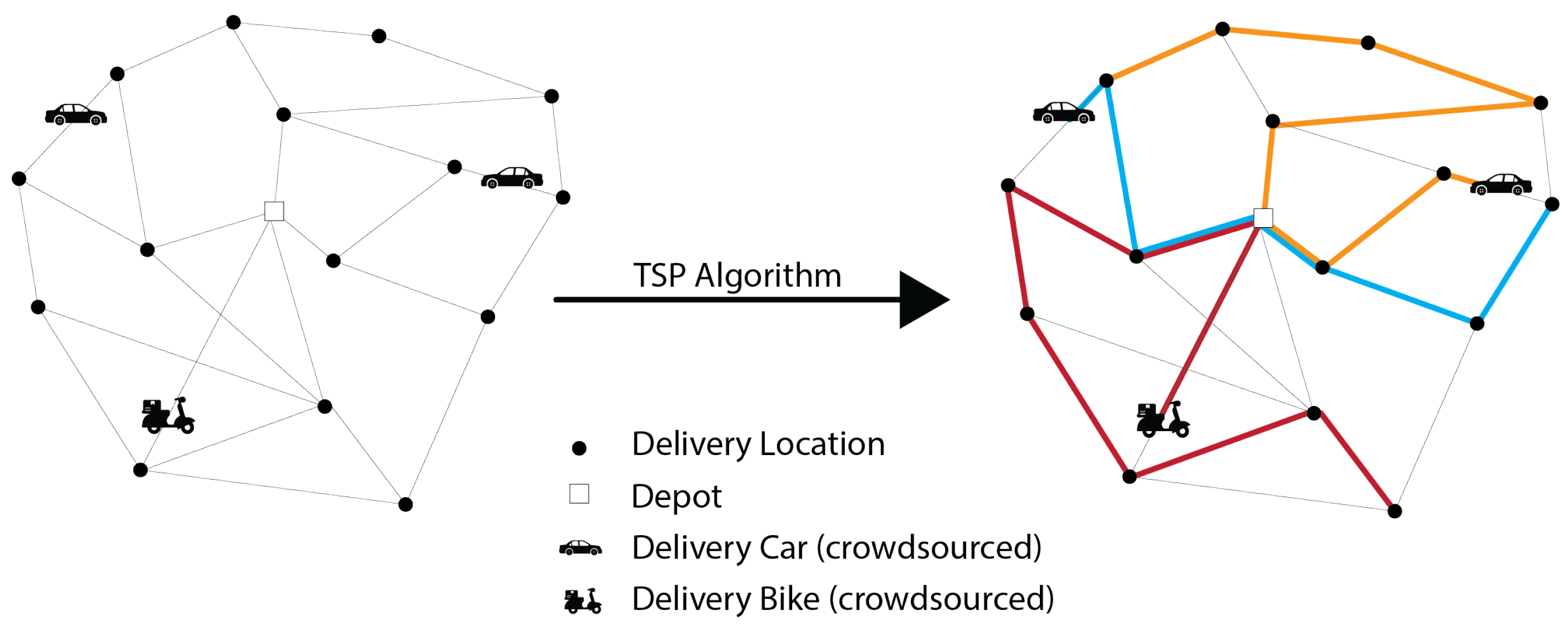
Another well-established optimization problem in LMD includes the Traveling Salesman Problem, which has found broad applications, especially in small-scale delivery where the distance between drop-off points must be minimized. It finds wide application in drone-based delivery systems. Along this line, the authors of [11] propose a hybrid metaheuristic that combines genetic algorithms with ant colony optimization for the Traveling Salesman Problem with drones, proving that applying drones to the traditional truck delivery systems increases efficiency in routes, especially in urban contexts. The work in [31] furthered this to extend the use of drone-truck tandem systems when they came up with a robust optimization model for routing delivery under uncertainty over traffic conditions. Their study also emphasizes the importance of practical considerations that, in real life, could involve such conditions as fluctuating traffic, bearing on delivery time with associated delay risks. In general, these models using TSP show how important drones are in drastically improving the pace and reliability of last-mile deliveries when combined with trucks and integrated with strong optimization techniques to handle uncertainties. Figure 3 shows how a basic TSP algorithm works.
Figure 3.
Crowdsourced vehicle routes in the Traveling Salesman Problem (TSP). This diagram shows the routes of crowdsourced vehicles in a TSP-based LMD scenario. In contrast to VRP, where the vehicles must return to the depot after completion of delivery tasks, the crowdsourced vehicles in this model do not necessarily return to the depot location. Color-coded individual vehicle routes are shown to highlight exactly how crowdsourced drivers complete their deliveries without any constraints on returning to a central hub.
2.2. Optimization Algorithms
Optimization algorithms form the basis for dealing with the complex issues of last-mile delivery, such as routing, task allocation, and efficiency. Using heuristics, metaheuristics, and machine learning, the logistics provider could come up with scalable and flexible solutions that can handle dynamic market demands and environmental constraints. A summary of the reviewed literature on optimization algorithms is provided in Table 1.
2.2.1. Mathematical Programming
Mathematical programming methods are crucial in last-mile delivery optimization as they offer formal frameworks to formulate and as well as optimally solve LMD problems. Mathematical programming methods are especially useful in tackling challenging logistics issues like the vehicle routing problem with drones (VRPD) and hybrid truck-drone delivery systems that comprise several decision variables and constraints.
Mixed-integer programming (MIP) models are typically used to formulate LMD optimization problems. For example, Kuo et al. [32] present an MIP formulation for a vehicle routing problem with drones and time windows (VRPTWD). They minimize total traveling expenses with drone-truck synchronization. Likewise, Yin et al. [33] suggest an arc-based mixed-integer linear program (MILP) for a truck-based drone delivery routing problem with time windows. A branch-and-price-and-cut algorithm with valid inequalities is used to enhance computational performance better. Madani et al. [34] present an integer linear programming formulation for a multi-visit and flexible launch and retrieval location hybrid truck-drone delivery system (HTDDS-MVLRL). In their work, they also propose an adaptive variable neighborhood search (VNS) heuristic that dynamically adapts search neighborhoods for better optimization efficiency. The integration of metaheuristics and mathematical modeling allows for significantly quicker convergence towards optimal or near-optimal solutions to real-world LMD problems.
Mathematical programming continues to be a fundamental methodology for formulating and developing LMD optimization models in general. The interaction among MIP, and heuristic-based techniques has made it far more possible to utilize hybrid delivery systems, truck-drone partnerships, and time-definite logistics services.
2.2.2. Heuristics and Metaheuristics
In general, heuristic and metaheuristic approaches have been massively applied in handling large-scale VRPs and TSPs, given that finding exact solutions is impracticable. Several techniques, like ACO, Genetic Algorithms (GA), and Simulated Annealing (SA), have rendered an efficient solution to severe problems in overcoming delivery, especially in real-time LMD systems. Pourmohammadreza and Jokar [35] came up with a two-phase heuristic method to solve the LMD problem with a large number of service alternatives, such as home delivery and self-pickup, showing how shifting client preferences may be integrated into the optimization methodology. Zhen et al. [36] are able to find the solution for the cooperating truck and drone delivery problem using a branch-price-and-cut algorithm in order to enhance computation time and give better route optimization for hybrid models of delivery. The heuristic methods presented here are particularly effective to address the complicated issues of modern LMD, where a trade-off needs to be made between real-time decisions with customer satisfaction while taking into consideration operational costs and efficiency.
2.2.3. Routing Based on Driver Experience
In the case of last-mile routing, driver experience increases predictive accuracy in terms of delivery time and reduction of time delays. Drivers normally hold tacit knowledge with respect to local traffic conditions, customer behavior, and real-time road conditions, which are all useful information bases that can complement other routing algorithms, including AI-infused routing systems. Mo et al. [10] assert that drivers tend to always deviate from planned routes because of their knowledge of the nature of the road network, the curb-side infrastructure, and customer preference. Their study developed a neural network that predicted actual routes executed by drivers, doing substantially better than traditional optimization-based approaches. Again, the model highlighted that drivers create route plans by emphasizing behavior that may lead to routes which better fit real-world conditions and preferences.
Furthermore, Dieter et al. [37] employ a hybrid decision support approach by integrating machine learning and optimization techniques to model driver behavior for the routing in LMD. This model combined conventional optimization techniques with data-driven knowledge of previous driver routes to demonstrate how knowledge about past route deviations of drivers can contribute to improving the overall system performance. Predicted and suggested tours are closer to the driver’s tendency, and thus the acceptance rates of routes improve, hence leading to improved performance in delivery.
Another recent work, Campo and Fernandez [16], concentrates on operational efficiency profiling of electric vehicle fleets, underlining how driver insights are crucial in range anxiety management and route planning for electric vans within an urban environment. With the integration of such driver knowledge into practice, some of the operational limitations surrounding electric vehicles, regarding charging infrastructure availability and time to recharge, were improved in a way that enhanced general sustainability and efficiency in the delivery fleet.
2.2.4. Limitations and Quantitative Synthesis of Optimization Algorithms

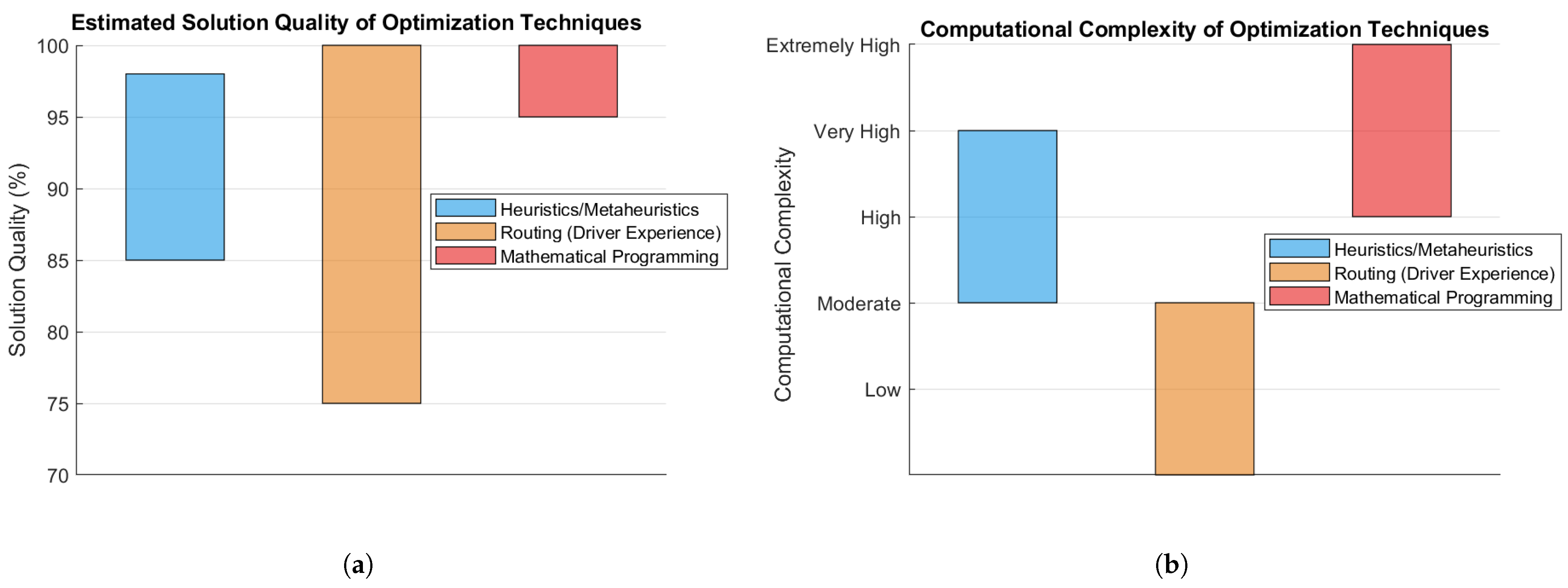
The computational complexity, scalability, and solution quality of LMD optimization methods differ. With a moderate amount of computational cost, heuristics and metaheuristics like GA and ACO provide near-optimal solutions between 85% and 98%, as shown in Figure 4a. However, there is no way to guarantee a global optimum, and these techniques are extremely susceptible to changes in the parameters [30,31,36].
Figure 4.
Comparison of optimization techniques in last-mile delivery. (a) Estimated solution quality, where heuristics/metaheuristics provide near-optimal solutions, driver-experience-based routing has wider variability, and mathematical programming achieves optimality at high computational cost. (b) Computational complexity comparison, showing heuristics/metaheuristics range from moderate to very high, driver-experience-based routing remains low to moderate, and mathematical programming incurs extremely high computational demands.
On the other hand, driver experience-based routing can leverage human intuition and local knowledge but lacks consistency and scalability. While effective in familiar environments, it is less effective in dynamic large-scale settings, with solution quality between 75% and 100% [10,16,37].
However, the optimal solution with a mathematical programming technique involving the use of Linear Programming (LP), Mixed Integer Linear Programming (MILP), or Mixed Integer Quadratically Constrained Programming (MIQCP) gives solutions that range between 95% and 100%. Solutions below 100% are possible when constraints are relaxed or time limits are set. Mathematical programming solutions take a lot of time to complete and come at a very high computational cost [32,33,34], as shown in Figure 4b. This makes the approach unsuitable for real-time decision-making. The necessity for hybrid techniques that strike a compromise between practicality and efficiency in large-scale LMD operations is highlighted by the trade-off between computational cost and solution quality [38].
Table 1.
Summary of heuristic and metaheuristic approaches applied to VRP and TSP, and driver experience routing methods for last-mile delivery optimization.
Table 1.
Summary of heuristic and metaheuristic approaches applied to VRP and TSP, and driver experience routing methods for last-mile delivery optimization.
| Reference | Problem Nature | Objective | Result | Category |
|---|---|---|---|---|
| [10] | Predicting driver route trajectories in last-mile delivery | Use neural networks to predict driver deviations from planned routes in last-mile delivery | Proposed model improves prediction accuracy and aligns better with driver behavior | Experience |
| [11] | Hybrid metaheuristic approach to TSP with drones | Develop hybrid metaheuristic combining genetic algorithm and ant colony optimization for TSP-D | Hybrid metaheuristic significantly improves route efficiency for drone-based delivery | TSP Metaheuristic |
| [28] | Vehicle routing with handling cost in front warehouse mode | Develop a variable neighborhood search and randomized tabu thresholding heuristic for routing | Proposed heuristic reduced handling costs and optimized delivery routes | VRP Heuristic |
| [39] | Data-driven delivery zone partition for last-mile logistics | Design a data-driven partition framework to improve courier workload balancing | Equitable partitioning increased on-time delivery rate by 2.2% and pickup rate by 1.1% | Experience |
| [29] | Two-echelon multimodal vehicle routing for city logistics | Develop a model with adaptive large neighborhood search algorithm to minimize generalized costs | ALNS algorithm improved multimodal and multi-commodity distribution efficiency | VRP Heuristic |
| [30] | Multi-depot vehicle routing problem with drones (MDVRP-D) | Formulate MDVRP-D with ACO-based algorithm for route optimization | ACO-based algorithm improves UAV routing and drone utilization | VRP Metaheuristic |
| [31] | Robust drone-truck delivery routes under traffic uncertainty | Develop a robust joint route optimization method to maximize profit while considering traffic risks | Robust solution reduced variance by up to 58% and improved feasibility by up to 90% | VRP Metaheuristic |
| [32] | Vehicle routing problem with drones considering time windows | Develop a mixed-integer programming (MIP) model and propose a variable neighborhood search (VNS) heuristic to optimize truck-drone delivery | The proposed VNS approach improves delivery performance and reduces total travel costs in truck-drone systems | VRP Mathematical Programming |
| [33] | Truck-based drone delivery routing problem with time windows | Formulate an arc-based mixed-integer linear program (MILP) and develop a branch-and-price-and-cut algorithm for efficient delivery routing | The branch-and-price-and-cut algorithm significantly enhances computational efficiency and solution quality for truck-drone routing with time windows | VRP Mathematical Programming |
| [34] | Hybrid truck-drone delivery system with multi-visits and flexible launch and retrieval locations | Propose an integer linear programming model and an adaptive variable neighborhood search (VNS) heuristic for optimizing multi-visit hybrid truck-drone delivery | The adaptive VNS approach dynamically categorizes search neighborhoods, improving convergence and solution quality in hybrid truck-drone operations | VRP Metaheuristic Mathematical Programming |
| [35] | Optimization of last-mile delivery with service options | Propose a novel two-phase approach combining multi-criteria decision-making with vehicle routing | Aggregation of orders reduced costs and minimized environmental impact | VRP Heuristic |
| [36] | Truck-and-drone cooperative delivery optimization | Develop branch-price-and-cut algorithm to optimize customer allocation and routing for trucks and drones | Cooperative truck-drone system outperforms single mode systems in efficiency and cost reduction | VRP Metaheuristic |
| [37] | Driver behavior in last-mile delivery routing | Develop a hybrid decision support framework combining machine learning and optimization | Driver behavior improved tour efficiency and reduced deviations from prescribed routes | Experience |
| [40] | Two-Echelon Multi-Trip Vehicle Routing Problem (2E-VRP) | Develop a matheuristic to solve the 2E-VRP with time windows | Matheuristic provides high-quality solutions for large instances | VRP Heuristic Metaheuristic |
| [41] | Low-carbon vaccine delivery with customer loss | Develop multi-objective model for vaccine delivery | Proposed model balances logistics costs and delivery reliability | VRP Heuristic |
| [42] | Vehicle Routing Problem (VRP) for last-mile delivery | Compare optimization algorithms for VRP with capacity and time windows | Tabu search outperforms local search for larger problem instances | VRP Heuristic Metaheuristic |
| [43] | TSP with multiple drones and trucks for last-mile delivery | Propose heuristic approaches for TSP with a truck-drone combination | Heuristics like genetic algorithm show time savings and cost reductions | TSP Heuristic |
| [44] | Covering delivery problem in last-mile logistics | Propose a heterogeneous teaching-learning optimization algorithm for the covering delivery problem | Proposed method outperforms state-of-the-art techniques for covering delivery | TSP Heuristic |
2.3. Autonomous Technologies
Autonomous technologies transform LMD by reducing human intervention and enhancing operation efficiency, thereby offering scalable solutions across varied environments. These range from UAV or drones, Autonomous Ground Vehicles (AGVs), to the very important delivery robots, each performing a key role in the reshaping of how deliveries are to be performed, especially in both urban and rural contexts. A summary of the reviewed literature on autonomous systems is provided in Table 2.
2.3.1. Drones (UAVs)
UAVs, popularly referred to as drones, have been important in solving urban congestion and helping raise the speed of delivery. UAVs are very viable for small and lightweight packages since they can avoid traffic by flying directly to a delivery point. Eskandaripour and Boldsaikhan [18] highlight how drones render eco-friendly and speedy deliveries in highly populated cities where road congestion renders deliveries through conventional vehicles very slow. They discuss technical challenges that their survey will undertake which will help in the improvement of drone efficiency for LMD, such as battery management, routing optimization, and environmental protection.
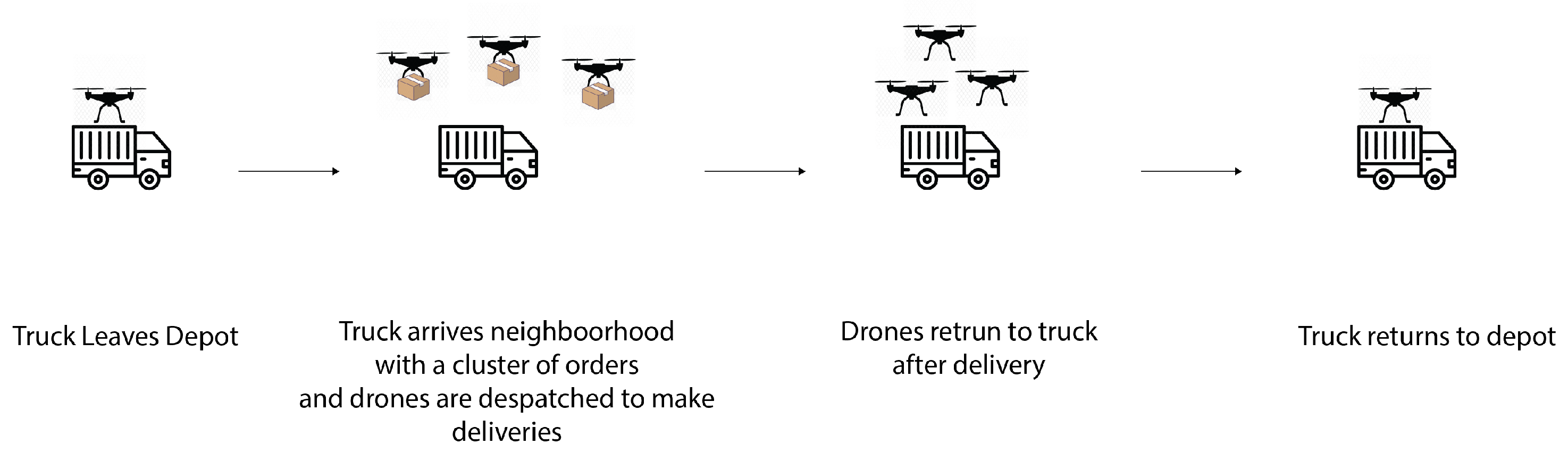
Essentially, drones would also work in cooperation with trucks in a hybrid model as shown in Figure 5, a concept that has been formalized in what was named the Autonomous Vehicle Routing Problem with Drones, A-VRPD, introduced by Imran et al. [38]. It works out the most efficient routes by combining Autonomous Vehicles (AVs) and drones with the aim of decreasing the operational cost in LMD, in particular, but not limited to, urban areas. Hybrid models, where drones will be loaded onto trucks as shown in Figure 5, are allowing for quicker, more agile delivery systems. There are, however, multiple issues related to UAVs: payload limitations, weather conditions, and regulatory restrictions [18,45]. For example, in the context of UAV trajectory planning, Liu et al. [46] address operational constraints from the requirement of energy efficiency with the assurance of public safety while delivering critical goods like perishable products.
Figure 5.
Hybrid drone–truck last-mile delivery model.
2.3.2. Robots
Robots have been increasingly deployed in recent times for last-mile urban deliveries. This class of vehicles will be largely utilized to make short-distance deliveries through heavy traffic, where the human-driven vehicles go through constant delays. According to Ostermeier et al. [47], the truck-and-robot systems have a very promising potential for decreasing logistics costs and urban traffic. Trucks would transport robots to drop-off points, and then the robots themselves drive to end customers at pedestrian speeds, creating minimal environmental and traffic impact compared to the traditional trucks. Lemardelé et al. [48] conduct a life-cycle analysis on Autonomous Delivery Robots (ADRs) which shows that optimizing the production process of robots and extending their operational lifetime greatly reduces their environmental impact, whereas Yao [13] highlights the importance of improving obstacle avoidance technologies in robots, which allows them to perform successfully in crowded urban areas.
The authors in [45] also investigate the effect of when public transport systems can be integrated with delivery robots, whereby robots use buses or trains to extend their range. This kind of synergy between autonomous robots and public transportation can considerably reduce costs and emissions while increasing delivery efficiency.
2.3.3. Limitations and Quantitative Synthesis of Autonomous Vehicle Utilization
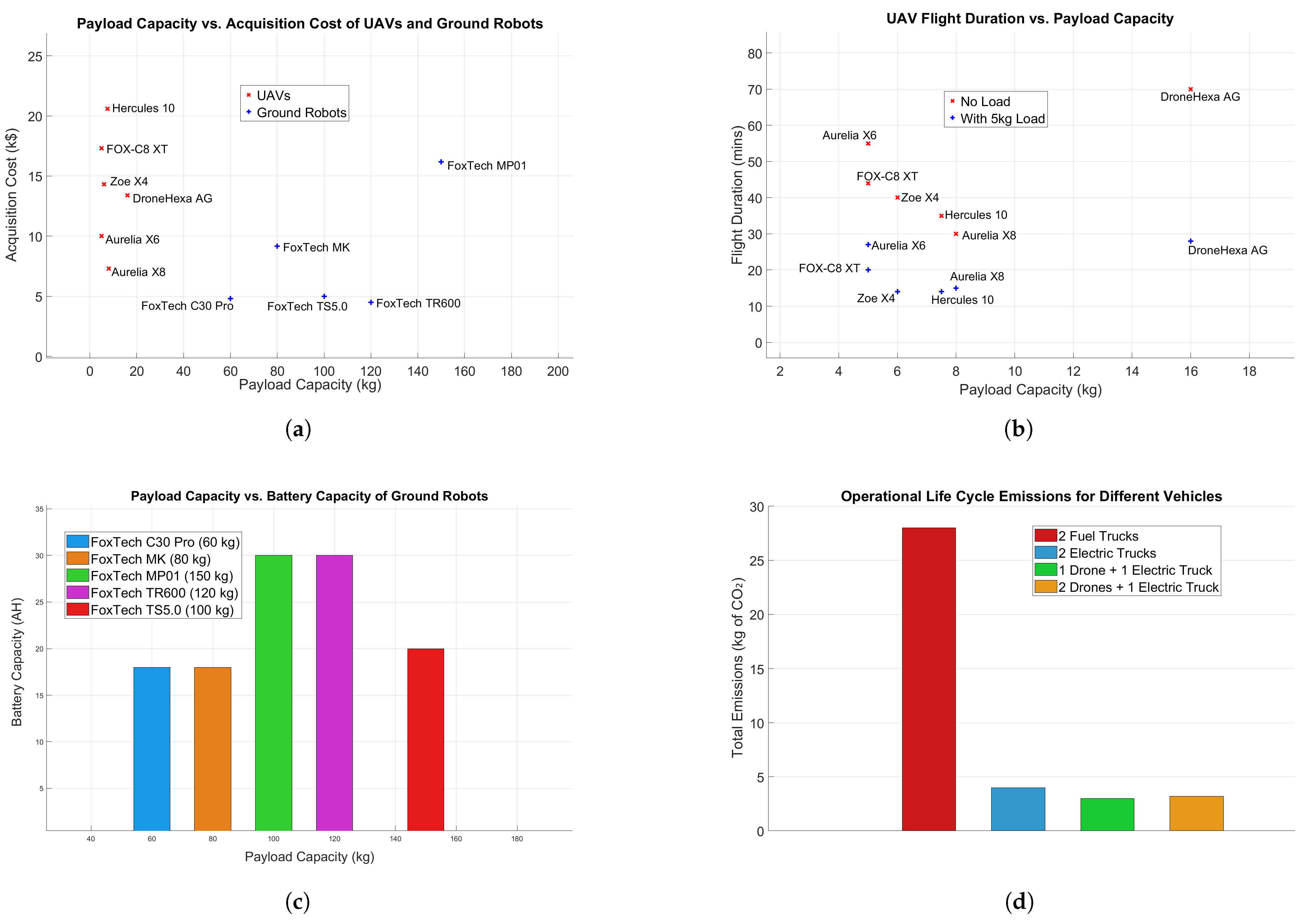
Autonomous ground robots and drones enhance LMD but are limited by payload, cost, and energy capacity. Drones are utilized for rapid deliveries, as illustrated in Figure 6a, but their low payload capacity and high cost of purchase render them less suitable for high-volume logistics [49,50]. Their steep drop in flight duration when loaded, illustrated in Figure 6b, reduces thir efficiency [49]. Additionally, they are not suitable to be used in bad weather.
Figure 6.
(a) Acquisition cost may increase with UAV payload capacity, while ground robots offer a lower cost per kg. (b) UAV flight duration drops significantly under load. (c) Battery capacity requirements for ground robots vary with payload. (d) Total life cycle emissions of different vehicle types, including fuel-based, electric, and hybrid systems.
Ground robots, being more energy efficient and having a higher payload capacity, are best suited for short-range urban delivery but are undermined by ground obstacles, navigation problems, and weather conditions as well. Figure 6c shows the relationship between battery capacity and payload [50].
Another important consideration when integrating autonomous vehicles into LMD is environmental sustainability. The overall emissions across the lifespan of various vehicle types in a given country are given in Figure 6d. Traditional fuel trucks have the largest amount of emissions, while electric trucks lower CO2 emissions considerably. Hybrid versions, which combine drones with electric trucks, lower emissions even more by utilizing ground transport less. This shows the possible environmental benefit of using UAVs and ground robots in combination with traditional logistics systems [51].
Despite these limitations, the integration of drones, robots, and traditional trucks can improve efficiency and lower costs; thus, greater autonomy, coordination, and regulation are needed.
Table 2.
Summary of approaches in autonomous delivery systems.
Table 2.
Summary of approaches in autonomous delivery systems.
| Reference | Problem Nature | Objective | Result | Category |
|---|---|---|---|---|
| [13] | Optimization methods for autonomous delivery robots in last-mile delivery | Review optimization models for robot operation and obstacle avoidance in last-mile delivery | Autonomous delivery robots reduce last-mile delivery costs and improve operational efficiency | Robot |
| [18] | Review of last-mile drone delivery systems | Identify key challenges and technical aspects of drone delivery systems | Drones offer eco-friendly, efficient delivery but face limitations in battery and payload | UAV |
| [25] | Autonomous robot scheduling for last-mile delivery | Optimize robot scheduling for safe and efficient delivery | COIL outperforms genetic algorithm, optimizing robot operation by 10% | Robot |
| [45] | Autonomous delivery robots and public transport in last-mile logistics | Synchronize ADRs with public transport for cost-effective delivery | Proposed solution reduces costs by up to 7.5% and emissions | Robot |
| [47] | Multi-vehicle truck-and-robot routing for last-mile delivery | Optimize truck-robot coordination to minimize transportation costs | Multi-vehicle system reduces costs by up to 62% compared to conventional truck delivery | Robot |
| [48] | Life-cycle analysis of autonomous delivery robots (ADRs) | Perform life-cycle analysis to assess environmental sustainability of ADR-based delivery systems | Two-echelon operations with ADRs generate between 60 and 130 grams of CO2-eq per parcel, but improvements are possible with better production and lifespan | Robot |
| [46] | Autonomous drone trajectory planning for superchilling delivery | Develop a multi-objective optimization model for drone trajectory planning | Improved safety, energy efficiency, and productivity in drone operations | UAV |
| [38] | Autonomous vehicle routing problem with drones (A-VRPD) | Formulate a Mixed Integer Linear Program (MILP) for A-VRPD and propose optimization methods | The proposed approach increases profits significantly compared to other VRPD solutions | UAV |
2.4. Logistics Automation and AI Strategies
Integration of AI and its subset Machine Learning (ML) in LMD systems has changed the game by offering a host of benefits, which include increased productivity, lower operating costs, and the ability to make decisions on its own. These technologies facilitate Logistic Service Providers to further optimize LMD operations by making the best decisions in dynamic complex environments characterized by large datasets, real-time information, and predictive models. Working in concert, AI and ML will leave logistics companies even more prepared to cope with the spikes in demand and traffic variability that have characterized the operational constraints of LMD in satisfying increasingly demanding customers’ fast, flexible, and reliable delivery requirements.
AI systems are enabling logistics companies to go beyond the traditional static models of delivery and introduce dynamic optimization capabilities that allow adjustments in real-time for route planning, resource allocation, and task assignments. It analyzes huge datasets, including historical traffic flow and up-to-the-minute weather reports, even down to customer behavior giving logistic providers the actionable insights to make decisions in the field at every touchpoint in delivery operations. A summary of the reviewed literature on AI strategies in logistics is provided in Table 3.
2.4.1. Predict Traffic Demand
One of the most powerful applications of AI in LMD is undoubtedly the prediction of traffic demand by integrated systems. Logistic providers can better foresee delivery bottleneck locations with predictive analytics from a variety of sources, including historical traffic patterns, weather forecasts, road closures, and current traffic conditions.This capability is exceedingly important in cities or urban areas that are considered highly traffic-congested and can actually affect the timing of delivery. Companies could reroute their delivery time in advance using predictive models, better allocate resources to meet the demand and avoid congestion, and make operations smooth.
In their work, Klein and Steinhardt [52] show that same-day delivery services can be optimized by a traffic-aware dynamic demand management system with high-precision predictions of traffic bottlenecks and surges in demand. Their work better explains how AI-driven systems will enable logistics providers to do a better job of allocating delivery resources, deploying vehicles where and when they are most needed. Furthermore, AI-powered predictive models can also forecast customer demand to help companies stock warehouses efficiently and avoid supply bottlenecks, or be used for traffic management [53]. Bentley et al. [25] come up with the adaptive matching framework for dynamic allocation of couriers for parcels in real-time demand so as to improve the overall efficiency of delivery by saving time with lower idleness and higher optimization of resources.
In addition, Russo and Comi [26] use ML-driven predictive analytics to allocate delivery tasks among couriers so that delays would be reduced and reliability of services could be improved to a greater extent. While these models predict demands, they also analyze the most efficient ways of task assignment so that the correct resources are dispatched to the correct locations at the right time.
This is not limited to cities since AI can be applied in the outskirts of cities to predict traffic demand and optimize its resources. They can optimize their delivery routes in suburban and rural locations using AI-driven systems that analyze the patterns of traffic flow and distribution for defining effective routes [54]. Such systems combine historical data with real-time data to allow logistics providers to make data-driven decisions that improve operational efficiencies across diverse geographical regions.
2.4.2. Route Optimization
ML has proven to be invaluable in route optimization, especially in complex urban environments where traffic conditions may change very fast. ML models allow logistic companies to embrace the vast majority of data inputs, such as real-time traffic and weather conditions, as well as customer preferences, in their route optimization systems [55,56]. These models are constantly updating delivery routes so that to ensure that parcels reach their destination in the shortest time possible, even in the event of unplanned setbacks.
Villamil et al. [55] examine a machine-learning-assisted two-echelon parcel distribution system for clustering delivery areas and utilization of nearest-neighbor routing algorithms. It was noticed that such a system decreases the time and distance traveled by roughly 22% owing to mutual optimization of both the distribution network and delivery routes. Clustering delivery regions by geographical proximity and delivery density reduces the distance the delivery vehicle has to travel, decreases operational costs, and minimizes environmental impact. This type of optimization has become even more important in big cities, as delivery vehicles have to negotiate busy streets and very limited parking options.
Multimodal delivery systems operating a fleet of trucks, drones, and other means of delivery have also seen huge benefits from ML-based route optimization. Bi et al. [57] explore the application of multi-agent reinforcement learning to the optimization of truck-drone delivery coordination and proved that this type of approach may balance drone battery consumption against delivery time, hence improving the overall efficiency of the system. In this model, drones perform the delivery, with trucks acting as mobile distribution hubs. In turn, it reduces the travel time and energy consumption of drones. This hybrid approach is especially valuable in very dense city environments, where drones can utilize the most direct paths to their destination without congesting the ground below, while trucks remain on the outside to reduce the amount of time spent within the heavily restricted confines of the city.
Wang et al. [58] apply group-based cooperative reinforcement learning to find an appropriate delivery route for urban logistics by changing the routes according to dynamic conditions like traffic and weather. There was a significant improvement in the reduction of delay in delivery and operational cost in this AI-enabled approach, thus presenting a good option for logistic providers in urban metros.
2.4.3. Autonomous Decision-Making
AI has also enhanced autonomous decision-making mechanisms of LMD systems. It makes the service providers in the area of logistics more responsive, effective, and efficient by eliminating the need for human intervention in the process. It will allow resource reallocation on the fly, facilitate customer relations management, ensure the creation of effective delivery routes, and even allow dynamic real-time adaptation with platforms integrated with AI. In today’s fast-moving delivery environment, unplanned disruptions are common and require real-time agility in decision-making.
Instead of just routing around deliveries in real time, autonomous decision-making systems handle unexpected disruptions—road closures or missed deliveries—to ensure that packages are delivered as efficiently as possible under less-than-ideal conditions. This operational flexibility is one of the major factors that logistics providers must have in order to meet tight timelines for delivery and the efficient use of resources.
With this in mind, Bruni et al. [59] developed an optimization model using ML that factored in demand fluctuations and operational constraints that could help the logistics provider make runtime decisions about fleet allocation and routing. This model helps to avoid overstretching resources, meeting delivery targets with a reduction of risks associated with demand variability, which is a welcome initiative in those scenarios where demand is unpredictable and the delivery windows tight.
Another development is the energy-efficient drone delivery systems. In [24], an ML-driven system for mission planning is proposed which provides energy efficiency in flight paths of drones. For such models, autonomous drone flight paths self-adjust in real time to account for both traffic and weather conditions, hence ensuring deliveries with minimum usage of time and maximum efficiency. This adaptability becomes all the more important in a dynamic environment where the conditions can change within a very short timeframe, again underlining the role played by AI-driven decision-making plays in LMD optimization.
Apart from autonomous decision-making capability, AI and machine learning are putting their transformative power in dynamic scheduling, the real-time adaptability that is critical to succeed in today’s fast-moving logistics environment. As delivery grow in complexity and demand patterns become increasingly volatile, machine learning has become a key enabler that allows logistics providers to make operational adjustments on the fly. This is where ML takes responsibility for dynamic scheduling, enabling companies to reshape their delivery schedules based on real-time data and fluctuating demand levels, while resources can be well-arranged for and the jobs get completed in remarkably short time frames.
Building upon this theme, Raj et al. [60] propose a stochastic model, coupled with machine learning, for the complete quick-commerce fulfillment chain—everything from order picking and batching to LMD. The goal here is optimum solutioning within tight deadlines but with minimum operational costs.
Li et al. [23] on the other hand, use deep reinforcement learning to provide a solution in the form of the real-time city express delivery adaptive sliding-window batch-matching algorithm, which dynamically adjusts the window size for matching the supply side of couriers to real-time demand fluctuations. In order to enhance operational efficiency, the system will continuously be recalibrating available resources to meet the dynamically changing patterns of demand. The system realigns to achieve an optimal match between couriers and packages, based on the trend of customers’ orders during the day, so as to minimize idle time and raise the speed of delivery.
In another development, Hong et al. [20] use machine learning algorithms to enable real-time route adjustments for pickup and delivery, along with dynamic scheduling of drone deliveries; in such highly variable environments, these artificial intelligence-based solutions ensure that logistical resources are used with maximum effectiveness. A matter of importance, in general, is the emphasis which dynamic scheduling places on urban logistics, where companies have to adapt minute by minute according to permanently changing conditions. This is because businesses operating in big cities must be ready to change schedules and/or routes at any moment due to high levels of traffic congestion and fluctuating delivery demands so that deliveries can be made on time.
2.4.4. Limitations and Quantitative Synthesis of AI Techniques and Logistic Automation
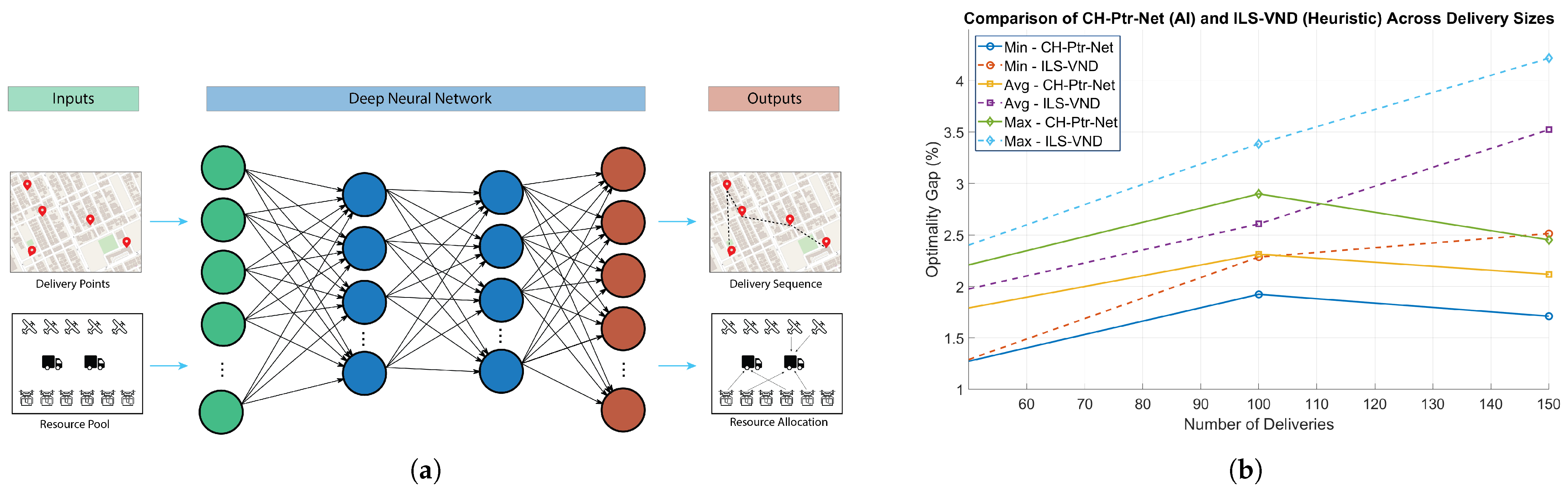
AI improves demand forecasting and route optimization in LMD but with critical limitations. Figure 7a below shows a deep neural network-based system, where the network takes delivery locations and fleet availability as inputs to optimize assignments and routes. Although AI provides enhanced speed and efficiency, AI’s performance relies on data quality, model generalizability, and computational efficiency. Demand forecasting is undermined by market volatility, seasonality, and data sparsity, which cause inaccurate predictions.
Figure 7.
Comparison of AI-based and heuristic-based approaches in LMD optimization. (a) A deep neural network system optimizes delivery assignments and routes based on delivery locations and fleet availability. (b) The optimality gap comparison between an AI-based CH-Ptr-Net and a heuristic-based ILS-VND across different delivery sizes highlights AI’s superior scalability in large-scale logistics.
Route optimization enhances delivery scheduling but is hindered by real-world limitations such as traffic and road closures. AI models have high computational costs for training but result in quicker inference compared to recalculating optimal routes using heuristics or mathematical programming, which becomes infeasible with a growing problem size. Figure 7b compares the optimality gap of an iterative local search heuristic (ILS-VND) with a graph neural network constraint-based hybrid pointer network (CH-Ptr-Net) for various sizes of delivery [61,62]. While the AI-based approach, CH-Ptr-Net, retains lower optimality gaps, the heuristic-based strategy displays greater variation as well as increasing gaps when the number of deliveries increases. This demonstrates the superiority of AI in scaling the optimization to huge logistics networks.
Table 3.
Summary of approaches in logistics automation and AI strategies.
Table 3.
Summary of approaches in logistics automation and AI strategies.
| Reference | Problem Nature | Objective | Result | Category |
|---|---|---|---|---|
| [3] | Human resource workload balancing for last-mile delivery | Optimize workload distribution among workers based on delivery zones and distances | Multi-algorithm approach achieves balanced workloads and reduced travel times | Decision-making |
| [4] | Data-driven optimization for last-mile delivery | Combine machine learning with VRP optimization to improve delivery time predictions and route efficiency | Proposed method offers 5% performance improvement over traditional optimization methods | Routing |
| [14] | Heterogeneous multi-drone last-mile delivery optimization | Propose ensemble multi-objective genetic approach for heterogeneous drone delivery problem | Ensemble genetic algorithm provides superior optimization performance for drone-based delivery | Routing |
| [15] | Parcel consolidation and UAV routing for last-mile delivery | Optimize UAV routing and consolidation to minimize delivery costs and delays | Discrete particle swarm optimization with reinforcement learning improved cost-efficiency | Routing |
| [19] | Locker-drone delivery network design | Optimize locker locations and drone allocations to minimize costs | Multi-capacity drone system reduces the number of lockers and drones required | Predict traffic |
| [20] | Two-phase optimization approach for drone package pickup and delivery | Optimize scheduling and route-planning for drones in multi-depot, multi-customer scenarios | Simulated Annealing based two-phase optimization enhances delivery efficiency compared to traditional methods | Routing |
| [22] | Route planning for last-mile deliveries using mobile parcel lockers | Develop hybrid Q-learning based method to optimize location and route planning for mobile parcel lockers | Hybrid Q-learning method outperforms traditional algorithms in optimizing delivery routes | Routing |
| [23] | Real-time city express delivery with adaptive matching | Maximize platform revenue through adaptive matching of couriers and parcel collection tasks | Proposed approach improves delivery matching efficiency and revenue | Decision-making |
| [24] | Autonomous recharging and mission planning for drones | Develop multi-criteria TSP model for drone flight mission planning and recharging optimization | Proposed model optimizes flight duration and battery recharging schedules for long-haul UAV missions | Routing |
| [57] | Truck-drone delivery optimization using multi-agent reinforcement learning | Optimize drone flight trajectories and truck routing using reinforcement learning | Multi-agent reinforcement learning model showed significant time efficiency improvements | Routing |
| [44] | Pickup and delivery with crowdshipping and dynamic occasional drivers | Develop event-based rolling horizon approach for dynamic driver availability | Proposed approach improves supply chain resilience under disruptions | Decision-making |
| [52] | Dynamic demand management and online tour planning for same-day delivery | Integrate pricing optimization with online tour planning to improve delivery profitability | Anticipatory approach improves contribution margin by up to 50% over traditional approaches | Decision-making Predict traffic |
| [53] | Data-driven methodology for last-mile routing | Incorporate driver preferences and historical data into route optimization for real-world application | Hierarchical approach aligns driver routes with optimized paths | Routing Predict traffic |
| [55] | Reconfiguration of last-mile parcel delivery supply chains | Propose a machine learning and routing optimization approach for supply chain reconfiguration | Reduced travel times by 22.6% and improved sustainability indicators | Routing |
| [56] | Crowdsourced last-mile delivery with parcel allocation and crowd routing | Develop data-driven column generation for crowdsourced delivery routing | Joint optimization reduces delivery costs by 32% | Routing |
| [58] | Group-based cooperative reinforcement learning for delivery area assignment | Optimize delivery area assignment with cooperative reinforcement learning to balance workloads | GCRL achieves 12% efficiency improvement over state-of-the-art models | Decision-making |
| [59] | Machine learning optimization for third-party logistics | Propose a heuristic and machine learning approach for logistics optimization | Heuristic outperforms traditional methods in optimizing capacity and cost management | Decision-making |
| [60] | Stochastic modeling of order fulfillment and last-mile delivery | Analyze cost-service trade-offs in quick-commerce last-mile delivery | Integrated model reduces fulfillment cost while maintaining high delivery reliability | Predict traffic |
| [63] | Emergency last-mile logistics for public health emergencies | Develop PTOCA framework for courier allocation | Outperforms baseline in delivery rate and on-time delivery | Decision-making |
| [64] | On-demand last-mile distribution network design | Integrate inventory and network design into last-mile distribution under tight deadlines | Omnichannel inventory pooling improves delivery speed but increases inventory cannibalization | Decision-making |
| [65] | Optimal placement of drone delivery stations | Use bio-inspired algorithms to optimize drone station placement and demand allocation | Simulated annealing reduces costs by 14%, improves runtime by 6.2 times over baseline models | Predict traffic |
| [66] | Attended home delivery with multiple visits | Propose an Adaptive Large Neighborhood Search for delivery under stochastic customer availability | Parallelized ALNS reduces delivery costs by up to 32% by planning for second visits | Predict traffic |
| [67] | Last-mile delivery by vehicle and drone for subscription-based orders | Optimize customer prioritization for consistent drone and vehicle delivery over multiple days | Matheuristic model offers logistical cost improvements of up to 0.5% for consistent drone service | Decision-making |
| [27] | Parallel drone scheduling traveling salesman problem | Enhance metaheuristic with Q-learning for drone scheduling | Q-learning enhances performance, solving drone TSP problems efficiently | Decision-making |
| [68] | Integrated warehouse assignment and carton configuration optimization | Propose deep clustering-based evolutionary algorithms to minimize fuel costs and total carton volume | DECIPACO model achieves significant improvements in cost and volume optimization | Decision-making |
2.5. Internet of Things (IoT) in LMD
IoT has really managed to revolutionize logistics in LMD, including real-time tracking that enhances efficiency and improves visibility across supply chains. These IoT devices are connected and further allow for ease of communication. Indeed, access to data is an integral component of facilitating real-time optimization in delivery operations. Such real-time interaction becomes so relevant in the process of handling complexities arising in LMD. A summary of the reviewed literature on IoT-enabled solutions is provided in Table 4.
2.5.1. Real-Time Tracking and Visibility
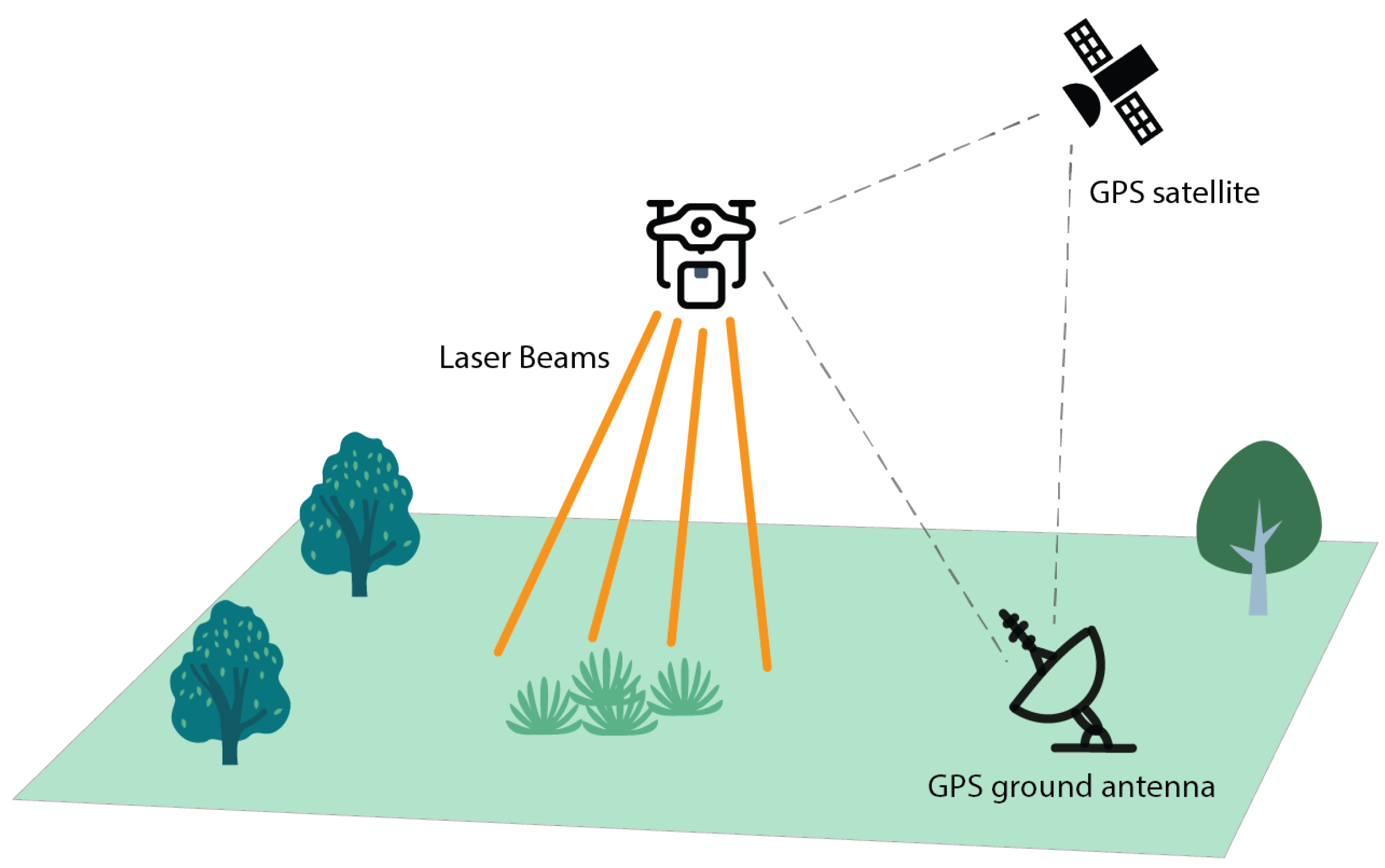
One of the key contributions of IoT to LMD is the ability for real-time monitoring and tracking of delivery vehicles and parcels. IoT-enabled devices, such as GPS trackers and sensors as shown in Figure 8, help the logistics company track the location of parcels and their present condition during the journey of delivery. This information in real time adds to the element of transparency and helps reduce risks related to delays or lost packages. Wanganoo and Patil [69] again define IoT-enabled tracking systems as an indispensable part of logistics providers in cities where every form of traffic and routing complexity exists. In addition, the visibility enabled by IoT guarantees that logistics providers can reroute their deliveries due to traffic and hence optimize the delivery times in traffic conditions. Furthermore, Ivankova et al. [70] confirm that IoT devices installed within supply chains decrease the cost of operation through lower human errors and higher real-time visibility. Their work describes how the application of IoT sensors and GPS systems enhances the ability of logistics providers to track parcels efficiently, thereby increasing customer satisfaction and overall operational efficiency.
Figure 8.
A drone equipped with Lidar technology and GPS navigation. The Lidar system emits laser pulses to map out the terrain below so that obstacles can be detected, while GPS satellites and a GPS ground antenna provide precise location data for accurate navigation. This combination ensures highly efficient and safe operations, even in challenging environments.
2.5.2. IoT Enabled Smart Lockers
Another key development in IoT integration for LMD pertains to smart parcel lockers. In such contexts, these lockers would be equipped with IoT sensors to enable automated processing of parcel delivery and pickup. Tang et al. [71] take China as a case study and also prove that IoT-based smart lockers improve accessibility for consumers, which facilitates better delivery efficiency and customer convenience. Integration of IoT in such lockers will enable the tracking of parcels in real time, as well as auto-notification of the customers, and it serves as a facility for secure package retrieval. It thus reduces the chances of missed deliveries and theft of packages. It is therefore proper to say that IoT-based intelligent lockers are turning out to be a necessity for e-commerce logistics in delivering flexible and reliable package management.
2.5.3. Drone Based IoT Systems
LMD also demonstrates notable applications of IoT in drone-based delivery systems. Drones equipped with IoT sensors can keep an eye on their surroundings, retrieve data in real time, and adjust their flight patterns on the fly to optimize delivery. Chen et al. [72] propose an IoT-based drone delivery solution by introducing the DroneTalk system, which integrates GPS, visual information, and autonomous flight control systems that allow seamless delivery within the urban environment. DroneTalk is based on IoT for real-time weather and collision avoidance monitoring, hence extremely efficient, especially in last-mile deliveries in urban and mixed indoor-outdoor environments. The 3D4 presented by Eeshwaroju et al. [73] leverages IoT technology in executing vertical deliveries for drones to high-rise buildings. The 3D4 system gives a flexible and robust solution for the challenges in urban delivery by enabling dynamic deliveries and rerouting drones based on real-time environmental factors like traffic and weather.
2.5.4. Energy and Resource Management with IoT
IoT integration in LMD has also facilitated the adoption of energy and resource management improvements. IoT devices installed in the delivery vehicles, be it drones or trucks, track fuel consumption, battery life, and vehicle performance in real-time. In this respect, Xu et al. [74] suggest an IoT-based as well as Mobile Edge Computing (MEC)-based energy-aware computation management strategy in order to improve the energy efficiency of the UAVs in LMD applications. Their MEC-based task offloading system optimizes energy consumption without sacrificing operational efficiency and hence is considered a major solution to lower the environmental impact of logistics operations. Similarly, Arora et al. [75] also highlight that IoT data-capturing systems facilitate an increase in operational efficiencies by observing the performance of LMD resources like delivery personnel, vehicles, and drones. IoT-enabled monitoring aids logistics companies in making better decisions on the allocation of resources to optimize deliveries with regard to cost and energy consumption.
2.5.5. IoT and Blockchain Integration
Blockchain technology and IoT can be used together to increase the security and trust of LMDs in sectors where, for instance, pharmaceutical or food goods need to be prepared and kept at precise temperatures. Markovic et al. [76] discuss how IoT and blockchain can be combined to realize a transparent and secure system for food delivery. IoT sensors monitor the temperature and conditions of transit food items, and blockchain provides immutability of data and shares data with all stakeholders.
2.5.6. Enhancing Last-Mile Efficiency with IoT
Elvas et al. [77] indicate that the integration of IoT with other disruptive technologies, such as AI and big data, will enable logistics providers to optimize their routes for delivery, thus reducing fuel consumption and enhancing customer satisfaction. IoT’s role in LMD is very critical since it enhances coordination among different stakeholders in this network and helps make deliveries even in worse conditions. In South Africa, for example, Kafile and Mbhele [78] examine how IoT has influenced last-mile logistics concerning cost and quality. The results showed that costs have reduced with the integration of IoT coupled with the attainment of higher levels of quality in the delivery services. The authors insisted that IoT technology accrues enormous benefits on account of increased operational efficiency in last-mile logistics in emerging markets like South Africa.
2.5.7. Benefit and Risks of IoT Integration
IoT integration enhances real-time monitoring, fleet management, and predictive maintenance in LMD, minimizing delays and operational expenditure. It brings with it risks of cybersecurity, exorbitant deployment costs, and data privacy issues. Figure 9a illustrates the benefits and risks of IoT adoption.
Figure 9.
(a) Benefits and risks of IoT integration in logistics, showing key advantages and challenges. (b) Interaction between AI and IoT, where AI-driven analytics enhance IoT sensing for real-time decision-making and adaptive logistics operations.
AI and IoT complement one another in facilitating data-driven decision-making. AI complements IoT by deriving insights from sensor data for route planning, demand prediction, and predictive maintenance. The AI model improves accuracy through feedback learning. Figure 9b depicts this process, demonstrating how AI-based analytics and IoT-based sensing make the logistics network adaptive and intelligent.
Drone-based deployment of computer vision tasks can facilitate automatic parcel recognition, obstacle avoidance, and traffic management. They also demand lots of processing capacity and persistent connectivity. Sensor malfunction and inaccuracy of data may cause problems; nevertheless, sensors, GPS, and RFID have the potential to enhance navigation accuracy, asset monitoring, and delivery validation.
Table 4.
Summary of Approaches in IoT.
Table 4.
Summary of Approaches in IoT.
| Reference | Problem Nature | Objective | Result | Category |
|---|---|---|---|---|
| [69] | IoT-enabled last-mile logistics for smart cities | Propose a conceptual framework integrating GPS, IoT, and TMS for real-time visibility and smart last-mile delivery | Improved real-time visibility, seamless coordination, and enhanced decision-making in last-mile delivery | Tracking |
| [70] | IoT’s role in transforming logistics | Examine how IoT can transform logistics and enhance efficiency | IoT provides transformative potential for logistics, enabling better data collection and analysis | Tracking |
| [71] | Consumer perceptions and IoT-based smart parcel lockers in China | Analyze consumer perceptions on IoT-based parcel lockers and factors affecting service quality | Identified key factors impacting consumer satisfaction, including service reliability, convenience, and diversity | Smart locker |
| [72] | DroneTalk: IoT-based drone delivery system | Develop DroneTalk, an IoT-based drone delivery system for mixed indoor-outdoor autonomous navigation | Achieved 99% successful drone flights without collision in simulations | Drone |
| [73] | An IoT based Three-Dimensional Dynamic Drone Delivery (3D4) System | Propose a 3D4 system for vertical and dynamic drone deliveries using an IoT, cloud-based platform for high-rise and dynamic locations | Enables flexible, secure deliveries to any location including high-rise balconies and windows, reducing traffic congestion and enhancing delivery security | Drone |
| [74] | Energy-aware computation management for UAVs in logistics | Develop an energy-aware task offloading strategy for UAVs using Mobile Edge Computing (MEC) | TOSS strategy optimizes energy consumption and task completion time | Energy Management |
| [75] | Automation and IoT for high-quality last-mile logistics | Explore IoT-based automation for improving last-mile logistics efficiency through better tracking and route optimization | Enhanced field executive performance and better customer service with IoT-enabled tracking and route management | Tracking Energy Management |
| [76] | IoT, Provenance, Blockchain for trust in last-mile food deliveries | Integrate IoT, blockchain, and provenance tracking to enhance trust and transparency in food delivery | Blockchain-enabled provenance tracking enhances transparency and food safety in last-mile delivery | Blockchain |
| [77] | Disruptive technologies for last-mile delivery efficiency | Propose a combination of disruptive technologies, including AI, IoT, Blockchain, and Big Data for last-mile delivery improvement | Disruptive technologies provide improved efficiency, lower costs, and sustainable solutions for last-mile delivery | Efficiency |
| [78] | IoT-enhanced last-mile distribution in South Africa | Investigate the impact of IoT on the cost and quality of last-mile logistics in South Africa | IoT integration reduces costs and improves delivery quality | Efficiency |
2.6. Energy Management and Optimization
Energy management has become one of the most important challenges in last-mile logistics due to the growing adoption of both UAVs and electric vehicles. Energy constraints of these systems such as battery life, load capacity, and demand for frequent recharging, call for operational solutions that are characterised by efficiency, cost-effectiveness, and environmental sustainability. A summary of the reviewed literature on energy management strategies is provided in Table 5.
2.6.1. UAV Energy Optimization and Recharging Strategy
UAVs have recently attracted much attention because of their potential as an environmentally friendly alternative to traditional vehicles. Yet, the range or limited capacity of their onboard battery poses enormous problems. Pan et al. [79] introduce an approach whereby UAVs are supported with a crowdsourced fleet of buses equipped with wireless recharging systems. In this process, enroute UAVs are allowed to land on those buses at any place for recharging purposes, extending operational range without using any dedicated charging stations. The proposed Energy-Neutral Flight Principle enables UAVs to retain energy reserves along their flight and thus facilitates efficient parcel delivery along optimal routes that leverage the mobility of buses.
In addition to crowdsourced recharging, the work in [80] discusses shared resources for depots, where drone-friendly fulfillment centers serve as charging nodes for UAVs. These are strategically located depots that enable the drones to recharge and optimize routes in real-time. The research underlines the importance of taking the nonlinear energy consumption of drones into consideration, especially when they move with heavier loads.
2.6.2. Hybrid Truck–Drone Systems and Energy Efficiency
While UAVs are good for short-range deliveries, a hybrid truck–drone system makes a more scalable solution that is being applied today to longer-range operations. He et al. [81] describe how trucks are used as mobile hubs moving drones to the delivery zones at which they can take over the last mile of delivery. Such a hybrid approach saves energy because the drone is not in flight for the entire journey, with the added advantage of saving on fuel through optimal routing of the truck. One such routing optimization is proposed by Alyassi et al. [24], where a path optimization of flights by using AI-driven systems is discussed. Real-time data such as the current weather condition of the day and battery vitals are combined with energy-efficient algorithms in order to dynamically readjust the flight path.
2.6.3. AI-Driven Energy Consumption Prediction
AI-driven energy management holds the potential to ensuring that delivery missions are not disrupted due to a shortage of energy. Urban et al. [82] deal with a neural network-based model that forecasts the energy consumption during a drone’s mission. In view of internal factors such as payload and external conditions such as weather, the system dynamically readjusts flight paths to avoid the incidence of drones running out of energy mid-flight. The predictive capability thus ensures success in delivery-related missions and improves the general reliability of drone-based systems.
2.6.4. Quantitative Synthesis of Energy Management
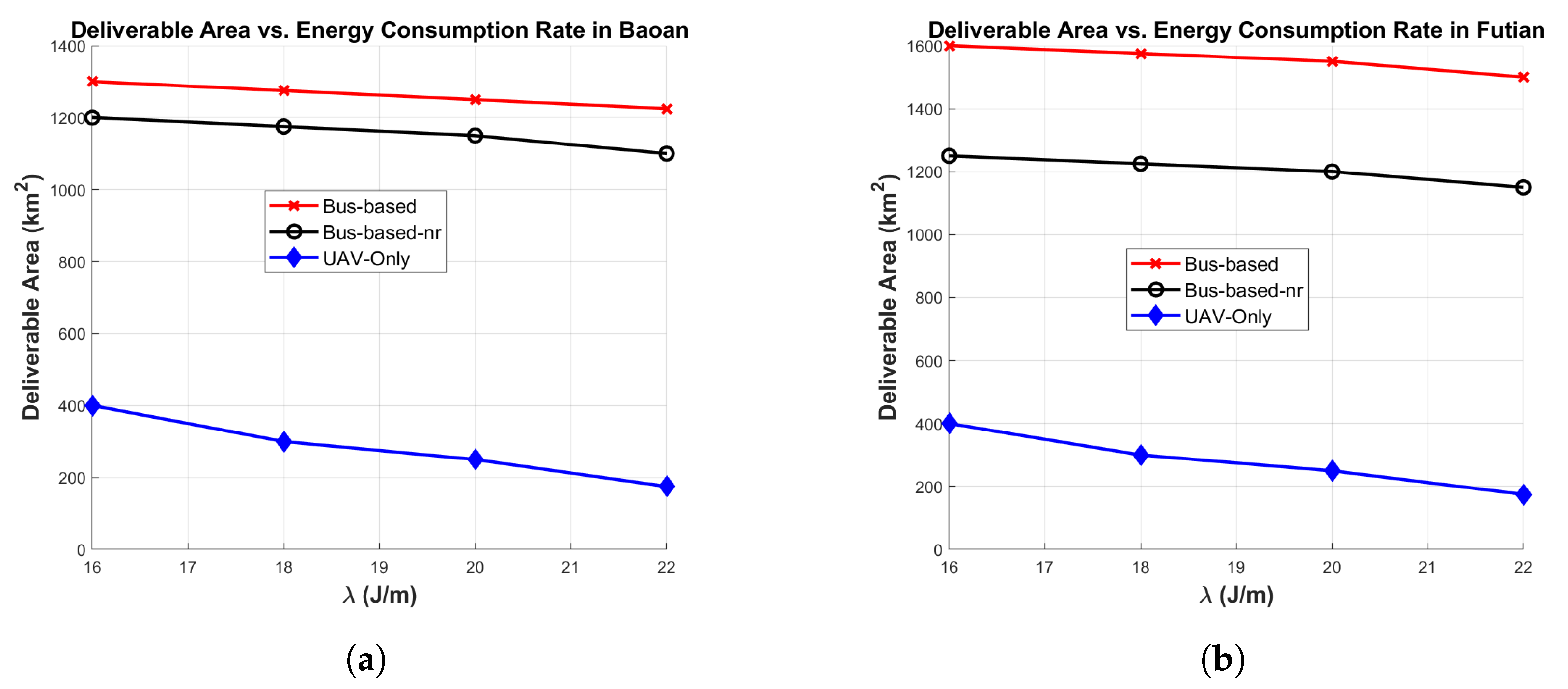
Energy consumption plays a crucial role in UAV-based delivery operations, especially in large-scale LMD systems. Figure 10a shows the energy consumption rate versus deliverable area in Baoan, China. When UAV energy consumption rises from 16 J/m to 22 J/m, the deliverable area of UAV-only operations decreases by 56.2%. By comparison, bus-based and bus-based with no recharging (bus-based-nr) incur a decrease of 8.9% and 16.1%, respectively, showing the benefit of hybrid delivery models in alleviating energy limitations [79].
Figure 10.
Energy consumption rate vs. deliverable area in (a) Baoan and in (b) Futian, China. The UAV-only approach experiences a sharp decline in coverage as energy consumption increases, whereas hybrid models (bus-based and bus-based-nr) maintain a larger deliverable area by leveraging bus stops to reduce UAV flight time [79].
Likewise, Figure 10b provides results for Futian, China, with a 12.9% and 17.3% saving for bus-based and bus-based-nr models, respectively, whereas UAV-only operations experience a sharp drop. The energy efficiency in hybrid models comes from UAVs landing on buses en-route, which cuts down on constant flight energy consumption. These results demonstrate the imperatives of energy-conscious routing planning and hybrid vehicle coordination to streamline UAV-based last-mile deliveries [79].
Table 5.
Summary of approaches in energy management and optimization.
Table 5.
Summary of approaches in energy management and optimization.
| Reference | Problem Nature | Objective | Result | Category |
|---|---|---|---|---|
| [79] | Energy-limited logistics UAV schedule using crowdsourced buses | Increase delivery range and load capacity of UAVs by landing on buses for recharging, optimize delivery scheduling | Increased delivery range and load capacity for UAVs, cost-effective and environment-friendly solution | Recharging |
| [80] | Drone-aided last-mile delivery with shared depot resources and fleet size plans | Optimize selection of shared fulfillment centers and fleet size for drone routes in last-mile delivery | Efficient drone fleet planning with reduced energy consumption, demonstrated computational efficiency on large instances | Recharging |
| [81] | Impact of regulations on a heterogeneous UAS-integrated last-mile delivery system | Examine the effects of operational regulations on the energy efficiency of truck-drone delivery systems | Truck-drone hybrid system saves 1.60 US gallons of gasoline under FAA regulations, competitive energy consumption | Hybrid |
| [82] | Energy management in autonomous delivery drones with AI-driven regression model | Develop a neural network-based AI-driven energy management model for predicting drone mission success | AI-based model improves energy consumption predictions and prevents mission failure in delivery drones | AI-driven |
2.7. Smart Locker Systems
The adoption of smart lockers has rapidly increased. The concept of smart lockers works as an alternative to traditional home deliveries because they let customers pick up packages at their leisure times and solve some of the logistical problems that many delivery companies face. It integrates smart lockers into urban and rural environments to optimize the delivery process, enhancing customer convenience and flexibility with a secure service at a lower cost of delivery. A summary of the reviewed literature on smart locker systems is provided in Table 6.
2.7.1. Urban and E-Grocery Applications
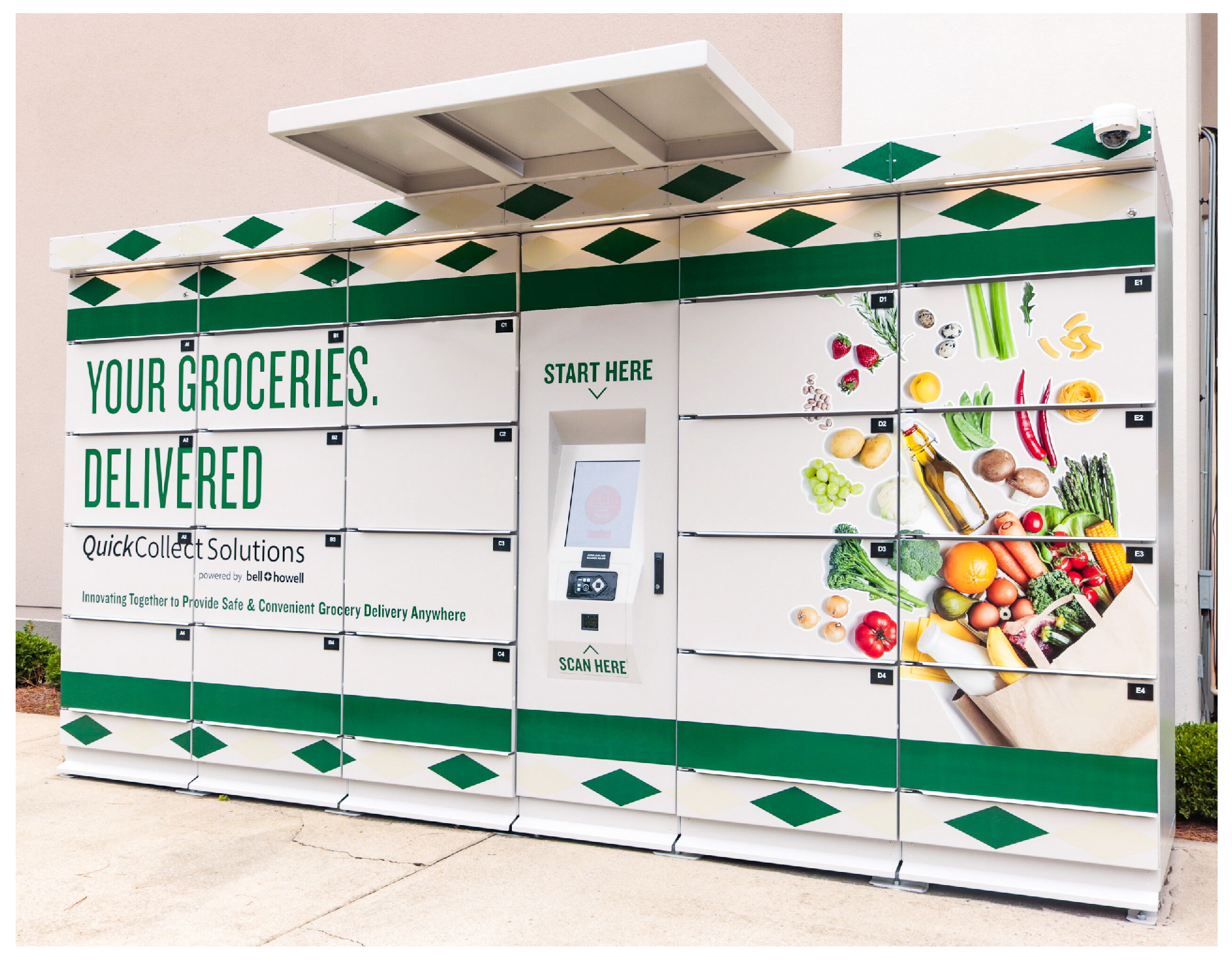
The presence of smart lockers is highly relevant to urban settings because they play a huge role in solving issues concerning traffic congestion, failed home deliveries, and environmental concerns arising in the case of conventional LMD. Leyerer et al. [83] discuss an integrated smart logistics approach that accommodates the peculiarities of the e-grocery sector. These are optimized for a network of refrigerated grocery lockers in decentralized transshipment points. Customers either pick up their ordered goods themselves from these lockers or have them delivered to their homes with the aid of electric cargo bicycles. This model reduces delivery distance and thereby associated emissions by a large extent compared to traditional methods. Urban e-grocery services with smart lockers imply more sustainable transportation and service level enhancement; for example, in this case, groceries can be refrigerated to prevent them from perishing before the customer is available. Figure 11 is an example of a smart locker system for groceries.
Figure 11.
Smart lockers for refrigerated grocery deliveries. These lockers provide a very secure, temperature-controlled environment for last-mile delivery of groceries, ensuring freshness and convenience for customers. Image Source: Bell & Howell QuickCollect GL Refrigerated Grocery Locker (https://bellhowell.net/products/quickcollect-gl-refrigerated-grocery-locker/, accessed on 14 December 2024).
2.7.2. Service Area Optimization
The placement of smart lockers should be very efficient so that utilities related to LMD are maximized. Che et al. [84] targeted the smart parcel locker service area optimization problem and presented a multi-objective optimization model. Their objective was to achieve maximum coverage with no overlap in the catchment area, while reducing locker idle capacity. With the contribution of the Taguchi method to nondominant sorting genetic algorithm II, this research demonstrated how optimally placed lockers can further create enhanced efficiency in the service while additionally minimizing operational costs and environmental impacts. Sawik [21] also explores smart lockers with capillary distribution networks and crowdshipping models, proving how they can allow for further efficiency gains. Sawik [21] was able to identify that smart locker systems must be integrated with the optimization of vehicle routing and facility location in order to offer cost-effective and green delivery options.
2.7.3. Customer Adoption and Satisfaction
Success in the adoption of smart lockers for LMD also depends on customer acceptance and satisfaction. In this respect, Yuen et al. [85] research the mechanisms that drive customer adoption of smart lockers, including convenience, privacy, and reliability, as key drivers of perceived value. With the help of a structural equation modeling analysis, they found that perceived value and transaction costs significantly influence customers’ intention to use smart lockers. Quan et al. [86] also conduct a study in Vietnam, where smart lockers remain a relatively new concept. This study showed that convenience and the location of lockers are vital in enhancing customer satisfaction with online shopping experiences.
The smart lockers also cut the ineffectiveness brought about by failed deliveries and, consequently, redelivery attempts. Added to these advantages are growing awareness of environmental sustainability, making smart lockers an attractive alternative to both logistics providers and customers. In projects that offer customers flexible parcel collection points around the clock, smart lockers prevent them from feeling annoyed due to waiting for home delivery, thus helping enhance overall satisfaction.
2.7.4. Rural Applications
Smart lockers provide potential alternatives in the rural areas marked by poor infrastructure, which mostly hinders traditional delivery approaches. Gundu [87] posits that there are massive opportunities for the application of smart lockers in the rural settings of South Africa, possibly improving last-mile logistics. The smart lockers provide a safe and convenient means for rural consumers to collect their parcels from accessible locations such as hospitals or police stations. This provides a sense of security and cuts down delivery costs and delays.
Table 6.
Summary of approaches that use smart locker systems.
Table 6.
Summary of approaches that use smart locker systems.
| Reference | Problem Nature | Objective | Result | Category |
|---|---|---|---|---|
| [21] | Optimizing Last-Mile Delivery: A Multi-Criteria Approach with Automated Smart Lockers, Capillary Distribution, and Crowdshipping | Develop multi-criteria optimization models integrating smart lockers, crowdshipping, and capillary distribution networks | Optimized locker deployment reduces costs and enhances delivery efficiency in last-mile delivery strategies | Service area |
| [83] | Shortening the Last Mile in Urban Areas: Optimizing a Smart Logistics Concept for E-Grocery Operations | Develop a multi-echelon optimization model to minimize costs for urban e-grocery deliveries using grocery lockers and electric cargo bikes | Optimized grocery locker locations and routes reduce emissions and shorten last-mile distances, enhancing sustainability | E-grocery |
| [84] | Multiobjective Optimization for Planning the Service Areas of Smart Parcel Locker Facilities in Logistics Last Mile Delivery | Propose a multiobjective optimization model for planning the location service areas of smart parcel locker facilities | Taguchi method and NSGA-II produce favorable solutions for optimizing service areas, reducing costs and improving delivery efficiency | Service area |
| [85] | The Determinants of Customers’ Intention to Use Smart Lockers for Last-Mile Deliveries | Analyze the impact of convenience, privacy, and reliability on customers’ intention to use smart lockers | Perceived value and transaction costs mediate the impact of smart locker attributes on customer intention | Customer satisfaction |
| [86] | Impact of smart locker use on customer satisfaction of online shoppers in Vietnam | Use structural equation modeling to assess the effect of smart locker attributes on customer satisfaction | Convenience, privacy, security, and reliability significantly impact customer satisfaction in Vietnam’s emerging e-commerce market | Customer satisfaction |
| [87] | Smart Locker System Acceptance for Rural Last-Mile Delivery | Analyze the likelihood of rural customers accepting smart lockers using an enhanced unified theory of acceptance and use of technology (EUTAUT) model | Identifies critical determinants of rural customers’ acceptance of smart lockers, and presents a modified UTAUT model based on focus group data | Rural LMD |
| [88] | Community logistics: A dynamic strategy for facilitating immediate parcel delivery to smart lockers | Propose Community Logistics Strategy (CLS) for real-time delivery updates to smart lockers | CLS outperforms traditional strategies by reducing delivery time and improving real-time request handling in dense urban areas | Service area |
| [89] | Location Optimization for Community Smart Parcel Lockers | Propose a bilevel programming model to optimize the location of community smart parcel lockers | Maximizes supplier profit and user satisfaction using a genetic algorithm, based on medium-scale residential community data in China | Service area |
| [90] | Customers’ intention to adopt smart lockers in last-mile delivery service | Integrate resource matching theory, innovation diffusion theory, and theory of planned behavior to understand customers’ intention to use smart lockers in Thailand | Convenience, reliability, privacy security, and compatibility significantly influence customers’ intention to use smart lockers | Customer satisfaction |
3. Operational Optimization: Strategies for Efficiency
Operational optimization deals with all the LMD strategies that attempt to maximize operational efficiency. This section details practical solutions including crowdsourcing and multimodal delivery models which are useful in this regard by discussing how they reduce operational costs, ensure timely deliveries, and triumph above fluctuating consumer demand amidst geographic complexities. A summary of the reviewed literature on operational optimization strategies is provided in Table 7.
3.1. Crowdsourced Delivery
Crowdsourcing has been evolving as one of the key ways to enhance the efficiency of LMD through the use of third-party couriers or casual drivers. In this regard, a logistics company dynamically assigns the delivery tasks to independent drivers who are using their own vehicles for delivering the packages. Crowdsourced delivery models are operationally flexible and allow logistics providers to scale up quickly to meet fluctuating demand without building a dedicated fleet. Figure 12 depicts a scenario of crowdsourced delivery.
Figure 12.
A crowdsourced last-mile delivery scenario where green circles represent available online couriers ready for delivery, and red circles indicate offline couriers not currently participating. Blue squares represent depots where packages are picked up before distribution by the couriers. This graphic depicts the dynamic nature of crowdsourced delivery, utilizing both active and inactive couriers in the system.
Silva et al. [1] investigate the data-driven approach of deep reinforcement learning for the optimization of crowdsourced last-mile deliveries. Their model performs dynamic task assignment to casual drivers at any instant in time, taking real-time availability and the demands of the customers into consideration. Similarly, Meng et al. [7] suggest the variable neighborhood search algorithm for the optimization of paths and order allocations to firm vehicles and crowdsourced couriers. Such a solution ensures that delivery routes are planned in a way that total travel distance is reduced while customer delivery windows are maintained.
Li et al. [91] further develop an auction-based framework for crowdsourcing first- and last-mile delivery operations. Their work emphasizes the importance of incentivizing the couriers through dynamic pricing models that balance both courier and platform preferences in order to yield enhanced quality of service and efficiency.
Jazemi et al. [54] further explore how crowdsourced drivers can significantly reduce operational costs while increasing flexibility, especially during periods of high demand, such as holidays or major promotional events. In general, this kind of flexibility due to crowdsourcing is deemed critical in managing surges in demand without substantial infrastructure investments. Using their current driver networks, platforms such as Uber and Lyft have effectively launched parcel delivery services. Machado [92] expanded on this concept by presenting deliveries made by crowdsourcing that are included into bus networks and other public transportation systems. Machado [92] was able to conclusively show how buses can convey small packages as well, using the same vehicles for both freight and passenger transportation. Crowdsourced delivery lessens the need for more vehicles by utilizing drivers and already-existing public infrastructure, which helps to minimize emissions and traffic.
3.2. Multimodal Delivery Models
Multimodal delivery is fast gaining popularity as a means of streamlining last-mile logistics by combining different transport modes: trucks, bikes, drones, and even public transport. Such systems fully utilize the peculiar advantages of each transport mode to create faster and less costly parcel delivery. Trucks are suited for long-distance hauls, whereas drones and tricycles are good in dense environments, especially where short distances need to be covered without delay.
Chen et al. [93] formulate the multi-fleet delivery problem that aims at effective delivery task assignment to trucks, tricycles, and drones under multiple monetary constraints. This approach was found to have the ability to significantly improve delivery efficiency while at the same time showing that lowering operational costs is possible compared to unimodal delivery systems. Vehicles of every type are used according to their respective capacity, flexibility, and speed. In a similar vein, Boysen et al. [94] analyze a two-echelon delivery system that combines autonomous cargo tunnels and micro hubs for multimodal deliveries in urban areas. The last mile would be covered by electric cargo bikes and drones from strategically located micro hubs. This makes the delivery process flexible and sustainable by using the different transport modes most efficiently for each delivery route.
Recently, drones have also found their place within the multimodal delivery systems. The review in [54] investigated the sharing of depot resources in drone-assisted LMD systems. In the review, the authors analyzed how drones could cooperate with trucks so that they can efficiently perform parcel delivery by selecting the most optimal launch points that will be able to minimize energy consumption This exemplifies the potential for collaboration between drones and trucks in the realm of short-distance deliveries, wherein trucks are responsible for the transportation to designated launch sites. Machado et al. [92] further investigated the integration of freight delivery into pre-existing bus networks as an element of a multimodal approach. The study showed that this integration of modes of transportation including buses for most of the deliveries and smaller vehicles for the last mile will bring significant reductions in operating costs and traffic congestion.
The multimodal option involves using each delivery mode optimally according to the context. More importantly, it provides logistics companies with flexibility in managing delivery volumes and scaling operations during peak seasons. Furthermore, Van Der Gaast and Arslan [95] illustrate how crowdshipping services and personal shopper systems can further optimize delivery solutions by integrating with multimodal networks, lowering costs and environmental impact.
Table 7.
Summary of operational optimization approaches in last-mile delivery.
Table 7.
Summary of operational optimization approaches in last-mile delivery.
| Reference | Problem Nature | Objective | Result | Category |
|---|---|---|---|---|
| [1] | Deep reinforcement learning (DRL) for stochastic last-mile delivery with crowdshipping | Implement DRL techniques to optimize same-day deliveries using occasional drivers (ODs) | DRL model minimizes delivery costs and improves flexibility with dynamic routing | Multimodal |
| [7] | Variable neighbourhood search for crowdsourced delivery scheduling | Optimize crowdsourced delivery schedules using variable neighbourhood search | VNS reduces delivery costs and improves scheduling efficiency in dynamic environments | Multimodal |
| [93] | Multi-fleet delivery problem with trucks, tricycles, and drones | Optimize multi-fleet delivery logistics under budget constraints | MFDP model improves cost efficiency and delivery time in mixed fleet scenarios | Crowdsourced |
| [91] | Auction-based crowdsourced first and last mile logistics | Propose an auction-based model to optimize crowdsourced delivery routes | Auction model improves efficiency in crowdsourced delivery while reducing costs | Multimodal |
| [92] | Integration of freight deliveries into passenger bus networks | Develop exact and heuristic algorithms for bus network optimization with freight integration | Freight and passenger integration reduces the number of buses required for urban deliveries | Multimodal Crowdsourced |
| [94] | Two-echelon last-mile delivery via cargo tunnels and delivery person | Propose a two-echelon model using cargo tunnels and delivery personnel for urban logistics | The cargo tunnel approach reduces surface traffic while optimizing last-mile delivery efficiency | Crowdsourced |
| [95] | Personal shopper systems in last-mile logistics | Compare the performance of personal shopper systems vs. inventory-owned delivery systems | Personal shopper systems are more efficient for small-sized customer orders | Crowdsourced |
| [96] | Bi-level optimization for last-mile delivery with multiple satellites | Develop a bi-level framework to optimize satellite-based last-mile delivery | Bi-level optimization improves the synchronization of goods at inner-city hubs, reducing congestion and emissions | Multimodal |
| [97] | Last-mile distribution using cargo bikes | Analyze the feasibility and sustainability of cargo bike delivery in urban areas | Cargo bikes reduce emissions and operational costs while improving delivery times | Multimodal |
4. Courier Centric Approaches
Numerous studies have highlighted courier satisfaction in the last-mile logistics context since any effective delivery system relies on couriers. Thus, their needs should be considered to attain high service quality and operational efficiency. The work in [98] is a good example of a heuristic approach to improve courier satisfaction through the dynamic assignment of each courier to a compact, geographically defined territory that matches demand. This method shortens each courier’s journey and makes them more familiar to particular delivery locations. Another top aim is striking a balance between courier well-being and customer satisfaction. In this context, Zhu et al. [99] emphasize the necessity of employing sophisticated operational models, including variable delivery time slots or region-based delivery optimization, to strike a compromise between client demand and courier satisfaction. A summary of the reviewed literature on courier-centric approaches is provided in Table 8.
Table 8.
Summary of courier-centric approaches in last-mile delivery.
Table 8.
Summary of courier-centric approaches in last-mile delivery.
| Reference | Problem Nature | Objective | Result | Category |
|---|---|---|---|---|
| [98] | Courier satisfaction in rapid delivery systems | Investigate how dynamic operating regions affect courier satisfaction in rapid delivery systems | Dynamic regions increase courier satisfaction and improve operational efficiency | Courier-centric |
| [99] | Evolution of transportation methods in last-mile delivery | Review transportation methods focusing on balancing courier needs and operational efficiency | Emphasizes balancing courier needs with operational demands to improve service quality and efficiency | Courier-centric |
5. Summary of Key Findings
This section consolidates the most important insights from the review on technological advancement, algorithmic strategies, and operational models that significantly enhanced LMD systems. Addressing efficiency, sustainability, and cost-effectiveness, the findings present a comprehensive framework for improving modern logistics practices.
5.1. Algorithms for Optimization
Optimization algorithms can greatly improve LMD systems by addressing some of the more complex challenges in routing, cost-effectiveness, scalability, and energy efficiency, which are important things in the adaptation of operations to contexts that vary throughout urban, suburban, and rural environments. Such developments have resulted in much higher delivery efficiency, reduced operational costs, and enhanced customer satisfaction. As the e-commerce and sustainability complexities rise, these solutions provide more flexible and resilient approaches to modern supply chains. Table 9 summarises the results regarding the algorithmic efficiency improvements concerning LMD optimization.
Table 9.
Efficiency of algorithms in LMD optimization.
Table 9.
Efficiency of algorithms in LMD optimization.
| Reference | Algorithm(s) Used | Efficiency Metrics | Application Scenario |
|---|---|---|---|
| [65] | Genetic Algorithm | 10% reduction in total cost and improved runtime by 1.8 times. | Optimizing hybrid truck-drone last-mile delivery systems. |
| [65] | Simulated Annealing | 14% reduction in total cost and improved runtime by 6.2 times. | Hybrid truck-drone and depot planning scenarios. |
| [55] | Three-Stage Decomposition Algorithm | Improved travel time and distance by up to 22.6% and balanced workload for urban distribution. | Two-echelon vehicle routing problem with clustering and nearest-neighbor optimization. |
| [17] | Multi-Objective Optimization | Up to 40% reduction in delivery time using integrated simulation models. | Evaluating green parcel-delivery interventions with macroscopic traffic simulation and mode shift models. |
| [60] | Multi-Objective Optimization | 8.9% reduction in fulfillment costs while balancing delivery time and cost. | Integrated order fulfillment processes. |
| [11] | Hybrid Metaheuristics | 15% improvement in solving TSP-D problems with binary pheromone frameworks. | Drone-based last-mile delivery optimization. |
| [29] | Adaptive Large Neighborhood Search (ALNS) | Reduced operational costs in two-echelon multimodal routing. | Urban logistics routing scenarios. |
| [66] | Adaptive Large Neighborhood Search | Achieved 32% cost savings for attended home delivery with stochastic modeling. | Residential attended deliveries with uncertainty. |
| [58] | Group-based Cooperative Reinforcement Learning (GCRL) | Improved delivery area efficiency by 12%. | Real-time delivery area assignment. |
| [39] | Hybrid Evolutionary Algorithms | Enhanced delivery zone partitioning with equitable workload distribution. | Urban last-mile logistics. |
| [68] | DEC-based Optimization | Balanced fuel costs and carton volumes. | Warehousing logistics and vehicle routing. |
| [46] | Multi-objective Optimization (CPSS Framework) | Balanced drone trajectory planning for safety, energy, and efficiency. | Superchilling delivery using drones. |
| [88] | Real-Time Community Logistics Strategy | Order fulfilment rate of 98.8%. | Immediate parcel delivery using smart lockers. |
5.2. Energy and Carbon Emission Reduction
Sustainability in last-mile logistics is a high-priority concern, and new strategies and systems are showing dramatic reductions in energy consumption and emissions. These have been brought about by integrating energy-efficient technologies, optimizing delivery models, and using collaborative logistics systems. With increasingly stringent environmental regulations and growing consumer awareness, adoption is therefore not only advisable but increasingly necessary to remain competitive and sustainable. Table 10 summarises the main findings on strategies that enable energy savings and reduce carbon footprints.
Table 10.
Energy optimization and carbon emission reduction in last-mile delivery systems.
Table 10.
Energy optimization and carbon emission reduction in last-mile delivery systems.
| Reference | Method | Improvement | Application Scenario |
|---|---|---|---|
| [21] | Electric Vehicle Integration | Significant reduction in CO2 emissions compared to diesel or pertrol vehicles in dense urban areas. | Electric vehicle fleet deployment in urban logistics. |
| [2] | Delivery Consolidation | Decreases fuel consumption rate. | E-commerce home delivery consolidation. |
| [55] | Two-Echelon Distribution Network with Territory Design | Reduced CO2 emissions by 29% compared to k-means + NN. | Urban parcel delivery using territory design optimization. |
| [17] | Green Parcel Interventions | Emission levels reduced by 53% through combined interventions (BEVs, lockers). | Parcel deliveries integrating multiple green initiatives. |
| [8] | Two-Echelon Delivery Systems | Achieved CO2 reductions of 13–32% by combining parcel lockers and micro-hubs. | Urban logistics with intermediate hubs. |
| [6] | Energy-Efficient Routing | Reduced fleet energy consumption by up to 26% using optimized speed profiling and heterogeneous vehicles. | Urban logistics with route optimization. |
| [45] | Autonomous Delivery Robots + Public Transport | Reduced emissions by up to 90% for EVs. | Robot-assisted deliveries integrated with public transport. |
| [55] | Two-Echelon Systems | Achieved 22.6% reduction in energy consumption and travel time. | Reconfigured supply chain for parcel delivery. |
| [74] | TOSS (Task Offloading and Scheduling Strategy) | Only 7% of energy consumed for optimization | Energy-efficient UAV-based logistics. |
| [83] | Refrigerated Grocery Lockers + ECBs | Reduced emissions by integrating electric cargo bicycles. | E-grocery operations with electric bicycles. |
5.3. Cost Efficiency
Cost efficiency remains one of the key objectives in the enhancement of LMD, given the soaring cost of e-commerce and urban logistics. Innovating strategies have shown a great deal of promise in seriously reducing the cost of operations, including transportation, fuel, and labor costs. Therefore, leveraging advanced algorithms, fleet management techniques, and integrated delivery models, organizations can achieve economic sustainability alongside operational sustainability through such approaches. Table 11 summarizes some of the important observations in strategies that reduce costs concerning LMD.
Table 11.
Cost efficiency strategies in last-mile delivery.
Table 11.
Cost efficiency strategies in last-mile delivery.
| Reference | Strategy | Cost Savings Achieved | Application Scenario |
|---|---|---|---|
| [56] | Joint Optimization of Parcel Allocation and Crowd Routing | Reduced total costs by 32% compared to optimizing crowd-courier routes alone. | Crowdsourced last-mile delivery using data-driven column generation and rolling-horizon approaches. |
| [45] | Autonomous Delivery Robots + Public Transportation | Achieved a cost reduction of up to 7.5% compared to traditional approaches. | Synchronizing delivery robot routes with public transportation lines in urban logistics. |
| [17] | Parcel Lockers | Up to 23% reduction in delivery cost | Improving last-mile delivery efficiency in dense urban areas. |
| [55] | Territory Design with Satellite Location Decisions | Achieved a 12.93% reduction in fixed costs compared to k-means + NN. | Two-echelon urban parcel delivery optimization. |
| [65] | Simulated Annealing | Reduced total costs by 14%. | Hybrid truck-drone and depot planning scenarios. |
| [19] | Locker-Drone Systems | Operational costs lowered by up to 80%. | Optimized locker and drone delivery systems. |
| [47] | Multi-Vehicle Truck-and-Robot Routing Problem | Achieved 62% overall cost savings compared to traditional truck delivery methods. | Urban logistics with robot-assisted deliveries. |
| [47] | Multi-Vehicle Truck-and-Robot Routing Problem | Achieved up to 24% reduction in transportation costs using integrated multi-vehicle routing and robot scheduling. | Optimized truck-and-robot delivery for urban logistics. |
| [2] | Delivery Consolidation | Reduced transportation costs by up to 52%. | E-commerce home delivery consolidation. |
| [30] | Multi-Depot Routing Problem | Achieved cost reductions via adaptive ant colony optimization for truck-drone delivery. | Multi-depot routing for truck-drone logistics. |
| [14] | Hybrid Multi-Objective Optimization | Improved cost and customer satisfaction trade-offs in heterogeneous drone deliveries. | Drone fleet routing optimization. |
| [83] | Grocery Locker Integration | Achieved cost savings through reduced delivery routes. | E-grocery logistics with smart lockers. |
5.4. Customer Experience
Improvement in customer experience in last-mile logistics is one of the critical factors to maintain a competitive advantage and to meet the expectations of consumers in a fast-evolving e-commerce environment. Techniques that focus on enhancing delivery reliability, speed, and convenience contribute in a way that increases customer satisfaction. Advanced technologies, innovative routing algorithms, and dynamic delivery systems have brought practical improvement in delivery performance, enabling the companies to gain trust and build loyalty among their customers. Table 12 summarizes the main findings on techniques to enhance customer experience.
Table 12.
Methods enhancing customer experience in last-mile delivery.
Table 12.
Methods enhancing customer experience in last-mile delivery.
| Reference | Method | Improvement in Customer Satisfaction | Application Scenario |
|---|---|---|---|
| [60] | Quick-Commerce Fulfillment | The mean and standard deviation of order fulfillment time increase by 44.1% and 18.6%. | Fast e-commerce fulfillment strategies. |
| [9] | Dynamic Community Partitioning | Improved time window adherence for dense e-commerce orders. | Dynamic delivery area optimization. |
| [52] | Demand-Management and Online Tour-Planning | Improved customer satisfaction by ensuring same-day deliveries within narrow time spans while optimizing delivery prices and spans. | Enhancing same-day delivery operations for e-retail providers. |
| [100] | Drone-Based Delivery Systems | Reduced delivery time for small parcels by 20%. | Drone-assisted pickup and delivery scenarios. |
| [39] | Data-Driven Delivery Zone Partition | Increased on-time delivery rate by 2.2%. | Delivery zone optimization using reinforcement learning. |
| [46] | Parallel Delivery Framework (CPSS) | Enhanced reliability of drone delivery for superchilled products. | Superchilled product delivery using drones. |
| [85] | Automated Smart Lockers | Increased satisfaction due to enhanced convenience and reliability. | Urban logistics with smart parcel lockers. |
| [88] | Community Logistics Strategy | Improved responsiveness to immediate delivery requests. | Immediate parcel delivery using smart lockers. |
5.5. Advantages of Hybrid Systems
Hybrid delivery systems leverage a lot from the benefits of different transportation technologies and methodologies to increase efficiency, scalability, and ecological sustainability. These models can address a variety of logistic challenges, such as the reduction of costs, diminution of urban congestion, and enhancement of reliability in delivery, thus showing to be particularly effective in urban and rural settings. Combining both conventional and innovative technologies, hybrid systems assure flexibility and adaptability when addressing the constantly evolving requirements for LMD. Table 13 summarizes the advantages associated with these systems.
Table 13.
Advantages of hybrid systems in last-mile delivery.
Table 13.
Advantages of hybrid systems in last-mile delivery.
| Reference | System Type | Advantages | Application Scenario |
|---|---|---|---|
| [43] | Truck–UAV Collaboration | Reduced delivery time and fuel consumption through synchronized operations between trucks and multiple UAVs. | Hybrid logistic routing using the multiple Flying Sidekick Travelling Salesman Problem (mFSTSP). |
| [19] | Locker–Drone Systems | Reduced operational costs by 80% and enhanced delivery flexibility. | Urban logistics using locker-drone integration. |
| [47] | Multi-Vehicle Truck–Robot Model | Achieved cost savings of 62% with dynamic task allocation. | Urban delivery with truck-robot coordination. |
| [36] | Cooperative Truck–Drone Models | Reduced delivery times and costs through advanced scheduling. | Rural logistics with truck-drone cooperation. |
| [43] | Drone–Truck Collaboration | Enhanced delivery efficiency by incorporating drones operating independently from trucks for last-mile delivery. | Parallel Drone Scheduling Traveling Salesman Problem (PDSTSP) using Q-learning-aided hybrid heuristics. |
| [30] | Drone–Truck Partnerships | Increased scalability and operational efficiency by 15%. | UAV-assisted parcel consolidation in urban areas. |
| [29] | Two-Echelon Multimodal Systems | Improved delivery flexibility and cost efficiency in urban logistics. | Multi-commodity multimodal routing for urban deliveries. |
| [101] | Drone–Truck Collaboration | Achieved higher delivery reliability in steep rural terrains. | Logistics in steep rural terrains using truck-drone partnerships. |
| [83] | Hybrid Grocery Locker–Electric Cargo Bicycle System | Reduced urban congestion and enhanced delivery efficiency. | E-grocery operations using lockers and electric bicycles. |
5.6. Advantages of IoT Integration
IoT technologies are now fundamentally changing LMD by enabling real-time monitoring, dynamic routing, and enhanced operational transparency. Improvement in reliability, better utilization of resources, and automation tend to overcome some of the largest inefficiencies in logistics structures. Organizations are therefore able to respond to dynamic changes in logistical requirements with increased levels of customer satisfaction and effectiveness through the incorporation of innovative solutions like smart lockers, predictive analytics, and real-time tracking enabled through IoT. Table 14 summarizes the main findings about the benefits of IoT in LMD.
Table 14.
Advantages of IoT in ast-mile delivery.
Table 14.
Advantages of IoT in ast-mile delivery.
| Reference | Method | Advantages | Application Scenario |
|---|---|---|---|
| [72] | DroneTalk IoT Platform | Achieved a 99% flight success rate in mixed environments. | IoT-integrated UAV logistics. |
| [78] | IoT-Enabled Vehicle Tracking and Fleet Management | Improved operational efficiency through real-time tracking, proactive decision-making, and reduced delivery delays. | Last-mile logistics in urban South Africa. |
| [77] | IoT-Based Real-Time Monitoring Systems | Enhanced operational efficiency through spatial and temporal management, reducing urban traffic and CO2 emissions. | Collaborative last-mile delivery in urban environments with integrated real-time data. |
| [76] | PROoFD-IT System | Enabled real-time compliance monitoring for food safety, reducing manual record-keeping and increasing transparency. | Urban food logistics with IoT-integrated delivery systems. |
| [73] | IoT-Based Dynamic Drone Delivery System (3D4) | Enabled flexible, contactless, and secure vertical and dynamic deliveries, reducing delivery delays and enhancing customer satisfaction. | High-rise building and urban parcel delivery using 3D4 intelligent platforms. |
| [71] | IoT-Based Smart Parcel Lockers | Improved service convenience, reliability, and fault handling capability, positively impacting customer satisfaction. | Urban and suburban logistics for parcel pickup and delivery in China. |
| [69] | Integrated IoT with GPS and TMS Systems | Improved real-time visibility, automated route optimization, and reduced delivery delays. | Last-mile parcel delivery in urban environments with poor addressing systems. |
6. Identified Research Gaps
While there are a lot of notable advancements, several big gaps in LMD research do exist, which provide ample opportunities for further exploration and innovation. These gaps point to areas where the current solutions are either insufficient or underdeveloped, especially in the issues of scalability, sustainability, and integration of emerging technologies. Addressing these challenges can help create more robust, efficient, and inclusive logistics systems. Table 15 summarizes the key research gaps identified in LMD optimization.
Table 15.
Identified research gaps in last-mile delivery optimization.
Table 15.
Identified research gaps in last-mile delivery optimization.
| Research Gap | Description |
|---|---|
| Lack of Combined Intervention Assessments | Existing studies primarily focus on single-dimensional impacts of individual interventions, such as BEVs or parcel lockers. No prior research has comprehensively modeled the multidimensional impacts of combined interventions in a well-fitted urban simulation environment. |
| Limited Real-Life Data Integration | Pilot projects for green parcel-delivery interventions are in reality context-specific, costly, and time-consuming, with limited transferability of findings to other settings. Simulation-based methods can provide more actionable and scalable solutions but remain underutilized. |
| Neglect of Proximity Station Optimization | Current models using parcel shops and lockers assume only a uniform distribution across delivery areas, ignoring the sequential pick-up process and location optimization that could enhance efficiency and ecological impact. |
| Scalability of Automated Smart Locker Systems | The need for models that handle large-scale automated smart locker networks and provide scalable solutions across various urban settings. |
| Integration of Diverse Distribution Strategies | Limited research on integrating automated lockers, capillary distribution, and crowdshipping into cohesive multimodal delivery systems. |
| Lack of Real-Time Data Utilization in Models | Existing optimization models, most of the time do not add real-time data, which is critical for adapting to dynamic urban logistics scenarios. |
| Limitations of Existing UAV Path Planners | Current UAV path planners fail to consider real-world factors like wind speed, payload weight, and energy consumption, leading to suboptimal routing decisions for long-haul missions. |
| Very few existing scalable Multi-UAV Coordination Models | There is a scarcity of models and algorithms for coordinating multiple UAVs simultaneously with shared or mobile charging stations to handle large-scale delivery scenarios. |
| Absence of Integrated Dynamic Re-Planning | Existing frameworks do not support real-time dynamic re-planning based on environmental changes, such as wind conditions or unexpected battery usage. |
| Limited Research on Multi-Commodity and Multimodal Systems | Current studies focus either on multi-commodity or multimodal transportation, but not their integration in a two-echelon system. |
| User Heterogeneity in Multimodal Logistics | Lack of comprehensive models that account for varying customer preferences in multimodal logistics systems. |
| Scalability of Adaptive Algorithms | Limited exploration of adaptive algorithms for solving large-scale instances of two-echelon multi-commodity multimodal VRPs. |
| Limited Integration of Learning Techniques for Multiple Purposes in Metaheuristics | Most studies integrate machine learning techniques into metaheuristics for a single purpose, such as algorithm selection or parameter tuning. The potential of using machine learning for multiple purposes, like operator selection and parameter setting, remains underexplored, limiting the performance of metaheuristic algorithms in solving complex optimization problems. |
| Limited Multi-Depot UAV Integration | While UAVs have been integrated with single-depot vehicle routing models, the complexity of multi-depot systems with heterogeneous trucks and UAVs remains underexplored, particularly in urban and mixed topologies. |
| Integration of ADRs with Public Transportation | Limited exploration of the integration between autonomous delivery robots (ADRs) and public transportation systems, especially for large-scale urban instances. |
| Comprehensive CPSS Framework for Drone Delivery | Lack of consideration of privacy and safety concerns in existing UAV trajectory planning models, coupled with inadequate integration of social, energy, and work efficiency objectives. |
| Lack of Mixed Indoor–Outdoor Delivery Models | Current systems are most of the time relying solely on GPS, which limits their ability to navigate in mixed environments, such as entering buildings for complete deliveries. DroneTalk highlights this gap by providing a solution that integrates visual localization and IoT for seamless indoor-outdoor navigation. |
| Lack of Dynamic Customer Demand Consideration in Parcel Locker Optimization | Existing models for planning smart parcel locker service areas focus on static parameters, therefore not realistic, such as fixed customer locations and demand, without accounting for dynamic and uncertain customer behavior, limiting real-world applicability. |
| Lack of Comprehensive Studies on LMD Transportation Modes | Research on certain LMD means of transportation, like drones or EVs, is expanding, but very few studies have looked at all of the modes of transportation, their development, and their similarities. This makes it possible to do a more holistic research in this field. |
7. Taxonomy of Last-Mile Delivery Optimization
Our proposed taxonomy gives a comprehensive classification for LMD optimization, addressing many of the gaps identified in previous review works. While some studies, such as Zhu et al. [99], bring useful views on various modes of transportation and the challenges in LMD, they do not bring a holistic view of the linkages between approaches and technology. Eskandaripour and Boldsaikhan [18] also primarily concentrate on drone-based LMD, but they do not address more general LMD optimization strategies that are central to our taxonomy, including multi-agent models or the use of IoT. Furthermore, the review by Jazemi et al. [54] does not provide a well-defined categorization scheme for LMD optimization techniques; thus, it cannot give a broad understanding of the different methodologies and their interrelationships.
Our taxonomy synthesizes a variety of methodologies, technologies, and approaches used in LMD optimization, therefore offering a comprehensive framework of analysis, categorizing under one unified structure the many strategies and tools used to address challenges related to cost-effectiveness, sustainability, and adaptability. The taxonomy uncovers knowledge about the interconnections and relationships between different dimensions of optimization. Figure 13 summarizes our taxonomy for LMD optimization.
Figure 13.
Taxonomy of last-mile delivery optimization.
8. Emerging Trends and Future Direction
This section details the trends that will shape last-mile delivery mechanisms in the near future. The logistics industry, facing increasing demands for transparency, efficiency, and scalability, is seeing the emergence of technologies such as blockchain, virtual reality (VR), augmented reality (AR), and automation driven by artificial intelligence (AI) as some of the most important contributors. Blockchain technology provides secure and transparent frameworks that enhance trust and coordination throughout the supply chain. VR and AR are redefining efficiency in operations and customer experience, especially in warehouse management and delivery precision. AI and automation promise scalable, cost-effective solutions ranging from autonomous vehicles to real-time decision-making systems. Together, these technologies signal a future where logistics providers can move toward faster, greener, and more reliable delivery systems able to meet the dynamic needs of businesses and consumers. Additionally, this section also discuses legal, financial, and infrastructural constraints that affect LMD and how emerging technologies may be incorporated in Rural LMD.
8.1. Blockchain
Blockchain technology has gathered considerable momentum in LMD because of its potential to facilitate transparency, security, and non-repudiation throughout the supply chain. A blockchain is a digital immutable ledger that is used to record every transaction step involved in delivery, from warehouse management to final delivery. Blockchain holds the promise of reducing fraud, disputes, and inefficiencies, particularly in industries where it is most needed, such as pharmaceuticals, food logistics, and high-value goods. Markovic [76] investigates the combination of IoT, provenance, and blockchain technology for trusted last-mile food delivery, showing that these technologies provide end-to-end transparency and traceability, thereby fostering consumer trust and improving food safety. Likewise Budak [102] demonstrates that blockchain enables real-time access to information to all the stakeholders, thus fostering collaboration among logistics providers, shippers, and customers. Blockchain can also enable automated payments and smart contracts that trigger payment based on successful delivery. Figure 14 illustrates a simplified representation of a blockchain.
Figure 14.
A blockchain model for last-mile delivery, beginning with a genesis block that initializes the system. Each subsequent block records delivery transactions that can include any or all of the following: courier IDs, depots, customer locations, and also the timestamps. The chain of blocks is linked by cryptographic hashes, which are the main reason that transparency, security, and traceability of each delivery is enforced.
8.2. Virtual and Augmented Reality
Virtual and augmented reality (VR/AR) are expected to play a more vital role in route optimization and customer experience. AR may be used in the warehouse to optimize operations such as picking orders by providing instructions in real time for the workers to reduce errors and further increase the speed of the process [103,104].
8.3. AI and Automation
The use of AI and automation plays a vital role in the future of LMD and holds the key to completely revolutionize the way logistics companies have traditionally been working. Amazon, FedEx and other companies have already begun to employ the use of self-driving vehicles such as drones and ground robots. These self-driving vehicles navigate city streets on their own, incredibly without the need for human beings, thus saving human labor while offering scalable solutions that match fluctuating delivery needs. In the future, these method may be widely applied to urban logistics, especially for shorter distances and same-day deliveries, where time and efficiency are a crucial factor. In particular, UAVs hold huge potential in automating LMD because they are able to avoid congestion on the road. They would be ideal for fast and short-distance deliveries even in rural areas. Overtime, AI and automation keep on advancing, and in turn, LMD will be shaped by these technologies, enabling faster, more reliable, and environmentally friendly delivery solutions.
8.4. Legal, Financial, and Infrastructure Constraints
The implementation of LMD technologies is confronted with regulatory policy issues, large upfront costs, and a lack of infrastructure. Legal obstacles, such as airspace rules for UAVs and labor legislation for autonomous vehicles, restrict widespread adoption. From a financial perspective, the high cost of purchasing and maintaining UAVs, ground robots, and AI-powered systems continues to be a great challenge for a lot of businesses. Infrastructural limitations, including charging outlets for electric vehicle fleets and access to telecommunication networks in remote areas, also rule out large-scale integration for now. Removing these limits requires policy innovation and public–private investment, as well as infrastructural technological advancement to facilitate scalable LMD solutions.
8.5. Integration of LMD in Rural Areas
Rural LMD integration is particularly challenging because of dispersed populations, greater delivery distances, and lower infrastructure. Although UAVs provide encouraging opportunities for bridging last-mile gaps, their practicality is impacted by energy limitations, environmental issues, and legal considerations. In rural logistics, hybrid strategies that combine autonomous ground robots, UAVs, and conventional transportation methods can increase accessibility and efficiency. IoT-enabled tracking and AI-powered route optimization can also improve delivery performance, bringing reliable and affordable LMD services to disadvantaged communities.
9. Conclusions
Optimization of LMD is still key to meeting the needs of urbanization, e-commerce growth, and sustainability pressures. This review identified the contributions of AI, IoT, and hybrid logistics models towards enhancing routing efficiency, operational flexibility, and cost-effectiveness. Yet, for these technologies to reach their full potential, fundamental legal, financial, and infrastructural barriers need to be surmounted.
One of the key findings is the importance of combining AI and IoT to strengthen predictive analytics and real-time decision-making in logistics. Demand forecasting and dynamic route optimization powered by AI have been demonstrated to have substantial improvements. However, their efficiency is contingent on the availability of data and computational scalability. The future lies in the exploration of adaptive AI models, which can work in uncertain and sparse data situations.
Another main takeaway is the potential for hybrid truck–drone delivery systems to increase delivery range and enhance energy efficiency. As shown in the energy management synthesis, UAV-only operations are subject to drastic energy limitations, whereas hybrid models alleviate these problems via strategic recharging and routing optimization. Logistics providers should prioritize the implementation of hybrid fleet strategies because this allows the maximum operational scalability to be achieved.
From a sustainability standpoint, green logistics initiatives like electric vehicles, shared delivery lockers, and multimodal last-mile distribution offer encouraging prospects. Regulatory and infrastructural issues are the main impediments to large-scale implementation; policy incentives and public–private partnerships are necessary to hasten the evolution of sustainable LMD solutions.
The future of LMD must balance human versus automated logistics. While automation maximizes efficiency, human couriers and traditional logistics networks remain valuable for reliability and adaptability. Research in the future must create hybrid human–AI logistics systems that adopt autonomous technologies without sacrificing operational flexibility.
Finally, to ensure the evolution of LMD, policymakers, industry, and academia must work together to close technology gaps, regulatory hurdles, and infrastructure constraints in order for the logistics sector to achieve a sustainable, resilient, and affordable last-mile delivery network.
Author Contributions
Conceptualization, A.S.S. and A.S.M.; methodology, A.S.S.; investigation, A.S.S.; resources, A.S.M. and T.R.S.; writing—original draft preparation, A.S.S.; writing—review and editing, A.S.M. and T.R.S.; visualization, A.S.S. and A.S.M.; supervision, A.S.M. and T.R.S.; project administration, A.S.S., A.S.M. and T.R.S. All authors have read and agreed to the published version of the manuscript.
Funding
This research received no external funding.
Data Availability Statement
Not applicable.
Acknowledgments
The authors would like to acknowledge the support of King Fahd University of Petroleum and Minerals (KFUPM) and the Department of Computer Engineering.
Conflicts of Interest
The authors declare no conflicts of interest.
References
- Silva, M.; Pedroso, J.P.; Viana, A. Deep reinforcement learning for stochastic last-mile delivery with crowdshipping. EURO J. Transp. Logist. 2023, 12, 100105. [Google Scholar] [CrossRef]
- Muñoz-Villamizar, A.; Velazquez-Martínez, J.C.; Caballero-Caballero, S. A large-scale last-mile consolidation model for e-commerce home delivery. Expert Syst. Appl. 2024, 235, 121200. [Google Scholar] [CrossRef]
- Moreno-Saavedra, L.M.; Jiménez-Fernández, S.; Portilla-Figueras, J.A.; Casillas-Pérez, D.; Salcedo-Sanz, S. A multi-algorithm approach for operational human resources workload balancing in a last mile urban delivery system. Comput. Oper. Res. 2024, 163, 106516. [Google Scholar] [CrossRef]
- Chu, H.; Zhang, W.; Bai, P.; Chen, Y. Data-driven optimization for last-mile delivery. Complex Intell. Syst. 2023, 9, 2271–2284. [Google Scholar] [CrossRef]
- Colajanni, G.; Daniele, P.; Nagurney, A. Centralized supply chain network optimization with UAV-based last mile deliveries. Transp. Res. Part C Emerg. Technol. 2023, 155, 104316. [Google Scholar] [CrossRef]
- Moon, J.; Anwar, H.; Villani, M.; Fahim, M.Q.; Jain, P.; Ahmed, Q.; Ramakrishnan, K. Energy-Efficient Routing of a Heterogeneous Vehicle Fleet with Optimized Speed Profiling. In Proceedings of the 2023 IEEE Conference on Control Technology and Applications (CCTA), Bridgetown, Barbados, 16–18 August 2023; pp. 835–840. [Google Scholar] [CrossRef]
- Meng, F.; Zhou, X.; Piao, X.; Chu, D. Variable neighbourhood search based on Metropolis criterion for crowdsourced delivery scheduling problem in dispatch model. Comput. Oper. Res. 2024, 167, 106662. [Google Scholar] [CrossRef]
- Pinchasik, D.R.; Hovi, I.B.; Dong, B. Replacing home deliveries by deliveries to parcel lockers: Cost, traffic, emissions, and societal cost effects of locker network expansions in greater Oslo. Int. J. Logist. Res. Appl. 2023, 1–26. [Google Scholar] [CrossRef]
- Ouyang, Z.; Leung, E.K.; Cai, Y.; Huang, G.Q. Dynamic community partitioning for e-commerce last mile delivery with time window constraints. Comput. Oper. Res. 2023, 160, 106394. [Google Scholar] [CrossRef]
- Mo, B.; Wang, Q.; Guo, X.; Winkenbach, M.; Zhao, J. Predicting drivers’ route trajectories in last-mile delivery using a pair-wise attention-based pointer neural network. Transp. Res. Part E Logist. Transp. Rev. 2023, 175, 103168. [Google Scholar] [CrossRef]
- Gunay-Sezer, N.S.; Cakmak, E.; Bulkan, S. A Hybrid Metaheuristic Solution Method to Traveling Salesman Problem with Drone. Systems 2023, 11, 259. [Google Scholar] [CrossRef]
- Ballano, A.; Al-Rahamneh, A.; Serrano-Hernandez, A.; Faulin, J. Agent-based modelling and simulation for hub and electric last mile distribution in Vienna. Procedia Comput. Sci. 2023, 220, 718–723. [Google Scholar] [CrossRef]
- Yao, R. Multiple Optimization Methods of Automatic Application in Last-mile Delivery System. In Proceedings of the 2023 International Conference on Power, Electrical Engineering, Electronics and Control (PEEEC), Athens, Greece, 25–27 September 2023; pp. 291–294. [Google Scholar] [CrossRef]
- Wen, X.; Wu, G.; Li, S.; Wang, L. Ensemble multi-objective optimization approach for heterogeneous drone delivery problem. Expert Syst. Appl. 2024, 249, 123472. [Google Scholar] [CrossRef]
- Li, X.; Yan, P.; Yu, K.; Li, P.; Liu, Y. Parcel consolidation approach and routing algorithm for last-mile delivery by unmanned aerial vehicles. Expert Syst. Appl. 2024, 238, 122149. [Google Scholar] [CrossRef]
- Castillo Campo, O.; Álvarez Fernández, R. Economic optimization analysis of different electric powertrain technologies for vans applied to last mile delivery fleets. J. Clean. Prod. 2023, 385, 135677. [Google Scholar] [CrossRef]
- Bell, L.; Spinler, S.; Winkenbach, M.; Müller, V. Assessing economic, social and ecological impact of parcel-delivery interventions in integrated simulation. Transp. Res. Part Transp. Environ. 2023, 121, 103817. [Google Scholar] [CrossRef]
- Eskandaripour, H.; Boldsaikhan, E. Last-Mile Drone Delivery: Past, Present, and Future. Drones 2023, 7, 77. [Google Scholar] [CrossRef]
- Zou, B.; Wu, S.; Gong, Y.; Yuan, Z.; Shi, Y. Delivery network design of a locker-drone delivery system. Int. J. Prod. Res. 2024, 62, 4097–4121. [Google Scholar] [CrossRef]
- Hong, F.; Wu, G.; Luo, Q.; Liu, H.; Fang, X.; Pedrycz, W. Logistics in the Sky: A Two-Phase Optimization Approach for the Drone Package Pickup and Delivery System. IEEE Trans. Intell. Transp. Syst. 2023, 24, 9175–9190. [Google Scholar] [CrossRef]
- Sawik, B. Optimizing Last-Mile Delivery: A Multi-Criteria Approach with Automated Smart Lockers, Capillary Distribution and Crowdshipping. Logistics 2024, 8, 52. [Google Scholar] [CrossRef]
- Liu, Y.; Ye, Q.; Escribano-Macias, J.; Feng, Y.; Candela, E.; Angeloudis, P. Route planning for last-mile deliveries using mobile parcel lockers: A hybrid q-learning network approach. Transp. Res. Part E Logist. Transp. Rev. 2023, 177, 103234. [Google Scholar] [CrossRef]
- Li, Y.; Wu, Q.; Huang, X.; Xu, J.; Gao, W.; Xu, M. Efficient Adaptive Matching for Real-Time City Express Delivery. IEEE Trans. Knowl. Data Eng. 2023, 35, 5767–5779. [Google Scholar] [CrossRef]
- Alyassi, R.; Khonji, M.; Karapetyan, A.; Chau, S.C.K.; Elbassioni, K.; Tseng, C.M. Autonomous Recharging and Flight Mission Planning for Battery-Operated Autonomous Drones. IEEE Trans. Autom. Sci. Eng. 2023, 20, 1034–1046. [Google Scholar] [CrossRef]
- Bentley, P.; Lim, S.L.; Arcaini, P.; Ishikawa, F. Using a Variational Autoencoder to Learn Valid Search Spaces of Safely Monitored Autonomous Robots for Last-Mile Delivery. In Proceedings of the Genetic and Evolutionary Computation Conference, Lisbon Portugal, 15–19 July 2023; pp. 1303–1311. [Google Scholar] [CrossRef]
- Russo, F.; Comi, A. Urban Courier Delivery in a Smart City: The User Learning Process of Travel Costs Enhanced by Emerging Technologies. Sustainability 2023, 15, 6253. [Google Scholar] [CrossRef]
- Chen, P.; Wang, Q. Learning for multiple purposes: A Q-learning enhanced hybrid metaheuristic for parallel drone scheduling traveling salesman problem. Comput. Ind. Eng. 2024, 187, 109851. [Google Scholar] [CrossRef]
- Li, Y.; Yang, J. The last-mile delivery vehicle routing problem with handling cost in the front warehouse mode. Comput. Ind. Eng. 2024, 190, 110076. [Google Scholar] [CrossRef]
- Wang, S.; Zhu, X.; Shang, P.; Lin, X.; Yang, L.; Tavasszy, L. Two-echelon multi-commodity multimodal vehicle routing problem considering user heterogeneity in city logistics. Expert Syst. Appl. 2024, 252, 124141. [Google Scholar] [CrossRef]
- Stodola, P.; Kutěj, L. Multi-Depot Vehicle Routing Problem with Drones: Mathematical formulation, solution algorithm and experiments. Expert Syst. Appl. 2024, 241, 122483. [Google Scholar] [CrossRef]
- Yang, Y.; Yan, C.; Cao, Y.; Roberti, R. Planning robust drone-truck delivery routes under road traffic uncertainty. Eur. J. Oper. Res. 2023, 309, 1145–1160. [Google Scholar] [CrossRef]
- Kuo, R.J.; Lu, S.H.; Lai, P.Y.; Mara, S.T.W. Vehicle routing problem with drones considering time windows. Expert Syst. Appl. 2022, 191, 116264. [Google Scholar] [CrossRef]
- Yin, Y.; Li, D.; Wang, D.; Ignatius, J.; Cheng, T.C.E.; Wang, S. A branch-and-price-and-cut algorithm for the truck-based drone delivery routing problem with time windows. Eur. J. Oper. Res. 2023, 309, 1125–1144. [Google Scholar] [CrossRef]
- Madani, B.; Ndiaye, M.; Salhi, S. Hybrid truck-drone delivery system with multi-visits and multi-launch and retrieval locations: Mathematical model and adaptive variable neighborhood search with neighborhood categorization. Eur. J. Oper. Res. 2024, 316, 100–125. [Google Scholar] [CrossRef]
- Pourmohammadreza, N.; Jokar, M.R.A. A Novel Two-Phase Approach for Optimization of the Last-Mile Delivery Problem with Service Options. Sustainability 2023, 15, 8098. [Google Scholar] [CrossRef]
- Zhen, L.; Gao, J.; Tan, Z.; Wang, S.; Baldacci, R. Branch-price-and-cut for trucks and drones cooperative delivery. IISE Trans. 2023, 55, 271–287. [Google Scholar] [CrossRef]
- Dieter, P.; Caron, M.; Schryen, G. Integrating driver behavior into last-mile delivery routing: Combining machine learning and optimization in a hybrid decision support framework. Eur. J. Oper. Res. 2023, 311, 283–300. [Google Scholar] [CrossRef]
- Imran, N.M.; Mishra, S.; Won, M. A-VRPD: Automating Drone-Based Last-Mile Delivery Using Self-Driving Cars. IEEE Trans. Intell. Transp. Syst. 2023, 24, 9599–9612. [Google Scholar] [CrossRef]
- Guo, B.; Wang, S.; Wang, H.; Liu, Y.; Kong, F.; Zhang, D.; He, T. Towards Equitable Assignment: Data-Driven Delivery Zone Partition at Last-mile Logistics. In Proceedings of the 29th ACM SIGKDD Conference on Knowledge Discovery and Data Mining, Long Beach, CA, USA, 6–10 August 2023; pp. 4078–4088. [Google Scholar] [CrossRef]
- Lehmann, J.; Winkenbach, M. A matheuristic for the Two-Echelon Multi-Trip Vehicle Routing Problem with mixed pickup and delivery demand and time windows. Transp. Res. C Part Emerg. Technol. 2024, 160, 104522. [Google Scholar] [CrossRef]
- Li, X. Multi-objective vaccine delivery problem considering low carbon and customer loss aversion. Expert Syst. Appl. 2023, 223, 119870. [Google Scholar] [CrossRef]
- Tiwari, K.V.; Sharma, S.K. An optimization model for vehicle routing problem in last-mile delivery. Expert Syst. Appl. 2023, 222, 119789. [Google Scholar] [CrossRef]
- Rinaldi, M.; Primatesta, S.; Bugaj, M.; Rostáš, J.; Guglieri, G. Development of Heuristic Approaches for Last-Mile Delivery TSP with a Truck and Multiple Drones. Drones 2023, 7, 407. [Google Scholar] [CrossRef]
- Tao, X.; Wang, Y.; Sun, Y.; Du, C.; Tang, S.; Li, J.; Ren, D. Heterogeneous teaching–learning based optimization with local search for the covering delivering problem in last mile delivery. Expert Syst. Appl. 2024, 252, 124176. [Google Scholar] [CrossRef]
- De Maio, A.; Ghiani, G.; Laganà, D.; Manni, E. Sustainable last-mile distribution with autonomous delivery robots and public transportation. Transp. Res. Part Emerg. Technol. 2024, 163, 104615. [Google Scholar] [CrossRef]
- Liu, H.; Tsang, Y.; Lee, C. A cyber-physical social system for autonomous drone trajectory planning in last-mile superchilling delivery. Transp. Res. Part C Emerg. Technol. 2024, 158, 104448. [Google Scholar] [CrossRef]
- Ostermeier, M.; Heimfarth, A.; Hübner, A. The multi-vehicle truck-and-robot routing problem for last-mile delivery. Eur. J. Oper. Res. 2023, 310, 680–697. [Google Scholar] [CrossRef]
- Lemardelé, C.; Pinheiro Melo, S.; Cerdas, F.; Herrmann, C.; Estrada, M. Life-cycle analysis of last-mile parcel delivery using autonomous delivery robots. Transp. Res. Part D Transp. Environ. 2023, 121, 103842. [Google Scholar] [CrossRef]
- Specht, M.; Widźgowski, S.; Stateczny, A.; Specht, C.; Specht, O. Comparative analysis of unmanned aerial vehicles used in photogrammetric surveys. TransNav 2023, 17, 433–443. [Google Scholar] [CrossRef]
- FoxtechRobot Official Site. Available online: https://www.foxtechrobot.com (accessed on 9 January 2025).
- Bao, D.; Yan, Y.; Li, Y.; Chu, J. The Future of Last-Mile Delivery: Lifecycle Environmental and Economic Impacts of Drone-Truck Parallel Systems. Drones 2025, 9, 54. [Google Scholar] [CrossRef]
- Klein, V.; Steinhardt, C. Dynamic demand management and online tour planning for same-day delivery. Eur. J. Oper. Res. 2023, 307, 860–886. [Google Scholar] [CrossRef]
- Ghosh, M.; Kuiper, A.; Mahes, R.; Maragno, D. Learn global and optimize local: A data-driven methodology for last-mile routing. Comput. Oper. Res. 2023, 159, 106312. [Google Scholar] [CrossRef]
- Jazemi, R.; Alidadiani, E.; Ahn, K.; Jang, J. A Review of Literature on Vehicle Routing Problems of Last-Mile Delivery in Urban Areas. Appl. Sci. 2023, 13, 3015. [Google Scholar] [CrossRef]
- Ramírez-Villamil, A.; Montoya-Torres, J.R.; Jaegler, A.; Cuevas-Torres, J.M. Reconfiguration of last-mile supply chain for parcel delivery using machine learning and routing optimization. Comput. Ind. Eng. 2023, 184, 109604. [Google Scholar] [CrossRef]
- Wang, L.; Xu, M.; Qin, H. Joint optimization of parcel allocation and crowd routing for crowdsourced last-mile delivery. Transp. Res. Part B Methodol. 2023, 171, 111–135. [Google Scholar] [CrossRef]
- Bi, Z.; Guo, X.; Wang, J.; Qin, S.; Liu, G. Truck-Drone Delivery Optimization Based on Multi-Agent Reinforcement Learning. Drones 2024, 8, 27. [Google Scholar] [CrossRef]
- Wang, H.; Wang, S.; Yang, Y.; Zhang, D. GCRL: Efficient Delivery Area Assignment for Last-mile Logistics with Group-based Cooperative Reinforcement Learning. In Proceedings of the 2023 IEEE 39th International Conference on Data Engineering (ICDE), Anaheim, CA, USA, 3–7 April 2023; Volume 2023, pp. 3522–3534. [Google Scholar] [CrossRef]
- Bruni, M.E.; Fadda, E.; Fedorov, S.; Perboli, G. A machine learning optimization approach for last-mile delivery and third-party logistics. Comput. Oper. Res. 2023, 157, 106262. [Google Scholar] [CrossRef]
- Raj, G.; Roy, D.; de Koster, R.; Bansal, V. Stochastic modeling of integrated order fulfillment processes with delivery time promise: Order picking, batching, and last-mile delivery. Eur. J. Oper. Res. 2024, 316, 1114–1128. [Google Scholar] [CrossRef]
- Gu, R.; Poon, M.; Luo, Z.; Liu, Y.; Liu, Z. A hierarchical solution evaluation method and a hybrid algorithm for the vehicle routing problem with drones and multiple visits. Transp. Res. Part C Emerg. Technol. 2022, 141, 103733. [Google Scholar] [CrossRef]
- Kong, F.; Jiang, B.; Wang, J.; Wang, H.; Song, H. Collaborative Delivery Optimization With Multiple Drones via Constrained Hybrid Pointer Network. IEEE Internet Things J. 2023, 11, 7739–7755. [Google Scholar] [CrossRef]
- Xia, K.; Lin, L.; Wang, S.; Wang, H.; Zhang, D.; He, T. A Predict-Then-Optimize Couriers Allocation Framework for Emergency Last-mile Logistics. In Proceedings of the 29th ACM SIGKDD Conference on Knowledge Discovery and Data Mining, Long Beach, CA, USA, 6–10 August 2023; pp. 5237–5248. [Google Scholar] [CrossRef]
- Snoeck, A.; Winkenbach, M.; Fransoo, J.C. On-demand last-mile distribution network design with omnichannel inventory. Transp. Res. Part E Logist. Transp. Rev. 2023, 180, 103324. [Google Scholar] [CrossRef]
- Elsaid, F.; Sanchez, E.T.; Li, Y.; Khamis, A. Optimal Placement of Drone Delivery Stations and Demand Allocation using Bio-inspired Algorithms. In Proceedings of the 2023 IEEE International Conference on Smart Mobility (SM), Thuwal, Saudi Arabia, 19–21 March 2023; pp. 39–44. [Google Scholar] [CrossRef]
- Özarık, S.S.; Lurkin, V.; Veelenturf, L.P.; Van Woensel, T.; Laporte, G. An Adaptive Large Neighborhood Search heuristic for last-mile deliveries under stochastic customer availability and multiple visits. Transp. Res. Part B Methodol. 2023, 170, 194–220. [Google Scholar] [CrossRef]
- El-Adle, A.M.; Ghoniem, A.; Haouari, M. The cost of carrier consistency: Last-mile delivery by vehicle and drone for subscription-based orders. J. Oper. Res. Soc. 2024, 75, 821–840. [Google Scholar] [CrossRef]
- Das, J.N.; Tiwari, M.K.; Sinha, A.K.; Khanzode, V. Integrated warehouse assignment and carton configuration optimization using deep clustering-based evolutionary algorithms. Expert Syst. Appl. 2023, 212, 118680. [Google Scholar] [CrossRef]
- Wanganoo, L.; Patil, A. Preparing for the smart cities: IoT enabled last-mile delivery. In Proceedings of the 2020 Advances in Science and Engineering Technology International Conferences (ASET), Dubai, United Arab Emirates, 4 February–9 April 2020. [Google Scholar] [CrossRef]
- Ivankova, G.V.; Mochalina, E.P.; Goncharova, N.L. Internet of Things (IoT) in logistics. IOP Conf. Ser. 2020, 940, 012033. [Google Scholar] [CrossRef]
- Tang, Y.M.; Chau, K.Y.; Xu, D.; Liu, X. Consumer perceptions to support IoT based smart parcel locker logistics in China. J. Retail. Consum. Serv. 2021, 62, 102659. [Google Scholar] [CrossRef]
- Chen, K.W.; Xie, M.R.; Chen, Y.M.; Chu, T.T.; Lin, Y.B. DroneTalk: An Internet-of-Things-Based Drone System for Last-Mile Drone Delivery. IEEE Trans. Intell. Transp. Syst. 2022, 23, 15204–15217. [Google Scholar] [CrossRef]
- Eeshwaroju, S.; Jakkula, P.; Abdellatif, I. An IoT based three-dimensional dynamic drone delivery (3D4) system. In Proceedings of the 2020 IEEE Cloud Summit, Harrisburg, PA, USA, 21–22 October 2020; pp. 119–123. [Google Scholar] [CrossRef]
- Xu, J.; Liu, X.; Li, X.; Zhang, L.; Jin, J.; Yang, Y. Energy-Aware Computation Management Strategy for Smart Logistic System with MEC. IEEE Internet Things J. 2022, 9, 8544–8559. [Google Scholar] [CrossRef]
- Arora, P.; Srivastava, S.; Majumder, S. Using automation technology and IOT based data capturing to ensure high quality last mile logistics. In Proceedings of the 3rd World Conference on Supply Chain Management, Colombo, Sri Lanka, 17–19 May 2017; pp. 5755–5756. [Google Scholar]
- Markovic, M.; Jacobs, N.; Dryja, K.; Edwards, P.; Strachan, N.J.C. Integrating Internet of Things, Provenance, and Blockchain to Enhance Trust in Last Mile Food Deliveries. Front. Sustain. Food Syst. 2020, 4, 563424. [Google Scholar] [CrossRef]
- Elvas, L.B.; Tokkozhina, U.; Martins, A.L.; Ferreira, J.C. Implementation of disruptive technologies for the last mile delivery efficiency achievement. Transp. Res. Procedia 2023, 72, 32–39. [Google Scholar] [CrossRef]
- Kafile, M.; Mbhele, T.P. Improving last mile distribution systems through the Internet of Things: A South African case. Acta Logist. 2023, 10, 597–603. [Google Scholar] [CrossRef]
- Pan, Y.; Li, S.; Chen, Q.; Zhang, N.; Cheng, T.; Li, Z.; Guo, B.; Han, Q.; Zhu, T. Efficient schedule of energy-constrained UAV using crowdsourced buses in last-mile parcel delivery. Proc. ACM Interact. Mob. Wearable Ubiquitous Technol. 2021, 5, 1–23. [Google Scholar] [CrossRef]
- Bruni, M.E.; Khodaparasti, S.; Perboli, G. Energy Efficient UAV-Based Last-Mile Delivery: A Tactical-Operational Model with Shared Depots and Non-Linear Energy Consumption. IEEE Access 2023, 11, 18560–18570. [Google Scholar] [CrossRef]
- He, C.; Singh, P.; P’yavka, S.; Wolfe, L.; Caldwell, K.; Islam, T.M.; Tang, C.; Mustafa, A. Balancing Trade-Offs: The Energy Efficiency of Unmanned Aircraft Systems Integration in Last-Mile Delivery and Operational Policy Restrictions. In Proceedings of the AIAA AVIATION FORUM AND ASCEND 2024, Las Vegas, NV, USA, 29 July–2 August 2024; p. 3646. [Google Scholar]
- Urban, M.; Aniculaesei, A.; Rausch, A. AI-Driven Runtime Monitoring of Energy Consumption in Autonomous Delivery Drones. Intell. Syst. Appl. 2023, 825, 267–283. [Google Scholar]
- Leyerer, M.; Sonneberg, M.O.; Heumann, M.; Breitner, M.H. Shortening the last mile in urban areas: Optimizing a smart logistics concept for e-grocery operations. Smart Cities 2020, 3, 585–603. [Google Scholar] [CrossRef]
- Che, Z.H.; Chiang, T.A.; Luo, Y.J. Multiobjective Optimization for Planning the Service Areas of Smart Parcel Locker Facilities in Logistics Last Mile Delivery. Mathematics 2022, 10, 422. [Google Scholar] [CrossRef]
- Yuen, K.F.; Wang, X.; Ma, F.; Wong, Y.D. The determinants of customers’ intention to use smart lockers for last-mile deliveries. J. Retail. Consum. Serv. 2019, 49, 316–326. [Google Scholar] [CrossRef]
- Quan, N.H.; Binh, N.T.; Ly, B.T. Impact of smart locker use on customer satisfaction of online shoppers in Vietnam. Humanit. Soc. Sci. Commun. 2022, 9, 403. [Google Scholar] [CrossRef]
- Gundu, T. Smart Locker System Acceptance for Rural Last-Mile Delivery. In Proceedings of the 2nd International Multidisciplinary Information Technology and Engineering Conference (IMITEC), Kimberley, South Africa, 25–27 November 2020. [Google Scholar] [CrossRef]
- Leung, E.K.; Ouyang, Z.; Huang, G.Q. Community logistics: A dynamic strategy for facilitating immediate parcel delivery to smart lockers. Int. J. Prod. Res. 2023, 61, 2936–2961. [Google Scholar] [CrossRef]
- Yang, X.; Wang, C.; He, X.; Zhang, H.; Xu, G. Location Optimization for Community Smart Parcel Lockers Based on Bilevel Programming. J. Adv. Transp. 2023, 2023, 1998188. [Google Scholar] [CrossRef]
- Tsai, Y.T.; Tiwasing, P. Customers’ intention to adopt smart lockers in last-mile delivery service: A multi-theory perspective. J. Retail. Consum. Serv. 2021, 61, 102514. [Google Scholar] [CrossRef]
- Li, Y.; Li, Y.; Peng, Y.; Fu, X.; Xu, J.; Xu, M. Auction-Based Crowdsourced First and Last Mile Logistics. IEEE Trans. Mob. Comput. 2024, 23, 180–193. [Google Scholar] [CrossRef]
- Machado, B.; Pimentel, C.; Sousa, A.d. Integration planning of freight deliveries into passenger bus networks: Exact and heuristic algorithms. Transp. Res. Part A Policy Pract. 2023, 171, 103645. [Google Scholar] [CrossRef]
- Chen, E.; Zhou, Z.; Li, R.; Chang, Z.; Shi, J. The multi-fleet delivery problem combined with trucks, tricycles, and drones for last-mile logistics efficiency requirements under multiple budget constraints. Transp. Res. Part E Logist. Transp. Rev. 2024, 187, 103573. [Google Scholar] [CrossRef]
- Boysen, N.; Briskorn, D.; Rupp, J. Optimization of two-echelon last-mile delivery via cargo tunnel and a delivery person. Comput. Oper. Res. 2023, 151, 106123. [Google Scholar] [CrossRef]
- van der Gaast, J.P.; Arslan, A.M. Personal Shopper Systems in Last-Mile Logistics. Serv. Sci. 2023, 15, 41–57. [Google Scholar] [CrossRef]
- Bruni, M.E.; Khodaparasti, S.; Perboli, G. A bi-level approach for last-mile delivery with multiple satellites. Transp. Res. Part C Emerg. Technol. 2024, 160, 104495. [Google Scholar] [CrossRef]
- Ceccato, R.; Gastaldi, M. Last mile distribution using cargo bikes: A simulation study in Padova. Eur. Transp. 2023. [Google Scholar] [CrossRef]
- Auad, R.; Erera, A.; Savelsbergh, M. Courier satisfaction in rapid delivery systems using dynamic operating regions. Omega 2023, 121, 102917. [Google Scholar] [CrossRef]
- Zhu, X.; Cai, L.; Lai, P.L.; Wang, X.; Ma, F. Evolution, Challenges, and Opportunities of Transportation Methods in the Last-Mile Delivery Process. Systems 2023, 11, 509. [Google Scholar] [CrossRef]
- Mulumba, T.; Diabat, A. Optimization of the drone-assisted pickup and delivery problem. Transp. Res. Part E Logist. Transp. Rev. 2024, 181, 103377. [Google Scholar] [CrossRef]
- Xiao, J.; Li, Y.; Cao, Z.; Xiao, J. Cooperative trucks and drones for rural last-mile delivery with steep roads. Comput. Ind. Eng. 2024, 187, 109849. [Google Scholar] [CrossRef]
- Budak, A.; Çoban, V. Evaluation of the impact of blockchain technology on supply chain using cognitive maps. Expert Syst. Appl. 2021, 184, 115455. [Google Scholar] [CrossRef]
- Plakantara, S.; Karakitsiou, A.; Mantzou, T. Managing Risks in Smart Warehouses from the Perspective of Industry 4.0. In Disruptive Technologies and Optimization Towards Industry 4.0 Logistics; Springer: Berlin/Heidelberg, Germany, 2024; pp. 1–47. [Google Scholar]
- Tiwari, S.; Baral, S.K.; Goel, R. 1 Application of AR and VR for supply chain: A macro perspective approach. In Augmented and Virtual Reality in Industry 5.0; De Gruyter: Berlin, Germany, 2023; Volume 2. [Google Scholar]
Disclaimer/Publisher’s Note: The statements, opinions and data contained in all publications are solely those of the individual author(s) and contributor(s) and not of MDPI and/or the editor(s). MDPI and/or the editor(s) disclaim responsibility for any injury to people or property resulting from any ideas, methods, instructions or products referred to in the content. |
© 2025 by the authors. Licensee MDPI, Basel, Switzerland. This article is an open access article distributed under the terms and conditions of the Creative Commons Attribution (CC BY) license (https://creativecommons.org/licenses/by/4.0/).