
You are currently viewing a new version of our website. To view the old version click .
Proceedings
  • Abstract
  • Open Access

7 April 2024

Light-Emitting Silicon Nanowires (Si NWs) as a Novel Sensing Platform for SARS-CoV-2 Detection †

,
,
,
,
,
,
,
,
and
1
URT Lab SENS, Beyond NANO, CNR-DSFTM, Viale Ferdinando Stagno d’Alcontres 31, 98166 Messina, Italy
2
Dipartimento di Scienze Chimiche, Biologiche, Farmaceutiche, ed Ambientali, Università degli Studi di Messina, Viale Ferdinando Stagno d’Alcontres 31, 98166 Messina, Italy
3
Dipartimento di Fisica e Astronomia “Ettore Majorana”, Università degli Studi di Catania, Via S. Sofia 64, 95123 Catania, Italy
4
CNR-IMM Catania Università, Istituto per la Microelettronica e Microsistemi, Via S. Sofia 64, 95123 Catania, Italy
This article belongs to the Proceedings XXXV EUROSENSORS Conference

Abstract

Silicon nanowires (Si NWs) are considered an outstanding material for several applications. We have realized quantum-confined and room-temperature luminescent Si NWs. These Si NWs exhibit a high-aspect ratio, and high sensitive and selective label-free detection has been demonstrated for proteins, small extracellular vesicles, and DNAs. The realization of a SARS-CoV-2 Si NW sensor able to detect a few virus copies and remain unaffected by the variant (such as Omicron) is reported, paving the way for new, cheap, optical label-free devices for the primary health care diagnosis with an industrially compatible approach.

1. Introduction

A strong demand for low-cost portable sensors emerged during the SARS-CoV-2 emergency. Nucleic Acid Amplification Tests (NAAT) were highly reliable but required several hours of analysis, leading to days for the outcome. Lateral flow tests emerged as a fast analysis strategy, but their reliability was affected by the diffusion of different variants. The Omicron variant demonstrated a very challenging detection, with an impaired detection [1] pushing the demand for new low-cost, fast, and reliable sensors. By a Metal-Assisted Chemical Etching (MACE), we have fabricated room-temperature light-emitting Si NWs [2,3,4] with a high aspect ratio (>300), paving the way for a SARS-CoV-2 sensor able to detect a few copies of the virus and remain unaffected by the variant.

2. Materials and Methods

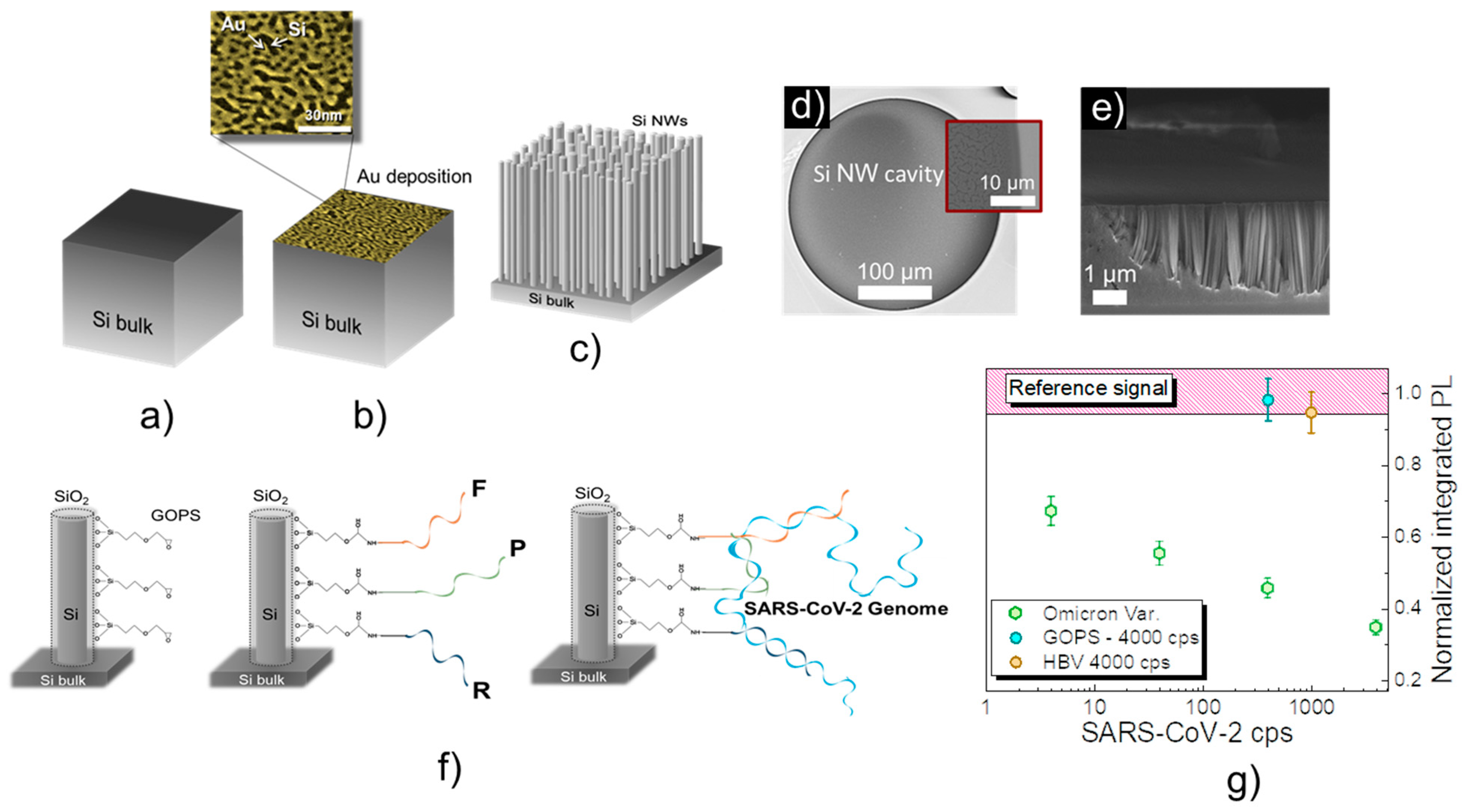
Si NWs were synthesized by MACE. A commercial Si wafer was used (Figure 1a), a few Au nanometers were evaporated (Figure 1b), and, after an HF/H2O2 etching, the Si NWs were finally obtained (Figure 1c). To limit the active area of the sensor increasing its reliability, the MACE synthesis was carried out after a photolithography process that left only small circular areas (≈150 µm of radius) exposed, as seen in the SEM images in plan view (Figure 1d) and cross-section (Figure 1e). After the synthesis, the Si NWs were functionalized as follows (Figure 1f): (i) silane treatment by using (3-Glycidyloxypropyl)trimethoxysilane (GOPS); (ii) incubation with three ammino-terminated ss-DNA oligonucleotides complementary to the SARS-CoV-2; (iii) final hybridization by using the synthetic SARS-CoV-2 genome or the extracted Omicron variant.
Figure 1. (a) Commercial Si wafer, (b) Au discontinuous layer, (c) Si NWs. SEM images Si NWs in the circular cavities in (d) plan view and (e) cross-section. (f) Functionalization protocol. (g) Calibration curve.

3. Discussion

The Si NW light-emission, normalized to the one obtained without any copies of RNA (reference signal), is reported as a function of the Omicron SARS-CoV-2 copies (cps) in Figure 1g (green hexagon). A total of 4 cps of the limit of detection is obtained without any amplification strategy and competitive with the NAAT standards. The Omicron detection shows the same signal of the SARS-CoV-2 clone, demonstrating the insensitiveness to the variant. The selectivity has been further tested by another target as Hepatitis B virus and without the oligonucleotide functionalization. In both cases, a negligible signal variation compared to the reference has been obtained. The detection of Omicron SARS-CoV-2 has been demonstrated with high selectivity and rapid detection. This result opens the route toward the realization of an industrially compatible silicon platform that can be used for the widespread and reliable detection of viruses.

Author Contributions

Conceptualization, A.I. and S.C.; methodology, A.I.; formal analysis, A.A.L.; investigation, A.A.L., E.L.S., M.J.L.F., B.F., L.F., M.G.R., F.N. and R.A.P.; resources, S.C.; data curation, A.A.L. and E.L.S.; writing—original draft preparation, A.A.L., E.L.S., A.I. and S.C.; writing—review and editing A.I. and S.C.; supervision, A.I. and S.C.; project funding acquisition, A.I. All authors have read and agreed to the published version of the manuscript.

Funding

This research received no external funding.

Institutional Review Board Statement

The Institutional Review Board of the University of Messina approved this study under the protocol number 36/20 and in accordance with the tenets of the Declaration of Helsinki.

Data Availability Statement

Dataset available on request from the authors.

Acknowledgments

F. Puntoriero is acknowledged for the useful discussion and help. I-PHOQS project CUP: B53C22001750006 is acknowledged.

Conflicts of Interest

The authors declare no conflicts of interest.

References

  1. André, E.; Bayart, J.-L.; Degosserie, J.; Favresse, J.; Gillot, C.; Didembourg, M.; Djokoto, H.P.; Verbelen, V.; Roussel, G.; Maschietto, C.; et al. Analytical Sensitivity of Six SARS-CoV-2 Rapid Antigen Tests for Omicron versus Delta Variant. Viruses 2022, 14, 654. [Google Scholar] [CrossRef] [PubMed]
  2. Lo Faro, M.J.; Leonardi, A.A.; Priolo, F.; Fazio, B.; Miritello, M.; Irrera, A. Erbium Emission in Er:Y2O3 Decorated Fractal Arrays of Silicon Nanowires. Sci. Rep. 2020, 10, 12854. [Google Scholar] [CrossRef] [PubMed]
  3. Lo Faro, M.J.; Leonardi, A.A.; D’Andrea, C.; Morganti, D.; Musumeci, P.; Vasi, C.; Priolo, F.; Fazio, B.; Irrera, A. Low Cost Synthesis of Silicon Nanowires for Photonic Applications. J. Mater. Sci. Mater. Electron. 2020, 31, 34–40. [Google Scholar] [CrossRef]
  4. Morganti, D.; Leonardi, A.A.; Lo Faro, M.J.; Leonardi, G.; Salvato, G.; Fazio, B.; Musumeci, P.; Livreri, P.; Conoci, S.; Neri, G.; et al. Ultrathin Silicon Nanowires for Optical and Electrical Nitrogen Dioxide Detection. Nanomaterials 2021, 11, 1767. [Google Scholar] [CrossRef] [PubMed]
Disclaimer/Publisher’s Note: The statements, opinions and data contained in all publications are solely those of the individual author(s) and contributor(s) and not of MDPI and/or the editor(s). MDPI and/or the editor(s) disclaim responsibility for any injury to people or property resulting from any ideas, methods, instructions or products referred to in the content.

Article Metrics

Citations

Article Access Statistics

Multiple requests from the same IP address are counted as one view.