


Abstract
GEOFIT, “Deployment of novel GEOthermal systems, technologies and tools for energy efficient building retrofitting,” is a recently launched 4-year H2020 project funded by the Innovation and Networks Executive Agency (INEA) under the call topic LCE-17-2017: Easier to install and more efficient geothermal systems for retrofitting buildings. GEOFIT is a part of INEA’s Energy Portfolio Low Carbon Economy (LCE), Renewable Energy Technologies (RET) and brings together 24 partners from 10 European countries to work on the development of novel and smart shallow geothermal systems. This paper introduces the project.
1. Introduction
This paper is a first general dissemination of the H2020 Project GEOFIT. GEOFIT is an integrated industry-driven project that will develop and deploy cost-effective enhanced geothermal systems (EGS) primarily for the retrofit of energy efficient buildings. This entails the technical development of innovative EGS and their components to be integrated with the novel ground-source heat pumps (GSHP) concepts designed for energy efficient retrofitting projects.
To integrate these novel EGS in energy efficient building retrofitting, the project develops a suite of tools and technologies that include: low invasive risk assessment technologies, site-inspection and worksite building monitoring techniques, control systems for cost-effective and optimised EGS in operation phase and novel dedicated tools for management of geothermal based retrofitting works. Furthermore, the project applies novel drilling techniques such as the improved low-invasive vertical drilling and trenchless technologies. GEOFIT brings these technical developments within a new management framework based on Integrated Design and Delivery Solutions for the geothermal based retrofitting process. The IDDS driven process will be built into a Geo-BIM enabled Retrofitting Management Platform (Geo-BIM tool). GEOFIT technologies and construction processes will be validated at 5 demonstration sites as open case studies in 4 countries featuring different climactic conditions, soil types and building typologies. These representative technical scenarios will be coupled to business models and business cases enhancing the likelihood of post-project adoption of these novel geothermal technologies and approaches.
2. Opportunities and Challenges
2.1. Geothermal Opportunities
Shallow Geothermal Energy (SGE) represents a renewable energy source (RES) with a large potential of energy savings and GHG emissions reduction in the building sector to achieve all major objectives of the EU’s energy policy. As published in partner UPONOR technical information on Ground Energy [1], several of the benefits and opportunities of geothermal systems include:
- Renewable: Ground energy is available endlessly, 24 h a day for heating and cooling
- Environmentally friendly: Any use of ground energy reduces emissions of greenhouse gas
- Safe and controllable: Ground energy is technically mature and has been used for heating and cooling for more than 50 years
- High performance: a response to all energy demands such as heating, cooling, hot water and energy storage
- Versatile: applicable in combination with other energy sources
- Economically sustainable: regionally usable, independent of external suppliers and changes in currency exchange rates
Realizing such benefits is relevant as buildings consume approximately 40% of Europe’s total energy consumption, represent about a third of CO2 emissions and almost half of EU buildings have boilers installed before 1992 with an efficiency rate below 60% [2]. According to the Environmental Protection Agency [3], in many cases geothermal installations can lead to 40–70% savings on home heating and 20–50% savings on home cooling.
2.2. Geothermal Challenges
Adapted from the call text LCE-17-2017 [4], the cost and efficiency of existing geothermal systems, mostly based on vertical wells, to provide heating and cooling in buildings being retrofitted or renovated are not very competitive in particular when digging is difficult. What is needed are easy to install and efficient underground coupling systems for retrofitting existing types of buildings, including historical buildings, to make geothermal energy a standard source of heat and cold in building renovation. Such systems would take into account the difficulties in drilling in built environments. There is also the need for improved and more cost-efficient heat pumps to optimize the use of the energy generated by geothermal systems. GEOFIT responded to the challenges of this call text with a holistic set of novel technologies and methods for each stage of retrofit construction processes.
3. GEOFIT Concept and Approach
3.1. Macro Approach and Novel Technologies
GEOFIT is built upon four research lines that work together. They are:
- Tools and methods for viable and cost-effective geothermal retrofitting
- Efficient geothermal systems and its components
- Integrated retrofit management framework based on IDDS
- Demonstration, exploitation and innovative business models
Figure 1 illustrates several of the technologies developed in these business lines which include novel ground heat exchanger concepts, innovative drilling techniques, the use of BIM and city scale urban planning assets as a retrofit multiplier coupled to the IDDS Framework, the integration and control of the building and geothermal system into the smart grid as a flexible asset, ground penetrating radar and other monitoring techniques for site assessment and during retrofit risk reduction, hybrid ground source heat pump systems and integrated heating and cooling concepts customized to specific site conditions and building typologies.
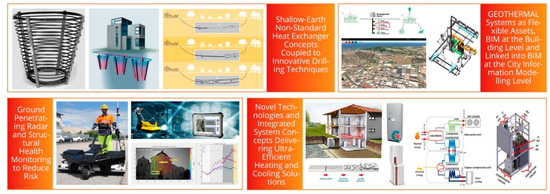
Figure 1.
Research Pillars of GEOFIT.
3.2. Technology Couplings and Construction Processes
Technology couplings and construction processes are at the core of GEOFIT’s scientific and technical objectives. Illustrated in Figure 2, the installation phase involves three coupled systems. Below ground heat exchangers, a hybrid heat pump and above ground heating and cooling technologies. Each are a design problem and each are coupled to one another. Facilitating the retrofit and reducing risk, BIM, ground survey and baseline monitoring are conducted. Enhancing system operation, integrated controls help optimize system performance and where appropriate, in a smart grid.
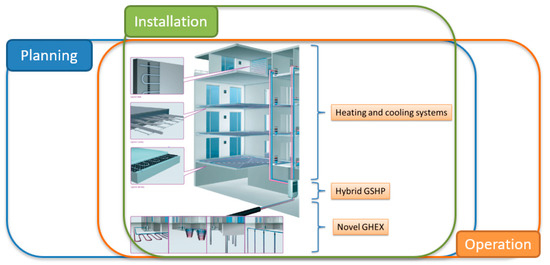
Figure 2.
Technologies, Couplings & Construction Processes.
3.3. Pilots
GEOFIT will feature five demonstration sites which are illustrated in Figure 3. From left to right they are, a historical building in Perugia, Italy being used as a conference and office center, a sport complex at the National University of Ireland, Galway where geothermal may connect to the swimming pool, a primary school in San Cugat, Spain, an office building in Bordeaux, France and residential buildings on Aran Islands in Ireland. Geothermal systems will be designed in an IDDS framework and have to deal with different climates, soil conditions and building typologies.

Figure 3.
GEOFIT Pilots.
3.4. IMPACT
If successful, GEOFIT will increase the commercial attractiveness of geothermal energy for heating and cooling and therefore increase the penetration of this renewable energy source. The project has established the following ambitious targets
- reduction in capital expenditures of installations by 18%
- improvement of GSHP and heating and cooling system efficiencies by up to 85%
- reduction of drilling time up to 20%
- reduction of waiting time for return of investment (5–15 years)
- high renovation rates of 50 m2 per day
- unlocking the potential of over 130 GW of flexible power for grid balancing
- reduction in CO2 emissions between 25% and 50% in retrofitted buildings
- potential replication with attainable market over €297 billion
- guarantee 100% comfort post-retrofit
- new business opportunities and market venues for geothermal retrofitting
4. Conclusions
This paper has provided a brief overview of the GEOFIT project which develops technologies and processes for smart geothermal retrofitting. Information related to the project can be quickly located by using google and the keywords “GEOFIT project” which will result in the project webpage, the project description in Cordis and project twitter account. For other information about the project or to join the GEOFIT stakeholder community to receive directly project information and updates, please contact the corresponding author.
Author Contributions
T.M. wrote the technical aspects of the paper, D.M. constructed images and M.C., R.S., M.B., A.F. and Z.L. reviewed and edited it.
Acknowledgments
The GEOFIT project has received funding from the H2020 programme under Grant Agreement No. 792210.
Conflicts of Interest
The authors declare no conflict of interest.
References
- UPONOR, Ground Energy Technical Information. Available online: https://issuu.com/uponor/docs/ground-energy-technical-information (accessed on 22 June 2018).
- European Commission. Fact Sheet, Toward a Smart, Efficient and Sustainable Heating and Cooling Sector; European Commission: Brussels, Belgium, 2016. [Google Scholar]
- Geothermal Heating and Cooling Technologies. Available online: https://www.epa.gov/rhc/geothermal-heating-and-cooling-technologies (accessed on 20 June 2018).
- TOPIC: Easier to Install and More Efficient Geothermal Systems for Retrofitting Buildings. Available online: http://ec.europa.eu/research/participants/portal/desktop/en/opportunities/h2020/topics/lce-17-2017.html (accessed on 22 June 2018).
Publisher’s Note: MDPI stays neutral with regard to jurisdictional claims in published maps and institutional affiliations. |
© 2018 by the authors. Licensee MDPI, Basel, Switzerland. This article is an open access article distributed under the terms and conditions of the Creative Commons Attribution (CC BY) license (https://creativecommons.org/licenses/by/4.0/).