


Abstract
A fiber based refractometer in a reflective interrogation scheme is investigated and optimized. A thin gold film was deposited on the tip of a coreless fiber section, which is spliced with a single mode fiber. The coreless fiber is a multimode waveguide, and the observed effects are due to multimode interference. To investigate and optimize the structure, the multimode part of the sensor is built with 3 different lengths: 58 mm, 29 mm and 17 mm. We use a broadband light source ranging from 1475 nm to 1650 nm and we test the sensors with liquids of varying refractive indices, from 1.333 to 1.438. Our results show that for a fixed wavelength, the sensor sensitivity is independent of the multimode fiber length, but we observed a sensitivity increase of approximately 0.7 nm/RIU for a one-nanometer increase in wavelength.
1. Introduction
The evolution of optical fiber technology brought great advances to the field of optical sensors and now we can see industrial applications that make use of its major advantages compared to electrical sensors, such as electromagnetic interference immunity, small size, higher sensitivity and fast response.
The use of a single mode-multimode-single mode (SMS) structure for sensing purposes started after the description of the self-imaging phenomenon by Soldano et al. [1] and it has been applied since then as an alternative for traditional optical sensing methods due to the low cost, easy of manufacturing of this device. The SMS sensor operation is based on multimode interference (MMI). The multiple paths available for light in the SMS structure leads to interference pattern dependent on the surroundings as temperature [2] and curvature [3]. Nonetheless, refractive index measurements based on SMS structure stands up due to its high sensitivity performance [4] when compared to long period gratings [5], Surface Plasmon Resonance [6], and Fabry Perot Interferometry [7].
In this work, reflexives MMI fiber sensor were assembled and its performance analyzed to optimize its sensitivity to index of refraction variation from 1.33 up to 1.42 within the 1475 nm to 1650 nm wavelength range. Although for a specific wavelength the sensor sensitivity is independent of the multimode fiber length [3], the results shown a sensitivity increase of approximately 0.7 nm/RIU for one nanometer increase in wavelength.
2. Materials and Methods
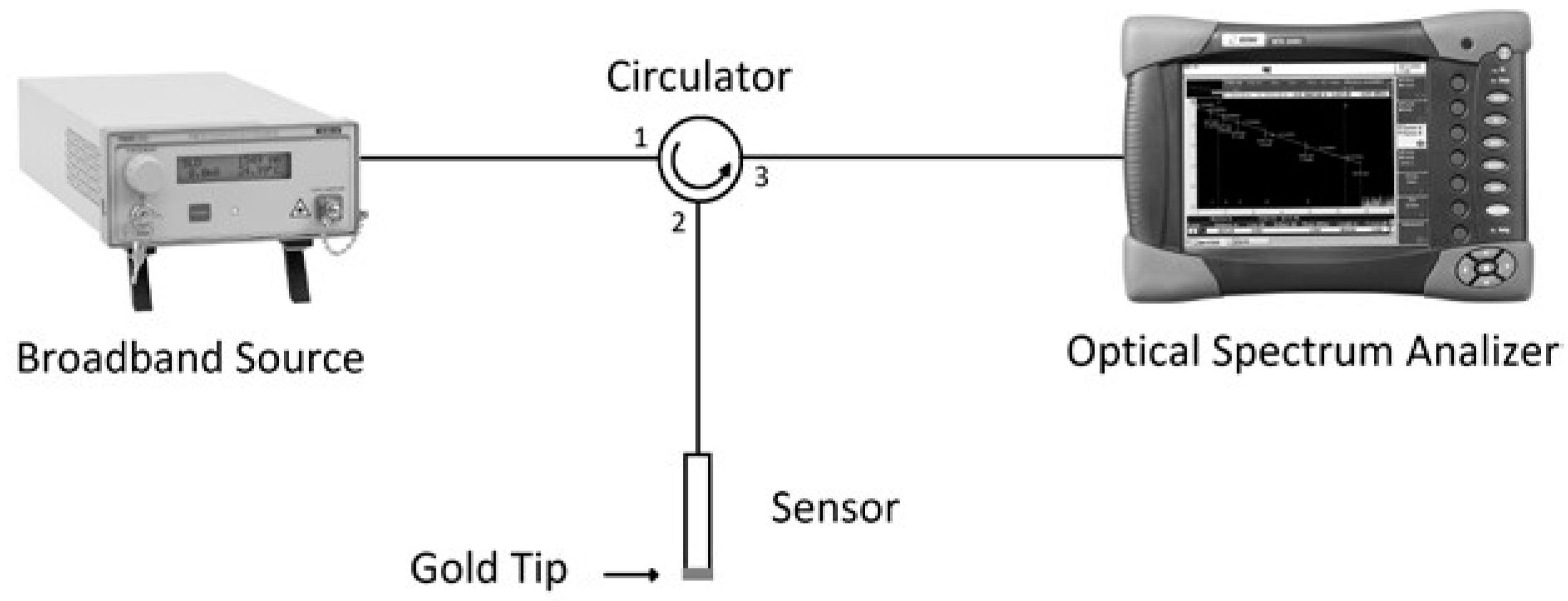
A thin gold film (100 nm of thickness) was deposited on the tip of the coreless fiber, which for our purposes acts as a multimode fiber (MMF). The gold film serves as a mirror, and thus we have a reflection based multimodal interference device. The beam of light will come from a broadband source (Thorlabs S5FC1005S), through a circulator and then the SMF which is spliced with the MMF, and will excite different modes inside the MMF. After the reflection and further propagation inside de MMF we have light reentering the SMF and then being detected in an optical spectrum analyzer (OSA), as shown in Figure 1. The reflective setup is easier to manipulate than a transmission setup, not only because it is more difficult to break, but also because, when measuring the properties of a fluid, one can simply dip it in the fluid, with no need to bend the sensor.
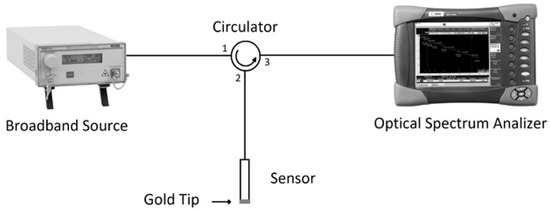
Figure 1.
Schematic diagram of the sensor and the interrogation setup.
We built 13 sensors with 3 different MMF lengths: 58 mm, 29 mm and 17 mm. The SMF had a total diameter of 125 µm and a core diameter of 9 µm and the MMF was a coreless silica fiber (Thorlabs FG125LA) with a diameter of 125 µm and a refractive index of 1.44 at 1550 nm. We used ethylene glycol solutions in water with refractive indices varying from 1.333 to 1.438, measured in an ABBE refractometer.
3. Results and Discussion
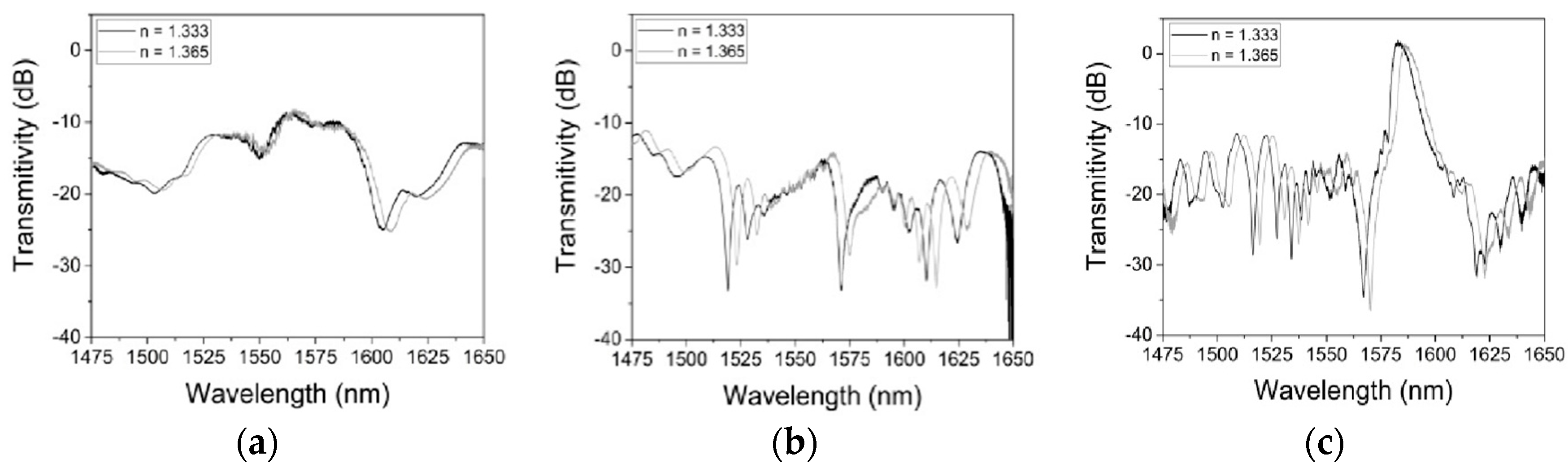
The sensitivity of all the sensors was analyzed after their spectra were measured. As expected from the literature [8], the sensitivity does not depend on the length of the MMF section. However it is possible to see in Figure 2 that the spectrum of sensors with bigger MMF lengths are more complex than the smaller ones, i.e., there are more options of peaks and valleys to be monitored.
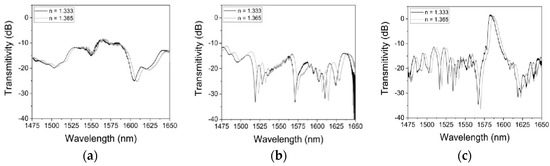
Figure 2.
Spectra for sensors with MMF length of (a) 17 mm; (b) 29 mm and (c) 58 mm.
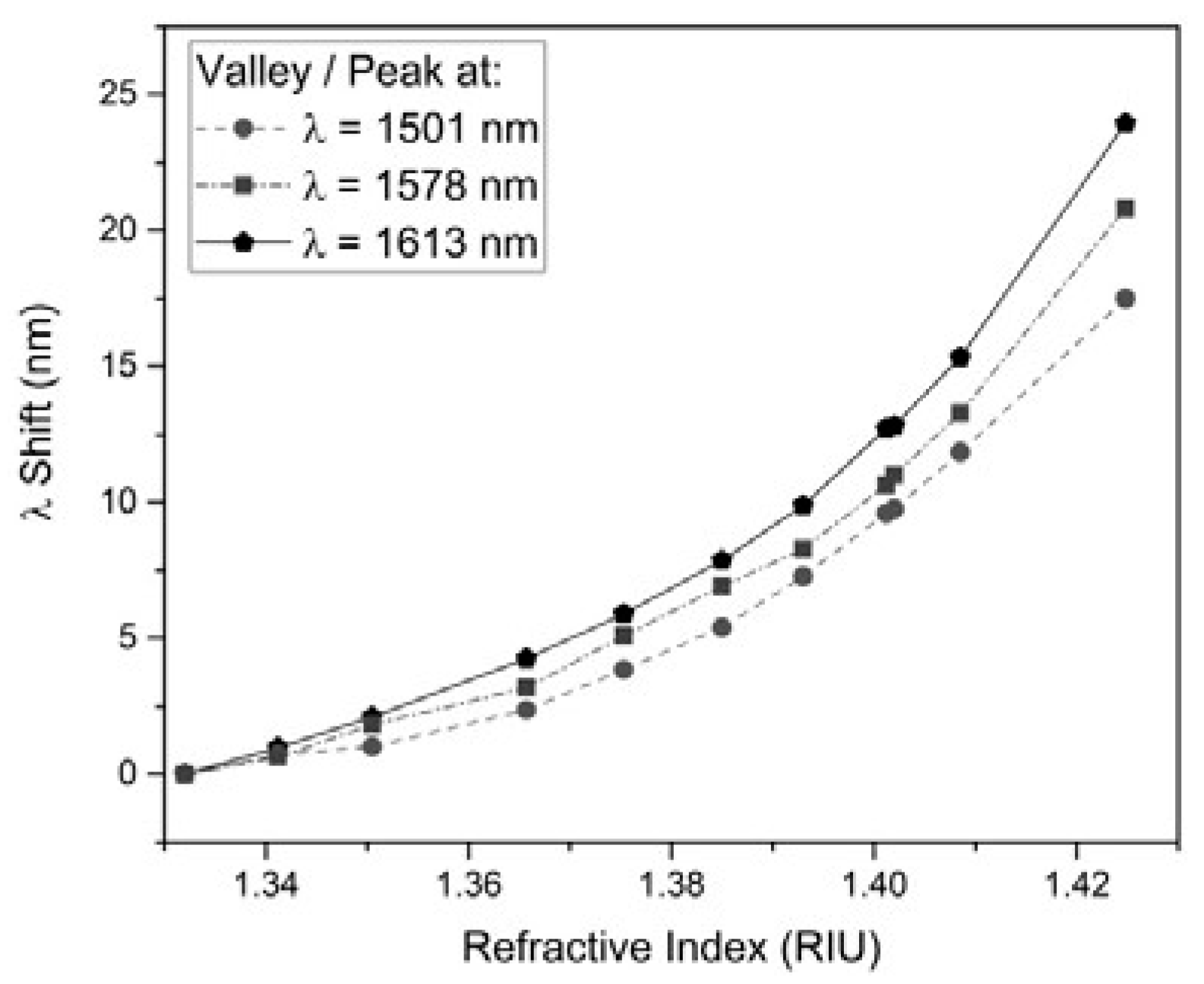
Although we have confirmed the independence of the sensitivity of the sensors from the MMF length, it is important to analyze the magnitude of the wavelength shift of peaks and valleys depending on their starting wavelength for pure water (1.33 RIU). Figure 3 shows the result of this investigation for sensors with MMF length of 58 mm. It is possible to see an increasing sensitivity for peaks in larger wavelengths.
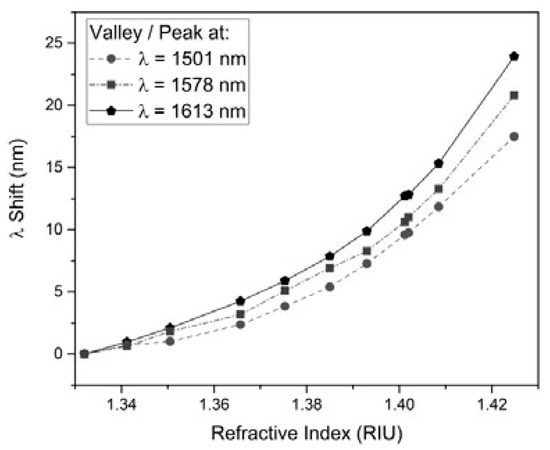
Figure 3.
Wavelength shift for 3 different peaks/valleys in the spectrum of sensors with MMF length of 58 mm. The starting wavelength of each peak/valley (using water as external medium) is shown in the inset and serves as labels to the curves. The shift is measured using these wavelengths as reference.
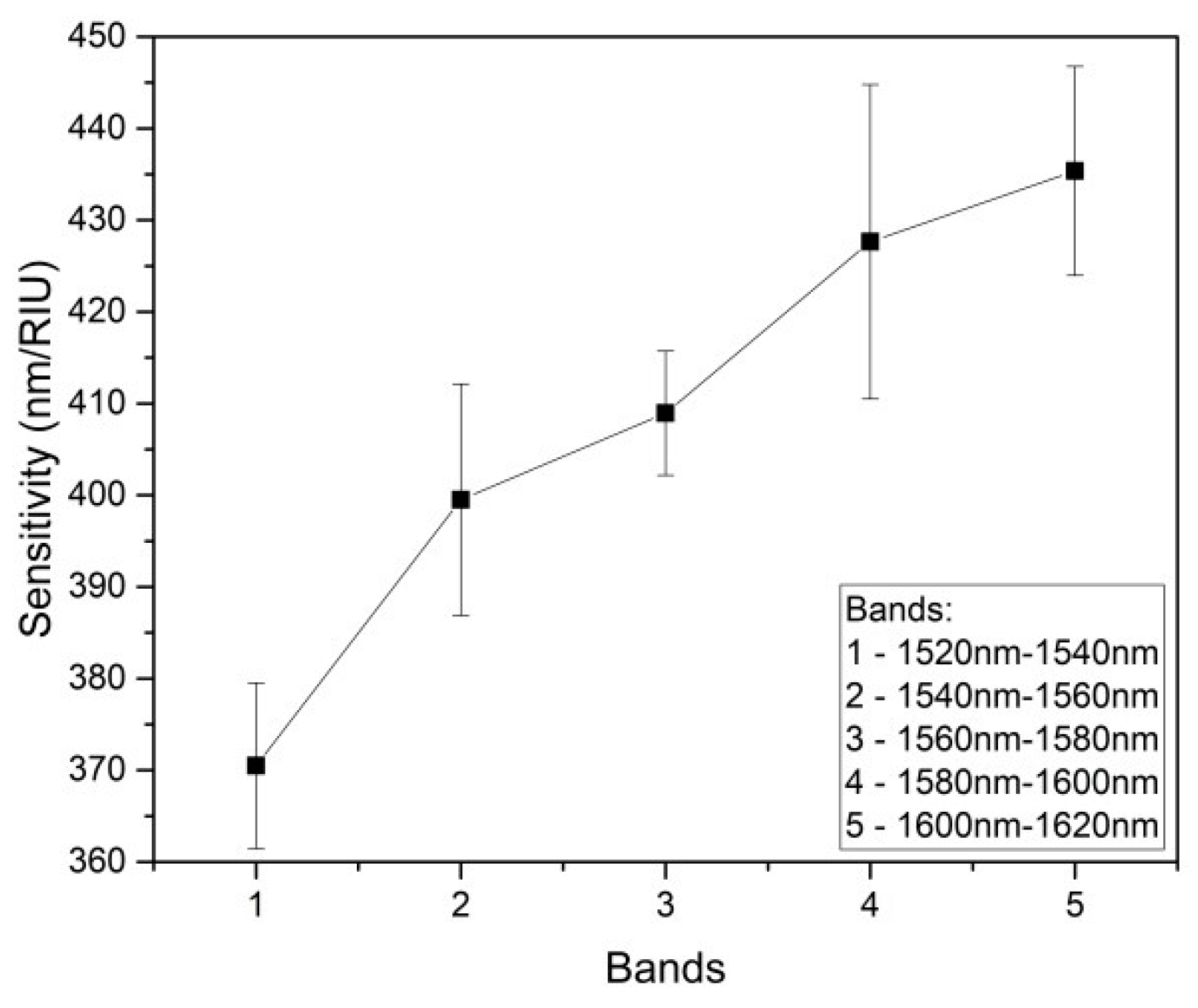
A more complete study of this effect is shown in Figure 4. For all the sensors, each valley/peak response was monitored and their sensitivity to changes in external refractive index was measured. They were then divided in 5 spectral bands of 20 nm each, according to their values of wavelength with water as external medium. With this analysis it becomes apparent an increase of the sensitivity for the upper bands, leading us to conclude that there is a larger sensitivity for larger wavelengths.
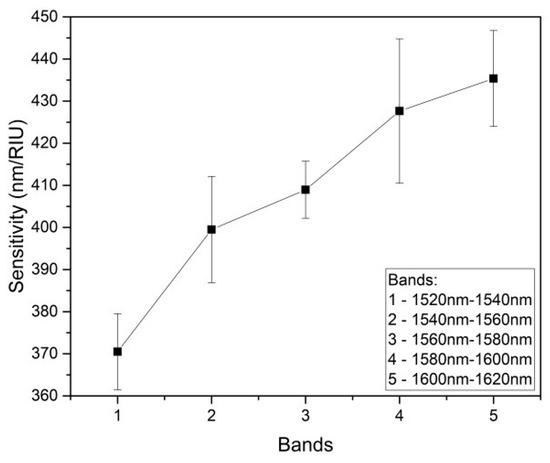
Figure 4.
SMS sensor sensitivity changes regarding the wavelength of the peak/valley monitored.
4. Conclusions
Our investigation showed an increase in the sensitivity of 0.7 nm/RIU for a one-nanometer increase in wavelength of the peak/valley observed. The length of the MMF section indeed does not influence the sensitivity, but it changes the overall shape of the spectrum, offering peaks and valleys in different regions of the spectrum to be analyzed. With this information we can try to build an optimized sensor and achieve the best sensitivity for this kind of setup.
Author Contributions
R.B., C.V.S.B., B.R. assembly and characterized the sensors. R.B., C.V.S.B., B.R. and M.A.G.M. performed the analysis and elaborated the manuscript.
Acknowledgments
The authors would like to thank the PIBIC (Programa Institucional de Bolsas de Iniciação Científica) program from CEFET/RJ, FAPERJ (Fundação de Apoio à Pesquisa do Estado de Rio de Janeiro grant.E29/2014) and the Worshipful Company of Tin Plate Workers alias Wire Workers of the City of London for the support to this work.
Conflicts of Interest
The authors declare no conflict of interest.
References
- Soldano, L.B.; Pennings, E.C.M. Optical multi-mode interference devices based on self-imaging: Principles and applications. J. Lightw. Technol. 1995, 13, 615–627. [Google Scholar] [CrossRef]
- Silva, S.; Franco, M.A.R.; Hayashi, J.G.; Malcata, F.X.; Frazao, O.; Jorge, P.; Cordeiro, C. Ultrahigh-sensitivity temperature fiber sensor based on multimode interference. Appl. Opt. 2012, 51, 3236–3242. [Google Scholar] [CrossRef] [PubMed]
- Gong, Y.; Zhao, T.; Rao, Y.J.; Wu, Y. All-fiber curvature sensor based on multimode interference. IEEE Photonics Technol. Lett. 2011, 23, 679–681. [Google Scholar] [CrossRef]
- Wu, Q.; Semenova, Y.; Wang, P.; Farrell, G. High sensitivity SMS fiber structure based refractometer—Analysis and experiment. Opt. Express 2011, 19, 7937–7944. [Google Scholar] [CrossRef] [PubMed]
- Liu, Y.; Williams, J.A.R.; Bennion, I. Optical bend sensor based on measurement of resonance mode splitting of long-period fiber grating. IEEE Photonics Technol. Lett. 2000, 12, 531–533. [Google Scholar] [CrossRef]
- Jorgenson, R.C.; Yee, S.S. A fiber-optic chemical sensor based on surface plasmon resonance. Sens. Actuators B Chem. 1993, 12, 213–220. [Google Scholar] [CrossRef]
- Tseng, S.M.; Chen, C.L. Optical fiber Fabry-Perot sensors. Appl. Opt. 1988, 27, 547–551. [Google Scholar] [CrossRef] [PubMed]
- Zhou, X.; Chen, K.; Mao, X.; Peng, W.; Yu, Q. A reflective fiber-optic refractive index sensor based on multimode interference in a coreless silica fiber. Opt. Commun. 2015, 340, 50–55. [Google Scholar] [CrossRef]
Publisher’s Note: MDPI stays neutral with regard to jurisdictional claims in published maps and institutional affiliations. |
© 2018 by the authors. Licensee MDPI, Basel, Switzerland. This article is an open access article distributed under the terms and conditions of the Creative Commons Attribution (CC BY) license (https://creativecommons.org/licenses/by/4.0/).