


Abstract
Metal oxide semiconductor gas sensors are used in a various applications in environmental, industrial and medical field, for instance. They are relatively inexpensive compared to other sensing technologies, robust, lightweight, long lasting and benefit from high material sensitivity and quick response times. Copper oxide (CuO) thin film has been promisingly proposed for chemical sensing applications. Particularly, it has been recommended as a sensitive layer for monitoring harmful and combustible gases. It is an attractive material because of nontoxic, inexpensive, abundance advantages, and its fabrication is easy. In this work, we have synthesized CuO thin films by Spray pyrolysis method. The effect of the temperature deposition is investigated:to say 350 °C, 400 °C, and 450 °C while the deposition duration was kipped to 15 min. The samples were analyzed by X-ray diffraction, Raman spectroscopy, XPS analysis, UV-visible transmission and four points probe method.
1. Experimental
The solution for CuO was prepared by dissolving copper chloride (II) (CuCl2) in distilled water; the solution has been stirred at 60 °C during 30 min. The ordinary glass substrates were cleaned with diluting nitric acid, acetone, ethanol, and distilled water. Spray pyrolysis was employed to depositthe CuO solution on the ordinary glass substrates, during 15 min at different temperatures including 350 °C, 400 °C, and 450 °C. The prepared films were analyzed using an X-ray diffractometer, spectroscopy Raman, XPS analysis, UV-visible spectrometer and 4-point probe method to the calculated sheet resistance and resistivity.
2. Characterization
The crystalline phase of the films was characterized by X-Ray diffraction DRX. In the Figure 1 we have the X-Ray diffraction spectrum of copper oxide (CuO) at various substrate temperatures deposition. In the other side, wehave Raman spectrum of CuO whose mentions the Ag(1), Bg(1), and Bg(2) modes located at 290, 338, and 626 (Figure 2). The Raman spectroscopy confirms the CuO phase formation proved by DRX data.
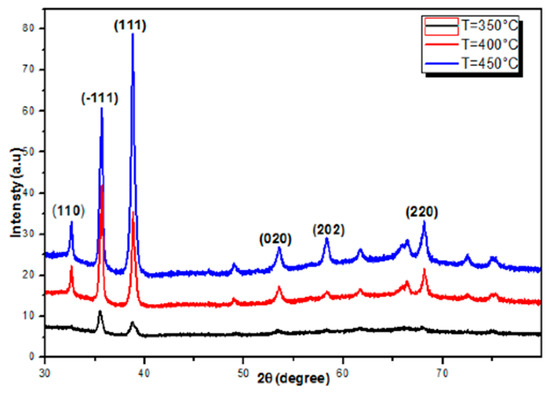
Figure 1.
X-ray diffraction patterns of CuO thin films deposited at various substrate temperatures.
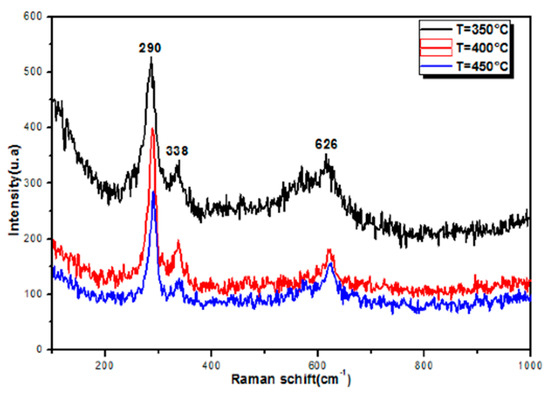
Figure 2.
Raman spectra of CuO thin films deposited at 350 °C, 400 °C and 450 °C.
3. Conclusions
The X-ray diffraction peaks at (110), (-111), (-202), (020), (-113) and (220) plans indicatethe formation of CuO thin films. Raman scattering measurements confirm the existence of CuO by peaks at 290, 338 and 626 cm−1. XPS analysis also show peaks indicating the presence of copper and oxygen. Band gap has been calculated according to the transmission measurements. We observe that the gap decreases while the substrate deposition temperature increases, and in contrary, the sheet resistance of these films increases when the substrate deposition temperature increases. These results make CuO thin films elaborated using spray pyrolysis set up, favourable for gas sensors applications.
Acknowledgments
This research is performed with the support of the Franco-Moroccan PHC Toubkal program.
Conflicts of Interest
The authors declare no conflict of interest.
© 2019 by the authors. Licensee MDPI, Basel, Switzerland. This article is an open access article distributed under the terms and conditions of the Creative Commons Attribution (CC BY) license (http://creativecommons.org/licenses/by/4.0/).