


Abstract
This study explores the governance of the Agricultural Knowledge and Innovation System in Greece, analysing its internal and external environments and proposing policies to strengthen innovation. A quantitative SWOT analysis and the Strategic Position and Action Evaluation (SPACE) matrix were employed to assess system dynamics. Data were collected through a structured questionnaire from December 2022 to March 2023, involving 61 senior managers across AKIS actors. Findings reveal that opportunities outweigh threats, while weaknesses surpass strengths. The SPACE matrix highlights the need for competitive strategies, offering valuable insights and policy directions for enhancing governance and fostering effective innovation processes within Greek agriculture.
1. Introduction
The European agri-food sector and innovations are currently seen as progressing too slowly toward sustainable agriculture [1]. In recent years, the urgency of accelerating and enhancing innovation has been increasingly emphasised, becoming a central focus of the European Commission’s vision for the future of food and farming [2]. Studies on Agricultural Knowledge and Innovation Systems (AKIS) have highlighted the importance of involving farmers directly in innovation processes. Their participation is vital for identifying effective responses to farm-related challenges and maximising the overall impact of innovations [3]. Through the AKIS system, they can collaborate, share ideas, and transform existing knowledge and research results into innovative solutions that can be more readily implemented in practice.
AKIS is expected to lead the transition toward a more sustainable future by fostering knowledge generation, enhancing collaboration, and supporting innovation [4]. However, its structure and operational mechanisms vary significantly across regions, shaped by distinct institutional and policy frameworks [5]. Despite these differences, AKIS has two fundamental characteristics: first, it functions as a social system designed to facilitate knowledge exchange and promote co-innovation among agri-food stakeholders; second, it is a goal-oriented system that serves not only farmers but also broader societal interests [6].
This research explores ways to improve AKIS in Greece governance by examining its internal and external environments and identifying policy measures to enhance innovation processes.
2. Materials and Methods
This study builds upon our previous work [3], where initial data were collected and preliminary analyses were conducted. In the present study, the data have been reprocessed, further analyzed, and presented with improved clarity and organization, enabling extended strategic analyses, including the SPACE Matrix evaluation.
Initially, a literature review identified the system’s strengths, weaknesses, opportunities, and threats (SWOT), which served as the foundation for a structured ad hoc questionnaire. Participants were asked to indicate their level of agreement using a 5-point Likert scale, where 1 represents ‘Strongly Disagree’ and 5 means ‘Strongly Agree.’ Descriptive statistics were used to summarise and present the main findings. The survey was conducted online between December 2022 and March 2023, collecting responses from 61 senior managers representing policy-making bodies, educational institutions, consulting firms, cooperatives, and farmers, following initial phone communications.
The second phase of the research involved examining the SWOT matrix, with a specific focus on assessing both External and Internal Factors (EFE and IFE). Two matrices have been developed incorporating both EFE and IFE, presenting key survey data, including the mean and standard error for each factor.
The objective of the third phase was to select the most appropriate strategy for enhancing the AKIS. To accomplish this, the SPACE Matrix was constructed by comparing the scores of all internal and external factors [7,8,9]. The SPACE Matrix allows for the identification of strategy types emerging from survey participants’ responses. It categorises strategies based on the dominance and interaction of various factors, resulting in four primary strategic approaches: (a) Conservative; (b) Defensive; (c) Competitive; and (d) Aggressive. These strategic categories provide valuable insights into the available pathways for decision-making and policy development.
3. Results and Discussion
Based on the evaluation results of the AKIS internal environment, the primary strength identified is its ability to find new solutions to agricultural challenges (mean: 3.90; SE: 0.12). Nowadays, the AKIS concept is used as a guiding principle for modernising the agriculture sector and ensuring the sustainable management and use of natural resources in the farming sector [3]. The AKIS framework has been embedded in the policy agenda of many countries to explore and analyse solutions to complex agricultural problems [10,11]. The findings also indicate that the main weakness of AKIS is the aging farming population (mean: 3.84; SE: 0.13). Regarding external opportunities, AKIS has significant potential for further development due to emerging opportunities and environmental factors (mean: 4.16; SE: 0.10). Pigford et al. [12] emphasised that a well-structured AKIS fosters innovation through approaches like smart farming and localised food systems. However, the most critical threat to AKIS is the complexity of legal and regulatory frameworks (mean: 4.18; SE: 0.11) (Table 1 and Table 2), Zahran et al. [11] ranked this complexity as the top barrier to developing the DG-AKIS at 92.2%. Additionally, Kebebe et al. [13] found that policy advocacy hindered Ethiopian stakeholders from leveraging agricultural technology for productivity and profit.

Table 1.
Internal factors evaluation matrix [3].
Table 2.
External factors evaluation matrix.
The findings revealed that the strengths of Internal Factors have a mean score of 3.51, while the weaknesses have a mean score of 3.64. Regarding External Factors, the opportunities received a total mean score of 3.89, compared to the threats at 3.80. The total score for external and internal factors was 7.69 and 7.15, respectively. The scores show two important results: the opportunities were greater than the threats, and the weaknesses were greater than the strengths.
The final objective was to define the most effective strategies for improving AKIS governance in the future, using the diagnosis of internal and external factors as a starting point. Based on the findings of the Strategic Position and Action Evaluation Matrix (SPACE), the strategy should focus on addressing weaknesses by leveraging available opportunities. The results indicate that the most suitable approach aligns with competitive strategies, which aim to overcome weaknesses by capitalising on existing opportunities (Figure 1).
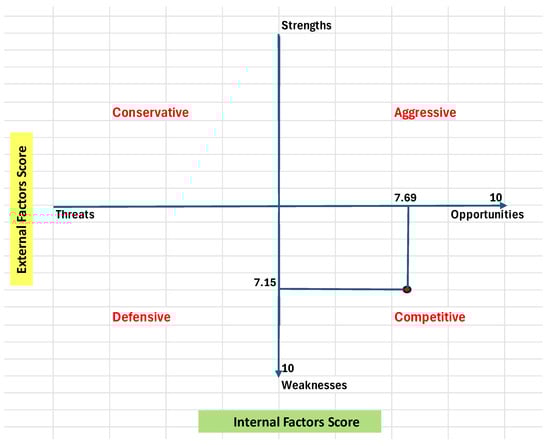
Figure 1.
Strategic Position and Action Evaluation (SPACE) Matrix.
4. Conclusions
This study offers new insights into strengthening AKIS in Greece from the perspective of various stakeholders. Its contribution is twofold: first, it provides an in-depth analysis of the internal and external factors affecting AKIS in Greece; second, it enriches the literature by presenting a framework that demonstrates how these factors can improve AKIS governance. Ultimately, defining specific recommendations within the framework of competitive strategies represents the most effective approach, considering both internal and external analyses.
Author Contributions
Conceptualization, E.A.; methodology, E.A.; software, E.A. and A.K.; validation, E.A. and A.K.; investigation, E.A. and A.K.; resources, E.A. and A.K.; data curation, E.A. and A.K.; writing—original draft preparation, A.M.; writing—review and editing, A.M. and E.A.; visualization, A.M.; supervision, A.M.; project administration, A.M. All authors have read and agreed to the published version of the manuscript.
Funding
This research was funded by the Hellenic Foundation for Research and Innovation (HFRI) under the third call for HFRI PhD Fellowships, grant number 6422.
Institutional Review Board Statement
Not applicable.
Informed Consent Statement
Informed consent was obtained from all subjects involved in this study.
Data Availability Statement
Data will be made available upon request.
Conflicts of Interest
The authors declare no conflicts of interest.
Abbreviations
The following abbreviations are used in this manuscript:
| AKIS | Agricultural Knowledge and Innovation System |
| SWOT | Strengths, Weaknesses, Opportunities, Threats |
| SPACE | Strategic Position and Action Evaluation |
| EFE | External Factors Evaluation |
| IFE | Internal Factors Evaluation |
References
- Kurtsal, Y.; Rinaldi, G.M.; Savini, F.; Sirri, R.; Melin, M.; Pacetti, E.; De Cesare, A.; Fioravanti, M.; Luppi, E.; Manfreda, G.; et al. Improving the Education and Training Policies of the Agri-Food and Forestry Sectors: Identifying New Strategies to Meet the Needs of the Sector and Farm-to-Fork Priorities. Sustainability 2024, 16, 1267. [Google Scholar] [CrossRef]
- Viaggi, D.; Kurtsal, Y.; Rinaldi, G.M.; Sirri, R.F.; Fioravanti, M.; De Cesare, A.; Manfreda, G.; Luppi, E.; Pacetti, E. Report on Identification of Strategies for Improvement (Deliverable 4.2 of the NextFOOD Project Funded Under the European Union’s Horizon 2020 Research and Innovation Programme GA No: 771738). 2021. Available online: https://www.nextfood-project.eu/wp-content/uploads/2022/02/d4.2-identification-of-strategies-for-improvement.pdf (accessed on 5 September 2024).
- Amerani, E.; Michailidis, A. The Agricultural Knowledge and Innovation System (AKIS) in a Changing Environment in Greece. Proceedings 2024, 94, 29. [Google Scholar] [CrossRef]
- EU SCAR AKIS. Preparing for Future AKIS in Europe; European Commission: Brussels, Belgium, 2019. [Google Scholar]
- Knierim, A.; Boenning, K.; Caggiano, M.; Cristóvão, A.; Dirimanova, V.; Koehnen, T.; Prager, K. The AKIS Concept and Its Relevance in Selected EU Member States. Outlook Agric. 2015, 44, 29–36. [Google Scholar] [CrossRef]
- Charatsari, C.; Michailidis, A.; Lioutas, D.E. Do Farm Advisory Organizations Promote Sustainability? A Study in Greece. Agric. Syst. 2024, 218, 104003. [Google Scholar] [CrossRef]
- Radder, L.; Louw, L. The SPACE Matrix: A Tool for Calibrating Competition. Long Range Plan. 1998, 31, 549–559. [Google Scholar] [CrossRef]
- Sherafat, A.; Yavari, K.; Mohammad, S.; Davoodi, S.; Bozorgzadeh, N. The Application of Strategic Position & Action Evaluation (SPACE) Matrix in the Organizational Goals and Strategies Development. J. Appl. Sci Res. 2013, 9, 2666–2673. [Google Scholar]
- Abbasi, F.; Esparcia, J.; Saadi, H.A. From Analysis to Formulation of Strategies for Farm Advisory Services (Case Study–Spain): An Application through SWOT and QSPM Matrix. Eur. Countrys. 2019, 11, 43–73. [Google Scholar] [CrossRef]
- Minh, T.T. Unpacking the Systemic Problems and Blocking Mechanisms of a Regional Agricultural Innovation System: An Integrated Regional-Functional-Structural Analysis. Agric. Syst. 2019, 173, 268–280. [Google Scholar] [CrossRef]
- Zahran, Y.; Kassem, H.S.; Naba, S.M.; Alotaibi, B.A. Shifting from Fragmentation to Integration: A Proposed Framework for Strengthening the Agricultural Knowledge and Innovation System in Egypt. Sustainability 2020, 12, 5131. [Google Scholar] [CrossRef]
- Pigford, A.-A.E.; Hickey, G.M.; Klerkx, L. Beyond Agricultural Innovation Systems? Exploring an Agricultural Innovation Ecosystems Approach for Niche Design and Development in Sustainability Transitions. Agric. Syst. 2018, 164, 116–121. [Google Scholar] [CrossRef]
- Kebebe, E. Bridging Technology Adoption Gaps in the Livestock Sector in Ethiopia: An Innovation System Perspective. Technol. Soc. 2019, 57, 30–37. [Google Scholar] [CrossRef]
Disclaimer/Publisher’s Note: The statements, opinions and data contained in all publications are solely those of the individual author(s) and contributor(s) and not of MDPI and/or the editor(s). MDPI and/or the editor(s) disclaim responsibility for any injury to people or property resulting from any ideas, methods, instructions or products referred to in the content. |
© 2025 by the authors. Licensee MDPI, Basel, Switzerland. This article is an open access article distributed under the terms and conditions of the Creative Commons Attribution (CC BY) license.