


Strengthening AKIS Governance: Strategic Insights from a SWOT and SPACE Analysis in Greece †


Abstract
1. Introduction
2. Materials and Methods
3. Results and Discussion
4. Conclusions
Author Contributions
Funding
Institutional Review Board Statement
Informed Consent Statement
Data Availability Statement
Conflicts of Interest
Abbreviations
| AKIS | Agricultural Knowledge and Innovation System |
| SWOT | Strengths, Weaknesses, Opportunities, Threats |
| SPACE | Strategic Position and Action Evaluation |
| EFE | External Factors Evaluation |
| IFE | Internal Factors Evaluation |
References
- Kurtsal, Y.; Rinaldi, G.M.; Savini, F.; Sirri, R.; Melin, M.; Pacetti, E.; De Cesare, A.; Fioravanti, M.; Luppi, E.; Manfreda, G.; et al. Improving the Education and Training Policies of the Agri-Food and Forestry Sectors: Identifying New Strategies to Meet the Needs of the Sector and Farm-to-Fork Priorities. Sustainability 2024, 16, 1267. [Google Scholar] [CrossRef] [Scilit]
- Viaggi, D.; Kurtsal, Y.; Rinaldi, G.M.; Sirri, R.F.; Fioravanti, M.; De Cesare, A.; Manfreda, G.; Luppi, E.; Pacetti, E. Report on Identification of Strategies for Improvement (Deliverable 4.2 of the NextFOOD Project Funded Under the European Union’s Horizon 2020 Research and Innovation Programme GA No: 771738). 2021. Available online: https://www.nextfood-project.eu/wp-content/uploads/2022/02/d4.2-identification-of-strategies-for-improvement.pdf (accessed on 5 September 2024).
- Amerani, E.; Michailidis, A. The Agricultural Knowledge and Innovation System (AKIS) in a Changing Environment in Greece. Proceedings 2024, 94, 29. [Google Scholar] [CrossRef] [Scilit]
- EU SCAR AKIS. Preparing for Future AKIS in Europe; European Commission: Brussels, Belgium, 2019. [Google Scholar]
- Knierim, A.; Boenning, K.; Caggiano, M.; Cristóvão, A.; Dirimanova, V.; Koehnen, T.; Prager, K. The AKIS Concept and Its Relevance in Selected EU Member States. Outlook Agric. 2015, 44, 29–36. [Google Scholar] [CrossRef] [Scilit]
- Charatsari, C.; Michailidis, A.; Lioutas, D.E. Do Farm Advisory Organizations Promote Sustainability? A Study in Greece. Agric. Syst. 2024, 218, 104003. [Google Scholar] [CrossRef] [Scilit]
- Radder, L.; Louw, L. The SPACE Matrix: A Tool for Calibrating Competition. Long Range Plan. 1998, 31, 549–559. [Google Scholar] [CrossRef]
- Sherafat, A.; Yavari, K.; Mohammad, S.; Davoodi, S.; Bozorgzadeh, N. The Application of Strategic Position & Action Evaluation (SPACE) Matrix in the Organizational Goals and Strategies Development. J. Appl. Sci Res. 2013, 9, 2666–2673. [Google Scholar]
- Abbasi, F.; Esparcia, J.; Saadi, H.A. From Analysis to Formulation of Strategies for Farm Advisory Services (Case Study–Spain): An Application through SWOT and QSPM Matrix. Eur. Countrys. 2019, 11, 43–73. [Google Scholar] [CrossRef] [Scilit]
- Minh, T.T. Unpacking the Systemic Problems and Blocking Mechanisms of a Regional Agricultural Innovation System: An Integrated Regional-Functional-Structural Analysis. Agric. Syst. 2019, 173, 268–280. [Google Scholar] [CrossRef] [Scilit]
- Zahran, Y.; Kassem, H.S.; Naba, S.M.; Alotaibi, B.A. Shifting from Fragmentation to Integration: A Proposed Framework for Strengthening the Agricultural Knowledge and Innovation System in Egypt. Sustainability 2020, 12, 5131. [Google Scholar] [CrossRef] [Scilit]
- Pigford, A.-A.E.; Hickey, G.M.; Klerkx, L. Beyond Agricultural Innovation Systems? Exploring an Agricultural Innovation Ecosystems Approach for Niche Design and Development in Sustainability Transitions. Agric. Syst. 2018, 164, 116–121. [Google Scholar] [CrossRef] [Scilit]
- Kebebe, E. Bridging Technology Adoption Gaps in the Livestock Sector in Ethiopia: An Innovation System Perspective. Technol. Soc. 2019, 57, 30–37. [Google Scholar] [CrossRef] [Scilit]

| Internal Factors | Mean * | SE |
|---|---|---|
| Strengths | ||
| S6: Finding new solutions for agricultural problems | 3.90 | 0.12 |
| S3: Educating farmers to improve their skills | 3.75 | 0.14 |
| S2: Improving farmer’s access to a new, diverse, and growing information system | 3.74 | 0.12 |
| S1: Strengthening of interactive learning through the sharing of different types of knowledge | 3.66 | 0.15 |
| S8: Developing each actor’s new capacities and skills within AKIS | 3.64 | 0.14 |
| S7: Enhancing coordination among AKIS actors | 3.57 | 0.14 |
| S9: Changing farmers’ knowledge, attitude, and strengthening of participatory spirit | 3.56 | 0.14 |
| S4: Boosting productivity and farmers’ income and subsequently improving their standard of living | 3.44 | 0.14 |
| S13: Empowerment of farmers to increase critical thinking skills to be able to analyse situations and determine their main demands | 3.43 | 0.13 |
| S11: Improvement in the responsibility of actors to farmers | 3.39 | 0.13 |
| S5: Increasing and attractive investment | 3.33 | 0.14 |
| S10: Improving farmers’ access to international markets | 3.13 | 0.12 |
| S12: Preventing anti-competitive practice | 3.05 | 0.14 |
| Mean | 3.51 | 0.14 |
| Weaknesses | ||
| W1: Aging of the agricultural population | 3.84 | 0.13 |
| W4: Ignorance of poor and marginal farmers | 3.82 | 0.13 |
| W8: Inadequate control and evaluation system by regional authorities | 3.82 | 0.13 |
| W3: Lack of enough development of social capital between farmers | 3.80 | 0.12 |
| W9: Lack of synergies between actors to co-create the appropriate innovation. | 3.80 | 0.12 |
| W2: Lack of focus in dealing with diverse demands that come from different farmers | 3.75 | 0.10 |
| W11: Lack of awareness of possibilities to receive advisor services | 3.67 | 0.12 |
| W10: Inadequate significant organisational capacity of advisors (knowledge and resources to achieve goals) | 3.46 | 0.12 |
| W6: Lack of enough use of new information and communication technologies | 3.39 | 0.14 |
| W7: Insufficient opportunities of education and training programs | 3.34 | 0.13 |
| W5: High costs of advisory service | 3.31 | 0.13 |
| Mean | 3.64 | 0.13 |
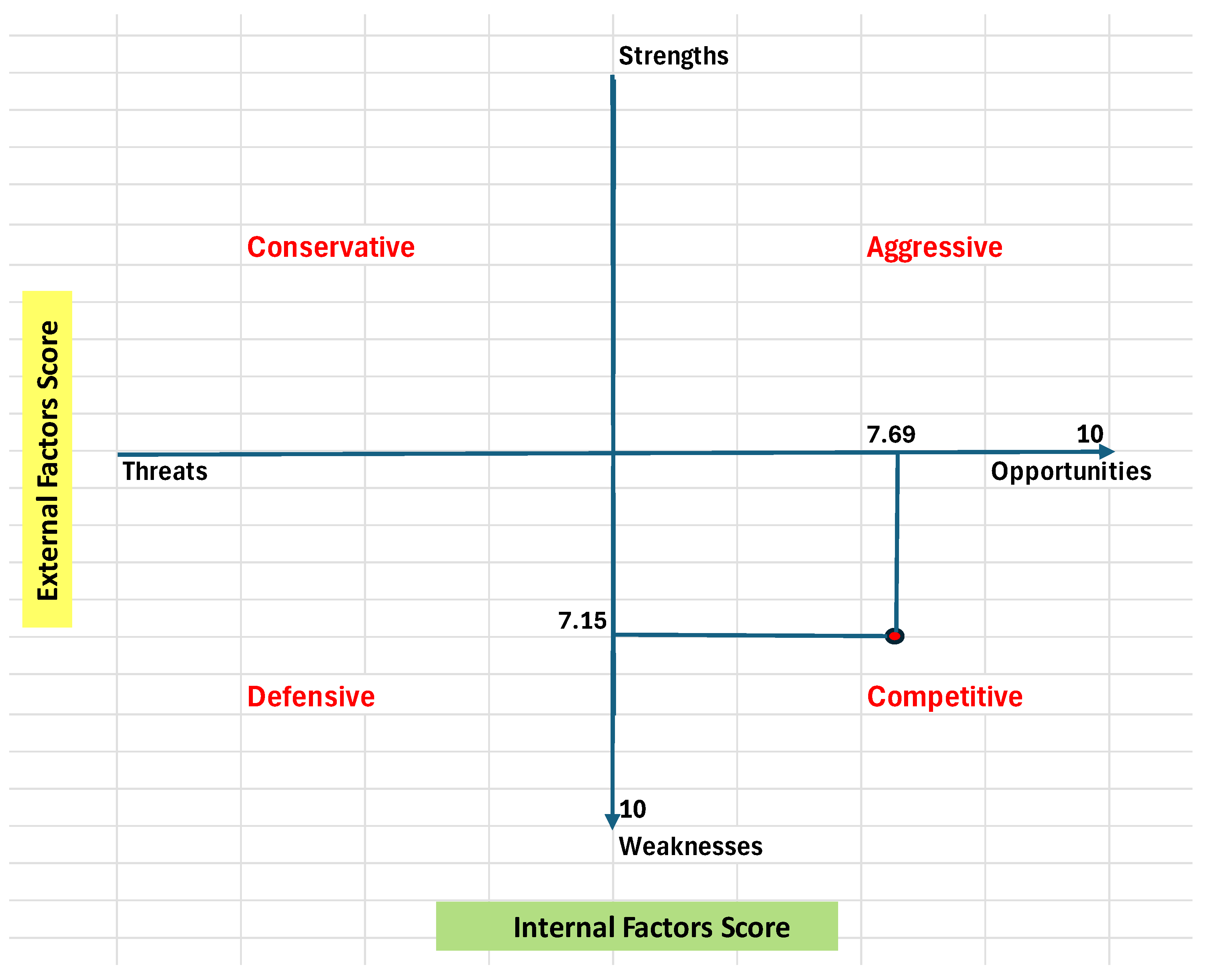
| Total Mean | 7.15 |
| External Factors | Mean * | SE |
|---|---|---|
| Opportunities | ||
| O3: New opportunities and environmental potential to develop agriculture | 4.16 | 0.10 |
| O1: Farming system to production of high-value products | 4.08 | 0.09 |
| O2: New market information system | 3.95 | 0.11 |
| O5: Development of programs, institutions, and facilities | 3.87 | 0.12 |
| O7: Development of relevant research in the European Union | 3.80 | 0.11 |
| O4: Strengthen policies in the European Union | 3.72 | 0.11 |
| O6: Increasing economic growth rate | 3.62 | 0.12 |
| Mean | 3.89 | 0.11 |
| Threats | ||
| Τ1: Complexity of legal and regulatory frameworks | 4.18 | 0.11 |
| Τ4: Adverse environment due to conditions of uncertainty (recession, pandemic, war) | 4.10 | 0.11 |
| Τ7: Unforeseen environmental changes | 3.79 | 0.13 |
| Τ8: Low resilience of agricultural holdings (small average size) | 3.79 | 0.13 |
| Τ6: The lack of financial and government support | 3.77 | 0.14 |
| Τ3: High fluctuations in prices of inputs and outputs | 3.72 | 0.02 |
| Τ5: Most innovations are capital-intensive | 3.62 | 0.13 |
| Τ2: Inadequate balance of supply and demand of products | 3.46 | 0.11 |
| Mean | 3.80 | 0.11 |
| Total Mean | 7.69 |
Disclaimer/Publisher’s Note: The statements, opinions and data contained in all publications are solely those of the individual author(s) and contributor(s) and not of MDPI and/or the editor(s). MDPI and/or the editor(s) disclaim responsibility for any injury to people or property resulting from any ideas, methods, instructions or products referred to in the content. |
© 2025 by the authors. Licensee MDPI, Basel, Switzerland. This article is an open access article distributed under the terms and conditions of the Creative Commons Attribution (CC BY) license.
Share and Cite
Amerani, E.; Kriari, A.; Michailidis, A. Strengthening AKIS Governance: Strategic Insights from a SWOT and SPACE Analysis in Greece. Proceedings 2026, 134, 9. https://doi.org/10.3390/proceedings2026134009
Amerani E, Kriari A, Michailidis A. Strengthening AKIS Governance: Strategic Insights from a SWOT and SPACE Analysis in Greece. Proceedings. 2026; 134(1):9. https://doi.org/10.3390/proceedings2026134009
Chicago/Turabian StyleAmerani, Epistimi, Alexandra Kriari, and Anastasios Michailidis. 2026. "Strengthening AKIS Governance: Strategic Insights from a SWOT and SPACE Analysis in Greece" Proceedings 134, no. 1: 9. https://doi.org/10.3390/proceedings2026134009
APA StyleAmerani, E., Kriari, A., & Michailidis, A. (2026). Strengthening AKIS Governance: Strategic Insights from a SWOT and SPACE Analysis in Greece. Proceedings, 134(1), 9. https://doi.org/10.3390/proceedings2026134009

