


Abstract
This study investigates the carbon footprint (CF) and eco-efficiency of rice cultivation in the Thessaloniki Plain, with the objective of identifying sustainable practices that mitigate greenhouse gas emissions while safeguarding productivity and farm income. Primary data were collected through structured questionnaires, and two complementary methods were employed: Life Cycle Assessment (LCA) for the quantification of CO2e emissions and Data Envelopment Analysis (DEA) for the evaluation of technical and environmental efficiency. Results indicated a CF ranging from 6532 to 13,263 kg CO2e/ha, largely shaped by residue management practices. Overall, the findings underline the importance of rational input use and the adoption of best practices to enhance sustainability.
1. Introduction
Agricultural production is one of the most important sectors of human activity with a significant environmental footprint, as it contributes substantially to greenhouse gas (GHG) emissions at all stages of the crop life cycle. According to [1], agricultural land occupies approximately 37% of the world’s land area and is responsible for 52% of anthropogenic methane (CH4) emissions and 84% of nitrous oxide (N2O) emissions. Furthermore, according to [2], agriculture is responsible for up to 30% of total anthropogenic GHG emissions, while the entire food chain contributes approximately one third of global emissions. In this context, rice cultivation plays a key role, as it is one of the most widespread and nutritionally critical crops worldwide, providing approximately 20% of total dietary energy intake [3]. Productivity increases have mainly been based on the intensive use of fertilizers, pesticides, and machinery, which has increased environmental pressures, especially in terms of GHG emissions [4,5]. This study focuses on rice cultivation in Northern Greece, aiming to quantitatively estimate the carbon footprint (CF) and ecological efficiency of agricultural holdings. To achieve this goal, two methodologies were applied: LCA to estimate CO2e emissions and DEA, to assess technical and environmental efficiency. The data came from primary research, through structured questionnaires to Greek rice producers. Overall, the study aims to contribute to the formulation of sustainable strategies for rice cultivation, which will minimize environmental impacts, promote the rational use of natural resources, and maintain productivity, while enhancing the production of a high-quality, value-added green product.
2. Methods
This study uses two methodologies to assess the environmental and productive efficiency of rice cultivation: the carbon footprint (CF) through LCA and DEA. The CF method is applied based on the LCA approach, as defined by the ISO 14000 series of standards [6]. LCA provides a systematic framework for recording and assessing the environmental impacts of a product throughout its life cycle. In this case, the cradle-to-farm gate approach is followed, which includes emissions from production and use of inputs up to harvest. The operational unit used is kgCO2e per hectare (ha), allowing comparability between agricultural areas regardless of yield. This methodology allows for the estimation of the overall CF and contributes to the understanding of the main sources of carbon dioxide emissions in rice production.
At the same time, DEA is used to assess the relative efficiency of agricultural holdings, treating each producer as a Decision-Making Unit (DMU). The study adopts the Charnes, Cooper, Rhodes (CCR) model with an input orientation and the assumption of constant returns to scale (CRS). The aim of the model is to minimize the inputs used for a given output, to optimize technical efficiency. Inputs include factors such as irrigation water, fertilizers, fuel, and labor, while the total amount of rice produced is used as the output. DEA allows for comparison between units with heterogeneous characteristics, highlighting best practices and deviations from efficiency. The combination of the two methods offers a holistic assessment approach, integrating both the environmental and productive dimensions of agricultural activity.
3. Results and Discussion
The present study evaluates the carbon footprint (CF) and technical efficiency of rice cultivation in Northern Greece, making a significant contribution to the limited Greek literature on the subject. The CF without residue incorporation was estimated at 6532 kgCO2e/ha, while with incorporation it increased to 13,263 kgCO2e/ha. The increase is mainly due to the threefold increase in methane (CH4) emissions, from 4368 to 10,864 kgCO2e/ha, due to anaerobic decomposition of organic matter under 120-day flooding conditions [7,8]. CO2 emissions (1855 kgCO2e/ha) remained stable, while N2O showed a small increase. The use of surface water, through gravity channels, reduced CO2 emissions from pumping, in contrast to regions such as India [9,10]. Figure 1 presents GHG emissions (CH4, N2O, CO2) in CO2 equivalent (CO2e) for two rice cultivation scenarios. Incorporation of residues leads to a significant increase in CH4, while N2O and CO2 emissions change marginally.
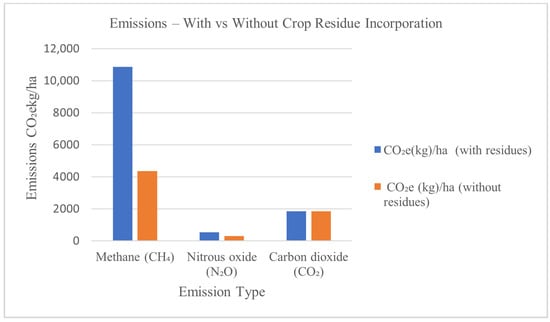
Figure 1.
Emissions—With vs. Without Crop Residue Incorporation. Source: Authors’ own creation.
Simultaneously, Data Envelopment Analysis (DEA) revealed that 83% of producers achieved high efficiency (≥0.90), of which 13% achieved full efficiency [10].The largest average deviations were found in the use of herbicides (−3324 g), fertilizers (−1262 kg), and irrigation (−400.7 m3), while harvest fuel consumption remained high (8377 L). Land and labor inputs (159.07 ha and 73.69 h) are already being utilized efficiently. Figure 2 presents the distribution of rice producers based on technical efficiency scores, as calculated through the DEA method.
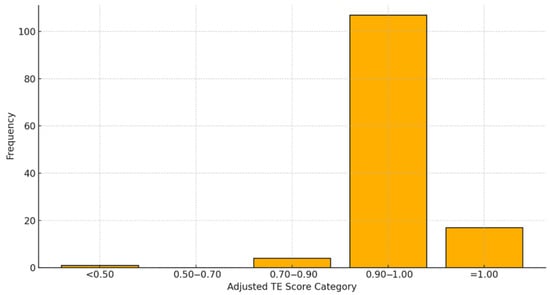
Figure 2.
The frequency distribution of adjusted technical efficiency scores. Source: Authors’ own creation.
The study highlights the need for strategies such as precision agriculture, intermittent irrigation [11], upgrading mechanical equipment and transfer of know-how from reference producers, to reduce the environmental footprint without reducing production.
4. Conclusions
This study evaluated the carbon footprint (CF) and technical efficiency of rice cultivation in Northern Greece, with an emphasis on the link between environmental and production performance. The results highlighted methane (CH4) as the dominant pollutant, due to anaerobic conditions and residue incorporation. The use of fertilizers, pesticides, water, and fuels shows significant room for improvement, while land and labor efficiency remain high. The application of LCA and DEA methods highlighted efficient units as benchmarks, showing that input reduction can enhance sustainability without loss in production. However, the use of generic emission factors and the absence of continuous measurements limit the accuracy of quantification. The theoretical and practical implications are significant: the work suggests evidence-based policies, strengthens the role of precision agriculture, and offers tools for monitoring environmental performance. The transition to friendly practices (e.g., intermittent irrigation, slow-release fertilizers) requires technological innovation, education, financial tools, and government support. Empowering producers through know-how and collaboration can reduce emissions, improve efficiency, and support a sustainable rice farming model aligned with European policies.
Author Contributions
E.A., Conceptualization, Methodology, Data curation, Formal analysis, Writing—original draft; A.M., Methodology, Data curation, Formal analysis, Writing—review and editing; A.P., Conceptualization, Supervision, Writing—review and editing. All authors have read and agreed to the published version of the manuscript.
Funding
This research received no external funding.
Institutional Review Board Statement
Not applicable.
Informed Consent Statement
Informed consent was obtained from all subjects involved in the study, and all data were collected and analyzed anonymously.
Data Availability Statement
The data presented in this study are available on request from the corresponding author.
Conflicts of Interest
The authors declare no conflict of interest.
References
- FAO. Reducing Greenhouse Gas Emissions from Rice Production in Asia: Mitigation Options and Adaptation Potentials; Food and Agriculture Organization of the United Nations: Rome, Italy, 2014; Available online: http://www.fao.org/3/i4184e/i4184e.pdf (accessed on 1 January 2025).
- Li, Z.; Yang, Y.; So, N.; Lee, J.-I. Carbon footprint of maize planting under intensive subsistence cultivation in South Korea. Int. J. Clim. Change Strateg. Manag. 2022, 15, 301–321. [Google Scholar] [CrossRef]
- Abdo, A.I.; Tian, M.; Shi, Z.; Sun, D.; Abdel-Fattah, M.K.; Zhang, J.; Wei, H. Carbon footprint of global rice production and consumption. J. Clean. Prod. 2024, 474, 143560. [Google Scholar] [CrossRef]
- Brentrup, F.; Küsters, J.; Kuhlmann, H.; Lammel, J. Environmental impact assessment of agricultural production systems using the life cycle assessment methodology: I. Theoretical concept of a LCA method tailored to crop production. Eur. J. Agron. 2004, 20, 247–264. [Google Scholar] [CrossRef]
- Wang, H.; Yang, Y.; Zhang, X.; Tian, G. Carbon footprint analysis for mechanization of maize production based on life cycle assessment: A case study in Jilin Province, China. Sustainability 2015, 7, 15772–15784. [Google Scholar] [CrossRef]
- ISO 14040; Environmental Management—Life Cycle Assessment—Principles and Framework. International Organization for Standardization: Geneva, Switzerland, 2006.
- Kashyap, D.; Agarwal, T. Carbon footprint and water footprint of rice and wheat production in Punjab, India. Agric. Syst. 2021, 186, 102959. [Google Scholar] [CrossRef]
- Benbi, D.K. Carbon footprint and agricultural sustainability nexus in an intensively cultivated region of Indo-Gangetic Plains. Sci. Total Environ. 2018, 644, 611–623. [Google Scholar] [CrossRef] [PubMed]
- Mohammadi, A.; Rafiee, S.; Jafari, A.; Keyhani, A.; Dalgaard, T.; Knudsen, M.T.; Nguyen, T.L.T.; Borek, R.; Hermansen, J.E. Joint life cycle assessment and data envelopment analysis for the benchmarking of environmental impacts in rice paddy production. J. Clean. Prod. 2015, 106, 521–532. [Google Scholar] [CrossRef]
- Huang, M.; Zeng, L.; Liu, C.; Li, X.; Wang, H. Research on the eco-efficiency of rice production and its improvement path: A case study from China. Int. J. Environ. Res. Public Health 2022, 19, 8645. [Google Scholar] [CrossRef] [PubMed]
- Żyłowski, T.; Kozyra, J. Crop cultivation efficiency and GHG emission: SBM-DEA model with undesirable output approach. Sustainability 2023, 15, 10557. [Google Scholar] [CrossRef]
Disclaimer/Publisher’s Note: The statements, opinions and data contained in all publications are solely those of the individual author(s) and contributor(s) and not of MDPI and/or the editor(s). MDPI and/or the editor(s) disclaim responsibility for any injury to people or property resulting from any ideas, methods, instructions or products referred to in the content. |
© 2025 by the authors. Licensee MDPI, Basel, Switzerland. This article is an open access article distributed under the terms and conditions of the Creative Commons Attribution (CC BY) license.