
Proceeding Paper

Enhancing AKIS in Greece: Pathways to Innovation and Collaboration †
by
Epistimi Amerani
*,
Nikoleta-Maria Kriari
and
Anastasios Michailidis
Department of Agricultural Economics, Faculty of Agriculture, Forestry and Natural Environment, Aristotle University of Thessaloniki, 541 24 Thessaloniki, Greece
*
Author to whom correspondence should be addressed.
Presented at the 18th International Conference of the Hellenic Association of Agricultural Economists, Florina, Greece, 10–11 October 2025.
Proceedings 2026, 134(1), 8; https://doi.org/10.3390/proceedings2026134008 (registering DOI)
Published: 30 December 2025

Abstract

The Agricultural Knowledge and Innovation System (AKIS) plays a pivotal role in fostering innovation and disseminating knowledge within the agricultural sector. This paper proposes a framework for strengthening AKIS in Greece. The study adopts a multi-actor approach, incorporating perspectives from farmers, researchers, policymakers, advisory services, and other relevant stakeholders. A structured questionnaire, administered online from December 2022 to March 2023, gathered responses from 61 senior managers across AKIS actors. By exploring their perceptions and opinions, this study aims to identify challenges and opportunities for enhancing the efficiency and effectiveness of AKIS in Greece. The findings contribute to policy dialogue and offer strategic directions for reinforcing collaborative innovation in the agricultural sector.

1. Introduction

Agriculture is a vital sector in Greece, contributing significantly to the national economy and rural development [1]. However, the sector faces numerous challenges, including technological gaps [2], fragmented advisory services [3,4,5,6], and limited collaboration among stakeholders [7]. Strengthening AKIS can address these challenges by fostering knowledge exchange, improving advisory services, and enhancing innovation [8].
This paper seeks to propose a framework for a more integrated and effective AKIS in Greece.

2. Materials and Methods

This study employs a multi-actor approach, integrating perspectives from farmers, researchers, policymakers, advisory services, and other key stakeholders. Data were collected through a survey of 61 expert representatives, primarily senior managers, from the eight main stakeholder groups. The data collection took place between December 2022 and March 2023 via an online survey tool, following an initial phone conversation. Descriptive statistics were used to summarize and present the main findings.

3. Results and Discussion

The actors’ perspectives on the importance of strengthening AKIS are illustrated in Figure 1. The findings indicate that the vast majority of respondents across all actor groups rated it as either very important or quite important. This highlights the critical need to improve the current state of AKIS from the stakeholders’ perspective. These results align with the Greek Strategic Plan 2030, which aims to enhance AKIS’ structural processes to boost the agricultural sector’s competitiveness and accelerate co-innovation. Furthermore, this finding is consistent with the study by Zahran et al. [8], which confirmed that actors in Egypt also place high importance on improving the effectiveness of existing AKIS.
According to the respondents’ views, it is evident that AKIS in Greece lags in key areas such as funding and investment attraction, input subsidies, market access, and overall governance. These factors are crucial prerequisites for ensuring the agricultural sector’s sustainability in the coming years (Table 1). Ιn Italy, Pascucci and de-Magistris [9] found that knowledge and innovation, the enhancement of advisory service quality within the regional AKIS and fostering interactions among stakeholders are crucial for AKIS advancement. In a similar vein, Turner et al. [10] identified hindering factors that adversely affect the progress and pace of co-innovation within the New Zealand AKIS. Likewise, Minh [11] verified that the AKIS in Vietnam’s northern uplands must improve its structural performance by addressing specific needs: knowledge and innovation, infrastructure for physical resources and funding, and the development of capabilities and accountability among participants. Furthermore, it is observed that the availability of necessary resources and services varies among the stakeholders involved, with none of them possessing all the required conditions. This heterogeneity makes the further development of AKIS imperative, as the combination of different stakeholders’ capabilities can drive the necessary technological, social, and institutional changes required for sustainable agriculture.
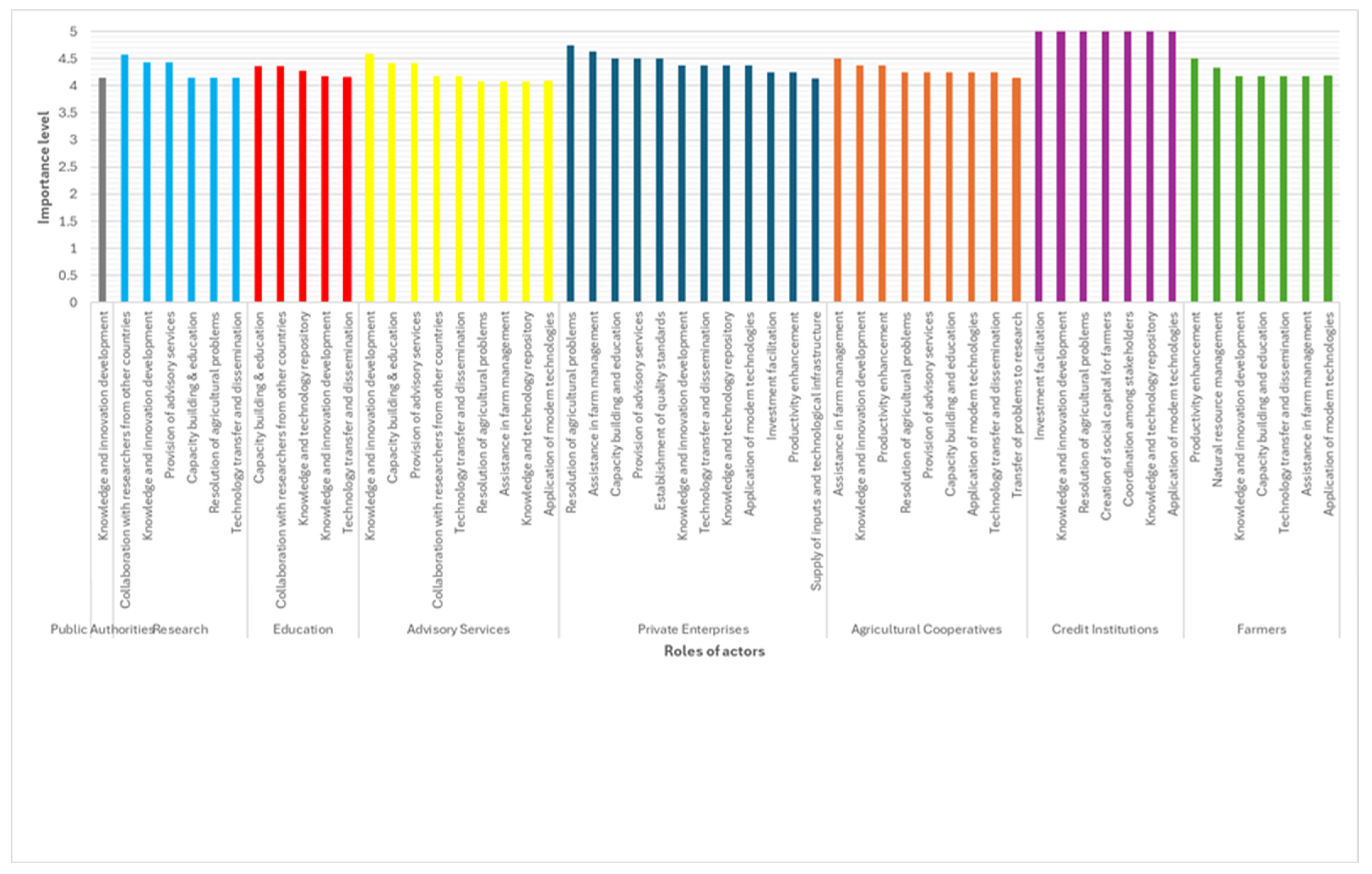
Then, actors have defined their potential roles in the development of AKIS, as illustrated in Figure 2. Many of these functions can be achieved through collaboration among two or more actors. For example, the development of knowledge and innovation may involve participation from all actors, while collaboration with international researchers and organizations is likely to be primarily led by research and education institutions. Productivity enhancement may be driven by farmers and cooperatives, while the provision of advisory services can be supported by research institutions, advisory services, cooperatives, and businesses. Capacity building and education may engage research institutions, education providers, advisory services, businesses, cooperatives, and farmers. Addressing agricultural challenges could involve a collaborative effort from research institutions, advisory bodies, businesses, cooperatives, and credit providers. The adoption of modern technology can be facilitated by advisory bodies, businesses, cooperatives, and credit providers. Similarly, farm management assistance could be provided by advisory bodies, businesses, cooperatives, and credit providers. This collaborative approach has the potential to strengthen AKIS by leveraging the expertise and contributions of multiple stakeholders. This finding is consistent with the study by Hermans et al. [12], which emphasized that each actor, whether individually or in partnership with others, plays one or two key roles in disseminating innovation both horizontally and vertically.
Finally, the significance of each linkage is essential for enhancing coordination and collaboration among participants, as shown in Table 2. The most critical connections, ranked by importance, are networks (average: 4.33) and platforms (average: 4.21). These findings emphasize the need to establish different types of connections based on the nature of relationships among participants. The number and strength of possible links between two participants vary depending on factors such as the services provided, available funding, stakeholder engagement, and the scope of work [8]. Various strategies exist to improve collaboration and coordination within AKIS. Across different countries, governance structures—such as networks and platforms—have been implemented to facilitate these efforts [13]. The European Union (EU) is progressively encouraging the formation of networks among farmers that extend throughout the value chain and beyond. Operational Groups within the European Innovation Partnership for Agricultural Productivity and Sustainability (EIP-AGRI) exemplify a multi-actor strategy, where diverse participants with different types of expertise (such as scientific and practical knowledge) work together throughout the project to create innovative solutions for actual agri-food systems [14]. Strengthening these connections can lead to more efficient knowledge exchange, resource-sharing, and innovation adoption, ultimately enhancing the effectiveness of AKIS.

4. Conclusions

This study offers new perspectives on strengthening the AKIS in Greece. The analysis underscores that reinforcing AKIS is essential for ensuring the sustainability and competitiveness of the agricultural sector. While its importance is widely acknowledged, significant challenges remain, including inadequate funding and investment opportunities, limited market access, weak stakeholder coordination, and the need for more effective advisory services. International experiences suggest that well-structured governance, enhanced advisory support, and improved financial mechanisms are key factors in the success of AKIS [14,15].
The findings emphasize that networks and platforms are crucial in fostering collaboration and knowledge exchange among AKIS actors. Moreover, disparities in the availability of essential resources and services among stakeholders highlight the need for a more integrated and cooperative agricultural knowledge system. A comprehensive, multi-sectoral approach that actively engages all key stakeholders is vital for creating a more effective and sustainable system. The insights from this research can serve as a valuable resource for policymakers, guiding the development of targeted interventions and institutional reforms to reinforce AKIS, drive agricultural innovation, and support the sustainability of rural areas.

Author Contributions

Methodology, E.A.; software, E.A. and N.-M.K.; validation, E.A. and N.-M.K.; investigation, E.A. and N.-M.K.; resources, E.A. and N.-M.K.; data curation, E.A. and N.-M.K.; writing—original draft preparation, A.M.; writing—review and editing, A.M. and E.A.; visualization, A.M.; supervision, A.M.; project administration, A.M. All authors have read and agreed to the published version of the manuscript.

Funding

This research was funded by the Hellenic Foundation for Research and Innovation (HFRI) under the third call for HFRI PhD Fellowships, grant number 6422.

Informed Consent Statement

Informed consent was obtained from all subjects involved in this study.

Data Availability Statement

Data will be made available upon request.

Conflicts of Interest

The authors declare no conflicts of interest.

Abbreviations

The following abbreviations are used in this manuscript:
AKISAgricultural Knowledge and Innovation System
EIP AGRIEuropean Innovation Partnership for Agricultural Productivity and Sustainability
EUEuropean Union

References

  1. Greece’s CAP Strategic Plans. Available online: https://agriculture.ec.europa.eu/document/download/b13e3e86-2c12-45e5-9659-35f0384c76b2_en?filename=csp-at-a-glance-greece_en.pdf (accessed on 10 January 2023).
  2. Amerani, E.; Michailidis, A. The Agricultural Knowledge and Innovation System (AKIS) in a Changing Environment in Greece. Proceedings 2024, 94, 29. [Google Scholar] [CrossRef]
  3. Konstantidelli, V.; Koutsouris, A.; Karanikolas, P.; Tsiboukas, K. Setting-Up a Farm Advisory Network in the Agricultural University of Athens: An Exploratory Analysis. In Proceedings of the 13th European IFSA Symposium, Chania, Greece, 1–5 July 2018. [Google Scholar]
  4. Charatsari, C.; Lioutas, E. Is Current Agronomy Ready to Promote Sustainable Agriculture? Identifying Key Skills and Competencies Needed. Int. J. Sustain. Dev. World Ecol. 2019, 26, 232–241. [Google Scholar] [CrossRef]
  5. Birke, F.M.; Bae, S.; Schober, A.; Wolf, S.; Gerster-Bentaya, M.; Knierim, A. AKIS in European Countries: Cross Analysis of AKIS Country Reports, i2connect Project. 2022. Available online: https://i2connect-h2020.eu/wp-content/uploads/2022/12/2022-12-02-AKIS-cross-analysis_updated.pdf (accessed on 6 September 2023).
  6. Koutsouris, A.; Zarokosta, E. Farmers’ Networks and the Quest for Reliable Advice: Innovating in Greece. J. Agric. Educ. Ext. 2022, 28, 625–661. [Google Scholar] [CrossRef]
  7. Amerani, E.; Nastis, A.S.; Michailidis, A. Greece’s AKIS: An Evaluation of Linkage Mechanisms. Rural Ext. Innov. Syst. J. 2023, 19, 9–23. [Google Scholar]
  8. Zahran, Y.; Kassem, H.S.; Naba, S.M.; Alotaibi, B.A. Shifting from Fragmentation to Integration: A Proposed Framework for Strengthening the Agricultural Knowledge and Innovation System in Egypt. Sustainability 2020, 12, 5131. [Google Scholar] [CrossRef]
  9. Pascucci, S.; de-Magistris, T. The Effects of Changing Regional Agricultural Knowledge and Innovation System on Italian Farmers’ Strategies. Agric. Syst. 2011, 104, 746–754. [Google Scholar] [CrossRef]
  10. Turner, J.A.; Klerkx, L.; Rijswijk, K.; Williams, T.; Barnard, T. Systemic Problems Affecting Co-Innovation in the New Zealand Agricultural Innovation System: Identification of Blocking Mechanisms and Underlying Institutional Logics. NJAS—Wageningen J. Life Sci. 2016, 76, 99–112. [Google Scholar] [CrossRef]
  11. Minh, T.T. Unpacking the Systemic Problems and Blocking Mechanisms of a Regional Agricultural Innovation System: An Integrated Regional-Functional-Structural Analysis. Agric. Syst. 2019, 173, 268–280. [Google Scholar] [CrossRef]
  12. Hermans, F.; Stuiver, M.; Beers, P.J.; Kok, K. The Distribution of Roles and Functions for Upscaling and Outscaling Innovations in Agricultural Innovation Systems. Agric. Syst. 2013, 115, 117–128. [Google Scholar] [CrossRef]
  13. Amerani, E.; Bournaris, T.; Koutsouris, A.; Loizou, E.; Nastis, S.A.; Natos, D.; Partalidou, M.; Michailidis, A. Online Training Platform for the Agricultural Knowledge and Innovation System (AKIS) in Greece. In Proceedings of the 11th International Conference on Information and Communication Technologies in Agriculture, Food & Environment (HAICTA 2024), Samos, Greece, 17–20 October 2024. [Google Scholar]
  14. EU CAP Network. Operational Groups | European CAP Network. 2024. Available online: https://eu-cap-network.ec.europa.eu/operational-groups_en (accessed on 6 February 2024).
  15. Knierim, A.; Boenning, K.; Caggiano, M.; Cristóvão, A.; Dirimanova, V.; Koehnen, T.; Prager, K. The AKIS Concept and Its Relevance in Selected EU Member States. Outlook Agric. 2015, 44, 29–36. [Google Scholar] [CrossRef]
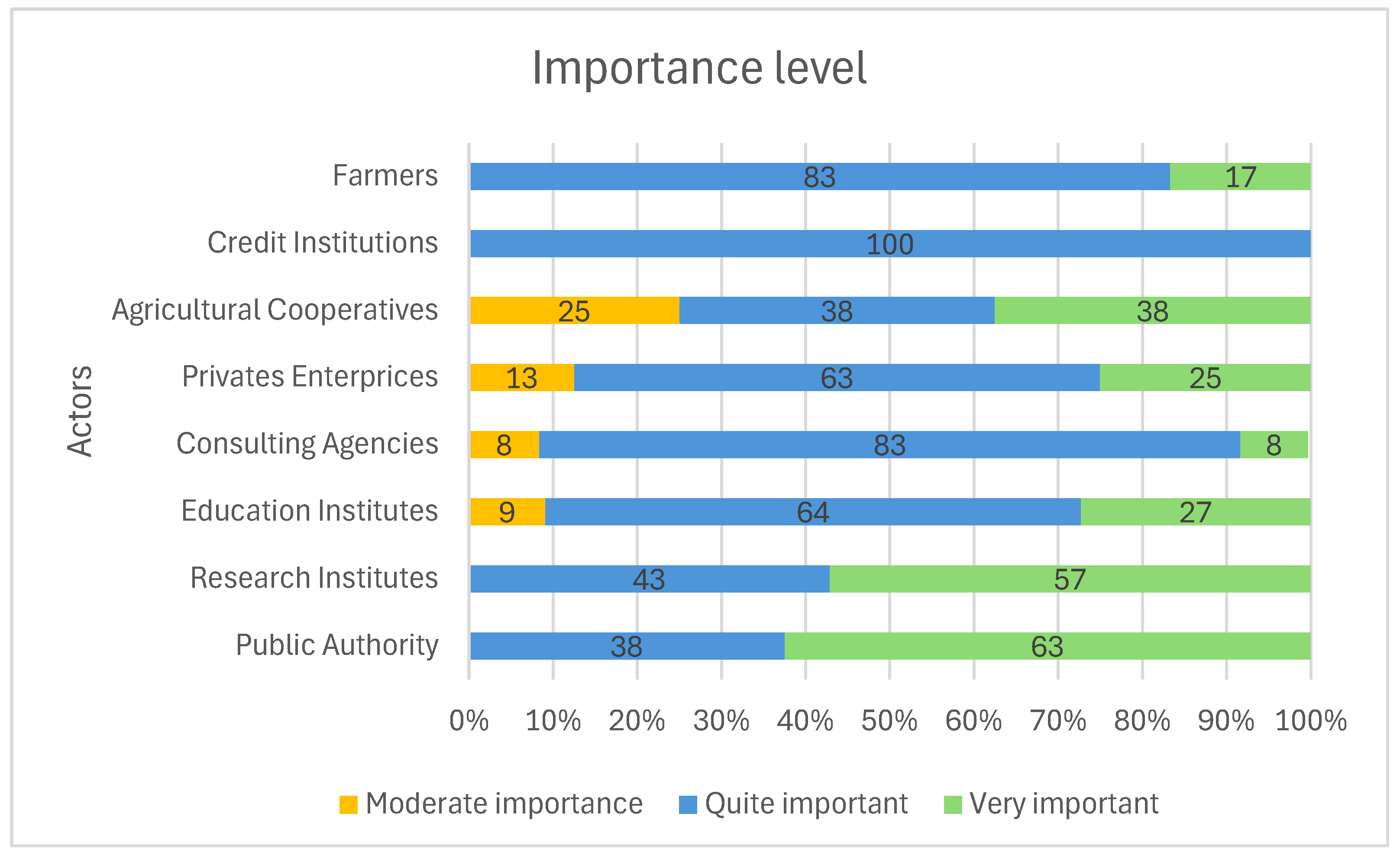
Figure 1. Importance level of AKIS development in Greece.
Proceedings 134 00008 g001
Figure 2. Average scores of the eight participant groups regarding the perceived importance of their potential roles in AKIS.
Proceedings 134 00008 g002
Table 1. The availability of the requirements of sustainable agriculture at each actor.
Requirements *Public
Authorities
ResearchEducationAdvisoryPrivate
Sector
CooperativesFarmersCreditOverall Average
Knowledge4.254.144.274.254.254.503.334.004.12
Collaboration 4.003.714.274.254.384.003.335.004.12
Competence3.884.144.454.174.254.383.503.003.97
Effective system3.884.004.094.254.504.503.333.003.94
Env. sustainability3.503.574.274.174.384.253.503.003.83
Technology3.254.294.004.083.754.003.174.003.82
Bargaining power3.633.434.003.254.134.003.005.003.81
Education3.383.714.643.924.004.502.833.003.75
Governance4.003.003.823.333.503.752.835.003.65
Access to markets3.502.572.643.254.003.883.005.003.48
Input subsidies3.382.142.273.333.754.003.335.003.40
Traceability 3.252.863.914.004.004.003.002.003.38
Risk management2.883.002.643.503.503.632.835.003.37
Capital attraction3.133.002.453.003.753.752.835.003.36
Credit support 3.752.571.912.673.253.883.005.003.25
* The requirements are ranked in descending order based on the overall average, from 1: not at all to 5: Very.
Table 2. Importance of each linkage from the actors’ perspectives.
Linkages *Public
Authorities
ResearchEducationAdvisory Private SectorCooperativesCreditFarmersOverall
Average
Rank
Networks4.384.574.184.174.134.255.004.004.331
Platforms4.004.294.364.004.384.005.003.674.212
Solidarity3.884.144.004.254.384.135.003.834.203
Activities4.134.434.184.334.134.384.003.004.074
Agreements3.503.864.093.754.134.255.003.504.015
Partnership3.503.434.094.173.634.005.002.333.776
Coordinating Committees4.003.713.453.423.754.003.002.833.527
Contracting3.503.143.734.083.383.882.003.003.348
Advocacy linkages3.383.143.273.253.633.383.002.833.239
* Linkages are ranked in descending order based on the overall average, from 1: not at all important to 5: Very important.
Disclaimer/Publisher’s Note: The statements, opinions and data contained in all publications are solely those of the individual author(s) and contributor(s) and not of MDPI and/or the editor(s). MDPI and/or the editor(s) disclaim responsibility for any injury to people or property resulting from any ideas, methods, instructions or products referred to in the content.