

You are currently viewing a new version of our website. To view the old version click .

Nitrogen, Volume 5, Issue 3

September 2024 - 18 articles

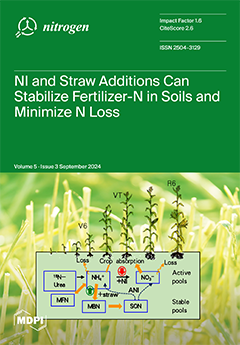
Cover Story: Soil-applied urea undergoes ammoniation and nitrification, converting into active forms of ammonium (NH4+) and nitrate (NO3-), which are then absorbed by crops. However, this process also leads to significant environmental losses. Our research reveals that incorporating a nitrification inhibitor (NI) and straw into the soil can help regulate the conversion of N from active pools to other N pools. This approach prevents the accumulation of mineral N in the soil and reduces fertilizer-N losses. While both measures reduced the activity of fertilizer-N in our study, they did not impact crops’ total N absorption, primarily due to the "added N interaction" (ANI) effect. The following abbreviations can be found in the figure: MFA, mineral fixed NH4+; MBN, microbial biomass N; and SON, soil organic N. View this paper
  • Issues are regarded as officially published after their release is announced to the table of contents alert mailing list .
  • You may sign up for email alerts to receive table of contents of newly released issues.
  • PDF is the official format for papers published in both, html and pdf forms. To view the papers in pdf format, click on the "PDF Full-text" link, and use the free Adobe Reader to open them.

Articles (18)

  • Article
  • Open Access
2,048 Views
18 Pages

Plantago Species Show Germination Improvement as a Function of Nitrate and Temperature

  • António Teixeira,
  • Pietro P. M. Iannetta and
  • Peter E. Toorop

20 September 2024

At the optimum temperature, which is the ideal range in which seeds germinate most efficiently, seed germination may be lower than expected under favorable conditions, and this is indicative of seed dormancy. Also, germination may be enhanced by addi...

  • Article
  • Open Access
3 Citations
2,802 Views
18 Pages

13 September 2024

Crop residue decomposition is fundamental for ecosystems, influencing carbon cycling, organic matter accumulation, and promoting plant development through nutrient release. Therefore, this study aimed to ascertain the rate of decomposition of four co...

  • Article
  • Open Access
2,161 Views
9 Pages

6 September 2024

The use of cover crops (CCs) based on tropical legumes, including Crotalaria ochroleuca, Crotalaria juncea, Crotalaria spectabilis, and Cajanus cajan, represents a pivotal aspect of agricultural rotations. These crops facilitate the incorporation of...

  • Article
  • Open Access
3 Citations
1,965 Views
17 Pages

Nitrogen Dynamics from Conventional Organic Manures as Influenced by Different Temperature Regimes in Subtropical Conditions

  • Abu Taher Mohammad Anwarul Islam Mondol,
  • Md. Akhter Hossain Chowdhury,
  • Sharif Ahmed and
  • Md Khairul Alam

23 August 2024

Determining nutrient-release patterns of organic manures can give an estimate of the potential amount of nutrients that a given material can contribute to crops along with chemical fertiliser. Nutrients released from organic manure depend on several...

  • Review
  • Open Access
2 Citations
3,681 Views
14 Pages

19 August 2024

The nitrogen/N dynamic is complex and affected by soil management (i.e., residue accumulation and correction/fertilization). In soil, most of the N is combined with organic matter (organic forms), but the N forms absorbed by plants are ammonium/NH4+...

  • Article
  • Open Access
3 Citations
3,157 Views
20 Pages

Comparison of Organic and Inorganic Fertilization in Fenugreek Cultivation Using Nitrogen Indicators

  • Antigolena Folina,
  • Antonios Mavroeidis,
  • Panteleimon Stavropoulos,
  • Lydia Eisenbach,
  • Ioanna Kakabouki and
  • Dimitrios Bilalis

13 August 2024

Nitrogen indices could be used to evaluate organic and inorganic fertilization because they provide quantitative measures of nitrogen availability in the soil, allowing for a more accurate assessment of nutrient-management practices and optimization...

  • Article
  • Open Access
1 Citations
1,602 Views
10 Pages

Effect of Time of Nitrogen Fertilization on Use of Root Reserves in Megathyrsus maximus Cultivars

  • Aline M. Motta,
  • Luiz J. M. Motta,
  • Lucas G. Mota,
  • Lucas M. B. Assis,
  • Anna B. O. Moura,
  • Luis C. O. Borges,
  • Gustavo B. A. Silva,
  • Camila F. D. Duarte,
  • Carla H. A. Cabral and
  • Carlos E. A. Cabral

10 August 2024

Nitrogen is a very important nutrient in grass maintenance fertilization and therefore must be applied at the appropriate moment. The objective of this study was to identify the most responsive moment to nitrogen fertilization and to verify if root m...

  • Review
  • Open Access
11 Citations
7,754 Views
14 Pages

8 August 2024

Global warming driven by climate change has profound impacts on nitrogen dynamics in terrestrial and aquatic ecosystems. The increased emissions of greenhouse gases alter the distribution and availability of nitrogen, which is a critical nutrient for...

  • Article
  • Open Access
2 Citations
2,175 Views
23 Pages

5 August 2024

Most crops are fertilized with high amounts of nitrogen, and have an alarmingly low utilization efficiency. For this reason, the coordination between the fertilizer contribution and the nitrogen requirements of the crop is very important. Therefore,...

  • Article
  • Open Access
1 Citations
1,824 Views
12 Pages

Reduction of Nitrogen through Anaerobic Processes in Chinese Rice Paddy Soils

  • Ahmed A. A. Aioub,
  • Shuquan Jin,
  • Jiezhang Xu and
  • Qichun Zhang

30 July 2024

Comprehending the anaerobic nitrogen transformations, including denitrification, anaerobic ammonium oxidation (anammox), and anaerobic ammonium oxidation linked with iron reduction (Feammox) in soil, is essential for improving soil fertility and mini...

of 2

Get Alerted

Add your email address to receive forthcoming issues of this journal.

XFacebookLinkedIn
Nitrogen - ISSN 2504-3129