


Abstract
This paper proposes a novel fractional-order African vulture optimization algorithm (FO-AVOA) for solving the optimal reactive power dispatch (ORPD) problem. By integrating fractional calculus into the conventional AVOA framework, the proposed method enhances the exploration–exploitation balance, accelerates convergence, and improves solution robustness. The ORPD problem is formulated as a constrained optimization task with the objective of minimizing real power losses while satisfying generator voltage limits, transformer tap ratios, and reactive power compensator constraints. The general optimization capability of the FO-AVOA is verified using the CEC 2017, 2020, and 2022 benchmark functions. In addition, the method is applied to the IEEE 30-bus and IEEE 57-bus test systems. The results demonstrate significant power loss reductions of up to 15.888% and 24.39% for the IEEE 30-bus and IEEE 57-bus systems, respectively, compared with the conventional AVOA and other state-of-the-art optimization algorithms, along with strong robustness and stability across independent runs. These findings confirm the effectiveness of the FO-AVOA as a reliable optimization tool for modern power system applications.
1. Introduction
1.1. Problem Background
The ORPD issue has become a central area of study in power system engineering due to its significant impact on modern-day energy management policies. Its primary objective is to reduce Ploss throughout transmission networks without compromising a superior voltage profile, as well as satisfying a vast range of equality and inequality operating constraints. Thus, RP allocation is regarded as a critical requirement of ensuring electric power system reliability, efficiency, and sustainability, which explains the rising academic attention on this area [1,2,3]. For these objectives to be achieved, adjustment of principal decision variables is crucial, e.g., generator voltage magnitudes, transformer tap levels, shunt capacitor/reactor installations, flexible AC transmission system (FACTS) devices, and active power generation levels. Because of the nonlinearity and high complexity of ORPD, gradient-free algorithms are commonly applied in real applications.
1.2. Related Work
All metaheuristic-based optimization techniques have proven to be helpful, with particle swarm optimization (PSO) is a resilient approach grounded in collective intelligence in nature. PSO has been vastly utilized in economic load dispatch (ELD) studies and, in combination with differential evolution (DE), has shown strong potential to optimize hybrid energy generation units [4]. Genetic algorithms (GAs) have been widely utilized for the ELD problem, particularly when conventional numerical algorithms are unable to identify globally optimal solutions within manageable system constraints. Through well-designed active power output allocation, enhanced versions of GA have shown higher accuracy and robustness in delivering credible results [5]. More recently, the energy and power sectors have adopted a broad range of metaheuristic search techniques, as highlighted in [6]. Among these, Mirjalili’s [7] nature-inspired grey wolf optimization (GWO) method has emerged as a powerful tool capable of handling complex, real-world ELD scenarios. Beyond ELD, GWO has also been applied to diverse optimization tasks across engineering and computational domains. Traditional optimization techniques, such as sequential, quadratic, linear, dynamic programming, and the Newton–Raphson method, have been employed in power system analysis for many years. However, their performance is very much compromised by early convergence and sensitivity to initial conditions [8], rendering them incapable of reproducibly reaching global optima. For this, hybrid optimization frameworks that use complementary algorithms have gained popularity, as they are able to leverage the positive aspects of different methods to produce improved global solutions [9].
Nowadays, power system optimization is very challenging owing to many realistic constraints such as demand–supply balance, generator capacity, emissions, prohibited operating regions (POZs), ramp rate limits, random variability from renewable sources, bus voltage controls, transformer tap controls, RP compensation, and the presence of continuous, discrete, and integer decision variables. All these together render power system optimization extremely nonlinear and nonconvex [10]. Most traditional optimization methods tend to become trapped in local optima and hence are not so effective for power system planning, operation, and management. But it has been found that bio-inspired algorithms can serve as effective alternatives in solving complex optimization problems. Their population-based and stochastic nature allows them to explore larger solution spaces and reduce the probability of entrapment in suboptimal regions, as opposed to deterministic derivative-based algorithms relying mainly on derivative information rather than fitness evaluations [11]. Bio-inspired approaches are often classified as evolutionary, ecological, and swarm-based algorithms, while hybridized versions offer even more potential by combining complementary features to achieve global solutions without premature convergence.
A particularly critical application in this area is the ELD problem with emission constraint, which minimizes fuel costs in relation to poisonous gas emissions [12]. This has been addressed by hybrid solutions such as a fuzzy-based PSO–DE method (FB-PSO-DE) taking into account valve-point loading effects (VPLEs), POZs, and multi-fuel sources for test systems of 10, 40, and 160 generation units. The hybrid solution was also more stable and convergent than the standalone PSO in more than seven test functions and 100 independent runs [13]. Similarly, adaptive differential evolution combined with a continuous greedy randomized adaptive search heuristic in the CGRASP–SADE algorithm was used to optimize generation cost under VPLE constraints [14]. Integration of renewable materials has also been explored for cost minimization encompassing the wind energy embedded in ELD using the moth–flame optimization (MFO) algorithm [15]. Further advancements witnessed the hybrid modified imperialist competitive algorithm (MICA), and invasive weed optimization (IWO) was explored for optimal power flow, where the VAR compensator’s decision variables, generator voltages, and transformer taps were taken into account [16].
A few other contributions include the use of multiagent-based PSO for loss minimization under nonlinear cost functions [17], the harmony search algorithm (HSA) for RP dispatch in the IEEE 30-bus system [18], and GWO for managing inequality constraints using penalty functions [19]. Hybridized methods, i.e., fractional order and the PSO algorithm for the IEEE 30- and 57-bus systems [20] and MFO algorithms for loss minimization in IEEE bus networks [21], have also provided promising results. However, the conventional MFO has the tendency to converge prematurely during the later optimization stages, with most of the individuals clustering around a nearby local area of the search space. Apart from that, GWO is also utilized for parameter tuning in the case of the IEEE 57-bus system [22], and seeker optimization (SO) is utilized for RP dispatch in IEEE systems [23]. In [24], a novel fractional swarming method was explored for optimum RP dis-patch. Hybrid PSO and the imperialist competitive algorithm (ICA) were revisited for the ORPD issue in [25]. Similarly, swarm intelligence for optimization [26], accurate power system modeling, and load flow analysis [27,28,29], as well as control design and nonlinear system performance [30,31], have been explored. Recent studies have demonstrated that the application of fractional calculus (FC) and fractional derivatives in modeling systems can significantly enhance performance in a wide range of scientific and engineering applications. Feature selection, image and hyperspectral data processing, robotic path planning, Kalman filter, and fractional-order filter design are just some of the applications where these methods have been used successfully. In this context, researchers suggest that FC techniques, along with evolutionary optimization algorithms, have immense potential to provide solutions to complex problems in energy-related fields. A few noteworthy examples include fractional-order robotic PSO, FPSO with fractional-order velocity terms [32,33,34,35,36], optical disc localization and segmentation [37], parameter estimation for Kalman filtering [38], land cover monitoring [39], feature selection applications [40], hyperspectral image classification [41], and fractional-order controllers for robot path planning [42]. Other contributions in this context are the multiband stabilizer design based on a hybrid GA–PSO lead–lag compensator dynamics for power systems [43], nonlinear system identification [44], and the power system and global engineering problem [45,46,47,48]. Tempered fractional gradient descent [49], Caputo fractional optimization [50], fractional gradient descent theory [51], convergence analysis [52], and fractional optimization survey [53]. Altogether, these developments have established the efficacy of FC-based solutions and demonstrated very clearly that FC will be amalgamated with metaheuristic algorithms to solve optimization problems in energy and power systems.
Table 1 highlights the main limitations of existing ORPD optimization approaches and clearly positions the proposed method among recent techniques. The table emphasizes how the proposed approach improves the coordination of generator voltages, transformer tap settings, and reactive power compensators under both radial and meshed network conditions. By effectively handling the nonlinear, constrained, and multimodal nature of the ORPD problem, the proposed method avoids premature convergence and ensures stable operation under varying loading conditions. This distinctive capability differentiates the proposed approach from conventional methods and enables more reliable and efficient minimization of real power loss.
Table 1.
Feature-based comparison of existing ORPD optimization approaches and the proposed algorithm.
Despite the strong performance of existing metaheuristic, hybrid, and fractional-order optimization approaches for ORPD, several limitations persist. Many methods suffer from premature convergence in later iterations, weak exploration–exploitation balance, high sensitivity to parameter tuning, and reduced scalability when applied to large-scale and highly constrained power systems. In addition, most existing fractional-order optimizers are either computationally intensive or lack robust convergence control. These weaknesses motivate the need for a more balanced and memory-driven optimization framework. Accordingly, this study introduces the FO-AVOA to effectively address these gaps by combining the strong global search capability of the AVOA with the nonlocal memory characteristics of fractional-order calculus.
1.3. Motivation and Contribution
The integration of fractional-order calculus into the African vulture optimization algorithm, referred to as the FO-AVOA, represents the core of advanced optimization in this study. By incorporating fractional dynamics, the proposed algorithm improves the efficiency of the exploration and exploitation processes for solving the ORPD problem, as fractional operators provide additional flexibility in controlling the search behavior compared to conventional integer-order operators. The inclusion of fractional calculus enhances the efficiency, scalability, and adaptability of the AVOA; consequently, the ORPD problem can be handled in a systematic manner to optimize power dispatch operations and minimize transmission losses. In addition, the FO-AVOA can contribute to improved energy market performance and grid management through real-time optimization and adaptive adjustment of load profiles, which promotes better resource utilization, reduced generation cost, lower system losses, and enhanced overall grid stability.
Although the use of fractional-order operators improves optimization efficiency and adaptability, it may introduce additional computational overhead due to the evaluation of fractional terms. However, this overhead is acceptable in view of the achieved improvement in solution quality and convergence behavior. Therefore, the main objective of this work is to provide an effective solution for the constrained ORPD optimization problem. To this end, this research proposes a novel application of the FO-AVOA as a new variant of the AVOA based on fractional calculus. The proposed algorithm provides an efficient computational solution for ORPD by determining optimal control parameters such as generator bus voltages, transformer tap settings, and reactive power compensators to satisfy load demands. In this study, the minimization of power loss is considered as the fitness function, while all equality and inequality constraints are maintained within acceptable limits. This proposed technique demonstrates novelty through the integration of fractional-order dynamics with a metaheuristic optimizer to achieve higher accuracy, reliability, and scalability in ORPD solutions.
The original contributions of the current work can be enumerated as:
- A novel fractional-order reformulation of the African vulture optimization algorithm (AVOA) is developed by embedding Grünwald–Letnikov fractional dynamics into the velocity update mechanism, introducing multi-iteration memory into the search process.
- A memory-driven exploration–exploitation balancing strategy is established through fractional-order control, enabling smoother convergence and significantly reducing premature stagnation compared to the conventional integer-order AVOA.
- A computationally efficient truncated fractional velocity model is derived for practical implementation, ensuring enhanced performance without introducing excessive computational overhead.
- A fractional-order ORPD optimization framework is constructed, enabling stable and simultaneous coordination of generator voltages, transformer tap settings, and reactive power compensators under nonlinear equality and inequality constraints.
- A rigorous comparative statistical validation framework is established using convergence analysis and probabilistic performance indicators to objectively quantify robustness, stability, and consistency of the proposed optimizer.
- A combined global–local validation strategy is employed using both large-scale CEC benchmark suites (2017–2022) and standard ORPD test systems to demonstrate the generalization capability and superiority of the proposed FO-AVOA.
The remainder of this paper is structured as follows: Section 2 introduces the formulation of the OPF problem, while Section 3 details the solution methodologies employed. The results, along with their statistical evaluation, are presented and discussed in Section 4, and conclusions are drawn in Section 5.
2. Problem Formulation
The ORPD problem plays a fundamental role in power system operation and voltage stability enhancement. Its main objective is to determine optimal control variable settings in order to minimize real power transmission losses, while satisfying both equality (power balance) and inequality (operational) constraints. In this study, ORPD is formulated based on standard IEEE test systems.
2.1. Real Power Loss Objective Function
The total active power loss in the transmission network is mathematically expressed as:
where is the number of transmission lines, G is the conductance of line l, are the voltage magnitudes at buses i and j, and and are the voltage phase angles. This expression shows that transmission losses are governed by bus voltage magnitudes, phase angle differences, and line conductance.
2.2. Penalized Objective Function
To ensure that operating constraints are strictly satisfied, a quadratic penalty approach is used. The augmented objective function is defined as:
where , , and are penalty multipliers, while , , and denote the numbers of voltage-controlled buses, transformers, and reactive generators, respectively. This penalty term becomes zero within permissible limits and positive upon violation, ensuring solution feasibility.
2.3. Equality Constraints
The equality constraints enforce system power balance at each bus:
where and are generated real and reactive powers, and are demanded real and reactive power, and and are the conductance and susceptance elements of the bus admittance matrix.
2.4. Inequality Constraints
- (a)
- Tap Limits
The transformer tap settings are expressed as:
- (b)
- Generator Voltage Constraints
The generation voltage and RP limits are defined by their upper and lower bounds as follows:
- (c)
- Reactor Limits
The bus compensators are subject to the following operational limits:
2.5. Compact OPF Representation
The ORPD optimization problem is finally expressed in compact form as:
subject to , ; where represents the state variables, and represents the control variables.
To enhance the global search dynamics and convergence behavior, the classical OPF formulation is generalized using fractional calculus as:
where is the Caputo fractional derivative of order α. The Caputo definition is selected due to its physical interpretability and compatibility with standard initial conditions:
This formulation introduces memory and hereditary characteristics, enabling the optimizer to account for long-term system behavior rather than only instantaneous gradients.
3. Design Methodology
3.1. African Vulture Optimization Algorithm (AVOA)
The AVOA, introduced by Abdollahzadeh et al. [54] in 2021, is a new addition to the bio-inspired metaheuristics family. The algorithm is motivated by the survival strategies and adaptive sagacity of African vultures, which are typified by their flexibility to adjust to different conditions of the environment. One of the salient features of these birds is their hunger-rate-driven decision-making process that regulates their competitive and navigation behaviors.
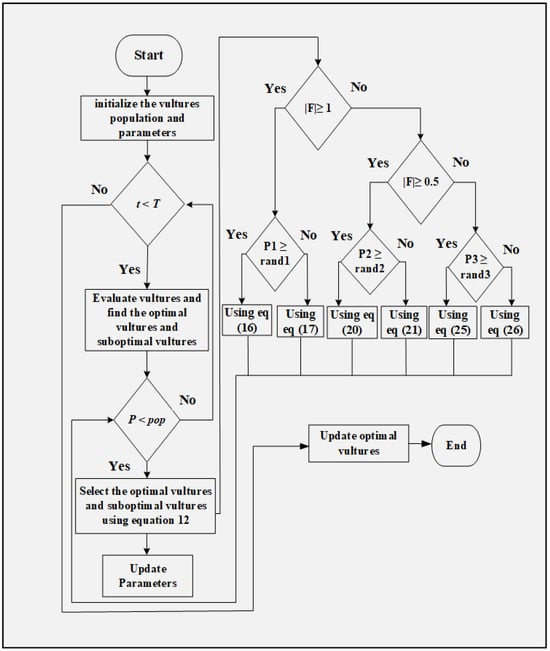
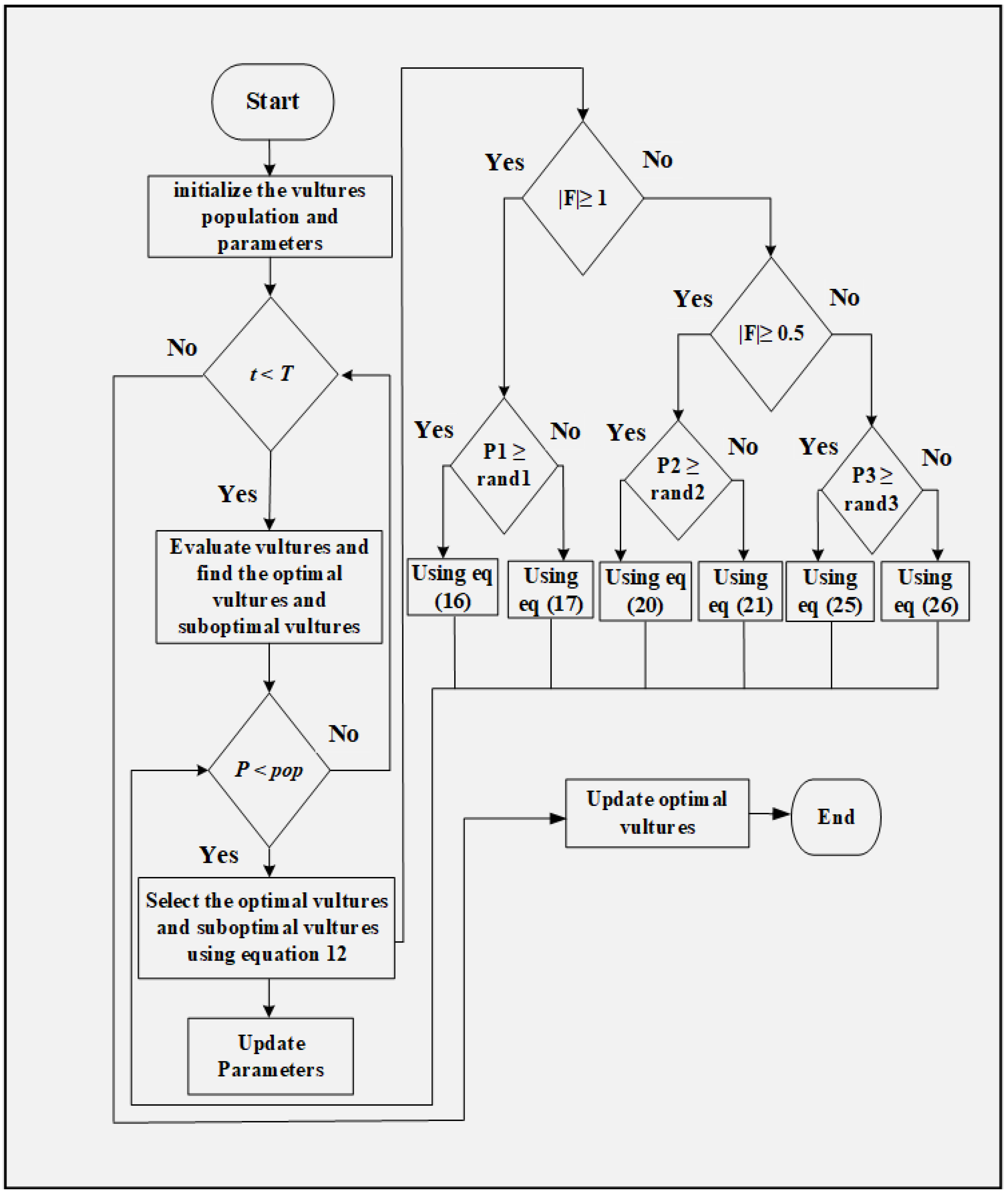
In the AVOA, this biological mechanism is converted mathematically into search dynamics to allow the algorithm to change its exploration and exploitation balance according to the optimization state. The step-by-step execution mechanism of the African vulture optimization algorithm is presented in Figure 1. The mathematical model of the hunger rate mechanism is as follows.
Figure 1.
Workflow of the AVOA.
In the hunger rate formulation, represents the hunger level of the kth vulture at iteration t. The term denotes a fixed parameter that is predefined prior to the execution of the algorithm. The variable indicates the current iteration, while specifies the maximum number of iterations. The random term is uniformly distributed in the interval [0, 1] whereas is a random variable within the range [−2, 2], and is randomly selected from [−1, 1]. The coefficient is assigned a fixed value of 2.5 in the AVOA. A negative hunger rate indicates that the vulture is in a hungry state, whereas values of correspond to a satiated condition. To model leadership dynamics, either the best or second-best vulture in the population is chosen as the leader, whose mathematical representation is provided in the subsequent equation:
Here, denotes a randomly chosen vulture, while and correspond to the best and second-best vultures in the population, respectively. The parameter is a control constant, fixed at 0.8.
3.1.1. Exploration Phase
When , the vultures begin searching for food across different regions, indicating that the AVOA has transitioned into the exploration phase. In this stage, the foraging behavior is modeled through two distinct strategies that describe the vultures’ movement patterns in safeguarding potential food sources. The corresponding mathematical formulation is expressed as follows:
In this model, denotes the updated position of the vulture in the subsequent iteration, while is a constant parameter with a fixed value of 0.6. The term and represents a random number uniformly distributed in the interval [0, 1]. The variable corresponds to the distance between the current vulture and the selected leader vulture. The symbol is a random number generated within the range [−2, 2], and and indicate the upper and lower bounds of the search space, respectively.
3.1.2. Exploitation Phase
When , the vultures focus on food sources within a limited region, indicating that the AVOA has transitioned into the exploitation phase. In this stage, the search process is modeled using two distinct strategies that characterize the vultures’ movements while competing for and protecting food. The mathematical representation of these strategies is provided as follows:
In this formulation, is a constant parameter with a fixed value of 0.4, and denotes one of the top-performing vultures in the population. The variable is a uniformly distributed random number within the interval [0, 1]. During the second phase, when the value of F falls below 1, the algorithm models the vultures’ behavior of food accumulation and their intense competition for resources. In the above equations, the subscript k denotes the index of the vulture (search agent), while and are computed independently for each agent at iteration t.
The parameters , , and are computed independently for each agent at iteration t. Here, is a constant parameter assigned a value of 0.4, while represents a uniformly distributed random number in the interval [0, 1]. The variables and are random numbers generated according to a Gaussian distribution. The parameters and are fixed at 1 and 1.5, respectively, and denotes the standard gamma function.
3.2. Fractional-Order African Vulture Optimization Algorithm (FO-AVOA)
The work introduces a new notion where FC is incorporated into the traditional AVOA and constructs a fractional-order AVOA (FO-AVOA). The motivation for such unification lies in the fact that it attempts to overcome the issue of premature convergence and to improve the quality of solutions in general. The AVOA has a good global search capability, but local exploitation capacity could be weak, which may adversely affect convergence in complex problems. In order to overcome this shortcoming, FC is incorporated in the AVOA model. With its built-in memory and retention characteristics, FC enables information sharing between candidate solutions during the exploitation step. This adjustment is likely to boost accuracy and convergence efficiency.
In addition, FC can readily model complex dynamics, such as irreversibility and chaotic processes, due to its long-memory nature. Combining these features with the AVOA’s flexibility, the FO-AVOA provides a novel optimization framework that integrates the strengths of both methods with enhanced performance. The use of fractional calculus (FC) has garnered a lot of interest from researchers working in a broad array of disciplines from engineering, computational mathematics, and applied physics. Unlike conventional integer-order calculus, FC is a more general mathematical formalism that is able to resolve the problems the classical ones cannot. Fractional derivatives unify derivatives of non-integer order, and fractional derivatives are a powerful means of modeling memory-type systems with hereditary features, particularly for simulating complex dynamic phenomena. Various definitions have been offered for fractional-order derivatives [55,56]. Among them, the GL definition is employed extensively to derive fractional calculus-based mathematical models. The Grünwald–Letnikov fractional derivative for an arbitrary signal s(t) is provided by:
Equation (30) represents the continuous Grünwald–Letnikov definition of the fractional derivative of order δ, formulated as a limit when the step size h → 0. This definition models fractional differentiation through a weighted infinite summation, naturally capturing the memory effect of the system. For numerical implementation, the limit operation is approximated by fixing the step size as the sampling interval T, which yields the discrete-time realization provided in Equation (31). In this case, the infinite summation is truncated to a finite memory length τ where k = 0, 1, …,τ. The fractional order satisfies 0 < δ ≤ 1, where δ = 1 reduces the formulation to the classical first-order derivative. The sampling step satisfies T = h > 0, and a sufficiently small step is selected to ensure numerical stability and accuracy.
In this expression, denotes the sampling interval, while specifies the truncation order. The term refers to the discretized form of the signal. In the special case where , the formulation reduces to the conventional integer-order derivative, which corresponds to the standard first-order derivative and can be expressed as follows:
To enhance the local exploitation of the conventional AVOA, the position of each vulture is updated as a function of its velocity, which is defined in terms of the fractional derivative.
where denotes the velocity of the kth vulture at iteration t. The fractional-order modification allows the velocity update to include both present and past states, thereby creating a memory-driven search mechanism. This approach balances exploration and exploitation more effectively, prevents stagnation in local optima, and provides smoother convergence toward the global optimum.
where and denote the velocity at the current and previous iterations, is the previous position of the vulture, and are the local and global best positions, and are acceleration coefficients, and are uniformly distributed random variables in the range of . This form represents the first-order integer difference of the velocity. By introducing fractional calculus, the model generalizes this into a fractional-order derivative of velocity:
where denotes the fractional derivative operator of order .
The fractional velocity of the kth vulture at iteration t, with r-term expansion, is provided as:
Equation (38) is obtained by truncating the infinite Grünwald–Letnikov fractional series in Equation (37) to the first four memory terms to achieve a computationally efficient implementation:
In practical implementation, the infinite Grünwald–Letnikov fractional series is approximated by truncating it to a finite number of past velocity terms r, as shown in Equation (38), to maintain computational efficiency. The fractional order δ ∈ (0, 1] acts as a tuning parameter that controls the influence of historical information; smaller values of δ emphasize global exploration, while values closer to unity enhance local exploitation. Unlike the integer-order AVOA, which updates velocity based only on the most recent iteration, the proposed fractional update exploits multi-iteration memory, leading to smoother convergence and reduced premature stagnation.
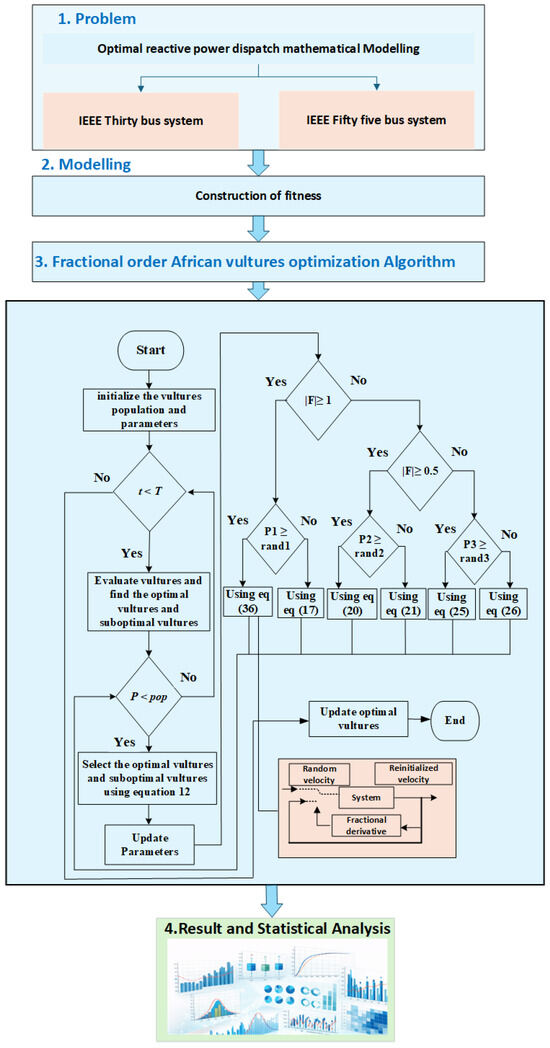
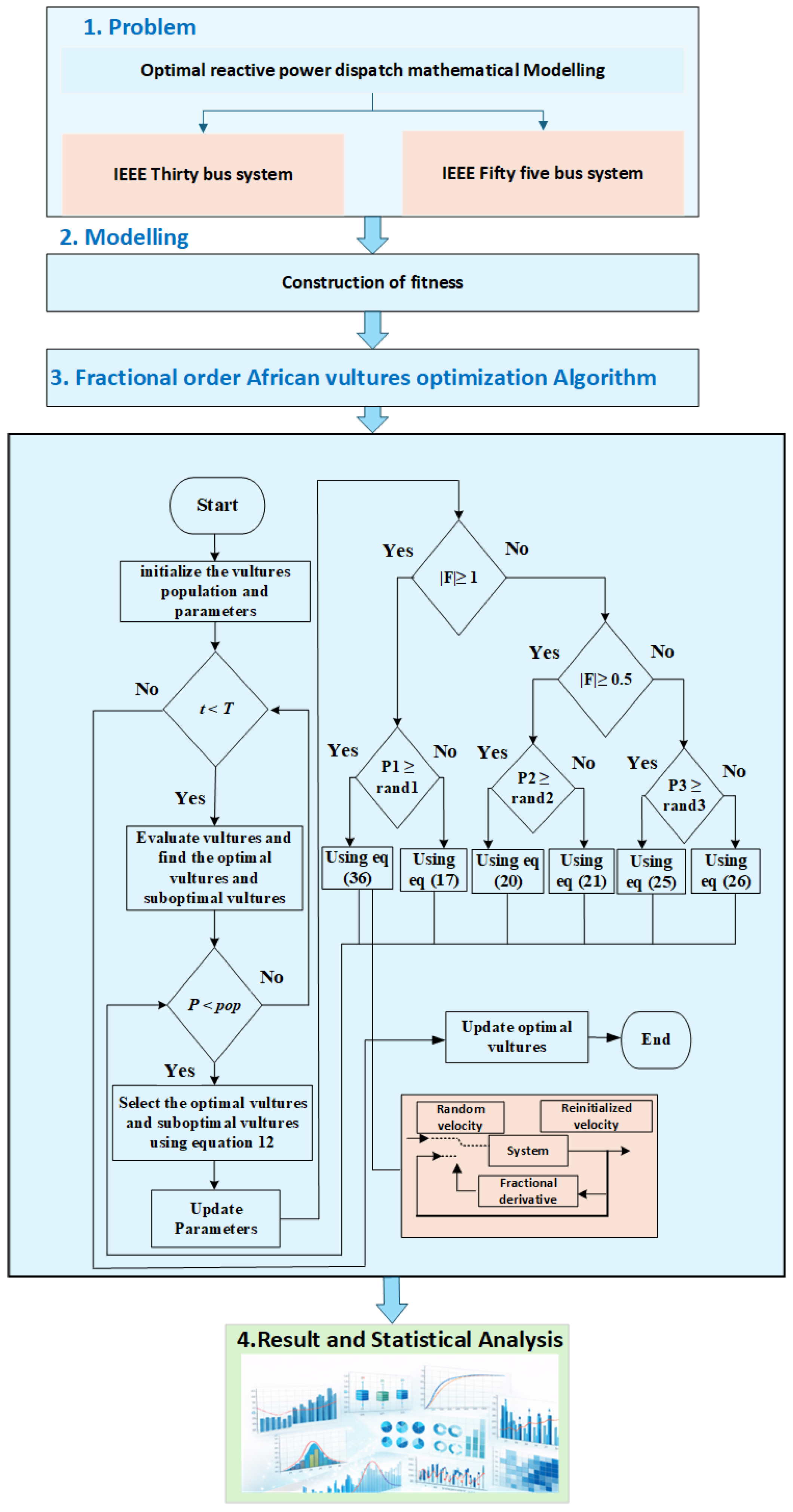
The pseudocode of the proposed FO-AVOA for solving the ORDP is presented in Algorithm 1 and illustrated in Figure 2. Figure 2 illustrates the complete workflow of the proposed FO-AVOA for solving the ORPD problem. The flowchart presents the main stages of the algorithm, including initialization of the vulture population using IEEE benchmark system parameters, evaluation of fitness based on real power loss minimization, selection of optimal and suboptimal vultures, and adaptive switching between exploration and exploitation strategies. The fractional-order updating mechanism is incorporated within the exploitation phase to introduce memory-based search dynamics. This visual representation complements the mathematical formulation and clearly demonstrates how the proposed FO-AVOA iteratively updates control variables until convergence is achieved.
| Algorithm 1. Pseudocode of FO-AVOA |
| Input: Population size N Maximum iterations MaxIter Problem dimension D Search space bounds [LB, UB] Objective function f(x) Fractional-order parameter α Output: Best solution xbest Best fitness fbest 1. Initialization 1.1. Initialize population X = {x1, x2, …, xN} randomly within [LB, UB] 1.2. Evaluate fitness f (xi) for all xi ∈ X 1.3. Determine leader vultures: Leader1 = best solution, Leader2 = second-best solution 2. Main loop For t = 1 to T do For each vulture k = 1 to N do 2.1 Update control parameters: Compute exploitation factor Fk(t) using Equation (12). Compute probabilities P1, P2, P3 Generate random numbers rand1, rand2, rand3∈ [0, 1] 2.2. Select search strategy If ∣Fk(t)∣ ≥ 1 then If P1 ≥ rand1 then Update the position of vulture k using the fractional velocity model, Equation (36). Else Update the position of vulture k using the truncated fractional model, Equation (38). Else if ∣Fk(t)∣ ≥ 0.5 then If P2 ≥ rand2 then Update Pk(t+1) using the AVOA position update in Equation (20). Else Update Pk(t + 1) using the AVOA position update in Equation (21). Else (i.e., ∣Fk(t)∣ < 0.5|) If P3 ≥ rand3 using Equation (25). Else Update Pk(t + 1) using Equation (26). 2.3 Boundary control If any component of Pk(t + 1) violates [LB, UB] project it to the nearest bound. 2.4 Fitness evaluation and greedy selection Evaluate f (Pk(t + 1)) If f(Pk(t+1)) < f(Pk(t)) then set Pk(t) = Pk(t + 1) End For 3. Return result Set xbest = Leader1 and fbest = f(xbest). |
Figure 2.
Working flowchart of the proposed methodology.
4. Results and Discussion
The performance of the new FO-AVOA was initially tested on the classical CEC 2017, 2020, and 2022 benchmark functions, which provide a good test bed for assessing constraint-handling optimization techniques. Details about the benchmark functions can be found in [57,58,59]. The test on multimodal objective functions (MMOFs) confirms the robustness and versatility of the FO-AVOA to different optimization tasks. As seen from Table 2, the FO-AVOA consistently demonstrates superior performance than the baseline AVOA in best, median, mean, worst, and standard deviation values; hence, it demonstrates superior convergence accuracy and stability. The same is confirmed by the statistical analysis reported in Table 3. In all the performance indicators, the FO-AVOA and AVOA are significantly different from each other as indicated by the Wilcoxon signed-rank test p-values all being below 0.05. To further validate the effectiveness of the proposed FO-AVOA, extensive experiments were conducted on benchmark functions from the CEC 2017 and CEC 2022 suites. Table A1 summarizes the experimental setup and benchmark configuration, while Table A2 and Table A4 present the mathematical formulations of the considered benchmark functions. The corresponding statistical performance results are reported in Table A3 and Table A5 in terms of best, median, mean, standard deviation, and worst values over multiple independent runs. Across the majority of test functions and evaluation metrics, the FO-AVOA consistently achieves superior or highly competitive results compared to the other optimization algorithms, demonstrating its strong robustness, stability, and convergence capability. These outcomes provide clear evidence that incorporating fractional-order dynamics significantly enhances the optimization performance. The inability to eliminate the null hypothesis in all cases verifies that the FO-AVOA achieves a statistically significant enhancement over the original AVOA, emphasizing the real-world advantage of the proposed adjustments. To further test the FO-AVOA, it was applied to the IEEE 30- and 57-bus test systems to optimize the power loss minimization problem. The obtained solutions were compared with existing and newly introduced metaheuristic approaches. In all instances, the FO-AVOA demonstrated strong global performance in discrete and continuous power system optimization models. These findings confirm that the FO-AVOA not only improves optimization accuracy but also offers greater reliability in solving real-world problems in reducing power loss in electrical networks.
Table 2.
Comparative analysis of FAVOA vs. AVOA for CEC 2020 MMOF.
Table 3.
Statistical comparison of FO-AVOA and AVOA performance using Wilcoxon signed-rank test.
4.1. ORPD with Thirteen Control Variables in the IEEE 30-Bus System (Case 1)
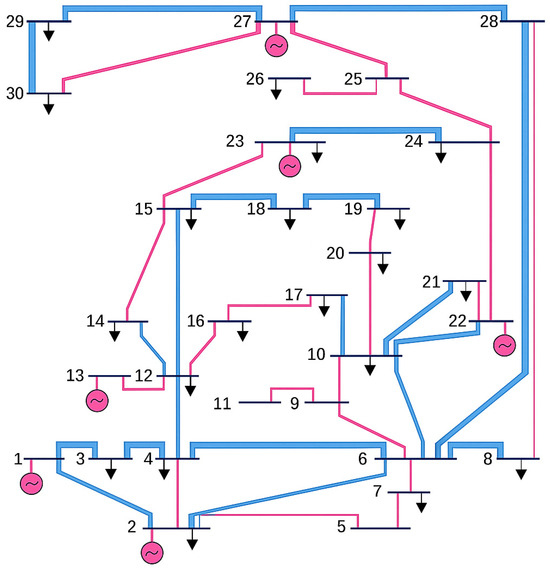
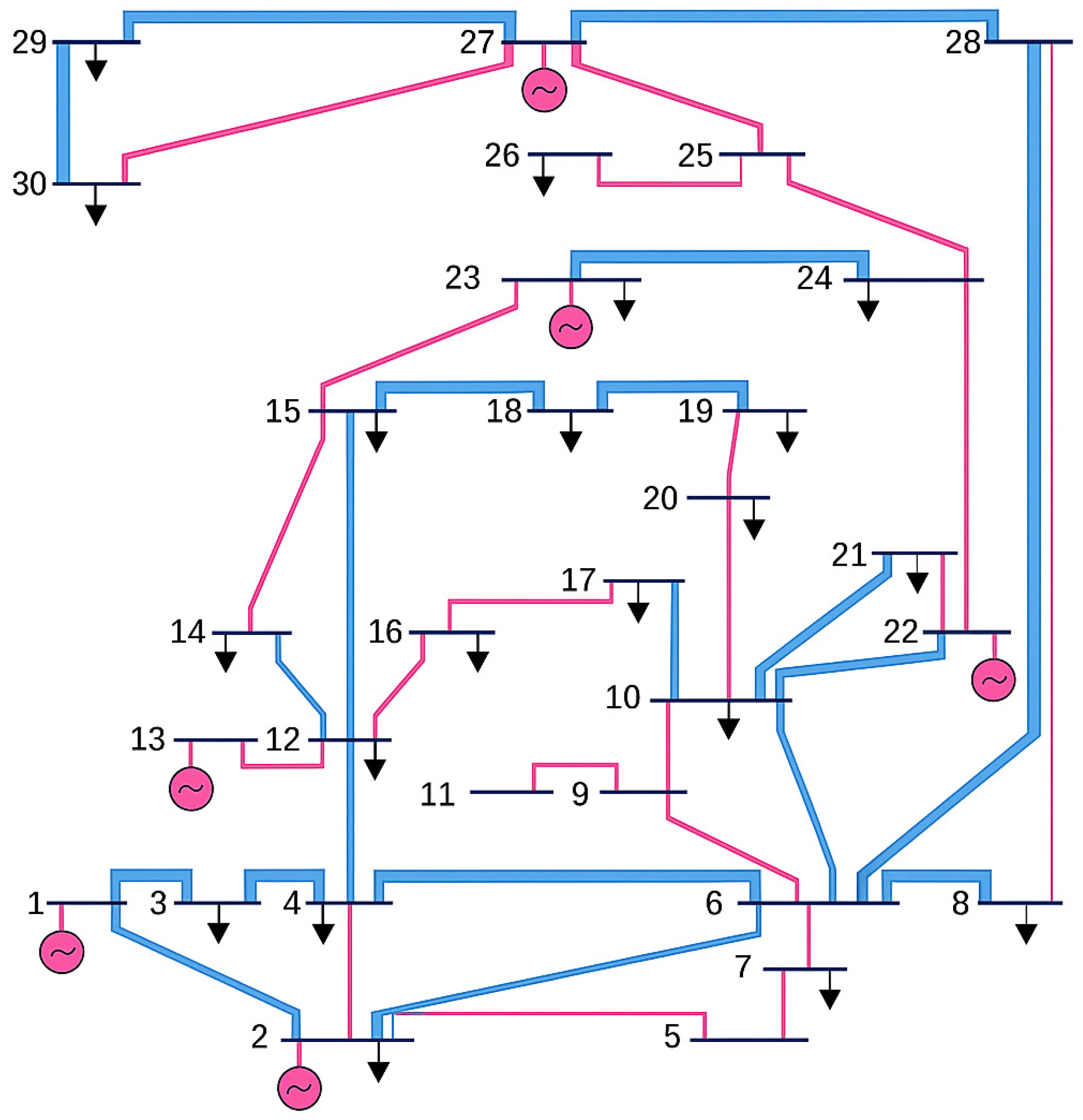
In the current case study, the proposed FO-AVOA is applied to the IEEE 30-bus power system, whose detailed single-line diagram is presented in Figure 3. The test system involves a total of thirteen control variables, including three shunt compensator units, four tap-changing transformers, and six generator voltage magnitudes, all of which are to be optimized with the aim of minimizing active Ploss and enhancing system performance. The related system description and parameter data are listed in Table 4.
Figure 3.
Single-line diagram of IEEE 30-bus system.
Table 4.
Test system description.
Optimization of these control variables is of utmost concern for successful ORPD, as they have direct influences on the voltage stability, RP balance, and transmission line losses. By making use of the fractional-order dynamics of the FO-AVOA, the algorithm can retain memory of past iterations, thereby improving exploration–exploitation trade-off during optimization. This assists in avoiding premature convergence of the algorithm and enhancing its capacity to discover high-quality solutions in big search spaces. In this paper, the real and RP requirements were obtained word for word from the IEEE base case, and boundary conditions of the optimization variables were defined according to the requirements in [16]. To provide a fair and qualitative comparison, all the simulations employed the MATPOWER load flow software, which provides a consistent computational environment for evaluating transmission line loss calculations on the basis of diverse optimization algorithms. Table 5 represents the comparative performance results. The results suggest that the proposed FO-AVOA efficiently achieved quality solutions by significantly minimizing overall active Ploss in the system. Relative to other state-of-the-art optimization methods, the FO-AVOA consistently provided improved solutions, displaying effective convergence characteristics and effective handling of system constraints. The results point toward the capability of the FO-AVOA to provide nearly optimal solutions for ORPD, thereby improving power system efficiency and reliability.
Table 5.
Comparative analysis of the proposed FO-AVOA with the literature.
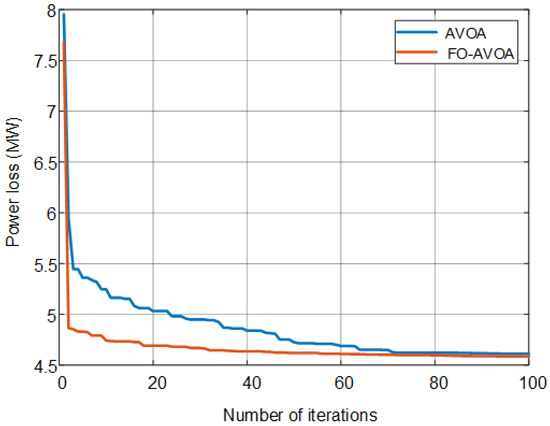
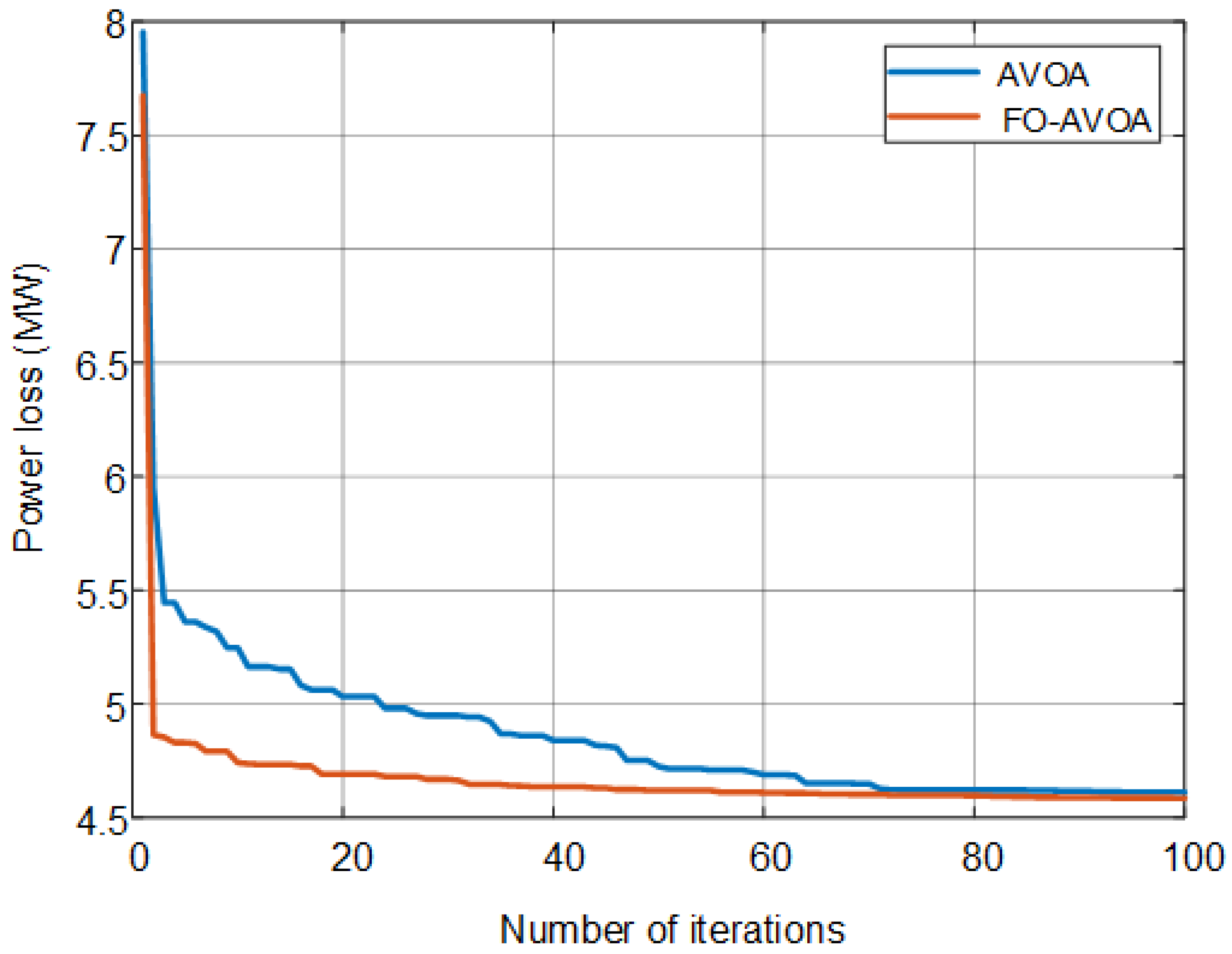
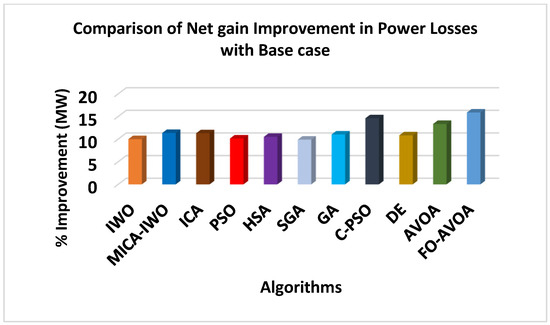
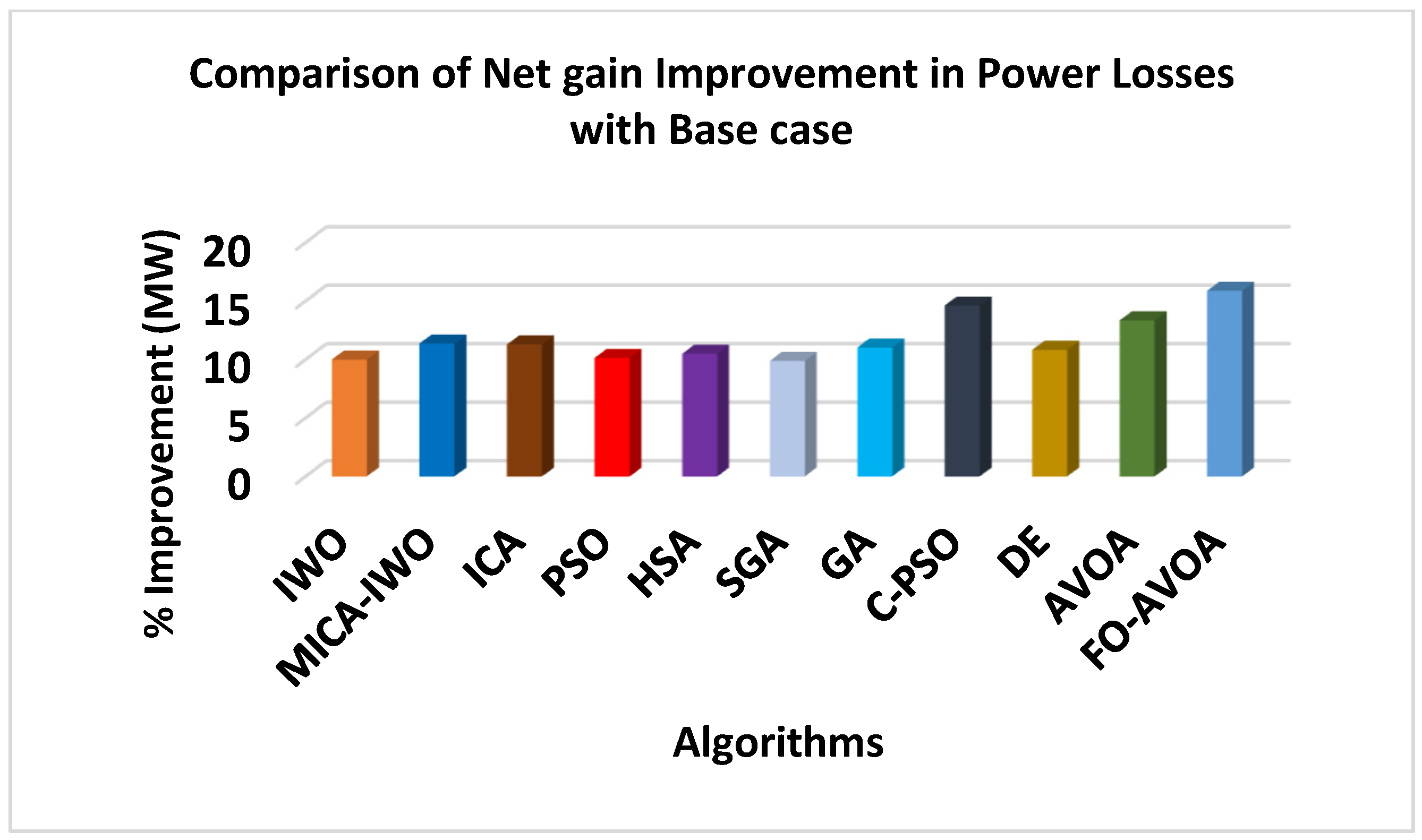
As presented in Table 5, the application of the FO-AVOA results in a loss of 4.611 MW, reflecting a 15.88% reduction relative to the base case loss of 5.482 MW. In contrast, other methods, such as IWO, MICA-IWC, ICA, PSO, HSA, SGA, GA, C-PSO, DE, and AVOA, achieved reductions of 9.99%, 11.36%, 11.29%, 10.14%, 10.5%, 9.88%, 11.027%, 14.62%, 10.83%, and 13.35% with the base, respectively, when compared against recently established optimization techniques. These results confirm that in solving the ORPD problem, the FO-AVOA consistently delivers superior solutions compared to widely recognized alternatives. Furthermore, all optimization variables remained within their specified operating limits throughout the simulations. Figure 4 illustrates the convergence and learning behaviors of the FO-AVOA during the ORPD optimization process.
Figure 4.
Convergence graph of FO-AVOA vs. AVOA for IEEE 30-bus system.
It is evident that the FO-AVOA converges significantly faster than the classical AVOA and other compared algorithms, reaching the optimal solution within a substantially lower number of iterations. The learning curve shows that after a relatively small number of iterations, the real power loss stabilizes around 4.611 MW, which confirms the strong robustness and numerical stability of the proposed algorithm. As the iteration count increases, all independent runs consistently converge to the same optimal solution, indicating reliable repeatability and strong convergence characteristics. Moreover, the convergence trend reveals that during the initial iterations, global exploration dominates the search process, while after nearly 100 iterations, the exploitation phase becomes dominant, leading to fine local refinement around the global optimum.
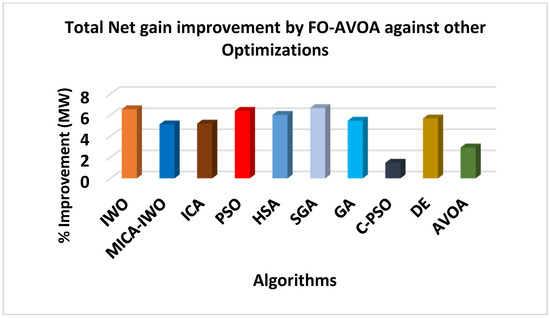
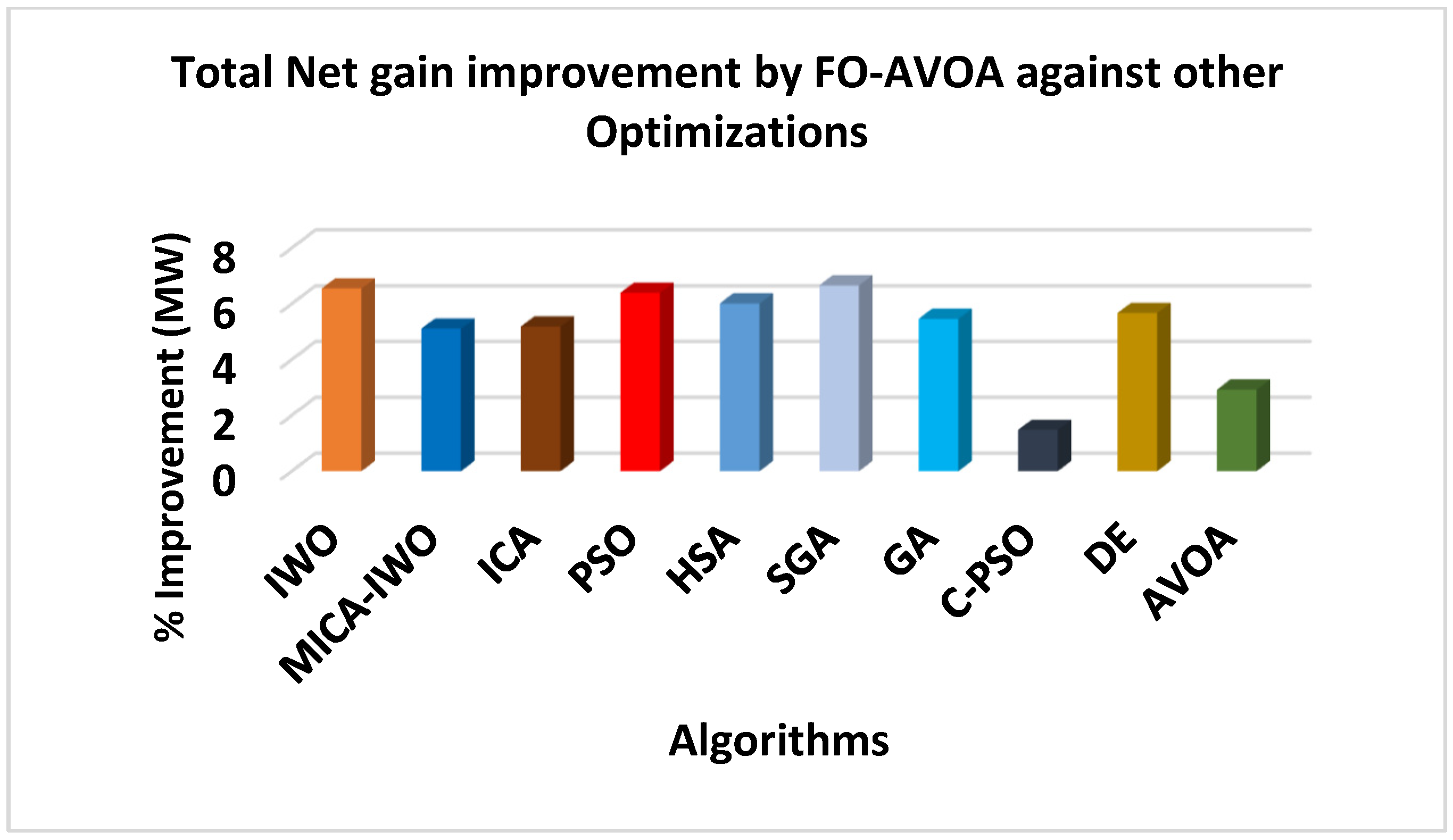
This smooth transition between exploration and exploitation is a direct outcome of the fractional-order memory mechanism, and it clearly explains the superior instantaneous performance and faster convergence behavior of the FO-AVOA compared with recently established optimization approaches. The percentage net improvement in Ploss reduction is shown in Figure 5 and Figure 6 with the base case, as well as with other optimization techniques by the proposed optimizer and with the rest of the optimization techniques cited in the literature, and the proposed FO-AVOA outperformed the other optimizers in achieving more reduction in Ploss in the case of the IEEE 30-bus system.
Figure 5.
Percentage net improvement in Ploss reduction by FO-AVOA and other algorithms with base case for IEEE 30-bus system.
Figure 6.
Total net gain in Ploss by FO-AVOA against other optimizations techniques.
The statistical analysis of the FO-AVOA using a box plot, the cumulative distribution function, a histogram, and the number of independent runs is shown in Figure 7. Figure 7a illustrates that the FO-AVOA consistently achieves a lower median value of the final solution across 100 independent trials compared to the standard AVOA. Figure 7b further confirms that the FO-AVOA substantially enhances the likelihood of reaching the optimal solution relative to the traditional AVOA. The histogram in Figure 7c highlights the distribution of lowest fitness values acquired throughout multiple runs, and Figure 7d displays the FO-AVOA’s repeated superiority, as it maintains lower levels of fitness throughout multiple experiments compared to the AVOA. Collectively, these graphical results underscore that fractional calculus implies an influential mathematical paradigm for enhancing traditional optimization algorithms, thereby increasing their efficiency, robustness, and reliability.
Figure 7.
Statistical performance in terms. (a) Box plot for fitness; (b) cumulative distribution function; (c) histogram analysis; (d) fitness comparison over independent run.
4.2. ORPD with Twenty-Five Control Variables in IEEE 57-Bus System (Case 2)
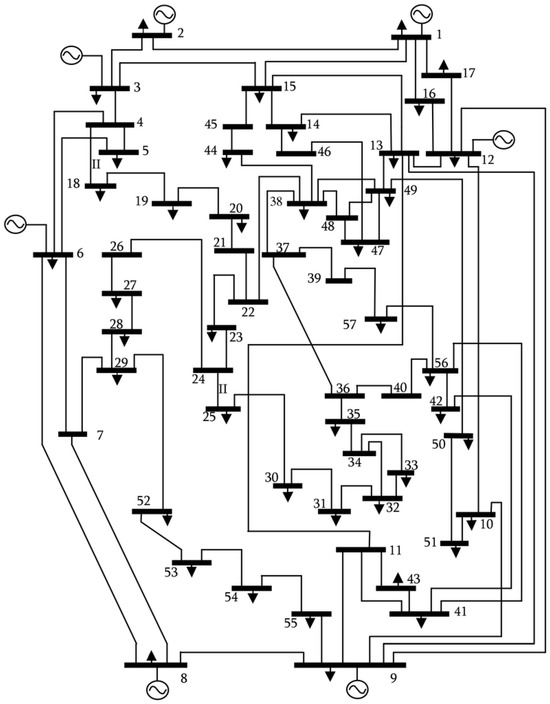
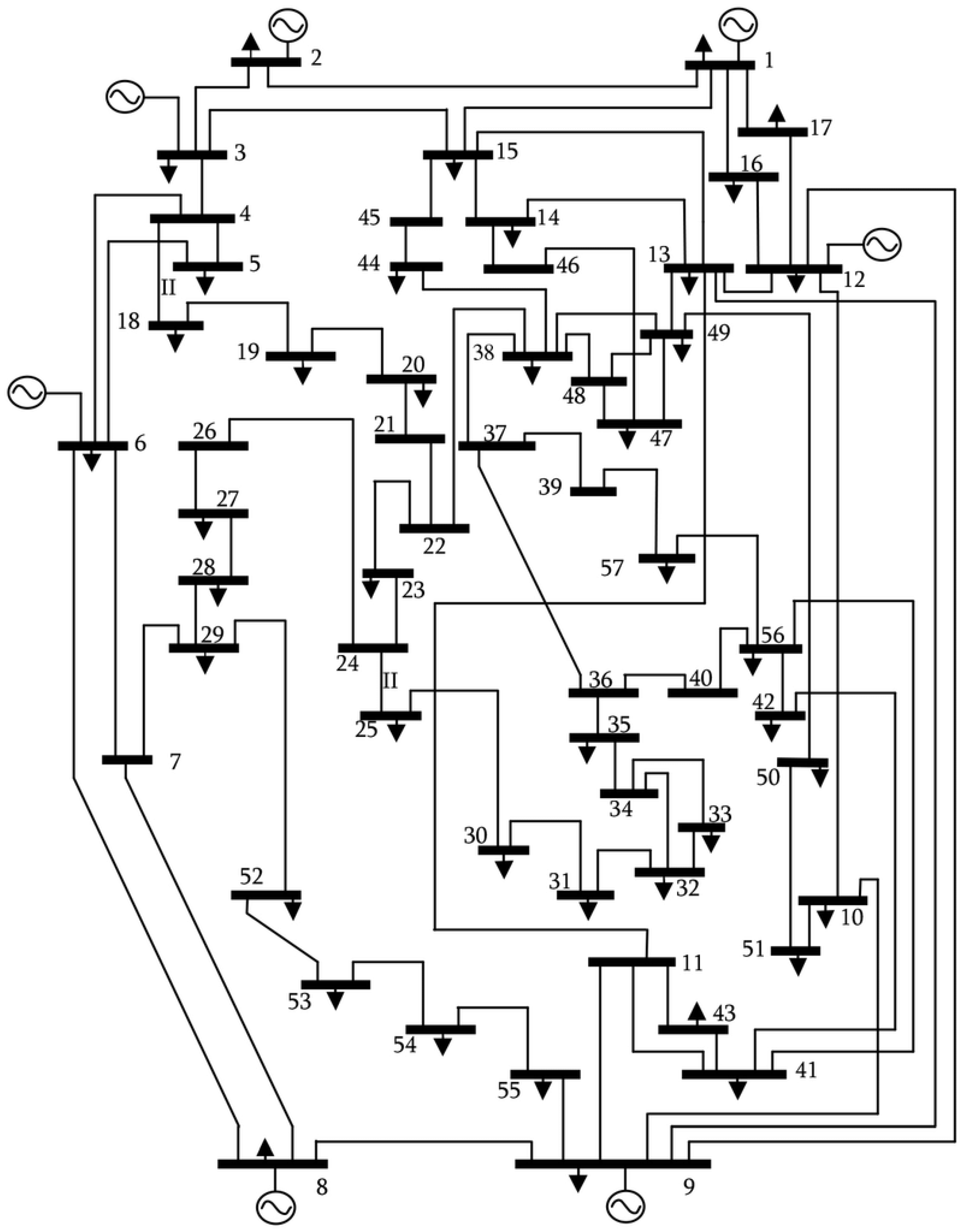
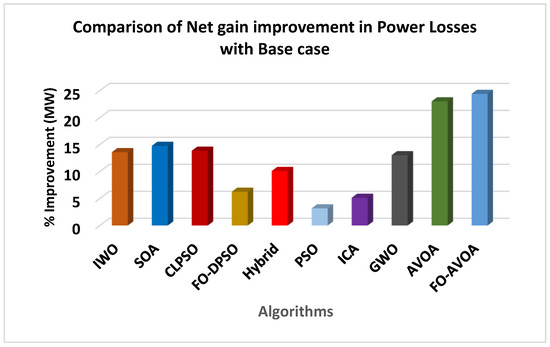
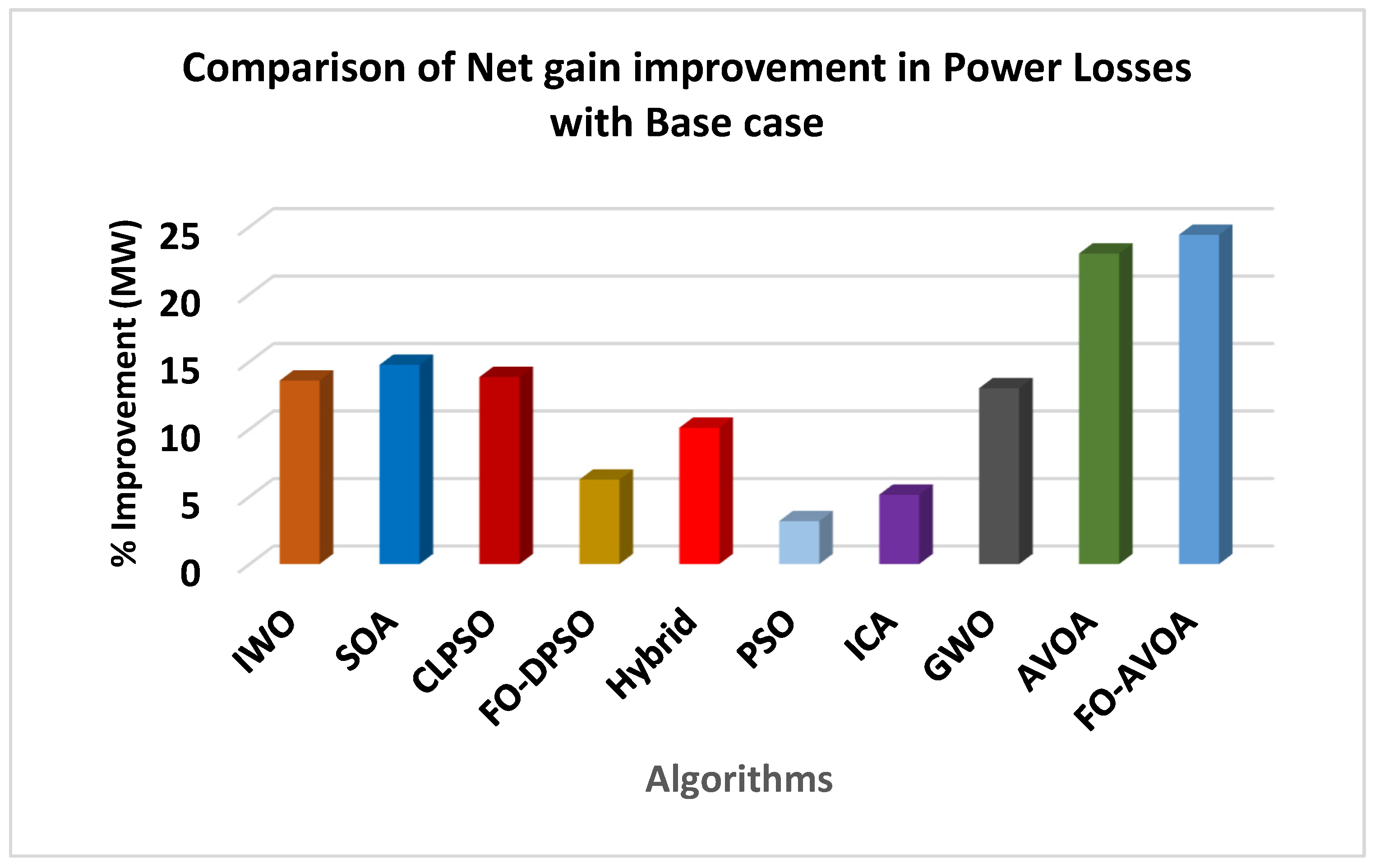
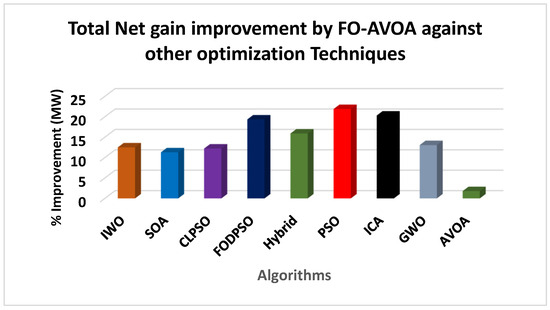
In this study, the proposed FO-AVOA is implemented in the IEEE 57-bus test system, which is depicted in Figure 8. Twenty-five control variables, such as generator voltages, transformer tap settings, and RP compensation devices, are optimized here. The IEEE 57-bus benchmark’s precise system parameters and parameter descriptions can be seen in [16], and their related data are presented in Table 6. The FO-AVOA proposed was subjected to a more complex optimization environment in the IEEE 57-bus test network, which reflects the greater dimensionality and operating constraints inherent in large-scale systems. Contrary to smaller cases, here, variable bounds and working conditions are specifically geared for the IEEE 57-bus benchmark, with the aim of performing realistic and close evaluations The comparative performance results, as in Table 7, strongly illustrate that the FO-AVOA attains a remarkable improvement in loss minimization and convergence efficiency. With the common simulation platform being MATPOWER, the FO-AVOA’s transmission loss is 21.5175 MW—a 24.399% reduction from the base case value of 28.462 MW. On the other hand, the other approaches, such as IWO, SOA, CLPSO, FO-DPSO, Hybrid, PSO, ICA, and GWO, yield comparatively modest improvements of 13.593%, 14.76%, 13.867%, 6.26%, 10.106%, 3.189%, 5.140%, 13.034%, and 23.01% by the AVOA, respectively. These results show that the FO-AVOA not only provides better solutions in terms of quality and convergence rate but also scales enormously to high-dimensional ORPD problems with all control variables kept strictly within operational ranges.
Figure 8.
Single-line diagram of IEEE 57-bus system.
Table 6.
Test system description.
Table 7.
Comparative analysis of the proposed FO-AVOA with the literature.
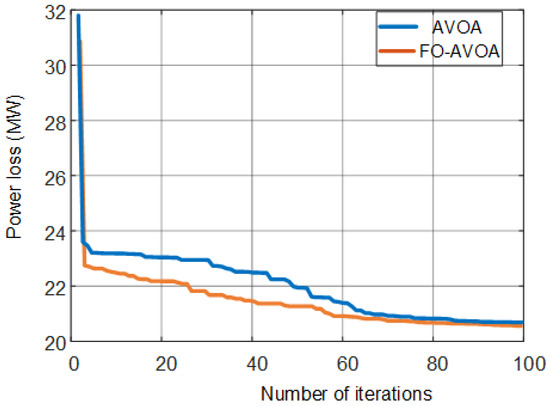
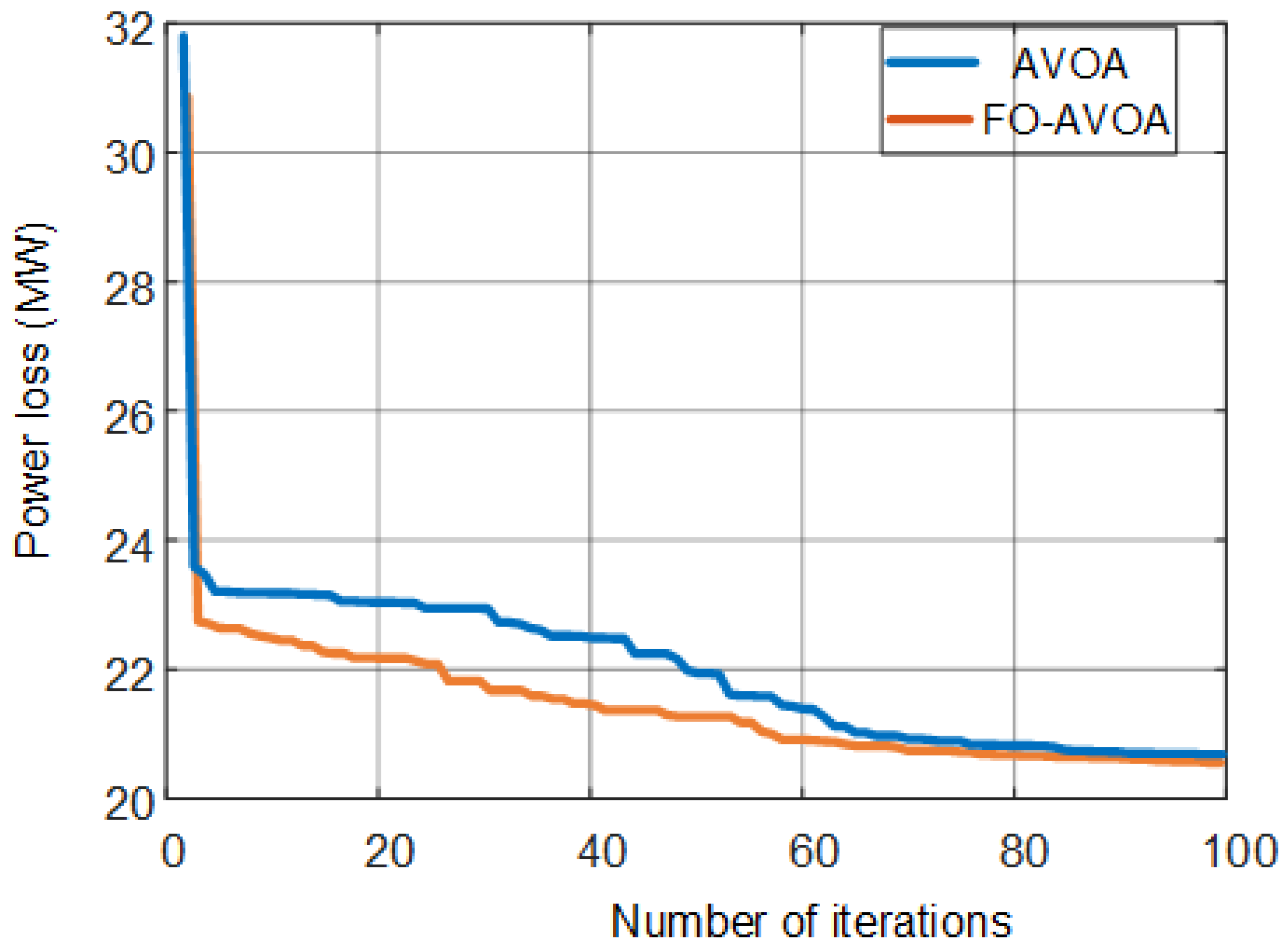
Figure 9 depicts the convergence characteristics of the FO-AVOA for the IEEE 57-bus system. With increasing iterations, all independent simulation runs steadily approach the same optimal solution, demonstrating strong convergence reliability and repeatability. During the early iterations, the algorithm exhibits dominant exploration behavior, which progressively diminishes as the search advances, while the exploitation phase becomes predominant after approximately 100 iterations. This smooth exploration-to-exploitation transition confirms the effectiveness of the fractional-order memory mechanism in guiding the search toward the global optimum. Overall, this behavior highlights the superior convergence capability, numerical stability, and optimization efficiency of the FO-AVOA when compared with recently developed alternative techniques.
Figure 9.
Convergence graph of FO-AVOA vs. AVOA for IEEE 57-bus system.
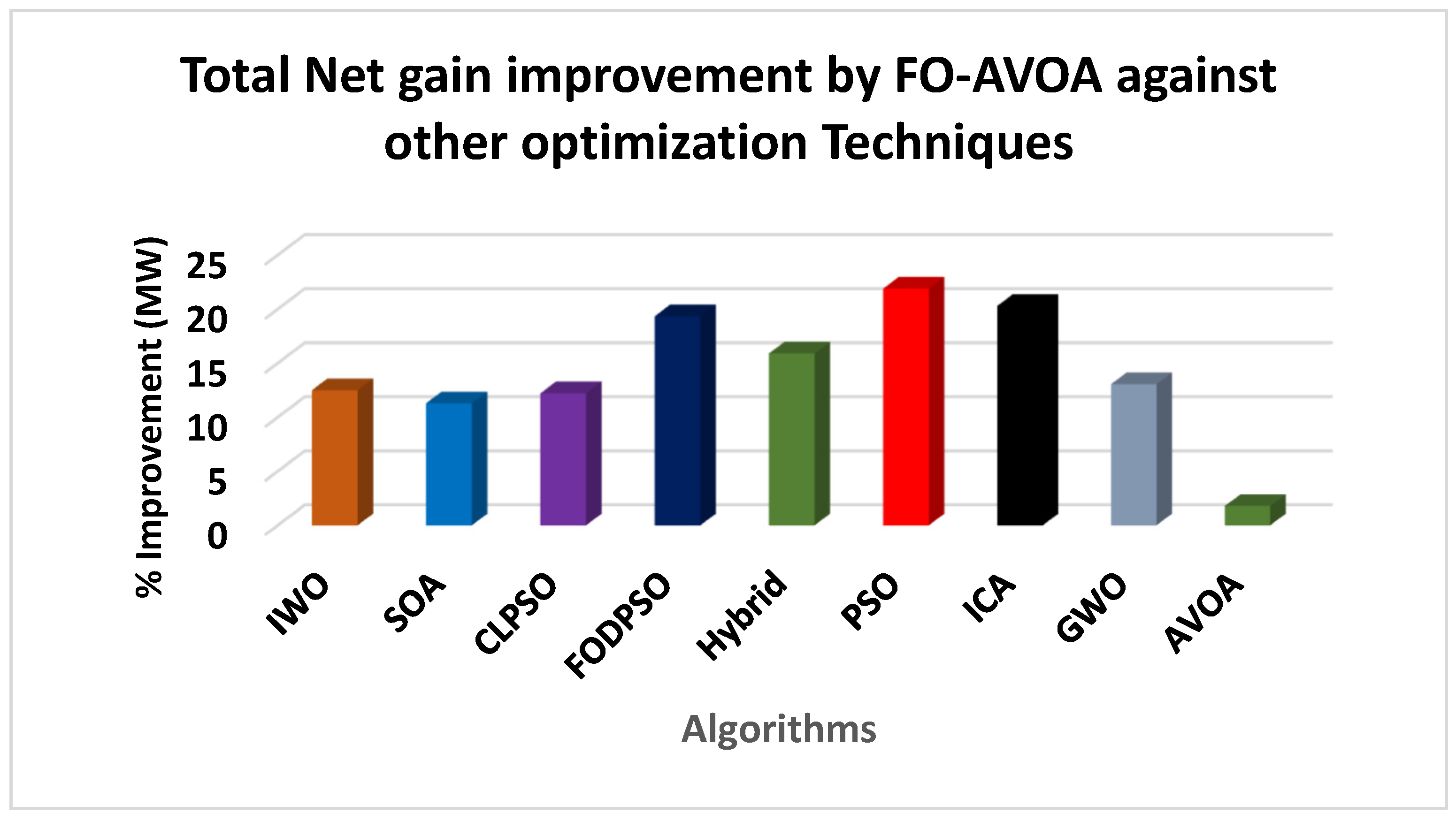
Figure 10 and Figure 11 present the percentage improvement in power loss reduction and compare the base case with other state-of-the-art optimizers by the proposed FO-AVOA reported in the literature. The results demonstrate that the FO-AVOA consistently outperforms competing techniques, achieving greater loss minimization in the IEEE 57-bus system.
Figure 10.
Percentage net improvement in Ploss reduction by FO-AVOA and other algorithms with base case for IEEE 57-bus system.
Figure 11.
Total net gain in Ploss by FO-AVOA against other optimizations techniques.
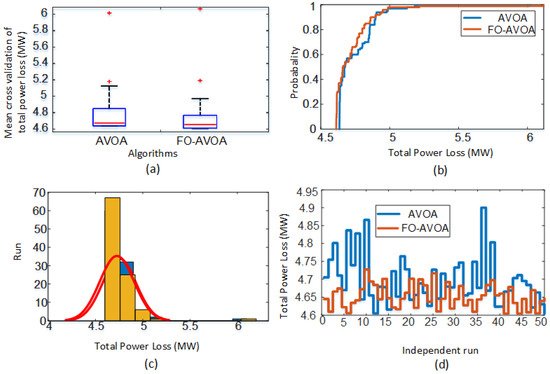
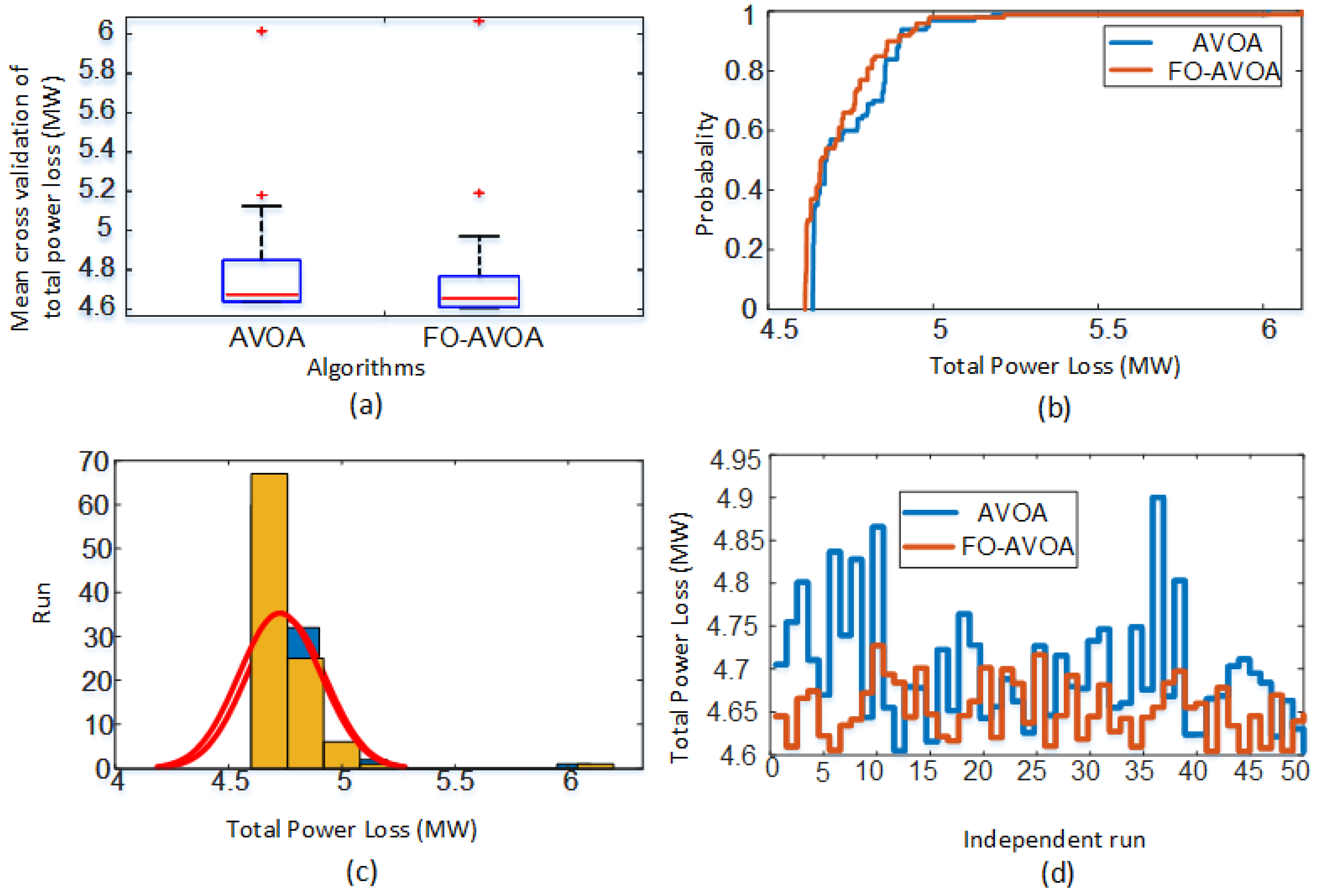
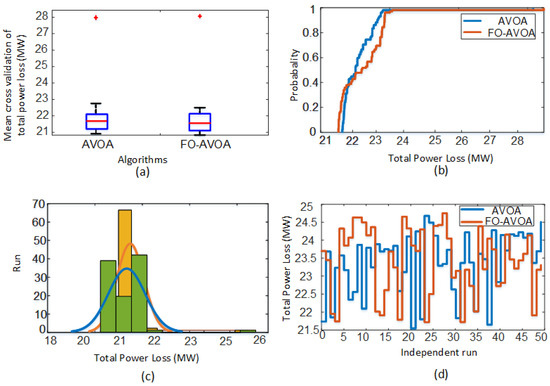
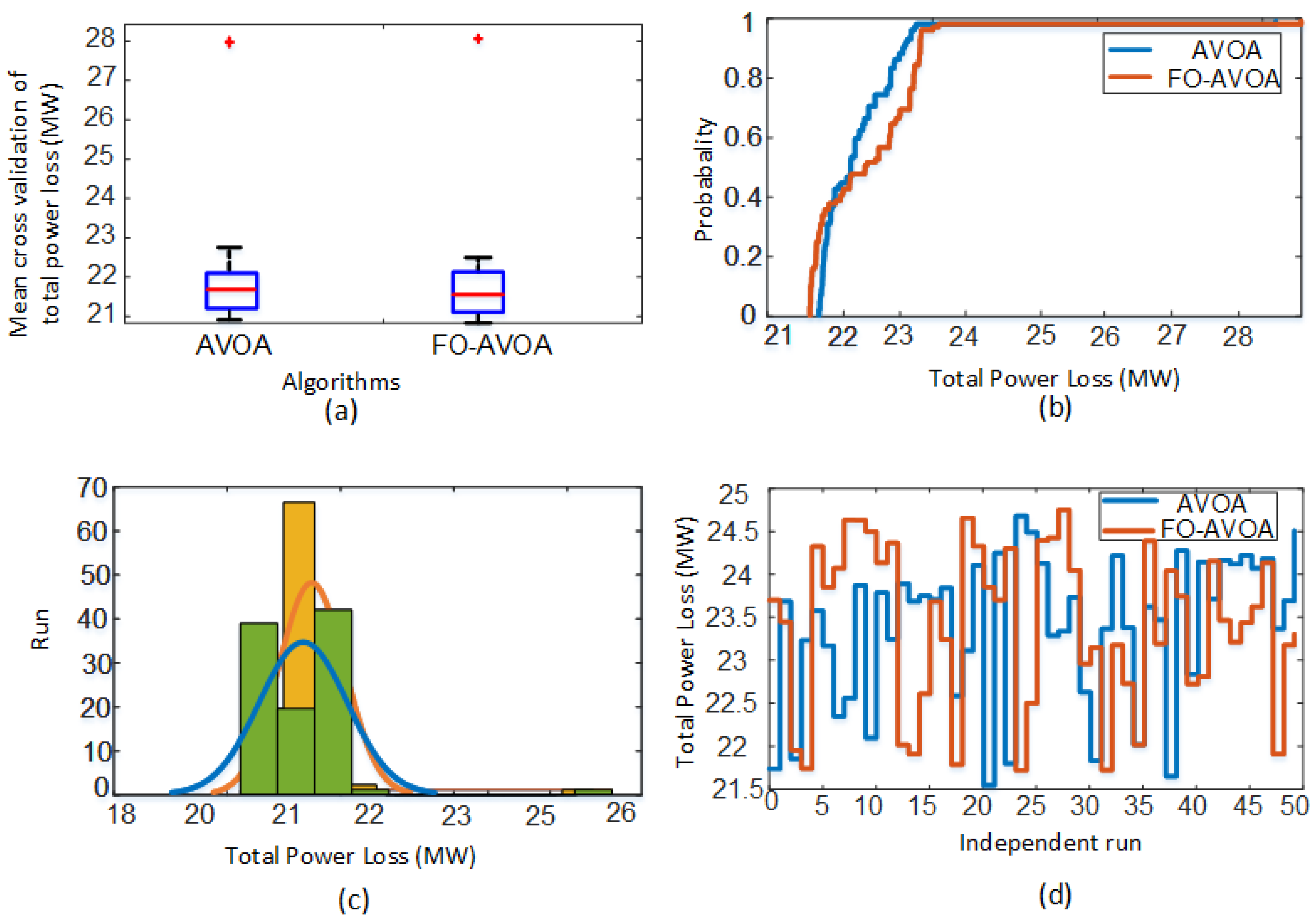
Figure 12 presents the statistical evaluation of the FO-AVOA through box plots, cumulative distribution functions, histograms, and multiple independent runs. As shown in Figure 12a, the FO-AVOA consistently achieves a lower median fitness value across 100 independent trials when compared with the standard AVOA. The cumulative distribution in Figure 12b further highlights its enhanced probability of attaining near-optimal solutions, surpassing the performance of the conventional variant.
Figure 12.
Statistical performance in terms. (a) Box plot for fitness; (b) cumulative distribution function; (c) histogram analysis; (d) fitness comparison over independent run.
Figure 12c shows the histogram of minimum fitness values, which depicts a focused distribution around better results, whereas Figure 12d validates the FO-AVOA’s consistent lead by sustaining lower levels of fitness throughout repeated experimentation. Collectively, these statistical evaluations depict how the incorporation of fractional calculus adequately fortifies the underlying optimization process, providing improvements in efficiency, robustness, and overall reliability.
The superior performance of the FO-AVOA can be mainly attributed to the intrinsic characteristics of the fractional-order velocity update. Unlike integer-order updates, which rely only on the most recent search step, the fractional-order mechanism introduces a multi-iteration memory effect, allowing the algorithm to exploit historical search information. This memory-driven behavior smooths the search trajectory, mitigates oscillations in later iterations, and significantly reduces the risk of premature convergence. In high-dimensional search spaces, this effect becomes particularly important, as the fractional-order operator enables a more balanced exploration–exploitation trade-off, allowing the FO-AVOA to escape local optima while maintaining strong local refinement capability. Consequently, the FO-AVOA achieves faster convergence with higher solution accuracy and greater robustness compared to conventional metaheuristic algorithms.
5. Conclusions
This study proposed a FO-AVOA to solve the ORPD problem by minimizing real power transmission losses under system operating constraints. By integrating fractional-order calculus into the classical AVOA framework, memory and nonlocal search characteristics were introduced, leading to improved exploration–exploitation balance, faster convergence, and enhanced robustness. The effectiveness of the FO-AVOA was validated through extensive testing on CEC benchmark functions and standard IEEE 30-bus and 57-bus power systems, where it consistently outperformed several state-of-the-art optimization techniques. These results demonstrate the scalability, stability, and strong optimization capability of the proposed approach. Future work will focus on extending the FO-AVOA to large-scale systems, multi-objective ORPD formulations, and power networks with high renewable energy penetration.
Author Contributions
Conceptualization and methodology were carried out by H.A., A.W. and B.M.K. Investigation was conducted by H.A. and A.W. Formal analysis, data curation, resources, and software development were performed by S.K., B.M.K. and A.M.A. Validation was carried out by H.A., A.W., S.K., B.M.K. and A.M.A. Visualization was performed by H.A., A.W. and A.M.A. Funding acquisition and project administration were handled by H.A. Writing—original draft was written by H.A. and A.W., while all authors (H.A., A.W., S.K., B.M.K. and A.M.A.) contributed to writing—review and editing. All authors have read and agreed to the published version of the manuscript.
Funding
This article is derived from a research grant funded by the Research, Development, and Innovation Authority (RDIA)—Kingdom of Saudi Arabia—with grant number (13385-Tabuk-2023-UT-R-3-1-SE).
Data Availability Statement
Data will be made available upon request.
Acknowledgments
The authors extend their appreciation to the Research, Development, and Innovation Authority (RDIA), Saudi Arabia, for funding this work through grant number (13385-Tabuk-2023-UT-R-3-1-SE).
Conflicts of Interest
The authors declare no conflicts of interest.
Nomenclature
| FO-AVOA | Fractional-order African vulture optimization algorithm |
| ORPD | Optimal reactive power dispatch |
| AVOA | African vulture optimization algorithm |
| Ploss | Power loss |
| TR | Tap ratio |
| RP | Reactive power |
| CEC | Congress on Evolutionary Computation |
| FC | Fractional calculus |
| FACTS | Flexible AC transmission system |
| PSO | Particle swarm optimization |
| ELD | Economic load dispatch |
| DE | Differential evolution |
| GA | Genetic algorithm |
| GWO | Grey wolf optimization |
| POZs | Prohibited operating regions |
| FB-PSO-DE | Fuzzy-based particle swarm optimization differential evolution |
| VPLE | Valve-point loading effect |
| CGRASP | Continuous greedy randomized adaptive search procedure |
| SADE | Self-adaptive differential evolution |
| MFO | Moth–flame optimization |
| MICA | Modified imperialist competitive algorithm |
| IWO | Invasive weed optimization |
| HSA | Harmony search algorithm |
| FOPSO | Fractional-order PSO |
| SOA | Seeker optimization algorithm |
| ICA | Imperialist competitive algorithm |
| MMOFs | Multimodal objective functions |
| SGA | Simple genetic algorithm |
| CPSO | Comprehensive learning particle swarm optimizer |
| FO-DPSO | Fractional-order Darwinian particle swarm optimization |
Appendix A
Table A1.
Experimental setup and benchmark configuration.
Table A2.
Mathematical model of different benchmark suites.
Table A3.
Summary statistics of benchmark functions.
Table A4.
Mathematical model of different benchmark suites.
Table A5.
Summary statistics of different benchmark suite functions.
References
- Albalawi, H.; Wadood, A.; Park, H. Economic load dispatch problem analysis based on modified moth flame optimizer (MMFO) considering emission and wind power. Mathematics 2024, 12, 3326. [Google Scholar] [CrossRef] [Scilit]
- Wadood, A.; Khan, B.S.; Khurshaid, T.; Kim, K.C.; Rhee, S.B. Chaos-infused wind power integration in the grey wolf optimal paradigm for combine thermal-wind power plant systems. Front. Energy Res. 2024, 12, 1301700. [Google Scholar] [CrossRef] [Scilit]
- Jadoun, V.K.; Pandey, V.C.; Gupta, N.; Niazi, K.R.; Swarnkar, A. Integration of renewable energy sources in dynamic economic load dispatch problem using an improved fireworks algorithm. IET Renew. Power Gener. 2018, 12, 1004–1011. [Google Scholar] [CrossRef] [Scilit]
- Santra, D.; Sarker, K.; Mukherjee, A.; Mondal, S. Combined economic emission and load dispatch using hybrid metaheuristics. Int. J. Hybrid Intell. 2019, 1, 211–238. [Google Scholar] [CrossRef] [Scilit]
- Sinha, N.; Chakrabarti, R.; Chattopadhyay, P.K. Evolutionary programming techniques for economic load dispatch. IEEE Trans. Evol. Comput. 2003, 7, 83–94. [Google Scholar] [CrossRef] [Scilit]
- Gopalakrishnan, R.; Krishnan, A. An efficient technique to solve combined economic and emission dispatch problem using modified Ant colony optimization. Sadhana 2013, 38, 545–556. [Google Scholar] [CrossRef] [Scilit]
- Faris, H.; Aljarah, I.; Al-Betar, M.A.; Mirjalili, S. Grey wolf optimizer: A review of recent variants and applications. Neural Comput. Appl. 2018, 30, 413–435. [Google Scholar] [CrossRef] [Scilit]
- Manton, J.H. Optimization algorithms exploiting unitary constraints. IEEE Trans. Signal Process. 2002, 50, 635–650. [Google Scholar] [CrossRef] [Scilit]
- Hu, Y.; Liu, K.; Zhang, X.; Su, L.; Ngai, E.W.T.; Liu, M. Application of evolutionary computation for rule discovery in stock algorithmic trading: A literature review. Appl. Soft Comput. 2015, 36, 534–551. [Google Scholar] [CrossRef] [Scilit]
- Askarzadeh, A. Solving electrical power system problems by harmony search: A review. Artif. Intell. Rev. 2017, 47, 217–251. [Google Scholar] [CrossRef] [Scilit]
- Binitha, S.; Sathya, S.S. A survey of bio inspired optimization algorithms. Int. J. Soft Comput. Eng. 2012, 2, 137–151. [Google Scholar]
- Zhang, J.; Wu, Y.; Guo, Y.; Wang, B.; Wang, H.; Liu, H. A hybrid harmony search algorithm with differential evolution for day-ahead scheduling of a micro-grid with consideration of power flow constraints. Appl. Energy 2016, 183, 791–804. [Google Scholar] [CrossRef] [Scilit]
- Naderi, E.; Azizivahed, A.; Narimani, H.; Fathi, M.; Narimani, M.R. A comprehensive study of practical economic dispatch problems by a new hybrid evolutionary algorithm. Appl. Soft Comput. 2017, 61, 1186–1206. [Google Scholar] [CrossRef] [Scilit]
- Neto, J.X.V.; Reynoso-Meza, G.; Ruppel, T.H.; Mariani, V.C.; dos Santos Coelho, L. Solving non-smooth economic dispatch by a new combination of continuous GRASP algorithm and differential evolution. Int. J. Electr. Power Energy Syst. 2017, 84, 13–24. [Google Scholar] [CrossRef] [Scilit]
- Khan, B.S.; Raja, M.A.Z.; Qamar, A.; Chaudhary, N.I. Design of moth flame optimization heuristics for integrated power plant system containing stochastic wind. Appl. Soft Comput. 2021, 104, 107193. [Google Scholar] [CrossRef] [Scilit]
- Ghasemi, M.; Ghavidel, S.; Ghanbarian, M.M.; Habibi, A. A new hybrid algorithm for optimal reactive power dispatch problem with discrete and continuous control variables. Appl. Soft Comput. 2014, 22, 126–140. [Google Scholar] [CrossRef] [Scilit]
- Zhao, B.; Guo, C.X.; Cao, Y.J. A multiagent-based particle swarm optimization approach for optimal reactive power dispatch. IEEE Trans. Power Syst. 2005, 20, 1070–1078. [Google Scholar] [CrossRef] [Scilit]
- Khazali, A.H.; Kalantar, M. Optimal reactive power dispatch based on harmony search algorithm. Int. J. Electr. Power Energy Syst. 2011, 33, 684–692. [Google Scholar] [CrossRef] [Scilit]
- Jamal, R.; Men, B.; Khan, N.H. A novel nature inspired meta-heuristic optimization approach of GWO optimizer for optimal reactive power dispatch problems. IEEE Access 2020, 8, 202596–202610. [Google Scholar] [CrossRef] [Scilit]
- Muhammad, Y.; Akhtar, R.; Khan, R.; Ullah, F.; Raja, M.A.Z.; Machado, J.T. Design of fractional evolutionary processing for reactive power planning with FACTS devices. Sci. Rep. 2021, 11, 593. [Google Scholar] [CrossRef] [Scilit] [PubMed]
- Mei, R.N.S.; Sulaiman, M.H.; Mustaffa, Z.; Daniyal, H. Optimal reactive power dispatch solution by loss minimization using moth-flame optimization technique. Appl. Soft Comput. 2017, 59, 210–222. [Google Scholar] [CrossRef] [Scilit]
- Sulaiman, M.H.; Mustaffa, Z.; Mohamed, M.R.; Aliman, O. Using the gray wolf optimizer for solving optimal reactive power dispatch problem. Appl. Soft Comput. 2015, 32, 286–292. [Google Scholar] [CrossRef] [Scilit]
- Dai, C.; Chen, W.; Zhu, Y.; Zhang, X. Seeker optimization algorithm for optimal reactive power dispatch. IEEE Trans. Power Syst. 2009, 24, 1218–1231. [Google Scholar] [CrossRef] [Scilit]
- Muhammad, Y.; Khan, R.; Ullah, F.; Rehman, A.U.; Aslam, M.S.; Raja, M.A.Z. Design of fractional swarming strategy for solution of optimal reactive power dispatch. Neural Comput. Appl. 2020, 32, 10501–10518. [Google Scholar] [CrossRef] [Scilit]
- Mehdinejad, M.; Mohammadi-Ivatloo, B.; Dadashzadeh-Bonab, R.; Zare, K. Solution of optimal reactive power dispatch of power systems using hybrid particle swarm optimization and imperialist competitive algorithms. Int. J. Electr. Power Energy Syst. 2016, 83, 104–116. [Google Scholar] [CrossRef] [Scilit]
- Tang, J.; Liu, G.; Pan, Q. A review on representative swarm intelligence algorithms for solving optimization problems: Applications and trends. IEEE/CAA J. Autom. Sin. 2021, 8, 1627–1643. [Google Scholar] [CrossRef] [Scilit]
- Tören, M.; Mollahasanoğlu, H. Short circuit and load flow analysis of the central feeder of rize province in DIgSILENT software Rize province. Turk. J. Electromechanics Energy 2024, 9, 85–94. [Google Scholar]
- Dommel, H.W.; Tinney, W.F. Optimal power flow solutions. IEEE Trans. Power Appar. Syst. 2007, PAS-87, 1866–1876. [Google Scholar] [CrossRef] [Scilit]
- Aksoy, A.; Nuroğlu, F.M. Estimation of voltage profile and short-circuit currents for a real substation distribution system. Turk. J. Electromechanics Energy 2018, 3, 22–27. [Google Scholar]
- Kadhim, R.A.; Kadhim, M.Q.; Al-Khazraji, H.; Humaidi, A.J. Bee algorithm based control design for two-links robot arm systems. IIUM Eng. J. 2024, 25, 367–380. [Google Scholar] [CrossRef] [Scilit]
- Yousif, N.Q.; Hasan, A.F.; Shallal, A.H.; Humaidi, A.J.; Rasheed, L.T. Performance improvement of nonlinear differentiator based on optimization algorithms. J. Eng. Sci. Technol 2023, 18, 1696–1712. [Google Scholar]
- Ghamisi, P.; Couceiro, M.S.; Benediktsson, J.A. A novel feature selection approach based on FODPSO and SVM. IEEE Trans. Geosci. Remote Sens. 2014, 53, 2935–2947. [Google Scholar] [CrossRef] [Scilit]
- Ates, A.; Alagoz, B.B.; Kavuran, G.; Yeroglu, C. Implementation of fractional order filters discretized by modified fractional order darwinian particle swarm optimization. Measurement 2017, 107, 153–164. [Google Scholar] [CrossRef] [Scilit]
- Couceiro, M.S.; Rocha, R.P.; Ferreira, N.F.; Machado, J.T. Introducing the fractional-order Darwinian PSO. Signal Image Video Process. 2012, 6, 343–350. [Google Scholar] [CrossRef] [Scilit]
- Shahri, E.S.A.; Alfi, A.; Machado, J.T. Fractional fixed-structure H∞ controller design using augmented Lagrangian particle swarm optimization with fractional order velocity. Appl. Soft Comput. 2019, 77, 688–695. [Google Scholar] [CrossRef] [Scilit]
- Machado, J.T.; Kiryakova, V. The chronicles of fractional calculus. Fract. Calc. Appl. Anal. 2017, 20, 307–336. [Google Scholar] [CrossRef] [Scilit]
- Ghamisi, P.; Couceiro, M.S.; Martins, F.M.; Benediktsson, J.A. Multilevel image segmentation based on fractional-order Darwinian particle swarm optimization. IEEE Trans. Geosci. Remote Sens. 2013, 52, 2382–2394. [Google Scholar]
- Zhu, Q.; Yuan, M.; Liu, Y.L.; Chen, W.D.; Chen, Y.; Wang, H.R. Research and application on fractional-order Darwinian PSO based adaptive extended Kalman filtering algorithm. IAES Int. J. Robot. Autom. 2014, 3, 245. [Google Scholar]
- Yokoya, N.; Ghamisi, P. Land-cover monitoring using time-series hyperspectral data via fractional-order darwinian particle swarm optimization segmentation. In Proceedings of the 2016 8th Workshop on Hyperspectral Image and Signal Processing: Evolution in Remote Sensing (WHISPERS), Los Angeles, CA, USA, 21–24 August 2016; IEEE: New York, NY, USA, 2016; pp. 1–5. [Google Scholar]
- Wang, Y.Y.; Zhang, H.; Qiu, C.H.; Xia, S.R. A Novel Feature Selection Method Based on Extreme Learning Machine and Fractional-Order Darwinian PSO. Comput. Intell. Neurosci. 2018, 2018, 5078268. [Google Scholar] [CrossRef] [Scilit]
- Paliwal, K.K.; Singh, S.; Gaba, P. Feature selection approach of hyperspectral image using GSA-FODPSO-SVM. In Proceedings of the 2017 International Conference on Computing, Communication and Automation (ICCCA), Greater Noida, India, 5–6 May 2017; IEEE: New York, NY, USA, 2017; pp. 1070–1075. [Google Scholar]
- Łegowski, A.; Niezabitowski, M. Robot path control based on PSO with fractional-order velocity. In Proceedings of the 2016 International Conference on Robotics and Automation Engineering (ICRAE), Jeju, Republic of Korea, 27–29 August 2016; IEEE: New York, NY, USA, 2016; pp. 21–25. [Google Scholar]
- Kuttomparambil Abdulkhader, H.; Jacob, J.; Mathew, A.T. Fractional-order lead-lag compensator-based multi-band power system stabiliser design using a hybrid dynamic GA-PSO algorithm. IET Gener. Transm. Distrib. 2018, 12, 3248–3260. [Google Scholar]
- Kosari, M.; Teshnehlab, M. Non-linear fractional-order chaotic systems identification with approximated fractional-order derivative based on a hybrid particle swarm optimization-genetic algorithm method. J. AI Data Min. 2018, 6, 365–373. [Google Scholar]
- Khan, B.M.; Wadood, A.; Park, H.; Khan, S.; Ali, H. Optimal Coordination of Directional Overcurrent Relays Using an Innovative Fractional-Order Derivative War Algorithm. Fractal Fract. 2025, 9, 169. [Google Scholar] [CrossRef] [Scilit]
- Wadood, A.; Albalawi, H.; Alatwi, A.M.; Anwar, H.; Ali, T. Design of a Novel Fractional Whale Optimization-Enhanced Support Vector Regression (FWOA-SVR) Model for Accurate Solar Energy Forecasting. Fractal Fract. 2025, 9, 35. [Google Scholar] [CrossRef] [Scilit]
- Wadood, A.; Ahmed, E.; Rhee, S.B.; Sattar Khan, B. A Fractional-Order Archimedean Spiral Moth–Flame Optimization Strategy to Solve Optimal Power Flows. Fractal Fract. 2024, 8, 225. [Google Scholar]
- Tenreiro Machado, J.A.; Silva, M.F.; Barbosa, R.S.; Jesus, I.S.; Reis, C.M.; Marcos, M.G.; Galhano, A.F. Some applications of fractional calculus in engineering. Math. Probl. Eng. 2010, 2010, 639801. [Google Scholar]
- Naifar, O. Tempered fractional gradient descent: Theory, algorithms, and robust learning applications. Neural Netw. 2025, 193, 108005. [Google Scholar]
- Shin, Y.; Darbon, J.; Karniadakis, G.E. A caputo fractional derivative-based algorithm for optimization. arXiv 2021, arXiv:2104.02259. [Google Scholar] [CrossRef] [Scilit]
- Hai, P.V.; Rosenfeld, J.A. The gradient descent method from the perspective of fractional calculus. Math. Methods Appl. Sci. 2021, 44, 5520–5547. [Google Scholar] [CrossRef] [Scilit]
- Aggarwal, A. Convergence analysis of fractional gradient descent. arXiv 2023, arXiv:2311.18426. [Google Scholar]
- Fernandez, E.; Huilcapi, V.; Birs, I.; Cajo, R. The Role of Fractional Calculus in Modern Optimization: A Survey of Algorithms, Applications, and Open Challenges. Mathematics 2025, 13, 3172. [Google Scholar] [CrossRef] [Scilit]
- Abdollahzadeh, B.; Gharehchopogh, F.S.; Mirjalili, S. African vultures optimization algorithm: A new nature-inspired metaheuristic algorithm for global optimization problems. Comput. Ind. Eng. 2021, 158, 107408. [Google Scholar] [CrossRef] [Scilit]
- Teodoro, G.S.; Machado, J.T.; De Oliveira, E.C. A review of definitions of fractional derivatives and other operators. J. Comput. Phys. 2019, 388, 195–208. [Google Scholar] [CrossRef] [Scilit]
- Sabatier, J.A.T.M.J.; Agrawal, O.P.; Machado, J.T. Advances in Fractional Calculus; Springer: Dordrecht, The Netherlands, 2007; Volume 4, No. 9. [Google Scholar]
- Liang, J.; Suganthan, P.N.; Qu, B.Y.; Gong, D.W.; Yue, C.T. Problem Definitions and Evaluation Criteria for the CEC 2020 Special Session on Multimodal Multiobjective Optimization; Zhengzhou University: Zhengzhou, China, 2019. [Google Scholar]
- Wu, G.; Mallipeddi, R.; Suganthan, P.N. Problem Definitions and Evaluation Criteria for the CEC 2017 Competition on Constrained Real-Parameter Optimization; Technical Report, 9; National University of Defense Technology: Changsha, China; Kyungpook National University: Daegu, Republic of Korea; Nanyang Technological University: Singapore, 2017. [Google Scholar]
- Kumar, A.; Price, K.V.; Mohamed, A.W.; Hadi, A.A.; Suganthan, P.N. Problem Definitions and Evaluation Criteria for the CEC 2022 Special Session and Competition on Single Objective Bound Constrained Numerical Optimization. Available online: https://www.kaggle.com/code/kooaslansefat/cec-2022-benchmark (accessed on 26 November 2025).

Disclaimer/Publisher’s Note: The statements, opinions and data contained in all publications are solely those of the individual author(s) and contributor(s) and not of MDPI and/or the editor(s). MDPI and/or the editor(s) disclaim responsibility for any injury to people or property resulting from any ideas, methods, instructions or products referred to in the content. |
© 2025 by the authors. Licensee MDPI, Basel, Switzerland. This article is an open access article distributed under the terms and conditions of the Creative Commons Attribution (CC BY) license (https://creativecommons.org/licenses/by/4.0/).