

Abstract
In this paper, we defined a new family of meromorphic functions whose analytic characterization was motivated by the definition of the multiplicative derivative. Replacing the ordinary derivative with a multiplicative derivative in the subclass of starlike meromorphic functions made the class redundant; thus, major deviation or adaptation was required in defining a class of meromorphic functions influenced by the multiplicative derivative. In addition, we redefined the subclass of meromorphic functions analogous to the class of the functions with respect to symmetric points. Initial coefficient estimates and Fekete–Szegö inequalities were obtained for the defined function classes. Some examples along with graphs have been used to establish the inclusion and closure properties.
1. Introduction and Definition
Let , , and denote the unit disc, set of real numbers, set of complex numbers and set of natural numbers, respectively. Also, will be used to denote the usual Pochhammer symbol, defined in terms of the Gamma function , by
For the functions f and g that are analytic in , we say that the function f is subordinate to g if there exits a function w, analytic in with and , such that . We denote this subordination by or . In particular, if the function g is univalent in , the above subordination is equivalent to and .
Let
and . Also, let denote the collection of functions in that are univalent in . Let denote the class of meromorphic functions of the form
which are analytic in the open punctured unit disc .
The Mittag–Leffler function, is a well-known special function, known for its applications in definitions of the various fractional order derivatives. Explicitly, the Mittag–Leffler function, which involves several parameters introduced by Srivastava et al. [1], is given by
Generalizing the operator introduced by Aouf and El-Emam [2], Horrigue and Madian in [3] introduced an operator , explicitly defined as follows:
Remark 1.
The operator is the meromorphic analogue of the operator recently studied by Umadevi and Karthikeyan [4]. We note that
- 1.
- 2.
- is the operator that was introduced and studied by Aouf and El-Emam [2] (also see [8,9]).
- 3.
- , .
- 4.
- , .
The geometrically defined subclass of , which had analytic characterizations, was redefined for the functions belonging to . But the studies involving meromorphic functions did have their own challenges, as the results involving functions in could not be easily translated to the functions belonging to . A function is said to be meromorphic starlike and meromorphic convex if it satisfies the condition
respectively. Here, we will let meromorphic starlike and meromorphic convex function classes be denoted by and .
Recently, Karthikeyan and Murugusundaramoorthy in [10] introduced and studied a class of analytic functions , satisfying the subordination condition
where is starlike symmetric with respect to the horizontal axis and is of the form
The class is non-empty and it does not reduce to the subclasses of . For the detailed analysis and closure properties of the class , refer to [10].
The study of the class was motivated by the definition of Multiplicative calculus. Refer to [11,12] for a detailed definition and purpose of multiplicative derivative. The ∗-derivative of f at z belonging to a small neighbourhood of a domain in a complex plane, where f is a non-vanishing differentiable, is given by
and . The existing architecture of the classes of univalent functions is built on a domain that admits zero, but the multiplicative derivative is defined only on a domain that omits zero. So when defining the class , we were able to use only the idea and motivation behind the definition of a multiplicative calculus.
In this paper, we intend to study a class of functions in , which would satisfy an analytic characterization analogous to the class . The same analogous characterization of could not be adopted for functions belonging to , and some major deviations were required in defining a class of meromorphic functions involving a multiplicative derivative.
Let denote the functions in satisfying the condition
where and is defined as in (5).
Example 1.
In this example, we will illustrate that the class is non-empty. Let . Note that is meromorphic of the form (1) and analytic in the open punctured unit disc . Then the differential characterization (18) is given by
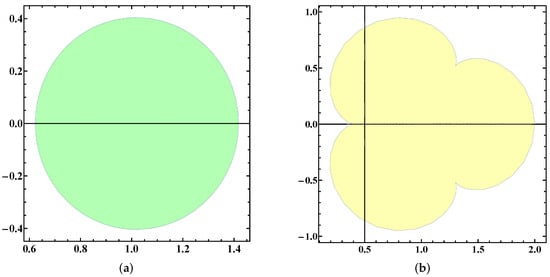
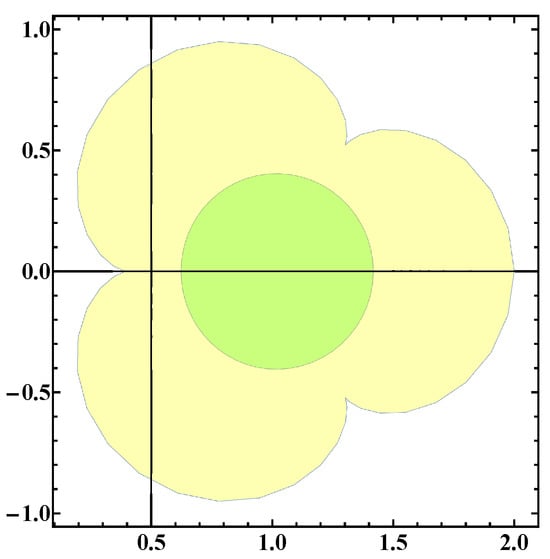
Figure 1a illustrates that maps onto a circular region with center at in the right half-plane. The function is analytic with and maps the unit disc onto a leaf-like region in the right half plane (see Figure 1b). Figure 2 illustrates that the image of lies inside the image of . Therefore, the following relations hold if
Figure 1.
(a) Image of under a mapping (b) Image of under .
Figure 2.
2D plots of nested inside .
Hence, is non-empty.
Remark 2.
Using the operator , we now define the following class analogous to the class .
Definition 1.
Remark 3.
Letting and in Definition 1, the class reduces to the class .
The following result is well-known, which we will be using to obtain the coefficient inequalities.
Lemma 1
([13]). If , and ρ is a complex number, then
and the result is sharp.
2. Main Results
We will start with the following.
Theorem 1.
If , then we have
and for all
where is given by
The inequality is sharp for each .
Proof.
As , by (8), we have
Thus, let be of the form and defined by
On computation, the right-hand side of (13) is
The left-hand side of (13) will be of the form
Now, to prove the Fekete–Szegö inequality for the class , we consider
If we let and in Theorem 1, we have
Corollary 1.
If we let , and in Theorem 1, we have
Corollary 2.
Letting (see [15] for detailed study pertaining to the three leaf-shaped region) in Corollary 1, we have the following result.
Corollary 3.
Letting (considering only the principal branch cut) in Corollary 1, we have the following result.
Corollary 4.
Remark 4.
The principal branch of the function is related to the analytic function associated with the Balloon-shaped region, recently introduced by Ahmad et al. [16].
Letting (considering only the principal branch cut) in Corollary 1, we have the following result.
Corollary 5.
Remark 5.
We note that several results can be presented by specializing the parameters and the superordinate function in the definition of the function class .
3. Analytic Functions with Respect to Symmetric Points
The class is not closed under most of the basic transformation. Motivated by the fact that the class is preserved under k-root transformation, Sakaguchi [17] considered function starlike with respect to symmetrical points, which satisfies the inequality
Here, we will define and study the class of functions with respect to symmetrical points.
Definition 2.
Remark 6.
Letting and in Definition 2, the class reduces to the class
Theorem 2.
If , then we have
and for all
where is given by
The inequality is sharp for each .
4. Conclusions
In this paper, we defined a new family of meromorphic function whose differential characterization was motivated by the definition of the multiplicative derivative. Note that the class was not defined by replacing the ordinary derivative with a multiplicative derivative in the meromorphic starlike function class. Rather, it is just a new class satisfying a new analytic characterization motivated by the multiplicative derivative. In addition, we redefined the subclass of meromorphic function analogous to the class of functions with respect to symmetric points. Now the question arises: Will the class be well-defined if the denominator in is replaced with ? In the analytic case, such a class was not well-defined and it required adaptation. Further, the question remains as to whether it is possible to obtain the sufficient condition for the star-likeness of and .
Author Contributions
Conceptualization, D.B., K.R.K. and G.M.; methodology, D.B., K.R.K. and G.M.; software, D.B., K.R.K. and G.M.; validation, D.B., K.R.K. and G.M.; formal analysis, D.B., K.R.K. and G.M.; investigation, D.B., K.R.K. and G.M.; resources, D.B., K.R.K. and G.M.; data curation, D.B., K.R.K. and G.M.; writing—original draft preparation, K.R.K.; writing—review and editing, D.B., K.R.K. and G.M.; visualization, D.B., K.R.K. and G.M.; supervision, D.B. and G.M.; project administration, D.B. and G.M. All authors have read and agreed to the published version of the manuscript.
Funding
This research received no external funding.
Data Availability Statement
No new data were created or analyzed in this study.
Acknowledgments
Authors would like to thank the referees for their comments which helped us to remove the mistakes.
Conflicts of Interest
The authors declare no conflict of interest.
References
- Srivastava, H.M.; Bansal, M.; Harjule, P. A study of fractional integral operators involving a certain generalized multi-index Mittag–Leffler function. Math. Methods Appl. Sci. 2018, 41, 6108–6121. [Google Scholar] [CrossRef]
- Aouf, M.K.; El-Emam, F.Z. Fekete–Szegö problems for certain classes of meromorphic functions involving q-Al-Oboudi differential operator. J. Math. 2022, 2022, 4731417. [Google Scholar] [CrossRef]
- Horrigue, S.; Madian, S.M. Some inclusion relationships of meromorphic functions associated to new generalization of Mittag–Leffler function. Filomat 2020, 34, 1545–1556. [Google Scholar] [CrossRef]
- Umadevi, E.; Karthikeyan, K.R. A subclass of close-to-convex function involving Srivastava-Tomovski operator. In Recent Developments in Algebra and Analysis. ICRDM 2022. Trends in Mathematics; Leung, H.H., Sivaraj, R., Kamalov, F., Eds.; Birkhäuser: Cham, Switzerland, 2024. [Google Scholar] [CrossRef]
- Srivastava, H.M.; Tomovski, Ž. Fractional calculus with an integral operator containing a generalized Mittag–Leffler function in the kernel. Appl. Math. Comput. 2009, 211, 198–210. [Google Scholar] [CrossRef]
- Tomovski, Ž.; Pogány, T.K.; Srivastava, H.M. Laplace type integral expressions for a certain three-parameter family of generalized Mittag–Leffler functions with applications involving complete monotonicity. J. Frankl. Inst. 2014, 351, 5437–5454. [Google Scholar] [CrossRef]
- Tomovski, Ž.; Hilfer, R.; Srivastava, H.M. Fractional and operational calculus with generalized fractional derivative operators and Mittag–Leffler type functions. Integral Transform. Spec. Funct. 2010, 21, 797–814. [Google Scholar] [CrossRef]
- Aouf, M.K.; Shamandy, A.; Mostafa, A.O.; Madian, S.M. Properties of some families of meromorphic p-valent functions involving certain differential operator. Acta Univ. Apulensis 2009, 20, 7–16. [Google Scholar]
- El-Ashwah, R.M.; Aouf, M.K. Differential subordination and superordination on p-valent meromorphic function defined by extended multiplier transformations. Europ. J. Pure Appl. Math. 2010, 3, 1070–1085. [Google Scholar]
- Karthikeyan, K.R.; Murugusundaramoorthy, G. Properties of a Class of Analytic Functions Influenced by Multiplicative Calculus. Fractal Fract. 2024, 8, 131. [Google Scholar] [CrossRef]
- Bashirov, A.E.; Kurpinar, E.M.; Özyapıcı, A. Multiplicative calculus and its applications. J. Math. Anal. Appl. 2008, 337, 36–48. [Google Scholar] [CrossRef]
- Bashirov, A.E.; Mısırlı, E.; Tandoğdu, Y.; Özyapıcı, A. On modeling with multiplicative differential equations. Appl. Math. J. Chin. Univ. 2011, 26, 425–438. [Google Scholar] [CrossRef]
- Ma, W.C.; Minda, D. A unified treatment of some special classes of univalent functions. In Proceedings of the Conference on Complex Analysis, Tianjin, China, 19–23 June 1992; International Press: Boston, MA, USA, 1992; pp. 157–169. [Google Scholar]
- Karthikeyan, K.R.; Murugusundaramoorthy, G.; Bulboacă, T. Properties of λ-pseudo-starlike functions of complex order defined by subordination. Axioms 2021, 10, 86. [Google Scholar] [CrossRef]
- Gandhi, S.; Gupta, P.; Nagpal, S.; Ravichandran, V. Starlike functions associated with an Epicycloid. Hacet. J. Math. Stat. 2022, 51, 1637–1660. [Google Scholar] [CrossRef]
- Ahmad, A.; Gong, J.; Al-Shbeil, I.; Rasheed, A.; Ali, A.; Hussain, S. Analytic Functions Related to a Balloon-Shaped Domain. Fractal Fract. 2023, 7, 865. [Google Scholar] [CrossRef]
- Sakaguchi, K. On a certain univalent mapping. J. Math. Soc. Japan 1959, 11, 72–75. [Google Scholar] [CrossRef]
Disclaimer/Publisher’s Note: The statements, opinions and data contained in all publications are solely those of the individual author(s) and contributor(s) and not of MDPI and/or the editor(s). MDPI and/or the editor(s) disclaim responsibility for any injury to people or property resulting from any ideas, methods, instructions or products referred to in the content. |
© 2024 by the authors. Licensee MDPI, Basel, Switzerland. This article is an open access article distributed under the terms and conditions of the Creative Commons Attribution (CC BY) license (https://creativecommons.org/licenses/by/4.0/).