1. Introduction and Definitions
Fractional calculus theory has found interesting applications in analytic function theory. The standard definitions of fractional operators and their extensions have been effectively utilized to derive various results, such as characterization properties, coefficient estimates [
1], and distortion inequalities [
2].
The complex modeling of phenomena in nature and society has recently been the object of several investigations based on methods initially developed in a physical context. These systems are the consequence of the ability of individuals to develop strategies. They occur in complex dynamical systems [
3], kinetic theory [
4], and hyperchaotic complex systems [
5]. Fractional differential equations concerning the Riemann-Liouville fractional operators or the Caputo derivative have been recommended by many authors (see [
6,
7,
8,
9,
10,
11]).
In
Section 1, we introduce generalizations for the Srivastava-Owa fractional operators. The conditions for the boundedness of the fractional integral operator in Bergman space are provided. Additionally, certain features are also given for these operators. In
Section 2, we generalize the Libera integral operator [
12], and we discuss the convexity and starlikeness for this operator. Additionally, results are presented for some fractional differential equations that have convex (starlike) solutions. In
Section 3, the generalization of the wave transformation is introduced. This transformation converts differential equations in the complex domain from fractional into ordinary, with illustrative examples.
In [
13], Srivastava and Owa presented the definitions of fractional operators in the complex domain as follows:
Definition 1. The fractional integral of order is given for an analytic functionin a simple connected region of a complex plane by Definition 2. The fractional derivative of order is defined for an analytic function in a simple connected region of a complex plane as Remark 1. From Definitions 1 and 2, we have the following:
- (1)
.
- (2)
.
We recall some definitions that can be found in [
14]. Let
denote the class of analytic functions in the open unit disk
. For
and
, let
Let the class
be defined as follows:
The subclass of consists of univalent functions (the functions that are one-to-one and analytic in ). A function is said to be starlike (convex, resp.) of order (where ) if it satisfies (, resp.).
2. -Riemann–Liouville Fractional Operators
To begin, we generalize the definitions of gamma functions given in [
5,
14] as follows:
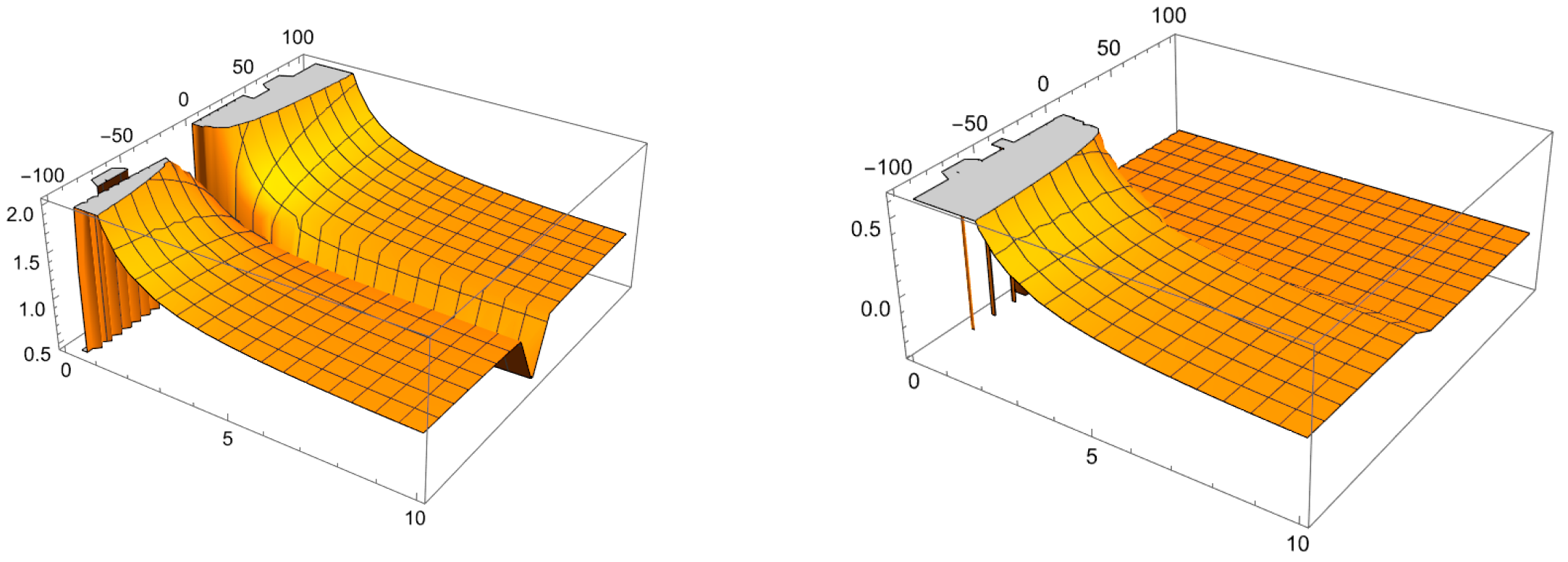
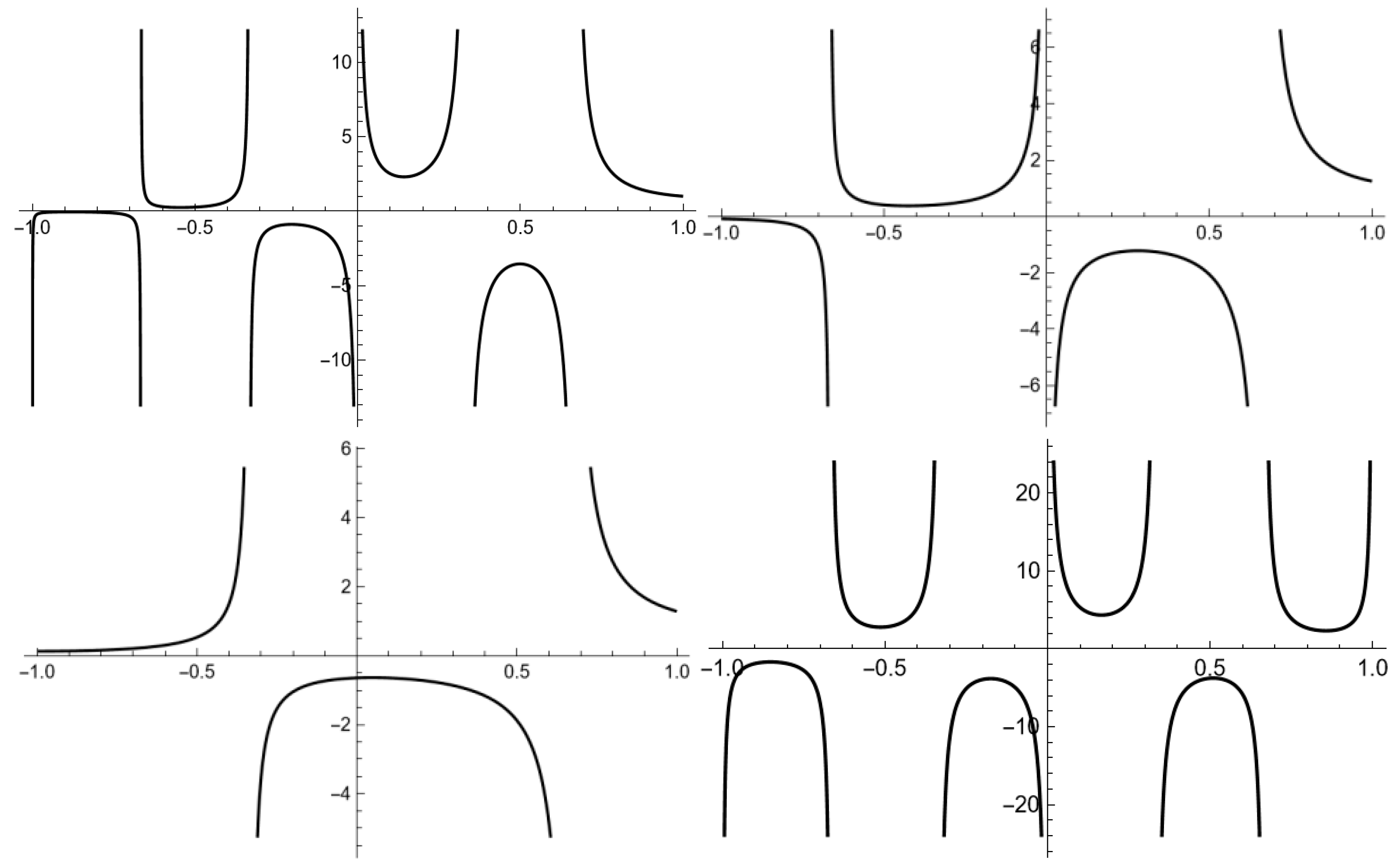
Definition 3. For , the -gamma function is defined as follows (see Figure 1): Remark 2. In the above definition, the following hold:
- (1)
If we take , then .
- (2)
If we take ,
we obtain the gamma function’s definition in [
5].
- (3)
If we take ,
then in [
14].
Proposition 1. Suppose and in with . Then, the following hold:
- (1)
.
- (2)
.
- (3)
.
- (4)
.
Proof. From the above definition and direct calculations. □
In the following definitions and results, we present fractional operators in terms of the gamma function.
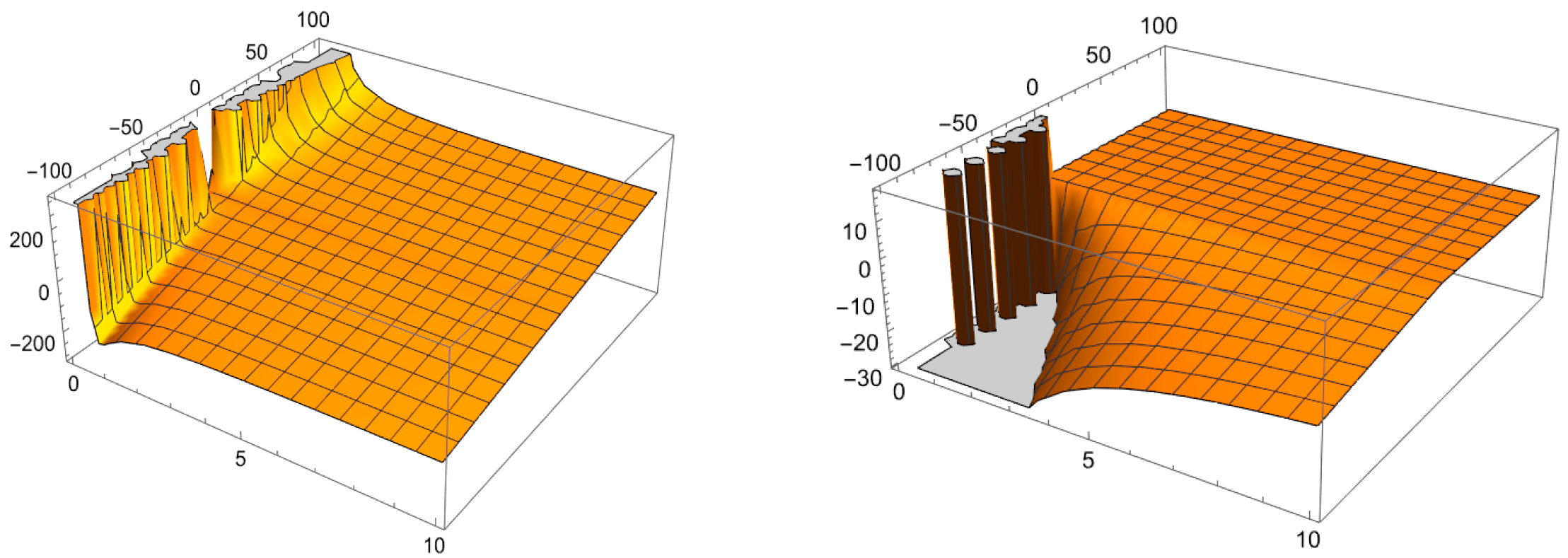
Definition 4. Let be a continuous function in . Then, the -Riemann-Liouville fractional integral is defined as follows (see Figure 2):
where
, and
.
Figure 2.
Plots of , , , and .
Figure 2.
Plots of , , , and .
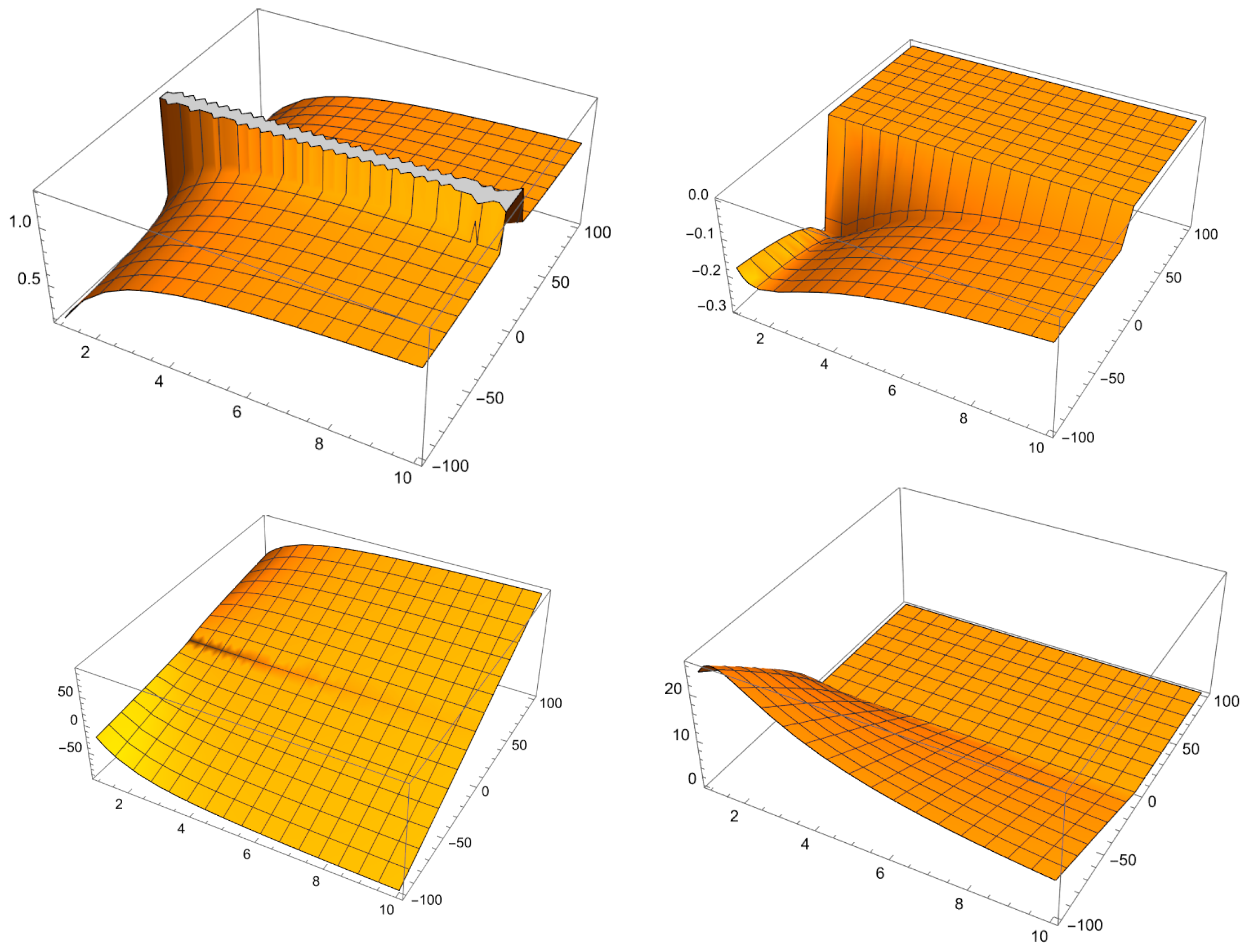
Definition 5. Let and . Then, the -Riemann-Liouville fractional derivative is defined as follows (see Figure 3):
Figure 3.
Plots of , , , and .
Figure 3.
Plots of , , , and .
Remark 3. In Definitions 4 and 5, the following hold:
- (1)
If and
,
we obtain Srivastava and Owa’s definitions in [
13].
- (2)
If ,
then we obtain the definitions by Ibrahim in [
15].
- (3)
If and
,
then we obtain the definitions by Ibrahim in [
16].
Proposition 2. For , the following statements hold:
- (1)
.
- (2)
and are linear operators.
- (3)
- (4)
- (5)
- (6)
If is analytic, then .
- (7)
If and , then
- (8)
.
- (9)
If ,
,
and ,
then - (10)
If ,
,
and ,
then
Proof. - (1)
(by Dirichlet equality).
Substituting
into the above integration yields
- (2)
Clear.
- (3)
Set
; then,
and, hence,
- (4)
Set
; then,
, yielding
- (5)
Follows from (3) and (4).
- (6)
Follows from (5).
- (7)
- (8)
- (9)
- (10)
□
Example 1. Consider the fractional differential equation with ; then, Recall that for the Bergman space is the class of all analytic functions in with ,
where the norm is defined bywhere denotes the Lebesgue area measure. In the following theorem, it is shown that the integral operator is bounded in .
Theorem 1. Let and . Then, is bounded in andwhere Proof. Assume that
. Then,
where
. □
Definition 6. Let . Then, the -Caputo derivative is defined by Theorem 2. Let , and be an analytic function. Then, 3. Convexity and Starlikeness
In this section, we generalize the Libera integral operator (see [
12]) using an operator of the form
or, equivalently,
Recall that the class of admissible functions
consists of those functions
that satisfy the admissibility condition (see [
17]):
Theorem 3 ([
17])
. Let . If and , then .
Theorem 4. Let and Then, is a starlike function.
Proof. Let
. Then,
is analytic and
. Hence,
We then obtain
which leads to
. The admissibility condition
is satisfied as follows:
Thus, and is starlike. □
Corollary 1. Let and . If is a starlike function. Then is also a starlike function.
Theorem 5. Let and . Suppose that Then, is a convex function.
Proof. Let
. Then,
is analytic and
. Hence,
After a simple calculation,
which leads to
. The admissibility condition
is satisfied as follows:
Thus, and is convex. □
Corollary 2. Let and . If is a convex function. Then is also a convex function.
The following results give some fractional differential equations with convex or starlike solutions.
Theorem 6 ([
17])
. Let , , and , where , . If , then .
Theorem 7. Let be analytic in with . If is the unique solution to the problemthen is a convex univalent solution in .
Proof. By applying Proposition 2 (10),
By (11) and (12), we have
Now, let
. Then,
is analytic and
, so
Thus, , so Theorem 6 leads to ; that is, . After simple calculations, . Hence, is convex. □
Theorem 8. Let be analytic in with . If is the unique solution of the problemthen is a convex univalent solution. Proof. By applying Proposition 2 (10),
By (12), (13) and (14), we have
Let
. Then,
is analytic and
, so
Thus, , so Theorem 6 leads to ; that is, . After simple calculations, . Hence, is convex. □
Theorem 9. Let be analytic in with . If is the unique solution of the problemthenis a univalent starlike solution. Proof. By the same proof technique as for Theorems 7 and 8. □
4. Fractional Complex Transform
Recently, a significant and highly beneficial technique for fractional calculus, known as the fractional complex transform, was introduced in a publication [
18,
19,
20,
21,
22]. This section illustrates some fractional complex transforms using the
-Riemann–Liouville fractional operator. Analogous to the wave transformation
where
and
are constants,
is applied to fractional differential equations in the sense of
-fractional operators.
We impose the fractional complex transform
where
is the fractional index.
Example 2. Let and . Then, In particular, if , we have Example 3. Consider the following equation:
.
Assume that
is a formal solution, when
and
. After direct calculations,
and
yielding
Equivalently,
where
. Clearly,
is a contraction function whenever
; then, (22) has a unique solution in
.
To calculate the fractional index for the equation
we assume that the transform
and the solution can be expressed as
By substituting (24) into (23), we obtain
Therefore,
where
is the Mittag-Leffler function. Thus, (25) is the exact solution of (20), so the approxi-mate solution of (23) is given by
In the following, we discuss equations of the form
with
, where
and
are analytic functions.
In functional analysis, recall that the norm on analytic functions is defined by where is the Banach space of analytic functions in .
Theorem 10 (Existence and Uniqueness).
Consider the problem in (26) with , and let satisfyand Then, there exists a unique solution .
Proof. Define
and the operator
by
Firstly, we prove that
is bounded.
Since , then is bounded.
Now, we prove that
is continuous. Since
is continuous on
, it is uniformly continuous on compact set
, where
. Therefore, given
, there exists
such that for all
, we have
for
. Then,
Thus, φ is continuous.
Now, we show that φ is an equicontinuous function on
. For
such that
, for all
, we obtain
which is independent on
u. Therefore, φ is a function that exhibits equicontinuity on
. The Arzela–Ascoli Theorem implies that any sequence of functions from
contains a subsequence that converges uniformly. Consequently,
is relatively compact. Schander’s fixed point theorem states that φ possesses a fixed point. A fixed point of φ is a solution that is obtained by construction.
Finally, we need to prove that φ has a unique fixed point.
The above follows from
and . Thus, by φ contraction mapping and by the Banach fixed point theorem, φ has a unique fixed point corresponding to the solution. □
Example 4. Consider the following problem:where (puncture unit disk). Let with solution .
By substituting into (28) and applying (18), we obtain ,
yielding By induction for m and , we have