Abstract
This article discusses the adaptive output synchronization problem of coupled fractional-order memristive reaction-diffusion neural networks (CFOMRDNNs) with multiple output couplings or multiple output derivative couplings. Firstly, by using Lyapunov functional and inequality techniques, an adaptive output synchronization criterion for CFOMRDNNs with multiple output couplings is proposed. Then, an adaptive controller is designed for ensuring the output synchronization of CFOMRDNNs with multiple output derivative couplings. Finally, two numerical examples are given to verify the effectiveness of the theoretical results.
1. Introduction
In recent years, coupled neural networks (CNNs) have received significant attention because their dynamical behaviors have been applied in many fields such as chaos generators design, image processing and secure communication. As an important dynamical behavior of CNNs, synchronization has been widely discussed during the past decade [1,2,3,4,5]. With the help of convex combination technique and time-varying Lyapunov functions, Long et al. [3] investigated the synchronization of coupled switched neural networks affected by stochastic disturbances and impulses. The state synchronization of CNNs was studied in above works [1,2,3,4,5], however, state synchronization is often difficult to achieve. Actually, sometimes only partial state variables are needed to be synchronized. Hence, some scholars have considered the output synchronization of CNNs [6,7,8,9,10]. Wang et al. [6] solved the output synchronization problem of directed and undirected CNNs by employing matrix theory and inequality technique.
In practical situations, it is more appropriate to use multiple weighted complex networks to describe various real networks (e.g., communication networks, public transport networks, etc.). Since CNNs are a special type of complex networks, some authors have considered the dynamical behaviors of multiple weighted CNNs [11,12]. In [11], some synchronization criteria were established for CNNs with multistate couplings by designing suitable event-triggered controller. In [1,2,3,4,5,6,7,8,9,10,11,12], the authors discussed networks with state coupling. As a matter of fact, output coupling is also an important coupling form in CNNs. Recently, some investigations about the output synchronization of CNNs with multiple output couplings have been reported [13,14,15]. A class of CNNs with multiple output couplings was introduced by Liu et al. [14], and the output synchronization problem for the proposed networks was investigated by exploiting the Barbalat’s lemma and adaptive controller. On the other hand, different time derivatives of node states may lead to different changes of other nodes in some real networks. Thus, considering the dynamical behaviors for CNNs with derivative coupling is meaningful [16,17,18]. Tang et al. [16] designed an impulsive pinning control strategy to ensure that the derivative CNNs are synchronized.
It is worth pointing out that [1,2,3,4,5,6,7,8,9,10,11,12,13,14,15,16,17,18] only focused on integer-order coupled neural network models. In fact, compared with integer-order derivatives, fractional-order derivatives can better describe the memory and hereditary properties of diverse materials and processes. Furthermore, fractional calculus can also be applied to biological neurons. For example, fractional-order derivatives afford basic and universal computation for individual neuron that can facilitate stimulus anticipation and information processing in [19]. Hence, more and more authors have shown interest in the coupled fractional-order neural networks (CFONNs) and have obtained important results [20,21,22,23]. In [20], a kind of multi-weights CFONNs with and without uncertain parameters was introduced, and several output synchronization criteria for such networks were derived based on Mittag–Leffler functions and Laplace transforms. Additionally, considering the diffusion phenomenon is inevitable in CNNs when electrons are moving in a nonuniform electromagnetic field, some researchers investigated the dynamical behaviors of CFONNs with reaction-diffusion terms [24,25,26,27]. Wang et al. [26] presented a multiple weighted coupled fractional-order neural network model with reaction-diffusion terms and solved the synchronization problem for proposed model by using adaptive schemes and some inequality techniques. Regrettably, the output synchronization of CFONNs with reaction-diffusion terms has not been studied.
As is well known, in 2008, HP Labs first produced nanoscale memristor devices. In the implementation of neural network circuits, resistors can be replaced by memristors to simulate synaptic structures. Therefore, a memristive neural network model was established successfully [28,29]. Li et al. [29] presented a quaternion-valued fuzzy memristive neural network and derived several quasi-synchronization criteria for such a network. Moreover, due to the fractional-order systems having property of long-term memory, there has been growing attention about the dynamical behaviors of fractional-order memristive neural networks [30,31,32,33,34]. Ma et al. [30] introduced a delayed coupled fractional-order memristive neural network model with parameter mismatch and designed a discontinuous controller to ensure that the proposed model can achieve synchronization. On the basis of Lyapunov functionals and fractional-order derivative inequalities, Mao et al. [31] addressed the synchronization issue of fractional-order multidimensional memristive neural networks with time-varying delays. Unfortunately, the output synchronization of coupled fractional-order memristive reaction-diffusion neural networks (CFOMRDNNs) under adaptive controller has never been considered.
This article discusses the output synchronization of CFOMRDNNs with multiple output couplings or multiple output derivative couplings via adaptive control. The main contributions of this article are as follows.
(1) This article introduces a type of CFOMRDNNs with multi-output derivative couplings. Different from the existing coupled fractional-order reaction-diffusion neural network models [24,26], derivative coupling is considered in the network model of this article because the state change velocities of neighbor nodes have a great influence on each node.
(2) An output feedback controller and an adaptive scheme are designed to ensure the output synchronization of CFOMRDNNs with multi-output derivative couplings. Considering that in many cases only partial state variables are required to be synchronized, this article explores the output synchronization problem of CFOMRDNNs with multi-output derivative couplings, which is different from the synchronization of coupled fractional-order reaction-diffusion neural networks investigated in [26].
(3) Under the help of the Laplace transform and Lyapunov functional, an output synchronization criterion is presented for CFOMRDNNs with multi-output couplings. It is evident that tackling the output synchronization problem of CFOMRDNNs with multi-output couplings is very meaningful, as it has not been discussed before.
2. Preliminaries
Let and mean the maximum and the minimum eigenvalues of the real symmetric matrix Q, respectively. ⊗ represents the Kronecker product. * means the convolution operator. and denote the set of all real numbers and the set of all positive real numbers, respectively. and stand for the set of all n-dimensional real-valued vectors and the set of all real-valued matrices, respectively. , is the boundary of and . For any with , .
Definition 1
(See [26]). Letting , the Caputo fractional derivative for is given by
where .
Definition 2
(See [35]). The Mittag–Leffler function is defined by
where μ, . When .
Lemma 1
(See [36]). For any continuously differentiable function , one has
where and .
Lemma 2
(See [37]). Set Φ be a cube and set be a real-valued function belonging to which vanishes on the boundary of . We have
in which .
3. Output Synchronization of CFOMRDNNs with Multiple Output Couplings
3.1. Network Model
The coupled fractional-order reaction-diffusion neural network model with multiple couplings considered in [26] is described by
where ; represents the state vector of the mth node; ; is the Laplace diffusion operator on ; ; denotes the activation function; ; denotes a constant matrix; represents the coupling strength of the ath coupling form; is the inner coupling matrices; is the outer coupling matrix in the ath coupling form, in which satisfies the following condition: if there is an edge between node m and node n, then ; otherwise, ; and .
Based on model (1), in order to investigate the output synchronization, the CFOMRDNNs with multiple output couplings are presented in this section, which are given as
where have similar meanings as these in network (1); denotes the output vector of the mth node;
in which ;
where .
Consider the following CFOMRDNNs with multiple output couplings consisting of identical fractional-order memristive reaction-diffusion neural networks with multiple output ouplings:
where have similar meanings as these in network (2); is the memristor connection weight and represents the control input of the mth node.
The memristor connection weight is defined as
in which denotes the switching jump, are known constants,
Define
in which . The matrix is considered in the following part of this article, then we can get
In many cases, only a fraction of state variables of the nodes are needed to reach synchronization. In the circumstances, these state variables may not be affected by the other state variables in the state of each node. Hence, the connection weight is selected in the form of (5) throughout this article.
Base on the switch rules in (4), the state of can be or if the index i of is fixed. Since the connection weight coefficient is determined according to the threshold value of , there are two possible values for . Hence, the number of possible forms of is . The characteristic function is defined as follows:
where . We can reach the conclusion that . Based on (6) and (7), we have
where .
For simplicity, define , .
In this article, the network (3) is connected and function meets the Lipschitz condition, namely, there exists which satisfies
for any . Furthermore, define
The Dirichlet boundary condition and initial value of network (3) are given as
where is continuous on .
Denote , in which . Then, it can be derived from (8) that
where .
By taking , we can acquire
In the following, the output synchronization is defined for the network (3).
Definition 3.
The network (3) can achieve output synchronization if
3.2. Adaptive Control for Output Synchronization
Design following output feedback controller and adaptive scheme for the network (3)
where , , and .
Define
Proof.
Construct the Lyapunov functional for the network (3):
where .
Because satisfies the Lipschitz condition, one obtains
Since
then
Additionally,
Select sufficiently large such that
By (13), one has
Based on (24), there exists a such that
Let and . According to (26), one acquires
From (27), we have
The inverse Laplace transform is used for (28), one has
Based on (30), we could gain
4. Output Synchronization of CFOMRDNNs with Multiple Output Derivative Couplings
4.1. Network Model
The CFORDMNNs with multiple output derivative couplings discussed are described as
where have the same meanings as these in network (3) and have the same meanings as it in network (4).
The Dirichlet boundary condition and initial value of network (32) are given as
where is continuous on .
According to (5) and (32), we have
where has the same definition as it in (5); and have the same definitions as these in (6).
Letting , one has
Denoting , we derive
where .
4.2. Adaptive Control for Output Synchronization
An adaptive output feedback controller for the network (32) is devised as follows:
where and .
Proof.
Take the following Lyapunov functional for the network (32):
in which .
Select sufficiently large such that
5. Numerical Examples
5.1. Example 1
Consider the following CFOMRDNNs with multiple output couplings:
where , , and
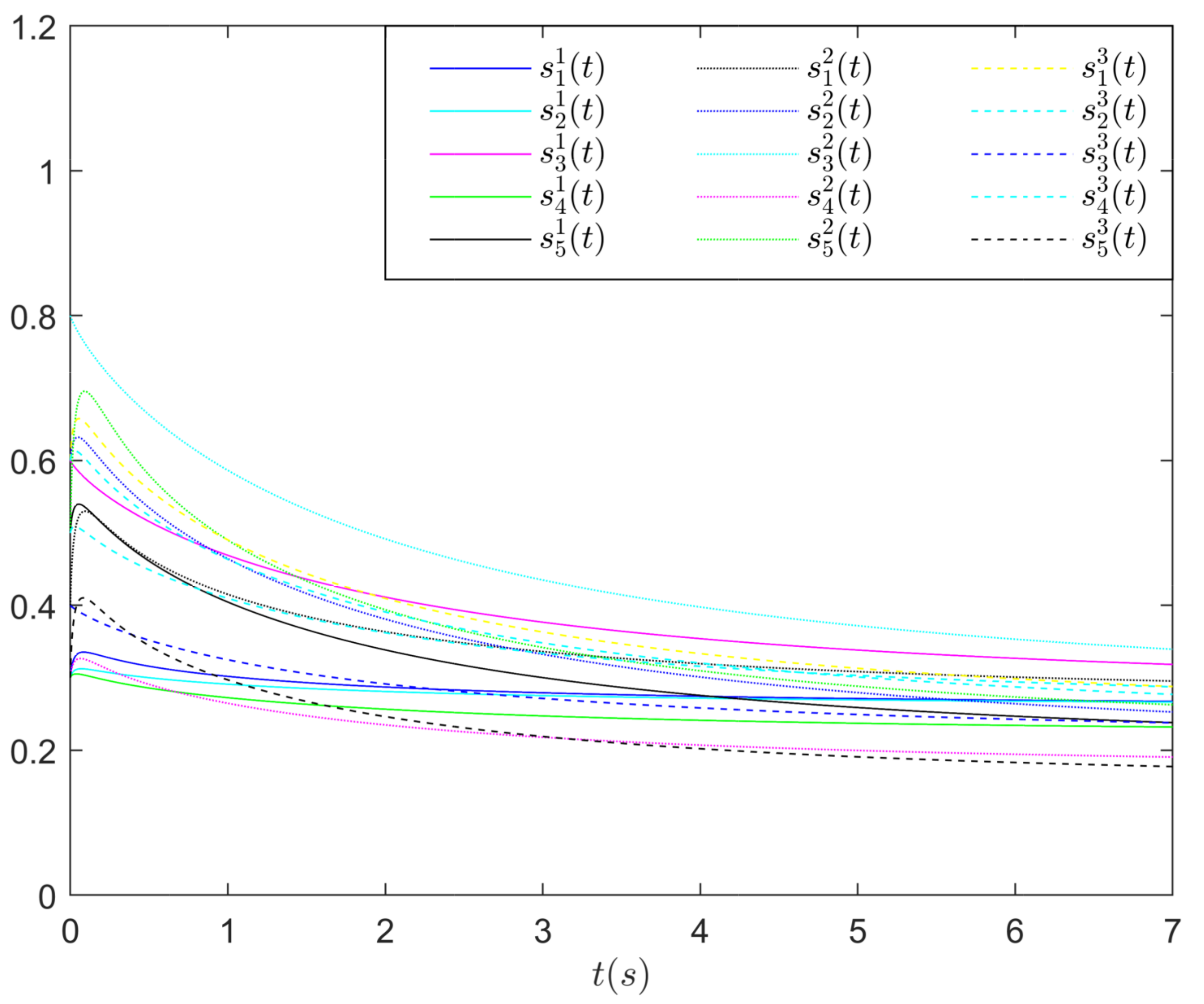
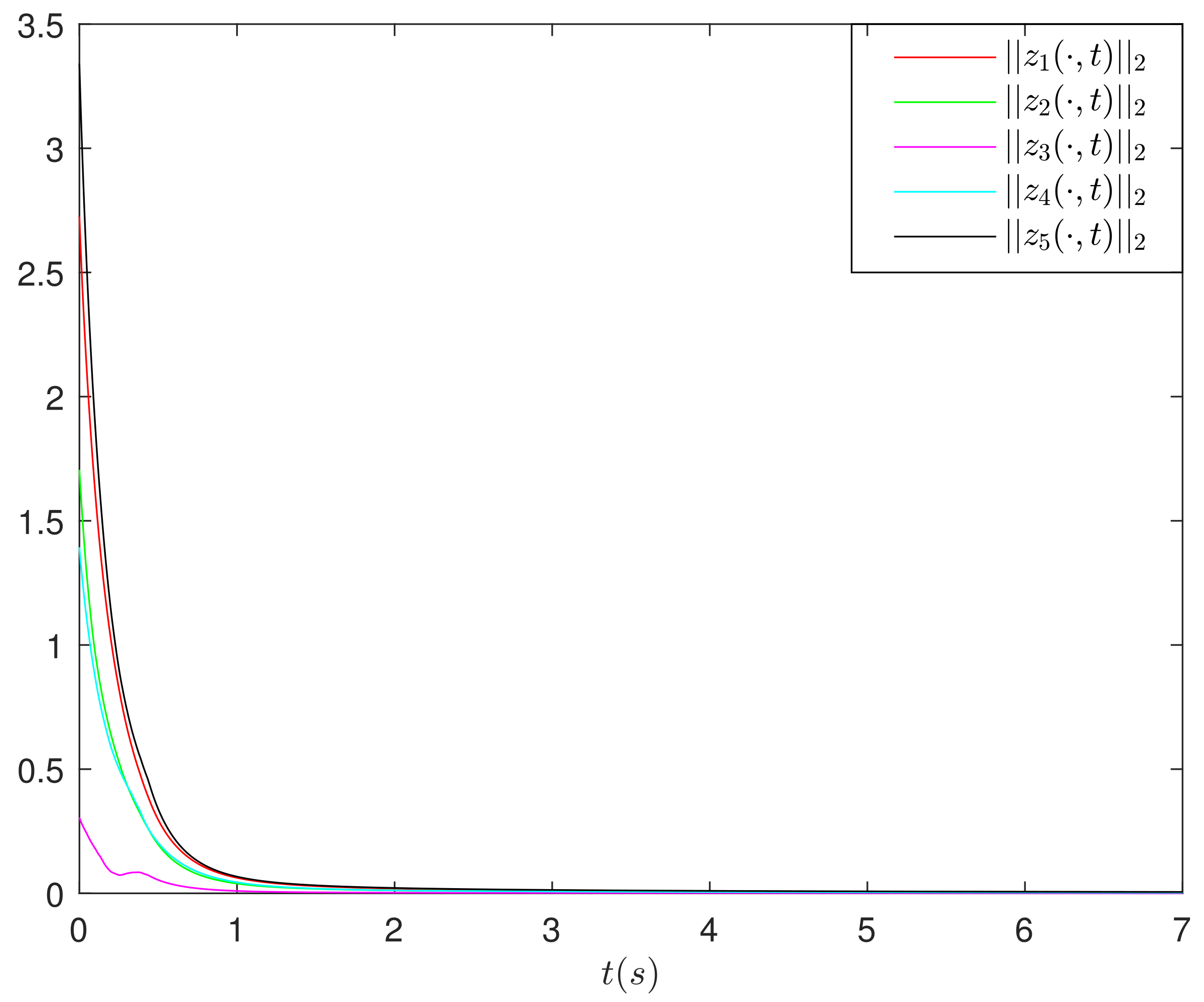
Obviously, the function fulfills the Lipschitz condition with . Based on Theorem 1, the network (47) attains output synchronization under the adaptive controller (12). Figure 1 displays the changing processes of norms of error vectors in the networks (47). From Figure 1, it is clear that the norms of error vectors can converge to 0, which reflects the effectiveness of the designed adaptive controller. Figure 2 depicts the change curves of the adaptive feedback gains for the networks (47).
Figure 1.
.
Figure 2.
.
5.2. Example 2
Take into account the following CFOMRDNNs with multiple output derivative couplings:
where , , and
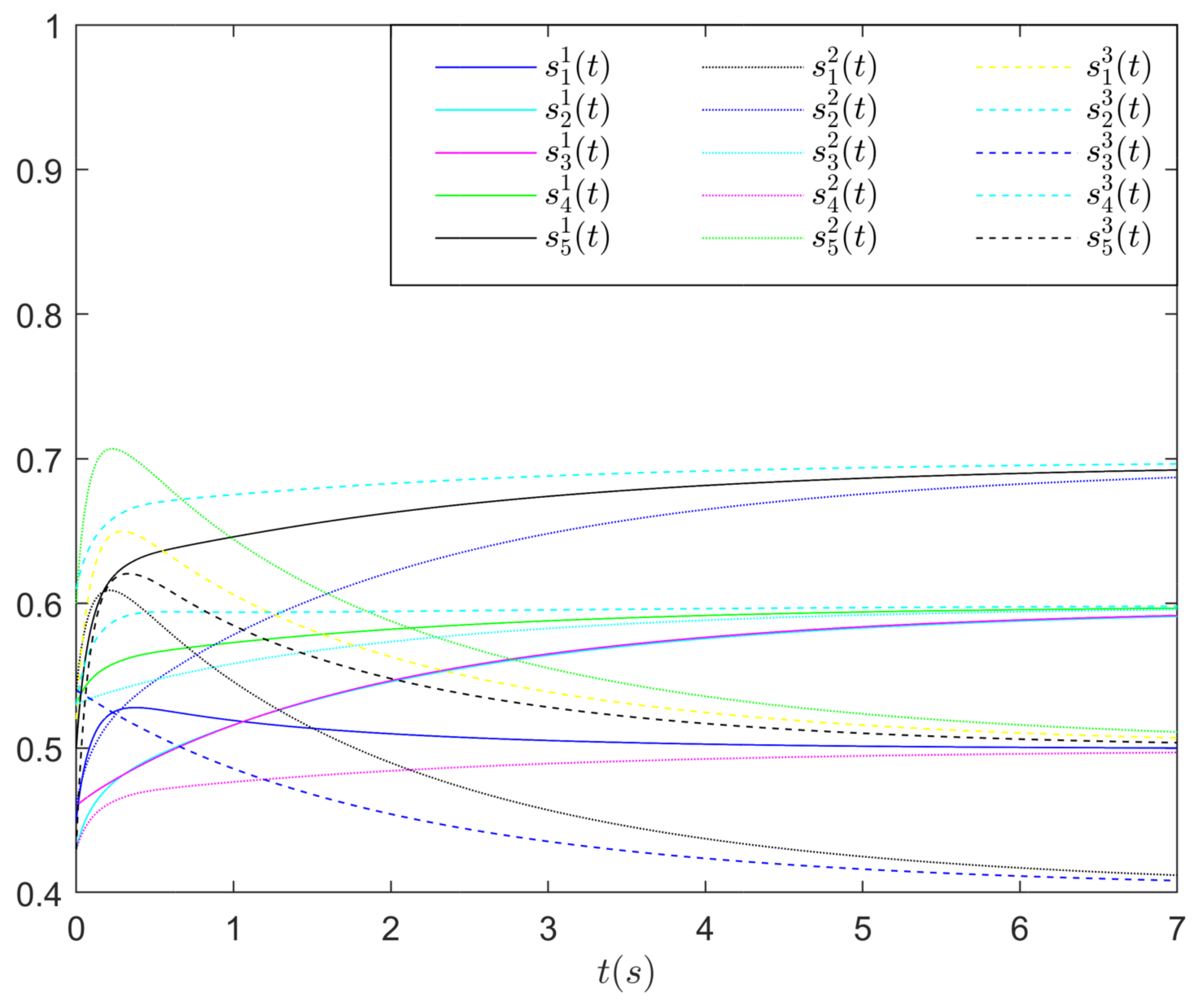
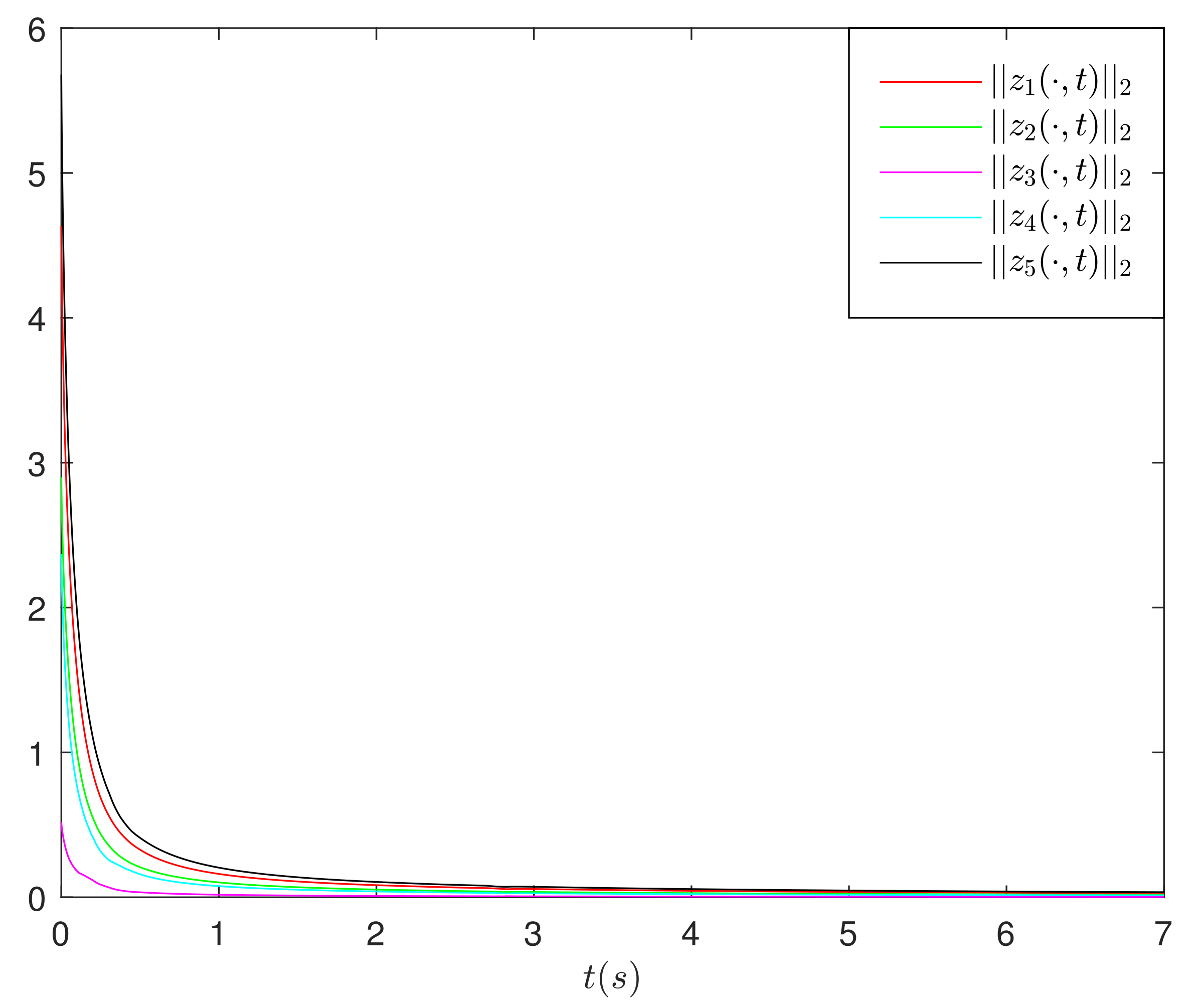
Evidently, the function satisfies the Lipschitz condition with . From the Theorem 2, it is found that the network (48) is output synchronized under the adaptive controller (38). From Figure 3, we can see the norms of error vectors can converge to 0, which reflects the designed adaptive output feedback controller in the networks (48) is effective. Figure 4 shows the change curves of the adaptive feedback gains for the networks (48).
Figure 3.
.
Figure 4.
.
6. Conclusions
In this article, two types of CFOMRDNNs with multiple output couplings or multiple output derivative couplings have been presented. We have addressed the problem of output synchronization of CFOMRDNNs with multiple output couplings with the assistance of the inverse Laplace transform and the properties of Mittag–Leffler function. Taking into account the effect of derivative coupling, the output synchronization of CFOMRDNNs with multiple output derivative couplings has been further studied by employing adaptive control strategy. At last, two numerical examples have substantiated the effectiveness of the derived output synchronization criteria.
Author Contributions
Validation, Y.W. and Z.-Y.X.; Writing—original draft, Feng You; Writing—review & editing, H.-A.T.; Supervision, J.-W.L. All authors have read and agreed to the published version of the manuscript.
Funding
This research was funded by the Scientific Research Foundation of Chongqing University of Technology under Grant 2021ZDZ001.
Institutional Review Board Statement
Not applicable.
Informed Consent Statement
Not applicable.
Data Availability Statement
No new data were created or analyzed in this study.
Conflicts of Interest
The authors declare no conflict of interest.
References
- Wu, S.C.; Li, X.D.; Ding, Y.H. Saturated impulsive control for synchronization of coupled delayed neural networks. Neural Netw. 2021, 141, 261–269. [Google Scholar] [CrossRef] [PubMed]
- Zhang, H.; Gong, D.; Chen, B.; Liu, Z. Synchronization for coupled neural networks with interval delay: A novel augmented Lyapunov–Krasovskii functional method. IEEE Trans. Neural Netw. Learn. Syst. 2013, 24, 58–70. [Google Scholar] [CrossRef] [PubMed]
- Long, H.; Ci, J.; Guo, Z.; Wen, S.; Huang, T. Synchronization of coupled switched neural networks subject to hybrid stochastic disturbances. Neural Netw. 2023, 166, 459–470. [Google Scholar] [CrossRef] [PubMed]
- Wen, S.; Zeng, Z.; Huang, T.; Meng, Q.; Yao, W. Lag synchronization of switched neural networks via neural activation function and applications in image encryption. IEEE Trans. Neural Netw. Learn. Syst. 2015, 26, 1493–1502. [Google Scholar] [CrossRef] [PubMed]
- Wang, J.; Zhang, H.; Wang, Z.; Liu, Z. Sampled-data synchronization of Markovian coupled neural networks with mode delays based on mode-dependent LKF. IEEE Trans. Neural Netw. Learn. Syst. 2017, 28, 2626–2637. [Google Scholar] [CrossRef] [PubMed]
- Wang, J.L.; Wu, H.N.; Huang, T.; Xu, M. Output synchronization in coupled neural networks with and without external disturbances. IEEE Trans. Control. Netw. Syst. 2018, 5, 2049–2061. [Google Scholar] [CrossRef]
- Wang, J.L.; Wu, H.N.; Huang, T.; Ren, S.Y.; Wu, J. Passivity and output synchronization of complex dynamical networks with fixed and adaptive coupling strength. IEEE Trans. Neural Netw. Learn. Syst. 2018, 29, 364–376. [Google Scholar] [CrossRef]
- Yu, H.; Antsaklis, P. Output synchronization of networked passive systems with event-driven communication. Trans. Autom. Control. 2014, 59, 750–756. [Google Scholar] [CrossRef]
- Wang, N.; Li, X.J. Optimal output synchronization control of a class of complex dynamical networks with partially unknown system dynamics. IEEE Trans. Syst. Man, Cybern. Syst. 2021, 51, 822–832. [Google Scholar] [CrossRef]
- Xiao, X.; Li, X.J.; Jin, X.Z.; Cui, Y. Output synchronization control for a class of complex dynamical networks with non-identical dynamics. Appl. Math. Comput. 2018, 335, 38–49. [Google Scholar] [CrossRef]
- Huang, Y.; Xiao, X.; Wang, Y.; Li, J. Event-triggered pinning synchronization and robust pinning synchronization of coupled neural networks with multiple weights. Int. J. Adapt. Control. Signal Process. 2023, 37, 584–602. [Google Scholar] [CrossRef]
- Wang, J.L.; Qin, Z.; Wu, H.N.; Huang, T.; Wei, P.C. Analysis and pinning control for output synchronization and H∞ output synchronization of multi-weighted complex networks. IEEE Trans. Cybern. 2019, 49, 175–205. [Google Scholar] [CrossRef]
- Wang, J.L.; Wang, D.Y.; Wu, H.N.; Huang, T. Output synchronization of complex dynamical networks with multiple output or output derivative couplings. IEEE Trans. Cybern. 2021, 51, 927–937. [Google Scholar] [CrossRef] [PubMed]
- Liu, X.L.; Wang, J.L.; Huang, T. Output synchronization for coupled neural networks with multiple delayed output couplings. IEEE Trans. Circuits Syst. II: Express Briefs. 2022, 69, 4394–4398. [Google Scholar] [CrossRef]
- Zhao, L.H.; Ren, S.Y.; Shi, Y.W.; Liu, Y.P. Generalized lag output synchronization of the multiple output coupled complex dynamical networks. In Proceedings of the 38th Chinese Control Conference (CCC), Guangzhou, China, 27–30 July 2019; pp. 930–935. [Google Scholar] [CrossRef]
- Tang, Z.; Park, J.H.; Wang, Y.; Feng, J. Impulsive synchronization of derivative coupled neural networks with cluster-tree topology. IEEE Trans. Netw. Sci. Eng. 2019, 7, 1788–1798. [Google Scholar] [CrossRef]
- Wang, D.Y.; Wang, J.L.; Ren, S.Y.; Huang, Y.L. Output synchronization and H∞ output synchronization of complex dynamical networks with multiple derivative couplings. J. Frankl. Inst. 2019, 356, 407–440. [Google Scholar] [CrossRef]
- Wang, J.L.; Wu, H.Y.; Huang, T.; Ren, S.Y. Finite-time synchronization and H∞ synchronization for coupled neural networks with multistate or multiderivative couplings. IEEE Trans. Neural Netw. Learn. Syst. Early Acces. 2022. [Google Scholar] [CrossRef]
- Lundstrom, B.N.; Higgs, M.H.; Spain, W.J.; Fairhall, A.L. Fractional differentiation by neocortical pyramidal neurons. Nat. Neurosci. 2008, 11, 1335–1342. [Google Scholar] [CrossRef]
- Lin, Y.T.; Wang, J.L.; Liu, C.G.; Huang, Y.L. Output synchronization of coupled fractional-order neural networks with multiple weights. In Proceedings of the 41th Chinese Control Conference (CCC), Hefei, China, 25–27 July 2022; pp. 953–958. [Google Scholar] [CrossRef]
- Liu, P.; Li, Y.; Sun, J.; Wang, Y. Output synchronization analysis of coupled fractional-order neural networks with fixed and adaptive couplings. Neural Comput. Appl. 2023, 35, 517–528. [Google Scholar] [CrossRef]
- Lin, Y.T.; Wang, J.L.; Liu, C.G. Output synchronization analysis and PD control for coupled fractional-order neural networks with multiple weights. Neurocomputing 2023, 519, 17–25. [Google Scholar] [CrossRef]
- Yang, D.; Ren, G.; Wang, H.; Yu, Y.; Yuan, X. Adaptive control for output projective synchronization of fractional-order hybrid coupled neural networks with mismatched dimensions. Neurocomputing 2023, 558, 126738. [Google Scholar] [CrossRef]
- Liu, F.; Yang, Y.; Chang, Q. Synchronization of fractional-order delayed neural networks with reaction–diffusion terms: Distributed delayed impulsive control. Commun. Nonlinear Sci. Numer. Simul. 2023, 124, 107303. [Google Scholar] [CrossRef]
- Zhao, F.L.; Wang, Z.P.; Wu, H.N.; Wang, J.L.; Huang, T. Output synchronization of reaction–diffusion neural networks under random packet losses via event-triggered sampled–data control. Neurocomputing 2022, 514, 563–573. [Google Scholar] [CrossRef]
- Wang, J.L.; Du, X.Y.; Liu, C.G. Synchronization and adaptive control for coupled fractional-order reaction–diffusion neural networks with multiple couplings. ISA Trans. 2023, 136, 93–103. [Google Scholar] [CrossRef]
- Qiu, Q.; Su, H. Finite-time output synchronization for output-coupled reaction-diffusion neural networks with directed topology. IEEE Trans. Netw. Sci. Eng. 2022, 9, 1386–1394. [Google Scholar] [CrossRef]
- Zhou, C.; Wang, C.; Sun, Y.; Yao, W.; Lin, H. Cluster output synchronization for memristive neural networks. Inf. Sci. 2022, 589, 459–477. [Google Scholar] [CrossRef]
- Li, R.; Cao, J.; Li, N. Quasi-synchronization control of quaternion-valued fuzzy memristive neural networks. Fuzzy Sets Syst. 2023, 472, 108701. [Google Scholar] [CrossRef]
- Ma, F.; Gao, X. Synchronization and quasi-synchronization of delayed fractional coupled memristive neural networks. Neural Process. Lett. 2022, 54, 1647–1662. [Google Scholar] [CrossRef]
- Mao, X.; Wang, X.; Lu, Y.; Qin, H. Synchronizations control of fractional-order multidimension-valued memristive neural networks with delays. Neurocomputing 2024, 563, 126942. [Google Scholar] [CrossRef]
- Chen, L.; Cao, J.; Wu, R.; Machado, J.T.; Lopes, A.M.; Yang, H. Stability and synchronization of fractional-order memristive neural networks with multiple delays. Neural Netw. 2017, 94, 76–85. [Google Scholar] [CrossRef] [PubMed]
- Fan, Y.; Huang, X.; Wang, Z.; Xia, J.; Li, Y. Global Mittag–Leffler synchronization of delayed fractional-order memristive neural networks. Adv. Differ. Equ. 2018, 2018, 338. [Google Scholar] [CrossRef]
- Zhang, L.; Yang, Y.; Wang, F. Lag synchronization for fractional-order memristive neural networks via period intermittent control. Nonlinear Dyn. 2017, 89, 367–381. [Google Scholar] [CrossRef]
- Li, Y.; Chen, Y.; Podlubny, I. Mittag–Leffler stability of fractional order nonlinear dynamic systems. Automatica 2009, 45, 1965–1969. [Google Scholar] [CrossRef]
- Lv, Y.; Hu, C.; Yu, J.; Jiang, H.; Huang, T. Edge-based fractional-order adaptive strategies for synchronization of fractional-order coupled networks with reaction–diffusion terms. IEEE Trans. Cybern. 2020, 50, 1582–1594. [Google Scholar] [CrossRef] [PubMed]
- Lu, J.G. Global exponential stability and periodicity of reaction–diffusion delayed recurrent neural networks with Dirichlet boundary conditions. Chaos Solitons Fractals 2008, 35, 116–125. [Google Scholar] [CrossRef]
Disclaimer/Publisher’s Note: The statements, opinions and data contained in all publications are solely those of the individual author(s) and contributor(s) and not of MDPI and/or the editor(s). MDPI and/or the editor(s) disclaim responsibility for any injury to people or property resulting from any ideas, methods, instructions or products referred to in the content. |
© 2024 by the authors. Licensee MDPI, Basel, Switzerland. This article is an open access article distributed under the terms and conditions of the Creative Commons Attribution (CC BY) license (https://creativecommons.org/licenses/by/4.0/).