
Abstract
The mathematical theories and methods of fractional calculus are relatively mature, which have been widely used in signal processing, control systems, nonlinear dynamics, financial models, etc. The studies of some basic theories of fractional differential equations can provide more understanding of mechanisms for the applications. In this paper, the expression of the Green function as well as its special properties are acquired and presented through theoretical analyses. Subsequently, on the basis of these properties of the Green function, the existence and uniqueness of positive solutions are achieved for a singular p-Laplacian fractional-order differential equation with nonlocal integral and infinite-point boundary value systems by using the method of a nonlinear alternative of Leray–Schauder-type Guo–Krasnoselskii’s fixed point theorem in cone, and the Banach fixed point theorem, respectively. Some existence results are obtained for the case in which the nonlinearity is allowed to be singular with regard to the time variable. Several examples are correspondingly provided to show the correctness and applicability of the obtained results, where nonlinear terms are controlled by the integrable functions and in Example 1, and by the integrable functions and in Example 2, respectively. The present work may contribute to the improvement and application of the coupled p-Laplacian Hadamard fractional differential model and further promote the development of fractional differential equations and fractional differential calculus.
Keywords:
Hadamard fractional; singular nonlinear term; coupled differential system; positive solution; integral and infinite-point boundary condition MSC:
26A33; 34A37
1. Introduction
The p-Laplacian differential equation was first introduced by Leibenson [1] when he studied the turbulent flow in a porous medium. Later, differential equations containing p-Laplace operators have been widely used in many fields such as non-Newtonian mechanics, cosmic physics, plasma problems and elasticity theory [1,2,3,4,5,6]. The p-Laplacian operator is defined as . For recent developments in this regard, see [7,8,9,10,11].
Recently, more and more researchers have dedicated their research to the existence and number of solutions of fractional differential equations and the corresponding nonlinear deformation, flexural wave and vibration, and the coupled problem, which can be referred to in [2,4,12,13,14,15,16,17,18,19,20,21]. There are many approaches to studying fractional differential equations, such as the mixed monotone operator method [10], Banach’s fixed point theorem [22], Leray–Schauder’s alternative method [23,24], Hussein–Jassim’s method [25], the comparison principle method [26] and so on. In recent years, some scientists have devoted themselves to studying the Hadamard fractional differential equation as well as related nonlinear dynamical differential systems [6,22,26,27,28,29,30,31,32,33]. The Hadamard fractional derivative of () order of a continuous function is given by
where denotes the integer part of the number , provided that the right-hand side is pointwise defined on . The Hadamard fractional integral of () order of a function is given by
In order to better guide the practice, a large number of workers are devoted to the basic theoretical research of fractional differential equations, among which the structure of Hadamard fractional differential equations is one of them. It has been noticed that some of the structure of fractional differential equations is based on Hadamard fractional differential equations. In [18], the authors discussed the following Hadamard fractional equations:
with the following multi-point boundary conditions:
where is a real number, and is the standard Hadamard fractional derivative. with , and ; The authors obtained a triple positive solution and a nontrivial solution by a fixed point theorem and through the relationship between nonlinear and linear operators. Ardjouni [15] studied the following Hadamard fractional differential equations:
with integral boundary conditions:
where are given as continuous functions, does not require any monotone assumption and is non-decreasing on x. The authors obtained the existence and uniqueness of the positive solution by the method of upper and lower solutions and Schauder and Banach fixed point theorems. In [34], we consider the following singular Hadamard fractional differential equation:
with the infinite-point boundary condition:
where ; , ; ; ; the p-Laplacian operator is defined as and ; and may be singular at ; and , are the standard Hadamard fractional derivatives. The existence of positive solutions is investigated by spectral analysis by us. For the portion of the research results that include the fractional differential systems and the corresponding nonlinear deformation, flexural wave and vibration, please refer to [4,15,16,17,18,19,20,21,35].
Motivated by the excellent results above, we consider the following Hadamard fractional differential system (HFDS):
with nonlocal integral and infinite-point boundary conditions:
where ; the p-Laplacian operator is defined as ; are parameters; are functions of bounded variation; and denote the Riemann–Stieltjes integral with respect to and ; and have singularity at ; and are the standard Hadamard fractional derivatives.
In this paper, we investigate the existence of positive solutions for a singular infinite-point coupled p-Laplacian boundary value system. Compared with [18,19], the nonlinear term is singular in regard to time variable in this study, fractional derivatives are involved in the nonlinear terms and infinite point is involved in boundary conditions for HFDS (1) and (2). However, the nonlinear term is continuous in the studies [18,19] and the nonlinear terms of reference [18,19] do not contain derivative terms. Compared with [19,36,37], the equation in this paper is a p-Laplacian boundary value system which is a great extension from the general fractional differential equation. Compared with the references, on the one hand, the equations we study are complex and the singular form of nonlinearity can simulate more complex systems; on the other hand, we obtain the existence and uniqueness of the solutions to the equations.
This paper is organized as follows: In Section 1, we explain the research background and necessity of studying such a fractional differential equation in the Introduction section. In Section 2, we introduce some definitions and lemmas which will be used later, and give the expression of the theorem of the Green function, provide the nature of the theorem of Green function, and prove the continuity and total continuity of operators. In Section 3, we obtain the main results by using the method of a nonlinear alternative of Leray–Schauder-type, Guo–Krasnoselskii’s fixed point theorem in cone and the Banach fixed point theorem, respectively. In Section 4, we list three examples to illustrate the validity of the proposed theories. Finally, we summarize some conclusions with the current shortcomings and future research plans in Section 5.
2. Preliminaries and Lemmas
With respect to some essential definitions and lemmas of fractional calculus of the Hadamard type, the reader may consult the recent bibliography such as those in [5,38,39]. Only the parts are listed here.
For convenience in terms of presentation, we list herein some conditions to be used throughout the paper.
: , and there exists a function such that for , and
Lemma 1
([3,5]). If , then
Lemma 2
([3]). Suppose that and , then the solution of Hadamard fractional differential equation is
Lemma 3
([3]). Suppose that is not a natural number, , then
for , where and .
Lemma 4.
Let E be a real Banach space, and be a cone. Let be two bounded open subsets in E such that and . Let the operator be completely continuous. Suppose that one of the conditions is as follows:
- (i)
- If , for all ;
- (ii)
- If , for all holds, then T has a fixed point in
Lemma 5.
Let E be a Banach space and be closed and convex. Assume U is a relatively open subset of Ω with , and let operator be a continuous compact map. Then, either one of the following occurs:
- (1)
- A has a fixed point in U;
- (2)
- There exists and with
Lemma 6
([40], Theorem 1.2.7). Let , then Θ is a relatively compact set if and only if the following are true:
- (a)
- is equicontinuous and is a relatively compact set for any on E;
- (b)
- There exists such that is a relatively compact set on
Now, we consider the following linear fractional differential equations.
Theorem 1.
Given , then the liner HFDE problems
have integral representation
where
in which
Proof.
By using Lemma 3, Equation (3) can be reduced to an equivalent integral equation:
for some Via of (2), one has , then
by means of , one obtains ; by the same means, one arrives at , and then
By simple calculation, we have
Substituting (11) into , we have
then
Incorporating (12) into (10), one has
Multiplying Equation (13) by and the Riemann–Stieltjes integral from 1 to e, one arrives at
hence,
and then,
where are as (5)–(7). Moreover, by simple calculation, one arrives at
and
Similarly, when one has (8) and (9), we omit the detail here. Moreover, one arrives at
and
□
Theorem 2.
The functions , , , and given by (5) have the following properties:
(1) , , , and are uniformly continuous on
(2)
where
(3)
where
Proof.
(1) It is easy to check whether , , and have uniformly continuous properties on
(2) By a similar method with [41], for , we obtain
hence, we have
By the same method, for , we have
and
Let and
where
Then, is a real Banach space, and is a Banach space with the norm . Define , and let P be a cone on and
The vector is a solution of system (1) and (2) if and only if is a solution of the following nonlinear integral equation system:
for
Now, an operator is defined as follows:
Next, we show that the operators and are three completely continuous operators. □
Theorem 3.
Let and hold, then the operators and are continuous, that is, A is continuous.
Proof.
At first, by the properties of , and , we have
so, we determine that is well defined on P.
Since , are uniformly continuous, there exists a large such that
Now, we show that is continuous; let , which means that in . Since , there exists a large enough such that and then that is .
Furthermore, by and (18), we have
By , we know that , and is integrable. Hence, for any by – and the Lebesgue control convergence theorem, we obtain
and
and hence, we obtain That is, , namely A is continuous in the space E. □
Theorem 4.
Let and hold, then the operators , and A are completely continuous.
Proof.
From Theorem 2, we have , , and thus, .
Now, we will prove that is relatively compact for bounded . Since V is bounded, there exists such that for any , . For , we have
where Similarly, for we derive
where which shows that is bounded. Next, we will verify that is equicontinuous. Let , we obtain
From the above and the uniform continuity of ,, and together with Lemma 6, we can derive that is relatively compact in , and so, we determine that is completely continuous. □
3. Main Results
Theorem 5.
Suppose that and hold, and there exist and two positive constants , ; further, suppose the following are true:
(i) For
(ii) For we have
and
Then, BVPs (1) and (2) have at least one positive solution.
Proof.
Let such that for any and for all . By condition and Theorem 2, we have
Hence,
So,
Let , where . For any , we have . By condition and Theorem 2, we have
then we have
Hence, . According to Theorem 4, operator is completely continuous; thus, by Lemma 4, the proof is finished. □
Theorem 6.
and there exists an , such that
Then, the BVPs (1) and (2) have a positive solution.
Suppose that and hold, and there exist the functions and the non-decreasing functions such that
Proof.
Let , then . According to Theorems 3 and 4, we determine that operator is completely continuous. If there exists and , we obtain , and then, by for , we have
hence,
that is,
Similarly,
Hence,
By , we have , which means . Then, by Lemma 5, a fixed point is obtained. Hence, the BVPs (1) and (2) have a positive solution.
In this section, we consider the equation under the condition of and being continuous. □
Theorem 7.
Assume that functions and are continuous, and there exist functions and non-decreasing functions such that
and
Then, the BVPs (1) and (2) have a unique solution. In addition, we can obtain the unique solution by constructing an iterative sequence and error estimate.
Proof.
In this section, we will use the Banach fixed point theorem. For , we have
Hence, we have
where
BVPs (1) and (2) have a unique solution in E by the contraction mapping principle. □
4. Examples
Example 1.
Consider the following boundary value problem:
where ,
and
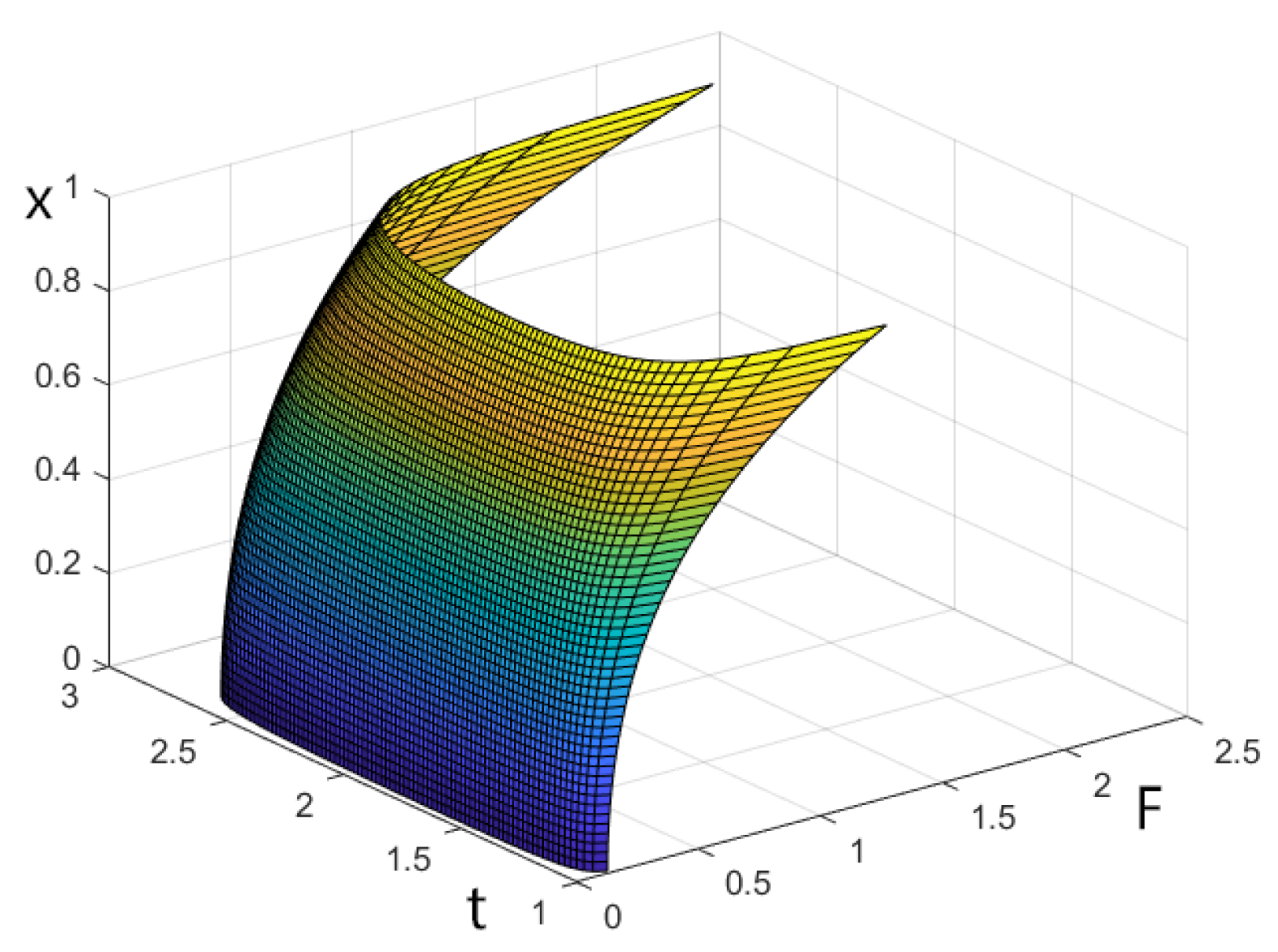
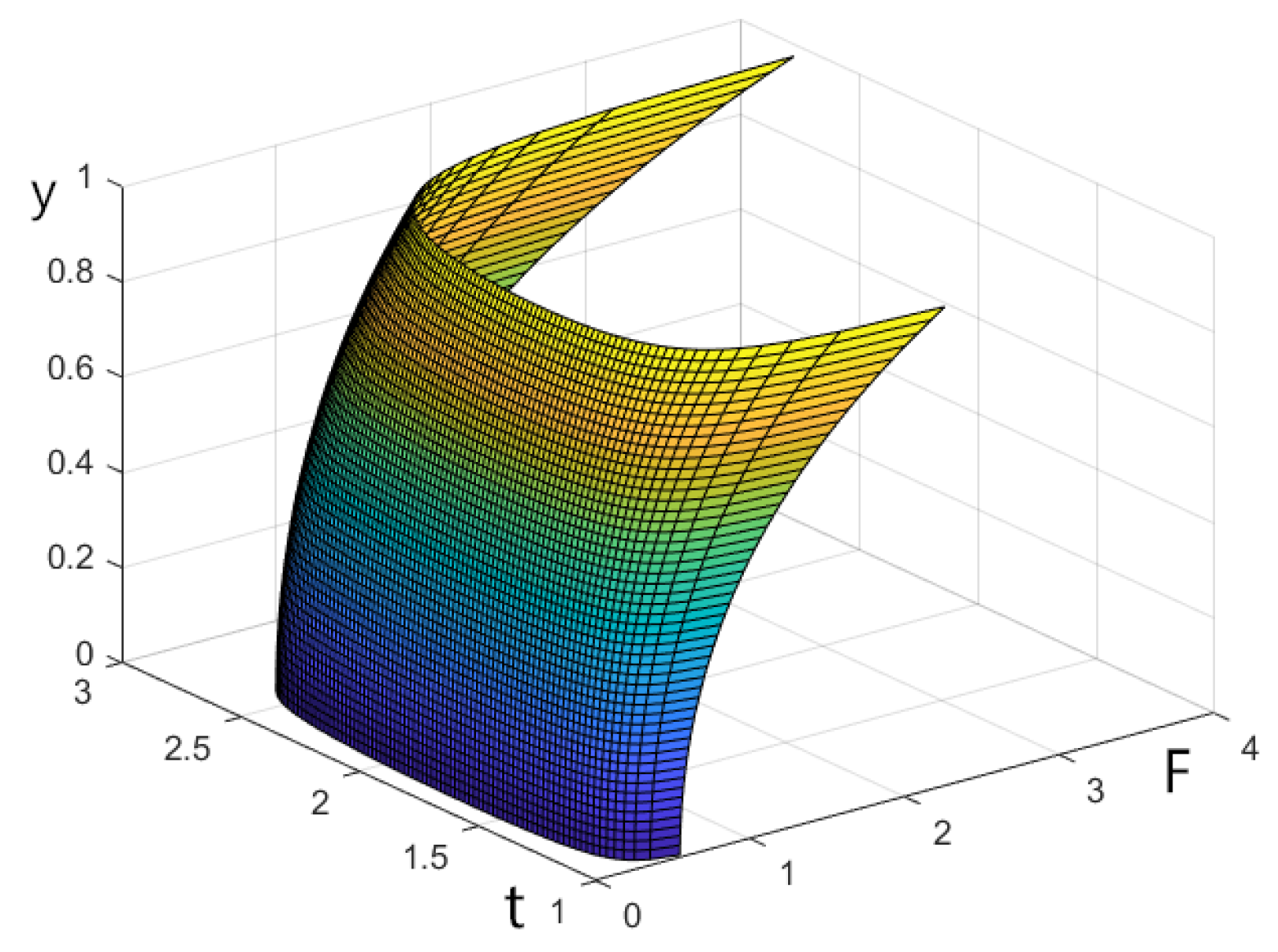
Now, let us simplify the expression of to for , and draw Figure 1 and Figure 2 in order to reveal the influence of .
Figure 1.
The first nonlinear function with singularity at points 1 and e (taking x = 1).
Figure 2.
The first nonlinear function with singularity at points 1 and e (taking y = 0.5).
Figure 1 and Figure 2 show a visualization of singular nonlinear terms of ; note that is similar with , hence we omit the impact of here. It is found that the nonlinearity is singular at and e. Although the nonlinear term has significant singularity, it can be controlled by an integrable function, so the solutions of the equation are still stable and robust. By a simple calculation, we have
and apparently,
Taking then for
Moreover, for
Hence, all the conditions of Theorem 5 are satisfied. Therefore, Equation (27) has at least one positive solution.
Example 2.
Consider the following boundary value problem:
Apparently,
where
hence, holds. Taking ,
so, holds. Hence, all the conditions of Theorem 6 hold, which implies that Equation (28) has at least one positive solution.
Example 3.
Consider the following boundary value problem:
where
By some calculations, we have
where
where and
Hence, all the conditions of Theorem 7 hold, which implies that Equation (29) has one unique solution.
It is worth mentioning that in this study, the nonlinear terms in the fractional-order differential equations exhibit a singularity that is one of the main innovations of the present research. Although singular nonlinear terms pose analytical difficulties, they can be controlled by an integrable function, which is why the solutions of the considered Hadamard fractional differential model are still stable and robust. Of course, in the future, we will strengthen the research on singular factors in practical engineering applications, especially in terms of solution stability or robustness.
5. Conclusions
The existence and uniqueness for positive solutions of a singular p-Laplacian Hadamard fractional-order differential equation with nonlocal integral and infinite-point boundary conditions are investigated. The methods used are a nonlinear alternative of Leray–Schauder-type Guo–Krasnoselskii’s fixed point theorem in cone and the Banach fixed point theorem, respectively. First, we derive the expression of the Green function, and then determine some properties of the developed Green function. Subsequently, we demonstrate the existence of solutions of Hadamard fractional differential equation with nonlinear singular conditions by Leray–Schauder-type Guo–Krasnoselskii’s fixed point theorem, respectively. Finally, we prove the uniqueness of the positive solution using Banach’s fixed point theorem. The existence results of Theorems 5 and 6 are obtained under the condition of singular nonlinearity, while the nonlinear term is continuous in much of the previous literature (e.g., see [15,18]), which is one of the main contributions of the present study. Of course, there are also some limitations to this study, such as the absence of complete numerical solutions. We plan to conduct further research on numerical solution examples on this type of equation. Additionally, we will explore more complex boundary conditions, such as extending the present interval from to or extending the study to other types of fractional differential equations, including Caputo–Hadamard, Atangana–Baleanu Caputo, and so on.
Author Contributions
Methodology, C.L.; Validation, C.L.; Formal analysis, C.L.; Investigation, C.L.; Resources, L.G.; Data curation, L.G.; Writing—original draft, C.L.; Writing—review & editing, L.G.; Project administration, L.G.; Funding acquisition, L.G. All authors have read and agreed to the published version of the manuscript.
Funding
This work was supported by the National Natural Science Foundation of China (Nos. 12272064 and 12101086), Natural Science Foundation of Jiangsu Province (No. BK20241773), Major Project of Basic Science (Natural Science) Research in Jiangsu Universities (Nos. 23KJA580001 and 24KJA120001), Changzhou Science and Technology Plan Project (No. CJ20241095).
Data Availability Statement
Data is contained within the article.
Acknowledgments
We thank the reviewers for their valuable comments.
Conflicts of Interest
The author declares that there are no conflicts of interest regarding the publication of this paper.
References
- Leibenson, L. General problem of the movement of a compressible fluid in a porous medium. Izv. Akad. Nauk Kirg. SSR Ser. Biol. Nauk. 1983, 9, 7–10. [Google Scholar]
- Cai, J.; Huang, W. Three-dimensional information storage of polymer doped with nano-silver. Micr. Opt. Technol. Lett. 2015, 57, 2662–2665. [Google Scholar] [CrossRef]
- Kilbas, A.A.; Srivastava, H.M.; Trujillo, J.J. Theory and Applications of Fractional Differential Equations; Elsevier Science BV: Amsterdam, The Netherlands, 2006. [Google Scholar]
- Li, C.; Zhu, C.; Zhang, N.; Sui, S.; Zhao, J. Free vibration of self-powered nanoribbons subjected to thermal-mechanical-electrical fields based on a nonlocal strain gradient theory. Appl. Math. Model. 2022, 110, 583–602. [Google Scholar] [CrossRef]
- Ahmad, B.; Alsaedi, A.; Ntouyas, S.; Tariboon, J. Hadamard-Type Fractional Differential Equations, Inclusions and Inequalities; Springer: Cham, Switzerland, 2017. [Google Scholar]
- Liu, W.; Liu, L. Properties of Hadamard Fractional Integral and Its Application. Fractal Fract. 2022, 6, 670. [Google Scholar] [CrossRef]
- Chai, G. Positive solutions for boundary value problem of fractional differential equation with p-Laplacian operator. Bound. Value Probl. 2012, 2012, 18. [Google Scholar] [CrossRef]
- Jong, K. Existence and uniqueness of positive solutions of a kind of multi-point boundary value problems for nonlinear fractional differential equations with p-Laplacian operator. Mediterr. J. Math. 2018, 2018, 129. [Google Scholar] [CrossRef]
- Guo, L.; Liu, L. Maximal and minimal iterative positive solutions for singular infinite-point p-Laplacian fractional differential equations. Nonlinear Anal. Model.Control 2018, 23, 851–865. [Google Scholar] [CrossRef]
- Guo, L.; Wang, Y.; Liu, H.; Li, C.; Zhao, J.; Chu, H. On iterative positive solutions for a class of singular infinite-point p-Laplacian fractional differential equation with singular source terms. J. Appl. Anal. Comput. 2023, 13, 1–16. [Google Scholar] [CrossRef]
- Ciftci, C.; Deren, F. Analysis of p-Laplacian Hadamard fractional boundary value problems with the derivative term involved in the nonlinear term. Math. Meth. Appl. Sci. 2023, 46, 8945–8955. [Google Scholar] [CrossRef]
- Huang, H.; Zhao, K.; Liu, X. On solvability of BVP for a coupled Hadamard fractional systems involving fractional derivative impulses. AIMS Math. 2022, 7, 19221–19236. [Google Scholar] [CrossRef]
- Li, C.; Guo, L. Positive Solutions and Their Existence of a Nonlinear Hadamard Fractional-Order Differential Equation with a Singular Source Item Using Spectral Analysis. Fractal Fract. 2024, 8, 377. [Google Scholar] [CrossRef]
- Guo, L.; Cai, J.; Xie, Z.; Li, C. Mechanical Responses of Symmetric Straight and Curved Composite Microbeams. J. Vib. Eng. Technol. 2024, 12, 1537–1549. [Google Scholar] [CrossRef]
- Ardjouni, A. Positive solutions for nonlinear Hadamard fractional differential equations with integral boundary conditions. AIMS Math. 2019, 4, 1101–1113. [Google Scholar] [CrossRef]
- Berhail, A.; Tabouche, N.; Boulares, H. Existence of Positive Solutions of Hadamard Fractional Differential Equations with Integral Boundary Conditions. SSRN Electron. J. 2019. [Google Scholar] [CrossRef]
- Zhang, K.; Wang, J.; Ma, W. Solutions for Integral Boundary Value Problems of Nonlinear Hadamard Fractional Differential Equations. J. Func. Spaces 2018, 2018. [Google Scholar] [CrossRef]
- Xu, J.; Liu, L.; Bai, S.; Wu, Y. Solvability for a system of Hadamard fractional multi-point boundary value problems. Nonlinear Anal. Model. Control 2021, 26, 502–521. [Google Scholar] [CrossRef]
- Ma, Y.; Maryam, M.; Riaz, U. Existence and Hyers-Ulam stability of Jerk-type Caputo and Hadamard mixed fractional differential equations. Qual. Theory Dyn. Syst. 2024, 23, 132. [Google Scholar] [CrossRef]
- Wang, X.; Wang, G.; Chen, Z.; Lim, C.; Li, S.; Li, C. Controllable flexural wave in laminated metabeam with embedded multiple resonators. J. Sound Vibr. 2024, 581, 118386. [Google Scholar] [CrossRef]
- Xie, Z.; Guo, L.; Li, C.; Shi, Y.; Han, B. Modeling the deformation of thin-walled circular tubes filled with metallic foam under two lateral loading patterns. Structures 2024, 69, 107289. [Google Scholar] [CrossRef]
- Idrees, S.; Saeed, U. Generalized sine-cosine wavelet method for Caputo-Hadamard fractional differential equations. Math. Meth. Appl. Sci. 2022, 45, 9602–9621. [Google Scholar] [CrossRef]
- Saha, K.; Sukavanam, N.; Pan, S. Existence and uniqueness of solutions to fractional differential equations with fractional boundary conditions. Alex. Eng. J. 2023, 72, 147–155. [Google Scholar] [CrossRef]
- Ma, R.; Meng, Y.; Pang, H. The Existence Results of Solutions to the Nonlinear Coupled System of Hilfer Fractional Differential Equations and Inclusions. Fractal Fract. 2024, 8, 194. [Google Scholar] [CrossRef]
- Jassim, H.K.; Abdulshareef Hussein, M. A New Approach for Solving Nonlinear Fractional Ordinary Differential Equations. Mathematics 2023, 11, 1565. [Google Scholar] [CrossRef]
- Wang, G.; Pei, K.; Chen, Y. Stability analysis of nonlinear Hadamard fractional differential system. J. Frankl. Inst. 2019, 356, 6538–6546. [Google Scholar] [CrossRef]
- Rahman, G.; Nisar, K.; Abdeljawad, T. Certain new proportional and Hadamard proportional fractional integral inequalities. J. Inequalities Appl. 2021, 2021, 71. [Google Scholar] [CrossRef]
- Abdalla, B.; Abdeljawad, T. On the oscillation of Hadamard fractional differential equations. Math. Meth. Appl. Sci. 2018, 2018, 409. [Google Scholar] [CrossRef]
- Istafa, G.; Rehman, M. Numerical solutions of Hadamard fractional differential equations by generalized Legendre functions. Math. Meth. Appl. Sci. 2023, 46, 6821–6842. [Google Scholar] [CrossRef]
- Zhang, W.; Ni, J. New multiple positive solutions for Hadamard-type fractional differential equations with nonlocal conditions on an infinite interval. Appl. Math. Lett. 2021, 118, 107165. [Google Scholar] [CrossRef]
- Nyamoradi, N.; Ahmad, B. Hadamard Fractional Differential Equations on an Unbounded Domain with Integro-initial Conditions. Qual. Theory Dyn. Syst. 2024, 23, 183. [Google Scholar] [CrossRef]
- Ma, L.; Wu, B. Finite-time stability of Hadamard fractional differential equations in weighted Banach spaces. Nonlinear Dyn. 2022, 107, 3749–3766. [Google Scholar] [CrossRef]
- Rao, Y.; Yussouf, M.; Farid, G.; Pecaric, J.; Tlili, I. Further generalizations of Hadamard and Fejer-Hadamard fractional inequalities and error estimates. Adv. Differ. Equ. 2020, 2020, 421. [Google Scholar] [CrossRef]
- Guo, L.; Liu, H.; Li, C.; Zhao, J.; Xu, J. Existence of positive solutions for singular p-Laplacian Hadamard fractional differential equations with the derivative term contained in the nonlinear term. Nonlinear Anal. Model. Control 2023, 28, 491–515. [Google Scholar] [CrossRef]
- Wang, Y.; Wang, P.; Meng, H. Dynamic performance and parameter optimization of a half-vehicle system coupled with an inerter-based X-structure nonlinear energy sink. Appl. Math. Mech. Engl. Ed. 2024, 45, 85–110. [Google Scholar] [CrossRef]
- Alruwaily, Y.; Ahmad, B.; Ntouyas, S.; Alzaidi, A. Existence Results for Coupled Nonlinear Sequential Fractional Differential Equations with Coupled Riemann–Stieltjes Integro-Multipoint Boundary Conditions. Fractal Fract. 2022, 6, 123. [Google Scholar] [CrossRef]
- Zhang, Q.; Li, C.; Zhou, L.; Li, L. Multipoint boundary value problems for higher-order Hadamard fractional neutral differential equations and inclusions. Bound. Value Probl. 2023, 2023, 11. [Google Scholar] [CrossRef]
- Podlubny, I. Fractional Differential Equations; Academic Press: New York, NY, USA, 1999. [Google Scholar]
- Hentenryck, P.; Bent, R.; Upfal, E. An Introduction to the Fractional Calculus and Fractional Differential Equations; Wiley: New York, NY, USA, 1993. [Google Scholar]
- Guo, D.; Cho, Y.; Zhu, J. Partial Ordering Methods in Nonlinear Problems; Nov a Science Publishers: New York, NY, USA, 2004. [Google Scholar]
- Zhang, X. Positive solutions for a class of singular fractional differential equation with infinite-point boundary value conditions. Appl. Math. Lett. 2015, 39, 22–27. [Google Scholar] [CrossRef]
Disclaimer/Publisher’s Note: The statements, opinions and data contained in all publications are solely those of the individual author(s) and contributor(s) and not of MDPI and/or the editor(s). MDPI and/or the editor(s) disclaim responsibility for any injury to people or property resulting from any ideas, methods, instructions or products referred to in the content. |
© 2024 by the authors. Licensee MDPI, Basel, Switzerland. This article is an open access article distributed under the terms and conditions of the Creative Commons Attribution (CC BY) license (https://creativecommons.org/licenses/by/4.0/).