Abstract
Chemical graph theory (CGT) is a field of mathematical science that applies classical graph theory to chemical structures and processes. Chemical graphs are the principal data format used in cheminformatics to illustrate chemical interactions. Several researchers have addressed boundary-value problems using star graphs. Star graphs were used since their method requires a central point linked to other vertices but not to itself. Our objective is to expand the mechanism by introducing the idea of an isobutane graph that has the chemical formula and CAS number 75-28-5. By using the appropriate fixed point theory findings, this paper investigates the existence of solutions to fractional boundary value problems of Caputo type on such graphs. Additionally, two examples are provided to strengthen our important conclusions.
MSC:
Primary 34A08; 39A12; 34B45; Secondary 47H10
1. Introduction and Preliminaries
The link between graph theory and chemistry has evolved significantly over time. Numerous investigations relating to both subjects have shown robust linkages between them, resulting in the formation of the research field known as chemical graph theory (shortly CGT) (for detail, see [1]). Chemical graphs were initially mentioned in the late eighteenth century, when Isaac Newton’s concepts influenced the way chemistry was seen (see [1]). Although research on the relationships of atoms accelerated over that century, the chemical bonds remained unknown. Thus, chemical graphs were first used to describe hypothetical forces between molecules and atoms.
CGT uses graph theory to describe molecules in order to explore their many physical characteristics. A graph is composed of a set of vertices (or nodes) and a set of unordered pairs of different components of that constitute the edges. The vertices denote the atoms in a molecule in chemistry, whereas the edges represent the chemical bonds.
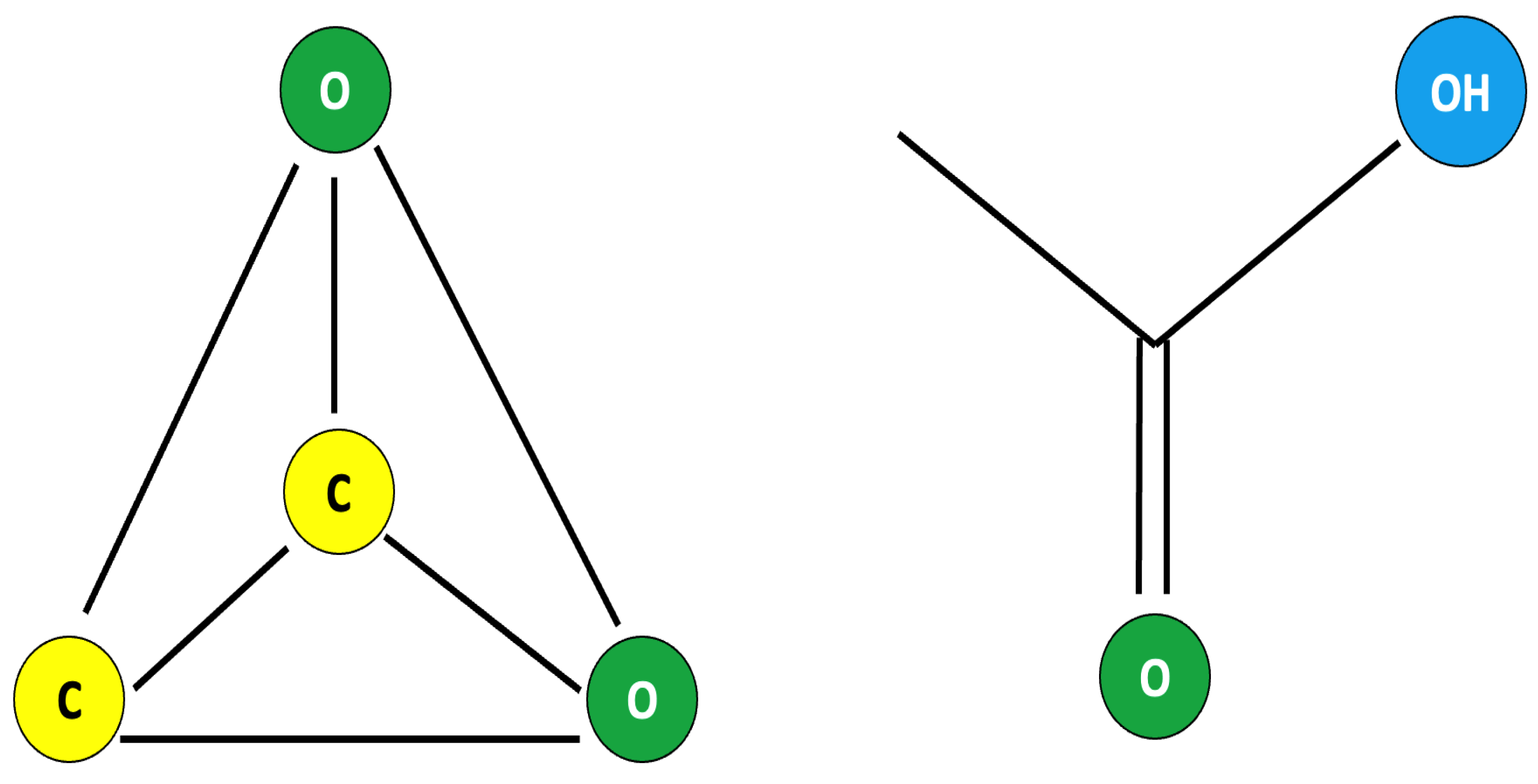
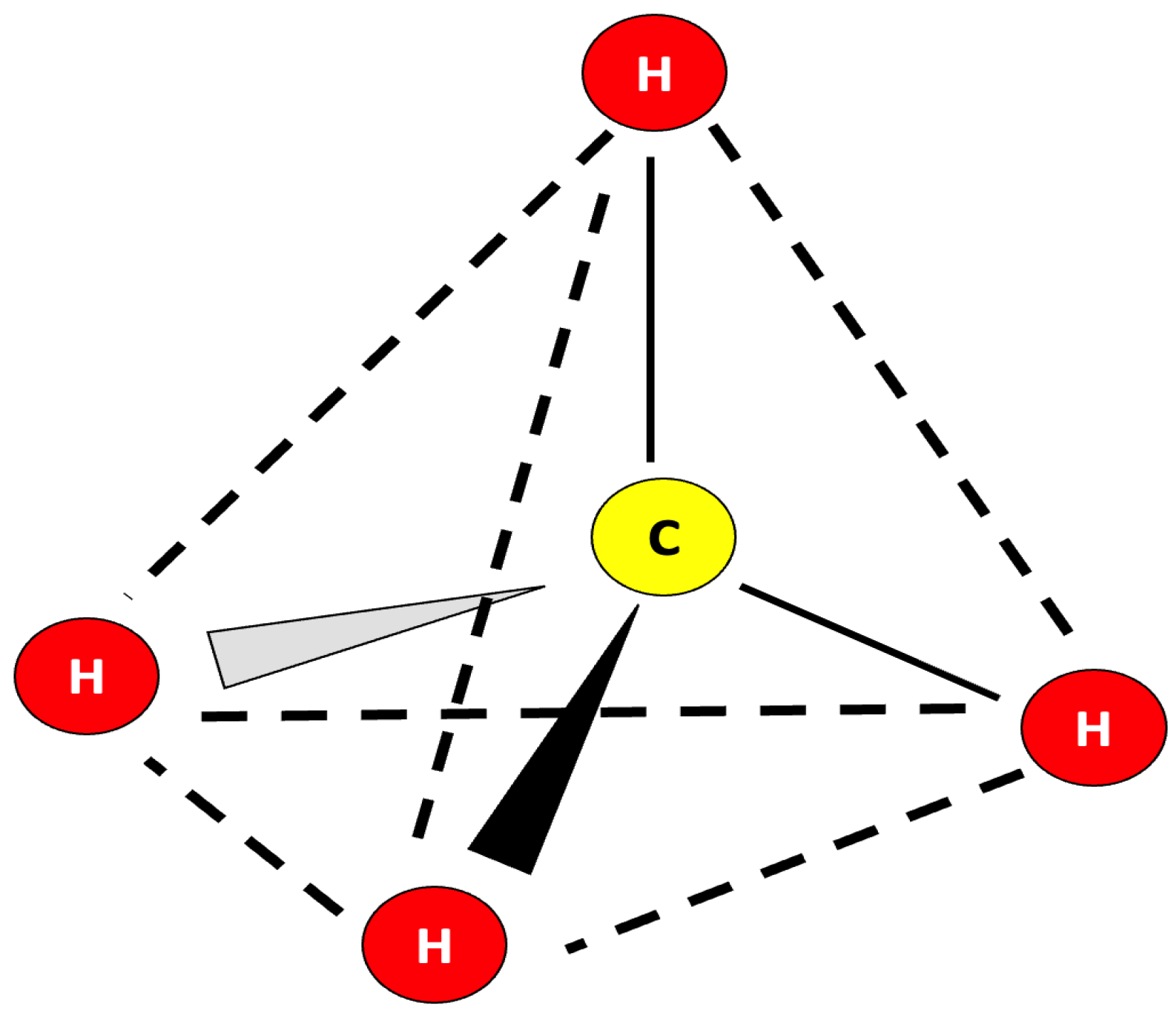
John Dalton devised the initial atomic model in 1805 by associating various atom kinds with distinct rings that can only represent the chemical positions and quantities of atoms in a compound (for detail, see [2,3]). August Kékule, on the other hand, demonstrated both the physical and orientational locations of atoms inside a molecule. He categorized many organic compounds and showed the bonding arrangements between particles in his model related to the “Tetrahedral Carbon Atom (see Figure 1)”, which featured the benzene ring (see [4]).
Figure 1.
A sketch of a tetrahedral carbon atom model.
Alexander Butlerov coined the phrase “molecular structure” in 1861, implying that any compound should have a rigid molecular composition. This phrase referred to a number of the compounds’ chemical features (for detail, see [5]). The line depiction of atomic bonds was originally used in [6] as a different interpretation paradigm. However, since these lines represented merely interatomic forces and not individual bonds, Couper’s work is credited with being the first graphical depiction of a chemical bond (see [7]). The molecular formula for acetic acid was established and represented chemically as a framework with geometric shapes linking the atoms in a molecule to symbolize chemical bonds (Figure 2). To learn more, the reader can refer to [8,9,10] and the references therein.
Figure 2.
A chemical and structural representation of acetic acid.
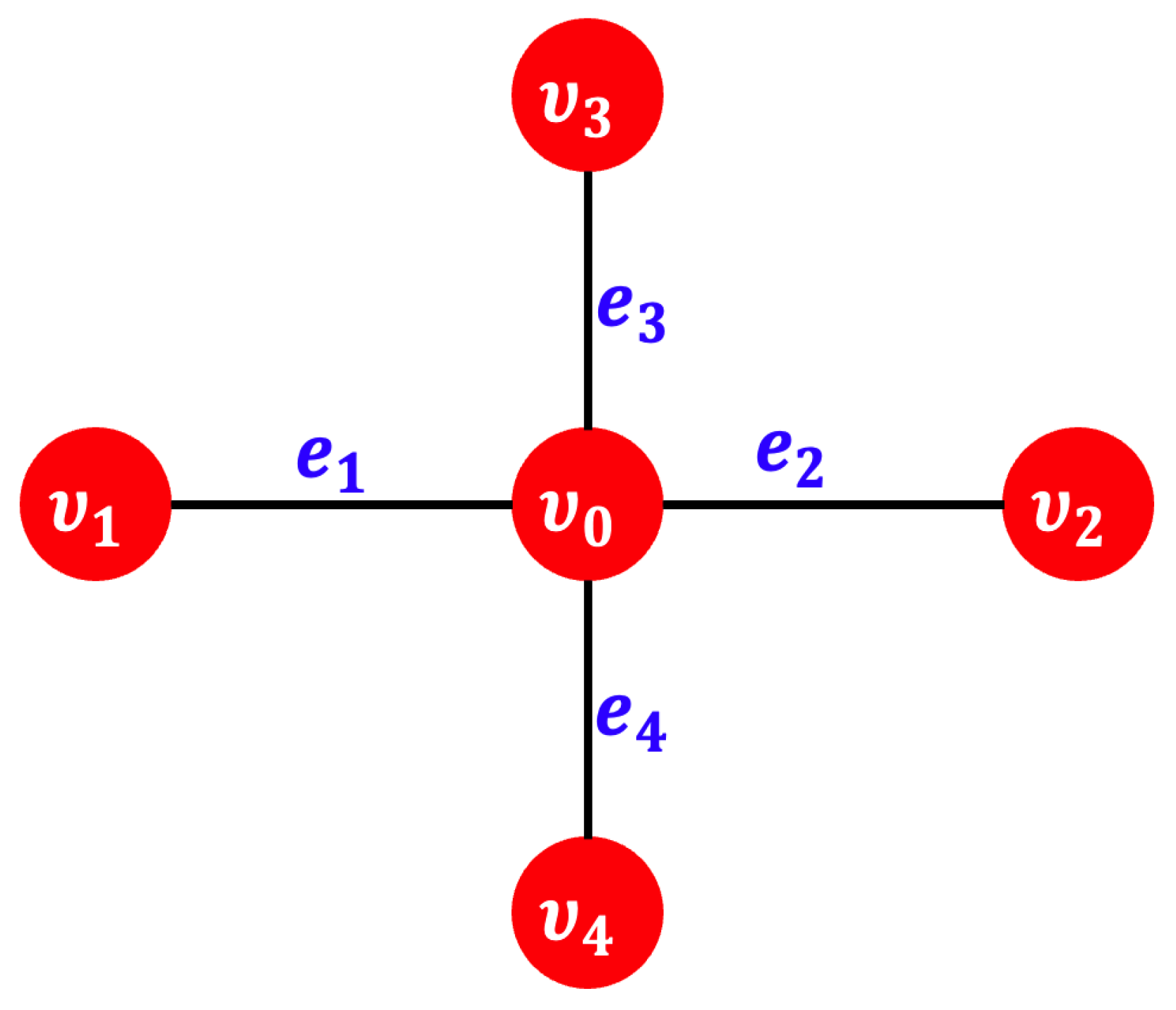
On the other hand, there has been considerable conceptual and practical progress lately in the subject of differential equations (see [11,12,13,14]). Many fields, including engineering, physics, and ecology, make use of differential equations on graphs. A graph is a pair consisting of nodes and the edges that link them (see Figure 3), which may be either finite or countably infinite in dimension. Local coordinates are defined on each edge (of a certain length), with the origin located at a specific node.
Figure 3.
A sketch of a graph with three edges and four vertices.
The majority of studies on fractional calculus in the context of specific functions focus on the solution of differential equations (for detail, see [15,16,17,18,19]). A number of new papers have recently been published focusing on nonlinear fractional differential equations and their solutions, utilizing techniques including Leray–Schauder theorem, stability analysis, and fixed-point analysis (see [20,21,22,23]).
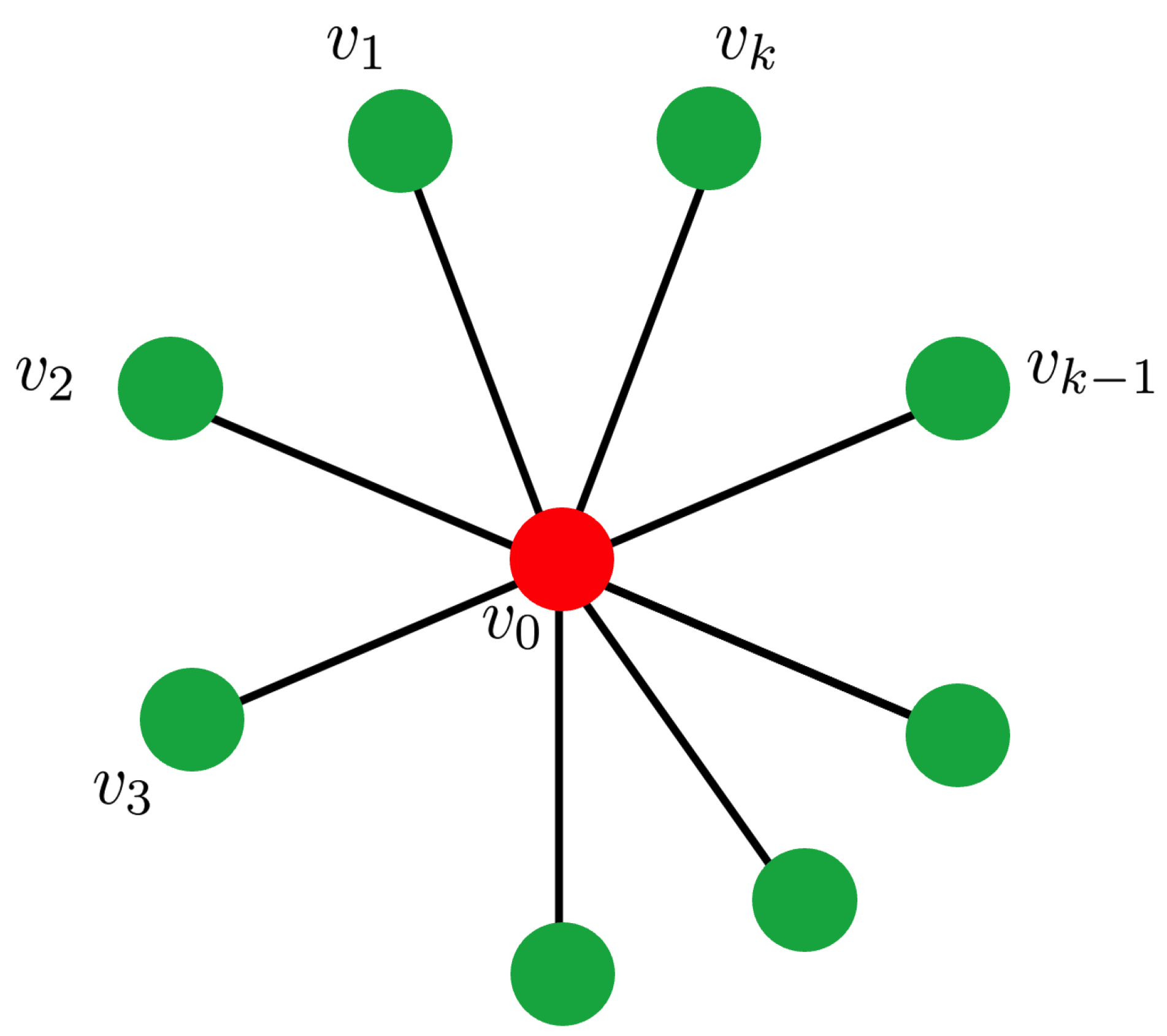
Lumer [24] pioneered the use of differential equation theory in graphs. He explored extended evolution equations by modifying specified operators on ramification spaces. In 1989, Zavgorodnij investigated the solution to the boundary value problem using a geometric structure defined at its inner nodes (see [25]). When finding computational solutions for the given differential equations, Gordeziani et al. used the double-sweep approach to obtain results (see [26]). In the literature, only a tiny amount of research has been carried out on star graphs (see Figure 4) linked with boundary value problems using specific fixed point methodologies (see [27,28]). We refer to [29,30,31,32,33,34,35,36] and the references therein for the current study in this area.
Figure 4.
A sketch of a star graph with a junction node and k edges.
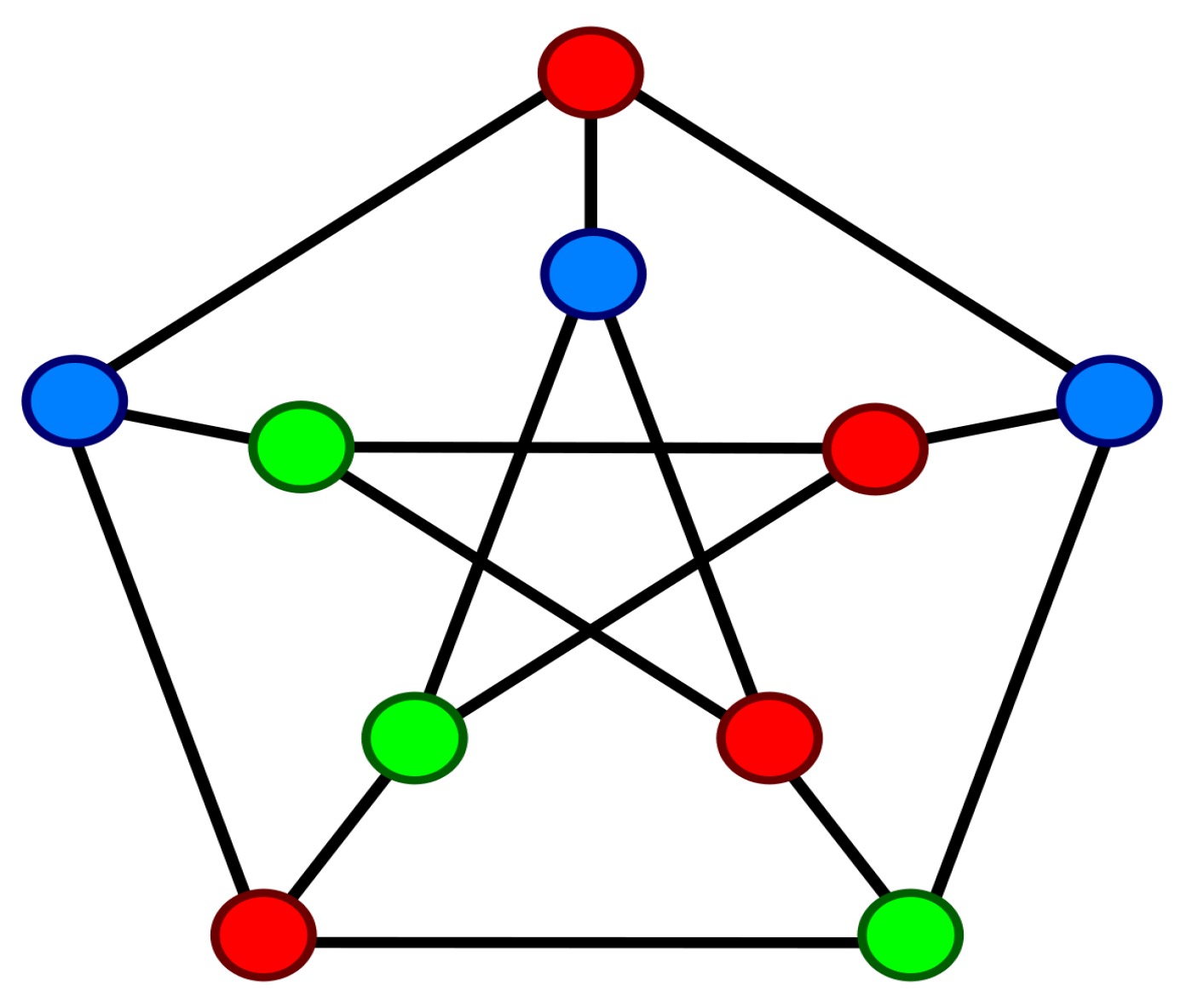
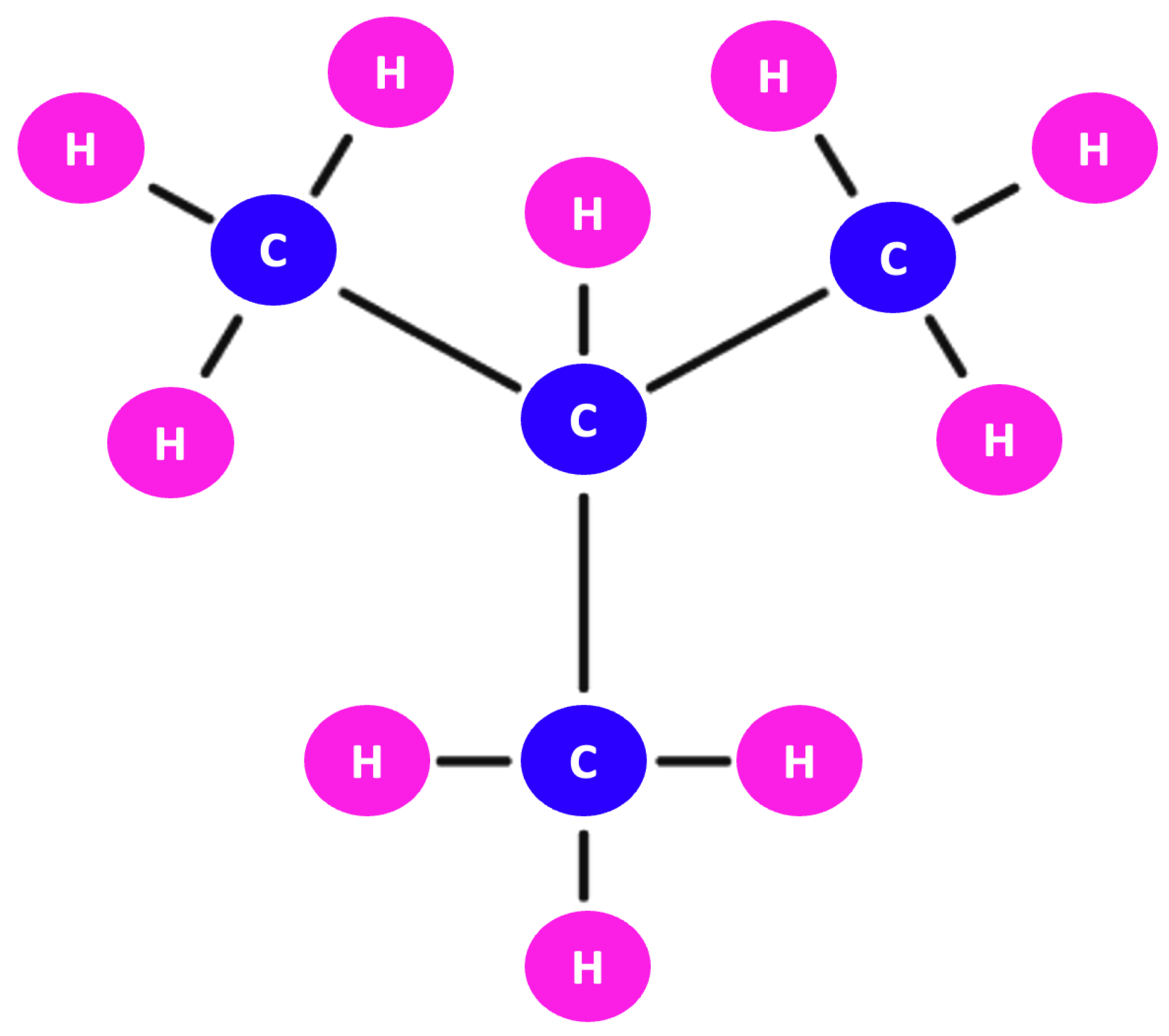
The techniques described in [27,28] for detecting the origin at vertices other than the junction node are unsuitable, as graphs typically have many junction points (for examples, see Figure 5 and Figure 6).
Figure 5.
Example of a non-star graph with many junction nodes.
Figure 6.
Chemical bond of an isobutane compound .
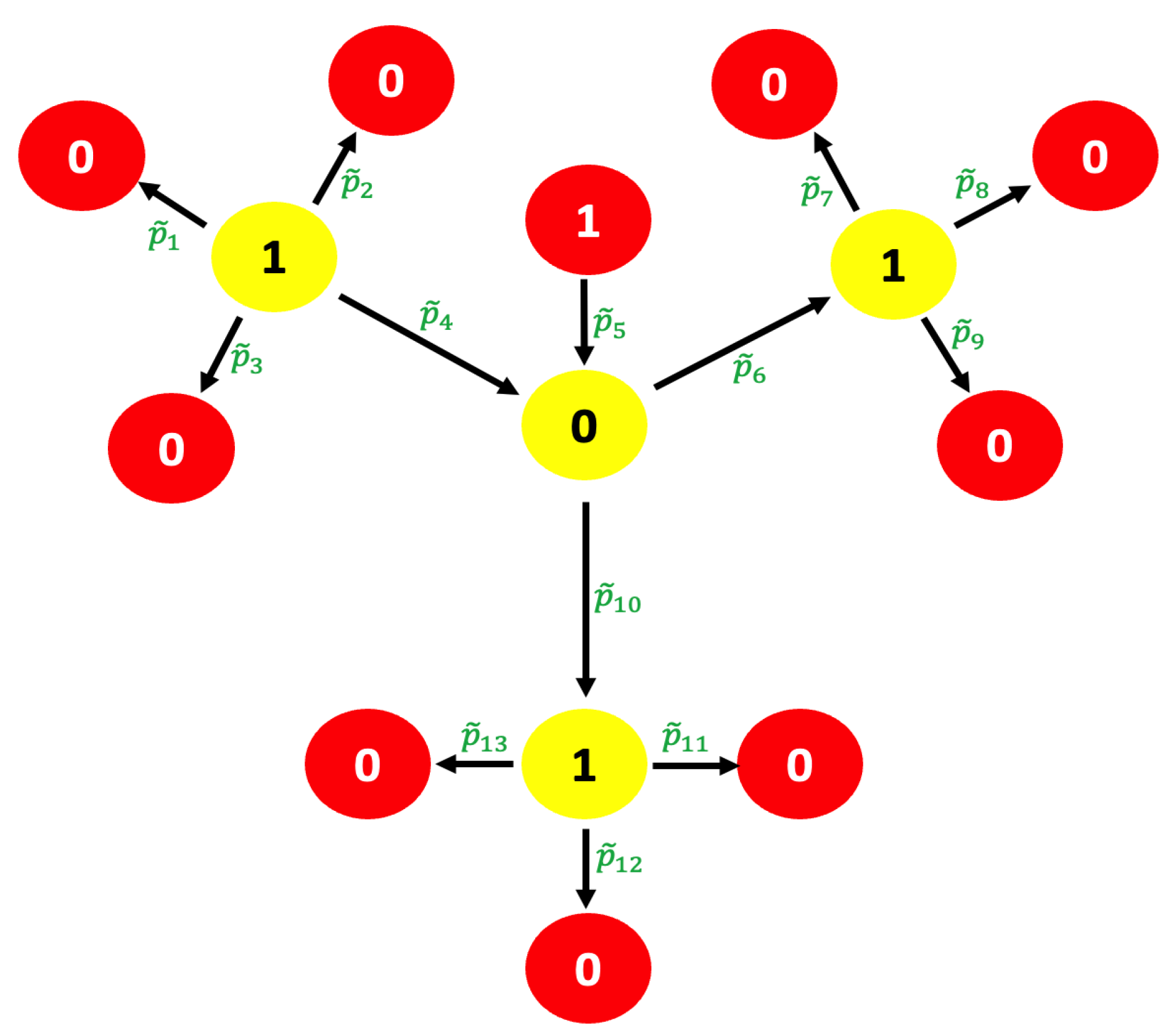
In [27,28], the authors framed the length of each edge as a parameter, but the size of all sides may be assumed constant from the initial stages of the computation. To solve this problem, we used a specific strategy in which we gave numerical values (0 or 1) to the vertices of the suggested graph with edge length (see Figure 7).
Figure 7.
Isobutane compound graph with edge length and vertices 0 or 1.
Thus, the label for each vertex is determined by the direction of each associated edge. Consequently, some vertices can also be labeled by 0 or 1, while the length of every edge is not fixed. It changes based on the rotational path along the boundary. Standardizing the length of each edge with the given alteration is not required, as we can use comparable methods to choose one of the two vertices of the linked edge as the origin.
Contrarily, various sophisticated fractional modeling strategies are covered in the research, including (but not confined to) the well-known Riemann–Liouville and Caputo operators (for detail, see [37,38,39,40,41,42,43,44]). The Caputo–Hadamard, Hadamard, and Hilfer operators have undergone a number of notable changes this decade, and many modeling projects have used these new operators (for more detail, see [45,46,47,48,49]). Six years ago, Caputo and Fabrizio, in [50], proposed an updated version of a fractional paradigm without a singularity. Nieto and Losada focused on important mathematical facets in the immediate aftermath of this work. Numerous studies on fractional modeling were published after nonsingular operators were included (see [51,52,53,54] and references therein).
Using the study described above, we explored the existence of solutions to the system, for each , stated below:
where is an unknown function, and are the Caputo fractional derivatives of , and orders, respectively, and is the sequential fractional derivative. Furthermore, with , , and is a given function that is continuously differentiable, where represents the total number of edges of the isobutane compound with length .
This paper analyzes the link between the framework of fractional boundary value problems (1) and the isobutane graph (see Figure 6), as mentioned above. The rising popularity of CGT is the critical impetus for this study. This branch of mathematics examines how bond lines and inter-atomic interactions affect the results of chemical processes. These new applications can be seen in chemical kinetics and biomacromolecules.
The next sections will need the notable results stated below.
Definition 1
([55]). The Caputo fractional derivative of order for a function is given by
where represents the integer part of ℘.
For , the general solution of is defined by
where .
Definition 2
([14]). The sequential fractional derivative for a sufficiently smooth function is defined as
where is a multi-index.
Generally, as specified in (2) may typically be either a Caputo operator, a Riemann–Liouville operator, or another kind of integro–differential operator. For instance,
whereas represents a fractional integral operator of order .
Lemma 1.
Suppose that . Then, is a solution of the subsequent problem:
if is a solution of the integral equation given below:
where .
Proof.
Assume that is a solution of (3). Thus, there exist constants such that
From the above, we obtain
and
Using the first boundary condition, we have
From the second boundary condition, we obtain
Now, by substituting the value of into (6), we obtain
Hence, substituting the values of into (5), we attain the solution (4). Conversely, it is obvious that satisfies (3) whenever it is a solution of (4). □
Our goal is to show that (1) has a solution using the following fixed point theory concepts.
Theorem 1
([56]). Let be a Banach space. If is a completely continuous operator, then either is unbounded or has at least one fixed point in .
Theorem 2
([56]). Let be a closed, bounded, convex, and nonempty subset of Banach space and be two operators such that whenever , where is compact and continuous and is a contraction mapping; that is, there is a such that
for all . Then, has a fixed point.
2. Main Results
Define as a Banach space with the norm
It is obvious that is a Banach space equipped with the norm
From Lemma 1, we can introduce an operator for each defined by
for each , where is defined for each by
for all .
We shall use the following notation to make computations easier:
Theorem 3.
Consider the problem (1). Assume that are continuous functions and there are such that , for all and . Then, problem (1) has a solution.
Proof.
The integral Equation (8) implies that the fixed points of described by (7) exist if and only if (1) has a solution. To establish this, we must first demonstrate that is completely continuous.
Since are continuous, is continuous too. Let be a bounded set and . For each , we have
where is given in (16). In addition,
and
where are given in (17) and (18), respectively, and for all . Therefore,
Hence,
which demonstrates the uniform boundedness of the operator .
Now, we shall show that is equicontinuous. For this, let and with . Then, we have
It is clear that, if then the R.H.S of the above expression converges to zero independently. Thus,
This reveals that as . This proves that is equicontinuous on . The Arzela–Ascoli theorem now entails the operator’s complete continuity.
Further, we have
of . We shall prove that is bounded in this section. For this, let . Then, we can write
and so
for all and . Thus,
and by similar computations, we have
where are given in (16)–(18). Hence,
which shows that is bounded. We can now verify that has a fixed point in and that (1) has a solution by using Lemma 1 and Theorem 1. □
We shall now look at the solution to problem (1) by putting different conditions.
Theorem 4.
Consider the problem (1). Supposing that are continuous functions and that there are bounded continuous functions , and nondecreasing continuous functions such that and , , with , we have
If , then (1) has a solution, where and the constants – are given in (13)–(15), respectively.
Proof.
We let . As for , we have
where are given in (16)–(18). We define a set
where is defined in (19). It is clear that is a nonempty, closed, bounded, and convex subset of . Now, we define and on by
where
and
for all and .
Let . For every , , we have
By similar computations, we have
and
This yields that
and so . Furthermore, the continuity of follows from the continuity of .
Now, we shall show that is uniformly bounded. As for this purpose, we have
for all . In addition,
and
for all . Thus,
which shows that is uniformly bounded on .
Now, we shall demonstrate that is compact on . For this, let with . Then, we have
Hence, as . In addition, we have
Hence, tends to zero as . Thus, is equicontinuous and therefore is a relatively compact operator on . Hence, T is compact on according to the Arzela–Ascoli theorem.
Lastly, it remains to prove that is a contraction. To show this, let ; then,
for each , where is given in (13). In addition, by similar computations, we have
and
where and are given in (14) and (15), respectively. Thus, we have
and so
Since is a contraction on , we deduce that has a fixed point that is a solution to problem (1) as a consequence of Theorem 2. □
3. Some Illustrative Examples
The conclusions of the proposed model (1) regarding the existence of solutions can be interpreted in several ways in relation to organic chemistry, which is the study’s underlying assumption. Any solution, say , at any edge () may thus represent the bond polarity, strength, energy, etc. Additionally, several chemical concepts can be interpreted in this way by the integer and fractional-order derivatives of the unknown functions, while ’s nonlocal character allows it to analyze the velocity of chemical interactions during a particular time interval . Moreover, is defined as functions of such quantities with respect to the time on each edge .
Here, we provide two examples to demonstrate the relevance of our findings.
Example 1.
Consider the boundary value problem
with boundary conditions
where and , are the Caputo derivatives of order m and n, respectively.
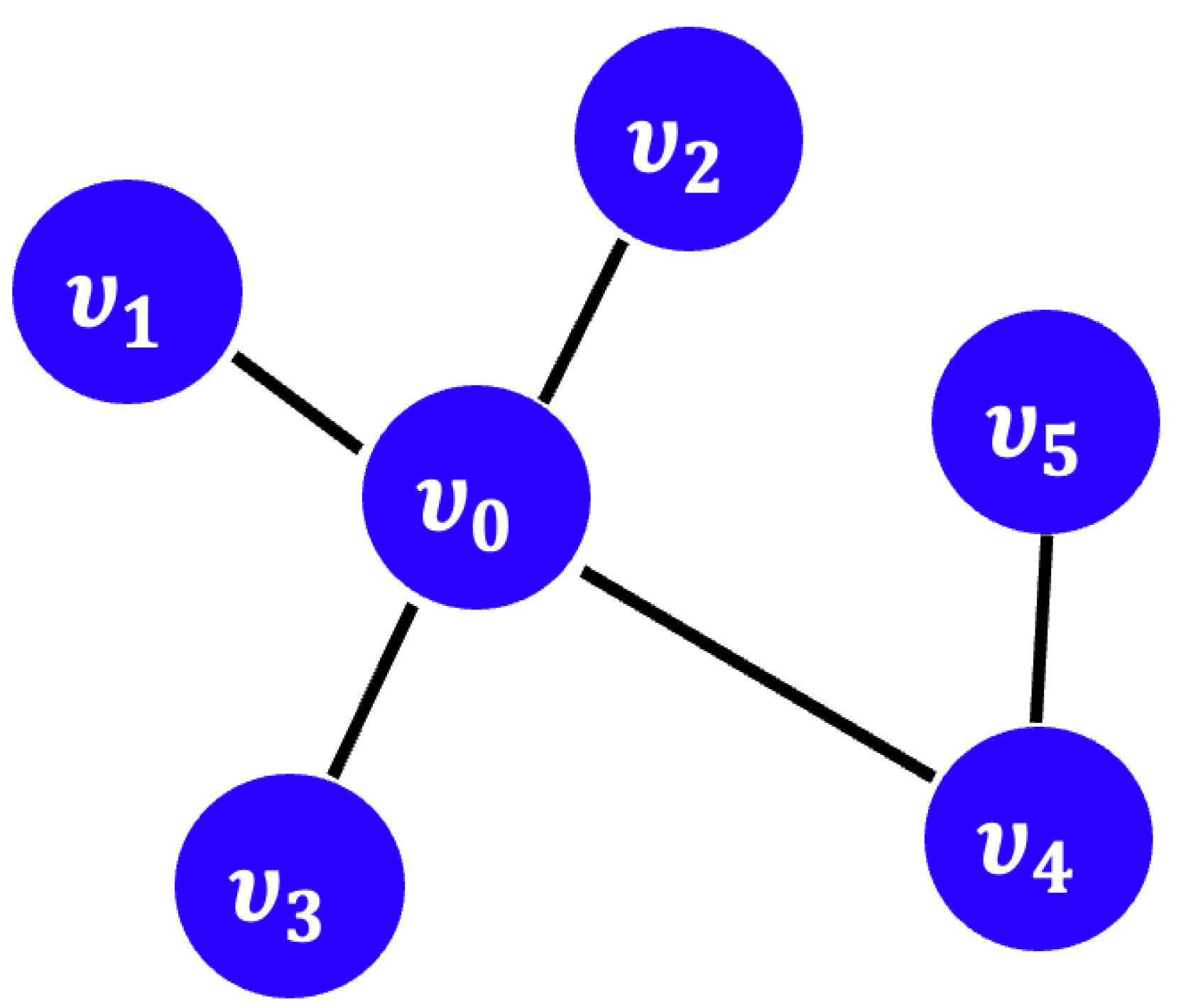
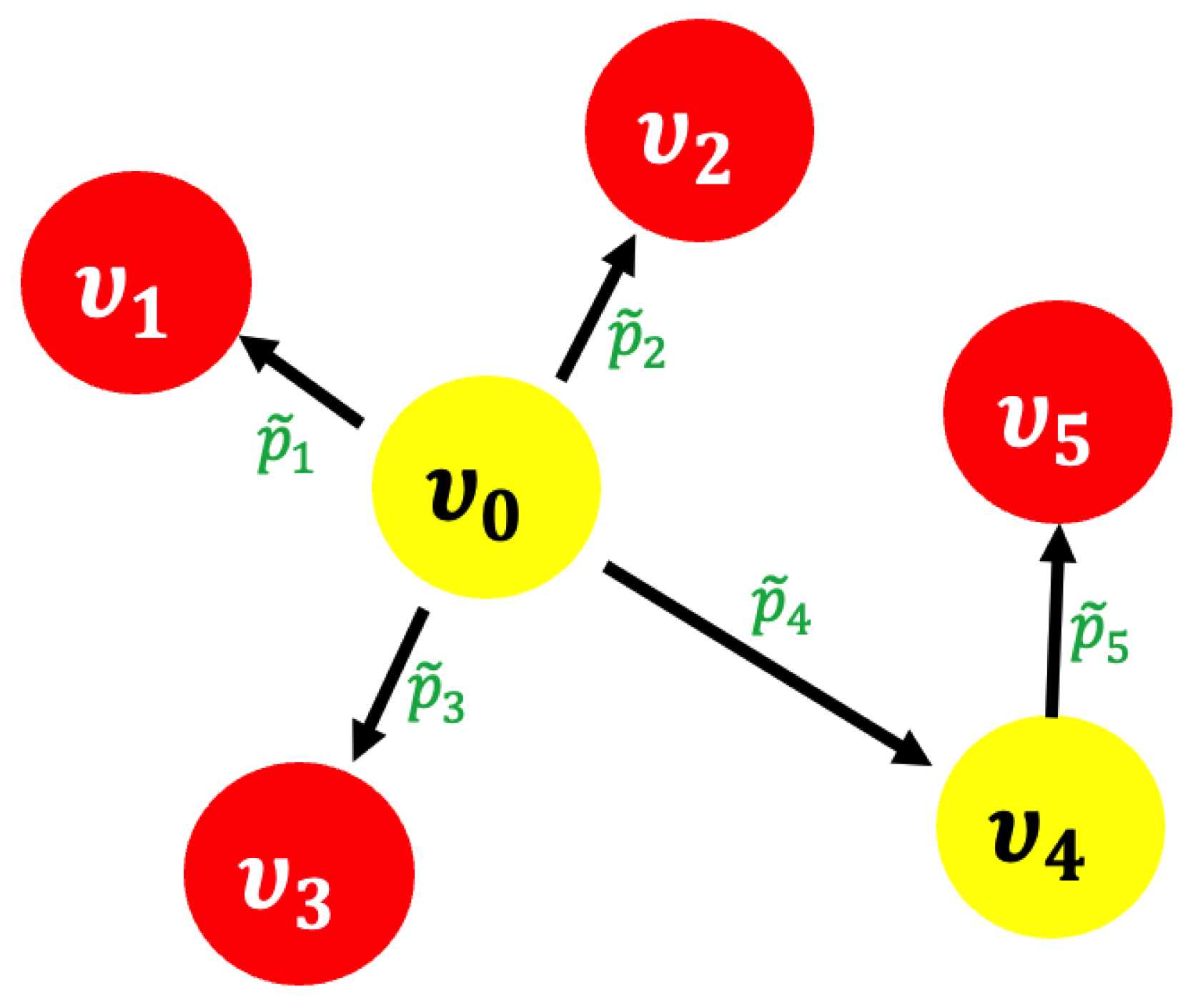
Here, we establish coordinate systems with , and on the graphs with more than one junction nodes (see Figure 8 and Figure 9 below), where is the solution of the system (22) with (23) on , . Similarly, and are the solutions of the system (22) with (23) on and , respectively, where .
Figure 8.
A sketch of a graph.
Figure 9.
A sketch of a directed graph.
Now, we shall prove that system (22) with (23) has a unique solution on each edge. For this, let be continuous functions defined by
Let . Then, we have
Here, , and , where , and . Let be identity functions. Thus, we obtain
for all and . In addition, the continuous function are defined by . In addition,
and so
Furthermore,
Hence, by Theorem 4, the problem (22)–(23) has a solution.
Example 2.
Consider the problem stated below:
with boundary conditions
where , and , are the Caputo derivatives of order m and n, respectively. Let be continuous functions defined by
Let . Then, we have
Here, , and , where , and . Let be identity functions. Then, we obtain
for all and . In addition, the continuous function is defined by
In addition,
and so
Furthermore,
Hence, by Theorem 4, the problem (24)–(25) has a solution.
4. Conclusions
CGT refers to a specific part of graph theory that has applications in chemistry. Mathematical tools from pure mathematics, graph theory, functional analysis, and trigonometry are used to tackle chemistry-based problems such as structure elucidation and isomer enumeration, with repercussions for both fields. The rapid expansion of this field over the last several decades has led to the introduction of a plethora of novel ideas and methods for pursuing this kind of study. This article defines the boundary-value problems for each edge within the context of an isobutane graph. Using the Krasnoselskii and Schaefer fixed point theorems, we investigated the existence of solutions to the suggested problem. Our proposed model may be used for various graph configurations, including digraphs, which are often used in medical technology in connection to protein networks. Future studies can investigate more challenges involving the graph characterization of various chemical structures using quantitative and computational approaches.
Author Contributions
Conceptualization, A.T. and W.S.; methodology, A.T., W.S. and J.-S.R.; software, A.T.; validation, A.T. and W.S.; formal analysis, A.T. and J.-S.R.; investigation, A.T. and W.S.; resources, A.T. and J.-S.R.; writing—original draft preparation, A.T. and W.S.; writing—review and editing, A.T. and W.S.; visualization, W.S. and J.-S.R.; supervision, W.S.; project administration, A.T.; and funding acquisition, J.-S.R. All authors have read and agreed to the published version of the manuscript.
Funding
This research was supported by (1) Basic Science Research Program through the National Research Foundation of Korea funded by the Ministry of Education (2016R1D1A1B01008058). (2) Competency Development Program for Industry Specialists of the Korean Ministry of Trade, Industry and Energy (MOTIE), operated by the Korea Institute for Advancement of Technology (KIAT) (No. P0002397, HRD program for Industrial Convergence of Wearable Smart Devices).
Data Availability Statement
Not applicable.
Acknowledgments
The authors thank the anonymous referees for their constructive suggestions and helpful comments which led to a significant improvement in the original manuscript of this paper.
Conflicts of Interest
The authors declare that they have no competing interest.
References
- Bonchev, D. Chemical Graph Theory: Introduction and Fundamentals. Chemical Graph Theory; Taylor & Francis: Abingdon, UK, 1991; Available online: https://books.google.de/books?id=X0AG7HhiccoC (accessed on 11 October 2022).
- Cardwell, D.S.L. John Dalton and the progress of science. Phys. Today 1970, 23, 77. [Google Scholar] [CrossRef]
- Dalton, J. A New System of Chemical Philosophy; Cambridge Library Collection—Physical Sciences; Cambridge University Press: Cambridge, UK, 2010. [Google Scholar] [CrossRef]
- Hein, G.E. Kekulé and the Architecture of Molecules. Adv. Chem. 1966, 61, 1–12. [Google Scholar] [CrossRef]
- Butlerov, A. Ueber Die Verwandtschaft Der Mehraffinen Atome. Z. Für Chem. 1862, 5, 297–304. [Google Scholar]
- Higgins, W. A Comparative View of the Phlogistic and Antiphlogistic Theories, 2nd ed.; Gale ECCO: Farmington Hills, MI, USA, 1791. [Google Scholar]
- Couper, A.S. Sur Une Nouvelle Théorie Chimique. Ann. Chim. Phys. 1858, 53, 488–489. [Google Scholar]
- Cayley, A. On the Theory of the Analytical Forms Called Trees. Mag. J. Sci. 1857, 13, 172–176. [Google Scholar] [CrossRef]
- Sylvester, J.J. On an Application of the New Atomic Theory to the Graphical Representation of the Invariants and Covariants of Binary Quantics with Three Appendices. Am. J. Math. 1878, 1, 64. [Google Scholar] [CrossRef]
- Gutman, I.; Polansky, O.E. Mathematical Concepts in Organic Chemistry; Springer: Berlin/Heidelberg, Germany, 1986. [Google Scholar]
- Oldham, K.B.; Spanier, J. The Fractional Calculus; Academic Press: New York, NY, USA, 1974. [Google Scholar]
- Lakshmikantham, V.; Leela, S.; Devi, J.V. Theory of Fractional Dynamic Systems; Cambridge Academic: Cambridge, UK, 2009. [Google Scholar]
- Podlubny, I. Fractional Differential Equations; Academic Press: New York, NY, USA, 1999. [Google Scholar]
- Miller, K.S.; Ross, B. An Introduction to the Fractional Calculus and Fractional Differential Equation; John Wiley: New York, NY, USA, 1993. [Google Scholar]
- Sabatier, J.; Agarwal, O.P.; Machado, J.A.T. Advances in Fractional Calculus, Theoretical Developments and Applications in Physics and Engineering; Springer: Berlin/Heidelberg, Germany, 2007. [Google Scholar]
- Agarwal, R.P.; Lakshmikantham, V.; Nieto, J.J. On the concept of solution for fractional differential equations with uncertainty. Nonlinear Anal. Theor. 2010, 72, 2859–2862. [Google Scholar] [CrossRef]
- Machado, J.A.T.; Kiryakova, V.; Mainardi, F. Recent history of fractional calculus. Commun. Nonlinear Sci. 2011, 16, 1140–1153. [Google Scholar] [CrossRef]
- Baleanu, D.; Diethelm, K.; Scalas, E.; Trujillo, J.J. Fractional Calculus Models and Numerical Methods; Series on Complexity, Nonlinearity and Chaos; World Scientific: London, UK, 2012. [Google Scholar]
- Qiu, T.; Bai, Z. Existence of positive solution for singular fractional equations. Electr. J. Differ. Equ. 2008, 146, 1–9. [Google Scholar]
- Zhang, S. Existence of positive solutions for some class of nonlinear fractional equation. J. Math. Anal. Appl. 2003, 278, 136–148. [Google Scholar] [CrossRef]
- Hashim, I.; Abdulaziz, O.; Momani, S. Homotopy analysis method for fractional IVPs. Commun. Nonlinear Sci. 2009, 14, 674–684. [Google Scholar] [CrossRef]
- Mdallal, M.A.; Syam, M.I.; Anwar, M.N. A collocation-shooting method for solving fractional boundary value problems. Commun. Nonlinear Sci. 2010, 15, 3814–3822. [Google Scholar] [CrossRef]
- Zhang, S. The existence of a positive solution for nonlinear fractional differential equation. J. Math. Anal. Appl. 2000, 252, 804–812. [Google Scholar] [CrossRef]
- Lumer, G. Connecting of local operators and evolution equations on a network. Lect. Notes Math. 1985, 787, 219–234. [Google Scholar]
- Zavgorodnii, M.G.; Pokornyi, Y.V. On the spectrum of second-order boundary value problems on spatial networks. Usp. Mat. Nauk. 1989, 44, 220–221. [Google Scholar]
- Gordeziani, D.G.; Kupreishvli, M.; Meladze, H.V.; Davitashvili, T.D. On the solution of boundary value problem for differential equations given in graphs. Appl. Math. Lett. 2008, 13, 80–91. [Google Scholar]
- Mehandiratta, V.; Mehra, M.; Leugering, G. Existence and uniqueness results for a nonlinear Caputo fractional boundary value problem on a star graph. J. Math. Anal. Appl. 2019, 477, 1243–1264. [Google Scholar] [CrossRef]
- Graef, J.R.; Kong, L.J.; Wang, M. Existence and uniqueness of solutions for a fractional boundary value problem on a graph. Fract. Calc. Appl. Anal. 2014, 17, 499–510. [Google Scholar] [CrossRef]
- Nicaise, S. Some results on spectral theory over networks applied to nerve impulses transmission. Lect. Notes Math. 1985, 1171, 532–541. [Google Scholar]
- Etemad, S.; Rezapour, S. On the existence of solutions for fractional boundary value problems on the ethane graph. Adv. Differ. Equ. 2020, 276, 2020. [Google Scholar] [CrossRef]
- Baleanu, D.; Etemad, S.; Mohammadi, H.; Rezapour, S. A novel modeling of boundary value problems on the glucose graph. Comm. Nonlinear Sci. Num. Simul. 2021, 100, 105844. [Google Scholar] [CrossRef]
- Rezapour, S.; Deressa, C.T.; Hussain, A.; Etemad, S.; George, R.; Ahmad, B. A theoretical analysis of a fractional multi-dimensional system of boundary value problems on the methylpropane graph via fixed point technique. Mathematics 2022, 10, 568. [Google Scholar] [CrossRef]
- Turab, A.; Sintunavarat, W. The novel existence results of solutions for a nonlinear fractional boundary value problem on the ethane graph. Alex. Eng. J. 2021, 60, 5365–5374. [Google Scholar] [CrossRef]
- Turab, A.; Mitrovic, Z.D.; Savic, A. Existence of solutions for a class of nonlinear boundary value problems on the hexasilinane graph. Adv. Differ. Equ. 2021, 494, 2021. [Google Scholar] [CrossRef]
- Ali, W.; Turab, A.; Nieto, J.J. On the novel existence results of solutions for a class of fractional boundary value problems on the cyclohexane graph. J. Inequal Appl. 2022, 5, 2022. [Google Scholar] [CrossRef]
- Turab, A.; Rosli, N. Study of fractional differential equations emerging in the theory of chemical graphs: A robust approach. Mathematics 2022, 10, 4222. [Google Scholar] [CrossRef]
- Shah, K.; Khan, R.A. Existence and uniqueness results to a coupled system of factional order boundary value problems by topological degree theory. Numer. Funct. Anal. Optim. 2016, 37, 887–899. [Google Scholar] [CrossRef]
- Shah, K.; Ali, A.; Khan, R.A. Degree theory and existence of positive solutions to coupled systems of multipoint boundary value problems. Bound Value Probl. 2016, 43. [Google Scholar] [CrossRef]
- Wang, J.; Shah, K.; Ali, A. Existence and Hyers-Ulam stability of fractional nonlinear impulsive switched coupled evolution equations. Math. Meth. Appl. Sci. 2018, 41, 2392–2402. [Google Scholar] [CrossRef]
- Turab, A.; Sintunavarat, W. A unique solution of the iterative boundary value problem for a second-order differential equation approached by fixed point results. Alex. Eng. J. 2021, 60, 5797–5802. [Google Scholar] [CrossRef]
- Sintunavarat, W.; Turab, A. A unified fixed point approach to study the existence of solutions for a class of fractional boundary value problems arising in a chemical graph theory. PLoS ONE 2022, 17, 2022. [Google Scholar] [CrossRef]
- Baleanu, D.; Etemad, S.; Rezapour, S. On a fractional hybrid integro-differential equation with mixed hybrid integral boundary value conditions by using three operators. Alex. Eng. J. 2020, 59, 3019–3027. [Google Scholar] [CrossRef]
- Baleanu, D.; Etemad, S.; Rezapour, S. A hybrid Caputo fractional modeling for thermostat with hybrid boundary value conditions. Bound Value Probl. 2020, 64. [Google Scholar] [CrossRef]
- Thabet, S.T.; Etemad, S.; Rezapour, S. On a coupled Caputo conformable system of pantograph problems. Turk. J. Math. 2021, 45, 496–519. [Google Scholar] [CrossRef]
- Mohammadi, H.; Kumar, S.; Rezapour, S.; Etemad, S. A theoretical study of the Caputo–Fabrizio fractional modeling for hearing loss due to Mumps virus with optimal control. Chaos Solitons Fractals 2021, 144, 110668. [Google Scholar] [CrossRef]
- Matar, M.M.; Abbas, M.I.; Alzabut, J.; Kaabar, M.K.A.; Etemad, S.; Rezapour, S. Investigation of the p-Laplacian nonperiodic nonlinear boundary value problem via generalized Caputo fractional derivatives. Adv. Differ. Equ. 2021, 68. [Google Scholar] [CrossRef]
- Alizadeh, S.; Baleanu, D.; Rezapour, S. Analyzing transient response of the parallel RCL circuit by using the Caputo–Fabrizio fractional derivative. Adv. Differ. Equ. 2020, 55. [Google Scholar] [CrossRef]
- Baleanu, D.; Rezapour, S.; Saberpour, Z. On fractional integro-differential inclusions via the extended fractional Caputo–Fabrizio derivation. Bound Value Probl. 2019, 79. [Google Scholar] [CrossRef]
- Baleanu, D.; Etemad, S.; Pourrazi, S.; Rezapour, S. On the new fractional hybrid boundary value problems with three-point integral hybrid conditions. Adv. Differ. Equ. 2019, 473. [Google Scholar] [CrossRef]
- Caputo, M.; Fabrizio, M. A new definition of fractional derivative without singular kernel. Prog. Fract. Differ. Appl. 2015, 1, 1–13. [Google Scholar]
- Losada, J.; Nieto, J.J. Properties of a new fractional derivative without singular kernel. Prog. Fract. Differ. Appl. 2015, 1, 87–92. [Google Scholar] [CrossRef]
- Sintunavarat, W.; Turab, A. Mathematical analysis of an extended SEIR model of COVID-19 using the ABC-fractional operator. Math. Comput. Simul. 2022, 198, 65–84. [Google Scholar] [CrossRef] [PubMed]
- Aydogan, M.S.; Baleanu, D.; Mousalou, A.; Rezapour, S. On high order fractional integro-differential equations including the Caputo–Fabrizio derivative. Bound Value Probl. 2018, 90. [Google Scholar] [CrossRef]
- Baleanu, D.; Mohammadi, H.; Rezapour, S. Analysis of the model of HIV-1 infection of CD4+ T-cell with a new approach of fractional derivative. Adv. Differ. Equ. 2020, 71. [Google Scholar] [CrossRef]
- Diethelm, K. The Analysis of Fractional Differential Equations, an Application Oriented, Exposition Using Differential Operators of Caputo Type; Lecture Notes in Mathematics nr. 2004; Springer: Berlin/Heidelberg, Germany, 2010. [Google Scholar]
- Smart, D.R. Fixed Point Theorems; Cambridge University Press: Cambridge, UK, 1990. [Google Scholar]
Disclaimer/Publisher’s Note: The statements, opinions and data contained in all publications are solely those of the individual author(s) and contributor(s) and not of MDPI and/or the editor(s). MDPI and/or the editor(s) disclaim responsibility for any injury to people or property resulting from any ideas, methods, instructions or products referred to in the content. |
© 2023 by the authors. Licensee MDPI, Basel, Switzerland. This article is an open access article distributed under the terms and conditions of the Creative Commons Attribution (CC BY) license (https://creativecommons.org/licenses/by/4.0/).