


Abstract
The Riesz space-fractional derivative is discretized by the Fourier pseudo-spectral (FPS) method. The Riesz space-fractional nonlinear Klein–Gordon–Zakharov (KGZ) and Klein–Gordon–Schrödinger (KGS) equations are transformed into two infinite-dimensional Hamiltonian systems, which are discretized by the FPS method. Two finite-dimensional Hamiltonian systems are thus obtained and solved by the second-order average vector field (AVF) method. The energy conservation property of these new discrete schemes of the fractional KGZ and KGS equations is proven. These schemes are applied to simulate the evolution of two fractional differential equations. Numerical results show that these schemes can simulate the evolution of these fractional differential equations well and maintain the energy-preserving property.
1. Introduction
Fractional differential equations can better describe the behavior of physical phenomena than integral differential equations. Many scholars have taken great interest in studying fractional differential equations and the theory of the fractional derivative. In general, factional differential equations can not have an exact solution. Numerical simulations for fractional nonlinear differential equations have become very important. Many different numerical methods have been to proposed to solve fractional nonlinear partial differential equations (PDEs) [1,2,3,4]. In this paper, we numerically investigate the following Riesz space fractional KGZ and KGS equations by the energy preserving method.
The space fractional KGZ equation can be written as [5,6,7,8]
which describes the propagation of Langmuir waves in plasma physics. Suppose the finite domain space with the initial conditions , , , , and the boundary conditions , , where is the Riesz space fractional derivative with .
The KGZ equation can have the following invariant energy conservation
where . When , the Riesz space fractional KGZ equation becomes the classical KGZ equation [9,10,11]. Ma et al. proposed a multi-scale integrator method to solve the KGZ equation [12]. Wang et al. solved the KGZ equation based on the lattice Boltzmann model [13]. Mei et al. proposed the Galerkin finite element method to solve the KGZ equation [14]. A lot of work has also been conducted on the Riesz space fractional KGZ equation [8,15]. Macias et al. proposed an energy conserving scheme to solve the fractional KGZ equation [15,16,17,18,19].
The fractional KGS equation can be written in the following form:
where . The initial conditions are , , , and the boundary conditions are , , . The complex function is the complex neutron field and the real function is the meson field. The variables and are the coupled constants.
The fractional KGS equation also has invariant energy conservation:
When and , Equation (3) is the classical coupled KGS equation. In quantum field theory, the coupled KGS equation is a mathematical model for the interaction of a conservation complex neutron field and a real meson field. Regarding the coupled KGS equation, many important conclusions have been obtained. Ohta et al. analyzed the stability of the coupled KGS equation [20]. Guo et al. investigated the global well-posedness of the KGS equation [21]. Kong et al. proposed a symplectic method to solve the coupled KGS equation [22]. The fractional KGS equation is an extension of the classical coupled KGS equation. Wang et al. proposed to solve the Riesz space fractional KGS equation using the difference method and the spectral method [23,24].
Recently, energy preserving methods have become important numerical methods in simulating energy conservation nonlinear PDEs, and they are structure-preserving numerical methods. Many different energy preserving methods have been derived, such as the discrete gradient method [25,26], the discrete variational derivative method [27] and the Hamiltonian boundary value method [28]. The AVF method, which is a kind of discrete gradient method, has been widely used to solve energy conservation integral PDEs and has achieved great success [29,30]. However, few people have applied the AVF method to solve energy conservation fractional PDEs. In this paper, we apply the AVF method to solve Riesz space fractional KGZ and KGS equations.
The rest of the paper is organized as follows. In Section 2, the definition and properties of the Riesz fractional derivative are given. The Riesz fractional derivative is discretized by the FPS method. In Section 3, the infinite Hamiltonian symplectic structures of the Riesz space fractional KGZ and KGS equations are obtained. These Hamiltonian systems are discretized by the FPS method and the second-order AVF method. Two energy preserving schemes of the Riesz space fractional KGZ and KGS equations are thus obtained. At last, numerical experiments confirm the advantage of the energy preserving schemes of the Riesz space fractional KGZ and KGS equations in simulating solitary wave behavior and preserving the energy conservation property of the equations. The new energy preserving schemes are superior to the existing second-order energy preserving schemes.
2. Discretization of the Riesz Space Fractional Derivative
Definition 1.
When , n is a positive integer, the Riesz space fractional derivative with α order can be defined as [2]
where is the Gamma function. is denoted as the α order derivative of at .
Lemma 1.
In the infinite domain interval , the function is equivalent to
where .
In the infinite domain interval , the fractional Laplace operator is defined as
where F and are represented as the Fourier transformation and the Fourier inverse transform of , and we can obtain
On the other hand, in the finite domain interval , the Fourier series can be defined as
where and the coefficients of the Fourier series are
We apply the FPS method to discrete the order Riesz space fractional derivative. Suppose the space integral interval is , the interval is divided into N equal parts. N is an even number. The space step length is . Take , where are the space Fourier collocation points. is the approximation of , we have
where , and
When , , and when , .
We can obtain
The order derivative of the approximation function can be denoted as
where is matrix, and the coefficients of the matrix are
3. Energy Preserving Method of Fractional KGZ and KGS Equations
In this section, we first give the Hamiltonian structures of the Riesz space fractional KGZ and KGS equations. Then, the space fractional derivatives of these two equations are discretized by the FPS method. The AVF method is applied to solve the semi-discrete fractional KGZ and KGS equations.
3.1. Energy Preserving Method of the Fractional KGZ Equation
Let , , then the space fractional KGZ Equation (1) is equivalent to
Equation (16) can be expressed by the following infinite dimensional Hamiltonian system
where , is zero matrix, is unite matrix and the corresponding Hamiltonian energy function is
The second-order partial derivative of Equation (16) can be approximated by the FPS method [31,32]. Suppose is the FPS approximation of the function . The values of the derivatives and at the collocation points are obtained in terms of the value of , i.e.,
The function is the trigonometric polynomial explicitly given by
where , and
Based on the above FPS method, we can obtain the semi-discrete system of the space fractional KGZ equation
where .
Equation (23) can be written as the following semi-discrete Hamiltonian system
where , , , . and are the zeros matrix and unite matrix. The corresponding Hamiltonian function is
The semi-discrete Hamiltonian system (24) is solved by the following second-order AVF method
From Equations (27)–(30), the auxiliary variables w, q can be deleted. We can obtain
Theorem 1.
The semi-discrete scheme (26) can preserve the discrete energy conservation of the finite dimensional Hamiltonian system
Proof.
From the basic theorem of the integral theory, we can get
The proof of the theorem is completed. □
3.2. Energy Preserving Method of the Fractional KGS Equation
Suppose , , , then Equation (3) can be written as the following differential equations
Equation (37) can be transformed into the following infinite dimensional Hamiltonian system
where ,
and the corresponding Hamiltonian energy function is
Equation (37) is discretized by the FPS method, and we can obtain
The semi-discrete Hamiltonian system (42) is solved by the second order AVF method, and we can get
According to the above Theorem 1, schemes (46)–(49) can also preserve the discrete Hamiltonian energy of the Riesz space fractional KGS equation exactly.
4. Numerical Simulation
4.1. Numerical Simulation of the Fractional KGZ Equation
In this section, we test the following discrete Hamiltonian energy errors
by schemes (31) and (32), where
and is the discrete Hamiltonian energy at .
The two level initial conditions can be taken as follows [16]:
and
Figure 1 gives the numerical solution of the KGZ equation with , . Figure 2 gives the numerical solution of the Riesz space fractional KGZ equation with , . These numerical results are consistent with the existing numerical results [16]. From Figure 1 and Figure 2, we can see that the new scheme can simulate the evolution of solitary waves of the Riesz space fractional KGZ equation well. The numerical solutions and the numerical schemes are stable. Figure 3 shows the energy error of the Riesz space fractional KGZ equation with , at . The energy error is up to , which can neglected. It is obvious that the new scheme can well preserve the discrete energy of the fractional KGZ equation.
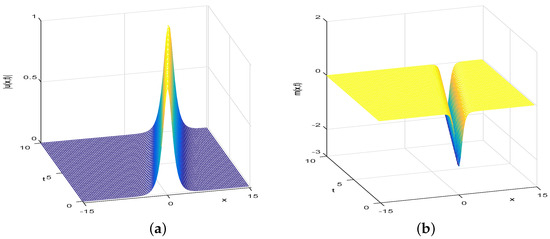
Figure 1.
Evolution of solitary waves (a) and (b) at , .
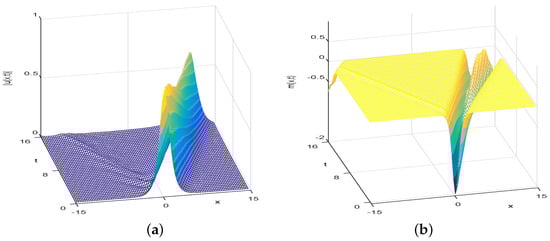
Figure 2.
Evolution of solitary waves (a) and (b) at , .
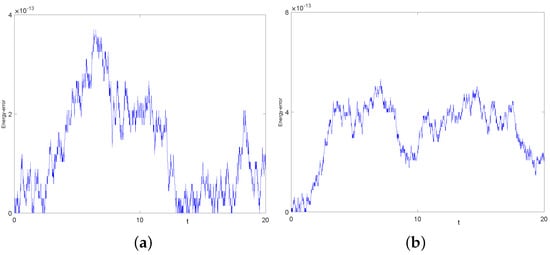
Figure 3.
Energy error of fractional KGZ equation: (a) , (b) at .
4.2. Numerical Simulation of the Fractional KGS Equation
We apply schemes (46)–(49) to simulate the Riesz space fractional KGS equation. The discrete Hamiltonian energy errors can be defined as
where
and is the discrete Hamiltonian energy at .
The parameter variables are taken as , First, we consider the evolution of single solitary waves. The initial condition of single solitary wave is taken as follows
Figure 4 shows the numerical solution of a single solitary wave of the KGS equation at , . Figure 5 shows the numerical solution of solitary waves and of the Riesz space fractional KGS equation at , . From Figure 4 and Figure 5, we can see that the new scheme of the Riesz space fractional KGS equation can also simulate the evolution of a solitary wave of the equation well. The numerical solutions and the numerical schemes are stable. Figure 6 shows the energy error of the Riesz space fractional KGS equation. The error can be neglected. The new scheme of the equation can also well preserve the discrete energy of the equation.
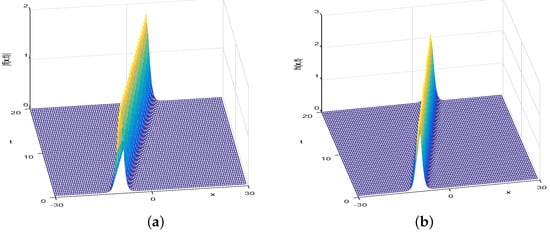
Figure 4.
Evolution of solitary waves (a) and (b) at , .
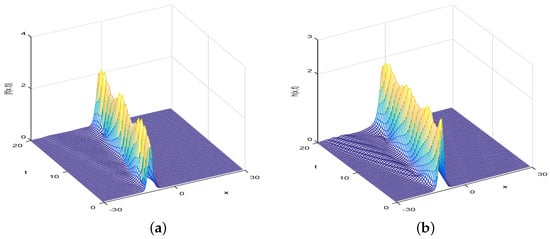
Figure 5.
Evolution of solitary waves (a) and (b) at , .
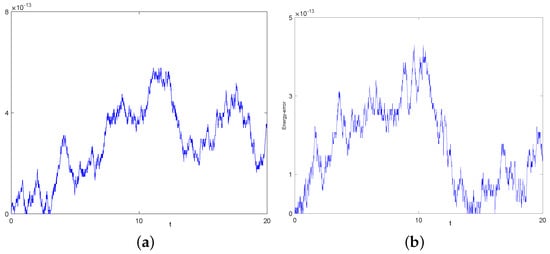
Figure 6.
Energy error of the fractional KGS equation: (a) , (b) at .
Then, we consider the evolution of two solitary waves with the following initial conditions
Figure 7 shows the numerical solutions of two solitary waves of the KGS equation at , . Figure 8 shows numerical solutions of two solitary waves of the Riesz space fractional KGS equation at , . The numerical results are consistent with the existing results [23]. From Figure 7 and Figure 8, we can see that the new scheme of the Riesz space fractional KGS equation can also simulate the evolution of multiple solitary waves of the equation well. The numerical solutions and the numerical schemes are stable. Figure 9 shows the energy error of the Riesz space fractional KGS equation. The error can be neglected. The new scheme of the Riesz space fractional KGS equation can also preserve the discrete energy of the equation well.
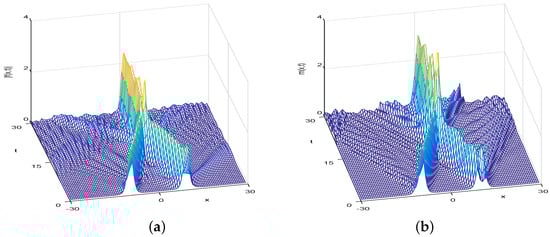
Figure 7.
Evolution of solitary waves (a) and (b) at , .
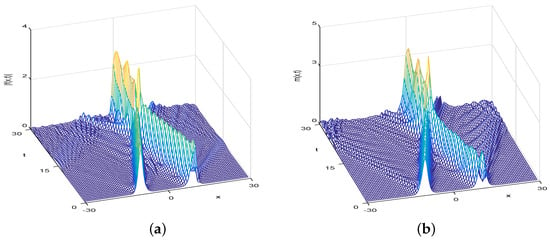
Figure 8.
Evolution of solitary waves (a) and (b) at , .
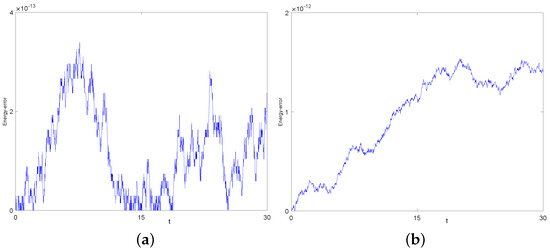
Figure 9.
Energy errors of the fractional KGS equations: (a) , (b) at .
5. Conclusions
In this paper, two new energy preserving schemes for the Riesz space fractional KGZ and KGS equations are proposed based on the FPS method and the AVF method. The energy conservation property is proven. Numerical results show that these new schemes can simulate the evolution behavior of the solitary waves of these fractional differential equations well and preserve the discrete energy conservation property. The existing energy conserving schemes of the space fractional KGZ and KGS equations are in general of second-order accuracy. However, these energy conservation schemes based on the second-order AVF method can be easily extended to high-order energy preserving schemes. In future work, we will construct high-order energy preserving schemes for fractional differential equations based on the high-order AVF method and analyze the convergence and stability of these new energy-preserving schemes.
Author Contributions
Conceptualization, J.S., S.Y. and L.Z.; methodology, J.S., S.Y. and L.Z.; data collection, S.Y. and L.Z.; writing—original draft and preparation, J.S., S.Y. and L.Z.; data analysis, L.Z. and S.Y. All authors have read and agreed to the published version of the manuscript.
Funding
This research was funded by the Hainan Provincial Natural Science Foundation of China (Grant No. 120RC450) and the Natural Science Foundation of China (Grant Nos. 11961020, 41974114).
Data Availability Statement
Not applicable.
Conflicts of Interest
The authors declare no conflict of interest.
Abbreviations
The following abbreviations are used in this manuscript:
| KGS | Klein–Gordon–Schrödinger |
| KGZ | Klein–Gordon–Zakharov |
| AVF | average vector field |
| PDEs | partial differential equations |
| FPS | Fourier pseudo-spectral |
References
- Ray, S.S. A new analytical modelling for nonlocal generalized Riesz fractional sine-Gordon equation. J. King Saud Univ. Sci. 2016, 28, 48–54. [Google Scholar]
- Wang, P.D.; Huang, C.M. Structure-preserving numerical methods for the fractional Schrödinger equation. Appl. Numer. Math. 2018, 129, 137–158. [Google Scholar] [CrossRef]
- Sun, Z.; Gao, G. Finite Difference Methods for Fractional Differential Equations; Science Press: Beijing, China, 2015. [Google Scholar]
- Li, C.P.; Zeng, F.H. Numerical Methods for Fractional Calculus; CRC Press: New York, NY, USA, 2015; pp. 1–17. [Google Scholar]
- Ding, H.; Li, C. Fractional-compact numerical algorithms for Riesz spatial fractional reaction-dispersion equations. Fract. Calc. Appl. Anal. 2017, 20, 722–764. [Google Scholar] [CrossRef][Green Version]
- Denghan, M.; Nikpour, A. The solitary wave solution of coupled Klein-Gordon-Zakharov equations via two different numerical methods. Comput. Phys. Commun. 2013, 184, 2145–2158. [Google Scholar] [CrossRef]
- Wang, J.J. Solitary wave propagation and interactions for the Klein-Gordon-Zakharov equations in plasma physics. J. Phys. A Math. Theory 2009, 42, 085205. [Google Scholar] [CrossRef]
- Macias-Diaz, J.E.; Hemdy, A.S.; Staelen, R.D. A compact fourth-order in space energy-preserving method for Riesz space-fractional nonlinear wave equations. Appl. Math. Comput. 2018, 325, 1–14. [Google Scholar] [CrossRef]
- Su, C.M.; Zhao, X.F. A uniformly first-order accurate method for Klein-Gordon-Zakharov system in simultaneous high-plasma-frequency and subsonic limit regime. J. Comput. Phys. 2021, 428, 110064. [Google Scholar] [CrossRef]
- Bao, W.; Su, C. Uniform error bounds of a finite difference method for the Klein-Gordon-Zakharov system in the subsonic limit regime. Math. Comput. 2018, 87, 2133–2158. [Google Scholar] [CrossRef]
- Akbulut, A.; Tascn, F. Application of conservation theorem and modified extended tanh-function method to (1+1) dimensional nonlinear coupled Klein-Gordon-Zakharov equation. Chaos Solitons Fractals 2017, 104, 33–40. [Google Scholar] [CrossRef]
- Ma, Y.; Su, C.M. A uniformly and optimally accurate multiscale time integrator method for the Klein-Gordon-Zakharov system in the subsonic limit regime. Comput. Math. Appl. 2018, 76, 602–619. [Google Scholar] [CrossRef]
- Wang, H.M. Numerical simulation for solitary wave of Klein-Gordon-Zakharov equation based on the lattice Boltzmann model. Comput. Math. Appl. 2019, 78, 3941–3955. [Google Scholar] [CrossRef]
- Gao, Y.L.; Mei, L.Q.; Li, R. Galerkin finite element methods for the generalized Klein-Gordon-Zakharov equations. Comput. Math. Appl. 2017, 74, 2466–2484. [Google Scholar] [CrossRef]
- Macias-Diaz, J.E.; Hendy, A.S.; Staelen, R.D. A pseudo energy-invariant method for relativistic wave equations with Riesz space fractional derivatives. Comput. Phys. Commun. 2017, 224, 98–107. [Google Scholar] [CrossRef]
- Hendy, A.S.; Macias-Diaz, J.E. A numerically efficient and conservative model for a Riesz space-fractional Klein-Gordon-Zakharov system. Commun. Nonlinear Sci. Numer. Simul. 2019, 71, 22–37. [Google Scholar] [CrossRef]
- Martinez, R.; Macias-Diaz, J.E.; Hendy, A.S. Theoretical analysis of an explicit energy-conserving scheme for a fractional Klein-Gordon-Zakharov system. Appl. Numer. Math. 2019, 146, 245–259. [Google Scholar] [CrossRef]
- Martinez, R.; Macias-Diaz, J.E. An energy-preserving and efficient scheme for a double-fractional conservative Klein-Gordon-Zakharov system. Appl. Numer. Math. 2020, 158, 292–313. [Google Scholar] [CrossRef]
- Macias-Diaz, J.E. Existence of solutions of an explicit energy-conserving scheme for a fractional Klein-Gordon-Zakharov system. Appl. Numer. Math. 2020, 151, 40–43. [Google Scholar] [CrossRef]
- Ohta, M. Stability of stationary states for coupled Klein-Gordon-Schrödinger equations. Nonlinear Anal. Theory, Methods Appl. 1996, 27, 455–461. [Google Scholar] [CrossRef]
- Huang, C.; Guo, B.; Huang, D.; Li, Q. Global well-posedness of the fractional Klein-Gordon-Schrödinger system with rough initial data. Sci. China Math. 2016, 59, 1345–1366. [Google Scholar] [CrossRef]
- Kong, L.H.; Chen, M.; Yin, X.L. A novel kind of efficient symplectic scheme for Klein-Gordon-Schrödinger equation. Appl. Numer. Math. 2019, 135, 481–496. [Google Scholar] [CrossRef]
- Wang, J.J.; Xiao, A.G. A efficient conservation difference scheme for fractional Klein-Gordon-Schrödinger equations. Appl. Math. Comput. 2018, 320, 691–709. [Google Scholar] [CrossRef]
- Wang, J.J.; Xiao, A.G. Conservative fourier spectral method and numerical investigation of space fractional Klein-Gordon-Schrödinger equations. Appl. Math. Comput. 2019, 350, 348–365. [Google Scholar] [CrossRef]
- McLachlan, R.I.; Quispel, G.R.W.; Robidoux, N. Geometric integration using discrete gradients. Philos. Trans. R Biol. Sci. 1999, 357, 1021–1045. [Google Scholar] [CrossRef]
- Quispel, G.R.W.; Mclaren, D.I. A new class of energy-preserving numerical integration methods. J. Phys. A Math. Theor. 2008, 41, 045206. [Google Scholar] [CrossRef]
- Furihata, D.; Matsuo, T. Discrete Variational Derivative Method, a Structure-Preserving Numerical Method for Partial Differential Equations; CRC Press: Boca Raton, FL, USA, 2010. [Google Scholar]
- Brugnano, L.; Iavernarivo, F.; Trigiante, D. Hamiltonian boundary value methods (Energy preserving discrete line integral methods). J. Numer. Anal. Appl. Math. 2010, 5, 17–37. [Google Scholar]
- Celledonia, E.; Grimmb, V.; McLachlanc, R.I.; McLarend, D.I.; O’Nealed, D.; Owrena, B.; Quispel, G.R.W. Preserving energy resp. dissipation in numerical PDEs using the “Average Vector Field” method. J. Comput. Phys. 2012, 231, 6770–6789. [Google Scholar] [CrossRef]
- Jiang, C.L.; Sun, J.Q.; He, X.F. High order energy-preserving method of the Good Boussinesq equation. Numer. Methods Appl. 2016, 9, 111–122. [Google Scholar] [CrossRef]
- Bridges, T.J. Multi-symplectic structures and wave propagation. Math. Proc. Camb. Phil. Soc. 1997, 121, 147–190. [Google Scholar] [CrossRef]
- Chen, J.B. Symplectic and multisymplectic Fourier pseudospectral discretizations for the Klein-Gordon equation. Lett. Math. Phys. 2006, 75, 293–305. [Google Scholar] [CrossRef]
Disclaimer/Publisher’s Note: The statements, opinions and data contained in all publications are solely those of the individual author(s) and contributor(s) and not of MDPI and/or the editor(s). MDPI and/or the editor(s) disclaim responsibility for any injury to people or property resulting from any ideas, methods, instructions or products referred to in the content. |
© 2023 by the authors. Licensee MDPI, Basel, Switzerland. This article is an open access article distributed under the terms and conditions of the Creative Commons Attribution (CC BY) license (https://creativecommons.org/licenses/by/4.0/).