Abstract
In this paper, based on the - scheme and nonconforming finite element method (FEM), a numerical approximation is presented for a class of two-dimensional time-fractional diffusion equations involving variable coefficients. A novel and detailed analysis of the equations with an initial singularity is described on anisotropic meshes. The fully discrete scheme is shown to be unconditionally stable, and optimal second-order accuracy for convergence and superconvergence can be achieved in both time and space directions. Finally, the obtained numerical results are compared with the theoretical analysis, which verifies the accuracy of the proposed method.
1. Introduction
The development of fractional calculus has marked a significant impact on partial differential equations involving fractional differential operators. Especially in recent years, the applications of fractional partial differential equations have emerged in viscoelastic (See [1,2]), electromagnetic (See [3,4]), fluid dynamics (See [5]), control theory (See [6]), image processing (See [7]), ion-channel gating dynamics in some proteins (See [8]), airfoil theory, tumor development (See [9]), etc. For example, several fractional models have been successfully used to describe physical phenomena (See [10]). Furthermore, sufficient conditions for the existence of solutions to fractional differential equations involving Caputo derivatives were discussed in [11]. The analytical solutions of fractional differential equations are difficult to calculate using mathematical or analytical methods due to the complexity of fractional differential equations. Therefore, it is essential to develop efficient numerical methods and conduct rigorous numerical analysis for fractional partial differential equations, especially the time-fractional diffusion equation (See [12,13]), which is very useful in modeling physical and biological systems.
Some efforts have been devoted to time-fractional diffusion equations. Using the first-order finite difference scheme in both time and space directions, Liu et al. derived some stability conditions for the time-fractional diffusion equation in [14]. Lin et al. applied the backward differentiation and collocation method to numerically solve the time-fractional diffusion problem over finite fields, spatial exponential convergence and temporal order accuracy can be obtained, where represents the order of the fractional derivative (See [15]). Two finite difference/element methods were proposed in [16] for time-fractional diffusion equations with Dirichlet boundary conditions. Based on the spatial mixed FEM and the classical time step method, Zhao et al. established an unconditionally stable fully discrete approximation scheme for the time-fractional diffusion equation, and the global superconvergence result was derived (See [17]). By constructing a higher-order -1 scheme for the Caputo fractional derivative, [18] investigated the time-fractional variable coefficient diffusion equation and demonstrated the stability and convergence in the -norm. Using the -1 format and an unconditionally stable difference scheme, Gao et al. numerically solved the multi-term and distributed-order time-fractional diffusion equations (See [19]). Ref. [20] proposed a linear quasi-compact finite difference scheme for semi-linear space-fractional diffusion equations with time delays. And the time-space fractional nonlinear diffusion equation received attention in [21,22].
Furthermore, Refs. [23,24] discussed the regularity of the solution to the time-fractional diffusion problem and suggested that a key consideration in solving the time-fractional diffusion problem is the nonsmoothness of the solution at the initial time. As a result, some researchers mainly focus on initial singularity. Jin et al. revisited the format error analysis and established order convergence results for smooth and nonsmooth initial data (See [25]). Using graded meshes is one way to deal with initial singularity (See [26]). By combining the scheme and spatial standard finite difference method on graded meshes, Ref. [27] presented a new analysis of stability and convergence for the time-fractional reaction-diffusion problem. Through complementary discrete convolution kernels, the global consistency error of fractional derivatives on graded meshes was deduced in [28], and the convergence analysis of the -FEM for the time-fractional reaction-diffusion equation was provided. The results in [27,28] showed that optimal order convergence can be achieved by choosing the suitable temporal mesh parameter. In addition, combining the - scheme and the bilinear FEM, the -norm error analysis of the time-fractional diffusion equation was described in [29]. With the aid of the time-space splitting technique, [30] established -norm error estimates of two finite difference methods for the time-fractional reaction-diffusion problem on graded meshes. Refs. [31,32] presented fully discrete schemes of - FE/spectral method on graded meshes for the time-fractional reaction-diffusion equations, and stability and convergence were deduced.
In the above analysis of smooth or nonsmooth data, the researchers were committed to developing a more efficient and accurate method. It is well known that superconvergence is an effective method for improving the accuracy of FE approximation. For example, Ref. [33] provided error estimates and superconvergence results for the multi-term time-fractional diffusion problem utilizing the -FEM on graded meshes. Moreover, by combining the - scheme on graded meshes and the nonconforming Wilson FEM, the superconvergence analysis of the time-fractional diffusion equation was demonstrated in [34]. However, it appears that the temporal accuracy in the analysis of [34] is reduced by . As a result, we re-analyzed the two-dimensional time fractional diffusion equation with variable coefficients to achieve optimal accuracy. The nonconforming FEM is an economical and flexible numerical method and is popular for its better convergence behavior. To the best of our knowledge, there has been limited research on the optimal superconvergence analysis of the two-dimensional time-fractional diffusion equation without sacrificing temporal accuracy. Therefore, the goal of this paper is to perform the optimal -norm error estimation and superconvergence analysis of the - nonconforming FEM for the time-fractional variable coefficient diffusion equation.
The two-dimensional time-fractional variable coefficient diffusion equation can be described as:
with a Dirichlet boundary condition
and a initial condition
is a rectangular domain with a boundary . The divergence operator and the gradient operator are represented by the symbol and the symbol ∇, respectively. is a smooth, bounded diffusion coefficient that satisfies where is a positive constant. and are the initial value function and the right-side source term, respectively. The operator is the -order left-sided Caputo fractional derivative with respect to t. For , is defined as
where is the Gamma function.
In this paper, it is assumed that there is a solution to Equation (1) such that . It should be noted that this is a reasonable assumption satisfied by the typical problem solution (1). In addition, [24] illustrated that if the solution of Equation (1) is not as singular as assumed, that is, for . Then the initial condition will be uniquely defined by the other data of the equation, which is obviously restrictive.
The rest of this paper is organized as follows. In Section 2, the - scheme and some lemmas are introduced. Section 3 is devoted to the spatial discretization of the nonconforming FEM. The fully discrete scheme and unconditional stability are discussed in Section 4. In Section 5, the -norm error estimate and the suboptimal -norm estimate are derived. The optimal -norm estimation is supplemented in Section 6. In Section 7, the interpolation postprocessing technique is introduced and the -norm global superconvergence result is presented. Section 8 implements numerical experiments to demonstrate the accuracy of our theoretical analysis. Finally, a brief conclusion completes our work.
2. - Approximation on Graded Meshes
Notations. denotes . The existence of and is described by . C is a positive constant and independent of mesh parameters, it can take various values in different locations.
2.1. Direct Error Analysis for - Time-Stepping Scheme
Select the graded meshes at , and N is a positive integer. Then the time step and . For the function defined on , we denote
The properties of the graded meshes are described in Lemma 1 below.
Lemma 1.
For the graded meshes , we have
Proof.
From the definition of , we can deduce
That is, for .
Furthermore, we derive the time step
can be discussed in two situations. For , the equation is established.
Using the Cauchy mean value theorem, we have
It is not difficult to obtain for with the help of
□
The - time step scheme proposed in [18] is used in this paper to approximate the Caputo fractional derivative :
Lemma 2
([18]). For a function and the - approximation on the graded meshes we have
In this article, is the inner product in the space , and denotes the -norm. For each the symbol represents the standard Sobolev space with the corresponding norm and semi-norm . expresses the space of the measurable function , and v satisfies .
Lemma 3
([32]). Assume that . For a function defined on the graded meshes , we have
Remark 1.
Similar to the derivation of Lemma 3 in [32], replacing with and the conclusion is still valid.
Lemma 4.
For a function defined on the graded meshes , assuming and we have
Proof.
We know from the result in [32] that is true for the function that satisfy and .
Furthermore, for the function , if for the conclusion presented in Lemma 4 is not difficult to deduce. □
Lemma 5.
Assume the function and we have
2.2. Global Consistency Error Analysis for - Time-Stepping Scheme
In this section, we introduce complementary discrete convolution kernels
And is established for the convolution kernels .
In Lemma 6, we present the modified discrete fractional Grönwall inequality, which is based on the results in [30,31].
Lemma 6.
For given non-negative sequences and , there is a constant ω independent of the time step, such that . If the non-negative functions defined on graded meshes satisfy
then
is true, where Mittag-Leffler function .
The following Lemma 7 plays an important role in the error estimation in this paper.
Lemma 7.
Assuming holds for , we can infer the result
In addition, if and , we have
3. Nonconforming FEM in Space
Let represent a family of anisotropic rectangular meshes on with that do not need to satisfy the regularity or quasi-uniformity assumptions. Assume that is the center of e for each . The four vertices of e are
, where and are the perpendicular distances between and two sides of e that are parallel to the two coordinate planes. Let , and .
The FE space is defined as
where represents for the jump of across the edge F if F is an internal edge, and if F is a boundary edge.
Let be the associated interpolation operator satisfying
From [35,36], we can obtain the following estimation results of the interpolation operator .
Lemma 8.
Assuming the function on anisotropic meshes, we obtain
and
The Ritz projection operator is then defined, which satisfies It is not difficult to conclude Lemma 9 from the results in Lemma 8, the definition of , and the literature [37].
Lemma 9.
For any function , we have
and
Combining the results in Lemma 8 and 9 with the proof in [38], the expected result is given in Lemma 10.
Lemma 10.
If the function we have
where is the absolute value and is the unit normal vector on .

4. Stability in -Norm and -Norm
Combining the - scheme and the nonconforming FEM, the fully discrete scheme of (1) can be expressed as: find such that
The unconditional stability of the fully discrete scheme (7) is described in Theorem 1.
Theorem 1.
Proof.
From Lemma 2, we know that
With the aid of (9) and the condition , applying the Cauchy-Schwartz inequality and Young’s inequality, (8) can be converted to
that is Remark 1 implies that
Choosing in (7) to estimate , we have
Lemma 2 means that
Then (12) can be rewritten as Using Remark 1, we obtain that
Further, inequality (13) can be simplified to
□
5. Error Estimates in Optimal -Norm and Suboptimal -Norm
Denoting the error equation has the following form:
By using the error equation, we present the convergence and superclose results of the fully discrete scheme in Theorems 2 and 3, respectively.
Theorem 2.
Proof.
Choosing in (14), we have
Lemma 2 implies
Applying the Lemma 10, we know that
Equation (15) can be simplified to
by substituting (16) and (17) into (15) and applying the Cauchy-Schwartz inequality. Using the result of Remark 1, we can easily determine that
Inequality (18) can be converted to
The next goal is to estimate . Based on the result of (6) in Lemma 9, we have the following derivation
Combine the results in Lemmas 4 and 5 with , we have is established employing
The preceding derivations suffice to demonstrate that
Finally, the desired result can be obtained by using the result of (6) in Lemma 9 and the triangle inequality . □
Theorem 3.
Proof.
Taking in (14), we have
can be found in Lemma 2.
Applying the results of Lemma 10 and the Cauchy-Schwartz inequality, it is straightforward to obtain the following inequality
that is
Using Remark 1, we have
Similar to the estimation of (20), can be obtained.
A more precise estimate of is required, and the derivation from the definitions of and is as follows:
The condition means that . Based on the above estimation of , we come to the conclusion
The superclose result is established by combining the result of (5) in Lemma 9, the triangle inequality , and the technique of combining interpolation with projection. □
6. The Optimal Error Estimate in -Norm
The -norm superclose result is derived in Theorem 5.2. However, the optimal time accuracy was not attained. As a result, improving temporal precision will be addressed in this section.
Due to analysis requirements, the -projection operator and the discrete Laplacian operator are introduced.
For we have .
And for the following formula is established:
Therefore, the fully discrete format of (1) can take the form: find such that
Using the property of the Ritz projection operator , the following relationship between between , , and can be obtained:
Theorem 4.
Proof.
Choosing in (25), we have
According to the result of Lemma 2, we know that
Combining Young’s inequality, the Cauchy-Schwartz inequality, and Lemma 9, the following derivation can be presented as
and
Referring to Lemma 10, we can know
The result in Lemma 6 shows that
In addition, (32) can be converted to
The result of Lemma 7 implies that
It is not difficult to obtain
from Lemma 9 and . □
7. Interpolation Postprocessing Technology
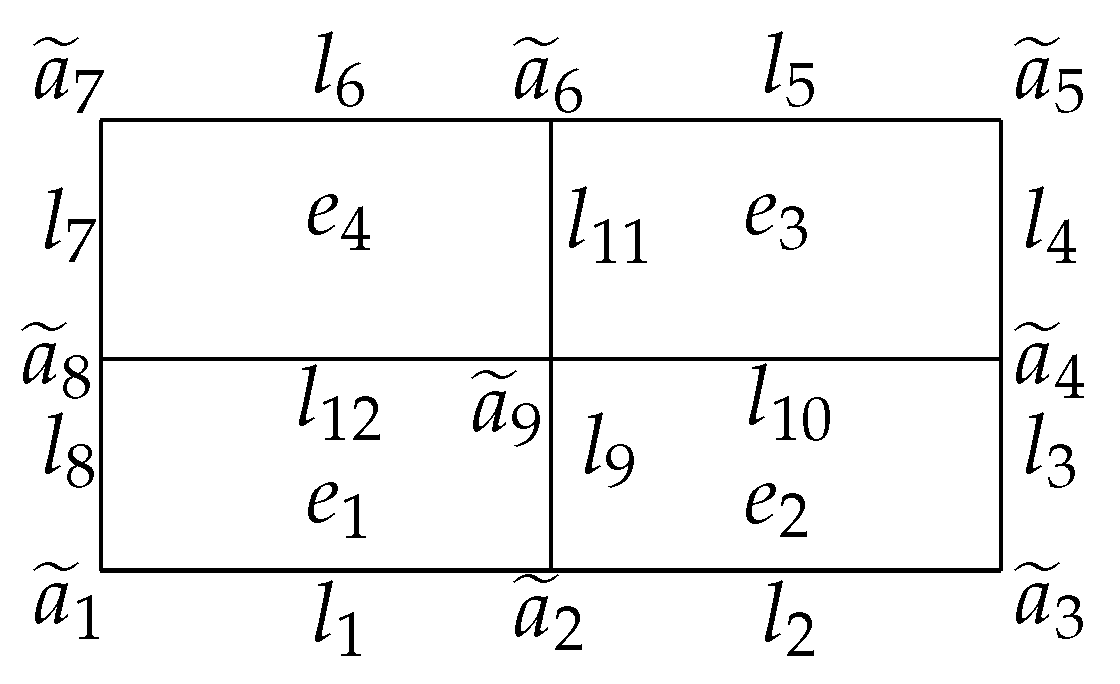
In this section, superconvergent results are derived by reconstructing a series of meshes . For (see Figure 1), it contains four adjacent small elements belonging to . Using the result in [39], the interpolation operator can be defined by
where represents the quadratic polynomial space on the element .
Figure 1.
New element
It has the following properties for the interpolation operator :
Theorem 5.
The following global superconvergence result can be obtained under the assumption of Theorem 4
Proof.
Combining the properties of and the result of Theorem 4, we have the following derivation
That is,
□
8. Numerical Results
In this section, two numerical examples are provided to demonstrate the correctness of our theoretical results.
Example 1.
Consider problem (1) defined in the region with diffusion coefficient , and final time . The function is chosen such that the exact solution , where .
Example 2.
Consider equation (1) in the spatial domain and the time interval , choosing the source term with the exact solution , where . In this example, we set the diffusion coefficient
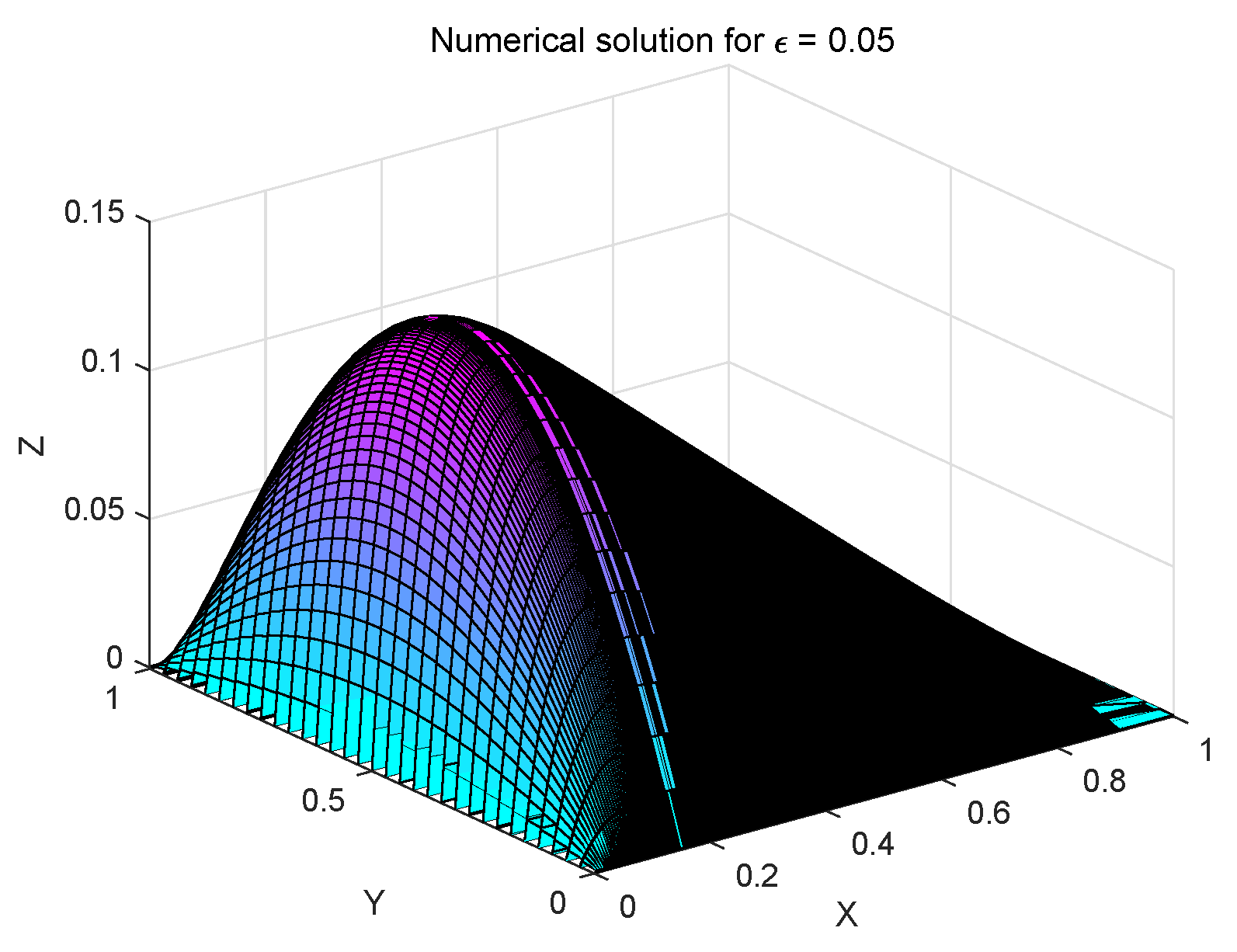
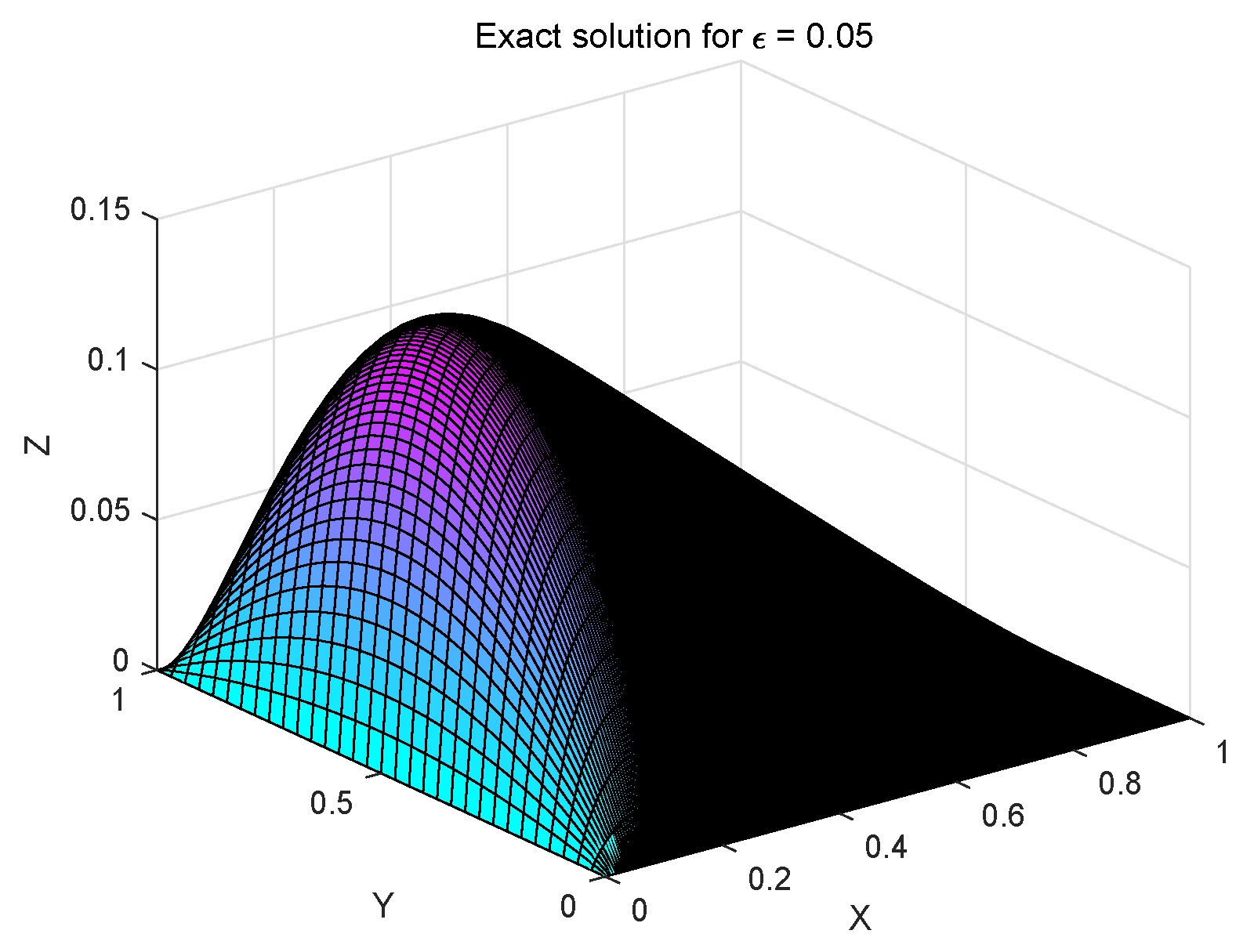
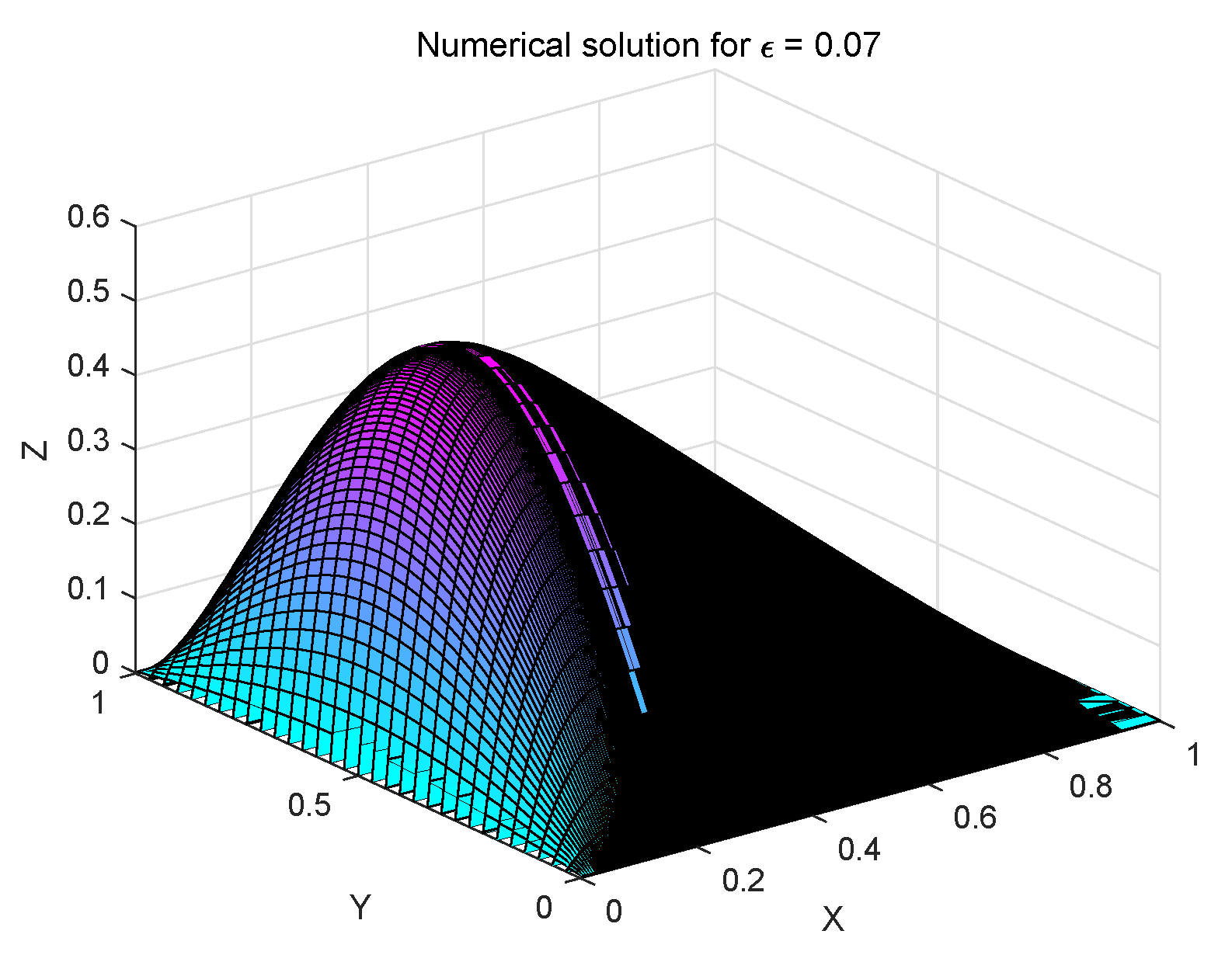
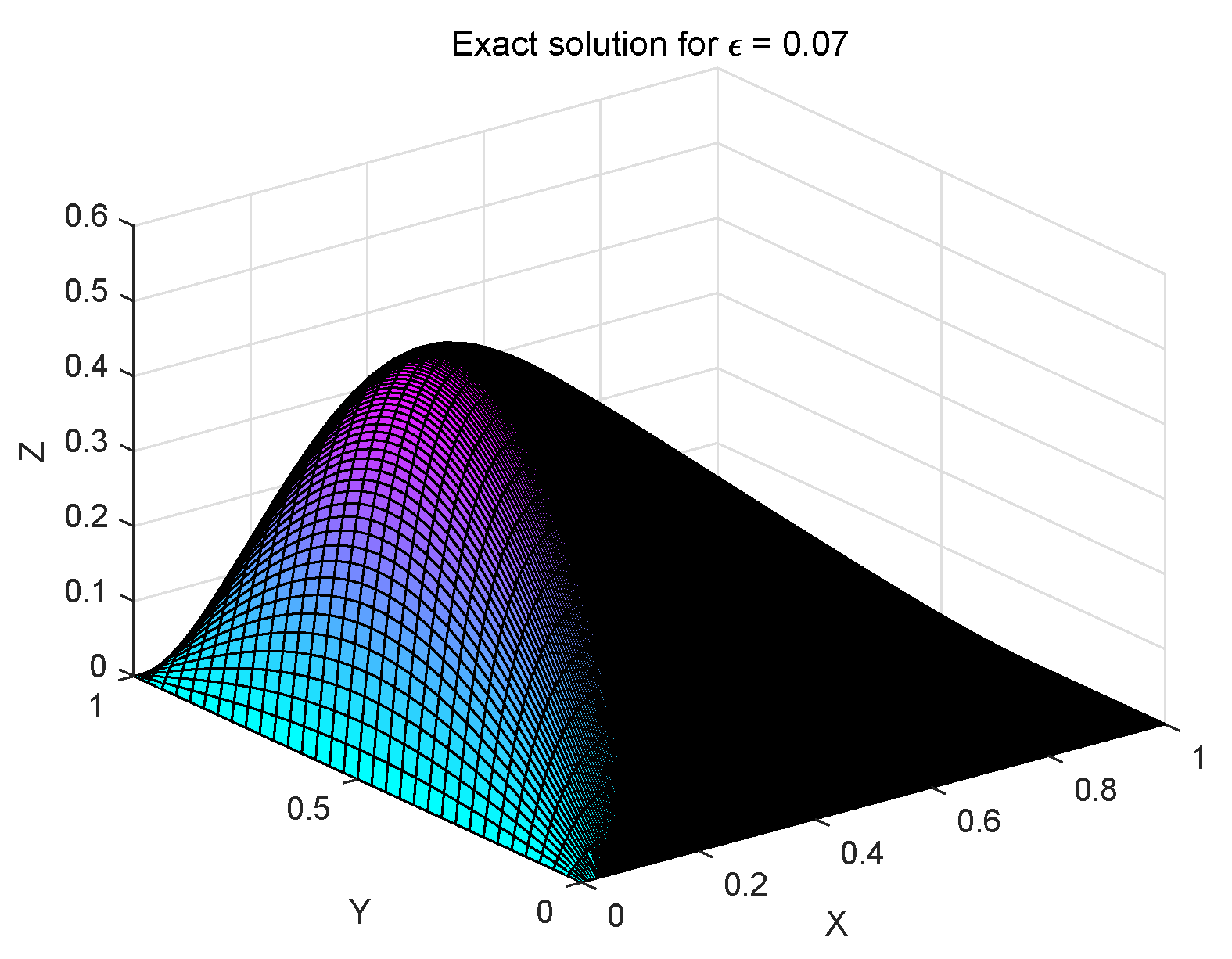
The exact and numerical solutions for Examples 1 and 2 are shown in Figure 2, Figure 3, Figure 4 and Figure 5. As can be seen from Figure 2, Figure 3, Figure 4 and Figure 5, the solution changes sharply in the x-direction, while it changes gently in the y-direction. That is, the solution to the problem (1) has strong anisotropy in the x-direction when the value of is very small. Further, comparing the images of the numerical solution and the exact solution, it can be seen that the numerical simulation is very perfect.
Figure 2.
Example 1.
Figure 3.
Example 1.
Figure 4.
Example 2.
Figure 5.
Example 2.
In addition, numerical experiments are performed on Examples 1 and 2 by choosing . The errors and convergence orders in the time and space directions are shown in Table 1, Table 2, Table 3, Table 4, Table 5, Table 6, Table 7, Table 8, Table 9 and Table 10, where and represent the number of elements in the x-direction and y-direction, respectively. The obtained numerical results are consistent with the theoretical analysis for different values and . The algorithm can achieves optimal second-order accuracy in both time and space directions.
Table 1.
Temporal numerical results of on graded meshes to Example 1.
Table 2.
Temporal numerical results of on graded meshes to Example 1.
Table 3.
Temporal numerical results of on graded meshes to Example 1.
Table 4.
Temporal numerical results of on graded meshes to Example 1.
Table 5.
Spatial numerical results of on anisotropic meshes to Example 1.
Table 6.
Temporal numerical results of on graded meshes to Example 2.
Table 7.
Temporal numerical results of on graded meshes to Example 2.
Table 8.
Temporal numerical results of on graded meshes to Example 2.
Table 9.
Temporal numerical results of on graded meshes to Example 2.
Table 10.
Spatial numerical results of on anisotropic meshes to Example 2.
9. Conclusions
In this paper, we analyze a class of two-dimensional time-fractional variable coefficient diffusion equation using a high-precision - scheme on graded meshes with an anisotropic nonconforming FEM. Unconditional stability, optimal -norm error estimates and global superconvergence result are rigorously derived. The results show that by selecting a suitable mesh parameter r, the optimal second-order accuracy can be achieved in time and space. Next we will focus on the superconvergence analysis of high-precision approximation schemes for nonlinear equations.
Author Contributions
Y.W.: Writing—review & editing, Methodology; Y.Z.: Writing—review & editing, Software; Y.F.: Writing—review & editing; F.W.: Investigation, Conceptualization; S.L.: Software, Conceptualization. All authors have read and agreed to the published version of the manuscript.
Funding
The work is supported by the National Natural Science Foundation of China (Nos. 11971416, 11672011) and the Scientific Research Innovation Team of Xuchang University (No. 2022CXTD002).
Acknowledgments
The first author (Yabing Wei) appreciates the funding provided by China Scholarship Council to support this work. And she is grateful to NTU for offering available resources during her visit.
Conflicts of Interest
The authors declare no conflict of interest.
References
- Schiessel, H.; Metzler, R.; Blumen, A.; Nonnenmacher, T. Generalised viscoelastic models: Their fractional equations with solutions. J. Phys. A 1995, 28, 6567–6584. [Google Scholar] [CrossRef]
- Bagley, R.; Torvik, P. Fractional calculus in the transient analysis of viscoelastically damped structures. AIAA J. 1985, 23, 918–925. [Google Scholar] [CrossRef]
- Taraqsov, V. Fractional integro-differential equations for electromagnetic waves in dielectric media. Theor. Math. Phys. 2009, 158, 355–359. [Google Scholar] [CrossRef] [Green Version]
- Rossikhin, Y.; Shitikova, M. Application of fractional calculus for dynamic problems of solid mechanics: Novel trends and recent results. Appl. Mech. Rev. 2010, 63, 010801. [Google Scholar] [CrossRef]
- Odibat, Z.; Momani, S. The variational iteration method: An efficient scheme for handling fractional partial diferential equations in fluid mechanics. Comput. Math. Appl. 2009, 58, 2199–2208. [Google Scholar] [CrossRef] [Green Version]
- Matignon, D. Stability results for fractional differential equations with applications to control processing. Comput. Eng. Syst. Appl. 1996, 2, 963–968. [Google Scholar]
- Guo, L.; Zhao, X.; Gu, X.; Zhao, Y.; Zheng, Y.; Huang, T. Three-dimensional fractional total variation regularized tensor optimized model for image deblurring. Appl. Math. Comput. 2021, 404, 126224. [Google Scholar] [CrossRef]
- Goychuk, I.; Hänggi, P. Fractional diffusion modeling of ion gating. Phys. Rev. E 2004, 70, 051915. [Google Scholar] [CrossRef] [Green Version]
- Lomin, A.; Dorfman, S.; Dorfman, L. On tumor development: Fractional transport approach. arXiv 2004, arXiv:q-bio/0406001. [Google Scholar]
- Yu, B.; Jiang, X.; Wang, C. Numerical algorithms to estimate relaxation parameters and caputo fractional derivative for a fractional thermal wave model in sperical composite medium. Appl. Math. Comput. 2016, 274, 106–118. [Google Scholar]
- Wang, J.; Lv, L.; Zhou, Y. Boundary value problems for fractional differential equations involving Caputo derivative in Banach space. J. Appl. Math. Comput. 2012, 38, 209–224. [Google Scholar] [CrossRef]
- Zhao, Y.; Zhang, Y.; Liu, F.; Turner, I.; Tang, Y.; Anh, V. Convergence and superconvergence of a fully-discrete scheme for multi-term time fractional diffusion equations. Comput. Math. Appl. 2017, 73, 1087–1099. [Google Scholar] [CrossRef]
- Gu, X.; Sun, H.; Zhao, Y.; Zheng, X. An implicit difference scheme for time-fractional diffusion equations with a time-invariant type variable order. Appl. Math. Lett. 2021, 120, 107270. [Google Scholar] [CrossRef]
- Liu, F.; Shen, S.; Anh, V.; Turner, I. Analysis of a discrete non-markovian random walk approximation for the time fractional diffusion equation. Anziam J. 2004, 46, C488–C504. [Google Scholar] [CrossRef]
- Lin, Y.; Xu, C. Finite difference/spectral approximations for the time-fractional diffusion equation. J. Comput. Phys. 2007, 225, 1533–1552. [Google Scholar] [CrossRef]
- Zeng, F.; Li, C.; Liu, F.; Turner, I. The use of finite difference/element approaches for solving the time-fractional subdiffusion equation. SIAM J. Sci. Comput. 2013, 35, A2976–A3000. [Google Scholar] [CrossRef]
- Zhao, Y.; Chen, P.; Bu, W.; Liu, X.; Tang, Y. Two mixed finite element methods for time-fractional diffusion equations. J. Sci. Comput. 2017, 70, 407–428. [Google Scholar] [CrossRef]
- Alikhanov, A. A new difference scheme for the time fractional diffusion equation. J. Comput. Phys. 2015, 280, 424–438. [Google Scholar] [CrossRef] [Green Version]
- Gao, G.; Alikhanov, A.; Sun, Z. The temporal second order difference schemes based on the interpolation approximation for solving the time multi-term and distributed-order fractional sub-diffusion equations. J. Sci. Comput. 2017, 73, 93–121. [Google Scholar] [CrossRef]
- Hao, Z.; Fan, K.; Cao, W.; Sun, Z. A finite difference scheme for semilinear space-fractional diffusion equations with time delay. Appl. Math. Comput. 2016, 275, 238–254. [Google Scholar] [CrossRef]
- Gu, X.; Huang, T.; Zhao, Y.; Lyu, P.; Carpentieri, B. A fast implicit difference scheme for solving generalized time-space fractional diffusion equations with variable coefficients. Numer. Meth. Part Differ. Equ. 2021, 37, 1136–1162. [Google Scholar] [CrossRef]
- Gu, X.; Sun, H.; Zhang, Y.; Zhao, Y. Fast implicit difference schemes for time-space fractional diffusion equations with the integral fractional Laplacian. Math. Meth. Appl. Sci. 2021, 44, 441–463. [Google Scholar] [CrossRef]
- McLean, W. Regularity of solutions to a time-fractional diffusion equation. Anziam J. 2010, 52, 123–138. [Google Scholar] [CrossRef] [Green Version]
- Stynes, M. Too much regularity may force too much uniqueness. Fract. Calc. Appl. Anal. 2010, 19, 1554–1562. [Google Scholar] [CrossRef] [Green Version]
- Jin, B.; Lazarov, R.; Zhou, Z. An analysis of the L1 scheme for the subdiffusion equation with nonsmooth data. IMA J. Numer. Anal. 2016, 36, 197–221. [Google Scholar] [CrossRef] [Green Version]
- Zhao, Y.; Gu, X.; Ostermann, A. A preconditioning technique for an all-at-once system from Volterra subdiffusion equations with graded time steps. J. Sci. Comput. 2021, 88, 11. [Google Scholar] [CrossRef]
- Stynes, M.; O’Riordan, E.; Gracia, J. Error analysis of a finite difference method on graded meshes for a time-fractional diffusion equation. SIAM J. Numer. Anal. 2017, 55, 1057–1079. [Google Scholar] [CrossRef]
- Liao, H.; Li, D.; Zhang, J. Sharp error estimate of the nonuniform L1 formula for linear reaction-subdiffusion equations. SIAM J. Numer. Anal. 2018, 56, 1112–1133. [Google Scholar] [CrossRef]
- Wei, Y.; Lü, S.; Chen, H.; Zhao, Y.; Wang, F. Convergence analysis of the anisotropic FEM for 2D time fractional variable coefficient diffusion equations on graded meshes. Appl. Math. Lett. 2021, 111, 106604. [Google Scholar] [CrossRef]
- Ren, J.; Liao, H.; Zhang, J.; Zhang, Z. Sharp H1-norm error estimates of two time-stepping schemes for reaction-subdiffusion problems. J. Comput. Appl. Math. 2021, 389, 113352. [Google Scholar] [CrossRef]
- Liao, H.; McLean, W.; Zhang, J. A second-order scheme with nonuniform time steps for a linear reaction-sudiffusion problem. arXiv 2019, arXiv:1803.09873. [Google Scholar]
- Chen, H.; Stynes, M. Error analysis of a second-order method on fitted meshes for a time-fractional diffusion problem. J. Sci. Comput. 2019, 79, 624–647. [Google Scholar] [CrossRef]
- Huang, C.; Stynes, M. Superconvergence of a finite element method for the multi-term time-fractional diffusion problem. J. Sci. Comput. 2020, 82, 1–17. [Google Scholar] [CrossRef]
- Li, M.; Shi, D.; Pei, L. Convergence and superconvergence analysis of finite element methods for the time fractional diffusion equation. Appl. Numer. Math. 2020, 151, 141–160. [Google Scholar] [CrossRef]
- Lin, Q.; Tobiska, L.; Zhou, A. Superconvergence and extrapolation of non-conforming low order finite elements applied to the Poisson equation. IAM J. Numer. Anal. 2005, 25, 160–181. [Google Scholar] [CrossRef]
- Shi, D.; Mao, S.; Chen, S. An anisotropic nonconforming finite element with some superconvergence results. J. Comput. Math. 2005, 23, 261–274. [Google Scholar]
- Fan, H.; Zhao, Y.; Wang, F.; Shi, Y.; Tang, Y. A superconvergent nonconforming mixed FEM for multi-term time-fractional mixed diffusion and diffusion-wave equations with variable coefficients. East Asian J. Appl. Math. 2021, 11, 63–92. [Google Scholar] [CrossRef]
- Zhang, H.; Yang, X. Superconvergence analysis of nonconforming finite element method for time-fractional nonlinear parabolic equations on anisotropic meshes. Comput. Math. Appl. 2019, 77, 2707–2724. [Google Scholar] [CrossRef]
- Lin, Q.; Lin, J. Finite Element Methods: Accuracy and Improvement; Elsevier: Amsterdam, The Netherlands, 2006. [Google Scholar]
Publisher’s Note: MDPI stays neutral with regard to jurisdictional claims in published maps and institutional affiliations. |
© 2022 by the authors. Licensee MDPI, Basel, Switzerland. This article is an open access article distributed under the terms and conditions of the Creative Commons Attribution (CC BY) license (https://creativecommons.org/licenses/by/4.0/).